
Enviado por WillSmithZoolander.

El final de la vida de una persona requiere unos cuidados acordes con la complejidad de ese proceso único e irrepetible. Los cuidadores informales (familiares, amigos o personas con vínculos afectivos), formales (aquellos que reciben una remuneración por su trabajo) o profesionales de la salud (principalmente, equipos especializados en cuidados paliativos) conforman una red básica para reducir el sufrimiento y garantizar el soporte adecuado a la persona enferma durante el trance de morir.
Sin embargo, brindar esa asistencia no resulta algo inocuo y puede tener “efectos secundarios” en todos los que participan.
Al cuidar de una persona con una enfermedad avanzada es fácil centrarse en la observación y el alivio de las necesidades que tiene o que van apareciendo. Hay incluso quien es capaz de adelantarse a que aparezcan. El inconveniente es que esa atención tan centrada en el otro puede hacer que se pierdan de vista las propias necesidades. “¿Qué necesito yo para estar bien?” es una pregunta que puede parecer egoísta o fuera de lugar en esas circunstancias, pero resulta imprescindible si queremos asegurar una buena calidad en los cuidados y no desgastarnos en exceso.
Frecuentemente, la vivencia de la enfermedad, el final de la vida y la pérdida del ser querido activan un cóctel de emociones: sufrimiento, hostilidad, enfado, culpa, vergüenza, amor, esperanza, decepción, gratitud, etc. Como seres humanos empáticos, no somos inmunes a ninguno de esos sentimientos. Si el cuidador no tiene formación ni las habilidades de gestión adecuadas, puede experimentar un tsunami emocional que le genere desasosiego y le deje una huella psicológica perdurable, difícil de borrar.
El desgaste por empatía o “fatiga por compasión” sería el equivalente del burn out o “síndrome del estar quemado” en aquellas profesiones donde se establece una relación de ayuda. El hecho de estar en contacto permanente con el sufrimiento puede llevar al profesional a sentirse exhausto y a perder el sentido de su trabajo o, incluso, la capacidad de generar un vínculo terapéutico con sus pacientes.
Estar expuesto constantemente a la incertidumbre de la evolución de una enfermedad y, finalmente, a la muerte puede generar impotencia, indefensión (o falta de control sobre las circunstancias) y preocupación constante. Además, la fragilidad y la muerte hacen que el cuidador se cuestione su propia existencia. O sea, es habitual que surjan dudas y preguntas como ¿qué sentido tiene la vida? o ¿qué sentido tiene sufrir? Si bien es cierto que estas reflexiones pueden dar lugar a grandes aprendizajes, al mismo tiempo pueden abrir un camino introspectivo difícil de recorrer en soledad y sin certezas.
Y, por último, el cuidador también puede experimentar el duelo anticipado, un proceso de aflicción o dolor que comienza antes de que se produzca el fallecimiento del ser querido. Suele estar acompañado de preocupación por el futuro y sentimientos de culpa, enfado e injusticia. Aunque son emociones que nos preparan para la pérdida, pueden dificultar la tarea de cuidado y no aseguran un mejor proceso de duelo una vez la muerte se haya producido. Transitar por esa anticipación, aceptar lo que está ocurriendo, requiere de una mirada compasiva del otro y de uno mismo.
Para mitigar todos estos posibles “efectos secundarios” hay un antídoto: el autocuidado. Este ayuda a preservar pequeños espacios para atender y cuidar de las propias necesidades, ya sean físicas (como comer sano, ducharse o hacer ejercicio), psicológicas (meditar, realizar actividades significativas…) o sociales (compartir con otros, dejarse ayudar…). Crea un espacio de conexión donde recordar que nuestro bienestar es tan importante como el del otro.
En este sentido, el autocuidado también puede considerarse un acto de responsabilidad, puesto que el malestar del cuidador afecta al enfermo. Es decir, al cuidar de uno mismo somos capaces de generar una especie de efecto mariposa que mejora los cuidados que podemos ofrecer a los demás.
Además, sabemos que aquellos profesionales capaces de generar un cambio de mirada hacia su propio rol y su contribución hacia el alivio del sufrimiento ajeno tienen menor riesgo de sufrir fatiga por compasión. A este fenómeno se le conoce como satisfacción por compasión.
Si el profesional se hace consciente de sus propios límites, valora sus esfuerzos de atención hacia el otro, celebra sus logros e incluso amplía su perspectiva y se siente partícipe de un bien mayor, podrá compensar ese desgaste por empatía.
Aplicado a los profesionales de los cuidados paliativos, esto se traduciría, por ejemplo, en tener claro que el objetivo no es curar al enfermo sino aliviar su sufrimiento; ser conscientes de lo que sí se ha podido conseguir (reducir significativamente el dolor físico, emocional o espiritual del enfermo) y sentir que contribuyen al bien de la sociedad mejorando la calidad de vida de las personas (y de sus seres queridos) hasta el final de sus días.
Junto con las pautas de autocuidado, esta lectura contribuirá a que la balanza del profesional se decante más hacia la satisfacción que hacia el desgaste. Eso le dotará de mayores recursos de afrontamiento ante situaciones de alto impacto emocional y le ayudará resignificar el sentido de su propio rol.

Las personas firmantes no son asalariadas, ni consultoras, ni poseen acciones, ni reciben financiación de ninguna compañía u organización que pueda obtener beneficio de este artículo, y han declarado carecer de vínculos relevantes más allá del cargo académico citado anteriormente.
Este artículo ha sido publicado originalmente en Catalunya Plural. Puedes leerlo en catalán aquí.
El último barómetro del Centro de Estudios de Opinión (CEO) confirma que el PSC continúa siendo la primera fuerza en el Parlamento, pero con síntomas claros de desgaste. La proyección sitúa a los socialistas entre 38 y 40 escaños, pero, según la comparación con el barómetro anterior, esto supone perder entre dos y cuatro diputados.
En cambio, Esquerra Republicana reaviva: se colocaría en segunda posición con 22–23 escaños, lo cual implica ganar entre dos y tres respecto a la encuesta anterior. El movimiento importante se produce alrededor de Junts per Catalunya y Aliança Catalana. Junts caería hasta los 19–20 escaños, cosa que quiere decir dejarse hasta 15–16 diputados en relación con el último barómetro del CEO. Al mismo tiempo, Aliança Catalana, que a las elecciones anteriores había entrado con solo dos diputados, aparece ahora empatada con Junts, también con 19–20 escaños, después de un salto de hasta 18 escaños en la estimación.
Al bloque de la derecha española, el movimiento es más discreto pero significativo: Vox llegaría a los 13–14 diputados y avanzaría el PP, que se quedaría con 12–13 escaños. La tendencia no es tanto un gran crecimiento del PP como el hecho de que el espacio más duro de la derecha (Vox y Aliança Catalana) gana peso relativo. Mientras tanto, Comunes continuaría con unos seis diputados y la CUP se movería entre tres y cuatro, prácticamente estabilizados respecto al barómetro anterior.
Estas cifras dibujan un escenario claro: el PSC continúa al frente, ERC recupera posiciones, Junts se hunde y la extrema derecha –en versión españolista y en versión “autóctona”– consolida una presencia que hace solo unos años parecía imposible en Catalunya. Pero, como siempre pasa con las encuestas, lo importante no son solo los números, sino qué nos dicen sobre el tipo de país que se está configurando.
La lectura más obvia es que Aliança Catalana se ha “comido” una parte importante de Junts per Catalunya. Varios análisis apuntan a que alrededor de un 20% de los antiguos votantes de Junts se inclinarían ahora por Sílvia Orriols, y que la fidelidad de voto de Junts es una de las más bajas del sistema. Pero el fenómeno va mucho más allá de un simple trasvase dentro del bloque independentista.
El CEO y las crónicas posteriores remarcan un punto crucial: cerca de la mitad de los votantes potenciales de Aliança Catalana no se definen como independentistas. Esto quiere decir que el partido no crece para que represente un “independentismo más puro” o una radicalización coherente del Procés, sino porque se ha convertido en un contenedor amplio de malestar. Un espacio donde confluyen votantes desencantados con Junts, votantes de Vox y del PP, personas que habían optado por ERC, y gente que, sencillamente, no encontraba ninguna opción que verbalizara su frustración.
Aliança Catalana no es, por lo tanto, la continuación del sobiranisme por otros medios, sino otra cosa: una extrema derecha que utiliza la identidad catalana como vehículo para articular un discurso de orden, de miedo y de exclusión. Su relato se centra menos en la construcción de un proyecto de país y más en la construcción de un enemigo: la inmigración, determinados barrios, cierta idea de “invasión” o de “pérdida de la Catalunya de siempre”.
Este detalle –que una parte sustancial de su electorado no sea independentista– es el que tendría que hacer saltar todas las alarmas. Indica que el que se está moviendo no es solo el eje nacional, sino una reconfiguración del voto identitario en clave autoritaria. La etiqueta “catalana” aquí no apunta tanto a un proyecto de emancipación colectiva como una frontera simbólica: un nosotros cerrado, amenazado, que necesita levantar muros (materialmente y culturalmente) para protegerse.
Dicho de otro modo: Aliança Catalana representa el punto de encuentro entre un independentismo agotado y una derecha radical europeizada, que comparte con otras fuerzas del continente la misma fórmula: mezclar precariedad, inseguridad y desigualdad con un discurso culturalista que señala la inmigración como culpable.
Si miramos el fenómeno en perspectiva, queda claro que el auge de Aliança Catalana no es un rayo caído del cielo, ni el resultado de un único error táctico de los otros partidos. Es el síntoma de un proceso largo de degradación institucional y política, en que las fuerzas de gobierno –en Cataluña, en el Estado y a Europa– han renunciado a abordar de manera seria las raíces materiales del malestar social.
Hace años que amplios sectores de la población conviven con precariedad estructural; con trabajos inestables y mal remunerados, con una crisis de la vivienda galopante y unos alquileres desbocados, y con un Estado infrafinanciado. Y todo esto mientras el 1% acumula cada vez más y más riqueza.
En paralelo, las instituciones europeas han ido consolidando un marco de políticas migratorias abiertamente racistas y seguritarias, con Frontex como emblema de la idea de que las fronteras valen más que las vidas. La migración ha sido convertida en un problema policial y militar, no en una realidad humana a gestionar con derechos y justicia. Esta lógica, asumida por gobiernos de todos los colores, legitima de facto los marcos mentales sobre los cuales opera la extrema derecha.
A todo esto se suma un ecosistema mediático y digital que, demasiado a menudo, vincula de manera acrítica delincuencia e inmigración, alimenta titulares alarmistas y transforma casos puntuales en pruebas irrefutables de un supuesto “caos generalizado”. El resultado es un clima en que el miedo y el resentimiento se normalizan, mientras las causas estructurales –políticas de vivienda, fiscalidad, regulación laboral, redistribución– quedan fuera de foco.
En este contexto, Aliança Catalana no hace nada especialmente original: simplemente ocupa el espacio que los otros han dejado vacío. Convierte el malestar en voto, pero lo hace desplazando la responsabilidad hacia los de siempre: los más vulnerables. No cuestiona los poderes económicos, ni las élites, ni las decisiones estructurales que han llevado hasta aquí. Cuestiona el vecino, el extranjero, “los de abajo” que son percibidos como extraños.
Por eso, centrar el debate exclusivamente en si AC tendrá 18, 19 o 20 diputados es perder de vista la cuestión fundamental: ¿qué piensan hacer las fuerzas que se reivindican democráticas y progresistas ante este malestar? Si la respuesta continúa siendo gestión tecnocrática, parches a corto plazo y una apelación abstracta a unos “valores europeos” que hace tiempos que no se traducen en políticas reales, el terreno continuará siendo propicio para que la extrema derecha crezca.
El CEO no nos dice solo quién va ganando la carrera por la Generalitat. Nos dice, sobre todo, que una parte creciente del país ha dejado de creer que la política sirva para mejorar la vida. Mientras esto no cambie, Aliança Catalana continuará siendo mucho más que una encuesta favorable: será el espejo incómodo de un sistema que hace años que deja demasiada gente atrás.
La entrada El auge de Aliança Catalana, más allá de las encuestas se publicó primero en lamarea.com.
Today, we’re announcing Amazon Elastic Kubernetes Service (Amazon EKS) Capabilities, an extensible set of Kubernetes-native solutions that streamline workload orchestration, Amazon Web Services (AWS) cloud resource management, and Kubernetes resource composition and orchestration. These fully managed, integrated platform capabilities include open source Kubernetes solutions that many customers are using today, such as Argo CD, AWS Controllers for Kubernetes, and Kube Resource Orchestrator.
With EKS Capabilities, you can build and scale Kubernetes applications without managing complex solution infrastructure. Unlike typical in-cluster installations, these capabilities actually run in EKS service-owned accounts that are fully abstracted from customers.
With AWS managing infrastructure scaling, patching, and updates of these cluster capabilities, you can use the enterprise reliability and security without needing to maintain and manage the underlying components.
Here are the capabilities available at launch:
With these features, you can accelerate and scale your Kubernetes use with fully managed capabilities, using its opinionated but flexible features to build for scale right from the start. It is designed to offer a set of foundational cluster capabilities that layer seamlessly with each other, providing integrated features for continuous deployment, resource orchestration, and composition. You can focus on managing and shipping software without needing to spend time and resources building and managing these foundational platform components.
How it works
Platform engineers and cluster administrators can set up EKS Capabilities to offload building and managing custom solutions to provide common foundational services, meaning they can focus on more differentiated features that matter to your business.
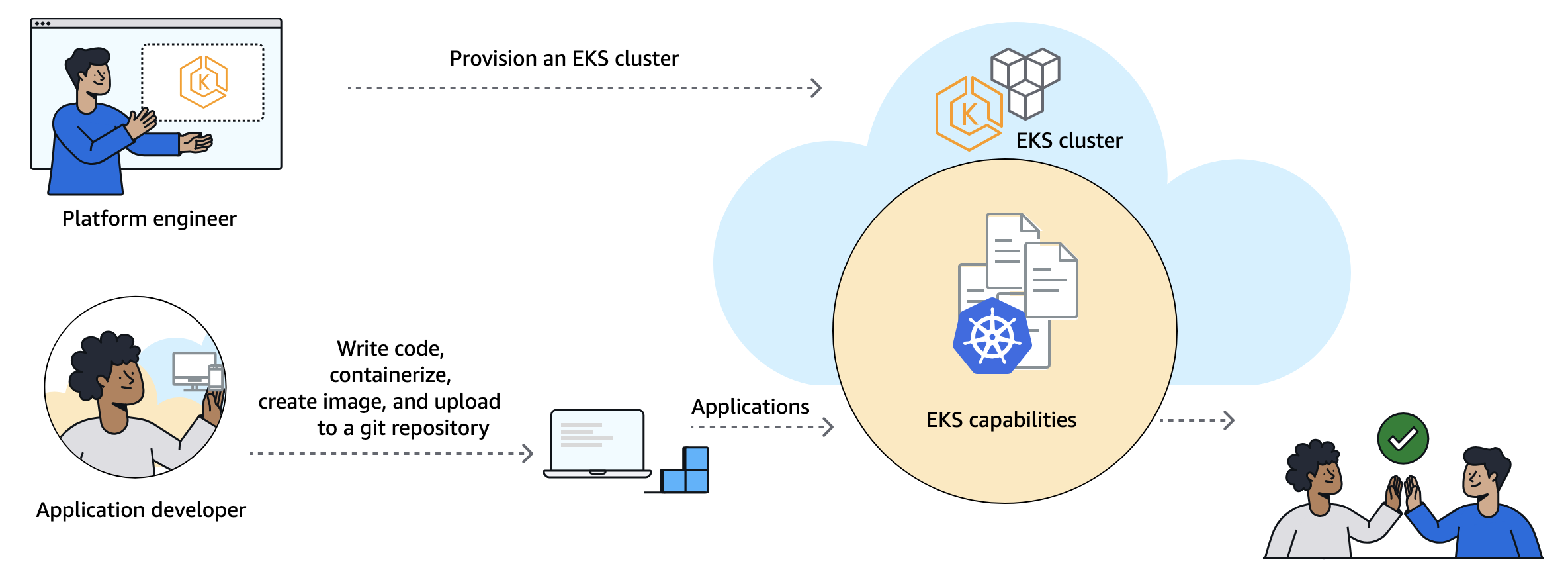
Your application developers primarily work with EKS Capabilities as they do other Kubernetes features. They do this by applying declarative configuration to create Kubernetes resources using familiar tools, such as kubectl or through automation from git commit to running code.
Get started with EKS Capabilities
To enable EKS Capabilities, you can use the EKS console, AWS Command Line Interface (AWS CLI), eksctl, or other preferred tools. In the EKS console, choose Create capabilities in the Capabilities tab on your existing EKS cluster. EKS Capabilities are AWS resources, and they can be tagged, managed, and deleted.
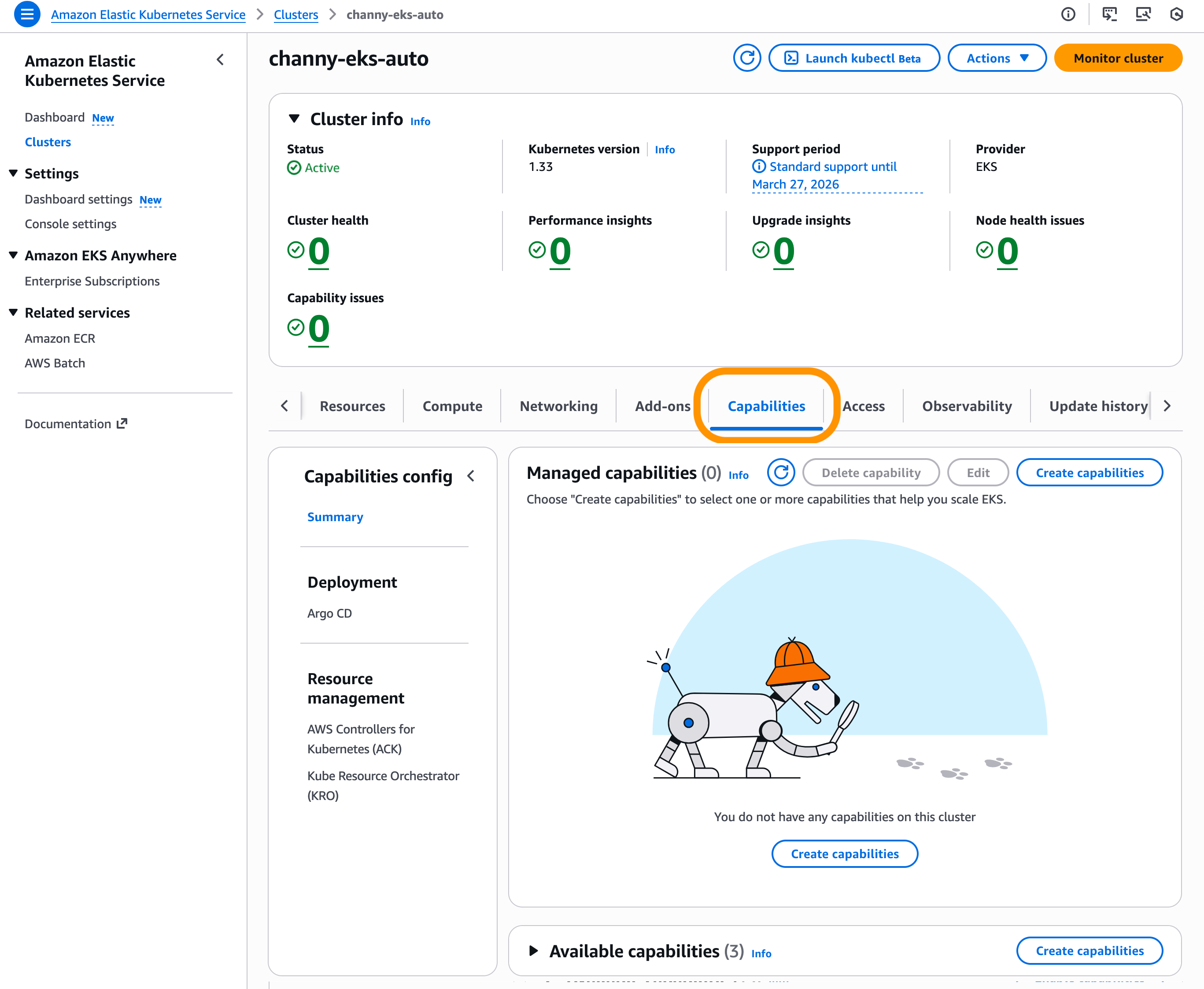
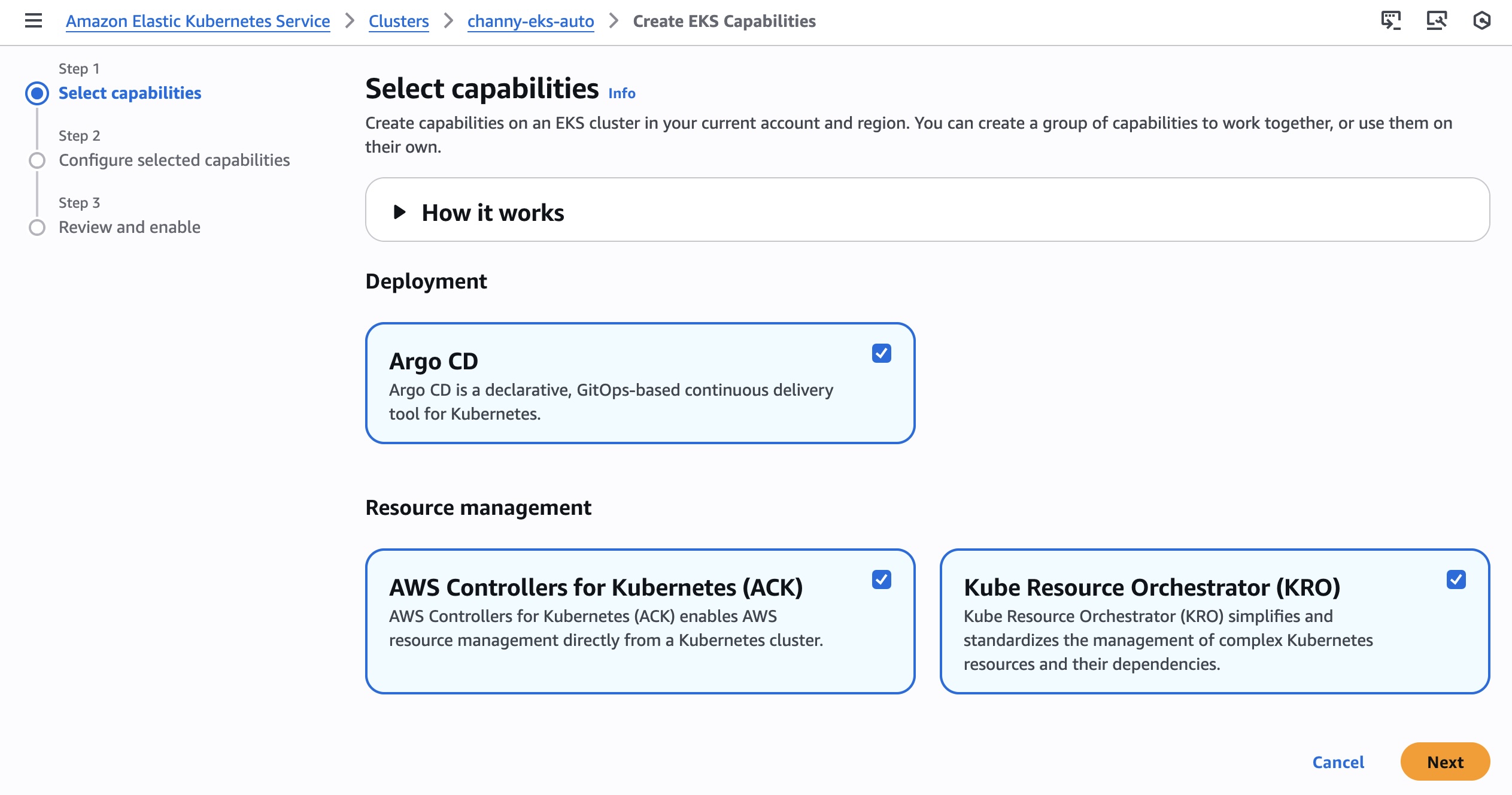
You can select one or more capabilities to work together. I checked all three capabilities: ArgoCD, ACK, and KRO. However, these capabilities are completely independent and you can pick and choose which capabilities you want enabled on your clusters.
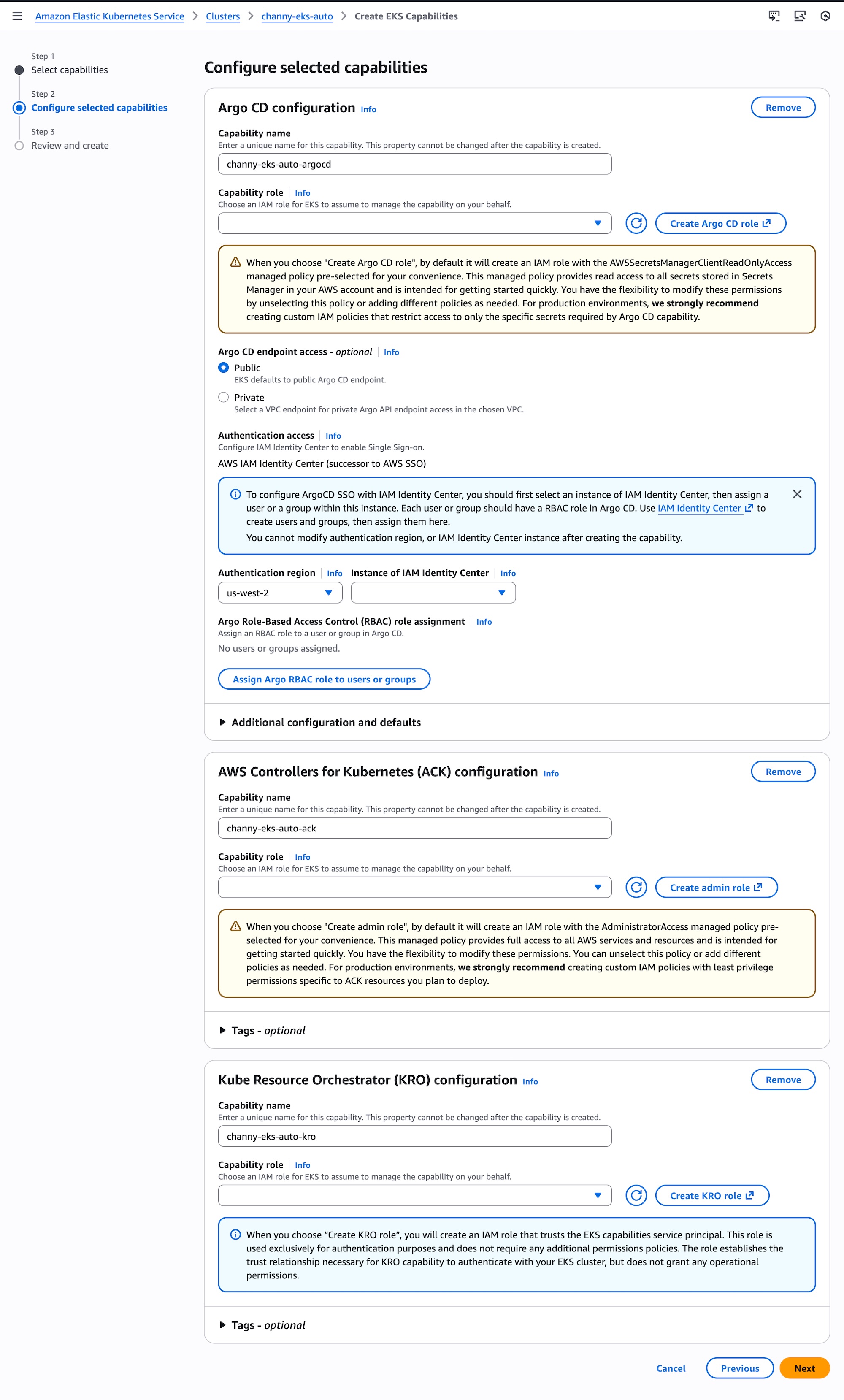
Now you can configure selected capabilities. You should create AWS Identity and Access Management (AWS IAM) roles to enable EKS to operate these capabilities within your cluster. Please note you cannot modify the capability name, namespace, authentication region, or AWS IAM Identity Center instance after creating the capability. Choose Next and review the settings and enable capabilities.
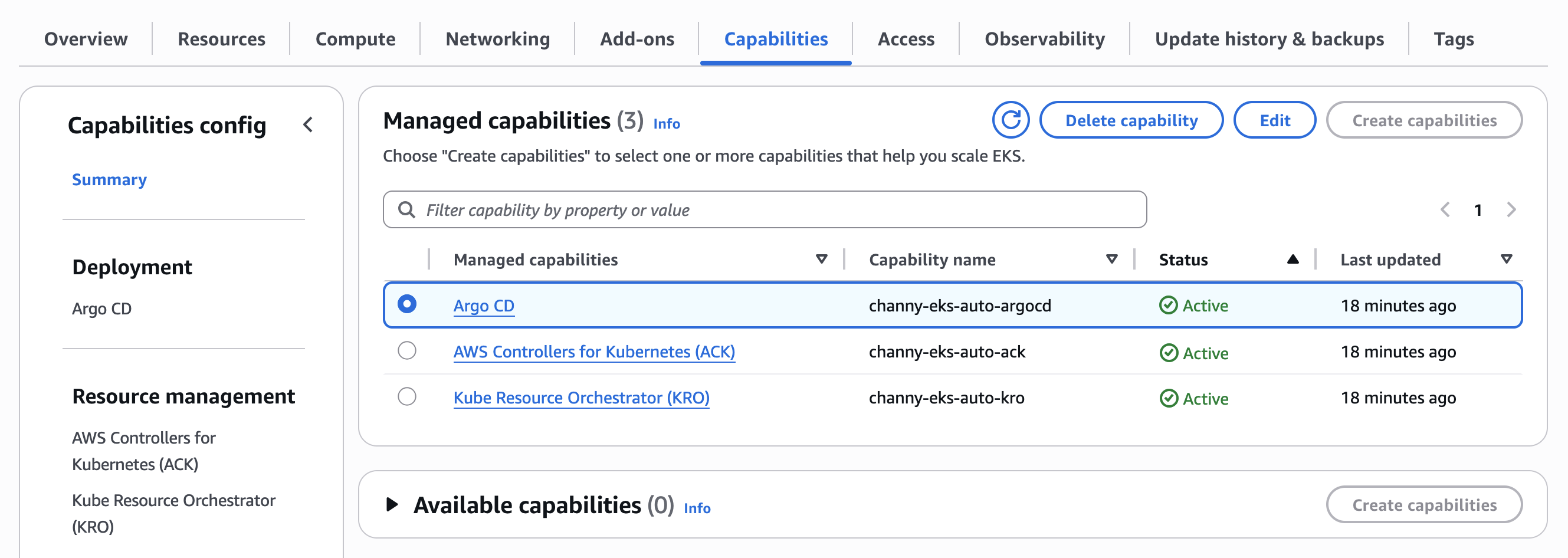
Now you can see and manage created capabilities. Select ArgoCD to update configuration of the capability.
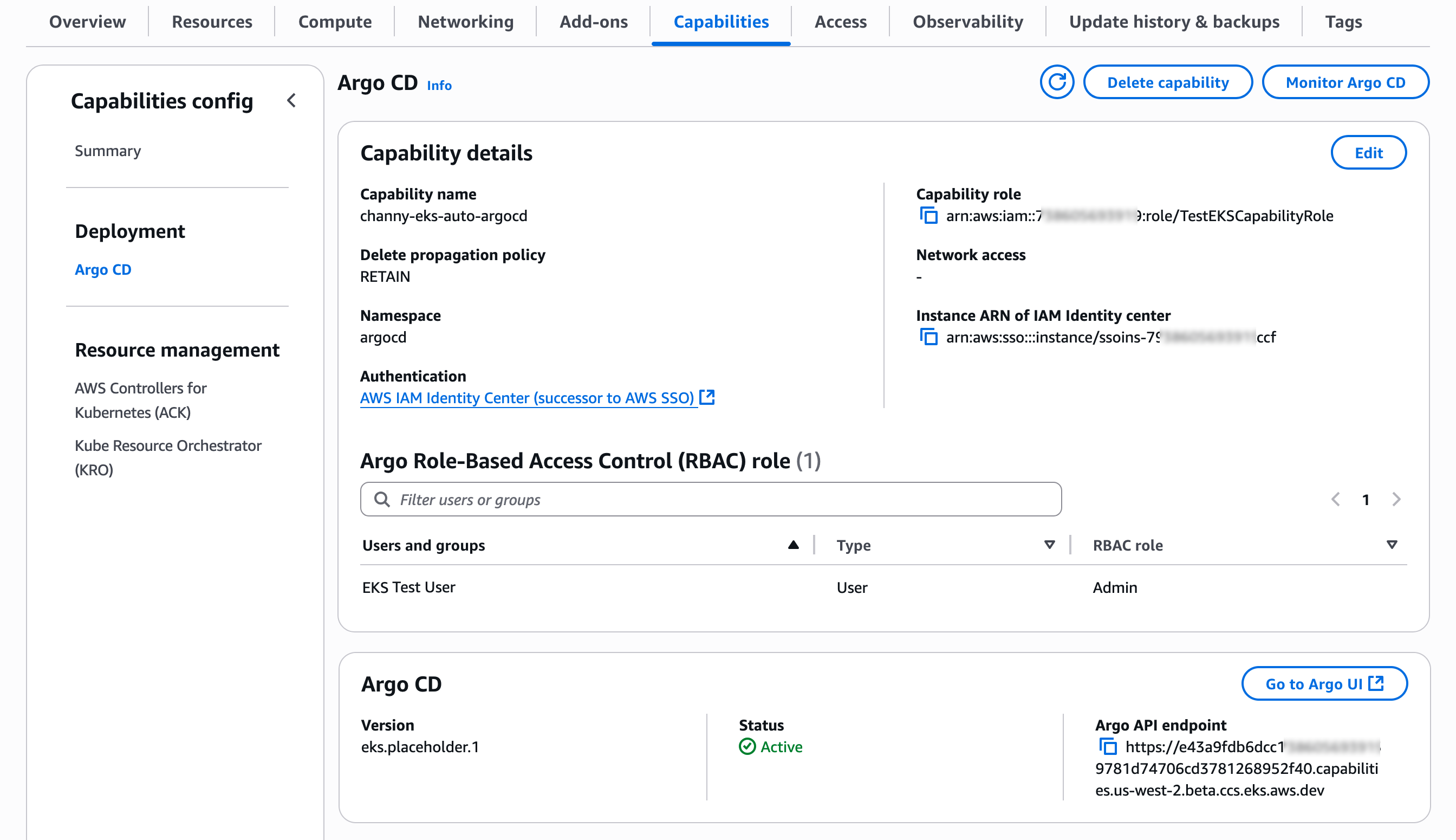
You can see details of ArgoCD capability. Choose Edit to change configuration settings or Monitor ArgoCD to show the health status of the capability for the current EKS cluster.
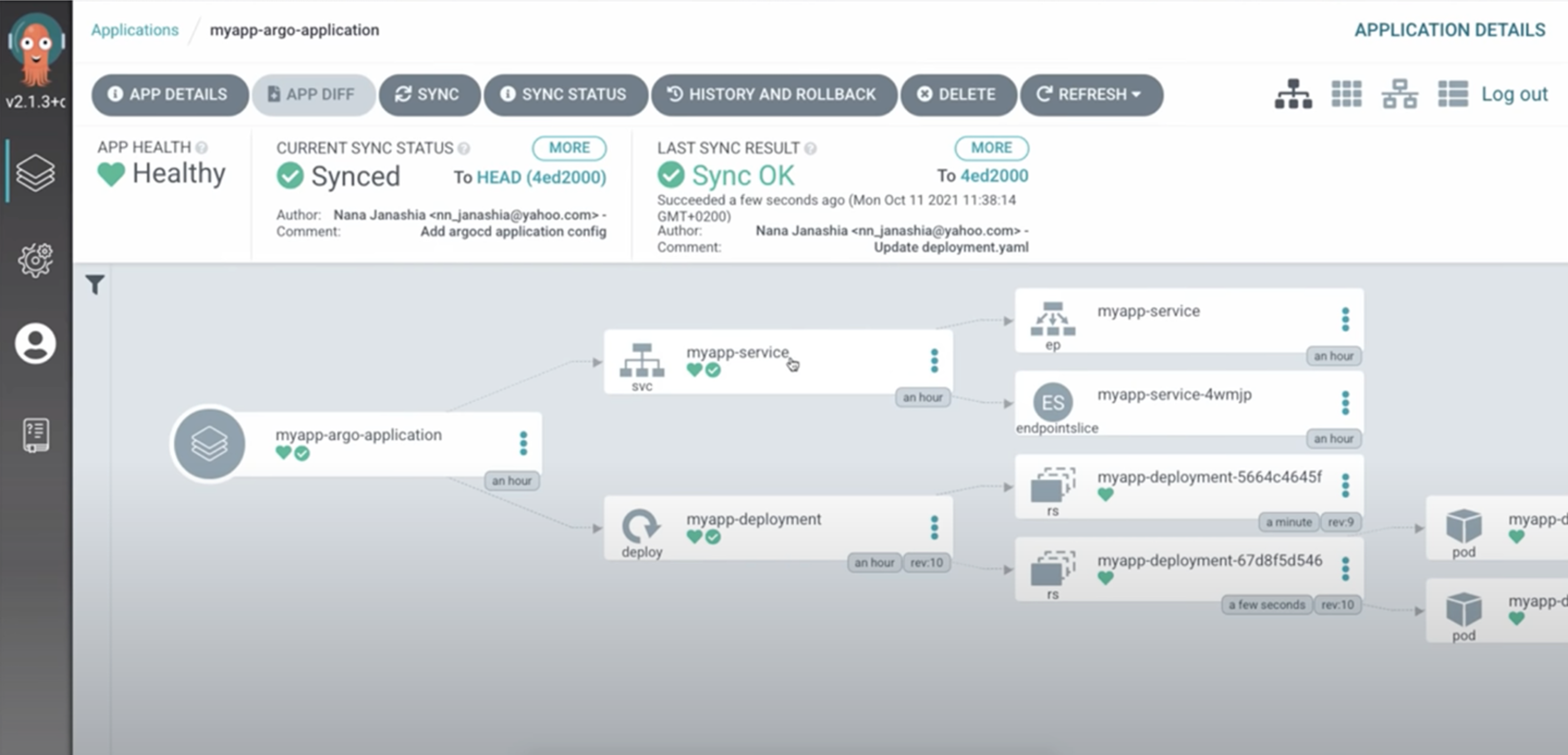
Choose Go to Argo UI to visualize and monitor deployment status and application health.
To learn more about how to set up and use each capability in detail, visit Getting started with EKS Capabilities in the Amazon EKS User Guide.
Things to know
Here are key considerations to know about this feature:
Now available
Amazon EKS Capabilities are now available in commercial AWS Regions. For Regional availability and future roadmap, visit the AWS Capabilities by Region. There are no upfront commitments or minimum fees, and you only pay for the EKS Capabilities and resources that you use. To learn more, visit the EKS pricing page.
Give it a try in the Amazon EKS console and send feedback to AWS re:Post for EKS or through your usual AWS Support contacts.
— Channy

Y no es la única…

La vivienda en España se ha disparado tanto que muchos jóvenes ya olvidan la idea de comprarse un piso y ven otras alternativas como las casas prefabricadas. Pero hay otros que van más allá y deciden vivir de otra forma. Este es el caso de José Antonio, un joven funcionario gaditano, decidió que no iba a esperar más y con su sueldo de 1.300 euros y sin la posibilidad de pagar un piso a decidido optar por la solución de vivir en una furgoneta.
“Es imposible alquilar algo en Cádiz con mi sueldo”, explica en un vídeo publicado en su perfil de TikTok, donde muestra su día a día y que recoge la cadena Telecinco. Su solución ha causado sorpresa y debate, pero él lo resume con una frase contundente: “Dime en qué piso me meto pagando 700 euros al mes”. @huffingtonpost
Eh, ¡¡¡Pero hemos subido el SMI!!! 😀

Ver post completo: Trabajando y aun así sin hogar. María José, con 58 años, lleva más de dos años viviendo en su coche en Málaga.
back to the classics…why this giant is so important? Which advantages?

The true power of Kubernetes lies in its ability to completely transform infrastructure management. Instead of thinking about individual virtual machines, networks, and load balancers, you get to manage a single, unified compute fabric with maintenance. This changes the game, making everything faster, more efficient, and ultimately less expensive (if your team has skills).
Consider the task of deploying a new application.
While the initial setup of the cluster requires careful planning, the benefits can be grat. Deploying a new application or scaling an existing one is now a lightning-fast process. Replicating a pod is nearly instantaneous because the container images are often cached on the worker nodes.
This resource sharing means you no longer have to reserve dedicated, underutilized VMs for every single application, leading to significant cost savings and a more efficient use of your cloud resources.
Declarative Configuration is the preferred method for managing Kubernetes objects. You define the desired state of your system (e.g., “I want 5 replicas of this container”) in a manifest file (.yaml). Kubernetes’ control plane then works to achieve and maintain that state. This is highly advantageous for automation and version control.
Imperative Configuration involves direct commands to the cluster (e.g., kubectl create deployment). While useful for quick, ad-hoc tasks, it is not reproducible and should be avoided in production environments.
Key takeaway: Always use declarative configuration for production workloads to ensure consistency, auditability, and easy rollback.

Kubernetes automates the deployment, scaling, and management of containerized applications. This includes tasks like service discovery, load balancing, and self-healing.
So, its primary goal is to maintain the Desired State. It is the ultimate decision-maker. If you ask for 3 replicas of an app, the Control Plane ensures 3 exist. If one dies, the Control Plane detects it and orders a replacement. So, K8s will take the burden of maintaining application availability.
Its management Team:
The component that talks to the outside world.
The backing store for all cluster data.
How we avoid losing it?:
It constantly watches the API Server for unscheduled Pods (Pods with an empty nodeName field). Its task is to assign Pods to Nodes, but NOT running the Pod (the Kubelet does that); it is strictly about the decision of where to place it.
Decision: When a new Pod is created, the scheduler initiates a rigorous three-step cycle to find the best home for it.
1. Filtering “Which nodes are capable of running this Pod?”
The scheduler looks at the entire cluster and filters out nodes that do not meet the hard requirements. If a node fails a filter, it is discarded from the list of candidates.
Result: A list of feasible nodes (0, 1, or many). If 0, the Pod goes into Pending state.
Scoring: “Which of the capable nodes is the best fit?”
The scheduler assigns a score (0–100) to the remaining feasible nodes based on active scoring functions.
Once the winner is selected, the scheduler sends a request to the API Server to update the Pod object. It writes the node’s name into the Pod’s nodeName field. The Kubelet on that specific node sees this assignment and starts the container runtime.
A daemon that embeds the core control loops. The central mind that watches and act.
Kubernetes is built on the “control loop” concept. A controller continuously watches the state of resources in the cluster, compares it to the desired state defined in your manifest files, and takes action to reconcile any differences. It constantly checks: “Is the reality matching what the user requested?”
The data plane consists of the Worker Nodes where your applications run. Each node has two main components:
The software responsible for actually running the containerized process.
In the past, this was almost always Docker.
Modern Kubernetes (and EKS) uses containerd or CRI-O.
CRI (Container Runtime Interface): interface that acts as a “universal translator” between the Kubelet and the container runtime.
The Kubelet sends generic commands (like “Start Container”) that are translated into the specific low-level actions needed to run the container.

A PodSpec is a YAML-based definition of a pod, describing its containers, volumes, networking, and other configuration. It is the core unit of deployment in Kubernetes. Understanding the PodSpec is crucial as it dictates the behavior and configuration of your application.
This is the most critical configuration for cluster stability.
For critical apps, set requests equal to limits. This gives you "Guaranteed QoS" (Quality of Service).
apiVersion: v1
kind: Pod
metadata:
  name: critical-web-app
spec:
  containers:
  - name: web
    image: nginx
    resources:
      requests:
        memory: "1Gi"   # Scheduler guarantees 1Gi is free on the node
        cpu: "500m"     # 0.5 CPU cores
      limits:
        memory: "2Gi"   # If it hits 2Gi, OOMKill happens
        cpu: "1000m"    # If it tries to use >1 core, it is throttled (slowed down)
Taints allow a Node to repel Pods. This is used for “Dedicated Nodes” (e.g., GPU nodes, Admin-only nodes). Unless a Pod has a special “Toleration” (a VIP pass), the Scheduler will not place it there.
Step 1: Taint the Node (The Bouncer)
# Apply a taint to a node
kubectl taint nodes gpu-node-01 dedicated=gpu:NoSchedule
Step 2: Add Toleration to Pod (The VIP Pass)
apiVersion: v1
kind: Pod
metadata:
  name: ml-training-job
spec:
  containers:
  - name: tensor-app
    image: tensorflow/tensorflow:latest
  tolerations:
  - key: "dedicated"
    operator: "Equal"
    value: "gpu"
    effect: "NoSchedule"
  # Note: A toleration allows entry, but doesn't guarantee it.
  # Usually combined with Node Affinity to ensure it *must* go there.
Affinity allows a Node to attract Pods. This is used for “Zone Awareness” or “Hardware Selection.”
apiVersion: v1
kind: Pod
metadata:
  name: high-availability-app
spec:
  affinity:
    nodeAffinity:
      requiredDuringSchedulingIgnoredDuringExecution:
        nodeSelectorTerms:
        - matchExpressions:
          - key: topology.kubernetes.io/zone
            operator: In
            values:
            - us-east-1a
            - us-east-1b
      preferredDuringSchedulingIgnoredDuringExecution:
      - weight: 1
        preference:
          matchExpressions:
          - key: disktype
            operator: In
            values:
            - ssd
  containers:
  - name: app
    image: my-app:1.0
IgnoredDuringExecution means that Kubernetes ignores the change for existing workloads. It does not evict them.
In Kubernetes, Pods are ephemeral : if a Pod writes data to its local disk and then crashes, that data is gone forever. To save data, we use Persistent Storage.
StorageClass : what is available (e.g., “Fast SSD”, “Cheap HDD”, “Network File System”).
PersistentVolumeClaim / PVC: what the apps want (e.g., “I want 10GB of the Fast SSD”).
PersistentVolume / PV : This is the real slice of storage .
In the old days (“Static Provisioning”), an Admin had to manually create 100 PVs and hope they were enough. Today, we use Dynamic Provisioning. When you create a PVC (The Order), the Cluster automatically talks to the Cloud Provider (AWS/GCP) to create the PV instantly.
This tells Kubernetes: “When someone asks for gp3-storage, ask AWS to create an EBS gp3 volume."
apiVersion: storage.k8s.io/v1
kind: StorageClass
metadata:
  name: gp3-storage
provisioner: ebs.csi.aws.com   # <--- The AWS EBS CSI Driver
parameters:
  type: gp3
  fsType: ext4
reclaimPolicy: Delete          # If PVC is deleted, delete the EBS volume too
volumeBindingMode: WaitForFirstConsumer # Important: Don't create volume until Pod is scheduled!
The developer applies this. Notice they don’t mention AWS or EBS or GCP.
apiVersion: v1
kind: PersistentVolumeClaim
metadata:
  name: my-database-pvc
spec:
  accessModes:
    - ReadWriteOnce            # EBS can only attach to ONE node at a time
  storageClassName: gp3-storage # Matches the SC above
  resources:
    requests:
      storage: 10Gi
The Pod “mounts” the PVC.
apiVersion: v1
kind: Pod
metadata:
  name: database-pod
spec:
  containers:
  - name: mysql
    image: mysql:8.0
    volumeMounts:
    - mountPath: "/var/lib/mysql" # Where the app expects the data
      name: my-storage
  volumes:
  - name: my-storage
    persistentVolumeClaim:
      claimName: my-database-pvc # Matches the PVC above
Most cloud block storage (AWS EBS, Google Persistent Disk, Azure Disk) is ReadWriteOnce (RWO).
To ensure resilience, there are ReplicaSets.
A ReplicaSet is a simple loop with one job: Ensure X copies of a Pod exist. It does not care where they run, only that they run.
A ReplicaSet does not “own” Pods by name. It owns them by Label. If you manually create a loose Pod with the label app: my-web-app, the ReplicaSet will see it, count it, and adopt it.
Danger Zone: If you already have 3 replicas running, and you manually create a 4th Pod with the same label, the ReplicaSet will notice “Current (4) > Desired (3)” and terminate one of them immediately to return to the desired state.
You rarely write a ReplicaSet YAML directly. You use a Deployment.
When you create a Deployment, it automatically creates the ReplicaSet for you.
apiVersion: apps/v1
kind: Deployment
metadata:
  name: frontend-deployment
spec:
  replicas: 3               # <--- Passes this to the ReplicaSet
  selector:
    matchLabels:
      app: frontend
  template:                 # <--- The Pod Template
    metadata:
      labels:
        app: frontend
    spec:
      containers:
      - name: nginx
        image: nginx:1.14.2
kubectl is the command-line tool for interacting with the Kubernetes API server. The kubeconfig file is where kubectl stores configuration for accessing your clusters. It contains cluster addresses, user credentials, and context information for different environments. Managing this file is key to securely and efficiently managing multiple clusters.
Namespaces are a way to logically partition a single cluster into multiple virtual clusters. They provide a scope for names and a mechanism for resource isolation, which is critical for managing multi-tenant environments and development teams.
Example: A common use case for namespaces is to separate environments. You could have a production namespace for your live applications and a development namespace for your testing and staging environments. This ensures that the two environments cannot interfere with each other, and you can apply different policies (e.g., security or resource quotas) to each.
The Golden Rule of containers is: Never bake configuration into your container image. If you have to rebuild your Docker image just to change a database URL or a log level, you are doing it wrong.
We solve this with ConfigMaps (for plain text) and Secrets (for sensitive data).
Think of a ConfigMap as a “Virtual Disk” that contains text files.
Fluent Bit is a log processor. It needs a complex config file (fluent-bit.conf) to know which logs to read and where to send them.
This object holds the actual text of the configuration file.
apiVersion: v1
kind: ConfigMap
metadata:
  name: fluent-bit-config
  labels:
    app.kubernetes.io/name: fluentbit
data:
  # The "Key" becomes the filename
  fluent-bit.conf: |
    [SERVICE]
       Parsers_File  parsers.conf
    [INPUT]
       Name    tail
       Tag     kube.*
       Path    /var/log/containers/*.log
       Parser  docker
       DB      /var/log/flb_kube.db
The Pod definition connects the ConfigMap to a specific path inside the container.
apiVersion: v1
kind: Pod
metadata:
  name: fluent-bit-pod
spec:
  containers:
  - name: fluent-bit
    image: fluent/fluent-bit
    volumeMounts:
    # 2. Mount the volume at a specific path
    - name: fb-config-vol       # Matches the volume name below
      mountPath: "/fluent-bit/etc/" # Where the file will appear
      readOnly: true
  volumes:
  # 1. Define a volume backed by the ConfigMap
  - name: fb-config-vol
    configMap:
      name: fluent-bit-config   # Matches the ConfigMap name above
The Result: When the container starts, it will find a file at /fluent-bit/etc/fluent-bit.conf containing the text you defined in the ConfigMap.
Secrets are used for sensitive data like passwords or API keys. While Secrets are a secure way to store sensitive information, it’s important to note that they are not encrypted by default within Kubernetes; they are simply stored as base64-encoded strings. However, they are more secure than storing plain text configuration because they decouple sensitive data from your application code, provide fine-grained access control through RBAC, and can be integrated with external key management systems for true encryption at rest.
Using these objects decouples configuration from your application code, making your container images more portable and your configuration easier to manage and update without rebuilding.
Workloads are the objects that manage and schedule pods. Common examples include:
Kubernetes is a Platform for Building Platforms.
If you want to add new features, you can do it using CustomResourceDefinitions (CRDs) and Custom Controllers. Together, these form the Operator Pattern.
Out of the box, Kubernetes knows about Pods, Services, and Deployments. But what if you want it to understand a Database?
apiVersion: apiextensions.k8s.io/v1
kind: CustomResourceDefinition
metadata:
  name: databases.example.com
spec:
  group: example.com
  versions:
    - name: v1
      served: true
      storage: true
      schema:
        openAPIV3Schema:
          type: object
          properties:
            spec:
              type: object
              properties:
                databaseName:
                  type: string
                version:
                  type: string
                storageSize:
                  type: string
  scope: Namespaced
  names:
    plural: databases
    singular: database
    kind: Database
    shortNames:
    - db
Once the CRD is applied, your developers can now use this simple abstraction. They don’t need to know about StatefulSets or PVCs.
apiVersion: [example.com/v1](https://example.com/v1)
kind: Database
metadata:
  name: my-app-db
spec:
  databaseName: "users_db"
  version: "8.0"
  storageSize: "20Gi"
Applying the YAML above does nothing by itself. It just saves a record in Etcd. To make it real, you need a Controller (Operator). This is code running in a Pod that loops forever:
The result is that your developers can manage a complex, multi-component database with a single, simple command. The custom controller handles all the underlying complexity, providing a powerful, automated, and declarative experience tailored to your organization’s needs.
But you need to code for creating a new Controller. Difficult? It used to be (writing raw REST API clients). Today, we use Frameworks like Kubebuilder or Operator SDK. These are code generators. They write 90% of the boilerplate for you.
In short, the pillars of Kubernetes. It you grasp all this, you can design really complex and powerful systems, like K8S’s dad.

Kubernetes in a Nutshell was originally published in Google Cloud - Community on Medium, where people are continuing the conversation by highlighting and responding to this story.
Today, we announced a significant collaboration with Amazon Web Services (AWS) to offer a managed, private and secure, on-demand, solution for cross-cloud connectivity. This solution is designed to enable customers to easily build enterprise-grade applications that span both Google Cloud and AWS environments. This collaboration is particularly timely, as the adoption of multicloud applications is rapidly accelerating, driven in part by the rise of AI. A Forbes survey highlighted that 82% of respondents anticipate that the arrival of AI services will increase the demand for multicloud networking due to the scarcity of specialized accelerator resources and the availability of diverse AI agents across different vendors. The surge in multicloud adoption is a strategic imperative for organizations looking to build agentic AI applications, optimize workloads, access best-of-breed services, meet data residency requirements, and ensure the necessary resiliency for modern hybrid and multicloud applications.
To address the inherent network infrastructure challenges introduced by multicloud deployments, we designed the Cross-Cloud Network to simplify and optimize networking between Google Cloud and other providers.This commitment to multicloud integration has led to over 50% of the Fortune 500 currently using the Cross-Cloud Network, and this collaboration provides a significant boost. Importantly, this new jointly engineered solution with AWS is being published under an open specification, creating an opportunity to expand the reach, allowing other providers to contribute and implement this solution in their own environments, further benefiting mutual customers.
Introducing the Cross-Cloud Interconnect for AWS
Today marks a major step in simplifying and securing the multicloud journey. We are thrilled to announce a first of its kind open specification that fundamentally streamlines private network connections between customers' environments across different cloud providers. This groundbreaking joint specification has culminated in the preview of partner Cross-Cloud Interconnect for AWS, a powerful expansion of our Cloud Interconnect portfolio. This innovation allows you to build on-demand connections in minutes between your Google Cloud and AWS VPCs, transforming multicloud networking from a complex build into a simple, managed service.

This is more than just a connection — it's a complete shift in how you adopt multicloud solutions. We are delivering substantial value to our mutual customers:
Simplicity and speed: Say goodbye to complex networking builds. This is a fully managed, cloud-native experience where a cross-cloud connection is as easy as peering two VPCs. We're cutting end-to-end setup time from days to mere minutes, with flexible, on-demand bandwidth starting at 1 Gbps during preview and scaling up to 100 Gbps at general availability.
Secure by default: Your data's security is paramount. All connections between the two clouds' edge routers are MACsec-encrypted — providing line-rate performance with always-on encryption — for a more secure foundation.
Inherently resilient: Benefit from an inherently resilient architecture that provides layers of protection against facility, network, and software failures, ensuring your critical applications remain online.
Open and optimized: The foundation is an open specification for seamless adoption across the industry. You can also benefit from an optimized total cost of ownership through vendor consolidation and an on-demand service model that lets you provision exactly what you need, when you need it.
This service is launching with availability in key locations like N. Virginia, Oregon, London, and Frankfurt, with rapid expansion planned to more locations globally.
Before today's jointly engineered solution, building applications that spanned multiple cloud environments was a significant undertaking, often becoming a barrier to multicloud adoption. Customers faced a complex, multi-layered process that involved cross-functional teams and substantial lead times.
A typical deployment required several intricate steps:
Procurement: Acquiring physical connections, whether dedicated or through a shared partner offering, and then building and managing the necessary infrastructure to ensure network availability and separation of fate.
Logical configuration: Establishing basic connectivity by meticulously assigning and negotiating non-overlapping link-local IP addresses and setting up VLANs.
Routing setup: Configuring BGP sessions, assigning Autonomous System (AS) numbers, and creating complex routing policies to meet specific performance and reliability requirements.
Security implementation: Conducting thorough security reviews and implementing custom solutions to encrypt traffic between the distinct cloud environments.
The integrated partner Cross-Cloud Interconnect offering completely abstracts away this complexity. Customers can now bypass all the manual steps and instantly leverage pre-built physical connections with built-in security and resiliency, achieving streamlined, on-demand connectivity between their Google Cloud VPCs and AWS.
Building this powerful cross-cloud connection is now remarkably simple. Customers configure a single "transport" resource in Google Cloud and accept it in AWS. This transport is an innovative, managed construct that completely abstracts and provisions the underlying physical interconnects, VLAN attachments, and Cloud Router instances. This profound simplification enables end-to-end connectivity in minutes, transforming multicloud deployment from a days-long engineering project into a simple, rapid configuration task.
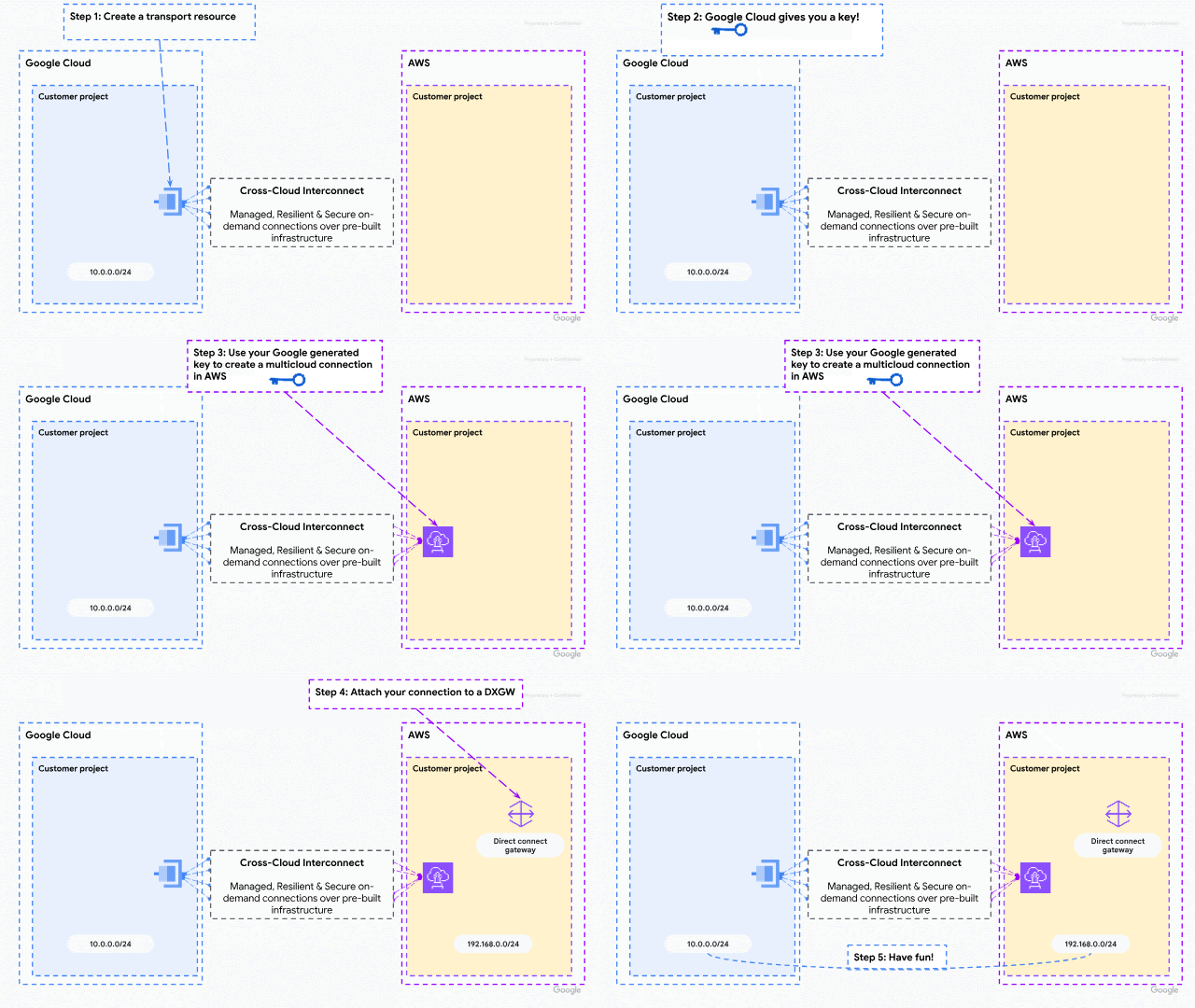
Under the hood: a secure and resilient foundation
We co-designed our solution to deliver a secure and resilient foundation for cross-cloud applications, with a simple new service that doesn’t compromise on core enterprise availability tenets.
Privacy and security: All peering relationships are built between link local addresses, facilitating connectivity between IPv4 and IPv6 private address spaces across both environments. All underlying physical connections between Google Cloud and AWS edge routers are MACsec-encrypted, and both providers manage key rotation to meet enterprise security requirements.

These new streamlined network connections between Google Cloud and AWS enable application teams to automate network builds for a variety of interesting applications. Consider the following scenarios:
Infrastructure and AI deployments supporting active-active or active-standby disaster recovery strategies. With basic connectivity between two peer services — e.g., agentic AI applications or database replicas — applications can synchronize state across the cloud boundary as if they are co-located, supporting maximum application resilience and operational consistency.
AWS customers issuing inbound requests into Google Cloud to allow a service running in AWS to securely and privately access a Google Cloud API. Examples include custom applications running on Compute Engine or a critical data warehouse hosted in BigQuery that bypasses the public internet for enhanced security and performance.
Google Cloud customers issuing outbound requests towards AWS, where a data pipeline orchestrating in Google Cloud can privately pull large datasets from an AWS datastore like S3 or an RDS instance.

Build applications across Google Cloud and AWS today
Regardless of your use case, if your organization would benefit from simple, secure, and robust on-demand connectivity between your Google Cloud and AWS environments, we invite you to start building your applications across clouds and let us manage your network connectivity infrastructure for you.
This collaboration is not restricted to Google Cloud and AWS. We invite other cloud and service providers to offer their customers this streamlined private peering capability with Google Cloud. To learn more, check out the open specification, and contact us at cross-cloud@google.com. We are truly excited to grow this ecosystem for the benefit of our joint customers.
As organizations increasingly adopt multicloud architectures, the need for interoperability between cloud service providers has never been greater. Historically, however, connecting these environments has been a challenge, forcing customers to take a complex "do-it-yourself" approach to managing global multi-layered networks at scale.
To address these challenges and advance a more open cloud environment, Amazon Web Services (AWS) and Google Cloud collaborated to transform how cloud service providers could connect with one another in a simplified manner.
Today, AWS and Google Cloud are excited to announce a jointly engineered multicloud networking solution that uses both AWS Interconnect - multicloud and Google Cloud’s Cross-Cloud Interconnect. This collaboration also introduces a new open specification for network interoperability, enabling customers to establish private, high-speed connectivity between Google Cloud and AWS with high levels of automation and speed.
“Integrating Salesforce Data 360 with the broader IT landscape requires robust, private connectivity. AWS Interconnect - multicloud allows us to establish these critical bridges to Google Cloud with the same ease as deploying internal AWS resources, utilizing pre-built capacity pools and the tools our teams already know and love. This native, streamlined experience — from provisioning through ongoing support — accelerates our customers' ability to ground their AI and analytics in trusted data, regardless of where it resides.” - Jim Ostrognai, SVP Software Engineering, Salesforce
Previously, to connect cloud service providers, customers had to manually set up complex networking components including physical connections and equipment; this approach required lengthy lead times and coordinating with multiple internal and external teams. This could take weeks or even months. AWS had a vision for developing this capability as a unified specification that could be adopted by any cloud service provider, and collaborated with Google Cloud to bring it to market.
Now, this new solution reimagines multicloud connectivity by moving away from physical infrastructure management toward a managed, cloud-native experience. By integrating AWS with Google Cloud’s Cross-Cloud Network architecture, we are abstracting the complexity of physical connectivity, network addressing, and routing policies. Customers no longer need to wait weeks for circuit provisioning: they can now provision dedicated bandwidth on demand and establish connectivity in minutes through their preferred cloud console or API.
Reliability and security are the cornerstone of this collaboration. We have collaborated on this solution to deliver high resiliency by leveraging quad-redundancy across physically redundant interconnect facilities and routers. Both providers engage in continuous monitoring to proactively detect and resolve issues. And this solution is built on a foundation of trust, utilizing MACsec encryption between the Google Cloud and AWS edge routers.
“This collaboration between AWS and Google Cloud represents a fundamental shift in multicloud connectivity. By defining and publishing a standard that removes the complexity of any physical components for customers, with high availability and security fused into that standard, customers no longer need to worry about any heavy lifting to create their desired connectivity. When they need multicloud connectivity, it's ready to activate in minutes with a simple point and click.” - Robert Kennedy, VP of Network Services, AWS
“We are excited about this collaboration which enables our customers to move their data and applications between clouds with simplified global connectivity and enhanced operational effectiveness. Today's announcement further delivers on Google Cloud’s Cross-Cloud Network solution focused on delivering an open and unified multicloud experience for customers.” - Rob Enns, VP/GM of Cloud Networking, Google Cloud
This collaboration between AWS and Google Cloud is more than a multicloud solution: it’s a step toward a more open cloud environment. The API specifications developed for this product are open for other providers and partners to adopt, as we aim to simplify global connectivity for everyone. We invite you to explore this new capability today. To learn more about how to streamline your multicloud operations please visit the in-depth Google Cloud Cross-Cloud Interconnect blog and the AWS Interconnect - multicloud website to get started.
AWS announces preview of AWS Interconnect - multicloud, providing simple, resilient, high-speed private connections to other cloud service providers (CSPs), starting in preview with Google Cloud as the first launch partner and then with Microsoft Azure later in 2026.
Customers have been adopting multicloud strategies while migrating more applications to the cloud. They do so for many reasons including interoperability requirements, the freedom to choose technology that best suits their needs, and the ability to build and deploy applications on any environment with greater ease and speed. Previously, when interconnecting workloads across multiple cloud providers, customers had to go the route of a ‘do-it-yourself’ multicloud approach, leading to complexities of managing global multi-layered networks at scale. AWS Interconnect - multicloud is the first purpose-built product of its kind and a new way of how clouds connect and talk to each other. It enables customers to quickly establish private, secure, high-speed network connections with dedicated bandwidth and built-in resiliency between their Amazon VPCs and other cloud environments. Interconnect - multicloud makes it easy to connect AWS networking services such as AWS Transit Gateway, AWS Cloud WAN, and Amazon VPC to other Cloud Service Providers (CSPs) quickly, instead of weeks or months.
Interconnect - multicloud is available in preview in five AWS Regions. You can enable this capability using the AWS Management Console. CSPs can also easily adopt via a published open API package on GitHub. For more information, see the AWS Interconnect - multicloud documentation pages.
Amazon Elastic Kubernetes Service (EKS) announces the general availability of EKS Capabilities, a fully-managed extensible set of Kubernetes-native platform features for workload deployment, AWS cloud resource management, and Kubernetes resource composition and orchestration. EKS Capabilities provides out-of-the-box platform features and offloads operations to AWS, improving the performance and security of your platform components.
EKS Capabilities streamlines building and scaling with Kubernetes, allowing you to focus on deploying applications rather than maintaining platform infrastructure. These capabilities run in AWS-owned infrastructure separate from your clusters, with AWS handling auto scaling, patching, and upgrading. Application developers get ready-to-use platform capabilities that enable faster workload deployment and scaling across the organization, while platform teams can offload operational tasks to AWS. Three capabilities are available at launch including continuous deployment with Argo CD, AWS resource management through AWS Controllers for Kubernetes (ACK), and dynamic resource orchestration using Kube Resource Orchestrator (KRO).
EKS Capabilities is available today in all AWS Regions, except AWS GovCloud (US) and China Regions. To get started with EKS Capabilities, use the EKS API, CLI, eksctl, AWS Console, or your favorite infrastructure as code tooling to enable it in a new or existing EKS cluster. To learn more, visit the EKS Capabilities feature webpage, user guide, pricing webpage, and AWS News Launch blog.

Al contrario que la mayoría de países, el Gobierno apenas la ha compensado, generando un aumento de la presión fiscal que afecta más a rentas bajas. @Jongonzlz
Ver post completo: España es el segundo país europeo que más ha recaudado con el IRPF por la inflación.

El entrenador de fitness tenía que consumir primero ingentes cantidades de comida para engordar rápidamente 25 kilos de peso; posteriormente, los perdería siguiendo un método de adelgazamiento que había diseñado previamente antes de que acabase el año. @20minutos
Ver post completo: Ya tenemos Premio Darwin 2025.