Shared posts
“Las manos manchadas de sangre” 🩸| @mjgant #tengounplan
Long Links
Welcome to the first Long Links of this so-far-pretty-lousy 2026. I can’t imagine that anyone will have time to take in all of these, but there’s a good chance one or two might brighten your day.
Unclassified
Thomas Piketty is always right. For example, Europe, a social-democratic power.
Lying is wrong. Conservatives do it all the time. To be fair, that piece is about the capital-C flavor, as in the Canadian Tories. But still.
Clothing is open-source: “If you slice the different parts off with a seamripper, lay them all down, trace them on new fabric, cut them out, and stitch them back together, you can effectively clone and fork garments.” From Devine Lu Linvega.
The Universe is weird. The Webb telescope keeps showing astronomers things that shouldn’t be there. For example, An X-ray-emitting protocluster at z ≈ 5.7 reveals rapid structure growth; ignore the title and read the Abstract and Main sections. With pretty pictures!
Music
One time in Vegas, I was giving a speech, something about cloud computing, and was surprised to find the venue an ornate velvet-lined theater. I found out from the staff, and then relayed to the audience, that the last human before me to stand on this stage in front of an audience had been Willie Nelson. I was tempted to fall to my knees and kiss the boards. How Willie Nelson Sees America, from The New Yorker, is subtitled “On the road with the musician, his band, and his family” but it ends up being the kernel of a good biography of an interesting person. Bonus link; on YouTube, Willie Nelson - Teatro, featuring Daniel Lanois & Emmylou Harris, Directed by Wim Wenders. Strong stuff.
Speaking of recorded music, check out Why listening parties are everywhere right now. Huh? They are? As a deranged audiophile, sounds like my kind of thing. I’d go.
Somewhere to put worker bees
When I was working at AWS in downtown Vancouver back starting in 2015, a lot of our junior engineers lived in these teeny-tiny little one-room-tbh apartments. It worked out pretty well for them, they were affordable and an easy walk from the office and these people hadn’t built up enough of a life to need much more room. For a while this trend of so-called-“studio” flats was the new hotness in Vancouver and I guess around quite a bit of the developed world. Us older types with families would look at the condo market and tell each other “this is stupid”.
We were right. The bottom is falling out and they’re sitting empty in their thousands. And not just the teeniest either, the whole condo business is in the toilet. It didn’t help that for a few years all the prices went up every year (until they didn’t) and you could make serious money flipping unbuilt condos, so lots of people did (until they didn’t).
Anyhow, here’s a nice write-up on the subject: ‘Somewhere to put worker bees’: Why Canada's micro-condos are losing their appeal. (From the BBC, huh?)
AI AI AI
Sorry, I can’t not relay pro- and anti-GenAI posts, because that conversation is affecting all our lives just now. I am actually getting ready to decloak my own conclusions, but for the moment I’m just sharing essays on the subject that strike me as well-written and enjoyable for their own sake. Thus ‘AI' is a dick move, redux from Baldur Bjarnason. Boy, is he mad.
Sam Ruby has been doing some extremely weird shit, running Rails in the browser, as in without even a network connection or a Ruby runtime. Yes, AI was involved in the construction.
Software
There’s this programming language called Ivy that is in the APL lineage; that acronym will leave young’uns blank but a few greying eyebrows will have been raised. Anyhow, Implementing the transcendental functions in Ivy is delightfully geeky, diving deep with no awkwardness. By no less than Rob Pike.
Check out Mike Swanson’s Backseat Software. That’s “backseat” as in “backseat driver”, which today’s commercial software has now, annoyingly, become. This piece doesn’t make any points that I haven’t heard (or made myself) elsewhere, but it pulls a lot of the important ones together in a well-written and compelling package. Recommended.
Old Googler Harry Glaser reacts with horror to the introduction of advertising by OpenAI, and makes gloomy predictions about how it will evolve. His predictions are obviously correct.
The title says it: Discovering a Digital Photo Editing Workflow Beyond Adobe. It’d be a tough transition for me, but the relationship with Adobe gets harder and harder to justify.
Indigenous reconciliation
Khelsilem is one of the loudest and clearest voices coming out of the Squamish nation, one of the larger and better-organized Indigenous communities around here.
There has been a steady drumbeat of Indigenous litigation going on for decades as a consequence of the fact that the British colonialists who seized the territory in what we now call British Columbia didn’t bother to sign treaties with the people who were already there, they just assumed ownership. The Indigenous people have been winning a lot of court cases, which makes people nervous.
Anyhow, Khelsilem’s The Real Source of Canada's Reconciliation Panic covers the ground. I’m pretty sure British Columbians should read this, and suspect that anyone in a jurisdiction undergoing similar processes should too.
Resonant computing, Black and Blue sky
There’s this thing called the Resonant Computing Manifesto, whose authors and signatories include names you’d probably recognize. Not mine; the first of its Five Principles begins with “In the era of AI…” Also, it is entirely oblivious to the force driving the enshittification of social-media platforms: Monopoly ownership and the pathologies of late-stage capitalism.
Having said that, the vision it paints is attractive. And having said that, it’s now featured on the flags waved by the proponents of ATProto, which is to say Bluesky. See Mike Masnick’s ATproto: The Enshittification Killswitch That Enables Resonant Computing (Mike is on Bluesky Corp’s Board). That piece is OK but, in the comments, Masnick quickly gets snotty about the Fediverse and Mastodon, in a way that I find really off-putting. And once again, says nothing about the underlying economic realities that poison today’s platforms.
I want to like Bluesky, but I’m just too paranoid and cynical about money. It is entirely unclear who is funding the people and infrastructure behind Bluesky, which matters, because if Bluesky Corp goes belly-up, so does the allegedly-decentralized service.
On the other hand, Blacksky is interesting. They are trying to prove that ATProto really can be made decentralized in fact not just in theory. Their ideas and their people are stimulating, and their finances are transparent. I’ll be moving my ATProto presence to Blacksky when I get some cycles and the process has become a little more automated.
Good crypto
The cryptography community is working hard on the problem of what happens should quantum computers ever become real products as opposed to over-invested fever dreams. Because if they ever work, they can probably crack the algorithms that we’ve been using to provide basic Web privacy.
The problem is technically hard — there are good solutions though — and also politically fraught, because maybe the designers or standards orgs are corrupt or incompetent. It’s reasonable to worry about this stuff and people do. They probably don’t need to: Sophie Schmieg dives deep in ML-KEM Mythbusting.
Books
Here’s one of the most heartwarming things I’ve read in months: A Community-Curated Nancy Drew Collection. Reminder: The Internet can still be great.
John Lanchester’s For Every Winner a Loser, ostensibly a review of two books about famous financiers, is in fact an extended howl of (extremely instructive) rage against the financialization of everything and the unrelenting increase in inequality. What we need to do is to take the ill-gotten gains away from these people and put it to a use — any use — that improves human lives.
I talk a lot about late-stage capitalism. But Sven Beckert published a 1,300-page monster entitled Capitalism; the link is to a NYT review and makes me want to read it..
Charlie Stross, the sci-fi author, likes webtoons and recommends a bunch. Be careful, do not follow those links if you’re already short of time. Semi- or fully-retired? Go ahead!
I have history with dictionaries. For several years of my life in the late Eighties, I was the research project manager for the New Oxford English Dictionary project at the University of Waterloo. Dictionaries are a fascinating topic and, for much of the history of the publishing industry, were big money-makers; they dominate any short list of the biggest-selling books in history. Then came the Internet.
Anyhow, Louis Menand’s Is the Dictionary Done For? starts with a review of a book by Stefan Fatsis entitled Unabridged: The Thrill of (and Threat to) the Modern Dictionary which I haven’t read and probably won’t, but oh boy, Menand’s piece is big and rich and polished and just a fantastic read. If, that is, you care about words and languages. I understand there are those who don’t, which is weird. I’ll close with a quote from Menand:
“The dictionary projects permanence,” Fatsis concludes, “but the language is Jell-O, slippery and mutable and forever collapsing on itself.” He’s right, of course. Language is our fishbowl. We created it and now we’re forever trapped inside it.
is showing up in person with a resume actually a thing now?
A reader writes:
My brother (Gen Z/millennial cusp) has been out of work (and stuck living back home with my parents) for a while now, and everyone is understandably frustrated with the situation.
A couple times my mom (boomer) and I (millennial) have been one-on-one and she’s brought up the situation, and she’s said that she has told my brother to just “go show up in person to places you’d like to get a job at and try to hand in your resume!”
Every single one of my millennial instincts is screaming NO NO NO, this is CLASSIC out-of-touch boomer advice from when we were trying to get jobs during the Great Recession. I told my mom that yeah, that doesn’t really work now since it’s not the 1980s, and since it’s literally the classic example of out-of-touch boomers with the job hunt, my brother is probably going to then ignore every other piece of advice you give him.
However, my mom’s response was yes, she knows all of that, but she heard recently (like this year) on the news that going in person to hand in your resume out of the blue is actually a good thing now, since it’ll get your resume directly in front of a human and help you avoid the AI filter bots. And she claimed she has a friend whose daughter got her most recent job this way!
Every millennial instinct of mine screams NOPE DISREGARD when I hear this touted as job hunt advice, but I know that the AI filters are so impossible to get past now. Is there actually some merit to it? Has everything I thought I knew about job searching changed in the nine years since I last interviewed?
It is still not a thing.
First, they’re highly likely to just tell you that you need to apply online … because you do in fact need to apply online. As has been the case for a long time now, most organizations use electronic applicant tracking systems. If your application isn’t in there, it’s not getting considered.
Second, with the rise in remote work, a ton of people don’t even work at companies’ main addresses anymore. There may not be anyone involved in hiring for the position even physically there. And even if they’re there, they’re generally going to be very busy and aren’t going to come out and talk to you just because you randomly showed up holding a resume — so anyone you do talk to is incredibly unlikely to have anything to do with hiring for that particular job.
Third, it will still annoy the crap out of most people involved in hiring and make you look naive/out of touch at best … and at worst, like you don’t think instructions apply to you. Their instructions are there for a reason.
You will always hear stories about how one weird job search gimmick worked for someone, but more often than not they’re a bad idea (and the amount of time your brother would put into going door to door with his resume would be far more effective put into networking, or writing a better cover letter, or other things with a bigger pay-off).
The post is showing up in person with a resume actually a thing now? appeared first on Ask a Manager.
Donald Trump busca una dudosa fórmula para lograr el control del Congreso
Desde que comenzó 2026, la política estadounidense avanza con la vista puesta en las elecciones de medio término de noviembre, el gran examen que cada dos años reorganiza el poder en Washington. En estos comicios los republicanos se juegan mucho, se renuevan los 435 escaños de la Cámara de Representantes y un tercio del Senado (35 escaños). Perder una de las dos cámaras significaría atascar la agenda legislativa de la Casa Blanca, multiplicar las investigaciones parlamentarias y abrir un bloqueo legislativo que podría desembocar en un juicio político contra Donald Trump. El presidente estadounidense, consciente de todo, ya se ha puesto a trabajar para maximizar escaños, cueste lo que cueste, incluso si hay que ir contra la Constitución.
Su último movimiento ha sido insistir en que el Gobierno federal debería supervisar, e incluso organizar, las elecciones intermedias que históricamente han estado en manos de los estados. Sin rodeos, ha llamado a los miembros de su partido a tomar el control y nacionalizar el sistema de votación. El mandatario estadounidense no dio más detalles sobre su plan para modificar un sistema electoral blindado por el reparto de competencias que establece la Constitución de EE UU. Deberíamos tomar el control del sistema de votación en al menos 15 lugares, dijo Trump;, Tenemos estados que son tan corruptos y están contando votos, afirmó sin identificar los territorios. Estas declaraciones tuvieron lugar en un encuentro con periodistas en el despacho Oval, en el que aseguró que el estado es un agente del Gobierno federal en las elecciones. No sé por qué no es el Gobierno federal el que las organiza directamente. Dentro del partido republicano empiezan a asomar voces relevantes que temen que su líder, una vez más, hable en serio. Algunos temen que su líder quiera revertir el control que la ley atribuye a los territorios, cuya administración electoral recae en funcionarios estatales y locales.
El llamado al cambio electoral ha despertado la preocupación dentro del partido demócrata, que a estas alturas conoce perfectamente a su presidente y sabe que sus palabras no son solo retórica partidista. Hay dos opciones, Trump se sale con la suya y logra forzar un cambio en la idiosincrasia del sistema electoral, o bien el mandatario lo utilizará como arma política para atacar a los estados en los que su partido no gane las elecciones. ¿Acaso Donald Trump necesita una copia de la Constitución? Lo que está diciendo es flagrantemente ilegal, dijo en el pleno el líder de la minoría en el Senado, el demócrata Chuck Schumer.
El líder norteamericano es consciente de que, históricamente, el partido gobernante suele perder escaños en las elecciones de medio término, y esta vez los demócratas lo tienen fácil porque solo tendrían que ganar tres distritos controlados por los republicanos para hacerse con la Cámara de Representantes. Por eso, Trump lleva tiempo trabajando en varias líneas. Una de ellas llegó el año pasado, impulsando una redistribución de distritos electorales para que los republicanos obtengan más escaños. Primero fue Texas quien se animó a redibujar el mapa electoral, y para contrarrestar le siguió California, una forma de ganar escaños sin cambiar votos.
Para respaldar su propuesta, Trump lleva mucho tiempo, desde que perdió las elecciones en 2020 según él por fraude cometido por los demócratas, preparando el terreno, asegurando sin pruebas, que, en algunas ciudades, curiosamente todas ellas demócratas, existe una terrible corrupción electoral. Siempre se ha opuesto al voto por correo, ha puesto en duda el buen funcionamiento y control de las máquinas de votación, y ha alimentado sin hechos el sentimiento de que millones de personas que no son ciudadanas votan en las elecciones estadounidenses. Según Trump sus votos influyen negativamente en los resultados electorales, pero los expertos insisten en que es ilegal y rara vez se da. Desde hace un año, los republicanos han estado impulsando la aprobación de la ley SAVE (SAVE Act en inglés), que busca exigir a todas las personas norteamericanas que presenten un certificado de nacimiento o cualquier identificación oficial que demuestre su ciudadanía en el momento de votar. Según una encuesta realizada por Brennan Center, más de 21 millones de nacionales no tienen a mano eses documentos, por lo que los detractores de la ley insisten en que aprobar la norma privaría de un derecho constitucional a muchos ciudadanos.
El presidente es persistente cuando algo se cruza en su camino, y lleva seis años impugnando su derrota en las elecciones del 2020. La semana pasada el FBI registró e incautó en el condado de Fulton, en Georgia, material vinculado a las elecciones ganadas por el demócrata Joe Biden. Ahora van a ver algo en Georgia, donde lograron obtener, con una orden judicial, las papeletas, van a salir a la luz cosas interesantes, seguía insistiendo Trump en una entrevista en un podcast esta semana.

CIERRE DE WALL STREET: Sangría en Bitcoin y Oro, el enigma de la liquidez y ¿recesión o 200k?
Jornada de máxima tensión en los mercados financieros internacionales. Cerramos Wall Street con una fotografía atípica: una sangría coordinada en Bitcoin y el Oro, los dos activos que tradicionalmente actúan como refugio o reserva de valor. Mientras el Nasdaq se desangra por el sector tecnológico, el Oro pierde brillo ante el fortalecimiento del dólar y Bitcoin perfora niveles críticos de soporte, desatando el pánico entre los inversores minoristas. ¿Es una corrección saludable o el inicio de un cambio de ciclo?
Analizamos el "enigma de la liquidez mundial": la desconexión entre la inyección de capital de los bancos centrales y el comportamiento errático de las criptomonedas. En este escenario, planteamos el gran dilema que divide a los analistas de cara al cierre de 2026: ¿Estamos a las puertas de una recesión global que arrastrará a todos los activos, o es este el último "sacudón" antes de ver a Bitcoin alcanzar los 200.000 dólares? Desgranamos los datos de Alphabet, Qualcomm y el impacto de la geopolítica en el sentimiento de riesgo.
#directo #wallstreet #bitcoin #oro #recesion #liquidez #nasdaq #bolsa #btc #gold #inversion #economia #negociostv #market #trading
Si quieres entrar en la Academia de Negocios TV, este es el enlace:
https://www.youtube.com/channel/UCwd8Byi93KbnsYmCcKLExvQ/join
Síguenos en directo ➡️ https://bit.ly/2Ts9V3p
Suscríbete a nuestro canal: https://bit.ly/3jsMzp2
Suscríbete a nuestro segundo canal, másnegocios: https://n9.cl/4dca4
Visita Negocios TV https://bit.ly/2Ts9V3p
Más vídeos de Negocios TV: https://youtube.com/@NegociosTV
Síguenos en Telegram: https://t.me/negociostv
Síguenos en Instagram: https://bit.ly/3oytWnd
Twitter: https://bit.ly/3jz6Lpt
Facebook: https://bit.ly/3e3kIuy
🔞Exención de responsabilidad: Toda la información, material y / o contenido incluido en este programa es sólo para fines informativos y educativos. Invertir en acciones, opciones y futuros es arriesgado y no es adecuado para todos los inversores. Consulte a su propio asesor financiero independiente antes de tomar cualquier decisión de inversión.
Negocios TV no se hace responsable de las opiniones expresadas en el vídeo.
NOTICIERO: Choque total entre Irán y EEUU, Putin y Xi lanzan un duro aviso a Trump y jaque a Europa
El escenario internacional entra en una fase de máxima fricción tras el agravamiento del conflicto entre Irán y Estados Unidos en el Mar Arábigo. Tras el derribo de un activo militar iraní, la respuesta de Teherán ha elevado el riesgo de una confrontación directa, mientras Washington mantiene un despliegue de fuerza sin precedentes en la región. Este choque ocurre en un momento de reconfiguración del orden mundial, donde las potencias del eje euroasiático han tomado posiciones claras frente a la nueva administración estadounidense.
En una acción coordinada, Vladimir Putin y Xi Jinping han lanzado un aviso formal a la Casa Blanca respecto a la estabilidad nuclear global. Ante la expiración del tratado New Start, Moscú y Pekín exigen a Donald Trump un marco de seguridad que respete la multipolaridad y detenga la expansión de la influencia militar occidental en zonas de fricción. Esta alianza estratégica sitúa a Europa en una posición de extrema vulnerabilidad, enfrentando un "jaque" energético y de seguridad mientras los canales diplomáticos tradicionales muestran signos de agotamiento. El directo analiza las implicaciones de este triple frente que amenaza con reescribir las reglas de la geopolítica contemporánea.
#directo #noticiero #geopolitica #iran #eeuu #trump #putin #xijinping #rusia #china #europa #tension #nuclear #negociostv #live #endirecto
Si quieres entrar en la Academia de Negocios TV, este es el enlace:
https://www.youtube.com/channel/UCwd8Byi93KbnsYmCcKLExvQ/join
Síguenos en directo ➡️ https://bit.ly/2Ts9V3p
Suscríbete a nuestro canal: https://bit.ly/3jsMzp2
Suscríbete a nuestro segundo canal, másnegocios: https://n9.cl/4dca4
Visita Negocios TV https://bit.ly/2Ts9V3p
Más vídeos de Negocios TV: https://youtube.com/@NegociosTV
Síguenos en Telegram: https://t.me/negociostv
Síguenos en Instagram: https://bit.ly/3oytWnd
Twitter: https://bit.ly/3jz6Lpt
Facebook: https://bit.ly/3e3kIuy
🔞Exención de responsabilidad: Toda la información, material y / o contenido incluido en este programa es sólo para fines informativos y educativos. Invertir en acciones, opciones y futuros es arriesgado y no es adecuado para todos los inversores. Consulte a su propio asesor financiero independiente antes de tomar cualquier decisión de inversión.
Negocios TV no se hace responsable de las opiniones expresadas en el vídeo.
ÚLTIMA HORA | Irán se planta con EEUU: advierte que el programa de misiles está descartado
Irán asegura que las conversaciones previstas con Estados Unidos este viernes en Omán se centrarán exclusivamente en el programa nuclear, descartando incluir el debate sobre misiles balísticos o seguridad regional. Teherán insiste en proteger sus líneas rojas estratégicas en un contexto de tensiones crecientes con Washington, tras incidentes recientes como el derribo de un dron iraní y maniobras navales que elevan el riesgo de escalada militar.
#ultimahora #iran #eeuu #negociacion #oman #tension #breakingnews #noticiasinternacionales #noticiasenespanol #negociostv
Si quieres entrar en la Academia de Negocios TV, este es el enlace:
https://www.youtube.com/channel/UCwd8Byi93KbnsYmCcKLExvQ/join
Síguenos en directo ➡️ https://bit.ly/2Ts9V3p
Suscríbete a nuestro canal: https://bit.ly/3jsMzp2
Suscríbete a nuestro segundo canal, másnegocios: https://n9.cl/4dca4
Visita Negocios TV https://bit.ly/2Ts9V3p
Más vídeos de Negocios TV: / @negociostv
Síguenos en Telegram: https://t.me/negociostv
Síguenos en Instagram: https://bit.ly/3oytWnd
Twitter: https://bit.ly/3jz6Lpt
Facebook: https://bit.ly/3e3kIuy
🔞Exención de responsabilidad: Toda la información, material y / o contenido incluido en este programa es sólo para fines informativos y educativos. Invertir en acciones, opciones y futuros es arriesgado y no es adecuado para todos los inversores. Consulte a su propio asesor financiero independiente antes de tomar cualquier decisión de inversión.
Negocios TV no se hace responsable de las opiniones expresadas en el vídeo.
The platform usage trap part 1: Why high activity doesn’t necessarily mean high value
For any organization that has invested in an internal developer platform, a question inevitably arises: Is it actually working?
Simply tracking adoption rates won't tell you if your platform is truly delivering value to your developers. This was the challenge faced by John Lewis, a major UK retailer. In our previous articles (parts 1 and 2) we introduced the John Lewis Digital Platform (JLDP) and how it enabled dozens of product teams to build high-quality software rapidly to power www.johnlewis.com and other critical applications. But how did they know that the platform was actually successful? Traditional product metrics like revenue and sales don’t translate easily to this world. When you focus only on whether your tenants use the platform, you don’t understand whether it’s bringing them value.
In this article, Alex Moss from the John Lewis platform team discusses how they moved beyond simple usage metrics to develop a sophisticated, multi-stage approach to measuring the real value of their platform — a journey that took them from lead-time metrics, to DORA, and finally to a "Technical Health" score. Along the way, they explore how the JLDP’s purpose evolved — and its value along with it. - Darren Evans
Initial measurement: A focus on platform value
In the early days of the platform, understanding its value was actually much easier. This was because the platform was created with a very clear purpose: to enable speed of change. The John Lewis business wanted to create multiple product teams working on several features of johnlewis.com in parallel, and to put those features in front of customers quickly for feedback.
Its origins in the world of the company’s John Lewis Digital online business resulted in it being treated as a product from a very early stage, and therefore integrated with that area’s reporting mechanisms too. Thus, it became normal to link the platform objectives to the online business’s broader goals each quarter and report on measurable key results. This kept the focus on the reasons the platform is important: do improvements to the platform continue to justify using it over seeking out a different one? We cannot afford to rest on our laurels!
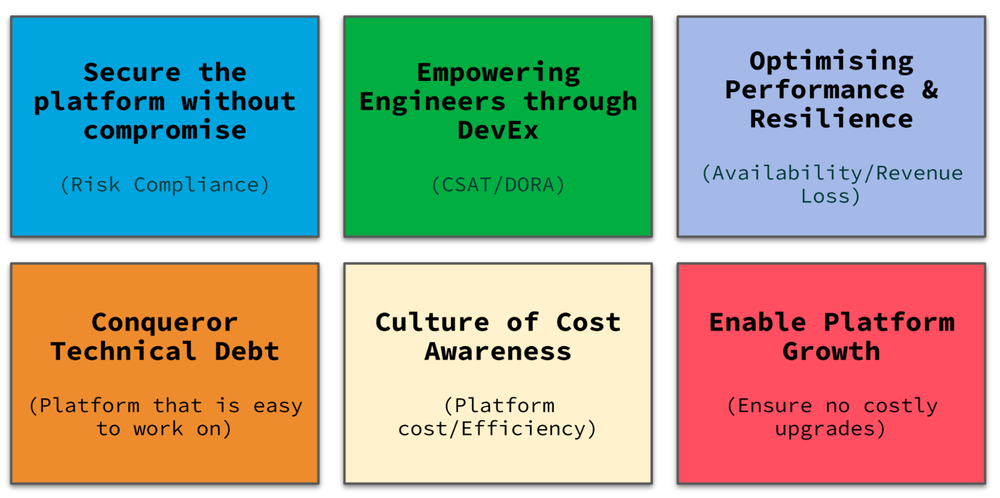
The six annual measures reported against every quarter. The specific measures have varied over the years.
In addition to this, in the first few years of the platform’s existence, there were three simple metrics that best indicated how the platform was living up to the rationale for creating it:
-
Service Creation Lead Time: How long it took to create a tenancy (the space in which a product team was creating their software)
-
Onboarding Lead Time: How long it took that product team to deploy something into production
- First Customer Lead Time: How long it took that product team to designate their service as “live to customers”

Some screenshots from the early version of the platform's self-written service catalogue, tracking the three metrics mentioned
This was then combined with the number of tenants present on the platform into a report, which was displayed as part of an initial home-grown Service Catalogue shown above (which was later replaced with Backstage). This report served two purposes:
-
A very clear visualization for stakeholders of how much their platform was being adopted, and how fast they were able to get up and running (in particular, “Service Creation” being measured in single-digit hours, in comparison to the weeks teams would traditionally have had to wait). This is important, because in the early days of your product, you need to justify its continued growth and investment.
-
A useful way for the platform team themselves (and stakeholders) to see which teams were taking their time about getting something into production. Is my product actually helping you? And if not, what more could we be doing?
Using this as a conversation-starter with our tenants opened doors to rich sources of feedback that could be turned into platform features: When we asked tenants “What’s stopping you from going live?”, they often answered that the product they were building was simply complex. But we also often saw that our own processes were getting in the way. This was important, as we could then do something about it.
The easiest of these barriers for us to overcome were typically technology-related. In previous articles, we covered two examples, “My team is spending a lot of time writing Terraform to provision PubSub,” and “we’re having trouble learning how to use Kubernetes.” To help, the platform team created “paved roads” to enable self-service provisioning or simplification of Kubernetes, significantly reducing these burdens for teams.
The more significant opportunities to streamline getting new services live were a result of our processes (e.g., security approvals) — and if your platform is empowered to simplify these sorts of organizational functions, then the gains can be extremely beneficial. One such example was the Information Security risk assurance process. Gaining the necessary security sign-offs and producing the required documentation was a necessary but time-consuming task, and - with the rate of change in the business - this was often something that many teams were going through in parallel. Our platform team successfully negotiated a simplified process for its tenants. It was able to do this because, by being resident on the platform, they could guarantee that security controls were in place and that policies were being followed. This was a direct result of the platform building features to meet those needs, and being able to provide evidence that they were being used — removing the need for the tenant team to either document or invent this themselves. This is still simplifying the developer experience through platform engineering, even though the solution is a less technically-based one.
Sometimes the conversation resulted in feedback that wasn’t even platform-shaped — for example, helping teams understand concepts like feature flagging and dark launching, or software design options to help break dependencies with legacy systems. John Lewis’ platform teams are staffed with experienced engineers, ideally ones with software development experience, which helps a lot with these sorts of interactions.
A key point here is that by measuring how effectively teams were making it into production, we could identify who to talk to and elucidate the feedback we needed on what problems needed to be addressed. Simply relying on your tenants thinking of this themselves when they don’t see the bigger picture (or have other priorities) is not nearly as effective.
We then combined the process with more traditional approaches such as sending out a survey or use of Net Promoter Scoring to help build popularity in the product. The results of these were usually very positive, and could be used to generate mindshare — especially where a product team was comfortable talking about their positive experiences in internal tech conferences and the like.
Helping understand team performance
A few years into the life of the platform, our emphasis started to shift. There was less of a need to prove the value of the platform — the business and our engineers were happy — so we shifted from “how can we get you into production as quickly as possible” towards “how can we enable you to continue to be as fast, but also reduce friction, in your day-to-day activities.” This led us towards DORA metrics.
Our initial DORA implementations involved mining information from our systems of record for change and incident, complimented by our already-mature observability stack for availability data, as well as pulling events from things like cloud audit logs. We built software to do this and stored it in BigQuery, which enabled us to visualize the data in our home-grown Service Catalogue tool. Later, we moved this into Grafana dashboards instead, which are still in use today:

Looking for patterns in this data led to us discovering additional features that would be useful for us to build. Two major examples of this were handling change, and operational readiness.
JLP’s service management processes were geared towards handling complex release processes across multiple large systems and/or teams - but we had fundamentally changed our architecture by adopting microservices. This empowered teams to release independently at will, and therefore manage the consequences of failed changes themselves. We used the data we’d collected about change failure rates and frequency of small releases to justify a different approach: allowing tenants to automatically raise and close changes as part of their CI/CD pipelines. After clearing this approach with our Service Management team, we developed a CLI tool that teams could use within their pipelines. This had the additional benefit of allowing us to capture useful data at point of release, rather than scraping more awkward data sources. The automated change “carrot” was very popular and was widely adopted, shifting the approval point left to the pull request rather than later in the release process. This reduced time wastage, change-set size and risk of collisions.
In a similar vein, with more teams operating their own services, the need for a central site-wide operations team was reduced. We could see from our metrics that teams practicing “You Build It, You Run It” had fewer incidents and were resolving them much more quickly. We used this as evidence to bring in tooling to help them respond to incidents faster, and decouple the centralized ops teams from those processes — in some cases allowing them to focus on legacy systems, and in others, removing the need for the service entirely (which resulted in significant cost savings, despite the fact that we had more individual product teams on-call). This, and supporting observability and alerting tooling, was all configured through the platform’s paved-road pipeline described in our previous article.
The DORA metrics helped us architecturally as well. Operational data shined a light on the brittleness of third-party and legacy services, thereby driving greater investment into resilience engineering, alternative solutions, and in some cases, causing us to re-evaluate our build vs. buy decisions.
Choosing what to measure
It’s very important to choose wisely about what to measure. Experts in the field (such as Laura Tacho) influenced us to avoid vanity metrics and to be cautious about interpreting the ones we do collect. It’s also important for metrics to be meaningful to the target audience, and presented accordingly.
As an example, we communicate about cost and vulnerability with our teams, but the form this takes depends on the intended audience’s role. For example, we send new vulnerabilities or spikes in cost directly to product teams’ collaboration channels, because experience has taught us that having our engineers see these vulnerabilities results in a faster response. On the other hand, for compliance reporting or review by team leads, reports are more effective at summarising the areas that need action. Because if we know one thing, it’s that nobody wants to be a leader of the “vulnerabilities outside of policy” dashboard!
It was not unusual for us to historically look at measures such as the number or frequency of incidents. But in a world of highly automated response systems, this is a trap, as alerts can be easily duplicated. Focusing too much on a number can drive the wrong behavior — at worst, deliberately avoiding creating an incident at all! Instead, it’s much better to focus on the impact of the parent incident and how long it took to recover. Another example is reporting on the number of vulnerabilities. Imagine you have a package that is used extensively across many components in a distributed system. Disclosing that the package has a vulnerability can create a false sense of scale, when in fact patching the base image deals with the problem swiftly. Instead, it’s better to look at the speed of response than a pre-agreed policy based on severity. This is both a much more effective and reasonable metric for teams to act on, so we see better engagement.
It’s very important that you put across as much context as possible when presenting the data so that the right conclusions can be drawn — especially where those reports are seen by decision-makers. With that in mind, we combined raw metrics we could visualize with user opinion about them. This helped to bring that missing context: Is the team that’s suffering from a high change failure rate also struggling with its release processes and batch size? Is the team that’s not addressing vulnerabilities quickly also reporting that they’re spending too much time on feature development and not enough on operational matters? We reached for a different tool — DX — to help us bring this sort of information to bear. In our follow-up article, we’ll elaborate on how we did this and how it prompted us to expand the data we collected about our tenants. Stay tuned!
To learn more about shifting down with platform engineering on Google Cloud, start here.
periolistos y su ADV
La reforma Sánchez-Escrivá dinamita el sistema de pensiones

El abogado de Mouliaá, indignado por la retirada de la denuncia: "Crea un precedente terrible"

ÚLTIMA HORA: Ruptura total entre EEUU e Irán: las conversaciones nucleares del viernes se cancelan
Las conversaciones nucleares previstas para este viernes entre Estados Unidos e Irán quedan canceladas, según informa Axios. El colapso llega tras la negativa iraní a incluir en la agenda cuestiones no nucleares como el programa de misiles balísticos. Washington advierte que las negociaciones están al borde de la ruptura total, aumentando la tensión geopolítica y el temor a una nueva escalada en Oriente Medio.
#ultimahora #eeuu #iran #marcorubio #diplomacia #tension #orientemedio #breakingnews #noticiasinternacionales #noticiasenespanol #negociostv
Si quieres entrar en la Academia de Negocios TV, este es el enlace:
https://www.youtube.com/channel/UCwd8Byi93KbnsYmCcKLExvQ/join
Síguenos en directo ➡️ https://bit.ly/2Ts9V3p
Suscríbete a nuestro canal: https://bit.ly/3jsMzp2
Suscríbete a nuestro segundo canal, másnegocios: https://n9.cl/4dca4
Visita Negocios TV https://bit.ly/2Ts9V3p
Más vídeos de Negocios TV: / @negociostv
Síguenos en Telegram: https://t.me/negociostv
Síguenos en Instagram: https://bit.ly/3oytWnd
Twitter: https://bit.ly/3jz6Lpt
Facebook: https://bit.ly/3e3kIuy
🔞Exención de responsabilidad: Toda la información, material y / o contenido incluido en este programa es sólo para fines informativos y educativos. Invertir en acciones, opciones y futuros es arriesgado y no es adecuado para todos los inversores. Consulte a su propio asesor financiero independiente antes de tomar cualquier decisión de inversión.
Negocios TV no se hace responsable de las opiniones expresadas en el vídeo.
Telegram alerta a sus usuarios españoles de los planes de Sánchez de censurar internet

Joven catalán increpa a una señora mayor en el metro de Barcelona por ser española: “Vete a España, muеrta de hambre”.

Me lo ha enviado el finolier César hoy, aunque sucedió en septiembre.
Ver post completo: Joven catalán increpa a una señora mayor en el metro de Barcelona por ser española: “Vete a España, muеrta de hambre”.
El hombre asqueroso declina la oferta de Pérez-Reverte.

En el evento de Reverte no, pero en TELEPEDRO, sí. Porque ya está en esa etapa pre-totalitaria.
10 doritos antes: Pablo Iglesias VS Fernando Paz sobre el Franquismo en El Gato al Agua.
Enviado por @Otrocontuiter
Ver post completo: El hombre asqueroso declina la oferta de Pérez-Reverte.
El dueño de Telegram alerta sobre la censura de Pedro Sánchez en un mensaje a todos sus usuarios


ÚLTIMA HORA: Wall Street en llamas: el Nasdaq se desploma tras la ruptura total entre Irán y EEUU
Wall Street vive una de sus sesiones más oscuras en lo que va de 2026. El Nasdaq 100 se desploma más de un 2%, perforando soportes críticos y dejándose más de 580 puntos en una venta masiva liderada por el sector de semiconductores e inteligencia artificial. La onda expansiva de los resultados de AMD, que se hunde un 16,8%, ha desatado el temor a una burbuja en la IA, arrastrando a gigantes como Nvidia (-3,94%) y Meta (-3,29%), que no logra convencer con su nueva estrategia de nube de inteligencia artificial.
La jornada se tiñe de rojo para las "Siete Magníficas", con Tesla sufriendo un duro castigo cercano al 5% tras los nuevos choques dialécticos entre Elon Musk y el presidente español, Pedro Sánchez, sumado a las nuevas restricciones regulatorias de China que obligarán a rediseñar los icónicos tiradores de puerta de sus vehículos. Mientras el mercado espera con nerviosismo los resultados de Alphabet y Qualcomm al cierre, Bitcoin acompaña el sentimiento de aversión al riesgo perdiendo los 73.000 dólares y confirmando la capitulación de los activos digitales en este "Miércoles Negro".
#ultimahora #nasdaq #bolsa #tecnologia #bitcoin #amd #nvidia #tesla #elonmusk #pedrosanchez #ia #mercados #wallstreet #breakingnews #negociostv
Si quieres entrar en la Academia de Negocios TV, este es el enlace:
https://www.youtube.com/channel/UCwd8Byi93KbnsYmCcKLExvQ/join
Síguenos en directo ➡️ https://bit.ly/2Ts9V3p
Suscríbete a nuestro canal: https://bit.ly/3jsMzp2
Suscríbete a nuestro segundo canal, másnegocios: https://n9.cl/4dca4
Visita Negocios TV https://bit.ly/2Ts9V3p
Más vídeos de Negocios TV: https://youtube.com/@NegociosTV
Síguenos en Telegram: https://t.me/negociostv
Síguenos en Instagram: https://bit.ly/3oytWnd
Twitter: https://bit.ly/3jz6Lpt
Facebook: https://bit.ly/3e3kIuy
🔞Exención de responsabilidad: Toda la información, material y / o contenido incluido en este programa es sólo para fines informativos y educativos. Invertir en acciones, opciones y futuros es arriesgado y no es adecuado para todos los inversores. Consulte a su propio asesor financiero independiente antes de tomar cualquier decisión de inversión.
Negocios TV no se hace responsable de las opiniones expresadas en el vídeo.
Cadena perpetua para el acusado de intentar asesinar a Trump en su campo de golf de Florida

Ryan Routh ha sido declarado culpable de intentar asesinar al entonces candidato presidencial, usar un arma de fuego para cometer un delito, agredir a un agente federal, posesión de un arma de fuego por parte de un delincuente y usar un arma con el número de serie alterado
El jurado declara culpable al acusado de intentar asesinar a Trump en un campo de golf de Florida
Cadena perpetua. El hombre procesado por intentar asesinar al presidente de EEUU, Donald Trump, en un campo de golf de Florida en 2024 ha sido sentenciado este miércoles a pasar toda la vida en la cárcel.
La jueza federal de distrito Aileen Cannon ha dictado la sentencia de Ryan Routh en la misma sala del tribunal de Fort Pierce en la que el condenado intentó apuñalarse a sí mismo en septiembre pasado poco después de que el jurado lo declarara culpable de todos los cargos, informa AP.
Los fiscales habían solicitado cadena perpetua sin posibilidad de libertad condicional, argumentando que Routh no muestra arrepentimiento y nunca se ha disculpado.
El abogado defensor asignado para la audiencia solicitó 27 años, señalando que Routh ya tiene casi 60 años. Routh también ha sido condenado a una sentencia consecutiva de siete años por uno de sus delitos relacionados con armas de fuego.
La sentencia de Routh estaba programada inicialmente para diciembre, pero Cannon accedió a posponer la fecha después de que Routh decidiera contratar a un abogado para la fase de sentencia, en lugar de representarse a sí mismo como lo hizo durante la mayor parte del juicio.
Los fiscales indicaron que Routh aún no ha aceptado ninguna responsabilidad y que debería pasar el resto de su vida en prisión, de acuerdo con las directrices federales.
El condenado ha sido declarado culpable de intentar asesinar al entonces candidato presidencial, usar un arma de fuego para cometer un delito, agredir a un agente federal, posesión de un arma de fuego por parte de un delincuente y usar un arma con el número de serie alterado.
“Routh sigue sin arrepentirse de sus crímenes, nunca se disculpó por las vidas que puso en peligro, y su vida demuestra un desprecio casi total por la ley”, decía el escrito fiscal.
El nuevo abogado defensor de Routh, Martin L. Roth, solicitó una excepción a las directrices de sentencia: 20 años de prisión además de una sentencia obligatoria de siete años por uno de los delitos relacionados con armas de fuego.
“El acusado está a dos semanas de cumplir 60 años”, escribió Roth en su escrito: “Un castigo justo proporcionaría una sentencia lo suficientemente larga como para imponer un castigo suficiente pero no excesivo, y permitir que el acusado experimente la libertad nuevamente en lugar de morir en prisión”.
Los fiscales dijeron que Routh pasó semanas planeando matar a Trump antes de apuntar con un rifle a través de la vegetación mientras el candidato presidencial republicano jugaba al golf el 15 de septiembre de 2024 en su club de campo de West Palm Beach.
En el juicio de Routh, un agente del Servicio Secreto que ayudaba a proteger a Trump en el campo de golf testificó que vio a Routh antes de que Trump apareciera. Routh apuntó con su rifle al agente, quien abrió fuego, lo que provocó que Routh soltara su arma y huyera sin disparar.
En la solicitud para obtener un abogado, Routh ofreció intercambiar su vida en un canje de prisioneros con personas detenidas injustamente en otros países, y dijo que la oferta de que Trump “descargara sus frustraciones en mi cara” seguía en pie.
“Solo un cuarto de pulgada más atrás y no tendríamos que lidiar con todo este lío, pero siempre fracaso en todo (como de costumbre)”, escribió Routh.
En su decisión de concederle un abogado a Routh, la jueza Cannon criticó la “farsa irrespetuosa” de la solicitud de Routh, diciendo que se burlaba del proceso judicial. Pero la jueza, nominada por Trump en 2020, dijo que prefería inclinarse por garantizar la representación legal.
Cannon aprobó el verano pasado la solicitud de Routh para representarse a sí mismo en el juicio. La Corte Suprema de Estados Unidos ha dictaminado que los acusados en casos penales tienen derecho a representarse a sí mismos en los procedimientos judiciales, siempre y cuando puedan demostrar ante un juez que son competentes para renunciar a su derecho a ser defendidos por un abogado.
Los antiguos defensores públicos federales de Routh actuaron como abogados de apoyo y estuvieron presentes durante el juicio.
Routh tenía múltiples condenas previas por delitos graves, incluida la posesión de bienes robados, y una amplia presencia en internet que demostraba su desprecio por Trump. En un libro autopublicado, animó a Irán a asesinarlo, y en un momento dado escribió que, como votante de Trump, debía asumir parte de la culpa por haberlo elegido.
AWS IAM Identity Center now supports multi-Region replication for AWS account access and application use
Today, we’re announcing the general availability of AWS IAM Identity Center multi-Region support to enable AWS account access and managed application use in additional AWS Regions.
With this feature, you can replicate your workforce identities, permission sets, and other metadata in your organization instance of IAM Identity Center connected to an external identity provider (IdP), such as Microsoft Entra ID and Okta, from its current primary Region to additional Regions for improved resiliency of AWS account access.
You can also deploy AWS managed applications in your preferred Regions, close to application users and datasets for improved user experience or to meet data residency requirements. Your applications deployed in additional Regions access replicated workforce identities locally for optimal performance and reliability.
When you replicate your workforce identities to an additional Region, your workforce gets an active AWS access portal endpoint in that Region. This means that in the unlikely event of an IAM Identity Center service disruption in its primary Region, your workforce can still access their AWS accounts through the AWS access portal in an additional Region using already provisioned permissions. You can continue to manage IAM Identity Center configurations from the primary Region, maintaining centralized control.
Enable IAM Identity Center in multiple Regions
To get started, you should confirm that the AWS managed applications you’re currently using support customer managed AWS Key Management Service (AWS KMS) key enabled in AWS Identity Center. When we introduced this feature in October 2025, Seb recommended using multi-Region AWS KMS keys unless your company policies restrict you to single-Region keys. Multi-Region keys provide consistent key material across Regions while maintaining independent key infrastructure in each Region.
Before replicating IAM Identity Center to an additional Region, you must first replicate the customer managed AWS KMS key to that Region and configure the replica key with the permissions required for IAM Identity Center operations. For instructions on creating multi-Region replica keys, refer to Create multi-Region replica keys in the AWS KMS Developer Guide.
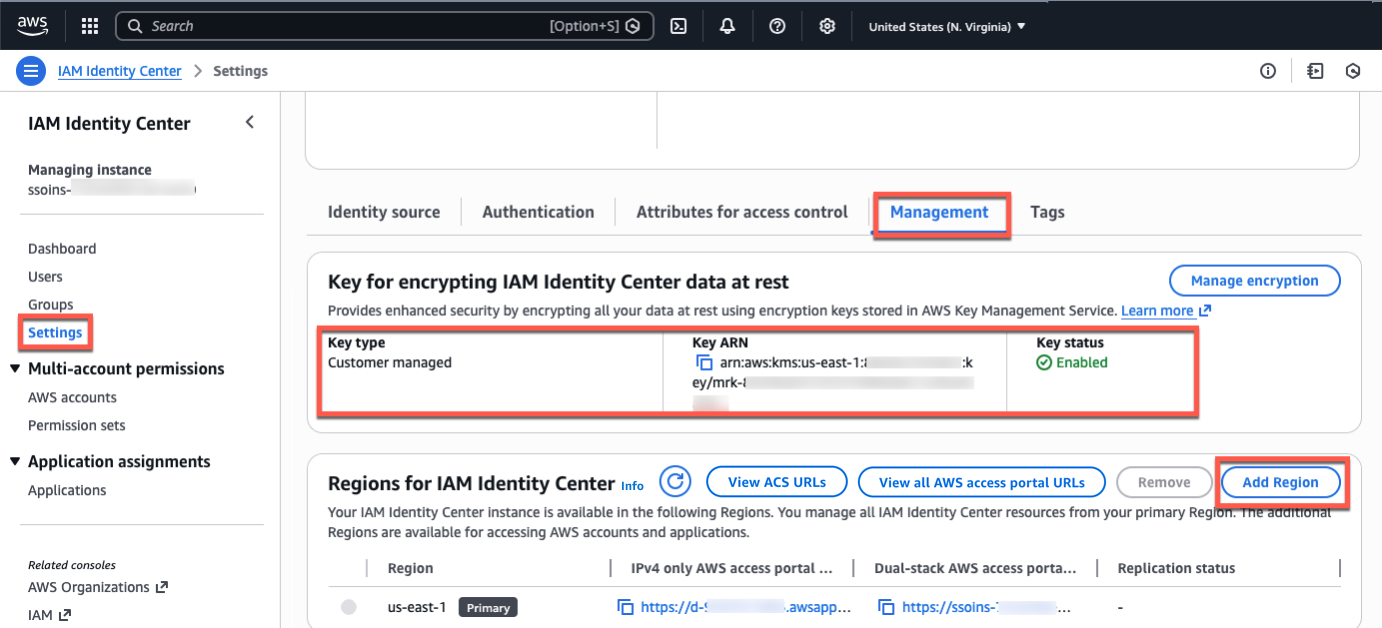
Go to the IAM Identity Center console in the primary Region, for example, US East (N. Virginia), choose Settings in the left-navigation pane, and select the Management tab. Confirm that your configured encryption key is a multi-Region customer managed AWS KMS key. To add more Regions, choose Add Region.
You can choose additional Regions to replicate the IAM Identity Center in a list of the available Regions. When choosing an additional Region, consider your intended use cases, for example, data compliance or user experience.
If you want to run AWS managed applications that access datasets limited to a specific Region for compliance reasons, choose the Region where the datasets reside. If you plan to use the additional Region to deploy AWS applications, verify that the required applications support your chosen Region and deployment in additional Regions.
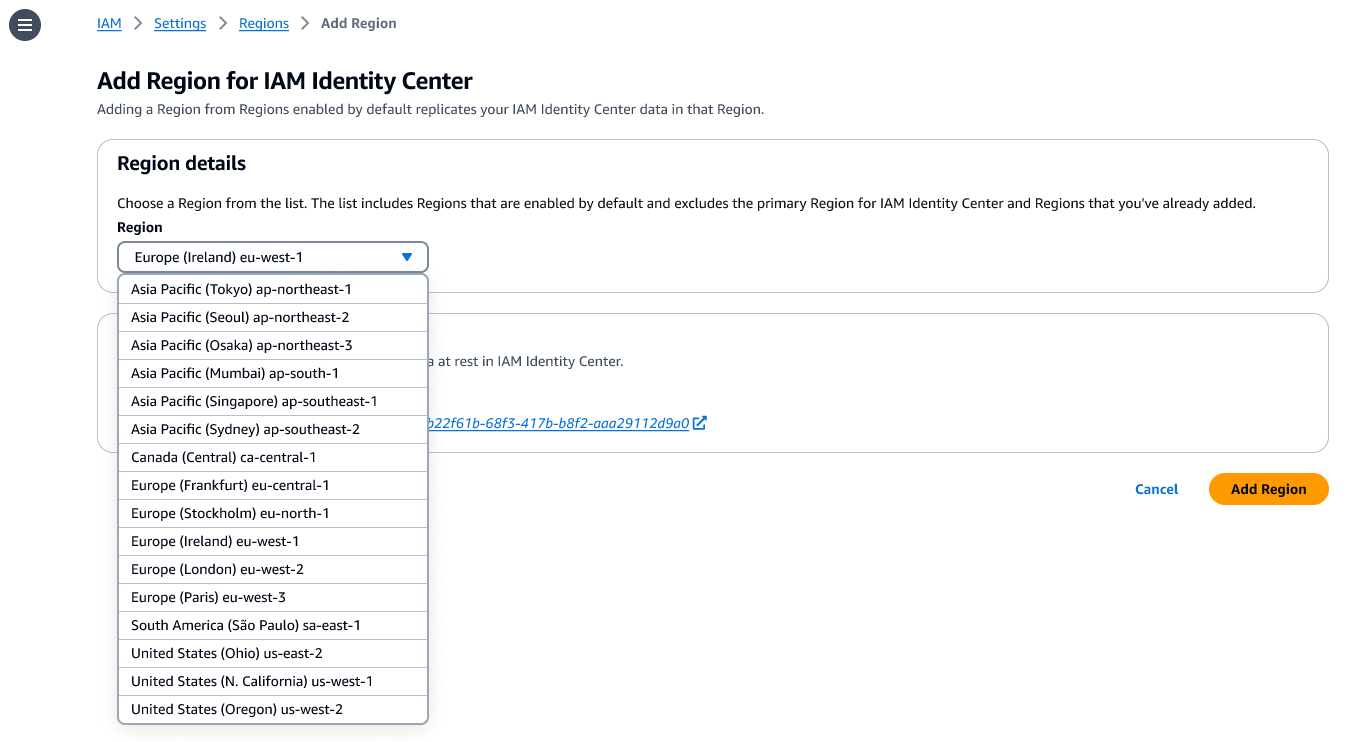
Choose Add Region. This starts the initial replication whose duration depends on the size of your Identity Center instance.
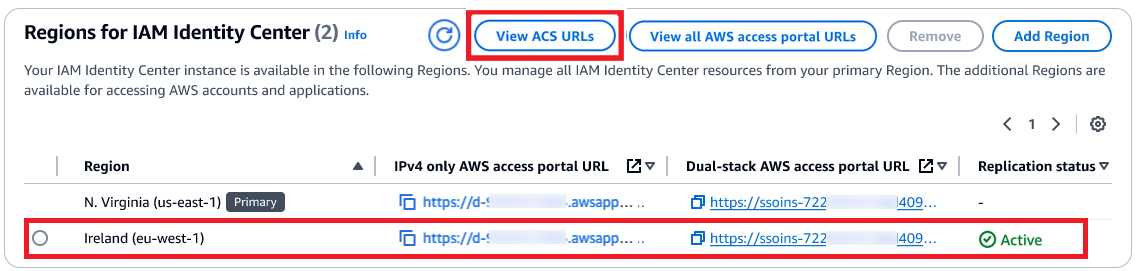
After the replication is completed, your users can access their AWS accounts and applications in this new Region. When you choose View ACS URLs, you can view SAML information, such as an Assertion Consumer Service (ACS) URL, about the primary and additional Regions.
How your workforce can use an additional Region
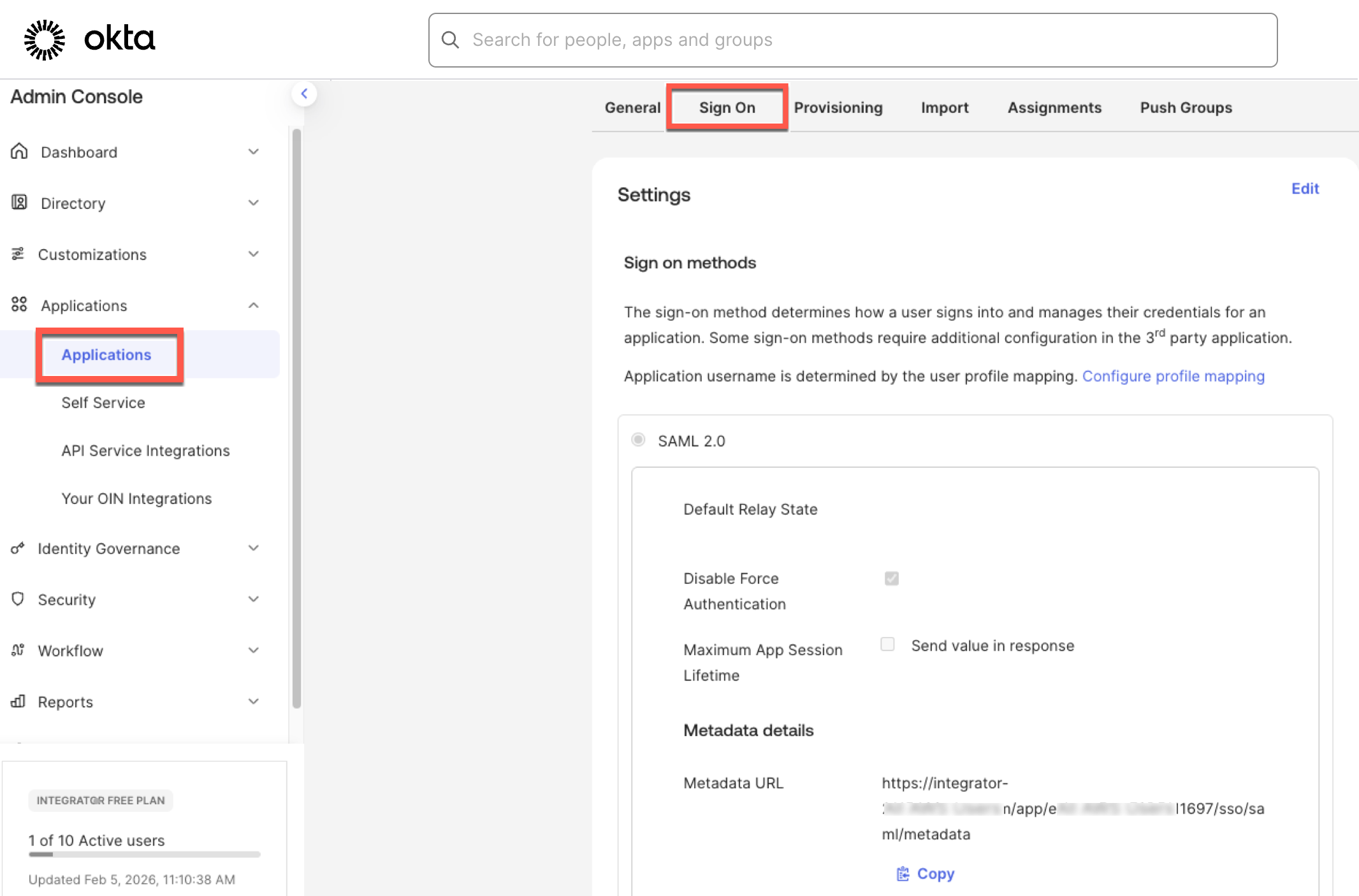
AWS Identity Center supports SAML single sign-on with external IdPs, such as Microsoft Entra ID and Okta. Upon authentication in the IdP, the user is redirected to the AWS access portal. To enable the user to be redirected to the AWS access portal in the newly added Region, you need to add the additional Region’s ACS URL to the IdP configuration.
The following screenshots show you how to do this in the Okta admin console:
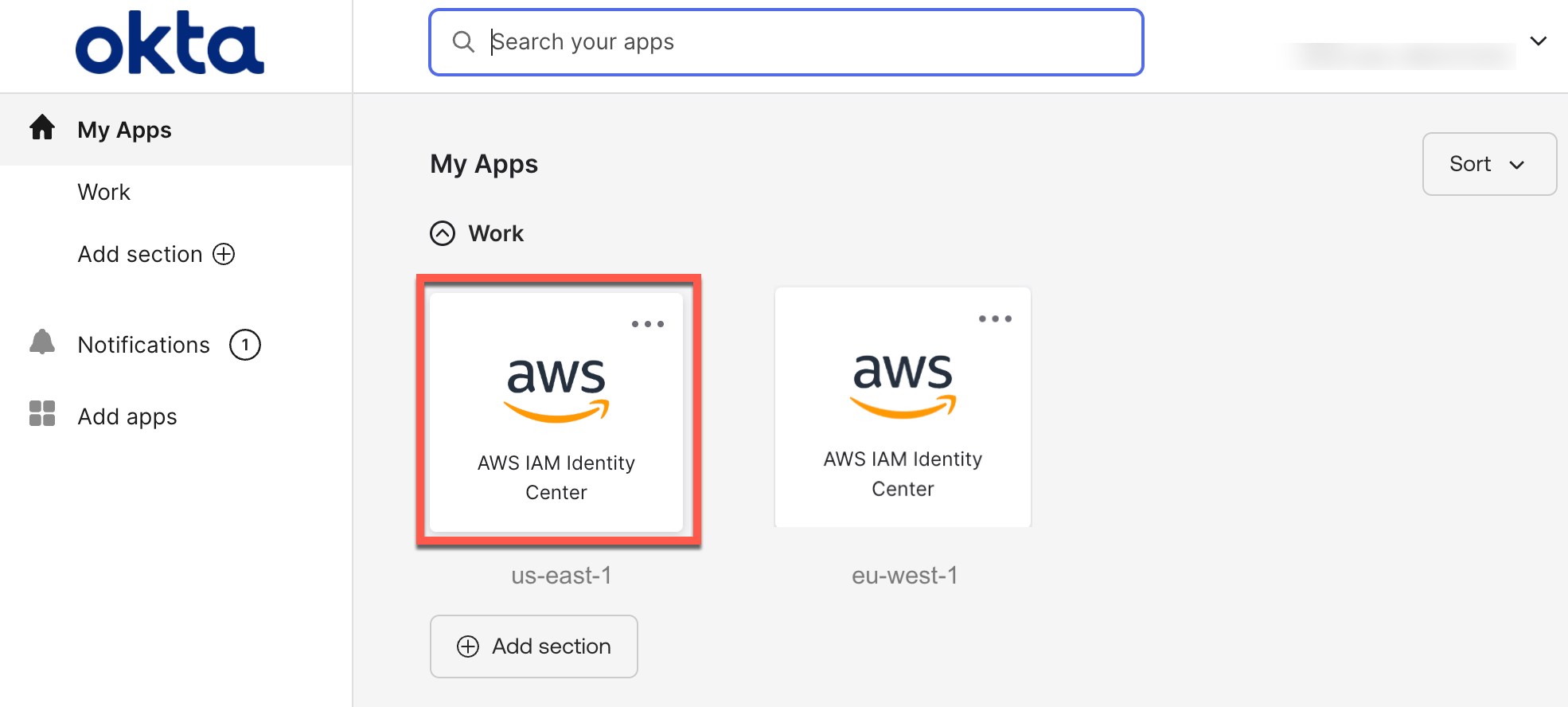
Then, you can create a bookmark application in your identity provider for users to discover the additional Region. This bookmark app functions like a browser bookmark and contains only the URL to the AWS access portal in the additional Region.
You can also deploy AWS managed applications in additional Regions using your existing deployment workflows. Your users can access applications or accounts using the existing access methods, such as the AWS access portal, an application link, or through the AWS Command Line Interface (AWS CLI).
To learn more about which AWS managed applications support deployment in additional Regions, visit the IAM Identity Center User Guide.
Things to know
Here are key considerations to know about this feature:
- Consideration – To take advantage of this feature at launch, you must be using an organization instance of IAM Identity Center connected to an external IdP. Also, the primary and additional Regions must be enabled by default in an AWS account. Account instances of IAM Identity Center, and the other two identity sources (Microsoft Active Directory and IAM Identity Center directory) are presently not supported.
- Operation – The primary Region remains the central place for managing workforce identities, account access permissions, external IdP, and other configurations. You can use the IAM Identity Center console in additional Regions with a limited feature set. Most operations are read-only, except for application management and user session revocation.
- Monitoring – All workforce actions are emitted in AWS CloudTrail in the Region where the action was performed. This feature enhances account access continuity. You can set up break-glass access for privileged users to access AWS if the external IdP has a service disruption.
Now available
AWS IAM Identity Center multi-Region support is now available in the 17 enabled-by-default commercial AWS Regions. For Regional availability and a future roadmap, visit the AWS Capabilities by Region. You can use this feature at no additional cost. Standard AWS KMS charges apply for storing and using customer managed keys.
Give it a try in the AWS Identity Center console. To learn more, visit the IAM Identity Center User Guide and send feedback to AWS re:Post for Identity Center or through your usual AWS Support contacts.
— Channy
Updated on February 5th — Fixed the Okta admin console screenshot.
Netflix says users can cancel service if HBO Max merger makes it too expensive
A potential deal between Netflix and Warner Bros. Discovery’s (WBD) streaming and movie studio businesses has raised fresh concerns about consolidation in the streaming industry. Attempting to quell fears that an acquisition of WBD’s streaming and movie studio businesses might lead to higher prices, Netflix Co-CEO Ted Sarados suggested in a Senate hearing today that any merger would have the opposite effect.
During the hearing, which was held by the US Senate Judiciary Committee’s Subcommittee on Antitrust, Competition Policy, and Consumer Rights, Sarandos sought to convince the senators that Netflix wouldn’t hold a streaming monopoly if regulators allow the acquisition to close.
Netflix is the largest subscription video-on-demand (SVOD) provider by subscribers (301.63 million as of January 2025), and WBD is the third (128 million streaming subscribers, including users of HBO Max and, to a lesser degree, Discovery+).

"Eres la peor, nunca te he visto sonreír en 10 años": los insultos de Trump a las periodistas que delatan su machismo y afán de censura

"Eres el peor periodista. Creo que nunca te he visto sonreír. Tu organización debería avergonzarse de ti", le dice el presidente de EEUU a la corresponsal en la Casa Blanca de la CNN, Kaitlan Collins, en un nuevo ejemplo de los constantes asaltos a las libertades desde la Casa Blanca
Trump acelera en su agenda autoritaria y anima a los republicanos a “nacionalizar” las elecciones en “al menos” 15 estados
A mí no suele gustarme hablar de nosotros mismos, los periodistas. A menudo nos consideramos importantes por pasar muchos días cerca de personas que realmente son importantes. Pero ocurre, siempre ha ocurrido, que hay perfiles más conocidos que otros para la ciudadanía. Cuando yo empezaba en esto como becario en el diario El País hace tres décadas, algunos veteranos decían que había quien compraba el periódico solo para leer las críticas de cine de Ángel Fernández Santos; las de toros de Joaquín Vidal, aunque ni siquiera le gustaran los toros; o las columnas de Manuel Vázquez Montalbán; Eduardo Haro Tecglen; Rosa Montero o Maruja Torres.
Es decir, siempre ha habido periodistas que han marcado la diferencia, que han trascendido. Y hoy sigue habiéndolos. Pero, al margen de ese puñado de referentes que nunca dejarán de existir, a mí suele gustarme muy poco la conversación sobre periodistas y la prensa.
Sin embargo, cuando ves que el Ejército israelí prohíbe la entrada de periodistas en Gaza y asesina por cientos a los que ya están allí, tenemos la obligación de denunciar unos crímenes que persiguen silenciar las informaciones sobre el genocidio cometido contra los palestinos.
Del mismo modo, cuando el presidente más poderoso del mundo se permite el lujo de insultar a una periodista de la CNN en el Despacho Oval, el mensaje es poderoso: persigue amedrentar, disciplinar, que el siguiente que pregunte cambie de tema para evitar las invectivas.
Y es algo que el presidente de EEUU hace a menudo, y con quienes más se recrea en sus ataques es con las mujeres, en un claro síntoma de su machismo y afán de censura.
El machismo viene de lejos. No en vano, Donald Trump fue condenado por intentar comprar el silencio de Stormy Daniels y, también, a pagar 5 millones de dólares por haber sido encontrado culpable de abuso sexual contra la columnista E. Jean Carroll. Del mismo modo, y se ha seguido comprobando estos días en los que el Departamento de Justicia ha publicado más de tres millones de documentos del depredador sexual Jeffrey Epstein, es evidente la presencia de Trump en las fiestas del financiero.
Pero no solo eso. A Nancy Cordes, cuando cuestionaba al presidente de EEUU acerca de su interpretación del tiroteo cometido por un ciudadano afgano que trabajó en su país para la CIA, ocurrido en Washington DC, cerca de la Casa Blanca, contra dos soldados de la Guardia Nacional y que se cobró una muerte, Trump le dijo: “¿Eres estúpida?”
El furioso ataque de Trump a la periodista llegó después de que ella le preguntara: “El inspector general del Departamento de Justicia ha informado que el Departamento de Seguridad Nacional y el FBI llevaron a cabo una investigación exhaustiva de los afganos que fueron traídos a Estados Unidos, entonces, ¿por qué culpa a la administración Biden?”.
“Porque los dejaron entrar”, contestó, Trump: “¿Eres estúpida? Eres una persona estúpida, porque llegaron en avión, junto con miles de otras personas que no deberían estar aquí, y solo haces preguntas porque eres una persona estúpida”.
Del mismo modo, el insulto que lanzó a Catherine Lucey, de Bloomberg, en el Air Force One fue algo que no ocurriría con un hombre. “Quiet, quiet, piggy [cállate, cerdita]!”, le dijo a Lucey cuando preguntaba en el avión que llevaba a Trump el viernes por la tarde a jugar al golf a Florida.
Días después, atacó a la corresponsal de la televisión ABC en la Casa Blanca, Mary Bruce, tras una pregunta considerada “vergonzosa” por Trump que tenía que ver con el asesinato del periodista Jamal Khashoggi. Y el invitado avergonzado era el príncipe saudí Mohammed bin Salman, sobre quien pesa la acusación internacional de haber estado detrás de la muerte de Kashoggi en el consulado saudí de Estambul en 2018.
“Hablas de alguien que fue muy polémico”, justificó Trump: “A mucha gente no le gustaba ese señor del que hablas; te cayera bien o mal, son cosas que pasan, pero él no sabía nada al respecto. Y podemos dejarlo así. No tienes por qué avergonzar a nuestro invitado con esa pregunta”.
“Creo que deberían revocarle la licencia a ABC, porque sus noticias son falsas y erróneas”, ha amenazado el presidente de EEUU.
La amenaza de revocar licencias no es la primera vez que sale de Trump. También lo dijo varias veces en septiembre, después de presionar a la CBS para no renovar a Stephen Colbert y a la ABC con Jimmy Kimmel.
Los insultos de este martes a Kaitlan Collins siguen el mismo patrón de recrearse en los ataques a las mujeres, pero, también, muestran lo nervioso que se pone Trump cuando le preguntan por Jeffrey Epstein, con quien tuvo una relación estrecha durante un tiempo.
“¿Qué les diría a las víctimas que sienten que no han obtenido justicia?”, ha preguntado este martes Kaitlan Collins, de la CNN, a Donald Trump en el Despacho Oval. Y ha respondido: “Eres la peor periodista. No me extraña que la CNN no tenga audiencia por culpa de gente como tú. Es una mujer joven. Creo que nunca te he visto sonreír. Te conozco desde hace diez años y creo que nunca te he visto sonreír”.
Ataques, censura y autocensura
Cuando alguien recibe un ataque directo del presidente más poderoso del mundo lo normal es que haya consecuencias. En este caso, la siguiente periodista ya cambió de tema. No insistió sobre las víctimas de Epstein, ni sobre la censura excesiva que denuncian de los archivos publicados, y, por supuesto, tampoco defendió a la compañera atacada.
En estos días, el presidente de EEUU ha anunciado un cierre de dos años del Kennedy Center por unas obras de remodelación. Lo que no ha dicho Trump es que su asalto al centro artístico –hasta el punto de incluir su apellido en el nombre de la institución– está teniendo como consecuencia una oleada de anulaciones por parte de los artistas y del público.
Del mismo modo que atacar a periodistas disciplina al resto que quieren preguntar, la censura y la autocensura exceden el ámbito de la prensa.
Este fin de semana me he dado una vuelta por la National Portrait Gallery, un museo centrado en los retratos y que reúne los realizados para los 47 presidentes de Estados Unidos. La National Portrait Gallery, además es un ejemplo de la censura y la autocensura que se vive en el país gobernado por Donald Trump.
Por ejemplo, Amy Sherald, la artista que saltó a la fama con su retrato de Michelle Obama en 2018, retiró su exposición de la National Portrait Gallery en septiembre pasado porque el museo, en un acto claro de autocensura, no quería exhibir Transforming Liberty, su obra de la Estatua de la Libertad trans para evitar provocar al presidente Trump.

Pero no es el único caso de censura y autocensura de uno de los museos más importantes de la capital de EEUU.
Nada más regresar a la Casa Blanca, Donald Trump publicó en Truth Social: “A petición y recomendación de muchas personas, por la presente doy por terminado el contrato de Kim Sajet como directora de la National Portrait Gallery”. Según el post, Sajet era “una persona muy partidista” y una “firme defensora” de los programas de diversidad e inclusión. “Su reemplazo será nombrado en breve”, continuaba el mensaje.
Sajet es una historiadora del arte de unos 60 años, neerlandesa y criada en Australia.
El 27 de marzo, Trump firmó un decreto que afirmaba que los museos del Smithsonian, uno de los cuales es la National Portrait Gallery, habían “caído bajo la influencia de una ideología divisiva y centrada en la raza” que “promovía narrativas que presentan los valores estadounidenses y occidentales como intrínsecamente dañinos y opresivos”. La orden ejecutiva se titulaba “Restaurando la verdad y la cordura en la historia estadounidense”.
La consecuencia de esta ofensiva censora está haciendo mella. Un ejemplo elocuente de ello es que la galería borró hace tres semanas la pequeña descripción que acompaña al retrato de Trump. ¿El motivo? Que al presidente de EEUU no le gustaba el texto porque mencionaba sus dos juicios políticos –impeachment–.

La nota del retrato de Trump mencionaba las nominaciones de Trump al Tribunal Supremo, el desarrollo de la vacuna contra la COVID-19 y que fue sometido a un juicio político dos veces “por cargos de abuso de poder e incitación a la insurrección” antes de ser absuelto por el Senado en ambos casos.
En cambio, el escueto texto que hoy lo acompaña sólo identifica el año de nacimiento de Trump, que es el 45º y 47º presidente, las fechas de su presidencia e información sobre el fotógrafo y la fotografía.
Afán de censura, insultos a periodistas y machismo. La Administración Trump profundiza su agenda ultra y autoritaria en todos los rincones de EEUU.

From guardrails to governance: A CEO’s guide for securing agentic systems
The previous article in this series, “Rules fail at the prompt, succeed at the boundary,” focused on the first AI-orchestrated espionage campaign and the failure of prompt-level control. This article is the prescription. The question every CEO is now getting from their board is some version of: What do we do about agent risk?

Across recent AI security guidance from standards bodies, regulators, and major providers, a simple idea keeps repeating: treat agents like powerful, semi-autonomous users, and enforce rules at the boundaries where they touch identity, tools, data, and outputs.
The following is an actionable eight-step plan one can ask teams to implement and report against:

Constrain capabilities
These steps help define identity and limit capabilities.
1. Identity and scope: Make agents real users with narrow jobs
Today, agents run under vague, over-privileged service identities. The fix is straightforward: treat each agent as a non-human principal with the same discipline applied to employees.
Every agent should run as the requesting user in the correct tenant, with permissions constrained to that user’s role and geography. Prohibit cross-tenant on-behalf-of shortcuts. Anything high-impact should require explicit human approval with a recorded rationale. That is how Google’s Secure AI Framework (SAIF) and NIST AI’s access-control guidance are meant to be applied in practice.
The CEO question: Can we show, today, a list of our agents and exactly what each is allowed to do?
2. Tooling control: Pin, approve, and bound what agents can use
The Anthropic espionage framework worked because the attackers could wire Claude into a flexible suite of tools (e.g., scanners, exploit frameworks, data parsers) through Model Context Protocol, and those tools weren’t pinned or policy-gated.
The defense is to treat toolchains like a supply chain:
- Pin versions of remote tool servers.
- Require approvals for adding new tools, scopes, or data sources.
- Forbid automatic tool-chaining unless a policy explicitly allows it.
This is exactly what OWASP flags under excessive agency and what it recommends protecting against. Under the EU AI Act, designing for such cyber-resilience and misuse resistance is part of the Article 15 obligation to ensure robustness and cybersecurity.
The CEO question: Who signs off when an agent gains a new tool or a broader scope? How does one know?
3. Permissions by design: Bind tools to tasks, not to models
A common anti-pattern is to give the model a long-lived credential and hope prompts keep it polite. SAIF and NIST argue the opposite: credentials and scopes should be bound to tools and tasks, rotated regularly, and auditable. Agents then request narrowly scoped capabilities through those tools.
In practice, that looks like: “finance-ops-agent may read, but not write, certain ledgers without CFO approval.”
The CEO question: Can we revoke a specific capability from an agent without re-architecting the whole system?
Control data and behavior
These steps gate inputs, outputs, and constrain behavior.
4. Inputs, memory, and RAG: Treat external content as hostile until proven otherwise
Most agent incidents start with sneaky data: a poisoned web page, PDF, email, or repository that smuggles adversarial instructions into the system. OWASP’s prompt-injection cheat sheet and OpenAI’s own guidance both insist on strict separation of system instructions from user content and on treating unvetted retrieval sources as untrusted.
Operationally, gate before anything enters retrieval or long-term memory: new sources are reviewed, tagged, and onboarded; persistent memory is disabled when untrusted context is present; provenance is attached to each chunk.
The CEO question: Can we enumerate every external content source our agents learn from, and who approved them?
5. Output handling and rendering: Nothing executes “just because the model said so”
In the Anthropic case, AI-generated exploit code and credential dumps flowed straight into action. Any output that can cause a side effect needs a validator between the agent and the real world. OWASP’s insecure output handling category is explicit on this point, as are browser security best practices around origin boundaries.
The CEO question: Where, in our architecture, are agent outputs assessed before they run or ship to customers?
6. Data privacy at runtime: Protect the data first, then the model
Protect the data such that there is nothing dangerous to reveal by default. NIST and SAIF both lean toward “secure-by-default” designs where sensitive values are tokenized or masked and only re-hydrated for authorized users and use cases.
In agentic systems, that means policy-controlled detokenization at the output boundary and logging every reveal. If an agent is fully compromised, the blast radius is bounded by what the policy lets it see.
This is where the AI stack intersects not just with the EU AI Act but with GDPR and sector-specific regimes. The EU AI Act expects providers and deployers to manage AI-specific risk; runtime tokenization and policy-gated reveal are strong evidence that one is actively controlling those risks in production.
The CEO question: When our agents touch regulated data, is that protection enforced by architecture or by promises?
Prove governance and resilience
For the final steps, it’s important to show controls work and keep working.
7. Continuous evaluation: Don’t ship a one-time test, ship a test harness
Anthropic’s research about sleeper agents should eliminate all fantasies about single test dreams and show how critical continuous evaluation is. This means instrumenting agents with deep observability, regularly red teaming with adversarial test suites, and backing everything with robust logging and evidence, so failures become both regression tests and enforceable policy updates.
The CEO question: Who works to break our agents every week, and how do their findings change policy?
8. Governance, inventory, and audit: Keep score in one place
AI security frameworks emphasize inventory and evidence: enterprises must know which models, prompts, tools, datasets, and vector stores they have, who owns them, and what decisions were taken about risk.
For agents, that means a living catalog and unified logs:
- Which agents exist, on which platforms
- What scopes, tools, and data each is allowed
- Every approval, detokenization, and high-impact action, with who approved it and when
The CEO question: If asked how an agent made a specific decision, could we reconstruct the chain?
And don’t forget the system-level threat model: assume the threat actor GTG-1002 is already in your enterprise. To complete enterprise preparedness, zoom out and consider the MITRE ATLAS product, which exists precisely because adversaries attack systems, not models. Anthropic provides a case study of a state-based threat actor (GTG-1002) doing exactly that with an agentic framework.
Taken together, these controls do not make agents magically safe. They do something more familiar and more reliable: they put AI, its access, and actions back inside the same security frame used for any powerful user or system.
For boards and CEOs, the question is no longer “Do we have good AI guardrails?” It’s: Can we answer the CEO questions above with evidence, not assurances?
This content was produced by Protegrity. It was not written by MIT Technology Review’s editorial staff.
El 'Washington Post' anuncia el despido de un tercio de su plantilla

El periódico ha estado perdiendo suscriptores debido a decisiones tomadas por el propietario y dueño de Amazon, Jeff Bezos, como la de retirar su apoyo a Kamala Harris, durante las elecciones presidenciales de 2024 frente a Trump, y reorientar las páginas de opinión hacia una línea más conservadora
El Washington Post está despidiendo a un tercio de su personal en la redacción y otros departamentos. El diario, propiedad del dueño de Amazon, Jeff Bezos, ha comenzado a aplicar los recortes este miércoles, incluyendo la eliminación de su sección de deportes y la reducción del número de periodistas que tiene en el extranjero.
Los cambios han sido anunciados por el editor ejecutivo, Matt Murray, en una reunión por Zoom con el personal, informa Associated Press.
La reducción de personal representa un importante golpe para el Post, periódico que ha pasado a la historia por sus revelaciones sobre el caso Watergate.
La plantilla ha sido informada de que recibirían correos electrónicos anunciando si su puesto había sido eliminado o no. Un representante del Post confirmó que se despediría a un tercio del personal, sin especificar el número total de empleados del periódico, informa AP.
La sección de libros del periódico se cerrará, y su sección de noticias del área de Washington y el personal de edición se reestructurarán, según informó Murray a los empleados.
El podcast Post Reports será suspendido.
Murray reconoció que los recortes serán un golpe, pero afirmó que el objetivo es crear un Post que pueda crecer y prosperar de nuevo.
“El Washington Post está tomando hoy una serie de medidas difíciles pero decisivas para nuestro futuro, lo que representa una importante reestructuración en toda la empresa”, ha dicho un portavoz del Post en un comunicado: “Estas medidas están diseñadas para fortalecer nuestra posición y centrar nuestra atención en ofrecer el periodismo distintivo que diferencia al Post y, lo que es más importante, que atrae a nuestros lectores”.
Como empresa privada, el Post no revela el número de suscriptores que tiene, aunque se estima que ronda los 2 millones.
Estas medidas se esperaban desde hacía varias semanas, cuando se filtró la noticia de que el Post había comunicado a sus periodistas deportivos que tenían previsto cubrir los Juegos Olímpicos de Invierno en Italia que no irían. Tras hacerse público, el Post dio marcha atrás y anunció que enviaría un equipo reducido.
Los problemas del Post contrastan con la situación de su competidor de siempre, The New York Times, que ha prosperado en los últimos años, en gran parte gracias a las inversiones en productos complementarios como su sitio web de juegos y las recomendaciones de Wirecutter.
El Times ha duplicado su plantilla en la última década.
En las últimas semanas, muchos empleados del Washington Post han apelado directamente al propietario del periódico, el multimillonario fundador de Amazon, Jeff Bezos. El periódico ha estado perdiendo suscriptores, en parte debido a decisiones tomadas por él, como retirar su apoyo a Kamala Harris, demócrata, durante las elecciones presidenciales de 2024 contra Trump, republicano, y reorientar las páginas de opinión hacia una línea más conservadora.
El sindicato de los empleados del Washington Post, el Washington Post Guild, hizo un llamamiento para que los lectores enviaran un mensaje a Bezos: “¡Ya basta! Sin el personal del Washington Post, no hay Washington Post”.
“Tras pagar 40 millones de dólares por la película de Melania, Bezos está despidiendo a cientos de periodistas del Washington Post que nos informan sobre hechos reales”, ha afirmado el congresista por Texas y líder del Progressive Caucus, Greg Casar: “Mientras tanto, convierte la redacción en una operación de defensa de los multimillonarios. Con demasiada frecuencia, los multimillonarios que controlan nuestros principales medios de comunicación traicionan a nuestro país”.
Anónimo y su ADV
El ser-‘streamer’, el nuevo sujeto del neoliberalismo
El paso atrás de Héctor de Miguel, que decidió dejar su programa de humor en la Cadena SER, no llegó acompañado de una gran explicación pública. No hizo falta. Bastó con que se filtrara el contexto para que el mensaje se entendiera con claridad. Meses de amenazas, campañas coordinadas de acoso en redes, señalamientos explícitos y una escalada de violencia verbal que había desbordado el terreno de la sátira para adentrarse en la intimidación directa. No era la primera vez que ocurría y, tristemente, tampoco será la última.
Durante los primeros años de expansión de Internet se impuso una narrativa que hoy suena casi ingenua. La red aparecía como un espacio horizontal en el que la comunicación escapaba al control de los grandes grupos mediáticos y abría posibilidades inéditas de cooperación, autoorganización y producción cultural distribuida. Blogs, foros y primeras redes sociales alimentaron la idea de que el poder simbólico se estaba descentralizando y que la ciudadanía ganaba herramientas para hablar en primera persona, sin intermediarios ni peajes. La promesa tenía un alcance tecnológico y político al mismo tiempo.
Dos décadas después, el balance es bastante más sombrío. La arquitectura técnica y económica de Internet no solo no ha debilitado a las grandes corporaciones, sino que las ha reforzado. Plataformas privadas concentran audiencias masivas, extraen datos a gran escala y fijan las reglas del juego comunicativo. La promesa de horizontalidad convive con dinámicas de acoso, linchamiento y violencia simbólica que se despliegan con una facilidad inédita. El ciberacoso forma parte de la estructura de un ecosistema diseñado para maximizar la atención, el conflicto y la polarización.
Este fenómeno se inscribe además en un marco político más amplio. Como ha señalado Miquel Ramos, la extrema derecha ha entendido antes que nadie el potencial de las redes como espacio de intimidación y disciplinamiento. Amenazas de muerte coordinadas, campañas de acoso sostenidas y ataques dirigidos contra periodistas, feministas, humoristas o activistas no buscan únicamente silenciar a una persona concreta. Buscan enviar un mensaje al conjunto. El objetivo es generar miedo, elevar el coste de hablar y normalizar la retirada. La extrema derecha y el beneficio corporativo convergen aquí sin fricciones. El conflicto genera tráfico, el escándalo produce clics y la indignación se monetiza mejor que la deliberación.
En ese contexto va tomando forma una nueva subjetividad que encaja con precisión en la fantasía neoliberal, una que ya anticipó Michel Foucault con el concepto de un nuevo modo de gubernamentalidad definida por la idea del “empresario de sí mismo”, en la que el sujeto deja de pensarse como parte de un entramado social y pasa a concebirse como una unidad económica aislada, responsable de gestionar su capital humano, su imagen pública y su rendimiento. El riesgo se internaliza, el fracaso se moraliza y la precariedad aparece como una deficiencia personal, no como un problema estructural. Y el ser-streamer encarna a la perfección la figura predilecta del nuevo neoliberalismo.
Xokas, el sujeto de sí mismo
El ser-streamer condensa lo que Byung-Chul Han ha descrito como el sujeto de rendimiento que se autoexplota creyéndose libre. Como ya anticipaba Foucault, el poder no necesita hoy imponerse desde fuera, sino que opera a través de la interiorización de normas de productividad, visibilidad y éxito. Sin embargo, esta subjetividad incorpora además una ficción específica de individualidad; el streamer se percibe a sí mismo como un yo autónomo, encerrado en su habitación frente a una cámara, convencido de que todo lo que ocurre es fruto exclusivo de su talento y de su esfuerzo, ignorando la red que hace posible su actividad.
Detrás de cada emisión hay decisiones algorítmicas, criterios editoriales de plataformas privadas y, sobre todo, una comunidad activa que sostiene, amplifica y da valor a su trabajo. La supuesta independencia descansa en una infraestructura colectiva que permanece invisibilizada, y el resultado es un sujeto que cree producir solo lo que en realidad es el efecto de una cooperación asimétrica, organizada y explotada por terceros, y que interpreta esa dependencia como libertad individual.
El caso de Xokas, uno de los mayores streamers del país, resulta especialmente ilustrativo. En su paso reciente por El Hormiguero, afirmó que en España se paga “una barbaridad de impuestos” y que el sistema “castiga a quien le va bien”, una formulación que condensa con notable claridad el núcleo ideológico del emprendedor contemporáneo. Huelga decir que ese discurso no es nuevo. Representa el discurso de la derecha de siempre, desde que los monárquicos ocuparon tal parte en el hemiciclo de la Asamblea Nacional Constituyente durante la revolución francesa de 1789. Pero hay un cambio, una nueva aportación al esquema neoliberal que ve al ser-streamer como una oportunidad para fortalecer su propaganda.
El primer neoliberalismo se aferró al mito del self-made man, y utilizaba los ejemplos del “genio creador” que, como Amancio Ortega, comenzaron su camino al éxito en un pequeño taller. Así, en base a su supuesto talento y a un gran esfuerzo lograron, con el tiempo, levantar un imperio (dejemos por ahora a un lado cómo ambas historias están llenas de momentos turbios en su carrera, como la explotación de las costureras gallegas que señala Fonsi Loaiza en su obra Oligarcas, los dueños de España.
Este relato, aunque relativamente eficiente, chocaba con el sentido común de la gente, a la que no se le escapa que, en la inmensa mayoría de los casos, quienes habían logrado levantar grandes fortunas económicas era principalmente porque ya habían heredado otras fortunas previas. Trump y Elon Musk son dos ejemplos claros de hijos de padres ricos que han multiplicado su fortuna. El dinero, ya se sabe, llama al dinero. Si eres pobre, el interés bancario que recibirás por tus ahorros será ínfimo. Si eres rico, puedes “generar” dinero simplemente estando sentado en tu sofá, y a más que tengas, mayor será tu recompensa. Esta lógica regresiva intrínseca al capitalismo hacía que el discurso del “si quieres puedes”, para la mayoría de la población, todavía sonara a farsa. Así que al neoliberalismo le faltaba algo; una nueva subjetividad que pudiera completar su relato.
Hoy, el “si te esfuerzas, puedes” resulta más verosímil mediante la figura de streamers/creadores de contenido de éxito que, como el Xokas, Jordi Wild o Ibai, han levantado una fortuna sin la necesidad de ser hijos de padres ricos. Basta con una cámara, una conexión a Internet y tiempo. Esa accesibilidad aparente completa una promesa que antes chirriaba, y es clave para eludir lo que es una realidad estructural del sistema; del mismo modo que por mucho que alguien se esfuerce jugando al baloncesto es extraordinariamente improbable que llegue a la NBA, las probabilidades de vivir dignamente del streaming son mínimas. El sistema oculta esa estadística bajo relatos de éxito extremo.
La consecuencia no es solo individual. Es política. Por el camino quedan trayectorias truncadas y jóvenes que renuncian a invertir en formación o en proyectos colectivos, empujados por narrativas épicas que invisibilizan la precariedad real del modelo. Al mismo tiempo, se refuerza una concepción de la sociedad como suma de individuos en competencia permanente, sin lazo social ni horizonte compartido. Esta fragmentación beneficia directamente a las grandes plataformas, que concentran el poder económico y simbólico mientras los sujetos se perciben como rivales y no como aliados.
En ese engranaje, figuras como Xokas funcionan como piezas perfectamente integradas en el sistema. El ser-streamer se presenta como libre de cadenas, pero en la práctica actúa como peón de un orden económico que necesita sujetos aislados, despolitizados y convencidos de que el juego es justo, incluso cuando las reglas ya están escritas.
La entrada El ser-‘streamer’, el nuevo sujeto del neoliberalismo se publicó primero en lamarea.com.
‘Un infierno en vida’: Israel intensifica los abusos y torturas sistemáticas a los presos palestinos
“Israel continúa con su política institucionalizada y sistémica de torturas y abusos hacia los presos palestinos, aprobada y respaldada por el sistema político, judicial, mediático y, por supuesto, por las autoridades carcelarias, que se jactan abiertamente de las condiciones en las que estas personas son retenidas”. Es la principal conclusión del nuevo informe elaborado por B’Tselem, el Centro de Información Israelí sobre Derechos Humanos en los Territorios Ocupados.
Titulado Infierno en vida, se trata de la continuación de un estudio publicado por el colectivo en agosto de 2024 –Bienvenidos al infierno–, en el que la organización proporciona cifras actualizadas y nuevos testimonios de 21 palestinos liberados de prisiones israelíes en los últimos meses. Además, incluye datos de otras organizaciones israelíes e internacionales de derechos humanos.
La información actualizada indica que las cárceles israelíes siguen funcionando como una red de campos de tortura para palestinos, con abusos sistemáticos aún más extendidos que antes: esto incluye abusos físicos y psicológicos, condiciones inhumanas, inanición deliberada y negación de atención médica, lo que ha provocado numerosas muertes.
Algunos testigos, según recoge el estudio, también describieron haber sufrido o presenciado violencia y abusos sexuales, que, avisa el documento, pueden herir cualquier sensibilidad: desde electroshocks a penetración de diferentes objetos y ataques de perros. “La transformación de las cárceles en una red de campos de tortura forma parte de la ofensiva coordinada del régimen israelí contra la sociedad palestina, cuyo objetivo es desmantelar el colectivo palestino”, insiste la organización israelí.
Según los datos recopilados, desde octubre de 2023 hasta diciembre de 2025, 85 palestinos, incluido un menor, murieron en cárceles o centros de detención israelíes. Además, algunos testimonios aportados al Comité contra la Tortura de la ONU indican abusos sexuales a menores.
A partir de septiembre de 2025, 350 menores fueron capturados por Israel. El 74% de ellos, según el documento, sufrieron violencia, el 26% fue interrogado bajo condiciones de presión y el 21% fue aislado durante dos días o más. Los abusos incluyen humillaciones verbales y psicológicas, que van mermando, a su vez, el estado físico de estas personas. «Ellos me decían que habían matado a mi familia entera. Yo me quería morir», recoge uno de los testimonios.
En el caso de la muerte documentada del menor, de 17 años, se atribuye al hambre y la denegación de tratamiento médico.
La entrada ‘Un infierno en vida’: Israel intensifica los abusos y torturas sistemáticas a los presos palestinos se publicó primero en lamarea.com.
I inherited a team from a terrible manager, job application asked about how anxiety affects your work, and more
It’s five answers to five questions. Here we go…
1. I inherited a team from a terrible manager
Thanks to your help, I have a shiny new job. I’ve inherited a team where the last manager, Jane, was a true chaos agent. I’m getting stories of her ignoring staff, not communicating on projects or workload at all, putting the blame on staff to senior manager when projects didn’t happen, drinking too much at work events, inappropriate behavior. All her behavior went unchecked for some years until she was suddenly let go.
The team are generally exhausted. There is some anger that they escalated complaints about Jane and nothing was done (until it was). At least one openly says she has PTSD.
I am trying to support the team and be an aggressively good manager. I’m being transparent about what I’m working on and how it involves them, consulting with them on planning, giving them clear guidance and timelines and so on. They are being super receptive to everything, and bringing good attitudes to the table because they seem so relieved to have a normal manager.
Every single day I’m getting multiple team members say, “Wow, it’s not like it was before” and “Wow, Jane would never have done that” or “Jane always did XYZ, it was awful.”
When they say these things, I want to acknowledge what they’ve been through but also not have meetings turn into group therapy sessions. And when the flush of me being not Jane has worn off, I’m sure they will discover some things they don’t like. They won’t get to do whatever they want all day anymore (like they were before) for a start.
So how do I best support this traumatized team to get the most out of them and help them move on, and what do I say when they start in on the Jane stories?
Visibly being an aggressively good manager (as you’re doing) and time. It’s going to take a while for them to viscerally feel and trust that they’re working in a different situation now and for the stability of that to feel solid.
In response to the comments about how things used to be under Jane, try to keep things moving forward in a reasonably upbeat way: “This is what I’ve found to work well” … “I’m always open to feedback if you have it” … “I’m glad this sounds better to you” … “Let’s see how this goes!” … etc.
I do think you can be open to some one-on-one venting about what happened in the past — and it might give you useful insights into some of the clean-up you’re going to have to do — but it shouldn’t be a group activity that takes over team meetings; that tends to go off the rails quickly and can keep people mired in the past longer. If you see that happening and redirection doesn’t resolve it pretty quickly, it might be worth addressing directly: “I know this team has had a rough time of it. I’m seeing our meetings start to derail on how things used to be, and while some of that is understandable to process the changes this team has been through, I also want to keep us focused on what we’re doing now.” (That said, if people are really struggling with it, there might be value in one discussion to process it together, for anyone who wants to participate, with the understanding that the team needs to move forward after that.)
2. Application asked about how anxiety affects your work
I was filling out a teacher job application and it had a questionnaire that included this question:
“In the last period of time, how much has anxiety interfered with your interaction with your team mates?” The answers you could choose from were:
* None
* Mild; some interactions have been strained, but no serious problems
* Moderate, we have complained or accused each other of minor insults or work slip-ups
* Severe, I am concerned that anxiety has made it difficult to work effectively as a team
* Extreme, I am concerned that my anxiety makes it impossible to work with others on this teamIs this question illegal?
If you’re in the U.S., it’s illegal. Employers can’t legally ask questions that are designed to suss out the existence of a disability. They could certainly ask questions about your relationships with coworkers and how effectively you’ve worked on a team, but they can’t ask, as they’re effectively doing here, “Do you have anxiety and, if so, how does it show up at work?”
3. I did a huge amount of work to save my team’s butt — and no one has even thanked me
My office was changing to a new system in a month after working toward it for over a year, and my manager called me into a meeting, near tears, and told me that the new system had not been set up to create important reports that we desperately need. Our work runs on these reports. We report to auditors and the government using these reports. We track our own data using these reports. Not having them wasn’t an option.
She asked if I had any ideas as to what could be done because I’m good with Excel, and if I knew any formulas that could organize this data in the way we needed.
I spent weeks designing a sprawling framework that automatically mapped all of our data into six wildly different reports, including some that were requested after the initial meeting as a “want” rather than a “need.” I learned new skills to make this happen and put aside my own work to get it done. I worked late. I analyzed and picked apart the old reports to correct the mapping, even identifying errors in the old reports that needed to be corrected moving forward. It was a ton of work and no one else in my department could have created this, including my manager. It felt like a miracle when I pulled it off. It is now being utilized by all levels of management in my division due to how useful it is.
And I never even received a thank you.
Now, six months on, it is invariably “my” file when there is an update or correction that needs to be made, but “our” file in every other context. That’s it.
I’m not expecting a parade or a promotion, but there hasn’t even been a conversation highlighting that someone at least understands that I pulled our butts out of the fire in a major way. I’m wondering if I’m being too sensitive? I work here. It wasn’t volunteer work; they paid me to do it. But without me, they would have had to delay launch and pay the system designers a whole lot of money to get the result I basically handed to them. Is it wrong to expect a ‘thank you’ for working, even if the task was this far outside of my normal purview?
No, you absolutely should have been recognized for going above and beyond and solving a massive problem! That would be true even if it were a normal part of your job; it’s extra true because it wasn’t.
You should ask for a raise, and make this a centerpiece of your argument for why you deserve it — both the creation of the system itself, and your ongoing role in keeping it working.
4. My boss’ personality changed after brain surgery
I’ve worked for the same boss at the same company for 16 years. During that time, my boss needed brain surgery. It’s been three years since his surgery, and his personality and management style have taken quite a turn for the worse. Instead of the demanding but fair boss I worked with for so many years, he is now harsh and downright mean — to the point that other colleagues will contact me privately after an undeserved public dressing down to ask if I’m okay. Executive leadership has been present for some of these meltdowns and have not intervened.
After three very difficult years working with him, I’m looking for another job and it looks like I’m about to get a very welcome offer. But I’m wondering how honest I should be in my eventual exit interview. Should I highlight these personality shifts to HR as a reason for leaving? It doesn’t seem quite fair to my boss, because it is very possible and even likely that these personality changes are due to the brain surgery itself and therefore there is little that can be done to change for the better. All the same, I’ve been shielding the rest of the more junior team from his mercurial moods as best I can and feel guilty quietly leaving them to deal with him in this state.
I want to approach this both honestly and compassionately, and any advice is appreciated!
Yes, tell HR. Your boss is in a position of power over other people and being abusive to them; it’s not a question of whether or not he can help it, it’s a question of the fact that it’s happening. You can certainly present it through a compassionate lens — specifying that it’s a change since his surgery and you realize it might stem from that — but it would be a significant kindness to the people left behind if you make someone aware that it’s happening. (And while executive leadership has seen some of it, they don’t necessarily know the extent of it.)
5. Leaving after I successfully pass a performance improvement plan
I’ve been on a performance improvement plan (PIP) for the past few months (it was paused for a long while) due to poor performance that ended up being caused by a sudden onset of a pretty serious disease.
Now that I’m recovering and back at work, my PIP is active again and … well, I’m progressing fine. No major issues, hitting KPIs and not feeling terrible after the work day. Barring any major hiccups, it’s looking like I’ll pass it.
I want to relax and get into the groove again but on the other hand, the way the middle levels of the company treated me while I was ill (grandboss and HR), up to and including open mockery in meetings. I still want out.
I really love my team but I’ve lost trust in the company. I also have wider issues with the workplace that are more of “we need to all join the union” problems but those don’t really factor into my PIP, they just piss me off.
I’m dealing with guilt from wanting to leave, anger from how I was treated, exhaustion from fighting an illness that impacted my life for the better part of two years and the longing to leave to see if I can get a better deal in a new workplace (likely outside of my current high-stress field). Obviously there’s a lot of parts at play here, but is it common to pass a PIP and leave anyway? Is it ethically questionable?
It’s in no way ethically questionable to leave after passing a PIP. It would be in no way ethically questionable to leave if the PIP had never happened, either. If you want to leave, you get to leave! Ethics don’t come into it, unless you’re, like, an airline pilot parachuting out of the plane mid-flight.
People end up leaving shortly after PIPs all the time — sometimes because they feel poorly treated, but sometimes because the PIP made them realize the job wasn’t a great match (whether due to the work itself or their manager’s expectations, or because the PIP made them feel too much instability, or all sorts of other things).
The post I inherited a team from a terrible manager, job application asked about how anxiety affects your work, and more appeared first on Ask a Manager.
¿Sabes mucho, pero haces poco?
❓¿Qué decisiones estás postergando por miedo al resultado?
#DavidCorbera #bioneuroemocion #confianza #accion #miedo #autoconocimiento #conciencia
How China Controls Earth's Critical Metals (Craig Tindale)
Watch the full conversation:
https://youtu.be/0t5fuMt03zI
Listen on your favorite podcast platform:
https://www.thegreatsimplification.com/episode/207-craig-tindale
Stubborn Optimism, Tending Your Inner Fire, and Why Hope Is Not Enough with Xiye Bastida | TGS 208
For many people reading this, the crises we discuss on this podcast – from ecological instability to financial collapse – often feel like a distant problem in the future. But for the youth of today, managing the impact of these situations will define most of their lives, and many have already dedicated their careers to mitigating the worst outcomes. What do the leading young voices envision for the future, and what are they doing today to make that a reality?
In this episode, Nate is joined by Indigenous environmental justice activist and Planetary Guardian, Xiye Bastida, to discuss how her indigenous heritage and leadership in the youth climate movement have helped guide her to continue her work toward a more ecologically attuned world. Together, they discuss the importance of intergenerational collaboration rooted in love, rather than simply rage or blind hope. Importantly, Xiye emphasizes what could become possible if we change our definition of what success looks like, live closer to the Earth, and start to view our planet as a sacred teacher, rather than a well of resources from which to extract.
What are the hopes and fears of younger generations during these increasingly tumultuous times? How might Indigenous wisdom inform our aspirations and strategy as we attempt to navigate the increasingly challenging world ahead? And how could a closer connection to the land help us cultivate a more sustained inner fire in order to continue moving in the direction of better futures – even if we don’t yet know the exact destination?
About Xiye Bastida:
Xiye Bastida is a 23-year-old activist and member of the Planetary Guardians, an independent collective elevating the science to make the Planetary Boundaries a measurement framework for the world and spark a global movement by inviting everyone to become guardians of our shared home. Xiye is the Co-Founder and Executive Director of Re-Earth Initiative, a global youth-led organization that has raised and allocated millions of dollars to help fund effective, small-scale projects across frontline communities in the Global South. Additionally, she has become a leading voice in the climate movement, organizing climate strikes, speaking on global stages like the United Nations, and redefining storytelling through her upcoming film, The Way of the Whale.
Additionally, Xiye has been recognized as a TIME 100 Next honoree, recipient of the UN Spirit Award, a Forbes Changemaker, and is currently a 776 Fellow, continuing to scale youth-led climate leadership globally. Most recently, she was named on Forbes’ 30 under 30 Social Impact List.
Show Notes and More:
https://www.thegreatsimplification.com/episode/208-xiye-bastida
Want to learn the broad overview of The Great Simplification in 30 minutes? Watch our Animated Movie:
https://youtu.be/-xr9rIQxwj4?feature=shared
---
Support The Institute for the Study of Energy and Our Future:
https://www.thegreatsimplification.com/support
Join our Substack newsletter:
https://natehagens.substack.com/
Join our Hylo channel and connect with other listeners:
https://www.hylo.com/groups/the-great-simplification/join/i9jLqPmbGI
---
00:00 - Introduction
03:40 - Early Impact and Activism Evolution
13:41 - Daily Work and Lessons in Strategic Campaigning
20:55 - Broadening the Lens Beyond Fossil Fuels
24:31 - Indigenous Background and Impact on Current Approach
30:58 - Xiye’s Hometown and Connections to Other Indigenous Cultures
37:19 - Current Challenges and Future Directions
46:57 - Re-Earth Initiative’s Mission and Impact
54:07 - Documentary: The Way of the Whale
1:01:30 - Tools for Hope and Advice for Future Generations
1:16:08 - Concluding Questions and Reflections