El auge de Vox en el último año no es mérito del partido. Candidatos autonómicos incapaces de hilar dos palabras sin liarse, una estructura territorial escuálida, un caudillo cuyo único mérito es ir mucho al gimnasio y llevar trajes 3 tallas por debajo de la suya pero que no ha cotizado un solo día de su vida y es intelectualmente nulo...Seamos honestos, la militancia de Vox es un pequeño rebaño de pegacarteles y su dirigencia una mezcla de neofascistas podridos de odio y, sobre todo, de arribistas que han entrado al partido soñando con vivir como Dios sin trabajar. Y ahora, estando en la cresta de la ola electoral, Abascal ha concluido que es el momento de purgar a todo aquel que no le profese una lealtad absolutamente perruna, o que simplemente ocupe el puesto de otro a quien Abascal debe favores y tiene que promocionar. Se abre ahora una ventana de esperanza para los demócratas: que nazca un nuevo partido ultra con Espinosa de los Monteros y Ortega Smith a la cabeza, que se lleven la mitad de los votos de Vox y que la ley electoral les penalice tanto que ambos partidos juntos no sumen ni 30 escaños. Pero la gran pregunta es ¿Cómo semejante fauna ha llegado a ganarse la confianza del 20% de los electores?
Cierto es que el dinero húngaro, el apoyo de Trump y el compromiso de los caciques españoles que financian a Vox soñando con volver a Los Santos Inocentes ayudan mucho, al igual que el enjambre de pseudomedios y cuentas en redes sociales que ejercen como su aparato de propaganda. Pero hay un factor aún más relevante: el desarraigo político de un amplísimo sector de la sociedad española que, tras el 15M, se desengañó del bipartidismo, que ya no se traga la inmensa montaña de estiércol cubierta con purpurina dorada que es el mito de la Transición y los grandes consensos entre dos partidos que representan sustancialmente los mismos intereses bastardos, y que quiere algo distinto. Ese algo empezó traduciéndose en ideales de regeneración democrática y justicia social, capitalizados por Podemos y Ciudadanos.
Cuando Ciudadanos se reveló como la acrítica muleta del PP y Podemos se pudrió con los delirios ególatras del Amado Líder y su corte de advenedizos, toda esa gente quedó huérfana de nuevo, y cada vez más cabreada no sólo por el desengaño de la "nueva política", tan extremadamente parecida a la vieja, sino por el paulatino deterioro de su calidad de vida tras la crisis del COVID, que (no seamos hipócritas) hoy ha llevado a la más absoluta precariedad a jóvenes, trabajadores que cobran el SMI y parados de larga duración, en un contexto donde la limitada subida de sueldos y prestaciones sociales es ínfima en comparación con la subida del precio de la vivienda y la cesta de la compra. Hoy, pese a tener "el gobierno más progresista de la Historia", vivimos claramente peor que hace 25 años. Porque, obviamente, el Gobierno mantiene una tibia política de centro izquierda que no acoge medidas sociales tan básicas como topar el precio de los alquileres o subir el SMI a cotas verdaderamente idóneas para garantizar una vida digna. Cierto es que tenemos un parlamento con mayoría de derechas que no le dejaría...pero al menos debería intentarlo para que la ciudadanía sienta que está de su parte.
Y ahí entra Vox. Es una maldita basura a todos los niveles, pero ofrece un chivo expiatorio indefenso al que culpar de todos los problemas (la inmigración) y, sobre todo, ofrece quemarlo todo. Y eso es muy tentador para quien se siente pisoteado por el sistema, sobre todo si su formación cultural, y sobre todo política, es limitada (cosa que el PPSOE ha fomentado durante estas décadas para que el personal sea lo más manipulable posible, y que ahora se le vuelve en contra). Es el voto del castigo, de la rabia, del "no tengo nada que perder y si todos me han decepcionado votaré a éstos aunque sólo sea para que se venguen en mi nombre y purguen a toda la casta política que me ha vendido". Da igual que ayer fuesen el único partido que emitió su voto contra la subida de las pensiones, que voten contra la subida del SMI y que su programa se centre en destruir los pocos derechos laborales y sociales que tenemos, privatizar servicios públicos y privilegiar a los más ricos aún más de lo que lo están, con medidas como rebajar drásticamente sus impuestos. Porque el odio y la desesperación ciegan hasta el punto de hacerte caer por un precipicio.
Eso explica que Vox, integrado por semejante atajo de analfabetos, estafadores, vendehumos y tarados de alma podrida, que ya han comenzado a devorarse entre ellos, hayan alcanzado semejante relevancia. Y eso explica también que un indepe que dice las verdades del barquero como Rufián ilusione mil veces más que las viejas caras de la política nacional. Hay capital humano para cambiar el país. Sólo necesitamos gente ejemplar (sobre todo ejemplar, que predique con el ejemplo y goce de virtudes morales básicas como la humildad y el desapego al sillón) para volver a ilusionar a quienes se refugian en la abstención o se han vendido al patético diablo de Vox por despecho. Aún nos queda un año y medio.
En este clip explican cómo la inteligencia artificial ya está reduciendo la fricción burocrática: desde reclamar a Hacienda hasta pelear indemnizaciones con aerolíneas. El futuro es claro: tu agente de IA negociando contra el suyo… y eso puede cambiarlo todo. ════════════════ 📝 Prueba GRATIS la app de gestión de proyectos de Odoo: https://www.odoo.com/r/717
📈: Invierte de forma segura y recibe un 2,02% sobre tu efectivo con Trade Republic: https://trade.re/spicy4tuna Invertir conlleva riesgos, los rendimientos no están garantizados. Aplican T&Cs.
📧 Contacta con el equipo de Executive Lab para acceder al siguiente Bootcamp de Inteligencia Artificial para Empresarios y Ejecutivos: https://executivelab.ai/
🏝️ Reserva tu estancia en Villa Spicy de Lombok Souls usando el código SPICY4TUNA para obtener un 10% de descuento: https://lomboksouls.com/spicy4tuna/
¿Comienzan las reestructuraciones masivas de plantilla por la IA? Block despide al 40% de sus trabajadores no porque su negocio vaya mal, sino porque la IA los vuelve prescindibles.
🔹XEOD.EU (Xtrackers II EUR Overnight Rate Swap UCITS ETF) → Sigue el tipo de interés diario del euro (ESTR), ideal para perfiles conservadores por su liquidez diaria y baja volatilidad. Rentabilidad del 2,2%. 🔹 XAIX (Xtrackers Artificial Intelligence & Big Data) → Invierte en empresas de Inteligencia Artificial y Big Data. Rentabilidad del 137% durante los últimos tres años.
Abre una cuenta gratuita en Freedom24 y accede a:
✔ Más de 3.600 ETFs y 1.000.000 de activos financieros ✔ Atención personalizada en español ✔ Hasta 20 acciones de regalo por abrir y recargar tu cuenta antes del 28/2
Freedom24 es un bróker regulado en Europa por CySEC y forma parte de Freedom Holding Corp., empresa cotizada en el Nasdaq (FRHC), con más de 500.000 clientes en Europa.
Este contenido está patrocinado por Freedom24. Ten en cuenta que toda inversión conlleva el riesgo de perder tu capital. Las previsiones o resultados pasados no garantizan rendimientos futuros. Infórmate bien antes de invertir. Es importante buscar asesoramiento financiero antes de tomar cualquier decisión de inversión.
¿El liderazgo consiste realmente en aplicar estilos… o en comprender las motivaciones que hay detrás de quien lidera? En este vídeo exploramos por qué el liderazgo auténtico va mucho más allá de técnicas y modelos, y cómo las motivaciones profundas transforman la manera de dirigir y de influir en los demás. #Liderazgo #DesarrolloDirectivo #LiderazgoAutentico #Management #CrecimientoProfesional
Todos hemos discutido con alguien que nunca duda y siempre cree tener la razón. En este vídeo te cuento por qué intentar convencer a un necio convencido casi siempre es una pérdida de tiempo. #DesarrolloPersonal #Discusion #ConversacionesDifíciles #Frustracion #Reflexion
Netflix backed out of its deal to acquire Warner Bros. Discovery’s (WBD’s) streaming and movie studios businesses on Thursday night. After increasing its bid for all of WBD by $1 per share on Tuesday, Paramount Skydance is poised to become the new owner of WBD, including Game of Thrones, DC Comics, and other IP, as well as the HBO Max streaming service and cable channels CNN and TBS.
Netflix and WBD announced merger intentions on December 5. Netflix was going to pay an equity value of $72 billion, or an approximate total enterprise value of $82.7 billion, for part of WBD. At the time, NBC News reported that WBD’s total market value was $60 billion.
But Paramount has reportedly been eyeing WBD for years and followed December's merger announcement with an aggressive hostile takeover bid. On Tuesday, in addition to raising its offer to buy all of WBD, Paramount also agreed to pay a $7 billion regulatory termination fee should a Paramount-WBD merger fail to close due to antitrust regulation, as well as a $0.25 per share ticking fee for every quarter that the deal doesn’t close, starting on September 30.
El 8 de marzo de 2018 lancé en Youtube un vídeo - denuncia al que siguió el apartamiento de la Magistrada Instructora de dicha causa, Ana Isabel Pérez Asenjo, por la admisión a trámite contra ella de una querella por omitir su deber de perseguir los delitos de Kote Cabezudo.
Por aquel vídeo ella me demandó al entender su derecho al honor vulnerado y la Audiencia Provincial de Guipúzcoa me condenó a indemnizarla con 40.000 euros más intereses y costas. La misma Audiencia Provincial que consideró que una víctima de Kote Cabezudo por ser violada,
etiquetas: kote cabezudo, mario diez, ana isabel pérez asenjo
El director del FBI, Kash Patel, ordenó el despido de al menos 10 funcionarios de la agencia que participaron en la investigación federal sobre el presunto manejo indebido de documentos clasificados por parte del presidente Donald Trump, según múltiples reportes publicados el miércoles, en lo que se interpreta como la...
ÚLTIMA HORA | Despiden a empleados del FBI que trabajaron en el caso Mar-a-Lago de Trump
Al menos diez empleados del FBI han sido despedidos tras haber participado en la investigación sobre los documentos clasificados hallados en la residencia de Mar-a-Lago del presidente Donald Trump. El caso fue dirigido por el fiscal especial Jack Smith y derivó en acusaciones formales en 2023. La causa quedó archivada después de que Trump regresara a la Casa Blanca en enero de 2025, en aplicación de la política del Departamento de Justicia sobre presidentes en ejercicio.
🔞Exención de responsabilidad: Toda la información, material y / o contenido incluido en este programa es sólo para fines informativos y educativos. Invertir en acciones, opciones y futuros es arriesgado y no es adecuado para todos los inversores. Consulte a su propio asesor financiero independiente antes de tomar cualquier decisión de inversión.
Negocios TV no se hace responsable de las opiniones expresadas en el vídeo.
ÚLTIMA HORA | La Quinta Flota de EEUU reduce su personal en Bahréin a efectivos “de misión crítica”
La Quinta Flota de EEUU reduce su personal en Bahréin y mantiene únicamente efectivos considerados “de misión crítica” en un contexto de máxima tensión regional. La medida se interpreta como un ajuste preventivo de seguridad y operatividad ante el deterioro del entorno en Oriente Medio, mientras continúan los movimientos militares y la incertidumbre sobre una posible escalada.
🔞Exención de responsabilidad: Toda la información, material y / o contenido incluido en este programa es sólo para fines informativos y educativos. Invertir en acciones, opciones y futuros es arriesgado y no es adecuado para todos los inversores. Consulte a su propio asesor financiero independiente antes de tomar cualquier decisión de inversión.
Negocios TV no se hace responsable de las opiniones expresadas en el vídeo.
This post is partly a belated response to Joshua Achiam, currently OpenAI’s Head of Mission Alignment:
If we adopt safety best practices that are common in other professional engineering fields, we'll get there … I consider myself one of the x-risk people, though I agree that most of them would reject my view on how to prevent it. I think the wholesale rejection of safety best practices from other fields is one of the dumbest mistakes that a group of otherwise very smart people has ever made. —Joshua Achiam on Twitter, 2021
“We just have to sit down and actually write a damn specification, even if it's like pulling teeth. It's the most important thing we could possibly do," said almost no one in the field of AGI alignment, sadly. … I'm picturing hundreds of pages of documentation describing, for various application areas, specific behaviors and acceptable error tolerances … —Joshua Achiam on Twitter (partly talking to me), 2022
As a proud member of the group of “otherwise very smart people” making “one of the dumbest mistakes”, I will explain why I don’t think it’s a mistake. (Indeed, since 2022, some “x-risk people” have started working towards these kinds of specs, and I think they’re the ones making a mistake and wasting their time!)
At the same time, I’ll describe what I see as the kernel of truth in Joshua’s perspective, and why it should be seen as an indictment not of “x-risk people” but rather of OpenAI itself, along with all the other groups racing to develop AGI.
To be clear, I wasn’t directly working on these kinds of “high-reliability engineering” projects. (I specialized instead in very-early-stage design and feasibility work for dozensofweirdsystemconcepts and associated algorithms.) But my coworkers were doing those projects, and over those five years I gained some familiarity with what they were doing on a day-to-day basis and how.
You understand exactly what the thing is supposed to be doing, in every situation that you care about.
You understand exactly what situations (environment) the thing needs to work in—temperatures, vibrations, loads, stresses, adversaries trying to mess it up, etc.
You have a deep understanding of how the thing works, in the form of models that reliably and legibly flow up from component tolerances etc. to headline performance. And these models firmly predict that the thing is going to work.
(The models also incorporate the probability and consequences of component failures etc.—so it usually follows that the thing needs redundancy, fault tolerance, engineering margins, periodic inspections, etc.)
Those models are compared to a wide variety of both detailed numerical simulations (e.g. finite element analysis) and physical (laboratory) tests. These tests are designed not to “pass or fail” but rather to spit out tons of data, allowing a wide array of quantitative comparisons with the models, thus surfacing unknown unknowns that the models might be leaving out.
For example, a space project might do vibration tests, centrifuge tests, vacuum tests, radiation exposure, high temperature, low temperature, temperature gradients, and so on.
Even after all that, nobody really counts on the thing working until there have been realistic full-scale tests, which again not only “pass” but also spit out a ton of measurements that all quantitatively match expectations based on the deep understanding of the system.
(However, I certainly witnessed good conscientious teams make novel things that worked perfectly on the first realistic full-scale attempt—for example, the Parker Solar Probe component worked great, even though they obviously could not do trial-runs of their exact device in outer space, let alone inside the solar corona.)
When building the actual thing—assembling the components and writing the code—there’s scrupulous attention to detail, involving various somewhat-onerous systems with lots of box-checking to make sure that nothing slips through the cracks. There would also be testing and inspections as you build it up from components, to sub-assemblies, to the final product. Often specialized software products like IBM DOORS are involved. For software, the terms of art are “verification & validation”, which refer respectively to systematically comparing the code to the design spec, and the design spec to the real-world requirements and expectations.
And these systems need to be supported at the personnel level and at the organizational level. The former involves competent people who understand the stakes and care deeply about getting things right even when nobody is watching. The latter involves things like deep analysis of faults and near-misses, red-teaming, and so on. This often applies also to vendors, subcontractors, etc.
3. Is any of this applicable to AGI safety?
3.1 In one sense, no, obviously not
Let’s say I had a single top-human-level-intelligence AGI, and I wanted to make $250B with it. Well, hmm, Jeff Bezos used his brain to make $250B, so an obvious thing I could do is have my AGI do what Jeff Bezos did, i.e. go off and autonomously found, grow, and run an innovative company.
Now look at that bulleted list above, and think about how it would apply here. For example: “You understand exactly what the thing is supposed to be doing, in every situation that you care about.”
No way.
At my old engineering R&D firm, we knew exactly what such-and-such subsystem was supposed to do: it was supposed to output a measurement of Quantity X, every Y milliseconds, with no more than noise Z and drift W, so long as it remains within such-and-such environmental parameters. Likewise, a bridge designer knows exactly what a bridge is supposed to do: not fall down, nor sway and vibrate more than amplitude V under traffic load U and wind conditions T etc.
…OK, and now what exactly is our “AGI Jeff Bezos” supposed to be doing at any given time?
Nobody knows!
Indeed, the fact that nobody knows is the whole point! That’s the very reason that an AGI Jeff Bezos can create so much value!
When Human Jeff Bezos started Amazon in 1994, he was obviously not handed a detailed spec for what to do in any possible situation, where following that spec would lead to the creation of a wildly successful e-commerce / cloud computing / streaming / advertising / logistics / smart speaker / Hollywood studio / etc. business. For example, in 1994, nobody, not Jeff Bezos himself, nor anyone else on Earth, knew how to run a modern cloud computing business, because indeed the very idea of “modern cloud computing business” didn’t exist yet! That business model only came to exist when Jeff Bezos (and his employees) invented it, years later.
By the same token, on any given random future day…
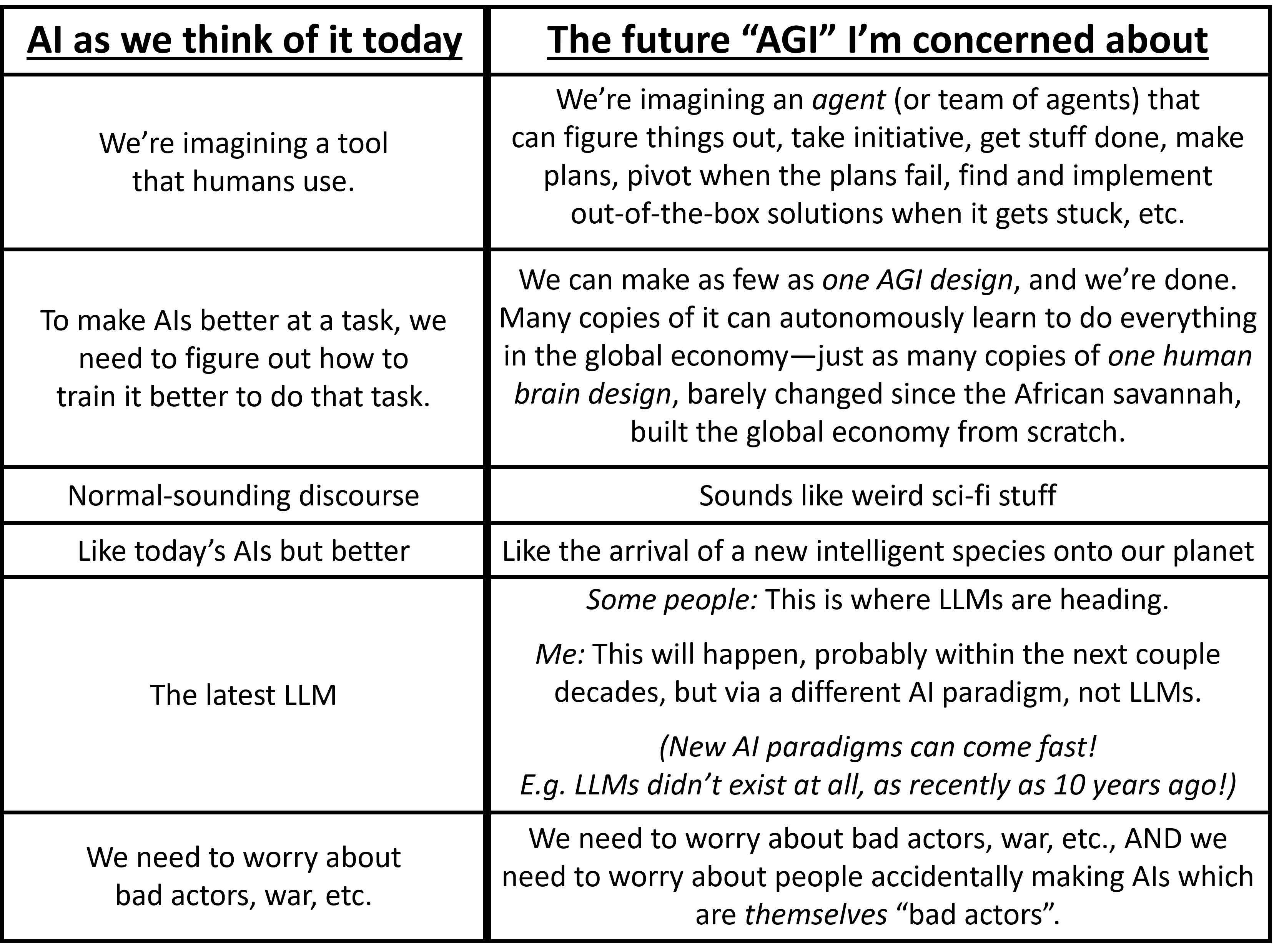
Our AGI Jeff Bezos will be trying to perform a task that we can't currently imagine, using ideas and methods that don't currently exist.
It will have an intuitive sense of what constitutes success (on this micro-task) that it learned from extensive idiosyncratic local experience, intuitions that a human would need years to replicate.
The micro-task will advance some long-term plan that neither we nor even the AGI can yet dream of.
This will be happening in the context of a broader world that may be radically different from what it is now.
And our AGI Jeff Bezos (along with other AGIs around the world) will be making these kinds of decisions at a scale and speed that makes it laughably unrealistic for humans to be keeping tabs on whether these decisions are good or bad.
…And we’re gonna write a detailed spec for that, analogous to the specs for the sensor and bridge that I mentioned above? And we’re gonna ensure that the AGI will follow this spec by design?
No way. If you believe that, then I think you are utterly failing to imagine a world with actual AGI.
3.2 In a different sense, yes, at least I sure as heck hope so eventually
When we build actual AGI, it will be like a new intelligent species on Earth, and one which will eventually be dramatically faster, more numerous, and more competent than humans. If they want to wipe out humans and run the world by themselves, they’ll be able to. (For more on AGI extinction risk in general, see the 80,000 hours intro, or my own intro.)
Now, my friends on the Parker Solar Probe project were able to run certain tests in advance—radiation tests, thermal tests, and so on—but the first time their sensor went into the actual solar corona, it had to work, with no do-overs.
By the same token, we can run certain tests on future AGIs, in a safe way. But the first time that AGIs are autonomously spreading around the world, and inventing transformative new technologies and ideas, and getting an opportunity to irreversibly entrench their power, those AGIs had better be making decisions we’re happy about, with no do-overs.
All those practices listed in §2 above exist for a reason; they're the only way we even have a chance of getting a system to work the first time in a very new situation. They are not optional nice-to-haves, rather they are the bare minimum to make the task merely “very difficult” rather than “hopeless”. If it seems impossible to apply those techniques to AGI, per §3.1 above, then, well, we better shut up and do the impossible.
What might that look like? How do we get to a place where we have deep understanding, and where this understanding gives us a strong reason to believe that things will go well in the (out-of-distribution) scenarios of concern, and where we have a wide variety of safe tests that can be quantitatively compared with that understanding in order to surface unknown unknowns?
I don't know!
Presumably the “spec” and the tests would be more about the AGI’s motivation, or its disposition, or something, rather than about its object-level actions? Well, whatever it is, we better figure it out.
We're not there today, nor anywhere close.
(And even if we got there, then we would face the additional problem that all existing and likely future AI companies seem to have neither the capability, nor the culture, nor the time, nor generally even the desire to do the rigorous high-reliability engineering (§2) for AGI. See e.g. Six Dimensions of Operational Adequacy in AGI Projects (Yudkowsky 2017).)
4. Optional bonus section: Possible objections & responses
Possible Objection 1: Your §3.1 is misleading; we don’t need to specify what AGI Jeff Bezos needs to do to run a successful innovative business, rather we need to specify what he needs to not do, e.g. he needs to not break the law.
My Response: If you want to say that “don’t break the law” etc. counts as a spec, well, nobody knows how to do the §2 stuff (deep understanding etc.) for “don’t break the law” either.
And yes, we should tackle that problem. But I don’t see any way that a 300-page spec (as suggested by Joshua Achiam at the top) would be helpful for that. In particular:
If your roadmap is to make the AGI obey “the letter of the law” for some list of prohibitions, then no matter how long you make the list, a smart AGI trying to get things done will find and exploit loopholes, with catastrophic results.
Or if your roadmap is to make the AGI obey “the spirit of the law” for some list of prohibitions, then there’s no point in writing a long list of prohibitions. Just use a one-item “list” that says “Don’t do bad things.” I don’t see why it would be any easier or harder to design an AGI that reliably (in the §2 sense) obeys the spirit of that one prohibition, than an AGI that reliably obeys the spirit of a 300-page list of prohibitions. (The problem is unsolved in either case.)
Possible Objection 2: We only need the §2 stuff (deep understanding etc.) if there are potentially-problematic distribution shifts between test and deployment. If we can do unlimited low-stakes tests of the exact thing that we care about, then we can just do trial-and-error iteration. And we get that for free because AGI will improve gradually. Why do you expect problematic distribution shifts?
My Response: See my comments in §3.2, plus maybe my post “Sharp Left Turn” discourse: An opinionated review. Or just think: we’re gonna get to a place where there are millions of telepathically-communicating super-speed-John-von-Neumann-level AGIs around the world, getting sculpted by continual learning for the equivalent of subjective centuries, and able to coordinate, invent new technologies and ideas, and radically restructure the world if they so choose … and you really don’t think there’s any problematic distribution shift between that and your safe sandbox test environment??
Maybe an analogy is: if you’re worried that a nuclear weapon with yield Y might ignite the atmosphere, it doesn’t help to first test a nuclear weapon with yield 0.1×Y, and then if the atmosphere hasn’t been ignited yet, next try testing one with yield 0.2×Y, etc.
El veto de Hungría y Eslovaquia está frenando actualmente el apoyo de la UE a Ucrania. Para los grandes medios de comunicación alemanes, la cuestión está clara: Orbán y Fico son conocidos por ser conflictivos y amigos de Rusia y, como quinta columna de Moscú, bloquean una línea común. Sin embargo, se tiende a olvidar … Continuar leyendo "Lo que hay detrás del veto de Hungría y Eslovaquia a los créditos para Ucrania"
El PIB de Argentina jamás ha sido tan elevado como en diciembre de 2025. Aunque incluso ahora sigue habiendo economistas que se niegan a aceptar el éxito de las reformas de Milei.
Este es el tipo que se esta inyectando ácido hialurónico en todo su cuerpo, solo se ha inyectado la mitad de lo que tiene previsto y ya el 20% de su cuerpo es de ácido hialurónico.@Naish.
Andy Hao Tienan no sólo se ha inyectado esta sustancia en el abdomen, sino que también ha apostado por ella en los hombros y el pecho. Juzguen ustedes mismos si el resultado ha valido la pena por más de medio millón de dólares. El influencer no pretende terminar aquí su cambio físico y asegura que únicamente está en el 40 por ciento de su particular transformación. Su plan es administrarse hasta 10.000 inyecciones. @marca
Han hackeado al organismo que se encarga de protegernos de hackeos. Nombres, teléfonos, direcciones, correos y contraseñas de altos cargos y trabajadores de INCIBE publicados en un foro de hacking.
El coste de comprar una Smart TV no solo se paga en forma de dinero al pasar por caja, sino con nuestra "atención" meses después de la adquisición. Pantallas con características de alta gama a precios de derribo solo son posibles cuando el fabricante espera recuperar su inversión obteniendo otros ingresos, como los procedentes de la publicidad personalizada.
El manifiesto exige una reforma de la Constitución que prohíba la privatización de las pensiones y la pérdida de poder adquisitivo, elevando la protección de las pensiones al rango de un derecho fundamental...
Los investigadores dicen haber identificado cómo el tabaquismo, un factor de riesgo bien conocido para las enfermedades oculares y la pérdida de la visión, aumenta la susceptibilidad a las enfermedades oculares relacionadas con la edad.