The university experiment: Campus as laboratory
Nature 514, 7522 (2014). http://www.nature.com/doifinder/10.1038/514288a
Innovative ways of teaching, learning and doing research are helping universities around the globe to adapt to the modern world.
The university experiment: Campus as laboratory
Nature 514, 7522 (2014). http://www.nature.com/doifinder/10.1038/514288a
Innovative ways of teaching, learning and doing research are helping universities around the globe to adapt to the modern world.
The spontaneous emission rate of dipole emitters close to plasmonic dimers are theoretically studied within a nonlocal hydrodynamic model. A nonlocal model has to be used since quantum emitters in the immediate environment of a metallic nanoparticle probe its electronic structure. Compared to local calculations, the emission rate is significantly reduced. The influence is mostly pronounced if the emitter is located close to sharp edges. We suggest to use quantum emitters to test nonlocal effects in experimentally feasible configurations.
Author(s): J. Mork, Y. Chen, and M. Heuck
We suggest and analyze a laser with a mirror realized by Fano interference between a waveguide and a nanocavity. For small-amplitude modulation of the nanocavity resonance, the laser can be modulated at frequencies exceeding 1 THz, not being limited by carrier dynamics as for conventional lasers. Fo...
[Phys. Rev. Lett. 113, 163901] Published Wed Oct 15, 2014
 Congratulations to this year’s Ig Nobel economics prize winner — ISAT — both on its Ig Nobel Prize and on ISTAT’s influence on the Italian economy.
The AFP news agency reports, on October 15, 2014:
Italy lifts out of recession thanks to hookers, drugs
Italy learnt it was no longer in a recession on Wednesday thanks to a change in data calculations across the European Union which includes illegal economic activities such as prostitution and drugs in the GDP measure.
Adding illegal revenue from hookers, narcotics and black market cigarettes and alcohol to the eurozone’s third-biggest economy boosted gross domestic product figures.
GDP rose slightly from a 0.1 percent decline for the first quarter to a flat reading, the national institute of statistics said.
Although ISTAT confirmed a 0.2 percent decline for the second quarter, the revision of the first quarter data meant Italy had escaped its third recession in the last six years….
This comes just four weeks after this year’s Ig Nobel Prize winners were announced at the Ig Nobel Prize ceremony, at Harvard University. The 2014 Ig Nobel Prize for economics was awarded to ISTAT — the Italian government’s National Institute of Statistics, for proudly taking the lead in fulfilling the European Union mandate for each country to increase the official size of its national economy by including revenues from prostitution, illegal drug sales, smuggling, and all other unlawful financial transactions between willing participants.
The relevant documents, in the awarding of that prize, are “Cambia il Sistema europeo dei conti nazionali e regionali – Sec2010” (ISTAT, 2014) and “European System of National and Regional Accounts (ESA 2010)” (Luxembourg: Publications Office of the European Union, 2013).
BONUS: “Droghe e prostituzione nel Pil, all’Istat il premio IgNobel per l’Economia” [La Repubblica]
Article
Random walks on a network describe the dynamics of many natural and artificial systems. Here, Perkins et al. study the path distribution—characterizing how the walker moves—and find that it is either finite, stretched exponential or power law for any random walk on a finite network.
Nature Communications doi: 10.1038/ncomms6121
Authors: Theodore J. Perkins, Eric Foxall, Leon Glass, Roderick Edwards

Laser architectures based on nanowires and nanofibers have attracted a continuously increasing interest in the last years. On page 6542, L. Persano, A. Camposeo, S. D'Agostino, D. Pisignano, and co-workers demonstrate imprinted nanopatterned lasers that are realized on the surface of single, electrospun, light-emitting polymer nanofibers. This method leads to individual fiber lasers that exhibit a lasing threshold that is reduced with respect to those from traditional thin-film architectures. Imprinting arbitrary photonic crystal geometries on electrospun lasing nanofibers will open new perspectives in optical circuits and nanophotonics.
Using light to control the movement of nano-structured objects is a great challenge. This challenge involves fields like optical tweezing, Casimir forces, integrated optics, bio-physics, and many others. Photonic "robots" could have uncountable applications. However, if the complexity of light-activated devices increases, structural disorder unavoidably occurs and, correspondingly, light scattering, diffusion and localization. Are optically-driven mechanical forces affected by disorder-induced effects? A possible hypothesis is that light scattering reduces the optomechanical interaction. Conversely, we show that disorder is a mechanism that radically enhances the mechanical effect of light. We determine the link between optical pressure and the light diffusion coefficient, and unveil that when the Thouless conductivity becomes smaller than the unity, at the so-called Anderson transition, optical forces and their statistical fluctuations reach a maximum. Recent advances in photonics demonstrate the possibility of harnessing disorder for fundamental physics and applications. Designing randomness allows new materials with innovative optical properties. Here we show that disorder and related phenomena may be exploited for optomechanical devices.
Author(s): Gene D. Sprouse
[Phys. Rev. X 4, 040001] Published Thu Oct 09, 2014
A colleague recently introduced me to Firstcut CNC Machining – a branch of ProtoLabs that does custom 3-axis CNC machining. They’re very easy to use – you upload them a 3D drawing (I use Autocad Inventor, because it’s free for academic use) and they will generate a quote for you. I uploaded the part below, which is a prototype of a LED ring light that sits on top of an objective, and got a quote back for $240 to machine it out of aluminum, although they can’t machine the angled holes in the cone perfectly, since they are doing 3-axis milling. Nevertheless, this was cheaper than I expected for such a complicated part, and their website is very easy to use. They also quote a 3 day turnaround, which is pretty nice (you can do one day turnaround, but it doubles the price).


Beautiful Chemistry is a new collaboration between Tsinghua University Press and University of Science and Technology of China that seeks to make chemistry more accessible and interesting to the general public. Their first project was the creation of several short films that utilize a 4K UltraHD camera to capture a variety of striking chemical reactions without the usual clutter of test tubes, beakers or lab equipment. I definitely would have paid a bit more attention in chemistry class if we’d had the opportunity to watch some of these. Filmed and edited by Yan Liang.
The spatial coherence of laser sources has limited their application to parallel imaging and projection due to coherent artifacts, such as speckle. In contrast, traditional incoherent light sources, such as thermal sources or light emitting diodes (LEDs), provide relatively low power per independent spatial mode. Here, we present a chip-scale, electrically-pumped semiconductor laser based on a novel design, demonstrating high power per mode with much lower spatial coherence than conventional laser sources. The laser resonator was fabricated with a chaotic, D-shaped cavity optimized to achieve highly multimode lasing. Lasing occurs simultaneously and independently in ~1000 modes, and hence the total emission exhibits very low spatial coherence. Speckle-free full-field imaging is demonstrated using the chaotic cavity laser as the illumination source. The power per mode of the sample illumination is several orders of magnitude higher than that of a LED or thermal light source. Such a compact, low-cost source, which combines the low spatial coherence of a LED with the high spectral radiance of a laser, could enable a wide range of high-speed, full-field imaging and projection applications.
Author(s): Tiago B. Batalhão, Alexandre M. Souza, Laura Mazzola, Ruben Auccaise, Roberto S. Sarthour, Ivan S. Oliveira, John Goold, Gabriele De Chiara, Mauro Paternostro, and Roberto M. Serra
A liquid-state nuclear magnetic resonance platform allows control and quantification of the non-equilibrium spin dynamics of a closed quantum system.
[Phys. Rev. Lett. 113, 140601] Published Fri Oct 03, 2014
Article
Slow-light propagation provides the means to enhance and control light–matter interactions and it has been predicted to increase the gain coefficient of active waveguides. Here, Ek et al. experimentally demonstrate that the gain of a material can be enhanced using slow-light effects in photonic crystals.
Nature Communications doi: 10.1038/ncomms6039
Authors: Sara Ek, Per Lunnemann, Yaohui Chen, Elizaveta Semenova, Kresten Yvind, Jesper Mork
Nature Photonics 8, 808 (2014). doi:10.1038/nphoton.2014.227
Ori Katz and Sylvain Gigan explain to Nature Photonics how a well-known astronomy technique has been adapted for imaging through turbid media, with great potential for bio-imaging applications.
Nature Photonics 8, 745 (2014). doi:10.1038/nphoton.2014.241
Smartphones that have been cleverly 'accessorized' are starting to offer a convenient and cost-effective alternative to conventional laboratory-based imaging and sensing equipment.
Nature Photonics 8, 784 (2014). doi:10.1038/nphoton.2014.189
Authors: Ori Katz, Pierre Heidmann, Mathias Fink & Sylvain Gigan
Nature Photonics 8, 751 (2014). doi:10.1038/nphoton.2014.222
Author: Jacopo Bertolotti
Exploiting the 'memory' properties of scattered light allows for single-shot imaging through thin opaque layers, including biological tissue.

We demonstrate a new concept for reconfigurable nanophotonic devices exploiting ultrafast nonlinear control of shaped wavefronts in a multimode nanomaterial consisting of semiconductor nanowires. Femtosecond pulsed laser excitation of the nanowire mat is shown to provide an efficient nonlinear mechanism to control both destructive and constructive interference in a shaped wavefront. Modulations of up to 63% are induced by optical pumping, due to a combination of multimode dephasing and induced transient absorption. We show that part of the nonlinear phase dynamics can be inverted to provide a dynamical revival of the wavefront into an optimized spot with up to 18% increase of the peak to background ratio caused by pulsed laser excitation. The concepts of multimode nonlinear switching demonstrated here are generally extendable to other photonic and plasmonic systems and enable new avenues for ultrafast and reconfigurable nanophotonic devices.
The polarization of the light scattered by an optically dense, random solution of dielectric nanoparticles shows peculiar properties when the scatterers exhibit strong electric and magnetic polarizabilities. While the distribution of the scattering intensity in these systems shows the typical irregular speckle patterns, the helicity of the incident light can be fully conserved when the electric and magnetic polarizabilities of the scatterers are equal. We show that the multiple scattering of helical beams by a random dispersion of "dual" dipolar nano-spheres leads to a speckle pattern exhibiting a perfect isotropic constant polarization, a situation that could be useful in coherent control of light as well as in lasing in random media.
We demonstrate a method for efficient coupling of guided light from a single mode optical fiber to nanophotonic devices. Our approach makes use of single-sided conical tapered optical fibers that are evanescently coupled over the last ~10 um to a nanophotonic waveguide. By means of adiabatic mode transfer using a properly chosen taper, single-mode fiber-waveguide coupling efficiencies as high as 97(1)% are achieved. Efficient coupling is obtained for a wide range of device geometries which are either singly-clamped on a chip or attached to the fiber, demonstrating a promising approach for integrated nanophotonic circuits, quantum optical and nanoscale sensing applications.
Author(s): T. Baumgratz, M. Cramer, and M. B. Plenio
A quantified measure of quantum coherence — a necessary resource of quantum information — has been proposed using a similar approach to that established for entanglement and quantum reference frames.
[Phys. Rev. Lett. 113, 140401] Published Mon Sep 29, 2014
Author(s): Ramachandrarao Yalla, Mark Sadgrove, Kali P. Nayak, and Kohzo Hakuta
Spontaneous emission from a cavity made of an optical nanofiber and a nanostructured grating is demonstrated, which would allow single quantum emitters to be easily integrated into an optical network.
[Phys. Rev. Lett. 113, 143601] Published Mon Sep 29, 2014
Author(s): Bruno Sanguinetti, Anthony Martin, Hugo Zbinden, and Nicolas Gisin
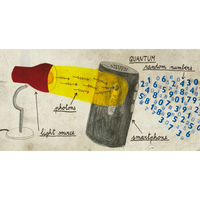
 Generating random numbers is critical to securing both communications and data. New results reveal how consumer hardware such as mobile phones can generate random numbers with a quantum origin.
[Phys. Rev. X 4, 031056] Published Mon Sep 29, 2014
Author(s): J. Pellegrino, R. Bourgain, S. Jennewein, Y. R. P. Sortais, A. Browaeys, S. D. Jenkins, and J. Ruostekoski
Light scattering by a cold atom cloud is reduced by exposing the cloud to near resonant laser light, where the size of the cloud is comparable to the wavelength of the light.
[Phys. Rev. Lett. 113, 133602] Published Fri Sep 26, 2014
Author(s): Yuxi Tian, Pedro Navarro, and Michel Orrit
 A single molecule can work as a vibration sensor that can detect displacements nearly as small as a proton.
[Phys. Rev. Lett. 113, 135505] Published Fri Sep 26, 2014
