27 Mar 19:19
by Hui Cao and Jan Wiersig
Author(s): Hui Cao and Jan Wiersig
This is a review on theoretical and experimental studies on dielectric microcavities, which play a significant role in fundamental and applied research. The basic concepts and theories are introduced. Experimental techniques for fabrication of microcavities and optical characterization are described…
[Rev. Mod. Phys. 87, 61] Published Thu Jan 22, 2015
24 Feb 09:25
by R. Carminati, G. Cwilich, L.S. Froufe-Pérez, J.J. Sáenz
We study the fluctuations of the light emitted by two identical incoherent
point sources in a disordered environment. The intensity-intensity correlation
function and the speckle contrast, obtained after proper temporal and
configurational averaging, encode the relative distance between the two
sources. This suggests the intriguing possibility that intensity measurements
at only one point in a speckle pattern produced by two incoherent sources can
provide information about the relative distance between the sources, with a
precision that is not limited by diffraction. The theory also suggests an
alternative approach to Green function retrieval technique, where the
correlations of the isotropic ambient noise detected by two receivers are
replaced by a measurement at a single point of the noise due to two fluctuating
incoherent sources.
23 Feb 21:06
by Kevin P. Homewood
Nature Photonics 9, 78 (2015).
doi:10.1038/nphoton.2015.1
Authors: Kevin P. Homewood & Manon A. Lourenço
The development of a group IV semiconductor laser that is CMOS-compatible represents a step towards the creation of fully integrated electronic and photonic circuitry.

09 Feb 20:05
by Martin Neugebauer, Thomas Bauer, Andrea Aiello, and Peter Banzer
Author(s): Martin Neugebauer, Thomas Bauer, Andrea Aiello, and Peter Banzer
Under certain conditions the spin of photons can acquire an unusual transverse component. Using intensity differences in the far-field, the transverse spin density is experimentally measured.
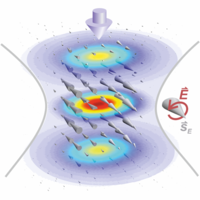
[Phys. Rev. Lett. 114, 063901] Published Mon Feb 09, 2015
07 Feb 22:07
by Riccardo
We are all well aware of how difficult is to get a permanent position in academia. The employers are very cautious as the tenured position comes with a very strong contractual stability and in some country with immortality (as civil service status). The postdocs work longer and longer hours to face the increasing competition. Academia needs more and more advanced skills that can only be acquired with years of experience but it refrains from rewarding it with a permanent job. An interesting alternative is that of the academic freelancer as proposed by Katie Rose Guest Pryal here, as a mean to alleviate the intense and extenuating life of a postdoc or not-tenured academic.

We have already started such an experiment, as I have hired a recently graduate and unemployed colleague to perform some theoretical calculations that we need for our experiments. The difference with respect to a normal collaboration is that this time I am paying him by the hour and he is performing the work choosing his time and without being based in London, just coming for a meetings to discuss the results. All the other discussions are done by Skype, email and probably soon in Slack.
In this way we can reward skills and actual hours of work, and potentially we can resolve personal issues such as family relocation etc… Would this work also for experimental work? It is hard to tell, but I could imagine having a setup in my house and performing experiments on demand as a freelancer does. Shared facilities similar to maker and hacker space could also make lab space and equipment more accessible.
Sooner or later we will have to invent a new way to develop science, a research 2.0, and it may start by embracing new concept such as remote and freelance work.
04 Feb 10:14
by R. Verre, Z. J. Yang, T. Shegai and M. Käll

Nano Letters
DOI: 10.1021/nl504802r

03 Feb 10:24
by Sam Schott, Jacopo Bertolotti, Jean-Francois Léger, Laurent Bourdieu, Sylvain Gigan
High resolution optical microscopy is essential in neuroscience but suffers
from scattering in biological tissues. It therefore grants access to
superficial layers only. Recently developed techniques use scattered photons
for imaging by exploiting angular correlations in transmitted light and could
potentially increase imaging depths. But those correlations (`angular memory
effect') are of very short range and, in theory, only present behind and not
inside scattering media. From measurements on neural tissues and complementary
simulations, we find that strong forward scattering in biological tissues can
enhance the memory effect range (and thus the possible field-of-view) by more
than an order of magnitude compared to isotropic scattering for $\sim$1\,mm
thick tissue layers.
30 Jan 23:03
by F. Antenucci, C. Conti, A. Crisanti, and L. Leuzzi
Author(s): F. Antenucci, C. Conti, A. Crisanti, and L. Leuzzi
We present a unified approach to the theory of multimodal laser cavities including a variable amount of structural disorder. A general mean-field theory is studied for waves in media with variable nonlinearity and randomness. Phase diagrams are reported in terms of optical power, degree of disorder,…
[Phys. Rev. Lett. 114, 043901] Published Fri Jan 30, 2015
30 Jan 12:33
by Cheng Zhang, Yonghua Lu, Yuan Ni, Mingzhuo Li, Lei Mao, Chen Liu, Douguo Zhang, Hai Ming and Pei Wang

Nano Letters
DOI: 10.1021/nl504689s

30 Jan 12:33
by Thomas Bauer
29 Jan 11:18
by Perry Schein, Pilgyu Kang, Dakota O’Dell and David Erickson

Nano Letters
DOI: 10.1021/nl504840b

28 Jan 09:46
by J. Cuerda, F. Rüting, F. J. García-Vidal, and J. Bravo-Abad
Author(s): J. Cuerda, F. Rüting, F. J. García-Vidal, and J. Bravo-Abad
In the context of plasmonic nanolasers, it has been previously recognized that systems with physically extended modes (as opposed to isolated cavity modes) can support lasing, and plasmonic crystals are a platform for such effects. In the present paper the authors present a general study that explores, from a unified perspective, the lasing properties of plasmonic crystals incorporating optically pumped four-level gain media.
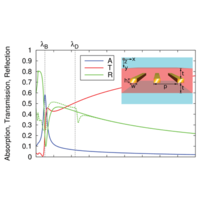
[Phys. Rev. B 91, 041118(R)] Published Mon Jan 26, 2015
27 Jan 09:14
by Gert-Ludwig Ingold and Astrid Lambrecht
The Casimir force is a spectacular consequence of the existence of vacuum fluctuations and thus deserves a place in courses on quantum theory. We argue that the scattering approach within a one-dimensional field theory is well suited to a discussion of the Casimir effect. It avoids in a transparent way divergences appearing in the evaluation of the vacuum energy. Furthermore, the scattering approach connects in a natural manner to the standard discussion of one-dimensional scattering problems in a quantum theory course. Finally, it allows for the introduction to students of the methods employed in the current research literature to determine the Casimir force in real-world systems.
23 Jan 21:19
by Daniel Giovannini
23 Jan 21:18
by Félix Ginot, Isaac Theurkauff, Demian Levis, Christophe Ybert, Lydéric Bocquet, Ludovic Berthier, and Cécile Cottin-Bizonne
Author(s): Félix Ginot, Isaac Theurkauff, Demian Levis, Christophe Ybert, Lydéric Bocquet, Ludovic Berthier, and Cécile Cottin-Bizonne
Populations that translate energy into motion constitute active matter. New research shows that activity induces a nonequilibrium adhesion between colloidal microspheres, quantified by an activity-dependent equation of state.
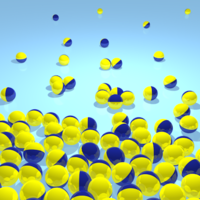
[Phys. Rev. X 5, 011004] Published Fri Jan 23, 2015
23 Jan 21:08
by Matthieu Davy, Zhou Shi, Jing Wang, Xiaojun Cheng, and Azriel Z. Genack
Author(s): Matthieu Davy, Zhou Shi, Jing Wang, Xiaojun Cheng, and Azriel Z. Genack
We show in microwave measurements and computer simulations that the contribution of each eigenchannel of the transmission matrix to the density of states (DOS) is the derivative with angular frequency of a composite phase shift. The accuracy of the measurement of the DOS determined from transmission…
[Phys. Rev. Lett. 114, 033901] Published Fri Jan 23, 2015
23 Jan 21:08
by Vincenzo Grillo, Gian Carlo Gazzadi, Erfan Mafakheri, Stefano Frabboni, Ebrahim Karimi, and Robert W. Boyd
Author(s): Vincenzo Grillo, Gian Carlo Gazzadi, Erfan Mafakheri, Stefano Frabboni, Ebrahim Karimi, and Robert W. Boyd
 Researchers generated an electron beam with very high orbital angular momentum—potentially good for atomic-scale images of the magnetism in materials.
[Phys. Rev. Lett. 114, 034801] Published Fri Jan 23, 2015
22 Jan 16:52
by Arthur Losquin, Luiz F. Zagonel, Viktor Myroshnychenko, Benito Rodríguez-González, Marcel Tencé, Leonardo Scarabelli, Jens Förstner, Luis M. Liz-Marzán, F. Javier García de Abajo, Odile Stéphan and Mathieu Kociak

Nano Letters
DOI: 10.1021/nl5043775

21 Jan 17:22
by Angelika Knothe Thomas Wellens
Angelika Knothe, Thomas Wellens
We present a theoretical study of frequency correlations of light backscattered from a random scattering medium. This statistical quantity provides insight into the dynamics of multiple scattering processes accessible in theoretical and experimental investigations. For frequency correlations ... [J. Opt. Soc. Am. A 32, 305-313 (2015)]
21 Jan 17:22
by Timothy Amoah and Marian Florescu
Author(s): Timothy Amoah and Marian Florescu
Hyperuniform disordered materials are a class of photonic solids with a constrained randomness that have short-range order and long-range statistical isotropy. In these materials, calculations suggest a new type of high-Q localization mechanism in optical cavities, that has no analogue in periodic or quasi-periodic photonic crystals.
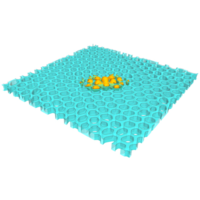
[Phys. Rev. B 91, 020201(R)] Published Tue Jan 20, 2015
15 Jan 15:26
by Javadi, Alisa; Maibom, Sebastian; Sapienza, Luca; et al.
Title: Statistical measurements of quantum emitters coupled to Anderson-localized modes in disordered photonic-crystal waveguides
Author(s): Javadi, Alisa; Maibom, Sebastian; Sapienza, Luca; et al.
Source: OPTICS EXPRESS, 22 (25): 30992-31001 DEC 15 2014
Document Type: Article
15 Jan 10:17
by N. Ghofraniha
Article
Replica symmetry breaking, in which identical systems subject to identical conditions evolve to different end states, has been predicted to occur in many contexts but has yet to be observed experimentally. Ghofraniha et al. report evidence for its occurrence in the pulse-to-pulse variations of a random laser.
Nature Communications doi: 10.1038/ncomms7058
Authors: N. Ghofraniha, I. Viola, F. Di Maria, G. Barbarella, G. Gigli, L. Leuzzi, C. Conti

14 Jan 22:32
by Louis Dellieu, Olivier Deparis, Jérôme Muller, and Michaël Sarrazin
Author(s): Louis Dellieu, Olivier Deparis, Jérôme Muller, and Michaël Sarrazin
Nanostructures are commonly used for developing superhydrophobic surfaces. However, available wetting theoretical models ignore the effect of vacuum photon-mode alteration on van der Waals forces and thus on hydrophobicity. Using first-principles calculations, we show that superhydrophibicity of nan…
[Phys. Rev. Lett. 114, 024501] Published Wed Jan 14, 2015
07 Jan 12:04
by Matthew N. O’Brien, Matthew R. Jones, Kevin L. Kohlstedt, George C. Schatz and Chad A. Mirkin

Nano Letters
DOI: 10.1021/nl5038566

06 Jan 14:48
by John Bechhoefer
In this paper, we discuss what is, what is not, and what is only sort of
superresolution microscopy. We begin by considering optical resolution, first in terms of diffraction
theory, then in terms of linear-systems theory, and finally in terms of techniques that use prior information, nonlinearity, and other tricks to improve resolution. This discussion reveals two classes of superresolution microscopy, “pseudo” and “true.” The former improves images up to the diffraction limit, whereas the latter allows for substantial improvements beyond the diffraction limit. The two classes are distinguished by their scaling of resolution with photon counts. Understanding the limits to imaging resolution involves concepts that pertain to almost any measurement problem, implying a framework with applications beyond optics.
06 Jan 10:13
by Lennart J. de Vreede, Albert van den Berg and Jan C. T. Eijkel

Nano Letters
DOI: 10.1021/nl5042676

04 Jan 13:19
by Collin, Stephane
Title: Nanostructure arrays in free-space: optical properties and applications
Author(s): Collin, Stephane
Source: REPORTS ON PROGRESS IN PHYSICS, 77 (12): DEC 2014
Document Type: Review