27 May 20:45
by Sidney R. Nagel
Author(s): Sidney R. Nagel
Soft condensed matter refers to materials where the constituent building blocks are larger than atoms but smaller than the system itself. The large size of the constituent particles makes these soft materials distinctive from hard condensed matter systems. Soft matter is easily deformable, dissipative, disordered, nonlinear, far from equilibrium, thermal and entropic, slow, observable, susceptible to external fields, patterned, nonlocal, interfacial elastic, memory retaining, and active. This article surveys soft-matter science and discusses different classes of systems including colloids; emulsions; foams; glassy, granular, and jammed matter; liquid crystals; polymers; adaptive mechanical metamaterials; and active matter.
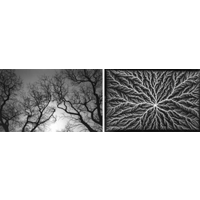
[Rev. Mod. Phys. 89, 025002] Published Wed Apr 12, 2017
03 May 14:01
by Schirmacher, Walter; Leonetti, Marco; Ruocco, Giancarlo
Title: Analytical description of the transverse Anderson localization of light
Author(s): Schirmacher, Walter; Leonetti, Marco; Ruocco, Giancarlo
Source: JOURNAL OF OPTICS, 19 (4): APR 2017
Document Type: Article
30 Apr 13:27
by Yi Yang, Owen D. Miller, Thomas Christensen, John D. Joannopoulos and Marin Soljačić

Nano Letters
DOI: 10.1021/acs.nanolett.7b00852

28 Apr 10:20
by Aleksandar Lukic
Aleksandar Lukic, Sebastian Dochow, Hyeonsoo Bae, Gregor Matz, Ines Latka, Bernhard Messerschmidt, Michael Schmitt, Jürgen Popp
We present a compact multimodal fiber probe that enables the simultaneous recording of nonlinear imaging modalities like coherent anti-Stokes Raman scattering (CARS), second harmonic generation (SHG), and two-photon excited auto-fluorescence (TPEF) for biomedical applications. The probe is based on ... [Optica 4, 496-501 (2017)]
28 Apr 10:19
by Daqing Wang, Hrishikesh Kelkar, Diego Martin-Cano, Tobias Utikal, Stephan Götzinger, and Vahid Sandoghdar
Author(s): Daqing Wang, Hrishikesh Kelkar, Diego Martin-Cano, Tobias Utikal, Stephan Götzinger, and Vahid Sandoghdar
Efficient interactions between photons and atoms are an essential ingredient for future quantum networks. A new experiment uses an optical resonator to create enhanced coupling between light and a single organic dye molecule.
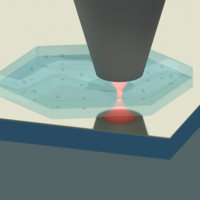
[Phys. Rev. X 7, 021014] Published Wed Apr 26, 2017
26 Apr 08:27
by Ivan Latella and Philippe Ben-Abdallah
Author(s): Ivan Latella and Philippe Ben-Abdallah
A giant thermal magnetoresistance is predicted for the electromagnetic transport of heat in magneto-optical plasmonic structures. In chains of InSb-Ag nanoparticles at room temperature, we find that the resistance can be increased by almost a factor of 2 with magnetic fields of 2 T. We show that thi...
[Phys. Rev. Lett. 118, 173902] Published Tue Apr 25, 2017
26 Apr 08:27
by Tianhua Feng, Yi Xu, Wei Zhang, and Andrey E. Miroshnichenko
Author(s): Tianhua Feng, Yi Xu, Wei Zhang, and Andrey E. Miroshnichenko
We introduce the concept of tunable ideal magnetic dipole scattering, where a nonmagnetic nanoparticle scatters light as a pure magnetic dipole. High refractive index subwavelength nanoparticles usually support both electric and magnetic dipole responses. Thus, to achieve ideal magnetic dipole scatt...
[Phys. Rev. Lett. 118, 173901] Published Tue Apr 25, 2017
26 Apr 08:27
by Aymeric Delteil, Zhe Sun, Stefan Fält, and Atac Imamoğlu
Author(s): Aymeric Delteil, Zhe Sun, Stefan Fält, and Atac Imamoğlu
Researchers have transferred quantum information from one quantum dot to another dot 5 m away using photonic qubits as the relay.
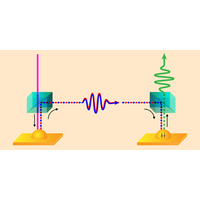
[Phys. Rev. Lett. 118, 177401] Published Tue Apr 25, 2017
26 Apr 08:22
by Daniel Hexner, Paul M. Chaikin, Dov Levine
Diffusion relaxes density fluctuations toward a uniform random state whose variance in regions of volume v=ℓd scales as σρ2≡⟨ρ2(ℓ)⟩−⟨ρ⟩2∼ℓ−d. Systems whose fluctuations decay faster, σρ2∼ℓ−λ with d
26 Apr 08:22
by David A. B. Miller, Linxiao Zhu, Shanhui Fan
We derive four laws relating the absorptivity and emissivity of thermal emitters. Unlike the original Kirchhoff radiation law derivations, these derivations include diffraction, and so are valid also for small objects, and can also cover nonreciprocal objects. The proofs exploit two recent approaches. First, we express all fields in terms...
25 Apr 10:06
by Sergey V. Makarov, Mihail I. Petrov, Urs Zywietz, Valentin Milichko, Dmitry Zuev, Natalia Lopanitsyna, Alexey Kuksin, Ivan Mukhin, George Zograf, Evgeniy Ubyivovk, Daria A. Smirnova, Sergey Starikov, Boris N. Chichkov and Yuri S. Kivshar

Nano Letters
DOI: 10.1021/acs.nanolett.7b00392

22 Apr 01:13
by J. Sperling, W. R. Clements, A. Eckstein, M. Moore, J. J. Renema, W. S. Kolthammer, S. W. Nam, A. Lita, T. Gerrits, W. Vogel, G. S. Agarwal, and I. A. Walmsley
Author(s): J. Sperling, W. R. Clements, A. Eckstein, M. Moore, J. J. Renema, W. S. Kolthammer, S. W. Nam, A. Lita, T. Gerrits, W. Vogel, G. S. Agarwal, and I. A. Walmsley
Criteria are formulated and experimentally verified for optical measurement schemes that probe nonclassical properties of light and are independent of the detector architecture used.
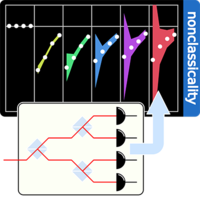
[Phys. Rev. Lett. 118, 163602] Published Fri Apr 21, 2017
21 Apr 11:21
by Milad I. Akhlaghi Aristide Dogariu
Milad I. Akhlaghi, Aristide Dogariu
Tracking trajectories of objects is conventionally achieved by direct beam probing or by sequential imaging of the target during its evolution. However, these strategies fail quickly when the direct line of sight is inhibited. Here, we propose and experimentally demonstrate real-time tracking of ... [Optica 4, 447-453 (2017)]
20 Apr 11:14
by Sanjib Ghosh, Christian Miniatura, Nicolas Cherroret, and Dominique Delande
Author(s): Sanjib Ghosh, Christian Miniatura, Nicolas Cherroret, and Dominique Delande
We show that the coherent forward scattering (CFS) interference peak amplitude sharply jumps from zero to a finite value upon crossing a metal-insulator transition. Extensive numerical simulations reveal that the CFS peak contrast obeys the one-parameter scaling hypothesis and gives access to the cr...
[Phys. Rev. A 95, 041602(R)] Published Fri Apr 14, 2017
20 Apr 11:14
by Daniel Navarro-Urrios
Nonlinear dynamics and chaos in an optomechanical beam
Nature Communications, Published online: 11 April 2017; doi:10.1038/ncomms14965
In optomechanics, optical nonlinearities are usually regarded as detrimental and efforts are made to minimize their effects. Here, the authors study the complex dynamics, including chaos, arising from the coupling of such optical nonlinearities with the mechanical modes of a silicon nanobeam cavity.

19 Apr 13:32
| Piled Higher
& Deeper by Jorge
Cham |
|
www.phdcomics.com
|
 |
|
|
15 Apr 20:21
by Tomer Goldfriend, Haim Diamant, and Thomas A. Witten
Author(s): Tomer Goldfriend, Haim Diamant, and Thomas A. Witten
A new theory suggests that sedimenting particles of irregular shape will drift horizontally as they fall, a result that may resolve a long-standing puzzle.

[Phys. Rev. Lett. 118, 158005] Published Fri Apr 14, 2017
12 Apr 20:16
by Adrian J. Menssen, Alex E. Jones, Benjamin J. Metcalf, Malte C. Tichy, Stefanie Barz, W. Steven Kolthammer, and Ian A. Walmsley
Author(s): Adrian J. Menssen, Alex E. Jones, Benjamin J. Metcalf, Malte C. Tichy, Stefanie Barz, W. Steven Kolthammer, and Ian A. Walmsley
Two independent groups have provided the first experimental demonstration of genuine three-photon interference.
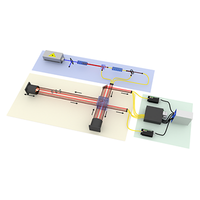
[Phys. Rev. Lett. 118, 153603] Published Mon Apr 10, 2017
12 Apr 20:15
by Sascha Agne, Thomas Kauten, Jeongwan Jin, Evan Meyer-Scott, Jeff Z. Salvail, Deny R. Hamel, Kevin J. Resch, Gregor Weihs, and Thomas Jennewein
Author(s): Sascha Agne, Thomas Kauten, Jeongwan Jin, Evan Meyer-Scott, Jeff Z. Salvail, Deny R. Hamel, Kevin J. Resch, Gregor Weihs, and Thomas Jennewein
Two independent groups have provided the first experimental demonstration of genuine three-photon interference.
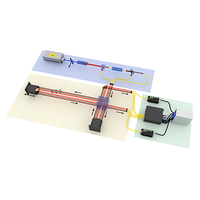
[Phys. Rev. Lett. 118, 153602] Published Mon Apr 10, 2017
11 Apr 19:33
by Yoshito Y. Tanaka and Tsutomu Shimura

Nano Letters
DOI: 10.1021/acs.nanolett.7b00672

07 Apr 10:03
by Nils Odebo Länk, Ruggero Verre, Peter Johansson and Mikael Käll

Nano Letters
DOI: 10.1021/acs.nanolett.7b00416

07 Apr 10:02
by Aleksei V. Chechkin, Flavio Seno, Ralf Metzler, and Igor M. Sokolov
Author(s): Aleksei V. Chechkin, Flavio Seno, Ralf Metzler, and Igor M. Sokolov
Brownian motion—the random movement of microscopic particles in a fluid—usually gives rise to a Gaussian probability of finding a particle at a particular place at a specific time. But in some situations, this probability behaves differently. A new mathematical model shows how to reconcile this behavior with other hallmarks of Brownian motion.

[Phys. Rev. X 7, 021002] Published Wed Apr 05, 2017
07 Apr 08:05
by Prashant Shekhar, Marek Malac, Vaibhav Gaind, Neda Dalili, Al Meldrum and Zubin Jacob

ACS Photonics
DOI: 10.1021/acsphotonics.7b00103
06 Apr 07:49
by Seung-Yeol Jeon
Nature Physics 13, 363 (2017).
doi:10.1038/nphys4002
Authors: Seung-Yeol Jeon, Hyungho Kwon & Kahyun Hur
Wave transport is one of the most interesting topics related to quasicrystals. This is due to the fact that the translational symmetry strongly governs the transport properties of every form of wave. Although quasiperiodic structures with or without disorder have been studied, a clear mechanism for wave transport in three-dimensional quasicrystals including localization is missing. To study the intrinsic quasiperiodic effects on wave transport, the time invariance of the lattice structure and the loss-free condition must be controlled. Here, using finite-difference methods, we study the diffusive-like transport and localization of photonic waves in a three-dimensional icosahedral quasicrystal without additional disorder. This result appears at odds with the well-known theory of wave localization (Anderson localization), but we found that in quasicrystals the short mean free path of the photonic waves makes localization possible.

02 Apr 20:30
by Rémi Faggiani, Arthur Losquin, Jianji Yang, Erik Mårsell, Anders Mikkelsen and Philippe Lalanne

ACS Photonics
DOI: 10.1021/acsphotonics.6b00992
02 Apr 20:20
by Davide Forcella, Claire Prada, and Rémi Carminati
Author(s): Davide Forcella, Claire Prada, and Rémi Carminati
The importance of spatial nonlocality in the description of negative refraction in electromagnetic materials has been put forward recently. We develop a theory of negative refraction in homogeneous and isotropic media, based on first principles, and that includes nonlocality in its full generality. ...
[Phys. Rev. Lett. 118, 134301] Published Fri Mar 31, 2017
02 Apr 20:20
by Christoph Hamsen, Karl Nicolas Tolazzi, Tatjana Wilk, and Gerhard Rempe
Author(s): Christoph Hamsen, Karl Nicolas Tolazzi, Tatjana Wilk, and Gerhard Rempe
A photon low pass filter is realized using a single atom strongly coupled to an optical cavity.
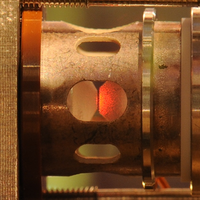
[Phys. Rev. Lett. 118, 133604] Published Fri Mar 31, 2017
01 Apr 13:52
by Carl M. Bender, Dorje C. Brody, and Markus P. Müller
Author(s): Carl M. Bender, Dorje C. Brody, and Markus P. Müller
A Hamilonian with PT-symmetry invariant properties is investigated as a candidate for an operator that has eigenvalues corresponding to the nontrivial zeros of the Riemann zeta function.
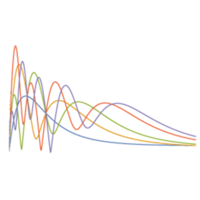
[Phys. Rev. Lett. 118, 130201] Published Thu Mar 30, 2017
30 Mar 20:52
by A. Prain, S. Vezzoli, N. Westerberg, T. Roger, and D. Faccio
Author(s): A. Prain, S. Vezzoli, N. Westerberg, T. Roger, and D. Faccio
Quantum field theory predicts that a spatially homogeneous but temporally varying medium will excite photon pairs out of the vacuum state. However, this important theoretical prediction lacks experimental verification due to the difficulty in attaining the required nonadiabatic and large amplitude c...
[Phys. Rev. Lett. 118, 133904] Published Wed Mar 29, 2017
28 Mar 20:06
by T. Czerniuk, D. Wigger, A. V. Akimov, C. Schneider, M. Kamp, S. Höfling, D. R. Yakovlev, T. Kuhn, D. E. Reiter, and M. Bayer
Author(s): T. Czerniuk, D. Wigger, A. V. Akimov, C. Schneider, M. Kamp, S. Höfling, D. R. Yakovlev, T. Kuhn, D. E. Reiter, and M. Bayer
A picosecond acoustic pulse can be used to control the lasing emission from semiconductor nanostructures by shifting their electronic transitions. When the active medium, here an ensemble of (In,Ga)As quantum dots, is shifted into or out of resonance with the cavity mode, a large enhancement or supp...
[Phys. Rev. Lett. 118, 133901] Published Mon Mar 27, 2017

