


Shared posts


04 Oct 19:37

Fiona Apple at the Newmark Theatre (or: Shut the Fuck Up, Portland)
by Courtney Ferguson
Perhaps you've read accounts of Fiona Apple's show at the Newmark Theatre last night (Robert Ham has a good one on Stereogum). I don't want to dwell on the horrible last 10 minutes of the show when a solitary heckler body-shamed Fiona Apple, because Apple and her incredible band played an amazing set, and to obsess over the last mortifying scene—when Portland transformed into a pitchfork-wielding mob of petulant preschoolers—would be to take away from the intimate and goofy and powerful set that these musicians so kindly worked their asses off to give to us. So let's try to remember the good parts—all 90 percent of the evening—because I sincerely doubt Fiona Apple will ever grace us with her presence again. Thanks, dickbag hecklers. Yes, even you well-wishers. Learn how to go to a show. It involves shutting your flaptraps and letting the talented people show you what they got. They most definitely don't need any help from you.
I saw Apple's electrifying show at the Schnitzer last summer and was blown away. It is handily in my top-five concerts of all time. She was riveting on stage, complete with wacky banter, and nailing every song as she dipped into her back catalog. It was powerful and fierce and full of raw emotion. This time out on tour, Apple has teamed up with frequent collaborator Blake Mills for a smaller and more intimate performance. The venue was cozier, the smudged chalkboard on stage added a whimsical, down-home spin, and the forbidden use of cell phones was meant to get us all fixed in the moment. Apple had a lot of nervous energy on the stage, cradling percussive doodads that she plucked from her toy chest of sounds, then ambling to the bass drum, where she slung herself, back to the piano bench, which she arched over backward. She was like a kid with boundless, unfocused energy. Until the songs started. Then she lasered in.
Fiona Apple is a genius. If she wants to walk around with an armful of gourds, then by all means. Once the first notes dropped, her powerful voice kicked in and the jitters melted away. She ripped through "Every Single Night," "Regret," and added a beautiful duet piece to Mills' very funny "Don't Tell Our Friends About Me." She killed "Dull Tool," and watched as Mills sang solo and played guitar (from his huge cache of guitars). As soon as it came down to the business of displaying her musical fortitude, Apple was a consummate professional. Honestly, I don't think her voice has ever sounded better. Gal can sing paint off walls. For all her silliness, Apple knows when she's clowning, like when she gently sparred with Mills over which one of them might grudgingly like Billy Joel, or when she let herself be the cobra to Mills' sexy snake-charming guitar solo. She was goofing, just like she set out to do at the start of the show. Couple that with Mills' stable and calm presence and fantastic accompaniment from bassist Sebastian Steinberg and drummer Amy Wood, and I'd say this show easily rivaled last July's house-on-fire performance. You know, until some jerk opened their mouth in the balcony.
More photos from the show by Jesse Champlin after the jump. And the last word I'm going to say about "helpful" hecklers.
I could hardly sleep last night thinking about what went down at the Newmark. It's a classy place—in fact I was telling photographer Jesse Champlin how civilized it all felt when we walked in. It's the home of a $10 cup of wine, for Christ's sake. But how one "helpful" heckler humiliated a musician that we all paid $60 to see was the grossest, most-low-down, embarrassing thing I have ever seen in our city. I was mortified. We were all mortified. Perhaps if everyone had shut their goddamn mouths after that lone voice from the balcony had screamed out, Fiona would've had the chance to gather herself and suffer her hurt feelings in private. But that didn't happen.
I don't want to step on Barbara Holm's toes with her weekly "My Least Favorite Piece of Misogyny This Week" column, but last night was mine. You can bet your bottom dollar that no one ever heard the following heckled at a concert:
"Get healthy, David Bowie, we want to see you in 10 years... You used to be beautiful."
"Get healthy, Iggy Pop, we want to see you in 10 years... You used to be beautiful."
Nope. Not something that gets yelled at dudes.
firehose likes this
04 Oct 19:36

I Have Feelings About Fiona Apple's Show at the Newmark Last Night
by Courtney Ferguson
I have never felt more emotions about a concert than I did last night. It was the best of times (amazing music, stellar performance) and the worst of times (I've never been more mortified by an audience) at the Fiona Apple show at the Newmark Theatre. Hope you enjoyed her musical genius while you could, Portland, there's no way she's ever coming back here.
My writeup is over on End Hits, with more pics.
04 Oct 19:12
Guillermo del Toro Does The Simpsons—and it is Overwhelmingly Glorious
by Wm.™ Steven Humphrey
Creepy flick director Guillermo del Toro helmed the opening sequence of The Simpsons' annual "Treehouse of Horror" (number XXIV, to be exact) and it airs this Sunday on Fox at 8 pm. OR YOU CAN WATCH IT HERE AND NOW! And you might want to spend an hour or two on it, just to figure out how many classic horror movie references (including some of his own) he crammed into this thing. As the title states, it is OVERWHELMINGLY GLORIOUS. Watch.
04 Oct 17:34
Interlude: More of the math of dudes kissing
by noreply@blogger.com (Will Wildman)
(Content: biphobia; transphobia and rape culture at the Dan Savage link. Fun content: math! No, really. Come back!)
This may be considered a sequel to another 'enrich your life through queer math' post from my old blog.
This isn't a post about Dan Savage, but it was inspired by things he's said that really neatly embody one of the major forms of biphobia. (He's also painfully transphobic and sexist and so many other things; I am not a fan. I am sure he's done good things, yay for him, but he desperately needs to not be The One Mainstream Queer Voice.)
This specifically is about the idea that bisexuals--both men and women, though Savage speaks more often regarding men, obviously--are just playing around and are still going to settle down in a hetero relationship once they've had their homo fun. The specific quote is thus: "And here’s another thing that is: Most adult bisexuals, for whatever reason, wind up in opposite-sex relationships. And most comfortably disappear into presumed heterosexuality." The implication (often made an explication) is that we bi people are users, happy to get all countercultural with our sexytimes but ultimately intending to ditch a same-gender partner and spend the rest of our lives taking advantage of all that sweet, sweet straight privilege while leaving said same-gender partners adrift and emotionally abandoned. (This feeds nicely into the similar claim that bi folk are all promiscuous sex-fiends, which I have laughed at enough for the time being; just noting the way one line of bigotry usually supports another.)
Now, it's difficult as hell to get actual reliable numbers on the proportions of queer folk in the world, for obvious reasons: first being that no matter how many times you swear that your survey is completely anonymous, queer people are generally going to need a good reason to single themselves out in a crowd, and 'the curiosity of straights' tends not to be it. A quick scroll through this wikipedia page on orientation demographics shows the hilarious level of variation in surveys, ranging from 1 in 7 to 1 in 200.
Fortunately, this is napkin math, so we don't need exact numbers to prove my point. Let us once again oversimplify tremendously and go with 10% of the population, all else equal, being in some way attracted to people who are theoretically the same sex as them (so including gay, lesbian, bisexual, and gender variants that tend to have trouble getting recognised, let alone catalogued). That's our starting assumption: 90% straight (P = 0.9), 10% queer (P = 0.1). You may see where I'm going with this.
I was waiting for a bus the other day and I saw this guy: gangly and a little stubbly and just generally ridiculously attractive and reading Perdido Street Station. Knucklebite. And I did some quick math in my head: the independent chance of flipping heads on a coin is 0.5, so the chance of getting two in a row is 0.5 * 0.5 = 0.25, the chance of getting three is 0.5 ^ 3 = 0.125, and the chance of getting four is 0.5 ^ 4 = 0.0625.
Say the chance that this ridiculously hot dude waiting for the bus next to me was interested in dudes is 0.1, like we said. That means that, the moment I see him, if I grab a quarter from my pocket, I have a better chance of flipping three heads in a row than I have of even being the right gender for him to be attracted to me. If any of the three are tails, sorry, he only likes women, better luck next time.
Whereas every time I meet a woman I find attractive, the probabilities are reversed: keeping in mind that both straight and bi women might be interested in me, I'd likely have to flip four heads in a row for her to say "Sorry, I only like the ladies." (So far this has only happened 1.5 times. The 0.5 is for when I didn't even have time to start flirting before she brought it up of her own accord.)
Most people have more than one romantic relationship in their lives before they settle down, if they are the settling type, meaning that, if not restricted by institutional homophobia, bisexuals will probably date a range of people with differing genders and orientations over the course of their lives. And while I might be equally attracted to men and women, the feeling is not mutual. Should I be fortunate enough to meet someone so perfectly matched to me that we decide to spend the rest of our lives together, raw probability says that person is probably going to be a woman. That's not my evil bisexual heartless fucklust driving me to use and discard innocent gay men: that's all that math will allow. Most of the people I'm attracted to in my life will probably be straight. I am as upset about this as anyone I mean seriously you should have seen that guy's face I just wanted to congratulate him on owning it--
Where was I?
Oh, right. Biphobes can shut the hell up and either do their math homework or (should they unfortunately be afflicted with dycalculia, like my lovely and non-biphobic sister-in-law) just start flipping coins every time they see someone hot, until the lesson sinks in.
This may be considered a sequel to another 'enrich your life through queer math' post from my old blog.
This isn't a post about Dan Savage, but it was inspired by things he's said that really neatly embody one of the major forms of biphobia. (He's also painfully transphobic and sexist and so many other things; I am not a fan. I am sure he's done good things, yay for him, but he desperately needs to not be The One Mainstream Queer Voice.)
This specifically is about the idea that bisexuals--both men and women, though Savage speaks more often regarding men, obviously--are just playing around and are still going to settle down in a hetero relationship once they've had their homo fun. The specific quote is thus: "And here’s another thing that is: Most adult bisexuals, for whatever reason, wind up in opposite-sex relationships. And most comfortably disappear into presumed heterosexuality." The implication (often made an explication) is that we bi people are users, happy to get all countercultural with our sexytimes but ultimately intending to ditch a same-gender partner and spend the rest of our lives taking advantage of all that sweet, sweet straight privilege while leaving said same-gender partners adrift and emotionally abandoned. (This feeds nicely into the similar claim that bi folk are all promiscuous sex-fiends, which I have laughed at enough for the time being; just noting the way one line of bigotry usually supports another.)
Now, it's difficult as hell to get actual reliable numbers on the proportions of queer folk in the world, for obvious reasons: first being that no matter how many times you swear that your survey is completely anonymous, queer people are generally going to need a good reason to single themselves out in a crowd, and 'the curiosity of straights' tends not to be it. A quick scroll through this wikipedia page on orientation demographics shows the hilarious level of variation in surveys, ranging from 1 in 7 to 1 in 200.
Fortunately, this is napkin math, so we don't need exact numbers to prove my point. Let us once again oversimplify tremendously and go with 10% of the population, all else equal, being in some way attracted to people who are theoretically the same sex as them (so including gay, lesbian, bisexual, and gender variants that tend to have trouble getting recognised, let alone catalogued). That's our starting assumption: 90% straight (P = 0.9), 10% queer (P = 0.1). You may see where I'm going with this.
I was waiting for a bus the other day and I saw this guy: gangly and a little stubbly and just generally ridiculously attractive and reading Perdido Street Station. Knucklebite. And I did some quick math in my head: the independent chance of flipping heads on a coin is 0.5, so the chance of getting two in a row is 0.5 * 0.5 = 0.25, the chance of getting three is 0.5 ^ 3 = 0.125, and the chance of getting four is 0.5 ^ 4 = 0.0625.
Say the chance that this ridiculously hot dude waiting for the bus next to me was interested in dudes is 0.1, like we said. That means that, the moment I see him, if I grab a quarter from my pocket, I have a better chance of flipping three heads in a row than I have of even being the right gender for him to be attracted to me. If any of the three are tails, sorry, he only likes women, better luck next time.
Whereas every time I meet a woman I find attractive, the probabilities are reversed: keeping in mind that both straight and bi women might be interested in me, I'd likely have to flip four heads in a row for her to say "Sorry, I only like the ladies." (So far this has only happened 1.5 times. The 0.5 is for when I didn't even have time to start flirting before she brought it up of her own accord.)
Most people have more than one romantic relationship in their lives before they settle down, if they are the settling type, meaning that, if not restricted by institutional homophobia, bisexuals will probably date a range of people with differing genders and orientations over the course of their lives. And while I might be equally attracted to men and women, the feeling is not mutual. Should I be fortunate enough to meet someone so perfectly matched to me that we decide to spend the rest of our lives together, raw probability says that person is probably going to be a woman. That's not my evil bisexual heartless fucklust driving me to use and discard innocent gay men: that's all that math will allow. Most of the people I'm attracted to in my life will probably be straight. I am as upset about this as anyone I mean seriously you should have seen that guy's face I just wanted to congratulate him on owning it--
Where was I?
Oh, right. Biphobes can shut the hell up and either do their math homework or (should they unfortunately be afflicted with dycalculia, like my lovely and non-biphobic sister-in-law) just start flipping coins every time they see someone hot, until the lesson sinks in.
04 Oct 04:00







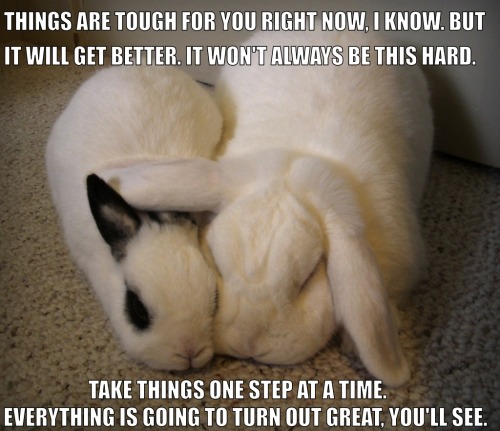


thefingerfuckingfemalefury: chromatophobiccuttlefish: turning-b...
Emotional support bunnies
Reblogging because I needed these bunnies badly.
I am actually crying right now because BUNNIES
Delivering lovely, wonderful messages of support and love
04 Oct 03:21
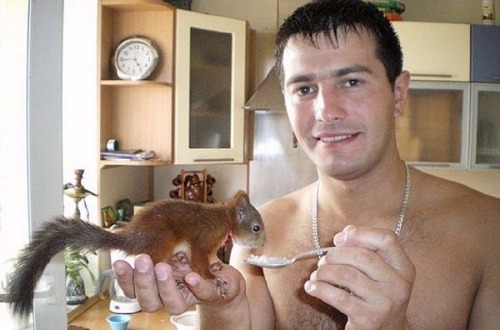
A man and his squirrel.
Soldiers in Belarus found a little squirrel and brought it to the Warrant officer. The squirrel was very weak and about to die, so the officer took care of it and fed it like a baby every four hours.
Three months ago the guy left the army and now works as a taxi driver and the squirrel is always in his pocket no matter where he goes!
Be still my beating heart.
oh my god.







04 Oct 00:33
Hell and soteriology Part 1: Bill O’Reilly’s accidental insight
by Fred Clark
Chris Skinner, a biblical scholar who blogs at Peje Iesous, got a good laugh at watching Fox News host Bill O’Reilly getting schooled by Notre Dame New Testament prof Candida Moss — “Scholar v. Blowhard on Jesus (Or: Candida Moss Shows How Schockingly Ignorant Bill O’Reilly Actually Is).”
Skinner piles on, deservedly, highlighting and underscoring several of the ways this brief interview exposes O’Reilly’s utter incomprehension of what he’s talking about.
Click here to view the embedded video.
Skinner is right about the facts of the matter, but O’Reilly’s popularity and influence have never been dependent on the facts of the matter. As a biblical scholar himself, Skinner wasn’t watching this interview the same way that most of O’Reilly’s audience is. The things that made him laugh at loud — or that led other biblical scholars, like James McGrath, Mark Goodacre and Chris Keith, to cheer Moss’ triumph — weren’t likely things that other viewers would see or pick up on.
That’s part of O’Reilly’s game plan. He doesn’t care if biblical scholars think he’s a buffoon, he just wants to make the Fox audience think that he knows just as much as any biblical scholar. And he’s good at this game. After Moss says it would be “anachronistic” to call Jesus a “socialist,” O’Reilly pretends not to know what anachronistic means. Why? So that a few sentences later, he can pretend that she just called Jesus an “anarchist” — “For you to say that he was a socialist in an anarchistic way, or whatever it was you said, is bunk.”
Neat trick, that. Other demagogues should take notes. (See also the way O’Reilly takes care to refer to his guest as “Dr. Moss,” which sounds respectful unless you know that it’s shorthand for “pointy-headed, ivory-tower obscurantist who doesn’t understand realamerica.”)
What struck me most in this exchange, though, is what Chris Keith notes about “the way in which one of Jesus’ ‘hard sayings’ played out in this interview”:
In addition to citing the Lukan beatitude “Blessed are the poor” (which differs from the Matthean “Blessed are the poor in spirt“), Dr. Moss points out that Jesus told the Rich Young Ruler to give away all his possessions in order to enter the kingdom (Mark 10//Matt. 19//Luke 18). O’Reilly accuses her of reading this parable literally. … But the Gospels never present this story of Jesus as a parable; they present it as an event from his life. O’Reilly responds the way almost all readers of this story tend to respond — surely that’s not what he really meant. But the text is on Dr. Moss’s side here. … The Gospel authors sure seem to think that Jesus meant just what he said, as does the young man who walks away, regardless of how hard that is for us to swallow. The very point is that this is impossible, which is why the disciples, who are also befuddled at who in the world, then, can be saved, get some further teaching from Jesus. … Any interpretation of this text that removes the impossible nature of Jesus’ demand has a hard time squaring with the text itself because it was meant to point toward an impossibility. What we do with this theologically and practically is a separate issue, and I’ll be the first to own up to having a bank account and failing to give away everything I have, despite calling myself a follower. But Jesus never said, “Well, of course, I don’t really mean that.”

Moss does not euphemize or equivocate about what the text says that Jesus said or that Jesus said this as a direct assertion of fact. Jesus said that if you don’t give away your wealth to help the poor, then you will go to Hell. Period.
As Keith wrote, O’Reilly’s reaction was typical of “almost all readers of this story … surely that’s not what he really meant.” I think he’s genuinely gobsmacked that Moss, cheerfully but emphatically, doesn’t go along with that. She refuses to play along with “surely that’s not what he really meant.”
And so O’Reilly takes the next usual step — which is also typical for “almost all readers of this story” — and he starts talking about Hell. If Jesus actually said and meant what Moss rightly notes he said and meant, O’Reilly tells her, “then you’re going to Hell and I’m going to Hell and everybody watching is going to Hell!”
To O’Reilly’s credit, the Gospels tell us this was also the reaction from Jesus’ disciples: If what you’re saying is true, then we’re all damned to Hell.
I’ll agree with Keith that what we do with that practically is a separate issue. (Jesus’ reply about camels and needles doesn’t offer much practical relief from the uncompromising moral obligation he’s just laid out.) But I don’t think that what we make of that theologically can be a separate issue. Here is one of the few biblical mentions of Hell and what it teaches us about Hell is utterly incompatible with everything you’ve probably been taught to associate with the idea.
But here’s the remarkable thing — the accidental insight O’Reilly’s aghast response points us toward — every mention of Hell in the Bible is just like this one.
If that’s what the Bible repeatedly and consistently says Hell means, then O’Reilly’s question and the question of Jesus’ disciples certainly seems appropriate: “Who then can be saved?”
We’ll look at that question in part 2.
03 Oct 17:38
Blame the Bush Era for Current Republican Dysfunction
by Daniel Larison
Ross Douthat offers an explanation for the behavior of what he calls Republican “Intransigents”:
So what you’re seeing motivating the House Intransigents today, what’s driving their willingness to engage in probably-pointless brinksmanship, is not just anger at a specific Democratic administration, or opposition to a specific program, or disappointment over a single electoral defeat. Rather, it’s a revolt against the long term pattern I’ve just described: Against what these conservatives, and many on the right, see as forty years of failure, in which first Reagan and then Gingrich and now the Tea Party wave have all failed to deliver on the promise of an actual right-wing answer to the big left-wing victories of the 1930s and 1960s — and now, with Obamacare, of Obama’s first two years as well.
This may account for some of what we’ve been seeing recently, but the experience of the Bush era is a much more important factor than disappointments with inadequate conservative victories of the past. During the Bush era, most conservatives either supported the administration’s domestic and foreign policy agenda or they didn’t put up much of a fight against any of it for at least the first five or six years. Not only did they end up backing a huge expansion of the welfare state and extraordinarily costly foreign wars, but in order to justify these moves they emphasized the value that these things supposedly had for the political fortunes of the GOP. The Bush-era GOP didn’t just fail to roll back previous government expansions, but did a great deal to increase the size and scope of government. Not long after making this bad bargain, conservatives saw the Republicans lose control of Congress, and they were still associated with one of the most unpopular presidents of modern times. Most conservatives backed almost every bad political and policy bet that Bush-era party leaders made, and it all went horribly wrong for both the GOP’s electoral prospects and conservative priorities. Many conservatives realized too late that they had put the political goals of the party first too often, and had deferred to party leaders too frequently, and so now there is great reluctance to do these things under any circumstances.
When any of those same leaders warn them against a certain course of action now, many conservatives, especially those members of Congress elected in the years since the defeats of 2006 and 2008, are not inclined to pay any attention to them. Given the track record of these leaders, it’s easy to see why they have so little influence. Having failed to reckon with or punish the failures of their party and movement conservative leaders and the policies they endorsed, Republicans find themselves pulled between leaders that have been utterly discredited over the past decade and insurgent members that have latched on to self-defeating tactics of their own. The current parlous state of the Republican Party is one of the longer-term effects of the disastrous Bush administration, and it will take many more years before the party has fully recovered from its wreckage.
03 Oct 16:17


About That “Job-Killing Obamacare”
by Andrew Sullivan
Wal-Mart, the nation’s largest employer, announced Monday that 35,000 part-time employees will soon be moved to full-time status, entitling them to the full healthcare benefits that were scheduled to be denied them as a result of Wal-Mart’s efforts to avoid the requirements of Obamacare.
Not a p.r. move. Apparently, Wal-Mart is struggling with its model of basement-level wages and piss-poor service. Having a workforce that is healthy, they are finally recognizing, can be an economic advantage. Imagine that!
Lowbrowmedia likes this
02 Oct 21:37

High-Speed Rails Deploys With Git
TL;DR — We reduced deploy times from ten minutes to less than five seconds by replacing the standard Capistrano deploy tasks with a simpler, Git-based workflow and avoiding slow, unnecessary work.
At Code Climate, we try to minimize the time between when code is written and when it is live in production. When deploys slowed until they left enough time to make a pot of coffee, we invested in speeding them up.
What’s in a deploy?
At its core, deploying a modern Rails application consists of a few simple steps:
- Update the application code
- Run
bundle install(if the Gemfile was updated) - Precompile assets (if assets were updated)
- Restart the application processes (e.g. Unicorn)
If the deploy fails, the developer needs to be alerted immediately. If application processes fail to rollover to the latest code, we need to detect that.
For kicks, I wrote a Bash script to perform those steps, to determine our theoretical lowest deploy time (just the time for SSH and running the minimum, required commands). It took about three seconds when there were no Gemfile or asset changes. So I set out to reduce our ten minute deploys to as close to that number as possible.
Enter Capistrano
If you take anything away from this article, make it this: Capistrano is really two tools in one. It provides both:
- A runtime allowing you to run arbitrary commands against sets of remote servers via SSH
- A set of default tasks for deploying Rails applications
The runtime is incredibly useful. The default tasks, which originated back in 2005, come from a pre-Git era and are unnecessarily slow and complex for most Rails applications today.
By default, Capistrano creates a releases directory to store each deployed version of the code, and implicitly serve as a deployment history for rollback. The current symlink points to the active version of the code. For files that need to be shared across deployments (e.g. logs and PID files), Capistrano creates symlinks into the shared directory.
Git for faster, simpler deploys
We avoid the complexity of the releases, current and shared directories, and the slowness of copying our application code on every deploy by using Git. To begin, we clone our Git repo into what will become our deploy_to directory (in Capistrano speak):
git clone ssh://github.com/codeclimate/codeclimate.git /data/codeclimate/app
To update the code, a simplegit fetch followed by git reset —hard will suffice. Local Git tags (on the app servers) work beautifully for tracking the deployment history that the releases directory did. Because the same checkout is used across deployments, there’s no need for shared symlinks. As a bonus, we use Git history to detect whether post-update work like bundling Gems needs to be done (more on that later).
The Results
Our new deploy process is heavily inspired by (read: stolen from) Recap, a fantastic set of modern Capistrano tasks intended to replace the defaults. We would have used Recap directly, but it only works on Ubuntu right now.
In the end we extracted a small set of Capistrano tasks that work together to give us the simple, extremely fast deploys:
-
deploy:update_code— Resets the Git working directory to the latest code we want to deploy. -
bundle:install:if_changed— Checks if either theGemfileorGemfile.lockwere changed, and if so invokes thebundle:installtask. Most deploys don’t includeGemfilechanges so this saves some time. -
assets:precompile:if_changed— Similar to the above, this invokes theassets:precompiletask if and only if there were changes that may necessitate asset updates. We look for changes to three paths:app/assets,Gemfile.lock, andconfig. Asset pre-compilation is notoriously slow, and this saves us a lot of time when pushing out changes that only touch Ruby code or configuration. -
deploy:tag— Creates a Git tag on the app server for the release. We never push these tags upstream to GitHub. -
deploy:restart— This part varies depending on your application server of choice. For us, we use God to send aUSR2signal to our Unicorn master process. -
deploy:verify— This is the most complex part. The simplest approach would have Capistrano wait until the Unicorn processes reboot (with a timeout). However, since Unicorn reboots take 30 seconds, I didn’t want to wait all that extra time just to confirm something that works 99% of the time. Using every ounce of Unix-fu I could muster, I cobbled together a solution using theatutility:
echo 'curl -sS http://127.0.0.1:3000/system/revision | grep "c7fe01a813" > /dev/null || echo "Expected SHA: c7fe01a813" | mail -s "Unicorn restart failed" ops@example.com' | at now + 2 minutes
Here’s where we ended up: (Note: I edited the output a bit for clarity.)
1 2 3 4 5 6 7 8 9 10 11 12 13 14 15 16 17 18 19 20 21 |
|
If your deploys are not as zippy as you’d like, consider if a similar approach would work for you. The entire project took me about a day of upfront work, but it pays dividends each and every time we deploy.
Further Reading
- Recap — Discussed above. Highly recommend taking a look at the source, even if you don’t use it.
- Deployment Script Spring Cleaning from the GitHub blog — The first time I encountered the idea of deploying directly from a single Git working copy. I thought it was crazy at the time but have come around.
02 Oct 21:36

dat neck

dat neck again

dose pecs

dat - head? and hand? Also he's talking to Wesley, as I'm sure you can tell by that Classic Wesley Pose.

Worf looks normal, and yet, Picard looks like a confused Stretch Armstrong with one giant arm

His other arm is super stubby though (this was usually covered up with clever camera angles on the show I think??)

such a beautiful ship that one could weep

HAHA THEY NAILED RIKER THOUGH, THIS IS 100% RIKER RIGHT HERE
Did you know that in 1988 they put out a STAR TREK: THE NEXT...
dat neck
dat neck again
dose pecs
dat - head? and hand? Also he's talking to Wesley, as I'm sure you can tell by that Classic Wesley Pose.
Worf looks normal, and yet, Picard looks like a confused Stretch Armstrong with one giant arm
His other arm is super stubby though (this was usually covered up with clever camera angles on the show I think??)
such a beautiful ship that one could weep
HAHA THEY NAILED RIKER THOUGH, THIS IS 100% RIKER RIGHT HERE
Did you know that in 1988 they put out a STAR TREK: THE NEXT GENERATION comic? It’s got a lot of cool necks in it.
02 Oct 17:20
The GOP’s Misinformation Problem in Action
by Daniel Larison
Robert Costa explains why there are so many Republicans in Congress committed to an effort that is certain to fail:
And so many of these members now live in the conservative world of talk radio and tea party conventions and Fox News invitations. And so the conservative strategy of the moment, no matter how unrealistic it might be, catches fire. The members begin to believe they can achieve things in divided government that most objective observers would believe is impossible [bold mine-DL]. Leaders are dealing with these expectations that wouldn’t exist in a normal environment.
Costa’s explanation seems to be the only way to account for Republican behavior that otherwise makes no sense. Picking an extremely unpopular fight that they are sure to lose doesn’t serve the party’s interests, and it doesn’t even seem to serve the longer-term interests of individual members. The trouble is that the Republicans most eager to have this fight may believe that they can prevail somehow, and they seem to be encouraged in this belief because they are relying on the same sources of misinformation that have served them so poorly in the past.
It is as if no one learned anything from the experience of the party-wide delusion that Romney was going to win the election. Some Republicans are making all of the same mistakes that they made when they ignored all of the evidence suggesting that the GOP was likely to lose in 2012. Most of the time, the echo chamber hurts conservatives and Republicans by making them oblivious to inconvenient facts and ideas, but in this case it is leading them to believe in an alternate political reality with its own set of rules. In that alternative reality, a pointless, self-defeating effort becomes a clever political strategy, and obnoxious and politically toxic tactics are treated as normal and appropriate.
02 Oct 17:17
Being a fan of the Oz Books
Ok, sometimes people get a bit confused when I say I LOVE the Wizard of Oz, but am dissatisfied by the Judy Garland film.
Ok… imagine you’re a Harry Potter fan, but instead of the books having been adapted more or less faithfully into popular films, the thing MOST people think when you say “Harry Potter” is a musical adaptation of HALF of Philospher’s Stone from the 30s, where Harry is cast about 8 years older than he should be, his scar is now in the shape of a star, Voldemort is now bright green and Hogwarts is not a castle but a beach hut.
Now this adaptation is critically acclaimed and iconic and should NEVER be remade.
But you still wish that some day they’d actually adapt ALL the books faithfully! But nope… instead you get stage plays about how this green Voldermort wasn’t actually so evil, movies about Dumbledore’s origin story (which don’t take any of the brilliant information already in the books) and cheap CGI tv movies where they just pick and choose whatever they like and mash it together into their own plot.
THAT’S what being an Oz fan is like.
Sure the “famous” adaptation is a great, enjoyable film… but I can’t help but feel disappointed that the books have yet to be adapted with the same love and care that, say, Harry Potter or Lord of the Rings have. Adaptations are never perfect or completely faithful, but the Judy Garland film is such a loose adaptation, it actually spoils some of the greatness of the original books.
I don’t think anyone has summarized my feelings about the Wizard of Oz as well as this.
01 Oct 23:09
What She Said
by Wm.™ Steven Humphrey
“This is a democracy, and in a democracy, hostage tactics are the last resort for those who can’t win their fights through elections, can’t win their fights in Congress, can’t win their fights for the presidency, and can’t win their fights in the courts. For this right-wing minority, hostage-taking is all they have left — a last gasp of those who cannot cope with the realities of our democracy.” —Sen. Elizabeth Warren speaking on the Senate floor, Sept 30.
What she said. Watch her entire speech here.
01 Oct 23:08
"I deal with writer’s block by lowering my expectations. I think the trouble starts when you sit down..."
“I deal with writer’s block by lowering my expectations. I think the trouble starts when you sit down to write and imagine that you will achieve something magical and magnificent—and when you don’t, panic sets in. The solution is never to sit down and imagine that you will achieve something magical and magnificent. I write a little bit, almost every day, and if it results in two or three or (on a good day) four good paragraphs, I consider myself a lucky man. Never try to be the hare. All hail the tortoise.”
-
-
Malcolm Gladwell on overcoming writer’s block – a fine addition to our ongoing archive of advice on writing. And wisdom from more famous artists, writers, and designer.
file under: things i needed to hear
(via geardrops)
Stephanie likes this
01 Oct 21:25


“What Kind Of World Do These People Live In?”
by Andrew Sullivan

“When I think of the Republican Party, I don’t think of principled conservative legislators who are men and women of vision strategy. I think of ideologues who are prepared to wreck things to get their way. They have confused prudence — the queen of virtues, and the cardinal virtue of conservative politics — with weakness. I know I’m very much a minority among conservatives in this, but the behavior of Congressional Republicans pushed me out of the party two years ago, even though I almost always vote Republican, or withhold my vote.
I am not a liberal, and do not want to vote for liberals, especially on social policy. But I told a Louisiana conservative friend the other day that the Congressional Republicans are making me consider the previously unthinkable: throwing my vote away by voting for a Democrat in the special election next month to replace my GOP congressman, who just resigned to take another job. The GOP candidates in this local race are hot and heavy to overthrow Obamacare. I think about how poor this district is — 26 percent of the district lives in poverty, making it one of the poorest Congressional districts in America — and how badly we need jobs and economic growth, and I think: What kind of world do these people live in?” – Rod Dreher.
You can tell I’m in the same camp, although I gave up completely on the GOP a decade ago as I saw its craven acquiescence to an imperial presidency, its love of massive, unfunded spending, its dogged support of wars of doomed nation-building, and its Christianist loathing of almost anything vibrant in modernity. But these past few days, by pure accident, I’ve thought about them in a slightly new perspective. I’ve been in Washington, DC, for a bunch of minor medical procedures: my thrice-yearly testosterone implant; my flu shot; a booster pneumonia shot; an HPV vaccine; an impending colonoscopy; an HIV blood test; and last, but by no means least, a repair of an umbilical hernia that has had me immobile since Friday. My compromised immune system requires constant check-ups, and the Dish now pays for my COBRA insurance – which will soon have to be traded in for Obamacare because my options are running out.
A word to Republicans: why would you want to deny someone these basic forms of healthcare? Or force them into bankruptcy because of them?
I could struggle on for a while without them and without my HIV meds. But sooner or later, I’d start running out of money, probably get a bad case of pneumonia, or an uptick in likelihood of cancer if my HIV breaks out again, or a hernia operation that was urgent rather than precautionary, or a debilitating bout of flu likely to make my asthma-ridden lungs even weaker in the future. This is the fragile reality I live in as a spectacularly privileged, if immuno-suppressed inhabitant of one of the most advanced societies on earth. But take any of it away and my well-being and basic health begin to fray.
Are you, Republicans, prepared to say that the countless working Americans who cannot now afford any of this should carry on without it indefinitely? People only have one life, you know. It can erode pretty quickly. On what moral grounds do you consign people to this fate when it is currently unnecessary?
I understand the important arguments about cost control, and any number of arguments about how to construct a system like this. I think I’ve heard them now for close to three decades – and we’ve all benefited from the arguments. But these needs are about as real as any can be. And our system has passed a remedy of sorts. It will need adjustment, reform, cost-cutting, and constructive criticism to make it work as well as it might. But seriously, after all we’ve gone through, you’re prepared to bring our entire system of government to a halt in order to prevent sick people from getting access to this kind of treatment?
What hallucinating, self-serving monsters have you become?
(Photo: Conservative Senator Mike Lee (R-UT), Senator Ted Cruz’s partner on defunding Obamacare, after the Senate voted to amend the House’s spending bill by removing language defunding the Affordable Care Act and voted to fund the government at a $986 billion annual level through Nov. 15, on September 27, 2013. By Melina Mara/The Washington Post via Getty Images.)
Mishri.someshwar, Chris.halls likes this
01 Oct 20:27
On Defending Principles
by Daniel Larison
A Wall Street Journal article compares the latest shutdown with the one in 1995-96, and finds few similarities. This passage jumps out:
“The difficulty here is that Republicans have no achievable endgame,” [bold mine-DL] said Daniel Meyer, a former Gingrich chief of staff who went on to serve as White House liaison to the House for President George W. Bush.
Whatever else one wants to say about the last few weeks leading up to the shutdown, it’s the sheer futility of the Republican defunders’ approach that continues to amaze. There is always the danger that any political effort could go wrong or backfire, but there is also usually the possibility that there could be a successful outcome. It is rare to see a coordinated effort to try something that everyone already knows has no chance of succeeding. It is bad enough to seek a maximalist goal with insufficient means, but to seek a goal that is unobtainable from the beginning is baffling. Perseverance is an admirable quality, but like any other it can be taken to excess and become harmful.
Scott Galupo quotes Rep. Steve Pearce (NM-02) saying this:
At times, you must act on principle and not ask what cost, what are the chances of success.
That might sound impressive until one thinks about it for a moment. Especially when one is defending a principle, it is important to understand what the costs and chances of success are, because it could undermine and even discredit that principle in the eyes of others if the cost is too high or failure is certain. If the principle at stake is a political one, the fact that there is no chance that a particular maneuver will work is relevant, because failure will have political implications that make it more difficult and costlier to defend that principle later on.
01 Oct 15:59


Sums It All Up
by Josh Marshall
Rep. Devin Nunes (R-CA), who just hours ago was castigating his colleagues as "lemmings" for shutting down the government over Obamacare, has now decided he's going to go lemming and vote with Boehner after all.
01 Oct 15:56
fascist: *supports an ideology that is massively, historically, universally violent*
fascist: *supports an ideology that is massively, historically, universally violent*
anti-fascist: kill fascists
fascist: that's not very tolerant of you!
anti-fascist: kill fascists
fascist: that's not very tolerant of you!
30 Sep 23:44
The parable of the shrewd Goodwill cashier
by Fred Clark
This is a story from last week:
Collier County (Fla.) deputies say 19-year-old Andrew Anderson was an employee at a Goodwill store in East Naples — he was arrested for giving out discounts.
… The 19-year-old was an employee at Goodwill Retail and Donation Center in East Naples — giving out discounts to customers he thought were in need.
“People would come in on bicycles — wearing all of the clothes they had, coming in with $2, $3 max,” Anderson said.
Not thinking anything of it, Anderson would cut prices in half, leaving families with a smile.
“I wasn’t actually stealing. Goodwill is a giving and helping company, so I took it upon to myself to be giving and helping because I feel people deserve it,” Anderson said.
… Store officials fired Anderson and reported the incident to deputies. They arrested him Tuesday and charged him with grand theft.

After Goodwill’s petty vindictiveness brought down the wrath of the Internet, the company desperately backpedaled and dropped the charges.
“After completing our internal investigation we have determined that the individual’s actions were not for personal gain, but rather for the benefit of others,” the statement read.
I will leave it to the reader to decide whether it is coincidence or providence that this occurred the same week that the Gospel reading for the common lectionary was the Parable of the Shrewd Manager — a story in which Jesus oddly praises a servant for handing out unauthorized discounts (“Blessed are the tricksters” indeed).
29 Sep 17:02


'Shame on us': How businesses brought the debt limit mess onto themselves
by Lydia DePillis
On Friday, we noted that CEOs of major American companies are not a little exasperated at what's going on in Washington. Some of them, though, recognize that they were part of the problem to begin with. World Fuel Services chairman Paul Stebbins -- a Georgetown government major who now runs a company ranked 74 on the Fortune 100 -- didn't need much prompting to describe how things went wrong, how corporate guys are withholding money from PACs that aren't part of the solution, and why they'd rather pay more taxes to make the uncertainty go away.

Lydia DePillis: So you were involved with Fix the Debt from the very early stages. Did anything come out of the first round of alarm-raising?
Paul Stebbins: Let's start with the basic fact that business was part of the problem. In August of 2011, I was meeting with the Business Roundtable in D.C., and most business guys were running around the world being busy running their corporations and not paying a lot of attention in a general way. The idea was, much as you may not like Washington, eventually they'll get in a room and make a decision, and you may or may not like it, but things will function. That was the case up until the August of 2011. And when 2011 hit and the President and the Speaker of the House were not able to come to an agreement, and we basically threatened the full faith and credit of the United States, the business community freaked out. Because the enormity of that crisis was so profound, we just could not believe that things could possibly be that bad.
I'll tell you, I just showed up to a dinner in Washington and I was sitting next to Saxby Chambliss, Mark Warner, Mark Udall, Alice Rivlin, Lindsey Graham, Bob Corker, Kay Hagan, Jeanne Shaheen, Olympia Snowe, Susan Collins, and they're all saying, 'we're in real trouble. This thing is really, really bad and we don't have a way out of the box.' So we engage, we raise a lot of money, and the most interesting thing that came out of it -- the business world, it's not unlike Congress, getting 150 senior business people to coalesce around anything is quite extraordinary in its own right. So it elevated out of the realm of the provincial business interests into a larger sense of citizenship.
We have a higher duty of care to engage this issue. It is grossly reckless to watch the long term business trajectory of the U.S. to be at such risk. And we are part of the pathology that got us here. We've all had our K Street lobbyists who are part of the problem. You've got the classic narrative: Progressives say, 'fat cat CEOs want to throw grandma into the snow, and all their special tax interests.' And then you've got the Club for Growth that thinks we sold them out.
The business community is fundamentally pragmatic. There's a sense of, 'can't we get in a room and just fix this thing.' Now, the problem with that is that CEOs are kind of naive. You come to Washington, you think you've got all this great data -- debt to GDP ratio, and what the interests rates will be, $12 trillion in net debt, Medicare's bankrupt in 13 years, Social Security's gone in 20, okay, we get all that, so why can't we fix it?
The reality is, you go over to Capitol Hill and you say to some guy, 'why can't you guys get in a rom and fix this thing?' And they nod at you very politely and say 'that was very nice of you to come, thank you for your input, you can go home now.' Because their reality is, the Club for Growth is telling every single Republican member of Congress 'we're going to raise $5 million to beat you in a primary if you even mention the word revenue.' And AARP is telling every Democratic member of Congress, 'if you even mention the word entitlement reforms, which is all that throw grandma into the snow stuff, we're going to raise $5 million and beat you in a primary.' And what makes a politician's life worth living? Reelection. So the CEOs had a bit of naivet about the political realities of what makes it so hard for a lot of well-intentioned people to actually get to yes.
The thing that got the business community catalyzed is you cannot have this reckless, nihilistic, fundamentalist, ideologically driven governance. That ultimately, advocacy can't trump governance.
So we did a lot of work to bring to bear pressure, and to also provide political cover for those who were really trying to do the right thing. And I could name a lot of people on the Hill who are trying to do the right thing. But then you get into a political cycle which was very difficult during the presidential campaign, because it's all about what side you're on, and don't you dare mention this, don't you dare mention that.
And by the way, immigration, education, energy, infrastructure, frozen. Nothing's happening. So when the US has the opportunity to be growing at 3 percent-plus GDP, we're dithering around at 1.8 percent, an I'll tell you what, at 2 percent GDP, large corporations aren't going to hire, because you're just treading water. And what a shame, because you've got Europe is a basket case, they've got 10 years of disaster ahead of them. China's a mess, financially. And and the US could be blowing the doors off it, but the worst enemy is us. This is self-imposed. So shame on us.
I'm an entrepreneur, I started my company in my 20s, and it's now a Fortune 74 company with $40 billion in sales. I'm not just a Harvard MBA guy. I'm the American dream, and it never occurred to me that my board of directors would be talking about risk analysis, and the U.S. government would be one of those risks.
LD: But wait, was there ever really a happy time when everything worked smoothly in Washington?
PS: When I worked in Congress, for a guy named Tim Wirth, back then, if you were a young freshman Congressman, and you picked up the sword and argued with the Speaker of the House, your parking space would be in Anacostia, you'll be on the dog catcher committee, you'd you would get no money from the party, so you better sit down, shut up, and listen, because you don't know anything, you're low on the totem pole. Now today, John Boehner, if he tries to punish one of these firebrands coming out of the conservative wing of his caucus, they wear it as a badge of honor. Look, I had the chairman of the Energy and Commerce committee, Fred Upton, tell me that he got into an argument with one of these young guys on his committee about the defunding of Affordable Care Act. Well the argument was 'look, Energy and Commerce had 50 hearings on that bill. Like it or not, it passed. The president signed it. The Supreme Court upheld it. So you don't get to pick a bill you don't like and link it to the entire financial well being of the United States.; Well the response is, 'I didn't come here to govern.' Well what did you come here for? What did you come here for? To burn it to the ground?
So when you talk about getting back to the fife and drum and getting back to American roots, are you kidding me? This is so antithetical to everything that America has been about.
So there's a sense in the business community that this is just appalling. You don't get to default on the United States. I've got 70 offices in 26 countries. I've got CEOs and government leaders around the world who take me aside privately and say 'what on earth are you doing over there? If you can't get this right, how the hell are we going to get this right?'
And all this stuff about China and India and Brazil? Baloney. We are still 24 percent of the world's GDP and we are the flywheel that drives all those other economies. And we are out to lunch.
LD: So now having realized your naivete, are you going to play the same game as the Club for Growth and AARP and fund candidates who agree with you?
PS: We made a decision which was, how do you maintain any integrity as Fix the Debt? Nobody took it seriously at the beginning. Nobody gave a damn. You are no threat. But when the CEOs actually got together and then it became a broader national organization, when the thing began to actually have an impact, boy, then the knives came out. So Paul Krugman in the New York Times: 'you fat cat CEOs, this is just a big lie, we'll grow our way out of this, you're trying to destroy the country and protect your tax exemptions.' And then on the other side, we had people come out and say, 'you fat cat CEOs, you're trying to destroy the Republican ethic.' It was unbelievable. So we never contemplated that we would take on these massive interest groups that would say 'you think you're going to stick your head up and play in this game, we'll knock you into next week.'
[More explanation of how crazy the situation is]
LD: But you didn't quite answer my question. Will Fix the Debt start trying to back or destroy candidates in primaries?
Why wouldn't Fix the Debt run the biggest Political Action Committee and only fund people who talked about it in the middle, and not in the extreme? Let's say you took that approach. There's a lot of practical reality why that's difficult to do. I also think it would undermine the very basic tenet of Fix the Debt, which is we are not in the professional advocacy business. We are trying to build a national conversation around the important things that speak to the future of the country. And we are trying to encourage leadership. And yes we understand you have pressure from these advocacy groups, but we'd like to provide cover for you, and not punish you for doing the right thing. So there's no way we're going to become the Koch Brothers overnight. That's just not what this is about.
So it's very frustrating, but one of the things the business people are starting to do is cut off the PACs, saying 'well, sorry, we're not giving you any money. Unless you've got something you can say about the debt, we're not giving you any money.' That's the way you fight back. You start withholding.
Any by the way, you educate your employees. You do town hall meetings, and explain to everybody in your company what this means. And I don't care who you vote for. But as a citizen, please engage in this conversation. Please call whoever you vote for and tell them this is important.
LD: You mentioned corporate tax reform. But there, we're in this dance where the Republicans and Democrats can't agree on whether it should raise revenue. Are you really okay with getting rid of all your tax exemptions and paying more?
PS: Absolutely. Absolutely. All these guys have been public saying 'I don't give a damn what my ultimate taxes are, fix it.' I have been in meetings where very prominent names you would know very well in the business domain have taken very loud and vociferous exception with Chairman Dave Camp and Senator Baucus saying 'just fix the damn thing, because your lack of doing anything is far more dangerous than any exemption I could possibly save.' Please take the exemptions, because it's the absence of knowing what to do. Business is about long term planning, and the cost of capital is a huge factor in your competitive ability. And the cost of capital's going to be related to the long term fiscal viability of the United States. With $1.1 trillion in debt, I'm competing with the government for the capital, and that's not good. So there is a business community that doesn't give a damn about the revenue neutral thing, because we need more revenue! Period. You can't get to the solution. You need to have it. It's a fact.
LD: The town hall idea is interesting. Are you really getting regular people to care about this issue?
[More about education and outreach]
I go to colleges, I'm going to Central Florida in a couple of weeks, I'm going to sit on a panel and tell everybody in that room, 'tell everybody in your dorm to be out there, and you should be furious at me. You should be livid that we have done this to you.' Talk about Facebook and Twitter. Twitter can start a revolution in Egypt, and we can't get our own debt fixed? Are you kidding me? And unfortunately, it gets misdirected into Occupy Wall Street, which becomes a kitchen sink full of every disgruntled something, as opposed to an intellectual core. You want an intellectual core for Occupy Wall Street? 'Fix this debt. I'm the future of this country, and you've screwed me.'
Are we naive? Do we think this gets done in 10 minutes? No. Am I going to give up because of that? No. Am I more angry than I was a year ago when I first went to that first dinner? You betcha.
LD: You're a constituent of Senator Marco Rubio. Have you gone and told him all this?
PS: Our group has, and we're very unhappy with Mr. Rubio. I think he has shown a very unfortunate lack of courage and leadership on this issue. And he seems much more interested in his career, namely a run for President at some point, than he is in fixing this kind of an issue, and I find that profoundly disappointing.
As a strategist all my life, I think about root cause. It's not about the debt, per se, it's about what it represents. It's our failure to invest in education, invest in infrastructure, responsible development of energy resources, both renewable and otherwise, all these things are critical. Our failure to get to this means we continue to displace the investments we should be making in our future. And that's criminal. We don't have the right to do that.
Businesses tended to think of Washington as a necessary evil that you just had to deal with. Versus, this is the kind of thing that is putting the experiment of the United States of America at risk, and we can't just sit back and pretend that's not happening. We have to actually get involved, and by the way part of getting involved is acknowledging that our indifference was part of the problem.
That is a very important journey for many of these people. When you go to the CEO Council, look at some of those names. That's amazing. That is amazing. And believe me, there's people who've raised lots of money for conservative Republicans, and people who've raised lots of money for President Obama, but they're on that list for the exact same reason.
I'll tell you a story. Bob Zoellick was in Australia, and the foreign minister took Bob aside and said, 'Don't you realize, America is one debt deal away from being great again.' Think about that. Because the whole world is watching the most important experiment in self-governance in the world, and can you do this. And if you could, can you imagine what signal that would send the world.
This interview has been lightly edited for clarity and length.
    
|
29 Sep 02:39


The worst sentence we read today
by Ezra Klein
"But, for now, Boehner doesn't have a plan beyond passing this resolution and waiting to see what happens."
|
|
28 Sep 19:44
Rubyists, A Non-Endangered Species
by Giles Bowkett
Picture a circle of chairs in a church basement, a small group of people, faces holding anxiety and shame, but also a quiet courage and determination. In the background, a cheap table, a big metal cylinder full of hot coffee, and a stack of paper cups. Everybody's quiet. I stand up.
Me: "My name's Giles, and I read Hacker News."
Everybody: "Hi Giles."
Due to my shameful addiction, which I struggle daily to overcome, yesterday I heard about a GoGaRuCo talk called "Why Hasn't Ruby Won?", and today I learned of a Wired article which will no doubt fuel plenty of Ruby FUD for months (and maybe even years) to come:
Twitter’s engineers came to realize that Ruby wasn’t the best way to juggle tweets from millions of people across the globe — and make sure the site could stay up during its headline moment with the president of Russia. The best way was a brand new architecture based on Java, a programing tool that has grown more powerful than many expected...
Originally, Twitter was one, monolithic application built with Ruby on Rails. But now, it’s divided into about two hundred self-contained services that talk to each other. Each runs atop the JVM, with most written in Scala and some in Java and Clojure. One service handles the Twitter homepage. Another handles the Twitter mobile site. A third handles the application programming interfaces, or APIs, that feed other operations across the net. And so on.
The setup helps Twitter deal with traffic spikes. Because the JVM is so efficient, it can handle much larger amounts of traffic with fewer machines. But the new operation is also more nimble. All these services are designed to communicate with each other, but if one goes down, it doesn’t take the others down with it.
I'm very happy to say I found out about this through a rant which raises the obvious criticism, which is that the article utterly fails to differentiate between Twitter switching languages and Twitter radically overhauling its architecture:
quite frankly the choice of language may not be all that important.
You could take a monolithic application written in any language, break it down so that it scales horizontally across servers and vertically to provide separate systems that communicate with one another in exactly the same language you started with and end up with a system that is… *drumroll* …faster, more scalable and less prone to crashing.
So I don’t buy the line that Java or the JVM saved Twitter. I would bet that a thorough re-architecting of their system saved Twitter. I’d be glad to update this based on Twitter devs first-hand knowledge but I’d already happily put some money on the architecture being more important than the language, it nearly always is.
I've written two books on Rails, and both of them discuss refactoring to service-oriented architecture. I'm writing a third, and the first thing I do in it is give a newbie-friendly demo of one such refactoring. I've worked on a large number of Rails apps, stretching back to 2005, and one very consistent theme I've noticed is that most sites use a more complex, service-oriented architecture than the "omakase" architecture which Rails assumes as its default. (And even 37Signals uses services for some things.)
Nonetheless, the past two days seem to hold a theme of skepticism about Ruby's future.
Time for a history lesson: around the same time Rails first appeared on the scene, proving that you could build a successful company with Ruby, Paul Graham wrote his book Hackers And Painters, which made many programmers aware that you could build a successful startup on Common Lisp (as Graham did with Viaweb). Another terrific company at the time, DabbleDB, demonstrated that you could build a great web app with Smalltalk.
All you really have to do is write good software.
However, if there's any extent to which this Ruby skepticism needs any response, I think the response should be a more honest appraisal of "the omakase stack," or the odd differences between Rails's official "conventions" and the standard deviations from those "conventions" which people who build Rails apps will make, as a matter of convention.
One of the weird things about the Rails community is that Rails's progenitor and overlord David Heinemeier Hansson gives out advice on infrastructure which is very hard to take seriously, and advice on business which very obviously works, yet people seem, to me, to ignore his opinions about business while imitating his infrastructure and finding that it doesn't work for them.

As an aside, I'd like to see people take Mr. Hansson's business advice more seriously. I said above that "all you really have to do is write good software," but really, there's more to it than that. Thinking about business is not always what programmers are good at, but if you want to be free of the danger that you might have to give up your favorite programming language because somebody read a poorly researched Wired article and failed to notice its deficiencies, then all you have to do is write good software, and turn a profit.
But if we're concerned about people with heavy-duty traffic needs taking Rails seriously, I think the Ruby and Rails culture(s) would be wise to acknowledge that most people who use Rails ultimately disregard the "omakase" stack, or at least customize it, in favor of a more service-oriented approach. We can't encourage people to think of Ruby and Rails as the same thing and then complain when they fail to differentiate them, just like we can't encourage people to think that everybody uses Rails the way 37Signals does, and then scoff when they point out that the "omakase" stack is not well-suited for the needs of a business like Twitter (or GitHub, another hugely successful company which uses Rails in the context of a significantly more service-oriented architecture).
Me: "My name's Giles, and I read Hacker News."
Everybody: "Hi Giles."
Due to my shameful addiction, which I struggle daily to overcome, yesterday I heard about a GoGaRuCo talk called "Why Hasn't Ruby Won?", and today I learned of a Wired article which will no doubt fuel plenty of Ruby FUD for months (and maybe even years) to come:
Twitter’s engineers came to realize that Ruby wasn’t the best way to juggle tweets from millions of people across the globe — and make sure the site could stay up during its headline moment with the president of Russia. The best way was a brand new architecture based on Java, a programing tool that has grown more powerful than many expected...
Originally, Twitter was one, monolithic application built with Ruby on Rails. But now, it’s divided into about two hundred self-contained services that talk to each other. Each runs atop the JVM, with most written in Scala and some in Java and Clojure. One service handles the Twitter homepage. Another handles the Twitter mobile site. A third handles the application programming interfaces, or APIs, that feed other operations across the net. And so on.
The setup helps Twitter deal with traffic spikes. Because the JVM is so efficient, it can handle much larger amounts of traffic with fewer machines. But the new operation is also more nimble. All these services are designed to communicate with each other, but if one goes down, it doesn’t take the others down with it.
I'm very happy to say I found out about this through a rant which raises the obvious criticism, which is that the article utterly fails to differentiate between Twitter switching languages and Twitter radically overhauling its architecture:
quite frankly the choice of language may not be all that important.
You could take a monolithic application written in any language, break it down so that it scales horizontally across servers and vertically to provide separate systems that communicate with one another in exactly the same language you started with and end up with a system that is… *drumroll* …faster, more scalable and less prone to crashing.
So I don’t buy the line that Java or the JVM saved Twitter. I would bet that a thorough re-architecting of their system saved Twitter. I’d be glad to update this based on Twitter devs first-hand knowledge but I’d already happily put some money on the architecture being more important than the language, it nearly always is.
I've written two books on Rails, and both of them discuss refactoring to service-oriented architecture. I'm writing a third, and the first thing I do in it is give a newbie-friendly demo of one such refactoring. I've worked on a large number of Rails apps, stretching back to 2005, and one very consistent theme I've noticed is that most sites use a more complex, service-oriented architecture than the "omakase" architecture which Rails assumes as its default. (And even 37Signals uses services for some things.)
Nonetheless, the past two days seem to hold a theme of skepticism about Ruby's future.
Time for a history lesson: around the same time Rails first appeared on the scene, proving that you could build a successful company with Ruby, Paul Graham wrote his book Hackers And Painters, which made many programmers aware that you could build a successful startup on Common Lisp (as Graham did with Viaweb). Another terrific company at the time, DabbleDB, demonstrated that you could build a great web app with Smalltalk.
All you really have to do is write good software.
However, if there's any extent to which this Ruby skepticism needs any response, I think the response should be a more honest appraisal of "the omakase stack," or the odd differences between Rails's official "conventions" and the standard deviations from those "conventions" which people who build Rails apps will make, as a matter of convention.
One of the weird things about the Rails community is that Rails's progenitor and overlord David Heinemeier Hansson gives out advice on infrastructure which is very hard to take seriously, and advice on business which very obviously works, yet people seem, to me, to ignore his opinions about business while imitating his infrastructure and finding that it doesn't work for them.
As an aside, I'd like to see people take Mr. Hansson's business advice more seriously. I said above that "all you really have to do is write good software," but really, there's more to it than that. Thinking about business is not always what programmers are good at, but if you want to be free of the danger that you might have to give up your favorite programming language because somebody read a poorly researched Wired article and failed to notice its deficiencies, then all you have to do is write good software, and turn a profit.
But if we're concerned about people with heavy-duty traffic needs taking Rails seriously, I think the Ruby and Rails culture(s) would be wise to acknowledge that most people who use Rails ultimately disregard the "omakase" stack, or at least customize it, in favor of a more service-oriented approach. We can't encourage people to think of Ruby and Rails as the same thing and then complain when they fail to differentiate them, just like we can't encourage people to think that everybody uses Rails the way 37Signals does, and then scoff when they point out that the "omakase" stack is not well-suited for the needs of a business like Twitter (or GitHub, another hugely successful company which uses Rails in the context of a significantly more service-oriented architecture).
28 Sep 19:17
Mastering comics is particularly challenging because it requires not one but three essential...
Mastering comics is particularly challenging because it requires not one but three essential skills:
- Mastering illustration
- Mastering prose
- Abandoning illustration and prose because comics is its own unique language
28 Sep 19:03
7 years ago: The language of religion I
by Fred Clark
September 28, 2006, here on slacktivist: The language of religion I
True story from back at Timothy Christian School:
We were studying evangelism and the teacher was going over something called the “Romans Road” — a series of passages from St. Paul’s epistle to the Romans that described humanity’s sinfulness and need for salvation. Evangelism, by definition, involves talking with people who do not already share our faith. Such people, I had noticed, also tended not to regard our Bible as their Bible, so I asked the teacher what we should say to someone who tells us they don’t believe in the Bible.
“You show them II Timothy 3:16,” the teacher said. And then she quoted it, “All scripture is given by inspiration of God, and is profitable for doctrine, for reproof, for correction, for instruction in righteousness.”
When I suggested that someone who didn’t believe in the Bible wasn’t likely to believe in II Timothy any more than they believed in Romans, she responded by quoting another passage, II Peter 1:21, and then another from the 119th Psalm.
It went on like that for a bit, like something from Abbot and Costello, with both of us getting more frustrated as she quoted Bible verse after Bible verse about the authority of the Bible and me not doing a very good job of expressing that someone who doesn’t believe in Bible verses won’t be convinced by a Bible verse that tells them to believe in Bible verses. Until finally she said this:
“Well if they still don’t believe in the Bible after you’ve showed them all those verses, then I guess they just can’t read.”
27 Sep 23:55
Twitter Ghosts
I’ve been thinking about death more than usual lately; my father died just before Father’s Day a year ago, and so I remembered, then was constantly reminded again on that day. But there’s another death that’s recently happened that really bothers me. The Internet is a really strange place.
A few days ago, I was reading Twitter as I often do, and I saw a tweet that mentioned a death. I don’t remember which one it was, specifically, but I didn’t think a whole lot of it: death happens all the time, and this one referred to an accident. It basically just said something like “Whoah, Michael, it was way too soon to lose you. :(” I didn’t think much of it, but a few minutes later, I saw a few more tweets: “@mmhastings, amazing reporter, what a great guy, how tragic.” If a few of my followers all knew this dude, then he must be a good guy. So I clicked through to his Twitter profile:

Here’s what I noticed:
- At least his last tweet is a nice one.
- He has 20,000 followers. Nice. And he’s only following 1,400 people, so it’s probably a legit number, not spammy.
- Oh, how weird, he’s from Hollywood. I lived there for half of last year, and am still in LA.
- Wait, he’s following me? And I’m not following him?
As the day went on, more and more articles came out, and I read them all. Apparently, Michael Hastings was a really awesome guy. Apparently he was one of the few real reporters, the ones who dig in deep, aren’t afraid to speak about what they find, and never backed down. The story about his death in Rolling Stone says “Hastings' hallmark as reporter was his refusal to cozy up to power.”
So here’s what weirds me out about this situation:
First of all, wow, life is short. At any given time, if I just got hit by a car and died, I probably wouldn’t be all that proud of my last tweet. Isn’t it weird, that when someone’s life gets cut short, we can see what they were up to right before their death? I can now read the words of a man I’d never spoken to, and see what he was up to and what he cared about. This isn’t new news, there’s even a 4chan meme (from back in the early days of /b/) about a kid who committed suicide and all of his friends writing eulogies on his MySpace page. This is one of the first times it’s (in)directly affected me, though, and so it’s taken on a different tone.
Second, why didn’t I know who this was? Apparently this was a man who was a really great person, the kind I would have liked. And apparently he saw enough value in my random ramblings on Twitter to pay attention to me. But why didn’t I reciprocate? We lived in the same place. It wouldn’t have been hard to go grab a beer sometime. I walked past the intersection that he died many, many times. Would I have been friends with this person in some alternate universe?
One of the things that I always said about my father’s death was that at least he had two months where he knew he was going to die. While it was an incredible stress on everyone involved, at least he was able to say everything to everyone he wanted to say something to, wrap up all his unfinished business, and make peace with the God he deeply believed in. Sudden deaths have their own entire element of terrible, where you don’t get that chance. I mean, I’ve been thinking about this situation basically nonstop for the last few days, and I didn’t even really know this person: I can’t imagine how horribly tragic this is for all of the people who were actually close to Michael. I saw what a toll my father’s death took on my mother, I can’t even imagine the grief his wife must be dealing with right now.
So many questions. So few answers. So sad. All we can do is look at these digital remnants, wonder, and remember.
27 Sep 19:44
Sleep: How much are you getting?
by Laura
 I was somewhat surprised at how many people commented on the snooze button post (or emailed me) this week. But then I saw how many people responded to a post Meagan Francis wrote about sleeping 8.5-9 hours a night, and realized that this is really a hot topic.
Meagan wrote (in a previous post) that she normally was asleep by 10:30 and woke up at 7 or so. She’s always felt she needed a bit more sleep than average and did better when she got it. So far so good. A commenter then stirred the pot by complaining that Meagan’s life was too cushy and other women just couldn’t relate. Meagan wrote a post to respond, and the original commenter responded back…which then set off the whole fascinating phenomenon of a long comment thread of people arguing. What did we do before the internet for entertainment?
I’m somewhere around comment 120 (oh yes, it got to that) noting that in fact, Meagan is absolutely average. According to the American Time Use Survey, the average American woman gets a whopping 8.86 hours of sleep a night. Wow! To be sure, that is all women over age 15, so we’ve got teenagers and retirees in there. But even employed women of kids under age 6 (e.g. Meagan) sleep, on average, 8.48 hours a night. If Meagan’s getting 8.5, she’s right on the nose of average.
And many of the comments say the same thing. People (who don’t have newborns) are aiming for 8 or so hours a night. Getting a lot less is not as common as we think it is. Of course, there are people who get less (“Gina” — who set the whole consternation going — may be one of them). But they may be more of outliers than you’d suspect from the usual conversations about sleep.
I’ve been tracking my time this week. My average for weekdays isn’t 8 hours. My 5 recorded nights have been 7:45, 8:00, 7:00, 7:25, and 7:00, giving me an average for weeknights of 7:26, or just shy of 7:30. However, I’ll probably bump that up a wee bit on the weekend. My average for the week should land above 7:30, which is my target. And that’s for a pretty busy week during which I’ve been “parenting solo” (not single parenting, as Gwinne pointed out!).
I would like a bit more me time in my life, which is why I sometimes go for 7 hours vs. 7.5 on weeknights. I do OK on 7. I do better on 7.5. I don’t really need 8.
How much sleep do you need? Have you tracked how much you usually get?