Shared posts

31 Oct 21:50

Presentation Skills Considered Harmful

by Kathy Sierra

There is no cure for presentation stage fright. You can reduce the symptoms with beta blockers, but when the drugs wear off, you're still… you. You're still up there with a cracking voice, runaway heart rate, and nauseating dread.

So what do you do? You read posts with titles like “Ten Tips For Better Presentations”, “Kick-ass With PowerPoint”, and “Public Speaking Secrets of Martin Luther King”. You read excellent books like “Resonate”, “Presentation Zen”, and “Confessions of a Public Speaker.” You Level Up Your Presentation Skills

You practice practice practice. 

You work on your 12-17 seconds of eye contact. You work on your posture, hand-gestures, and VOICE PROJECTION. You watch a thousand hours of TED talks.

You work on your Opening With Humour, your 3-Act Narrative, and your Emotional Hooks.

And since the bar has gone up for even the geekiest conferences today, you work on your evocative-yet-not-cliche graphics, your designer-but-not-default-theme layout, and your clever-yet-clean typography.

But because you are a human, your stage fright now–after working on it so very very hard–is worse

Nothing cuts stage fright like focusing on the million ways you’re doin’ it wrong.

If you have severe stage fright, the worst way to improve your presentation is to focus on your presentation skills.

Presentation skills are all about YOU. What YOU do. What YOU say. How YOU say it. Stage fright is all about YOU. What they think about YOU. What they tweet about YOU. What they tell everyone in your professional community about YOU.

The Big Problem is… YOU

Or rather, the problem is thinking that what matters in your presentation is you. Because unless you're a paid performer – musician, comedian, motivational speaker – you are not the reason they came to the conference. They are sitting in your session because of someone that matters far more to them than you: themselves. They are there for their own experiences, and “watching you present” is not one of those experiences.

My path to coping with heart-stopping stage-fright is to focus NOT on what I do but on what they experience. And since I'm a software developer, I’ll think of the audience as my users. 

And if they’re my users, then this presentation is a user experience

And if it's a user experience, then what am I? 

Ah... now we’re at the place where stage fright starts to dissolve.

Because if the presentation is a user experience, than I am just a UI.

That’s it.

I am a UI.

Nothing more.

And what’s a key attribute of a good UI?

It disappears. 

It does not draw attention to itself.

It enables the user experience, but is not itself the experience.

And the moment I remember this is the moment I exhale and my pulse slows. Because I am not important. What is important is the experience they have. My job is to provide a context in which something happens for them. 

When you design for a user experience, you quit focusing on your skills and start focusing on their skills. What experience can you help them have? Can you give them a more powerful perspective? Can you give them a new idea with immediate implementation steps they can't wait to work on? Can you give them a clear way to finally explain something to others that they've been feeling but could not articulate? Can you give them a new tip or trick that has such a high-payoff it feels like a superpower? Can you give them knowledge and insight into a tough topic, so they can have more interesting, high-resolution conversations in the hallway?

And now we're truly at the heart of what matters most in a presentation. Look at the previous paragraph of experiences you can help them have. What's the common thread? It's not really about the user experience they have during your presentation. Like your presentation, their experience of it is also just the enabler for something bigger. Because what matters most is NOT the UX but the POST-UX UX. What happens after and as a result of the user experience? The best software and product designers know this. The best game designers know this. The best authors know this. The best filmmakers know this. What happens after what happens happens? 

When they walk away from the user experience, then what? Are they different? Are they a little smarter? Are they a little more energized? Are they a little more capable? Are they a little more likely to talk to others about it?

This is no different from the goals we have for any other product/service/tool/book we create for others to use. It is always about the post-UX-UX. Otherwise, we have wasted their precious time and scarce cognitive resources. And when that happens, they will care about our non-optimal presentation skills.


But we still need Minimum Useful Presentation Skills to “be a UI”

We need just enough skills to create the UX that leads to the post-UX UX. And that's a hell of a lot less than what we’ve been told we need. Your users must be able to hear you, so try to not speak too quickly for the room acoustics. They must be able to see what's on the screen, so it's worth paying attention to text and graphic sizes and contrast. And they must be able to stay awake and focused, so it's worth trying to have some sense of pacing and variety, though there's a surprisingly easy presentation hack for this. A hack that violates a lot of the standard presentation slide advice. A key to helping your audience stay focused is to NOT maintain a consistent look and feel. 

If you watch my presentations, you'll see my slides frequently shifting from black text on white background to white text on black background. I change fonts. I place the text in different (yes, random) places on the screen from slide to slide. I do almost everything you are NOT supposed to do. I do not make beautiful slides. I often use way too many slides (300+ in my last 1 hour talk). 

I have taken this to an extreme that sometimes does get in the way, drawing attention to itself, and that is the one thing I am working to correct. If too many fonts and variations becomes noticeable on its own, then I've just violated the "UI should vanish" rule. The goal is to have enough variety to keep their brain alert, but not so extreme that it draws attention to itself.

And what of the three-act, emotional hook, narrative arc? What about personal stories, appropriate humor, etc.? None of this really matters unless/except in service to the user experience you're designing for. And again, there is a surprisingly simple trick that is usually just as effective as the most artfully-crafted narrative:

Open with a question they would very much like an answer for.

That's it. Pose a question. You don't have to announce you're going to answer it, just… start. If you're looking for an opening phrase, try something like, “Imagine you want to…” and then go. Don't hesitate. And whatever you do, do NOT try to “establish your credibility”. Never try to tell them or sell them on why they should listen to you. If the question is one they want answered, their brain won't let it go. The rest of the presentation is just a steady reveal of the answer(s).


Be the UI

When I give a presentation, whether it's a mega-event keynote or a small intimate meeting, I have one crucial rule: nobody is allowed to introduce me. If they insist, then it must be only my name (though I try to discourage that too). And I do not introduce myself.  This has been my rule since my first conference, and not only does it send the message that I (the presenter) am not what matters, it's also a powerful stage-fright reducer. It lets you step up to the podium as a UI rather than The Presenter. This matters.

Because if YOU are a UI, then what is a presenter’s introduction? That annoying splash screen.

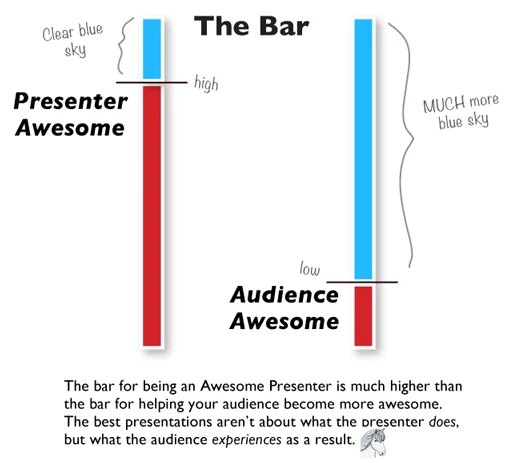
PresenterBarFlat.jpg

If you, like me, struggle with terrifying stage-fright, you might try this: as you prepare a presentation, keep a giant post-it in front of you that says, “YOU ARE JUST A UI”. Keep the focus off of you so you can get on with creating an experience for the people who do matter: your audience. Your users. Because every moment we spend obsessing over how this will make us look is a moment NOT devoted to how our presentation will make them look.


24 Oct 23:52

The Rails-way and bigger projects

by Andrzej Krzywda

The whole idea of having a data-structure that you retrieve from the database and carry through all the layers to the UI makes the development very quick at the beginning.

The coupling it provides, at the later stages of development makes it very difficult to split the app into any kind of modules. It's also difficult to test anything in isolation. That's why Cucumber, Capybara, Selenium are so popular, as they help you in writing integrated tests.

Integrated tests have their place, but it's impossible to test everything through all the layers. This results in slow builds - a typical syndrome in Rails projects.

The Rails way makes sense for smaller projects. What I'm disagreeing with is using "The Rails way" in bigger, serious projects.

The Rails itself has nothing inherently wrong. I'm not attacking Rails, I'm only attacking 'the Rails way'. You can use Rails for bigger projects, if you know what you're doing.
24 Oct 18:19

Photo


10 Oct 23:13

Why The GOP Is Relenting

by Andrew Sullivan

Screen Shot 2013-10-10 at 7.02.47 PM

And why the president just turned their latest gambit down:

By a 22-point margin (53 percent to 31 percent), the public blames the Republican Party more for the shutdown than President Barack Obama – a wider margin of blame for the GOP than the party received during the poll during the last shutdown in 1995-96. Just 24 percent of respondents have a favorable opinion about the GOP, and only 21 percent have a favorable view of the Tea Party, which are both at all-time lows in the history of poll.

Obama’s ratings are pretty stable, in comparison. And this is the cherry on the top:

Thirty-eight percent see the Affordable Care Act (or “Obamacare”) as a good idea, versus 43 percent who see it as a bad idea – up from 31 percent good idea, 44 percent bad idea last month.

(Chart: poll of polls for Republican party favorability.)


10 Oct 21:50

Brief Note on the Dictatorship of the Proletariat and the USA's Government Shutdown

Brief Note on the Dictatorship of the Proletariat and the USA's Government Shutdown:

Makes a super interesting argument about government vs. the State.

10 Oct 19:54

Super Mario fully implemented in HTML5

by Cory Doctorow


Full Screen Mario is Josh Goldberg's complete remake of the classic Super Mario Brothers in HTML5. You can play re-creations of the original levels, make your own in an HTML5-based level editor, or play any of an infinite number of randomly generated levels. The code is on GitHub for your happy hacking, too. It's a pretty impressive example of what HTML5, in-browser functionality can do.


Full Screen Mario is a purely HTML5 remake of the original Super Mario Brothers. You can play the original levels, play through some of literally millions of possible random maps, or create your own using the level editor. This whole project is open source and free - if you would like to use the code, check out the Github or email me.

Full Screen Mario (via Waxy)


10 Oct 18:57

"When wealth is passed off as merit, bad luck is seen as bad character. This is how ideologues..."

“When wealth is passed off as merit, bad luck is seen as bad character. This is how ideologues justify punishing the sick and the poor. But poverty is neither a crime nor a character flaw. Stigmatise those who let people die, not those who struggle to live.”

- Sarah Kendzior, A government shutdown, a social breakdown (via randomactsofchaos)
10 Oct 17:31

Dragonslayer

by Fred Clark

Samantha at Defeating the Dragons is a terrific writer and thinker whose blog has quickly gained a lot of attention from a variety of angles — including from the mainstream white evangelical world. The quality of her writing is a credit to the Master’s program at Liberty University, even if Liberty might not be pleased with the incisive honesty she directs toward the evangelical world to which it belongs.

Her post today, though, won’t just make Liberty et. al. a bit uncomfortable. This is the one subject — the one deviation from the long list of acceptable “stances” — that often causes them to cut all ties, to sever all connections, and to speak of a person, if at all, only in the past tense.

If you’re not from that world — from the American evangelical world of Independent Baptists and Liberty University — then I’m not sure I can communicate to you how courageous this is: “ordeal of the bitter waters, part one.”

My heart was in my throat, my fingers floating over the refresh button on my twitter feed. I was curled up under a gigantic down-alternative comforter, huddled under the half-tent I’d made on the floor of my bathroom. Hours went by as I watched what was happening– the strikes, the interruptions. In the last few minutes I joined with thousands of other voices shouting and screaming, a cacophonous din stretching over the internet, across twitter mentions and live feeds. Together, we watched the underhanded attempt at deceiving an entire country of watching people.

The next day, we celebrated. We declared “We Do Not Sit.” We’d spent the night standing. It didn’t matter that we all knew what would happen, that all of that would swiftly be overturned, and the voices screaming into the night would be silenced. We’d stood. For that single day, it was . . . almost enough.

~~~~~~~~~~

I’m pro-abortion. Pro-reproductive rights. Pro-choice.

She is not alone. A third of church-going, Bible-reading white evangelicals are pro-choice.

But one is not allowed to speak of this. One is not allowed to explain why, to make the case, to question the assumptions, to speak of any possibility other than the One Official Stance that is the only “stance” tolerated by the tribe.

Samantha knows this. She knows this is the big taboo and she knows what it will mean to have violated it — the doors that will be closed, the friends that will be lost, the writing opportunities that will be revoked, the invitations rescinded.

Some will condemn, others will seek to punish, many will simply turn away for fear of any association that might get them condemned or punished.

She already knows this, she’s already had some small foretaste of it:

And then, one day, someone asked me if I could drive them to Richmond so they could sit outside the abortion clinic.

I squirmed. “I . . . I’m sorry. I can’t.”

She nodded affably. “Too much work that weekend?”

Do I say anything? Do I just let her think that? That would be the easiest thing. “Actually . . . I don’t really agree with that.”

“With what?” She stopped, turned to face me, her stance becoming aggressive.

“With sitting outside the abortion clinic. Oh, I know you don’t do anything crazy,” I rushed to add. “But I’m not comfortable with the whole thing.”

“Oh.”

She defriended me on Facebook. When I saw her around campus, she wouldn’t look me in the eye.

They don’t like to look you in the eye. The tribal gatekeepers will escort you from the premises, wordlessly, and all those prior connections will be disconnected, but they probably won’t ever look you in the eye. That would involve an impermissible conversation requiring too many unutterable words.

Defeating the Dragons probably just lost some readers.

For my part, it just gained a big fan. I’m looking forward to “part two.”


10 Oct 17:30

7 things @ 9 o’clock (10.10)

by Fred Clark

1. Joshua Holland @ Moyers & Company: “To Understand the Shutdown You Have to Grasp the Mindset of the GOP Base

Democracy Corps – a Democratic-leaning polling firm – released a study this week based on a series of focus groups they conducted with loyal Republican voters. They divided them up into three sub-groups which together represent the base of the party. Evangelicals represent the largest group, followed by Republicans who identify with the tea party movement. “Moderates,” the third group, make up about a quarter of the party’s base, according to the pollsters.

Fear of a changing society is one thing that unites all three factions. The battle over Obamacare, write the study’s authors, “goes to the heart of Republican base thinking about the essential political battle.”

They think they face a victorious Democratic Party that is intent on expanding government to increase dependency and therefore electoral support. It starts with food stamps and unemployment benefits; expands further if you legalize the illegals; but insuring the uninsured dramatically grows those dependent on government. They believe this is an electoral strategy — not just a political ideology or economic philosophy. If Obamacare happens, the Republican Party may be lost, in their view.

And while few explicitly talk about Obama in racial terms, the base supporters are very conscious of being white in a country with growing minorities. Their party is losing to a Democratic Party of big government whose goal is to expand programs that mainly benefit minorities. Race remains very much alive in the politics of the Republican Party.

They worry that minorities, immigrants, and welfare recipients now believe it is their “right” to claim [public] benefits. Tea Party participants, in particular, were very focused on those who claim “rights” in the form of government services, without taking responsibility for themselves.

They are also unified in their belief that Obama is a usurper who has hoodwinked the public into re-electing him by hiding his true beliefs, which are essentially Marxist. They also think that Democrats have won the major political battles of our time because Republican legislators in Washington didn’t put up a fight.

But there are also deep divisions within the base, according to the analysis. Evangelicals still focus overwhelmingly on social issues. They think gay rights are the biggest threat to our society, but they also worry about the loss of what they see as an idyllic small-town culture. They feel besieged as the cultural ground shifts beneath them, and see themselves as a beleaguered, “politically incorrect” minority.

2. Michael Lind @ Salon: “Tea Party radicalism is misunderstood: Meet the ‘Newest Right’

The Newest Right is the simply the old Jeffersonian-Jacksonian right, adopting new strategies in response to changed circumstances. …

The political strategy of the Newest Right, then, is simply a new strategy for the very old, chiefly-Southern Jefferson-Jackson right. It is a perfectly rational strategy, given its goal: maximizing the political power and wealth of white local notables who find themselves living in states, and eventually a nation, with present or potential nonwhite majorities.

Although racial segregation can no longer be employed, the tool kit of the older Southern white right is pretty much the same as that of the Newest Right.

… Today the white notables of the South increasingly live in states like Texas, which already have nonwhite majorities. They fear that Obama’s election, like Lincoln’s, foreshadows the emergence of a new national majority coalition that excludes them and will act against their interest. Having been reduced to the status of members of a minority race, they fear they will next lose their status as members of the dominant local class.

While each of the Newest Right’s proposals and policies might be defended by libertarians or conservatives on other grounds, the package as a whole—from privatizing Social Security and Medicare to disenfranchising likely Democratic voters to opposing voting rights and citizenship for illegal immigrants to chopping federal programs into 50 state programs that can be controlled by right-wing state legislatures—represents a coherent and rational strategy for maximizing the relative power of provincial white elites at a time when their numbers are in decline and history has turned against them.

3. Garry Wills @ The New York Review of Books:Back Door Secession

John Boehner holds the nation hostage because the Tea Party holds him hostage. The problem with modern Republicans is not fanaticism in the few but cowardice in the many, who let their fellows live in virtual secession from laws they disagree with.

Neo-secession and neo-nullification. What’s next? Neo-neck beards?

Republican leaders in Congress are too cowardly to say that the voting restrictions being enacted by Republican-controlled state legislatures are racially motivated. They accept the blatant lie that they are aimed only at non-existent “fraud.” They will not crack the open code by which their partners claim to object to Obama because he is a “foreign-born Muslim” when they really mean “a black man.” They will not admit that the many procedural laws adopted to prevent abortion are in violation of the law as defined by the Supreme Court. They go along with the pretence that all the new rules are “for women’s health.” De facto acts of secession are given a pseudo-legal cover.

… The presiding spirit of this neo-secessionism is a resistance to majority rule. We see this in the Senate, where a Democratic majority is resisted at every turn by automatic recourses to the filibuster. We see it in the attempt to repeal the seventeenth amendment, which allows a majority of voters to choose a state’s senators. The repealers want that choice to go back to the state legislatures, where they rule thanks to anti-majority gerrymandering.

The Old South went from virtual to actual secession only when the addition of non-slave Western states threatened their disproportionate hold on the Congress and the Court (which had been Southern in makeup when ruling on Dred Scott). It is difficult to conjecture what will happen if the modern virtual seceders do not get their way. Their anti-government rhetoric is reaching new intensity. Some would clearly rather ruin than be ruled by a “foreign-born Muslim.” What will the Republicans who are not fanatics, only cowards, do in that case?

4. Joan Walsh @ Salon: “The real story of the shutdown: 50 years of GOP race-baiting

To be fair to Republicans, not everyone is or was comfortable with this strategy. One of the things I remember best from Richard Ben Cramer’s legendary history of the 1988 election, What It Takes, was the way both George H.W. Bush and Bob Dole grappled with whether and how to reach black voters, in the wake of the Reagan revolution. Each man struggled, in his own way, to understand and accept exactly how party leaders, starting with Goldwater, had actively pushed African-Americans out of the party of Abraham Lincoln. Dole’s discomfort seemed a little deeper and more genuine; in the end, Bush acceded to Atwater and Roger Ailes, one of Richard Nixon’s media henchmen, to produce the infamous Willie Horton ad that helped torpedo Michael Dukakis.

Over and over, that’s how things got worse: Republicans who know better, who probably aren’t “racist” in the old-fashioned sense of believing in black inferiority and opposing the equality and integration of the races, nonetheless pander to those who are, for electoral gain. And when the election of our first black president riled up the racists and launched the Tea Party – supposed deficit hawks who tolerated skyrocketing government spending under George W. Bush — too many Republicans went along.

Today, the entire government has been taken hostage by leaders elected by this crazed minority, who see in the face of Barack Obama everything they’ve been taught to fear for 50 years.

5. Lee Fang @ The Nation: “Meet the Evangelical Cabal Orchestrating the Shutdown

The coalition is managed by Heritage and the Council for National Policy. The latter organization, dubbed once as “the most powerful conservative group you’ve never heard of,” is a thirty-year-old nonprofit dedicated to transforming the country into a more right-wing Christian society. Founded by Tim LaHaye, the Rapture-obsessed author of the “Left Behind” series, CNP is now run by Christian-right luminaries such as Phyllis Schlafly, [The Liar] Tony Perkins and Kenneth Blackwell.

… The board of the Council for National Policy, the Conservative Action Project’s sponsor, features Michael Grebe, an influential Republican lawyer who leads the Bradley Foundation—a GOP money machine with close ties to Republican National Committee chair Reince Priebus and Governor Scott Walker. The Heritage Foundation’s Ed Meese and Becky Norton Dunlop, both well-respected among mainstream Republicans, are said to be prime players in the effort.

Kevin Gentry, a key employee of Koch Industries’s lobbying subsidiary Koch Public Sector, has served on the board of CNP. Gentry now helped to run the new $250 million fund for conservative advocacy groups called Freedom Partners and manages the twice-annual secret gatherings for Charles Koch’s cohorts. (It was at a CNP gathering that Charles Koch once compared himself to the theologian Martin Luther.)

6. Brian Tashman @ Right Wing Watch: “Religious Right Leaders Hail Ted Cruz as a Modern-Day George Washington

Family Research Council’s [The Liar] Tony Perkins commended Cruz and his allies for instigating the government shutdown: “I think they are acting heroic, I think they are heroes. They are along the lines of the patriots who founded this nation, they are standing up to the liberal press and to the naysayers and to the RINOs and saying, ‘No we’re not going along with it any longer, we’re going to try and use what ability we have to save this country.’”

7. Chris Skinner @ Peje Iesous: “Why ‘Jesus’ Is to Blame for the Government Shutdown

If you listen to the sound bites of congressional leaders and other talking heads who both oppose universal healthcare and also identify as “Christian,” you can hear echoes of Bill O’Reilly’s Jesus. Apparently, the Jesus that baptizes Bill O’Reilly’s political views is the same Jesus who smiles approvingly at the congressional temper tantrum which has led to the government shutdown. That same Jesus sees universal healthcare as “unethical” because it undermines the work ethic of others who receive healthcare at their places of business and in the process rewards the lazy and slothful among us. It is interesting to note that, in all of the healing narratives in the New Testament, there is not one place where Jesus asks an individual about his/her job or work ethic before deciding to heal.

…Even in my own personal experience, the most outspoken opponents of universal healthcare have been self-proclaimed “born again Christians” who are quick to tell you that they read the Bible literally. Mind you, they don’t generally read the parts about caring for the poor and marginalized literally, though certainly the parts about cataclysmic end-times events. … Ironically, these same individuals also proclaim that “Jesus wants to save the world,” though we should keep in mind that such salvation, like much else in their reading of the New Testament is “spiritual” more than anything else.

The Jesus of Bill O’Reilly and other ultra-right-wingers is a Jesus who stands at the head of our nation, approves of our affluence, nods with acceptance at our disregard for the disenfranchised, embraces our imperial policies, and insists that his words shouldn’t be taken literally, at least not when it comes to turning the other cheek or giving sacrificially to help the less fortunate.


10 Oct 17:26

What’s The Endgame?

by Andrew Sullivan

US-POLITICS-ECONOMY

Ambers runs through various possibilities:

The most likely scenario is one where Boehner folds but pretends he didn’t, and Obama negotiates, but only in words. Privately, Boehner would prefer this solution because it would not actually concede any significant ground to the Tea Party, and if the optics are right, he could emerge from this fracas with roughly the same amount of power as before it started. What would this look like? A play, consisting of three acts. Act 1: Republicans promise to pass a clean CR and debt ceiling increase in exchange for specific words from Obama that he can be held to; Act 2: Obama proclaims publicly that he has said all along that he has been willing to negotiate with Republicans, and then says something like, “and I look forward to talking to them right after the the government opens on subjects ranging from tax reform to reducing the burden of entitlements.” Act 3: Boehner seizes on that sentence and tries to sell it to his conference. An unofficial whip count confirms this, but he says publicly that he will do the honorable thing and not allow the nation to go into default SO THAT Republicans can hold Obama accountable on his promise. Finale: the votes pass.

Waldman considers the situation from Boehner’s point of view:

[T]here is not a single factor that over time is making a GOP victory more likely. My guess is that Boehner knows this but is hoping that the fight itself will win him enough breathing space with the conservatives to keep his job when its over. He’ll lose, but he’ll show them that he was willing to inflict some harm on the country in the process, which will deplete their rage just enough.

Think about that for a moment. The only way the Speaker can keep his job is to inflict serious economic damage on the country. That’s the measure of his mettle. We can get lost in the tick-tock of this, and forget to step back and realize that this remains one of the most reckless, nihilist gambits by any political party in my adult lifetime – up there with impeaching Clinton, which, at least, wouldn’t have plunged the entire world into a second depression.

The more extremist they get, the more dangerous they become. If we can survive this self-induced fiasco, we have surely one overwhelming imperative – to get as much constructive things done in the next year and then launch a huge effort to rid the House of these fanatics in 2014. It won’t be easy, but it’s getting urgent.

(Photo: US Speaker of the House John Boehner leaves after speaking at the US Capitol in Washington, DC, October 8, 2013. By Saul Loeb/Getty.)


09 Oct 20:44

Red Dawn delusions and an unmet longing for real community

by Fred Clark

I’m not sure whether Glenn Beck’s subject here is marriage equality or renewable energy or affordable health insurance for working people. Or maybe it’s about the fight to keep a 35-percent marginal tax rate on upper incomes from becoming a 37-percent marginal tax rate. In any case, here is what right-wing TV and radio loon Glenn Beck had to say:

I want my children and my grandchildren to be able to air this episode. I stood. I gave it my all. I did everything I could. Against all odds, I stood. In the face of an avalanche; against, quite honestly, systems that will become enemies of all humanity, I stood. I want my children and my grandchildren to be able to have my name and say “when all of the rest of your families did nothing, this is what my family did.”

Wolveriiiines!

It doesn’t matter if this was about Obamacare or eliminating food stamps or deporting immigrants — Beck talks like this about everything.

“I stood. I gave it my all. I did everything I could. Against all odds, I stood.”

Beck is a fairly transparent liar. His real legacy for his children and his grandchildren won’t be their pride that he stood bravely against the “enemies of humanity.” It will be a big fat trust fund — invested in the kind of private, off-shore hedge funds his audience could never afford, and not in money-losing crap like those commemorative gold coins he’s always scaring the suckers into buying.

And as for how he made all that money, well, he’ll just have to hope that his children able to forgive him some day. He did it all for them, he’ll say. But they’ll know, and he’ll know, that’s a lie. He liked it. He was good at it. And he was really … he was alive.

But what about Beck’s audience? A percentage of them, apparently, are fearful and gullible enough to swallow this stuff completely. A small portion of his audience may be — and, I’m sorry, there’s no delicate way to put this — not very bright, and thus susceptible to believing what Beck says because an authoritative-sounding voice on the radio said it must be so.

But most of Beck’s audience isn’t that dim. And so most of Beck’s audience has to be mostly aware that this is a game of make-believe. Yes, it’s fun to pretend we’re just like Patrick Swayze in Red Dawn, because he was so cool and wouldn’t it be cool if we were that cool and that brave instead of the way we know ourselves to be, and wouldn’t it be great if we had Jennifer Grey and Lea Thompson looking at us like that, instead of the way …

But not-so-deep-down, they have to know it’s just a game. It’s just pretend. I don’t just mean a dim nagging at the edge of their self-awareness, I mean a pervasive, constant, gnawing ache. And the harder they play the game the more it backfires, highlighting the vast gulf between the pretend-self and the actual, unavoidable self.

For it to be otherwise — for them not to know this, not to know themselves — would require a depth of delusion I cannot comprehend.

Kevin Drum points us to a fascinating study of the appeal of what the researchers call “outrage-based radio and television programs.” That is, shows like Glenn Beck’s, which exist to manufacture and to fuel the sensation of outrage, and thus also, the chance to feel — if only by pretending — the kind of heroic pride imitated by that delirious Beck quote above.

Tom Jacobs discusses this study in a Pacific Standard piece, “What’s the Appeal of Angry, Polarized Media?

Psychological research has generally pointed to our desire to avoid cognitive dissonance—that is, information that conflicts with our strongly held (and emotionally based) convictions. But in a recently published paper, a trio of Tufts University researchers led by sociologist Sarah Sobieraj provides an alternative analysis.

“The data suggests to us that outrage-based programming offers fans a satisfying political experience,” they write in the journal Poetics. “These venues offer flattering, reassuring environments that make audience members feel good. Fans experience them as safe havens from the tense exchanges that they associate with cross-cutting political talk they may encounter with neighbors, colleagues, and community members.”

Read Jacobs’ whole article for a fascinating look at one of the things Sobieraj et. al. found to be a primary desire for conservative fans of “outrage” media: a refuge from potentially being perceived as racist:

“The experience of being perceived as racist loomed large in the mind of conservative fans (we interviewed),” they report. Every single conservative respondent raised the issue of being called racist, and did so without even being asked.

Kevin finds this frustrating. The same research that provides mountains of evidence that racial animosity is driving much of this conservative outrage media also demonstrates that confronting — or even mentioning — such evident racial resentment tends to “drive people to the safe confines of friendly media, and help fuel the ongoing outrage machine.”

The same is true, I suspect, of the kind of discussion I offer above, about the fantasy game being played by the perpetually outraged. They’re pretending – and we know they’re pretending. And they know that we know they’re pretending. But to say so out loud tends only to push them further into pretense and into ever more elaborate and extreme fantasies of outrage.

“I wish there were some way to talk about it that didn’t instantly estrange conservatives even further — but that also didn’t water the truth down into mush,” Kevin writes. “I imagine I’ll be wishing for that for a very long time.”

The one little mustard seed of hope I take from all this comes from another finding from the researchers at Tufts:

Their content analysis found many examples of hosts who “offer social connections by building a sense of intimacy.” With their informal, conversational style, these media-savvy men and women create “what feels distinctly like a one-on-one relationship between the individual fan and the host.

“Whereas political conversation generates fear of social exclusion, outrage-based programs incorporate and even include viewers and listeners,” the researchers report. “The host presents as a kindred spirit who ‘gets you’ even when other folks do not.”

Discussing politics with your colleagues or neighbors comes with the fear of saying something unacceptable, and subsequently being excluded from the next barbecue or water-cooler conversation. In contrast, “the comfort zones provided by the shows we studied present no such risk,” Sobieraj and her colleagues write. “In fact, they offer imagined and, in some cases, tangible social connections.”

This is part of what I mean when I say that people like Glenn Beck aren’t telling lies to deceive their listeners, but rather are telling lies that invite listeners to participate in deception — in a community of mutually agreed-upon deception.

That community cannot be real — cannot be any more real than the lies on which it is based. But Sobieraj et. al. confirm that “outrage” per se may not be the deepest or most powerful attraction for those who have gotten hooked on this drug-like indignation. They enjoy the outrage — they enjoy the feeling of pretend-heroism that comes from shouting “Wolverines!” along with Glenn and Rush and Bill-O and Randall Terry and the Liar Tony Perkins. But the game itself isn’t as important to them as just having someone else to play with.

They long for community. And that, I think, might be the only way to get them to accept the possibility of liberation from their addiction to outrage. They long for community and they have thus settled for, and become trapped by, the pretend community of indignation and outrage. That can’t compete with the genuine article.

There’s a role here for churches and other neighbors — actual neighbors, not the virtual kind that beam in on cable TV or AM radio. Whether it’s a small-group Bible study or a softball team or a bowling league or a bar, a diner, a coffee shop or some other great good place, the more involved they can be with a real community, the freer they will be from the lies of the false one.

08 Oct 23:08

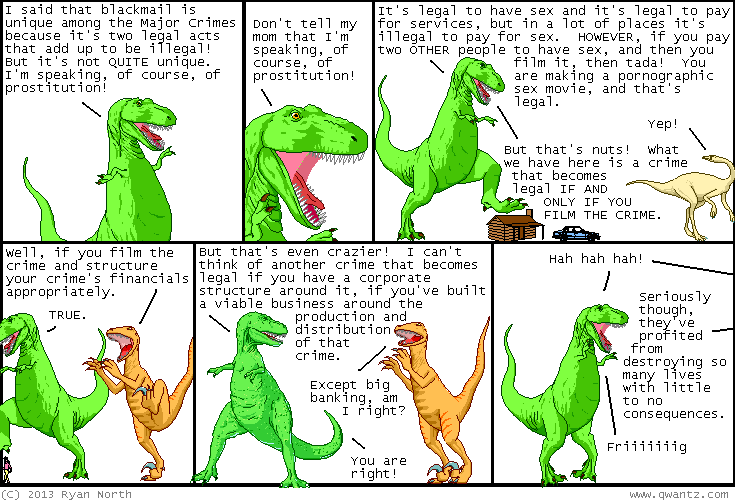
honestly quite happy with my phrase "pornographic sex movie" and intend to use it at every opportunity in the future

archive - contact - sexy exciting merchandise - cute - search - about
← previous October 7th, 2013 next

October 7th, 2013: Thanks to everyone who came out to IndieCade and to our little event last night at the Time Travel Store! I believe everyone had a good... time??

I hope you enjoyed that pun; I am a professional writer

One year ago today: should've wished for more wishes, grahams

– Ryan

08 Oct 22:49

Sad

by Josh Marshall

The saddest thing about this mess is that Republican can't even decide why they shutdown the government and started threatening debt default? Obamacare? Or maybe now it's the debt? Or a new supercommittee to pursue the 'grand bargain'. Now they just want to negotiate. Which thing?

08 Oct 22:49

Your Trusted Source

by Josh Marshall

Craig Smith, CEO of Swiss America, one of those companies that sells gold to morons on conservative media outlets assures Fox News' Neil Cavuto viewers that debt default should turn out just fine. Watch.

08 Oct 22:29

No Escape Hatch

by Josh Marshall

ICYMI from last night: Why there's no escape hatch from a debt default. No 14th Amendment, no platinum coin. None.

08 Oct 20:00

As a follow-up to my previous post, I thought I’d draw my...


As a follow-up to my previous post, I thought I’d draw my own Catwoman-with-a-sports-bra. I think she looks much happier with some support. The other Catwomans belong to Pascalle Lepas and Claire Hummel, respectively.

What other female superheroes need sports bras? I think there’s a few who would appreciate the treatment.

08 Oct 17:44

Narnia: The Home Shopping Network Tragedy

by Ana Mardoll
[Content Note: The violent massacre of a village; Slavery; Republican agendas]

Narnia Recap: In which the crew finds a destroyed village, a Sea Serpent, and a Midas pool.

Voyage of the Dawn Treader, Chapter 8: Two Narrow Escapes

So, hey: Chapter Eight!! Not Seven anymore. Boom! This one is full of good stuff but is also pretty short, so I hope to cover everything in maybe three posts, which will then free up loads of time for us to gape at Chapter Nine and compare ALL THE NOTES on how we didn't notice how fucked up Chapter Nine was when we read the book as kids. (Or perhaps that's just me.)

In today's half of Chapter 8, the crew will find a ruined village and will acquire a boat for Reepicheep. And just to be really clear, it's the boat that is the important thing there, as far as Lewis and the crew is concerned.

    EVERYONE WAS CHEERFUL AS THE DAWN Treader sailed from Dragon Island. They had fair winds as soon as they were out of the bay and came early next morning to the unknown land which some of them had seen when flying over the mountains while Eustace was still a dragon. It was a low green island inhabited by nothing but rabbits and a few goats, but from the ruins of stone huts, and from blackened places where fires had been, they judged that it had been peopled not long before. There were also some bones and broken weapons.
   “Pirates’ work,” said Caspian.
   “Or the dragon’s,” said Edmund.

And that's all you get.

No, really, that's as far as the crew explores or expostulates on the matter. And I have thoughts on that, but let's finish out this piece. 

   The only other thing they found here was a little skin boat, or coracle, on the sands. It was made of hide stretched over a wicker framework. It was a tiny boat, barely four feet long, and the paddle which still lay in it was in proportion. They thought that either it had been made for a child or else that the people of that country had been Dwarfs. Reepicheep decided to keep it, as it was just the right size for him; so it was taken on board. They called that land Burnt Island, and sailed away before noon.

These four short paragraphs confused me as a child, but I wasn't the sort of child who argued with books, so I just assumed I was stupidly missing something obvious. Now I'm not so charitable.

The text claims that the ruined village had been "peopled not long before", but apparently there are no bodies. I say "apparently" because if there were bodies, then it seems like those bodies would hold a clue on the whole Pirate vs Dragon debate: are the bones nommed on with teeth marks or are they damaged with the sorts of weapons that humans tend to use when they fight. (It's already been established that at least some of the Lone Island pirates used bows and arrows.)

Also: The crew have been on Dragon Isle for six or seven days, so is this "not long before" period prior to that? If the village was attacked while the Dawn Treader was on Dragon Island, this would not only be relevant in the Probably Not A Dragon sense (since Eustace was the only dragon in the area, them being solitary creatures), but would also be highly relevant in the "are we safe" sense. You'd think that Drinian would kinda care about knowing if there's a pirate ship waiting in the waters on the other side of the island ready to shoot fiery arrows into his ship, even if Caspian wouldn't think of it.

Second: HOLY SHIT WAIT WHAT. That is a direct transcript of my adult thoughts on reading that the crew can't figure out if the boat was made for a human child or if the ruined village was a village of dwarfs. Because, um, I would sort of think you could make a rough guess at the average height of the local people based on the sizes of the stone huts and how big the doorways are and what eye level the pictures and/or other decorations were hung at and the size of the broken tools and weapons all over the ground.

Is it lack of imagination that caused this error, such that Lewis didn't bother to imagine the village in his mind's eye for a moment before plunging ahead? Or is it lack of empathy, that he just didn't care whether the villagers were tall or short, nor whether they were killed by dragons or pirates?

And the question sticks with me even more when I realize that this whole sequence feels rushed and out of place; it almost seems like the only reason for this village to exist at all was to insert Reepicheep's boat so that he would have it for the next chapter when he teaches kayaking to the Dufflepuds (and, of course, the boat returns in the final chapter so that Reepicheep can sail up a vertical wall of water). Which, if that really were the only reason to insert that here, means that Lewis felt it was easier to stick an off-screen massacre into his children's book so that the heroes could loot the burnt remains rather than to have the Dawn Treader properly fitted out with a boat-slash-lifeboat which would accommodate the needs of its one non-human member. SURE!

I kinda feel like that's a metaphor for this whole series. Nameless, faceless people die so that the heroes can profit from their deaths. And while you could probably level that accusation at a lot of books, never has it seemed so blatant and repetitive to me as with this blood-thirsty series; if it's not a reign of terror or a genocide it's an island-wide massacre.

On a wider-scale of Empathy Fail, it seems like maybe Lewis didn't realize that "pirates" aren't just things that exist on the ocean, like sea monsters and dragons, but rather are actual people who the heroes have actually encountered. Were the pirates who (possibly) wiped out the people of this village the same pirates operating around the Lone Islands earlier in the book? On the one hand, this island is approximately three weeks out from the Lone Islands and that was farther out than "all the oldest sea captains whom [they] could find in Narrowhaven" had traveled. But on the other hand, there's no indication that Caspian asked the presumably younger pirate captains, which he had recently released from any semblance of legal justice and who probably wouldn't want to hang out in the same tavern with him in case the King With The Pointy Sword changed his capricious mind. And if it were slavers who hit the island, that would actually explain why no bodies are present.

But if anything, that just makes this so much WORSE. Because, (a) could Caspian have prevented this relatively-recent attack if he hadn't let the pirates go in order to seem magnanimous? Worse, did he indirectly cause this incident by making it harder to raid the Lone Islands for slaves to sell to Calormen and therefore indirectly encouraging the pirates to go further out for new merchandise? Could this have been a peaceful community who never heard of slavery until a bunch of recently-driven-out-of-the-Lone-Islands pirates showed up on their doorstep and hauled them all off to Calormen? Because christ, that would be very awful and while Caspian wouldn't be responsible for the pirates' actions, he would be responsible for creating this situation by letting go people who he knew to be armed, dangerous, and perfectly willing and capable to continue pirating and slaving.

And all this comes back to an established problem with Caspian in that he doesn't actually DO things (kingly things!) to protect people until they actually become valuable to him. A few nameless faceless natives who might have been captured or killed by the slavers Caspian didn't effectively try to stop? Wev. He's like a Republican-conservative-dream king who doesn't do jack-shit in his own country (because he left) and instead sort of half-heartedly wars on other people but only when he gets something concretely valuable out of it for him, and not for all the stuff government shouldn't get involved in like Entitling People To Food and Safety From Privileged People With Guns Arrows. WHAT AN AWESOME ARTHURIAN KING, LEWIS!

Then, (b) we see that once again Caspian is shit at facilitating the things he DOES want to do. If this village was hit by pirates, and if that happened before the Lone Island incident (and therefore couldn't have been prevented or caused by Caspian), then that would mean that the pirates did know their way out here and Caspian was wasting his time pouring wine for a bunch of elderly men in taverns rather than actually going and talking to the people who currently own boats and travel in them. Many of us have read adventure stories where the amoral-but-greedy (and probably debonair, depending on the genre) sea captain is willing to answer questions for coin; I refuse to believe that a properly-determined Caspian couldn't have found at least one pirate captain to talk to him about their trip.

And several of you have wonderfully pointed out in the comments that despite going to Galma to have a tournament and visit the Duke's daughter, no one on-board considered asking about the Galmian sailors hired by the Lost Lords (who have vanished just as thoroughly from the novel as the villagers of Burnt Island have). Even if the Galmian sailors were never heard from again, I'd want to talk to their surviving relatives and see if they filed a flight plan or something. ("Oh, yes, my dad was the captain of that ship. He always used to tell me that a true sailor sets his sights on the second star to the left of Aslan's Mane and sails straight on 'till morning.")

Caspian doesn't talk to the families of the lost Galmian sailors for the same reason that he doesn't talk to pirate captains and doesn't bring back souvenirs for the relatives of the dead Lost Lords, and I think it's because they're beneath him. Arthurian Chivalry can allow him to rub elbows with the hoi polloi to a limited degree -- he can, for instance, speak with Elderly Respectable Retired Captains since they have a sort of earned nobility from surviving on the Lady Sea for long enough to grow old -- but he can't talk to younger sailors or surviving relatives or people who haven't earned their Privilege Patches. And the last time someone without a Privilege Patch tried to talk to him, Lord Bern bashed the poor fellow about the head with a hand encased in a gauntlet.

Last time, bekabot pointed out that the world of Narnia feels deeply depopulated at times. I agree wholeheartedly, and I really do believe that background characters -- the characters who have to exist in order for the world-building to be true -- really do stop existing when Lewis doesn't need them. A lot of books invisible their background characters to various degrees (sometimes problematic and sometimes not), but the people of Narnia don't seem to be there-but-hidden; they seem to be not-there-at-all. At no point were we worried in the trip from the Lone Islands to here that pirates might attack the ship, and yet here at Burnt Island they pop briefly back into existence again. And then Reepicheep gets a boat and we never speak of pirates ever again.

But this means that Narnia is built upon a privilege which is almost breath-taking in its totality. For marginalized people to not exist when not wanted is the impossible dream of privilege. Invisibling us is the next best thing, the consolation prize to not being able to summon us from the ether when needed and banish us back to the void when not. Narnia has achieved this, and I suspect in large part because it's a work by a privileged author about a privileged culture with a privileged religious message for privileged children who are intended to grow up to maintain the privileged order. (And woe betide the children who would undermine that order with vegetarianism and feminism and lipstick.)
08 Oct 17:31

If You Wonder Why I’m Shitting Myself

by Andrew Sullivan

“President Obama waived a ban on arming terrorists in order to allow weapons to go to the Syrian opposition. Your listeners, US taxpayers, are now paying to give arms to terrorists including Al Qaeda. … This happened and as of today the United States is willingly, knowingly, intentionally sending arms to terrorists, now what this says to me, I’m a believer in Jesus Christ, as I look at the End Times scripture, this says to me that the leaf is on the fig tree and we are to understand the signs of the times, which is your ministry, we are to understand where we are in God’s end times history. … Rather than seeing this as a negative, we need to rejoice, Maranatha Come Lord Jesus, His day is at hand,” – Michele Bachmann, a sitting member of Congress.


08 Oct 17:00

A post-mortem on post-election post-mortems

by Fred Clark

I’m so old I can still remember the election of 2012 like it was just 11 months ago. BooMan reminds us of all the post-election talk of revitalized Republican outreach to Latino voters, women and youth.

Remember that? As BooMan writes, it didn’t quite work out that way: “Hispanic and youth outreach? Pfft. Let’s turn the Tea Party up to eleven!!”

Hand-in-hand with the Republican Party’s brief period of post-election introspection came a parallel process among the establishment institutions of white evangelicalism. They, too, briefly recognized the election — and particularly the four triumphs that day for marriage equality everywhere it was on the ballot — as a sign that they were swimming against a demographic tide that spelled their impending obsolescence. The white evangelical post-mortems were eerily similar to those of the political party to which they had bound themselves — so much so that for much of last November and December, I had to keep double-checking the name of the blogs in my RSS feed, because four or five paragraphs into an article I still couldn’t tell whether I was reading about the Republican Party or white evangelicalism.

The invaluable Rhetoric Race and Religion blog collected dozens of those post-election reflections — some about the GOP, some about white evangelicals, many about both at the same time. The headlines tell the story: “The Religious Right After the Election,” “What’s next for religious conservatives?,” “Election results raise questions about Christian right’s influence,” “What historically white denominations can learn from the Republican Party,” “Election 2012: A New Day for Religion in America” and on and on.

Click over to RRR’s list and read through some of those many pieces. They seem to come from a world much farther away than just 11 months ago, and yet the questions they raise and the issues they highlight remain just as pertinent today. The demographic trends have not changed — nor could they. And the old culture-war message has not suddenly acquired any new appeal.

So what’s the plan and the follow-through on the white evangelical side of all this once-much-discussed “outreach”? As BooMan says, the GOP quickly dropped such talk, preferring to double-down on the Tea Party Gone Wild strategy. But what about the religious right?

After the election, I wrote about what I saw as a split between “true believers” and “hucksters” on the religious right:

Broadly speaking, the hucksters of the religious right are advocating one response while the true believers of the religious right are advocating another.

The hucksters are urging their followers, supporters and partisan patrons to double down on all the same things they’ve been doing all along. They want the same stances, same agenda, same strategies, same tone — but a different result. That different result, they say, will come from doing all the very same things even harder.There’s no evidence that would work, but the hucksters don’t measure success by political outcomes. They measure success by fundraising outcomes — and an Obama win was probably more potentially lucrative for them than a Romney win would have been.

The true believers, on the other hand, seem to realize that more of the same approach won’t produce the societal changes they had hoped for. They’ve begun re-evaluating their political tactics, agenda and tone, considering if there might not be a better, more effective way of advancing the values they care about.

Here we are, 11 months later, and it seems to me that among white evangelicals, as with the GOP, the hucksters are winning.

08 Oct 16:09

Detonating An Economic Nuclear Bomb

by Andrew Sullivan

Daniel Gross warns that the impact of a default would be massive:

A U.S. debt default, or the whiff of one, would be a much more significant financial event [than the Lehman disaster]. As Yalman Onaran of Bloomberg noted, “The $12 trillion of outstanding government debt is 23 times the $517 billion Lehman owed when it filed for bankruptcy on Sept. 15, 2008.” True. But the increase in damage wouldn’t be arithmetic, it would be exponential—Lehman to the 10th power rather than Lehman times ten.

A debt default, even if momentary and partial, wouldn’t be like blowing up a much bigger stick of dynamite. As Warren Buffett suggests, it would be like detonating a nuclear bomb.

Why would a default be so much worse than Lehman Brothers? It has largely to do with who owns U.S. government debt and how much debt those companies and institutions have. Lehman caused a company to fall, a sector to fall, and stocks to fall a bunch. A U.S. government default—or again, even the whiff of one—would cause all that to happen, plus it would bring down a bunch of governments and possibly ignite a revolution and a couple of wars.


07 Oct 22:46

An Interview with Justice Scalia about the Devil

by Christopher Frizzelle
Zephyr Dear

The men running the country, ladies and gentlemen.

Okay, okay, that's not what the whole interview is about—it's also about Seinfeld! Asked about popular entertainment, Scalia says: "I loved Seinfeld. In fact, I got some CDs of Seinfeld." But it's the Devil stuff I can't get out of my head. Just imagine being Jennifer Senior, conducting this interview, trying to ask a question about Scalia's drafting process, when Scalia interrupts and leans in and starts stage-whispering about the Devil. Here's the lead up:

You believe in heaven and hell?
Oh, of course I do. Don’t you believe in heaven and hell?

No.
Oh, my.

Does that mean I’m not going?
[Laughing.] Unfortunately not!

Wait, to heaven or hell?
It doesn’t mean you’re not going to hell, just because you don’t believe in it. That’s Catholic doctrine! Everyone is going one place or the other.

But you don’t have to be a Catholic to get into heaven? Or believe in it?
Of course not!

Oh. So you don’t know where I’m going. Thank God.
I don’t know where you’re going. I don’t even know whether Judas Iscariot is in hell. I mean, that’s what the pope meant when he said, “Who am I to judge?” He may have recanted and had severe penance just before he died. Who knows?

Can we talk about your drafting process—
[Leans in, stage-whispers.] I even believe in the Devil.

You do?
Of course! Yeah, he’s a real person. Hey, c’mon, that’s standard Catholic doctrine! Every Catholic believes that.

Every Catholic believes this? There’s a wide variety of Catholics out there…
If you are faithful to Catholic dogma, that is certainly a large part of it.

Have you seen evidence of the Devil lately?
You know, it is curious. In the Gospels, the Devil is doing all sorts of things. He’s making pigs run off cliffs, he’s possessing people and whatnot. And that doesn’t happen very much anymore.

The interviewer clarifies that Scalia thinks the reason the Devil has stopped possessing people and making pigs run off cliffs is because the Devil has gotten "wilier." Then she asks:

Isn’t it terribly frightening to believe in the Devil?
You’re looking at me as though I’m weird. My God! Are you so out of touch with most of America, most of which believes in the Devil? I mean, Jesus Christ believed in the Devil! It’s in the Gospels! You travel in circles that are so, so removed from mainstream America that you are appalled that anybody would believe in the Devil! Most of mankind has believed in the Devil, for all of history. Many more intelligent people than you or me have believed in the Devil.

I hope you weren’t sensing contempt from me. It wasn’t your belief that surprised me so much as how boldly you expressed it.
I was offended by that. I really was.

Then they move on to rabbit hunting, Ruth Bader Ginsburg, dinner parties, John Paul Stevens, law schools, heroic decisions (his most "heroic" decision was not recusing himself from a case involving his friend Dick Cheney), and whether Scalia will know when he's losing it ("Oh, I’ll know"). You ought to read the whole thing.

[ Subscribe to the comments on this story ]

07 Oct 21:36

The GOP Blithely Blunders On

by Daniel Larison

As Rod Dreher notes, the public strongly disapproves of Congressional Republicans’ recent performance. He cites a report on a new poll:

Disapproval of congressional Republicans’ budget wrangling after a weeklong shutdown has shot up to 70 percent, with 51 percent disapproving “strongly,” according to a new Washington Post-ABC News poll.

It’s true that most voters aren’t pleased with Congressional Democrats or Obama, either, but both the extent and the intensity of disapproval are significantly worse for the GOP. (Strong disapproval of Republicans’ handling of things among registered voters is a little higher still at 53%.) That’s not a surprise when no one, including Republicans in Congress, can explain what the GOP hopes to achieve at this point. When Republicans are consistently on the wrong side of public opinion on these questions by a more than three-to-one margin, they must be suffering substantial political damage. Whether that damage is long-lasting or temporary depends in part on what Republicans in Congress do next.

One of the new arguments that Republicans in Congress are floating is that breaching the debt ceiling won’t result in default. Not only is this not true, but it is indefensibly reckless to pretend that the rest of the world will react to a failure to raise the debt ceiling this way. If they continue blithely blundering towards the possibility of default, they will receive and will deserve to receive the lion’s share of blame for any costs that this pointless standoff has imposed on the country.

07 Oct 21:36

On Writing

by Scott

underwood5small“Writing is finally about one thing: going into a room alone and doing it. Putting words on paper that have never been there in quite that way before. And although you are physically by yourself, the haunting Demon never leaves you—the knowledge of your own terrible limitations, your hopeless inadequacy, the impossibility of ever getting it right. No matter how diamond-bright your ideas are dancing in your brain, on paper they are earthbound.”

– William Goldman

07 Oct 21:30

Quote For The Day

by Andrew Sullivan

“Prime Minister Netanyahu’s speech in the UN demonstrates that ensuring Iran doesn’t have nuclear weapons is not his only goal. Netanyahu needs to make the Iranian publicly surrender, to beat them, to humiliate them. He wants to win big, to be a real man. And real men don’t only talk, real men shoot. Or at least threaten to shoot until the other side is begging, down on its knees. Netanyahu wants to see the other side on their knees. Not only Iran, but the Palestinians too … If Israel wants security, it needs to build trust with those who are our current enemies. Netanyahu cares far too much for our pride and honor and far too little for our safety. Mister Prime Minister, one doesn’t achieve peace or security with pride or honor. Peace and security are achieved through negotiations. It is time we give up victimhood and take responsibility for our safety and well-being. Time to support negotiations with Iran and to sign a peace and security agreement with the Palestinians,” – MK Merav Michaeli.


07 Oct 20:18

Wonkblog: The 13 reasons Washington is failing

by Ezra Klein

The government is shut down. Confidence in Congress is at all-time lows. The American people haven't believed the country to be on the right track in almost a decade. Congress might do something truly crazy and default on the national debt.

At this point, it's almost cliche to say Washington isn't working. But the truth is harsher: Washington is actively failing. It's failing to craft policies that make the country better. And it's failing to avoid disasters that make the country worse.

It's nice to imagine these failures are temporary or aberrational. It's comforting to believe that they're the result of bad people, or dumb people, or incompetent people. But the truth is more unnerving: The American political system is being torn apart by deep structural changes that don't look likely to reverse themselves anytime soon. A deal to reopen the government won't fix what ails American politics.

And so we need to look deeper than just this battle. The sooner we recognize that something is wrong with Washington, the sooner we can begin the hard work of fixing it. Here, then, are 13 of Washington's problems — ordered, subjectively, from small to big — and there are, of course, many more.

1) Earmarks are gone.


In 2011, Republicans decided to eliminate earmarks. They did this over the objection of some of their more senior members, like Mitch McConnell, who argued, correctly, that eliminating earmarks simply meant the executive branch gets to decide how to spend the money.

The argument against earmarks was that they were corrupting. They gave lobbyists something to beg for and members of Congress something to give away. But they also gave congressional leadership something to trade with. It used to be that Boehner could ask a member to take a tough vote and, in return, help him or her get a bridge built back home. That bargaining chip is gone.

"You can't sit down with members and say, 'We need your vote, tell me what I can do to make this an easier vote for you, are there things that are unrelated to this that are helpful in your district?' " said one business trade group lobbyist who asked to remain anonymous. "That's a killer, in my opinion. All the criticisms of Tom Delay and the old style, that worked."

2) Too much sunshine can burn

American politics is vastly more transparent than it was a few decades ago. That sounds great, right?

In many cases, it is. But there's a reason corporations don't webcast their negotiations when they're considering a merger and families don't hit "record" when they're having a fight. Sometimes, it's easier to resolve disputes in private.

As Alex Seitz-Wald argues, "even transparency deserves a critical look. Hill rags and Internet gossip sheets now cover incremental legislative updates, with a focus on process, which is ugly and easily distorted for partisan gain. Leaked comments and proposed deals often stymie negotiators."

It used to be that politicians could try and work out deals in private and then sell them in public. Now the deals essentially get worked out in public — which means it's far easier for a delicate discussion to be crushed as fuzzy reports leak and enraged interest groups blitz the proceedings.

3) Big business has lost a lot of its power over the Republican Party

Here's an amazing fact: The Chamber of Commerce, which spent hundreds of millions of dollars supporting the Republican Party in the last two elections, completely supports the Democratic Party's position right now. They're for a "clean CR" to reopen the government. They want the debt limit raised. They're even considering spending money to protect business-friendly Republicans from tea party challengers.

But they're not being listened to. Nor is the Business Roundtable. "There is an element of the more independent, tea party coalition Republicans that, frankly, don't listen to very many people," John Engler, president of the Business Roundtable, told Talking Points Memo. "They are on a mission, often defined on the basis of their view of the world, and they aren't paying very much attention to what this means beyond maybe their own districts.

There are plenty of times when the business community's agenda diverges from the public interest. But the business community needs a functioning government and a growing economy just as much as everyone else does. The problem is they helped elect a group of Republicans that isn't particularly interested in such mundane matters of effective governance.

"The Tea Party comes in and it isn't a case of being responsible," says Greater Washington Board of Trade Director Jim Dinegar. "They don't want to spend a dime, they want to reduce, reduce, reduce. It's a very effective and destructive third party that doesn't play well with others."

4) Gerrymandering is protecting politicians from voters

Political scientists, election wonks and journalists disagree over how much gerrymandering actually matters. Sam Wang argues that it's the major reason that Republicans managed to keep the House despite getting 1.5 million fewer votes than Democratic House candidates. John Sides and Eric McGhee believe the effect is much smaller.

It's worth noting that Republicans agree with Wang on this one. "When you hear members talk candidly about their biggest victory, it wasn't winning the House in 2010," says Robert Costa. "It was winning the state legislatures in 2010 because they were able to redraw their districts so they had many more conservative voters. The members get heat from the press but they don't get heat from back home."

That's perhaps the real power of gerrymandering: Whether it affects the partisan balance or not, it clearly packs candidates into less representative districts — which makes it easier for them to ignore popular will (this is a case Elizabeth Drew makes in the New York Review of Books).

The common response to this is that the Senate isn't gerrymandered but it, too, has polarized. There are two reasons that that's not a reason to stop worrying about gerrymandering. The first is that a major reason the Senate is more polarized is that it's full of former members of the House of Representatives. They come to the Senate and bring the tactics of the more-polarized House along with them.

The second reason is that the non-gerrymandered Senate remains less polarized than the House — at the moment, for instance, they're easily passing legislation to reopen the government.

5) Ted Cruz (and others like him) has gained a lot of power over the Republican Party

Here's Grover Norquist on Ted Cruz: "He pushed House Republicans into traffic and wandered away."

And here's how one Republican senator described a meeting where Senate Republicans got a chance to confront Ted Cruz: "It just started a lynch mob."

In general, structural explanations tend to be better guides to American politics than individual explanations. But people, and their choices, matter too. Ted Cruz takes the loathing of his fellow Republicans as a mark of pride. But they're furious at him for a good reason: He's put the Republican Party and the country in a terrible position without any plausible endgame.

While it's true that Ted Cruz is the almost inevitable expression of long-term trends in American politics, it's also true that he could choose to be a more responsible leader than he's been. Instead, he found a crack in the foundation of American politics and began cramming dynamite into it.

6) John Boehner is not a very good speaker


Yes, Speaker John Boehner has a very hard job. He is leading a party riven by conflict. He is mistrusted by the Tea Party. He's found that he has to lead from behind lest he watch his initiatives fail on the floor of the House.

But Boehner routinely makes his job harder than it needs to be. He didn't have to go around irresponsibly promising his members a "whale of a fight" on the debt ceiling. He could bring legislation to the floor with Democratic votes and, if that endangers his speakership, he could try to cut a deal to keep control with Democratic votes. He could also simply try and govern in a more responsible way and, if that means losing his position, so be it.

If Boehner wanted to, he could cut deals to pass comprehensive immigration reform, a grand bargain on the budget and the permanent end of the debt ceiling. All that might mean that is he's not speaker in 2015 and is, instead, a rich lobbyist, or a well-paid university professor, or a member of multiple corporate boards, or maybe even just a member of the House of Representatives. It's not such a horrible fate.

7) The House is obsessed with a rule that's not actually a rule

First things first: The Hastert rule, which states that the Speaker of the House will only a bring a bill to the floor if a majority of his own party supports it, is not a rule. It's not written down in a rulebook somewhere. It's not in the Constitution. It's just a name people gave to something Speaker Dennis Hastert did sometimes.

Don't believe me? Just ask Hastert himself. "The Hastert rule never really existed," he told Eleanor Clift. "It's a non-entity as far as I'm concerned."

Boehner's broken the Hastert rule a number of times in this Congress. He broke it during the fiscal cliff. He broke it on Sandy aid and the Violence Against Women Act. He's apparently told some Republicans he's open to breaking it on the debt ceiling.

But when Boehner isn't breaking the Hastert rule, he's pretending he can't break the Hastert rule in order to get more leverage in negotiations. And sometimes when Boehner wants to break the Hastert rule, conservative groups begin threatening him with his own promises to not break it, which makes it harder for him to break it. The result is the most conservative 26 percent of the House of Representatives often has a veto on what comes to the floor.

8) The Senate is obsessed with a rule that shouldn't be a rule


When the Senate was created, there was no such thing as the filibuster. In fact, when the filibuster was created no one even knew they'd created the filibuster: They'd deleted a rule they thought was redundant — "the motion to move to the previous question" — and it was only a few decades later that they realized they'd deleted the only way the Senate had of shutting people up.

But that was okay. Because for most of American history senators used the filibuster extremely judiciously. That's all changed in recent years. The Senate had to spend more time breaking filibusters in 2009 and 2010 than in the 1950s, 1960s, and 1970s combined. The Senate has gone from a majority-rules institution to one where only a supermajority can govern — and supermajorites are exceedingly rare in American politics.

"Over the last 50 years, we have added a new veto point in American politics," says Gregory Koger, author of Filibustering: A Political History of Obstruction in the House and Senate. "It used to be the House, the Senate and the president, and now it's the House, the president, the Senate majority and the Senate minority. Now you need to get past four veto points to pass legislation. That's a huge change of constitutional priorities. But it's been done, almost unintentionally, through procedural strategies of party leaders."

The filibuster isn't a particularly large part of the current shutdown crisis. But it's part of why polarized parties are able to grind the American political system to a halt. It used to be that large swaths of the minority party could find common ground with large swaths of the majority party, and so they didn't always want to see the majority party fail. Now that that common ground is gone, the fact that the minority party can continually make the majority party fail is dangerous for governance and confusing for voters.

9) Polarized media makes it easier for politicians and voters to fool themselves

The problem with living in an age when you can choose your own media isn't just that it's easier to surround yourself with people who agree with you. It's that it's easier to surround yourself with people who, purposefully or not, mislead you.

Today, a lot of Republicans woke up and read RedState.org, where they learned that "Republicans are winning the shutdown fight, and Democrats know it." The first half of that is probably wrong, and the second half is definitely wrong. But if it's what you already wanted to believe, it sure sounds good.

A few weeks ago, they were reading people explain why Ted Cruz and Jim DeMint might be right that the Democrats would really trade away parts of Obamacare to keep the government open. Want to know how bad it gets? Some elected Republicans believe that breaching the debt ceiling would actually help the economy.

"Many of these members now live in the conservative world of talk radio and tea party conventions and Fox News invitations," says the National Review's Robert Costa. "And so the conservative strategy of the moment, no matter how unrealistic it might be, catches fire. The members begin to believe they can achieve things in divided government that most objective observers would believe is impossible. Leaders are dealing with these expectations that wouldn't exist in a normal environment."

This is true at the highest levels of the conservative elite, by the way. In an interview with New York magazine, Justice Antonin Scalia explained that he prefers more conservative newspapers because "why should I get upset every morning?"

10) The Republican Party has become particularly extreme


It's worth being very clear about this: Though both parties have moved toward their respective poles, Republicans have moved much further right than Democrats have moved left. That's clear in the DW-Nominate data. It's clear from a comparison of the two parties' policy positions, where Democrats are proposing entitlement cuts even as Republicans pledge to never raise taxes under any circumstances. It's clear from a comparison of the two party's political strategies, where the GOP's repeated shutdown and debt-ceiling threats have no analogue in recent Democratic congresses (Speaker Nancy Pelosi didn't threaten default unless President Bush agreed to end the Iraq War).

As congressional scholars Thomas Mann and Norm Ornstein put it, "The GOP has become an insurgent outlier in American politics. It is ideologically extreme; scornful of compromise; and dismissive of the legitimacy of its political opposition. When one party moves this far from the mainstream, it makes it nearly impossible for the political system to deal constructively with the country's challenges."

11) There is no "Republican Party"

The last time the Republican Party forced a government shutdown was 1996 and Speaker Newt Gingrich was clearly in charge of congressional Republicans. He had led the Republicans to their gains in the 1994 midterm election. He was the lead architect of the post-election strategy. He negotiated with President Bill Clinton. And when it came time to cut the deal, he could deliver the votes.

Today's Republican Party is far more splintered. Like the 1994 midterm elections, the 2010 midterm elections saw Republicans beating Democrats, but before that happened, it saw Tea Party Republicans beating incumbent Republicans — a psychological trauma that cows most Republican politicians even today.

Speaker John Boehner isn't in charge of today's Republican Party. Mainstream elected Republicans live in fear that a Tea Party primary challenger will end their career, as happened to Senator Bob Bennett and Congressman Mike Castle and Senator Dick Lugar. Senate Minority Leader Mitch McConnell is facing a tea party challenger. Boehner was forced to shut down the government by Ted Cruz.

It now seems totally reasonable for Business Week to run a cover like this one:


"The Man Who Does" is Jim DeMint, the senator most closely identified with the Tea Party's strategy of mounting primary challenges against Republican incumbents, and now the head of the Heritage Foundation. DeMint doesn't run Congress. But he's part of the reason Boehner and McConnell don't, either. And this ongoing civil war inside the Republican Party is making the Republican Party both more extreme and less predictable.

12) The parties have never been further apart


This is the big one.

For much of the 20th century, America's two major political parties were ideologically diverse. The Republican Party included both Barry Goldwater and George Romney. The Democratic Party included both Strom Thurmond and Eugene McCarthy. The spread of political opinions in each party made it cross-aisle deals easier and organized, extended party warfare harder. Bipartisan votes were common. Filibusters were rare.

But in recent decades the parties have polarized. According to the respected DW-Nominate system, which measures party polarization, the two parties have never been further apart in Congress.

There's nothing inherently wrong with that. It makes sense for Republicans to agree more with each other than they do with Democrats, and vice-versa. But our political system wasn't built for polarized parties. (In fact, it wasn't built for parties at all — the Founding Fathers hated political parties, even though they went on to start a few of them.) The result is deep governmental dysfunction as a system that requires bipartisan cooperation collides with political parties that can't cooperate.

13) Our system of government is cracking under the stress

Look around. Almost no other countries have our system of government. That's because our system of government is pretty unstable. "Aside from the United States, only Chile has managed a century and a half of relatively undisturbed constitutional continuity under presidential governments," the late, great sociologist Juan Linz wrote. "But Chilean democracy broke down in the 1970s."

Systems like our own have a broad tendency toward instability and partisan conflict because a democratically elected executive can come from one party and a democratically elected legislature from another. Both sides end up having control over some levers of power, a claim to be carrying out the will of the public, and incentives that point in opposite directions. That's very different than the kind of system you see in, say, the United Kingdom, where only one party controls the government at any given time.

"We can say with at least some certainty that if highly divided countries adopt executive-centered presidential systems, then they are probably making a mistake," Robert Elgie of Dublin City University concludes.

The secret to the American political system's stability was that our political parties were unusually mixed and so they didn't have the typical incentives toward flat-out conflict. In other words, we weren't a highly divided country. But that's no longer true. And so our system is beginning to exhibit the predictable, and terrifying, tensions of all presidential systems.


07 Oct 19:36

The GOP’s Ongoing Absurd Predicament

by Daniel Larison

Byron York talks to an anonymous House Republican, who explains how House GOP leaders have been repeatedly caught off guard and “unaware of what was going on”:

The congressman walked the group through a set of issues involved in the shutdown — the continuing resolution, House-Senate relations, the coming debt limit talks, and more — but what was perhaps most striking was his frank talk about how the GOP leadership got itself into its current predicament. What became clear after an hour of discussion was that the House Republican leadership’s position at the moment is the result of happenstance, blundering, and an continuing inability to understand the priorities of both GOP and Democratic colleagues [bold mine-DL].

As this House Republican explains, the leadership didn’t just misjudge how Democrats would respond to the defunders’ tactics, but they were also oblivious to what was going on inside their own party. While Cruz and his allies were putting together their plan, such as it was, the leadership had no idea this was happening, and as a result they were unprepared for it when it happened. The absurdity of the GOP’s position became clear towards the end of the report:

The crisis that House Republican leaders didn’t see coming is now consuming them, with unpredictable consequences. “We’re not in a situation that has been planned out and war-gamed and plotted, OK?” said the congressman.

No kidding. Republicans are stuck with insurgents that want the impossible and leaders that don’t know what’s going on in their own party, and together they have created a situation in which all of them appear to have no idea what they’re doing. No wonder one recent poll found Republicans trailing by 9 points on the generic House ballot.

07 Oct 19:35

Hyperbole and a Half's Allie Brosh at Powell's in November

by Alison Hallett


Maybe it's because I'm friends with a lot of sensitive weirdos, but every time Allie Brosh posts a new Hyperbole and a Half comic, my Facebook feed goes nuts.

Her strip "Depression Part Two," posted earlier this year after a long hiatus, kept popping up over and over again, usually shared with some variation on "THIS" or "this is what depression feels like."

Not all of her work is super heavy, though, by any stretch; sometimes she writes about dogs. And anyone who's ever been asked to "rate their pain" on that stupid pain scale will appreciate this one.

The Bend, Oregon-based cartoonist is releasing a collection of her comics and writing later this month, and she'll be reading at signing at the downtown Powell's store on Saturday, November 2 at 4 pm.

[ Subscribe to the comments on this story ]

07 Oct 18:28

There Is No There There

by Andrew Sullivan

Boehner, House Leaders Speak To Press After Republican Conference Meeting

What does the GOP want? It’s a question I keep asking myself. They say they want to kill Obamacare because it is allegedly killing jobs. But in order to do that, they are threatening a default that would wipe out more jobs than the collapse of Lehman. They say they want to reduce the deficit, but the deficit has been falling extremely fast these past few years – in part because of the sequester they got out of their last hostage-taking event in 2011. Government spending has already been pummeled in this recovery – far more so than in past recoveries.

usgs_line.phpThey say they want to reverse what they see as the end of American freedom because of the dawn of public subsidies for private insurance policies, based on a Heritage Foundation idea and implemented by their last presidential nominee in his home state. Okay, so how about running a campaign for Congress and presidency that explicitly promises to repeal Obamacare entirely? Oh, yes, they already did that and lost. How about upping the ante and making it explicit in the campaign that this is the very last chance to end Obamacare and save America? Oh, yeah, I forgot. They did that too.  So what do they want? I’m not sure they even know.

My best guess is that since they failed to make Obama a one-term president, they now intend to do what has become their custom with second-term Democratic presidents: impeach him. How to do it? Risk blowing up the entire global economy, bet on Obama caving at the end by some kind of dubious executive action, and then prosecute him for it. And what would that do exactly? It would not end Obamacare. But it would throw us instantly into both a Second Great Depression and a severe constitutional crisis.

public-sector-jobsI simply do not see here any actual constructive strategy to help the country recover from the worst recession in decades. I see absolutely no strategy to deal with what everyone agrees is a deeply dysfunctional and grotesquely inefficient healthcare system. I see no viable way to bring down the long-term debt, because such a goal can only be achieved in our system with compromises from both parties, and the GOP is offering nothing that only the Democrats want. That’s why this is such a serious crisis, because the key driver of it has no real idea what it wants to do except destroy a re-elected president.

This is a function of many factors the Dish has covered for years – the intellectual bankruptcy of conservatism under George W Bush; the rise of fundamentalist thinking in religion, economics and politics; the cultural marooning of the white rural conservativesoulpbc.jpg poor; the substitution of a political party with a media-industrial complex that simply wants conflict for ratings and money; the collapse of anything that might be called a conservative intelligentsia able to converse with a liberal intelligentsia on common, empirical grounds; the cowardice of Republican elites in the face of their know-nothing wing, epitomized most brutally by John McCain’s selection of a delusional crazy person as his vice-presidential candidate in 2008; and the recourse to purism of an almost absurdist variety on the right – see Mark Levin’s influential view that the entire Constitution needs to be made over.

The GOP vacuum – for what else can we call such a nihilist temper tantrum? – was best encapsulated for me by a story in yesterday’s NYT. It featured a district gerry-mandered for Palinism, one that seems very reminiscent of the Greenberg-Carville focus groups cited here. This is where my heart sank:

Mr. Tripcony, the surveyor, said he underwent heart surgery not long ago without health insurance, “a bad blow.” He has been making payments against the cost. He had heard of the online marketplace for insurance that opened on Oct. 1 under the Affordable Care Act.

“I just don’t trust it,” said Mr. Tripcony, who has an equal distrust of President Obama. “I don’t like him, and I don’t feel comfortable with anything he’s got to do with.”

Mr. Tripcony said he had a better idea for a system to provide health care at a fair price. “I think it should be the same for everybody,” he said. “One big company, whether owned by the government or private.” Informed that he had described the single-payer system that Mr. Obama abandoned when Republican critics called it socialized medicine, he said, “Yeah, I know, it’s crazy.”

He said he might eventually seek health insurance under the new system. “In a couple of months, when they get the Web sites working, I may do it.”

Mr Tripcony is doing us a favor. He is telling us the truth. This crisis has almost nothing to do with actual policy – as you can see from a base Republican’s rational support for a single-payer healthcare system and willingness to get Obamacare insurance. There is nothing to the current Republican strategy but blind, irrational hatred for a re-elected president: “I don’t like him, and I don’t feel comfortable with anything he’s got to do with.” Somehow, this “feeling” must be granted some “relief”, or they will bring down the world economy. But any relief granted on these terms would simply pave the way for more economic terrorism and blackmail in the future, which would mean an end to our system of government.

The GOP have driven themselves into a tight, airless corner of ideological purity and self-destruction. The trouble is: their own self-destruction means ours as well. And the world’s.

(Photo by Getty Images; graphs by US Government and Calculated Risk; cover from The Conservative Soul)


07 Oct 18:04

What people really look like

by Cory Doctorow


Dale Favier from Portland Home Massage has written a spectacular piece about the reality of the human body as seen from the point of view of a massage therapist who sees a lot of naked people. The tl;dr takeaways:

* Men have silly buttocks.

* Woman have cellulite. All of them. It’s dimply and cute.

* Adults sag.

* Everybody on a massage table is beautiful. There are really no exceptions to this rule.

Lean people have a kind of rawboned, unfinished look about them that is very appealing. But they don’t have plump round breasts and plump round asses. You have plump round breasts and a plump round ass, you have a plump round belly and plump round thighs as well. That’s how it works. (And that’s very appealing too.)

Woman have cellulite. All of them. It’s dimply and cute. It’s not a defect. It’s not a health problem. It’s the natural consequence of not consisting of photoshopped pixels, and not having emerged from an airbrush.

Men have silly buttocks. Well, if most of your clients are women, anyway. You come to male buttocks and you say -- what, this is it? They’re kind of scrawny and the tissue is jumpy because it’s unpadded; you have to dial back the pressure, or they’ll yelp.

Adults sag. It doesn’t matter how fit they are. Every decade, an adult sags a little more. All of the tissue hangs a little looser. They wrinkle, too. I don’t know who put about the rumor that just old people wrinkle. You start wrinkling when you start sagging, as soon as you’re all grown up, and the process goes its merry way as long as you live. Which is hopefully a long, long time, right?

What People Really Look Like

(via Wil Wheaton)

(Image: body shots 002, a Creative Commons Attribution Share-Alike (2.0) image from susan402's photostream)


07 Oct 04:04

Morpheus

by boulet