Shared posts

25 Oct 22:17

A programmer commiserates with journalists

by Jason

cartoon5005

I feel for the journalist, because I see in them the same geekery that inhabits my fellow software developers.

They’re different in detail but identical in kind.

They work in packs, but the individual has something to prove. They labor in parallel, joining together just before release. They enjoy the artful skill of their fellow producers, and genuinely want success for the person sitting to their left, but secretly want to demonstrate their own superiority, and find more fulfillment in the achievement of that respect than that of their readership.

They quibble over differences in tools indiscernible to an layman — this typewriter over that one, vim versus emacs. “Isn’t it all just a way to type?”  ”NO!” yells everyone, returning to their inscrutable disagreement.

Because we fight with maximum venom with those with whom we have the most in common.

They throw themselves into work, producing inhuman, prodigious amounts of output. They live for work; even when not corporeally present their minds are always half at work, whirring, dwelling, figuring.

They live for that perfect turn of phrase, like that elegant single line of code in which a lesser programmer would take three (and wouldn’t handle the error case properly).

So when I continually hear of the demise of the profession of the journalist, I’m sad. I know, time waits for no one, survival of the fittest, broken business models, you can’t live off useless classifieds, etc etc. I know.

But I want there to be rooms where obsessive hoards clack away on qwertys, impelled by a common genetic defect to find fulfillment in the 27-character title, the 375-word summary, the scoop, the anonymous primary source, the Pulitzer, the respect of the other mutants who know the toil of this particular production.

We developers should revel in what we have. We get paid more than we’ll admit our friends who work in other fields (even while we secretly believe we deserve more). Our jobs are consistently rated the best possible job based on work environment, stress, and salary. We are served by professional organizations online and offline, mostly free. We have no need to unionize because we are not exploited. There are jobs for us whether or not we keep up with the latest technology (COBOL developers in NYC command the same salary as Rubyists). There’s no external force destroying our industry and livelihood — in fact just the opposite, software is eating the world, and we’re the teeth.

Revel while you can. Even in 1990 no journalist thought the titans of their industry would be shrinking, bankrupt, sold for pennies on the dollar, demolished by free classified ads, the rise of laymen bloggers, and a world that (wrongly?) refuses to value the tenants of their profession.

What will be next to fall? When will it be our turn to be made redundant or, at least, unvalued?

Revel while you can.

And be thankful.

And buy a writer a drink.


15 Oct 20:40

Edge Of Space Dev On Major Fixes, Terraria Clones

by Nathan Grayson

Edge of Space is yet another one of those reminders that game development has gone completely bonkers in recent years. Like direct inspiration Terraria before it, Edge of Space offers massive, bit-and-bob-and-secret-and-jetpack-laser-shark-packed worlds, despite being developed by an itsy bitsy team of two. It’s also run the full gamut of crowd-powered developmental aids – from Kickstarter to Steam Greenlight to Steam Early Access. Lead developer Jake Crane has, in other words, been around the block. But in an ever-expanding genre with a single game’s influence looming heavy, how do you avoid being more than just a clone? And is the trend of Early Access actually a danger in disguise – both for gamers and developers? Also, what’s on the horizon for Edge of Space, a game that’s still very much unfinished? I spoke with Crane about all that and more.

(more…)

15 Oct 19:30

Teaching kids by getting out of their way

by Cory Doctorow


Sergio Juárez Correa teaches at José Urbina López Primary School in Matamoros, Mexico -- a violent, terribly impoverished border town. His school is often referred to as "a place of punishment." But when he encountered the educational ideas of Sugata Mitra (who famously installed computers in slums for illiterate street-kids to use, and found that they'd taught themselves to use them and were educating themselves), he rebuilt his teaching around leaving his kids alone as much as possible. His classroom became one of the highest-scoring groups in the Mexican educational system.

Moreover, one of Correa's students, a young girl named Paloma Noyola Bueno, demonstrated extraordinary talent and appears to be some kind of savant with incredible potential. That's pretty amazing and heart-warming, but what gets me as the parent of a school-aged kid (and as a sometime teacher) is the demonstrated efficacy of letting kids drive their own education with their own curiosity and passion.

I hate the way schools are focused on producing high test-scores. It scares me that if my kid walks into a classroom excited about reading and it's time to do math, she'll have to do math, because no one -- not the teacher, nor the school, nor even the kid -- can afford to have her blow the standardized test. Every important thing I know, I learned because I became passionate about it and then the adults around me let me pursue it.

One day Juárez Correa went to his whiteboard and wrote “1 = 1.00.” Normally, at this point, he would start explaining the concept of fractions and decimals. Instead he just wrote “½ = ?” and “¼ = ?”

“Think about that for a second,” he said, and walked out of the room.

While the kids murmured, Juárez Correa went to the school cafeteria, where children could buy breakfast and lunch for small change. He borrowed about 10 pesos in coins, worth about 75 cents, and walked back to his classroom, where he distributed a peso’s worth of coins to each table. He noticed that Paloma had already written .50 and .25 on a piece of paper.

“One peso is one peso,” he said. “What’s one-half?”

At first a number of kids divided the coins into clearly unequal piles. It sparked a debate among the students about what one-half meant. Juárez Correa’s training told him to intervene. But now he remembered Mitra’s research and resisted the urge. Instead, he watched as Alma Delia Juárez Flores explained to her tablemates that half means equal portions. She counted out 50 centavos. “So the answer is .50,” she said. The other kids nodded. It made sense.

How a Radical New Teaching Method Could Unleash a Generation of Geniuses [Joshua Davis/Wired]

(Image: Peter Yang)


15 Oct 19:01

The Political Price Of Epistemic Closure

by Andrew Sullivan

A reader writes:

Speaking of Ted Cruz and the possibility of a “one-man default,” you ask, “One wonders what kind of demented ego lies behind this reckless, phony demagogue?” It’s not “ego” in the normal sense of the word. It’s paranoia – as in Richard Hofstadter’s The Paranoid Style in American Politics. For example, here’s a commenter on Krugman’s NYTimes column headlined “The Dixiecrat Solution:”

The Republicans are trying desperately to save America from the self appointed Czar and his Democrat henchman desperate to save their jobs. Your dire prediction is only shared by those of you in the Socialist media that also drank the Koolaid. Too bad you cannot be voted out of office too.

That’s what’s really behind this recklessness. They don’t believe default will have any real consequences; they do believe the repeated warnings – “dire predictions” – are nothing but left-wing “socialist” Screen Shot 2013-10-15 at 12.00.10 PMpropaganda, meant to squelch their movement and perpetuate the currently ascendant sociopolitical regime.

So there’s every reason to believe they will deliberately push the nation into default for no other reason than to call this “socialist” bluff, explode the “dire prediction” for the empty propaganda it is, validate their vision of the world, and completely reset the terms of any future debate. In other words, they want default. They want a showdown. And they may deliberately sabotage any attempt to avoid it: “Bring it on!”

Cruz may be reckless, and a demagogue, but I suspect he shares this commenter’s worldview – all of which is much scarier than mere “ego.” Maybe this has to happen. Maybe one side or the other has to explode, has to be exposed for what it is. They’re convinced that it’s the “socialist” mainstream that will be exploded. We think otherwise.

The only problem is, a great deal more than an abstract political vision may be exploded during the test.

(Image from Twitter user darthredpandacare)


15 Oct 17:08

Oooof

by David Kurtz

Supreme Court to hear new case on whether EPA exceeded its power in regulating greenhouse gas emissions from factories and power plants.

14 Oct 22:00

Chinese Media Says It's Time to "De-Americanize" the World

by Paul Constant

Agence France-Presse, via Yahoo News, says:

While US politicians grapple with how to reopen their shuttered government and avoid a potentially disastrous default on their debt, the world should consider 'de-Americanising', a commentary on China's official news agency said Sunday.

"As US politicians of both political parties (fail to find a) viable deal to bring normality to the body politic they brag about, it is perhaps a good time for the befuddled world to start considering building a de-Americanised world," the commentary on state news agency Xinhua said..."A new world order should be put in place, according to which all nations, big or small, poor or rich, can have their key interests respected and protected on an equal footing."

Given the way everything seemed to fall apart this weekend, it's really hard to argue the American side of this debate right now.

[ Subscribe to the comments on this story ]

14 Oct 20:35

Zombies vs. animals? The living dead wouldn't stand a chance

by David Mizejewski

With The Walking Dead's fourth season premiere and Halloween almost upon us, the living dead are back in full-force.

Zombies are scary. We humans are evolutionarily pre-programmed to abhor the dead bodies of our own species. It's a natural reaction, helping healthy individuals avoid fatal pathogens.

The thought of being eaten alive is a natural fear, and when it's your own species doing the eating, it's even more terrifying.

Relax. Next time you're lying in bed, unable to fall asleep thanks to the vague anxiety of half-rotten corpses munching on you in the dark, remember this: if there was ever a zombie uprising, wildlife would kick its ass.

To enjoy zombie horror, you suspend disbelief and put aside some of science's rules. That said, if we assume zombies can't spread whatever is causing them to reanimate to other species, and that they are relatively slow moving—both true (so far! — Ed.) of Walking Dead zombies—there are more than enough wild animals out there to dispatch the undead.

That's because zombies are essentially walking carrion, and Mother Nature doesn't let anything go to waste.

Carrion is on the menu for a vast number of species, from tiny micro-organisms to the largest carnivores.

Here's just some of the North American wildlife that would make short work of a zombie horde.


Photo: USFWS Pacific Southwest Region (cc)

Birds: Winged Zombie Annihilators

Many birds feed themselves by scavenging on dead things. The two vulture species native to North America, the turkey vulture and the black vulture, flock up to make short work of any corpses they find. Both vulture species are dwarfed by the massive California condor whose wingspan can reach 10 feet and who also relish carrion. A sluggish zombie wouldn't stand a change against one of these giants, or a flock of vultures for that matter. California condors are endangered, so a zombie apocalypse could really give a boost to their population by providing them with an abundance of food.

This video shows a juvenile California condor ripping the heart out of a dead carcass, surrounding by ravens picking up scraps. Ravens are not small birds, and just look at the size of this baby condor in comparison.

Video Link

Ravens, crows, and magpies are expert scavengers as well, in addition to being bold and extremely intelligent. Many species of gulls, known for their brash behavior when it comes to scoring a meal, would also gladly feed off slow-moving zombies in coastal areas. These birds usually require other animals to break through or break down the tough skin and hide of their carrion meals, so they'd have to wait until the zombies decomposed a bit or were dismembered by others animals, but once that happened, nothing would stop them from devouring the undead with gusto.

Raven Symmetry
Raven Symmetry by ingridtaylar.

Despite being expert hunters, eagles are not above scavenging. Bald eagles in particular make carrion a regular part of their diet, and with their huge talons, they're not afraid to dispatch animals that are near-death--or undead. The slightly larger golden eagle is no stranger to scavenging either, and has also been documented attacking and killing animals as large as deer, so a torpid zombie wouldn't pose much of a challenge.

Watch these bald eagles and crows strip a deer carcass down to nothing in the space of 48 hours.

Video Link

Mammals: Zombie Dismemberment Crew

North America's large mammal predators would be more than a match for zombies. We have two bear species, brown (or grizzly) and black bears. Male brown bears can weigh in at 1,000 pounds and are not afraid of humans. They can deliver a bite of 1200 pounds per square inch and have long, sharp claws designed to rip open logs and flip boulders in search of insects and other small critters to eat. They would easily tear apart rotting zombie flesh.  Black bears are much smaller and typically run from humans, but even a black bear when approached or cornered would make short work of a zombie. Both bear species have an incredible sense of smell and both love to eat carrion, so even if zombies didn't approach them, the bears eventually would learn that these walking bags of flesh make good eating.

Grizzly Bear
Grizzly Bear by Scott_Calleja.

Like black bears, gray wolves are very shy of humans and typically run away at the first sight of us. Also like bears, they are no strangers to scavenging and they would also no doubt eventually begin to take advantage of the easy pickings presented by lumbering zombies. Coyotes are far less shy than wolves and can happily live alongside humans, including in the heart of our cities. These intelligent canids would quickly learn that they could take down zombies one by one, especially the eastern populations of coyote which are much larger and bolder due to past interbreeding with wolves and domestic dogs.

Unlike bears, wolves and coyotes, mountain lions prefer fresh meat and don't typically feed on carrion, other than what they kill themselves. Like all cats they hunt by stealth and are irresistibly attracted to any signs of weakness in potential prey. Unlike most other North American predators, mountain lions are known to perceive humans as a potential prey item. Any zombie shuffling through mountain lion territory (which can be surprisingly close to our cities) would trigger those feline predatory instincts and would likely end up with one of these big cats sneak-attacking from behind and delivering a spine severing bite to the back of the neck.

Jaguar Woodland Park Zoo
Jaguar Woodland Park Zoo by symonty.

Even bigger and more powerful than mountain lions are jaguars, which range through Mexico and are still sometimes found in the desert southwest of the United States. Jaguars also hunt by stealth and have a special technique to quickly dispatch their prey: a skull crushing bite to the head with huge canine teeth. A jaguar bite delivers 2,000 pounds of pressure per inch, which is the most powerful mammalian bite on the continent.  That, combined with a killing technique that seems specifically designed to dispatch zombies, makes the jaguar a natural zombie predator.

Watch this video of a jaguar making short work of a caiman. A zombie wouldn't have any remote chance against these big cats.

Video Link

It's not just mammalian carnivores that would take apart zombies. On the Walking Dead, Rick's horse fell victim to a horde of zombies in season one, but I can only chalk that up to the fact that it was a domestic beast that didn't view humans (even undead ones) as a threat. Wild hoofed mammals would not be so passive as to let zombies to get close enough to swarm and overwhelm them.

In fact, hoofed mammals are more dangerous to humans than carnivores. Moose attack and kill more people than bears do every year. They consider humans a threat, but as the largest living deer species, they are not afraid of human-sized creatures. If a zombie got too close, a moose would stomp it into an immobile pile of gore without a second's hesitation.

This video shows moose fighting technique, which involves delivering massively powerful blow with sharp hooves.

Video Link

And moose are nothing compared to bison. Bison are one-ton of muscle, horn, and thick hide. They do not tolerate being approached and would easily gore and trample as many zombies as dared approached them like so many flies. Watch this video of what a bison can do to a car with a flick of its head, and think about what a zombified human body would look like on the receiving end of this bison's wrath.

Video link

Speaking of hoofed mammals ramming cars, this video of bull elk will give you some perspective on the size of this large deer species and their aggression during the breeding season. Bull elk are armed with giant antlers with spear-like tips that would impale and dismember a pack of zombies.

Video Link

Mountain goats would probably not encounter too many zombies simply due to the inaccessibility of the steep mountain slopes they call home. Every so often, however, they do head down to more manageable terrain. Even though they are not large, they can be fierce and are armed with dagger-like horns, as this unfortunate hiker learned.

mountain_goat_myatt
mountain_goat_myatt by Oregon Department of Fish & Wildlife

Reptiles: Scaly Zombie Clean-Up Committee

Most North American reptiles are small lizards, turtles and snakes and wouldn't pose much threat to zombies. Ironically, it would probably be venomous rattlesnakes that would be at most risk from zombie attack.  When camouflage fails them, their survival tactic is to draw attention to themselves with a loud rattle, and then hold their ground, striking out at anything that approaches them.  With no circulatory system or living tissue, snake venom wouldn't have any effect on zombies and they'd easily be able to pick up the snake and eat it.

Western Diamondback Rattlesnake (Crotalus atrox)
Western Diamondback Rattlesnake (Crotalus atrox) by rarvesen, on Flickr

That said, we do have a few reptiles particularly suited for zombie clean-up. Two species of crocodilians call North America home: the American alligator and the American crocodile.  American crocodiles are extremely endangered and found only in limited areas of Florida, but like California condors, they could benefit from an influx and slow-moving, half-rotten prey staggering about their wetland habitat.

Alligators are far more numerous and are found throughout Florida west to Texas and along the coastal plain wetlands as far north as the Carolinas. Once almost totally wiped out, alligators are now numerous due to protections under the Endangered Species Act, and sometimes even show up in people's backyards. 'Gators can grow to be 13 feet long and deliver an extremely powerful bite with over 2,000 pounds of pressure per inch.

Both species are stealth hunters and can burst from the water at surprising speeds to pluck large prey from the shoreline. They are quite capable of tearing a human-sized meal into bite sized chunks of meat with their tooth-studded, vice-like mouths. Soft zombie flesh would melt in their mouths like butter.

Alligator 1
Alligator 1, by Bogeskov

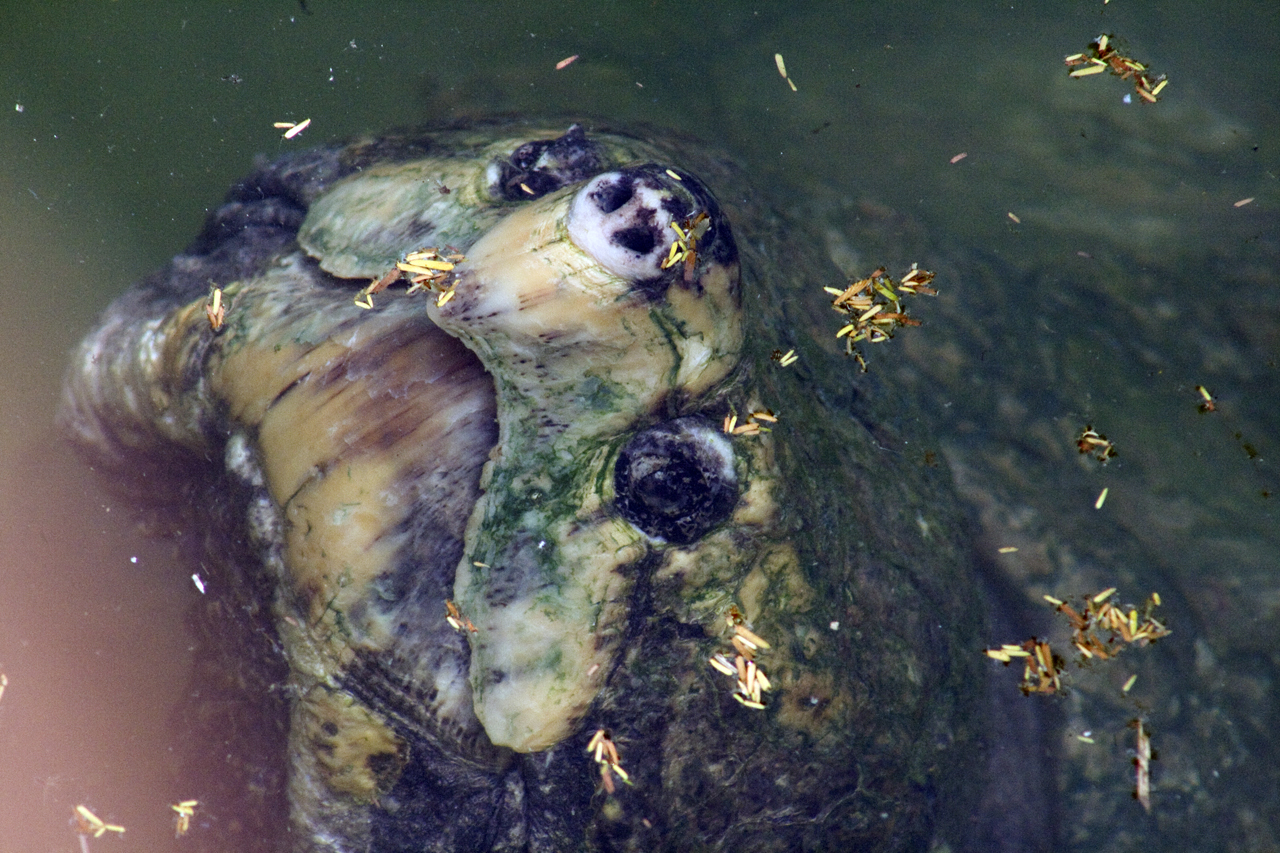
Any zombie that staggered into fresh water ponds, lakes streams or swamps would likely fall prey to aquatic turtles too, who, with their beak like jaws would happily feast on soft zombie flesh. Painted turtles, river cooters and sliders of all sorts make carrion a part of their normal diet and dispatch with any zombies with "death by a thousand bites."  The ubiquitous common snapping turtle specializes in carrion-eating and as their name suggests can tear off decent sized chunks and swallow them whole. In fact,  snapping turtles have been used by police to find corpses underwater due to their relish for dead flesh.

Common snapping turtles are dwarfed by the alligator snapping turtle, which is the worlds largest freshwater turtle and can weigh over 200 pounds. Disguised to look like rotten leaves at the mucky bottom of the water bodies in which they live, they are the perfect foil for any zombie that ends up in the water. Check out the massive head on this one.

alligator snapping turtle
alligator snapping turtle by me and the sysop

Decomposers: Masters of the Zombie Buffet

At the end of the day, however, it's not the North America's mega-fauna that pose the most threat to zombies. In nature, there are a whole host of tiny creatures whose main purpose is to feed upon and break down the flesh of the dead: the decomposers. Zombies, with their rotting flesh are obviously not immune to these decomposers (what do you think causes the rotting effect?), many of which are too small to see with the bare eye. Bacteria, fungi, molds, insects such as fly maggots or flesh-eating beetles, and other invertebrates all make up nature's diminutive clean-up crew that can obliterate a dead body in surprisingly little time. The clumsy undead wouldn't have the dexterity to pick off these decomposers, even if they could see or feel them. It would just be a matter of time before decomposers stripped off all soft tissue, including brains, and left zombies nothing more than immobile, hollowed-out skeletons.

Not convinced? Check out this video of a rabbit being consumed down to the bone by wildlife decomposers in just a week.

Video Link

Here is a time-lapse video showing Dermestid flesh-eating beetles consuming the flesh off a series of birds for the Natural History Museum of London. These beetle are easy to raise in captivity and only feed on (un)dead flesh, so they pose no harm to the living. Survivors of a zombie apocalypse could raise these beetles by the millions and drop them onto zombies to do their work. It might take a few weeks per zombie, but they'd get the job done.

Video Link

Here are some maggots going to town on a carcass. Flies can literally produce millions of grotesque larvae in no time at all. There would be no way for zombies to escape these flying insects or avoid being utterly engulfed with writhing, insatiable maggots.

Video Link

Zombies No Match for Wildlife, Wildlife No Match for Humans

So there you have it. Even if zombies managed to feed on smaller, slow-moving animals, or mob and overtake a few individuals of the larger species, it's pretty clear that on the whole, zombies, like living humans, are no match for much of North America's wildlife…at least not on a one-on-one basis. In reality, however, the battle between wildlife and humans is not going so well for the wildlife.

Sadly, much of our continent's wildlife has disappeared and many species continue to decline. Habitat loss, invasive species and climate change are just some of the human-induced challenges our wildlife are facing. You can get involved protecting wildlife with the National Wildlife Federation and help make sure that we have a future filled with these amazing species.


14 Oct 18:49

Teleglitch DLC Offers Musical Death Arsenal

by Jim Rossignol


Masterful top-down shooter Teleglitch – which is appalling difficult, and one of my favourite games of the year (or last year, really) – has a DLC, and it’s called Guns And Tunes. This is fairly self explanatory: new music to score your inevitable death, and some new guns. There will be right more monster-mincing tools, and you’ll even be able to select which of them you want to start the game with, or choose to have them randomised for you at the outset. The DLC costs £0.99.

You can read about what we made of Teleglitch just here.

14 Oct 18:49

PuzzleScript Is A Simple Language For Making Puzzle Games

by Graham Smith

This is like my job before I started writing here.

When I spoke to Stephen “increpare” Lavelle last month, the creator of brainy puzzle game English Country Tune described his oeuvre as “pushing stuff around” games. That’s a good genre! It’s in my top ten, alongside “making people fall down” games, “staying inside the lines” games and “steering balls into holes” games.

Now increpare has expanded his work in the field by releasing PuzzleScript, an open-source puzzle game engine that makes it easy to create “pushing stuff around” games and all manner of other puzzles. It’s easy enough that successful indie designers like Terry Cavanagh and Bennett Foddy can make games in it in between the hundreds of other games they’re producing in any given second.

(more…)

14 Oct 18:42

What’s Wrong with Movement Conservatism

by Daniel Larison

Erick Erickson exemplifies the self-deluding movement conservative with this response to the failure of his preferred strategy:

Isn’t it interesting that when Ted Cruz and Jim DeMint were touring America to fight against Obamacare, the popularity of the GOP was going up and the popularity of Obamacare was going down. [sic]

But now that John Boehner and the Orange Man Group of Capitol Hill are the faces of the GOP, Obamacare’s popularity is going back up and the GOP’s popularity is going back down.

That might be interesting if it were true, but no reasonable interpretation of the evidence supports it. When Cruz and others were “touring,” not many people were paying attention to them. Thanks to the shutdown strategy that Erickson wanted and wants to continue, the public paid closer attention to what the defunders were doing in Washington. Unsurprisingly, most recoiled from it, blamed Republicans more for the shutdown, and approved of the party less. Party leaders did exactly what Erickson wanted, and it blew up in their faces. Even though they were merely going along with the bad idea he helped promote, Erickson wants to blame them for everything that has gone wrong. This is the domestic political equivalent of when Iraq war boosters tried to blame Rumsfeld for screwing up their otherwise “brilliant” plan. It’s always someone else’s fault.

Obviously, his purpose is to deflect blame for the political damage that Erickson and his allies inflicted on the GOP and on the opposition to the health care law, but the only people that would believe such a transparent deception are those that still imagine that Republicans are winning the standoff, and they are becoming fewer by the day. As if that weren’t enough, Erickson ties this to a blatant fundraising pitch for the organizations most responsible for foisting this failure on the GOP and for primary challengers against Republican leaders that went along with the doomed strategy for far longer than anyone would have thought possible. It is most of what is wrong with movement conservatism summed up in one short post: lie to your audience, evade responsibility for failure, and then urge people to throw their money away to fund more of the same “activism” that helped create the current mess.

14 Oct 18:41

Word cloud of GOP thinking illustrates paranoia, fear and discouragement

by Rob Beschizza

A Democratic-led study of the GOP (PDF link) placed evangelical, Tea Party and moderate Republicans in focus groups to share their "passions, nuances and divisions." It's a fascinating, if obviously biased report: according to its conclusions, conservatives believe they have essentially lost a war with Obama and that the Republican party let him walk it.

Republicans shut down the government to defund or delay Obamacare. This goes to the heart of Republican base thinking about the essential political battle. They think they face a victorious Democratic Parry that is intent on expanding government to increase dependency and therefore electoral support. It starts with food stamps and unemployment benefits, expands further if you legalize the illegals, but insuring the uninsured dramatically grows those dependent on government. They believe this is an electoral strategy—not just a political ideology or economic philosophy. If Obamacare happens, the Republican Party may he lost, in their view.

As a foreigner, resident in the U.S. since the turn of the century, it seems to me that a fault line that then divided America between the two parties has drifted rightward into the conservative realm. Whereas Democrats generally agree on the fundamentals and are divided by the extent of their commitment to change, Republicans seem more often split by basic philosophical disagreements, especially over subjects such as climate change and civil liberties.

    
14 Oct 18:39

Iceland's book boom

by Rob Beschizza
"In Iceland," writes Rosie Goldsmith, "one in ten people will publish a book." [BBC]


14 Oct 18:36

Spark Camera, a simple movie-making app

by Rob Beschizza

iPhone video tends toward brevity--think Vine and Instagram--and fancier movie apps are thin on the ground. Spark Camera, from IDEO, aims to make it easier to shoot atmospheric, attractive mini-movies with a smartphone. The maximum length is 30 seconds, no logging-in is required to start shooting, and it's $2 in the App Store. Wired's Kyle VanHemert reviewed it today, and thinks that the results are gorgeous:

It’s as lightweight and easy to use as the iPhone’s stock camera app but ultimately far more powerful. And one key way it sets itself apart from other lightweight video-making apps is that it lets you revisit and rework old clips at any time–to swap in a new filter, try out a new tune, or tack a new bit of video onto the end of the sequence. ... In the end, though, the best thing about Spark might be the simple fact that it lets you do your thing in private. Whereas Instagram and Vine funnel your efforts onto their servers and into your the feeds of your friends, Spark stashes your videos safely on your camera roll.

This is what sells it to me: something to get into, not something to show off.


14 Oct 18:35

Oldřich Kulhánek, Czech painter

by David Pescovitz
Oldrich20kulhanek 905

Oldřich Kulhánek (1940 - 2013) is a famed Czhech artist whose illustrations appear on Czech banknotes and postage stamps. In 1971, Kulhánek was arrested for "defamation of the allied socialist states" for painting "a distorted portrait of Joseph Stalin, perforated five-pointed red stars or joyful faces of socialist workers turned into a hideous grin."

This Kafka-esque situation was to continue until 1972 and on the 5th of July 1973, he was tried in court. At this farce, like in a scene out of the writer Hašek’s "Good Soldier Schweik", eleven of his prints were sentenced by the judge to be destroyed, i.e. burnt. However the "gentlemen" of the court, did no such thing, and kept the prints for themselves – which was tantamount to government sanctioned theft. Kulhánek later commented “I realised that one’s situation in life, even if a tragic one, never lacks a touch of humour – though, usually very black humour!”
Oldřich Kulhánek (via Juxtapoz)


14 Oct 17:34

Ender's Game, chapter fourteen, part one, in which Mazer Rackham doesn't replace Graff soon enough

by noreply@blogger.com (Will Wildman)
This is the big one, the penultimate chapter in which all secrets begin to be revealed and all of the hell we've gone through up to now pays off.  As a depressing side-note, we are suddenly faced with the realisation that Graff is not only the worst person ever, but that narratively there is someone who could have filled his role so, so much better.

(Content: violence, discrimination based on fertility.  Fun content: sweet abs, Greek history.)

Ender's Game: p. 255--273
Chapter Fourteen: Ender's Teacher

We actually get both names in the first Scene of Faceless Unnarrated Dialogue--Graff and Admiral Chamrajnagar of the interstellar fleet--and it has some lampshaded poetic moments (Chamrajnagar gets mystical about the majesty of spaceflight, Graff snarks) but is otherwise pure filler.  Graff has no interest in influencing Ender's curriculum; he is "only here because I know Ender".  Funny how you keep needing other people to fix Ender for you, then.

Ender gives us some establishing SF about living on Eros--the cramped hallways cut through the stone, the weak gravity and permanent slope of the corridors, etc.  He makes no new friends, partly because he never stays in any classes for long: he attends a lecture or two, then gets some private tutoring, then immediately moves on.  For the first time in half a book, we get a sense of what he's studying: astrogation, military history ('Oh my god, 1910s Germany stole my ideas!'), abstract mathematics that he has a hard time consciously understanding but intuits easily.

The new game is the simulator, "the most perfect videogame he had ever played", which basically means an RTS.  Ender starts out playing a single starfighter, but then they scale up to squadron-versus-squadron, and the computer learns quickly from his new techniques.  With very little fanfare or acknowledgement, Ender loses quite a few games as he re-learns the same lessons he's learned twice in this book already: use all your troops in concert and give general orders instead of micromanaging.  I'm not sure how this runs into Ender's total phobia of losing games--he's realised that the simulator is Command School's equivalent of the battleroom, but apparently losing to the computer doesn't count.

After a year at Eros, he's back to winning every time, and he asks Graff if it isn't going to get harder again.  Graff shrugs it off, and the next day Ender wakes up to find an old man apparently meditating on the floor in his bedroom.
Ender got up and showered and dressed, content to let the man keep his silence if he wanted.  He had long since learned that when something unusual was going on, something that was part of someone else's plan and not his own, he would find out more information by waiting than by asking.  Adults almost always lost their patience before Ender did.
I am struggling to figure out what this could refer to.  The last time he stayed quiet and tried to watch someone else's plan in action to get the upper hand, he ended up in a deathmatch in the showers.  This only makes sense if they've continued to randomly screw with Ender's head over the course of the year he's been on Eros, which is on the one hand predictable but on the other weird that we haven't heard details.

Ender studies the old man--sixtyish, staring at him with total apathy--and asks him why the door is locked, with no response.
Ender didn't like games where the rules could be anything and the objective was known to them alone.
Which is a weirdly accurate description of the human-formic war.

So he starts exercising around the room, self-defence techniques and forms, and when he gets near the man, a hand snaps out, yanks him off-balance, and Ender tumbles to the ground, but when he looks up again the man is back in position, perfectly still.

This whole scene is such an obvious play on the enigmatic martial arts master testing a new student that I'm not sure what to say, except that it doesn't become any less stupid and orientalist when you whitewash it.  (Mazer Rackham is half-Maori, and since his other half is undefined we can probably assume it's white, but he's still not an Okinawan raising an army to repel the invaders.)
Ender stood poised to fight, but the other's immobility made it impossible for Ender to attack.  What, kick the old man's head off?  And then explain it to Graff--oh, the old man kicked me, and I had to get even.
As much as I approve of Ender's long-awaited grasp of self-control, he's still operating on the fantasythat his previous two kills (or 'fights', in his mind) were purely driven by self-defence, conveniently forgetting that in both cases he kept on attacking even once Stilson and Bonzo were incapacitated on the floor.  That's how he murdered Stilson--in Bonzo's case, it's likely that the mortal injury had already been dealt, but that didn't stop him from continuing with the kicking.  Self-defence does not include killing the incapacitated--nor do I think it can only apply when someone is actively trying to kill you.  Ender could, for example, knot up his sheets and try to bind the stranger until he can be safely detained--that might require force, but as long as it was only the force Ender needed to be assured that he wasn't going to be attacked again, rather than Ender's normal default-to-lethal, I'd have no problem with it.  Why are Ender's only settings Kill and Angst?

Wait, no, I forgot a setting: Uncomfortable Homoerotic Subtext.  It's been hours, Ender is exhausted and frustrated, so he heads back to his bed to work on his desk, and as soon as he bends over, the strange old man lunges in behind him, grabs him by the hair and the crotch, and throws him down to pin him face-first into the floor.  That's how that goes.
"I surprised you once, Ender Wiggin.  Why didn't you destroy me immediately afterward?  Just because I looked peaceful?  You turned your back on me.  Stupid.  You have learned nothing.  You have never had a teacher." 
Ender was angry now, and made no attempt to control or conceal it.  "I've had too many teachers, how was I supposed to know you'd turn out to be a--" 
"An enemy, Ender Wiggin [....] the first one you've ever had who was smarter than you."
There's an extended reflection on how the enemy is the only real teacher--nothing that folks who have been reading along can't predict, although it's got a nice rhythm.  This teacher/enemy/Shaolin master lets ender up, and Ender responds by attacking in a frenzy that ends with him against the door and the stranger sitting cross-legged on the floor again.  Dude approves, and says that he will now be in charge of Ender's simulator training, and thus things are, once again, about to get still more real.
"In this school, it has always been the practice for a young student to be chosen by an older student.  The two become companions, and the old boy teaches the younger one everything he knows.  Always they fight, always they compete, always they are together.  I have chosen you."
Dammit, Card, there are only so many times I can try to find alternative explanations for you.  That time has ended.  You brought this on yourself with your inexplicable fixation on the ancient Greek military.  You're on your own now.  If it happens again, I'm just going to link to art from Free!.

As the teacher leaves, Ender attacks him yet again, delivers a solid kick to the back before getting thrown across the room, and they both do that 'smiling while bleeding from fresh injuries because this is how men bond' thing, and Ender asks what to call his teacher, and it is revelation time: "Mazer Rackham".

The explanation is straightforward enough as to how the hero of a war seventy years ago could still be around--they put him in a ship, sped it up near lightspeed, and brought him back again for the sequel.  From his perspective, he spent twenty years confined to Eros because he knew too much, then eight years in flight equivalent to fifty on Earth.  This creates a really interesting dynamic which the book unfortunately doesn't get into at all.  When the campaign comes, the soldiers fighting it will be people Mazer Rackham knew and fought beside, but from their perspective it's only been five years versus his twenty-eight.  He's not just going to watch friends die in battle, but friends who exist exactly as he remembers them from decades ago.  Not just colleagues, but the living memories of them as they were in the days of glory that they shared.  That is a psychology and a tension that would be worth telling.  Not in this book, though!  (Or any that I know of.)

In the days that follow, Ender and Mazer bond over videos of human fleets fighting formic ships, contiguous videos instead of the patchwork ones that Ender constructed, and Ender is delighted to find that Mazer is pointing out things even he hadn't noticed: "For the first time, Ender had found a living mind he could admire."  We could read this as Ender being a total jackwagon about basically everyone he's ever heard of, but I am trying to be positive, so I instead take it as a tragic commentary on how the warped course of Ender's life has caused him to lose all awareness of or interest in people in any discipline other than military theory.  Art, science, medicine, history, whatever--plebes.

Ender finally asks to see how Mazer won the Second Invasion, after he describes himself as "the only person who had ever defeated the buggers by intelligence rather than luck".  Ender describes what he knows of the final battle: the enormous formic fleet versus the tiny human strike force, Mazer's reckless charge, a single shot, and then nothing of the battle.  Mazer rolls his eyes at what passes for secrecy and shows Ender the proper video, which shows exactly the same, except that there simply is no battle.  Mazer destroys a single enemy ship and the entire formic fleet goes dead.  Mazer fast-forwards through three hours of footage as the humans boggle.

Because we haven't complained about how geniuses are hated by lesser geniuses in a while, Mazer explains that all the xenobiologists told him he wasn't qualified to have an opinion on what happened, despite having won the battle based on his theory--that the formics are a purely hivemind race, with sentient queens but all the drones merely very complicated telepathically-controlled limbs.  Mazer identified and killed the queen, and the invading fleet died en masse.  Mazer shows Ender the videos of the formic fleet destroying the humans further outside the solar system, and Ender quickly identifies the same ship as the "I" of the fleet, which OBVIOUSLY no one else in seven decades has been able to do.

You know, Ender would be a more interesting character if his defining trait wasn't supposed to be 'empathy' but 'empathy with the formics'--if he were human on the outside, 'alien' on the inside, unsuited to normal society but serendipitously perfect for fighting an aggressive hivemind.

There's a whole lot more SF about formic psychology--why they thought nothing of killing human crews (which they assumed were mindless drones) but left mechanical transmitters running in captured ships, how they used Eros as their own base for the Second Invasion and humans scavenged gravity control and such when they took it back.  It's neat enough, but narratively whatever.  Let's talk about why Graff shouldn't have existed in the first place.

Graff's problem as a character is that he has no history.  He's supposed to be a teacher, but we never see him teach, and he definitely doesn't develop curricula.  His job mostly seems to consist of psychological analysis, except that he's not very good at that, either--he keeps relying on reports and unaccountable computer spasms and such.  His whole thing is that he somehow knows that he has to make Ender's life a living hell in order to make him a good commander, in spite of all intuition and theory and history, but we don't know where he got these ideas or why he is convinced that they will work when they never have before.  Who could have the justification for this?

Mazer Rackham.  Graff should have been Mazer--'Hyrum Graff' was a pseudonym that he could use to administrate the Battle School, only to reveal his true identity to Ender when they arrived on Eros.  Mazer Rackham does have special qualifications no one else has: based on near-to-nothing, he was able to extrapolate the nature of the formic hivemind and successfully use it against them.  For reasons they never explain (said to have something to do with 'psychology', presumably because he'd be too emotionally involved?) he can't command the Third Invasion, so he's got to replicate himself.  Whether the military had found Ender or not, Mazer was going to be around for the end of the war--that's just a fact of the way his near-lightspeed time-travel trip worked.  And then because he's a genius he quickly spots Ender and is all 'This kid is the one' and the military is all 'Whatever, loser' and Mazer is all 'Fine, you train your favourites as well but I'm going to focus on this one until you bring me one you can prove is better'.

Mazer could pull all of the ridiculous mind-torturing stunts that Graff pulls, but instead of being explained by his having attended Franz Kafka's Military Academy, they would be 'justified' by Mazer trying to inflict all the same twists that created him on Ender.  It would be a fantastic commentary on the way people often replicate the abuses that are done to them against others.  Instead of just assuming that Graff knows what he's doing and he's following some textbook, people would have much more obvious and legitimate grounds to demand Mazer explain himself, which would fit even better with the book's overall theme of 'the commoners are stupid and will try to stop geniuses because they don't understand what's good for them', which is a terrible theme but at least he could try to execute it well.

Ultimately, what does Graff bring to the story as a result of his character rather than his role?  I'm coming up with nothing.  Whereas Mazer brings a whole host of psychological questions and implications that we never get to spend any time exploring.

Where were we?  Is Mazer still talking?  Goddammit, he is.
"They probably thought they were routinely shutting down our communications by turning off the workers running the tug.  Not murdering living, sentient beings with an independent genetic future.  Murder's no big deal to them.  Only queen-killing, really, is murder, because only queen-killing closes off a genetic path."
There are a couple of reasons this bit is spectacularly stupid, the first and lesser of which is that this 'genetic path' definition of murder is a very strange position for Mazer Rackham to hold--it's kind of got to be Mazer acting as Card's mouthpiece.  But more importantly: who the fuck defines personhood based on the ability to reproduce?!  If this is taken literally, then murder ceases to be murder once a) a person has already reproduced, b) a person physically incapable of reproducing, and possibly even c) a person chooses not to reproduce.  So: post-menopause women, anyone infertile (including, for example, anyone who undergoes SRS), and all those damnable queers.  Totally not murder, because they can't have kids!  I can at this point confirm that I have found the maximum possible scorn I can have for a sci-fi author, because I cannot scorn any author more than I do Orson Scott Card.  What a tool.

Lastly for this week, Mazer lists humanity's advantages against the formic fleets: first, of course, our indomitable human spirit of creativity, allowing each one of us to be independently more brilliant than expected, while the formics rely on mass numbers and coordination of simple strategies.  Second, and substantially more impressive, is Doctor Device: the M.D. Device, Molecular Detachment, which focuses a pair of beams (they are extremely specific about this, it's a pair of beams) on matter to create an expanding field in which electrons get interrupted and all matter falls apart.  Whenever the field hits more matter, it creates a new expanding field, potentially allowing for a chain reaction that leaps from ship to ship to wipe out an entire fleet.  Bonus points to anyone who can guess how the final battle at the formic homeworld will go!

Next week: the return of everyone, ever, including that one guy, you know, the one who did the thing.
14 Oct 17:26

Wonkblog: The rest of the world can’t understand why we’re doing this to ourselves

by Ezra Klein

To the rest of the world, the United States looks insane right now.

They're dealing with real problems that their political systems are struggling to solve. The United States's political system is creating fake problems that it may choose to leave unsolved.

"The United States was the one bright spot in the world recovery," says OECD Secretary General Angel Gurria. "It was leading the recovery! Leading the creation of jobs! This unfortunate situation with the budget and debt happens at the moment it was looking good."

The OECD -- or, more formally, the Organization for Economic Cooperation and Development -- is the modern-day descendant of the The Organization for European Economic Cooperation, which managed the Marshall Plan in the aftermath of World War II. Today, the OECD has 34 member countries and a mandate "to help governments foster prosperity and fight poverty through economic growth and financial stability."

That global perspective drives Gurria's admiration of the U.S. economy. Look around, he says. "The U.S. is growing at 2-3 percent while Europe is only starting to rise from negative growth, and Japan is struggling to get prices up to 2 percent inflation. The U.S. is growing with very low inflation and you are creating jobs. Perhaps you’d like it to be at a brisker speed, but you’ve created more than seven million jobs in the last few years. These are just facts. You look even better compared to Europe but even by themselves these numbers are objectively positive."

The United States's fiscal situation is also much improved. "Sequestration was not desired," Gurria says. "But it has the effect that now the deficit is going below 4 percent. Not long ago you were near double digits. So you have a fiscal consolidation, some might say it was too fast, but the deficit today in the United States is much lower than in the European countries. Everyone at home has a lot of doubts in their own economy and their own economic leadership and their own performance but the fact of the matter is the U.S. has been doing a good job."

At least, it was doing a good job. But then the government shut down. And then U.S. leaders began fighting over default. Consumer confidence is plummeting as a result.

At best, the United States is slowing its recovery -- and that of the rest of the world. At worst, it's going to trigger another global crisis. That's why, Gurria says, his concern isn't that the United States's economy is weak, but that its political system is.

"More than any number of GDP or growth or debt, the question is whether the U.S. will has the institutions to move forward on the issues it has to deal with internally and then play the leadership role it plays for the global economy," he said.

In other words, the question is whether we'll stop being insane.

One of the key roles the OECD plays for countries that are trying to improve their economies (as opposed to trying to sabotage them) is as a collector of best practices. So I asked Gurria whether a big deal on the budget should include taxes or focus just on spending cuts. His answer was interesting: It should include taxes, he said, but not the kind of taxes the United States tends to favor,

"You do need more revenues and you do need to cut expenses. But you also don’t want to go in a direction whereby increasing taxes creates a reticence to create new jobs. You don't want to increase taxes on work. You don’t want to increase taxes on investment and the creation of wealth. If you need more revenues, go for consumption taxes, go for property taxes, go for green taxes, but don’t make it more expensive to create new jobs."


14 Oct 02:05

This Is Where We Are

by Andrew Sullivan

 
This is a fascinating speech from today’s rally at the World War II veterans’ memorial. It’s fascinating because it’s a riveting, candid insight into the forces that are behind the government shut-down and the debt-ceiling blackmail of the country and the world. They do not believe this president is a legitimate president. It is beyond their understanding that he was re-elected handily, or that he commands, even during this assault on our system of government, far more support than the Tea Party. Let’s not be mealy-mouthed. This speaker, Larry Klayman of Freedom Watch, accuses the president of treason in this speech, of deliberately pursuing policies to kill members of the armed services, because he is an Islamist, and allegedly “bows to Allah”. What he is saying is the president is a deliberate mole of foreign agents determined to destroy the American way of life. And there is no pushback from the crowd and no pushback from GOP leaders.

This is what we’re dealing with. This is not an alternative budget; it is not another way of insuring millions and cutting healthcare costs; it is not a contribution to anything but to the logic of nullification of an election. It is yet another declaration of cold civil war – a call for a nonviolent refusal to be governed by a re-elected president because he is pursuing policies with which an electorally defeated minority disagree. Simply pursuing those policies has rendered Obama a “monarch” who is arguing “his way or the highway.” But all Obama is doing is implementing a campaign promise and settled law, while governing under a continuing resolution that reflects the sequester’s level of spending, a level agreed to by the Republicans. He wants a budget agreement between the House and Senate in a conference that the Republican House has long resisted entering. He has said that he is happy to negotiate with anyone on anything as long as the blackmail of a government shut-down and of a threatened global depression are ended. And his record shows that he has compromised again and again – as his own most fervent supporters look on in dismay.
I’m not privy to the negotiations now going on in the Senate and can only glean from outsiders what the meetings with legislators have been like. But I’m not distorting the raw facts of the situation here, or trying to distract from them. And I’d love a much more expansive Grand Bargain on taxes and entitlements, that could ease our long-term debt (but it would have to be a bargain, not merely a set of Republican demands). But the rank threats of unimaginably radical consequences if a re-elected president doesn’t junk what he was re-elected to do are so foul in their lack of concern about the common good, so poisonous in their slander of a president, and so contemptuous of our orderly system of government, that it is vital the threats do not work and are not accommodated. No president of any party has any right to legitimize such an attack on the American system of government and the way it conducts business – by elections, debates, compromises and budgets, not threats of total government shut-down and the collapse of the dollar if our global credit rating is effectively destroyed overnight.

I hoped we’d be nearing some kind of deal at this point, rather than witnessing this upping of the ante from the forces that truly live on the fringes of the far right, but which, without any resistance, have now defined the Republican party. It is no accident that among those addressing this rally to blackmail the country and the world were Sarah Palin and Ted Cruz. I can see a very powerful populist electoral ticket with both of those on it – either of a third Tea Party or of an even more  radicalized GOP. And perhaps that is the only way to expunge this nihilist extremism from our system. Except that it may succeed in expunging the system and the economy before we can test it where in a democracy we are accustomed to test it: in elections, not in the chaos of economic blackmail.


14 Oct 02:03

A Rolling Coup

by Andrew Sullivan

How else do you explain this amendment to the following rule passed by the House just before it shut down the government:

Here’s the rule in question:

  • When the stage of disagreement has been reached on a bill or resolution with House or Senate amendments, a motion to dispose of any amendment shall be privileged.

In other words, if the House and Senate are gridlocked as they were on the eve of the shutdown, any motion from any member to end that gridlock should be allowed to proceed. Like, for example, a motion to vote on the Senate bill. That’s how House Democrats read it. But the House Rules Committee voted the night of Sept. 30 to change that rule for this specific bill. They added language dictating that any motion “may be offered only by the majority Leader or his designee.” So unless House Majority Leader Eric Cantor (R-VA) wanted the Senate spending bill to come to the floor, it wasn’t going to happen. And it didn’t.

So, in advance, the GOP changed parliamentary procedure to ensure that no clean resolution, based on a Senate budget agreement, could get on the floor of the House for a general vote. The hostage-takers made it impossible to defuse the bomb they have attached to our system of government without their consent – even against a majority of House members of both parties.

These people are deadly serious. Since they lost an election, they decided to start a cold civil war.


13 Oct 18:51

Archeologist suggests much of Paleolithic cave art was done by women

13 Oct 17:01

The Oskar Schindler Of Argentina?

by Andrew Sullivan

John L. Allen, Jr. details a new Italian book that claims that title for the man who became Pope Francis:

In reply to persistent charges that the young Fr. Jorge Mario Bergoglio was complicit in Argentina’s infamous “dirty war” from 1976 to 1983, when roughly 30,000 people disappeared, Scavo asserts that Bergoglio was actually a Jesuit version of Oskar Schindler – quietly saving lives rather than engaging in noisy public protest.

The future pope, Scavo writes, saved as many as a thousand targets of the military dictatorship by providing shelter in a Jesuit college, passing them off as seminarians or laity on retreat, then helping them move out of Argentina.

In one case, according to Scavo, Bergoglio gave a man who bore him a passing resemblance his own passport and priest’s clothing to make his escape.


13 Oct 06:42

New eBook: Software As A Disservice - Fixing A Broken Rails App

by Giles Bowkett
I wrote a new (e)book, called Software As A Disservice: Fixing A Broken Rails App. It's a caffeine-fueled foray into fixing legacy code. I wrote it partly because I have some Rails students who I'm training, and I wanted to show them the difference between bad Rails code and good Rails code. I also wrote it because I was a little bit outraged by somebody else's ebook.

I started with this open source Rails app, an allegedly good example of a subscription site using Stripe. The "allegedly good" part, btw, is not alleged by Stripe, but by the app's author, who also sells a subscription (using the app itself) to a site with tutorials on how to build Rails apps, including an ebook about building the subscription site app in the first place.

It's a wonderfully meta business model, and I love how it involves giving code away for free. But the code is, in my opinion, awful, and anybody who used it as an example of how to build Rails apps would be misled about how Rails apps should be architected and how Rails code should look. In my opinion, this app does you a serious disservice if you take it at face value, so I called my book Software As A Disservice.

In this book, I take this app's open source code, and work hard to make it suck less.

The book itself is only about 120 pages, which only gave me enough space to make significant progress in both re-architecting and refactoring the User model. If you've refactored and/or re-architected a bunch of legacy Rails sites already, you might not learn anything; this is probably not the book for you. You should buy this if you're new to Rails, and you want to understand the difference between good Rails code and bad Rails code.

Caveat: this book is full of foul language. One chapter is called "Why The User Model Is Fucked." There are also garish, violent, and sexual metaphors involving raccoons, bananas, anal sex, dangerous machinery, weapons, and tentacles. There's probably other disturbing and/or inappropriate stuff that I forgot about, and it's entirely possible that a reasonable person could read this book and worry about my mental health. However, as long as you learn something about writing good Rails apps in the process, I can basically live with that.

The book's crazy like that because I wanted it to be funny, I wanted it to be candid, and I wanted it to feel kind of live and real-time. I wrote it while fixing the app in question, and if you think it's possible to fix legacy code without swearing a lot, you're either some supernatural entity of the holy variety yourself, or you're fucking dreaming. Anyway, the benefit of the "live and real-time" factor is that the book's annotated with git commit hashes, so you can go through the code, do a git checkout xyz12345 to explore the code at every stage in the process, and/or see exactly how the code changes from moment to moment with git diff.

The book's only in PDF format; I've upgraded my toolchain to make mobi and epub output possible as well, but it won't be ready for a little while longer. I'm going to release both this book and Rails As She Is Spoke in Kindle format for sure, but epub format remains a maybe, and I'm not sure how many of my other books will also get converted. Anyway, Software As A Disservice is 122 pages long, it's aimed for newbie to intermediate Rails devs, and it's $23.

To buy Software As A Disservice: Fixing A Broken Rails App for $23:


To promote it, I'm also selling a bundle of Software As A Disservice along with my other two Rails books, Rails As She Is Spoke and Unfuck A Monorail For Great Justice. That's $61; the total to buy those books individually is $101. So you save exactly $40 if you buy the bundle.

To buy the bundle and save $40:


11 Oct 23:08

Second Coming of ... Unskewed Polls!

by Josh Marshall

In the wake of catastrophically bad poll results on GOP efforts to burn down the country, the GOP poll unskewers return!

11 Oct 23:07

Google Sets Plan to Sell Users’ Endorsements

by John Gruber

Claire Cain Miller and Vindu Goel, reporting for the NYT:

On Friday, Google announced an update to its terms of service that allows the company to include adult users’ names, photos and comments in ads shown across the Web, based on ratings, reviews and posts they have made on Google Plus and other Google services like YouTube.

When the new ad policy goes live Nov. 11, Google will be able to show what the company calls shared endorsements on Google sites and across the Web, on the more than two million sites in Google’s display advertising network, which are viewed by an estimated one billion people.

Looking forward to hearing from Google fans how this is acceptable.

11 Oct 22:04

Michele Bachmann Wants to Impeach President Obama for Being a "Dictator"

by Paul Constant

The only thing that could sink Congressional Republican approval ratings even lower would be if they moved to impeach President Obama. So, naturally:

Rep. Michele Bachmann (R-Minn.) said Tuesday that President Obama has “committed impeachable offenses” and that the House could hold a hearing to impeach.

“We can have an impeachment hearing in the House, and in my mind the president has committed impeachable offenses,” Bachmann told conservative talk show host Rusty Humphries in an interview first detailed by Right Wing Watch.

Say what you want about Michele Bachmann, but I think "in my mind the president has committed impeachable offenses" is maybe the most honest thing she's ever said. In her mind, the president has done a whole bunch of things.

[ Subscribe to the comments on this story ]

11 Oct 19:58

Boggle’s ideas are not always terribly sophisticated. But...


Boggle’s ideas are not always terribly sophisticated. But I’ll back this one.

11 Oct 19:43

Interference Combines Mark Of The Ninja, Cyberpunk

by Nathan Grayson

Many games let you hack things. Too many, I might argue, especially when the result is some half-baked mainframe-smoking minigame. Inference, however, is taking a far more interesting approach, allowing you to hack reality in order to stealthily maneuver around dead-eyed killbots in a cyberpunk noir sidescrolling world. Basically, think Mark of the Ninja, but levels are both playgrounds for the fleet-footed and Rubik’s Cubes for the gargantuan-brained. It’s a neat setup, but based on a newly released free demo, it still needs a fair amount of work.

(more…)

11 Oct 19:35

National Cancer Institute director warns staff of increasingly dire effects of shutdown on science

by Xeni Jardin


National Cancer Institute headquarters, Bethesda, Maryland.

Harold Varmus, director of the National Cancer Institute, sent this email today to "NCI staff, grantees, advisors, reviewers and others," warning of increasingly damaging effects the ongoing federal government shutdown will have on cancer research and treatment at NCI. Even worse than the litany of known, present harm, is this grim prediction: the damage won't end when the government reopens.

A copy of this email was provided by a Boing Boing reader who was one of the recipients:

I am writing to keep you abreast of the ways in which the National Cancer Institute (NCI) and its extramural and intramural research programs have been --- and are likely to be --- affected by the current shutdown of the federal government. And I am also writing to ask for your help in responding to the difficult situation that we are likely to face when the government is reopened.

As you have doubtless seen in the media, if not experienced directly, the NCI, along with the rest of the NIH, has been obliged to place on furlough many valuable employees, presently about 80 percent of our staff. While all components of the NCI have furloughed many personnel, most of those we have been able to exempt from furlough are in our intramural programs and needed to preserve ongoing research protocols, ensure laboratory safety, care for experimental animals, and, especially, serve our patients at the Clinical Research Center. This situation has been hard for everyone, particularly for many of our trainees, who have been told to limit their activities on campus to those permitted during the shutdown. They, like regular staff members, are unable to travel to scientific meetings or to perform much of the research they came to NCI to do.

Although the shutdown has been felt most acutely by our staff and investigators in the intramural program, the effects on the extramural research community are likely to become progressively greater as the situation persists. Presently, the vast majority of NCI’s extramural staff is furloughed, which means that many NCI staff members are unable to provide their usual administrative and programmatic support services to extramural grantees. Furthermore, many grantees, especially those responsible for planning collaborative work, including clinical trials, have been limited in their abilities to conduct important meetings that require NCI staff and support. Still, we have been able to exempt from furlough some program officers who provide oversight and guidance for clinical trials that were initiated prior to the shutdown. Moreover, the length of the shutdown has not been great enough to affect most ongoing research activities at extramural sites. Since the Payment Management System has remained operational, we also continue to process requests to obtain expected funds for most of the grants awarded to our extramural investigators. However, that may not be possible if an award was made with restrictive terms or if a request triggers a need for additional interactions.

Now that the shutdown is nearing the end of its second week, however, further consequences are coming into view. While grant applications can be accepted and stored at grants.gov, the NIH Office of Extramural Research has discouraged submissions, and applications will not be processed further until normal business operations are restored through Congressional appropriations. (See the OER’s message at http://grants.nih.gov/grants/guide/notice-files/NOT-OD-13-126.html). Furthermore, NCI’s Division of Extramural Activities (DEA) has postponed until undetermined dates several site visits to evaluate re-competing centers and large grant applications, and it has postponed more than a dozen meetings to review grant applications. Thus, the NCI’s grant review cycle could be significantly delayed, threatening a smooth restart of NCI’s support of extramural research, even if the NIH reopens relatively soon.

This situation could have serious effects on the review and funding of virtually all NCI programs, including NCI-designated Cancer Centers, program project and SPORE grants, training awards, and individual research project grants. Questions or concerns about these matters should be sent to John Czajkowski, NCI Deputy Director for Management ([email redacted]), or to Dr. Paulette Gray, Director of the Division of Extramural Activities ([email redacted]).

Part of the reason I am writing at this time is to prepare you for the possibility that we at the NCI (and presumably others at the NIH) will be asking reviewers and advisors to adapt to abrupt and inconvenient changes in the scheduling of meetings to review grant applications and oversee programs. These changes may require you to alter long-standing plans to attend worthwhile events. But avoiding a major crisis in grant-making and program development this year may be possible only if all members of the NCI communities are willing to help alleviate the consequences of the shutdown.

Needless to say, all of us at the NCI hope that the current situation is resolved quickly, but we have no way to know when the shutdown will end. In the meantime, I encourage all of you to monitor major media outlets regularly, as we do, for updates on the status of federal operations. As long as the shutdown continues, the NCI will remain committed to advancing our common cause---research to control cancer---as best we can within the limits of the law. Your patience, persistence, and flexibility are very much appreciated during this unhappy and uncertain time.

Harold Varmus

Director, NCI

Related posts on Boing Boing:

• "This mom with a rare form of cancer can't get treatment she needs due to government shutdown"

• "During the shutdown, some scientists can't talk about science"

• "Meet two cancer patients whose treatment is on hold due to US gov shutdown: an 8yo girl, and a father of 3"

• "US gov shutdown may mean some kids with cancer won't be treated, CDC's outbreak detection programs also halted"

More in our Shutdown 2013 archives.


11 Oct 18:31

US gov shutdown means imminent death for thousands of lab mice

by Xeni Jardin
NPR's "All Things Considered" did a piece this week about what the shutdown means for thousands of lab mice used in medical research at government facilities. In a word, death.


11 Oct 18:08

Enneagram five “Health Levels”, from http://www.enneagraminstitute.com. I found...

Enneagram five “Health Levels”, from http://www.enneagraminstitute.com. I found this fascinating and incredibly relatable as an INTP. I place my self at Level 5, trying to get to Level 4. 

—-

Level 1(At Their Best): Become visionaries, broadly comprehending the world while penetrating it profoundly. Open-minded, take things in whole, in their true context. Make pioneering discoveries and find entirely new ways of doing and perceiving things.

Level 2: Observe everything with extraordinary perceptiveness and insight. Most mentally alert, curious, searching intelligence: nothing escapes their notice. Foresight and prediction. Able to concentrate: become engrossed in what has caught their attention.

Level 3: Attain skillful mastery of whatever interests them. Excited by knowledge: often become expert in some field. Innovative and inventive, producing extremely valuable, original works. Highly independent, idiosyncratic, and whimsical.

Average Levels

Level 4: Begin conceptualizing and fine-tuning everything before acting—working things out in their minds: model building, preparing, practicing, and gathering more resources. Studious, acquiring technique. Become specialized, and often “intellectual,” often challenging accepted ways of doing things.

Level 5: Increasingly detached as they become involved with complicated ideas or imaginary worlds. Become preoccupied with their visions and interpretations rather than reality. Are fascinated by off-beat, esoteric subjects, even those involving dark and disturbing elements. Detached from the practical world, a “disembodied mind,” although high-strung and intense.

Level 6: Begin to take an antagonistic stance toward anything which would interfere with their inner world and personal vision. Become provocative and abrasive, with intentionally extreme and radical views. Cynical and argumentative.

Unhealthy Levels

Level 7: Become reclusive and isolated from reality, eccentric and nihilistic. Highly unstable and fearful of aggressions: they reject and repulse others and all social attachments.

Level 8: Get obsessed yet frightened by their threatening ideas, becoming horrified, delirious, and prey to gross distortions and phobias.

Level 9: Seeking oblivion, they may commit suicide or have a psychotic break with reality. Deranged, explosively self-destructive, with schizophrenic overtones. Generally corresponds to the Schizoid Avoidant and Schizotypal personality disorders.

11 Oct 16:26

Asymco: ‘The Five Year Plan’

by John Gruber

Horace Dediu:

If we include all iOS and Android devices the “computing” market in Q3 2008 was 92 million units of which Windows was 90% whereas in Q3 2013 it was 269 million units of which Windows was 32%.

Like I said yesterday, mobile is already bigger than the PC market ever was, and it’s still growing fast.