Shared posts

21 Nov 18:07

Film Corner: I Am Getting Tired Of This

by Ana Mardoll
Hint: The "this" that I am tired of is not "superhero movies" or "sequels".


Answer: It's the whole 'white women clinging to white men like that's the be-all end-all of creative movie postering and not the same old shit we've seen in nearly every other movie poster since time began' thing that I am tired of.

Especially angry-making because I recently re-watched The Avengers after re-reading Chris' excellent post on (and this is my words here, not necessarily his) Joss Whedon cutting 'secondary characters' out of the movie as though that act is somehow gender-neutral (it's not) and as though 'primary characters' in superhero movies aren't overwhelmingly cis male (they are) and as though 'secondary characters' in superhero movies aren't overwhelmingly the only major* female presence in the movie (they are) and as though it's not sexism that causes this (it is) but rather somehow bad luck, like we assign superhero gender expression by rolling D&D die (we don't).

* I don't want to quibble over what constitutes "major", but the handful of other women in Thor and Iron Man don't count for me. Take that for what you will, or don't. 
21 Nov 17:55

"There were two ‘Reigns of Terror’, if we could but remember and consider it; the one wrought murder..."

“There were two ‘Reigns of Terror’, if we could but remember and consider it; the one wrought murder in hot passions, the other in heartless cold blood; the one lasted mere months, the other had lasted a thousand years; the one inflicted death upon a thousand persons, the other upon a hundred million; but our shudders are all for the horrors of the… momentary Terror, so to speak; whereas, what is the horror of swift death by the axe compared with lifelong death from hunger, cold, insult, cruelty and heartbreak? A city cemetery could contain the coffins filled by that brief terror that we have all been so diligently taught to shiver at and mourn over; but all France could hardly contain the coffins filled by that older and real Terror - that unspeakable bitter and awful Terror which none of us has been taught to see in its vastness or pity as it deserves.”

- Mark Twain, A Connecticut Yankee in King Arthur’s Court (via fourwindsshotgun)
20 Nov 23:49

Are Crowdfunded Assassinations A Thing Now?

by Andrew Sullivan

Andy Greenberg introduces readers to Kuwabatake Sanjuro, a self-described crypto-anachist who presides over “a kind of Kickstarter for political assassinations”"

According to Assassination Market’s rules, if someone on its hit list is killed–and yes, Sanjuro hopes that many targets will be – any hitman who can prove he or she was responsible receives the collected funds. … Like other so-called “dark web” sites, Assassination Market runs on the anonymity network Tor, which is designed to prevent anyone from identifying the site’s users or Sanjuro himself. Sanjuro’s decision to accept only bitcoins is also intended to protect users, Sanjuro, and any potential assassins from being identified through their financial transactions. bitcoins, after all, can be sent and received without necessarily tying them to any real-world identity.

Brian Merchant checks out the site:

In the FAQ section, Sanjuro explains who’s eligible for extermination:

“I’ll allow anything that has a good reason,” he says. “Bad reasons include doctors for performing abortions and Justin Bieber for making annoying music. The person should have wronged someone in some way related to the previous question. Politicians, bureaucrats, regulators and lobbyists are accepted without question.” Currently, there are six people marked for death: Jyrki Tapani Katainen, the prime minister of Finland; François Gérard Georges Nicolas Hollande, the president of France; “Barack Hussein Obama II”; Ben Shalom Bernanke; the NSA director Keith Brian Alexander; and James Clapper, the head of the National Intelligence Agency.

Pledges have already been made, too. By far the highest bounty is on Bernanke, with 124 bitcoin on his head. With today’s exchange rate, that comes out to a value of $75,000 USD. That is now essentially a price on Bernanke’s head, if any users are convinced enough by Sanjuro’s twisted gambit to pull the trigger. And Sanjuro hopes it’s just the beginning. He’s awaiting a user-generated list of murder subjects – just input your own into the text box like so, and you’ll have done your part to instigate a conspiracy to kill.

P.J. Vogt isn’t sure how seriously to take a site like Assassination Market:

The skeptical part of me is pretty sure these markets are a scam. Assassination isn’t the kind of service that lends itself to public advertisements or to trusting people based on their online reputations. And the fact that the website specifically promises to go after high-profile politicians adds to its unlikeliness. Viewed in that light, Assassination Markets is just another place where a fool and his bitcoin are soon parted.

And yet, these kinds of stories – about an enormous but hypothetical idea that will likely never be realized – can get real very quickly. To take a recent example, the idea of the Silk Road, when it was introduced, seemed completely preposterous to me. Yes, it was technically possible for people to buy and sell drugs online. But who, beyond a tiny fringe, would actually use it? Of course I was wrong – the site ran successfully for two years before being shuttered.

Either the news didn’t get to Bernanke or he didn’t let it get to him; this week he gave a “cautious blessing to bitcoin” in advance of a congressional hearing on virtual currency:

Bernanke mostly distanced himself from virtual currencies, saying the Fed “does not necessarily have authority to directly supervise or regulate these innovations or the entities that provide them to the market.” But he also said that bitcoin and its ilk “may hold long-term promise, particularly if the innovations promote a faster, more secure and more efficient payment system.”

20 Nov 20:29

Non-Pneumatic Tires Finally Hit the Commercial Sector. Will Polaris Roll Over the Competition?

0polaristerrainarmor01.jpg

Ever since we saw Resilient Technologies' Non-Pneumatic Tires being tested out on Humvees, we wondered if it would ever trickle down to the civilian sector. Well, it has. Off-road vehicle manufacturer Polaris has announced their new Sportsman WV850, a "military-grade" ATV kitted out with the NPTs.

0polaristerrainarmor02.jpg

"We have seen great success with NPTs in military and disaster relief scenarios," said Dovid Longren, Vice President of the Off-Road Division, "and are excited to bring this technology to the consumer market for extreme work applications." While it's unlikely your average contractor will need to drive 350 miles after his tires have sustained ".50 caliber ballistic damage," as Polaris has done in testing, it is nice to know that the NPTs have also been tested for 1,000 trouble-free miles of travel with a three-inch railroad spike jammed into the tread and structural webbing. With that kind of durability, you can get away without carrying a spare, meaning there's more room to haul stuff.

0polaristerrainarmor03.jpg

It's not clear if Polaris has licensed Resilient Technologies' original design or entered into some kind of partnership; RT's website hasn't been updated since 2011. But Polaris has re-branded the NPTs "Terrain Armor," and as you can see in the promo video, they look pretty bad-ass:

(more...)
20 Nov 20:27

Treat Triad dog puzzle

by Jason Weisberger


Pretzel going bonkers for the Treat Triad dog puzzle on a rainy, indoors day.

These past few rainy days, I've been trying to entertain my dogs with puzzles. The Treat Triad is a clear winner.

Both a Great Pyrenees and a Cavalier King Charles, dogs large and small, love smacking the spinner around and then figuring out how to open the treat bay doors. It is light, simple and hasn't broken apart after hours of battering.

Treat puzzles are no way to get the dog to let you sleep, but they certainly keep them busy when its too nasty to go out!

The Treat Triad


20 Nov 18:42

Blade Runner animated as 12,000 hand-painted watercolor paintings

by Rob Beschizza

The absolutely stunning work of Swedish artist Anders Ramsell, who painted each frame as a 1.5 x 3cm work of art. It's taken him a while to complete the epic job; Pesco wrote about the first three minutes last year. The end result runs about 30 minutes, which is exactly how long Blade Runner should be. [Video Link]


20 Nov 17:58

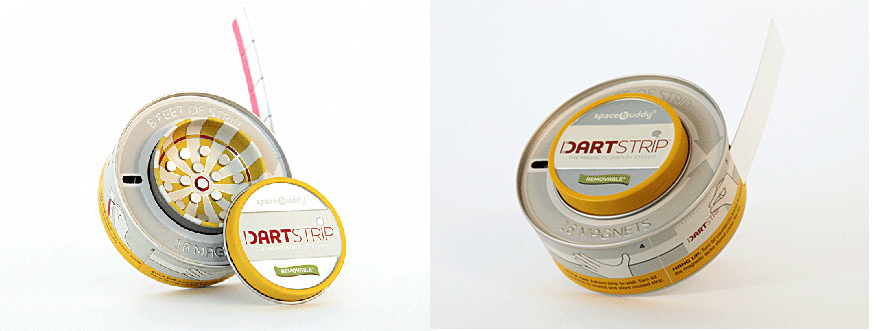
Packaging for the Win: Dartstrip Lets You Display Your Wall Art and Look Good Doing It

Dartstrip-Display.jpg

You never realize how hard it is to hang something until you actually have to do it. Getting your photo/art/mirror/whatever straight is tough enough, but finding a hanging system that doesn't take away from what you're trying to display is often a challenge in itself. Enter Dartstrip, a new product that epitomizes how the best design should be invisible.

And like most unseen designs, the system is deceptively simple: Dartstrip is nothing more than an eight-foot strip of magnetized steel with a restickable adhesive backing. The product is laser-scored with snap points at one-inch increments for easy customization depending on how large or wide your display space is. The strips are a clean white and can be painted over to match walls and other surfaces; magnetic 'pins' hold posters or photos in place. Check out the video below to see what Dartstrip is all about before we go into the details with co-founder Kermit Westergaard:

But the major innovation of Dartstrip comes in the form of none other than the packaging.

Dartstrip-Packaging.jpg

(more...)
20 Nov 17:54

Obama scoffs at people who call him a 'socialist': 'You gotta meet real socialists'

Obama scoffs at people who call him a 'socialist': 'You gotta meet real socialists':

godlesscommiequeer:

thestolencaryatid:

President Obama on Tuesday dismissed critics who call him a “socialist,” suggesting they meet some real socialists if they think he’s one.

"People call me a socialist sometimes," he said at the Wall Street Journal CEO Summit, addressing 100 top business leaders.

"But, no, you gotta meet real socialists. You’ll have a sense of what a socialist is," he said to laughter from the crowd.

"I’m talking about lowering the corporate tax rate, my health care reform is based on the private marketplace, stock market’s looking pretty good last time I checked," he said, listing his capitalist bona fides. "And, you know, it is true I’m concerned about growing inequality in our system, but nobody questions the efficacy of market economies in terms of producing wealth and innovation and keeping us competitive."

this is entertaining loll

"Nobody questions the efficacy of market economies in terms of producing wealth and innovation and keeping us competitive."

Did he… does he… KNOW anything about economics?

20 Nov 17:53

WordPress Adds Built-In Support for Markdown

by John Gruber

Finally.

20 Nov 17:48

How Simple Mini Habits Can Change Your Life

by Stephen Guise

Jogging

“The only way to make sense out of change is to plunge into it, move with it, and join the dance.” ~Alan Watts

It was late 2012, just after Christmas, and like many others I was reflecting on the year.

I realized that I had ample room for improvement in too many areas of my life, but knowing that New Year’s Resolutions have a poor 8% success rate (University of Scranton research), I wanted to explore some other options. I knew I wanted to start before January 1st too, because arbitrary start dates don’t sit well with me.

On December 28th, I decided that I wanted to get in great shape. In the previous days and weeks, however, I hardly exercised at all and felt quite guilty about it. My goal was a 30-minute workout, and it seemed impossible.

I wasn’t motivated, I was tired, and my guilt was making me feel worthless. Feeling stuck, I remembered a technique I learned from a book, and little did I know that this technique would change my life in a big way in 2013.

The technique is from the creativity book Thinkertoys, and it is to consider the opposite of an idea you’re stuck on. So I looked at my 30-minute exercise goal, and my giant fitness plan to get in great shape, and I thought about the opposite.

You could say the opposite is eating fast food and sitting on the couch, but the opposite that came to my mind was one of size.

What if, instead of carrying around this overwhelming fitness anvil on my shoulders, I just did one push-up?

Initially, I scoffed at the idea. How absurd to do a single push-up and act as if it means anything! But when I continued to struggle with my bigger plans, I finally gave in to the idea and did one, and since I was already in push-up position, I did a few more.

After that, my muscles were warmed up, and I decided to try one pull-up. Just like you guessed, I ended up doing several more. Eventually, I had exercised for 30 minutes.

My mind was blown—did I just turn a single push-up into a full workout? Yes, yes I did.

The One Push-Up Challenge Is Born

From here, I challenged my blog readers to do at least one push-up per day for a full year. People have had great success with it, and here’s what it turned into for me: For the last 3+ months, I have gone to the gym three to six times per week to exercise and I’m in great shape because of it. Now I know why it works.

I have always held a keen interest in psychology and neuroscience, and I study them for my writing. So when I read about the studies on willpower that show it’s a limited resource, everything started making sense.

I couldn’t do my 30-minute workout because my willpower wasn’t strong enough or was depleted. But I could do one push-up and segue into a 30-minute workout because it only required a tiny amount of willpower to start, after which my body and mind stopped resisting the idea.

Of course, this concept does not only apply to fitness, but to any area of your life you wish to change. And I believe I’ve found the perfect way to leverage this technique – habits.

What’s More Important Than Your Habits?

Nothing. Habits form about 45% of your total behavior, according to a Duke University study. Not only that, but they are behaviors that you repeat frequently, which compounds their significance in your life. Habits are your foundation, and if this foundation is weak, you won’t be happy with the way you live.

The reason people fail to change their lives, and fail to instill new habits, is because they try to do too much at once. In simplest terms, if your new habit requires more willpower than you can muster, you will fail. If your new habit requires less willpower than you can muster, you will succeed.

The calculation can’t just be for one instance, however, but also for when you’re tired and your willpower is zapped. Can you continue it then?

One thing I’ve been wanting to do more is write. It’s therapeutic for me and I write for a living, so it’s fairly important that I practice. When I found that I wasn’t writing as much as I should, I found out how to combine the power of The One Push-Up Challenge with a habit plan.

How To Change Your Life With Mini Habits

Mini habits are exactly as they sound. First, you choose a desired habit or change you’d like to make—it could be thinking more positively, writing 1000 words a day, or reading two books per week. I’ve had success doing three at once.

Next, you shrink these habits down until they are “stupid small,” a term I made up because when you say the requirement out loud, it is so small that it sounds stupid. Here are mine:

1. Write 50 words per day (article, story, etc.)

2. Write 50 words per day (for the habits book I’m writing)

3. Read two pages in a book per day

Easy, right? I could complete this list in ten minutes total. So far, I’ve met these daily requirements 100% of the time, and then much more.

I’ve actually written one to two thousand words and read 10-30 pages per day, for these 12 days in a row and counting. Prior to this, I wasn’t reading at all and writing very little.

It works because your brain falls for the bait.

“Oh, only 50 words? I can write that.”

And then you start. And you’ll find, like I have, that one you start, good things happen.

Ten Daily Mini Habit Ideas

1. Compliment one person

2. Think two positive thoughts

3. Meditate for one minute

4. Name three things you’re thankful for

5. Do one push-up

6. Write 50 words

7. Read two pages

8. Do ten jumping jacks

9. Go outside and take 100 steps

10. Drink one glass of water

You can change nearly any area of your life; and at one mini habit at a time, it’s easier than you think.

When you remove the pressure and expectations, you allow yourself to start.

What mini habit(s) will you start today?

Photo by Digo_Souza

Avatar of Stephen Guise

About Stephen Guise

Stephen Guise writes at Deep Existence. If you sign up for his Tuesday email messages (which are similar to this post), you’ll get 40 custom focus wallpapers free. His book, Mini Habits, is coming December 2013. Click here to keep informed!

The post How Simple Mini Habits Can Change Your Life appeared first on Tiny Buddha.

20 Nov 17:45

The Great White (Skin) Northern

by Josh Marshall

If Rob Ford was a African-American/Canadian crackhead, boozing, episodically violent, John Mayor, how would this story be playing. From TPM Reader ND ...

I'm enjoying your coverage of the Rob Ford debacle (if debacle is even the right word) up in Toronto. But as a native of Washington, D.C. whose formative years were shaped by the arrest, and subsequent reelection, of Marion Barry, I can't help but look at the marked contrast between the two mayors through the lens of race (though, in full disclosure, I'm a white suburbanite, so make of this what you will).
Read More →
20 Nov 17:39

8 More Things the Rich Do Every Day

by Fred Clark

Dave Ramsey blames victims and preaches a false gospel of Anti-Jubilee.

I understand he speaks in churches. I picture him walking to the pulpit, turning to the same words of Isaiah that Jesus preached from, reading the same passage Jesus read, and then saying, “Today, this scripture has been renounced in your hearing.”

But then maybe, besides all that, he’s a nice guy on some kind of compartmentalized personal level. And maybe there’s no such thing as karma, and so he’ll never have to pay a price for promoting odious crap like Tom Corley’s “20 Things the Rich Do Every Day.” Corley might as well have called this list: “A Rich Guy Finds 20 Different Ways to Accuse the Poor of Being Lazy.” Or maybe, “20 Reasons I, Tom Corley, Should Be First Up Against the Wall When the Revolution Comes.”

In the spirit of that nasty little kick-’em-while-they’re-down manifesto, here’s an extension of that list from Corley that Dave Ramsey likes so much:

8 More Things the Rich Do Every Day

21. Collect debts owed to them, with interest. (99.99 percent of wealthy people collect interest from those who owe them money. They do this every single day. Nearly all poor people lazily fail to do this.)

22. Fully exploit every tax break, government subsidy and taxpayer-handout available to them. Wealthy people don’t leave money on the table by failing to take 100 percent — or even 150 percent — of every penny available to them through corporate tax breaks, investment subsidies, the home-mortgage deduction, loopholes and the like. Wealthy people even take the responsible step of hiring professionals to ensure that they’ve milked every cent that an expansive reading of the law might technically allow. Poor people almost never hire such professionals. Participation rates for things like SNAP, Medicaid, Head Start, and even unemployment insurance show that poor people tend to be utterly irresponsible when it comes to efficiently exploiting all the taxpayer money they’re legally due. Lazy.

23. Withhold wages. It’s been estimated that about 20 percent of employers — i.e., wealthy people — routinely practice some form of wage theft. Poor people, on the other hand, almost never take advantage of the free labor available from their workers due to lax regulation, an unlevel legal playing field, and blatant corruption.

24. Take sole responsibility for their financial status. Ask any wealthy person who is responsible for their wealth and most of them will tell you that no one is responsible other than they themselves. Poor people never step up like that. They’re always looking to blame somebody else for laying them off, or ripping them off, or they’re whining about not being paid a living wage or about being charged more because poverty makes for a lousy credit score. Failing to take full personal responsibility for your personal financial status is just lazy,

25. Borrow money from their parents. Wealthy people are able to borrow money from their parents because their parents also tend to be wealthy. Poor people are unable to borrow money from their parents because their parents also tend to be poor. This proves that laziness and irresponsibility are genetic.

26. Declare bankruptcy. While only a small percentage of wealthy people declare bankruptcy personally, many have learned that it’s often quite profitable to purchase a company, drive it into the ground, run up its debt, lay off its workers, sell off its parts, and then dissolve it in bankruptcy. Poor people never bother to learn this technique. And whereas some billionaires, like Donald Trump, have enjoyed bankruptcy multiple times, the vast majority of poor people have been too lazy to put together the kind of vast personal fortune that would allow them to do so legally or quasi-legally.

27. Lobby lawmakers to rig the game in their favor. Do you know what you call a lobbyist who works to skew legislation in favor of the wealthy? “A lobbyist.” Do you know what you call a lobbyist who works on behalf of poor people and their interests? That’s a trick question — there’s no such thing.* Wealthy people take the personal responsibility to hire lobbyists to protect, pursue and privilege their interests — not just in Washington, but in every statehouse, city hall and county office building in America. Lazy poor people just sit back, never spending a penny on such advocacy.

28. Oppress widows, orphans and strangers. Wealthy people know that while there doesn’t seem to be much money to be gained from exploiting those who have the least, the secret to such success is volume. Poor people lack the self-discipline to exploit the powerless. They’re too busy lazily being exploited themselves.

* Actually, there a several awesome lobby groups that champion the interests of the poor. Some, like ACORN, have been destroyed as punishment for doing so, but groups like Bread for the World and Network are still alive and kicking. They leverage a lot of bang for the buck, but still, if you compare the total budgets of groups like that with the total lobbying budget for the other side you’ll come up with a percentage that looks like a rounding error for zero.

20 Nov 17:35

By Not Taking Human Electricity Usage Into Account, We've Been Facing Solar Panels the Wrong Way

0westfacingsun.jpg

Go West, young man [whose job it is to install solar panels]

As we neared graduating time at art school in Brooklyn, we students began dividing into two camps: Stayers and Leavers, with the former ready to seek their fortunes in NYC, and the latter scattering across the globe in pursuit of work. My friend Helena, a Stayer and an Art Direction major, worried about the NYC real estate market: "What if I can't find an apartment," she fretted, "with southern light?"

That southern exposures yield the most sunlight during the day is well-known among every architect, interiors photographer and loft-seeking artist in the Northern Hemisphere. Slightly less well-known is that northern exposures supposedly reveal truer colors. But now it's another direction that's coming into play concerning the sun, and that direction is west.

The Pecan Street Research Institute, based at the University of Texas at Austin, has determined that Northern-Hemisphere solar panels need to face west in order to maximize their potential. This goes against all common sense, as it is southern exposure that yields the most hours of sunlight during the day. But a study of 50 homes in the Austin area found that the ones with west-facing panels fared far better.

Why? The answer is to do with the humans living inside the houses, not the panels themselves. Peak electricity demand in that region is defined as 3pm to 7pm--exactly when the sun is in the west. That means west-facing panels produced almost 50% more juice during the hours when it counts most, which led to a 65% peak reduction (versus the 54% peak reduction of a south-facing solar panel). Following on that, Quartz opines, "Most of the world's solar panels are facing the wrong direction."

"There's no other residential demand response tool generating 60 percent reductions," PCRI CEO Brewster McCracken told Green Tech Media. "Those are pretty extraordinary peak reductions."

I'm of the opinion that more people enjoy watching sunsets than sunrises. Solar panels, it seems, ought to follow suit.

(more...)
20 Nov 17:33

Quote For The Day

by Andrew Sullivan

“The vision of ‘technology’ as something you can buy according to a plan, then have delivered as if it were coming off a truck, flatters and relieves managers who have no idea and no interest in how this stuff works, but it’s also a breeding ground for disaster. The mismatch between technical competence and executive authority is at least as bad in government now as it was in media companies in the 1990s, but with much more at stake,” – Clay Shirky.

I loved this other insight:

Given examples of technological success from commercial firms, a common response is that the government has special constraints, and thus cannot develop projects piecemeal, test with citizens, or learn from its mistakes in public. I was up at the Kennedy School a month after the launch, talking about technical leadership and Healthcare.gov, when one of the audience members made just this point, proposing that the difficult launch was unavoidable, because the government simply couldn’t have tested bits of the project over time.

That observation illustrates the gulf between planning and reality in political circles. It is hard for policy people to imagine that Healthcare.gov could have had a phased rollout, even while it is having one.

20 Nov 03:50

Example of how the police can search your car without a warrant or your consent [video]

by Mark Frauenfelder

Question: "Am I free to go or am I being detained?"

Answer: "Duh constitution don't apply at checkpoints."

The cops are desperate to bust this young man. They are surprised to discover that they are being videoed.

(Thanks, Mikea)


20 Nov 00:14

How Cleaning Eggs Can Contaminate Them

by Andrew Sullivan

Ever wonder why most people around the world don’t refrigerate their eggs? Robert T. Gonzales provides the surprising explanation:

[E]ggs run the risk of getting feces on them. Whether that feces contains traces of Salmonella or not, it stands to reason that if an egg gets poop on it, you should wash it off. And, in America, that’s exactly what we do. In an elaborate automated process involving in-line conveyor belts, massive egg-scrubbing machinery, high-volume air-filtration systems and – last but not least – chlorine misters, American eggs are washed, rinsed, dried, and sanitized in an effort to remove as much dirt, poop and bacteria as possible, all while leaving the shells intact. (Read the details in the USDA’s Egg-Grading Manual.)

Or rather, almost intact. When a hen lays an egg, she coats it in a layer of liquid called the cuticle. It dries in just a few minutes, and is incredibly effective at protecting the egg from contamination, providing what European egg marketing regulations describe as “an effective barrier to bacterial ingress with an array of antimicrobial properties.” America’s egg-washing systems strip eggs of this natural protection. “Such damage,” the EU guidelines note, “may favor trans-shell contamination with bacteria and moisture loss and thereby increase the risk to consumers, particularly if subsequent drying and storage conditions are not optimal.” Washing eggs is therefore illegal throughout much of Europe.

Plus, America is home to some sick-ass chickens:

The other reason Americans tend to refrigerate their eggs: our risk of Salmonella poisoning is often significantly higher than it is overseas, because our chickens are more likely to carry it. In the UK, for instance, it is required by law that all hens be immunized against Salmonella. This protection measure, enacted in the late 1990s, has seen Salmonella cases in Britain drop from 14,771 reported cases in 1997 to just 581 cases in 2009.

There is no such law in the United States, and while more farmers are electing to immunize their hens in the wake of a massive Salmonella-related recall in 2010Salmonella infection remains a serious public health issue. Even in spite of our egg-washing and our refrigeration habits, FDA data indicates there are close to 150,000 illnesses reported every year due to eggs contaminated by Salmonella.

19 Nov 21:27

Winning Back The Nation’s Trust

by Andrew Sullivan
Zephyr Dear

But, like.. it's an IT problem, though. Those don't work that way. The only people who have half a grasp on the complexities of any given issue are the tech guys actively working on it, and as soon as they understand it completely, it goes away.

Dickerson contends that Obama’s credibility has taken a major hit:

The complexity of the repair job and the history of broken promises means [the Obama team] probably shouldn’t even be guaranteeing the site will be working by a hard date. In a battle for credibility, these claims don’t send calm—they send a warning that another disappointment is coming. Baby please take me back, this time I promise. … Obama’s credibility challenges won’t stop when his incompetently mismanaged health care website is finally repaired. Once that gets fixed, the president will ride another credibility roller coaster: truthfully describing whether the Affordable Care Act is working as designed.

Tomasky’s gives advice to the president:

Actions are needed now. Obama should be up there—not Kathleen Sebelius, and not the website’s Mr. Fix It Jeffrey Zients; Obama—on a daily or near-daily basis explaining to people, “Here’s what we did today to make this better.” He needs to be (non-sports analogy ahead!) like a mayor handling a snowstorm or a garbage strike. That’s what this is. Citizens need to know stuff. They need to feel someone is in charge. One press conference is defense. Daily updates on what’s getting better make for offense.

Of course he’s not going to. If he were that kind of hands-on manager, this mess might not have happened in the first place.

My thoughts on the subject here.

19 Nov 21:23

Vancouver's new building code bans doorknobs

by Cory Doctorow
Zephyr Dear

Hey, neat! Fuck doorknobs.

The City of Vancouver -- Canada's only city with its own building code -- is mandating that new doors be fitted with lever-handles instead of doorknobs. The move is intended to increase accessibility -- a doorknob requires substantially more dexterity and strength than a lever -- but it will also make things easier for people with full hands. Doorknobs will remain in use for decades in Vancouver, of course (housing stock has a long shelf-life), but over time, they will dwindle away to historical curiosities. (via Hacker News)


19 Nov 18:55

Lincoln's Gettysburg PowerPoint, delivered 150 years ago today

by David Pescovitz
NewImage12

For those who missed Abraham Lincoln's PowerPoint presentation in Gettysburg 150 years ago today, he kindly posted his slides online, along with rough speaker notes. "The Gettysburg Powerpoint Presentation" (Thanks, Bob Pescovitz!)

(And here's Peter Norvig on why he created this Web classic way back in 2000: "The Making of the Gettysburg PowerPoint Presentation")


19 Nov 18:13

“Don’t think… feel”

by Scott

“I’ve had a sign over my typewriter for over 25 years now, which reads ‘Don’t think!’ You must never think at the typewriter — you must feel. Your intellect is always buried in that feeling anyway.” — Ray Bradbury

I stumbled across this quote recently and it struck me as profoundly right.

I do a lot of thinking about the craft of screenwriting. I come by it honestly. I never went to film school or had any formal training before I broke into the business, so I had to do whatever I could to get my act together to sustain a career as a screenwriter. Moreover I had trained to become an academic, albeit in a completely different field, before I took my “year off from school” which subsequently became the rest of my life.

Put those two together and the result is applying a significant amount of my gray matter to reading, studying, analyzing, questions, concerns, ideas and concepts related to writing screenplays.

When I began teaching screenwriting in my spare time about a decade ago, that only intensified my thought process. Writing is one thing. Teaching writing is quite another. The former is pretty much just ‘doing.’ The latter requires one to… well… think about the doing, then articulate that process in a coherent form which can be conveyed to students.

In the ten years or so I’ve been teaching, I have created dozens of classes and taught well over one hundred of them to over a thousand writers. All of that required considerable thinking.

And yet while I’m proud of the approach I have developed which I teach — grounded in solid theory and years of experience working as a professional in Hollywood, not formula, not pap, a comprehensive, character-based approach to the craft — when I send writers off to write their scripts or accompany them in workshops, I always make a point similar to Bradbury: No matter the books you’ve read or theories you’ve ingested, no matter what you’ve come up with in your prep work, whatever your thinking has brought you to, you must be willing to trust your characters, follow your feelings as you write. Because writing is a journey of discovery no matter how much thought you’ve put into it.

Now I would hasten to add a proviso: Bradbury was a genius. He was destined to be a writer, perhaps even born with a writer’s soul. So it was probably natural and easy for him to ‘cut off’ his intellect and trust his gut when writing. Those of us who exist on a more terrestrial plane may not be so lucky and will have to rely at least somewhat on our intellect as we write.

But it’s that last point that really grabbed me: Your intellect is always buried in that feeling anyway.

Wow. I love that. Because it describes in succinct fashion the very process I try to convey here on the blog, in my teaching and in my own writing.

Learn the craft as best you can through study and analysis. Immerse yourself in your story universe during prep-writing. Brainstorm. Character development. Plotting. All of it. That should engage both your intellect and your heart.

But when you hit FADE IN, default to your emotions. At the end of the day, you want a script reader to feel something. What better way to ensure that than by feeling something ourselves?

Look, as I say ad nauseum, there is no right way to write. But consider the potential of Bradbury’s imperative when you launch into writing page: Don’t think! Feel. If you’ve done sufficient prep work, the intellect with be there as a sort of ‘subtext’ to your feelings.

And that combination could be the ideal one for your creative process.

This November, I’m running a daily series: “30 Things About Screenwriting,” reflections on and basic tenets about the craft. They represent my take. If any of them resonate with you, great. If not, feel free to ignore them. Bottom line: You need to figure out your own approach to screenwriting. My hope is what you read on this blog day after day helps feed that process and provides you inspiration along the way.

For the rest of the 30 Things About Screenwriting series, go here.

19 Nov 18:04

Space Sims: Get In ‘Ter Interstellaria, It Looks Stellar

by Graham Smith

It's starbound to be kickstarted at this point. (pause for laughter)

As we rush torwards some sort of videogame genre singularity, it becomes harder to write brief descriptive sentences which aren’t just lists of adjectives. Let’s do Interstellaria. It’s a side-srolling 2D space simulation sandbox role-playing game where you can land on planet surfaces to perform puzzle and action platforming. “Ohh,” you say. “One of those.” It’s also on Kickstarter. “Oh,” you say. “One of those.”

It’s also almost entirely funded with 17 days to go (“Ohh! One of those!”) and it has a soundtrack by Chipzel, who did the music for Super Hexagon. There’s a trailer below.
(more…)

19 Nov 17:54

The Democratic “Bench” and 2016

by Daniel Larison

Hendrik Hertzberg repeats a very common claim about the Democrats and 2016:

A footnote: Hillary Clinton’s prominence points up the remarkable shallowness of the Democratic bench. Whether or not she chooses to run, the supply of plausible alternatives is shockingly thin.

This gets things backwards. Whatever the quality of other possible candidates, the fact is that virtually no one talks about any other Democratic politicians this way because Clinton is presumed to be the overwhelming favorite. That is, the “bench” appears shallow because Clinton’s presumed frontrunner status crowds out any interest in other possible candidates, and so no one ever bothers to entertain the other possibilities. Because virtually no one promotes these other would-be candidates, they remain obscure to the rest of their party and the country at large, and that is bound to discourage many of them from even considering the idea. It’s also more common for people to speculate about candidates from the party out of power, and when the sitting president has three years left in office there is less incentive for ambitious members of the president’s part to express interest in the position.

The assumption that Democrats have a “shallow” bench for presidential candidates reflects an odd difference between the two parties. On the Republican side, there is a tendency to speculate about the presidential prospects of almost any elected official with a pulse. Movement conservatives spend an inordinate amount of time building up and comparing possible candidates years in advance, and this then filters into other media coverage. No matter how lacking in qualified presidential candidates the Republicans may be, movement conservatives usually deem their “bench” to be overflowing with available talent. The big complaint in 2012 wasn’t that the Republican “bench” was shallow, but that the “best” candidates stayed on the “bench” instead of running. Warren is receiving some of the same treatment right now because she happens to be a favorite with some progressive activists and pundits, and they are drawing attention to her because of specific policy views that Warren has that they want to see promoted within the party.

This week’s possible Republican presidential candidate happens to be Scott Walker, but it shouldn’t be very long before another politician is chosen more or less at random to be treated to speculation about presidential aspirations. It is rare for something comparable to happen on the Democratic side, which is another reason why the list of possible Democratic candidates seems so much shorter than the other party’s.

19 Nov 17:53

GDP misses out the value of stuff the net makes free

by Cory Doctorow


In the New Yorker, James Surowiecki looks to Erik Brynjolfsson and Andrew McAfee's forthcoming book The Second Machine Age: Work, Progress, and Prosperity in a Time of Brilliant Technologies for a discussion of one of the major problems with using GDP as a means of assessing the economic health of a nation. Because GDP uses the dollar-value of all transactions as a proxy for economic vibrancy, it discounts to zero any productivity improvements that result in expensive things becoming free. For example, if every technology company has to license a Microsoft operating system for every one of its servers and products, that's great for GDP: it adds billions to the national bottom line. But when GNU/Linux comes along and zeros out the cost of operating systems for your data-center and embedded systems, GDP drops.

But the impact on the nation is a net positive: first, because existing products get cheaper as they no longer include a Microsoft tax; second, because new products and services emerge that would not have been profitable/possible with the Microsoft tax included. It's not great for Microsoft, its employees, suppliers, and shareholders, but their pain -- which is real and terrible -- is dwarfed by the wider benefit.

Surowiecki also touches on the much more important question about automation and its impact on GDP: the existing economic system awards the entire dividend from automation to capital, at the cost of labor. When the factory you're working in figures out how to halve the labor inputs to its products, it fires half the workers and splits the savings between price-drops and higher dividends to shareholders. It's true that workers get some benefit from lower priced goods, and its possible that they own a piece of the company (say, through a 401(k)), but the widening gap between the rich and the poor, and the asymmetrical recoveries being experienced in developed nations -- GDP growing while wages and employment stagnate or drop -- show who the winners are in this game.

Economic orthodoxy holds that automation will offset lowered wages and employment by creating new classes of jobs. That has happened before, albeit with a wrenching and brutally painful lag between the disruptive growth of a new technology and the creation of the new jobs. It's long overdue in the modern economy, and there's reason to suspect that it may not come, or if it does, it will be insufficient to absorb all the idle labor created by automation.

Whatever the answer is, I can't believe that it's preventing automation. There's nothing noble about the fact that all of us use toilets but only some of us have to clean them. Rather than opposing the self-cleaning toilet, we should be agitating for opportunities and support for people whose toilet-cleaning jobs are obviated by technological change.

I've posted about Brynjolfsson and McAfee's work before; if you're interested in this subject, you should also check out Federico Pistono's Robots Will Steal Your Job, But That's OK, which is a free download.

Brynjolfsson is the co-author, with Andrew McAfee, of the forthcoming book “The Second Machine Age,” which examines how digitization is remaking the economy. “We’re underestimating the value of the part of the economy that’s free,” he said. “As digital goods make up a bigger share of economic activity, that means we’re likely getting a distorted picture of the economy as a whole.” The issue is that, as Kuznets himself acknowledged, “the welfare of a nation . . . can scarcely be inferred from a measure of national income.” For instance, most Web sites are built with free, open-source applications. This makes running a site cheap, which has all sorts of benefits in terms of welfare, but G.D.P. ends up lower than it would be if everyone had to pay for Microsoft’s server software. Digital innovation can even shrink G.D.P.: Skype has reduced the amount of money that people spend on international calls, and free smartphone apps are replacing stand-alone devices that once generated billions in sales. The G.P.S. company Garmin was once one of the fastest-growing companies in the U.S. Thanks to Google and Apple Maps, Garmin’s sales have taken a severe hit, but consumers, who now have access to good directions at no cost, are certainly better off.

New technologies have always driven out old ones, but it used to be that they would enter the market economy, and thus boost G.D.P.—as when the internal-combustion engine replaced the horse. Digitization is distinctive because much of the value it creates for consumers never becomes part of the economy that G.D.P. measures. That makes the gap between what’s actually happening in the economy and what the statistics are measuring wider than ever before.

Gross Domestic Freebie

(Image: BEA)


19 Nov 06:28

kaerstyne: star-anise: edwardspoonhands: Apparently if you...


kaerstyne:

star-anise:

edwardspoonhands:

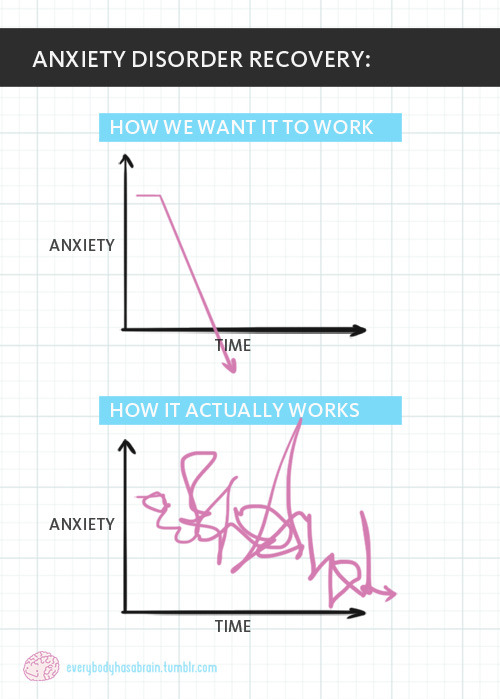
Apparently if you have an anxiety disorder you can go backwards in time. 

Are you kidding? I can go back to that exact moment when I was 6 and I said something embarrassing any time I like.

well that’s just painfully accurate

19 Nov 06:25

Google Fined $17 Million in Multistate Settlement Over Tracking of Consumers

by John Gruber

Reuters:

Google Inc will pay $17 million to settle allegations by 37 states and the District of Colombia that it secretly tracked Web users by placing special digital files on the Web browsers of their smartphones.

The deal, announced Monday morning, ends a nearly two-year probe by the states into allegations that Google bypassed the privacy settings of customers using Apple Inc’s Safari Web browser by placing “cookies” into the browser. […] The Safari Web browser used on iPhones and iPads automatically blocks third-party cookies, but Google altered the computer code of its cookies and was able to circumvent the blocks between June 2011 and February 2012, according to the states’ allegations.

A $17 million fine will really teach Google a lesson. It takes them almost two hours to generate that in revenue.

19 Nov 06:25

Sick To My Stomach

by Josh Marshall

As many wise people wrote during the height of the Trayvon Martin case, public morality plays don't always align neatly with the deep-seated social injustices we connect them to. It was never clear to me that Zimmerman was guilty beyond a reasonable doubt of racially profiling and then intentionally killing Trayvon Martin. Based on the evidence that was a difficult case to make. But that's what Florida prosecutors charged him with. I don't remember the ins and outs of Florida law. But what seemed more clear cut was something like manslaughter or negligent homicide. It always seemed possible to me that Zimmerman was just a coward with a gun and something to prove who got scared and killed a kid.

Read More →
19 Nov 01:26

Face Of The Day

by Andrew Sullivan

splitportrait

Alice at My Modern Met marvels:

Ulric Collette, the Quebec-based photographer behind Genetic Portraits, a series where he splits family members’ faces apart and then photoshops them together, recently created a new portrait that’s close to his heart. Saying, “I’m really proud of this one,” it shows his mother who’s 61 years old on one side, and his daughter, who is 12 years old on the other.

Though a lot of his other portraits look a little on the creepy side (see here and here), this one is almost like we’re looking at a younger and older version of the same person. “My daughter grew to look a lot like my mom, and this portrait really show it,” Ulric states. “On a personal level, this photograph represent the two most important woman in my life. On a more technical level, they look so much alike that it’s incredible. It’s because of results like that I continue to do this series.” As author Gail Lumet Buckley once wrote, “Family faces are magic mirrors looking at people who belong to us, we see the past, present, and future.”

More of Collette’s work here. Previous Dish on the artist here.

19 Nov 01:24

Vi Hart explains logarithms

by Cory Doctorow

The incomparable, incredible, mathematically gifted Vi Hart continues to make the world a better place for numbers and the people who love them, with a video explaining logarithms. Watch this one today (here's the torrent link).


18 Nov 23:59

Toronto council strips power from mayor Rob Ford, who compares self to Kuwait, then body-slams female councillor

by Xeni Jardin
Zephyr Dear

This guy...

The City Council of Toronto has voted to strip Mayor Rob Ford of most of his powers after a totally bonkers session in which Ford vowed "outright war," and compared the vote to "a coup d'etat" and to the Iraqi invasion of Kuwait in 1990.

Ford -- who admitted earlier this month to smoking crack cocaine in a "drunken stupor" -- told council members, "What goes around, comes around, friends." "If you think American-style politics is nasty, you guys have just attacked Kuwait," he said to groans and laughter in the council chambers. "And you will never see something -- mark my words, my friends, this is going to be outright war in the next election, and I am going to do everything in my power to beat you guys."

Also during this meeting, he physically knocked down a council member during a break "while he and his brother, City Councilor Doug Ford, sparred with hecklers in the council gallery." More at CNN.com: "Toronto council strips power from embattled Mayor Rob Ford"


18 Nov 23:46

Taking A Step Back

by Andrew Sullivan

Bernstein argues that the recent spate of anti-Obamacare stories is mostly a media-driven phenomenon:

The last media frenzy about Obama’s collapse (not counting a smaller one over Syria) came in the spring, when Triple Scandals threatened to destroy him. But those scandals fizzled prematurely, leaving the scandal-loving press with a bad case of frustration. Indeed, as Brandon Nyhan was writing before those Triple Scandals, Obama was way overdue for something like that. When it didn’t pan out, the press was presumably still primed for a pile-on, and even though ACA implementation may not have been a promising topic, they worked with what they had.

In other words, it’s like Whitewater because it’s the result of the press primed and ready and waiting for something to blow up around. It’s different because there is a real story here, but that doesn’t seem to have anything to do with how the press is behaving. Like Whitewater, or like the Triple Scandals from April, the phony frenzy part of this will blow over soon. But not before there’s plenty of damage – to the reputation of much of the working press, that is. There’s this week’s real fiasco.

He follows-up at his blog:

It’s ugly out there, folks.

The two that set me off in particular today are Josh Kraushaar’s massive overinterpretation of the events of last week, leading him to believe that Democrats are close to abandoning the ACA. And then Todd Purdom on the imminent collapse of “Big Government progressivism” if the ACA doesn’t work well (complete with supporting quotes from William Galston).

There’s just a lot of nonsense right now. Which is pretty much what happens when these press frenzies get started, but it’s very frustrating. … yes, there is a substantive story on health care reform here, but what the press are up to is mostly just fantasy.

Drum chimes in:

 This has pretty obviously become a game of one-upsmanship, and it seems to be continuing this week. For a story to get attention, it has to be even more hysterical than anything that’s come before, so that’s what we’re getting. It’s a doom-mongering bubble.