Shared posts

30 Mar 06:03

Help. I keep getting into horrible toxic relationships because I hate myself an I need validation. Eventually they all leave because I'm no longer useful. I hate myself and I know once someone calls me pretty I'll do whatever they want and the process will restart. I feel worthless, how can I learn to love myself and not need validation? or at least stop the process of doing everything someone wants me to so I don't feel alone and worthless?

You need more help than I can give with a few lines on the Internet.  I would really like you to try one of these options to find someone to talk to.

But I will tell you what I believe.

You are not worthless.  You’re priceless.

A chair you can sit in has worth; a chair you can’t sit in is worthless.  But you are not a chair.  You were not created to be sat on.  You are not a thing, a tool, or a possession.  You are a human being.

I don’t even want to tell you “yes, you have worth,” because that would be telling you that there’s a contest and you won it, and that’s not true.  The truth is there’s no contest at all.  Human beings don’t have price tags or quality stamps, don’t exist on a ranking from “best” to “worst.”  We simply are.  We experience life.  Whether or not some other person thinks you’re useful to them doesn’t change that.  You’re a human being and you don’t have to earn your existence.  You’re already good enough.

If you never do anything at all with your life except live it, you will be good enough.

30 Mar 06:02

I always thought that brains sort of operated like a train, hence "train of thought." When I thought of my ADHD brain, I imagine hundreds of tracks with various trains all going different directions, and whenever I would quickly jump to other subjects in my head, I would refer to it as "jumping trains." I dunno, I thought I would share my weird analogy.

I really like that analogy! I hope other people do too! :)

-J

29 Mar 23:41

The Rich to the Poor: Do What I Say, Not What I Do

by Jay Livingston, PhD

Economic policies often rest on assumptions about human motivation.  Here’s Rep. Ryan (Republican of Wisconsin):

The left is making a big mistake here. What they’re offering people is a full stomach and an empty soul. People don’t just want a life of comfort. They want a life of dignity — of self-determination.

Fox News has been hitting the theme of “Entitlement Nation” lately. This Conservative case against things like Food Stamps, Medicare, welfare, unemployment benefits, etc rests on some easily understood principles of motivation and economics.

1.    Giving money or things to a person creates dependency and saps the desire to work. That’s bad for the person and bad for the country.
2.    A person working for money is good for the person and the country.
3.    We want to encourage work.
4.    We do not want to encourage dependency.
5.    Taxing something discourages it.

Now that you’ve mastered these, here’s the test question:

1. According to Conservatives, which should be taxed more heavily:

a.    money a person earns by working.
b.    money a person receives without working, for example because someone else died and left it in their will.

If you said “b,” you’d better go back to Conservative class. A good Conservative believes that the money a person gets without working for it should not be taxed at all.

Not all such money, of course.  Lottery tickets are bought disproportionately by lower-income people.  If a person gets income by winning the PowerBall or some other lottery, the Federal government taxes the money as income. Conservatives do not object.  But if a person gets income by winning the rich-parent lottery, Conservatives think he or she should not pay any taxes.

What Conservatives are saying to you is this: working for your money is not as good as instead of inheriting it. This message seems to contradict the principles listed above. But, as Jon Stewart recently pointed out, Conservatives apply those principles of economics and motivational psychology only to the poor, not to wealthy individuals or corporations.

Cross-posted at Montclair SocioBlog and the Huffington Post.

Jay Livingston is the chair of the Sociology Department at Montclair State University. You can follow him at Montclair SocioBlog or on Twitter.

(View original at http://thesocietypages.org/socimages)

29 Mar 22:58

horrorproportions: dealing with anxiety


horrorproportions:

dealing with anxiety

29 Mar 22:37

Critique of the Gotha Programme-- I

Critique of the Gotha Programme-- I:

"But one man is superior to another physically, or mentally, and supplies more labor in the same time, or can labor for a longer time; and labor, to serve as a measure, must be defined by its duration or intensity, otherwise it ceases to be a standard of measurement. This equal right is an unequal right for unequal labor. It recognizes no class differences, because everyone is only a worker like everyone else; but it tacitly recognizes unequal individual endowment, and thus productive capacity, as a natural privilege. It is, therefore, a right of inequality, in its content, like every right. Right, by its very nature, can consist only in the application of an equal standard; but unequal individuals (and they would not be different individuals if they were not unequal) are measurable only by an equal standard insofar as they are brought under an equal point of view, are taken from one definite side only — for instance, in the present case, are regarded only as workers and nothing more is seen in them, everything else being ignored. Further, one worker is married, another is not; one has more children than another, and so on and so forth. Thus, with an equal performance of labor, and hence an equal in the social consumption fund, one will in fact receive more than another, one will be richer than another, and so on. To avoid all these defects, right, instead of being equal, would have to be unequal."

29 Mar 22:36

The Not-So-Bitter End

by Andrew Sullivan

Ted Thompson appreciates John Cheever’s talent for penning convincingly happy endings:

This is one of the things that’s so apparent when you’re reading Cheever: his openness to redemptive beauty. His suburbs aren’t corrupt, awful places. They’re not places that have dark, ugly roots that he’s trying to expose—which is often the basic project in the subgenre of American suburban fiction (and film and TV). Cheever’s world is one that, no matter how buttoned-up it may be, is continuously ruptured by unexpected beauty. For me, finding this on the page was a revelation. You aren’t supposed to write about suburban neighborhoods like that—to acknowledge their beauty, and locate great meaning in it. It’s pretty clear why writers like Jim Harrison spend so much time describing the natural world, but we’ve become almost conditioned to believe that manicured suburban aesthetics are only an illusion to conceal some fundamental rottenness.

In Cheever, this isn’t really the case. No matter how cruel his characters are to each other, no matter how much they disappoint each other or what sins they commit, there’s still a sense that there’s light in his world. It comes through in the way he describes trees so well, and smells and breezes and the ocean. The landscape balances out the torment of the tortured characters within it—and sometimes, that beauty is even enough to save them.

Writing a happy ending that feels meaningful is probably one of the hardest tricks in literature. There’s a lot of comedy out there (particularly in movies and television) that follows that ancient structure of the world falling apart and then being put back together again, but so much of it feels like, okay, those problems were solved and now I can forget about them. You don’t want a literary story to have that effect—you want it to have a resonance with the reader beyond the last page, and I feel like it’s a lot easier to do with tragedy than comedy.

29 Mar 22:14

Foxes and Hedgehogs, Angels and Hacks: Oh, the humanity!

by John Holbo

Down the MOOC-hole, where I have been, I haven’t kept score in the Silver/Krugman kerfuffle. But, Plato-preoccupied as I was, I did make a false inference. I knew it was some fox-hedgehog thing. Silver was using Archilochus to frame what is wrong with standard opinion journalism. Perfect! I thought. Because I have read Plato’s Republic.

“Since, then, ‘opinion forcibly overcomes truth’ and ‘controls happiness,’ as the wise men say, I must surely turn entirely to it. I should create a facade of illusory virtue around me to deceive those who come near, but keep behind it the greedy and crafty fox of the wise Archilochus” (365b-c).

Socrates [Adeimantus] is being ironic [contrarian, for argument purposes], of course.

If Socrates were around today, he’d say opinion journalism is a false facade of virtue that overcomes truth. (I can hardly think of a better description of how Leon Wieseltier’s ideal goes wrong in practice. Wearing a heavy crown of virtue, so ostentatiously, doesn’t keep you upright. Everyone who wears one tends to bend to one side or the other, under the weight. Oh, the humanity!)

So of course I figured Silver was self-styling as a Socratic hedgehog, exposing greedy, crafty op-ed foxes. Now that I’ve caught up, by reading all this stuff, I realize the opposite is the case. He thinks he’s the fox, they are the hogs.

It’s not so important, of course, how we parse the fox-hedgehog metaphor. But it might clarify the debate. Silver’s charge against the op-ed hedgehogs (a.k.a. the foxes) is that they know one thing, i.e. their priors.

But that is really more a case of them wanting one thing, i.e. to be right. The charge is really more properly this: the superficially foxy op-ed writer can think many things about many things but wants only one thing, i.e. to ‘know’ he is basically right about everything. Thus, the foxiness of the op-ed writer – the flexibility that comes with not being a specialist but a generalist – is peeled back to reveal crypto-hedgehogism. What all op-ed foxes know how to do is deploy many opinions, in all directions, as spiny defenses of one impervious basic attitude: I am basically right about everything! There is a certain plausibility to that charge.

But it becomes hard to reconstruct the foxish alternative. Is Nate Silver saying he is superficially a hedgehog – i.e. a quant, a number guy? He knows only one thing: how to count? But underneath that superficial monotony, he’s a fox, i.e. he is prepared to think anything? But only if there are good reasons. He has transcended mere human limitations of cognitive bias and motivated reasoning?

That would be hubristic, to say the least.

If you tone it down a bit it makes more sense but it comes out a bit weird, as an advertisement: Silver could just be promising that his folks aren’t going to be total hacks. Being a competent numbers guy doesn’t make you a god, free of cognitive bias, but it does preserve you from being an hack, one might hope. But ‘read us, we are trying to be free of utter hackery, whereas other outlets tend to have at least some people on the payroll who are flagrant hacks’ is kind of a funny pitch.

I haven’t given Silver’s site a chance, because I literally haven’t visited it yet. I’ve been too busy. But it seems to me that critics are right that Silver’s sales pitch – ‘this is what we are doing that is distinctive!’ – has to be misleading. Sales pitches usually are.

29 Mar 22:12

birdandmoon: Baby bird season is arriving soon. Last year I...


birdandmoon:

Baby bird season is arriving soon. Last year I made a chart that suggests what to do if you find a baby songbird (or, um, relative) out of its nest.

In response to some requests from wildlife rehabbers (aka my heroes), I’ve put two free English printable PDFs on my site. If you find them useful and are able, support me by grabbing something in my store.

Also, many many thanks to Rose Marie Menacho (Facebook group) for the Spanish translation, cgleason for design tweaks, and Alain M (@EcoCit) for the French translation!!

29 Mar 17:41

The white evangelical army of hate is hurting people and redefining ‘Christianity’

by Fred Clark

Let’s start with how this affects real people.

Here’s Ben Moberg, writing about what it’s like to be the favorite punching bag for “the likes of the Gospel Coalition, Franklin Graham, John Piper, and Russell Moore.” This was written before those bullies forced World Vision to reverse itself and offer a groveling apology — to the bullies, When Evangelicals Turn Against Children to Spite Me“:

I am tired, friends, so tired of being hit. I am tired of being the most galvanizing symbol for evangelical Christians. It is awaking a lot of old demons in me and the stab feels so much deeper when it’s your own faith attacking you. But who am I kidding? It is usually my own faith attacking me. And I am now at a breaking point, as I am sure is true for many others.

I’m done with evangelicalism.

I am done being patient with Piper.

I am done pretending I can engage with the SBC.

I am done hoping Franklin ends up more like his dad.

I am done listening to Denny Burk and his blowhards at the Gospel Coalition.

I am done with each and every one of the tweeters out there bragging about dropping their sponsorship of a child in need, just because they hate me.

I am done fleeing from and returning to this perpetually abusive house of faith. I am stopping the cycle. I am empty of strength.

And I am clinging closer to Jesus than ever before.

Thank God our God is our God.

But then, after having to endure another two days of that, Moberg writes about the experience of “When World Vision Drops Me.” That’s a lovely meditation on how personally important World Vision and its president, Richard Stearns, have been to Moberg’s faith — a close connection that made all this all the more painful for him. Here’s where he arrives at the end:

I am not ready to forgive those that held starving children as ransom because of who I am and I am not ready to forgive Richard Stearns for this profoundly deep betrayal. I am not ready to forgive either of them for the devastating message they have sent to gay children everywhere.

But I can do grace. I can reach into the deep pockets of all that I have left and let it be a balm on my heart, let it tend to me until that moment comes when, as Anne Lamott says, “it finally becomes unimportant that you hit back.” I can give and give and give even as I’m pissed off and hurt because although they don’t deserve this, neither do I.

And my rage isn’t wrong, because this isn’t right. And so I will channel it all into doing my job here as a blogger, as a believer, loving gay kids and talking about the Jesus that wouldn’t change them for the world.

Evan Hurst tries to focus on the one positive thing that positively results from this latest convulsion of evangelihate:

When given an explicit choice to love children or hate gay people, they chose the latter, and they chose it loudly. … Perhaps the only silver lining is that the Religious Right truly just showed America, and World Vision, who they really are.

There wasn’t much doubt about who they really were before, but there isn’t any doubt now. These folks — Piper and The Gospel Coaliion, Mohler and Moore and the SBC, Franklin Graham and the hacks at Christianity Today, and the whole hideous white evangelical army of hate they lead — just voluntarily rejected any benefit of any doubt about who they really are as opposed to who and what they inexplicably claim to be.

And so, David Michael McFarlane says, if they won’t allow us to extend them that benefit of the doubt, we should stop extending it. Let’s just stop pretending, “It’s Time to Stop Calling Fundamentalists ‘Christians’“:

To call a response of this magnitude embarrassing is no longer sufficient. In the last two years Fundamentalists have banded behind a fast food chain, racist reality TV star and discriminatory legislation in their attempt to police LGBTQ persons. It’s offensive and spiteful and incompatible with the Bible, which repeats time and time again to judge not — especially not persons outside of Christian communities. On Monday they stopped feeding orphans and widows and the needy among them, a command found in every Gospel and Epistle of the New Testament and even Leviticus. The global poor will suffer not because World Vision endorsed gay marriage or diverted money to fund Pride parades, but because the organization tried to become a smidge more inclusive.

The defense for Fundamentalists’ obsession with homosexuality is the Bible, which they claim to read literally. If this was true, they might notice the words “poor” and “poverty” appear 446 times and that “wealth” is mentioned in 1,273 verses, rarely positively. Only five or six passages discuss homosexuality, though nearly every American can recite them, hearing each one quoted so often. If Fundamentalists fought LGBTQ equality as a hobby, after fulfilling their duty to fight poverty, they might be chastised and forgiven. They’ve revealed, though, they will abandon the poor, to condemn not only gay men and women but anyone who tolerates them. In doing so they’ve denied the very faith and savior they claim to revere. Whatever religion Fundamentalism is, it isn’t Christianity, and it’s time to revoke that label.

Categorizing homosexuality, not injustice, as the greatest evil is absurd and disturbing, but it reflects a whole moral system that contradicts the essence of Christian Scripture. …

McFarlane provides more examples of the fundamentalist moral system disregarding and contradicting and flat-out rejecting the great majority of what their Bible actually teaches. Such examples are not hard to find. Fundamentalists are eager to provide them. Contempt for Jesus and for the Bible are kind of a big theme of theirs. They’ve created whole communications networks just to trumpet that viewpoint.

Still, though, “judge not.” I’m a Baptist, so for me, just because folks like Franklin Graham, John Piper, Denny Burk, et. al., gleefully reject 90 percent of what Jesus was about doesn’t mean that I can suddenly claim the ability to declare that they are not Christians. Declaring who is and who is not a “real, true Christian” is their game, not mine.

Yes, the Gospel is utterly incompatible with a bullying crusade that deliberately takes money away from starving children in order to ensure that other people lose their jobs helping those children. And, yes, it certainly seems like such folks are racing headlong to a full-helping of “I never knew you, depart from me.” And that that “depart from me” will probably seem redundant, by that point, since these folks have been doing nothing but departing for decades now. But just as it is foolishness and blasphemy for them to play-act as God by routinely pronouncing that gays or scientists or women (or gay women scientists) cannot be “real, true Christians,” it would be just as foolish for me to presume I could make that same pronouncement about them. The “real, true Christian” game can only be played by people who think they’re God, and I ain’t God.

But McFarlane isn’t interested in playing the RTC game either. He’s not talking about condemning fundamentalists to Hell, but about trying to help them escape the Hell-on-Earth they’re choosing to live in.

For Fundamentalists to call themselves Christians does less to tarnish the name of Jesus (though it does) than to muddle their understanding of why they do the things they do. “Because the Bible says so,” they say, and then act in defiance of every biblical ethic.

It’s a dangerous road to go down, I realize, designating who’s in and who’s out. Fundamentalists do it often, to gay people, Democrats and, until he buckled under pressure, the director of World Vision. Such spiritual judgment requires an authority no human being possesses. I’m not interested in saying these people are destined for Hell, but I think we need to resemble the identities we claim. To strip Fundamentalists of the Christian label would at least force them to examine their true motivations toward greed, revenge, and malice.

McFarlane’s piece reminds me of some of the statements we read last week from Christians in the CAR. Fr. Nary and the evangelical leaders in that country are pleading for and insisting on a clearer distinction between Christianity and the violent mob that has appropriated its name. Those church leaders admit that many Christians have joined those violent mobs, and thereby “throw an infamous discredit on people of God,” but in a weird echo of Evan Hurst, they also find it necessary to assert, forcefully, that Christians in the CAR are Not All Like That: “all anti-Balaka are not Christians and that all Christians are not anti-Balaka.”

That’s a cross, the symbol of Christianity, so these folks must be Christians, right? I mean, that’s what they say, so that must be what “Christian” means, right?

That’s an important distinction. Like McFarlane, those CAR church leaders recognize that the violent mobs draw power from their dubious claim to be acting on God’s will. Insisting that words have meaning — that “Christianity” does not and cannot mean killing Muslims or that “Christianity” does not and cannot mean cutting off aid to the world’s poorest children in order to bully gay people — is an important and necessary way of denying that source of power for the armies of hate.

But it may be too late. McFarlane and the churches of the CAR are correct that words ought to mean what they mean. That word, “Christianity,” ought to have something to do with Jesus Christ and it ought to have something to do with the things that Jesus Christ taught and demonstrated and incarnated. But usage changes meaning — it causes words to take on new meanings. Usage flaunts the rules of etymology. Prescriptivist attempts to insist on original definitions flounder in response. That begs the question as to whether the normative use of language McFarlane and the CAR churches employ can ever succeed against the descriptive language employed by the armies of hate.

We can insist that it’s incorrect to identify Christianity as a Muslim-hating, gay-hating, crusade of contempt for the poor, but that’s probably about as promising as insisting that it’s incorrect to say “flaunt” instead of “flout,” or “flounder” instead of “founder,” or “begs the question” instead of “raises the question.”

The word “Christian” ought to mean something at least vaguely Christ-ish. The word “Christian” ought to have more to do with Fr. Nary’s radical hospitality than with the brutality of the anti-Balaka. The word “Christian” ought to have more to do with World Vision’s gospel-driven service to the poorest than with the sanctimonious contempt of the white evangelical bullies.

But when the armies of hate are on the march, insisting that “We are Christians and we do this because we are Christians and because this is what Christians do,” then we have to recognize that the word is changing for the worse, whether we like it or not.

29 Mar 07:25

More old comics! I made this comic about a year and half ago for...


More old comics! I made this comic about a year and half ago for awesome comedy musical video series Showbeast then I forgot all about it! Now I will post it because I like it!

25 Mar 06:23

Photo


23 Mar 21:06

Chaos, Bewilderment and Being Pissed-off While Viewing Art

by Shambhala Times Editor
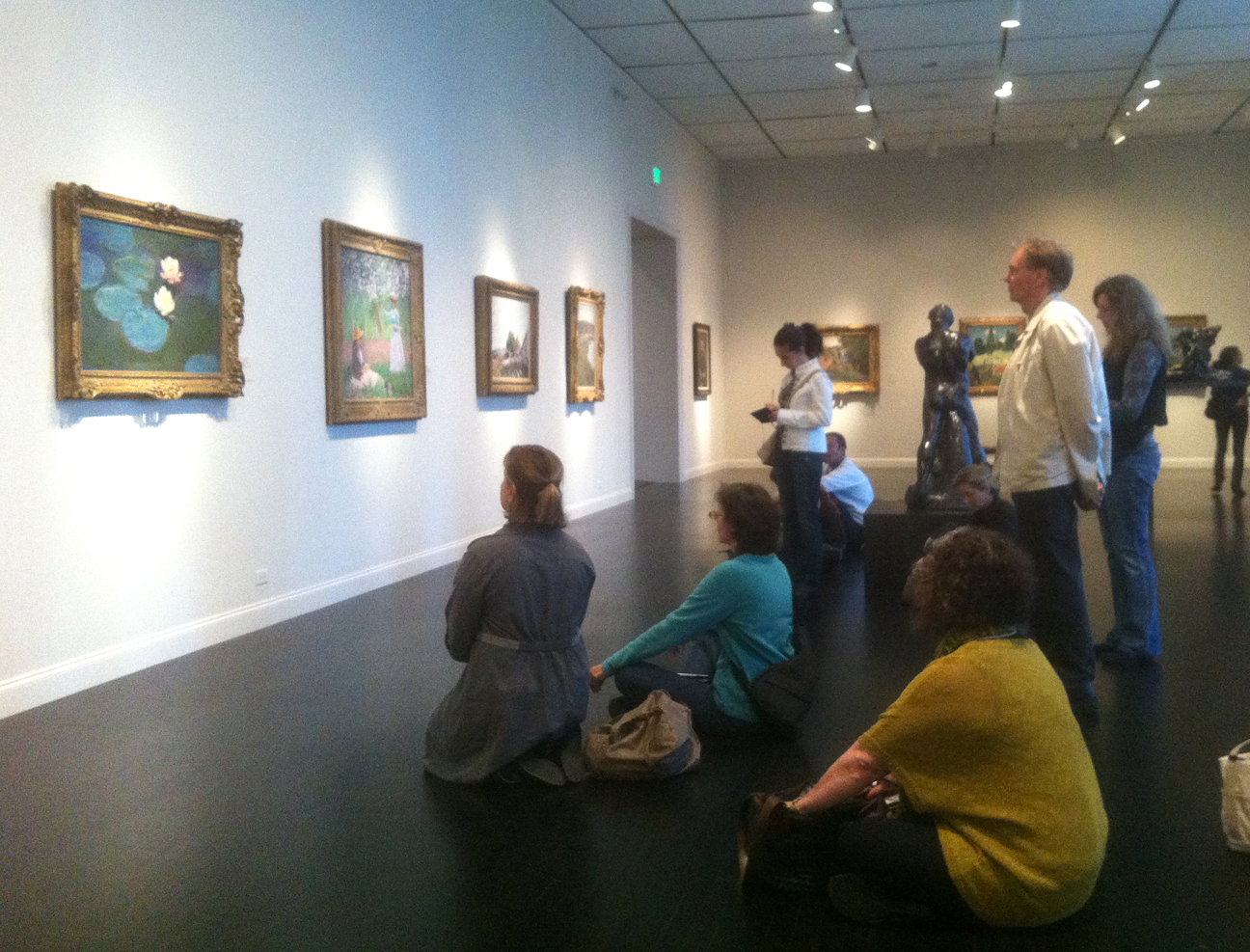
Steve Saitzyk Leading Contemplative Viewing Shambhala Art Field Trip to LACMA

Steve Saitzyk Leading Contemplative Viewing Shambhala Art Field Trip to LACMA

Today is Shambhala Art Day, which has been designated by Sakyong Mipham Rinpoche to occur on the spring equinox. It is a day when the entire Shambhala community and friends are invited to celebrate art forms and disciplines that embody the Dharma Art teachings of Chogyam Trungpa Rinpoche. These teachings encourage the creation and manifestation of art that wakes up the viewer as well as its maker to a sense of unconditional sacredness within the phenomenal world.

“A work of art is created because there is basic sacredness, independent of the artist’s particular religious faith or trust. Sacredness from that point of view is the discovery of goodness, which is independent of personal, social, or physical restrictions.”
~ Chogyam Trungpa Rinpoche. pg. 130, in True Perception


article by Steven Saitzyk

I don’t like chaos, being bewildered, or pissed-off. In the Shambhala tradition, chaos is often regarded as good news; bewilderment, a good sign. Being pissed-off is important, which I learned during a conversation with Chogyam Trungpa Rinpoche. We were discussing iconography and the nature of wrathful and peaceful deities, and he said something that stunned me, “The peaceful deities should piss you off. Their pristine purity is irritating to ego.” While I knew the wrathful deities were bewildering and evoked a sense of chaos, I believed the peaceful deities would be a blissful refuge from all that. Whatever comfort zone I had shrank.

Knowing that chaos, bewilderment and irritation have their positive qualities and not just negative ones helps me to not panic or immediately assume something is wrong with my experience. Avoiding them has not been an option, not only because they are part of life, but also because I teach the integration of meditation with the creative and viewing processes where chaos, bewilderment and irritation are ever-present.

I find that chaos asserts itself the instant I start something new. I have learned that if I don’t retreat, it becomes an opportunity to surrender to my habitual patterns and be in that space, waiting see what arises and takes shape. My first reaction to chaos is often bewilderment. I am confronted with an empty space that I need to fill with something, anything. Yet, if I manage to hang out in that space and not immediately fill it, I experience the sensation of being very present, open and energized. I simply don’t know what is going happen, or what I will do next.

Contemplative Viewing 2012 SA Field Trip to LACMABewilderment is not a problem to be solved but a space to be in. What I learned from my experience about being pissed-off is that it is not solely my ego trying to reassert the control it has lost; it is also a response to the clarity, precision and truth of seeing things as they are. This was reinforced by another important person in my life using the term “pissed-off” while viewing art. He is an internationally known artist that I respect, and once while looking at some art together he said, “I always know when I see an important new work: It pisses me off.” I understood that to mean there was some sharpness, some truth about it that cut through to the very core of his being.

The irritation I experience in such situations is in part a result of the separation between me and my experience. I have found that chasing after the experience does not resolve that split. When I can fully experience the irritation, it relaxes and dissolves into the singular experience of clarity.

Whether we manifest our creativity by making art or not, we can all engage in contemplative viewing of art. By contemplative “viewing,” I mean using as many of our senses as possible with whatever art form is being offered. Contemplative viewing is an opportunity to practice engaging chaos, bewilderment and irritation in a mindful and experiential way and discover how they can change into vision, sanity and appreciation. Contemplative viewing stretches our boundaries, expands our comfort zone and changes how we perceive and appreciate our world. However, before that can happen, we begin with chaos. For example, the mere thought of going to a museum and viewing an unfamiliar work, especially if it is particularly challenging and off-putting, can bring about a sense of chaos. In addition, we are suddenly asked, “What do you think about it?” That may bring about a major moment of bewilderment.

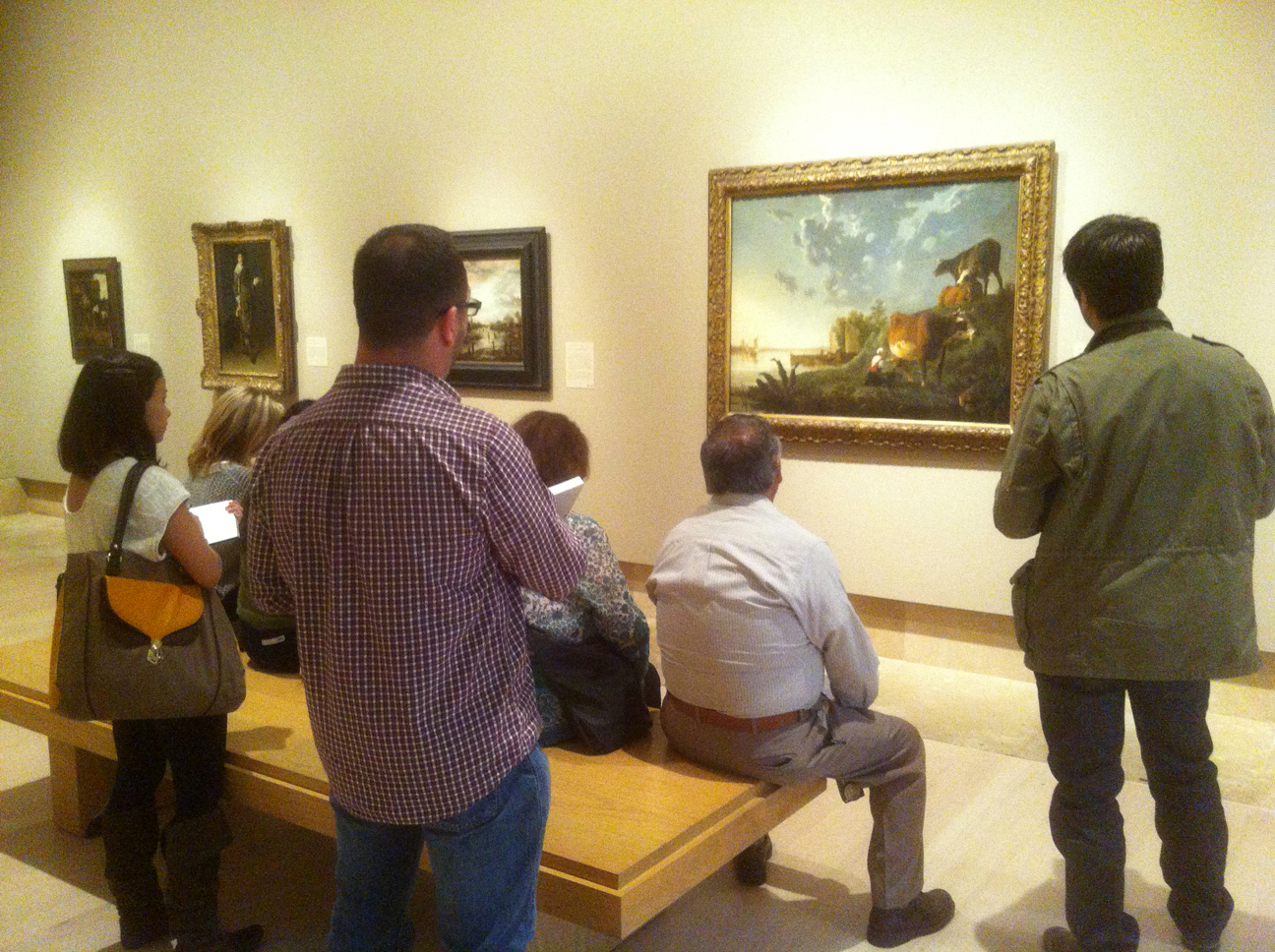
Contemplative Viewing 2012 SA Field Trip to LACMA 3In such scenarios, in order to minimize any sense of chaos, we tend to prepare for it by arming ourselves with information about the art, the artist and its history, as well as any reviews we can find. I used to do that. I wanted to see what I was supposed to see and say what I was supposed to say when questions arose. This process is, of course, the opposite of contemplative viewing. In truth, it is questionable if there was much of any viewing going on at all. I came to realize that I was projecting thoughts and feelings onto the art and then viewing my projections as the art. When I was armed with information in this way, I filtered out any direct experience of the art in favor of my own prejudgments and the thoughts and opinions of others.

Contemplative viewing does not begin with looking at a label or title of a work or whether you know anything about the work or the artist. You must put that aside as best you can. We know we can do this at least briefly because we do this during meditation. Thoughts arise, and we don’t have to chase them. We can return to our breath and senses, and the thoughts will dissolve into space all by themselves. Therefore, we can take what we have learned in meditation, and for a few moments rest our senses on the artwork, which becomes the object of our meditation rather than our breath.

AC class engaged in contemplative viewing at Norton Simon 2This provides a space for us to have our own experience, as unfiltered, unmanipulated and direct as possible in the environment in which we find ourselves. Not only does this process give rise to an experience based on our sense perceptions, but the inevitable thoughts that arise are connected to that experience, rather than existing as thoughts about thoughts. We call those thoughts that come out of the immediacy of direct experience first thoughts, and when they are shared, they often vividly describe the artwork. With this slow viewing, chaos and bewilderment serve us by providing the space, the openness and the awareness for our own experience to arise and be recognized and appreciated.

At this point, reading the label and introducing what is known about the artist, the art, the history of the time it was created and so on enriches and enlarges our view rather than filters it. If we are share our viewing process with others, which I strongly recommend, the very act of articulating it, as well as the act of listening to others, creates new experiences. Just as in the practice of meditation where with each out breath we can let go of our thought stream and come back to a fresh moment with fresh eyes and discover new perceptions and realizations, we can also return to view even familiar works of art over and over again with fresh eyes and make new discoveries to appreciate and share.

You may view a July 10, 2013 talk on “How to View Art” given by Steven Saitzyk here.

~~
Steven Saitzyk is the International Director of Shambhala Art, a non-profit arts education program designed to integrate meditation into the creative process. He is also a founder of the Shambhala Art Program. Currently, he works as an Adjunct Professor of Humanities and Sciences at Art Center College of Design in Pasadena, California. He also teaches at the California Institute for the Arts. He is an exhibiting painter and published author. His soon-to-be-released second book is titled “Place Your Thoughts Here: Meditation for the Creative Mind.” He began his studies of Dharma Art and Iconography with Chögyam Trungpa Rinpoche in 1974 and since has taught internationally. See: www.shambhalaart.org or www.stevensaitzyk.com for more info. E-mail: saitzyk@shambhalaart.org or steven@stevensaitzyk.com.

23 Mar 20:36

Laura Kalbag on Freelance Design: Inspiration

by Laura Kalbag
Zephyr Dear

eeeeyeeeeessss

“Where do you get your inspiration from?” It’s an odd question that designers ask each other. But it’s not asking what motivates us to do our work, or what makes us want to be designers in the first place.

What is inspiration?

When we’re asked where we get our inspiration from, we’re usually being asked where we find that little seed of an idea that grows into a creative solution to a problem.

As a web designer, the expected answer is often a CSS or Responsive Web Design gallery website, and the underlying question is, Where do you pinch your best ideas from?

When I was in high school, art class exercises were usually formed of slavishly copying an artist’s work. We’d use the tools and techniques the artist used in order to better understand how and why the work was created. This helped us experience the process the artist used to create such work.

A study of eyes in different paintings from my art class when I was 17.

Following these exercises, we would usually complete a piece of our own work, with subject matter of our choosing, but using the same tools and techniques as the artist. Here we were learning how to apply the artists’ thinking in the context of our own work.

A mug wrapped in paper and string, inspired by the style of Christo and Jeanne-Claude.

Researching solutions

Every design problem is unique. The context, environment, audience, and goals will never be the same again. But the problems we’re solving can be similar to those that went before. These similarities are what we can use to research potential solutions. When we’re researching the solutions through the experience and ideas of others, it’s like being back in art class again. We’re learning how it feels to use other designers’ tools and techniques, so that we can discover what might suit our own processes. Our wide-ranging explorations lead us each to find inspiration in a different artist or technique. Just as every design problem is unique, there’s no single designer, book, or gallery site that can solve every design problem.

Borrowing ideas isn’t a bad practice. We can research and learn from these resources, although to copy their aesthetics or functionality in their entirety is bad practice. If we copy other designers’ work, regardless of the context of their origins or our projects, we won’t have learned anything, and it will likely result in poor work and an inappropriate solution.

Evolving resources

I was discussing inspiration with my friend Bevan Stephens a few weeks ago. We talked about how, at some point in our design careers, we seemed to stop looking for ideas in galleries and similar resources. We didn’t realize it at the time, but somehow we’d gained confidence, and felt we didn’t need to actively search for ideas from aesthetic showcases anymore.

When we start out, we are usually very conscious of every design decision we make. It takes time for us to familiarize ourselves with our preferred rules and patterns. The more experience we get, the more subconscious these design decisions become. We can make a decision without any conscious justification, although we can then unravel our reasoning in a perfectly clear way. I believe this confidence comes to all designers with time.

A similar thing happens with the way we research solutions. We spend a huge amount of time interacting with other designers’ work; in our research and in the products we use. Sometimes a solution, or an element of the execution, will stand out to us. We may just absorb the effectiveness (or ineffectiveness). Or we’ll remind ourselves to save it for later, in a notebook, some kind of resources library, or just in our heads.

The more experience we have, the greater the osmosis. The viewing and filing of the solutions becomes quicker, more automatic. We become more efficient at storing the information and ideas that we need.

The exceptions

Whilst I think I’m getting better at subconsciously storing ideas and potential solutions, occasionally I find myself returning to the design galleries. It’s not usually for a general browse, but more often for looking at a specific category, a particular type of website. I find myself needing to learn again. I seek out ideas from gallery sites when I’m feeling unsure. This usually happens when the context of a project is new to me. It’s a different type of site, product, audience, or approach. I need to supplement my mental library of ideas. I’m not blindly copying work like I might have done when I was starting out, I’m now better at identifying when I need more resources to help me understand a problem. I understand more about how to appropriate ideas and techniques without copying. Still, I need to bolster my confidence. I want to feel as though I know what I’m working with.

Design as a practice and process stays constant, but the technology, audiences and other outputs change around us. We will always be able to apply our skills of seeing, solving problems and making decisions, but the industry standards and best techniques are always changing. The evolving web means we need to keep learning. Still, we need to be smart about how we learn, and understand the difference between learning and copying so we don’t fall back on the work of others when we should be innovating for ourselves.

23 Mar 20:19

discovering the will of God

by forgedimagination

signposts

The bell rang, and I heaved a sigh of relief. My first day of attending classes was over, and I hadn’t made any major mistakes. Maybe being in a classroom won’t be as hard as I thought, and, feeling brave, I turned to look at the young man I’d recognized from auditions earlier in the week. We were in the same program, and he seemed nice– in a sudden fit I asked if he’d like to come to dinner with some of my friends.

I was shocked at myself. I’d just asked a guy to dinner. After I’d just officially met him an hour ago. After not even being on campus for a week. Samantha what were you thinking but I managed to keep a pleasant expression plastered on my face. He thought about my invitation for a second, then said “sure, where and when?”

“6 at the Four Winds? Meet outside?”

He nodded, then we gathered up our bags and left.

At dinner that night, as we introduced each other and made small talk, I realized that one of the “getting to know you” questions spelled trouble for me. Hometown, major, age– I had all those covered. But I quickly learned to dread the “so how did you know God wanted you to come to PCC” question.

I didn’t have an answer. At least, not an answer that I could give.

~~~~~~~~~~

I started thinking about where I might want to go to college when I was a sophomore in high school, and at the time, I thought I only had three options. All through high school, I only ever really considered three schools: Patrick Henry College, Bob Jones University, and Pensacola Christian College. I’m not sure exactly why I never bothered looking into other schools like Maranatha or Cedarville or Liberty, but it probably had something to do with me thinking that they were all too liberal. Considering the response I got from my fundamentalist friends when I announced I was going to Liberty, it was probably the “liberal” thing.

The summer after my sophomore year I went to PCC’s “Summer Music Academy,” and I absolutely loved it. The environment was much more lax than what I’d grown up with, and I loved the music faculty.

When it finally came time for me to start applying to colleges, I took a more careful look at BJU and PHC– talked to people who’d gone to each, got their informational packets . . . but, in the end, I realized that attending PCC would mean that I would be closer to home, it was cheaper, and because I was already familiar with the campus and how the school operated I figured I wouldn’t be as nervous. Also, I’d made a lot of friends at the summer program who were going, and that seemed like a huge plus. So, I sent out one application. In the fall, I packed my bags, made the one-hour drive to Pensacola, and never really looked back.

However, when I started staring down the question how did the Lord reveal his Will to you? over and over and over again . . . I started wondering if I’d made a mistake. There was entire sermons and chapel services to the concept of “discovering the will of God for your life,” and some of the people around me were agonizing over decisions that I had never thought needed to be agonized over.

How did you to decide to be a music major? Uhm . . . I like playing the piano? (Corollary: it was a degree a woman was allowed to get.)

Did the Lord call you to education? Not exactly. I just don’t like the classes I’d have to take if I were in the ministry major, and the performance major was too much work.

And, the biggie: do you know what the Lord’s plan is for your life? No. Idea.

I’d decided which college I was going to go to based purely on practical, real-life considerations. I had friends there. It was close to home. I liked the faculty. And while those would probably be considered “normal” reasons to non-fundamentalists, they certainly were not the reasons I was supposed to have. I was supposed to feel “called” to PCC. I was supposed to have “guidance from the Lord” when I picked a school. I was supposed to just know that this is where God wanted me.

After about a month of hearing all of that, I called bullshit.

I believe that many of the people I spoke to honestly, genuinely believed that God had led them to PCC. I also believe that there were probably just as many people who were puffing up their stories with “spirituality” in order to get some bizarre version of Christian brownie points.

I ran into the same idea again in my senior year– only this time it was graduate school, and my process was similar: I wanted to study English and I needed a school that would accept my credits so I wouldn’t have to start over. Liberty was the only school I found that had an MA program that I knew wouldn’t be a nightmare to try to get into.

When I announced that decision to friends, though, nearly everyone told me that they would be “praying” that I would “find God’s true will” for my life. To them, there was no possible way that Liberty University could be what God wanted, and that’s when it hit me:

It wasn’t really about God’s will. Not really.

“Being in the center of God’s will” actually amounted to doing what your fundamentalist community approves of. Pensacola was one of the few viable options available for most of the people I went to college with, which almost automatically made it “God’s will” for a lot of them. However, when you’re inside that framework, there’s no real way to separate “God’s will” from “what fundamentalism allows.” They are taught to us as being the same thing. Fundamentalism allows this because it’s God’s will. So the second I stepped outside of fundamentalism and went to the-still-conservative-but-not-fundamentalist Liberty, I was viewed as needing to be “brought back.” I was straying away from God, backsliding, ignoring Him to pursue what I wanted instead of what He wants.

This mentality trickles down into everything– it’s God’s will for women to be in subjection to men. It’s God’s will for women to be modest. It’s God’s will for us to be keepers at home. It’s God’s will for women to be silent in church.

In the end, discovering God’s will becomes follow all the rules.


23 Mar 20:17

Assistant AG admits he doesn't understand what Weev did, but he's sure it's bad

by Cory Doctorow
Andrew “weev” Auernheimer is serving a 41-month sentence for visiting a publicly available webpage and revealing that AT&T had not secured its customers' sensitive financial information. Now, weev's lawyers are appealing, and in the opening day's arguments, Assistant US Attorney Glenn Moramarco admitted I don’t even understand what [Auernheimer actually did.]" Then he compared it to blowing up a nuclear power-plant.


23 Mar 03:35

→ Microsoft read blogger’s Hotmail email to trace leak

This is really, really bad:

Microsoft went through a blogger’s private Hotmail account in order to trace the identity of a source who allegedly leaked trade secrets.

(Also, how creepy is the name of Microsoft’s “Trustworthy Computing Investigations” department?)

I don’t know why I see people lambasting Microsoft for this and advising people to leave Hotmail for Gmail, then patting Google on the back for today’s completely unrelated (and long overdue) discontinuation of unencrypted connections. Google shouldn’t have been allowing unencrypted connections before today anyway — what year is this? — and they still store all of your email without any protection from them (or any secret “national security” demands that they may be forced to comply with).

You won’t fix problems like this Microsoft debacle long-term by moving from Hotmail to Gmail. If your email contains or will ever contain sensitive information, you shouldn’t be using a free webmail service whose entire business model relies on analyzing your mail’s content for advertising purposes.

I continue to recommend buying your own domain and pointing it at either your own IMAP server or a dedicated, paid, standard IMAP host. (I’ve used Fastmail for 7 years and have no complaints.)

∞ Permalink

23 Mar 03:25

To Whom is George Zimmerman a Hero? And Why?

by Jay Livingston, PhD

16George Zimmerman was signing autographs at a gun show in Orlando this week. Only 200 showed up for the meet-and-greet, but Zimmerman has many supporters around the country, and, as Jonathan Capeheart says:

This leads to what should bean inevitable question: Who are these people glorifying the killer of an unarmed teenager in one of the most racially polarized incidents in recent history?

I keep wondering how Jonathan Haidt – with his theory of the differing values of liberals and conservatives — would explain this embrace of Zimmerman. The liberal reaction presents no problems. Haidt says that liberal morality rests on two principles:

  • Care/Harm
  • Fairness/Cheating

Killing someone certainly qualifies as Harm, and, almost literally, getting away with murder is not Fair.

The Zimmerman side is that he shot in self-defense. That argument persuaded the jury, or at least created sufficient reasonable doubt. But it doesn’t explain why some people on the right see him as a hero. What moral principle does he represent?

In Haidt’s schema, conservatives take Harm and Fairness into account but balance them with three others:

  • Loyalty/Betrayal
  • Authority/Subversion
  • Sanctity/Degradation

(A sixth foundation – Liberty/oppression – underlies both the liberal and conservative side.)

It’s hard to see how any of these describe the autograph-seekers.  What else might explain that reaction?

The obvious candidate is racism. If the races had been reversed — if a Black man had confronted a White teenager, killed him, and then been acquitted on self-defense grounds — would the left have hailed him as a hero? I doubt it. Would those same autograph hounds in Orlando have sought him out? I doubt it.  And if Black people had then turned out to get his autograph, can you imagine what the reaction on the right would have been?

But it’s not just racism. It’s a more general willingness to do harm, great harm, to those who “deserve” it.  The liberal view (Harm/Care) is that while in some circumstances killing may be necessary or inevitable, it is still unfortunate.  But over on the right, killing, torture, and perhaps other forms of harm are cause for celebration, so long as these can be justified. In 2008, Republicans cheered Sarah Palin when she stood up for torture. In 2011, they cheered Rick Perry for signing death warrants for record numbers of executions. When Wolf Blitzer hypothsized a young man who had decided not to buy medical insurance but now lay in the ICU, and Blitzer asked “Should we let him die?” several people in the Republican audience enthusiastically shouted out, “Yes.”

My guess as to the common thread here is a dimension Haidt doesn’t include as a foundation of morality: boundary rigidity. In those earlier posts, I referred to this, or something similar, as “tribalism.”

Morality is not some abstract universal that applies to all people.  Tribal morality divides the world into Us and Them.  What’s moral is what’s good for Us.  This morality does not extend to Them.

Could it be that as you get farther out on the right, you find more people whose boundaries are more rigid?  They are the hard liners who draw hard lines. Once those lines are drawn, it’s impossible to have sympathy — to extend Care — to someone on the other side. If you imagine that you live in a world where an attack by Them is always imminent, defending those boundaries becomes very important.

That seems to be the world of gun-rights crowd lionizing Zimmerman.  Their cherished scenario is the defense of boundaries against those who are clearly Not Us.  They stand their ground and defend themselves, their families, their houses and property, even their towns and communities.  It is a story they never tire of, repeated time after time in NRA publications.  Zimmerman is a hero because his story, in their view, embodies the narrative of righteous slaughter.

Cross-posted at Montclair SocioBlog.

Jay Livingston is the chair of the Sociology Department at Montclair State University. You can follow him at Montclair SocioBlog or on Twitter.

(View original at http://thesocietypages.org/socimages)

23 Mar 03:23

Mine PEEPER

by Justin Pierce

The intelligence community now knows you have read this and enjoy comics about farts.

22 Mar 19:54

ziver: oh, that’s cute Westboro Baptist Church. you don’t want to disclose where your founders...

ziver:

oh, that’s cute Westboro Baptist Church.

you don’t want to disclose where your founders funeral is going to take place. why? because a funeral is a personal thing, a mourning period for families and friends? you’d hate to have people who are angered by your beliefs and your practices protest your funeral, wouldn’t you? (✿≖︿≖)

I am deeply, deeply opposed to protesting Fred Phelps’ funeral, because the message it would send is: “Harassing mourners is fine; the only mistake he made was doing it to the wrong people!”

And honestly, in general I’m a little uncomfortable about the attitudes people have toward the WBC, because it’s a tiny organization that arguably was fueled more by lawsuit-trolling than religion anyway, but it gets held up as this icon of American homophobia.  When most homophobia isn’t like that, it’s much quieter and more widespread and insidious and much better at clothing itself in the gentle, bureaucratic language of “we’re trying to be reasonable here but you are behaving unreasonably by having that sexuality.”

I worry that directing too much publicity towards the tiny-minority and almost cartoonish hatred of “God hates fags” takes some of the heat off “God loves you and wants you to have a healthy sexuality so you can be happy and have a normal family.”

20 Mar 23:07

The last decade was a historically awful time to enter the job market

by Emily Badger

The recession wreaked particular havoc on opposite ends of the labor market: on the young and unemployed marooned in their parents' homes for lack of work, and on the (relatively) old and experienced stuck in the workforce for lack of money to retire.

Their problems were clearly not unrelated (particularly in the case of the retirement-aged grocery clerk whose job might have been done by a 19-year-old). But between the two of them, their parallel misfortunes made for a historical anomaly in this latest recession.

You can see it in this chart from the Brookings Institution, which compares the employment rates for different age cohorts in 2000 and 2011 across America's 100 largest metros:

Brookings Institution

Brookings Institution

Over the course of the decade, the employment rate for 16-to-19-year-olds fell  from 44 to 24 percent, the lowest it's been in Current Population Survey data going all the way back to 1948.

"It is an astonishing drop," says Martha Ross, a fellow with Brookings' Metropolitan Policy Program who co-authored a recent paper on the recession's abysmal impact on employment prospects for young adults. What really stands out about that graph, though, is what happened to workers over 55. Their employment rates went up over this same time.

"We haven’t seen this before," Ross says, "this combination of employment rates dropping for the younger and prime-age workers while they’re increasing among the workers who are of or near retirement age."

Brookings is calling this a historically unprecedented "great age twist." While every other age group was less likely to be working in 2011 than in 2000 (with unusually bleak prospects for the youngest workers), older people were actually more likely to be working.

In some ways, this may reflect the particular circumstances of a recession rooted in housing collapse: Many retirement-aged workers who had their savings tied up in their homes suddenly needed to stay on the job much longer than they had planned. And the impact of that decision cascades down to younger, less experienced and less educated workers who've had to compete for jobs with the overqualified.

This picture now raises some particularly alarming questions about the workers aged 24 and younger. Studies have suggested that people who are unemployed as young adults later earn less when they are employed. Aging into a crummy economy doesn't just hurt you when you're looking for your first job from your mother's basement; the negative effects persist for years.

Early unemployment, in other words, has lasting scars. And we've just watched an entire cohort come of working age at a time when employment prospects for young workers have been at an unprecedented low.

"It’s not written in stone, and it’s not your destiny," Ross says of the long-term repercussions. "But this is a really formative period in someone’s life."

Young workers without a college degree will have a particularly hard time. But other workers who've been biding their unemployed time in school will have to add massive debt to this equation.

This suggests we should start talking more not about how the recession has hurt young workers, but what it will mean for them for years to come to have entered the job market with such historically bad timing.


20 Mar 05:45

21 Oddly Satisfying GIFs You Won’t Be Able to Stop Watching Yeah! Cut that dough! Slice that...

21 Oddly Satisfying GIFs You Won’t Be Able to Stop Watching

Yeah! Cut that dough! Slice that paper, you sharp little knife, you! Fit that joint! Fit it! R! R! R! R! Make that bowl! Make it all night long! Yeah, candle! Burn! Smash, bullet! Smash like your little life depends on it! Yeah, roll it up. Roll that ice cream UP! YIP! YIP! YIP! YIPYIPYIP! Damn, pen! Keep writing! I’ve never felt this way towards a frisbee before. Yeah, pop tarts. Do it! Solder my heart. Solder it good. Twiiiiiiiist, pretzel. TWIST! TWIST! OMG! Paper airplane, you are a rascal. Yes, frisbee! Get it! Don’t you ever stop, pasta! Slice that paper like it deserves to be sliced! WOOO!!!

20 Mar 02:55

Submit ENTJ Confessions here!

Zephyr Dear

They've made it to 23. INTP Confessions is 700+.

Submit ENTJ Confessions here! :

entjconfessions:

Please submit confessions! Keep this blog running

19 Mar 03:51

Being Buddhist In The Bible Belt

by David Kurtz

A school district in Louisiana gets popped for pushing Christianity and discriminating against a Buddhist student -- but it sure doesn't seem sorry about it. (You can still see the school board's "beliefs" posted on its old website, where No. 1 is "God exists.")

18 Mar 15:09

Depressionblog 2/17

Living with depression is like being your own toddler.

"I wanna nap!”

"You can’t nap now, you won’t sleep properly at bedtime and then you’ll be all grumpy in the morning."

"I wanna cookie!  I wanna whole bag of cookies!”

"Eating just cookies isn’t good for you.  How about you eat your dinner and then you can have a cookie."

"I wanna watch TV!”

"You can do that, but not all day. You still have to clean your room and then I want you to go outside!"

…Okay, being an adult in general is like being your own toddler, but with depression the toddler is much louder and brattier.

16 Mar 21:18

"Outside of civil society, if a bitter enemy makes an attempt on my life or, pushed away twenty..."

“Outside of civil society, if a bitter enemy makes an attempt on my life or, pushed away twenty times, he returns again to ravage the field that I cultivated with my own hands; since I have only my individual strength to oppose to his I must either perish or kill him, and the law of natural defense justifies and approves me. But in society, when the force of all is armed against only one, what principle of justice could authorize it to kill him? What necessity can absolve it? A victor who kills his captive enemies is called a barbarian! A grown man who kills a child that he could disarm and punish seems to us a monster! An accused man condemned by society is nothing else for it but a defeated and powerless enemy. Before it, he is weaker than a child before a grown man.”

- Robespierre 1791
16 Mar 21:02

sirmitchell: No wait, this one is the best gif. 


sirmitchell:

No wait, this one is the best gif. 

15 Mar 20:31

From FB March 15, 2014 at 03:17PM

no need for a plugin: use #TODO in code and git config —global alias.g “grep —break —heading —line-number”, then git g ‘TODO’ :)

15 Mar 20:29

aloofshahbanou: There’s too much “I need him, he completes me” and not enough “I complete me yet I...

aloofshahbanou:

There’s too much “I need him, he completes me” and not enough “I complete me yet I want them along for this journey”

15 Mar 16:43

So, like… what was up with F. Murray Abraham playing the older version of Tony Revolori's...

image

So, like… what was up with F. Murray Abraham playing the older version of Tony Revolori's character (in The Grand Budapest Hotel)?

I saw some articles commenting on how a person of color (Revolori) got a central role in the film - which is awesome! - but so far nothing about how he somehow ages into a dude who ISN’T a visible poc? That seems problematic? (Also, just… weird. And distracting.)

15 Mar 16:35

toysfortrots: fuzzyhorns: toysfortrots: whitepeoplesaidwhat: makenziemaryandmollyy: thedokster: ...

toysfortrots:

fuzzyhorns:

toysfortrots:

whitepeoplesaidwhat:

makenziemaryandmollyy:

thedokster:

Saw this fool on the kik tag and I just could not resist.

I made sure that he wasn’t black at all before I told him straight.

I am so done with white people wearing “dread”locs and acting like it’s a fashion trend.

I don’t get it…why can’t white people have dreads? I’m mixed and I think it looks best on white people tbh.

Another ew and stfu.

-Holly

Lol, I hope he laughed and told OP to fuck off.

im confused, so ^ is a white dude saying that the op shouldnt have framed that encounter? curious on your logic there

Because it’s pretty damn antisocial (i.e. assholish) to police someone’s hairstyle?

Culture flows and changes - no one can keep a lid on it. Trying to keep certain cultural artifacts and practices exclusive to a certain group is futile at best, and a pathetic waste of effort at worst.

Am I allowed to get bent out of shape at people who like to get drunk and act lewd on St. Patrick’s Day because my family is Irish?

(content alert: i am not a postmodernist or cultural relativist)

so do you really think those things are equivalent?

cultural practices are historical

st patricks day is essentially a holiday about the historical construction of ireland itself, as a resistant self-determining state exploited by GB

can non-irish people participate in the cultural construction of “ireland is a country and should determine itself”? uh, yeah, duh, i think?

otoh, dreadlocks really refer to a historical practice for black people. notice we are not referring to specific countries, because black people need to deal with being a post-national identity in a sense, a diaspora. we are not referring to a thing that one can join, either, because that is not how blackness works.

can white people have dreadlocks? in a critically important sense: no. because white people can not have the history of black people

can white people draw upon their own specific cultural history or black culture for a practice to lock their hair? sure. will the result be dreadlocks? no.

let’s stick with the irish for a moment. if you lock your hair as a irish person, what meaning does it have as a cultural practice? ironically for white hippies everywhere, it was a martial practice apparently to make helmets more comfortable to wear.

so underneath all this are some philosophical questions: do our cultural practices have meaning outside of a capitalist consumer culture which insists on cultural relativism? if they do or can have that meaning, what responsibility do we have as individuals to understand the history our action is symbolically instantiating? and finally, by acknowledging meaning outside the bounds of capitalist cultural relativism, can we leverage this against capitalism? (the last one is a topic for another day, but imo, yes)

for black people, experiencing racism because of the texture of their hair is a real phenomenon because we live in a white supremacist culture. locs are a cultural practice of black people in that current historical context. the literal practice of locking your hair is transferable, but the symbolic context is not.

so

1. if a white person locks, it literally has no meaning outside of being fun or fashionable to them. if they insist it as a practice has no meaning, they are, by extension, denying that important symbolic meaning it has to black people by diluting the pool of performances with their meaningless performances of the practice. locs on black people become “just fashion” once they are available to white people as such (see —> for the consequences of this)

2. confronted with the potential consequences of 1, then usually the next move is, ok fine, i am a white person and i want it to have meaning. now what? well, the meaning it would have is that they identify with irish warriors wearing uncomfortable metal helmets. do i for real think most white people locking their hair are irish diaspora showing their support for sinn fein? no i fucking dont

—> we are back to 1 where

white people are demanding that cultural practices have no symbolic meaning, so that they can have access to them as cultural CONSUMERS not as cultural producers or historical agents

which i think is fucked up capitalist bullshit