Shared posts
Taking Elliot Rodger seriously.
Divorce complaint of Richard Feynman's second wife
(Via Clifford Pickover)
Visual gags in comedies: US vs UK
Tony Zhou created this fantastic, 7-minute critique of the visual style of comedy in US films, as compared with UK films (especially the films of Edgar "Shaun of the Dead" Wright).
Read the restxsleepyeepy: hiddenlex: bestnatesmithever: karenfelloutofbedag...


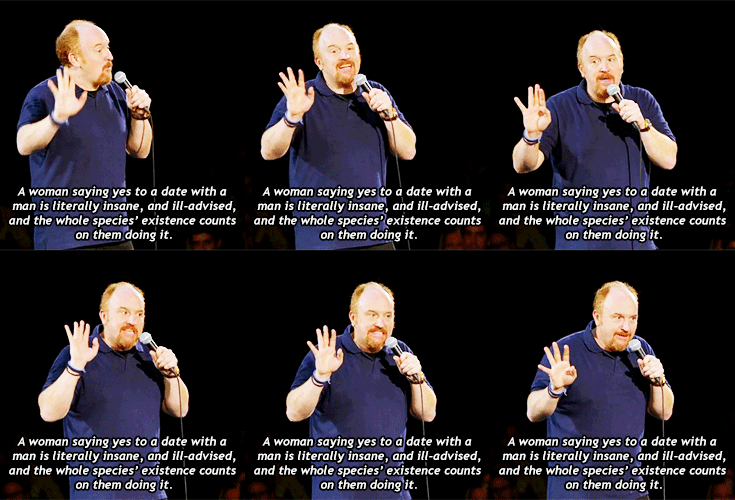
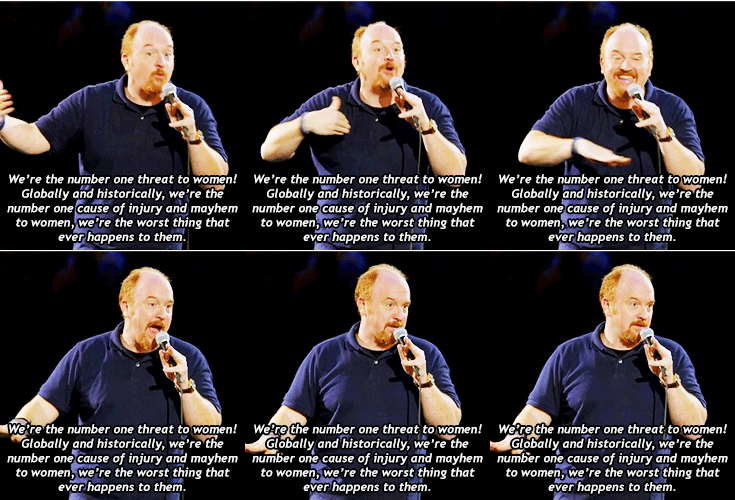
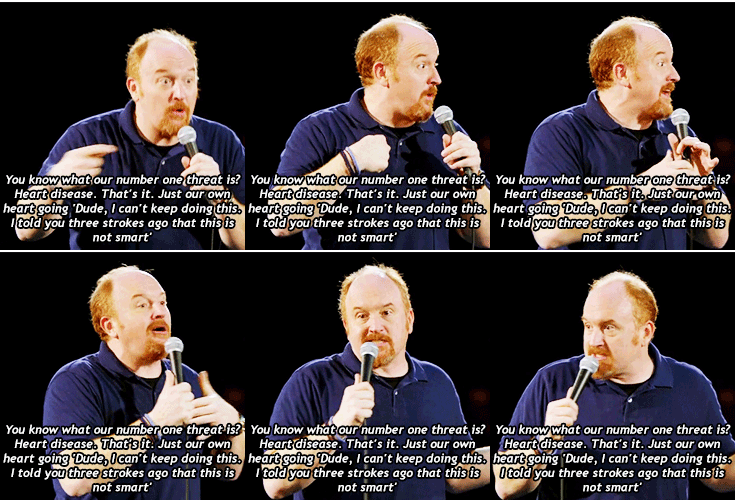
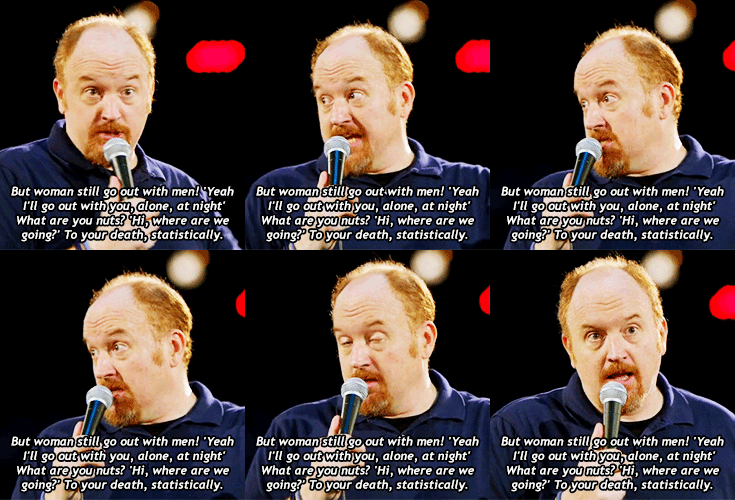
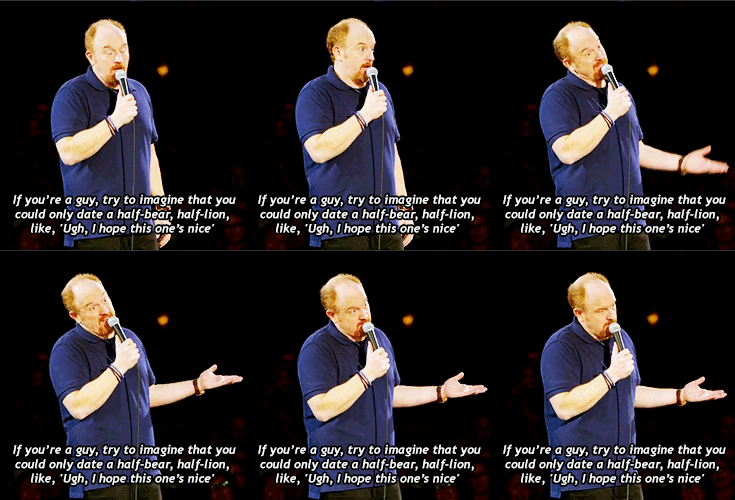
Louis CK on our culture on dating
I HAVE SO MUCH RESPECT FOR THIS MAN.
'Ugh, I hope this one's nice'
I may or may not have referenced this joke when making a point today.
Louis is tha man.
"Then I had kids. But what a boring story: “Then I had kids.” Still, I have to be truthful. And the..."
-
Zadie Smith, Storytelling Is a Magical, Ruthless Discipline
Zadie always says it best.
(via thetinhouse)
"Did I really almost drift away, down that anemic, intellectual path where storytelling is considered vulgar and characters a stain on the purity of a sentence?"
Thank you, Zadie!
(via ellenkushner)
I needed to hear this today.
Really Creepy Bundle: name your price for amazing, transmedia horror
Jamie from Vodo writes, "We've launched the Really Creepy Bundle, a brand new collection of terrifying, chilling and downright disturbing indie creativity that includes four highly-rated games (Oknytt, Finding Teddy, The Path and Sang Froid), award winning fiction (Nebula nominee Stranger In Olondria, and a month subscription to Nightmare magazine), four spooky short films, an 8 track compilation from LA's Not Not Fun Records, laden with doom plus the definitely disturbing and massively entertaining graphic novel (The Furry Trap) -- which Boing Boing rated one of the best damn comics of the year in 2013.
Read the restThe myth of heroism
(I am scarce around here because I am simultaneously grappling with impending burn-out—I'm 240,000 words into a 300,000 word project, which is to say, neariy 800 pages into a 1000-page story, and it's hard going because my natural length is closer to 30,000 words—and trying not to scream myself hoarse with rage because politics. (Ahem. That is: we swim in a media environment that is designed to act as a potent neurological depressant, the various incumbents are currently covering possibly the most important election campaign I've lived through, and about two-thirds of them have a partisan agenda: the cognitive dissonance is getting to me.) But anyway: happy fun blog thoughts, or at least not overtly political blog thoughts, now follow.)
Where do heroes come from?
I will confess that I find it difficult to write fictional heroes with a straight face. After all, we are all the heroes of our internal narrative (even those of us who others see as villains: nobody wakes up in the morning, twirls their moustache, and thinks, how can I most effectively act to further the cause of EVIL™ today?). And people who might consider themselves virtuous or heroic within their own framework, may be villains when seen from the outside: it's a common vice of fascists (who seem addicted to heroic imagery—it's a very romantic form of political poison, after all, the appeal to the clean and manly virtue of cold steel in subordination to the will of the State), and also of paternalist authoritarians.
But where does it come from?
I've been reading a lot of superhero fiction lately (The Violent Century by Lavie Tidhar, Turbulence by Samit Basu, the Velveteen books by Seanan McGuire, to name but four: I'll even confess to Carrie Vaughn's superhero spin-off series, and others besides) and pathologically failing to get around to reading Supergods by Grant Morrison—I am remiss, and my ability to absorb dollops of theory after a hard day of scribbling is very small ... but it seems pretty damn clear that the superhero archetypes hail back to the polytheistic religions of yore, to the Greek, Roman, Norse, and Egyptian pantheons and their litany of family feuds and bad-tempered bickering. (And is it just me or are half the biggest plots in superhero pre-monotheist mythology the punch-line to the God-Father (or occasionally one of his more troublesome sons) failing to keep his cock to himself, and the other half due to a jealous squabble between goddesses that escalates into a nuclear grudge-fest until suddenly Trojan Wars break out?)
We have this in common with our 5000-years-dead ancestors: we're human beings, and our neural architecture hasn't changed that much since the development of language and culture (unless you believe Julian Jaynes—and I don't). We still have the same repertoire of emotional reactions. We still have a dismaying tendency to think it's all about us, for any value of "it" you care to choose. We fall for a whole slew of common cognitive biases, including a complex of interacting heuristics that make us highly vulnerable to supernatural beliefs and religions. (The intentional stance per Dennett means we ascribe actions to intentionality; confirmation bias leads us to assume intentionality to natural events because this is something that's been bred into us throughout the many millions of years of predator/prey arms races that weeded out those of our ancestors who weren't fast enough to correlate signs such as lion prints at the nearby watering hole with other signs like Cousin Ugg going missing and realize there was a connection. So our ancestors looked on as lightning zapped another unfortunate Cousin Ugg, felt instinctively that there had to be a reason, and decided there was a Lightning God somewhere and he'd gotten mad at our tribe.)
We have other biases. We look at people with good skin and bilaterally symmetrical features (traits indicative of good health) and we see them as beautiful (hey, again: we're the end product of endless generations of organisms that did best when they forged reproductive partnerships with other organisms that were in good health), so obviously they've been blessed by the gods. And the gods bless those who are virtuous, because virtue (by definition) is what the gods bless you for. So beauty comes to be equated with good; and this plays itself out in our fictions, where our heroes and favoured protagonists are mostly handsome or pretty and the villains are ugly as sin ...
This isn't just a fictional trope. Look at the studies of physical appearance and pay levels in business: the taller you are, the higher your earning potential, and the fatter you are (fat is currently associated with sloth and greed—both vices) the less you earn. (Again, look at US presidents: they're all freakishly tall, and it's very common for shorter candidates to be weeded out earlier in their party primary selection process. The POTUS is a hero role—the father of the nation and all-protector with the power to throw nuclear fireballs or send Reaper drones to slay the tribal enemies. No surprise that candidates for POTUS have to look heroic, inasmuch as this is possible when there's a threshold age for entry of around 40 years and the uniform is a lounge suit.)
But back to fiction: we also have the reification of good and evil. People who believe in such a dualistic eschatology often find it quite hard to explain just what constitutes good or evil; as the judge said in the pornography trial, "I know it when I see it". I say that it's entirely an artefact of where you stand; good is what I think is good, evil is what people who disagree with me think is good. The inability to separate subjective detriment from objective detriment is at the root of a lot of our social failure modes: from morality legislation along the lines of "this is no good for me, therefore we must forbid everybody from doing it", to the blood feud. It's a very handy tool for constructing the plots that underlie narratives of human tragedy, as long as you don't take it at face value (in which case you get paper-thin ugly caricatures of villainy battling it out with two-fisted pretty-faced righteousness, and you just know in advance how that is going to end).
Okay, simple thesis: superhero fiction and imagery is very largely a throwback to an earlier age, to the clan-based hero/villain narratives of polytheism, the great tragedies of lust, betrayal and revenge. By giving the protagonists of fiction supernatural powers we can amplify the drama of their confrontations: turn up the gain on the emotional nuances, present with dramatic immediacy and impact questions about philosophy—the will to power, the limits of moral behaviour—that are for most of us, most of the time, remote abstractions. All of this is a major tool in the arsenal of the fantastika, allowing us to examine these themes of empowerment and morality in a contemporary or alternate setting without the handicaps of excessive realism (as with hard SF) or the other problematic issues of genre fantasy (do you pick high fantasy, with the distancing and frequently questionable cod-mediaevalism of its settings, or urban fantasy, with its raft of cliched vampire and werewolf lore?) ... to some extent the cold war spy thriller also enabled these fantasies of super-agency, by placing mundane trenchcoat-wearing office workers at the fulcrum of terrible forces, but it was a clumsy and indirect approach, more reminiscent of the form of Lovecraftian horror (as I've written elsewhere). Giving the agents and antagonists personal superpowers (as Lavie Tidhar does in "The Violent Century") works so much better at highlighting the human consequences of tragedy.
Superhero fiction emerged in its modern form in the 1920s and 1930s, at much the same time as science fiction. (I think it's no coincidence that these forms emerged just as mainstream literature decisively turned its back on the fantastic, while ongoing accelerating technological change and the social tensions of the Great Depression and the rise of duelling totalitarian ideologies took hold on the popular imagination.) At times it was used for much more experimental work, but from the early 1950s onwards the dead hand of the Comics Code Authority crippled its efficacy as an expressive fiction format in American literature, with particularly detrimental effects on the depiction of female and ethnic minority empowerment (no, seriously, click that link: Saladin Ahmed has done your homework for you and there is stuff there that you probably won't believe). But from the late 1970s onwards the effects of the CCA—and, in the UK, the Obscene Publications Act (1958) (which gave the police extraordinary powers to seize and destroy anything they deemed "obscene", with the onus on the accused to prove that it wasn't with their liberty in jeopardy if they took the case to court) began to fade. And since then we've seen, first, the flowering of graphic novels (permitting long form story arcs to progress and develop, with character studies far more detailed than the previous norm in weekly or monthly 16- or 24-page comics), and subsequently the adoption of some superhero tropes in SF/F written fiction, and the huge boom in the Marvel and DC movie franchises.
The big movie breakthrough was probably the 1978 Christopher Reeve Superman movie, a big budget film that was groundbreaking in the way it handled both storytelling and production values for what had hitherto been perceived by the film industry as "kids stuff". And I don't think it's a coincidence that 20-30 years later we're seeing a boom in literary fiction that uses with the tropes of superhero/supervillain comics.
Novelists don't really hit their stride until they reach their late 30s to 40s; the generation who grew up with post-Superman movies and the likes of "V for Vendetta" and Neil Gaiman's "Sandman" were ready to take the rich source material of modern mythology seriously in a way that most of their elders (honorable exceptions like Kim Newman notwithstanding) were not. We're probably still 20-30 years away from a superhero novel winning the Booker prize, much less the Nobel Prize for Literature, but I wouldn't write the idea off as fantasy; the re-legitimization of the art form into the mainstream of literature is visibly on-going, and its assimilation is probably proceeding faster than that of SF—a spiky, chewy, unlovable form that is hard for the humanities to approach. (The tools of hard science fiction are much trickier and slipperier to handle than those of the fantastic, because the cultural divide in our educational systems deprive many of the people following the literary and cultural track of the tools they need to engage with science and technology effectively. Whereas myth and legend comes naturally to the hands of people whose education, even if it doesn't directly engage with the Greek and Latin classics, is pervaded by the writings of the literary elders who did.)
As for me, I'm writing this blog entry to keep track of my thoughts on the subject for another matter: the afterword to Laundry Files #6, "The Armageddon Score". Which is complete in first draft, and will be published in July 2015, and deals with the matter of superheroes. Because in today's fast-moving hyper-colourful world, a literary character study of a middle-aged civil servant's mid-life turmoil, marital breakdown, and career crisis really needs Dolby surround sound, spectacular special effects, and lots of skin-tight lycra. At least, that's my story, and I'm sticking to it. (It started with two elevator pitches: A character study of a middle-aged female civil servant's marital and career breakdown (with super-heroes), and—the action-oriented version—Bob's exes form a superhero team: together, they fight crime. Make what you will of this, I'm saying no more until this time next year.)
Publishers’ Deal with the Devil
What doctrine call you this, Che sera, sera,
What will be, shall be? Divinity, adieu!
– The Tragical History of Doctor Faustus, Christopher Marlowe
To evoke Faust as allegory for the ongoing dispute between Amazon and book publishers is appropriate on two levels, the first being the nature of the original story.
Faust was the protagonist of a German legend, who, dissatisfied with his life as a scholar, sold his soul to the devil in exchange for infinite knowledge and the full array of worldly pleasures. Said legend has been appropriated by multiple authors for variations on the same theme, including Christopher Marlowe’s The Tragical History of Doctor Faustus, Johann Wolfgang von Goethe’s Faust, and a host of other plays, operas, books, and symphonies. Indeed, most of you reading this have likely uttered the phrase “Make a deal with the devil,” and so have adopted the original idea and made it your own, without paying a cent to anyone.
Ideas have always been free, but their closest cousin, words, have long been a bit more problematic. The publishers would have you believe that their words, written by authors of course, but blessed by them, are worth a premium, and certainly ought not be shared freely. And, for centuries, that was mostly true. Books – and newspapers and magazines, for that matter – were sold for a price.
The problem, though, as newspapers and magazines have long since discovered to their peril, is that no one was ever paying for the words. Rather, it was the difficulty in distributing words that demanded a premium, whether that be the paper, the printing, the shipping, or the distributing. With the Internet, each of these proved unnecessary, leaving only the writing, editing, and publishing, and the market has dictated exactly what those are worth, all things being equal: $0.
The issue is that writing, editing, and publishing are all fixed costs; they are accrued before an article or book is published, and increasing the distribution of said article or book is, relative to these costs, completely free. The costs the Internet obviated, on the other hand, such as paper, ink, shipping, and retail space, were all variable costs; to create one additional book (or newspaper or magazine) required money. To put it another way, before the Internet free was not an option, and once customers were already paying something, it was a whole lot easier to get them to pay just a little bit more. And, with that little bit more, publishers could cover their fixed costs, and perhaps even turn a tidy profit.
On the Internet, though, words are much more like the mythical story of Faust, available to anyone and everyone for zero marginal cost. Each of you reading this article is creating a new version of this site on your computer, and it’s not costing anyone a cent.1 Unfortunately for those accruing those fixed costs, it’s much more difficult to convince customers to move from $0 to even $0.01 than it is to go move from $1 to $2 (or $10 to $20).
This reality, unsurprisingly, terrifies the publishers, which is where we return to Faust: just as the doctor made a deal with the devil, so have publishers, but in this case the devil is Amazon, and Mephistophilis, the devil’s agent, is DRM.
Unlike newspapers, which quickly placed all their content on the Internet in the 90s, massively increasing readership but ultimately hollowing out their revenue base, publishers approached the digital era much more gingerly. It’s not that the idea of ebooks was unknown – the first ebook reader launched in 1998 – but rather that publishers, having seen what happened to music with the release of Napster, were rightly terrified of a world in which books were accessible to anyone, at any time, for free. Over the next several years different publishers dabbled with different ebook readers, but it wasn’t until Amazon, with its longstanding relationship with publishers, launched the Kindle in 2007 that the publishers fully got on board, and key to the publishers embrace of the Kindle was its proprietary DRM. Over time the publishers would also launch their titles on other companies ebook readers, such as the Nook and iBooks, but always with DRM.
The problem with DRM, as Nook owners now know all too well, is that it ties your books to a single company. If you start buying Kindle books, you will always buy Kindle books, because your books will only ever work on a Kindle. The result is that anyone who has bought Kindle books is now more loyal to Amazon than they are to any of the publishers. Not that they were ever loyal to publishers, of course; said loyalty is reserved for specific authors. And that right there is the root of the publishers’ Faustian bargain: unloved by consumers, yet unwilling to give up their position as middleperson, publishers traded away infinite distribution and the truly free exchange of ideas for the yoke of another, infinitely more powerful middleperson – Amazon.
And now, Amazon is demanding its payment. While the specifics are unclear, publishers Hachette and Bonnier are to give up more control and money when it comes to ebooks, and to help them remember their end of the deal, Amazon is “forgetting” to keep many of their physical books in stock.
Let me be perfectly clear here: I think what Amazon is doing is ugly and I don’t like it. And, were this 1985, I would absolutely be raising antitrust alarms around Amazon’s monopsonistic position in printed books (i.e. their position as by far the largest buyer of books gives them undue power). However, it’s not 1985; it’s 2014, and a huge percentage of the population has at least one device capable of reading ebooks. In fact, publishers could break the back of the Amazon monopsony today were they to start selling all of their books without DRM. Can’t find the book you want on Amazon? How about you simply visit the publisher’s site and buy it there. Or, as is more likely, visit the site of your favorite author.
Ah, but that’s the rub. The publishers need Amazon because they need the Kindle’s DRM, because they know without that artificial friction their contribution to a book’s fixed costs would become untenable. As George Packer recounted in his anti-Amazon article Cheap Words:
Amazon executives considered publishing people “antediluvian losers with rotary phones and inventory systems designed in 1968 and warehouses full of crap.” Publishers kept no data on customers, making their bets on books a matter of instinct rather than metrics. They were full of inefficiences, starting with overpriced Manhattan offices.
I’ve worked with publishers, and here’s the thing: Amazon is right. It’s not that publishers don’t add value,2 but rather that their economics are wholly incompatible with the reality of the Internet. If publishers are to have a future free of Amazon, that future will be as a service with upside directly tied to a book’s success. Specifically:
- Authors will hire publishers from a competitive marketplace based on reputation, quality of service, and price
- Fees will likely be some sort of fixed price up-front, with a percentage of revenues
- Books will be published without DRM and marketed primarily by the authors themselves, likely at lower price points but with significant upside for breakthrough works
Some sort of DRM remains an option in this new world, but it must be controlled by the author (or, if he chooses, his publisher) directly. DRM is artificial scarcity, and whoever controls it controls the entire market (I myself have chosen to not make all my content here on Stratechery available to everyone, but I control the means by which it is distributed). The problem with publishers is that, due to their own incompetence and (understandable) unwillingness to change, they gave the keys to the castle to Amazon, and it’s no surprise they are now paying the price; the devil always has its due.
- OK, fine, the bandwidth and electricity cost something, but you know what I mean
- As the author Charlie Stross notes:
Forbes seem to think that Hachette is a producer and Amazon is a distributor. This isn’t quite true. I am a producer. From my perspective, Hachette is a value-added wholesale distributor: they supply editorial, production, packaging, marketing, accounting, and sales services and pay me a percentage of the revenue. (I could do this myself, and self-publish, but I don’t want to be a publisher, I want to be a writer: we have this thing called “the division of labour”, and it suits me quite well to out-source that side of the job to specialists at Hachette, or Penguin, or Macmillan.)
Unfortunately for Stross, a division of labor neatly isolated from the market success of his work is one of those inefficiencies ruthlessly culled by the Internet; of course he thinks this is a loss to consumers, but that ignores the fact that most would-be authors never actually even had a chance.
The post Publishers’ Deal with the Devil appeared first on stratechery by Ben Thompson.
Exclusive: Transgender travelers singled out in TSA screenings, docs show | Al Jazeera America
one of the reasons i havent been on an international flight in 5 years
"A memorial erected in Vancouver sparked controversy because it was dedicated to “all women murdered..."
-
wikipedia page for the École Polytechnique massacre
men are violent against women, and when women point this out, they are threatened with more violence
(via fawnbro)
The unironic use of misogyny to defend against the serious accusation of misogyny is a leading cause of feminist headdesking and a compelling reason why the YouTube comments section should be set on fucking fire.
The Benefits of Cruelty
As I continued to ponder the ideas I shared in my last post, I gave more thought to the idea of the potential hidden benefits of cruelty.
When I used to do a lot of shoplifting in my late teens, aside from the self-destructive nature of those pursuits, there were some benefits as well. It was a way to face my fears. I built a lot of courage during that time. I stretched beyond my comfort zone.
Years later I found more productive (and legal) ways to achieve those same benefits, such as getting into public speaking. Over a period of years, I built up from doing short 7-minute speeches to doing 3-day workshops. Speaking gives me a similar high like shoplifting did, but I don’t have to worry about getting arrested for it… at least not presently.
Shoplifting wasn’t something I just got sucked into. I chose to do it. Eventually it became something of an addiction, but in the beginning it was a choice. By contrast the acts of cruelty I undertook in my past were usually unconscious. They largely resulted from unquestioned habits installed during early childhood.
That said, I’ve still been asking myself, What’s the benefit of cruelty? If it’s such a popular engagement for humanity, surely there must be some benefit to it. Otherwise why would people perform such acts?
I suppose for some it could convey a sense of power or dominance. Maybe I could access those feelings at one time, but I generally don’t feel that way towards acts of cruelty today. They don’t seem strong or powerful to me. If I were to deliberately do something cruel today, I expect that it would make me feel weaker, not stronger.
Belongingness
As I reflected upon this question further, however, I realized that there is a very real benefit to cruelty. That benefit is a greater sense of belongingness. In a group that condones some acts of cruelty, to participate in such acts can give one a sense of being part of the collective.
An unintended side effect of my sometimes obsessive commitment to personal growth is that it can create a feeling of distance between myself and the rest of society. The more I move away from social norms, the more there’s the potential to feel like a social outcast… or to be treated like one by others.
One way I compensate for this is by spending more time with like-minded people. This is one reason I love speaking and doing workshops — it provides more opportunities to connect with people with similar values.
The truth is that most of the areas in which I may be different from others don’t seem to negatively affect my sense of belongingness. Not having a job, not being religious, being in an open relationship — these rarely cause me any real trouble in relating to other people.
Compassion
There is one area which seems to cause me more trouble than any other — my sense of compassion. It would seem that being more compassionate should make it easier to connect with others. But in my experience, it often serves to create more distance, at least in a society that doesn’t normally place such a high value on values like compassion and caring. We may idealize such qualities, but in our day-to-day interpersonal interactions, compassion can actually be a social liability.
Suppose I’m with a group of friends, and everyone is eating animal products, while I eat something else (or nothing at all) because my moral compass tells me that turning animals into consumables is wrong. Perhaps a few of them even celebrate their choices, like proclaiming the tastiness of barbecued flesh… while my perceptions are quite different from theirs. I find it more difficult in these moments to experience a sense of harmony with such friends.
Occasionally when someone has invited me to lunch or dinner, I’ve redirected to suggest other ways of connecting that don’t involve food. How about if we go for a walk instead? I might say. That makes it easier for me to focus on what we have in common instead of highlighting our differences.
Being a Social Outcast
Another way this difference in compassion gets highlighted is when I’m around other men who have views towards women that are very different from mine. I don’t like it when men talk about women as objects or targets, when they rate a woman’s value based on her looks, when they act as if the only reason to connect with a woman is to get her into bed. If I challenge these attitudes and suggest alternatives, then I become a target of ridicule for such men, which has happened on more than one occasion. There are countless threads on other people’s forums, especially in the seduction community, where such men criticize and condemn me, basically for not being enough like them. They’ll sometimes post pictures of women I’ve connected with and criticize whatever they can about them too. To them, women are objects to be manipulated, and anyone who suggests otherwise is not only wrong, but also a perceived enemy to some degree.
Many women, unfortunately, aren’t much better. Some who’ve never met nor talked with me, have written lengthy blog posts analyzing the failure of my marriage, the perversion of my interest in open relationships, or the pure deviance of my love of cuddling. I become a target for whatever past transgressions any man has ever done to them. I wonder who they’re really writing about, since the thoughts, feelings, and intentions they condemn me for aren’t any that I could conceivably recognize as mine. So I remain an outcast among the men who objectify women and among the women who demonize men, and those are some pretty sizable communities.
Another group of people with whom I sense a sometimes glaring disconnect is entrepreneurs. When I do things like removing third-party advertising from my website or uncopyrighting my work, for some reason many people in that community seem to perceive me as a threat. Sometimes they’ll write long posts about how I must have some secret agenda beneath the surface. I happen to like having a website that isn’t full of ads; I think that’s a nicer way of serving my readers. I want people to be able to enjoy my articles for free without unnecessary distractions like pop-up ads. I get more joy from helping people than I do from earning money. This prioritization of my values, however, can create a disconnect with entrepreneurs who are more profit-focused. While I am technically an entrepreneur, I often find it hard to relate to other entrepreneurs because they usually value money a lot more than I do, whereas in their minds I go way too overboard in trying to help people for free, so therefore I must be less savvy or perhaps even a bit wacko. A more generous criticism of me is that I’m too idealistic and not realistic enough. I think that some of them are genuinely bothered by the fact that my business actually works. One entrepreneur actually stood up at one of my workshops, went on about how it doesn’t work to follow your heart in business, and closed with, “So fuck you, Steve Pavlina!” I smiled at her, bowed, and continued with the workshop.
I get invited to speak to groups of entrepreneurs sometimes, and with such groups I often like to speak about finding and following one’s path with a heart in business. That isn’t an easy thing to do, especially when other speakers at the same event may be sharing ways to make more money (sometimes in ways that I consider manipulative), but I feel that I have an important message to share. At some events, I feel that this message falls on deaf ears with most of the people in the room, but when one or two people talk to me privately afterwards and tell me how much they needed to hear what I shared and how much it validated their own thoughts and feelings on the subject, it really lights me up inside and encourages me to continue doing this where I can.
Despite the challenges, I consider myself very lucky to have enjoyed some really wonderful connections with like-minded people. But like me, these people usually dwell on the fringes of society. They too, to at least some degree, are social outcasts, even though many of them seem much happier and more fulfilled than the average person.
I find it so easy to connect with other people who really care about others and who are committed to doing good in the world while minimizing the harm they cause. In their presence I effortlessly relax into oneness. But with most people I meet, it isn’t so easy to connect with such a degree of harmony.
I’ve been wondering whether I should focus even more attention on like-minded people and engage in fewer interactions where a perceived incompatibility is more likely… or if I should seek out ways to feel a sense of belongingness with a much broader range of people. I often flip-flop on my approach here.
Connecting Through Cruelty
Just as thievery is a way to face fears and build courage, cruelty is actually a way to create a sense of belongingness. Since some level of cruelty is extremely common among human beings, it’s easier to belong if one is able to exhibit some cruelty now and then. Eat animals. Objectify women. Bash men. Throw around a few racial slurs. Manipulate people for personal gain. This validates you as one of the gang. If you can embrace cruelty in some fashion, it isn’t difficult to find a social tribe that will welcome you.
Have you ever observed yourself being a bit cruel now and then, perhaps even more than felt good to you, in order to fit in? Did you ever advertise your cruelty to reduce or avoid the risk of becoming a social outcast among your peers?
Being a caring and compassionate man is very important to me, so much so that I’m willing to be a social outcast if I must. However, I’d rather not be such an outcast if I can avoid it. I do desire a greater sense of belongingness. I’m just not willing to sacrifice my compassion to do it.
So just as I learned to discover and re-integrate the benefits of stealing without the drawbacks, I’m now seeking ways to re-integrate the benefits of cruelty — namely a greater sense of belongingness — but without the perceived drawbacks.
I’m not yet sure what this solution will look like. I feel like I’m getting closer to a significant perspective shift though, one which could open up some wonderful new opportunities for me socially.
I think that somehow I’m going to need to get better at connecting with people’s hearts when I communicate with them. If I’m unwilling to connect with people on the basis of shared cruelty, then I have to find something else to share — something that’s powerful enough to override the potential feeling of disconnect due to our differences. Surely there must be something more powerful that we can share other than cruelty.
Cruelty is very expedient. It’s actually a pretty efficient way to connect. If you wish to be accepted into a new group, you can listen attentively and learn their particular language of cruelty and then demonstrate that you can speak that language too. Boom — you’re quickly accepted into the group. I think that’s partly because outside of that group, it may be risky to speak that same language. By taking that risk yourself, you validate the group, and so the group validates you in return.
I don’t find compassion to be quite as expedient. With the right people, compassion is a truly wonderful way to connect. But when people aren’t used to connecting on that basis, it takes time to earn their trust. Some people are still suspicious of genuine, open-hearted invitations, as if there must be a hidden agenda in there somewhere. A lot of people have been hurt or betrayed in the past, and so they don’t even trust what their own intuition is telling them. They get stuck in their heads or in their fears and talk themselves out of otherwise perfectly good connections.
Connecting on the basis of compassion with like-minded people is easy. When I meet a woman who thinks like I do, it’s wonderful. We love to co-create and share that delightful feeling of oneness. It’s perfectly natural to us. But for someone who isn’t used to this language, it may take a while for them to feel comfortable with it, if they can even make that journey at all. They can’t just dive into it and enjoy it. It’s too different from what they’re used to. They may actually find it easier to connect through teasing each other or making sarcastic comments. There are women who truly seem to want to connect with a man who will treat them like an object. Trying to cultivate a loving, heart-centered connection with such a woman doesn’t work so well; it’s not what she wants.
I absolutely love the depth, intimacy, and warmth that comes from connecting with people on the basis of compassion and love, but in my experience it tends to be slow, and not everyone is willing to invest the time to create a foundationally strong connection in this way.
Speed isn’t the most important factor to me. But I do wonder whether I could discover a way to more quickly cultivate a sense of belongingness with more people without having to connect with their cruelty.
Compassion is wonderful on its own, but I don’t feel that it can fully substitute for cruelty’s primary benefits when it comes to creating a sense of belongingness, especially in a group situation.
Humor
I wonder if humor could be a possible key. Humor and cruelty do overlap in some ways, but we can still have either one without the other. What about the subset of humor that involves no cruelty then? Good-natured humor could be a fairly universal way to connect, and humor can be much more expedient than compassion. I think that even sarcasm and teasing can qualify as good-natured, if the intention is to amuse, entertain, connect, and create laughter rather than to inflict harm or to damage someone’s self-esteem… and if the humor is playfully received.
Humor is something I really like about humanity. I love that we have the ability to laugh at ourselves and our circumstances. It would be an interesting path of development to strengthen one’s humor skills as a way of enjoying the benefits of cruelty, but minus the drawbacks of cruelty.
Sharing acts of cruelty is a form of mutual validation. Sharing humor can also be a form of mutual validation.
What’s unsatisfying about the humor route, however, is that it doesn’t resolve my feelings towards cruelty. It can be a way of connecting superficially, but by itself it doesn’t make me want to connect more deeply with a person. I still regard it as a helpful tool, and I use it liberally in my social connections, but more as a way to release tension than as a way to experience real intimacy with someone.
Shared Delusion
One person suggested that connecting on the basis of shared delusion could work. We all delude ourselves to some extent, don’t we? We all deny some aspects of truth. On the surface this approach makes sense since most of the people I know who eat animals seem to be in denial about the cruelty aspects of such behaviors; they usually don’t like to face that part of themselves. So I could relate to them and empathize with them better by noticing how I do the same in some area of my life.
I’ve already explored this to some degree, and it does help, but in practice I find that it only takes me so far.
This can be a difficult concept to apply because much of the time we’re deluding ourselves, we simply don’t see it. It’s easier to notice and to point out someone else’s delusions. Seeing our own is tougher. That’s the nature of the beast.
However, even when we can empathize with each others’ delusions, this doesn’t usually create much intimacy or belongingness. I still see the cruelty as being wrong, and as time passes, I find it increasingly difficult to unearth aspects of myself which can compare with the scope of paying people to torture and slaughter other beings.
Suppose it was 1943, and you sat down with a Nazi officer who expressed pride in the efficiency of the concentration camp he managed. Suppose he shared his delight at improving the facility’s conversion rate, in terms of how quickly they’re able to convert Jews into ashes… or the productive output of their forced labor… or the efficiency of recycling the prisoners’ stolen possessions. Would you be able to find a suitable self-delusion that would allow you to effectively empathize with this person? Could you pat him on the back and say, “Yeah, I get ya! You know… lately I’ve also been feeling more inclined to reduce large numbers of people to ashes. I’ve been wondering if I should work on that though”?
Or is it more likely that you’d be too busy dealing with your own disgust at this person’s attitude to really access much empathy in the moment?
If you’d sat down with Elliot Rodger before he went on a shooting rampage and listened to him talk about his hatred of women, his sense of entitlement, and his desire for retribution, would you feel motivated to want to connect with him further? Would you be able to empathize with his attitude? Or would you be more interested in wanting to get him off the streets and have him locked up somewhere?
That said, this empathy approach does help in fairly mild cases, especially with very open-minded, growth-oriented people. But in practice I don’t find it that effective much of the time. When I see that Nazi-like, entitlement attitude in someone as it applies to our treatment of animals, I normally feel more interested in leaving than in trying to relate to them. I simply feel too disgusted or disappointed to want to connect further, at least in that moment.
BDSM
Another reader suggested that BDSM could be a practical way to explore my connection to cruelty — specifically the S&M side of side of BDSM. I know women who enjoy this sort of thing — women who like being treated like objects, enjoy giving and/or receiving pain, or who get turned on by being humiliated. None of that feels good to me though. I just don’t like it. Even when I’m with a woman who’s happy to play together in this way, and there’s clear consent from her to go there, I can’t be that kind of partner for her. It’s too big of a turn-off for me.
When I do D/s play, there’s no violence or cruelty involved, either physically or emotionally. If I felt that the woman was beginning to feel embarrassed or humiliated by what we were doing, I wouldn’t continue playing with her in that way. My exploration of this area is light-hearted, playful, fun, and even silly at times. I only do it with women who perceive it in a similar fashion. It’s basically a form of role-playing that allows us to intensify our feelings for each other. For me the dominance aspect has to do with my enjoyment of being able to direct our play together, as opposed to doing anything that involves force or coercion.
I understand and accept that for some people, carefully chosen expressions of cruelty can increase the emotional intensity of a connection in positive ways. I just don’t derive that same kind of pleasure from it, even when I’m convinced that the other person would.
I enjoy such delicious emotional intensity from more subtle ways of connecting — through the sensitivity of touching, smiling, or sensual kissing. A slow, more tantric approach is so much more stimulating to me than anything that would fall on the side of cruelty.
Revenge
Another suggestion was to try to access the more vengeful part of me. What if someone wronged me in a really severe way? Could I get in touch with the cruelty aspect of myself more easily then, by wanting to seek vengeance?
Maybe if the conditions were right, I could get really pissed off for a time, but does that mean I have to wait for someone to do something really egregious in order to access those feelings? Even if that happened, knowing myself as I do, I’d eventually recover. I simply don’t like dwelling in those feelings for long. If I did indulge in those feelings, I’d expect that the people in my life would help to pull me out of that place and back to a more positive and constructive emotional state again.
I don’t feel that most people who transgress against animals are doing it with the intention of committing serious harm. I think the harm arises mainly from ignorance, denial, and rationalization as opposed to a genuine hatred of animals and the intention to see them suffer. As I learned in the recent Food Revolution Summit, surveys show that even most animal eaters want to see their food animals raised and slaughtered more humanely. I can’t think of anyone I know who actually approves of the standard factory farming practices.
Even when I consider a company like Monsanto, which is about as close to pure evil as a company can get — for instance, their actions have led to the suicides of more than 250,000 farmers in India — I still feel that they’re acting from a place of fear, greed, and ignorance. That doesn’t give rise to a strong desire for vengeance within me. Same goes with the Wall Street investors who help to fuel and reward such enterprises.
I just don’t feel any desire to exact revenge on people for eating animals or for working in that field. I feel more sorrow and disappointment with the situation than anger or hatred.
Emotional Honesty
Since I don’t actually feel a desire for vengeance, what about allowing myself to more openly express my true feelings?
I feel that I already do a decent job of allowing myself to feel what I feel and to acknowledge my feelings on the inside. I allow myself to feel the sorrow. Sometimes the magnitude of the cruelty emotionally overwhelms me. From time to time, I just let go and cry. When I allow those feelings to surface, I feel a sense of relief afterwards.
I don’t, however, normally share these feelings when I’m with people who eat animals, probably because I don’t fully trust them. But maybe that attitude is a mistake.
Normally when I’m out sharing a meal with people who eat animals, and I see the dead flesh on their plate, I feel sad about it. I feel disappointed. I feel ashamed that humanity is still doing this. Within my heart I’ll often say a silent prayer for the animal who had to suffer in order to become that meal. I’ll send out a silent “I’m sorry” thought, as if it’s my duty to apologize to all animals on behalf of humanity. But I do my best not to let those feelings show. I don’t share with anyone what’s happening inside me in those moments.
As we continue to eat, I may look away from their plate and try to distract myself from what I’m feeling. Or I’ll talk about something unrelated. Or I’ll do my best to enjoy my own meal. But there’s usually a part of me that still feels the sadness during those times. If someone comments about how delicious the animal flesh is, I feel the sting of that even more. A being had to suffer and die merely for entertainment purposes… so unjust and unfair. But I don’t show — I never show — what I’m really thinking and feeling.
As I write this, this behavior is beginning to sound inauthentic to me. Perhaps I don’t share these feelings because I don’t want to make other people uncomfortable. Maybe I’m just being polite. Maybe I don’t want to risk yet another debate about something that isn’t worthy of debate in my view. Once you’ve indulged in the equivalent of debating with a Nazi over whether a Jew is really a person for the 1000th time, do you really want to risk kicking off round 1001? The outcome is all too predictable.
Maybe that’s a mistake. I don’t have to turn my feelings into a topic for discussion every time I share a meal with an animal eater, but I could at least stop suppressing my own natural inclination to let my face reveal how I feel in the moment. Is it okay to let myself look sad when I’m feeling sad?
Sometimes if I’m feeling a bit overwhelmed in a larger group setting, when I’m very present to the fact that there’s a significant quantity of sliced up animal corpses in the room with me, and everyone else seems to be smiling and laughing and enjoying some festivities, with no acknowledgement whatsoever of the suffering and the sacrifice of lives it took to satiate their appetite for flesh, I’ll excuse myself and just leave for a while. At one large group dinner I attended, I discovered that there was not a morsel of vegan food for me to eat, despite the fact that I always let the hosts know about my diet in advance. I was hungry, and the server was very apologetic for the situation. I actually felt relieved though. I quietly left the room and went for a walk outside for an hour. The cool night air was soothing to my spirit. I rejoined the group later after everyone had their fill of flesh. I didn’t feel I’d missed anything that mattered to me. Sometimes I just need to go off on my own to engage in my own care of the soul practices.
The truth is that eating animals doesn’t just hurt animals. It also causes emotional pain in people who are sensitive to the emotional pain of other living beings.
If you were walking down the street, and you saw someone physically beating their dog and heard the dog yelping in pain, would you feel any emotional disturbance within you? Would you care? Would you feel anything for the dog? Why not for other animals too then?
When Elliot Rodger hurt people, many others who didn’t know him or any of the victims felt hurt as well. He delivered pain to people who were nowhere near any of the bullets. I feel such pain whenever I see people condone acts of cruelty towards animals as well as people.
The pain I feel in those situations is normally much greater than whatever sting I may feel from violence that’s intentionally directed at me. I can stand up for myself. There are people I can turn to for help. I can consciously choose to bear the pain. I can seek meaning and purpose in it. But animals in factory farms are not even permitted to defend themselves. Even their beaks and claws are sliced off. Their purpose is to serve as gustatory entertainment for a significantly more powerful — and more violent — species.
I’m deeply disappointed that humanity is so willing to prey upon the weak, when it’s completely unnecessary for our survival.
Can these feelings actually help me connect with people and to enjoy more intimacy in my life though? Or do they only serve to distance and isolate me from others? I don’t presently know the answer to that. Are there more people out there who can relate to what I’ve shared here? Or am I just too different from you for having these thoughts and feelings? Would you rather see me honor these feelings… or suppress them?
Of course there are other possibilities to explore as well. These are the ones that I’m pondering for now.
Conscious Life Workshop (CLW)
Aug 22-24, 2014
Golden Nugget Hotel & Casino, Las Vegas
CLW is a powerful new lifestyle design workshop. At CLW you'll explore and discover how to make your path with a heart financially sustainable. Learn how to center your life around doing what you love while you generate abundant income from your interests to fuel your desired lifestyle.
Learn more...
Registration: $597
Save $100 (Early Bird Discount)
Register for only $497 until Jul 22, 2014
Steve Recommends
Site Build It! - Start your own money-making website
Lefkoe Method - Eliminate a limiting belief in 20 minutes
PhotoReading - Read books 3 times faster (discount for my readers)
Paraliminals - Condition your mind for positive thinking and success (discount for my readers)
Getting Rich with Ebooks - Use ebooks to create streams of passive income
Sedona Method (FREE audios) - Release emotional blocks in a few minutes
The Journal - Record your life lessons in a secure private journal
Life on Purpose - A step-by-step process to discover your life purpose
|
|
If you've found Steve's work helpful, please donate to show your support. |
Add Steve on Google+ - Follow Steve on Twitter - Get Steve's Free newsletter
All Hail the Go-Cup: Culture as a Form of Control
In New Orleans there is this magical thing where you can put your alcoholic drink in a plastic cup of any kind and leave the establishment you are patronizing — or even your own very house — and go outside!
!!!
It’s called a “go-cup” and, in its simplest form, it looks like this:
The bars and restaurants have them for your convenience and many residents keep a supply on hand too.
I still remember the first time I went to New Orleans, about five years ago, and realized that I could do this. It was… okay “liberating” might be a strong word… but it did bring into sharp relief the lack of freedom that I experience in other parts of the U.S. that do not allow public consumption of alcohol. Moreover, it revealed to me how deeply I had internalized the idea that (1) you can’t drink alcohol in public, (2) if you want to drink alcohol and you’re not at home, you have to purchase it from a vendor and, (3) if you purchase a drink, you must finish drinking it or abandon the remains if you want to go somewhere else.
None of these rules apply in New Orleans.
I had the pleasure of showing my friend Dolores around the city last month and chuckled as she kept forgetting that we could leave a bar or restaurant with a drink in hand. I’d suggest we go and she’d remember, suddenly, that we could. We didn’t have to sit around and finish our drinks. Or, even crazier, we could pop into a bar as we walked by, order a drink, and keep going our merry way. Her realization that these were possibilities happened over and over again, as she kept reverting to her non-conscious habits.
Dolores’ experience is a great example of how we internalize rules invented by humans to the point where they feel like laws of nature. In our daily lives in Los Angeles, where we both live, we hang out together and drink alcohol under the local regulations. We rarely feel constrained by these because we forget that it could be another way. This is the power of culture to make alternative ways of life invisible and, as a result, gain massive public conformity to arbitrary norms and laws.
Lisa Wade is a professor of sociology at Occidental College and the co-author of Gender: Ideas, Interactions, Institutions. You can follow her on Twitter and Facebook.(View original at http://thesocietypages.org/socimages)
Fightin’ Words
Zephyr Dearew
by Jessie Roberts
Andrew Bacevich argues that Tom Clancy “was among the first to intuit that the antimilitary mood spawned by Vietnam represented an opportunity”:
What Clancy did was seize the role of Reagan’s literary doppelgänger—what the Gipper might have become had he chosen writing instead of politics after ending his acting career. Clancy’s own career took off when President Reagan plugged Red October as “my kind of yarn.” As well he might: Clancy shared Reagan’s worldview. His stories translated that worldview into something that seemed “real” and might actually become real if you believed hard enough. Reagan was famous for transforming the imagined into the actual; despite never having left Hollywood during World War II, he knew, for example, that he had personally witnessed the liberation of Nazi death camps. Similarly, Clancy, who never served in the military, imagined a world of selfless patriots performing feats of derring-do to overcome evil—a world that large numbers of Americans were certain had once existed. More to the point, it was a world they desperately wanted to restore. Clancy, like Reagan, made that restoration seem eminently possible.
Soon after Clancy’s death, the Washington Post published an appreciation entitled “How Tom Clancy Made the Military Cool Again,” written by a couple of self-described Gen-Xer policy wonks. “Clancy’s legacy lives on in the generations he introduced to the military,” they gushed, crediting Clancy with having “created a literary bridge across the civil-military divide.” His “stories helped the rest of society understand and imagine” the world of spooks and soldiers. Perhaps not surprisingly, those who served or aspired to serve found those stories to be especially gratifying. Clancy depicted American soldiers and would-be soldiers precisely as they wished to see themselves.
"Enough is Enough - A Thinking Ape's Critique of Trans-Simianism"
Zephyr DearLess credit than is due to actual apes, here...
The following was taken from a cave wall painting in southern Tunisia more than 300,000 years ago. Fossil evidence suggests that the author was of the species Homo erectus.
“Enough is Enough”
A Thinking Ape’s Critique of Trans-SimianismTo further expound upon the topic of last week’s installment, I will address the more specific claims of Dr. Klomp and his radical theory that has been gaining wider acceptance throughout the community. Once again I would like to thank our readers for sending in your fish bones and boar hides in support of this journalist’s campaign to expose Dr. Klomp’s trans-simianist prattle for what it is: a collection of wishful thoughts out of keeping with any factual evidence.
The term ‘trans-simian’ comes from the shortening of ‘transitional simian,’ a concept Dr. Klomp has developed to describe an individual who is in an evolutionary transition from simian to post-simian, though Klomp himself admits that he is not entirely clear what a true post-simian would be. Characteristics exhibited by a trans-simian include augmentation of one’s natural abilities with ‘tools,’ as well as one’s mental capacities with what has been dubbed ‘culture.’
Klomp’s primary argument rests on what he calls the ‘Quickening,’ an imagined point somewhere in the future when the advancement of ‘culture’ occurs so rapidly that its pace will far exceed that of biological evolution. In his own words,
“There will come a time when within a single generation we will develop one or possibly even two new ideas… Current advancements in the ‘bow’ and ‘arrow’ industries suggest an exponential trend in the expansion of our technological capacities. We are able to perform hunts in a fraction of the time it took our ancestors, thus freeing up valuable time to ‘ think ‘ of new ideas. In the post-simian world, we may develop into a species that is not only intellectually superior to our current state, but capable of feats beyond the comprehension of a contemporary simian.”
Pardon this author for not holding his breath.
Notice that Klomp cherry-picks discoveries to better support his argument of an exponential growth. It took more than a million years to develop fire and the hand-ax, and yet Klomp believes simply because it took only 2,000 years to develop bows and arrows that new inventions will spring up in even shorter timeframes. This theory is an expansion of ‘Morg’s Law,’ which states that since a sharpened rock can in turn become a chisel to make an even sharper rock, that the sharpness of hand-axes will increase exponentially over the span of tens of thousands of years. While Morg’s Law has so far proven accurate, Klomp can’t escape the reality that there is an upper limit, namely that a rock can only become so sharp. We have already noticed a slight decline in the growth of hand-ax sharpness, but Klomp insists that when the potential of stone axes becomes exhausted, new materials will be discovered to replace the rocks and continue the exponential trend of sharpness. As of the time of this article, however, he has provided no evidence of what these miracle rocks are. Klomp also argues that there will come a time when we will use tools to create other tools, though naturally this is a laughable fiction since there has never been any recorded evidence of a tool making another tool, or even any records for that matter.
Another factor in Klomp’s post-simian world is the development of “abstract thought” that will be aided by
“the ability to store memories and thoughts outside our brains onto physical media, perhaps on flattened tree bark. To achieve this we will have to overcome the problem of turning words, which are sounds, into things we can see, but given current trends this is an engineering issue that will ultimately be resolved. This will be the real catalyst for the Quickening, when the memories of one generation will literally become immortal and then build upon the memories of the next, creating a sort of mass mind that experts in my field are calling “history.” In the post-simian world our era might even be referred to as pre-history.”
Here we see Klomp’s predictions descend from unsupported speculation to sheer fantasy. His recent cave painting, The Quickening is Near, explains in great detail different methods we may employ to transform words into some kind of visible format, but all are incomplete. The simple fact remains that words are sounds, not pictures, and no amount of wishing will change that. Even if such a thing were possible, it is doubtful that many would wish to store their memories externally. This author, for one, would prefer it if his memories stayed in his head and not on some cold, lifeless bark.
The most shocking of Klomp’s predictions, however, is that we apes will have little or no place in the post-simian world.
“As technological progress outpaces biology, new selective pressures will arise that will force our species to evolve mentally and physically beyond what we are now. This is the same trend that gave rise to our own intelligent species, but it will only accelerate in the coming generations. Our new environment increasingly favors higher dexterity and intelligence, and so the true post-simian will not be an ape at all. It will share some similarities with the modern ape, but at the same time possess capacities far beyond our comprehension. The thought capacity of a single post-simian could be greater than the combined brains of every ape in the world.”
More intelligent than an ape? Klomp fails to explain just what a post-ape can think of that we mere mortals cannot. The capacity of the simian mind is already far beyond any animal in the world: We are capable of using speech to let others know where we are, where to sleep and eat, and where to find shelter when it rains. Exactly how fast do we need our brains to be to figure these things out? When will we decide that enough is enough?
Let us assume, for the sake of argument, that such a post-simian future is possible or even probable. Is it really a world we should want to strive for, where our very ape nature is stripped away in the name of efficiency? Technologies such as the bow and arrow already desimianize the act of hunting. While our ancestors were able to experience the pure ape feeling of clubbing an animal to death with a rock, we are left with the cold, sterilized bow that kills cleanly and quickly from a safe distance. This separation from basic daily activities is a slippery slope. What would happen if we no longer had to gather fruits and nuts, and they simply grew wherever we wanted them, or had drinking water flow right to our feet instead of wandering in search of streams for days? These seeming conveniences would rob us of what it means to be an ape. Klomp predicts that through a technology called ‘hygiene’ we could extend the simian lifespan well into the late 20s or possibly 30s. What exactly will the post-simian do with all that time? Do we really want to live in a society populated by geriatric 27- year- olds? In living so long and spending so much time ‘thinking,’ do we not also run the risk of becoming a cold, passionless race incapable of experiencing our two emotions (fear and not fear)? How much of our simianity are we willing to sacrifice for this notion of progress?
Rest assured that while Klomp may have accru ed a recent following, there is no reality to his fantastic claims. What is concerning is the increasing number of young apes spending less time clubbing animals and more time ‘inventing,’ ‘thinking’ and ‘creating,’ none of which contribute to the preservation of the simian way of life. These sorts of fads come and go, however, and this author is confident that in a short while everyone will have forgotten about Klomp and the notion of being anything more than an ape.”
-Thog
Professor of Finding an Animal and then Killing It,
The University of the Woods– Translated by Aaron Diaz of Dresden Codak
How Not To Read The Bible
by Matthew Sitman
From ages 17 to 23, Jessica Misener was a born-again Christian. And then she went to graduate school at Yale, learned a bit of Hebrew and Greek, delved into studying Scripture, and eventually lost her faith, which “hinged almost solely on believing the Bible to be the literal, inspired word of God”:
More and more, I realized that the Bible was a flawed, messy, deeply human book — and that in treating it as an unimpeachable guidebook for life in the 21st century, many conservative Christians were basing their entire worldviews on a text that, in my opinion, wasn’t that much different from any other historical collection of letters and stories. I was forced to confront the fact that I’d converted into a pre-fab worldview: one hatched largely in recent American history from Jonathan Edwards and the theology of the Great Awakening, and one that “family values” politics has buoyed through modern decades.
This was something the evangelical students in my program at Yale talked about often: the behemoth of doubt that sets in as your airtight hermeneutic of scripture is drained from the bottom. Christians from other traditions didn’t have it so bad…We evangelicals, with our infallible view of scripture ripped from our hands, were left gasping for air. If you crumple and toss out a literal reading of the Bible, then what does it mean to talk about Jesus literally dying for your sins?
There are places in Misener’s essay that evoke empathy and interest, especially her descriptions of what faith did in her life – how she liked who she was as a Christian, and how she misses the meaning that religion offered. But I find it utterly baffling to assume – as she implicitly does – that our options for reading the Bible amount to a choice between the evangelical belief in Scripture’s “inerrancy” and the view that it’s little more than an unreliable jumble of tall tales and fables.
This is all the more curious given that, by her own admission, the evangelical position she once held is something of a modern invention, and that most Christian traditions outside of evangelicalism, such as the Roman Catholic, Anglican, and Orthodox ones, to say nothing of more liberal strains of Protestantism, hold different and often more nuanced and complex understandings of the Bible. In fact, out of fairness to my evangelical friends, I’d even say that within conservative evangelical theological circles you can find approaches to the Bible that uphold inerrancy without reducing it to a simplistic literalism. Misener doesn’t seem to show any interest in any these alternatives. Which is fine, as far as it goes, but it’s worth emphasizing that what she describes as a kind of personal revelation – the Bible is “messy,” and doesn’t really hold up well when read literally – is something with which countless theologians and thinkers throughout Church history have affirmed, commented on, and tried to understand. Dreher is on the same page:
It’s a false choice to say that either Scripture is 100 percent infallible in a literal sense, or that none of it is reliable. It’s rather that Scripture requires an authoritative interpretive community, which is the Church. When are we free to read Scripture as a metaphor, and when must we accept it literally? Both [Roman and Orthodox] churches have answers to this, but they aren’t simple answers, and they aren’t strictly binding. You can find Orthodox Christians who believe that Genesis is literally true, and must be affirmed as such, and you can find Orthodox Christians who believe that Genesis is a “true myth” — that is, a symbolic story, like parables, through which God reveals foundational truths about Creation that are beyond the comprehension of us finite creatures (that’s what I believe, for the record).
Now maybe, ultimately, Misener wouldn’t find these alternative ways of approaching the Bible persuasive either. Many don’t, and I sincerely respect them. Or perhaps, after being burned by evangelicalism, Misener just wanted nothing to do with religion – as someone who grew up in a rather severe fundamentalist church, I’m sympathetic to that impulse. There are good reasons to be an agnostic or atheist, and even those of us who continue to be attached to Christianity, which I am, grapple with doubt, uncertainty, and dark nights of the soul. I have to say, though, that the intellectual bankruptcy of certain forms of American evangelicalism strikes me as problematic grounds for jettisoning Christianity.
But most of all, Misener’s essay points to the sad state of so much American religious life, especially the messages delivered by too many Christian churches. She makes clear that, at times, she still feels “a wave of something truly ineffable, a surreal flutter in my soul that the world was vast and overwhelming and rich and meaningful and also not really fucking meaningful at all.” That’s something most of us have felt, I’d guess, whether believer or not. It’s a pity that the brittle, ahistorical, and ultimately untenable evangelicalism she was peddled convinced her that those feelings are alien to Christianity, that faith demands the silencing of doubt and uncertainty. It’s a shame that too many Christian churches present the Bible in such a way that, when an earnest young person encounters the historical-critical approach to it, the result is shock and perplexity. It’s lamentable that more churches aren’t places where such difficulties can be worked through, where you feel welcome even if you are far from having what you believe figured out. Pope Francis has said that the Church should be a “hospital for sinners,” which is to say a refuge for all of us who struggle in all kinds of ways, profound doubt included. Misener’s story is testimony to how far Christians have to go to make the Pope’s words a reality.
To You Internet Misogynists
First of all, fuck you. It’s always been like, you know, an irritating thing that you’d attempted to co-opt the language of feminism and other civil rights struggles to cloak your sexist ideas in bullshit like “Men’s Rights” and calling this sexist garbage “activism.” And for a long time, I think a lot of people like me were down with ignoring this shit because it was juvenile and stupid, but also because it seemed like this tactic was clearly the same as racists whining about why there isn’t White History Month, or homophobes trying to have a Straight Pride Parade, something that anyone with half a brain could see is transparently a way to prop up the bigotry of people who already control the balance of power in this world.
But this UC Santa Barbara killer brings up a way that this type of shit can affect people. Because, when you co-opt the rhetoric of revolution and struggle, it’s more than just “trolling” or some bullshit to make, you know, actual decent people angry. It’s language that can make a disturbed person think that defending bigotry is a legitimate struggle, that, in Rodger’s case, that owning and subjugating women is a cause worth killing and dying for. Because that’s what those words mean, you fucking garbage assholes, those words are for people who struggle from real oppression, to inspire people to sacrifice and never give up. The fact that straight white men have taken these words to rally around calcifying the bigotry that’s slipping from their fingers is truly disgusting, and now it’s more clear that it has fucking consequences.
Fuck you, you pieces of shit, fuck you.
secretlymisha: it’s deeply disturbing that people are so eager to associate mental illness with...
it’s deeply disturbing that people are so eager to associate mental illness with mass violence, yet refuse to associate misogyny with killing women
When the bourgeoisie goes fascist
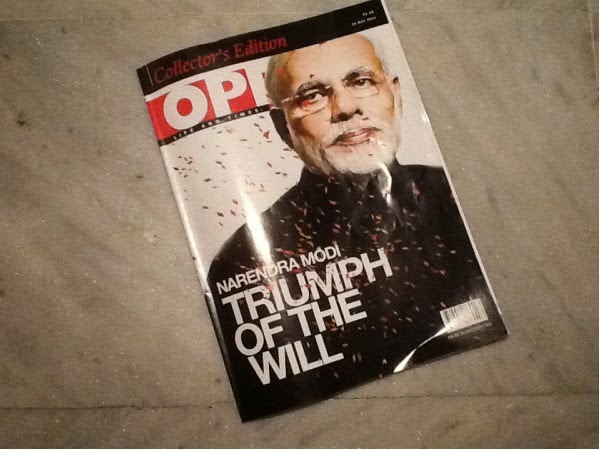
What is there to say about Modi that isn't widely known by now? The man is arguably a fascist. He doesn't run a fascist regime, nor lead a fascist party. He has not overthrown parliamentary democracy. But he is a longstanding member of the Rashtriya Swayamsevak Sangh (RSS), which Chetan Bhatt describes as:
"a secretive, militaristic, masculine cult; a distinct Indian form of fascism that was directly inspired by Italian Fascist youth movements ... Its founders greatly admired Hitler and Mussolini".And he is most certainly, which seems like a tautology, a racist murderer. Modi has direct, hands-on expertise in organising the communal massacre of Muslims. This massacre was characterised not just by slaughter but by the most gruesome sexual violence, undertaken by the parties of the Hindu Right with - according to dozens of independent reports - the collusion of the state of Gujarat and its chief minister, Modi. And the 2002 pogroms don't exhaust the grim reality of Modi's period in charge of Gujarat. As soon as the Hindu nationalist BJP took control of the state of Gujarat in 1998, they embarked on a systematic attempt to purge the state apparatus of Muslims - particularly its repressive apparatuses - and to marginalise and exclude them as far as possible. And the iron fist doesn't stop at bashing Muslims. Bhatt writes:
Modi has treated legal and democratic institutions in Gujarat with contempt. He has acted with tenacious vindictiveness against journalists, human rights activists and police officers who have crossed him. Modi’s choice of close aides— Maya Kodnani, Amit Shah, among others— are not examples of poor political judgment but egregious moral failures that are visible internationally. There remain the unsolved murders of BJP MLA Haren Pandya and environmental activist Amit Jethwa. With Modi in power, which investigations are likely to be sabotaged? Which human rights activists and lawyers are going to be targeted further?
In addition to attacks on minorities, we see an emboldened Hindutva assault on other basic freedoms and liberties in civil society that are a source of international concern— from the policing of women and romantic love on streets and campuses by self-appointed Hindutva mutaween to the attacks on university curricula, the pulping of books, and attacks on artists, filmmakers, journalists and writers.
So, let's say it. "The world's largest democracy" has elected a fascist. He took it with a 14% swing in favour of the BJP, giving him a 12% lead over the Congress candidate. The National Democratic alliance, of which the BJP is the leading coalition partner, now totally dominates parliament.
There is no mystery about how this happened. The Congress party was running on empty, corrupt, presiding over a steep rise in inequality. The Left was complicit in this - particularly the Left Front in West Bengal, which has been imposing neoliberal accumulation-by-dispossession in a brutal way, lost badly in the recent elections.
And Modi, who has already spent years building his own base and leaving no doubt as to his Hindu nationalist credentials, reached a broader audience by deploying some fairly classic populist interpellations on the theme of Congress corruption. He attacked the traditionally dominant party of Indian capitalism as a party of corrupt elites that was responsible for the injustices and inequalities visited on the country's poorest. He said that this corruption was holding back Indian development. If the country's capitalist base could be expanded and deepened without being beholden to Congress and its cronies, the people would prosper. And although Modi's BJP machine is every bit as tightly imbricated with favoured businesses as the Congress machine, this worked.
Of course, Modi organises his support base around a fanatical personality cult - during the recent elections, he 'appeared' in dozens of towns and villages by projecting a 3d hologram of himself. This isn't because he has personal charisma but because he effectively markets himself as a hard bastard who can 'get things done'. This ideologeme of the 'Gujarat model' of capitalist development, which is entirely bullshit and hype as far as any claim to commanding growth goes, is very much linked to his reputation as a hard man. For example, the boss of India's biggest business conglomerate, the Tata group, reports glowingly on how Modi facilitated the transfer of a car plant to the state of Gujarat within days. He gives the impression of being a technocrat able to suppress and transcend the quarrelsome arguments and grasping hands of the parliamentary political machine, in order to 'get things done'. So much the worse for troublesome minorities if he has to be a bit rough with them in the process.
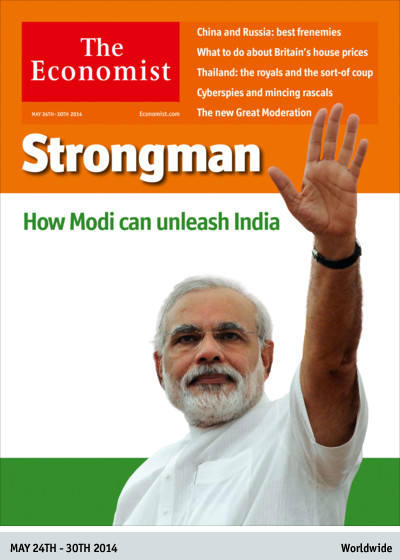
And that seems to be why much of the business press admires him. So what if the reasons they so admire him are inextricable from the reasons for his hitherto pariahdom? This is the bourgeoisie we're talking about: they aren't known for being sentimental about mass murder. That is why the rush to normalise and redeem him is on. Mark The Economist ganting for Modi's open door to capital. 'He's a strongman, he'll knock some heads together, he'll get the country open for business again.' Hark at Fareed Zakaria gushing about India's "inspiring" election, creaming his pants for the alliance with American business. Look at American politicians enthusing about his 'economic reforms'. Witness Obama signalling the end of Modi's global pariah status by inviting him to the US despite the visa ban.
This is not an accident. There is a generalised tilt toward authoritarianism in the neoliberal era, which is based on an attempt to rescue capitalist state authority from the overload of demands that postwar democracy was placing upon it and allow it to pursue optimal neoliberal accumulation strategies. This is linked to new sources of legitimacy in class democracies (racist, nationalist, ethnic, patriarchal, etc), and punctuated repeatedly by periods of technocratic despotism. So in a period of protracted global crises and stagnation, the elective affinity between business-minded authoritarianism and violent exclusionary ethnic absolutisms is hardly unexpected.
And yet, so brazen about it. So cheerfully contemptuous of the survivors, refugees, advocates, and human rights bodies. So blasé about the mutilated and deceased. These are capitalism's liberal advocates and apologists - this is how they speak in public. They dare to talk openly like this now.
About That Apple-Beats Deal
Yinka Adegoke, writing for Billboard:
When news broke on Thursday May 8 that Apple was in talks to buy Jimmy Iovine and Dr Dre’s Beats Electronics for a shocking $3.2 billion the deal’s closure seemed imminent. In fact Billboard’s sources repeatedly said late that day, the transaction would be announced the following Monday… “Tuesday, latest.”
Well, Monday and Tuesday passed and we were assured the deal would actually be announced early this week. By early this week we were told it would now be announced next week. We, like other outlets, have been reassured the deal is happening…or as close to definitely happening as any source is willing to say given they’re speaking on background.
That they’ve been so wrong thus far makes me disinclined to believe anything Billboard (or The Financial Times, or The Wall Street Journal, or anyone else who reported the deal as imminent back on May 8) reports about it now.
Among the reasons Adegoke cites for the delay:
Apparently, the Apple family near imploded with outrage when that video went up on Facebook of an ‘excited’ Dr. Dre with R&B singer/former Coca Cola pin-up Tyrese. In the video they share, in language perhaps unsuitable for a family blog, how Dre will be hip-hop’s first billionaire and other nice things about Compton. People often forget that despite Apple being this company that makes sexy products, with sexy profit margins, and sexy retail outlets… it is not in fact a very sexy company. It is a conservative company, particularly without the leadership of its guiding light Steve Jobs who would shake things up massively on a daily basis.
Steve Jobs did not “shake things up massively on a daily basis”, and my guess is, he would have been more pissed off than anyone at Apple about Beats’ leaking of the deal to the press. And it seems pretty clear that that’s what happened. It wasn’t Apple that leaked, it was Beats, and their leaking it might have scuttled the deal.
One thing’s for sure: Apple is suffering a crisis of confidence right now and they could do with a pair who help them to “Think Different”.
Anyone who thinks “Apple is suffering a crisis of confidence right now” doesn’t understand Apple at all. No wonder Billboard has botched the story on this acquisition.
On the Future of MetaFilter
Matt Haughey:
Since we’ve never seen a return to our pre-Fall 2012 traffic levels, I have to assume whatever hidden law we broke we’re still breaking, or that Google sees us as a home for comment spam even though we boot every single one we can find though a series of sophisticated methods, and the whole experience has been frustrating to say the least. At this point, I’m at wits end trying to figure out why our high-quality site, featuring good advice from a dedicated community of real people with a best-in-industry 24-hour moderation staff has seen such big decreases.
On the flip side, I’ll accept that MetaFilter is from “two or three Internets ago”, and perhaps this is Google’s way of saying they’re changing with the times and we’re not. I’m ok with that too, but since Google is a giant black box to outsiders, we’ll never really know.
Depressing news.
Update: Says Marco Arment:
Google owns the ad-driven web: their search brings all of your pageviews, and their ads bring all of your income. You’re just along for the ride, hoping to stay in Google’s good graces — an arbitrary, unreliable, undocumented metric that changes constantly. (Google’s only “open” with the trivial, unprofitable parts of their business. Search and ads are closed, proprietary, and opaque in every possible way.)
This is one reason I’ve never tried to monetize pageviews at Daring Fireball. My goal has always been to increase readers — to reach and appeal to people who want to come here to read what I write, on a daily or at least regular basis. I get thousands of referrals every day from Google, but I don’t try to monetize them. My only hope is for a few of them to like what they see and come back.
I think I can keep writing stuff that people want to read. I don’t know how to write stuff that Google’s ever-changing algorithms will return as highly-placed search results, so I’ve never really tried.
Glassholes, Google Web Search, and Google Plus
EV Grieve:
So when the other diner came in wearing Google Glass, management asked her to take them off before dining. She refused, and left the restaurant. […] On April 20, the diner wrote a post about what happened, which apparently angered some of her 3,000-plus Google+ followers.
Around this time the spate of reviews arrived on Google. Feast looked into this, and discovered that all of the one stars are from people who commented on the diner’s original Google+ post. The negative reviews include lines such as: “Ignorant bigots and hateful. Perhaps being illegally discriminate too. The food is irrelevant as the service is less than poor.” The reviewer lives in Phoenix. […]
“When the first thing that comes up when you search Feast in Google is a 3.1, it can really hurt a restaurant like us. Then you have 13 people, which is about half the total reviews, who have never been to our restaurant let alone live in NYC, leave you one-star reviews … it’s malicious and technically a violation of Google’s own terms for leaving reviews,” the Feast manager said. “Again I can understand her leaving the one-star based on her experience, but 12 others with no experience on who we are or what we do is unfair.”
It’s a perfect storm of Google-ism. Glass users are weirdos. They also tend to be users of Google Plus. They vent/lash out on Google Plus when an establishment — even respectfully — asks them not to wear Glass. Google web search shows the establishment’s Google Plus profile as its top search result.
What’s troublesome here isn’t Glass. It’s Google’s favoritism for Google Plus. If Google Plus were an independent company, there’s no way Google web search would give it such prominent placement.
gailsimone: dbvictoria: Gail Simone is on a tear on twitter...


Gail Simone is on a tear on twitter this morning.
I said some stuff.
Read this.
We Don’t Need Your Thought Control
by Tracy R. Walsh
Cass Sunstein shares new evidence – sure to surprise very few teenagers - that high school really is a form of brainwashing. At least in China:
New research, from Davide Cantoni of the University of Munich and several co-authors, shows that recent curricular reforms in China, explicitly designed to transform students’ political views, have mostly worked. The findings offer remarkable evidence about the potential influence of the high school curriculum on what students end up thinking – and they give us some important insights into contemporary China as well.
Cantoni found that a 2001 curriculum change designed to “form in students a correct worldview, a correct view on life, and a correct value system” largely succeeded: Students who had been taught under the new curriculum were more likely to view China as a democracy and were more skeptical of free markets than those who hadn’t. (The curriculum was introduced to different provinces at different times, creating natural experimental and control groups.)
What Better Place Than Here, What Better Time Than Now
I was in an Ikea last weekend, when their background music system started playing Rage Against The Machine.
I was actually paralyzed for a moment. I found myself looking around, thinking “Am… Am I just old? Is this old-person music now? Or is it finally time? Here? Why here, now?” I felt, briefly, like I was revisiting a scene from They Live, entirely in my own head. Am I the only person who can hear this? Doesn’t anyone else know what comes next?
I took a minute to look around; I expected to see at least one other person trying to decide whether or not it was time to start flipping stuff over and setting it on fire, but nope. Not a one.
UPDATE: A cölleägüe pöints öut thät there ären’t enough ümläuts in this pöst, which I will äddress directly.
Nostalgia, in 5 Graphs
Tomorrow I’m moving away from the Bay Area, the only post-college home I’ve known. It’s been five years of good ice cream, bad pizza, adorable friends, and monotonously beautiful weather. I’m already nostalgic for Oakland, even as I’m excited for the British adventures that lie ahead (and overwhelmed by the boxes of books that gaze pleadingly up at me, hoping I’ll relocate them).
And what better outlet for nostalgia then graph jokes?
First, the chilling inner life of the non-nostalgic person:
Second, the tragic paradox of the nostalgic soul:
Third, the pack rat:
Fourth, the Buddhist, free of attachments to worldly things:
And finally, me: some messy combination of the above.
To assess your own pack-rat/Buddhist tendencies, feel free to print this post, stick it in a desk drawer, and see how much you want to throw it out after 1, 6, and 12 months.
Narnia: Gods and Lovers
Voyage of the Dawn Treader, Chapter 16: The Very End of the World
I have to admit, I'm a little apprehensive about VoDT ending for us soon, because my plan is to segue into the film adaptations like I usually do, except I'm not entirely sure how that's going to work because there is no way I'll be able to fit the Disney movie into one post, as I have vast and epic feels about it.
And I don't know how long Chapter 16 will last because Lewis had kinda this habit of rushing the final chapters like whoa. (See also LWW which was like "and then they had all these adventures and grown-up things and then the end" in the space of a single paragraph.) So let's take a deep breath and dive in.
REEPICHEEP WAS THE ONLY PERSON ON board besides Drinian and the two Pevensies who had noticed the Sea People. He had dived in at once when he saw the Sea King shaking his spear, for he regarded this as a sort of threat or challenge and wanted to have the matter out there and then. The excitement of discovering that the water was now fresh had distracted his attention, and before he remembered the Sea People again Lucy and Drinian had taken him aside and warned him not to mention what he had seen.
We've already discussed this and won't belabor the issue, but briefly: Reepicheep is a menace to all the things. He doesn't even fit the ridiculously over-enthusiastic chivalry mode anymore since, as I understand it, Chivalry absolutely had a paradigm for everyone making menacing postures in order for all the involved parties to go, yep, you're totes manly, man-guy, without people necessarily killed over the posturing. I don't remember who brought it up--and Disqus isn't cooperating--but I more and more love the stellar idea that Reepicheep is an NPC who was embraced by Peter Pevensie's player a touch too enthusiastically.
And this is probably the last time we'll get to talk about it, but it's never entirely clear to me how Lewis felt about this character. On the one hand, Lewis' love affair with chivalry seems pretty obvious to me, so in some ways this may be the favored character--the one who is allowed to act out all the chivalric impulses that sadly have to be set aside for things like Prudence and Plotting and whatnot. On the other hand, Reepicheep is a Talking Animal and therefore well-established as silly and empty-headed, so it's possible that he's some kind of cautionary tale for going overboard (literally!) with chivalry when Good Christians of course only go to the Caspian level of chivalry.
Maybe Lewis himself didn't know. Maybe Reepicheep became one of those fondly exasperating characters who, as the author, you just end up shaking your head at as they fling themselves at plot obstacles with wild abandon. And... to a certain extent, that's not entirely a bad thing? But we're still left with the problems that Reepicheep is the single representative character of a marginalized population (the Talking Animals) and that his violent, homicidal urges create a lot of unfortunate implications to go along with the underlying theologies in Narnia.
When the guy who makes it to heaven on-page is the guy who tried to slaughter his way there, and the slaughtering-attempts are never really addressed narratively as an immoral (as opposed to silly and inconvenient) thing, then I have side-eye feels at the whole theologies in general. Anyway.
Just before midday Lucy saw a large shoal of fishes grazing on the weed. They were all eating steadily and all moving in the same direction. “Just like a flock of sheep,” thought Lucy. Suddenly she saw a little Sea Girl of about her own age in the middle of them—a quiet, lonely-looking girl with a sort of crook in her hand. [...] Neither could speak to the other and in a moment the Sea Girl dropped astern. But Lucy will never forget her face. It did not look frightened or angry like those of the other Sea People. Lucy had liked that girl and she felt certain the girl had liked her. In that one moment they had somehow become friends. There does not seem to be much chance of their meeting again in that world or any other. But if ever they do they will rush together with their hands held out.
And I... mmph.
Okay. I get that for a lot of us this was a really sweet passage growing up. (And I love what bluecarrot brought up in a previous post, that it was very rip-off in retrospect for this moment to not pay off in Last Battle because that would have been sweet and lovely.)
But.
There's still a lot of problematic implications in this passage that just kinda ruin it for me. We have the Exceptional Person who is a member of her society without being other like them, in this case the Sea Girl isn't scared of the privileged people nor is she angry with them. And of course this willingness to not be sad or angry at the privilege people makes her one of those Good marginalized/other people, the sort that Lucy can identify with.
Once we've established that goodness, then she and Lucy can be friends forever without any of that messy talking or bonding which might, potentially, require Lucy to manage her privilege somewhat (as well as being aware of the privilege of her friends and companions). And this is especially problematic in the context of the characters in this novel having privilege like whoa, that one of the few times we see Queen Lucy making any friends, she does so wordlessly or almost entirely off-screen (see: Aravis, if I recall correctly), which means that Queen Lucy never has to make an on-screen attempt to check her buckets of privilege in order to interact with, for example, someone whose lands she just invaded.
None of this also delves into the fact that these friendly relationships between girls are occurring in a book where girl-friendships are otherwise noticeably absent and often outright antagonistic. Lucy and Susan are not noticeably friendly to each other in the books, and in fact Prince Caspian has that long walk through the woods which is overlaid with a lot of sibling rivalry and generalized unhappiness with one another. And the only girl-friendships we've seen in this book were the ones depicted in the Magician's tower, when Lucy lost a friendship forever and eternity because girls are catty and awful like that. Notably, Lucy does not befriend Ramandu's Daughter (despite them probably having some stuff in common, like Future Queen Of Narnia), and I'm not entirely sure we'll see any girl-friendships in the series from here on out, with the exception of a few brief (and also problematic) interludes with Aravis.
Someone, somewhere, will excuse this as a Write What You Know problem: Lewis never had any girl-girl friendships (on account of not being a girl himself) and therefore didn't want to tackle them. But he does tackle girl friendships, when he wants to give cautionary tales that never quite seem to apply equally to other genders. And even if all this avoidance of girl-friendships was an authorial weakness instead of a misogynistic impulse (and again I remind here that Intent Is Not Magic, etc.), it would have been relatively simple to write a few lines about Lucy befriending Ramandu's Daughter (and maybe learning her name that would have been good too), or hey even having had a few lady-Animals on the boat would have been nice too.
So. Lotta problems all rolled up into this particular girl being the first-and-only friend Lucy makes on this voyage, and their compatibility being wrapped up in the girl not being like those Other members of her community and also the friendship wheels being greased by a total lack of communication beyond a quick soulmates-at-first-glance moment.
“My Lord,” said Caspian to Drinian one day, “what do you see ahead?”
“Sire,” said Drinian, “I see whiteness. All along the horizon from north to south, as far as my eyes can reach.”
“That is what I see too,” said Caspian, “and I cannot imagine what it is.”
“If we were in higher latitudes, your Majesty,” said Drinian, “I would say it was ice. But it can’t be that; not here. All the same, we’d better get men to the oars and hold the ship back against the current. Whatever the stuff is, we don’t want to crash into it at this speed!”
[...] “Blooming lilies, your Majesty,” said Rynelf. “Same as in a pool or in a garden at home.”
“Look!” said Lucy, who was in the stern of the boat. She held up her wet arms full of white petals and broad flat leaves.
“What’s the depth, Rynelf?” asked Drinian.
“That’s the funny thing, Captain,” said Rynelf. “It’s still deep. Three and a half fathoms clear.”
“They can’t be real lilies—not what we call lilies,” said Eustace.
Something something something theologies.
And actually, this part isn't that bad. I guess? There's a lot about how otherworldly it all is and the sea is so bright and the days are longer and it's just white-white-white everywhere and the scent of lilies covers everything but none of it is unpleasant exactly except that it's not exactly nice either and Lucy says, "I feel that I can’t stand much more of this, yet I don’t want it to stop," and I kinda like that line, although not personally in this context.
(For the record, in case anyone cares, though it's not really relevant to the larger post, the line reads a lot to me like newly-in-love feels. And while I am fully aware of the oft-used metaphorical link between religion and love, that's not a metaphor that has personally ever resonated with me. So I like the line and I can see where it's coming from and going, but it doesn't quite work for me here. Not that this is relevant to anything whatsoever. Disregard.)
There came a day when they had to row out of the current and feel their way forward at a snail’s pace, rowing. And soon it was clear that the Dawn Treader could sail no further east. Indeed it was only by very clever handling that they saved her from grounding.
“Lower the boat,” cried Caspian, “and then call the men aft. I must speak to them.”
“What’s he going to do?” whispered Eustace to Edmund. “There’s a queer look in his eyes.”
“I think we probably all look the same,” said Edmund.
This is really the point where Beverly Crusher is supposed to sweep out and declare the admiral unfit for duty on account of being under the influence of weird sea water, but the designated Narnian theocracy doesn't really allow for human intervention against a king--we'll have to leave that to Aslan. More on that in a bit.
(Also please savor that it was Edmund who was not worried about a "queer look" in the eyes after having eaten magical food. I don't even with consistency in this series.)
“Friends,” said Caspian, “we have now fulfilled the quest on which you embarked. The seven lords are all accounted for and as Sir Reepicheep has sworn never to return, when you reach Ramandu’s Land you will doubtless find the Lords Revilian and Argoz and Mavramorn awake. To you, my Lord Drinian, I entrust this ship, bidding you sail to Narnia with all the speed you may, and above all not to land on the Island of Deathwater. And instruct my regent, the Dwarf Trumpkin, to give to all these, my shipmates, the rewards I promised them. They have been earned well. And if I come not again it is my will that the Regent, and Master Cornelius, and Trufflehunter the Badger, and the Lord Drinian choose a King of Narnia with the consent—”
“But, Sire,” interrupted Drinian, “are you abdicating?”
“I am going with Reepicheep to see the World’s End,” said Caspian.
(God, Caspian is so wall-of-texty.)
And. I mean. It's probably some kind of measure for how much Lewis and I are not on the same page, that of literally every single choice Caspian has made in this book, this is the choice I have the least issue with. Like, if you're going to abandon your recently-wrecked-by-civil-war country in order to sail out on a ridiculously useless and deathly dangerous quest that in no way benefits your land or your subjects, then I kind of guess it doesn't matter if you go all the way to the World's End or just all-the-way-minus-a-couple-days-rowing. I'm not saying this is a good idea, I'm saying that it may be the least bad idea of all the many bad ideas that Caspian comes up with.
Can the Dawn Treader even just stay there for a few days? They're in shallow waters, and they must have some kind of anchor. They are literally consuming the surrounding sea in order to survive, so they're not going to run out of food or water. Jumping ahead, the text says it takes three days to get from Point A to the next Point B, and while I freely grant that the adventurers have no way of knowing that, it just feels so arbitrary to have a schedule now. (Did we not have a schedule when we were lounging about on Dragon Island, killing sheep and stuff?) It just seems kind of odd to not send out a scouting party composed of more than three children and a mouse who is determined to never return, but that's Aslan for you. HE IS A HELPER.
Which, really, that is the stupid part of Caspian's plan. Not the "I'm going on ahead, I'll be back" part, but the "I'm going on ahead, you guys leave immediately, I'll come back in a tiny row boat". That part is not well-thought out, I grant you that. But, you know. Caspian.
“Caspian,” said Edmund suddenly and sternly, “you can’t do this.”
[...] “Can’t?” said Caspian sharply, looking for a moment not unlike his uncle Miraz.
“Begging your Majesty’s pardon,” said Rynelf from the deck below, “but if one of us did the same it would be called deserting.”
“You presume too much on your long service, Rynelf,” said Caspian.
“No, Sire! He’s perfectly right,” said Drinian.
“By the Mane of Aslan,” said Caspian, “I had thought you were all my subjects here, not my schoolmasters.”
“I’m not,” said Edmund, “and I say you can not do this.”
“Can’t again,” said Caspian. “What do you mean?”
And then, ugh. There is all this. I THROW UP MY HANDS AT THIS.
Can I just, like, primal-scream at C.S. Lewis for a minute? I am so done with all this physical manifestation of evil stuff, where you just know someone is bad because their face is wrong or their eyes are glinty or whatever. Because, first? NO.
And second? Caspian has been acting like his Uncle Miraz since this voyage began. The Uncle Miraz Ship sailed around about the time that Caspian was calmly looking on while men in full armor under his command were bludgeoning elderly gatekeepers for not being sufficiently obedient to the king they'd never met before. The Uncle Miraz Ship was circumnavigating the globe around about the time they were discussing leaving dragon!Eustace behind (rather than hauling him back to Narnia whatever damn way they could manage) and was returning to port laden with spices while Caspian was kicking through the ashes of a ruined village looking for loot.
You do not, do not, get to have a main character who does everything that Caspian does and then invoke the Uncle Miraz card the moment he gets stubborn about not wanting to follow the authorial plans.
“If it please your Majesty, we mean shall not,” said Reepicheep with a very low bow. “You are the King of Narnia. You break faith with all your subjects, and especially with Trumpkin, if you do not return. You shall not please yourself with adventures as if you were a private person. And if your Majesty will not hear reason it will be the truest loyalty of every man on board to follow me in disarming and binding you till you come to your senses.”
“Quite right,” said Edmund. “Like they did with Ulysses when he wanted to go near the Sirens.”
Caspian’s hand had gone to his sword hilt, when Lucy said, “And you’ve almost promised Ramandu’s daughter to go back.”
Caspian paused. “Well, yes. There is that,” he said.
And then there's this. What can I even do with this?
"You shall not please yourself with adventures as if you were a private person." Yes. WE KNOW. Welcome to the point that everyone in the audience has been making since Lucy and Edmund and Eustace were all hauled out of the ocean and given the tour. It is an insult to my intellect, actually, to expect me to believe that everything up until now has been For The Good Of Narnia, but if Caspian takes six more days (round trip and back) to glance at the end of the world and return, then those are Private Person Adventures.
(Please take a moment to insert all the juvenile snickering you might need.)
“Well, have your way. The quest is ended. We all return. Get the boat up again.”
“Sire,” said Reepicheep, “we do not all return. I, as I explained before—”
“Silence!” thundered Caspian. “I’ve been lessoned but I’ll not be baited. Will no one silence that Mouse?”
And yada, yada, Caspian is struggling with personal demons right now and is totes Uncle Miraz etc., except that I'm not entirely sure I agree with the implication that a king who doesn't want to let his friend sail off into the sunset fully intending to never return is therefore a Bad Guy. I mean, I guess? I'm actually pretty pro-Letting Reepicheep Make His Own Life Choices, and if that means sailing over the edge of the world, I reckon that's his right? It's just... amusing to me that obviously this is Caspian being in a childish sulk as opposed to Caspian being kinda not on-board with never seeing Reepicheep again.
But when the others rejoined him a little later they found him changed; he was white and there were tears in his eyes.
“It’s no good,” he said. “I might as well have behaved decently for all the good I did with my temper and swagger. Aslan has spoken to me. [...] It was terrible—his eyes. Not that he was at all rough with me—only a bit stern at first. But it was terrible all the same. And he said—he said—oh, I can’t bear it. The worst thing he could have said. You’re to go on—Reep and Edmund, and Lucy, and Eustace; and I’m to go back. Alone. And at once. And what is the good of anything?”
“Caspian, dear,” said Lucy. “You knew we’d have to go back to our own world sooner or later.”
“Yes,” said Caspian with a sob, “but this is sooner.”
“You’ll feel better when you get back to Ramandu’s Island,” said Lucy.
He cheered up a little later on, but it was a grievous parting on both sides and I will not dwell on it.
I have this sort of sneaking feeling--and I realize this is a Your Mileage May Vary moment--but if your god or your boyfriend or whatever the case may be, if someone you love only really ever interacts with you in ways that are terrible, frightening, menacing, and/or leave you crying and sad, then maybe that relationship is not a healthy one for you. Or it wouldn't be for me, I'll put it that way.
I know that these books do establish good parts of Aslan, too; the awe and wonderment and mane-huggles and whatnot. But they're so few and far between (in my opinion) all the fear and terror and crying bits. And there's so little, so horribly little, of quieter moments with Aslan. The times that are neither crying with fear nor crying with joy, but rather just cuddling up with him for the warm comfort that is all the warmer and more comforting because you know you don't have to savor it up. It'll be there tomorrow and the next day and the next day and the next.
So much of Aslan, as written on the page, reminds me of one of those tempestuous lovers that I could never have any fondness for in books, movies, real life, etc. The ones where they stir every emotion inside you, fully and deeply and passionately yada yada, and it's vibrant and exciting and so forth, but there's always that overlaid fear that you need to treasure this moment right here right now because it may never happen again and he may be gone for good tomorrow. And okay maybe Aslan isn't the kind of lover to dump Lucy and Edmund, but are they going to see him with their eyes and feel his mane with their hands between VoDT and their eventual death? I know Lewis would probably be all mmph mmph mmph theologies and feelings but it's not the same for me. Maybe it's the same for them, but it wouldn't have been for me.
I never liked those kinds of lovers, because I can't be happy feeling like this good moment in time is my last good moment in time. Instead, I've always preferred the non-stormy, non-tempestuous lovers who act like your shared long-term happiness is a priority for them beyond just the immediate and short-term. The kind of relationships, to quote Jane Austen, that bring "that sanguine expectation of happiness which is happiness itself"--or, to put another way, the quiet belief that things will continue to be good. I guess Lewis would call those lovers "tame" lions. But I also fail to understand what would be wrong with preferring them to wild ones, if there were your thing. And I'm not quite sure why "doesn't make me cry all the time" is a bad criteria to have for gods or lovers.
Chilean activist destroys student debt papers worth $500m
“You don’t have to pay another peso [of your student loan debt]. We have to lose our fear, our fear of being thought of as criminals because we’re poor. I am just like you, living a s**tty life, and I live it day by day — this is my act of love for you.”
The War on Workers’ Rights
I have an oped in the New York Times on the Republican war on workers’ rights at the state level. My conclusion:
The overall thrust of this state legislation is to create workers who are docile and employers who are empowered. That may be why Republican legislators in Idaho, Wisconsin, Michigan, Maine, Ohio, Minnesota, Utah and Missouri have been so eager to ease restrictions on when and how much children can work. High schoolers should learn workplace virtues, says the conservative commentator Ben Stein, like “not talking back.” Early exposure to employment will teach 12-year-olds, as the spokesman of an Idaho school district put it, that “you have to do what you’re asked, what your supervisor is telling you.”
And if workers don’t learn that lesson in junior high, recent Republican changes to state unemployment codes will ensure that they learn it as adults. In 2011, Florida stipulated that any employee fired for “deliberate violation or disregard of the reasonable standards of behavior which the employer expects” would be ineligible for unemployment benefits. Arkansas passed a similar amendment (“violation of any behavioral policies of the employer”). The following year so did South Carolina (“deliberate violations or disregard of standards of behavior which the employer has the right to expect”) and Tennessee. The upshot of these changes is that any employee breaking the rules of her employer — be they posting comments about work on Facebook, dating a co-worker or an employee from a rival firm, going to the bathroom without permission — can be fired and denied unemployment. Faced with that double penalty, any worker might think twice about crossing her boss.
What might Adam Smith, often claimed as the intellectual godfather of the American right, have said about these legislative efforts? “Whenever the legislature attempts to regulate the differences between masters and their workmen,” wrote Smith in “The Wealth of Nations,” “its counsellors are always the masters. When the regulation, therefore, is in favour of the workmen, it is always just and equitable; but it is sometimes otherwise when in favour of the masters.”
Indeed.
The oped is based on Gordon Lafer’s eye-opening report last fall for the Economic Policy Institute, “The Legislative Attack on American Wages and Labor Standards, 2011-2012,” which you should also read.
assbutt-in-the-garrison: shiphassailed: tigerpellets: I NEVER KNEW THIS I NEVER KNEW THAT WAS...
I NEVER KNEW THIS
I NEVER KNEW THAT WAS WHAT AMERICANS MEANT WHEN THEY SAID “QUITE”
WHY DIDN’T ANYBODY TELL ME
SUDDENLY THAT ONE SONG THAT GOES “HELLO I MISS YOU QUITE TERRIBLY” MAKES LIKE A MILLION TIMES MORE SENSE
are you serious british people
i feel like this means i’ve been overestimating your enthusiasm about things for my entire life
this is quite eye opening
I spend a lot of time around academics from the US and UK, and this distinction has actually been a major topic of conversation at various times, because of how it impacts on their shared perception of colleagues’ work. As in, Americans will say X academic is “quite good”, meaning s/he is awesome and deserves a job/publications/talk invites, but a British person will usually assume they mean the opposite - that this is someone they don’t need to bother with - and vice versa, And every time this has been explained to a particular group, everyone has basically gone, oh SHIT.
Meanwhile, we Australians sit back and point out that we don’t really use “quite” in either sense (though when we do, it’s the UK version): instead, if we say someone is “pretty good”, we mean they’re fucking brilliant, but if we say they’re “all right”, we mean “yeah, not really”.