Shared posts

01 Aug 18:11

Tweets Of The Day

by Andrew Sullivan

Here’s one from the AP at 6 am, July 29:

As much of world watches Gaza war in horror, members of Congress fall over each other to support Israel: http://t.co/DepO2etLQS — The Associated Press (@AP) July 29, 2014

Five hours later:

Many U.S. lawmakers strongly back Israel in Gaza war (revises wording in this @AP tweet: http://t.co/RZs5dh0m2L ): http://t.co/OvBKx75U6Z — The Associated Press (@AP) July 29, 2014

Jay Rosen sighs:

The original header produced the news well enough but it failed to produce enough innocence for the AP. “Many U.S. lawmakers strongly back Israel…” is not more true than “they fall over themselves.” But it is more innocent. When the switch is made the AP feed suffers a loss of vivid. Its colors wilt. There is less voice, less urgency in the language. And the AP willingly pays this cost.

And the contrast between the entire world, including the US public, and the Congress is indeed a startling one. There are countless debates going on about the Gaza war in America and around the world – on the web, across dinner tables, in schools and colleges, on vacations, in offices and even on Fox News. Everywhere, in fact, but in one place: the Congress, where, in a polity divided bitterly down the middle on almost everything, there is unanimity that Israel can never do any wrong, and that the US must support Israel under every conceivable circumstance. They cannot manage to extend unemployment benefits, they cannot pass basic infrastructure spending, they cannot deal with a refugee crisis on the border, but by unanimous consent, they agree to increase funding for Israel’s Iron Dome. They seem far more solicitous of the needs of a foreign country than of their own. And when the greatest deliberative body on the face of the earth is less open to debate than the world’s top boy band, something is wrong with our democracy.

Pointing this out is not bias; it’s essential. It’s essential because it reveals a deep rot in our deeply unrepresentative government, distorted in this as in many other instances, by the toxic, undemocratic influence of a moneyed lobby.

01 Aug 01:34

The Bizarre Bazaar: Who Owns Express.js?

by Giles Bowkett

A GitHub Drama


After abandoning Node.js for Go, TJ Holowaychuk apparently made his separation official by selling off the branding and official GitHub "ownership" of his Express framework to StrongLoop, a Node.js company whose projects include software services, consulting services, support, and free software. (StrongLoop's CEO, by the way, is no stranger to the concept of businesses based on free software, having previously sold his startup Makara to Red Hat and developed Red Hat's OpenShift product - Red Hat being the company which pioneered open source business models.)

As an aside, I'm often disturbed by how many things GitHub is these days.

.@GitHub is awesome, of course, but it's also so obviously a vim which labors under the deranged misapprehension of being a Facebook.

— タチコマ (@gilesgoatboy) July 28, 2014

The latest Node.js drama undermines my tweeted theory, because much of the drama unfolds on GitHub. So maybe GitHub's a Twitter which used to be an emacs?

Anyway, here's the history. If my retelling fails at fairness, apologies to all involved.

First, StrongLoop announced the sponsorship on its blog. A major Express contributor immediately filed an issue on GitHub: "This repo needs to belong in the expressjs org." The discussion that unfolded there is interesting (although currently locked), but here's a summary: Holowaychuk transferred ownership to StrongLoop without either asking or informing the Express community beforehand. StrongLoop's been committed to Node.js for a good while now, and hopes to support Express with documentation and continued development. However, the Express community may have taken over for Holowaychuk some time ago, so there's some contention over whether or not the "ownership" of the project was legitimately his to transfer in the first place.

An angry blog post argues that it was not:

When TJ Holowaychuk lost interest in maintaining Express, he did the right thing (for a change) by letting others take over and keep it going. In open source, that meant the project was no longer his, even if it was located under his GitHub account – a common practice when other people take over a project.

Keeping a project under its original URL is a nice way to maintain continuity and give credit to the original author. It does not give that person the right to take control back without permission, especially not for the sole purpose of selling it to someone else...

What makes this particular move worse, is the fact that ownership was transferred to a company that directly monetizes Express by selling both professional services and products built on top of it. It gives StrongLoop an unfair advantage over other companies providing node services by putting them in control of a key community asset. It creates a potential conflict of interest between promoting Express vs. their commercial framework LoopBack (which is built on top of Express).

This move only benefits StrongLoop and TJ Holowaychuk, and disadvantages the people who matter the most – the project active maintainers and its community.


Holowaychuk responded with a blog post of its own, pointing out that he had communicated with Doug Wilson of the Express community, asking Wilson if he'd like some of the proceeds of the deal:

My intent was to share said compensation with Douglas since he has been the primary maintainer on Express lately. I signalled that intent by emailing him...

I don't want to wade into the drama here, which is why I've made an effort here to be dispassionate and objective. I'm totally happy to let that shake out however it shakes out. But I have to admit that I think there's a really interesting question at the heart of all this: who owned the Express web framework? Was it really Holowaychuk's to sell?

I find this question interesting because it reminds me of a totally wrong theory I cooked up recently: that being free is what ruined the Ruby web framework Rails.

Totally Wrong Theory: Being Free Ruined Rails


I've previously argued that the Rails/Merb merge was a mistake, and that Rails went off the rails. I came up with my new, totally wrong theory when I was trying to figure out how the Rails/Merb merge happened in the first place.

Before I get into it, I want to point out that one of the major flaws in my theory here is that Rails isn't actually ruined. As I said, the theory is a totally wrong theory (and being totally wrong is obviously another one of its flaws). But I want to explore the idea to illustrate some of the flaws in the purist, old-school definitions of open source software. Because I don't think that theory is correct, either.

That theory comes from Eric Raymond's The Cathedral and the Bazaar, which provides a great statement of the classic concept of what open source is, and what open source means. This essay, and the book it later became, first articulated the idea that "with enough eyeballs, all bugs are shallow," and laid out 19 rules of open source development. For example, "the next best thing to having good ideas is recognizing good ideas from your users. Sometimes the latter is better." Or, "release early. Release often. And listen to your customers."

The Cathedral represents a software development model where developers build code in private and release it in public. The Bazaar represents a model where all development occurs in public. Raymond argues for the Bazaar in favor of the Cathedral. I don't know how development worked in Express, or how it will proceed now, but Rails uses a hybrid model, where the majority of development occurs in public, yet certain decisions happen in private.

Many other projects use this model as well. (Obviously, in the case of Express, the decision to sell sponsorship occurred in private.)

The Rails/Merb merge is one example of a major decision which occurred in private. There was no public debate, just a sudden announcement, with a big thank you to the Merb team for all the free help that would get Rails 2 to Rails 3. But free help isn't always free.

37Signals (now Basecamp) have long advocated turning down unnecessary feature requests, and Rails creator David Heinemeier Hansson took the idea to absurd lengths with his description of Rails as an "omakase" framework. But one explanation for the Rails/Merb merge is that EngineYard said "we'll pay for Rails 3 to happen, as long as Rails 3 is also Merb 2," and members of Rails core forgot their own advice about turning down unnecessary feature requests because, for once, the unnecessary feature requests came along with the offer of (unnecessary) free work.

To be clear, the feature requests, and the free work to support them, were unnecessary in my opinion, but not in the opinion of the people who made the merge happen. I'm going to make an attempt to be objective regarding Express, but when it comes to Rails, that train has already sailed. It's my belief that the Rails/Merb merge brought Rails an incomplete but ambitious modularity it didn't actually need, and that there's an inherent irony here, because Mr. Hansson vigorously and scornfully opposed adding a different kind of modularity to Rails apps: stuff like moving business logic out of Rails models and into simple Ruby objects, moving application logic out of Rails entirely and treating it as a library instead of a framework, and wrapping Rails's ActionMailer system in simpler API calls like Email.send.

Good Modularity and Bad Modularity


The general theme: how to unfuck a monorail. Many Rails developers wrestle with this theme, but Mr. Hansson seems (in my opinion) to dismiss it categorically and without any significant consideration. (Indeed, so many Rails developers wrestle with this issue that I think it's fair to call it a crucial moment in the lifecycle of most Rails apps.)

Some of these things are a lot easier to do because of the Rails/Merb merge, yet it's interesting to contrast Mr. Hansson's hostility to these ideas with his embrace of the merge. On the one hand, we saw claims of a powerful modularity that either failed to materialize or which proved useful to only a few people.


On the flip side, Rails's creator seemed pretty contemptuous of people who created simpler, more practical forms of modularization to suit the needs of their individual applications. It's a fascinating contradiction, from the developer who once lambasted "architecture astronauts," to attack pragmatic modularization with very immediate causes, while championing an abstract modularity with less obvious usefulness.

I think this was an error in judgement, and I think it happened because the work seemingly came for free. Because why else would a team famous for ignoring feature requests happily embrace an incredibly ambitious set of feature requests?

Managing open source frameworks takes time. Writing code takes time; discussing pull requests takes time; and running a private chat room for your "open source" project takes time.

To unpack that last statement, gaining access to the private Rails core Campfire is a key step in becoming a member of Rails core:

Yehuda gave me access to control the LightHouse tickets and to the Rails CampFire...The fact that I was invited to be a part of the Rails Core Team really surprised me. It was unexpected until I read Yehuda in CampFire saying that the guys with commit access should join the core team after the release of Rails 3 and David was OK with that.

Here's where Rails operates as a hybrid between the Cathedral and the Bazaar. Its core team's private Campfire chat functions as a Cathedral, but its GitHub activity functions as a Bazaar.

The Bizarre Bazaar


The Cathedral and the Bazaar argues that the Bazaar is superior because no one person is smarter than a community of smart people, and because nobody can craft a One True Design™ which is better suited to a problem space than the design which will emerge if you allow lots of people to work on the problem.

This is obviously very different from the "omakase" philosophy of Rails. And there are benefits to that philosophy. When Rails first came on the scene, it seemed like an Apple product - impeccably designed, shaped by the kind of singular focus no community could ever achieve. No community would ever decide in aggregate to shape a project around REST in 2006, or to unilaterally replace JavaScript with CoffeeScript. Communities typically suck at boldness, as well as beautiful user experience, and one of Rails's greatest innovations was treating the developer's user experience as one of the most important aspects of its design.

Yet the "omakase" philosophy also created a community which operates on the foundation of an unspoken shared disregard for the community's alleged leadership. The sign of an experienced Rails developer is a weird duality; a skilled Rails dev knows the recommendations of Rails core, and ignores or contradicts most of them. As Steve Klabnik said, Rails really has two default stacks, the "omakase" stack and the "Prime" stack, which could also be described as the official stack and the stack which is the default for everybody except 37Signals and utter newbies. There is something just deeply, dementedly messed-up about a community where following best practices, or believing that the documentation is correct, are both sure signs of cluelessness.

Rails is not the only open source project to feature this half-Cathedral, half-Bazaar hybrid. (You could call it a bizarre Bazaar.) Ember works in a similar way, and Cognitect's transit-ruby project features the following disclaimer in their README:

This library is open source, developed internally by Cognitect. We welcome discussions of potential problems and enhancement suggestions on the transit-format mailing list. Issues can be filed using GitHub issues for this project. Because transit is incorporated into products and client projects, we prefer to do development internally and are not accepting pull requests or patches.

(This disclaimer, of course, did not prevent people from filing pull requests anyway, one of which was unofficially accepted.)

Sidekiq & Sidekiq Pro


I believe 37Signals and EngineYard both have funded some of Rails's development, and that they're far from alone in this. I know ENTP did the same when I worked for them, and I believe that's also true of Thoughtbot, Platformatec, several other companies, and of course a staggering number of independent individuals. I'm certain Twitter directly funded some of the work on Apache Mesos, and that Google indirectly funded it as well by contributing to Berkeley's AMP Lab, where Mesos originated. While "open source" was the opposite of corporate development when the idea first swept the world, today most successful open source projects have seen a company, or several companies, pay somebody to work on the project, even though the project then gives the work away for free.

It's an amazing evolution in the economics of software, and something I think everybody should be grateful for.

However, I know of an alternate model, and I have to wonder how Rails might have handled the Merb merge differently, if it had been using this model instead. This is the Sidekiq and Sidekiq Pro model.

In his blog post How to Make $100K in OSS by Working Hard, Mike Perham wrote:

My Sidekiq project isn’t just about building the best background processing framework for Ruby, it’s also a venue for me to experiment with ways to make open source software financially sustainable for the developers who work on it hundreds of hours each year (e.g. me)...

When Sidekiq was first released in Feb 2012, I offered a commercial license for $50. Don’t like Sidekiq’s standard LGPL license? Upgrade to a commercial license. In nine months of selling commercial licenses, I sold 33 for $1,650...

In October last year I announced a big change: I would sell additional functionality in the form of an add-on Rubygem. Sidekiq Pro would cost $500 per company and add several complex but useful features not in the Sidekiq gem...

In the last year selling Sidekiq Pro, I sold about 140 copies for $70,000. Assuming I’ve spent 700 hours on Sidekiq so far, that’s $100/hr. Success! Sales have actually notched up as Sidekiq has become more popular and pervasive: my current sales rate appears to be about $100,000/yr.


If I recall correctly, when he wrote this blog post, Perham was also working full-time as Director of Infrastructure at an ecommerce startup. His blog now lists his job as Founder and CEO of Contributed Systems, whose first product family consists of Sidekiq and Sidekiq Pro. Perham seems to have discovered a really effective model for funding open source software.

What if Rails had used this model? I like to think there's an alternate universe where this happened; where 37Signals gave away Rails for free, and charged a licensing fee for an expanded, more powerful version called Rails Pro.

Rails & Rails Pro


I like to imagine that in this alternate universe, when people wrestled with the paralyzing monorail stage of the Rails app lifecycle, Mr. Hansson and the other members of the Rails core team would have had no choice but to listen to their users, because their business depended on it. I also like to imagine that in this alternate universe, a Merb merge would not have been possible. The financial incentives to think carefully before accepting feature requests, even when they arrive in the form of code, would have been stronger.

Keep in mind that when you send a pull request you're saying, "I wrote some code. I think you should maintain it."

— Nicholas C. Zakas (@slicknet) May 29, 2014

But this business model raises a whole bunch of questions, because so many people and companies contributed so much time and effort to make Rails in the first place. Would they have done the same, in this alternate universe? It's one thing when you're contributing to a project "everybody" owns, and another when you're contributing to somebody else's business. (Sidekiq certainly sees a lot of contributions, but Perham does most of the work, and I can't currently peek at the contrib graph for Sidekiq Pro.)

And consider: What happens if Mike Perham wants to sell Sidekiq and Sidekiq Pro? For that matter, what happens if 37Signals wants to sell their interest in Rails? And what if Express had been using this business model? Can you hand off your semi-open-source, semi-commercial project for somebody else to run?

From the "About Us" section on the home page for Mike Perham's company Contributed Systems:

We believe that open source software is the right way to build systems; building products on top of an open source core means the software will be maintained and supported for years to come.

Contributed Systems is a play on the computer science term "distributed systems" and the fact that we allow anyone to contribute to our software.


Sidekiq's popular for a reason: it's really good. And if Sidekiq Pro accepts contributions just like Sidekiq does, then it's neither really open source nor closed source, but more like "gated community source." (Because it's a Ruby gem, so my guess is that it is open source for those who have access to it, but you have to pay to get that access in the first place.)

There's an enormous mess of contradictions here. Software development is basically the only industry making money right now in the entire United States. And yet its foundation is this basically communist idea that everybody will contribute to the greater good. The idea that you can sell sponsorship and/or ownership of a project, as with TJ Holowaychuk and StrongLoop, really exposes these contradictions.

Law Is Hard, Let's Go Hacking


Perham's "gated community" model might be the best approach. Most open source licenses prefer to avoid these issues by entirely disavowing any and all responsibility. It's simpler, but I doubt it's as sustainable. Here's the MIT Public License:

Permission is hereby granted, free of charge, to any person obtaining a copy of this software and associated documentation files (the "Software"), to deal in the Software without restriction, including without limitation the rights to use, copy, modify, merge, publish, distribute, sublicense, and/or sell copies of the Software, and to permit persons to whom the Software is furnished to do so, subject to the following conditions:

The above copyright notice and this permission notice shall be included in all copies or substantial portions of the Software.

THE SOFTWARE IS PROVIDED "AS IS", WITHOUT WARRANTY OF ANY KIND, EXPRESS OR IMPLIED, INCLUDING BUT NOT LIMITED TO THE WARRANTIES OF MERCHANTABILITY, FITNESS FOR A PARTICULAR PURPOSE AND NONINFRINGEMENT. IN NO EVENT SHALL THE AUTHORS OR COPYRIGHT HOLDERS BE LIABLE FOR ANY CLAIM, DAMAGES OR OTHER LIABILITY, WHETHER IN AN ACTION OF CONTRACT, TORT OR OTHERWISE, ARISING FROM, OUT OF OR IN CONNECTION WITH THE SOFTWARE OR THE USE OR OTHER DEALINGS IN THE SOFTWARE.


Translation: "no money changes hands, and you can do anything you want as long as you acknowledge authorship, but we take no responsibility at all for anything which happens, so don't ask us for shit."

I am not a lawyer. If you're a lawyer reading this, I have a question for you: would disavowing any and all warranties still even be possible under the law if money had changed hands?

In a similar vein, I don't think any true Bazaar exists, in the sense of Eric Raymond's metaphor, because it's customary in open source projects to yield final decision-making power to whoever started the project, and to refer to that person as the project's Benevolent Dictator for Life. (If Holowaychuk had any real right to sell Express, this might be where it came from.) That one individual person's final decision-making process is inherently closed, and could only be truly open if we all developed the power of telepathy. I think this "BDFL" custom exists because it's much easier to skirt the issue of the contributors' social contract than it is to define anything more specific.

(Pirate Party founder Rick Falkvinge talks about this extensively in his book Swarmwise, which is essentially about how to use the development model of open source software for political purposes instead. He makes the point that adding a formal voting process to a chaotic, ad hoc organization is most likely to alienate the people who would otherwise become the organization's most productive members, because highly productive contributors are not typically fans of overly bureaucratic process.)

Communist Capitalism or Capitalist Communism?


The open source movement dates back as far as the late 1970s, although at that time it was known as the free software movement, and that is actually a different thing. Whereas the free software movement saw software transparency as a requirement for a free society, open source seeks to fit the superior utility of open development practices into a business framework.

The "open source" label was created at a strategy session held on February 3rd, 1998 in Palo Alto, California, shortly after the announcement of the release of the Netscape source code. The strategy session grew from a realization that the attention around the Netscape announcement had created an opportunity to educate and advocate for the superiority of an open development process...

The conferees also believed that it would be useful to have a single label that identified this approach and distinguished it from the philosophically- and politically-focused label "free software."


Open source projects very often use a communist methodology for capitalist purposes. There are times when this duality is tremendously entertaining; for instance, any time a Linux sysdamin tells you "Communism doesn't work," you get a free joke. Likewise, you get a free joke any time somebody tells you that Linux proves all software should be open source, and the joke is the user interface for Blender, an open source 3D graphics and animation package with notoriously incompetent UX. I think it's extremely likely that the only way to produce good software is to balance capitalist interests against a communist methodology, and if I'm correct about that, it would certainly qualify as one of the many reasons software is inherently hard to get right. The inherent tension between these two forces is tremendous. The drama around Express's transfer of ownership springs from that.

I'd love to give you a pat answer to the question of who owns Express.js, but I think it's a big question.


Update: Mike Perham wrote me to say that his customers can contribute to Sidekiq Pro, and that 5-10 customers have, although he has to own the copyright, to keep the publishing/licensing issues from being insane.
31 Jul 18:19

One cop in Seattle issues 80% of city's marijuana tickets

by Mark Frauenfelder

An internal investigation revealed that the officer "flipped a coin when contemplating which subject to cite," and that he called Washington's legal marijuana law "silly." Read the rest

31 Jul 00:56

From FB July 30, 2014 at 08:08PM

need to be snapped out a really dark feeling. but i basically dont expect palestine to exist in a decade. this is the messiest stretch of colonization, and then it will be done, and in a decade it will seem all but inevitable that it happened. and maybe the colonizers great great great grand children will feel guilty or weird about it in a century or two when they ride to their liberal arts school on a hoverboard.

30 Jul 18:26

I Must Be Missing Something

by Josh Marshall

If I didn't know better I would almost think the President is goading GOP backbenchers into a race-drenched tyranny-derp freakout perfectly designed to crush the GOP for yet another generation among non-white voters and alienate a lot of white people who aren't part of the GOP base.

30 Jul 16:46

Creating a Culture of No Mistake

by Shambhala Times Editor

Gentle and ToughCOLUMN: Dharma Teaching
Gentle and Tough

guest article by Acharya Noel McLellan

Gentleness is nice and all, but it’s a tough world out there. We can’t always live in a protected world of soft things, kind people, and the sounds of running water. There are harsh realities in this world. Some parents choose to send their children to tough schools for this reason, to acclimate them to the hard side of things.

I’ve heard that in some Inuit societies young children are allowed to handle sharp knives, despite the likelihood of getting cut. The use of knives is such a basic element of everyday life, that learning to handle and respect them early, through experiential education, is the norm.

Without doubt, one way or another individuals need to come to terms with the hard edges of life – the cold winds, the burdens of everyday duties, not having what we want, harsh words, competition, and the sheer aggression that is an aspect of our society. For some, that aggression is an everyday reality, a part of their family or school culture, or a presence on the streets they traverse. How do we educate our children to relate with this part of the world? What sort of culture do we want to develop around the truth of aggression?

We love our children and we want them to flourish, to succeed, and especially to survive. We want to keep them safe, but we don’t want to keep them weak. So what is the best way to teach them to be tough, resilient, and powerful?

In a traditional sense, it is the role of the father lineage to transmit these qualities and introduce the hard world. In our culture, this transmission has become tremendously confused and perverted. The qualities of toughness, fearlessness, and the ability to meet our world with power have been thoroughly mashed together with aggression and egotism.

At the core of our encounter with life is our feeling about ourselves. Generally we experience aggression as something that points toward a negative feeling, the sense that there is something lacking, inadequate, lesser, or unworthy in us. This sense of lack is the seed of aggression within us. Our culture waters this seed in many ways, through competition – the premise that we could prove our worth by succeeding in comparison to others; materialism – the premise that we could be worthy if we had more; and through intimidation – threats of punishment if we don’t accept our lack of power. In the world of children and teens, these forces loom large. They speak through peers, parents, teachers, and media, and result in rage, depression, and apathy.

In order to meet and transform this culture we need to begin from nonaggression, a ground of trust in human beings. As teachers we must develop this trust personally. Trusting ourselves we have no need to convince others by deception. Knowing a trust in ourselves that is basic and true, we can trust our students. This is a deep trust, not a calculating one. It doesn’t ask our students to prove they are worthy of it, that’s the territory of aggression. It holds their entire being, which may be full of doubt, depression, anger, and frivolity, in a great embrace of trust and kindness.

Once the poet and Zen master Ryokan was invited to dinner by the parents of a teenage boy who was developing an angry and rebellious disposition. The parents hoped the priest would impart some words of wisdom to the boy and maybe set him straight. The evening progressed, but the parents were disappointed, as Ryokan said not a word to the lad. As Ryokan prepared to depart, the boy bent to assist the honored guest with his sandals. Tying on a sandal the boy felt a drop of moisture on the back of his neck. Looking up he saw the face of Ryokan gazing down at him, smiling slightly, his eyes wet with tears. After this, though the priest had said nothing to him, the boy’s attitude shifted.

Basic trust is the seed of a different culture, the “culture of no mistake.” This is an environment of basic acceptance and worthiness, in which one need not constantly compensate for an underlying sense of inadequacy. No one has made a fundamental mistake, therefore we can make relative mistakes, we can be who we are, seeing our shortcomings without feeling guilty.

Learning to relate with aggression in an aggressive, fearful environment is like watering seeds with gasoline. Flames may spring up, not likely flowers.

Gentleness does not produce weakness. From the ground of nonaggression we can begin to relate with the sharp edges of our world. With trust in ourselves we can finger a sword’s blade. We can take an insult. We can feel cold rain on our face. We can fuck up and apologize. We can say, “NO,” when we need to. We can compete when we want to, and we can turn competition off when it’s not called for. Knowing the yang, we can keep to the yin.

Everyone needs the culture of no mistake. We should create it for ourselves at least. If we can share it with another, that’s society. Some people’s lives are full of aggression. You may be the only genuine reference point they have.

~~
Acharya Noel McLellanNoel McLellan
is an Acharya in the Shambhala lineage, a mentor for the Ziji Collective, a middle and high-school teacher at the Shambhala School in Halifax, and the father of two small, ferocious beings. His work, rest and play are dedicated to creating good human society.

30 Jul 03:12

Seems Like a Strong Case

by Josh Marshall

Attorneys for two Alabama doctors are seeking to dismiss a lawsuit brought by Johnny Lee Banks Jr. who claims that he entered the hospital for a routine circumcision but emerged from Princeton Baptist Medical Center without a penis. Lawyers for the doctors deny wrongdoing but "declined to answer questions about specifics in the suit, including whether the man had a penis when he left the hospital."

30 Jul 00:37

The only way to guarantee startup success

by Jason

cartoon5310

Everyone said this would be the most embarrassing moment in the band’s eight-year career.

Depeche Mode had decided to play the Pasadena Rose Bowl — capacity 60,000 — for the 101st show of their 1988 tour. To sell out would make it one of the largest music concerts ever played in America — highly unlikely for an English electronic band. Claiming they were popular enough to fill that stadium was an audacious act of bravado that critics were eager to see transform to humiliation as they played to a vast, near-vacant space, mocked by the each of the tens of thousands of empty seats.

KROQ DJ Richard Blade knew that secretly the band themselves were doubtful. As he sat with singer/writer Martin Gore in the empty stadium before tickets went on sale, Martin “confided in me that he was nervous and hoped they could at least sell out the floor seats — just 10,000 tickets.”

But the show sold out, with paid attendance greater than any Rose Bowl event in the eight preceding years. It was the defining moment of the band’s career — the moment when they undeniably “made it.”

And yet, simultaneously, one of the saddest moments.

Again from Blade:

“Backstage, after their amazing performance, I chatted with [lead singer] Dave Gahan as he cried from pure happiness. He told me that the tears were because he didn’t know if the group could ever pull off anything this great again and for him it was the most emotional concert of his career.”

Indeed, they never would pull off anything that great again, even though they increased record sales, wrote more hits, released more albums, played more tours, even reforming the band after the loss of one member and through multi-year battles with drugs, alcoholism and depression from the three remaining members.

It’s true though, what could top that moment? After you’ve proved everything that could be proved, to the critics, to your fans, and even to yourself?

But what does it mean for you or me, that reaching the pinnacle of success is not only strikingly fleeting, but also unhappy? That tears of joy transmute immediately to tears of sadness, because reaching the peak means by definition your next steps must be downhill?

What does it mean for you or me, that the same thing is true for startups? It’s well-documented that immediately following the “success” of an exit, founders almost inevitably fall into a sadness and even depression, as I’ve written about on this blog.

It could mean this is all for nothing. That our fleeting moment of noon-time glory is cruelly bookended by years of gut-twisting emotional mountain-climbing in the a.m. and a meandering, permanently unfinished quest for meaning and purpose in the p.m..

It does mean this, if you let it. The way you let this happen is to believe that the goal is to achieve a single moment of success — a big sale, going public, or passing it on to your daughter.

Rather, you must understand that it is the building, not the result of that building, that matters.

Let’s break it down:

You spend 99.99% of your time on the journey of building a startup, and 0.01% basking in the temporary euphoria of “success,” such as selling it to someone else or ringing the bell on the morning of your IPO.

If that moment even comes, which it most likely will not. Often 100% of your time is spent on the journey, 0% in euphoric ecstasy.

If you look back and say “That was a wonderful time in my life. I’m glad I did it, and I’d do it again. Sure I would do some things differently — is that not true of anything? — but I’m proud of what I did and I’m stronger and wiser today than ever before. I created terrific jobs, where great people were empowered to build important things together, who were comfortable and safe, who shared in the bounty of whatever upside we could muster, and who themselves would also say they’re personally fulfilled just as I am.”

Then you win.

But if your measure of “success” is based on a specific outcome — based on metrics, or money, or growth-rate, or number of employees, or whether you had an exit, or how much money you raised, or how many humans you cajoled into sticking their nose in your app, then mathematically you’re almost guaranteed to fail, but only because of your own definition of failure. You’re guaranteed to spend years of your life in nervous agony, chasing an outcome you think will make you happy instead of making all those years be the years you are happy.

Then you lose.

Don’t get me wrong — I love making money, I’ve made plenty from previous startups and I hope to make plenty more at WP Engine, and so do our employees (all of whom are shareholders) and our investors. And honoring metrics is part of building a high performing team and building a huge, sustainable enterprise. Nothing wrong with using metrics and money to keep score in this game.

Keep score, so long as you can distinguish between the game and life. Keep score, while also basking in the thrill of generating happy customers and launching unique products and gathering the energy and brainpower of brilliant humans tackling interesting problems.

In fact, I’d argue that focusing on the nature of the journey solves one of the great riddles facing all startups. To paraphrase Peter Thiel: the first employee joins because it’s the ground floor of an exciting startup, but why will the 20th person join? Or the 200th?

To be part of the journey.

That’s why you should be there too.

If you value the journey, your “success” is guaranteed.


29 Jul 18:37

GOP Having Some Cognitive Dissonance

by Josh Marshall

Boehner: Impeachment is 'scam' for Dems to raise money. Also we may have to impeach the president.

28 Jul 19:04

A scientist sets an example for the church

by Fred Clark

I do not know much of anything about “the evolution and ecology of microbes and genomes,” or much of anything about Dr. Jonathan Eisen, who specializes in that field. But Eisen seems to be a mensch.

The UC Davis professor was recently invited to give a prestigious endowed lecture series and, as Upworthy would say, What He Did Next Will Surprise You.

I do not think I have ever given a named lecture before. Then I made one fateful decision — I decided to look up who had spoken at the lecture series previously. And, well, it was not what I wanted to see. And another lecture series from the same institute had the same problem. Bad gender ratio of speakers.

So he responded to the invitation with a polite No, Thank You, explaining why, and urging the organizers of the lecture series to instead take the opportunity to correct that ratio:

Thank you so much for the invitation and the respect it shows to me that I would be considered for this. However, when I looked into past lectures in this series I saw something that was disappointing. From the site XXXX where past lectures are listed I see that the ratio of male to female speakers is 14:3. I note — the XXXX lecture series — also from XXXX — also has a skewed ratio (11:2). As someone who is working actively on multiple issues relating to gender bias in science, I find this very disappointing. I realize there are many issues that contribute to who comes to give a talk in a meeting or seminar series or such. But I simply cannot personally contribute to a series which has such an imbalance and I would suggest that you consider whether anything in your process is biased in some way.

The organizers’ reply to Eisen offered a bit of the usual defensiveness — explaining that they’d tried to invite more women to speak, etc. — but to their credit, they eventually arrived at something a bit more constructive, asking Eisen to: “recommend female researchers in this area who are dynamic speakers that would be able to give a very publicly accessible talks (TED talk level) on the topic, and ideally are also doing great research too.”

Dr. Eisen leapt at the opening — recommending a bunch of women in his field with great enthusiasm.

What I appreciate most about Eisen’s account of this process is where he says that he made “one fateful decision.” By that he didn’t mean his later ensuing decision to decline the invitation — he doesn’t seem to consider that a decision at all. The only decision he made was the initial one — “I decided to look up who had spoken at the lecture series previously.” He decided to look, and once he had looked, and seen, everything that followed after that was simply the necessary consequence of having looked. Once you look and see, the ensuing decisions are no longer really optional.

The honor of being invited to give a prestigious lecture, Eisen writes, “would be really nice.” But the niceness of that honor loses its appeal once he realizes that it would involve him becoming complicit in perpetuating a disappointing pattern — turning that 14:3 ratio into an appalling 5:1.

For us white guys in the American church, it can be really nice to be invited to speak at conferences, to sit on panels, boards, and drafting committees. Such invitations are an honor — one that may even come with honoraria (which is also, you know, really nice). But that honor begins to seem much less honorable once we make the fateful decision to look.

And once we look, we’re obliged to follow Eisen’s example — to say “No, thank you” and to be prepared to wholeheartedly recommend others in our stead.

Go thou and do likewise.


28 Jul 01:41

The Lie Behind The War

by Andrew Sullivan

Christian woman killed in Israeli airstrike on Gaza

Katie Zavadski, fresh from a Dishternship, nails down a critical fact in the latest Israel-Hamas death-match. As the Dish has noted before, the Israeli government knew from the get-go that the murderers of three Israeli teens – the incident that set off this bloody chain of events – were not doing official Hamas’ bidding even in the West Bank, let alone Gaza:

After Israel’s top leadership exhaustively blamed Hamas for kidnap of 3 teens, they’ve now admitted killers were acting as “lone cell.”

— Sheera Frenkel (@sheeraf) July 25, 2014

This was confirmed by Mickey Rosenfeld, the police spokesman:

Israeli police MickeyRosenfeld tells me men who killed 3 Israeli teens def lone cell, hamas affiliated but not operating under leadership1/2

— Jon Donnison (@JonDonnison) July 25, 2014

So the entire swoop on the West Bank against Hamas, which soon escalated into all-out war, was based on a a false premise, uttered by Bibi Netanyahu thus: “Hamas is responsible, and Hamas will pay.” It’s worth recalling in that context that Hamas had recently been very quiet on the rockets front:

Fewer rockets were fired from Gaza in 2013 than in any year since 2001, and nearly all those that were fired between the November 2012 ceasefire and the current crisis were launched by groups other than Hamas; the Israeli security establishment testified to the aggressive anti-rocket efforts made by the new police force Hamas established specifically for that purpose.

Netanyahu saw an opportunity to hammer Hamas and punish the PA for cooperating with them. He took it. It disempowers both and makes an even more radical successor more likely. But if you assume that Netanyahu has no intention of ever coming to a peace agreement, a more radical Palestinian population helps justify that. Meanwhile, the core project of a permanent Greater Israel is advanced.

After watching this situation for too many years now, I have developed one key measurement: follow the settlements. Everything that happens is designed for their benefit. And that goes for the current ghastly carnage. It’s staggering what the Israeli government will sacrifice to advance the settlements.

(Photo: The dead body of Jalila Ayad, a Christian woman killed in an Israeli airstrike on her house in Gaza City, is carried to the Al-Shifa hospital morgue on July 27, 2014. By Mohammed Talatene/Anadolu Agency/Getty Images.)

27 Jul 23:19

http://inkclaws.tumblr.com/post/93038631356/swanjolras-like-tbh-i-feel-like-my-problem-with

http://inkclaws.tumblr.com/post/93038631356/swanjolras-like-tbh-i-feel-like-my-problem-with:

swanjolras:

like tbh i feel like my problem with the “dark and gritty!!” trend in modern stories is this

there’s this idea in our culture that cynicism is realistic? that only children believe in happy endings, that people are ultimately selfish and greedy and seeing with clear eyes means seeing the world as an awful place

that idealism is— easy, i guess. butterflies and sunshine and love are easy things to have in your head.

but i’ve known since i was fifteen that idealism— faith in humanity— optimism— is the most difficult thing in the entire world.

i constantly struggle to have faith in humanity, because it’s really, really easy to lose it. it’s easy to look at the news and go “what were you expecting? of course humans behave this way.” it’s easy to see the world and go “ugh, there’s no hope there.” and the years when i believed that were easy. miserable— but easy.

it is hard work to see the good in people. it is hard work to hope. it is hard work to keep faith and love and joy and appreciation for beauty in my daily life.

and when moviemakers and tv producers and writers go “omg!!! all characters are selfish and act poorly and don’t love each other, nothing ever happens that is happy or good, that’s so much more realistic, that’s so much more adult”

no, it’s not

it’s childish.

it’s the most childish thing i can imagine.

26 Jul 21:50

The recent release of “Dawn of the Planet of the Apes"...


The recent release of “Dawn of the Planet of the Apes" reminded me of one of my favorite ape vs. man films – this 1932 video that shows a baby chimpanzee and a baby human undergoing the same basic psychological tests.

Its gets weirder – the human baby (Donald) and the chimpanzee baby (Gua) were both raised as humans by their biological/adopted father Winthrop Niles Kellogg.  Kellogg was a comparative psychologist fascinated by the interplay between nature and nurture, and he devised a fascinating (and questionably ethical) experiment to study it:

Suppose an anthropoid were taken into a typical human family at the day of birth and reared as a child. Suppose he were fed upon a bottle, clothed, washed, bathed, fondled, and given a characteristically human environment; that he were spoken to like the human infant from the moment of parturition; that he had an adopted human mother and an adopted human father.

First, Kellogg had to convince his pregnant wife he wasn’t crazy:

 …the enthusiasm of one of us met with so much resistance from the other that it appeared likely we could never come to an agreement upon whether or not we should even attempt such an undertaking.

She apparently gave in, because Donald and Gua were raised, for nine months, as brother and sister. Much like Caesar in the “Planet of the Apes” movies, Gua developed faster than her “brother,” and often outperformed him in tasks. But she soon hit a cognitive wall, and the experiment came to an end. (Probably for the best, as Donald had begun to speak chimpanzee.)

You can read more about Kellogg’s experiment, its legacy, and public reaction to it here.

26 Jul 06:23

Love Is Art: The Fuck Painting

by drew
Zephyr Dear

god dammit worst things for sale

how do you keep finding the worst things

more importantly why

why are you this way

love-is-art-fuck-painting

“Love Is Art” is a $50 kit consisting of a piece of fabric and a bottle of paint. You put the paint on you and your partner’s body, fuck on the canvas, let it dry, and then hang it up. Then, probably, if you’re the kind of person who thinks this is cool, whenever someone asks, you smile creepily and say “That print was made by making love.”

Or, if you’re not a weirdo, you try it out of being a good sport and find that the paint dries fast and doesn’t come off your body, leaving you scrubbing your body and screaming in the shower (2 stars out of 5.)

25 Jul 22:37

Bezos Alarms Amazon Investors With Spending Pace as Loss Widens

by John Gruber
Zephyr Dear

is this a 'pop' sound I hear?

(see also: baseball)

Bloomberg:

Jeff Bezos is testing the patience of investors after Amazon.com Inc. missed analysts’ estimates for a second straight quarter, sending the shares tumbling 11 percent.

The world’s largest online retailer yesterday reported a second-quarter loss of $126 million, more than double what was predicted, even as sales climbed 23 percent to $19.3 billion. Expenses jumped 24 percent to $19.4 billion. […]

The loss in the latest period was the biggest since the third quarter of 2012, when Amazon posted a $274 million loss. Looking ahead, Amazon projected sales of $19.7 billion to $21.5 billion for the current quarter. Operating losses are projected to be $810 million to $410 million, Amazon said.

You can’t dig forever.

25 Jul 22:28

cleolinda: cinematicnomad: apparently e.l. james called former...

Zephyr Dear

whoa dang


cleolinda:

cinematicnomad:

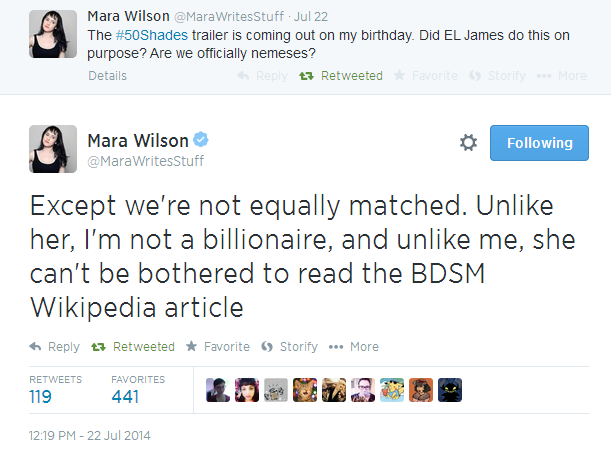
apparently e.l. james called former child star mara wilson (matilda) a “sad fuck” for critiquing the 50shades books a while ago and now there’s a feud. i love it.

I’m in on this feud and I have chosen my side.

MARA WILSON, YOU HAVE MY SWORD.

25 Jul 22:20

Playing the long game.


Playing the long game.

25 Jul 18:26

Feminism: This Is Really All I Wanna Say About FSoG

by Ana Mardoll
[Content Note: Non-Consensual Fantasies, the usual Rape/Abuse CN for Twilight/FSoG, BDSM/kink]

Probably everyone is aware by now that the trailer for the new 50 Shades of Grey movie is out on the internets. (I recommend both Erika's deconstruction of the book and Cliff's deconstruction of the book. So highly recommended.) The following is a collection of tweet thoughts I made about Twilight and 50 Shades of Grey last night, but in longer format:

Twilight has toxic abusive relationships in it, yes. But I would really beg the world to remember that the success of Twilight could (and I would argue does) indicate that many of our girls and women feel safer with fiction where the things they desire are "forced" on them rather than the girls and women going out to get what they desire for themselves.

Is that a problem? Yes.

Is it a problem to be solved by berating lady-readers and lady-writers? No.

If our society has made girls and women feel unsafe--and I want to stress that word, unsafe--for WANTING and GETTING the things they desire through their own non-forced-upon-them-means, then the problem is with our society and not with the lady-readers and lady-writers trying to navigate that unsafety.

And I would also like to point out that I could easily name a hundred male-authored scifi/fantasy books (a) that have worse relationship dynamics, (b) that do not end with a girl/woman getting what she wants (i.e., Winning At Patriarchy), and (c) which come under a fraction*** of the scrutiny and criticism that we give to works by women, for women, about women protagonists. And that avalanche of criticism, as well as what it is directed against and what it isn't directed against, doesn't occur in a vacuum.

So, yes, Twilight has bad things in it and no one is obliged to like it. But let us remember that it's not uniquely bad (looking at almost all the male-authored scifi/fantasy on my bookshelf, with a few key exceptions--and the fact that many of you reading along KNOW which scifi/fantasy male authors are feminist should kinda drive that point home, I think, because it's a short list and well-known precisely because they are wonderful rare unicorns). And let us also not fall into the trap of shaming women for liking Twilight because that just compounds the underlying issue that women aren't allowed to like the things they like.

What I will say about 50 Shades of Gray in specific is this: My feminism does not dictate how I like to fuck. My patriarchal upbringing did try to dictate that. I will not shame women for liking kink. I will not shame women for liking kink in the name of "protecting" them or offering them "better" kink they should read instead. I will not infantalize women. I will trust that they can tell the difference between real life rape/abuse versus fantasy rape/abuse. I will not pretend that the rape and abuse in 50 Shades of Grey is different or unique or worse than the rape and abuse I read in hundreds of male-authored books.

I will remember that rape victims can have rape fantasies. That purity culture can make noncon fantasies the only "valid" source of relief and pleasure for some women. That my feminism punches up at the purity culture and patriarchy that dictates how women are allowed to fuck rather than punching down at the many, many women who have read and enjoyed a goddamn novel for fuck's sake. I will remember that every time I sneer about 50 Shades and its readers, there are women in the room who hear me and hear loud-and-clear that their desires (in bed, in reading, in wherever) are mock-worthy and shameful and wrong and bad.

By all means, do not come away from this thinking you have to like Twilight or 50 Shades. Or thinking that you can't criticize these books. I've spent 5 years criticizing Twilight, which would seem to indicate that I think criticism of these books is both necessary and valid. But I seriously beg that criticism of these books be done in a thoughtful manner that doesn't infantilize women* or shame them** for liking these books.

So, yeah. All I'm gonna say about 50 Shades is that it's personally not my thing, but I have zero problem with women writing or reading or enjoying noncon fantasies, and I would say to people who do have a problem with that: maybe try getting rid of purity culture and sex-shaming of women first and see if that doesn't cause the popularity of noncon fiction to dip a little. I think that's a worthy experiment to try first, if only because then we'll be in a world without purity culture. (Yay!)


* Sexuality is complicated. If you wanna talk about books that fucked up my sexuality as a kid, L'Engle and Lewis fucked me way worse than Twilight or 50 Shades ever could have. If you're shocked by the knowledge that I would rec Twilight over L'Engle to a Hypothetical Impressionable Teenager, well. I will just point out that Bella gets sex and doesn't have to give up Heaven or Unicorns for it. (Yeah, that's gonna be a flamewar in the comments, I predict.)

** I am almost-but-not-quite certain that ebook sales for 50 Shades far outpaced paper sales. I just want to stop and think about what it means that a book about women only getting what they want by having it forced on them... was successful in part because women could get the book they wanted without the people around them knowing at-a-glance that they had gotten a thing they wanted. Wow, it's almost like the point is being proved right there.

*** (Yes, these footnotes are out of order.) I can almost guarantee that a FSoG movie about kink for adult women will be subjected to 1000% more hand-wringing than fucking Ender's Game which was, I remind you, a book about genocide and thinly-veiled sexual assault in showers. For children. Written by a guy who actively uses his platform to lob hatred at non-[straight cis white men]. Also, you need to read Will's posts on Ender's Game because they are everything.
25 Jul 18:00

How important do you find building colour palettes to be in your work? Do you build pre set ranges for spaces/characters/places/moods or do you find it easier to paint entirely in the moment?

Oh I plan the hell out of my colors. 80% of my painting time is just me stressing over whether I picked the right colors. I have tons of pre-set palettes for different locations and types of pages. Every scene, interaction, and character is color-coded. I’m incredibly anal about why someone’s shirt has to be blue or why two locations must have complementary color schemes, even if they don’t intersect.

I’ve learned that this type of attention to detail isn’t all that important to readers, but it’s one of those things that I just *have* to do because I’m me.

24 Jul 20:59

my manager had a coffee with me “to see how i am doing” so i asked him how am i...

my manager had a coffee with me “to see how i am doing”

so i asked him how am i doing

and he said really well

so i said ok then so how about you promote me then and give me a raise

and he said ok ill start the process now (it takes months to get through HR)

that worked??????????

24 Jul 20:57

‘But Even the Home Screen Is Confusing’

by John Gruber

David Pierce, reviewing the Amazon Fire Phone for The Verge:

You can’t even see the time without tilting your phone just so. An errant buzz is your only indication that you have a notification, prompting you to cock your wrist or swipe down from the top bezel to open the notification windowshade. None of this is explained, none of it is intuitive. Dynamic Perspective makes everything look cleaner, but makes actually using your phone a lot harder. I don’t need my phone to be clever, or spartan. I need it to be obvious. The Fire Phone is anything but.

Rough.

Related: Josh Topolsky:

My quick personal take on the Fire Phone: it is functionally and aesthetically awful.

24 Jul 20:33

A good joke can change the world

by Fred Clark
Zephyr Dear

I was reading a book that suggested that widespread horrific practices only seemed to end once the right joke came along...

Click here to view the embedded video.

I have always believed that a good joke can change the world.

Now we have proof that it’s true: Office Space helped rid the world of ‘flair.’”

“About four years after Office Space came out, T.G.I. Fridays got rid of all that [button] flair, because people would come in and make cracks about it,” [Mike] Judge recently told Deadline. “One of my ADs asked once at the restaurant why their flair was missing and they said they removed it because of that movie Office Space. So, maybe I made the world a better place.” Indeed, now a chastened, more mature T.G.I Fridays no longer forces its waiters to talk about their flair, instead allowing them — and their grateful patrons — a side order of dignity to go with their bacon mac ‘n’ cheese bites.

Granted, in the grand scheme of things, the fact that waitstaff at chain restaurants were required to don “flair” in an aggressive display of mandatory cheer and (literally) uniform individuality was not one of the gravest injustices besetting humanity.

Still, though, the end of such demeaning work requirements does, as Judge says, help make “the world a better place.” Thousands of people stuck in lousy dead-end jobs now have slightly less-lousy dead-end jobs.


But let’s not get lost in the particulars of this case, what’s important here is the confirmation of the general principle: A good joke really can change the world.

We have other examples that this is true but we don’t always notice them because the effect of good jokes usually tends to be defensive. The craftspeople at some of our finest joke workshops (the guilds of Stewart, Colbert, Onion, Toast, Silverman, etc.) expend a lot of energy playing a kind of whack-a-mole game in which prophylactic jokes prevent the world from getting worse. That’s a harder thing to identify or measure, but the effect is real.

Consider, for example, that in 2009, the possibility of President Sarah Palin did not seem wholly preposterous the way it does today. That was the work of thousands of jokes — some perfectly crafted, some kind of sloppy and off-target. The cumulative effect of all those jokes helped to make the world a better place — or to prevent it from getting worse in one particular way, which amounts to something like the same thing.

The relatively modest achievement of Judge’s Office Space joke is a reminder that this isn’t easy. Judge crafted a precise and devastating joke and then was able to deliver that joke through an expensive, high-profile platform. Alas, most of us do not have access to such platforms, and we can’t hire someone as skilled and popular as Jennifer Aniston to ensure that our jokes are so perfectly delivered.

But pay attention to Judge’s description of the process that unfolded over time. It took several years from the release of Office Space before the last buttons were removed and partial dignity was restored to these workers. And it wasn’t solely because of Judge and Aniston — it was due to thousands of people all over the country repeating and embellishing and riffing on the original joke.

It takes a village. The good news is that we now have powerful new technology  and new tools for disseminating the best jokes — Twitter and other social media. Our best jokes can now be spread, amplified, applied and reapplied with great cumulative power.

Even so, could even the best jokes ever manage to eliminate something more serious than the indignity of “flair”? Could even a perfect joke ever hope to make a difference when it comes to serious, pervasive, enduring structural injustices like patriarchy, plutocracy or racism?

We’ll never know unless we try.

Here’s John Oliver, doing his part, attacking the obscene injustice of American mass incarceration with what might really be one of the most potentially powerful weapons we have — a bunch of good jokes:

Click here to view the embedded video.

24 Jul 18:40

Not Sure That Works

by Josh Marshall

Glenn Beck: That innocent Boston Bombing bystander I called a terrorist can't sue me for libel because he became a public figure when I accused him of being a terrorist.

24 Jul 18:40

My Standing 'Oh Good Grief' Headline

by Josh Marshall

Gov. Brewer: Inmate who gasped and snorted for almost two hours before dying in botched execution "did not suffer."

24 Jul 18:29

Life Goal: To have a Wikipedia page. Secondary Life Goal: …With a “controversies”...

Life Goal: To have a Wikipedia page.

Secondary Life Goal: …With a “controversies” section.

24 Jul 00:42

That's Horrific

by Josh Marshall

"A condemned Arizona inmate gasped and snorted for more than an hour and a half during his execution Wednesday before he died, his lawyers said, in an episode sure to add to the scrutiny surrounding the death penalty in the U.S." Details here.

As much as it's treated as sick or a joke, firing squad really would be a vastly more humane form of execution than the one we now have.

22 Jul 04:56

Earning $10,000 per Month

by Steve Pavlina

For the upcoming Conscious Life Workshop, the key goal is to help you achieve a sustainable income of $10,000 per month (or more) AND do work you enjoy AND enjoy plenty of lifestyle freedom.

Some people wonder about this $10K per month figure. How could it be possible for them, especially when no one in their line of work makes that much money?

Since this is a goal I’ve achieved and maintained for many years (and in different fields), let me share some simple realities about earning $10K or more per month. This is basically common sense — certainly not rocket science —  but it’s not commonly applied. These are truths that people resist, sometimes to a ridiculous extent, but such resistance is largely futile. You can save yourself a lot of wasted effort if you just accept the obviousness of these ideas and work with them instead of trying to become the exception to them.

Some skills pay much better than others. Some skills don’t pay at all.

Instead of thinking about being paid $10K per month, put your focus on generating $10K+ of value for society. Don’t ask, How can I earn $10K per month? Ask instead, How can I create and provide $10K of value for others each month?

Thinking about how you can generate significant value for others may seem like a tall order, but it’s a great way to cut through the B.S. that might otherwise get in your way. If a certain option clearly won’t generate $10K+ per month in value for other people — as in, there’s no way anyone would receive that much value, collectively or individually — then you can reject that option.

The hard truth is that many people invest in lines of work and paths of skill-building that don’t provide — and will never provide — anywhere close to $10K of value for others, especially if this value is to be provided each and every month.

You may have spent a lot of time developing skills that other people don’t value very much. Join the club! We all do that. It’s the default behavior, conditioned by learning from other people who are also earning less than $10K per month.

I happen to love disc golf. I’ve invested a lot of time in it. But no one pays me to play disc golf. I’m not going to earn $10K per month teaching people how to play disc golf either. I enjoy the skill for recreational purposes, but it’s not an income-generating skill for me, and I expect that it never will be.

You’ve surely trained your brain to get good at something, even if it’s video games, movies, and social media. Wherever your attention is going, you’re building skill. That’s unavoidable. It’s how your brain works. Experience is training.

How many of your current skills are capable of generating $10K per month in value for other people? If the answer is zero, that would be sufficient to explain why you aren’t earning $10K or more per month already.

It’s fine to have some skills that aren’t income generating. But please recognize that not all skills are equal in terms of their ability to generate income.

Consider two potential skills you might develop: yoga and public speaking.

Some of my readers are amazing at yoga. They’ve invested years in their yoga practice. They can do all sorts of pretzel-like poses, and they look beautiful doing it. They’re very proud of their yoga skills. And they almost invariably struggle with money.

Of course a yoga pro could combine yoga with other skills like teaching and entrepreneurship to open a yoga studio or create their own yoga franchise, but those are entirely different skill sets that can also take years to develop as well. If you’re really passionate about teaching and/or franchising, then you can certainly make $10K per month or more that way. But in this case, I’m just referring to an investment in the actual practice of yoga. Financially, it’s dead weight.

The reality is that most people don’t care whether you practice yoga or not. They don’t receive much, if any, value from your practice. So of course they don’t pay you to practice yoga. See if you can earn $10K per month from practicing yoga. Good luck with that!

Now consider public speaking. Suppose you train up your public speaking skills instead of your yoga skills. Unlike practicing yoga, public speaking pays really well. The top speakers can earn $200K+ per talk (as Hillary Clinton presently does). A skilled but non-famous speaker can definitely earn $10K+ per month from speaking, if they develop their skills enough. I have numerous friends who earn this much from speaking. Give 4 talks per month at $2500 each, and you’re earning $10K per month. $2500 is a very modest speaking fee. My first paid speaking engagement was for $3000.

Good presentation skills are highly valued by society. Society has made it very clear that it values public speaking skills, financially speaking. Why are speaking skills so highly valued? Let’s not worry about that kind of why right now. Let’s simply accept and acknowledge that — for whatever reasons — some skills are great income generator candidates, and some aren’t.

There are lots of jobs people learn to do that just aren’t worth $10K per month. No one is willing to pay that much to have those jobs done, even if they’re done really well. If you ask for that much, you’ll probably be laughed at — and replaced by someone more reasonable.

If you’re currently doing work that society clearly doesn’t value as a $10K per month activity, then don’t fight society. Don’t argue with it. Don’t complain that you should be paid more. Just accept the decision of the marketplace.

Instead of railing against the unfairness of it all, consider investing in a skill-building path that does actually offer a potential income of $10K+ per month. And stop investing in so many skills that clearly won’t help you get there.

If your goal is to earn $10K+ per month, this is common sense, is it not? Yet how often do people cling to their unrewarded skills, as if society should simply change its mind about their value? Try meeting society halfway — at least.

Develop a portfolio of $10K per month skills.

Why stop at just one $10K per month skill? The mono-skill approach can work, but it’s risky. Change is inevitable. What if the world changes in ways that render your core income-generating skill obsolete? Wouldn’t it be wise to have at least one or two well-developed backup skills as well? Then if you can’t enjoy the same cash flow from your primary skill for some reason, you can pivot to one of your other core skills and still maintain your desired lifestyle.

Here are some skills I’ve invested in that I could use, individually or collectively, to earn $10K per month or more:

  • Designing and programming computer games
  • Writing / blogging
  • Public speaking / workshops
  • Negotiating business deals
  • Coaching / transformational work

I can use different combos of these to earn $10K per month or more as well.

I’m not the one who determines what these skills are worth. Society does that. The marketplace does that. I simply observed that these skills tend to be handsomely rewarded, for those who make a serious investment in them.

I have many other skills that don’t pay well at all. I’m very well-versed in Star Trek. I’ve finished hundreds of video games. But for some odd reason, people never seem to offer me money for these skills. However, I receive abundant opportunities to generate income from writing and speaking — to the point where I have to turn down a lot of offers.

The programming skill was largely luck. I started learning to program when I was 10 years old. With this skill, before I even graduated from college, I was already earning about $50 per hour co-designing and programming video games for a local games studio (that’s my estimate based on my contractor payments plus the royalties from sales I received for the published games). So even though my video game playing skills were financially worthless, I was actually able to leverage my gaming experience to generate some real money by combining those skills with programming. My design knowledge stemmed largely from playing a lot of games, but I couldn’t leverage that skill until I also learned to program games.

Earning $50 per hour in the early 90s was a lot for a student. The only job I’d had before that was selling video games at a local games store for $6 per hour. That was a huge pay increase, but I didn’t actually work any harder. I simply pivoted to a different skill set.

As I got older, I deliberately decided to cultivate other skills that are capable of generating more than $10K per month. And so, for many years now, I’ve been earning well over $10K per month. My ability to maintain this income is very resilient because I can pivot to several other skills as needed.

I don’t work any harder than people who earn 1/10th what I earn. It’s just that while someone else is sweating through a session of Bikram yoga, I’m practicing an income-generating skill like writing articles about personal growth. This doesn’t require greater effort or discipline. It just requires different decisions about which skill paths to get into — and which to get out of.

If you want to earn $10K per month or more, then try deliberately building skills that can be used to generate that much income. There are many to choose from. But if you don’t develop any of them, then of course that $10K per month target will seem out of reach. Still common sense, is it not?

To significantly increase your income, you may have to do different kinds of work. You may have to develop different skills. This is easier than it sounds.

The next few years are going to pass anyway. During that time, you’re automatically going to build skill in the areas where you direct your focus. Your brain will take care of that for you. Take in experience, and it will feed a skill.

Take control of your attention. Start putting your attention on income-generating activities and interests. Withdraw your attention from some non-income generating activities and interests. Fire some of your old hobbies. Hire some new hobbies.

I’m not saying you have to go crazy and become a money-seeking robot. I’m definitely not saying that all of your interests have to be income-generating. Just shift the balance enough to match your values.

Once you develop some strong income-generating skills, you’ll be able to practice them more efficiently. This will give you more space for hobbies that don’t generate income.

One of the reasons I invest in high-payoff activities is that I want to have a lot of free time to enjoy a nice lifestyle. I don’t want a life that’s all work. I’d rather earn tens of thousands of dollars from doing a cool project like a weekend workshop by leveraging high-payoff skills vs. going to some office every single day and having to rely on low-payoff skills.

Bet big on skills you enjoy AND that pay well.

Sometimes through social pressure (especially family pressure), people bet big on skills that pay well but that they also hate. I’d say the big three are medicine, law, and engineering. I can’t tell you how many times I’ve received an email from a student who was pressured into one of these fields by their family, and they hate it.

Do yourself a favor: Don’t bet big on income streams you dislike. The stress and resentment isn’t worth the money.

I bet big on writing because I really like writing. Writing is a zen-like experience for me. I feel very lucky to be able to write and share so much. In the past decade, I’ve essentially tripled my writing speed even though my typing speed is only a little faster today. For me this is a very nice skill to have. I enjoy practicing it, and if I write in ways that create value for people, I can generate substantial income through my writing. I could easily earn $10K per month from my writing if all I did was write and self-publish books.

I did not, however, bet big on one-on-one coaching. I know it’s possible to earn $10K per month from coaching since I have friends who earn well beyond that level. Some of them get paid $100K per year per client. That’s not a typo. With 2-4 clients they earn $200-400K per year. I think that’s great — for them. I’m pretty good at coaching because of all the related transformational work I’ve done, but I don’t like coaching nearly as much as writing and speaking. So I won’t bet bigger on coaching. I don’t want it to be a serious income stream for me since I don’t want to do a lot of coaching, even if it meant more income.

Ask yourself: Would I still practice this skill — and continue to build it up — if I knew I’d never be paid for it again?

If the answer is no, it’s time to pivot to a different skill set. Being paid is nice, but it should certainly be possible to find a different skill that pays well AND that you’d also enjoy practicing. So don’t settle for one or the other. Go for the full package.

Abandon the dead ends.

We don’t have the time and energy to pursue all possible skill paths. We have to pick and choose.

Perhaps the biggest stumbling block that holds people back is that they don’t abandon the dead ends. These are the skill paths that are clearly leading nowhere, or they’re just running you in circles. Don’t cling to those paths if you want to make progress. You simply don’t have the bandwidth.

This is one reason I deleted all my social media accounts earlier this month. I’d invested years in getting good at social media, but eventually I realized that continuing on this skill path was a dead end for me. I didn’t enjoy it that much, and it wasn’t a powerful income-generating path for me either. I didn’t see the point in training my brain through further experience with social media.

By deleting social media from my life and by consciously choosing not to continue developing that skill path, I freed up mental bandwidth for developing new skills and for betting bigger on existing skills. I also freed up more time to enjoy my lifestyle, like I’m doing this week at a Fringe Theatre Festival in Canada.

I definitely haven’t missed social media. Dropping it has been terrific thus far. I’m very pleased with the decision to opt out of this skill path and to allow my social media skills to atrophy, decline, and degrade. I’ve gotten as good as I’m ever going to get at social media. From here on I’m only going to get worse. Five years from now I expect I’ll be somewhat incompetent at social media… but I’ll be well on my way to mastering something much more important to me. Get the idea?

If you take a serious look at how you spend your time, you’ll see that you’ve been investing in many skills. You may be really good at certain video games. Or cooking certain types of meals. Or yoga. Or posting amazing status updates.

Where have you been putting your attention? That’s where you’re building skill.

How many of those activities do you find deeply fulfilling? How many of those activities will generate $10K per month in income if you bet bigger on them?

Don’t be stubborn. Don’t cling to skill paths you’ve outgrown. When a skill path isn’t delivering strong enough benefits anymore (if it ever did), have the sense to opt out. Put your attention where you want it to go instead.

When you drop an unproductive skill path, rest in the empty void for a while before committing to a new path. Let the old path die off, so it stops influencing your thinking so much. Then examine some new possibilities and perform a conscious pivot. Feel free to dabble at first. But when you see the golden combo of fulfillment plus strong income potential, bet big. Invest heavily. And reap the rewards.

* * *

One reason people question their ability to earn $10K per month is that they’ve become too deeply mired in skill paths that can’t possibly pay that much. If you want to receive that much income from people, then work on providing that much value for people.

The world will give you plenty of feedback about what it thinks your skills are worth. Your heart will give you feedback about how your skill path feels to you. Listen to both sides. If you don’t like their answers, then get off your old path, and choose a new path.

Sometimes you won’t even be able to see the right new skills to develop until you abandon the paths that clearly aren’t working. Don’t expect that $10K+ per month opportunity to squeeze into your life through the haze of video games, Facebooking, and yoga postures. Try doing a little housekeeping first. Create some space.

We’ll be doing this type of in-depth examination in a very personalized way at the upcoming Conscious Life Workshop next month, so if you’re ready to move forward on this in a big way, we can work through it together. I’ll help you to design and start moving forward on your future skills path, and you’ll understand what to do to leverage your evolving skills to earn plenty of income. You’ll be supported by dozens of other people who are on similar journeys, so you’ll also gain from their insights regarding how to intelligently balance fulfilling work, lifestyle freedom, and abundant income. And on top of that, it’s going to be a whole lot of fun! :)

Incidentally, the early bird discount for the workshop ends on July 22, 2014, so you’ll save $100 when you sign up by then. Join us! No excuses… just join us.


Steve Recommends


Site Build It! - Start your own money-making website

Lefkoe Method - Eliminate a limiting belief in 20 minutes

PhotoReading - Read books 3 times faster (discount for my readers)

Paraliminals - Condition your mind for positive thinking and success (discount for my readers)

Getting Rich with Ebooks - Use ebooks to create streams of passive income

Sedona Method (FREE audios) - Release emotional blocks in a few minutes

The Journal - Record your life lessons in a secure private journal

Life on Purpose - A step-by-step process to discover your life purpose


If you've found Steve's work helpful, please donate to show your support.

Get Steve's Free newsletter

Uncopyrighted by Steve Pavlina

21 Jul 19:44

If Facebook Was A Guy

FACEBOOK: Hi, I’m Facebook.
ME: Nice to meet you, I’m Ryan.
FACEBOOK: What’s your last name? Where do you live? When were you born? What’s your phone number? Is that work or mobile? Can I have your work number too?
ME: Facebook, I just met you.
FACEBOOK: This is what friendship is to me.

***

ME: Hey, you know what’d be lots of fun? If we had a picnic!
FACEBOOK: Hey, you know what’d be lots of fun? If you told me the names of every single person you know!

***

FACEBOOK: Hey Ryan, do you know this person?
ME: That’s Sarah. I haven’t spoken to her for years.
FACEBOOK: Okay, here’s a shot of her bedroom and some pictures of her children as they sleep.

***

FACEBOOK: Hey Ryan, do you know this person?
ME: I… maybe? I may have seen him at a party.
FACEBOOK: He likes The Big Bang Theory. You wanna be friends, right?
ME: No.
FACEBOOK: I’ll ask you to be friends with him every time I see you again for the next six months.

***

FACEBOOK: Your friends went to the beach. Do you have any comments on these pictures of your friends at the beach?
ME: Huh?
FACEBOOK: I’m showing their swimsuit pictures to everyone. Do you like them? You can tell me if you like them. It’s fine if you like them.
ME: They’re… okay, I guess?
FACEBOOK: Okay, I just told them and everyone they know that you like their swimsuit pictures.

***

MY FRIEND STEVE: Hey, Facebook just said we’re not friends anymore? What the hell, Ryan?
ME: Huh?
FACEBOOK: Hah hah hah

***

NSA: Hey Facebook, what can you tell us about Ryan?
FACEBOOK: Age, interests, relationships, activities, where he was last night, what he looked like while he was there, the last five places he’s lived - what do you want?
NSA: That’ll be great, thanks. Do we need a warrant?
FACEBOOK: Nah, just make a fake account and friend someone who is friends with Ryan. That’s good enough for me!
NSA: Hah hah hah

***

FACEBOOK: Hey, did you know your aunt is racist?
ME: I… no?
FACEBOOK: Here’s something they wrote about “the foreigners”.
ME: Why would you think I’d want to see this?
FACEBOOK: Do you like what you see? You can tell me if you like it. It’s fine if you like it.

***

FACEBOOK: Hey, this corporation wants to engage with you.
ME: What? No.
FACEBOOK: They paid me money so you’re going to listen to them whether you want to or not.
CORPORATION: Hi, are you getting married? Do you want to buy diamonds? You mentioned diamonds earlier so you should buy our diamonds.
ME: I was talking about the James Bond movie, Diamonds Are Forever.
CORPORATION: We can sell you that too.
ME: Wait, how did you know I was talking about that in the first place?
FACEBOOK: Hah hah hah

***

ME: Facebook, I don’t want to be friends anymore. Forget everything I ever told you about myself.
FACEBOOK: Okay.
ME: Facebook, did you delete everything?
FACEBOOK: I did. Sorry to see you go.
ME: …
ME: …Facebook, if I said I wanted to be friends again, what would you say?
FACEBOOK: Here’s all your old shit again! I never deleted anything!
FACEBOOK: Hah hah hah

21 Jul 13:13

15 Reasons Why Things Can you believe this? Here’s another. I know, right? This is it. And...

15 Reasons Why Things

Can you believe this? Here’s another. I know, right? This is it. And this. Oh sure, how about that? This guy hasn’t even heard of it. And that. LOL. Haven’t we all? This. This. WOOOOOOOOO! Okay, that’s almost it. This.

21 Jul 13:03

Netanyahu’s ‘Telegenically Dead’ Comment Is Grotesque but Not Original

by Glenn Greenwald
GAZA, PALESTINE - 2014/07/20: Palestinian medics carry the body of a child killed in Shijaiyah east of Gaza City, after Israel expanded its ground offensive on the Gaza Strip (Photo by Ibrahim Khader/Pacific Press/LightRocket via Getty Images)GAZA, PALESTINE - 2014/07/20: Palestinian medics carry the body of a child killed in Shijaiyah east of Gaza City, after Israel expanded its ground offensive on the Gaza Strip (Photo by Ibrahim Khader/Pacific Press/LightRocket via Getty Images)

Benjamin Netanyahu, yesterday, on CNN, addressing worldwide sympathy for the civilian victims of Israeli violence in Gaza:

They want to pile up as many civilian dead as they can. They use telegenically dead Palestinians for their cause. They want the more dead, the better.

Joseph Goebbels, November 16, 1941, essay in Das Reich, addressing Germany sympathy for German Jews forced to wear yellow stars:

The Jews gradually are having to depend more and more on themselves, and have recently found a new trick. They knew the good-natured German Michael in us, always ready to shed sentimental tears for the injustice done to them. One suddenly has the impression that the Berlin Jewish population consists only of little babies whose childish helplessness might move us, or else fragile old ladies. The Jews send out the pitiable. They may confuse some harmless souls for a while, but not us. We know exactly what the situation is.

Rather than lard up the point with numerous defensive caveats about what is and is not being said here (which, in any event, never impede willful media distorters in their tactics), I’ll simply note three brief points:

(1) To compare aspects of A and B is not to posit that A and B are identical (e.g., to observe that Bermuda and Bosnia are both countries beginning with the letter “B” is not to depict them as the same, just as observing that both the U.S. in 2003 and Germany in 1938 launched aggressive wars in direct violation of what were to become the Nuremberg Principles is not to equate the two countries).

(2) In general, the universality of war rhetoric is a vital fact, necessary to evaluate the merit of contemporary claims used to justify militarism (claims that a war amounts to mere “humanitarian intervention”, for instance, have been invoked over and over to justify even the most blatant aggression). Similarly, the notion that one is barred from ever citing certain historical examples in order to draw lessons for contemporary conflicts is as dangerous as it is anti-intellectual.

(3) Anglo-American law has long recognized that gross recklessness is a form of intent (“Fraudulent intent is shown if a representation is made with reckless indifference to its truth or falsity”). That’s why reckless behavior even if unaccompanied by a desire to kill people – e.g., randomly shooting a gun into a crowd of people – has long been viewed as sufficient to establish criminal intent.

One can say many things about a military operation that results in more than 75 percent of the dead being civilians, many of them children, aimed at a population trapped in a tiny area with no escape. The claim that there is no intent to kill civilians but rather an intent to protect them is most assuredly not among them. Even stalwart Israel supporter Thomas Friedman has previously acknowledged that Israeli assaults on Lebanon, and possibly in Gaza, are intended ”to inflict substantial property damage and collateral casualties” because “the only long-term source of deterrence was to exact enough pain on the civilians” (which, to the extent it exists, is the classic definition of “terrorism”). The most generous claim one can make about what Israel is now doing in Gaza is that it is driven by complete recklessness toward the civilian population it is massacring, a form of intent under centuries of well-settled western law.

* * * * *

American journalism is frequently criticized with great justification, but there are a number of American journalists in Gaza, along with non-western ones, in order to tell the world about what is happening there. That reporting is incredibly brave and difficult, and those who are doing it merit the highest respect. Their work, along with the prevalence of social media and internet technology that allows Gazans themselves to document what is happening, has changed the way Israeli aggression is seen and understood this time around.

Credit to Jonathan Schwarz, now working with Matt Taibbi’s forthcoming First Look Media digital publication, for finding the 1941 article cited here.

The post Netanyahu’s ‘Telegenically Dead’ Comment Is Grotesque but Not Original appeared first on The Intercept.