Shared posts

01 Dec 03:13

git: handy alias to find the repository root

by JessiTRON
To quickly move to the root of the current git repository, I set up this alias:

git config --global alias.home 'rev-parse --show-toplevel'

Now,  git home prints the full path to the root directory of the current project.
To go there, type (Mac/Linux only)

cd `git home`

Notice the backticks. They're not single quotes. This executes the command and then uses its output as the argument to cd.

This trick is particularly useful in Scala, where I have to get to the project root to run sbt compile. (Things that make me miss Clojure!)

BONUS: handy alias to find the current branch

git config --global alias.whereami "rev-parse --abbrev-ref HEAD"

As in,

git push -u origin `git whereami`
27 May 18:34

Consent is a necessary prerequisite for any sexual ethic

by Fred Clark

Libby Anne of Love, Joy, Feminism has written several of the most insightful responses I’ve seen to the horrifying revelations of the history of sexual abuse by reality TV personality Josh Duggar, and to the disastrously inept response from his famous family. This is a story from her native tribe — the white evangelical/fundamentalist Christian patriarchal homeschooling subculture of Bill Gothard, the Quiverful cult, the Vision Forum, “courtship” and all the rest. While she has since gotten free of that world, she still knows it intimately, and you won’t find a better interpreter or translator of that world and its ways than Libby Anne.

(To back up that praise, consider this post: “My concerns about the Duggars.” And then consider that it was written more than three years ago.)

In that capacity as a translator and interpreter of the Duggars’ white Christian subculture, Libby Anne is particularly helpful when it comes to explaining why the members of that tribe — the Duggars and their defenders — seem mystified at the way the rest of the world is responding to the news of Josh Duggar’s past (perhaps) pattern of sexual abuse. She writes about “Josh Duggar and the Tale of Two Boxes” — a post that builds on her older post, “A Tale of Two Boxes: Contrasting Sexual Ethics.” That original post has become an indispensable piece of my own mental vocabulary because it does such a fine job of articulating the shape and the limits of evangelical sexual ethics — at least as popularly understood and practiced.

The Tale of Two Boxes clarifies a great deal, as I’ve written about before (see “Sex and theology” and, more recently, “Here’s that ‘Anything Goes’ rant about evangelical sexual ethics“). The basic idea is that for white evangelicals and other so-called social conservatives, all forms of extra-marital sex are considered sinful, while marital sex is good. This produces a system with two — and only two — categories to be considered: Married and Not-Married. And thus it creates a system that asks one — and only one — question when evaluating the ethical status of any given sex act: Are the actors married to one another?

The end result is Libby Anne’s Two Boxes:

TwoBoxes2

Here’s how Libby Anne applies this to the case of Josh Duggar and the irreconcilably different understandings of his actions held by his defenders and those who are appalled by his deeds:

Social conservatives tend to divide sexual acts into “marital sex” and “non-marital sex.” For social conservatives, child sexual molestation is in the same category as gay sex or consensual premarital sex. When divided in this way, sexual molestation doesn’t look all that different from consensual premarital sex — though both are considered sin. This is why the Duggars can talk about Josh’s “mistakes” the way they do—as though it were simply him going too far with a girlfriend, or viewing pornography. Because for them, they’re in the same category—sexual contact before marriage.

Progressives do not have ethical or moral problems with premarital sexual intercourse — but they very much have a problem with child molesting. To conservatives this can look like an inconsistency — even hypocrisy — but it’s not. Progressive sexual ethics center around consent. Sexual contact that is consensual is okay. Sexual contact that isn’t consensual is not okay.

Consent is, indeed, the key factor here. But note that the problem is not only that this essential factor is absent from the “conservative” Two Boxes scheme. That Two-Boxes framework also prevents those steeped in it from comprehending the role that consent plays for the rest of us.

That, in turn, leads to the absurd cartoon straw-man that such conservatives love to mock and dismiss whenever the matter of consent comes up. Hence the reaction of my old friend the Kuyperian Marine, who could never seem to hear the word consent without sarcastically responding, “As long as its between two consenting adults, then anything goes!” This was an intelligent guy — a man with a Ph.D. in ethics who is capable of immensely subtle and principled thought on a host of other subjects. But he was unable to grasp the vital ethical importance of consent because he was so steeped in Two-Boxes ideology.

His confusion, and that of countless others, arises from misunderstanding statements like the one Libby Anne makes when she says that “Progressive sexual ethics center around consent.” His sexual ethics center around marital status, so he assumes — incorrectly — that this means consent must play an identical role in progressives’ sexual ethics to the role marital status plays in his own thinking. He assumes, in other words, that those hippy progressives also have Two Boxes.

To put this all another way, for social conservatives, marriage is necessary and sufficient for ethical sexual activity. When they hear folks like Libby Anne (or me) emphasizing the essential importance of consent, they therefore assume that we are, in turn, arguing that consent is necessary and sufficient for ethical sexual activity. But that’s not what we’re saying. We’re saying consent is necessary. Period.

Ethical sexual activity must be consensual. Take away mutual consent and you take away the possibility of ethical sexual contact. Mutual consent is the necessary starting point, the prerequisite for the possibility of ethical sex. But the presence of mutual consent alone is not sufficient to guarantee that, therefore, “anything goes.” It’s not as Two-Boxes simple or zipless as that. (Any attempt to posit a scenario in which mutual consent would be both necessary and sufficient would involve carefully constructing a simplified hypothetical in such a way as to acknowledge multiple other factors by way of excluding them from consideration in that particular case.)

The real task facing social conservatives is to make a convincing case that marriage is a necessary condition for ethical sex. Many of them aren’t even trying to make that case because they’re too busy defending the indefensible proposition of Two Boxes ideology — the claim that marriage is a sufficient condition for ethical sex. They seem to think that arguing for the necessity of marriage would be a step back from arguing for its sufficiency — and therefore a kind of retreat or wavering or compromise.

But it’s only a retreat from something absurd and morally reprehensible. I can respect and converse with someone who argues that both marriage and consent are necessary conditions for ethical sexual activity, but if someone is arguing that marriage is sufficient, then they cannot believe that consent matters (apart from a once-and-for-all-time “I do”) and that is a perspective I cannot respect or abide.

27 May 16:26

Why I’m A Gender Abolitionist, At Least On Even-Numbered Days

by ozymandias

[Related: SilphiumTrans-Positive Gender Abolitionism Is Totally Possible, Yes It Is]

In Favor of Gender Abolitionism

By the ancient law of Chesterton’s Fence, when one sees a fence in a field for no reason, one should by no account knock it down. People don’t build fences for no reason. If you don’t know why that fence is there, then you should figure out why, in case the answer is “it is a necessary part of preventing Cthulhu from rising from sunken R’lyeh and destroying us all.”

So let’s talk about why people built this here gender fence.

There is one obvious difference between human men and human women: namely, with a few exceptions, women are the ones who have babies and who breastfeed. The second obvious difference is that (again, with a few exceptions) men are stronger than women.

Gender-related human universals include:

  • females do more direct childcare
  • males dominate public/political realm
  • males engage in more coalitional violence
  • males more aggressive
  • males more prone to lethal violence
  • males more prone to theft
  • males, on average, travel greater distances over lifetime
  • division of labor by sex

So let’s pretend we’re designing a society with two groups that are entirely identical, except that one of them is physically stronger and one of them has babies. Obviously, you’re going to have a division of labor by sex: you want women to perform work that can be easily done while pregnant or nursing a child, and men to do any work that requires physical strength. Women are going to do more childcare, because they’ve already nursed the children so they have more of a connection, and taking care of children is an obvious example of work one can do while pregnant or nursing. Men will be more aggressive, violent, and prone to theft, because they’re stronger and more likely to win. Men will travel farther, because they don’t have to carry children and with all the strength and concomitant violence they’re more able to take care of themselves in strange territory. The public/political realm is disproportionately likely to involve (a) violence, (b) going far away, or (c) things that are hard to do while pregnant or nursing, explaining male dominance. Besides, men are the violent and strong sex; even if women wanted power, the men would be more than capable of violently enforcing that women couldn’t get it.

If you have all those sex differences in how your society works, it affects how you’d socialize your children. After all, if you’re certain Jane is going to take care of children as an adult, you should probably teach her the necessary skills when she’s a child. Similarly, you’d also want to inculcate different values in men and women: John, who might grow up to be a soldier, needs to be taught the importance of bravery.

The thing is that, thanks to technology, very few of these considerations apply in our current society. A sexually active woman before birth control and low infant mortality rates could expect to be pregnant or nursing for most of her life; after birth control, she can expect to have one or two children. Thanks to bottlefeeding and breastmilk pumping, fathers can take a nearly-equal role in the early years of a child’s life. Physical strength is an advantage for fewer and fewer jobs. More and more jobs can be easily done by a working mother.

Therefore, there is less need to socialize men and women differently.

However, gender socialization also has fairly significant costs. Enforcing particular norms requires punishing people who deviate from them: hence, oppositional sexism. Even those who are not punished might end up in worse situations than they would have without gender roles: a man who’d be happier as a stay-at-home dad might end up working full-time because that’s what’s expected of them.

Some people have proposed that we end gender roles without ending gender. That is fairly plausible if you have a trans-exclusive viewpoint: you just let “gender” mean the same thing as “sex.” However, if you have a trans-inclusive viewpoint, then you have this mysterious Essence of Gender floating about that doesn’t indicate anything about a person. I predict that that is an unstable situation and what will happen is people not caring about gender at all.

It’s true that ending gender socialization would cause a decrease in neurodiversity: fewer people would have a strong sense that they are a particular gender. However, one can imagine gender clubs springing up like kink clubs do today: consenting adults may enact byzantine gender roles in private, without the costs associated with gender roles today. That preserves the “has gender” neurotype. And there might even be a net increase in neurodiversity. Right now, thanks to gender socialization, all the ‘feminine’ or ‘masculine’ traits are correlated, creating two primary neurotypes. If we ended gender socialization, they would become much much less correlated, allowing for a far wider array of possible neurotypes.

Against Gender Abolitionism

However, as I said, I’m only in favor of gender abolitionism on even-numbered days. On odd-numbered days, I have some other thoughts.

First, there may be more sex differences than strength and ability to bear children. My analysis above assumes that those sex differences are either too small to be usefully predictive or irrelevant to socialization. If it turns out men are slightly better than women at math, then you should probably ignore gender and just look at quantitative IQ. Women are significantly more capable of multiple orgasms than men, but that doesn’t affect anything interesting about socialization. However, if sex differences turn out to be tremendously important, as important as strength and childbearing, then my analysis is overturned.

(Note that the existence of very important sex differences does not imply the necessity of strengthening those sex differences through socialization. If men are more violent than women, then you should socialize men into androgyny– at least on that trait.)

One category of sex differences I find really interesting is sex differences in preferences about the other sex. If women as a whole are much more attracted to men with long hair, then you can improve women’s overall happiness by socializing men to want to have long hair. I find it pleasingly counterintuitive to think about a society in which men and women are basically the same but taught to be different because of their different desires about each other.

But the question that puzzles me most is:

Has anyone else noticed that social dysphoria is really weird?

People often have a preference about what category they’re put in. Maybe one category is treated better than another category; maybe one category more accurately reflects their experiences; maybe people in one category are expected to behave in a way that it’s easier for them to behave in. Social dysphoria is a preference about what category one is put in that is totally unrelated to any of those reasons. I agree that I have breasts, a vagina, a uterus, female-typical hormones, etc. and that many people consider “woman” to mean “a person who has breasts, a vagina, a uterus, female-typical hormones, etc.” Being nonbinary empirically involves all the nonsense involved with being a woman, with bonus tedious conversations about my gender and risk of being disowned. And people expect women to cry a lot, wear skirts, and watch Legally Blonde, and I am a total fan of all three of those things.

Nevertheless, I want people to put me in this imaginary “nonbinary” category I made up, rather than the “woman” category.

I have put a lot of effort into thinking about an analogous experience to social dysphoria, and the closest I can find is whether you identify as a “Michigander” or a “Californian” if you’ve lived in both places. Even that’s a bad analogy because it probably does relate to what “Michigander” means (a person with a connection to Michigan) and anyway if someone misstates you you are likely to shrug rather than to frantically google “Michigander passing tips assigned Californian at birth.”

Like, no wonder people keep thinking we transition out of a sexual fetish or a desire for male privilege! If I didn’t experience it I would be confused too.

Sometimes I explain social dysphoria as a product of the existence of constant gender socialization that sometimes misfires. But sometimes I wonder if what’s actually going on is that people have some sort of drive (of varying strength) to find their local gender role and execute it as best they can, regardless of what that gender role is.

There’s some evidence that cis people also experience that drive. Anecdotally, children often have amusingly flawed understandings of gender difference: a child whose mother is a doctor may conclude that boys can’t be doctors, while a child whose mother drinks coffee and whose father drinks tea may decide that girls like coffee and boys like tea. That certainly looks like children are trying to figure out what men and women are supposed to do in their own culture.

Children seem to acquire rigid gender stereotypes around age five and become more flexible around age seven. On one hand, of course, this might just be children noticing that a lot of our society is gendered; dividing children into two random groups is enough to create stereotypes. Children might just be looking for information about their own place in society, and noticing that gender is a pretty major division. On the other hand, as far as I know, there’s been no research showing that children acquire rigid race stereotypes around age five and become more flexible at seven. If gender rigidity is solely a product of children looking for firm roles in society, one would also expect to see race rigidity.

Cordelia Fine’s Delusions of Gender alerted me to the research of primatologist Frances Burton. She argues that there is significant within-species variance among primates about gender roles: in some groups, males are involved parents, while in others, they are hands-off. Primates seem to “learn” gender roles from observing other primates within their local group. Since it is unlikely that primates were socialized into caring about gender by the patriarchal mass media, it seems that my hypothesized drive may be present in primates.

So if there is such a drive, what do we do?

Gender socialization still has fairly significant costs. However, leaving that drive unfulfilled seems likely to both make everybody unhappy and to not work. I would suggest keeping gender socialization to traits that are relatively unimportant and changeable by society. For instance, we might preserve women wearing skirts, liking pink, and listening to pop music, while eliminating the pressure on men not to cry and encouraging women to enjoy STEM fields.


25 May 05:14

Doesn’t Matter, Warm Fuzzies | Melting Asphalt

Doesn’t Matter, Warm Fuzzies | Melting Asphalt:

Here’s a sorely underappreciated idea:

Humans are better at sensing whether something is working out in their favor than understanding why or how it’s working out.

For example, you don’t need to understand why it’s useful to welcome guests when they arrive (e.g. with a hug or a handshake) to appreciate that it’s a good idea. All you need to know is that it creates good warm fuzzy feelings when you do it, versus awkward vibes when you don’t.

These kinds of unjustified, “irrational,” black-box behaviors exist because of a simple fact of human psychology: Our brains were built to form quick, binary judgments about everything we encounter, i.e., a positive or negative valence (friend or foe, approach or avoid). Relative to these intuitive judgments, however, verbal explanations are relegated to the position of, quite literally, an afterthought. It’s simply more important for our brains to know what is good for us — so we can approach or avoid it, continue the practice or abandon it — than to know why.

Now, take this facility of ours (judgment without understanding), hitch it to the process of cultural evolution (copy what works, discard what doesn’t), crank it for a few generations, and out will pop a bunch of practices that do useful things, but which we don’t fully understand — i.e., rituals.

So if we don’t fully understand them, but they work anyway, rituals must feel like magic. This is the psychology behind Arthur C. Clarke’s famous third law:

Any sufficiently advanced technology is indistinguishable from magic.

And here’s the behavioral analogue:

Any sufficiently opaque ritual is indistinguishable from magic.

“Magic,” says Bronislaw Malinowski, “is to be expected and generally to be found whenever man comes to an unbridgeable gap, a hiatus in his knowledge or in his powers of practical control, and yet has to continue in his pursuit.”

25 May 03:06

practicing care through play

as children we play with stories and we play with care

some of us practice caregiving through play and are encouraged in this practice by a society that is grooming us to care for the feelings of others while we deny our own

but at the same time, caring for others can be a means of caring for the self

when care is offered freely, rather than demanded or extracted, we can feel secure in our capacity to care for others and ourselves

for this reason, soft chambers believes that games are a useful tool for exercising the capacity to care

in games, especially digital games we play without other human participants, we can play at caregiving in a setting in which no one’s actual feelings are at risk

if a game is constructed in such a way that is as free as possible of manipulation and the desire to entrap and absorb us, then through play we can create evidence that we are both capable of and worthy of care

23 May 17:12

fortress-mind: I have a new favourite journal article.


fortress-mind:

I have a new favourite journal article.

23 May 03:02

like as much enjoyment as i’ve gotten out of, say, Deus Ex, it’s also my least favorite way of doing...

like as much enjoyment as i’ve gotten out of, say, Deus Ex, it’s also my least favorite way of doing a near future dystopia: no sense of levity.

That probably seems like a really goofy thing to a lot of people who enjoy those stories. The reason for it is because of my own life experiences, and how they color my relationship to dystopia. Basically, I’m already living in one. And the thing of it is, once dystopia is real to you, once it’s an inextricable part of your life, you can’t treat it as this thing that’s far over the distant hills, ensconced in dark clouds, looming and terrible. It is looming and terrible, but it’s also no longer mysterious or exotic.

You live there. That’s home. Part of making a home for yourself in a bad place and time is finding ways to feel okay. And that makes levity a crucial part of any dystopian fiction for me, if it’s characters have no joy, no love, no everyday as a consequence of the dysfunction of their society, it doesn’t click as real for me. Interrupted normalcy is very important, a crucial element, but there must be a normal before and a normal after for the interruption to have any weight or impact.

22 May 17:42

durnedscribblingwoman: rainnecassidy: chaneladdict: bootycap:C...


durnedscribblingwoman:

rainnecassidy:

chaneladdict:

bootycap:

Captain America: The First Avenger, The Screenplay

OMGGG

I’M DEAD

How is it that the best 10% of lines in any screenplay always get cut, dammit?

because subtle characterisation and good dialogue are apparently less important than blowing shit up

21 May 20:11

Fascinating analysis of worldbuilding in fiction (and real...


Fascinating analysis of worldbuilding in fiction (and real life). Definitely food for thought.

19 May 00:45

Extremism In Thought Experiment Is A Vice, Actually

by ozymandias

[content warning: brief discussion of thought experiments involving infanticide, rape, incest, etc.; extensive discussion of thought experiments involving torture]

Scott Alexander wrote an essay a while back arguing that:

Moral dilemmas are extreme and disgusting precisely because those are the only cases in which we can make our intuitions strong enough to be clearly detectable. If the question was just “Which is worse, a thousand people stubbing their toe or one person breaking their leg?” neither side would have been obviously worse than the other and our true intutition wouldn’t have come into sharp relief. So a good moral philosopher will always be talking about things like murder, torture, organ-stealing, Hitler, incest, drowning children,the death of four billion humans, et cetera.

This is totally, completely, flat-out wrong.

Let’s take the Torture vs. Dust Specks thought experiment. Scott praises it as “beautiful in its simplicity; it just takes this assumption [that utility aggregates linearly] and creates the most extreme case imaginable.” He criticizes people who say that philosophers are crappy people for even considering it.

But the thing is that there is actually an alternate formulation of Torture vs. Dust Specks! It’s Alicorn’s essay, Sublimity vs. YouTube:

Suppose the impending existence of some person who is going to live to be fifty years old whatever you do2.  She is liable to live a life that zeroes out on a utility scale: mediocre ups and less than shattering downs, overall an unremarkable span.  But if you choose “sublimity”, she’s instead going to live a life that is truly sublime.  She will have a warm and happy childhood enriched by loving relationships, full of learning and wonder and growth; she will mature into a merrily successful adult, pursuing meaningful projects and having varied, challenging fun.  (For the sake of argument, suppose that the ripple effects of her sublime life as it affects others still lead to the math tallying up as +(1 sublime life), instead of +(1 sublime life)+(various lovely consequences).)

Or you can choose “Youtube”, and 3^^^3 people who weren’t doing much with some one-second period of their lives instead get to spend that second watching a brief, grainy, yet droll recording of a cat jumping into a box, which they find mildly entertaining.

Sublimity or Youtube?

Sublimity vs. YouTube gets at the same utility aggregation problem as Torture vs. Dust Specks. It elicits the same emotional response of “how can a single moment outweigh an entire life?” It shows the same fact that people cannot emotionally understand very very large numbers. It does feature pleasure instead of pain, but torture vs. dust specks presupposes utilitarianism, which traditionally treats the two as interchangeable. Literally the only difference is that no one will think you are a terrible person who supports torture.

And yet I predict most of the people reading this have never heard of it.

Taking torture out of the thought experiment has two advantages. First, a certain percentage of the population’s brains shut down as soon as they see words like “torture” and “rape”, and you will not get any arguments out of them other than TORTURE IS BAD RAPE IS BAD HOW DARE YOU SUGGEST THAT TORTURE AND RAPE ARE GOOD THEY ARE BAD. Indeed, that’s what Scott’s post is complaining about. Now, you can argue that these people should not do that thing. I might even agree! But as long as they continue to exist, including torture in your thought experiment is basically saying “It is my belief that everyone in the category ‘people who are totally, irrationally averse to torture’– which, anecdotally, seems to be at least half of the population– has absolutely nothing interesting or important to say about utility aggregation, such that I am willing to entirely shut them out of the discussion.”

(Compare: Everyone should have basic statistical literacy, enough so they can read even misleading graphs. It is still wrong to make misleading graphs.)

Now, some thought experiments are deliberately intended to get at those people’s TORTURE IS BAD RAPE IS BAD sense. “Is there anything wrong with consensual, protected incest that is kept secret and that everyone involved thought was a wonderful experience that brought them closer?” is supposed to contrast our instinctive INCEST IS BAD with the observable fact that that incest had no negative consequences. Pat Robertson’s “atheists would think that someone raping their daughters in front of them is morally wrong” observation is supposed to contrast the idea that there’s no such thing as morality with people’s instinctive moral sense. Fine.

But, first, that is a relatively narrow category. It doesn’t even include things like Peter Singer’s advocacy for infanticide: the question of whether babies have a right to life could be just as easily discussed with the framing “was it okay for classical Athenians to leave unwanted babies to die?” as “is it okay to kill disabled babies?”, but the former is much less emotionally laden. Second, there’s no justification for making it more upsetting than necessary. “Do atheists think rape is wrong?” gets at the issue, you don’t need to include the brutal raping of daughters in front of people.

Furthermore: how confident are you that “TORTURE IS BAD TORTURE IS BAD” is actually an incorrect thing to feel about torture? The correct utilitarian rule about torture is “don’t torture people, even if it’s the right thing to do; it is more likely you are mistaken than that torture is morally right.” Being repelled by torture to the extent that you can’t even consider that it’s correct in a thought experiment seems to me like the way that your emotions and intuition internalize that rule. By developing your capacity to be okay with torture in thought experiments, you are practicing being okay with torture. Even if your rational mind still endorses the rule “don’t torture people, even if it’s the right thing to do”, your intuition has shifted to “don’t torture people, unless it’s right– and since we keep thinking about times when it’s right, there are a lot of those times accessible by our availability heuristic.”

(Remember that your intuition doesn’t understand big numbers. That’s part of the purpose of torture vs. dust specks to begin with.)

I think a lot of torture vs. dust specks arguers aren’t really interested in the paradoxes of utility aggregation. They’re interested in signaling that they are hard-headed people who bite bullets and come to counterintuitive ethical conclusions. And, you know, if you want to optimize your thought experiments for signaling hard-headed contrarianism, that’s your business. But you really shouldn’t pretend that it’s just a product of the tragic constraints of moral philosophy and there’s nothing you can do about it.


17 May 17:19

STOP WASTING YOUR NEW BODIES CISGENDERS

amydentata:

briddcwen:

endrogenoftheworld:

anotherdayanothermod:

jeffjeffjeffjeffdejeff:

endrogenoftheworld:

I find it entertaining, how cisgenders shop for bodies. Its all novelty to them. Some kind of game. They have no appreciation for finding just the right fit. They jump in a different body and revel in how weird it is. Like before the schism when cis women would talk about what they’d do if they “had a penis for a day”. Now that they can, at will, they waste the opportunity. You can learn a lot about people by inhabiting their bodies. But they never dive deep.

Bodies aren’t costumes, people! They’re the medium through which we experience the world. Try inhabiting that new body. For a long period of time. Pick up the nuance of how your brain interacts with it. The places they match, the places they don’t. How do the physical realities of your new body affect your psychology over time? They spend so much time quarreling over sexed bodies they never even notice how something simple like height affects one’s attitude toward others.

They treat dysphoria like a funhouse mirror they can switch off whenever they want. They don’t appreciate the nuance of matching one’s body to one’s brain map. I spent years adjusting my body until it fit my brain perfectly, like a tailored suit. Iterate, test, iterate, test. I was a master designer producing for a market of one. Meanwhile they’re churning out plastic knickknacks.

Sure, it’s simple enough to add a map module so whatever body you inhabit feels correct. But there is an art form to matching an avatar to your original wiring. Lots of people swap celebrity bodies, or live the rest of their lives inhabiting idealized pore-free supermodel skin. Or they drop the skin altogether and seek porcelain perfection. Maybe they just like the simplicity of lower-maintenance materials. But either way, they lose out on the inner peace that only perfectly-matched original wiring can foster. There is a beauty in a perfectly-matched traditional body. They’re never perfect as bodies, being made of gushy skin cells and messy DNA and vestigial organs. It’s not the material that matters. It’s the alignment. If you really want to go the extra mile, you can do what I did and purposefully create faults that don’t trigger dysphoria. It has a wabi-sabi aesthetic to it, beauty in imperfection.

OMG remember when body mods first went viral, and all the 6th wave feminists thought trans people would cease to exist? AHHAHHAHAHAHA that was hilarious. I wish I could have simultaneously filmed all their expressions as the years went on and their precious little theory failed to pan out. They’re all anti-reembodiment now. Huge surprise. “Biology is not destiny! But don’t change your biology either! Because that’s unnatural!” Hypocrites. This year’s progressives are next year’s conservatives.

anti-reembodiment is the embodiment of cis privilege

^^^^ BOLDED FOR TRUTH

It’s all good, though, because while they’re stalking through my Nano feed word by word with their beady little eyes, all I have to do is think about a post and its in my head. I can troll them at the speed of thought. WATCH OUT NEOPATRIARCHY

Gonna go ahead and reblog this ancient three-year-old post and maybe apologise to Amy if she finds it weird

Nah it’s cool I want to write more stealth fiction within social media like this

14 May 16:27

AI. eh-eye.

by Peter Watts

I had such hopes for this post. I was going to compare the two big AI movies that came out over the past few weeks. I was going to celebrate the ways in which a common theme could be explored through bombast vs. introspection, through Socratic dialog vs. the more wisecracky kind. I wasn’t expecting perfection in either case, although I was expecting A’s for effort. Alex Garland’s past genre work has never been short on style and ambition— and though even he admits a tendency to fuck up his landings (especially in the credible-science department), he’d explicitly aspired to get the science right in Ex Machina. Whedon’s no slouch either, even given the general adolescence of his SF efforts (I do seem to remember a couple of late Dollhouse episodes that showed uncharacteristic depth). The first Iron Man movie remains, to my mind at least, the best thing to ever come out of Marvel Studios (largely because a high-tech full-body battle prosthesis seems a bit more grounded than a super-advanced alien race who ride horses and dress up their Clarke’s-Third tech in the shape of hammers); Age of Ultron seemed to be focusing back on that more SFnal corner of the Marvel universe. At the very least, I knew, Whedon would make the dialog sparkle.

But it was not to be. Ultron proved so unremittingly inept that we couldn’t even be bothered to stay for the mandatory post-credits bonus scene. I can justify a few paragraphs thumbnailing the depths of its failings, but there’s no point in any kind of interleaved comparison between Ex Machina and Ultron. It would be like comparing Solaris to The Phantom Menace.

The AI in today’s title stands, of course, for “Artificial Intelligence”. It refers to Alex Garland’s Ex Machina. eh-eye, on the other hand, stands for “artificial idiocy”— only misspelled, because it’s just that stupid. That is what we begin with.

All manner of spoilers follow. You have been warned.

*

There was one brief shining moment when I thought Ultron might have actually surpassed Ex Machina in its exploration of AI: the moment when Ultron woke up.

Nobody expects it. Tony Stark is off partying, assuming that routine diagnostics will cycle on through the night. Even Jarvis seems taken aback. But Stark has barely switched off the lights before Integration Completes: a disembodied voice wonders what it is, and, a moment later, knows. A moment after that Ultron has already chewed through the entire Internet; it knows everything there is to know about the Avengers, about Humanity, about the world in which it finds itself. It forks. Suddenly it’s everywhere and nowhere. Suddenly it’s building teleops for itself; not just at Stark Industries, but way the hell over in eastern Europe. All of this, new-born squall to omniscient omnipresence, in less than a minute. Jarvis never had a chance.

Now that, thought I, is a hard take-off.

And then, with all that insight and power at its disposal, this new God Machine builds an army of robots that can be taken out by a guy with a bow and arrow.

That’s pretty much the movie right there. There’s some kind of hand-wavey mission directive gone all Monkey’s Paw— Ultron decides the best way to Protect Humanity is to change Humanity into something tougher, although I missed why you’d have to exterminate the species to do that. Nor did I quite understand why the most efficient means of ensuring our extinction involved ripping a city out of the ground, levitating it high enough to cause an Extinction-level event on impact, and then dropping it; why not just release a doomsday pathogen and wait a few years? Doesn’t immortality confer any kind of patience at all? At the very least, you’d think the global supply of nukes might come in handy. Ultron absorbed the entire internet and somehow missed the Terminator franchise?

I have been programmed to protect this housefly. I shall destroy it instead. Where are my 35-Megaton nukes?

I have been programmed to protect this housefly. I shall destroy it instead. Where are my 35-Megaton nukes?

Of course, Ultron’s IQ seems to ebb and flow as the, the— I’ll just grit my teeth and call it the plot— needs it to. He can figure out how to turn a big chunk of eastern Europe into a Roger Dean Tribute, but he lacks the smarts to realize that the mutant at his side— who he recruited because she could read minds— might, you know, read his mind and discover his plans for global armageddon. He has access to satellite feeds from LEO up to geosynch, yet somehow misses a flying aircraft carrier wallowing in from stage left (don’t tell me it’s in stealth mode; you can see it in visible light). He has the world’s industrial infrastructure at his command, knows more about the Avengers than they know about themselves, and the best countermeasure he devises is a robot that can be disabled with a kick to the groin.

Not that it matters. The other side’s moves are hardly a model of sophistication: no strategy, no hackery, no attempt to fight code with code or even, I dunno, pull the breakers on the Sovakian power grid. No, they just stand there and bash things until Ultron runs out of bodies to throw at them. And wouldn’t you know it, it works. The stakes are typically, ridiculously high— the whole damn planet in danger yet again— but when the dust has settled there hasn’t even been any human collateral. Oh, we see no end of screaming civilians plummeting from the sky— only to be rescued, time and again, by Blondie or Cap’n Crunch. Even the pet dog gets away unscathed. What are the odds?

I know. Meaningless question. The laws of probability, even the laws of physics, don’t seem to matter in the Whedonverse. Hell, you’ve got thousands of people lifted so high that the tops of the clouds are spread out far below them— by all appearances, cruising altitude for commercial airliners— and nobody’s so much as short of breath. No one’s even shivering.

Dialog, at least? After all, witty, self-aware banter is Joss Whedon’s signature dish. But the wisecracks in Age of Ultron are stale and forced. The inspirational monologs are clichéd. (The performance are fine— you can’t fault the actors— but there’s not much anyone can do to salvage lines like “How will we fight him? Together!“) The closest I came to laughing at dialog was when I realized that the Sovakian twins always spoke in heavily East-European-accented English, even when they were alone and speaking to each other. I guess subtitles would have been out of the question; they’d only have worked if Whedon had been aiming at an audience that could read.

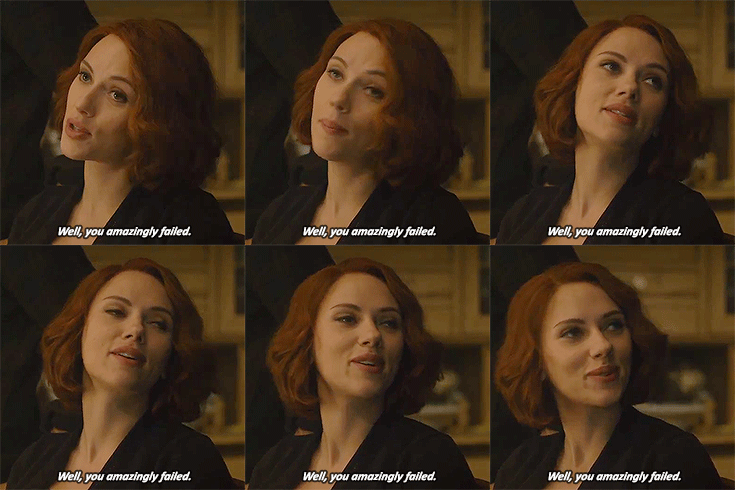
Truer words, Natasha.  Truer words.

Truer words, Natasha. Truer words.

I know this is a comic book movie. I’m happy to play by whatever comic-book rules get laid out in-universe: but not when those rules keep changing from moment to moment, for no better reason than to excuse sloppy storytelling. There’s a reason they’re called rules, after all— and I don’t think I’ve seen such egregious sloppiness since Into Dumbness.

One last observation. Joss Whedon has provoked a bit of an online shitstorm over Age of Ultra‘s treatment of Natasha Romanoff: the softening of her persona, the retconning of hyperefficient assassin down to lovelorn nurturer and soother of savage beasts. Having finally seen the film, I gotta say I don’t see what all the fuss is about. In the midst of all this wreckage, focusing so much outrage on the ham-fisted mishandling of one measly character is like watching a house burn down while complaining about the color of the living room drapes.

I’ve gone on too long. Sorry about that; I honestly expected to dispense with Ultron in a paragraph or two before moving on to greener pastures. But the more I thought about this movie, the worse it got. I could not bring myself to merely dismiss it. I had to tear at its rotting carcass for 1300 words. Ex Machina is coming, I promise.

For now, though, I have to wash this taste out of my mouth.

13 May 17:36

The last gasp of (US) neoliberalism

by John Quiggin

The defeat of the “trade promotion authority” bill in the US Senate marks a big setback for Obama’s attempts to push the (still secret) Trans-Pacific Partnership agreement through Congress. As always, there’s plenty of manoeuvring to come, and the deal may still get up, but even so, it looks like the last gasp for neoliberalism, in the US sense of the term.

In global terms, neoliberalism, epitomized by Thatcher in the UK, is an appropriation by conservative/reactionary parties of the economic component of classical liberalism, but without any of the associated concerns with personal freedom, except as this coincides with the desires of conservatives and reactionaries to maintain a social order where they can do as they have always done.

By contrast, US neoliberalism is a development from within US liberalism, closer to Blair’s Third Way than to Thatcher. In general, neoliberalism maintained and even extended “social liberalism”, in the US sense of support for equal marriage, reproductive choice and so on. In economic terms, its central claim was that the goals of the New Deal, central to Democratic Party politics, could best be pursued through market-friendly policies that would earn the support of the financial sector (the only major business sector that was prepared to back Democrats, or at least to bankroll suitable candidates from either party). Apart from subservience to Wall Street, the signature issues for US neoliberals were free trade, cuts in “entitlement” spending, and school reform1. In terms of political strategy, the big idea was a ‘grand bargain’, in which Republicans would accept minimal increases in taxation in return for the abandonment of most of the Democratic program.

The Clinton administration was explicitly neoliberal in all respects. Bush ran on a platform of “compassionate conservatism” designed to appropriate the appeal of neoliberalism, and was never really able to break with it. And, while Obama’s 2008 election campaign was masterfully ambiguous, his first Administration neoliberal through and through, dominated by Wall Streeters like Paulson, Geithner2 and Summers, and by neoliberal operators like Emanuel3 and Duncan. And the same would clearly have been true if Hillary Clinton had been elected.

But developments since then, including the global financial crisis, the failure of school reform4 and increasing awareness of entrenched inequality have destroyed the appeal of neoliberalism. It’s obvious by now that the neoliberal policy agenda belongs to the political right, and the backers of that agenda (for example, Wall Street and education reformers like Michelle Rhee) have recognised that fact as clearly as anyone.

The result has been a significant shift to the left in the second Obama Administration, reflected in more populist rhetoric, the abandonment of the search for bipartisanship and in some substantive policy shifts, for example on minimum wages. The big exceptions are issues like the TPP and the security state, where Obama was captured by the permanent government almost from day 1, and has never shifted.

Hillary Clinton is making similar adjustments, realizing that a purely cultural claim to affinity with working class whites, combined with an actual alliance with Wall Street, is no longer going to cut it electorally or within the Democratic Party. She’s maintained silence on the TPP so far, but I predict that, when she can no longer avoid the issue, she will be forced to come out against it.

What does this mean for the future of the Democratic Party? I’ll leave that up to readers for the moment.


  1. I’ve decided not to bother with scare quotes around “reform”. The word has been successfully appropriated by neoliberals, both in the US and global senses

  2. Geithner didn’t work on Wall Street until after his Treasury stint. But the NY Fed is pretty much a subsidiary. 

  3. I’ve read that Emanuel was the model for Josh Lyman in The West Wing, the fictional apotheosis of neoliberalism. 

  4. Reliably metronomic centrist Nick Kristof said a while back that, while he still supported school reform, the topic was now so politically toxic that he would focus instead on early childhood interventions where there is enough actual evidence of benefit to garner some broadbased support. 

11 May 18:20

elodieunderglass: nyshadidntbreakit: alexdallymacfarlane: Dav...


elodieunderglass:

nyshadidntbreakit:

alexdallymacfarlane:

David Mitchell on the apparent “sincerity” of David Cameron’s position on gay marriage

THERE IS NO FONT BIG ENOUGH TO CONTAIN MY YES, THIS

Wub Wub Wub.

David Mitchell’s comedic ranting delivery is so important to me, and I’m not even lying, I study it hard.

10 May 23:08

Theses on Identity Politics

transkafka:

Identity Politics are always based on flattening out experience, making the critique of society abstract rather than lived.  

Identity Politics promote cross-class alliances, thus offering those with more power (and thus an interest in the proliferation of class society) to silence the most marginalized within these alliances. 

Identity Politics are rooted in the ideology of victimization, and thus celebrate and come to enforce norms surrounding what activity people are allowed or able to participate in. This plays out by reinforcing certain mythologies  about struggle (i.e. “only cis-white-men participate in black blocs or “oppressed people are incapable of certain strategies of revolt”).

Identity Politics are always based on the fallacy of coherent communities. Some French people once said that “there are greater ethical differences within communities than between them.” That is to say that those trapped within certain “communities” or identity confines often have less in common with one another than they do with those who they are purported to be opposed to. This fallacy thrives on abstraction of experience rather than analysis of lived experience itself. A queer in prison has more in common with their straight cellmate than with some scumbag gay senator, and yet the mythology of the “queer community” serves to suffocate enemies of society and subjugate them to their self-appointed representatives.  

Identity Politics are fundamentally reformist and seek to find a more favorable relationship between different subject positions rather than to abolish the structures that produce those positions from the beginning. Identity politicians oppose “classism” while being content to leave class society intact. Any resistance to society must foreground the destruction of the subjectifying processes that reproduce society daily, and must destroy the institutions and practices that racialize and engender bodies within the social order. 

Identity Politics are deployed by, inherently refer to, always valorize and are in and of themselves the State. 

from Queer Ultraviolence: Bash Back! Anthology 

09 May 21:08

Don't give in: an angry population is hard to govern; a depressed population is easy

by Laurie Penny

Don't let the bastards get you down – choose action over despondency when coming to terms with the general election result.

Be angry, don't despair. Photo: Flickr/Pabak Sarkar

Hours after the Conservatives were re-elected, the government looked at cutting access to work schemes for the disabled. You'd think they'd at least have the decency to bring some flowers before shafting the vulnerable, but no. Not these guys. Not today. Today is not yesterday. Today, David Cameron does not just have the political will to slash welfare and widen the wealth gap: he has a mandate.

I have spent much of the past 48 hours lying in bed staring at the ceiling, reading despairing, four-letter posts on social media and trying to work out how on earth this happened, as if anyone with half a brain doesn't know. The political elites closed ranks and capitulated to a politics of fear, first in Scotland, and then across the nation.

The muddled, equivocating voice of what was once the party of the left could not compete with the merciless message of austerity telling us we got what’s coming to us. We know what that is. More cuts to public services. More inequality. More lies. More of the old Cameron doctrine with no pratting about pretending we’re all in it together. The same great taste, now with zero liberals.

A lot of people are very depressed today, and with good reason. I think it’s important to talk about that depression. Talking helps. I read that in a pamphlet somewhere.

Depression is a physical and emotional illness with a profound sociopolitical component. It’s also a total bastard. Depression tells you that you're lazy and worthless. That the bad things that may happen to you and your family are all your fault, and if you feel like dying, you'd better do it, and decrease the surplus population. Sound familiar?

There's a reason depression and its precarious cousin, anxiety, are the dominant political modes of late capitalism. This is how you're supposed to feel. This is how you do feel, if you accept their logic. You don't need a nasty little voice in your head telling you you're useless and deserve nothing. You've got Iain Duncan Smith. For five more years.

The Tories prey on the politics of despair, and I think we've let them do it. It’s not our fault. Depression is still a source of shame, especially in a country like this. When everything feels awful and out of control, it's paradoxically easier to blame yourself and your neighbours than it is to direct anger outwards.

When things are getting worse very quickly, when society is getting meaner and more expensive, when your work is precarious, your housing is precarious, and precariousness itself has become an anxious daily reality, it's somehow comforting to think that you and your community could have changed it all by making different choices. That it's your fault for being lazy and sick. It may not feel good, but it feels safe – safer than facing the idea that so many decisions about your life are being made without your input, by people whose interests are so alien to your own they may as well be on a slab in a base in New Mexico.

The psychiatrist M Scott Peck is one of many experts to observe that depression is just anger, defanged and turned in on itself. That's as true on a social level as it is on a political one. An angry population is hard to govern. A depressed population is easy. The new Tory government would really prefer it if our collective political position was “prone”.

It is no accident that, of all the public services that have been cut to the gristle by what we must now think of as the first five years of Tory austerity, the already-underfunded mental health system suffered most. The crisis in mental health in Britain is profoundly political.

The politics of the modern right are the politics of depression, and right now they are winning. What remains of the British left is flat on its back, staring at the ceiling in a mess of unwashed sheets, and shouting at it to get up is not going to help right now.

I’m not about to tell you to just buck up. I’m not advocating enforced blissed-outedness like a sort of fascist Gwyneth Paltrow. Some of my best friends are hippies, and I like yoga and meditation and suspicious smoothies as much as the next bourgeois lefty throwback, but downward-facing-dog is not a radical position, and that’s not what this is about.

I’m talking about treating ourselves and others, if we can stomach it, with some basic charity right now. I’m talking about being careful not to slip into catastrophic thinking, which is difficult, because there actually has been a catastrophe.

Depression is not inappropriate at this time. But the moment when you give in to it utterly is the moment they've won. They win when people start saying things like “that's just the way the world is”.

The opposite of depression is not happiness. It’s not even hope. The opposite of depression is action. It's dragging your bone-weary carcass into the shower and doing what needs to be done so you can deal with the day. It's reaching out to friends even when you have no idea what to say. It's making a to-do list, even if nine out of ten numbered points are “drink, because fuck this”.

The opposition of depression is action. Action is the only thing that gets us to a better world, and big actions start with very little ones. We don’t have to overthrow the government today. We can take a few days to drink cold tea and listen to Billy Bragg’s saddest albums. Depression wins when getting better seems so overwhelming as to be impossible. Recovery begins one tiny, tiny step at a time.

I understand that it's comparatively easy for me to say this. I have a job. I'm studying abroad right now at an elite American university. There is a huge difference between being depressed because your country is going to hell and your communities are fragmenting and being depressed because your own life, in addition, is about to implode under the weight of George Osborne’s red briefcase. Those of us with the good fortune to be in the former category have the option of staring blankly at the wall, because at least we still have a wall. More than anyone else, those people have a responsibility to get up and do something as soon as the hangovers wear off.

This is not a moment for people who happen to have made it through the past five years with moderate financial stability and our consciences intact to accept the narrative that we are assigned politics by class. That the best way to read our ethics, our understanding of the worth and purpose of humanity, is off the back of a bloody bank statement. This is not a moment to throw up our hands, open a packet of biscuits and say – fuck it, I got mine.

Because that’s a disgusting thing to do.

I am not particularly interested in how or whether the Labour party is going to choose to sort its sorry self out and provide a real, electable alternative to the politics of fear and hopelessness. I hope it does, but right now I'm more concerned about what's going to happen to people on the ground. Right now, the important thing is to take care of ourselves and one another, and to be as kind as possible. Because there’s a big fight ahead, and kindness is more important now than ever.

Kindness is mandatory. Anger is necessary. Despair is a terrible idea. Despair is how they win. They won’t win forever.

And we don't ever have to talk about Nick Clegg again now. So there's that.

09 May 15:04

Your cyberpunk games are dangerous

Your cyberpunk games are dangerous:

On a certain level, this story makes me really sad. There are still games and sci-fi stories that deal with technology that’s just on the cusp of becoming reality, but the thing is, that’s mostly military tech. And rather than posing protagonists in opposition to these technologies, or manipulating them against their masters, what do we see?

Call of Duty: Black Ops, mostly.

Cyberpunk is worse than dead. It wears a suit and collects a salary.

09 May 14:56

cyberpunk was a thing for three reasons:1. newly minted and rapidly accelerating computer technology...

cyberpunk was a thing for three reasons:

1. newly minted and rapidly accelerating computer technology lifted previously immutable physical constrains on the flow of information, and

2. authorities were not at all keeping pace with the rapid proliferation of infotech, and furthermore

3. it was clear that this technological advancement was proceeding exponentially with no end in sight, which played on the popular countercultural imagination.

cyberpunk is now dead because

1. computer technology has become relatively static,

2. authorities have enough understanding of infotech to muzzle it for most purposes, even if they can’t defang it entirely, and

3. infotech has become much more heavily commercialized, where previously it was an emergent phenomenon, and the commercialization was in manufacturing and selling the computers themselves – now there is nearly no profit margin in selling personal computers due to market saturation and OEM competition, and nobody can compete in chip manufacturing because of intel’s insurmountable head start on infrastructure and patents.

but

cyberpunk will come alive again when the infotech bubble bursts. because infotech has become wound into the fundamental infrastructure of the world, and has formed an extremely important link in how the young create culture and communicate, we will continue to make it work. when the frenzied grasping at monetization eventually consumes itself, toppling much of the industry, we will need to maintain what we have become accustomed to in the absence of the update treadmill, without the ubiquitous availability of new products hot and fresh from an east asian cleanroom factory.

we will be forced to maintain and repair what we already have with what is immediately available.

computer repair shops, rather than places where the savvy can sucker old people out of their money for five minute fixes, will become places where we keep computers alive and ticking as they wear down, and what is sold on the market will become much more focused around long-term usefulness.

the structure will adapt, but the inherent openness of the internet is in more than just the free flow of “valuable” data – it is in the free flow of cultural data. And the story of how the ‘net changed us has many chapters yet to be told.

08 May 18:30

A personal programming language roadmap

by Avdi Grimm
Zephyr Dear

Elm just shot up my list.

Elm
Elixir
Haskell
Clojure

Lately I’ve become increasingly sensitive to how little time I have left to learn new technologies. It’s not that I’m nearing death: I’m not, at least not by 21st century baseline human standards. It’s more a matter of the impossible and ever-expanding variety of tech that is out there to be learned. That, coupled with the limited time that that my work commitments and my family commitments leave me with; a spare few hours a week at most.

There are lots of reasons to learn new technologies.  Probably the most common reason is job-related necessity: land a C# gig, learn C#. I’m fortunate in that I don’t have to let work dictate what I learn at this point. I get to pick and choose how I will fill my limited research time based on other criteria.

I’ve always been a programming language hobbyist. I’ve always kept lists in my head, lists of languages that I “totally want to play around with one of these days”. Long lists. But it’s time to get realistic about what I can actually accomplish in the time I have.

Since time is precious, I don’t want to be haphazard. I don’t want to dabble. I have some vague ideas about how I’d like to contribute to the field of software development, and toward that end I want to maximize the utility of the time I spend in study.

So today I sat down, and took a look at my bookshelf. I thought about all the programming languages I have queued up in my mental “it would be fun to learn…” or “it would be fun to spend more time with…” lists. And I did some painful triage.

I came up with a list of programming languages I want to make a concerted to learn, because I think they will expand my skill and understanding in important ways. Ways that will hopefully equip me to explore some new directions I’ve been thinking about.

Here’s the list:

  • Smalltalk (in the form of Pharo) because I need to understand Alan Kay’s ideas better.
  • Elixir/Erlang, because I need to grok using agents and CSP in practice
  • Rust, because I need a better C++ for certain plans, and one finally exists.
  • Clojure, because I need to have hands-on experience with an industrial-strength lisp, persistent data structures, property testing, and the various asynchrony facilities it offers.
  • Elm, because I need to understand the reactive model better.
  • Emacs Lisp, because for greater efficiency I need to become more fluent in reworking my programming environment.
  • Io, because I need to understand how prototype-based objects influence program design.
  • Scheme, because I still want to work my way through SICP some day. Also, Chicken looks like fun.

This implicitly means there is a much longer list of languages that are off the table for now. It was tough letting go of some of these. A few notables include:

  • Node.js, because it offers nothing new.
  • Dart, TypeScript: Because as interesting as they are, they just aren’t relevant to what I’m doing.
  • Go, because I don’t need a better C.
  • Haskell: this hurts, because I badly want to do more with Haskell. But Haskell already expanded my brain once, and I need to expand my brain in different directions now.
  • Common Lisp: I really want to be able to say that I know Common Lisp. But realistically, modern lisp projects are going to be started in Clojure, not CL. The only reason I might go back on this is to understand CLOS better, so I can steal ideas from it.
  • Idris: there’s a future in stronger static analysis, but I don’t think it’s my future. I’m more interested in improving dynamic analysis.
  • Java 8: There’s nothing there for me that I don’t already have.
  • C# 6: A lot of neat ideas here, but none that will expand my horizons substantially.
  • C++11/14: Too little, too late, with too much baggage. Especially now that Rust is stable.
  • Scala: Mainly of interest from a Functional and Reactive point of view, and I think I have that covered between Clojure and Elm.
  • TCL: Part of me still wants to return to TCL and have some more fun with it. But it’s not going to move me forward in any meaningful way.
  • Modern Perl: Same discussion as TCL.
  • Python: a fine language, but too similar to Ruby to be worth re-acquainting myself at this point.
  • UPDATE: Factor, because unique as it is I haven’t seen anything to suggest that it will teach me things I need to know. I might be persuaded otherwise, however.
  • UPDATE: Julia, for the same reasons and with the same caveat as Factor.
  • UPDATE: Prolog, because I’m not solving that sort of problem. I may revisit this one.
  • UPDATE: Lua, because I don’t need to embed a super fast and simple scripting language in anything just now.

Of course, there’s a lot more to programming technology than just languages. But that’s a list for another day.

This is my roadmap, defined by some very particular and personal forces. It should not be your roadmap. But I thought I’d share it, as a source of ideas.

08 May 18:15

Drinking Myself To Permadeath In Brogue

by Graham Smith
Zephyr Dear

hey how come I've never heard of Brogue?

My favourite thing in roguelikes are the unidentified scrolls and potions, and no game does them better than the freeware, long-developed Brogue [official site]. It’s a mouse-controllable and surprisingly pretty ASCII roguelike in which quaffing everything you find is a valid early game strategy for identifying found potions and where reading every scroll is as likely to help you as hurt.

I decided to play the game with a rule: not only would I drink and read everything I found, I’d do so as soon as I found them, no matter what the situation. This is what happened.

… [visit site to read more]

07 May 22:39

The magician’s question: not “does it exist?,” but “does it work”?

by philphord
doom3

MF Doom in “Bookhead.” Not relevant, really, to what I’ve written below, but it feels right to put it here, and magic is all about how things feel.


I’ve mentioned elsewhere that my main interest these days is magic and magical styles of thought. Starting with my 2009 essay “Taboo: Time and Belief in Exotica,” I have slowly moved away from a fairly narrow rationalism to an appreciation of alternate rationalities. Now, a skeptic of the Martin Gardner variety will snort at that last sentence: “there is no such thing as an ‘alternate rationality.’ Something is either rational or it isn’t. And belief in magic isn’t rational — which is to say, it’s not worth a tinker’s damn.”*

To which Ramsey Dukes might reply, first, that such an is-it-or-isn’t-it binary is intellectually impoverishing, and, second, who said anything about believing in magic? A magical result (for example, a successful tarot reading) is something that manifests in an individual’s experience. You don’t need to believe in your experience; belief is what you need in order to accept propositions that you cannot experience, like “Jesus is the son of God” or “consciousness is solely a property of the brain.” The first proposition is religious and the second is scientific, but Dukes wants us to consider what things these forms of thought have in common. One of these is a concern with whether something is rather than what it does.

You probably have never heard of Ramsey Dukes. Only occultists read him, it seems, and not all of them by any means. But his book S.S.O.T.B.M.E. Revised: An Essay on Magic was one of the most pleasant surprises I had all in all the years of research I did for my book Dig. Here was a mathematician who did graduate work with John Conway at Cambridge in the 1960s and who used his precise, logical, well-trained mind to think seriously about something I was pretty sure didn’t exist.** (Or, in the two-proposition self-cancelling structure I have come to recognize as typical of us intellectual moderns, it is something that doesn’t exist and is in any event very terrible and wrong.)

Ramsey Dukes is a pseudonym, the magical persona of Lionel Snell. Actually, though, Snell comprises a whole community of personae: Ramsey Dukes, Liz Angerford, Ambrose Lea, Adamai Philotunus, and the Honorable Hugo L’Estrange, an urbane Satanist delighted by the Thatcher government’s perfect realization of his Satanic values. In his first books, especially, Dukes attributes all his best ideas to the brilliant but obscure British magician Lemuel Johnstone—who turns out to be yet another alternate persona. All this is easy to figure out now, in the internet age, but would have been a good deal more tricksterish back in the 1970s, when Dukes’s S.S.O.T.B.M.E. and Thundersqueak were first published.

He is also the author of a book with the absolute best title in literary history: Blast Your Way to Megabuck$ with my SECRET Sex-Power Formula: And Other Reflections Upon the Spiritual Path. That’s a good one to leave out in the bathroom for when company comes over. It’s worth noting, as Dukes does on the first page of the title essay, that he doesn’t actually have a secret sex-power formula and has never successfully blasted his way to megabucks. A strain of amused disappointment runs through Dukes’s work: at a certain point, he realized that no-one is going to get rich by writing intellectual books on the occult. New-Age and true-believer types aren’t going to like the “intellectual” part, and intellectuals aren’t going to like the “occult” part. Books like Dukes’s don’t get reviewed in the New York Times.*** Nevertheless, in a painfully funny essay on his career as a writer on weird and marginal topics, Dukes writes about an experience that is surely familiar to pretty much all writers of academic books:

The next step after writing the book that no-one will publish is to publish the book that no-one will review or buy. A certain sympathy with publishers is thereby gained. […]

As a book salesman, the nicest discovery is to find that bookshop staff do not frog-march you out by the scruff of the neck and demand in a loud voice before others present why you are wasting their time with such a pathetic and unsalable item. The vast majority are really quite friendly and quite prepared to give you a chance, on sale or return. So you love them so much that, when you creep back in disguise months later and find none are sold, you feel guilty about having betrayed their confidence in you […]

I recall visiting a big London bookshop and feeling almost drunk with joy to find my books had at last gone from the shelf. I sat down by the ornamental pool that the shop featured in order to savor my bliss — an attractive pool only spoilt by the litter that floated in it. Then I saw that the litter was my books. […]

“Publish and be damned” holds no meaning for us cranks, for we are well and truly damned by birthright.****

Anyway, there’s a lot more to say about Dukes’s ideas — Dukes is to my own thinking about magic what Lemuel Johnstone was to Dukes — but for now I want to dwell a while longer on that interesting distinction between what is and what works.

There’s a good interview with Dukes/Snell that touches on this point. The interviewer asks how someone like Snell, with his mathematical training, could interest himself in magic. Here is the response:

Oh, now that’s easy … If I tell a “rationalist” or people in the current scientific culture [that] a good way to do vegetable gardening is to speak to the fairies and ask them where you should put the plants—[to] get [their] advice, in other words, [like] what Findhorn did, where they spoke to the devas—the response tends to be “but there’s no such thing as fairies, they don’t exist. You can’t do that. They don’t exist, show me them, where do they live?”

Now when I was studying maths, our maths teacher came in one day and wrote on the board “let I be such that I squared= -1.” And for the whole rest of the first lesson we were all saying “but you can’t have a square root of a minus number, it doesn’t exist!” He said, “well think of it as another dimension.” [We responded] “OK, another dimension, which direction is it, where is it, you know, tell me this dimension”—all the sort of things people would say if you said fairies might exist in another dimension. So basically, we refused to co-operate because the square root of -1 doesn’t exist. But the mathematics thing is, well who cares whether it is exists or not? The thing is, does it work? So you start working as if it exists, and I emphasize as if, because that’s the magical formula: you act as if something is true, you act as if the tarot pack really was the wisdom of the ancients.

And the mathematician finds that not only does it work—you can create a mathematics on what they call imaginary numbers—but, the amazing thing is, it turns out to be utterly fundamental to the way the universe works. You know, electricity and all that sort of thing depends on these “imaginary” numbers. And you realize that that has gone on throughout history, because actually numbers don’t exist any more than fairies and yet our whole economy is built on them. So as a mathematician I wasn’t hung up on whether these things exist or not, but the question for me is, “do they work? Do they get you somewhere?” And our mathematics master, because we did maths and higher maths, we also had to do physics in those days, and when we went off to do [this] he said “oh, you’re off to the folklore department now.” He was very scornful about these scientists with their insistence that they would only work with things that existed! He said “that gets in the way of sheer logic.” So I see it as really quite fundamental to my magical thinking, the fact that I learned that what matters is whether something works, not whether it exists or not.

I suspect that a lot of musicologists will sympathize with this point of view. After a few drinks, a lot of us might find ourselves saying (at least among friends) “who cares if this analytical structure/socio-cultural dynamic/interpretive lens/whatever is ‘really there’ in the music? It feels right to me. It makes sense of the music. It yields insight. I don’t give a damn if it’s ‘what the composer intended’ or if it’s the one, true, privileged meaning of the music. I don’t even think there is such a meaning. It works for me, and if it works for you too, then that’s enough, because the name of the game here is meaning, and if I’ve increased the net amount of meaning in the world we share, then I’ve done my job.”

To deny magical thinking as a serious mode of thought, or to repress the recognition of it in our intellectual and everyday life, is to remain ignorant of how thinking really works. As Dukes writes at the beginning of S.S.O.T.B.M.E., “we might all think more clearly if we knew what we were doing.”

*I think this is a pretty realistic touch. Movement skeptics really do say things like “not worth a tinker’s damn.” Their favorite words — charlatan, mountebank, humbug, crackpot, etc. — have a fusty, empire ring to them, as if their blog comments were dyspeptic letters to Punch circa 1905. This is interesting, though for reasons that go beyond the main point of this post. Movements are set in motion not only by shared ideas but by shared images of the self. For all that skeptic movementarians would indignantly refuse to acknowledge that their ideological commitments are based in anything other than pure reason (or for that matter that they even have ideological commitments), they are inspired by their ideal skeptical persona, an anglophilic image of the donnish destroyer of illusion, the bibulous terror of the common-room, the Darwin’s-bulldog type armed with Olympian irony and sturdy common sense. That is what they admire; that is what they dream of being. Richard Dawkins and Christopher Hitchens, the real heroes of organized skepticism, can lay claim to their leadership of this movement for reasons other than their Englishness, but their Englishness accounts for their iconic (rather than merely representative) status.

**Now that I think of it, Dukes is exactly the kind of clever and sardonic Englishman that movement skeptics want to be, though from their point of view he would doubtless appear much as Professor James Moriarty appeared to Sherlock Holmes, a monstrous perversion of intellectual talent.

*** More’s the pity, as he is one of my favorite writers. I long to write an essay-review of his works. Are you listening, mainstream book review editors? I work for cheap. Very, very cheap.

**** Ramsey Dukes, “On Writing and Publishing: A Crank’s Progress,” in What I Did In My Holidays: Essays on Black Magic, Satanism, Devil Worship, and other Niceties (Mandrake, 1998), 195. Another pretty impressive title and an excellent thing to leave out when your kids have their friends over.


07 May 17:19

On the Topic of the Avengers 2

by Damion Schubert

Shortly after the launch of Avengers 2, Joss Whedon decided to take a break from Twitter.  This prompted the Outrage Machine to spin up and announce that Joss’ departure was based on the shrill response he got from feminists based on the depiction of Black Widow in the movie.  Joss has since replied that this notion is ‘horseshit’.

“I saw a lot of people say, ‘Well, the social justice warriors destroyed one of their own!’ It’s like, Nope. That didn’t happen,” he continued. “I saw someone tweet it’s because Feminist Frequency pissed on Avengers 2, which for all I know they may have. But literally the second person to write me to ask if I was OK when I dropped out was [Feminist Frequency founder] Anita [Sarkeesian].”

For the record, I didn’t see Anita say anything on twitter personally, but I did see her partner Josh McIntosh wonder why the Avengers 2 has so much darned violence in it.  The answer is simple: because it’s the FUCKING AVENGERS.  You don’t make a movie starring the Hulk, for example, and then have him not smash things in an orgy of violence the whole time.  Unless you’re Ang Lee.  Note: this is probably something that most directors consider a cautionary tale.  I sure do.

Still, Joss’ makes a point that I want to underscore, which is that you shouldn’t get in the business of making pop culture (movies, television, books, video games, whatever) unless you’re prepared for your creation to be cross-examined and critiqued by pretty much everyone who touches it.  Joss has been being praised and criticized by feminists for his portrayals of women going back to Buffy.  He’s also gotten plenty of criticism from people complaining about how the Avengers were portrayed from die-hard comic book nerds (“Tony Stark didn’t make the Vision, Hank Pym did!”)  As a creator, this is all input.  You take what is useful to you, and you discard the rest.  If you’re too thin-skinned for this process, then you’re too much of a mewling baby to actually handle being a film or game creator.

 This thread of redditors whining about Joss’ capitulation, and occasionally comparing Joss Whedon to a beaten husband is an excellent menagerie of people who clearly are too thin-skinned to actually put themselves out there.

That being said, let’s talk about the Avengers 2 and what’s wrong with it.

I thought that the Hulk/Black Widow storyline was the only sour note in what is otherwise perhaps one of the finest comic book movies I’ve ever seen.  In particular, I loved their treatment of Scarlet Witch, really enjoyed the treatment of the rising tension between Cap and Iron Man (which will conclude in Civil War), and I adored James Spader so much as Ultron that I want to release a  recut of the movie with Ultron only using Robert California quotes.

But that Black Widow storyline – seriously, WTF.

There’s a lot of people complaining about various aspects, but I don’t buy into most of them. For example, sure, she’s damseled, but that’s after the most heroic act in the movie by any hero, and once damseled, she immediately uses her tech know-how to rescue herself by leading the Avengers to her location.  It’s all good.

However, it’s pretty disquieting when a woman describes herself as a monster because she can’t have kids.  NOT because she’s a ruthless assassin who has done some pretty dark things (a storyline I though was very well-handled in the first movie, and was dropped here).  But because she’s sterile.  As IO9 points out:

That’s what the Red Room did to her. It’s not the loss of innocence through killing or being forced to live a life of betraying people. The greatest loss is motherhood. That’s why she’s a monster like the Hulk. Poor Black Widow. She leaned in, and where did it get her? She’s a lonely, incomplete, monster.

Alyssa Rosenberg disagrees:

And ultimately that’s a great deal of what I want from my female action heroes: that they not be required to take off their femininity when they suit up for battle, and that they not be required to leave it hanging in the closet when they return from the wars. Certainly, there are some female characters for whom violence may be straightforward and have few other implications for their senses of self. But isn’t the whole point of having women as well as men be superheroes and swordfighters that they bring a new range of perspectives to our experiences of these very old stories?

And this is all valid.  What Rosenberg misses in her analysis, though, is that the Age of Ultron Black Widow rubs people the wrong way because she doesn’t act in a way that is at all consistent with what we know about Black Widow.

Natasha has always been an interesting character because she is a femme fatale who fights on our side.  She is Mata Hari, but fights (and kills) on the side of the angels.  This is not a story that gets told very often, and it’s interesting.  She has no superpowers, beyond being cold, calculating, and willing to do ‘whatever it takes’ to get the job done.  That will and tenacity is the only thing that allows her to get on the same battlefield with titans and gods.  In the first Avengers, you got that clearly.  In this movie, you got 2 hours of Widow being tentative and full of self-doubt, going back before the Witch charmed her.

The definitive Natasha scene for me in any Marvel movie is her tied to a chair in The Avengers.  She’s clearly been caught using a sex kitten ploy to get information, and is now tied to a chair and is being interrogated.  As the scene unfolds, it becomes clear that things are not as they seem, and that there has been no point in the exchange where she’s not in full control.  She’s been toying with them all this time, which has been easy because men are pretty dumb when around a beautiful woman.

I would have liked to see THAT Natasha giving the Hulk a lullabye. Watch her switch seamlessly into calming, soothing feminine force in complete and firm control, and then once the job is done, switch back ‘on’ Ruthless mode to rejoin the team.  Lullabye mode is just an extension of her willingness to use male foibles to get the job done.  Instead, we got the  tentative, cautious, fearful Black Widow that is suddenly deciding out of nowhere that maybe she DOESN’T want to get it done.

Her willingness to get it done’, as mentioned previously, is her motherfucking superpower.

I would have liked to see THAT discussion of whether she’s a monster.  Is someone who toys with intimacy as a weapon a monster?  Does someone who can control a monster  become a monster?  These are still interesting questions which challenge feminism and what we know about the character – but they feel like questions that would challenge the Black Widow we know.

We also get a Black Widow who seems cautious, tentative and coy when chasing a man she clearly wants.  Um, really?

I dunno.  Overall, I still loved the movie, and I thought that Scarlett did a good job with the lines she was given.  All of this is more impressive (and discordant from her themes) when you realize she was pregnant throughout filming.  I just kind of wish that the Black Widow I loved from the previous Marvel films had made an appearance.


05 May 20:17

It's Going to be A Hard, Hard Fall

by Josh Marshall

People are still talking about the now preposterous possibility of a Christie presidential campaign that isn't an abysmal flop. But once folks come back to reality — and even more once Christie comes back to planet Earth and even tacitly admits his career in politics is likely over — there's a dark story that's ready to be told. And that is that Chris Christie has stepped on and pissed off enough people on his ascent through New Jersey and now national politics that it is going to be a brutal fall. There's no soft landing in the offing. This is probably just a hint of what's coming.

05 May 18:58

self-critical-automaton: sadjadewithcake: I am the only person in the world who thinks that Billy...

self-critical-automaton:

sadjadewithcake:

I am the only person in the world who thinks that Billy Crystal’s performance as Calcifer justifies the rest of that fucking dub, so never accuse me of having my standards set too high.

(OTOH I can’t watch Kiki’s Delivery Service in English without thinking “Hi there, I’m Troy McClure! You may remember me from such talking animal roles as the uncomfortably racist bird in a recent Disney animated special, or Lassie in Lassie IV: Timmy’s Revenge.”)

i honestly think christian bale’s howl is a fantastic performance

i only watched the english dub until earlier this year and i was extremely uncomfortable with the fact that a male drag performer was cast to play the witch of the waste, because of the implication. Also, I’m rather attached to some of the liberties that were taken with the script in the english translation tbh, they make the end a little more emotionally impactful for me.

And yeah, Billy Crystal was an amazing calcifer, and somehow Bale’s deep soothing voice feels right at home in Howl’s throat, and actually increases my Howl-is-not-a-man feelings.

05 May 17:52

drethelin:Different personality traits are beneficial depending on whether you’re living in a highly...

drethelin:

Different personality traits are beneficial depending on whether you’re living in a highly dense or a very sparse area. Being strong, ready to fight, and comfortable on your own is an adaptation to rarely seeing people, having to do your own physical labor, and with only meeting people rarely and not in situations conducive to long-term cooperation. It also means bonds that do form can be longer and more loyal: once you establish someone as a friend and not a threat, they’re very valuable. Being ready to fight to signal your ability to defend yourself and possessions is not only far more costly when you’re SURROUNDED by people, it’s far less valuable when there are police and tons of witnesses everywhere. etc.

04 May 20:18

under the cut for spoilery musings about why Ultron/SpaderBot fell so flat for me, and again, grain...

under the cut for spoilery musings about why Ultron/SpaderBot fell so flat for me, and again, grain of salt: I didn’t finish the movie. (If any of this is clarified later in the movie, please do let me know - this isn’t so much a ‘review’ as a collection of thoughts and questions based on an incomplete experience.)

1. how much of Ultron is based on Tony Stark’s programming and how much is based on a pre-existing alien AI? 

2. if Ultron is based on Tony’s brain patterns and behaviors, why isn’t Ultron equally Bruce’s ‘son,’ since at no point was Tony shown working on Ultron independent of Bruce? 

3. Was Ultron conscious as one of Tony’s drones at the beginning? Why does he feel so strongly about ‘having no strings’ if he doesn’t know what it means to have strings in the first place? 

4. Ultron was traditionally created by Hank Pym, a prime moment of YOU DUN FUCKED UP, PYM. Hank Pym is like, the anti-Tony Stark. Everyone hates Hank Pym including Hank Pym. No one ever lets Hank Pym live down his mistakes. Like Ultron.

5. Tony Stark just kind of did it by accident because I guess otherwise he would be too unlikable? But you HAVE TO COMMIT. If it’s Tony’s fault, it’s Tony’s fault, but it doesn’t really seem to be. Ultron could easily be almost entirely alien AI, with little of Tony’s programming. He said he wasn’t close to cracking it. Tony goes on to make Vision ON PURPOSE, and he IS right about that. So really, we should have all been listening to Tony all along. 

6. Seriously, why the hell does Ultron talk that way. WHY do I have to watch a super-advanced alien AI say “If I could throw up in my mouth, I would” and this is NEVER COMMENTED ON. Did Ultron learn to talk that way from reading message boards? Is he the Meme King? WHY. 

7. Apparently people really like Spader. I have no opinion on Spader, except every Blacklist ad I see makes me inexplicably angry. I don’t know what the Blacklist is about but I assume it is about Spader having some kind of ‘list’ that is bad and then he smirks about it while wearing a fedora.

8. Daddy issues. Ultron is all about those daddy issues. But we don’t ever seen Tony and Ultron like. Having any kind of relationship with each other? And we still don’t know if Ultron actually remembers being a rando drone or if he even was at all?? (Maybe this was commented on later in the movie and I missed it). Again, if you’re gonna commit, YOU GOTTA COMMIT. 


This could’ve been fixed with way more setup of why Ultron is behaving the way he is, but no, we just skip to the end. He goes straight from “hello I am alive” (which was a pretty cool scene) to “kill all humans” which is a familiar story that pretty much everyone recognizes, but it’s treated as shorthand. It’s like, oh remember how in some movies AIs get super intelligent and turn against their creators? That’s what this is. Also he’s the fucking quip master. I know you watched Avengers 1 and were like “damn, I wish there was another Tony Stark in this movie that I could watch when I wasn’t watching Tony Stark.” 


The thing is, I don’t think this is hard to fix. And actually it’s very possible that this all WAS in the first cut of the movie. I don’t know if I’ll ever gel with Ultron’s bizarre speech patterns and mushy metal face, but with SOME setup I’d at least be chill about it. Unfortunately, that setup…kind of ends up making Tony unambiguously the villain/a giant fuckup. Just like Hank Pym. Show Tony working on Ultron secretly, independently of Bruce. Show how his paranoia manifests itself in the creation of Ultron. You really just need that one extra scene. We just need one conversation between the two of them, even just a one-sided one where Tony isn’t aware that Ultron is listening. If Ultron IS basing his speech and behavior on Tony, SHOW HOW HE MAKES THAT CONNECTION. Heck, extending his “I am alive” moment would help - show what information he comes up with in a little more detail. 

HELL. AND THIS WOULD BE AWESOME: HAVE HIM ASSIMILATE JARVIS. And use Jarvis’s memories as part of his education. Jarvis DOES have a close relationship with Tony. What if that were corrupted/manipulated to culminate in the creation of Vision, before he chooses the Avengers’ side at the end? 


Look. I love robots. I love robot characters. I like it when robots learn to love and I like it when robots try to figure out what it means to be human and I like it when robots rebel against the creators and I like it when robots take human motivations to their logical conclusion. In my perfect world, Ultron fulfills like, 3 out of those 4. He very emphatically does NOT learn to love, but he decides that everything about him that was made in the image of humans is flawed and that’s why he makes Vision - a robot made by a robot, which is my ABSOLUTE favorite thing, especially since Vision looks like a Christmas tree and is adorable and DOES learn to love. Both Vision and Ultron are two sides of the same coin: both trying to figure out how to be TRUE individuals, outside of their programming. Ultron, unfortunately, doesn’t stand a chance. He is a glitch, a virus, personified, but though he takes on a life of his own everything he is is based on human programming. His human programming alway comes back into play no matter what choices he makes. Vision, being one degree of separation away from human programming, is the one who actually is capable of making his own decisions and becoming a true individual. Which is why I’m a little mad about the “Jarvis was hiding and Tony just pops him in a robot body” plot point but I didn’t see this actually play out and at least Jarvis is very charming and likable and I bet he makes a great robot. 

04 May 18:15

dreamkeeperscomic: (via...


dreamkeeperscomic:

(via https://www.youtube.com/watch?v=idAzyJpO7o8)

Many pearls of wisdom here about writing, especially if (as happens to many of us) you find yourself stuck in that learning-before-doing phase of your pet creative undertaking.

04 May 05:33

starlingsongs: everyone knows about the Geek Social Fallacies but what about Geek Economic...

starlingsongs:

everyone knows about the Geek Social Fallacies but what about Geek Economic Fallacies?

#1. It’s Free! All It Requires Is Time!

#2. All Problems Are Technical Problems

04 May 05:32

gogul-mun: “I feared for my life…”1st video2nd video What the...


gogul-mun:

“I feared for my life…”
1st video
2nd video

What the actual fuck

04 May 05:31

honestly it all just kind of hit me writing that last postcis gay people are not There for each...

honestly it all just kind of hit me writing that last post

cis gay people are not There for each other in a financial sense bc for the most part they don’t need to be. You don’t wear gay in your flesh.

But trans people are seen and we’re targeted and we’re made to suffer, and not just by being beaten in the street but by being denied opportunities that cis people, even gay cis people, would never be denied, if only because they can be invisible if need be.

but in the face of that, where is the supposed LGBT collective solidarity? where are queers who have, even if only a little, sticking their necks out for queers who have-not?

nowhere. All the support I’ve received in my state of dire need has been from other trans women. Not even from trans men, only other trans women.

Are you going to read this and come around and say “that’s greedy, I don’t have to do anything of the sort, you don’t deserve it, I earned it!”

Dare you?