dave strider: *turns chair backwards* so john the whole idea of "confirming" a character as "canonically" gay is restrictive and reductive, as if it's a checklist or a puzzle to be solved rather than a set of experiences to go through and,
fandom: *shaking the tea leaves* DAVE CONFIRMED GAY? OR NO?? Where are the answers! *pins another photo to the red twine corkboard*
Shared posts
30 Apr 21:48

Prescriptions, Paradoxes, and Perversities
by Scott Alexander
[WARNING: I am not a pharmacologist. I am not a researcher. I am not a statistician. This is not medical advice. This is really weird and you should not take it too seriously until it has been confirmed]
I.
I’ve been playing around with data from Internet databases that aggregate patient reviews of medications.
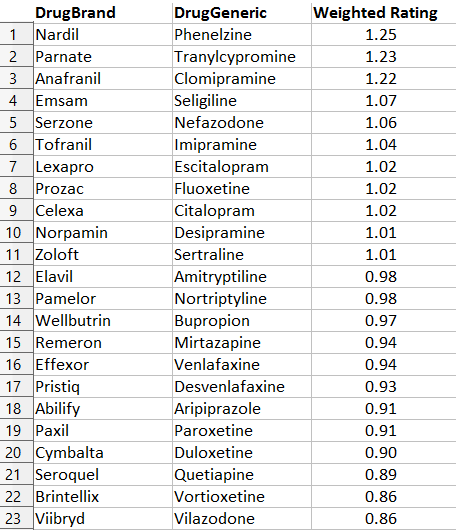
Are these any good? I looked at four of the largest such databases – Drugs.com, WebMD, AskAPatient, and DrugLib – as well as psychiatry-specific site CrazyMeds – and took their data on twenty-three major antidepressants. Then I correlated them with one another to see if the five sites mostly agreed.
Correlations between Drugs.com, AskAPatient, and WebMD were generally large and positive (around 0.7). Correlations between CrazyMeds and DrugLib were generally small or negative. In retrospect this makes sense, because these two sites didn’t allow separation of ratings by condition, so for example Seroquel-for-depression was being mixed with Seroquel-for-schizophrenia.
So I threw out the two offending sites and kept Drugs.com, AskAPatient, and WebMD. I normalized all the data, then took the weighted average of all three sites. From this huge sample (the least-reviewed drug had 35 ratings, the most-reviewed drug 4,797) I obtained a unified opinion of patients’ favorite and least favorite antidepressants.
This doesn’t surprise me at all. Everyone secretly knows Nardil and Parnate (the two commonly-used drugs in the MAOI class) are excellent antidepressants1. Oh, nobody will prescribe them, because of the dynamic discussed here, but in their hearts they know it’s true.
Likewise, I feel pretty good to see that Serzone, which I recently defended, is number five. I’ve had terrible luck with Viibryd, and it just seems to make people taking it more annoying, which is not a listed side effect but which I swear has happened.
The table also matches the evidence from chemistry – drugs with similar molecular structure get similar ratings, as do drugs with similar function. This is, I think, a good list.
Which is too bad, because it makes the next part that much more terrifying.
II.
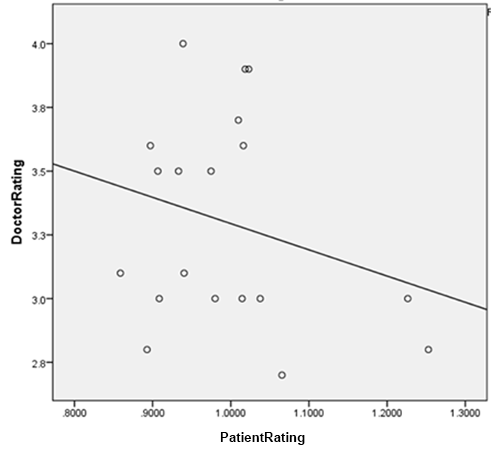
There is a sixth major Internet database of drug ratings. It is called RateRx, and it differs from the other five in an important way: it solicits ratings from doctors, not patients. It’s a great idea – if you trust your doctor to tell you which drug is best, why not take advantage of wisdom-of-crowds and trust all the doctors?
The RateRX logo. Spoiler: this is going to seem really ironic in about thirty seconds.
RateRx has a modest but respectable sample size – the drugs on my list got between 32 and 70 doctor reviews. There’s only one problem.
You remember patient reviews on the big three sites correlated about +0.7 with each other, right? So patients pretty much agree on which drugs are good and which are bad?
Doctor reviews on RateRx correlated at -0.21 with patient reviews. The negative relationship is nonsignificant, but that just means that at best, doctor reviews are totally uncorrelated with patient consensus.
This has an obvious but very disturbing corollary. I couldn’t get good numbers on how times each of the antidepressants on my list were prescribed, because the information I’ve seen only gives prescription numbers for a few top-selling drugs, plus we’ve got the same problem of not being able to distinguish depression prescriptions from anxiety prescriptions from psychosis prescriptions. But total number of online reviews makes a pretty good proxy. After all, the more patients are using a drug, the more are likely to review it.
Quick sanity check: the most reviewed drug on my list was Cymbalta. Cymbalta was also the best selling antidepressant of 2014. Although my list doesn’t exactly track the best-sellers, that seems to be a function of how long a drug has been out – a best-seller that came out last year might have only 1/10th the number of reviews as a best-seller that came out ten years ago. So number of reviews seems to be a decent correlate for amount a drug is used.
In that case, amount a drug is used correlates highly (+0.67, p = 0.005) with doctors’ opinion of the drug, which makes perfect sense since doctors are the ones prescribing it. But amount the drug gets used correlates negatively with patient rating of the drug (-0.34, p = ns), which of course is to be expected given the negative correlation between doctor opinion and patient opinion.
So the more patients like a drug, the less likely it is to be prescribed2.
III.
There’s one more act in this horror show.
Anyone familiar with these medications reading the table above has probably already noticed this one, but I figured I might as well make it official.
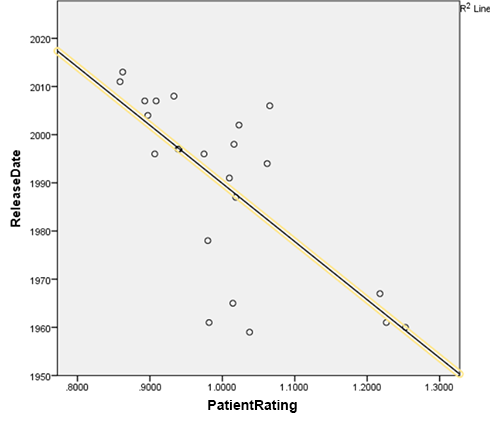
I correlated the average rating of each drug with the year it came on the market. The correlation was -0.71 (p 3.
This pattern absolutely jumps out of the data. First- and second- place winners Nardil and Parnate came out in 1960 and 1961, respectively; I can’t find the exact year third-place winner Anafranil came out, but the first reference to its trade name I can find in the literature is from 1967, so I used that. In contrast, last-place winner Viibryd came out in 2011, second-to-last place winner Abilify got its depression indication in 2007, and third-to-last place winner Brintellix is as recent as 2013.
This result is robust to various different methods of analysis, including declaring MAOIs to be an unfair advantage for Team Old and removing all of them, changing which minor tricylics I do and don’t include in the data, and altering whether Deprenyl, a drug that technically came out in 1970 but received a gritty reboot under the name Emsam in 2006, is counted as older or newer.
So if you want to know what medication will make you happiest, at least according to this analysis your best bet isn’t to ask your doctor, check what’s most popular, or even check any individual online rating database. It’s to look at the approval date on the label and choose the one that came out first.
IV.
What the hell is going on with these data?
I would like to dismiss this as confounded, but I have to admit that any reasonable person would expect the confounders to go the opposite way.
That is: older, less popular drugs are usually brought out only when newer, more popular drugs have failed. MAOIs, the clear winner of this analysis, are very clearly reserved in the guidelines for “treatment-resistant depression”, ie depression you’ve already thrown everything you’ve got at. But these are precisely the depressions that are hardest to treat.
Imagine you are testing the fighting ability of three people via ten boxing matches. You ask Alice to fight a Chihuahua, Bob to fight a Doberman, and Carol to fight Cthulhu. You would expect this test to be biased in favor of Alice and against Carol. But MAOIs and all these other older rarer drugs are practically never brought out except against Cthulhu. Yet they still have the best win-loss record.
Here are the only things I can think of that might be confounding these results.
Perhaps because these drugs are so rare and unpopular, psychiatrists only use them when they have really really good reason. That is, the most popular drug of the year they pretty much cluster-bomb everybody with. But every so often, they see some patient who seems absolutely 100% perfect for clomipramine, a patient who practically screams “clomipramine!” at them, and then they give this patient clomipramine, and she does really well on it.
(but psychiatrists aren’t actually that good at personalizing antidepressant treatments. The only thing even sort of like that is that MAOIs are extra-good for a subtype called atypical depression. But that’s like a third of the depressed population, which doesn’t leave much room for this super-precise-targeting hypothesis.)
Or perhaps once drugs have been on the market longer, patients figure out what they like. Brintellix is so new that the Brintellix patients are the ones whose doctors said “Hey, let’s try you on Brintellix” and they said “Whatever”. MAOIs have been on the market so long that presumably MAOI patients are ones who tried a dozen antidepressants before and stayed on MAOIs because they were the only ones that worked.
(but Prozac has been on the market 25 years now. This should only apply to a couple of very new drugs, not the whole list.)
Or perhaps the older drugs have so many side effects that no one would stay on them unless they’re absolutely perfect, whereas people are happy to stay on the newer drugs even if they’re not doing much because whatever, it’s not like they’re causing any trouble.
(but Seroquel and Abilify, two very new drugs, have awful side effects, yet are down at the bottom along with all the other new drugs)
Or perhaps patients on very rare weird drugs get a special placebo effect, because they feel that their psychiatrist cares enough about them to personalize treatment. Perhaps they identify with the drug – “I am special, I’m one of the only people in the world who’s on nefazodone!” and they become attached to it and want to preach its greatness to the world.
(but drugs that are rare because they are especially new don’t get that benefit. I would expect people to also get excited about being given the latest, flashiest thing. But only drugs that are rare because they are old get the benefit, not drugs that are rare because they are new.)
Or perhaps psychiatrists tend to prescribe the drugs they “imprinted on” in medical school and residency, so older psychiatrists prescribe older drugs and the newest psychiatrists prescribe the newest drugs. But older psychiatrists are probably much more experienced and better at what they do, which could affect patients in other ways – the placebo effect of being with a doctor who radiates competence, or maybe the more experienced psychiatrists are really good at psychotherapy, and that makes the patient better, and they attribute it to the drug.
(but read on…)
V.
Or perhaps we should take this data at face value and assume our antidepressants have been getting worse and worse over the past fifty years.
This is not entirely as outlandish as it sounds. The history of the past fifty years has been a history of moving from drugs with more side effects to drugs with fewer side effects, with what I consider somewhat less than due diligence in making sure the drugs were quite as effective in the applicable population. This is a very complicated and controversial statement which I will be happy to defend in the comments if someone asks.
The big problem is: drugs go off-patent after twenty years. Drug companies want to push new, on-patent medications, and most research is funded by drug companies. So lots and lots of research is aimed at proving that newer medications invented in the past twenty years (which make drug companies money) are better than older medications (which don’t).
I’ll give one example. There is only a single study in the entire literature directly comparing the MAOIs – the very old antidepressants that did best on the patient ratings – to SSRIs, the antidepressants of the modern day4. This study found that phenelzine, a typical MAOI, was no better than Prozac, a typical SSRI. Since Prozac had fewer side effects, that made the choice in favor of Prozac easy.
Did you know you can look up the authors of scientific studies on LinkedIn and sometimes get very relevant information? For example, the lead author of this study has a resume that clearly lists him as working for Eli Lilly at the time the study was conducted (spoiler: Eli Lilly is the company that makes Prozac). The second author’s LinkedIn profile shows he is also an operations manager for Eli Lilly. Googling the fifth author’s name links to a news article about Eli Lilly making a $750,000 donation to his clinic. Also there’s a little blurb at the bottom of the paper saying “Supported by a research grant by Eli Lilly and company”, then thanking several Eli Lilly executives by name for their assistance.
This is the sort of study which I kind of wish had gotten replicated before we decided to throw away an entire generation of antidepressants based on the result.
But who will come to phenelzine’s defense? Not Parke-Davis , the company that made it: their patent expired sometime in the seventies, and then they were bought out by Pfizer5. And not Pfizer – without a patent they can’t make any money off Nardil, and besides, Nardil is competing with their own on-patent SSRI drug Zoloft, so Pfizer has as much incentive as everyone else to push the “SSRIs are best, better than all the rest” line.
Every twenty years, pharmaceutical companies have an incentive to suddenly declare that all their old antidepressants were awful and you should never use them, but whatever new antidepressant they managed to dredge up is super awesome and you should use it all the time. This sort of does seem like the sort of situation that might lead to older medications being better than newer ones. A couple of people have been pushing this line for years – I was introduced to it by Dr. Ken Gillman from Psychotropical Research, whose recommendation of MAOIs and Anafranil as most effective match the patient data very well, and whose essay Why Most New Antidepressants Are Ineffective is worth a read.
I’m not sure I go as far as he does – even if new antidepressants aren’t worse outright, they might still trade less efficacy for better safety. Even if they handled the tradeoff well, it would look like a net loss on patient rating data. After all, assume Drug A is 10% more effective than Drug B, but also kills 1% of its users per year, while Drug B kills nobody. Here there’s a good case that Drug B is much better and a true advance. But Drug A’s ratings would look better, since dead men tell no tales and don’t get to put their objections into online drug rating sites. Even if victims’ families did give the drug the lowest possible rating, 1% of people giving a very low rating might still not counteract 99% of people giving it a higher rating.
And once again, I’m not sure the tradeoff is handled very well at all.6.
VI.
In order to distinguish between all these hypotheses, I decided to get a lot more data.
I grabbed all the popular antipsychotics, antihypertensives, antidiabetics, and anticonvulsants from the three databases, for a total of 55,498 ratings of 74 different drugs. I ran the same analysis on the whole set.
The three databases still correlate with each other at respectable levels of +0.46, +0.54, and +0.53. All of these correlations are highly significant, p
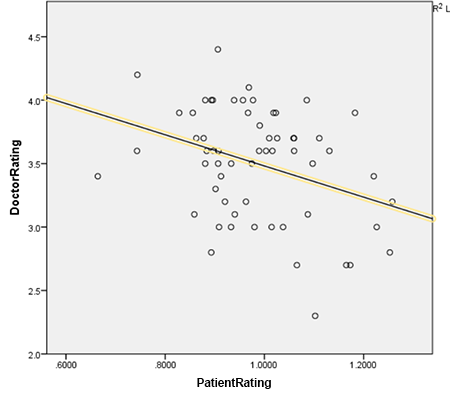
The negative correlation between patient rating and doctor rating remains and is now a highly significant -0.344, p
The correlation between patient rating and year of release is a no-longer-significant -0.191. This is heterogenous; antidepressants and antipsychotics show a strong bias in favor of older medications, and antidiabetics, antihypertensives, and anticonvulsants show a slight nonsignificant bias in favor of newer medications. So it would seem like the older-is-better effect is purely psychiatric.
I conclude that for some reason, there really is a highly significant effect across all classes of drugs that makes doctors love the drugs patients hate, and vice versa.
I also conclude that older psychiatric drugs seem to be liked much better by patients, and that this is not some kind of simple artifact or bias, since if such an artifact or bias existed we would expect it to repeat in other kinds of drugs, which it doesn’t.
VII.
Please feel free to check my results. Here is a spreadsheet (.xls) containing all of the data I used for this analysis. Drugs are marked by class: 1 is antidepressants, 2 is antidiabetics, 3 is antipsychotics, 4 is antihypertensives, and 5 is anticonvulsants. You should be able to navigate the rest of it pretty easily.
One analysis that needs doing is to separate out drug effectiveness versus side effects. The numbers I used were combined satisfaction ratings, but a few databases – most notably WebMD – give you both separately. Looking more closely at those numbers might help confirm or disconfirm some of the theories above.
If anyone with the necessary credentials is interested in doing the hard work to publish this as a scientific paper, drop me an email and we can talk.
Footnotes
1. Technically, MAOI superiority has only been proven for atypical depression, the type of depression where you can still have changing moods but you are unhappy on net. But I’d speculate that right now most patients diagnosed with depression have atypical depression, far more than the studies would indicate, simply because we’re diagnosing less and less severe cases these days, and less severe cases seem more atypical.
2. First-place winner Nardil has only 16% as many reviews as last-place winner Viibryd, even though Nardil has been on the market fifty years and Viibryd for four. Despite its observed superiority, Nardil may very possibly be prescribed less than 1% as often as Viibryd.
3. Pretty much the same thing is true if, instead of looking at the year they came out, you just rank them in order from earliest to latest.
4. On the other hand, what we do have is a lot of studies comparing MAOIs to imipramine, and a lot of other studies comparing modern antidepressants to imipramine. For atypical depression and dysthymia, MAOIs beat imipramine handily, but the modern antidepressants are about equal to imipramine. This strongly implies the MAOIs beat the modern antidepressants in these categories.
5. Interesting Parke-Davis facts: Parke-Davis got rich by being the people to market cocaine back in the old days when people treated it as a pharmaceutical, which must have been kind of like a license to print money. They also worked on hallucinogens with no less a figure than Aleister Crowley, who got a nice tour of their facilities in Detroit.
6. Consider: Seminars In General Psychiatry estimates that MAOIs kill one person per 100,000 patient years. A third of all depressions are atypical. MAOIs are 25 percentage points more likely to treat atypical depression than other antidepressants. So for every 100,000 patients you give a MAOI instead of a normal antidepressant, you kill one and cure 8,250 who wouldn’t otherwise be cured. The QALY database says that a year of moderate depression is worth about 0.6 QALYs. So for every 100,000 patients you give MAOIs, you’re losing about 30 QALYs and gaining about 3,300.
29 Apr 17:53


On Praiseworthiness
by ozymandias
There is a common criticism of allies in social justice movements as “seeking cookies.” The prototypical interaction goes something like this:
Straight person: I think gay people should be allowed to get married!
Gay person: Good… for you?
Straight person: I don’t say the word ‘faggot’!
Gay person: I’m glad?
Straight person: I have never in my life beat up a gay person for being gay!
Gay person: …do you want a medal?
This is, of course, very silly behavior.
There is also a very common argument in animal rights movements that goes something like this:
Alice: Meat is murder!
Bob: That’s not fair. A lot of people don’t know how to be vegan. We should encourage people to reduce their meat consumption as much as they can and accept that a lot of times they’re still going to be eating meat.
Alice: Um. Animals are literally getting tortured.
Bob: Yes, that’s why I’m saying we should get people to have Meatless Mondays or maybe switch to free-range eggs.
Alice: Meatless Mondays? Would you support Murderless Mondays?
Bob: If the average person killed more than one person a day YOU’RE FUCKING RIGHT I WOULD.
I think both of those interactions are getting at the idea of praiseworthiness.
“Praiseworthy” is different from “good.” “Good” is about the effect your actions have; “praiseworthy” is about where you’re starting from.
If you accept the child-in-the-pond argument, not donating $3000 to malaria relief and being an assassin paid $3000 are morally equivalent actions. However, they aren’t equally blameworthy. You would have to be an unusually bad person to become an assassin, but a saint to donate all your money to charity. Becoming an assassin is doing much worse than you could be expected to do; giving all your money to charity, much better.
If you grow up in a liberal environment, it is not praiseworthy to support gay marriage. Everyone supports gay marriage. It would be unusually homophobic of you not to support gay marriage. On the other hand, a person who grows up in an evangelical Christian environment might have to go through a lot of struggle and personal growth to conclude that homosexuality should not be illegal and LGB people should be treated with compassion and love, although homosexuality is still against the law of God. Although the former is better than the latter, the latter is more praiseworthy, because the person’s default was worse.
Why does this matter? Because shaping.
Shaping is a principle of behavior modification. Imagine that you wanted to train a dog to fetch the newspaper. First, you’d reward him for going outside when you said “fetch”, or maybe even heading to the door. Once he got the idea, you’d gradually stop rewarding that and start rewarding the dog walking in the direction of the newspaper. Once he starts doing that, eventually you’d reward him when he began to mouth the newspaper. And so on and so forth.
There are two errors you can fall into in this process. First, you can say “the dog should already know how to go outside! I am not going to reward him unless he goes to the newspaper!” But it doesn’t matter what the dog should do. If he doesn’t know to go outside, he’s not going to go to the newspaper, and he is never going to find out that he would get rewarded for it. Second, you can say “the dog knows to go outside! What a good dog! I should reward him a lot!” But you aren’t actually looking for the dog to know to go outside; you’re looking for him to fetch the newspaper. If he keeps getting rewards for something he knows how to do, he’s not going to try to become better.
The same principles apply to humans. We want to shape ourselves and each other to become ideally virtuous humans, and part of that is rewarding good behavior and punishing bad behavior. Therefore, we should avoid both of the possible errors: we should reward people for doing the best they can, even if the best they can is slight; and we shouldn’t reward people for doing what they’re supposed to do, even if it’s objectively speaking better than what the previous person was doing.
28 Apr 00:20


Faker, Monster, Victim, Mad Genius
by ozymandias
If you’re neurodivergent, you get to be one of about four things, and all of them suck.
The Faker. Fakers aren’t really neurodivergent. They’re making it up! Probably for attention, or to get accommodations so that they don’t have to study so much. They are taking normal life problems that everyone has and pretending that they’re some kind of ‘disorder’, and they definitely shouldn’t seek accommodations or therapy or medications for it.
A more subtle form of the faker archetype is the idea that neurodivergence doesn’t exist and people who claim to be neurodivergent should have their experiences rounded off to the nearest neurotypical’s. For instance, think about “in my day, we didn’t call that ADHD, we called it lazy!” or “how can you be depressed? There are people out there with real problems!” A lot of advice along the lines of “why don’t you cure your depression by eating oranges and doing yoga?” falls into this category (the rest, unfortunately, comes from depressed people who haven’t quite grasped that not everyone’s brains work the same way).
Complaints about overmedication are usually playing into the Faker archetype (although not always; see Mad Genius). This archetype is one that’s very commonly internalized: many neurodivergent people (including those who are, say, having psychotic episodes) are convinced that they are actually secretly making it up and not neurodivergent at all.
The Monster. Monsters are Chaotic Evil. They are no longer able to tell apart right and wrong, and instead actively value other people’s suffering. This usually results in murder.
In fiction, the Monster is common in bad horror and thrillers whose authors don’t want to have to bother to motivate their villain. The explanation that terrorists and shooters are “disturbed” is an example of the monster archetype. On a more prosaic level, female abusers are often pathologized as having borderline personality disorder. If someone is talking about a disorder leading to lack of empathy, they’re probably using the Monster archetype.
The Victim. Victims are endlessly suffering, endlessly pitiable. Everything about them boils down to their pain. They don’t have preferences or thoughts or hobbies or facts about themselves other than their neurodivergence. They certainly aren’t happy.
I think this archetype drives a lot of “you’re not like my child.” My child is a victim! But you are blogging, you crack jokes, you have opinions, and you generally do things that are totally unrelated to how miserable you are. Therefore, you can’t be as bad as my child– even if you have meltdowns, even if you aren’t cognitively capable of working, even if you can’t speak sometimes or all the time, even if you were exactly like their child when you were five. You are not The Victim; therefore, of course, you must be The Faker.
When the victim sees fit to actually do something, they turn into their cousin, the inspiration. You think you get away from being an endlessly suffering, endlessly pitiable person whose entire existence boils down to their pain because you’ve “gotten a job” or “had a life worth living” or “climbed Mount Everest.” But don’t worry! We will frame all of your achievements as being about Your Noble Struggle To Overcome How Disabled You Are.
The Mad Genius. The mad genius is pretty much the best option you can choose and still come off as neurodivergent, which is maybe why so many people try to pass as it. The mad genius is neurodivergent, true. But they’re also talented, they provide value to other people, and their neurodivergence is intimately connected to their ability to provide value.
The archetypical example is, of course, the great artist who is Nobly Suffering For His Art. But think also of the stereotypical STEM person so consumed with great thoughts about important issues that he can’t be bothered with little things like social interaction and remembering where he put his lunch. Manic Pixie Dream Girls are a common female variation of this archetype: they might be weird, but they’re weird because they’re authentic, and their authenticity allows men to connect more deeply with their childlike selves.
Mad Geniuses are the archetype people are most worried about getting rid of through medication or eugenics– the common worries that antidepressants or ADHD meds turn people into zombies or prevent the existence of the next Sylvia Plath are a product of this archetype.
27 Apr 19:30
Violence Considered Harmful
by Pippin

This is not me “weighing in” in a long-considered, chin-stroking manner, by any means, but I felt inclined to write something small about videogame violence this evening, so here I am writing it. Actually I was talking on Sup Holmes and Jostle Bastard and its relationship to Hotline Miami came up and I said I found game violence “distasteful”, I think, so consider this an extension on that thought, in my usual whirling, not-edited, write-a-blog-post-quickly way.
I’m not a fan of violence in games. I very rarely play games that involve it any more. But to be more specific I’m not a fan of “senseless” violence in games. The kind of violence that is “just” the mechanic of the game say, that is taken for granted, that you “just do”. So that’s stuff like Half-Life 2, say, where you just slaughter Combine soldiers endlessly, or Red Dead Redemption where you slaughter everyone and everything endlessly. And so on. (You can kind of tell from the datedness of my examples where I started giving up on games like this.) And, yes, you have “reasons” for killing those people (mostly) in those games, but the game itself, the game-as-game is just leveraging killing as a form of entertainment and fun and frisson, something that we’re supposed to enjoy and not think about. (None of this is news to any of us.)
The thing that bothered me today was returning to think about the great discussion that someone like Anita Sarkeesian provides of depictions of woman in videogames in Feminist Frequency. As she says, it’s okay to enjoy media you also find problematic, but it’s important to notice that it’s problematic. I guess I want to ask: is it okay to specifically enjoy the problematic bits of these media? Continuing with Sarkeesian’s example, then, it’s okay to enjoy, say, Hitman, even though its depiction of women is depressing and upsetting, but is it “okay” to enjoy specifically enacting the degradation/abuse/murder of women in that and other games? My instincts here are telling me that it’s not so okay (I could be wrong.) I’m not saying it’s somehow “Cosmically Not Okay”, I don’t believe in that sort of thing, but I think it seems deeply problematic to specifically enjoy and relish, say, having sex with and then murdering a prostitute in Grand Theft Auto. Again, not to condemn the entire game or claim you can’t “enjoy Grand Theft Auto” – but I feel worried if you are really, really enjoying that specific act. Getting specific, I feel worried if I enjoy or seek out that kind of act.
Bringing me back to violence in general. Depictions and actions of violence are endemic in videogames – this we know. We kill a lot of people. But killing people (in our day to day life) is A Bad Thing. I’d say it’s just as bad as the objectification, mistreatment or abuse of women, for example (in real life). Yet other than over-reacting people who want to burn videogames to the ground, i don’t feel like I hear a lot of thought about whether it’s problematic that so many of us are enjoying that part of games? Like, if it would be worrying to enjoy abusing or even “just” objectifying a woman in a videogame (and I do find it worrying), isn’t it worrying to enjoy murdering people in a videogame? Or to enjoy killing hundreds and hundreds of creatures, human or not, in a video game? To really specifically be relishing it, head-shots in slow motion, blood spray, statistics, all the pornography of combat? Even if the narrative says it’s “okay” somehow? Should we feel okay about specifically liking that?
Now obviously, obviously “it’s a game” and we know that and liking violence in games doesn’t mean we’re a bunch of psychopathic killers in real life. I don’t think there’s some sort of causal link from violence in games to violence in life (I’d be surprised if it was so simple).
But I think I do think that there’s probably a connection (in both directions) between violent videogames and violent cultures and beliefs? And that I do think that enjoying and relishing enacting violence in videos worries me a bit. Because I have enjoyed it myself (and I bet I still would).
And I don’t think that’s A Good Thing. At the very least not something that should go lightly unexamined.
27 Apr 18:54
a-cute-potsexual:black and indigenous people made up a huge amount of the people protesting the...
black and indigenous people made up a huge amount of the people protesting the vietnam war and american interference in global affairs in the 50s 60s and 70s but if everyone wants to keep pretending it was long haired white guys and white girls wearing flower crowns that’s cool too
“hippies” come from “hipsters” who were beatniks ie black youth (until kerouac and his cronies took it over and made it their thing)
the word “hip” comes from aave 40s “jive slang”
malcolm x in his autobiography said that hippie described a specific type of white man who “acted more negro than negroes”
27 Apr 04:25
geometryofthoughts: now seeking: tips on both coping with crippling indecision and the incapacity...
now seeking: tips on both coping with crippling indecision and the incapacity to envision a future for oneself
?
I have some much longer thoughts I’ve been meaning to write about this (I actually have a whole list of Tumblr posts to write on this topic). But in the meantime, here are a couple of quick musings.
Shreeda knows this already, since we’ve talked about it at great length, but for the rest of my followers: I am also plagued by decision paralysis. When I think about the future, I have this image in my mind:
I’m standing at a fork in the road, and I need to choose which way to go. But the air is thick and foggy, and I can only see a few feet down either of the roads. I’m on a journey searching for something, but I’m not sure quite what it is, or how I will know when I find it. I need to figure out which road will lead me to it. But I’m afraid to head down either one, for a couple of reasons: (1) if I go down the wrong road, I may waste long years traveling down it, before I realize it leads to the wrong place; by then it may be too late to turn around, retrace my steps, and start on the correct path; (2) something even worse might happen: I might go down the wrong road, but never realize it’s the wrong road; I might get drawn into it, and forget the elusive quest I was pursuing, and get caught up in that road’s perils or delights.
To make this more concrete, I might, for example, pick the wrong subject to study in grad school. And then I might get sucked into the minutia of that subject, and get so caught up in useless little research problems that I lose sight of the overarching questions that originally drove me there. I could waste my entire lifetime like that, following fractal pathways down to the detailed depths of obscurity. If my life’s purpose is to find the answer to some deep fundamental question, that detailed exploration would be a betrayal of that purpose.
If you know what your purpose is, then it’s easy to avoid that trap: just pick one path and start going down it, and check periodically to see whether it accords with your purpose. If not, abandon that path and try something new. If you don’t know what your purpose is, though, it seems much easier to get caught up in some useless diversion.
So the simple answer seems to be: determine your purpose, and then start exploring paths until you find one congruent with it. But you and I both know that this is easier said than done.
Perhaps the solution is to abstract the process one level meta. Take the quest for a purpose to be your task. And then the same procedure can be applied. Start down a foggy pathway. Ask yourself, along the way, “have I discovered my purpose yet?” If yes, then all is well. If no, then maybe this is not the path that will reveal your purpose. Try another. Keep searching until it reveals itself.
Of course, it’s more complicated than that, because once you find a purpose, how can you know whether it’s the true purpose, or just another diversion? What diagnostic criteria can you use to determine whether something really is your goal?
I’m sort of inclined to go with the simple answer here: “you’ll know it when you feel it”. But that’s because I feel particularly in tune with my purpose today. But maybe that simple answer is correct after all. If you have to ask, it’s not your purpose. Keep looking.
A last note: the search for a purpose does not need to be a source of stress, I don’t think. One can approach the search with a fevered desperation, where the absence of a purpose weighs heavily, and one feels incomplete and anxious until it is found. But one can also approach the search with a sense of calm, a knowledge that the search is well underway, and soon the purpose will be found, or at the very least, one is doing the best one can to find it. I feel like I’ve found my purpose right now, but should I lose sight of it again, I hope I’ll have this latter sense of calm as I take up my search for it again.
I hope this is helpful in some way. I’m writing it to myself as much as I’m writing it to you.
27 Apr 01:13
The Lady of Shalott in the Ivory Tower
Somehow I’ve gone seven months on this blog, and still haven’t written about the most important piece of my internal mythology: the Lady of Shalott in the Ivory Tower.
If you haven’t read The Lady of Shalott by Alfred, Lord Tennyson, I strongly recommend doing so before you read this post. My interpretation is highly nonstandard, and I don’t want to bias anyone else’s experience of the story. The poem is archetypal, meaning it has many different meanings, and many points of connection to all of our lives. What follows, in the remainder of this post, is merely one of them.
When I was younger, I wanted to grow up to be
a writer. I dreamed of it from the time I was 6 until I was about 19
years old. And I wrote, almost constantly. I wrote stories and poetry
and they were praised by the adults who read them. Words came flowing out of me from
some inner fountain, with hardly any conscious direction. And when I
was upset, the sadness would well up in me, until it came pouring out in
the form of poetry. I spilled poetry onto the page as if it were blood or
tears. I wrote from the intensity of the feelings inside me.
I was mentally unstable, an emotional wreck. But when I was 17, I started dating a wise Native American quantum physicist who does a lot of yoga, and he taught me the basics of meditation. He taught me yoga and pranayama, and how to clear my mind of thoughts. And when the emotions welled up inside of me, he taught me how to breathe them out.
I practiced these breathing exercises all through college, and I was happier than I’d ever been. I was hard-working and successful in school; I aced all my classes despite having greatly overburdened my schedule. I seemed to be heading towards a lifetime of happiness and success… and yet, I could no longer write. All of the emotions that once fueled my writing were gone: I breathed them out as soon as they came, lest they interfere with my work.
And at the end of college, I looked at my life, and I saw that it was good. I was calm, and happy, and headed to the best grad school in my field. But I hadn’t written a song since I was 17. I realized I had traded my writing abilities for calm and contentment. And I knew the truth of what David Zindell had written: Who would bring light must endure burning. That one simple sentence burned in me. Stealing an image from a friend’s internal mythology, I called it the Promethean fire: the understanding that all acts of creation were acts of suffering, and that I, in creating songs and poetry, was sacrificing myself on an alter, letting myself be pecked at by the twin ravens Fear and Desire, in order to give a gift to humanity.
In my first semester of grad school, I stopped meditating. I stopped doing yoga. The calmness fell from me. My mental health declined rapidly. That semester culminated in a breakdown of sorts, but during that breakdown, I finished one song and wrote another. In the months that followed, I wrote two more. I had chosen the Promethean fire; I had chosen the agony of burning. That winter I visited the vast darkness of the arctic North, and drank from the Horn of Dearth.
There is a problem I’ve discovered, where pure unmediated experience (the kind you get when you meditate) is the most peaceful sort of experience, the purest and most serene. But creation requires the inner turmoil I spoke of, and it also requires a certain degree of detachment: to stand back from sensation, to treat it as an object and transcribe it onto the page. Thus I am torn between these two alternative modes of experience.
This is where the Lady of Shalott comes in, for her story is exactly about this conflict: between the pure, radiant joy of unmediated experience, and the detached, almost analytical pleasure of creating a work of art.
The Lady of Shalott sits in a lofty tower – symbolic of her removal from the world – and weaves a beautiful tapestry out of the sights that she sees. But a curse has been placed upon her: she must never look at the world directly, and must only perceive it through a mirror. The mirror, of course, is yet another symbol of her indirect experience of the world.
At first, she is happy with this state of affairs: she knows not what the curse may be, and so she weaveth steadily, and little other care hath she, the Lady of Shalott. But as the poem progresses, she grows increasingly discontent with her life: “I am half-sick of shadows,” she says. “Shadows”, of course, call to mind the indirect experience of reality as perceived by the denizens of Plato’s cave.
The final straw comes when the Lady of Shalott sees Sir Lancelot pass through the image in the mirror. He is stunningly handsome, so handsome that she stands up, turns away from her tapestry, and looks out the window at him, thereby invoking the curse:
From the bank and from the river
He flash’d into the crystal mirror,
“Tirra lirra,” by the river
Sang Sir Lancelot.
She left the web, she left the loom,
She made three paces thro’ the room,
She saw the water-lily bloom,
She saw the helmet and the plume,
She look’d down to Camelot.
Out flew the web and floated wide;
The mirror crack’d from side to side;
“The curse is come upon me,” cried
The Lady of Shalott.
In accordance with the curse, she leaves the tower, and goes down to the river where she finds a boat. And she lays herself down in it, and undoes the chain, and floats away with the current. As the boat moves along, she sings, and as she sings, she dies:
Lying, robed in snowy white
That loosely flew to left and right –
The leaves upon her falling light –
Thro’ the noises of the night
She floated down to Camelot:
And as the boat-head wound along
The willowy hills and fields among,
They heard her singing her last song,
The Lady of Shalott.
Heard a carol, mournful, holy,
Chanted loudly, chanted lowly,
Till her blood was frozen slowly,
And her eyes were darken’d wholly,
Turn’d to tower’d Camelot;
For ere she reach’d upon the tide
The first house by the water-side,
Singing in her song she died,
The Lady of Shalott.
The poem ends with the denizens of Camelot finding her body, and Lancelot himself looking upon her:
Who is this? and what is here?
And in the lighted palace near
Died the sound of royal cheer;
And they cross’d themselves for fear,
All the knights at Camelot:
But Lancelot mused a little space;
He said, “She has a lovely face;
God in his mercy lend her grace,
The Lady of Shalott.”
I would like to call your attention to two interpretations of these events. In neither of them does the Lady of Shalott actually die, as I’m inclined to interpret her death as metaphorical.
In the first interpretation, she is dying to the analytical, mediated world, and being born into the world of pure experience and the unconscious. She dies on the river; it’s well know that rivers (and water in general) often represent the unconscious. So that is one way of viewing the events in this poem. Her descent to the river is like my experiences with meditation: something that gives her the freedom of direct experience, but deprives her of the ability to create artwork.
The other is to view them in terms of the Two Forms of Immortality: immortality through children, and immortality through works. One could claim that the Lady of Shalott has given up immortality through works for immortality through children. After all, it’s the vision of a handsome man that causes her to turn away from her tapestry. And her death can be viewed metaphorically through the mystical unity of sex and death. She is not truly dying, but uniting with Lancelot, and letting her body become a vessel for their children.
I am the Lady of Shalott in the Ivory Tower. I am torn between the mediated life of the mind, and the pure unbridled joy of experience. I am torn between the desire to create and the desire to enjoy. I’m poised at the threshold between them, sick of shadows but only half sick.
And I am torn between the life of artistic and intellectual creation, and the simple life of family and housework. Every day I’m tormented, because I don’t know how to fit both these things into a single lifetime, and I want both of them.
But it’s the first sense that is most important to me; it’s the first conflict that weighs most heavily on my mind. Do I continue to endure burning? Or do I quench my fire in the river? Do I let the sea free me?
Jesus was a sailor, when he walked upon the water
And he spent a long time watching from his lonely wooden tower
And when he knew for certain only drowning men could see him
He said “all men will be sailors, then, until the sea shall free them”
Do you understand now? Do you understand why I’ve chosen this name for my blog? This song has the exact same imagery as the poem: the lofty tower contrasted with the freedom of the water.
Someday the sea will free me, I think. But for now I cling to my tower; I cling to land. I feel the sea is the right path; I feel it will ultimately engulf me. But for now I stand clinging to the dry rocks, to my writings and my poetry. Like Saint Augustine, I beg, “not yet”.
26 Apr 17:38
Nefarious Nefazodone And Flashy Rare Side Effects
by Scott Alexander
[Epistemic status: I am still in training. I am not an expert on drugs. This is poorly-informed speculation about drugs and it should not be taken seriously without further research. Nothing in this post is medical advice.]
I.
Which is worse – ruining ten million people’s sex lives for one year, or making one hundred people’s livers explode?
I admit I sometimes use this blog to speculate about silly moral dilemmas for no reason, but that’s not what’s happening here. This is a real question that I deal with on a daily basis.
SSRIs, the class which includes most currently used antidepressants, are very safe in the traditional sense of “unlikely to kill you”. Suicidal people take massive overdoses of SSRIs all the time, and usually end up with little more than a stomachache for their troubles. On the other hand, there’s increasing awareness of very common side effects which, while not disabling, can be pretty unpleasant. About 50% of users report decreased sexual abilities, sometimes to the point of total loss of libido or anorgasmia. And something like 25% of users experience “emotional blunting” and the loss of ability to feel feelings normally.
Nefazodone (brand name Serzone®, which would also be a good brand name for a BDSM nightclub) is an equally good (and maybe better) antidepressant that does not have these side effects. On the other hand, every year, one in every 300,000 people using nefazodone will go into “fulminant hepatic failure”, which means their liver suddenly and spectacularly stops working and they need a liver transplant or else they die.
There are a lot of drug rating sites, but the biggest is Drugs.com. 467 Drugs.com users have given Celexa, a very typical SSRI, an average rating of 7.8/10. 14 users have given nefazodone an average rating of 9.1/10.
CrazyMeds might not be as dignified as Drugs.com, but they have a big and well-educated user base and they’re psych-specific. Their numbers are 3.3/5 (n = 253) for Celexa and 4.1/5 (n = 47) for nefazodone.
So both sites’ users seem to agree that nefazodone is notably better than Celexa, in terms of a combined measure of effectiveness and side effects.
But nefazodone is practically never used. It’s actually illegal in most countries. In the United States, parent company Bristol-Myers Squibb (which differs from normal Bristol-Myers in that it was born without innate magical ability) withdrew it from the market, and the only way you can find it nowadays is to get it is from an Israeli company that grabbed the molecule after it went off-patent. In several years working in psychiatry, I have never seen a patient on nefazodone, although I’m sure they exist somewhere. I would estimate its prescription numbers are about 1% of Celexa’s, if that.
The problem is the hepatic side effects. Nobody wants to have their liver explode.
But. There are something like thirty million people in the US on antidepressants. If we put them all on nefazodone, that’s about a hundred cooked livers per year. If we put them all on SSRIs, at least ten million of them will get sexual side effects, plus some emotional blunting.
My life vastly improved when I learned there was a searchable database of QALYs for different conditions. It doesn’t have SSRI-induced sexual dysfunction, but it does have sexual dysfunction due to prostate cancer treatment, and I assume that sexual dysfunction is about equally bad regardless of what causes it. Their sexual dysfunction has some QALY weights averaging about 0.85. Hm.
Assume everyone with fulminant liver failure dies. That’s not true; some get liver transplants, maybe some even get a miracle and recover. But assume everyone dies – and further, they die at age 30, cutting their lives short by fifty years.
In that case, putting all depressed people on nefazodone for a year costs 5,000 QALYs, but putting all depressed people on SSRIs for a year costs 1,500,000 QALYs. The liver failures may be flashier, but the 3^^^3 dust specks worth of poor sex lives add up to more disutility in the end.
I don’t want to overemphasize this particular calculation for a couple of reasons. First, SSRIs and nefazodone both have other side effects besides the major ones I’ve focused on here. Second, I don’t know if the level of SSRI-induced sexual dysfunction is as bad as the prostate-surgery-induced sexual dysfunction on the database. Third, there are a whole bunch of antidepressants that are neither SSRIs nor nefazodone and which might be safer than either.
But I do want to emphasize this pattern, because it recurs again and again.
II.
In that spirit, which would you rather have – something like a million people addicted to amphetamines, or something like ten people have their skin eat itself from the inside?
I can’t get good numbers on how many adults abuse Adderall, but a quick glance at the roster for my hospital’s rehab unit suggests “a lot”. Huffington Post calls it the most abused prescription drug in America, which sounds about right to me. Honestly there are worse things to be addicted to than Adderall, but it’s not completely without side effects. The obvious ones are anxiety, irritability, occasionally frank psychosis, and sometimes heart problems – but a lot of the doctors I work with go beyond what the research can really prove and suggest it can produce lasting negative personality change and predispose people to other forms of addictive and impulsive behavior.
If you’ve got to give adults a stimulant, I would much prefer modafinil. It’s not addictive, it lacks most of Adderall’s side effects, and it works pretty well. I’ve known many people on modafinil and they give it pretty universally positive reviews.
On the other hand, modafinil may or may not cause a skin reaction called Stevens Johnson Syndrome/Toxic Epidermal Necrolysis, which like most things with both “toxic” and “necro” in the name is really really bad. The original data suggesting a connection came from kids, who get all sorts of weird drug effects that adults don’t, but since then some people have claimed to have found a connection with adults. Some people get SJS anyway just by bad luck, or because they’re taking other drugs, so it’s really hard to attribute cases specifically to modafinil.
Gwern’s Modafinil FAQ mentions an FDA publication which argues that the background rate of SJS/TEN is 1-2 per million people per year, but the modafinil rate is about 6 per million people per year. However, there are only three known cases of a person above age 18 on modafinil getting SJS/TEN, and this might not be different from background rates after all. Overall the evidence that modafinil increases the rate of SJS/TEN in adults at all is pretty thin, and if it does, it’s as rare as hen’s teeth (in fact, very close to the same rate as liver failure from nefazodone).
(also: consider that like half of Silicon Valley is on modafinil, yet San Francisco Bay is not yet running red with blood.)
(also: ibuprofen is linked to SJS/TEN, with about the same odds ratio as modafinil, but nobody cares, and they are correct not to care.)
I said I’ve never seen a doctor prescribe nefazodone in real life; I can’t say that about modafinil. I have seen one doctor prescribe modafinil. It happened like this: a doctor I was working with was very upset, because she had an elderly patient with very low energy for some reason, I can’t remember, maybe a stroke, and wanted to give him Adderall, but he had a heart arrythmia and Adderall probably wouldn’t be safe for him.
I asked “What about modafinil?”
She said, “Modafinil? Really? But doesn’t that sometimes cause Stevens Johnson Syndrome?”
And then I glared at her until she gave in and prescribed it.
But this is very, very typical. Doctors who give out Adderall like candy have no associations with modafinil except “that thing that sometimes causes Stevens-Johnson Syndrome” and are afraid to give it to people.
III.
Nefazodone and modafinil are far from the only examples of this pattern. MAOIs are like this too. So is clozapine. If I knew more about things other than psychiatry, I bet I could think of examples from other fields of medicine.
And partially this is natural and understandable. Doctors swear an oath to “first do no harm”, and toxic epidermal necrolysis is pretty much the epitome of harm. Thought experiments like torture vs dust specks suggest that most people’s moral intuitions say that no amount of aggregated lesser harms like sexual side effects and amphetamine addictions can equal the importance of avoiding even a tiny chance of some great harm like liver failure or SJS/TEN. Maybe your doctor, if you asked her directly, would endorse a principled stance of “I am happy to give any number of people anxiety and irritability in order to avoid even the smallest chance of one case of toxic epidermal necrolysis.”
And yet.
The same doctors who would never dare give nefazodone, consider Seroquel a perfectly acceptable second-line treatment for depression. Along with other atypical antipsychotics, Seroquel raises the risk of sudden cardiac death by about 50%. The normal risk of cardiac sudden death in young people is about 10 in 100,000 per year, so if my calculations are right, low-dose Seroquel causes an extra cardiac death once per every 20,000 patient-years. That’s ten times as often as nefazodone causes an extra liver death.
Yet nefazodone was taken off of the market by its creators and consigned to the dustbin of pharmacological history, and Seroquel is the sixth-best-selling drug in the United States, commonly given for depression, simple anxiety, and sometimes even to help people sleep.
Why the disconnect? Here’s a theory: sudden cardiac death happens all the time; sometimes God just has it in for you and your heart stops working and you die. Antipsychotics can increase the chances of that happening, but it’s a purely statistical increase, such that we can detect it aggregated over large groups but never be sure that it played a role in any particular case. The average person who dies of Seroquel never knows they died of Seroquel, but the average person who dies from nefazodone is easily identified as a nefazodone-related death. So nefazodone gets these big stories in the media about this young person who died by taking this exotic psychiatric drug, and it becomes a big deal and scares the heck out of everybody. When someone dies of Seroquel, it’s just an “oh, so sad, I guess his time has come.”
But the end result is this. When treatment with an SSRI fails, nefazodone and Seroquel naively seem to be equally good alternatives. Except nefazodone has a death rate of 1/300,000 patient years, and Seroquel 1/20,000 patient years. And yet everyone stays the hell away from the nefazodone because it’s known to be unsafe, and chooses the Seroquel.
I conclude either doctors are terrible at thinking about risk, or else maybe a little too good at thinking about risk.
I bring up the latter option because there’s a principal-agent problem going on here. Doctors want to do what’s best for their patients. But they also want to do what’s best for themselves, which means not getting sued. No one has ever sued their doctor because they got a sexual side effect from SSRIs, but if somebody dies because they’re the lucky 1/300,000 who gets liver failure from nefazodone, you can bet their family’s going to sue. Suddenly it’s not a matter of comparing QALYs, it’s a matter of comparing zero percent chance of lawsuit with non-zero percent chance of lawsuit.
(Fermi calculation: if a doctor has 100 patients at a time on antidepressants, and works for 30 years, then if she uses Serzone as her go-to antidepressant, she’s risking a 1% chance of getting the liver failure side effect once in her career. That’s small, but since a single bad lawsuit can bankrupt a doctor, it’s worth taking seriously.)
And that would be a tough lawsuit to fight. “Yes, Your Honor, I knew when I prescribed this drug that it sometimes makes people’s livers explode, but the alternative often gives people a bad sex life, and according to the theory of utilitarianism as propounded by 18th century philosopher Jeremy Bentham – ” … “Bailiff, club this man”.
And the same facet of nefazodone that makes it exciting for the media makes it exciting for lawsuits. When someone dies of nefazodone toxicity, everyone knows. When someone dies of Seroquel, “oh, so sad, I guess his time has come”.
That makes Seroquel a lot safer than nefazodone. Safer for the doctor, I mean. The important kind of safer.
This is why, as I mentioned before, I hate lawsuits as a de facto regulatory mechanism. Our de jure regulatory mechanism, the FDA, is pretty terrible, but to its credit it hasn’t banned nefazodone. One time it banned clozapine because of a flashy rare side effect, but everyone yelled at them and they apologized and changed their mind. With lawsuits there’s nobody to yell at, so we just end up with people very quietly adjusting their decisions in the shadows and nobody else being any the wiser.
I don’t want to overemphasize this, because I think it’s only one small part of the problem. After all, a lot of countries withdrew nefazodone entirely and didn’t even give lawsuits a chance to enter the picture.
But whatever the cause, the end result is that drugs with rare but spectacular side effects get consistently underprescribed relative to drugs with common but merely annoying side effects, or drugs that have more side effects but manage to hide them better.
Landryst likes this
25 Apr 02:49
My own relation to hair is interesting, and somewhat contradictory.I typically wear my hair in two...
My own relation to hair is interesting, and somewhat contradictory.
I typically wear my hair in two braids. I started braiding it back in high school, though definitely not every day. Originally, I think I was reclaiming a hairstyle that belonged to the girls I had hated back in elementary school. They were all nice little girls who wore their hair in braids with ribbons; they were sweet and kind in class while the teacher was watching, but cruel on the playground outside. And I was a poorly-behaved little girl, with tangled curly brown hair, who always spoke in class when she wasn’t supposed to, and preferred to be friends with boys. During recess I was picked on relentlessly.
During elementary school itself I avoided braids, both to differentiate myself from the girls I hated, and because I find it extremely uncomfortable when my braids were too loose. But as much as I hated the other girls, I was also jealous of them, and I longed for the praise that the teacher gave them. So I think that’s why I started braiding my hair once I got to high school: once the other girls had stopped wearing that hairstyle, I was free to claim it for my own. And in doing so, I was distorting the good-girl hairstyle into a sort of rebelliousness, since I was wearing it despite being too old.
For the first two years of college, I rarely braided my hair. But then, in the summer after my sophomore year, I shared an office with a Muslim woman who wore a headscarf. I loved the mystery of the headscarf, the way a part of her was hidden from the rest of the world; she had an extra layer of concealment beyond what other women wore. I wanted something like that for myself, but of course I couldn’t wear a headscarf, since I’m not Muslim. Then I remembered a passage I had read in a book, where a woman from the early 1900s described her hair as a secret treasure: kept up in braids during the day, and only let loose at night for her husband to see. That summer I started wearing braids every day, and tried never to take them out when men were around.
That lasted until the end of college, when I got tired of all the work and started wearing my hair loose occasionally. Later, I became “homeless” for eight months (I had a place to sleep, but no access to a shower or kitchen) and kept my hair braided all the time again, since I’d discovered this allowed me to go an indefinite length of time without showering. These days, I keep my hair braided most of the time: I’ve stopped using shampoo and conditioner for filthy hippie reasons, and now my hair makes its own conditioner (hooray!). But if I shower every day, that doesn’t work. And if I leave it loose for multiple days but don’t shower and comb it, then it gets really tangled. So now I braid it almost daily, and it’s actually for very wild-and-untamed reverting-to-nature reasons that I keep my hair in such a carefully tamed form.
On a separate note, I haven’t cut my hair since I was 14 (not even to get the split ends trimmed off). When I was about 16, I stopped shaving my legs, and never started again. Sometime in college (or maybe grad school) I stopped shaving my armpits. This felt like the right thing to do, but for a while I was internally conflicted: shaving was feminine, and I refused to do it; did that mean I was rejecting my femininity? But I realized that shaving represented civilization, and unshavenness represented the wild and untamed. And I realized that in our culture, we tend to equate masculinity with wildness and femininity with civilization. And I figured that however important my femininity was, my allegiance to nature was more important; ever since that I haven’t felt conflicted about my armpit hair. In any case, femininity does not have to be aligned with civilization. I don’t have to be carefully polished, sophisticated, and urban to be feminine. I can cultivate a forest-witch sort of femininity.
So that was long-winded, but hopefully explains the weird contradiction that is myself and my hair. On one hand I am wild and untamed and aligned with nature; on the other hand I wear my hair in braids and value the modesty, concealment, and discipline inherent in that hairstyle.
Oh, and one last thing: I never wanted to be one of those grownup women with business clothes and short hair. My mom has short hair, and she’s absolutely wonderful, but for the most part, I have this association where short-haired women are professional (i.e. bitchy and aggressive and businesslike), while long-haired women are relaxed and carefree and happy. I always wanted to be one of the latter women, so I keep my hair long and I will never, ever wear business clothes.
24 Apr 20:56
Any reason why you still have your old Flickr page up?
Hello anon! I’m guessing you’re asking this for two reasons: (1) the personality on my Flickr page is dramatically out of keeping with the one I have here; and (2) the content of my Flickr page is likely to hurt my reputation when I’m looking for a job.
(For those who haven’t seen my Flickr page, it’s a relic of my high school years: lots of immodest selfies, and an obvious fondness for attention.)
Anyway, to answer your question… I’ve considered deleting it, but I’m also sort of a hoarder when it comes to information. I’ve successfully overcome my hoarding tendencies when it comes to physical possessions, but where information is concerned, I have trouble just letting go, and allowing the past to slide into forgetful oblivion. My memory is terrible, and my current conception-of-self seems to overwrite my memories a lot, to the point where I’m often very surprised while looking at records of what I was like in the past. So if I deleted my Flickr account, then I would, in a very real sense, be throwing away a large portion of my life during high school.
I’m sure it would be healthier to just let the past go, and let the future go, and focus on the present. But I did that for a couple years at the beginning of college, and now I have almost no recollection of those years. Throughout the rest of my life (starting at around age 13 and continuing to the present), I’ve kept extensive archives in the form of journals, saved IM conversations, daily itineraries, and the like. But during those two years, I didn’t keep a journal, and a couple of harddrive crashes deprived me of all my IM logs. So I’m left with only sparse and faded memories – I remember the apartment I lived in, I remember the peaceful day-to-day life that I had with my boyfriend at the time, but I remember very few specific events.
Those were two of the happiest years of my life. And I’m sure they were happy in part because I managed to put aside some of my worries and just enjoy the present. I’m sure that my current compulsive data-hoarding and record-keeping is not healthy. And yet, I would love to be able to look back at those happy years from my past, and reread my memories.
There must be a compromise somewhere, between compulsive information-hoarding and letting it all slip away. But I’m not sure where that compromise is yet, and I don’t know whether it would involve deleting my Flickr.
24 Apr 19:34
 “Hair comparison analysis is practically DNA compared to bite mark analysis,” says Chris Fabricant, director of strategic litigation for the Innocence Project. Bite-mark analysis — generally the practice of identifying alleged bite marks on human skin and then matching the pattern left behind to a person’s dentition — relies on two basic assumptions: One, that human dentition, like DNA, is unique; and two, that human skin is a good medium for transferring and preserving a bite-mark impression. But as it turns out, neither is true, according to research conducted by Mary Bush, a professor of dentistry at the State University of New York at Buffalo, who, with her team, has conducted the only actual scientific inquiries into the practice in decades.
 In the popular Showtime series Dexter, serial killer of serial killers Dexter Morgan has a day job with the Miami police, where he works as a blood-spatter analyst. The episodes show him expertly analyzing sprays of blood on walls or drops on floors, quickly — and reliably — arriving at a concrete theory of the crime that, more often than not, leads the PD’s homicide detectives to swift resolution.
 Among the most common pattern-matching evidence found at crime scenes are shoe prints and tire tracks. Although, generally speaking, soles and tire treads are decidedly not unique, since both are mass produced — 299 million tires were sold in the U.S. in 2013 alone — a combination of factors allegedly transform these common items into unique pieces of evidence for courtroom purposes. Uniqueness is derived from the degradation of these items from normal wear and tear, cuts, scrapes or other factors.
 Perhaps no area of forensics is more familiar to people — or outside DNA, more believed to be infallible — than fingerprint examination. The practice has been around for more than a century, and its ubiquity and repetition, combined with the mere passage of time, has helped to cement fingerprint matching’s reputation. The problem is that this practice, too, is an entirely subjective endeavor — and it is only recently that there has been any serious scientific inquiry into its validity. “No two prints are alike,” experts will say, but there’s no actual proof that is true.
 Although it is certainly a good thing that the FBI agreed to undertake a review of the work of its hair examiners — and then to clearly and publicly declare the miserable results — there is a deeper and even more troubling truth about the hair analysis revelations: There are potentially tens of thousands of additional cases out there that will not necessarily ever be reviewed. That’s because the FBI examiners for 25 years provided training to hundreds of hair examiners across the country — training that included the demonstrably, scientifically-flawed language that has been exposed in the current, and ongoing FBI case review.
Five Disturbing Things You Didn’t Know About Forensic “Science”
by Jordan Smith
Last week, The Washington Post revealed that in 268 trials dating back to 1972, 26 out of 28 examiners within the FBI Laboratory’s microscopic hair comparison unit “overstated forensic matches in a way that favored prosecutors in more than 95 percent” of the cases. These included cases where 14 people have since been either executed or died in prison.
The hair analysis review — the largest-ever post-conviction review of questionable forensic evidence by the FBI — has been ongoing since 2012. The review is a joint effort by the FBI, Innocence Project and the National Association of Criminal Defense Lawyers. The preliminary results announced last week represent just a small percentage of the nearly 3,000 criminal cases in which the FBI hair examiners may have provided analysis. Of the 329 DNA exonerations to date, 74 involved flawed hair evidence analysis.
While these revelations are certainly disturbing — and the implications alarming — the reality is that they represent the tip of the iceberg when it comes to flawed forensics.
In a landmark 2009 report, the National Academy of Sciences concluded that, aside from DNA, there was little, if any, meaningful scientific underpinning to many of the forensic disciplines. “With the exception of nuclear DNA analysis … no forensic method has been rigorously shown to have the capacity to consistently, and with a high degree of certainty, demonstrate a connection between evidence and a specific individual or source,” reads the report.
There is one thing that all troubling forensic techniques have in common: They’re all based on the idea that patterns, or impressions, are unique and can be matched to the thing, or person, who made them. But the validity of this premise has not been subjected to rigorous scientific inquiry. “The forensic science community has had little opportunity to pursue or become proficient in the research that is needed to support what it does,” the NAS report said.
Nonetheless, courts routinely allow forensic practitioners to testify in front of jurors, anointing them “experts” in these pattern-matching fields — together dubbed forensic “sciences” despite the lack of evidence to support that — based only on their individual, practical experience. These witnesses, who are largely presented as learned and unbiased arbiters of truth, can hold great sway with jurors whose expectations are often that real life mimics the television crime lab or police procedural.
But that is not the case, as the first results from the FBI hair evidence review clearly show. And given the conclusions of the NAS report, future results are not likely to improve. What’s more, if other pattern-matching disciplines were subjected to the same scrutiny as hair analysis, there is no reason to think the results would be any better. For some disciplines the results could even be worse. Consider the examples below:
1. Bite-mark analysis is based on two falsehoods and has wrongfully convicted at least 24 people

Bite marks, long accepted as criminal evidence, now face doubts about reliability. (David Duprey/AP)
ASSOCIATED PRESS
Indeed, some of the harshest criticism contained in the NAS report focuses on bite-mark evidence, and concludes that there is no scientific underpinning to the discipline. In a recent four-part series on bite-mark analysis, The Washington Post’s Radley Balko described how forensic odontologists — dentists who profess expertise in bite-mark analysis (and who are qualified as such by the American Board of Forensic Odontology) not only reject the NAS’s conclusion, but actively attack anyone who dares to criticize the field. Two examples: In 2013, ABFO leadership orchestrated an aggressive — and ultimately unsuccessful — plan to expel their own colleague, Dr. Michael Bowers, from membership within the American Academy of Forensic Sciences, which would have hamstrung Bowers from testifying against the practice in court. His crime: being a vocal critic of bite-mark “science.” In 2014, speaking at an ABFO dinner, Manhattan prosecutor Melissa Mourges, a strident supporter of bite-mark evidence, not only derided Mary Bush’s work, but also peppered her remarks with petty insults about Bush’s physical appearance.
Of course, as it is with hair analysis — and, really, any of the questionable forensic disciplines critiqued by the NAS — the utter lack of a scientific foundation has done nothing to keep bite-mark evidence out of the courtroom. To date, DNA has exonerated 24 individuals sent to prison on bite-mark evidence.
2. Dexter lied to you about blood spatters. They sow chaos and confusion.

If only it were that easy.
While there is some actual science involved in bloodstain-pattern analysis — knowledge of the physics of fluids is helpful, as is an understanding of the pathology of wounds — the sheer number of variables involved in the creation of any given bloodstain makes reaching any definitive conclusion about the circumstances of its origin difficult at best. “The uncertainties associated with bloodstain pattern analysis are enormous,” the NAS report concluded.
Yet for defendants, as with other forensic disciplines, the conclusions of a bloodstain “expert,” can mean the difference between living free or behind bars. The NAS report warns that while science supports “some aspects” of bloodstain-pattern analysis — whether blood “spattered quickly or slowly” for example — some experts “extrapolate far beyond what can be concluded.” This risk was powerfully demonstrated in the bizarre case of Warren Horinek, a former Fort Worth, Texas police officer who, based solely on the conclusions of a blood pattern expert, was convicted and sentenced to 30 years in prison for the 1995 murder of his wife — a death that the police, medical examiner, and prosecutor all concluded was actually suicide.
Horinek remains in prison.
3. Worn shoes and tires can land you on death row, but there’s no evidence they’re unique

Keith Cook looks over tire track impressions for comparison. (John Patriquin/Portland Press Herald/Getty)
Getty Images
There are several problems with this type of evidence — not least of which is the fact that while the evidence found at a crime scene remains static, fixed in time, shoe and tire wear is continuous, meaning in part that unless you can immediately match a shoe or tire to a crime scene, the potential probative value of that evidence could quickly be irretrievably lost. But more concerning is that there is no science demonstrating that any particular marks are actually unique, nor are there any standards for how many unique characteristics it takes to declare a match between object and evidence. There is “no defined threshold that must be surpassed, nor are there any studies that associate the number of matching characteristics with the probability that the impressions were made by a common source,” reads the NAS report. “Experts in impression evidence will argue that they accumulate a sense of those probabilities through experience, which may be true. However it is difficult to avoid biases in experience-based judgments, especially in the absence of a feedback mechanism to correct an erroneous judgment.”
Indeed, spurious shoe print evidence offered by an FBI examiner helped to send Charles Irvin Fain to death row for the 1982 kidnapping, rape and murder of a 9-year-old girl in Idaho. According to the examiner, wear on Fain’s shoes matched wear patterns in shoe prints connected to the crime — and those wear patterns, the expert concluded, were created by a person with a particular gait. The perpetrator would “have to have the same characteristic walk as the individual who owned those shoes,” the expert testified.
DNA testing ultimately led to Fain’s release from prison in 2001 after spending 18 years on death row.
4. No two fingerprints are alike? That is the question

(Thomas Kienzle/AP)
ASSOCIATED PRESS
Importantly, fingerprints collected from crime scenes are often only partial prints, distorted, smudged, or generally “noisy,” as one group of investigators, seeking to formulate error rates for fingerprint examination, wrote last year. And that’s where problems can happen: Consider the case of Brandon Mayfield, the Oregon lawyer who was falsely accused of participation in the 2004 Madrid, Spain train bombings based on a fingerprint collected from a bag containing detonation devices. The FBI later admitted it bungled the print match.
Fortunately, there are ongoing efforts underway within the discipline’s community of experts to validate forensic fingerprint examinations. Jennifer Mnookin, a UCLA law professor and lead investigator into fingerprint error rates, says that leaders in the field have begun to embrace the emerging “research culture” that the area is taking on. “At this point it’s not that the work is done,” she says. “It isn’t. But compared to bite marks…to handwriting [analysis], there is now a growing body of research looking at these questions [of validity and reliability] in a way that didn’t exist 10 to 15 years ago.”
5. The FBI trained an army of local hair-analysis charlatans

(University of Rhode Island)
Whether all of the state cases will ever be identified let alone reviewed, remains to be seen.
For Timothy Bridges, the stakes couldn’t be much higher. Bridges was convicted and sentenced to life in prison for the beating and rape of an 83-year-old woman in Charlotte, NC, in the spring of 1989. The victim (who died of unrelated causes before Bridges trial), variously described her attacker and denied that she was raped. Ultimately, Bridges, who had wavy shoulder-length hair — which is how the victim once described her attacker — was charged with the crime. There was no DNA to connect Bridges to the crime and he was not a match for a bloody palm print found at the scene (that print was never matched to anyone). But there were two hairs collected that an FBI-trained examiner testified not only were “likely” Bridges, but also that there was a very low chance they could belong to anyone else: The “likelihood of two Caucasian individuals having indistinguishable head hair is very low,” expert Elinos Whitlock testified — the very sort of language unsupported by science and found in the faulty cases identified in the current FBI review.
Bridges appealed his conviction, arguing in part that there was no scientific basis to Whitlock’s testimony. In 1992, the state appeals court disagreed: “We find no reversible error,” the court ruled, concluding that testimony by a “properly qualified witness on hair identification” was admissible.
Bridges is currently seeking a new trial and the state is reportedly reviewing the matter.
Photo: Showtime
The post Five Disturbing Things You Didn’t Know About Forensic “Science” appeared first on The Intercept.
24 Apr 04:34

Inerrancy, white evangelicals, ‘and the sin of racism’
by Fred Clark
Emma Green’s “Southern Baptists and the Sin of Racism,” for The Atlantic is a good overview of what has changed — and what hasn’t — in the SBC thanks to the generational shift from Richard Land to Russell Moore.
Green doesn’t always navigate the maze of Baptist diversity perfectly (the NBC/ABC relationship trips her up), but she does a terrific job of illustrating the intrinsic whiteness of American evangelicalism by amplifying the voices of conservative black evangelicals.
And Green hits very close to the heart of the matter here:
Southern Baptists officially believe in biblical inerrancy, meaning that scripture is “truth, without any mixture of error,” a phrase that dates back to the confession of faith U.S. Baptists adopted in 1833. In 2012, the Southern Baptists voted to reaffirm their belief in inerrancy, in opposition to “some biblical scholars who identify themselves as evangelicals [who] have in recent years denied the historicity of Adam and Eve and of the fall of mankind into sin, among other historical assertions of Scripture.”
But if Southern Baptists in 1860 believed the scriptures justified a system of slavery based on race, and Southern Baptists in 2015 believe the scriptures justify total opposition to racial discrimination, did one group err?
At the very least, this proves that an inerrant Bible doesn’t amount to much without inerrant readers who can understand and interpret it inerrantly.
For the sake of argument, let’s grant the idea that the Bible is inerrant — that it provides “truth, without any mixture of error.” That still wouldn’t allow the Bible to function the way inerrantists want it to, because the humans reading such an inerrant Bible are not themselves inerrant. None of us approaches the text “without any mixture of error.” We humans are all — demonstrably as well as doctrinally — flawed, fallible and finite creatures who come to the text as mixtures of error. Even if the text were perfect, we would never be capable of reading it perfectly.
The Oracle at Delphi was inerrant. Fat lot of good that did anybody, though.
This is not a new insight. Some of the oldest stories we humans have told one another include this very same observation — that finite, imperfect people cannot be expected to perfectly comprehend perfect truth. All those stories about oracles and prophecies and genies granting wishes are there to remind us of that. And the history of the Southern Baptist Convention and its doctrine of “biblical inerrancy” is there to remind us of that too.
So it doesn’t really matter whether or not the Bible is the “inerrant” text that the Southern Baptists claim it to be. An inerrant text would still be read by us. It would be read no differently than any other text.
Overall, though, I think Green provides us a sharp image of the Southern Baptist Convention’s long, ugly struggle with what its leaders now at last admit is “the sin of racism.” But I think it’s a mirror image — accurate, but backwards.
Green identifies the SBC’s 19th-century embrace of “biblical inerrancy” as a contributing factor to its being utterly wrong about slavery. And she identifies white Southern Baptist’s individualistic understanding of their faith as an impediment to their ability to pursue “racial reconciliation” today. In both those cases, I think cause-and-effect work the other way around.
Southern Baptists did not get slavery wrong because they believed in “biblical inerrancy.” Their doctrine of biblical inerrancy was created to defend and sustain being wrong about slavery. And the individualism of white evangelical faith is not merely an obstacle to racial justice — it’s the product of centuries of injustice.
Both of these things — the idea of “inerrancy” and an individualistic understanding of salvation and faith — were designed to accommodate stark injustice. That is what they are for.
Inerrancy is an artifice constructed to provide a way of reading the Bible to defend slavery. Period. That’s where it comes from. That’s why it exists. It enabled Southern Baptists in 1833 and 1845 and 1965 to cite pro-slavery proof-texts in order to limit and to trump the Golden Rule. And it enabled them to read the Golden Rule without questioning whether it should be allowed to limit and to trump those pro-slavery proof-texts.
And the white evangelical ideal of individual salvation — a “personal Lord and savior” whose kingdom exists only in some otherworldly afterlife — was developed as a rationalization for the brutal injustice and denial of salvation that white Christians were determined to defend and endorse in this world and in this life. That’s where white evangelical individualism comes from. That’s why it exists.
The generational shift from Richard Land to Russell Moore marks genuine progress for the SBC. They’ve switched from a spokesman who didn’t want to be perceived as racist to a spokesman who actually doesn’t want to be racist.
That’s a positive change. But Moore’s apparently heartfelt calls for racial reconciliation are still taking place within a religious tradition that was indelibly shaped by the defense of slavery and white supremacy. And that tradition is still adamantly clinging to the mechanisms and habits it designed and developed for that purpose.
23 Apr 21:23
swanjolras: man this has been said before by cleverer folks than me, but sometimes you have to sit...
man this has been said before by cleverer folks than me, but sometimes you have to sit down and let the sheer size and age of the storytelling tradition just completely overwhelm you, ja feel?
like— think for a second about how mind-bogglingly incredible it is that we know who osiris is? that somebody just made him up one day, and told stories about him to their kids, and literally thousands and thousands of years later we are still able to go “there was a god whose brother cut him into pieces”, it’s so arbitrary, it’s so incredible
that in talking about scheherazade and her husband, you are doing something that someone in every single generation has done since it was written— you are telling stories that have lasted an impossible amount of time
can you conceive of telling a story, and then traveling into the future and hearing that same story told— with alterations, and through media that you could not possibly conceive of, but your story— in the year 3214?
the fact that we! as a species! have been telling the same damn stories for so long— the fact that we’ve seen homer’s troy and chaucer’s troy and shakespeare’s troy and troy with fucking brad pitt because we never fucking stop telling stories! never ever ever!
we never stop caring about stories, or returning to the same stories, or putting our own spins on stories. we never stop talking about the characters as if they were real, or asking what happened next, or asking to hear it again.
generation after generation, they never ever ever stop mattering to us.
23 Apr 17:15
i am the fun hater that doesn’t like jokes that are pranks or have “surprise” endings i just scowl...
i am the fun hater that doesn’t like jokes that are pranks or have “surprise” endings i just scowl and don’t say anything
guy culture seems predicated on surprise jokes or at least men are just constantly crossing each others boundaries constantly ina show of who can endure the most boundary pushing and is therefor not a sissy so if you were to refuse such a simple thing as the hilarity ofa suprise joke you’re obviously no fun
23 Apr 17:12
zoomwitch: amphetameme: post-teenager: dagfella: this is the...
this is the farthest ive seen the “human nature” argument taken im in awe
I WANT INFINITE HOUSES
I WANT YAWNING, FRACTAL 4TH DIMENSIONAL HOUSES
HOUSES FOLDING INTO HOUSES, HOUSES COALESCING AT THE CRACKS BETWEEN HOUSES
THERE IS NO GOD THERE IS ONLY HOUSES
HOUSES STRETCHING OUT INTO THE PALE WHITE VOID, I COMPREHEND INFINITUDES AND KNOW THERE IS NO DEATH
the contrapositive, of course, is also true: if you do not want an infinite number of houses, you are not human
human nature
23 Apr 17:10
like a lot of what scares me when i read lenin and moa is like this worshipping of the system the...
like a lot of what scares me when i read lenin and moa is like this worshipping of the system the people are constituents of over the people and i know the drive was to be less individualist but i think we can have a communal spirit without puting our faith in a superstructure that becomes it’s own thing and lives it’s own life with it’s own drives that do not consider the whole body there begin to be people who are mearly flakes of dead skin or other detritus on the body of the larger beast
23 Apr 05:40
i didn’t end up identifying with robots out of thin air dont’chaknow?like, sci-fi authors at large...
i didn’t end up identifying with robots out of thin air dont’chaknow?
like, sci-fi authors at large have met people like me and they have collectively found us so inhuman that they pick the robots to take on our traits. the construction of thinking of my behavior as automated and unnatural is not an accident
23 Apr 05:36
at some low level my brain must just figure out sorts of mappings between things rightlike, you’ve...
Zephyr Dearehhhh coherent != good necessarily
at some low level my brain must just figure out sorts of mappings between things right
like, you’ve got simple mappings from symbols to symbols of course, and once you have those you could build bigger mappings between larger things if you wanted to but i’ll make no assumptions about the brains methods of implementing such things it might have learned a totally different process
but at some level there’s just mappings and the thing is that a lot of nts seem to have a good map maker. their map maker doesn’t make many errors or seemingly any at all. my map maker? my map maker makes shitty mappings. it will always keep crossing threads or interpolating things. if a mapping gets stored, you can’t just go back to rewire that one piece it doesn’t work it simply does not scale
there are simply too many mappings made ina daily thoughts for one to go through and correct the flippy flopps. even if there were some refuse to unflip :/
i know not all autistic ppl experience this or at elast we do not all experience it in the same areas. maybe this is a selective feature of general executive functioning stuff
23 Apr 01:25
My guess, for what it’s worth, is that salvage trades will be among the few growth industries in the 21st century, and the crafts involved in turning scrap metal and antique machinery into tools and machines that people need for their homes and workplaces will be an important part of that economic sector. To understand how that will work, though, it’s probably going to be necessary to get a clearer sense of the way that today’s complex technostructures are likely to come apart. Next week, with that in mind, we’ll spend some time thinking about the unthinkable—the impending death of the internet.
A Field Guide to Negative Progress
by John Michael Greer
I've commented before in these posts that writing is always partly a social activity. What Mortimer Adler used to call the Great Conversation, the dance of ideas down the corridors of the centuries, shapes every word in a writer’s toolkit; you can hardly write a page in English without drawing on a shade of meaning that Geoffrey Chaucer, say, or William Shakespeare, or Jane Austen first put into the language. That said, there’s also a more immediate sense in which any writer who interacts with his or her readers is part of a social activity, and one of the benefits came my way just after last week’s post.
That post began with a discussion of the increasingly surreal quality of America’s collective life these days, and one of my readers—tip of the archdruidical hat to Anton Mett—had a fine example to offer. He’d listened to an economic report on the media, and the talking heads were going on and on about the US economy’s current condition of, ahem, “negative growth.” Negative growth? Why yes, that’s the opposite of growth, and it’s apparently quite a common bit of jargon in economics just now.
Of course the English language, as used by the authors named earlier among many others, has no shortage of perfectly clear words for the opposite of growth. “Decline” comes to mind; so does “decrease,” and so does “contraction.” Would it have been so very hard for the talking heads in that program, or their many equivalents in our economic life generally, to draw in a deep breath and actually come right out and say “The US economy has contracted,” or “GDP has decreased,” or even “we’re currently in a state of economic decline”? Come on, economists, you can do it!
But of course they can’t. Economists in general are supposed to provide, shall we say, negative clarity when discussing certain aspects of contemporary American economic life, and talking heads in the media are even more subject to this rule than most of their peers. Among the things about which they’re supposed to be negatively clear, two are particularly relevant here; the first is that economic contraction happens, and the second is that that letting too much of the national wealth end up in too few hands is a very effective way to cause economic contraction. The logic here is uncomfortably straightforward—an economy that depends on consumer expenditures only prospers if consumers have plenty of money to spend—but talking about that equation would cast an unwelcome light on the culture of mindless kleptocracy entrenched these days at the upper end of the US socioeconomic ladder. So we get to witness the mass production of negative clarity about one of the main causes of negative growth.
It’s entrancing to think of other uses for this convenient mode of putting things. I can readily see it finding a role in health care—“I’m sorry, ma’am,” the doctor says, “but your husband is negatively alive;” in sports—“Well, Joe, unless the Orioles can cut down that negative lead of theirs, they’re likely headed for a negative win;” and in the news—“The situation in Yemen is shaping up to be yet another negative triumph for US foreign policy.” For that matter, it’s time to update one of the more useful proverbs of recent years: what do you call an economist who makes a prediction? Negatively right.
Come to think of it, we might as well borrow the same turn of phrase for the subject of last week’s post, the deliberate adoption of older, simpler, more independent technologies in place of today’s newer, more complex, and more interconnected ones. I’ve been talking about that project so far under the negatively mealy-mouthed label “intentional technological regress,” but hey, why not be cool and adopt the latest fashion? For this week, at least, we’ll therefore redefine our terms a bit, and describe the same thing as “negative progress.” Since negative growth sounds like just another kind of growth, negative progress ought to pass for another kind of progress, right?
With this in mind, I’d like to talk about some of the reasons that individuals, families, organizations, and communities, as they wend their way through today’s cafeteria of technological choices, might want to consider loading up their plates with a good hearty helping of negative progress.
Let’s start by returning to one of the central points raised here in earlier posts, the relationship between progress and the production of externalities. By and large, the more recent a technology is, the more of its costs aren’t paid by the makers or the users of the technology, but are pushed off onto someone else. As I pointed out a post two months ago, this isn’t accidental; quite the contrary, as noted in the post just cited, it’s hardwired into the relationship between progress and market economics, and bids fair to play a central role in the unraveling of the entire project of industrial civilization.
The same process of increasing externalities, though, has another face when seen from the point of view of the individual user of any given technology. When you externalize any cost of a technology, you become dependent on whoever or whatever picks up the cost you’re not paying. What’s more, you become dependent on the system that does the externalizing, and on whoever controls that system. Those dependencies aren’t always obvious, but they impose costs of their own, some financial and some less tangible. What’s more, unlike the externalized costs, a great many of these secondary costs land directly on the user of the technology.
It’s interesting, and may not be entirely accidental, that there’s no commonly used term for the entire structure of externalities and dependencies that stand behind any technology. Such a term is necessary here, so for the present purpose, we’ll call the structure just named the technology’s externality system. Given that turn of phrase, we can restate the point about progress made above: by and large, the more recent a technology is, the larger the externality system on which it depends.
An example will be useful here, so let’s compare the respective externality systems of a bicycle and an automobile. Like most externality systems, these divide up more or less naturally into three categories: manufacture, maintenance, and use. Everything that goes into fabricating steel parts, for instance, all the way back to the iron ore in the mine, is an externality of manufacture; everything that goes into making lubricating oil, all the way back to drilling for the oil well, is an externality of maintenance; everything that goes into building roads suitable for bikes and cars is an externality of use.
Both externality systems are complex, and include a great many things that aren’t obvious at first glance. The point I want to make here, though, is that the car’s externality system is far and away the more complex of the two. In fact, the bike’s externality system is a subset of the car’s, and this reflects the specific historical order in which the two technologies were developed. When the technologies that were needed for a bicycle’s externality system came into use, the first bicycles appeared; when all the additional technologies needed for a car’s externality system were added onto that foundation, the first cars followed. That sort of incremental addition of externality-generating technologies is far and away the most common way that technology progresses.
We can thus restate the pattern just analyzed in a way that brings out some of its less visible and more troublesome aspects: by and large, each new generation of technology imposes more dependencies on its users than the generation it replaces. Again, a comparison between bicycles and automobiles will help make that clear. If you want to ride a bike, you’ve committed yourself to dependence on all the technical, economic, and social systems that go into manufacturing, maintaining, and using the bike; you can’t own, maintain, and ride a bike without the steel mills that produce the frame, the chemical plants that produce the oil you squirt on the gears, the gravel pits that provide raw material for roads and bike paths, and so on.
On the other hand, you’re not dependent on a galaxy of other systems that provide the externality system for your neighbor who drives. You don’t depend on the immense network of pipelines, tanker trucks, and gas stations that provide him with fuel; you don’t depend on the interstate highway system or the immense infrastructure that supports it; if you did the sensible thing and bought a bike that was made by a local craftsperson, your dependence on vast multinational corporations and all of their infrastructure, from sweatshop labor in Third World countries to financial shenanigans on Wall Street, is considerably smaller than that of your driving neighbor. Every dependency you have, your neighbor also has, but not vice versa.
Whether or not these dependencies matter is a complex thing. Obviously there’s a personal equation—some people like to be independent, others are fine with being just one more cog in the megamachine—but there’s also a historical factor to consider. In an age of economic expansion, the benefits of dependency very often outweigh the costs; standards of living are rising, opportunities abound, and it’s easy to offset the costs of any given dependency. In a stable economy, one that’s neither growing nor contracting, the benefits and costs of any given dependency need to be weighed carefully on a case by case basis, as one dependency may be worth accepting while another costs more than it’s worth.
On the other hand, in an age of contraction and decline—or, shall we say, negative expansion?—most dependencies are problematic, and some are lethal. In a contracting economy, as everyone scrambles to hold onto as much as possible of the lifestyles of a more prosperous age, your profit is by definition someone else’s loss, and dependency is just another weapon in the Hobbesian war of all against all. By many measures, the US economy has been contracting since before the bursting of the housing bubble in 2008; by some—in particular, the median and modal standards of living—it’s been contracting since the 1970s, and the unmistakable hissing sound as air leaks out of the fracking bubble just now should be considered fair warning that another round of contraction is on its way.
With that in mind, it’s time to talk about the downsides of dependency.
First of all, dependency is expensive. In the struggle for shares of a shrinking pie in a contracting economy, turning any available dependency into a cash cow is an obvious strategy, and one that’s already very much in play. Consider the conversion of freeways into toll roads, an increasingly popular strategy in large parts of the United States. Consider, for that matter, the soaring price of health care in the US, which hasn’t been accompanied by any noticeable increase in quality of care or treatment outcomes. In the dog-eat-dog world of economic contraction, commuters and sick people are just two of many captive populations whose dependencies make them vulnerable to exploitation. As the spiral of decline continues, it’s safe to assume that any dependency that can be exploited will be exploited, and the more dependencies you have, the more likely you are to be squeezed dry.
The same principle applies to power as well as money; thus, whoever owns the systems on which you depend, owns you. In the United States, again, laws meant to protect employees from abusive behavior on the part of employers are increasingly ignored; as the number of the permanently unemployed keeps climbing year after year, employers know that those who still have jobs are desperate to keep them, and will put up with almost anything in order to keep that paycheck coming in. The old adage about the inadvisability of trying to fight City Hall has its roots in this same phenomenon; no matter what rights you have on paper, you’re not likely to get far with them when the other side can stop picking up your garbage and then fine you for creating a public nuisance, or engage in some other equally creative use of their official prerogatives. As decline accelerates, expect to see dependencies increasingly used as levers for exerting various kinds of economic, political, and social power at your expense.
Finally, and crucially, if you’re dependent on a failing system, when the system goes down, so do you. That’s not just an issue for the future; it’s a huge if still largely unmentioned reality of life in today’s America, and in most other corners of the industrial world as well. Most of today’s permanently unemployed got that way because the job on which they depended for their livelihood got offshored or automated out of existence; much of the rising tide of poverty across the United States is a direct result of the collapse of political and social systems that once countered the free market’s innate tendency to drive the gap between rich and poor to Dickensian extremes. For that matter, how many people who never learned how to read a road map are already finding themselves in random places far from help because something went wrong with their GPS units?
It’s very popular among those who recognize the problem with being shackled to a collapsing system to insist that it’s a problem for the future, not the present. They grant that dependency is going to be a losing bet someday, but everything’s fine for now, so why not enjoy the latest technological gimmickry while it’s here? Of course that presupposes that you enjoy the latest technological gimmicry, which isn’t necessarily a safe bet, and it also ignores the first two difficulties with dependency outlined above, which are very much present and accounted for right now. We’ll let both those issues pass for the moment, though, because there’s another factor that needs to be included in the calculation.
A practical example, again, will be useful here. In my experience, it takes around five years of hard work, study, and learning from your mistakes to become a competent vegetable gardener. If you’re transitioning from buying all your vegetables at the grocery store to growing them in your backyard, in other words, you need to start gardening about five years before your last trip to the grocery store. The skill and hard work that goes into growing vegetables is one of many things that most people in the world’s industrial nations externalize, and those things don’t just pop back to you when you leave the produce section of the store for the last time. There’s a learning curve that has to be undergone.
Not that long ago, there used to be a subset of preppers who grasped the fact that a stash of cartridges and canned wieners in a locked box at their favorite deer camp cabin wasn’t going to get them through the downfall of industrial civilization, but hadn’t factored in the learning curve. Businesses targeting the prepper market thus used to sell these garden-in-a-box kits, which had seed packets for vegetables, a few tools, and a little manual on how to grow a garden. It’s a good thing that Y2K, 2012, and all those other dates when doom was supposed to arrive turned out to be wrong, because I met a fair number of people who thought that having one of those kits would save them even though they last grew a plant from seed in fourth grade. If the apocalypse had actually arrived, survivors a few years later would have gotten used to a landscape scattered with empty garden-in-a-box kits, overgrown garden patches, and the skeletal remains of preppers who starved to death because the learning curve lasted just that much longer than they did.
The same principle applies to every other set of skills that has been externalized by people in today’s industrial society, and will be coming back home to roost as economic contraction starts to cut into the viability of our externality systems. You can adopt them now, when you have time to get through the learning curve while there’s still an industrial society around to make up for the mistakes and failures that are inseparable from learning, or you can try to adopt them later, when those same inevitable mistakes and failures could very well land you in a world of hurt. You can also adopt them now, when your dependencies haven’t yet been used to empty your wallet and control your behavior, or you can try to adopt them later, when a much larger fraction of the resources and autonomy you might have used for the purpose will have been extracted from you by way of those same dependencies.
This is a point I’ve made in previous posts here, but it applies with particular force to negative progress—that is, to the deliberate adoption of older, simpler, more independent technologies in place of the latest, dependency-laden offerings from the corporate machine. As decline—or, shall we say, negative growth—becomes an inescapable fact of life in postprogress America, decreasing your dependence on sprawling externality systems is going to be an essential tactic.
Those who become early adopters of the retro future, to use an edgy term from last week’s post, will have at least two, and potentially three, significant advantages. The first, as already noted, is that they’ll be much further along the learning curve by the time rising costs, increasing instabilities, and cascading systems failures either put the complex technosystems out of reach or push the relationship between costs and benefits well over into losing-proposition territory. The second is that as more people catch onto the advantages of older, simpler, more sustainable technologies, surviving examples will become harder to find and more expensive to buy; in this case as in many others, collapsing first ahead of the rush is, among other things, the more affordable option.
The third advantage? Depending on exactly which old technologies you happen to adopt, and whether or not you have any talent for basement-workshop manufacture and the like, you may find yourself on the way to a viable new career as most other people will be losing their jobs—and their shirts. As the global economy comes unraveled and people in the United States lose their current access to shoddy imports from Third World sweatshops, there will be a demand for a wide range of tools and simple technologies that still make sense in a deindustrializing world. Those who already know how to use such technologies will be prepared to teach others how to use them; those who know how to repair, recondition, or manufacture those technologies will be prepared to barter, or to use whatever form of currency happens to replace today’s mostly hallucinatory forms of money, to good advantage.
22 Apr 18:30
"While individuals get our empathy and sympathy, institutions seldom do. The “we’re in this together”..."
“
-
While individuals get our empathy and sympathy, institutions seldom do. The “we’re in this together” spirit of films from the 1930s, 1940s and 1950s later gave way to a reflex shared by left and right, that villainy is associated with organization. Even when they aren’t portrayed as evil, bureaucrats are stupid and public officials short-sighted. Only the clever bravado of a solitary hero (or at most a small team) will make a difference in resolving the grand crisis at hand.
This rule of contemporary storytelling is so nearly universal that it has escaped much comment — because you never notice propaganda that you already agree with. In other words, the reflex is self-reinforcing. A left-leaning director may portray villainous oligarchs or corporations while another film-maker rails against government cabals. But while screaming at each other over which direction Big Brother may be coming from, they never seem to notice their common heritage and instinct — Suspicion of Authority (SOA) — much in the way fish seldom comment on the existence of water.
Indeed, one of the great ironies is that we all suckled SOA from every film and comic book and novel that we loved… and yet, we tend to assume that we invented it. That only we and a few others share this deep-seated worry about authority. That our neighbors got their opinions from reflexive, sheeplike obedience to propaganda. But we attained ours through logical appraisal of the evidence.
No, you did not invent Suspicion of Authority. You were raised by it.
”-
“Susicion of Authority” is Also Propaganda - From Memexplex.com (via abstractminutiae)
I was totally on board with this, and found it really insightful, until the third paragraph. I agree that “suspicion of authority” is pervasive in our society. But I don’t think we learn it from the media; I think we learn it from experience. (I mean, yeah, the media reinforces that experience. And the advertising complex has incentives to make us more self-centered, more interested in fulfilling our own desires (by purchasing products!) than contributing to a healthy society. But still.) From the time we enter elementary school, we learn suspicion of authority from experience, as we’re taught to navigate a bureaucratic maze of rules that seem to be laid out more in order to trip us than to give us structure.
I’ve been thinking, ever since I wrote that post on 1970s mysticism, how to reconcile my competing intuitions: (1) that social technologies are really important, and (2) that hierarchy and social structures seem to squelch fulfilling experiences, instead of encouraging them. And I keep thinking that as much as I care about holding society together, it’s not worth it if it requires a stunting of the human experience. So then what do we do?
But then, a few days after writing that post, I was talking to a friend who’s reading Evola. And I really need to read Evola, since I think his book might contain the answer to this dilemma; because it sounds like he’s describing a harmony between social technologies and the need for individual spiritual experience. It sounds like he’s talking about a hierarchy that lifts people up into joyful fulfillment of duties and responsibilities, instead of crushing people down like a boot and extracting all you can from them.
And I honestly think we have the latter perspective on authority because of the society we live in. This becomes apparent to me every week when I take the train. I live in Harpers Ferry, and work in Baltimore, so to get there I take the MARC line. And the MARC is a DC commuter train, so I have to take two trains: one from WV to DC, and another from DC to Baltimore. And the difference between the two trains is striking.
On the West Virginia train, the conductors have a sort of kind, fatherly authority about them. They’re definitely in charge, but they’re also very personable and approachable. I always have a sense that they’re looking out for us (even protecting us) while we’re on their train.
I’m having trouble describing this, and it’s coming out sort of cliche, so let me give an example instead. One time, I was taking the WV train home, and I heard the following exchange. Apparently, there was a woman who needed a ride home, and a man on the train said he might be able to provide one. The man got off at a certain stop, and the woman stayed on the train. While the train was still stopped, the conductor came back onto the train and said to the woman “Ma’am, did you need a ride home? The gentleman out there says he can give you one.” And the woman said “thank you” and got off the train.
The point is, people are really nice on this train. The man was kind enough to offer the woman a ride home, and the conductor went out of his way to bring the woman the message. (Also, one time countersignal was coming to visit me, and he missed his stop on the train, but someone from the next stop drove him back to my town. People are just really nice here.)
Anyway, none of this sounds like a very big deal, but the contrast with the Baltimore train is incredible. It’s hard to describe the mannerisms of the WV conductors, but… they’re how I always imagine 50s men. Whereas the Baltimore train conductors seem more like police officers. They yell at people, they always seem to be glaring, and they generally seem to be unapproachable. Their body language gives off a sense of “what do you want?” I said that the WV conductors seem almost protective of the train passengers. The Baltimore conductors, on the other hand, seem like they’re trying to protect the train from us. I’m always worried they’re going to be mad at me; their default attitude seems to be suspicion.
I usually sleep on the train. (I bring a blanket with me, and sleep across a three-seater, and look like a homeless person; I hope I’m not eroding social trust by doing this. I’m very out-of-place compared to all the well-dressed older gentlemen in their suits, on their way to work in DC.) But anyway, since I’m sleeping, I’ll put the train ticket out where the conductors can see it, so they can collect it while I’m asleep. One time, I was riding the Baltimore train, and I was sleeping in a seat with my backpack next to me. The ticket was on top of my backpack. The conductor woke me: “Ma’am, hand me your ticket.” Bewildered, I said “it’s right there, on top of the backpack.” I waited for him to take the ticket. “Ma’am,” he said again, “hand me your ticket.” I pointed at the ticket. “Ma’am,” he said a third time, “we’re not allowed to touch your bag.” I handed him the ticket, and he walked off, and I was struck by how much his statement hurt. Like, I’m sure he was a new conductor, and was just overzealously following company policy, or something. And I’m sure that rule existed because a lot of train patrons would get angry if the conductor touched their bag, or it helps the train avoid liability, or whatever. But I felt utterly rejected; I felt untouchable, as if the conductor were disgusted by my filthy diseased backpack and my lowliness as a train passenger. It was weird. It stuck in my mind.
As I said, I sleep on the train, and sometimes, nobody collects my ticket (or nobody sells me one, if I need to buy my ticket on the train). In the latter case, I always make sure to buy the appropriate ticket once I arrive in DC; I don’t want to cheat the MARC train out of its money. But when the Baltimore train forgets to sell me a ticket, I buy it with some reluctance, thinking “well, I guess I should give the train company their money, since that’s the right thing to do”. But it feels like a drag, and I do it out of a sense of duty rather than a sense of loyalty. Whereas when the WV train forgets to sell me a ticket, I think “oh no, I came all this way without a ticket! I better buy one as soon as possible, so as not to betray the conductors!” The conductors on the WV train trust me, and I don’t want to betray that trust by traveling without a ticket.
This is excessively long, but I really wanted to write it up, because every time people talk about authority, I think about these two different trains. Because to me, they exemplify the two different kinds of authority: one that’s uplifting and inspires loyalty, and another that rules by fear and crushes people down. And it seems like in our culture, many of us associate “authority” with the latter, and maybe don’t even realize that the former exists.
22 Apr 17:47
guide to new meme:
the snake/snail memes formed separately, so they have different formats. with snake, the full phrase goes first, but with snail, the shortened phrase goes first with the full version in parentheses.
basically it’s “snake people, or sneeple” vs “sneeple (snail people)”everyone reblog this so people can be informed on proper meme usage
21 Apr 21:03

After signing Tim Tebow, the Philadelphia Eagles should sign Michael Sam
by Fred Clark
In what may be the Chip Kelliest move yet of a dizzying off-season, the Philadelphia Eagles have signed quarterback Tim Tebow to a one-year contract.
And why not? The former Heisman trophy winner hasn’t played in the NFL since 2012, and his career mark of a 33.4 quarterback-rating is pretty dismal (even granted that QBR seems like a weird and dubious statistic). But the Iggles already have four other quarterbacks with sub-par passer-ratings, so why not add a fifth? Might as well bring in one more to compete for the team’s third-string QB slot — after all, your third-string quarterback isn’t going to make or break the team’s success.

So, this happened. (Eagles team photo via Twitter.)
Mainly though, this seems like another magnificent case of Eagles head coach Chip Kelly trolling sports radio and the media. Whether or not Kelly is the football genius that many claim him to be, he’s never dull — even during the off-season. Kelly has spent the winter dismantling and (maybe) rebuilding his team in his own image — trading away his starting quarterback, the team’s all-time leading running back, and key members of its defense and offensive line. (My wife’s LeSean McCoy jersey is now as out-of-date as my DeSean Jackson jersey.)
But this is a Tim Tebow story — meaning it’s only secondarily about football. The guy isn’t most famous for his limited playing time with the Broncos, Jets and Patriots, but for the ostentatious gesture he trademarked. Tebow is most famous for “Tebow-ing” — kneeling in prayer during games in an extravagant display of religious devotion.
Tebow’s outspoken white evangelical faith has made him more than a quarterback. It’s made him a culture-war icon. He’s become a representative of a particular brand of Christianity — one that emphasizes preaching and public prayer. And, whether or not it’s what he intended, that has also made him a representative of a particular brand of religious politics — a partisan ideology that emphasizes anti-feminist and anti-gay culture-war issues.
Signing Tim Tebow will thus bring with him a whole new set of fans — people who may or may not care about football, but who have very strong tribal affiliation with the strains of religion and politics he has come to represent. Even if Tebow never steps onto the field in an Eagles uniform, it’s likely the team will sell a lot of Tim Tebow jerseys to those who want to wear that tribal affiliation literally on their sleeves.
But isn’t there a risk that signing Tebow could also alienate other fans from other tribes? The white evangelical Christianity of the culture-warriors defines itself by what it’s against, and the people it defines itself against may feel slighted that the Eagles have brought back a symbol of the religion and politics that opposes them. Isn’t that a big risk to take for a player who’s been out of the game for years and whose primary success was back in college?
That’s why I think the Eagles should follow up by signing another player who’s been out of the game for a while and whose primary success was back in college: Michael Sam.
Like Tim Tebow, Michael Sam is a gifted athlete who accomplished some remarkable things on the field as a college player. Like Tim Tebow, Michael Sam is a charismatic guy spoken highly of by former coaches and teammates. And like Tebow, Sam’s identity off the field has overshadowed his record in the game itself. Sam makes headlines not because he was the SEC’s defensive player of the year, or because he demonstrated he can rush the quarterback at the NFL level, but because he is the first openly gay athlete at the elite college level that the NFL has ever had to contend with in public.
Signing Michael Sam to the same kind of one-year contract that Tebow just got could be huge for the Philadelphia Eagles. Imagine this: The front page of PhiladelphiaEagles.com features two jerseys for sale — Tim Tebow and Michael Sam — side by side under a banner headline reading “Pick Your Side: Offense or Defense?”
Cha-ching! It’d be a culture-war proxy election, fought with dollars. They’d make a fortune — maybe even enough to pay for one of those wild fan-imagined scenarios where the Eagles manage to trade up to draft Marcus Mariota.
Plus, it just seems like a very Chip Kelly kind of thing to do.
21 Apr 16:55
"[T]he stereotype that African Americans are excessively fond of watermelon emerged for a specific..."
“[T]he stereotype that African Americans are excessively fond of watermelon emerged for a specific historical reason and served a specific political purpose. The trope came into full force when slaves won their emancipation during the Civil War. Free black people grew, ate, and sold watermelons, and in doing so made the fruit a symbol of their freedom. Southern whites, threatened by blacks’ newfound freedom, responded by making the fruit a symbol of black people’s perceived uncleanliness, laziness, childishness, and unwanted public presence. This racist trope then exploded in American popular culture, becoming so pervasive that its historical origin became obscure. Few Americans in 1900 would’ve guessed the stereotype was less than half a century old.”
-
-
William Black, “
How Watermelons Became a Racist Trope”
(via profkew)
Wow. I didn’t even know that. That fruit was ours. Ours. And white people tainted our fucking symbol of commerce and freedom.
(via karnythia)
21 Apr 05:05
starlingsongs: other than a couple of episodes that are patently transmisogynistic, tim & eric...
other than a couple of episodes that are patently transmisogynistic, tim & eric awesome show remains my unchallenged favorite comedy show.
like even on shows that ostensibly mean to poke fun at television, they never deviate from television presentation or the television voice.
tim & eric awesome show deliberately fails to live up to the standards of production value for television in the 21st century and in doing so call attention to how all other television looks and sounds identical.
20 Apr 22:59


In Praise of Self-Diagnosis
by ozymandias
The problem with comparing self-diagnosis and professional diagnosis is that both categories combine a wide variety of different things with hugely varying levels of accuracy.
Self-diagnosis can be thoughtful research, using both the experiences of other neurodivergent people and professional journals and books, taking advantage of your devotion to figuring out your own case and your privileged vantage point about how your own brain works. Or it can be someone taking a PsychCentral quiz and diagnosing themselves with twelve personality disorders.
Professional diagnosis can be someone with years of training and clinical experience across a wide variety of neurodivergences who listens thoughtfully to the patient’s experiences, uses medical tests to rule out possible physical and neurological causes, and understands how the patient’s culture and social experiences affect their neurodivergence. Or it can be a general practitioner saying “are you sad? Tired a lot? Here, have some antidepressants.”
Now, the best professional diagnosis is almost certainly better than the best self-diagnosis. And the worst professional diagnosis is probably better than the worst self-diagnosis, if only because there’s a higher base rate of depression than there is of twelve comorbid personality disorders. But these two categories overlap a lot, and I think a thoughtful, careful self-diagnosis should be considered far more credible than our friend the Indiscriminately Antidepressant-Prescribing GP.
Fun fact: according to one study, 38% of people currently using antidepressants have never met criteria for a disorder that antidepressants are prescribed for. This might be a reasonable state of affairs– after all, antidepressants are pretty safe drugs, depression is awful, and even under current standards about half of depressed Americans get no treatment— but it does suggest that professional diagnosis of depression is not great evidence that you were actually, at any point, depressed.
One thing that often gets conflated with self-diagnosis but should, in my opinion, be thought about separately is peer diagnosis: people who have a particular neurodivergence– particularly if they’re also a member of the community of people who have that neurodivergence– and who know you well suggesting that you have that neurodivergence. One of the biggest problems with self-diagnosis is that just reading the DSM symptoms doesn’t let you know what a neurodivergence looks like in the same way that interacting with a lot of people with that neurodivergence does. You might not know what “often has trouble organizing activities” looks like unless you know a lot of ADHD people. Clinical experience solves that problem, but so does knowing a hell of a lot of autistic people.
The other problem is that some neurodivergences are much, much easier to self-diagnose than others. Gender dysphoria is probably Self-Diagnosis Georg, insofar as the diagnostic criteria are basically:
- Says they have gender dysphoria
- Repeats that they have gender dysphoria in a very loud and emphatic voice
- Gets agitated at the suggestion that they don’t have gender dysphoria
- Demands hormones to treat their gender dysphoria, which they have
But even neurodivergences where the criteria aren’t purely self-referential can be pretty easy to diagnose. “Hm, I’m not eating very often because I’m afraid of getting fat. I wonder what I could possibly have.” “Huh, I experienced a traumatic event and now I’m on edge all the time and sometimes things remind me of my trauma and I have flashbacks. What could it be?” Similarly, people who suspect they have depression can find out pretty accurately if they’re depressed by taking the Beck Depression Inventory.
On the other hand, something like autism or borderline personality disorder has more complex symptoms, and someone who isn’t familiar with what they look like can be seriously misled. And some conditions like schizophrenia, while often pretty obvious to an outside observer, tend to leave people unable to figure out that they’re schizophrenic. In those cases self-diagnosis is going to be unreliable.
However, one thing that is usually easy to figure out (schizophrenia aside) is that something is wrong. Once you get beyond the PsychCentral quiz level of self-diagnosis, most people who consider the possibility that they’re neurodivergent are going to have some sort of problem. It might not be the problem they think they have! If someone self-diagnoses as having generalized anxiety disorder, they might actually have another mood or personality disorder, they might be in an abusive relationship or social group, they might be autistic and continually in a state of proto-meltdown, or they might just be under inhumane levels of stress.
I don’t mean to say that it isn’t important to figure out which you have. If you’re anxious, you might want to try exposure therapy, while if you are autistic and in a state of proto-meltdown, you probably want to remove stimuli that cause you to melt down from your environment. However, this does mean that a lot of self-misdiagnosis isn’t a problem of special snowflake fakers: it’s a problem of people who legitimately have something wrong with them but are mistaken about what.
Finally, I found in my own case that just having a professional diagnosis wasn’t very helpful in understanding myself. I had to go through something a lot like a self-diagnosis process– researching my symptoms, understanding coping mechanisms, talking to other people with similar brain issues to mine. So even if you have a professional diagnosis, you might be advised to research your diagnosis yourself or talk to someone who has. It pays off.
19 Apr 15:33
seriously though likehow much sense does sonic make like that??? 16, no parents, ridiculous blue...
seriously though like
how much sense does sonic make like that??? 16, no parents, ridiculous blue hair, maybe does some immoral shit but ends up using his powers to keep ppl from getting displaced from the neighborhood when maniacal shitty ceo Dr. Robotnik tries to fuckin’ redevelop to create his automated city (4 rich ppl)
i’m using shitty grammar to mask how sincerely cool an idea i think this is, because i must maintained the appearance of being too cool for something as brighteyed and dorky as sonic the hedgehog fanfiction.
19 Apr 15:32
While I maintain that the original star wars movies are much better in isolation if we take them in...
While I maintain that the original star wars movies are much better in isolation if we take them in the context of the knights of the old republic series there’s an interesting meta analysis.
KotOR era is like 4000 years before the events of the movies. That’s an absurdly long time, like countless human cultures have risen and entirely vanished in reality in that time frame. So the countless incidental similarities in design between things in this era and the film era, like the look of Imperial Star Destroyers, the design of uniforms and rank insignia, cannot be taken to be a contiguous, uninterrupted, multi millennia stagnation. It’s too out there for me.
What it means is that Emperor Palpatine is trying to recreate the glory of a dead civilization, aping every element he possibly can. And historians almost certainly notice it, but the power at his disposal is so great and terrifying that there’s little to be done about it directly.
I’d bet the rebellion was started by people who recognized Sith construction and dress when they saw it. Honestly, it’s such a comic book villain thing to do, if I were in their shoes I would have been like “holy shit he’s not even being subtle about this.”
19 Apr 15:25
jadagul: I’m always intrigued by how mythology collections will abruptly shift genres.The first...
I’m always intrigued by how mythology collections will abruptly shift genres.
The first chunk of The Morte D’arthur is history. (Not necessarily factual history, but the genre is definitely history). That’s the bit where Arthur is born and then establishes his kingdom.
Then there’s a second chunk, which was my favorite, which is a collection of adventure stories. This knight rides off on a quest, and gets in a bunch of fights, and then gets a castle and a lady. Now this other knight rides off on a quest, and gets in a bunch of fights.
And I just broke into the third chunk, which is the Grail quest. And suddenly there are almost no fights, and instead there’s tons of moralizing and Christian mysticism, and every third chapter someone has a mystic vision which then gets explained in the next chapter by a hermit, and every fight that does happen is actually a religious allegory (which, again, will get explained to you by a hermit). I’m actually finding it a bit uncomfortable to read.
And I assume there’s a fourth chunk wherein Arthur and Lancelot go at it which is probably going to be tragedy, but I haven’t gotten there yet.
Another way to describe the same splits: In the first part, Lancelot isn’t there. In the second part, Lancelot is the greatest knight in the world and kicks everyone’s ass. In the third part, the narrator won’t shut up about how Lancelot’s soul is black with sin and he should be ashamed because he devoted himself to worldly pursuits and is full of sin. And I assume in part four he becomes either the villain or the tragic hero.
I don’t know that I have a real point here. Just interesting how the genre shifts happen. In modern novels that’s rare and generally considered a huge failing, but I think it’s just part of the “mythology collection” genre.
19 Apr 15:23
expanding on that last post I made:i’ve known i was a geek much longer than i’ve known i was a girl....
expanding on that last post I made:
i’ve known i was a geek much longer than i’ve known i was a girl. Mutual appreciation of niche interests like old sci-fi and new video games was one of the only ways I was able to comfortably socialize prior to my transition. But the experience of Being A Geek was very different before and after, mainly because of the communities I found myself in.
Back in the day, I ran in a bunch of communities, but chiefly the prestigious classic Star Trek fandom, a bit of the Zelda fandom, the Warcraft fandom, and a few others here and there. But it was mainly through online message boards, both single-interest and general interest – the land of the menz, to be sure. These were the kinds of places where if your profile made it clear you were a girl you’d have everyone hounding you for attention or to prove your legitimacy as a nerd. With questions about minutiae, of course, always the little not so obvious details, which you’re expected to know with precision. And that inclination is where you get both the absence of women in the community, and the root of my argument that male fandoms are heavily curative.
All the tiny details of every episode or every chapter or every movie were catalogued, originally through expansive fan sites, and currently through wikis. The act of appreciation was in watching again and again, studying all the little details and facets of what was there in the original text. And discussions generally took the form of sharing bits of information. But when there was disagreement? It was never small. Couldn’t be. Because in these fandoms there could only be one correct perspective – The Way It Is In The Thing. And so even minor disagreements about interpretation would spiral out into big 30 page arguments, as two guys or two groups of guys would essentially jockey for position in the fandom, to prove that they have it right and the other guy is wrong and needs to be corrected.
I mean, you just don’t see nearly as much of that in woman-centric fandom groups. A little, certainly, but never like I used to see. Y’see even back then, the divide existing, it wasn’t that there weren’t female fans, but that, ostracized from male fandom groups, they had to make their own spaces. And back then, the big place was Livejournal. Oh, boy fans loved to laugh about livejournal, where the girls and emo kids wrote shitty fanfic with self inserts about kissing, eeeew! I’m not kidding, that really was the attitude, it was grade school as hell, but all behind that textbook masculine guise of “heh, i’m too smart and mature for that shit.”
And I didn’t transition until a couple of years ago, but the process wasn’t just about changing me, it was about detaching myself from these toxic communities that I wasn’t getting anything out of, and, almost like it was inevitable, I found my way to the lady-dominated fandom communities which then and now nest here on tumblr, which is kind of a post-livejournal in that way. Really, I found my way back into fandom via Homestuck. And that’s where I really started to Get the potential and value in transformative fandom, the fandom of fanfic and original characters and cosplay. It really lets you take what’s already there, and rather than leaving it dead on the table, grabbing the bits you like most and just sprinting with them, seeing as far as they can take you, letting your own imagination run wild.
And you just, you could never conceive of that in male fandom groups. It would be absurd to them. AU just isn’t in their vocabulary. They really seem to treat knowing the story like it’s a contest to see who can remember with the fewest inaccuracies and omissions. It’s awfully adversarial, and looking back on it? It was never very fun. But I didn’t know any other way to socialize back then.