
If you find your constantly craving sweet or salty foods, a recent study showed that over-stimulating your brain with pictures of those foods may help kill your desire for them.

If you find your constantly craving sweet or salty foods, a recent study showed that over-stimulating your brain with pictures of those foods may help kill your desire for them.

You might feel a bit foolish trying to negotiate prices at major retailers, but more and more stores are offering price match policies and other guarantees that enable you to talk down prices. Here are six major retailers where you might be able to haggle and save a buck.


When you're deciding what form of birth control to use, it's important to go over all of your options. When comparing, you may want to consider how effective one form will be over extended periods of time.


Fall is a great time to take stock of your gardening and other bladed tools, and get them in pristine shape before they're put away for the season. Sharpening tools like shovels, hoes, pruning shears, knives, and chisels can make a world of a difference in how they work. Here are some tips for sharpening the most common tools.


Let's play a game. We'll list everyday household items that normally get tossed in the trash or recycled, and see how many clever reuses for them we can come up with.

There's a new way for thieves to steal your ATM PIN code or find out which numbers you pressed on many keypads (like number door locks): All they need is an iPhone case that shows infrared. You can prevent it with a simple trick, though.


A cut or damaged power cord will often mean a costly replacement of an otherwise-working tool or appliance. However, there are times when you can repair the cord yourself without replacing the entire tool.

No. We are not making this up. Jim Romenesko has the story, and these two Midwestern papers probably aren’t the only ones that have thought of it so far.

The Tribune frames the Thanksgiving paper as a “Premium Issue,” for which they will charge “an additional fee up to $2.00″ to subscribers’ bills. Again, they’re calling this paper a “premium issue” even though the majority of the extra content is advertisements. That companies pay the newspaper for.
The Detroit Free Press, meanwhile, wants to charge subscribers the newsstand rate, which subscribers tell Romenesko is $1 more than the price subscribers would normally pay for that extra-large Thanksgiving paper.
Is this normal? I've never seen a paper jack up the price of a specific issue. @romenesko @abeaujon @evanmcmurry pic.twitter.com/bfuAll3xYx
— Steve Friess (@SteveFriess) September 18, 2014
The good news for subscribers who like to complain (and you’re reading Consumerist, so that’s probably you) is that both papers say that they’ll waive the fee for any subscribers who notice the problem and call the paper up to complain. So that’s nice. Everyone else, apparently, is on their own.
DEAR NEWSPAPERS: SUBSCRIBERS DON’T WANT TO PAY EXTRA FOR BLACK FRIDAY COUPONS [Romenesko] (Thanks, Joe!)


(Patrick)
The bad news is that, according to Home Depot, between April and September of this year, thieves stole info on approximately 56 million accounts.
The not-disastrous news is that this number is much smaller than had been predicted, given the volume of customers who shopped at Home Depot during that 5-month period. The Target breach in 2013 only lasted for a few weeks, but resulted in the theft of information of more than 100 million customers.
Home Depot’s statement doesn’t offer an explanation for why the number of compromised accounts is so much smaller than originally predicted, but journalist Brian Krebs, who broke the story on the attack, reports today that it looks like the breach may have been confined to self-service checkout terminals at around 1,700 U.S. stores.
While self-checkout lines have their fans, many Home Depot customers still prefer to go through the traditional checkout line when paying. If Krebs’ reporting is accurate, that means that only a fraction of shoppers were made vulnerable during the breach.
And, as someone who had to have his card replaced when it was used to try to buy sketchy diet supplements from a Korean website, I will admit to having shopped at Home Depot only days earlier and to having used the self-checkout line.
While there have been reports that the malware used in this attack was the same or similar to that used in the Target theft, Home Depot claims this was “unique, custom-built malware” made to evade detection.
“The malware had not been seen previously in other attacks, according to Home Depot’s security partners,” reads a statement from the company, which says it took affected payment terminals out of service after being made aware of the breach in early September.
Other not-horrendous news: Home Depot restated its previous claim that it doesn’t look like PIN information was stolen for debit card users.
“We apologize to our customers for the inconvenience and anxiety this has caused, and want to reassure them that they will not be liable for fraudulent charges,” said Frank Blake, chairman and CEO. “From the time this investigation began, our guiding principle has been to put our customers first, and we will continue to do so.”

“It wasn’t a cockfight,” a rep for Walmart Mexico told Bloomberg about the alleged incident, explaining that the birds weren’t equipped with blades and that no roosters were harmed. “There wasn’t anything that would be in violation of any game regulations.”
Gambling on cockfights is illegal in Boca del Rio and could result in a fine of up to around $7,200 for the store. The Walmart rep also says there was no gambling at the event.
The promotional event took place on Sept. 15, in advance of Mexican Independence Day on the sixteenth, and was to promote a soda company from the area. Local animal rights groups alerted authorities after seeing photos of fighting birds posted online.
Even if the event doesn’t qualify as the typical, bloody cockfight, a Boca del Rio city official tells Bloomberg that it’s still illegal to bring live animals into a retail store.
“This commercial establishment has a specific license to sell certain products, but not to organize an event different from its activities,” explains the official. “And this was an event totally different from the activities that they were licensed to carry out.”
The company now has until Sept. 24 to show the city evidence disproving the cockfighting allegations.

The PCAST report [PDF] does acknowledge that there is a growing problem with the over-use of antibiotics, not just in agriculture, but also in the medical field, where about half of the antibiotics given every year are unnecessary or prescribed in a way that doesn’t maximize their effectiveness.
It also makes note of the financial costs of infections from drug-resistant bacteria, with direct health care costs of upwards of $35 billion a year, and another $35 billion lost annually in productivity from all the time taken off work, including the 8 million total days spent in hospitals.
“And the problem is worsening,” reads the report. “A number of bacterial diseases are almost or entirely untreatable because the causal agents have acquired resistance to all of the antibiotics that can be deployed against them.”
PCAST makes several recommendations for stemming the tide to antibiotic resistance, from the bureaucratic — appointing a member of the National Security Council staff as White House Director for National Antibiotic Resistance Policy (DNARP) — to the financial — expanding funding for state and local public health departments for programs targeted at the detection of antibiotic resistance, reponse to outbreaks, and “aggressive” prevention activities — to the innovative — supporting research into new antibiotics and alternatives to antibiotics.
But where the recommendations fall short is on agricultural use of antibiotics, even though farm animals consume four times the amount of antibiotics as those prescribed to the entire U.S. population.
PCAST even writes in the report that “it is clear that at least some drug-resistant pathogens have evolved under selective pressure from antibiotic use in agriculture and may have contributed significantly to resistance in clinical settings.”
It also states that any national strategy to reduce the emergence and incidence of antibiotic resistance must include “substantial changes in the use of antibiotics in agricultural settings, in order to preserve antibiotic utility in human medicine.”
And yet, the report takes a wait-and-see approach to this issue, offering its support to the previous FDA guidance (which only came about as the result of a lawsuit filed by the Natural Resources Defense Council and others who wanted the FDA to fulfill the decades-old legal obligation it had been ignoring).
PCAST says the FDA should, rather than actually force farmers to stop using drugs for growth promotion, sit back and assess the progress of its voluntary guidance “by monitoring changes in total sales of antibiotics in animal agriculture and, where possible, in usage of antibiotics; and by developing and undertaking studies to assess whether decreases are observed in antibiotic resistance among farm animals.”
And only if the FDA eventually determines that its guidance is as pointless as it appears to be, does PCAST recommend that it “should take additional measures,” though it offers no recommendations on what those measures might be.
“Waiting for an agency that has failed for over 40 years to take action on the overuse of antibiotics in livestock feed is not a wise strategy,” reads a statement from advocacy group Keep Antibiotics Working. “To make matters worse, the report fails to make a strong call for FDA to put in place a system to collect information on antibiotic use that is needed to determine if FDA’s policies that [PCAST] endorses are actually working.”
Additionally, KAW points out that many farmers will go the cheapest and easiest route, so as long as they are able to get their hands on low-cost antibiotics that are proven to increase animal growth, they have no incentive to look into alternatives.
“Today’s report from the President’s science advisors underscores the crisis we’re facing as bacteria become increasingly resistant to antibiotics,” says Mae Wu, health attorney at the Natural Resources Defense Council. “Unfortunately, much more follow through is needed from the Administration. Just as the administration is taking steps to deal with abuse of antibiotics in humans, it must take steps to curb the overuse of antibiotics in animals, which consume about 80 percent of the antibiotics sold in the United States. Shying away from taking these needed steps will not yield the ‘substantial changes’ that PCAST says are necessary.”
Congresswoman Louise Slaughter from New York, an outspoken critic of over-use of antibiotics and the only microbiologist in the House, says that she appreciates PCAST’s recommendations for greater surveillance of antibiotic use in agriculture, but also takes issue with the report’s failure to recommend stronger actions from the FDA.
“I maintain that voluntarily asking industry to change labels is not enough to protect human health,” said Rep. Slaughter in a statement. “Not only does it give industry two more years to begin complying, it leaves a loophole a mile wide for using antibiotics daily to prevent disease when they are clearly only meant for treatment.”
While some defenders of the use of antibiotics in animal feed claim that farmers do use discretion and primarily use these drugs for disease prevention, a recent investigative report found that many of the nation’s largest chicken farms are providing drugs — some of them belonging to classes of antibiotics that are considered “critically important” to humans — without regard to whether their birds were at risk for illness.
That same report spoke to a farmer who has raised chickens for Perdue for years, including some flocks that were antibiotic free. He claims there was no difference in the mortality rate between those fed the drugs and those who were not, implying that the antibiotics fulfill no medical need and are used solely for growth promotion. But he also says that both types of flocks grew to full size, which makes one wonder if farmers aren’t throwing away money on medically unnecessary drugs that also don’t result in bigger animals.


Disapproving pumpkin. (Kmo139)
The 12-year-old victim survived the May attack, which has left the southeastern Wisconsin town and the country shocked by nature of its viciousness. So the fact that two nearby stores are selling a Slender Man costume isn’t going over well with many locals.
“Just the reaction with the neighborhood and the girl’s finally back in school and feeling good… and I just think this would set her back,” one shopper told WITI in Milwaukee.
The two stores carrying the costume tell WISN they have no plans to remove them from the shelves, but another local store owner says he won’t carry it.
“We don’t mind scary, but we try not to be sick. I have two daughters and I try to run my business so that they would be proud. So we try and carry a selection of stuff that is appropriate for families and having fun,” he said.
The two 12-year-old suspects have both been charged as adults with attempted murder. One has been ruled not competent to stand trial and committed, while a judge is currently deciding if the other is fit to do so.
Bad taste, or just an oversight? Stores selling “Slenderman” Halloween costume [WITI]
Some area stores selling Slenderman costume [WISN]


Another unrelated fountain that you cannot bathe in. (Hammerin Man)
It seems we must be clear on this point, because there are those out there who apparently don’t understand — or don’t want to understand — how public resources are to be used.
NewsOK.com reports that an Oklahoma City man was arrested this week after people reported that a guy was freaking everyone out and causing a ruckus in a public fountain.
When an officer arrived, she talked to the suspect, who happened to be soaked and breathing hard, and he had a good reason: He said he’d been washing his hair with mayonnaise in a nearby fountain. So you know, you get wet when you’re shampooing your hair, unless you’re very careful or at the salon.
The 23-year-old man was arrested on a complaint of bathing in a prohibited public area. He also probably has very shiny hair right now because I heard somewhere that mayo is great for getting a bit of a glow.
Arrested man tells police he was washing hair in fountain with mayonnaise [NewsOK.com]

Alexandria and Arlington crime report Washington Post These were among incidents reported by the Alexandria Police Department. For information, call 703-838-4636 or visit www.alexandriava.gov/police. ASSAULTS. Abingdon Dr. W., 1800 block, 9:59 p.m. Sept. 10. An assault was reported. Beauregard Rd. and more » |
Prince William County community calendar, Sept. 18-24, 2014 Washington Post Manassas farmers market, 7:30 a.m.-1 p.m. Thursdays, Loy E. Harris Pavilion, 9201 Center St., and 7:30 a.m.-1 p.m. Saturdays, Parking Lot B, West Street (next to the train station visitors center). 703-361-6599 or www.visitmanassas.org. “Pairs By Any ... and more » |
Fairfax County Animal Watch Washington Post No incidents were reported by the Animal Control Division of the Fairfax County Police Department. For information, call 703-246-2253. FAIRFAX CITY. The following incidents were reported by the animal control section of the Fairfax City Police Department. and more » |
Prince William County crime report Washington Post These were among incidents reported by Prince William County police. For information, call 703-792-7245. BRISTOW AREA. THEFTS/BREAK-INS. Lanier Overlook Ct., 8400 block, 11 p.m. Sept. 7 to 7 a.m. Sept. 8. A purse was stolen from a residence entered ... and more » |
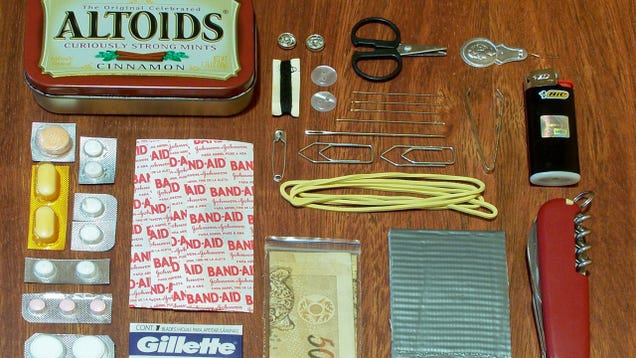
Tiny, light and infinitely transportable, this affordable little kit might save your life in an emergency. Here's how to build your own mini survival kit and how to use the stuff in it.http://indefinitelywild.gizmodo.com/now-that-its-u...


