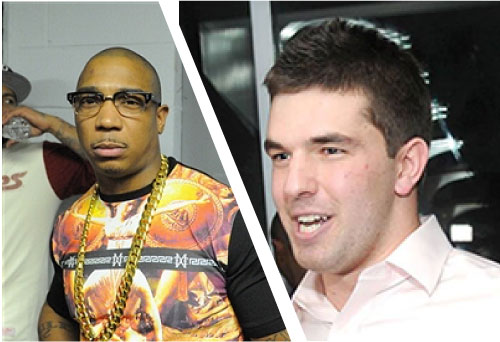
This can't be good for Fyre Media co-founders Billy McFarland and Ja Rule: leaked emails and documents show that organizers were not only grossly incompetent, they didn't seem to particularly care that the Fyre Festival was doomed.
In an urgent April 3 email with the subject line, "RED FLAG- BATHROOMS/ SHOWER SHIPPING," a mid-level Fyre Festival worker alerted senior staff, including 25-year-old co-founder Billy McFarland and Fyre Media president Conall Arora, of a growing crisis: the unexpectedly high costs (estimated to be at least $400,000) of shipping enough toilets and showers to the Bahamas to accommodate an anticipated 2,500 people on the island.
This followed the news that its caterer, Starr Catering Group, had just pulled out of the festival. Those two events prompted one assistant on the email thread to joke, "No one is eating so therefore no ones pooping."
Here's another snapshot from the train wreck:
But there was one problem with Weinstein's plan: Those luxury villas — which Fyre Media marketed on its website and sold for thousands of dollars to attendees — don't seem to have existed.
Two days later, on April 22, Weinstein sent an email to staff strongly suggesting a campaign begin to reach out to the influencers planning to attend — and prepare them for seriously reduced accommodations.
"It is my opinion based on conversations with influencers, that the majority of them are not going to receive what they were promised," Weinstein said in a note urging Fyre staff to be more transparent. "In speaking to even low level influencers, it was clear they expected their own rooms at private villas on the beach. Of course, these villas don't exist."
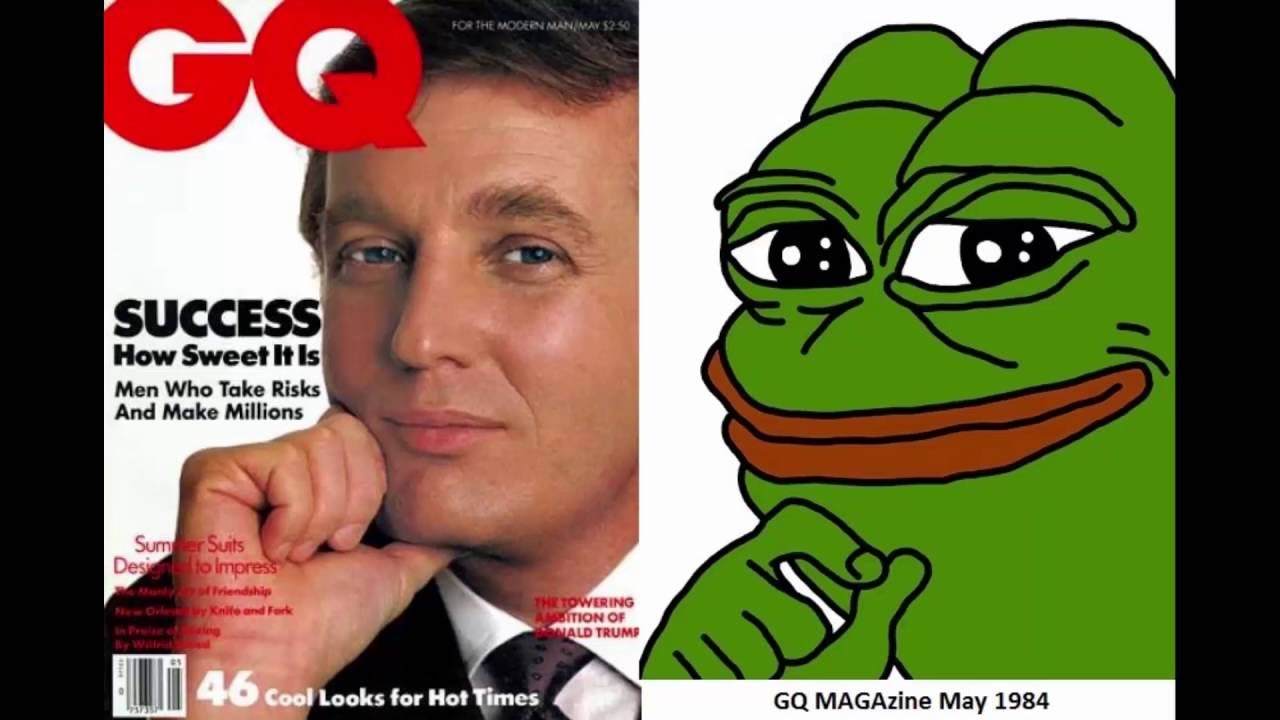
After reading this, it's clear that the only way McFarland could avoid being sent to prison is if Trump appoints him to Secretary of HUD.
A big envelope arrives in the mail: it's a college admissions packet! You're going to college! You do a little dance. You tell your parents. You all cry. And then you join the Facebook group for the class of 2021.
If you graduated high school this year, you may have gone through this very same process alongside hundreds of thousands of other incoming college freshmen. And if you're one of a very tiny, select minority, you got accepted to Harvard. Congratulations! Unless you're one of the ten (or more) students who just got their acceptance rescinded for posting offensive memes on Facebook.
According to the Harvard Crimson, the official college newspaper, about a hundred students from the official Harvard College Class of '21 Facebook group joined a private group chat for only posting memes. From there, an even smaller splinter group was formed for more "R-rated" memes, which I guess is what the kids these days call super racist content. In order to get into the "R-rated" group—which was at one point titled "Harvard memes for horny bourgeois teens"—students had to post something edgy enough inside the regular meme chat.
The Crimson reports that the memes in the splinter group made fun of "sexual assault, the Holocaust, and the deaths of children." One joked about lynching a Mexican child, calling it "pinata time."
It's not entirely clear how Harvard administrators caught wind of "Harvard memes for horny bourgeois teens," but in mid-April, group participants received an email from the Admissions Office. The Crimson obtained a copy of the email, which reads, "The Admissions Committee was disappointed to learn that several students in a private group chat for the Class of 2021 were sending messages that contained offensive messages and graphics. As we understand you were among the members contributing such material to this chat, we are asking that you submit a statement by tomorrow at noon to explain your contributions and actions for discussion with the Admissions Committee."
According to the Crimson, at least ten students have had their acceptance to Harvard rescinded as a result. The university has declined to comment on the "the admissions status of individual applicants."
It's not the first time Harvard has dealt with bad-meme-posters in an incoming class of freshmen (just last year, administrators officially admonished students in the Class of 2020 via Facebook), but this might be the first time anyone's had their acceptance revoked over memes. The Crimson doesn't name any names, probably because no one wants to be known as the kid who almost went to Harvard except they edgelorded too hard.
Does posting incredibly offensive content under your real name mean that you're not smart enough to go to Harvard? Is there some kind of special irony in the supposition that this would have never happened if Harvard dropout (and this year's commencement speaker) Mark Zuckerberg hadn't created Facebook? And now that Harvard is policing memes, is the withdrawal of admission on the basis of shitposting going to become a national trend? I'd rather not consider the answers to these questions, but unfortunately, time will probably tell.
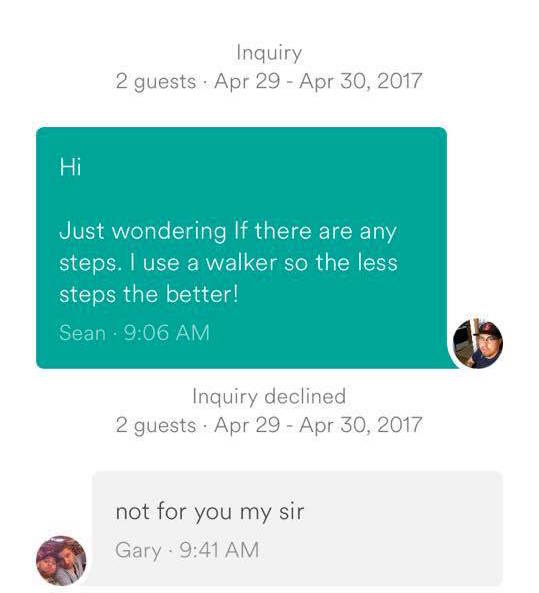
In late April, Sean Gray, founder of Is This Venue Accessible and a key figure in the DC-area punk scene, was making plans to travel from Washington DC to Brooklyn to see noise-rock band the Cherubs play a reunion show at Saint Vitus. It was a one-night trip, and Gray, who has cerebral palsy and uses a walker, sent a message to a potential host asking about accessibility. The exchange went like this:
Gray had used Airbnb a few times in the past, but usually tries to stay in hotels. "I'm not a heavy user of it," he told me. "Mostly due to shit like this." This trip, however, he was strapped for cash, and, besides, hotel accommodations in New York City are a luxury commodity. He managed to book another Airbnb, but it "still had one or two steps and was a shithole."
Gray's experience is far from isolated, according to a new report from Rutgers University. Based on a randomized experiment consisting of nearly 4,000 booking requests, "Hosts were less likely to preapprove, and more likely to reject outright, the requests from travelers with disabilities than requests from travelers without disabilities," the study found. "The preapproval rate was 75 percent for travelers without disabilities, compared to 61 percent for travelers with dwarfism, 50 percent for travelers with blindness, 43 percent for travelers with cerebral palsy, and 25 percent for travelers with spinal cord injury."
The Americans with Disabilities Act of 1990 is designed to prohibit discrimination based on disability. It applies to businesses ranging from restaurants to airlines to hotels and theoretically ensures that reasonable accommodation will be afforded to those with disabilities, including those with wheelchairs, walkers, service animals, and the blind. Generally, the ADA did not anticipate the sharing economy. With respect to Airbnb, its protections do not apply to owner-operated lodgings with fewer than six rental units. Which is much of the service.
Nonetheless, Airbnb instituted its own non-discrimination policy last year. In a statement this week, the company said, "Discrimination of any kind on the Airbnb platform, including on the basis of ability, is abhorrent, a violation of our anti-discrimination policy and will result in permanent removal from our platform." I've reached out to Airbnb for comment on Gray's rejection and will update if and when it responds.
The Rutgers study concludes with some suggestions as to how Airbnb can address the problem. They range from simple education—informing hosts covered by the ADA that they are indeed covered by the ADA, for example—to the usage of "mystery shoppers" for checking disability policy compliance to developing principles in concert with disability advocacy organizations.
The real problem, however, is unlikely to be solved by Airbnb itself. The problem is instead the law that lets hosts off the hook in the first place. "If we're entering an era where these new types of hotels, which are essentially private homes, can't offer accommodations, it defeats and undoes all of the progress we've made with the ADA as far as equal access is concerned," Mason Ameri, co-author of the new study, told the New York Times. "The law needs to catch up with services like Airbnb."
Gray is skeptical that a fix exists at all. This is just the nature of the sharing economy, and, well, it's bullshit. Just a week before the Airbnb incident, he was rejected by an Uber driver unwilling to accommodate Gray's walker. "At this point Uber, Airbnb, etc are like Walmart of the sharing economy," he said. "Hashtag protest all you want but if getting a room through Airbnb is sometimes 75 percent cheaper than a hotel, there will never be a shortage of consumers.
"And people with disabilities are a very, very small amount of consumers," Gray added. "Until their backs are against the wall, [companies like Airbnb] won't do anything."
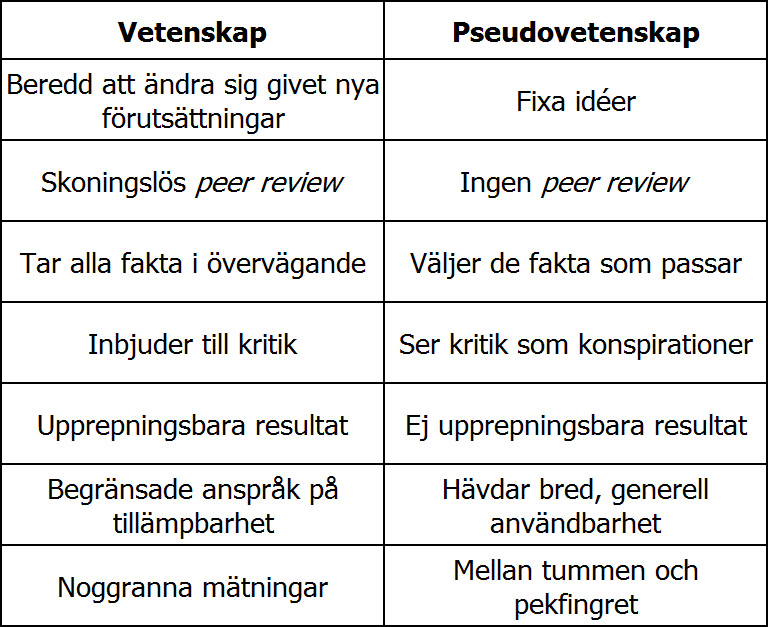
Pseudovetenskap är ett brett och delvis svårdefinierat område. Den gränsar till men skiljer sig även från såväl ovetenskap som dålig vetenskap. Läsning av detaljerade, noggranna artiklar som den nedan rekommenderas. Tills dess går det bra att sprida förenklade uppställningar som den ovan på de kanaler man tycker passar.
All icke-vetenskap är inte pseudovetenskap, och vetenskapen har icke-triviala gränser mot andra icke-vetenskapliga företeelser såsom religion och olika typer av icke-systematiserad kunskap. Vetenskapen har också interna avgränsningsproblem som gäller att skilja på god och dålig vetenskap.
Likväl kan pseudovetenskapen bara förstås i relation till vetenskapen.
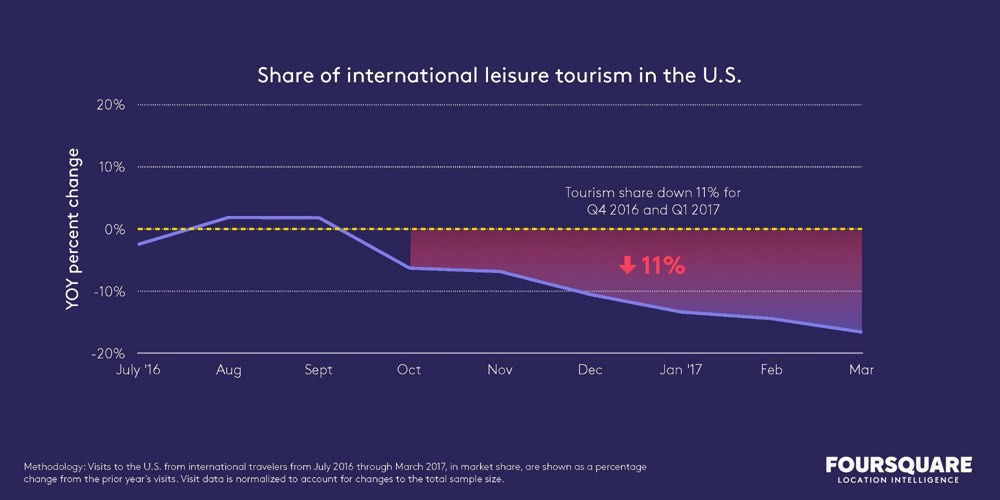
Our findings reveal that America’s ‘market share’ in international tourism started to decline in October 2016, when the U.S. tourism share fell by 6% year-over-year, and continued to decrease through March 2017, when it dropped all the way to -16%. Currently, there is no sign of recovery in the data.
And business travel to the US is suffering as well, relative to other countries:
Business trip activity is up in the U.S. by about 3% (as a share of international traveler global activity), but that trend line is not as high as elsewhere in the world, where YoY trends are closer to 10%. Relative to business travel gains globally, business travel to the U.S. is suffering.
As Foursquare notes, correlation is not causation and there are other factors at play (e.g. a stronger US dollar), but it’s not difficult to imagine that our xenophobic white nationalist administration and its travel & immigration policies have something to do with this decline.
It’s the question we all have at some point running a business.
Someone recently noticed that I have a larger YouTube subscriber count then they expected, given my channel’s newness and the relatively small number of views so far. Their channel was getting a ton of views from some neat niche content, but he was having trouble getting repeat visitors and subscribers.
What was I doing differently?
I don’t like my wedding photos. It’s been 15 years! And I still remember how much I hated the haircut I got two days before the event.
I don’t spend much money on things other than camera gear and computers. Most of my clothes look like someone else had them during their good days :) But soon after my wedding, I decided to find a fancy salon and pay fancy prices to someone who knows exactly how I’d like to cut my hair.
I met Valerie.
Valerie has been awesome. I’ve been seeing her for years. And when I heard Valerie opened her own salon, of course I followed her.
Her business is solid. Given her skill and personality, she’s created a loyal customer base who will gladly go where she goes. But I’m sure at some point, she and her partner will find themselves in the situation all of us business owners find ourselves.
How do we get more?
James Corden might be my favorite late night talk show host. For all sorts of reasons. But he really caught my eye with Carpool Karaoke, where he drives along with a celebrity and they break into song.
When James first started the show and particularly this segment, success didn’t seem likely. They couldn’t book anyone. With sheer willpower and luck they booked Mariah Carey, who refused to sing when it was time to tape Carpool. Somehow James and his charming personality convinced her to sing. He had to start first.
Today, he’s blown up. Every A-lister wants to be on Carpool.
As I watched James videos, I spotted something interesting:
At the end of every single video James posts on YouTube, he asks folks to subscribe and check out other videos. He even points in most videos to exactly where he would like them go next.
You wouldn’t think he’d have to do this. Doesn’t his fame carry him enough? He already has almost 11 million YouTube subscribers.
But you do this long enough, and you realize how much you have to encourage people to do the thing you really need them to do. You can’t make them guess you need more subscribers or likes or followers.
You need explicit calls to action.
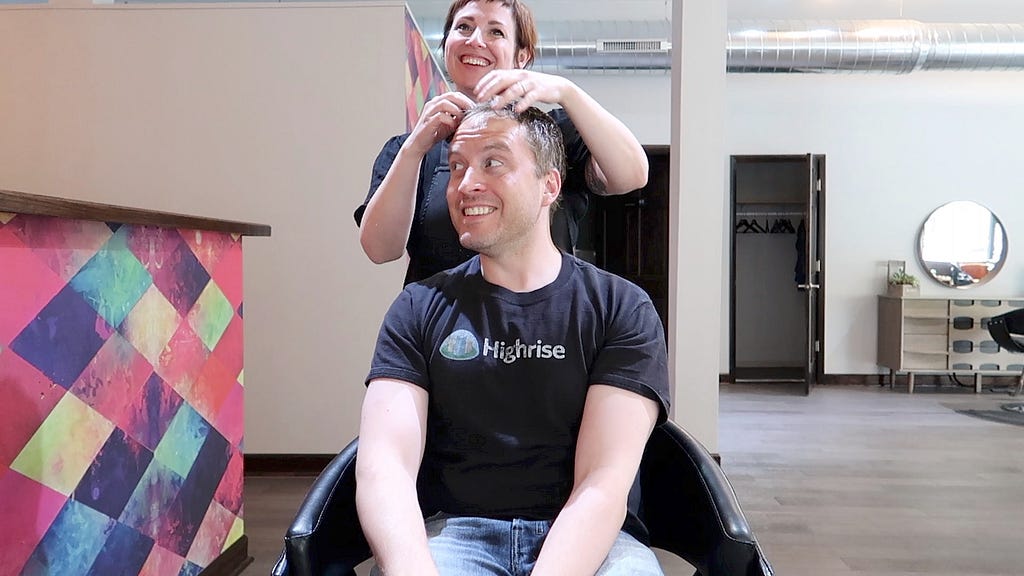
At the end of my first haircut with Valerie at her new salon, her partner Anna caught me filming the haircut for my vlog.
When she heard I’d be posting the video to YouTube, she asked that I tag their page and link up their site. Of course I would. And a week after the haircut, I gave them positive reviews on Yelp and Facebook too. I don’t think I’ve ever given anyone a Facebook review. I haven’t reviewed anything on Yelp in years.
But that call to action from Anna at the end of the appointment really stuck in my head and got me to… act.
I think far too many people feel embarrassed to ask for action. They don’t want to “put people out”. But what’s really happening is that most people watching content, reading your articles, trying out your stuff, might like to subscribe or share, but don’t realize that’s important to you until you ask.
You aren’t putting people out. You don’t have to be a pest. And they can ignore you. I didn’t have to link up anything about my salon.
But I love what Valerie does, and of course I’d want to help spread her new salon. Since Anna made it clear they could use all the love possible, I’m even more inclined to do it.
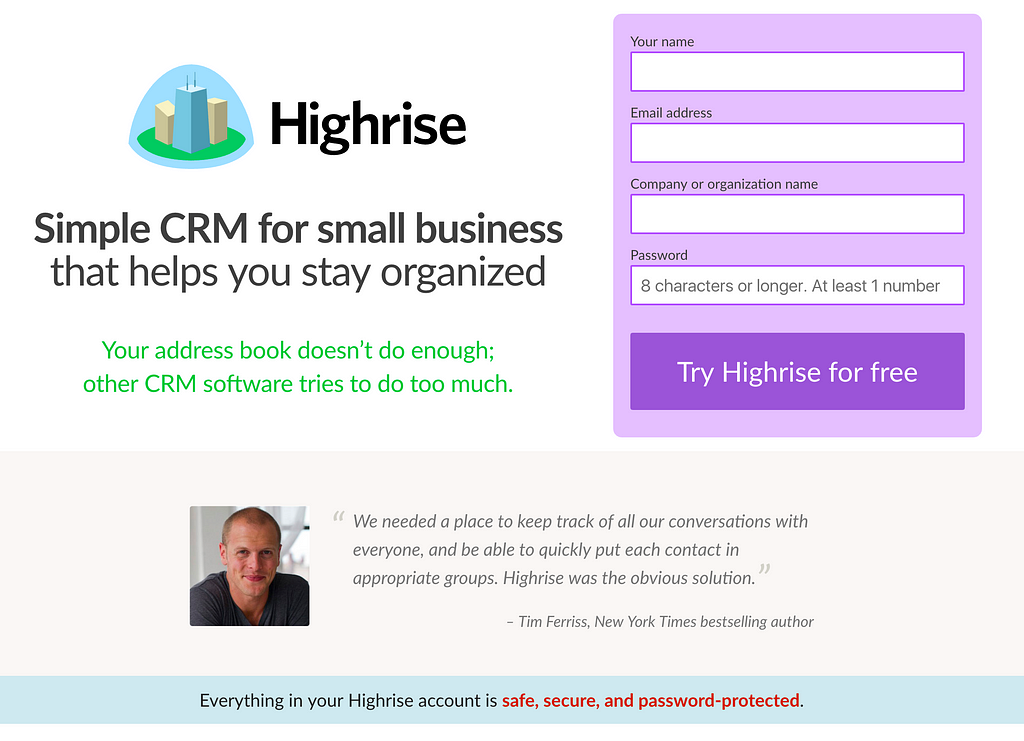
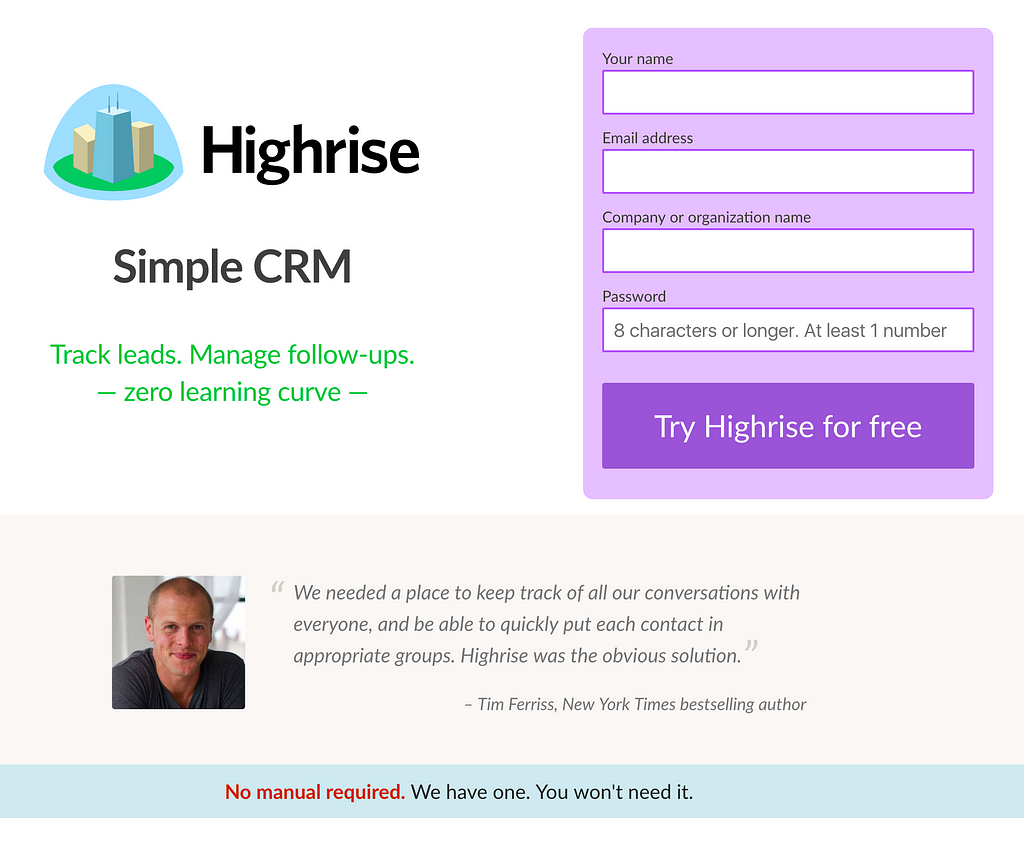
Almost every video, every blog post, every email I send out, I make sure I explicitly call out what I could use the audience to do next: please like the video, heart the post, visit Highrise. And the numbers speak for themselves. When I add those calls to action I see the traffic, likes, followers, spike compared to versions where I don’t.
Want more followers? Ask for them. If James Corden does it, no reason you shouldn’t.
P.S. :) Please help spread this by clicking the ❤ below.
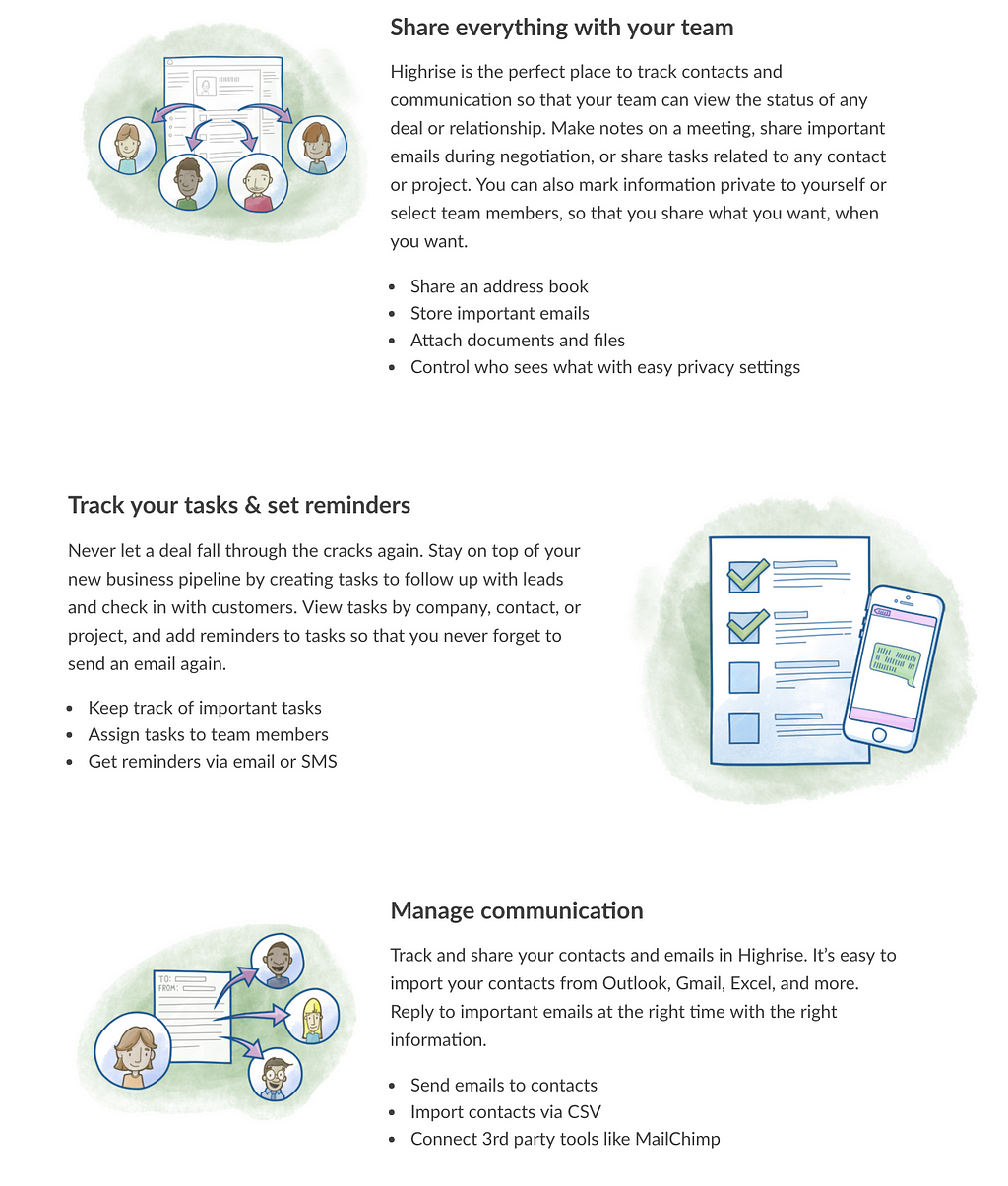
You should follow my YouTube channel, where I share more about how we run our business, do product design, market ourselves, and just get through life. And if you need a no-hassle system to track leads and manage follow-ups you should try Highrise. And if you need a new hair stylist in Chicago, go say hi to Valerie.
Alan Sokal utförde 1996 ett hyss som blivit klassiskt: Han skickade in en nonsens-artikel till en tidskrift med postmodernistisk läggning och fick den publicerad (Faktoider: Sokal). Många drog den tilltalande och rimliga men dock ovetenskapliga slutsatsen att hysset visade att all postmodernism är nonsens. Sokal själv var mer blygsam.
From the mere fact of publication of my parody I think that not much can be deduced. It doesn't prove that the whole field of cultural studies, or cultural studies of science – much less sociology of science – is nonsense. Nor does it prove that the intellectual standards in these fields are generally lax. (This might be the case, but it would have to be established on other grounds.)
Sokal-affären inspirerade många efterföljare, och fortsätter att inspirera. Som nu senast Peter Boghossian och James A. Lindsay. De är båda aktiva skeptiker och ateister, har skrivit böcker som A Manual for Creating Atheists och Everybody is Wrong About God, och har ett rejält horn i sidan till genusvetenskap. Det var denna, i deras tycke pseudovetenskap, som de skulle avslöja med Sokals metod. De skrev en artikel som de kallade "The Conceptual Penis as a Social Construct", utan vare sig rim eller reson men fullproppad med begrepp, fraser och citat som skulle imponera på den förmenta expertisen i genren. De skickade in nonsens-artikeln till den etablerade tidningen NORMA, "International Journal for Masculinity Studies" – och fick avslag. Och vilket avslag sen.
We feel that your manuscript would be well-suited to our Cogent Series, a multidisciplinary, open journal platform for the rapid dissemination of peer-reviewed research across all disciplines. [...] To ensure all work is open to everyone, the Cogent Series invites a “pay what you want” contribution towards the costs of open access publishing if your article is accepted for publication.
- Refuseringsmailet från NORMA
Att inte bara refuseras utan därtill rekommenderas att vända sig till en vanity journal, som tar betalt (riktpris $1350) för att publicera, det är så hård en refusering kan bli utan att bli direkt ohövlig.
Här skulle Boghossian och Lindsay ha gjort halt. Det experiment de tänkt ut hade misslyckats. Men de fortsatte. De uppmuntrades av Cogent-tipset, trots att de mycket väl visste vad den sortens tidskrifter går för. På något sätt trodde de att de samtidigt skulle kunna slå mot skräptidskrifter som publicerar vad som helst och slapp genusvetenskap.
The publication of our hoax reveals two problems. One relates to the business model of pay-to-publish, open-access journals. The other lies at the heart of academic fields like gender studies.
Nu är det svårt att hänga med. För deras experiment uträttar inte alls båda delarna. Den som vill avslöja exempelvis genusvetenskap som trams med Sokals modell får göra som han och få en tramsartikel publicerad i en etablerad, välrenommerad tidskrift. Att vanity journals publicerar vad som helst mot betalning är ett helt annat problem som demonstrerats flera gånger (jämför Faktoider: Skräptidskrifter). Att en sådan publicerar en tramsartikel i genren X säger inte ett dyft om genren X.
Detta om Boghossian och Lindsays artikel. Nästa problem uppstod sedan de fått en artikel om sin föregivna sokalisering av genusvetenskap publicerad i Skeptic. Det är en etablerad, välrenommerad skeptisk tidskrift som sedan 1992 beskrivit myriader myter, vanföreställningar, bluffterapier och pseudovetenskapliga påhitt. Den borde inte publicera en artikel baserad på ett illa utfört och vantolkat experiment, just eftersom den är specialiserad på att granska illa utförda och vantolkade experiment. Och det var heller inte en undangömd artikel, utan den har hyllats särskilt av välkända skeptiker som Michael Shermer (chefredaktören) med flera.
Men dessa har även fått en hel del kritik. Det är viktigt; skeptiker följer inte, ska inte följa, någon "ledare" och oreflekterat apa efter, utan reagera när saker blir fel. Det händer då och då att även skeptiska kändisar och förebilder som Shermer, Sam Harris och Richard Dawkins har fel; ja, för den sistnämnde är det sedan länge snarare så, att det händer att han har rätt. Och när de har fel får de veta det, även av sina fans. Åtminstone de fans som inte är så mycket fans att de glömt bort att vara skeptiker.
When I was a computer science undergraduate I was working on social robotics – the robots use computer vision to detect the humans they socialise with. I discovered I had a hard time being detected by the robot compared to lighter-skinned people. At the time I thought this was a one-off thing and that people would fix this.
Later I was in Hong Kong for an entrepreneur event where I tried out another social robot and ran into similar problems. I asked about the code that they used and it turned out we’d used the same open-source code for face detection – this is where I started to get a sense that unconscious bias might feed into the technology that we create. But again I assumed people would fix this.
So I was very surprised to come to the Media Lab about half a decade later as a graduate student, and run into the same problem. I found wearing a white mask worked better than using my actual face.
This is when I thought, you’ve known about this for some time, maybe it’s time to speak up.
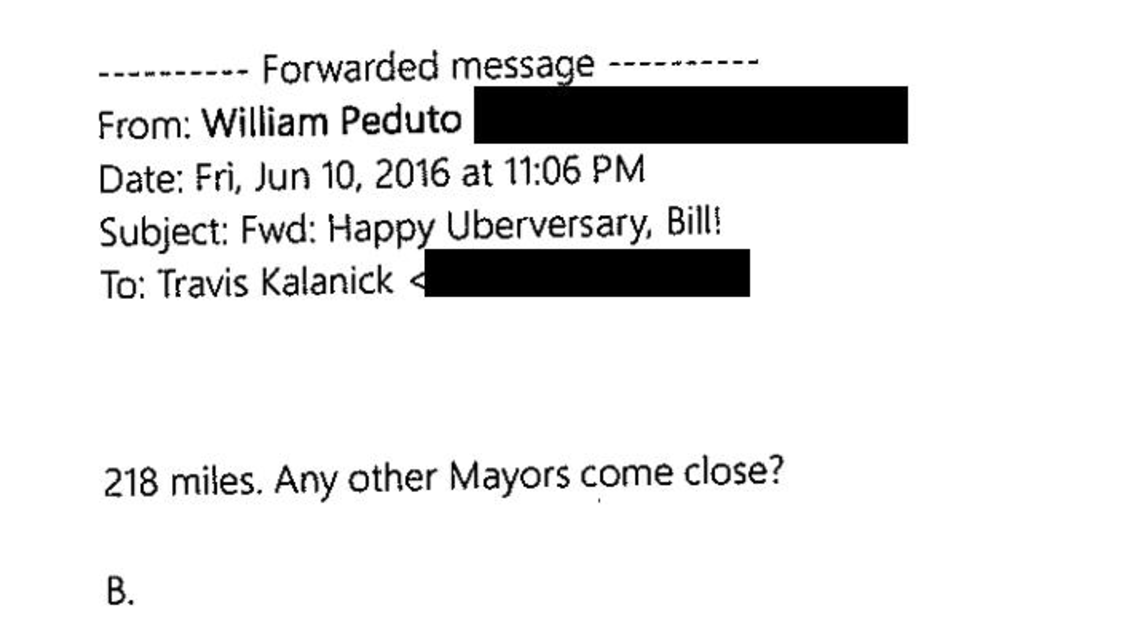
In October, soon after Uber began testing driverless cars in the city, I obtained about a dozen emails sent between Pittsburgh mayor Bill Peduto and Uber CEO Travis Kalanick. One of them stood out more than any other.
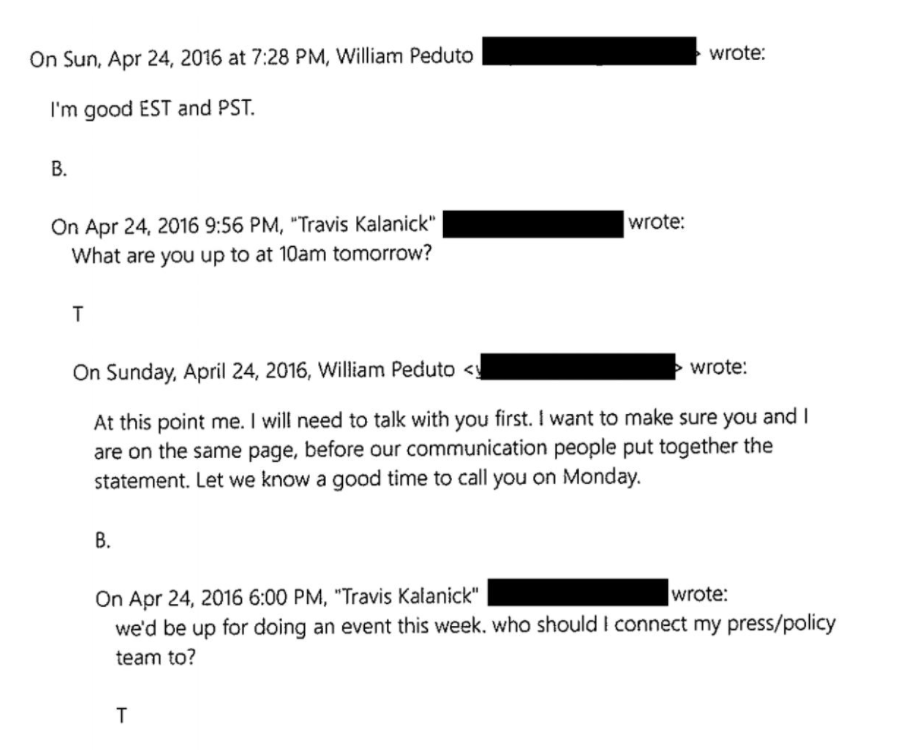
In this email, Peduto is showing off how much he uses Uber, the company he had brought to Pittsburgh. Strictly speaking, there's no malfeasance here. But this email showed a very powerful man seeking the approval of another, far more powerful man. It was signed "B," a signature that—in the emails I obtained—Peduto used only with Kalanick, copying the "T" signature Kalanick used with Peduto in other, earlier emails.
Experts who have studied Uber's politics suggested to me that the saga of B and T would not end well for B.
"The emails suggest Peduto is patient zero here, with him kind of carrying water for the company and enlisting other politicians," Rick Claypool, research director at Public Citizen, told me.
Seven months later, the other shoe has dropped: Pittsburgh and Peduto are now finding that there are consequences for selling out long-established civic norms, processes, and regulations to woo a company that has run over many other cities in the past.
The New York Times reported Sunday that Pittsburgh's honeymoon with Uber has gone sour; Peduto is pissed that Uber did not help the city earn a federal "Smart Cities" grant, hasn't delivered as many jobs as Peduto says were promised, has started charging for driverless car rides, and won't share driverless car data with the city.
"I sent their CEO a very stern text on Saturday night"
This should surprise no one: Peduto didn't require Uber to sign any contracts, obtain any licenses, sign any memoranda of understanding, or otherwise lock in anything for the city: "There is no formal agreement," Peduto told The Washington Post in September. Sunday, the executive director of National Association of City Transportation Officials told that predicting that a large corporation would take advantage of the power imbalance it had exacted over a mid-sized city was "101"-level college civics.
It's instructive—if dispiriting—to watch Peduto slowly realize over the course of the last few months that Kalnick and Uber aren't his friends.
September & October 2016
Peduto told the Washington Post how Uber originally came to the city:
"When [Kalanick and I] had our first meeting, he referenced the Pittsburgh Project," Peduto told the Post. "'What's that?' I asked. 'Do you know about the Manhattan Project?' he said. 'At Uber, we call this the Pittsburgh Project — the goal is to build an autonomous vehicle center in Pittsburgh.' Well, that piqued my interest."
The emails I obtained showed that Peduto was both eager to impress the Silicon Valley hotshot and was happy to carry the company's water in public. In May 2015, Peduto and his staff fought hard both in public and behind the scenes to get the Pennsylvania Public Utility Commission to reduce a fine levied against the company for operating in the state without permission. After we published our story, Peduto railed against us on local radio.
"I have an opportunity to talk to the CEO of Uber on a semi-regular basis. And they're committed to creating over a thousand jobs in this city that are well-paying jobs," Peduto told Pittsburgh radio station WDVE after our story ran. "To say 'Oh my god, he's trying to help this horrible company, he's defending this horrible company. When we are creating an entire industry that brought the White House here to talk about autonomous vehicles, robotics, and everything else and will bring other companies and spinoffs for decades to come … it's unbelievably ridiculous."
November 2016
Peduto and former Obama spokesperson and Uber's president of policy and strategy David Plouffe spoke together in front of 3,000 mayors at the National League of Cities' City Summit. Peduto said any regulations that make it more difficult for Uber's driverless cars to operate will harm the United States: "The Wright Brothers didn't wait until there were rules in place," he said. "What [Uber] wanted to see was a government that was willing to green light innovation."
January 2017
Peduto's breakup with Uber began in earnest as the #deleteUber movement hit its peak. Donald Trump's Muslim travel ban spurred widespread protests at airports around the country, and Uber drivers broke cab strikes. Meanwhile, Uber's promise of bringing 1,000 jobs to the city hadn't yet come true.
"I sent their CEO a very stern text on Saturday night and I expressed my great disappointment not only on behalf of the city of Pittsburgh, but for every city on earth," Peduto told CityLab.
"Peduto has stopped texting Mr. Kalanick"
He told the Pittsburgh Post-Gazette that the city had "held up our end of the bargain," but that few of the jobs Kalanick promised had actually come to Pittsburgh: "We haven't seen much from Uber. This is a two-way street, not a one-way. I need to see more interest from them in our communities."
February 2017
Peduto continued to distance himself from Uber, announcing early in the month that Uber had not yet fulfilled its promises to the city. "I anticipate that 2017 will be better than 2016," he said.
Meanwhile, public outrage about Uber's power in the city and perceived power over local politicians came to a head as mayoral challenger John Welch told a crowd he "[doesn't] need to have a CEO's cell phone number on speed dial."
Pittsburgh Controller Michael Lamb formally suggested that Uber's driverless car data should be shared with the city, and called on Peduto to make public any arrangements or contracts the city made with Uber to acquire that data—arrangements and contracts that don't exist, because the whole thing has been a handshake agreement since the start.
Uber pulled its self-driving cars from Pittsburgh's roads for three days after a wreck in Tempe, Arizona. Peduto said the move showed that "Uber has more at stake in this than just profit."
April and May 2017
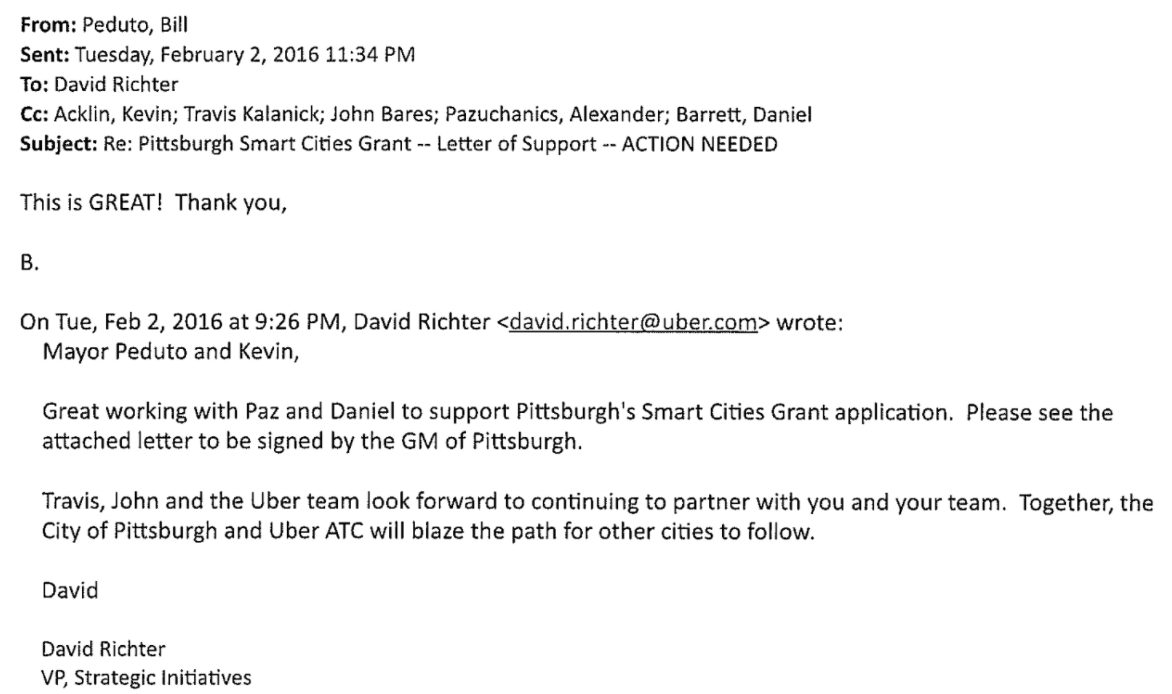
Shit started to hit the fan in April, as Peduto said the company has a "moral obligation" to help the city and its community; Uber declined to help Pittsburgh win a "Smart Cities" grant from the federal government. Emails between Uber and the city of Pittsburgh that I obtained in October showed that the city had long banked on Uber's help on that application.
Uber successfully lobbied the Pennsylvania state legislature to get a law passed that allows it to charge customers for rides in its self-driving cars, which Peduto said was not what he had planned to have happen. Peduto told Politico that there was a "constant drumbeat of Uber not being a good partner," and he was framed as "one of the company's most vocal critics."
Sunday, the New York Times reported that Peduto "has stopped texting Mr. Kalanick," and also reported that Uber had not fulfilled its promise to hire candidates from the neighborhood surrounding its autonomous vehicle center.
*
The takeaway here for politicians is that Uber—nor any other major corporation—is not your friend. The company has shown time and time again that it will ignore regulations, lobby ferociously, promise the moon and stars, and then act as it always has: in whatever manner is best for Uber. Uber has always done this; it's long past time for local politicians to stop handing the keys to their cities to the company.
Watch stone carver Anna Rubincam as she goes from measuring a live person (essentially creating a geometric model of their face) to a clay model to a finished stone portrait in three weeks.
On a human face, even though there’s a change in pigment, there’s no end. Like, you come to the end of the lips and it just carries on going. And if you try and make it a stark difference, then the face will look strange. The skin is sort of a continuous surface that undulates and has tension in certain places and slack in other places.
I got so anxious watching her carving the stone piece from the clay model. One false move and… *bites nails* More about how the film was made. (via digg)
Klockan är sex på lördagskvällen och kyrkorna ringer till helg. Fram till skiftet sextio- och sjuttiotal jobbade vi på lördagar. Skolveckan var sex dagar lång.
Vi backar bandet lite. Under industrialiseringen gick arbete över från att vara uppgiftsorienterat (man gjorde det som behövde göras) till att regleras av tid. Eftersom man sällan gick iväg till en annan plats än där man bodde för att jobba, var gränsen vagare mellan arbete och fritid. På en gård på 1700-talet levde folk som nutida IT-entreprenörer. ”Mycket jobb? Haha, vi ser det inte som jobb, det är en livsstil.” Medellivslängden var typ 43 år och alla luktade skit.
1919 lagstiftades om åtta timmars arbetsdag, det vill säga 48-timmarsvecka. Sedan gick det alltså femtio år och så blev det 40 timmar. Nu har det gått ytterligare femtio år. Det borde vara dags för en ny reform.
I nordkoreanska arbetsläger är en arbetsvecka densamma som för nyanställda på brittiska investmentbanker, det vill säga 112 timmar. Sexton timmar per dygn, sju dagar i veckan. De flesta anser att detta är orimligt som standard och praxis. Som med allting destruktivt finns det något coolt och sexigt med det dock. Om jag hade fått en hundring varje gång jag hört folk säga att de jobbat sextio timmar eller mer på en vecka, hade jag kunnat gå ner på halvtid. Och det inte bara sägs, det sägs som att det var något positivt. Det kanske är det? Jag vet inte. Jag vet bara att vi aldrig har haft det bättre än nu.
Det är som att det vore något magiskt med fyrtiotimmarsveckan. 112 verkar vara för mycket. Men samtidigt är 30 för lite. Så lite att det är helt orimligt för alla partier utom V och MP. Det är väldigt konstigt. För vi vet ju också att arbetsmarknaden kommer stöpas om. Snart kommer, med Yuval Hararis ord, the useless class att vara en stor grupp. Och i Sverige ser befolkningspyramiden ut sådan, att vi kommer att behöva många som tar hand om de åldrande. Då kan vi ta några, som får jobba övertid tills de spricker och går av. Eller många, som får jobba kortare veckor men klara det.
Vad jag inte fattar är i grunden detta: Varför är de breda partierna inte utopister? Varför begränsas politiken och idéerna av konventioner och av det som finns. Hur kan en femtio år gammal standard vara självklar?
Vi väljer inte så mycket politiker var fjärde år, som vi väljer förvaltare. Trygga gubbar (oberoende av kön) som minimerar risk och vars visionära förmåga inskränker sig till en något justerad procentsats på på marginalskatten. Det vill säga precis de personerna som i alla andra sammanhang hade avfärdats som direkt destruktiva i sin uselhet. Människor som aldrig kan komma på någonting nytt. Som aldrig kan skapa någonting.
(I wrote this on Tumblr. It's since been picked up and quoted all over the place, and I'm being asked a lot if it's actually something I said, and if it's true. It is, and it is. Here's the original.) duckswearhats asked: Hi, I read that you've dealt with with impostor syndrome in the past, and I'm really struggling with that right now. I'm in a good place and my friends are going through a lot, and I'm struggling to justify my success to myself when such amazing people are unhappy. I was wondering if you have any tips to feel less like this and maybe be kinder to myself, but without hurting anyone around me. It's a big ask, I know, but any help would make my life a lot less stressful
The best help I can offer is to point you to Amy Cuddy’s book, Presence. She talks about Imposter Syndrome (and interviews me in it) and offers helpful insight.
The second best help might be in the form of an anecdote. Some years ago, I was lucky enough invited to a gathering of great and good people: artists and scientists, writers and discoverers of things. And I felt that at any moment they would realise that I didn’t qualify to be there, among these people who had really done things.
On my second or third night there, I was standing at the back of the hall, while a musical entertainment happened, and I started talking to a very nice, polite, elderly gentleman about several things, including our shared first name*. And then he pointed to the hall of people, and said words to the effect of, “I just look at all these people, and I think, what the heck am I doing here? They’ve made amazing things. I just went where I was sent.”
And I said, “Yes. But you were the first man on the moon. I think that counts for something.”
And I felt a bit better. Because if Neil Armstrong felt like an imposter, maybe everyone did. Maybe there weren’t any grown-ups, only people who had worked hard and also got lucky and were slightly out of their depth, all of us doing the best job we could, which is all we can really hope for.
*(I remember being amused and flattered that he knew who I was, not because he'd read anything by me, but because the Google algorithm of the time had me down as Neil #1. If you just typed Neil, it would take you to neilgaiman.com. Many people, including me, felt that if there was a Neil #1, it was most definitely him.)
What’s it going to take to get traction? “Make something people want.” “Minimum viable products.” “Talk to users and build features.” These are all common phrases used amongst those of us who are focused on building products. But I recently had a great reminder…
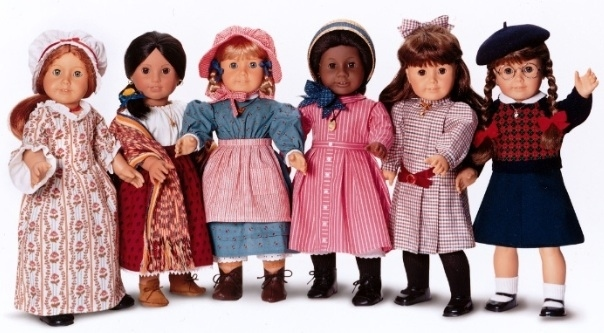
It’s amazing how much of a phenomenon American Girl is. If you aren’t familiar, in 1986, a woman named Pleasant Rowland launched a new doll company. She was fed up with the shallowness of Barbie and Cabbage Patch Kids.
Here I was, in a generation of women at the forefront of redefining women’s roles, and yet our daughters were playing with dolls that celebrated being a teen queen.
So she made her own. At first, everyone thought she couldn’t compete. But it turned out to be an instant success.
The dolls don’t stand out to me as better quality than other dolls we could buy. They’re not bad quality. But if you were to size one up against a Journey Doll at Toy R Us:
And according to American Girl stats, they’ve sold over 30 million dolls since 1986, or roughly more than 1,000,000 American Girl dolls each year.
This isn’t a knock against Journey Dolls, but why is American Girl doing so much better?
If you have a young daughter and have visited an American Girl store, the answer might be obvious to you.
A handful of weeks ago my niece was visiting from out of town. We brainstormed a bit on things to do with her, and having lunch at the American Girl store was at the top of the list.
Before lunch, walking through the store, we saw quite a few things I haven’t seen at a Toys R Us. You can make an appointment to get your doll’s hair done. Your doll, Julie, likes music from the 70s? Here’s a child sized room where you can experience Julie’s life by hanging out in an Egg Chair, listening to 70s music, watching lava lamps, and buy matching outfits.
And it’s not just about shopping for dolls. This American Girl store had an entire book store attached to it. Pleasant wanted her dolls to help teach girls the importance women have had on the world, so each original doll also had at least 6 books with deep backstories published along with it.
It wasn’t meant to blare from the shelves on its packaging or visual appeal alone. It had a more important message — one that had to be delivered in a softer voice.
Our lunch at American Girl wasn’t an ordinary lunch. It’s fancy. White table cloths. There’s multiple courses, starting with mini cinnamon rolls. Dolls get a special seat at the table and even their own cup and saucer. Didn’t bring a doll? You can borrow one of theirs.
Of course I recognize the marketing here. A girl without an American Girl gets to borrow a doll. It’s an addictive “free taste”.
But as a parent, this was something other than just spending money. It was a meal where my daughter and niece were fully engaged. A chance for us to bond while they get to inhabit a world of their choice.
American Girl was never just a doll. Equal, if not more, time has been spent not on the features of the doll, but on stories, messaging, lunches, and activities for the humans involved.
Pleasant realized that in order to get traction in a market as crowded as toys are, where no one thought she could succeed, instead of building products, she invented experiences.
And as I see my daughter grow, it becomes more and more apparent how independent she’s getting. I feel her pushing me away so she can do things herself. I cherish experiences like our lunch at American Girl.
P.S. Please help spread this by clicking the ❤ below.
You should follow my YouTube channel, where I share more about how we run our business, do product design, market ourselves, and just get through life. And if you need a no-hassle system to track leads and manage follow-ups you should try Highrise :)
Building products was originally published in Signal v. Noise on Medium, where people are continuing the conversation by highlighting and responding to this story.
Last week, the Wall Street Journal reported that the next iPhone will have some significant changes. The report notes that the next iPhone will not have a home button and will instead be made of a single piece of glass, a long-rumored and seemingly inconsequential move that is in fact central to an ongoing and hugely important legislative struggle between America's largest company and thousands of independent smartphone repair shops.
Moving the Touch ID fingerprint-reading sensor from the home button into the screen itself will have the side effect of giving Apple a straightforward path to monopolizing screen repair. The move could give Apple unprecedented control over the ownership and repairability of your phone, which means that in the very near future, it's possible that the only company that will be able to do a simple iPhone screen replacement will be Apple itself.
If the Wall Street Journal report is true (similar things have been reported by Bloomberg and featureless, buttonless fingerprint-reading technology has been patented by Apple), the development could hurt thousands of independent smartphone repair companies around the United States, and it threatens the very concept of phone ownership. The move would combine the only part of the iPhone that can currently only be replaced by Apple (the Touch ID sensor) and the most often broken part of the iPhone (the screen) into one part.
The removal of the home button would be an instant death blow to many of the roughly 15,000 independent smartphone repair companies in the United States, most of which are small businesses that work primarily on iPhones and specialize in screen replacement.
A few caveats before we get to the meat of the matter: Even if Apple decides to not get rid of the home button in the next iPhone, the way the company currently handles Touch ID replaceability is still central to the ongoing right-to-repair legislation currently being considered in eight states; this matters, even if Apple kicks the redesign further into the future. This is because the only part of the iPhone that has a software lock preventing repair, and Apple's lobbying against this legislation has been focused on protecting that software lock. It is also entirely possible that Apple makes Touch ID easier to repair with the next iPhone by redesigning its software; this would be a good result.
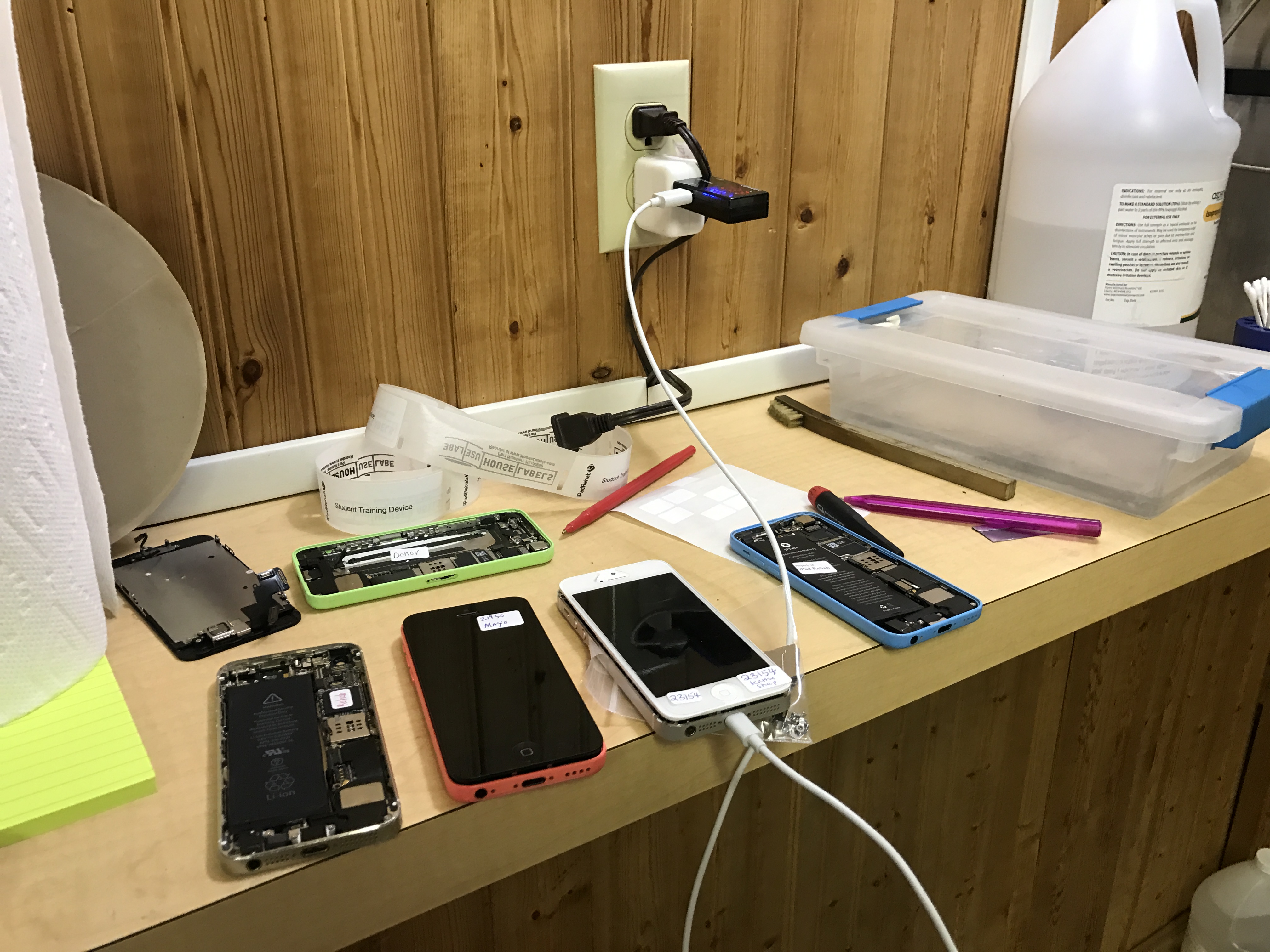
How independent iPhone screen repair works today If you crack the screen of your iPhone and take it to a third-party repair company, a technician can swap your broken screen for a new one. This screen may have been salvaged from another phone, or it might be an aftermarket part bought from any number of factories in China. These aftermarket parts are of varying quality—some are as good as Apple's original parts, others are less good. Regardless of the quality of the part, however, the repair tech never replaces the actual Touch ID button. Instead, they will swap it from your old screen onto your new one.
The Touch ID sensor is paired with the "Secure Enclave" chip inside of the phone, which you may remember from the Apple vs. FBI encryption debate from last year. The Secure Enclave stores your fingerprint data, passcode, and other cryptographic information using a built-in random number generator. The security features that have to do with preventing repair, it should be noted, have nothing to do with the overall encryption of data on the iPhone. For the purposes of this article, accessing the data stored within the Secure Enclave is functionally impossible without entering your passcode to unlock the phone.
Because fingerprints are stored on the Secure Enclave and not on the Touch ID sensor itself, it is impossible to save an unlock fingerprint on one phone, physically transfer that sensor to another phone, and unlock the second device using the fingerprint from the first. This is good, because otherwise you'd be able to unlock and take data from otherwise encrypted phones by simply putting a new button on them.
But Apple took its Touch ID security one step further.
"There's never a moment when you're not with somebody else, and there's cameras everywhere but the bathroom"
Apple notes in a white paper that the Secure Enclave and Touch ID are given a "device's shared key," which is a unique cryptographic signature shared between the Touch ID and Secure Enclave. This means that replacement Touch ID sensors will not work if swapped onto your phone, because they aren't paired with the existing Secure Enclave in your phone. This was a big problem on the iPhone 5S, because the cable that connects the Touch ID sensor to the phone's logic board broke easily during standard repairs. Replacement buttons worked as a home button only; Touch ID would be forever broken on that device, meaning the user had to enter a passcode whenever they wanted to unlock the phone. This is what it looks like when you put a new Touch ID sensor on an iPhone:
Taken as a whole, companies that repair iPhones employ skilled people. They know to be careful with the Touch ID sensor, and they know that the old sensor must be transferred to the new phone when doing a screen repair. It's a system that's annoying, but that works for the vast majority of cases.
How iPhone screen repair at the Apple Store works today If you take a phone with a cracked screen to the Apple Store, the Geniuses there don't have to swap the button from your old screen to the new one. According to one current and two former Apple Store employees, there is a "Calibration Machine" in the back room of every Apple store that is able to reset the pairing between Touch ID buttons and the Secure Enclave. So when Apple replaces your screen, it simply recalibrates the new button to work with your existing phone.
"The calibration machine was a rather big device (imagine something roughly the size of a fairly large microwave) that phones had to be inserted into after replacing the display," one former employee told me in an email. "It took about ten minutes per phone to calibrate them, and the device would run a battery of pressure-sensitive tests in addition to registering the display with the secure enclave. An iPhone had to be secured in the device, naturally, and a mechanical arm would perform the necessary functions."
Image: Taylor Lewis
A current Apple Genius told me that the machine is hooked up to an iMac, which is hooked up to a special server, which runs the software that recalibrate the device. Apple employees are told that the calibration machine costs between $20,000 and $60,000 (there are different models of calibration machine), and it is available only to Apple Stores, not to so-called "Apple Authorized Service Providers." No photos of the machine are available publicly, and I was told it would be impossible to take one without getting caught: "There's never a moment when you're not with somebody else, and there's cameras everywhere but the bathroom," the Genius told me. "Apple is so secretive that they don't even want us wearing our Apple shirts outside."
[If you know anything more about how recalibration works or about the calibration machine, you can contact me securely.]
I spoke with three different iOS security experts about how recalibration would work. Apple holds many of the secrets of Secure Enclave close to its chest, and little is known outside of Apple about the specifics of the Touch ID-Secure Enclave relationship. Only one of the three experts would speculate on the record about the mechanics of recalibrating the phone. Apple did not respond to request for comment on any aspect of this article and has ignored dozens of requests about repair issues from Motherboard over the past two years.
In theory, Touch ID reprogramming should require only a piece of software and perhaps authentication from an Apple server, according to Luca Tedesco, one of the world's best-known iPhone jailbreakers.
"You probably don't need any hardware to do it," Tedesco told me. "I wouldn't think there is much more required than some software running in the Secure Enclave Processor." Tedesco said that the "pressure-sensitive tests" are likely standard touch screen tests that are done as part of "SwitchBoard," an internal app that ensures the phone is running properly before it's sold to or returned to a customer.
"Apple is going to see it as an opportunity to cut off the aftermarket, to require software to do glass repair, which would be the end"
Though we don't know exactly how Apple recalibrates phones, Apple Geniuses told me that the machine is unable to bypass what's known as "iCloud Activation Lock," a security measure that bricks phones that have been reported as stolen. The recalibration can only occur if the phone has been unlocked by a customer using their passcode, meaning they are the owner of the phone. This is an extremely important point: All three Apple Geniuses told me that the calibration machine can currently only be used on phones that have been unlocked by their owners using their passcodes. The calibration machine also cannot extract any data from the phone.
The mere existence of this machine, however, is hugely important to the future of iPhone repair.
The future of cracked screens This brings us to the next model of the iPhone. If Touch ID is integrated into the screen and the home button is removed entirely from the device, then any phone that has a cracked screen will have to be recalibrated with the Secure Enclave in order to function properly. And if Apple controls the only machine that can perform recalibration, that spells doom for independent repair.
iFixit, a company that posts electronics repair guides on its website and sells iPhone replacement parts, says that roughly 15,000 companies have signed up for its wholesale parts sale program; most of those companies would struggle to survive if Apple makes this change to the iPhone.
"If Apple integrates a component that has cryptography on it into a critical repair failure component, then we're going to have a problem," Kyle Wiens, CEO of iFixit, told me. "A substantial number of people who have bought a smartphone have broken their screens. It's a very common repair, and doing those repairs is a really important part of the economy."
"You've got 15,000 repair shops across the country that are fixing these things," he added. "If there's a cryptographic element to fixing the glass, then our ability to do repairs could completely go away."
Touch ID integration, then, is quite literally an existential threat to independent repair companies, and if Apple suddenly becomes the only company that is able to fix your phone if you break it, then do you really own it?
Image: Jason Koebler
Touch ID and the Right to Repair For the last several years, Apple has been lobbying against "Right to Repair" legislation that has been proposed in several states around the country. The legislation would require manufacturers to sell repair parts and diagnostic machines and tools to third party repair companies and the general public. Bills are being considered in Nebraska, New York, Massachusetts, Illinois, Tennessee, Wyoming, Minnesota, and Kansas.
Specifically, legislation in these states notes that manufacturers "shall make available for purchase by owners and independent repair providers all diagnostic repair tools incorporating the same diagnostic, repair, and remote communications capabilities that such original equipment manufacturer makes available to its own repair or engineering staff." It also says that manufacturers "may not exclude diagnostic, service, and repair documentation necessary to reset a security-related electronic function from information provided to an owner or independent repair provider." Manufacturers must also allow owners to reset security systems back to their original state.
"We've only got a one or two year window to get this done or it could be game over. So let's get it done."
If the legislation passes, Apple will be required to sell its calibration machines on the open market. Not every mom-and-pop shop is going to buy a $20,000 calibration machine to fix a few iPhones, but many of the larger operations already shell out tens of thousands of dollars for top-of-the-line microscopes, and would surely buy the machine if it were made available.
I went to the Electronics Reuse conference in Houston in October, which was full of repair professionals hoping to get at least one right to repair law passed this year. At one meeting, Wiens told members of the trade group Repair.org that this Touch ID issue is a ticking time bomb that has added urgency to the group's efforts.
"Apple is going to see it as an opportunity to cut off the aftermarket, to require software to do glass repair, which would be the end," he said. "We've only got a one or two year window to get this done or it could be game over. So let's get it done."
Apple has lobbied hard against this legislation, and later this week will send a representative to Lincoln, Nebraska, to speak at a hearing on the issue. Behind closed doors, Apple has told lawmakers that right to repair legislation would create security vulnerabilities for their customers and, in Nebraska, has told lawmakers that it would turn the state into a "Mecca" for hackers.
"Apple has no problem inventing fear-based rhetoric that is not based in facts"
Apple has never been specific about the types of security vulnerabilities it's worried right to repair will introduce, but it seems likely that Apple is lobbying at least in part to keep its calibration machine a secret and out of the hands of independent repair professionals. So, does Apple have a legitimate gripe with the legislation that is more compelling than the idea of a megacorporation losing a slice of the repair market?
Security experts are split on this issue and, admittedly, not enough is known about the Touch ID / Secure Enclave architecture to make a completely informed call. Nicholas DePetrillo, a mobile security expert with Trail of Bits, told me that Apple simply doesn't want any changes made to its security architecture for repair reasons.
"It boils down to the fact that Apple has legit security design reasons for this architecture, this is not simply to lock someone out of the phone or to kill third party repairs, it's hardware root of trust and to protect the consumer," he told me in an email. "No security professional will look at this and say, 'There's no reason for that! They're doing that simply to annoy third party repair shops.'"
The fact remains, however, that Apple has not ever made a specific public case about how repair threatens security and has relied on the fact that essentially nothing is known about the recalibrating process.
Tedesco says that there are any number of ways that Apple could prevent Touch ID from being hacked, even if recalibration machines were made available to the general public.
As I mentioned, recalibrating the Touch ID sensor does not:
Allow stolen, iCloud-locked phones to be unlocked
Allow anyone to unlock the phone without the passcode
Allow anyone to access the data within the phone without the passcode
So what is Apple protecting? Tedesco says any hacks on Touch ID would be far-fetched and would have "trivial countermeasures."
"If you had an Apple server that handled recalibration requests, it would be very possible to enforce authorization from a user or to tell if their Touch ID sensor had been recalibrate by a malicious party," he said.
"I honestly think it's more burdensome for Apple to repair all screens than for them to allow Apple to recalibrate," he added. "They make money from repairs, but losing the ability to repair would probably lose them customers."
"Worst case scenario, we see Cellebrite in the repair business"
The repair community, for its part, is not buying Apple's arguments. Apple has in the past introduced artificial software barriers to repair under the guise of protecting users' security, and has not earned the benefit of the doubt on the security issues (if any) of right to repair legislation.
Apple spontaneously bricked thousands of user- and third-party repaired phones with a software update that caused a problem known as "Error 53" that affected any phone that had its home button replaced (Touch ID did not work on these devices but they could be used with a passcode). At the time, Apple noted that it was "the result of security checks designed to protect our customers … this security measure is necessary to protect your device and prevent a fraudulent Touch ID sensor from being used."
"The real gateway to the secure boot chain of the device is always the passcode lock [and not Touch ID]," Jessa Jones, one of the world's best iPhone repair and data recovery experts, wrote to the Nebraska lawmaker who is sponsoring right to repair legislation. The letter was obtained by Motherboard, and Jones will be speaking to legislators at Thursday's right to repair hearing in Lincoln.
"Without the passcode, no data recovery in the world can access data on any modern iOS device," she wrote. "Apple chose to do nothing about [Error 53], then they lied about it to inspire fear about device security, even though they knew this was not in the consumer's best interest and there was no security risk. This tells us that at least Apple has no problem inventing fear-based rhetoric that is not based in facts."
One of the central question that legislators must grapple with, then, is whether manufacturers should be able to maintain such extreme control over their devices even after they've sold them. Apple has taken many steps to protect the security of their customers, but in doing so, has worked to monopolize the repair business. Apple thus far hasn't been willing to be honest and public about the specific security concerns it has with repair, and yet legislators have continued to allow it to kill legislation that is aimed at benefiting its consumers.
"In other security-based industries such as locksmithing, there is no protective regulation in place to protect consumers from criminal intent," Jones wrote. "Consumers enjoy the freedom to employ any locksmith they choose. Criminal acts are criminal. It is counter to the freedom of our citizens to continue to ask consumers to throw away repairable devices over fear of potential criminal acts, especially when there is no evidence to support that there is a bona fide security risk from any aspect of independent repair."
If Apple kills right to repair legislation and integrates Touch ID into the glass, Tedesco jokingly imagines a future in which the world's best hackers partner with the repair community.
"Worst case scenario," he said, "we see Cellebrite in the repair business."
Update: One sentence of this article has been edited to be more specific about the relationship between Touch ID, Secure Enclave, and repair.
For a site called Motherboard, we very rarely write about the various components that make up a computer—much less a driver update for a very specific video card. But in this case I think we should make an exception.
The catch here is that there's only one Apple computer that has the PCI slot for a new graphics card: The 2012 Mac Pro. So if you want to put a $1,200 GPU in a computer you can now buy on eBay for a couple hundred bucks, go for it. Or you could buy a series of dongles and cases, edit some system files in the MacOS terminal, buy an external display, and use the TITAN on a MacBook Pro.
Or we could just reckon with the fact that Nvidia is now making graphics cards for Hackintoshes, because Apple currently does not make any powerful computers. The Apple developer community is pissed that the new MacBook Pros are underpowered and the Mac Pro hasn't gotten a significant upgrade in four years.
A new, modular Mac Pro that could presumably support the TITAN isn't expected until sometime next year. Over on the Hackintosh subreddit, a post about Nvidia's MacOS support is the most upvoted thread of all time; people will no longer have to deal with the myriad compatibilty issues that have plagued GPUs used in Hackintoshes.
Hackintoshes, meanwhile, have become the computer of choice for many Apple developers.
"OMG, i'd thought i'd never see the day. Am i dreaming? Like seriously this can't be happening right now," Redditor spongeyperson posted in the Hackintosh subreddit.
"Holy shit," Redditor EvaUnit01 wrote. "I can finally get a modern GPU so I can work more quickly? Best week on record."
And so what you really have here is a revolt against Apple's closed ecosystem and unupgradeable designs. Apple is planning to reverse course and make the new Mac Pro upgradeable, and the Hackintosh movement has become so big, that the biggest GPU maker in the world is making products for it.
Berlin-based art collective Raubdruckerin (which translates to pirate printer) (previously) uses elements of urban design to create guerilla printing presses, adding ink to manhole covers, grates, and street tiles to create utilitarian designs on t-shirts and bags. The experimental print makers view the works as footprints of a particular city, with current designs collected from Amsterdam, Athens, Paris, Lisbon, and their hometown of Berlin.
By printing each of the works outside, members of Raubdruckerin are immersed in the population of each city they print, imparting spectacle on aspects of a city’s design that are often overlooked. Other motivations of the project include a desire to stimulate a new perception to their audience’s surroundings, redefine everyday routines, and encourage printed sustainability. The group is incredibly considerate of the source of all materials that go into production, making sure to choose the right manufacturers for each certified organic cotton wearable and eco friendly ink.
The collective is currently on a tour through Europe through early May. You can follow their printing stops on their Facebook and Instagram, and see more urban printed designs on their online shop.
I’m an introvert. Most people don’t believe me when I tell them this (I do a lot of public speaking for an introvert 😳), but I am an introvert through-and-through. When I need to recharge, I seek alone time as opposed to being around a group people.
As an introvert, I also tend to avoid questions that seem overly personal or require long, drawn-out answers. Honestly, it can feel draining to divulge so much of myself and talk all the time.
Early in my career, I remember how this played out at work: My boss at the time would ask me for feedback about the company… And I struggled to answer his questions candidly. As introvert, I never felt comfortable being 100% transparent with him about what I thought could be better in the company.
I’m embarrassed thinking back on what was probably viewed as avoidant, disengaged behavior. It’s not that I didn’t want to be honest — I just didn’t know how.
Little did I know that, on the other end as a manager, it’s possible to create a work environment where introverts like me can feel comfortable giving their feedback. Having studied this issue and gathered insights from thousands of employees we work with through Know Your Company, I now know how to build a workplace where quieter employees feel comfortable speaking up.
Here are 11 things you can do and say today to encourage even your most introverted employee to be more forthcoming with you…
1. Set up a time to talk in advance.
My former boss used to walk up to an employee’s desk and ask her, “How are things going?” or “Wanna go grab coffee in like 10 minutes and have a quick one-on-one?” While these seem like positive, well-intentioned gestures on the surface, I remember these “surprise” requests for feedback feeling abrupt and off-putting to me as an employee. As introverts, we prefer having time to reflect, process, and prepare what we might want to share. So asking for feedback on-the-spot without a heads up doesn’t jive. Instead, set up time to ask for feedback in advance. For example you might say: “Hey ____, I would love an opportunity to grab some time with you, and simply listen to what you think could be better in the company. Do you have any time later this week or next?”
2. Be clear on the “why.”
Are you asking for feedback to “check a box” because it’s something leaders are “supposed to do”? Or do you genuinely believe that your employees’ feedback is paramount to the business as a whole? If it’s the latter, make that clear. (And if it’s the former, here’s a bit of data to understand why employee feedback matters). Oftentimes, introverts like myself don’t speak up because it’s unclear why our feedback is being asked for and if it will be valued. If I don’t hear the “why,” then I’m not going to put in the extra energy to share feedback that already feels unnatural for me to share in the first place.
As a manager, you must reveal the “why” behind you asking for feedback and show your employees why their feedback matters to you. For instance, you can say something like: “The reason I’m asking for your input is because I truly believe your suggestions will help the company get to where it needs to be in the long run.”
3. Ask “what” instead of “any.”
When you’re asking your quieter employees for feedback, pay attention to the exact words in the questions you’re asking. Using the word “what” instead of “any” invites a greater response to a question. For example, when you ask, “Do you have any feedback on how the last client meeting went?” it’s very easy for the person to default and say “no.” But when you ask, “What could have been better in that last client meeting?” that question assumes that there are things that could be better. Asking “what” instead of “any” opens the opportunity for someone to provide a more honest answer.
4. “Time box” your question.
Give your employees a specific timeframe to contextualize their feedback the next time you ask them a question. This helps more introverted employees in particular think of feedback that is more concrete to share with you. I call this “time boxing.” For example, rather than asking, “What could we do better?” which usually leads to generic, vague responses, I’ll ask, “What’s something in the past 2 weeks that we could’ve done better? ” When you narrow that frame of reference to “the past two weeks,” it’s much easier for the other person to respond. She or he is now reflecting on just the past two weeks, instead of having to jog their memory for the past year or more.
5. Ask about “one thing.”
Not only do I try to contextualize questions to specific timeframe, but I try to ask about one thing, instead of leaving a question open-ended. For example, instead of asking, “What could we have improved on in that last project?” you should ask, “What one thing in the last project could we have improved on?” By asking for “one thing,” you make the question much less overwhelming for an introverted employee to answer. And the less overwhelming the question is, the more likely it is that you’ll get a candid, in-depth answer.
6. Ask: “I feel X didn’t go well. Would you agree or disagree?”
Another way to create a safe environment for your quieter employees to open up is to admit something you’re struggling with yourself. This is particularly helpful when you’re noticing radio silence from an employee. For example, let’s say you ask her or him, “What’s one thing about the last project we could have improved on?” And the other person is clamming up and can’t seem to think of anything (even though you asked about “one thing”). Try sharing something you think didn’t go well, and say: “I feel like I personally didn’t do the best job at X. Would you agree or disagree?” This vulnerability gives permission to the other person to be critical about something they might not otherwise be.
7. Look to the future.
People tend to be more honest when you ask them about the future versus the past. This is because giving feedback about the past can feel like a negative critique about what went wrong, while giving feedback about the future is seen as a forward-looking, creative opportunity to make things better. Use this to your advantage when looking to get honest feedback from a quieter employee. For example, you can ask: “Going forward, what’s one thing you think we should try doing as a company to improve our marketing?” instead of “What should we have done to prevent the marketing initiative from failing in the past?” See how the first question about the future seems much more positive and inviting compared to the second question about the past.
8. Bring a notebook.
Whether or not you consider yourself an avid notetaker, bring a notebook to your next one-on-one with your employee. When you have a notebook in front of you and a pen in hand, you’re indicating that you’re ready to listen, absorb, and take notes on the feedback the other person is giving you. It also demonstrates that you’re not entering the conversation with an already fixed agenda of what you want to get out of it. For an introverted employee, this is especially important, as it reassures her or him that the energy it will take to open up and give honest feedback will be worth it.
9. Say thank you.
Showing gratitude to an employee who shares a dissenting point-of-view is one of the most effective ways to encourage her or him to be honest with you... Yet it’s something we often forget to do. Get into the habit of regularly saying, “I appreciate that viewpoint” or “It means a lot to hear that” or simply “Thank you” every time an employee gives you feedback. When you do, you prove that candid feedback is welcome — even if it’s an opinion you might not outright agree with. Your quieter employees will be more willing to open up again the next time around, if you show gratitude for their input.
10. Be quiet.
Perhaps the best way to show someone who is more introverted that you want to listen to their feedback is to do that: Just listen. Be quiet. Don’t rebut. Don’t talk. Don’t think about what you’re going to say next. Just listen. Why? Typically, when you respond right away, you come across as defensive. And when you come across as defensive, it means you didn’t really want to hear the feedback. This will discourage an employee from sharing their honest feedback with you in the future.
If you do feel like you need respond, you can say something like: “I’m grateful to you for sharing that. Let me take some time to digest what you’re saying and get back to you.” Introverts in particular recognize silence not as an absence of thought, but as a space for deep thinking. They’ll respect that you’re not trying to counter every point or talk over them.
11. Let her or him know WHEN you’ll follow up — and stick to it.
The biggest reason why quieter employees tend to not be as forthcoming with feedback is because of the sense of futility: It feels futile to give feedback because no action will be taken. In fact, studies have shown that futility is the #1 reason employees don’t speak up at work. This means in order to overcome the sense of futility and get honest feedback from your employees, you must communicate how you’re going to close the loop about a piece of feedback that’s been given to you.
To do this, the next time an employee shares some salient feedback with you, try saying: “This is a helpful piece of feedback. I’m going to chew on it and get back to you by next Friday on how we’ll more forward.” Or if it’s something you can take action on immediately, you can say: “Because you shared this, I’m going to change X for our next project.” If it’s something that requires some time to think through, you can say: “Can we follow-up 2 weeks from now, and I’ll have an update on where I think we should go from here?” Notice in each of these examples, I’m very specific about when I will follow up with the employee. Make sure you do the same to show you’re serious about acting on their feedback or resolving their issue in some way.
These tactics are helpful not only in asking for feedback from introverted employees, per se. As managers, founders, and CEOs, we all have at least one employee who we wish we heard from more regularly: An employee in our company who we might not see all the time, an employee who we haven’t developed a strong personal rapport with yet, or an employee who we’re dying to know what she or he really thinks.
The next time you’re wanting to get honest feedback from one of these employees, try a few of these 11 suggestions. It’s as simple as setting up a time to talk in advance or bringing a notebook (or both!).
You’ll hear more honest feedback from your employee than ever before.
I recently discovered one easy trick to make money from home! Well, “easy” is relative and “make money” is also kind of debatable, but I definitely have not left my house.
I’ve been in decluttering mode for the last couple weeks and have become super active with my local moms resale group on Facebook. For those of you not deep into Suburban Mom World, these are private groups of parents (almost entirely moms) who are buying and selling things—mostly kids’ stuff, but also adult clothing and kitchenwares and furniture. Laura Hazard Owen has an superb write-up of how these groups work. She’s in the Boston area and I’m just outside Chicago, but the mechanics are the same: Members put up a photo, price and description of the item they’re selling and interested buyers comment on the post to claim their place in line. Pick-ups are typically done via porch—that is, sellers leave their goods outside and buyers swing by to get them at their convenience, sticking cash in a mailbox or under a doormat. It is a remarkably efficient system and very addictive. I once almost commented “Sold!” on a friend’s photo of green tea Kit Kats before realizing it was a regular post in my News Feed.
The overachiever in me wanted to become the mogul of my Facebook resale group, and the business journalist in me wanted to figure out which items sell and why. Sitting in my basement among plastic storage bins filled with my daughter’s outgrown clothing and baby gear, and perhaps inspired by Jason Fried’s advice that you should practice making money, I set out on my little sales experiment. Here’s what I learned.
Items awaiting pick-up on my porch.
Copywriting Doesn’t Matter
I was led astray by early success in offloading my DVD of Pride & Prejudice for $3. Here’s what I wrote:
It is a truth universally acknowledged that a person in possession of even a tiny fortune must be in want of this movie. Show how ardently you admire and love Colin Firth emerging from a lake wearing a clingy white shirt! This is a two-disc set. I just upgraded to Blu-ray so I don’t need the DVD anymore.
Not only did I have a taker within the hour with three more buyers commenting “Next,” but I also got 16 Likes and inspired a mini discussion about how much everyone loves the movie. You are surely made of hardier stuff than I am, but I was powerless to resist such social media affirmation.
I knew I couldn’t match the wit of my favorite salesmom, a woman who’s elevated the For Sale post to a kind of performance art (here’s one: “Crushed purple blazer. Small tear in armpit which can be easily fixed, unless your armpit is a size 8. I shoplifted this from Saks 12 years ago. It’s beautiful and I’m probably going to hell.”) But I was convinced I’d have to pen Jane Austen-level copy every time. So for a Little Mermaid hooded swim cover-up in 2T, I wrote, “Thingamabobs? You’ve got plenty. But do you have this adorable Little Mermaid cover-up?” I listed it for $2 and no one bought it. Meanwhile, other items whose posts were written in the sparsest language (3T shirt, VGUC, lots of life left, sf/pf PPU*, $3) sold just fine. I stopped being cute and just started listing the basic information. Of course, there are lots of sales scenarios where copywriting matters a great deal, but my weird bubble of a Facebook group did not appear to be one of them. I moved onto price.
(*very good used condition, smoke free/pet free, porch pick up)
Pretty Much Everything Costs Five Dollars
The Boppy is a U-shaped pillow designed for nursing. Mine was in good used condition and I also had two covers, one with a small tear in the seam. The pillow retails for around $30 new. One day, I saw a mom selling her Boppy and cover for $3. It was claimed almost immediately and then another woman commented “Next,” so I messaged that person and asked if she’d like to buy my Boppy and two covers. She asked how much I wanted for it and I hesitated. Three dollars seemed low, especially because I had an extra cover. But one of my covers had a tear. I didn’t know how to justify charging more than the other mom, so I said $3. She picked it up that afternoon.
The next day, a mom listed a Boppy and cover in the same condition for $2. Later that day, another mom listed her Boppy for free. Free! The local market for used Boppy nursing pillows had somehow collapsed entirely within two days.
I have no idea whether those second-day Boppy sellers even saw the earlier sale posts, let alone based their pricing on them. But I noticed that in my resale group, pretty much everything converges toward the $5 mark, regardless of original retail value. As Laura Hazard Owen notes in her essay, price and size tend to have an inverse relationship, resulting in a market where “you can sell a Jumperoo for maybe $5; you can sell two used pairs of Hanna Andersson baby socks for $5.” This is absolutely the case in my Facebook group. Even in cases where you can price items higher, the economics are hilariously skewed. I sold my daughter’s old crib and mattress for $30, a price so low that I’m not sure my husband feels fairly compensated for the time he spent looking for the hardware and instructions, not finding the manual either in the house or online, and then printing instructions off the Internet for a different crib model from the same manufacturer and carefully annotating them. I, on the other hand, felt fantastic about getting the crib and mattress out of the basement. And that brings me to the last thing I learned.
It’s Not About Money
In this mini economy, the value of a transaction is measured in something other than money. It’s about community! Oh barf, I know. But it’s true. As the seller, I accept a price below fair resale value for my daughter’s gently used dresses and bibs because it is a luxury to be able to private message my address to someone I’ve never met and trust that the money will simply appear under my doormat, without anyone getting scammed. I don’t use Craigslist anymore, but if I did, I would probably ask to meet in a McDonald’s parking lot or the lobby of my local police station (which specifically makes its lobby available for Craigslist transactions). It just feels too big and scary. And despite Facebook’s badgering, I have no desire to try their Marketplace, where you can post your items more publicly to people in your geography. The thought of complete strangers being able to see my name and profile photo is terrifying, and besides, the moms in my resale group who’ve tried Marketplace say they get bombarded by people who want to haggle. (I still haven’t worked out why I feel okay with dozens of Lyft drivers seeing my address and photo.)
On my resale group of 2,000-some people who live within a seven-mile radius, I feel safe. These are women that I know from my daughter’s preschool, my exercise studio, and the playground. Many of us are also members of two other Facebook groups of local moms that have become an indispensable source of hyperlocal news, recommendations for babysitters/handymen/birthday party venues, and general bonhomie. The resale group feels like an extension of that community.
I thought that I was providing something of value to the moms buying my used stuff. It turns out I get way more out of these little transactions as a seller. My husband and I had always planned to have more than one child. We recently, reluctantly changed our plans for a number of reasons, one of them being that my uterus seemed to have very different ideas about what the size of our family should be. I’ve been using the resale group as a kind of reverse retail therapy, a literal letting go of the idea that I should be keeping the nursing pillow and crib for a second kid. There are days when this turn of events makes me so sad I don’t want to leave the house. But I don’t have to! I go down to the basement, find something cute in a storage bin, snap a photo and post it. If I’m lucky, someone will buy it. I private message her my address, put the thing in a plastic grocery bag labeled with her name and leave it on my porch swing. Then I retreat to my office and listen for the sound of the porch door squeaking open. I pretend I’m not home. After she slips a few bills under my doormat and leaves, the door banging shut behind her, I feel a little lighter. Like I said before, it’s not easy and I’m not making much money. But I’m gradually feeling better. Very good condition, lots of life left.
To hear insights on making money from people who have been doing it for a long time, check out Basecamp’s podcast The Distance, featuring the stories of businesses that have been running for 25 years or more. New episodes every other Tuesday.
Danish artist Thomas Dambo works on large-scale sculptures with recycled materials, having completed 25 wooden works around the world in just under three years. His latest project, The Six Forgotten Giants, is based in his hometown of Copenhagen, a project the builds and hides friendly giants throughout the city’s forests. Using a treasure map, visitors can find the oversized creatures, each of which comes with a poem that describes a bit of their personality.
All of the giants are produced from recycled wood, material that was gathered by Dambo and his team from 600 pallets, a shed, an old fence, and various other sources. Using local volunteers to build the works, Dambo then names each sculpture after one of the builders, such as Teddy Friendly seen below. You can see more images of the oversized sculptures on Dambo’s website. (via Bored Panda)
There are certain books where, as you're reading, you realize your mind is about to change. Reading Kill All Normies is one of those experiences. Written by Angela Nagle, an Irish writer and academic known for articles identifying "The New Man of 4chan," the book is a record of the recent online "culture wars", culminating in the 2016 US election and the triumph of the alt-right. It is also an indictment of the left, pinpointing just how it allowed this to happen.
The book opens with a cultural history, "From Hope to Harambe," outlining the progression from mid-00s pickup artist communities, to overtly anti-feminist "neomasculinity," to Gamergate (here Nagle's narration takes a near-audible sigh), leading to its collusion with 4chan's troll army and its political awakening as the alt-right. Nagle wrote her PhD dissertation on online misogyny, witnessing this evolution in real-time. "There's a sort of broad arch of reactionary politics which moves from anti-feminism to racism," she explains, meeting me in Dublin to talk about the book.
With its promise of a collective identity, the alt-right can seduce and assimilate these groups, lending them a sense of coherent identity.
Nagle approaches the alt-right as a tangle of wayward factions, united in their loathing of the left. Named for Marxist theorist Antonio Gramsci who argued that political change follows cultural change, the "Gramscian Alt-Light" are those people you've seen on 4chan threads: creative, angry, unpredictable, but politically vacuous and messy. The "Manosphere" are men threatened by feminists, who they claim augur in civilizational decline and "cucking." They have converted their misogyny into racism, which links them with more old-fashioned far-right bigotry.
What each group shares is a fear of the future, an atomized life spent forever alone. With its promise of a collective identity, the alt-right can seduce and assimilate these groups, lending them a sense of coherent identity.
Among the alt-right's leaders, Nagle sees Richard Spencer as the most influential and the most likely to sustain a political career. "Mike Cernovich, Lauren Southern and Milo, all those people are brilliant at media," says Nagle. "They're really good at Twitter, but they're shallow thinkers. Richard Spencer is much smarter. He realizes that conservatism will never be cool, so he's trying to bring in figures from the dissident left."
Essentialist arguments about what it is to "be a man" have evolved to address what it is to be a white man. Nagle cites "Return of Kings" (a "neomasculinity" blog) author Roosh V's transition from pickup artist to alt-right proponent as an example. Overwhelmed by a sexual hierarchy in which they cannot compete, and immersed in anti-immigration rhetoric and talk of "white genocide," the alt-right has coalesced around an aggressive, ultra-conservative version of white masculinity.
Nagle identifies a contradiction at the heart of the alt-right's demands: It might call for a return to old-fashioned values, but it fails to recognize how those same forces that brings it together erode any chance of returning to that lifestyle (the kind lived by people who hardly use the internet in the first place). "I think they want out of their lives, because their own lives are nothing like that," Nagle explains. "They're living the ultimate kind of individualism. They spend their time watching porn and playing video games. They're not part of any greater purpose." Spencer himself alludes to this in speeches, stating that "in a culture which offers video games, endless entertainment, drugs, alcohol, porn, sports, and a thousand other distractions to convince us of another reality, we want to cut all of that away."
This argument for the "real" stretches far beyond the online right: As a generation born far away enough from lifetime monogamy, home ownership, job security and a life without technology, we have little concept of the "normal" we're denied. On the alt-right, this plays out as an irresolvable frustration. "When they talk about 'normies,' explains Nagle, "they're also saying 'I want a normal life. I want a wife and a house and a family.' They're deeply conflicted, because everything they hate in this world is what they are the ultimate example of."
It would be tempting to dismiss this as an attack on easy targets (a group of antisocial teenage boys), but Nagle never dismisses their hopes and frustrations. Instead, she traces where they come from. Nor does she spare the online left: Kill All Normies can be categorized alongside Jarrett's Kobek's 2016 anti-novel I Hate the Internet in that both titles attack the online left from the left. Beside the /b/tards and racists and the Men Going Their Own Way (aka "MGTOW," the anti-feminist group that claims to renounce women and sex entirely), still it is the left who come out looking worst of all.
This is what makes Kill All Normies so troubling, and in other ways so exhilarating to read. Nagle attacks a liberal internet sunk in filter-bubbled complacency, drunk on the relative ease of expressing one's politics in retweets, and obsessed with calling out the right-wing bogeyman.
Nagle links this stagnation to a poverty of thought: "The thing is, you cannot come up with new ideas if the intellectual culture of your movement is totally closed down. Which has been the case for years. That's why the alt-right has been such a shock, because everyone was banking on the fact that everyone now agrees with us."
Nagle's argument finds horrifying validation at the book's conclusion, which leaps forward to January of this year, immediately after the suicide of author and cultural critic Mark Fisher. Rather than mourning his loss, or expressing condolences to his bereaved family, members of the online left gloated and portrayed his untimely death as a victory:
Nagle is damning here, writing that "this response is a fairly typical example of precisely the sour-faced identitarians who undoubtedly drove so many young people to the right during these vicious culture wars."
In the recent past, Fisher came under fire online for his essay "Exiting the Vampire Castle," which argues against the online left's call-out culture as obstructing change, and breeding a further sense of futility among the online left. When I interviewed Fisher two years ago about his Facebook project "Boring Dystopia," he was certain that Facebook, Twitter and their ilk would die away within our lifetimes.
This hasn't yet come to pass. Rather, "online politics" have gone mainstream, and won an election. What went so horribly wrong in online life, that it got this bad? Have we learned to love the filter bubble so much that we've forgotten our own humanity?
More than anything, this book is about the a battle for the real. What is real? Who gets to be a normie?
It is tempting to dream of an end to Twitter, of Facebook imploding and Instagram going offline, to put an end to this culture war. But Nagle isn't convinced it would solve our dilemma: "I think it would be replaced by something that would fulfill the same purpose. I wouldn't want to suggest a technical solution to what is in essence an absence of ideas."
The book ends with the alt-right on the ascendant, spilling off the screen and into real life as riots erupt at American universities. The alt-right has been validated: we have already let them, to paraphrase Ivanka Trump (herself misquoting Ayn Rand). Now, who is going to stop them?
More than anything, this book is about a battle for the real. What is real? Who gets to be a normie? What will we accept as "normal," and what will we stand against? To Nagle, the challenge posed is a moral one: "We think of them as kind of a dirty word, one which reminds of us of reactionary politics, but moral questions are so important. We constantly make moral decisions, whether we want to or not. And the central issue of the alt right is a moral one."
A quote often (and probably inaccurately) attributed to Ernest Hemingway. And if you take the quote too literally, you’ll miss the power of what it teaches.
We have at least two sides when it comes to creating something.
On one, we see endless possibility. We can create anything our minds conjure. The muses are everywhere.
On the other, our brains are great at tearing down all the bullshit, and finding the kernels of what’s efficient. What’s practical. What’s actually good. And that side often doesn’t like what it sees of the other.
When I create, I try to take “Hemingway’s” advice.
To begin something I want to create, a blog post, a software feature, a YouTube episode, I’ll start from a thread of optimism. A motivating book. A TED talk that has me inspired to teach. A workout where I was able to push just a little further than last time.
I hype myself up to get closer to that feeling where anything is possible.
From there, I throw tons of stuff onto my canvas. I’ll write pages of run on sentences. I’ll code just to get the idea working. It’s not the best stuff. It’s not even good. But the goal is to get something, anything on the page.
Eventually, I’ll take a break. I’ll get a solid night’s rest. A walk. Lunch. Something to mark the change because it’s time to switch modes.
I start to edit.
I take all these things I created and pare them down.
What you see as 500 words today, started with 1200. The code you see tomorrow is the result of two dozen versions.
One thing I’ve noticed about editing is that I know I’m getting closer to something decent when the editing starts to hurt. When it feels like I’m starting to cut bone.
I start to throw away the things that I had previously considered good, in order to make room for what’s sitting on the canvas now. I remove that anecdote I was originally convinced HAD to be there. Or I realize no one is going to need this feature after all, even if it was the thing that had me most excited to start.
My best work comes when I balance my two selves — the one who can do anything and the one who’s my strongest critic.
When I find a way to invite both of my selves to a project, but make them work separately, that’s when things get really good.
P.S. Please help spread this by clicking the ❤ below.
You should follow my YouTube channel, where I share more about how we run our business, do product design, market ourselves, and just get through life. And if you need a no-hassle system to track leads and manage follow-ups you should try Highrise :)
“Write drunk; edit sober” was originally published in Signal v. Noise on Medium, where people are continuing the conversation by highlighting and responding to this story.
How we found our ideal episode length for The Distance
In the communities of podcasters and aspiring podcasters that I frequent on Facebook and elsewhere, a frequent topic of debate is the ideal length of an episodes—25 minutes? An hour? I also get asked from time to time how we came up with 15 minutes for The Distance. I’d love to tell you that we thoughtfully deliberated episode length during the planning process for the show, drawing on years of collective storytelling experience to arrive at our decision, but the truth is that the 15-minute guideline just kind of happened—and then became a useful constraint that’s guided our production ever since.
The Distance started in 2014 as longform written stories of about 2,500 words each. At the end of that year, as Serial was wrapping up its first season, we started talking about trying audio for our stories about long-running businesses. The consensus was to do a show that wouldn’t be overly complicated to produce. As a super basic test of this concept, Shaun (Basecamp’s video producer, who would eventually become the co-producer on The Distance) took the first-ever Distance story about Horween Leather and recorded himself reading it, audiobook-style. That clocked in at 10 minutes and 30 seconds, which he pointed out was a nice length for a short train ride or walk to the grocery store.
I admit that I dragged my feet a little on the podcast idea, mostly because I come from a traditional print journalism background and had no audio experience. Once I came around on the podcast, I decided I wanted to do actual audio stories and not just audiobook-style readings of the written articles. (After a few months of releasing both a written and audio version of a story, we went podcast-only.) Here’s what I posted in our Basecamp discussion:
Why did I suggest 15 minutes? I honestly don’t know. Probably because 10 minutes seemed too short, especially relative to most of the 30- or 60-minute podcasts I listen to, and because it’s natural to think of time in quarter-hour increments. Also, I was terrified of doing audio and 15 minutes already seemed like a daunting amount of space to fill.
So from day one, I had the 15-minute guideline in my head. And I found that even though I wasn’t timing my scripts as I wrote them, the resulting episodes would always be around 15 minutes. Maybe I’d internalized that time limit without knowing it, or maybe I’d gotten adept at gauging how big of a story I’d get from a particular subject and adjusted my story selection process accordingly. (If a subject yielded a larger-than-expected story, we could always do a multi-part series, but I wouldn’t pursue a story where it seemed like there wasn’t enough of an angle to sustain 15 minutes.) When I worked in newspapers and pitched stories to editors, they would usually ask, “How much room do you need?” This is because a print newspaper editor has to plot physical space on a page in terms of column inches. I got pretty good at sizing up stories in a literal sense, and these same instincts have served me well in audio.
As we’ve gotten past 50 episodes of The Distance (hurrah!), I’ve come to really embrace the 15-minute episode length. It forces a particular kind of economy in storytelling, making us ruthless in cutting anything from an episode that might be boring, tangential or self-indulgent. If an early version of an episode comes in significantly over 15 minutes, I have to justify that length. More often than not, I don’t miss what gets cut. It makes the stories better and more focused. And keeping the episodes at 15 minutes means that our workload stays manageable, especially as we’ve increased the production values on the show to add music and spend more time on editing. The Distance is just Shaun and me. We release stories every other week and don’t have seasons. If we were to, say, double our episode length while keeping our current level of quality, it would require a significant rearranging of our workflow—how I select stories, the amount of time I spend doing interviews, and then the editing process—that I’m not sure is sustainable as a two-person operation.
I’ve heard from some people that they’d like our stories to be longer, and there’s evidence to suggest that listeners prefer shows with episodes that run closer to an hour. But for now, 15 minutes is working well for us. As I mentioned before, we have the option of doing a two-parter if a story merits more time—and we’ll be doing just that later this month. Yes, there’s more prestige in longer stories, and I’ve been guilty of fetishizing length for its own sake too. But we’re in good company with our 15-minute episodes. I love shows like The Specialist and Curious City, which are also on the shorter end. There are lots of differently sized spaces in people’s days when they could be listening to shows. Sometimes it’s nice to have an episode that fits into a short errand, without the need to pause and pick up the story again later. The Distance might be about long-running businesses, but we don’t want to be long-winded.
Originally Highrise was built for Jason and David, the founders of Basecamp, who had trouble staying on top of who was talking to the lawyer, who needed to follow up with the landlord, what was said to the reporter, etc.
But do our customers look like Jason and David?
Maybe they did originally but things changed over the last decade Highrise has been in business? Is that still our reason for existing? So we recently did a series of Jobs-to-be-Done interviews to understand who uses Highrise at a deeper level.
The results were clarifying.
Our interviews uncovered that Highrise was now in the hands of a very different group of people with very different needs. It’s less about “Contacts” and more about “Leads” someone needs to get into a sales process. It’s less about “Todos” and “Tasks” and more about “I need a reminder to follow-up with this lead in a few weeks.” But that’s just functionality and how it’s communicated.
The core job we saw people looking for was a system to track leads and manage follow-ups that needs to be turned on immediately. No manual required. So, it’s less about: “I need robust pipeline analytics”, and more about “I need this system to be running yesterday.”
With this insight in front of us, there’s a lot of options. How should we change the product? The marketing site? How can we get in front of more people who look like these customers?
But I’m not one to put all my resources in long term projects. We need quick experiments, quick lessons, and hopefully quick wins along the way.
So I took our current marketing site, and gave it a very fast redesign. Can I change the headlines and copy to match what our customers say about the product?
Here’s the before and after “above the fold”.
Before => After
Every single customer we’ve talked to refers to Highrise being the simplest.
“Simple CRM for small business that helps you stay organized” — Too wordy. Became:
Simple CRM
Probably better for SEO, and if simple and instant are so important to Highrise, let’s cut to the chase.
The sub-head of: “Your address book doesn’t do enough; other CRM software tries to do too much.” became:
Track leads. Manage follow-ups. Zero learning curve.
Covers the main features our customers are looking for, and nails one of the main benefits: we’re instant. “Zero learning curve” — a phrase coming directly from our customers.
The original page has the headline: “Everything in your Highrise account is safe, secure, and password-protected.”
But our customers don’t talk a lot about security being on their mind when they signed up, so let’s not waste the valuable space on it. Again, let’s cover how easy to learn this thing is. So that became:
No manual required. We have one. You won’t need it.
Features Section
Before => After
The original site had a few “features” in a bit of a random order. I prioritized them from the importance that came through in the interviews. I went through the copy and replaced all mentions of “Tasks” and “Contacts” with “Follow-ups/Reminders” and “Leads”.
“Track your tasks & set reminders” became:
Track your follow-ups & set reminders
“Share everything with your team” became:
Share leads with your team
Also, our customers talk about setting up a system. So “Manage communication” became:
Manage a system of communication
This wasn’t just search and replace. I made the copy more concise and grammar more consistent.
Midsection
Before => After
There’s a nice illustration of a utility knife in the middle of our landing page. I left it. But I changed the headline from “The tools you need, all in one place” to:
The tools you need, all in one simple place
Our customers weren’t talking about “people, conversations, and tasks”. They were talking about leads, follow-ups, and getting rid of busywork. So the sub-headline “Highrise is the just-right, more thoughtful way to keep track of the people, conversations, and tasks that are the lifelines of your business” became:
Highrise is the “no-busywork” system to track leads, manage follow-ups and grow your business.
There’s a section of copy in the middle:
Before => After
That was pretty much left alone except for making some of the bullets more consistent grammatically.
Footer
Before => After
I added a few testimonials from Twitter to the new footer. Also changed the old headline “Highrise makes using CRM Software simple. Import your contacts from any email system and get started today.” To:
CRM systems are cumbersome and take too much time. We designed ours so you’ll be a master within minutes.
The original wasn’t too bad. Could have just changed Contacts to Leads. But the new one expresses simple with a bit more flair: “master within minutes”
Also dropped the “Do something amazing today!” which has been a sort of placeholder for something more interesting that never materialized.
Still to come…
The changes above took under an hour but we saw a 35% bump in our conversion rate. It was already a well converting page, so I’m thrilled.
Still, it’s not close to the end-goal of our Jobs-to-be-Done interviews. The page overall still has a lot of problems I’m working on now with bigger changes and experiments coming out soon.
For example…
The Tim Ferriss quote at the top is nice:
But it’s not very on message. Doesn’t talk about leads or follow-ups. It mentions “quickly” but that’s more about categorizing a contact vs getting started today or on-boarding others without training.
The illustrations are nice but don’t exactly convey simple. They’re generic.
Personally, I’m on the fence about the utility knife:
On one hand it conveys: “I’m a simple tool you can use to do a lot of things”. But on the other: that’s not quite the job customers are hiring Highrise for. We’re not trying to be a “do lots of things in a simple” package. We’re trying to be the “system you can set up today and everyone will instantly understand, so you and your team can get back to selling to your leads.”
There’s still a lot of copy on the page that’s off message: “Review communications with your investors. See all the people your company knows at The New York Times and how to contact them.” — Not really our customers’ problems.
That Washington Post quote is nice because it’s from a major paper:
But that couldn’t be more off message.
Even the final testimonials are nice:
But only Andrew briefly touches “simple”.
And my biggest issue is that the page itself is so many words. If someone is looking for “instant” wouldn’t they appreciate a page that gets to the point? I’d like to see our Homepage mimic the ethos of Google’s or Draft’s.
Understood immediately, and if you really want to dig in, you can. We’ll see how an experiment with that turns out.
I have a lot more work to do. And it’s coming soon. You should stay tuned.
But it’s a great lesson that embracing the words your customers use can have a big impact. It’s not what you think you are; it’s what your customers think you are.
P.S. Please help spread this article by clicking the ❤ below.
You should follow my YouTube channel, where I share more about how we run our business, do product design, market ourselves, and just get through life. And if you need a no-hassle system to track leads and manage follow-ups you should try Highrise :)
I spelvärlden Warhammer 40,000 är kejsaren en central figur. Även om han inte gör så mycket direkt väsen av sig.
He has sat immobile, his body slowly crumbling, within the Golden Throne of Terra for over 10,000 standard years. Although once a living man, His shattered, decaying body can no longer support life, and it is kept intact only by the cybernetic mechanisms of the Golden Throne and a potent mind itself sustained by the daily sacrifice of thousands of lives. The Emperor chose to sacrifice His immortal life at the end of the Horus Heresy in the service and protection of Mankind. To humanity's countless trillions across the galaxy-spanning Imperium, He is nothing less than God.
Jag kände till det där lite grann och har väl aldrig funderat så mycket över det ... Tills jag såg en kommentar från upphovsmannen:
The whole idea of the Emperor is that you don't know whether he's alive or dead. The whole Imperium might be running on superstition. There's no guarantee that the Emperor is anything other than a corpse with a residual mental ability to direct spacecraft. It's got some parallels with religious beliefs and principles, and I think a lot of that got missed and overwritten.
- Rick Priestly, intervjuad av Owen Duffy för Cardboard Sandwich 11 december 2015 [arkiverad]
Ett gigantiskt imperium som i grunden styrs av en stor vanföreställning? Tanken känns, på något sätt, inte så avlägsen. Kanske folk år 40 000 fungerar lite annorlunda än vad vi gjort de senaste 40 000 åren, men förmodligen inte; förmodligen kommer vi fortfarande att vara primater som nyss rest på oss, styrda av samma enkla behov och mekanismer.
As I write this it’s the first week of May, and there’s an energetic buzz in the air — because it means that Summer Hours are about to start here at Basecamp. The description of Summer Hours in our employee handbook is simple:
During summer, we work 4-day work weeks, aka “summer hours”. Summer hours are in effect from May 1 through August 31 each year.
Summer Hours are one of my favorite practices at Basecamp — but not just because they are an extra day off each week. Keeping Summer Hours hones our prioritization skills and breathes fresh energy into our work.
I think it’s a practice more businesses should adopt, and here’s why:
Summer Hours hone prioritization
When we say 4-day work weeks (32 hours), we mean it. We aren’t cramming 40 hours into 4 days. This is essential to our practice of Summer Hours. Why? The key is in the constraint.
Removing a day each week forces you to prioritize the work that really matters, and let the rest go. It’s not about working faster, but learning to work smarter. It’s about honing your prioritization, scope hammering and judo skills.
Summer Hours energize and connect us
During the summer here in Colorado, my family loves spending time outside camping and hiking. Having three-day weekends to do that feels like a luxury of time. We don’t feel rushed or stressed, and I return to work each Monday energized — like I’ve been on a mini-vacation.
Adding to that energy, in our Basecamp HQ we have a “What did you do this weekend?” automatic check-in where everyone posts pictures and shares stories of their weekend adventures. This “non-work” check-in strengthens connections between everyone on the team, which is especially important for a remote company.
Summer Hours are seasonal
The most important aspect of what makes Summer Hours effective for us is seasonality. Because Summer Hours aren’t normal hours, we look forward to them and take advantage of them — they are a special treat.
Another side effect of seasonality is that when we transition back to normal hours, having 5 days a week feels like a luxury of time! We put our newly honed prioritization skills to good use, and get even more meaningful work done. It’s a virtuous cycle of improvement that builds season after season.
Your Summer Hours
I wrote this post to encourage you to think about how you can benefit from adding Summer Hours to your work. Here are two experiments I recommend trying:
Add a constraint to your week: Pretend you will be out of the office this Friday. If that were true, how would it change your week? What would you focus on? What would you cut? I do this thought experiment every Monday to help prioritize my week.
Turn a vacation into a season: Instead of taking a two week vacation, what if you took Friday off for the next two months? How would that change your enjoyment of the summer season? I’ve found it to be more rewarding and relaxing.
Happy experimenting, and have a great summer!
Do you have similar seasonal or productivity experiments that you try in your work? If so, I’d love to hear about them!
1. Data är något som man skulle kunna tolka som att det betyder något.
och information så här:
2. Information är något som man har tolkat som att det betyder något.
Jag tror att det finns många fallgropar i de här definitionerna, men också en styrka, som främst ligger i att de tydliggör relationen mellan verkligheten och fantasin/tolkningen.
Med 1. blir mängden data väldigt stor, och det är en fördel. Allting som finns i världen blir data, och alla kombinationer av allting blir data. (Antagligen är det också så att all information i dess konkreta manifestation också blir data.)
Data betyder på latin "de givna" och det är den tolkningen jag tycker att man ska lägga på data. De givna är det man inte ifrågasätter. Det blir som en tautologi, men sådant finns inom alla vetenskaper.
Med 2. blir information bara en liten, liten plutt i jämförelse med alla data. Jag vet egentligen inte hur jag ska uttrycka det, men kanske ska man säga att information har två aspekter, en konkret aspekt och en tolkningsaspekt.
Låt mig illustrera med Michael Leytons bild av vad ett minne är, fritt citerat:
Ett minne är något som existerar i nutid men som vi tolkar som att det tillhör det förflutna.
Jag tänker på hur Piaget beskriver hur ett spädbarn lär sig vad sinnesintrycken betyder. En tremånaders bebis kan enligt Piaget inte förstå synintryck som något värdefullt, utan måste lära sig korrespondensen mellan synen och "det värdefulla" (huvudsakligen det som går att äta), via andra sinnen. I början behöver man röra vid saker och stoppa dem i munnen för att etablera vad som är värdefullt, och sen kombinerar man detta gradvis med att också titta på saker, så att man till slut kan genom att bara titta på något avgöra om det är värdefullt (går att äta).
Hela tolkningen av data är lite understuderad, och vi har ingen riktigt bra begreppsapparat för att tala om den.
Sen används ju inte orden data och information på det sätt som jag definierar dem. Ofta används ordet data så att jag skulle vilja att det var information som användes. Uttrycket "öppna data" betyder oftast att man redan har tolkat det man har samlat in, och gett det värde. Och samtidigt indikerar man att tolkningen och användningspotentialen inte alls är fastslagen. Jämför med om man säger "öppen information", när tolkningen och perspektivet känns som att det är mycket mer fastslaget.
On April 18, screenwriting website The Black List announced its newest tech initiative: an AI which would "read" and evaluate users' screenplays. The Black List, by its own admission, expected some skepticism.
But it couldn't have possibly prepared for the sheer volume of negative criticism. The backlash was so overwhelming that, only a day later on April 19, the website took down the option to use the tech. Founder Franklin Leonard also posted a note on the website, which read in part:
"We were, are, and will remain an organization that celebrates, reveres, and often stands in awe of writers, and today is no different. No matter how difficult it was to hear some of the feedback about our decision (I will say that 'You'd fit in well in the Trump administration' felt unnecessarily hurtful and inaccurate,) we sincerely appreciate it—all of it—if for no other reason than that it allows us to better serve."
The Black List started, as its namesake implies, as a list. In 2005, Leonard surveyed 100 film industry development executives for their favorite feature film scripts that had yet to be produced. In the intervening years, the annual list has become an industry distinction; award-winning scripts such as Slumdog Millionaire, Argo, and Spotlight all appeared on the list before becoming critically acclaimed films.
The Black List has evolved into a community of screenwriters and filmmakers; it organizes local meetups. It runs writing workshops and maintains a library of resources on the craft of screenwriting. And most notably, it offers members screenplay evaluations by professional readers, who will rate the scripts and give them constructive feedback. Those screenplays are also uploaded online, where producers and filmmakers can filter and search for them by type.
The now defunct script analysis tool was rolled out in partnership with technology company ScriptBook. Via machine learning and natural language processing, the AI "learned" thousands of produced screenplays. It then used the resulting algorithm to evaluate—objectively, allegedly—screenplays that were fed into it. Script analysis of this sort, according to The Black List, is not new:
"Increasingly, these tools are being used by studios and production companies to make decisions, so we want to offer such a tool to writers at the lowest price point possible."
The 4-page summary report that users would have received covered several practical areas, such as a film's potential genre, rating, and film budget:
It could also measure the protagonists' and antagonists' likeability:
And it could also do Orwellian deep dives into each characters' "sentiment," like this breakdown of three characters' anger, annoyance, fear, and happiness.
The price for one of these reports? One hundred dollars, which, interestingly enough, is a higher price point than a Black List professional reading, which costs $50 (plus the cost of membership, which is $25 per month).
I feels like this is a dystopian future where a computer is judging the merits of a screenplay.
"What's disheartening about a [tech] program like this is that when you're trying to break into the industry, everything already feels like a racket already," said writer and filmmaker Joyce Wu in an interview with Motherboard. "There's gatekeepers purporting to give you a stamp of approval, and it's preying on people. As a screenwriter, I feels like this is a dystopian future where a computer is judging the merits of a screenplay. It's hard to not have a knee jerk reaction to that."
"The vast majority of people who would be paying for that service would not need the information it would have provided," continued Wu. "[The studios] do that stuff on their own anyway."
Wu is an independent filmmaker who wrote, directed, and produced her first feature film, She Lights Up Well, in 2014. Since then, she's been writing, directing, and starring in a web series entitled Mr. Right, which she's currently shopping as a pilot and hopes to convert into a television series. As an Asian American woman in Hollywood, Wu knows firsthand about the politics that determine what gets made and what does not.
Image: Alden Ford
"People want to believe that Hollywood is a meritocracy, and I wish that was the case," said Wu. "When a screenwriter doesn't get noticed, he or she might think, 'Maybe my script isn't any good.' And that insecurity feeds into the 'pay-to-play notion'—that maybe if I paid people to analyze my script, I'd get better feedback."
Perhaps the tool would not be equally helpful to all users; as screenwriter101 stated in a Reddit thread, which Leonard opened to address ScriptBook concerns:
"If the writer does not have a high quality script, the information that this analysis supplies would be useless. As you have said, the analysis makes no judgement on the quality of the script, just the relation of its elements to other films.
So prospective customers should really be informed of this and that they should not pay for this analysis unless their script has already been rated highly on the [Black List] website. Otherwise, they are paying for information that is useless to them as they don't have a script that could be sold, regardless of what this analysis tells them."
Other users, such as coquinbuddha, felt that such a tool promoted a wrong-headed mentality about script writing—there is no quick fix to becoming a successful writer. One must do the necessary work and research.
"This may sound elitist, but if a person can't even figure out what genre their script is, they aren't very likely to have a career in this industry.
With respect, if you really want to help new writers, don't encourage them to believe there is some sort of alternative to learning the craft and business behind being a professional writer. Being a professional writer requires research, diligence, actually learning how things work. Telling people who haven't bothered to understand how to actually do the work of a screenwriter -- but have big dreams of making it someday -- that now there's this report that can tell them everything they were too lazy to learn, isn't really helping them… there are no $100 shortcuts."
Steven Tsapelas is one of those writers with big dreams. He currently works as a supervising writer and producer for MoPo Productions, but he has also tried, with varying degrees of success, to break into mainstream entertainment. His web series, We Need Girlfriends, went viral in 2006, around the same time that YouTube first took off. It eventually became a TV sitcom pilot for Sony Pictures, but never got picked up. Tsapelas recently submitted a new screenplay, Ugh Whatev Okay, to the Austin Film Festival. He describes it as a homage to 90's teen comedies, with a twist.
Image: Steven Tsapelas
Even at his stage of the game, where he's on the verge of breaking out, Tsapelas is against using an AI program like this one. He'd rather seek out professional feedback for the type of money he would pay.
You can't quantify a Daniel Day-Lewis performance when you enter a script into this software.
"There are rules that a lot of amateur writers don't follow when they write screenplays," said Tsapelas in an interview with Motherboard. "And it is important to have some of those guidelines in place; if you submit a screenplay [as an emerging writer] that's going to cost $500 million, you're going to look like an idiot."
"But a lot of this is also a guessing game," continued Tsapelas. "Nobody knows what's going to hit or work. And when you talk about the likeability of the character, how do you quantify that? There Will Be Blood has the least likable character of all time. But you love him, and you can't quantify a Daniel Day-Lewis performance when you enter a script into this software."
Tsapelas also echoes previous sentiments—that writers who take their craft seriously will learn fundamental information the hard way, through practice and experience.
"If you're a working writer, you know what you're writing," said Tsapelas. "You know how to craft your pitch."
When you watch Hayao Miyazaki’s Spirited Away for the first time, it’s easy to get lost in the movie’s breathtaking visuals and and sprawling plot. The movie’s music, though, is where you can really get a sense of the emotions that guide Chihiro as she journeys deeper into the spirit world.
Advertisement
Where Miyazaki’s visual style is often flamboyant and whimsical, Spirited Away composer Joe Hisaishi’s soundtrack is at times shot through with somberness and loneliness. It’s in the fusion of those two drastically different approaches to the same story that Melbourne-based producer Andrei Eremin, a.k.a. Ghosting, found inspiration for his new project, the Reimagining Miyazaki mixtape.
“The mixtape started as a lightbulb moment to sample Spirited Away, one of my all-time favorite films,” Eremin explains on his Bandcamp page. “I took out my keyboard on a whim, cut up the intro to the film, and within four hours I’d finished the best track I’d ever made.”
Advertisement
Pulling tracks from the iconic Miyazaki film,Eremin turns the sound of the story (and by extension, the story itself) into something different, but deeply familiar. Eremin says that after his epiphanic experiment with Spirited Away, he’s planning on sampling every other Miyazaki movie that’s been released to date.
Det har blivit dags att vända blad. Igen. För knappt ett och ett halvt år sedan tog vi Obiter Dictum i en ny riktning. Försvann gjorde våra veckoliga avsnitt med regelbundet snack om det där som försegår i populärkulturens numera oändliga värld, plats tog en ny inriktning fokuserad helt på specialavsnittens nedgrottade form. Det har varit 20 roliga månader men framförallt 20 krävande månader. Som nog alla märkt har produktionstakten avtagit. Inspirationen finns där, men tiden och medlen för att göra Obiter Dictum har trutit när varje avsnitt blivit ett omfattande projekt.
Därför är det dags för Obiter Dictum att födas på nytt. Att återuppstå. Det låter mer dramatiskt än vad det är. I praktiken är detta mest av allt en tillbakagång till hur saker var för i podcastens begynnelse. Från och med nu kommer vi, istället för att fokusera på specialavsnitt, att släppa två avsnitt i månaden där vi enbart fokuserar aktuell populärkultur, mindre kulturella fenomen och spaningar om vad som händer i vår samtid.
För att göra detta behöver vi er hjälp. Vi har över en sju år lång period släppt knappt två hundra avsnitten av podden. Det har varit fantastiskt kul men också kostat på. Därför startar vi nu en Patreon-kampanj där vi uppmanar alla ni som gillar det vi gör att hjälpa oss. Ju mer pengar vi får in, desto mer odpod kan vi göra. På vår Patreon-sida finns ett antal delmål för att möjliggöra både programpunkter och specialavsnitt. Vi är givetvis även intresserade av att höra vad ni vill ha mer av så kommentera, twittra eller facebooka oss jättegärna med idéer och förslag på andra delmål. Vi fattar att det är mycket begärt och det här vänder sig framförallt till alla ni som under åren frågat oss hur ni kan hjälpa, och vad ni kan ge. Men vi uppskattar verkligen alla som lyssnar på Obiter Dictum, det är ni som gör den här podden värd att göra. Och nu ber vi er om lite hjälp.