Shared posts

11 Aug 13:48

Recreating the Loot Train Battle from Game of Thrones

by Jason Kottke

Oh, this is a clever bit of TV/film analysis by Evan Puschak: he reconstructs the Loot Train Battle from the most recent episode of Game of Thrones using clips from other movies and TV shows (like 300, Lord of the Rings, Stagecoach, and Apocalypse Now). In doing so, he reveals the structure that many filmed battle scenes follow, from the surprising enemy attack presaged by the distant sound of horses (as in 300) to the quiet mid-chaos reflection by a shocked commander (as in Saving Private Ryan). Everything is a Remix, right?

This reminds me of how the Rogue One production team made a full-length reel of the film for director Gareth Edwards from scenes from other movies so that the timing and pacing could be worked out.

It’s very simple to have a line [in the script] that reads “Krennic’s shuttle descends to the planet”, now that takes maybe 2-3 seconds in other films, but if you look at any other ‘Star Wars’ film you realise that takes 45 seconds or a minute of screen time. So by making the whole film that way — I used a lot of the ‘Star Wars’ films — but also hundreds of other films too, it gave us a good idea of the timing.

For example the sequence of them breaking into the vault I was ripping the big door closing in ‘Wargames’ to work out how long does a vault door take to close.

This fascinating behind-the-scenes look at the battle doesn’t allude to any such storyboarding, but as Puschak notes, battle scenes from dozens of other movies surely weren’t far off in their minds while putting this one together.

Tags: Evan Puschak   Game of Thrones   movies   remix   TV   video
04 Aug 07:47

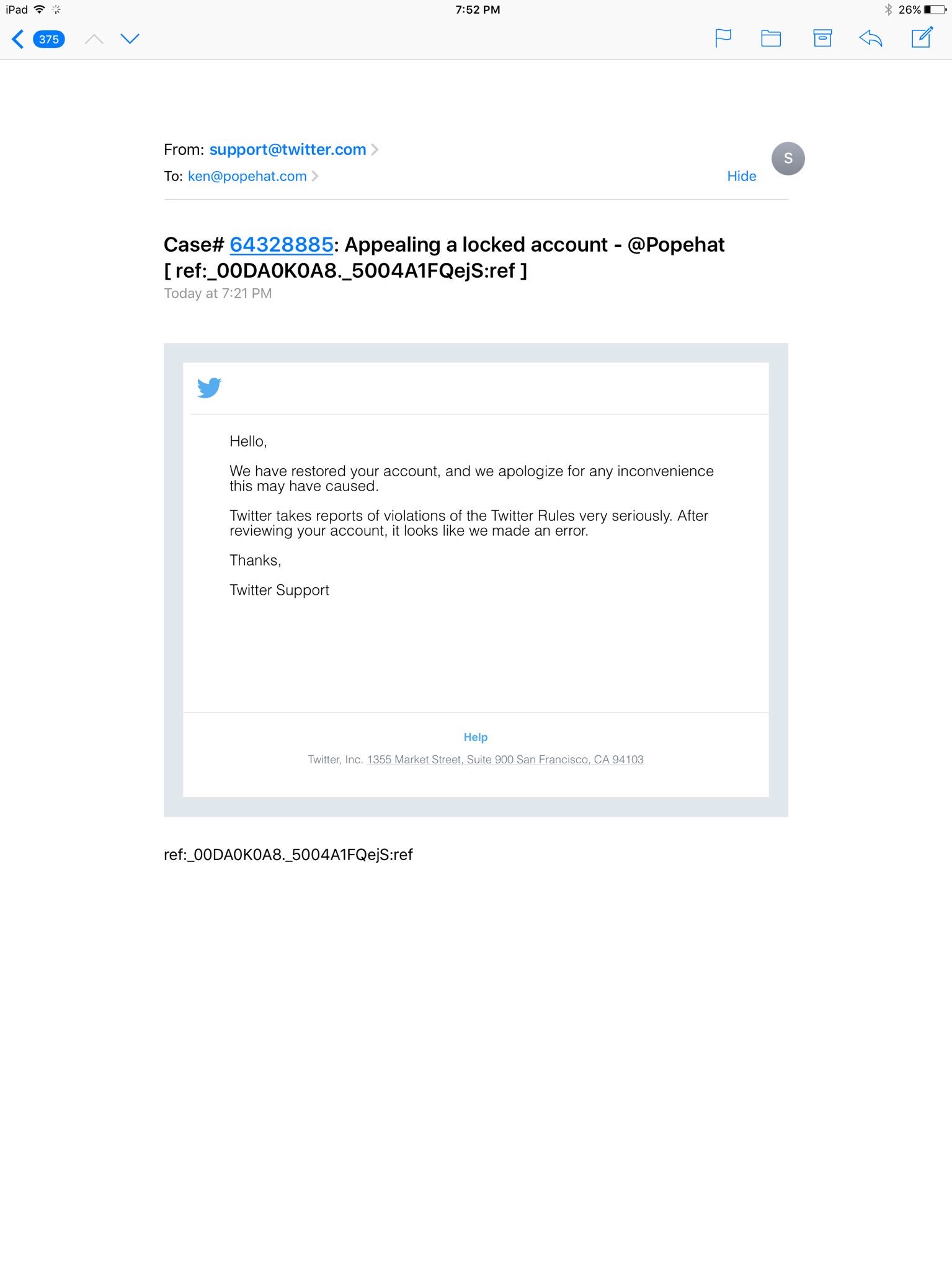
Popehat suspended from Twitter for sharing a threat he received (Update: unsuspended)

by Rob Beschizza

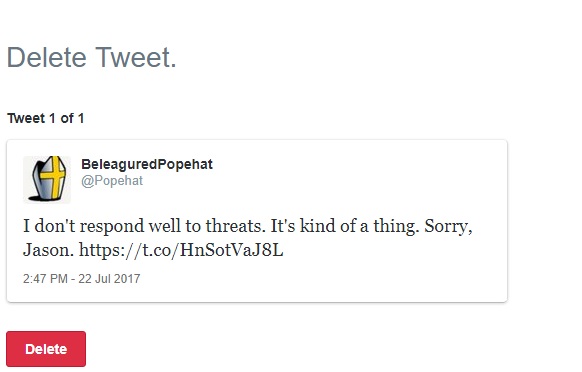
This morning, Twitter covered Ken "Popehat" White's profile page in balloons to celebrate his birthday. This afternoon, it suspended his account for posting screenshots of threats he'd received from another user.

The ranting missive, from a far-right lawyer in Texas whose threatening Twitter postings White had earlier mocked, promises such hatred and cruelty that White will want to kill himself or flee to "escape my wrath."

But it was White's response that fell afoul of Twitter's mysterious rules on posting personally identifying information—even when such information is disclosed and widely publicized.

Twitter is a private company. It has every right to suspend me or kick me off, however foolish its reason. It's got the right to free speech and free association. My rights have not been violated. I am not a victim. When you use a "free" service like Twitter and Facebook, you're buying into the policies and attitudes they pursue, for better or worse. Want a platform with no dumb policies? Create one or pay for one.

For the moment, I doubt this reflects an evaluation by anyone at Twitter that "it's okay for a deranged bigot to threaten people on Twitter but not okay to publish his threats." Rather, this is part of the inevitable result of automating responses to abuse complaints. Now, if Twitter reviews this, and thinks that's the right result — well, that would be something else again.

Twitter is still where the abusive can rail on and on before they get canned, while anyone with an earnest interest in using the site in good faith must adhere to vague, unhelpful policies in how they deal with all that trash.

UPDATE Twitter unsuspended White's account and agreed the original suspension was a mistake. Right on!

03 Aug 12:19

RED’s upcoming $1,200 smartphone is enormous

by Sean O'Kane

We finally have a few more details about RED’s forthcoming $1,200 Hydrogen One smartphone, thanks to a video that Marques Brownlee just posted to YouTube. RED let him take a look at a few different prototypes of the phone: a non-working unit that represents what the final phone will look like, one that shows off the phone’s new “holographic display,” and a third that was a full, separate camera module with its own lens and sensor.

Overall, this was still just another big tease from RED, which has also been showing the phone to celebrities like Brad Pitt. There’s not much more information than what the company already shared at the beginning of July. But we were able to glean a few things from this video.

First off, this thing is huge....

Continue reading…

02 Aug 10:34

Bitcoin Just Split Into Two Different Versions

by Jordan Pearson

Bitcoin, a digital currency worth $43 billion USD, is in uncharted and potentially risky territory after a split created two versions on Tuesday: the original bitcoin that's existed since 2008, and the new Bitcoin Cash, which aims to be a more populist alternative.

The split in the network was triggered on Tuesday afternoon (all times EST) when an upstart group of bitcoiners pushed the button on a "hard fork"—an unprecedented event in bitcoin's history, and one that the majority of the community had tried to prevent for two years. In fact, just one week ago, it seemed like the possibility of a split had been safely avoided altogether.

The fork was scheduled for Tuesday morning, and bitcoiners anxiously awaited the split. Due to some of bitcoin's quirks, the event actually happened six hours later. The hard fork was marked at 2:20 PM by the creation of an inaugural "block" of transaction data for Bitcoin Cash: nearly two megabytes in size. Bitcoin's blocks are capped at one megabyte, and Bitcoin Cash can support up to eight. Bigger block sizes is the major difference between the two virtual currencies and the impetus for the split. A second vanity block was quickly added to the chain and contained the phrase, "Hello world."

Read More: The Next 24 Hours Will Decide Bitcoin's Fate

Now two near-identical versions of bitcoin exist, each with their own set of rules and diehard supporters. Everybody who owns bitcoin automatically received the same amount in Bitcoin Cash, and this brand-new currency will have to fight to survive.

Bitcoin's price dipped $200 USD to roughly $2,700 per coin ahead of the split, but as of our time of publication, the currency is chugging along. Bitcoin Cash, on the other hand, is extremely volatile but showing signs of life. Before Bitcoin Cash was created with the inaugural block, popular cryptocurrency exchange Kraken credited customer accounts with the currency and allowed trading; basically, issuing IOUs. In about 10 minutes of trading, the imaginary price of Bitcoin Cash crashed to $140 from $400. It seemed bad, but immediately after the fork, the price rebounded to $200.

Bitcoin Cash's success largely lies in the hands of "miners," who run server farms to create the blocks that sustain the bitcoin network. At present it's unclear how many bitcoin miners have moved over to Bitcoin Cash, but it seems to be only a fraction. In the time that it took Bitcoin Cash miners to create a single block of transaction data for their public ledger, bitcoin proper had created dozens, which could indicate that Bitcoin Cash doesn't yet have the horsepower to take on bitcoin.

The split is a last-minute twist in a two-year debate that turned the bitcoin community into warring camps. The "civil war," as some called it, centred around the question of how best to change bitcoin so that it can handle more people using it without slowing down.

By late 2016, the "blocks" of bundled transaction information that are chained together to make up bitcoin's public ledger, called the blockchain, were full. This resulted in transactions being marooned for hours or even days before being processed in a block. Think about how long it takes for a debit transaction to be approved at the corner store—it might feel like forever, but on bad days bitcoin can be much, much worse.

Read More: The Dream of Buying a Coffee With Bitcoin Is Dying, If It's Not Already Dead

There was an exemption for those who could afford it, however: attach a high "fee" to your bitcoin transaction for a miner to include it in the next block. This is presumably fine for any of the many powerful financial institutions looking into bitcoin as a way to streamline parts of their existing business. They can afford the fees. This is bad, however, for people who want to use bitcoin to pay for everyday things like deodorant or a sandwich.

After a long period of debate, bitcoin developer Pieter Wuille proposed "Segregated Witness" (or segwit), a new rule that would free up some space in bitcoin's one megabyte blocks—but not much. Still, the community largely came around to the idea.

After a user-led campaign to strongarm holdout bitcoin miners into supporting segwit succeeded in July, the network was set to "soft fork" on August 1 to implement the change. A soft fork is a way to change bitcoin's rules without splitting the network, but everyone has to be in agreement. At the time, miners didn't unanimously support segwit, and so major Chinese bitcoin firm Bitmain coded a hard fork as a contingency plan.

That hard fork plan, initially just a hypothetical, actually succeeded in splitting bitcoin into two versions on Tuesday afternoon.

The hard fork was unexpectedly taken from "contingency plan" to "Plan A" and branded "Bitcoin Cash" by a group of users and developers that believe Segregated Witness didn't go far enough to increase the size of bitcoin's blocks. The "cash" bit in the name of bitcoin's new rival is meant to emphasize how this version is for anybody to use, not just financial institutions or large companies. Right now, the main differences between Bitcoin Cash and the original bitcoin are: no segwit, and a maximum of eight megabyte blocks instead of one.

It's tempting to see Bitcoin Cash and the hard fork as aberrations, but in hindsight they're expressions of an impulse that's been in bitcoin's DNA the whole time.

What's keeping bitcoin together isn't code or even money: it's a belief. The bitcoin protocol, when it was released by an anonymous person or group called Satoshi Nakamoto nearly a decade ago, was anti-establishment and petulant. Bitcoin called out the banks and regulators as bullshitters and beat them at their own game with a currency that went on to become just as "real" as the US greenback, even though it's an abstraction created with math and computers. It's a pretty good joke, and it channels a libertarian politics that's bound to attract true believers.

It's arguably bitcoin's own anti-authoritarian impulse that motivated the Bitcoin Cash hard fork. That, and a gambler's instinct that drives people to dump billions of dollars into a made-up currency in the first place. When everybody is yelling at you to fall in line, like during the years-long scaling debate, the most "bitcoin" thing you can do is tell them to shove it.

It will probably be many weeks, or even months, before the real impact of Bitcoin Cash is felt. Regardless, it's an historic day.

Get six of our favorite Motherboard stories every day by signing up for our newsletter.
01 Aug 07:23

People Are Buying Fish Antibiotics Because They Can’t Afford Human Ones

by Kaleigh Rogers

Amazon reviews can be enlightening and entertaining, and sometimes—as author Rachel Sharp revealed on Twitter this weekend—concerning. On Sunday, Sharp tweeted some reviews left on Amazon listings for antibiotics intended for pet fish, and they revealed something disturbing: People are buying these antibiotics to take themselves.

Here's everything you need to know about this bizarre trend:

People Write in Code

In the reviews for products such as Fin Mox and MoxiFish—both billed as fish doses of the antibiotic amoxicillin—consumers write in lightly veiled code how effective the medication was for their "fish:"

Basically every brand of fish antibiotic on the site has some form of these reviews, which make it blatantly obvious that people are taking, intend to take, or are pretending to take these animal medications themselves to treat human ailments.

A Symptom of US Healthcare?

Sharp suggested that people taking antibiotics meant for guppies is a sign of how inaccessible and expensive American health care has become. In fact, some reviews even allude to this, noting that the fish pills are a "great alternative to racking up debt at the fish hospital."

Though generic antibiotics are often very affordable, or even free, at pharmacies, the cost of visiting a doctor to get a proper prescription can be prohibitive for some people, particularly people who don't have health insurance. Studies have shown it's common for people to keep old prescriptions of antibiotics to use in the future without a diagnosis, or even take their pets' antibiotics.

Online, there are plenty of posts from people asking about or recommending using medication intended for animals as an alternative to getting a proper prescription. It's not entirely surprising that they might also be turning to fish antibiotics from Amazon.

With our better understanding of antibiotic resistance, doctors have also become more judicious in doling out antibiotics. Studies show that people are frustrated and dissatisfied when they go in hoping for penicillin and are told no, which could be another driver behind the aftermarket on fish meds.

This Is a Terrible Idea

For a number of reasons, it's not a good idea to take random fish antibiotics you bought on the internet. First of all, not every infection is a bacterial infection, which are the only kind antibiotics treat. Even if you have similar symptoms to a previous infection, like say bronchitis, without seeing a doctor, you don't know if it's bacterial, viral, parasitic, or something chronic.

Different infections call for different antibiotics, too, and doses depend on the individual and the infection: something that's difficult to determine on your own. Plus, fish antibiotics online may not even be what they say they are. The Food and Drug Administration hasn't approved these, so they're not regulated, which means you have no idea what you're really getting.

But perhaps most importantly, using antibiotics incorrectly (like taking the wrong dose or the wrong type of medication), or when you don't need them, contributes to antibiotic resistance. The more we abuse antibiotics unnecessarily, the more bacteria are exposed to our best defenses and can evolve to evade them. It's part of the reason why antibiotic-resistant superbugs are on the rise.

Some Buyers Might Not Be Taking Them...Yet

Browsing through online forums makes it obvious these off-label antibiotics are particularly popular with doomsday preppers: people who stockpile emergency supplies in preparation for some future apocalypse. In this case, the fish antibiotics are added to the stockpile, rather than consumed now, in anticipation that in the future, antibiotics might be much more difficult, or impossible, to get.

31 Jul 11:46

Wolf trees

by Jason Kottke

Wolf Tree

I took this photo of a wolf tree over the weekend. When thick forests were cleared for pasture and farming by settlers to colonial America, single trees were sometimes left by design or accident. In the absence of competition for light and space, these trees were free to branch out and not just up. They grew tall and thick, providing shade for people & animals and some cover for predators like wolves. Being the lone tree in an area, wolf trees were often struck by lightning or afflicted by pests that had nowhere else to go, contributing to their grizzled appearance.

In some cases, they grew alone like this for hundreds of years. Then, as farming moved to other places in the country, the pastures slowly turned back into forests, the new trees growing tall and straight with an old survivor in their midst. Wolf trees often look like they’re dead or dying, partially because of their age and all the damage they’ve taken over the years but also because the newer trees are crowding them out, restricting their sunlight and space. But they still function as a vital part of the forest, providing a central spot and ample living space for forest animals, particularly birds.

More reading on wolf trees, including the possible etymology of the phrase: Wolf Trees: Elders of the Eastern Forest, the Public Land Journal, and What’s up with the “Wolf Tree” at Red Rocks Park? (specifically about the tree in my photo, which might date from the 1700s). I’ll leave any possible metaphorical meaning of the wolf tree as an exercise to the reader.

Tags: this is a metaphor for something
31 Jul 07:19

Dear Blue Apron,

by Nathan Kontny

This is one of those open letters of advice. It’s from a friend, me. And it’s free advice. So it might be worth just that — nothing.

But I, and probably everyone else, noticed Amazon encroaching on your business. And since I’m a big fan, and we at Highrise have weathered some intense competition too, I thought some of our learnings might trigger something for you.

Also, you and I both understand, I know absolutely nothing about your business or running a public company. I hate those open letters that are like “YOU NEED TO DO THIS”. You don’t. I suspect you’ll be fine if you just stay true to yourselves.

So even if this doesn’t help you, maybe it’ll help someone else.

Know Thyself

When I took over as CEO of Highrise in 2014 — which was also the same week I signed up for Blue Apron! :) — I really had no idea what I had on my hands. I didn’t create Highrise. I didn’t know why 37signals/Basecamp bothered to build it. I didn’t know who its best customers were.

So we did a bunch of customer interviews getting to the real Job people hire Highrise to perform. Despite our headlines and website copy we found it wasn’t a group address book or a contact management tool. Customers were buying the fastest, simplest thing they could get up and running instantly to track leads and manage follow-ups. That’s extremely specific. But knowing that fuels a ton of decisions now. From marketing site changes, feature prioritization, and most importantly communicating to the world what we do.

If you were to interview me about Blue Apron you’d hear: I first signed up 3 years ago. It was a crazy time in my life. I had a three month old, and had just started a brand new job as CEO of Highrise that very week. Jason, the CEO of Basecamp, our parent company, introduced it to me.

He too was about to be a dad. Interesting connection. :)

I had zero time to worry about meal planning. We were ordering delivery and takeout way too much and feeling the effects. We needed help. Jason mentioned Blue Apron sends you everything to make a great and healthy meal. Perfect.

One wrinkle was that meals still felt like they were taking too much time. But I embraced it. What I thought was convenience I was looking for, became instead a way to retreat some from work and the craziness around me.

I could just cook and think about something else.

Eventually, however, the long cooking sessions won out and I took a break. Shortly thereafter you introduced the Family plan and I came right on back.

The Family plan was the perfect fit. We just have a family of 3. Our now 3 year old daughter is finicky. So two meals a week for 4 people most often turns into 4 dinners with the leftovers warmed up the other two nights. And it seemed like you got the message on time because more recent recipes take less time to make.

Somewhere in there is a path that might not be what you expected. Or want to take. But it might be a path only you can tackle better than Amazon.

Convenience or Luxury?

One of my favorite books in the world is Trade Off by Kevin Maney. Kevin explores how successful companies appear to either fully embrace High Convenience or High Fidelity. Fidelity being things like luxury goods or experiential products. A good example of convenience vs. fidelity are MP3s vs. concerts.

Companies that try to be both high fidelity and high convenience fail at both, and fail at attracting customers for the long term.

From our customer interviews, I know Highrise is a high convenience business. People come to us because they need a solution as fast as possible. If they have to get on a phone call with a sales rep to go through pricing options and possible customizations we will fall on our face.

I feel like there’s room here for Blue Apron to choose to either go for higher fidelity or higher convenience.

On one hand you’re nailing convenience, but I’m sure there’s more you could do to remove steps from your service like even faster recipes.

But fidelity might be a better choice. Amazon after all seems to always gun for high convenience. Maybe the farm to table work you’re doing is already the best way to combat their push to convenience.

Out-teach Amazon

We can all probably predict that Amazon isn’t going to get into the business of teaching me to be a better chef. But I really could use the help.

I have always hoped to master some principles of what makes a great recipe. I want to feel confident going into someone’s pantry and inventing a recipe with optimized ratios of salt, sweet, acid, umami, etc.

But I’m not confident. I’ve cooked so many meals already in my life and I feel like I’ve learned very little. It could be an interesting area to take Kathy Sierra’s advice to out-teach your competition. The process of cooking Blue Apron meals could become more of a learning experience on how these recipes come together if that was a path you chose.

Anyways, good luck. I’ve really enjoyed being a Blue Apron customer over these years, and think you’ll be able to keep competing well even with the likes of Amazon in the ring. I’m even about to make your Corn and Cheddar Enchiladas as soon as I’m done writing this letter :)

P.S. You should follow me on YouTube: here, where I share more about how we run our business, do product design, market ourselves, and just get through life. Also if you’ve enjoyed this article, please help it spread by clicking the ❤ below.

And if you need a zero-learning-curve system to track leads and manage follow-ups you should try Highrise.


Dear Blue Apron, was originally published in Signal v. Noise on Medium, where people are continuing the conversation by highlighting and responding to this story.

31 Jul 07:16

The deal Jeff Bezos got on Basecamp

by DHH

In 2006, Jeff Bezos bought a minority, no-control stake of Basecamp from Jason and me. We didn’t need any money to run the company, as we’d been profitable from the get-go, so none of it went to fund “our incredible journey”. As the Valley players say, we took money off the table.

It was an unusual deal for a number of reasons. First, Basecamp remained an LLC, which it still is. Not a corporation. Bezos’ personal investment shop simply took the role of a member in the LLC. This means that even to this day our paperwork and administrative overhead is laughably simple (Basecamp has no CFO, not even a full-time accountant!).

Second, there was no exit lined up! Jeff did have a one-time provision to sell his stake back to us after, I believe, seven years, but we didn’t trigger it, so now we’re in this together with no end in sight.

What Jeff got was the same deal that Jason and I had: His share of the yearly profits. What a quaint concept! But also a profitable one. Over the more than a decade that Jeff has been onboard, we’ve paid him back his initial investment five times over through profit distributions! And he still owns the stake.

What Jason and I got from the deal was the total confidence to go the distance. In 2006, we’d only been running Basecamp for a few years. We’d been besieged by venture capitalists and acquisition sniffers. But Basecamp wasn’t actually making that much money yet. Profitable, yes, but modestly so.

It’s only human to be tempted in such a situation. Only a year earlier, Yahoo had bought Flickr for some twenty million dollars. Jason and I had both been through the dot-com bust of the early 2000s. Now all of the sudden money was flowing again. So your mind wanders.

But thankfully it didn’t wander all that far. We had a good thing going, and we had no interest in giving it up. But at the same time, it seemed prudent to hedge the bet at least somewhat. It was entirely possible that Basecamp could have petered out, and we’d been back to doing consulting with no residual to show for it. That wouldn’t exactly had been the end of the world, but surely it would have engendered some regret.

Speaking of which. When we first started talking to Jeff, he spoke of his regret-minimization framework. It applied very well here. If we sold part of the company to VCs or all of it to some big company, there was a very good chance we’d end up regretting it. We’d be working for someone else, be on their timeline. All the ills we’ve been talking about for a long time.

But selling a small, no-control stake to Jeff? If Basecamp was going to fail, clearly we wouldn’t regret that. And if Basecamp was going to succeed, we’d not regret it either, since Jeff’s involvement would only mean giving up a small slice of the upside, without any of the normal investment-induced drawbacks.

The hardest part was actually talking Jeff down on the size of the purchase. Originally he wanted a bigger slice, which would have meant more money for Jason and I, but it would also have meant giving up more of the company. We decided that all we needed were a few million each to protect the downside of a bust, so that’s what we sold him.

I think it’s a shame that arrangements like this aren’t more common. I think many companies would be better off if the founders got to hedge their bet just enough to dare go the distance without the anchor of traditional venture capital.

The big financial cliff for most entrepreneurs is the difference between no net worth and a few million. The difference between having a few million and a lot of millions is vanishingly small in comparison.

Well, I suppose that even a lot of millions is now a vanishingly small difference to Jeff. He just got crowned the richest man in the world. But you get the point 😂


The deal Jeff Bezos got on Basecamp was originally published in Signal v. Noise on Medium, where people are continuing the conversation by highlighting and responding to this story.

31 Jul 07:05

Here’s what’s wrong with the “relax, the world is better than ever” arguments

by Jason Kottke

In recent years, commentators like Max Roser, Steven Pinker, Nicholas Kristof, and Matt Ridley have argued contrary to the prevailing mood that our world increasingly resembles a dumpster fire, things have actually never been better. Here’s Kristof for instance arguing that 2017 will likely be the best year in the history of the world:

Every day, an average of about a quarter-million people worldwide graduate from extreme poverty, according to World Bank figures.

Or if you need more of a blast of good news, consider this: Just since 1990, more than 100 million children’s lives have been saved through vaccinations, breast-feeding promotion, diarrhea treatment and more. If just about the worst thing that can happen is for a parent to lose a child, that’s only half as likely today as in 1990.

In a long piece for The Guardian, Oliver Burkeman does not dispute that the world’s population is better off than it was 200 years by any number of metrics. But he does argue that this presumably bias-free examination of the facts is also a political argument with several implications and assumptions.

But the New Optimists aren’t primarily interested in persuading us that human life involves a lot less suffering than it did a few hundred years ago. (Even if you’re a card-carrying pessimist, you probably didn’t need convincing of that fact.) Nestled inside that essentially indisputable claim, there are several more controversial implications. For example: that since things have so clearly been improving, we have good reason to assume they will continue to improve. And further — though this is a claim only sometimes made explicit in the work of the New Optimists — that whatever we’ve been doing these past decades, it’s clearly working, and so the political and economic arrangements that have brought us here are the ones we ought to stick with. Optimism, after all, means more than just believing that things aren’t as bad as you imagined: it means having justified confidence that they will be getting even better soon.

What things are like right now are the result of past actions. But the world to come is the result of what’s happening right now and what will happen in the next few years. Momentum (mass times velocity) is a powerful thing in a big world, but it’s not everything. It’s a bit like saying “ok, we’ve got the car up to speed” then letting up on the gas and expecting to continue to accelerate.

The New Optimists “describe a world in which human agency doesn’t seem to matter, because there are these evolved forces that are moving us in the right direction,” Runciman says. “But human agency does still matter… human beings still have the capacity to mess it all up. And it may be that our capacity to mess it up is growing.”

And just because things are good now doesn’t mean they couldn’t be better or start heading in the other direction soon.

But after steeping yourself in their work, you begin to wonder if all their upbeat factoids really do speak for themselves. For a start, why assume that the correct comparison to be making is the one between the world as it was, say, 200 years ago, and the world as it is today? You might argue that comparing the present with the past is stacking the deck. Of course things are better than they were. But they’re surely nowhere near as good as they ought to be. To pick some obvious examples, humanity indisputably has the capacity to eliminate extreme poverty, end famines, or radically reduce human damage to the climate. But we’ve done none of these, and the fact that things aren’t as terrible as they were in 1800 is arguably beside the point.

Read the whole thing…it’s a solid defense against a sentiment I find increasingly irksome.

Tags: Matt Ridley   Max Roser   Nicholas Kristof   Oliver Burkeman   Steven Pinker
13 Jul 11:21

‘Share Until This Pig Is Caught’: Germany’s Far Right Hunts an Innocent Man Online

by Theresa Locker

A version of this article originally appeared on Motherboard Germany.

There's screaming everywhere. Policemen rush in from the left, as a guy dressed in a pair of shorts and a hoodie gesticulates in their path; hundreds of people stand on the periphery, glass bottles flying in protest. Suddenly, smoke appears from out of nowhere, and one of the officers hits the ground. The violent scene depicted in this short video was one of many from the G20 Summit in Hamburg, Germany, this past weekend.

Over the weekend, one of the people featured in the video became the subject of a social media witch hunt. An online mob of self-proclaimed vigilantes hunted down the man in shorts from the video and wrongly accused him of being the person who threw a firecracker that "deprived [the policeman] of his eyesight", a widely shared Facebook post reads. Not even a swift statement of correction from the Hamburg Police could stop the false report from going viral.

Bild: Screenshot Karolin Schwarz / Twitter
"This is the 'protester' who blinded a policeman with a firework. Find him! Please share. There is a five-figure bounty for capturing/arresting him." Screenshot via Facebook.

An unblurred photo of the man was posted and circulated by the right-wing Facebook group "Bürgerproteste Hannover" (which translates to "Civilian's Protest Hannover") on Saturday night, and spread rapidly thereafter. The call for users to "share [the photo] until this pig is caught" went viral—it was shared by over 100,000 people within a few hours, although the group only consisted of about 3,500 members at the time of publication.

As fact checking website Faktenfinder pointed out, Hamburg police unfortunately contributed to the confusion with a tweet from July 8, claiming one policeman's eyes had been injured by firecracker. This tweet was later refuted by Hamburg police, and none of the information from the now-deleted Facebook post was true: The man in the photo didn't harm the Hamburg policeman with a firecracker, and the official who was attacked didn't go blind—instead, he was treated for noise damage, the Hamburg Police clarified on Twitter.

The tabloid Bild, which is Germany's largest newspaper by circulation, added fuel to the fire by publishing an unblurred photo of the protester and giving legitimacy to an online witch hunt.

Right-wing Facebook users made up a fake, five-figure bounty for identifying the man in the video and also said there was an official manhunt that actually didn't exist.

On the evening of July 8, Hamburg police tried to calm tensions on Twitter, but it was too late:

Translation: "IMPORTANT! The man shown here is NOT a suspect! Please call off the online manhunt for him!"

On Sunday night, Bild finally admitted on Twitter that the man in question was not a suspect "according to Hamburg police" and quietly updated its article without posting a correction note.

"It'll be difficult to rein this in again," tweeted Karolin Schwarz, founder of Hoaxmap, a German website dedicated to debunking hoaxes. And she's probably right: The Hamburg police force's statement and photo aren't likely to go viral on Twitter, and won't spread in the same way that Bürgerproteste Hannover's original post did. The case shows just how fatal the combination of rash, reactionary social media use and an emotionally charged atmosphere can be. Within mere hours, the combination turned an innocent man into a violent offender being tracked down by a virtual mob.

Bürgerproteste Hannover's video was finally deleted after being shared hundreds of thousands of times. If you want to get an idea of the sorts of inhumane fantasies that get whipped up thanks to senseless witch hunts like this one, you don't have to dig too far. A visit to the Facebook page "Pegida BW - Bodensee," where the video was reuploaded on July 8, shows a series of calls for murder, violence, use of firearms, and a slew of other serious crimes. The right-wing organization interprets the Hamburg police force statement as a conspiracy meant to protect left-wing violence and imaginary "pressure from above."

Even a local branch of a large police union, the DPoIG of Königsbrunn, fueled the mob's efforts: "WANTED: This is the 'protester' who wanted to bomb our colleague with a firecracker!"

The creator of the hoax is highly satisfied with his social media bomb: "This is and will be an incentive to all of us!"

Bürgerproteste Hannover is entirely pleased with its efforts, claiming that a mention on Faktenfinder, a German analog to Snopes, legitimized the group. The group also believes it's perfectly acceptable that its entirely false message got over 100,000 shares in one day: "This is and will be incentive for all of us!" concludes another Facebook post by the group.

There's a role for the public in investigations—usually, they should participate if the police specifically ask for help. But spreading social media rumors, accusing people of crimes with no evidence, and starting online vigilante mobs can quickly create a dynamic that could potentially put innocent people in harm's way.

Another particularly dramatic example of this happened in the aftermath of the 2013 Boston Marathon bombings: Within a day, countless Reddit users had posted reports about the name and address of one of the alleged attackers. Finally, a mob of onlookers and cameramen from local media outlets gathered on the doorstep of a man who turned out to be completely innocent—and who was also found dead shortly thereafter.

Whether there's a link between Reddit's investigation and that man's death is unclear, but one thing is certain: Information on the internet spreads so quickly that it's impossible to predict when an anonymous post will put someone in real-life danger.
13 Jul 10:33

Kyrkovalet (S)

by Hexmaster
Fick lägga upp skärmdumpen i fullstorlek för att avsändaren i mikroskopisk text "SSU" skulle synas ...

Inte för att tilltaget skulle ha vält kyrkovalsstugorna. Men har inte alla förstått vid det här laget att avsändare ska anges, tydligt? Vare sig det gäller näringsidkare, religiösa organisationer, politiska organisationer eller någon annan sorts organisation, så ska det direkt framgå vem som håller i megafonen. Allt annat ser ut som om man försöker smyga ut sin PR – och då straffar man ut sig direkt, oavsett vad budskapet gäller.

Sajten kyrkovalet.info är en sida som upplyser om kyrkovalet. Man får rak och enkel information om vad det är, när det hålls, och så lyfts tre frågor som avsändaren tycker är särskilt viktiga: Samkönade äktenskap, kvinnliga präster samt "rasistiska och konservativa krafter" som engagerar sig i det val, där det klena deltagandet innebär att det är lättare att få genomslag för den som lyckas mobilisera sina väljare.

Sidan hade inte förlorat mycket på att få sin avsändare tydligt angiven. Men man fick titta extra noga för att upptäcka att det inte var en neutral sida från Svenska kyrkan eller så.
– Både sidans namn, kyrkovalet.info, och dess utformning, gör att man vid första anblicken tror att det är en informationssida som Svenska kyrkan står bakom.
– Alla är fria att lägga ut vilken information man vill. Men jag tycker ändå att avsändarna borde vara tydliga med vilka de är. Här finns det helt klart en viss förväxlingsrisk.
- Anki Bondesson, kyrkovalsledare på SvK:s nationella kansli, citerad i SSU står bakom "informationssajt" om kyrkovalet, Dagen den 10 juli 2017

Nu ser sidan ut så här. Som den skulle ha gjort från början.

13 Jul 08:29

How Eminem was discovered by Dr. Dre

by Jason Kottke

In an extended clip from the HBO series The Defiant Ones, this is the story of how a white rapper from Detroit and rap’s best producer got together to start one of the decade’s signature musical collaborations. It’s evident from how Eminem and Dre tell the story that their first session in the studio was like falling in love…you only click like that with something a few times in a lifetime and then you spend the rest of your life trying to get back to that feeling.

This isn’t an official clip from HBO (they uploaded a much shorter segment) but after seeing it, I am definitely watching the whole series.

Tags: Dr. Dre   Eminem   The Defiant Ones   TV   video
06 Jul 07:10

Impeachment and its misconceptions explained

by Jason Kottke

At the recent Aspen Ideas Festival, legal scholar and former Obama advisor Cass Sunstein shared some views on his understanding of and some misconceptions about impeachment, namely that it doesn’t need to involve an actual crime and “is primarily about gross neglect or abuse of power”. Or as he put it more formally in a 1998 essay in the University of Pennsylvania Law Review:

The simplest is that, with respect to the President, the principal goal of the Impeachment Clause is to allow impeachment for a narrow category of egregious or large-scale abuses of authority that comes from the exercise of distinctly presidential powers. On this view, a criminal violation is neither a necessary nor a sufficient condition for impeaching the President. What is generally necessary is an egregious abuse of power that the President has by virtue of being President. Outside of this category of cases, impeachment is generally foreign to our traditions and is prohibited by the Constitution.

The “distinctly presidential powers” bit is a high bar to clear. Examining the case for Nixon on that basis, and only some of the reasons for wanting to impeach him hold up.

Richard Nixon nearly faced four counts. One failed count, for tax evasion, was completely inappropriate, Sunstein argued: Though an obvious violation of law, it had no bearing on Nixon’s conduct of the presidency. A second charge, for resisting subpoena, is possibly but not necessarily valid, since a president could have good reasons to resisting a subpoena. A third is more debatable: Nixon was charged with covering up the Watergate break-in. Nixon might have been more fairly prosecuted for overseeing the burglary, Sunstein argued, but nabbing him for trying to use the federal government to commit the cover-up was “probably good enough.” Only the fourth charge, of using the federal government’s muscle to prosecute political enemies, is a clear slam-dunk under the Founders’ principles.

Clinton’s impeachment, argued Sunstein in that same Penn Law Review essay, was less well-supported:

I suggest that the impeachment of President Clinton was unconstitutional, because the two articles of impeachment identified no legitimate ground for impeaching the President.

Sunstein explained the intent of the members of the Constitutional Convention in a Bloomberg article back in February. It’s interesting in the light of the Russian collusion investigation that the debate about impeachment at the convention centered around treason.

James Madison concurred, pointing to cases in which a president “might betray his trust to foreign powers.” Gouverneur Morris added that the president “may be bribed by a greater interest to betray his trust; and no one would say that we ought to expose ourselves to the danger of seeing the first Magistrate in foreign pay without being able to guard against it by displacing him.”

So what about Trump? Sunstein doesn’t offer much (no apparent mention of collusion with Russia):

Sunstein, having scolded legal colleagues for playing pundit, was reluctant to address the question directly. Setting aside the impossibility of impeaching Trump under the present circumstances of GOP control of Congress, Sunstein said he was wary of trying to remove the president simply for being bad at his job. Nonetheless, he said Trump’s prolific dishonesty might form a basis for trying to remove him.

“If a president lies on some occasions or is fairly accused of lying, it’s not impeachable — but if you have a systematic liar who is lying all the time, then we’re in the ballpark of misdemeanor, meaning bad action,” he said.

If I were a betting person, I would wager that Donald Trump has a better chance of getting reelected in 2020 than he does of being impeached (and a much better chance than actually being removed from office through impeachment) if the Republicans retain their majority in Congress. Although their healthcare bill has hit a hiccup due to public outcry (and it’s only a hiccup…it will almost surely pass), Congressional Republicans have shown absolutely no willingness to do anything not in the interest of their agenda…so why would they impeach a Republican President who is ticking all of the far right’s action items thus far?

Tags: Bill Clinton   Cass Sunstein   Donald Trump   legal   politics   Richard Nixon
06 Jul 07:01

But can you sell water?

by Jason Fried

A few years back, I did an extended Q&A session at Techstars Chicago. Great group, great questions. I really enjoyed it.

Before the talk, Troy, the guy who ran Techstars Chicago at the time, showed me this board they had propped up on an easel outside the office.

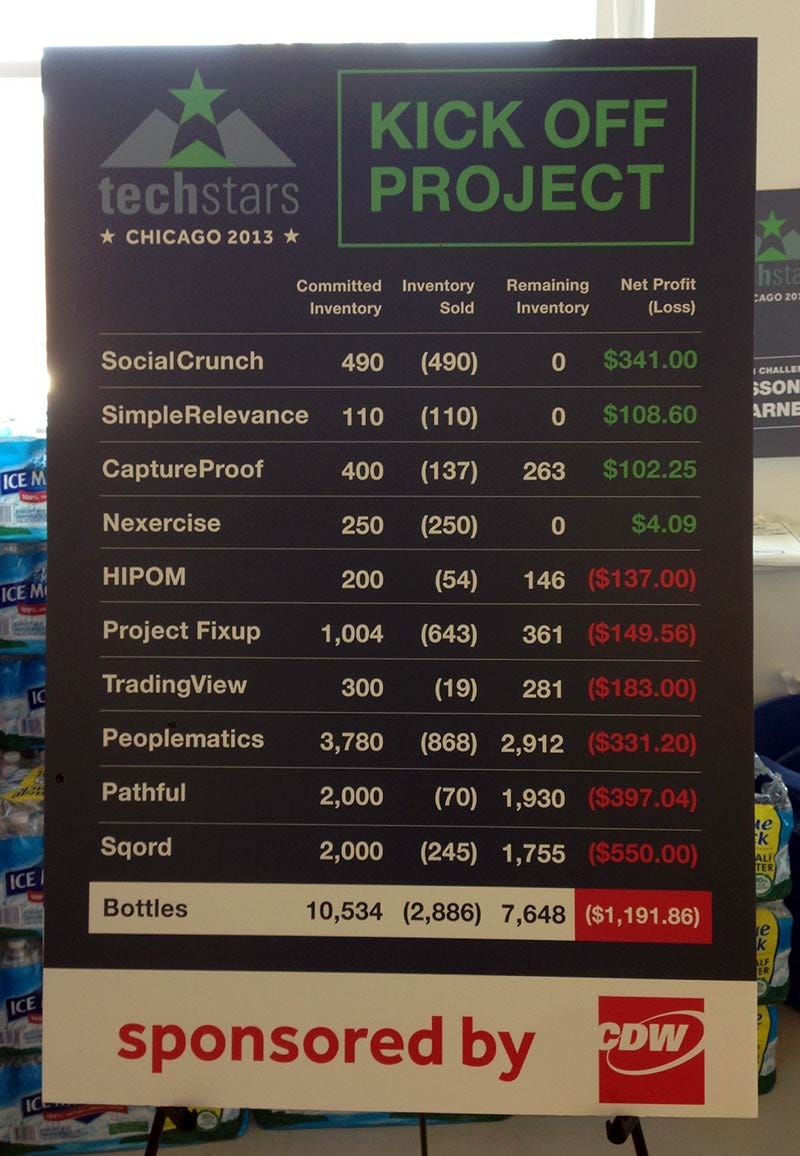
The board listed every company in the current Techstars Chicago class, along with some numbers. The columns included inventory, inventory sold, remaining inventory, and net profit.

Here’s a picture of the board:

Lots of red!

These are the results from the challenge. But what was the actual challenge?

The challenge

Each company was told to go sell bottled water. Each company had to decide how many bottles of water they wanted for their inventory. They couldn’t get more later. They had one set of inventory and that was it. They could charge whatever they wanted per bottle.

A few other rules… They couldn’t sell them in the Merchandise Mart (which is the massive building where Techstars Chicago is headquartered), so they had to hit the streets to find buyers.

I believe they had one day to sell their water.

Observations from the results

  • The companies that were over-confident lost the most money. In this case I define over-confident as taking on too much inventory.
  • 75% of the 40% of the companies that were profitable ended up with zero inventory. If they had a second chance, I wonder if they’d increase the price of their water. It’s impossible to tell from the board when the companies with zero inventory ran out of inventory, but they may have been better off selling their bottles for more and ending up with just a few extra at the end rather than zero. Does zero mean they underpriced their product?
  • It’s a lot better to only sell 110 bottles and make a profit of $108.60 than it is to sell 868 bottles and end up losing $331.20. Again, impossible to tell from the chart, but I wonder how much work went into selling 868 bottles only to lose $331.21 compared to how much work went into selling 110 bottles and ending up with a $108.60 profit.
  • The top two sellers (Peoplematics and Project Fixup) both lost money.
  • SocialCrunch, the company that ended up with the highest profit, were sitting in the front row at my talk ;)

I wonder if the results in the water challenge will mirror the results of the companies themselves if/when they get their own actual products to market.

Overall, I love this exercise. I think this is a great idea. No matter what you do in life, selling is a core skill. And there’s nothing quite like having to hit the bricks and sell your wares. It’s the best teacher you’ll ever have.


But can you sell water? was originally published in Signal v. Noise on Medium, where people are continuing the conversation by highlighting and responding to this story.

05 Jul 07:35

A Photographer Captures the Unusual Way Sperm Whales Sleep

by Kate Sierzputowski

© Franco Banfi / Licensed for use on Colossal

Photographer Franco Banfi and a team of scuba divers were following a pod of sperm whales when suddenly the large creatures became motionless and began to take a synchronized vertical rest. This strange sleeping position was first discovered only in 2008, when a team of biologists from the UK and Japan drifted into their own group of non-active sperm whales. After studying tagged whales the team learned this collective slumber occurs for approximately 7 percent of the animal’s life, in short increments of just 6-24 minutes.

The image, Synchronized Sleepers, was a finalist in the 2017 Big Picture Competition in the category of Human/Nature. You can see more of the Switzerland-based photographer’s underwater photography on his website and Instagram. (via kottke.org)

05 Jul 07:35

New Oil Paintings That Trace Fictitious Memories by Joshua Flint

by Kate Sierzputowski

Towards the door we never opened, oil on linen, 45″ x 28″

Joshua Flint (previously) paints scenes in relationship to the way we access old memories in our mind, blurring motions and obscuring the identities of his works’ subjects. The visual narratives are not linear, but rather create a surreal mash-up of landscapes and worlds, sourcing inspiration from digitized museum archives, vintage shops, and social media.

“The paintings fluctuate between the familiar and the unknown while simultaneously including the past and present,” said Flint in an artist statement. “By rearranging the hierarchy of elements the paintings become fictions that allow countless interpretations. Layered into works are references to liminality, ecological issues, neuroscience, psychological states, and the history of painting, among others.”

Flint has upcoming solo exhibitions at Seager / Gray Gallery in Mill Valley, California and Robert Lange Studios in Charleston, South Carolina this fall. You can see more of his oil paintings and studio sketches on his Instagram.

The World Between, oil on canvas, 48" x 48"

The World Between, oil on canvas, 48″ x 48″

The Guest, oil on wood panel, 36" x 36"

The Guest, oil on wood panel, 36″ x 36″

Carousel, oil on wood panel, 36" X 48"

Carousel, oil on wood panel, 36″ X 48″

The Volunteers, oil on wood panel, 30" x 40"

The Volunteers, oil on wood panel, 30″ x 40″

Threshold, oil on wood panel, 36" X 48"

Threshold, oil on wood panel, 36″ X 48″

The Assistant, oil on wood panel, 36" x 36"

The Assistant, oil on wood panel, 36″ x 36″

Future Present, oil on wood panel, 12" x 12"

Future Present, oil on wood panel, 12″ x 12″

The Projectionist, oil on wood panel,12" x 12"

The Projectionist, oil on wood panel,12″ x 12″

04 Jul 12:48

Goop and Infowars sell the same wellness stuff

by Rob Beschizza

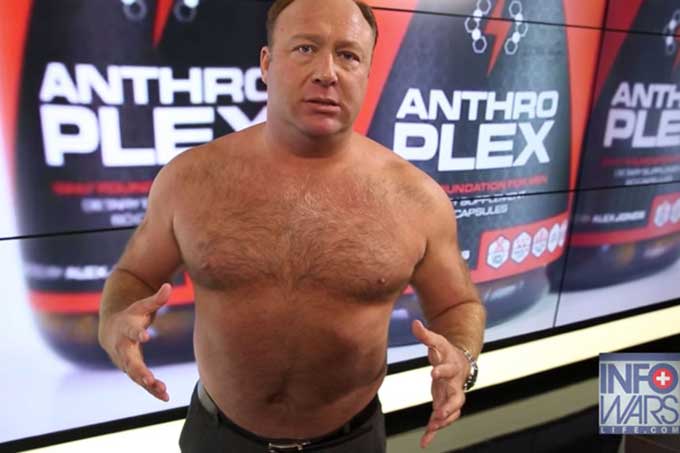
You'd think Goop, Gwyneth Paltrow's "lifestyle brand" for clean-freak whippies, and Infowars, Alex Jones' conspiracy compendium for seething fascists, wouldn't share much in common. But they both have exactly the same business model: selling wellness to people skeptical and fearful of mainstream medicine and healthcare. Nikhil Sonnad took a look at the ingredients on each site and found that it's all the same stuff.

We at Quartz have created a compendium, from Ashwagandha to zizyphus, of the magical healing ingredients both sides of the political spectrum are buying, and how they are presented to each. We looked at the ingredients used in products sold on the Infowars store, and compared them to products on the wellness shops Moon Juice and Goop. All make similar claims about the health benefits of these ingredients, but what gets called “Super Male Vitality” by Infowars is branded as “Sex Dust” by Moon Juice.

Call it horseshit theory: opposite extremes of lifestyle branding converging on a hidden axis of shared appreciation for their audiences.

[h/t Agies]

03 Jul 05:47

Hur man (inte) ska läsa en studie

by Hexmaster
Artikeln handlar om annat också men följande citat är dess höjdpunkt. Det är värt att lyftas fram, spridas och läggas på minnet. För på några meningar sammanfattas hur olika delar av en forskningsrapport används på olika sätt när läsarna är ute efter olika saker.
En van forskare fokuserar på två delar vid läsningen av en vetenskaplig artikel: resultatdelen med dess tabeller, figurer och ordknappa text, samt den torra, kondenserade redovisningen av metoderna. I diskussionsdelen får författaren fritt breda ut sig om resultatens betydelse – den delen skummar man igenom; när forskare citerar vetenskapliga artiklar är det endast resultaten som avses. Men informationsavdelning och medier gör inte denna distinktion utan förmedlar gärna spekulationer från artikelns diskussionsdel. De är ju ofta mer begripliga än själva resultaten.
- Agnes Wold: Universitetes fjärde uppgift, Fokus 30 juni 2017 [min markering]

Begripliga, och spännande – långt bättre rubrikmaterial än de slutsatser som faktiskt kan dras. Men mindre pålitliga och relevanta, och därmed mindre vetenskapliga. Trots att artikeln som helhet kan vara nog så välskriven. Det är helt enkelt så vetenskapliga artiklar är upplagda.

Det gäller alltså inte bara att hålla reda på vilken studie som en rubrik kommer ifrån, vilka som genomfört studien, hur de burit sig åt osv. Man får även hålla reda på från vilken del av studien som ett påstående har hämtats.

Sådant borde inte vanliga läsare behöva hålla reda på. Att media plockar fritt ur artiklar och vinklar för att optimera det så kallade nyhetsvärdet hör sedan gammalt till spelets regler. Men att informationsavdelningar på högskolor och universitet gör likadant är en problematisk och dum förväxling av roller som gränsar till sabotage av den egna verksamheten.

29 Jun 08:58

Hur många journalister är miljöpartister?

by Hexmaster
Påståendet dyker upp då och då, i sammanhang där det avgjort tolkas som ett gravt underbetyg: Sympatisörer för miljöpartiet är kraftigt överrepresenterade i journalistkåren.

Är det sant? Varifrån kommer uppgiften?

Härifrån:
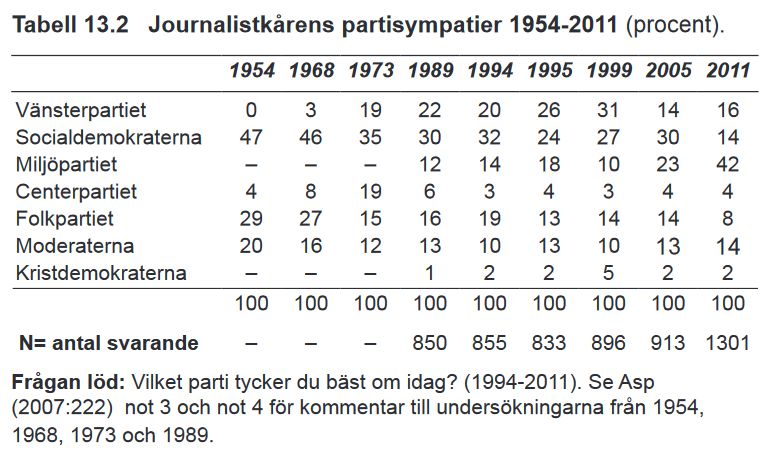
Det största partiet bland svenska journalister är miljöpartiet. Hela 41 procent [olika avrundningar?] svarade att miljöpartiet var det bästa partiet. Inte något parti har sedan undersökningarnas start 1989 kunnat uppvisa en så stor andel sympatisörer. Det är nästan tre gånger så stor andel som anser att socialdemokraterna eller moderaterna är bästa parti.
- Kent Asp: Journalistkårens partisympatier [PDF]

En av procentsatserna som cirkulerar är "50 % av Sveriges journalister är miljöpartister". Den kommer från en liten delmängd:
Det går en tydlig skiljelinje mellan journalister som arbetar inom dagspress och journalister som arbetar inom radio och tv. Över 50 procent av journalisterna på Sveriges Radio och Sveriges Television sympatiserar med miljöpartiet, kommersiell radio och tv kommer därefter. Minst andel sympatisörer har miljöpartiet i landsortspress och populärpress.
Liten, men tung – eller? Asps undersökning fick kritik:
På Sveriges Television arbetar cirka 1.100 journalister om man räknar in hela landet. Den som läser kolumnerna i Kent Asps undersökning finner ganska snabbt att 93 av dessa journalister har besvarat hans enkät. Om det är programledare för Bolibompa, reportrar på Sportspegeln, fotografer, redigerare eller samhällsreportrar på Rapport framgår inte. Bara detta är en så allvarlig brist att redan här blir undersökningen oanvändbar som underlag för en diskussion om betydelsen av journalisters politiska hemvist.
[...]
Jag själv har jobbat som journalist med svensk inrikespolitik sedan slutet av 1980-talet. Under den perioden har jag fått en mängd olika enkäter från forskare som ställt frågor om mina politiska prefenser. Utan undantag har jag kastat samtliga dessa enkäter i papperskorgen. Varför? Svaret är enkelt: En reporter som bevakar svensk inrikespolitik ska självfallet inte besvara sådana frågor.
- Mats Knutson: Är SVT:s journalister miljöpartister? SVT:s politikblogg 16 april 2014 [archive.org]

Asps svar:
– Att det är 93 SVT-medarbetare som deltar i enkäten handlar helt enkelt om att de inte utgör en större andel av journalistförbundets medlemmar. De journalister som arbetar på SVT och Sveriges Radio utgör omkring 16 procent av alla Sveriges journalister som är med i förbundet. Dessa 93 personer från SVT utgör, tillsammans med de från SR, även omkring 16 procent av journalisterna i urvalet. Att hävda att det inte skulle vara representativt är så korkat så det liknar ingenting, säger han.
[...]

Mats Knutson kritiserar även att det inte framgår vilken typ av journalistik de som svarat sysslar med, och att det är en brist. Håller du med?

– Det spelar ingen roll. De som är med i journalistförbundet är även med i undersökningen, och det borde han veta om. Journalisterna som bevakar rikspolitik är en väldigt liten grupp, och av den kan man inte dra några generella slutsatser.
- Pär Ullrich, Kent Asp slår tillbaka mot Knutson: "Korkat", Dagens Media 22 april 2014

Vad ska man tro? Det finns mycket mer att studera och reda ut här: metodik, bortfall, relevans ... Men en sak är säker, och det är att de som ofta och gärna drar till med påståendet inte har gjort några djupare analyser av undersökningen.

27 Jun 13:33

Mark Zuckerberg isn’t running for President

by Jason Kottke

The scuttlebutt around the tech/media internet water cooler over the past few months is that Facebook CEO Mark Zuckerberg is going to run for President in 2020. This feeling has been fueled by Zuck’s goal for this year of visiting the remaining 30 or so US states that he has yet to visit and the way in which he’s been documenting his trips. Nathan Hubbard argues that Zuck actually has other things on his mind as he tours America:

Zuck isn’t running for President. He’s trying to understand the role the product he created played in getting this one elected.

Facebook has undergone two major evolutionary events in its history, both of which were driven by what Zuck saw as existential threats.

The incredible revenue growth in mobile (probably the greatest biz execution of our generation) helped Facebook survive a platform shift.

And the fearless acquisitive streak of Instagram, WhatsApp and others helped Facebook survive a shift in how we communicate and organize.

Zuck woke up on Nov 9th acutely aware that FB had facilitated a new shift he didn’t foresee or understand; that’s terrifying to a founder.

He’s the head of product. So he’s ventured out into the world beyond his bubble to do field research and inform how FB will evolve again.

I am also sympathetic to the argument that Zuckerberg doesn’t need to run for President because he’s already the leader of the largest group of people ever assembled in the history of humanity (aside from possibly the British Empire). Facebook doesn’t possess many necessary qualities of a sovereign country, but it also has many advantages that countries don’t. Zuckerberg is already among the world’s most important people and with Facebook still growing, he could one day soon be the most powerful person in the world.

Tags: Facebook   Mark Zuckerberg   politics
26 Jun 10:33

Remembering Prisoners of Gravity, the greatest science fiction TV show of all time

by Cory Doctorow

From 1989 to 1994, the public broadcaster TV Ontario ran Prisoners of Gravity, a brilliant science fiction TV show that used a goofy framing device (a host trapped in a satellite who interviewed science fiction writers stuck down on Earth) for deep, gnarly, fascinating dives into science fiction's greatest and most fascinating themes, from sex and overpopulation to cyberpunk and religion. (more…)

21 Jun 07:50

Why did Amazon buy Whole Foods? World domination.

by Jason Kottke

Amazon’s New Customer is a really great analysis by Ben Thompson of Amazon’s strategy and why Amazon bought Whole Foods: they purchased a new customer for Amazon infrastructure, not a retailer. Early on in the piece, Thompson lays this one on us:

Amazon’s goal is to take a cut of all economic activity.

No qualifiers. All economic activity. In the world. Sort of a Dutch East India Company for the internet age. Thompson explains how they’re going to do it and why fresh food is such a strategic hole for them.

As you might expect, given a goal as audacious as “taking a cut of all economic activity”, Amazon has several different strategies. The key to the enterprise is AWS: if it is better to build an Internet-enabled business on the public cloud, and if all businesses will soon be Internet-enabled businesses, it follows that AWS is well-placed to take a cut of all business activity.

On the consumer side the key is Prime. While Amazon has long pursued a dominant strategy in retail — superior cost and superior selection — it is difficult to build sustainable differentiation on these factors alone. After all, another retailer is only a click away.

This, though, is the brilliance of Prime: thanks to its reliability and convenience (two days shipping, sometimes faster!), plus human fallibility when it comes to considering sunk costs (you’ve already paid $99!), why even bother looking anywhere else? With Prime Amazon has created a powerful moat around consumer goods that does not depend on simply having the lowest price, because Prime customers don’t even bother to check.

This, though, is why groceries is a strategic hole: not only is it the largest retail category, it is the most persistent opportunity for other retailers to gain access to Prime members and remind them there are alternatives. That is why Amazon has been so determined in the space: AmazonFresh launched a decade ago, and unlike other Amazon experiments, has continued to receive funding along with other rumored initiatives like convenience store and grocery pick-ups. Amazon simply hasn’t been able to figure out the right tactics.

When I heard about the Whole Foods deal, the first thing I thought about was Amazon Go. The company has been trying to experiment with different retail environments, but without the proper scale, it doesn’t make a lot of sense. Whole Foods gives them a chance to develop their fresh food delivery infrastructure at scale…so that they can offer it to other customers just like they do with AWS.

P.S. Whenever I think about Amazon as a business, I recall this 2012 post by Eugene Wei on Amazon’s low-margin strategy. I suspect Thompson’s post will join it in my thoughts.

Tags: Amazon   Ben Thompson   business   economics   Whole Foods
20 Jun 10:52

How Amazon's Tech Could Change Whole Foods

by Carl Franzen

The US grocery industry was thrust into the national spotlight on Friday when Amazon announced it was buying Whole Foods for $13.7 billion.

While many were initially shocked by the news, it's not totally surprising given Amazon's business ambitions and the state of Whole Foods. Amazon's own grocery store service, Amazon Fresh, has been operating since 2007 and steadily expanded from a few small markets to a handful of major cities around the world.

Meanwhile, Whole Foods has been struggling with declining sales for more than a year straight, and its leadership has been locked in an acrimonious public battle with activist investors over the future direction of the company.

Antitrust regulators still have to approve the deal—which may prove difficult. And there's a lot to unpack if it goes through, not the least of which are the implications it has for competitors like Walmart (which today also made headlines with an acquisition of its own), smaller grocery and retail chains, local economics, the food supply, American labor, transportation, and more.

Yet Amazon is as its heart a technology company (lest we forget, it was founded in midst of the dot com bubble in 1994 as an online book retailer), and to this day it produces some of the most futuristic and invasive consumer technology available.

Setting aside the larger concerns, here are some obvious Amazon technologies that make sense connected to Whole Foods and will probably make the combined companies a ton of money from those of us who have problems controlling our rampant online consumerism (*raises hand*).

Echo/Alexa
Amazon's quickly growing family of interactive speaker devices are already perfect for dictating your shopping list. But they've been limited in what they can order to Amazon's offerings (and participating third-parties). Once Whole Foods is absorbed, it would seem very convenient to be able to speak and add items to your grocery list for delivery as soon as you run out of them.

Amazon Now
This is Amazon's fast, same-day delivery service for small items. If Amazon links Whole Foods to this, and does a good job of narrowing those delivery windows, those of us who have Amazon Now in our cities should theoretically never have to rush off to the store for forgotten recipe ingredients.

Amazon Prime Air
Drone delivery. Amazon has been teasing this idea since 2013, and it still has a long way to go in terms of both legality and practicality here in the US. But again, it's not hard to imagine a dystopian on-demand future where instead of going to your local corner bodega/store, you shout for emergency cat food into your Echo and it uses Amazon Now to call an Amazon Prime Air drone over to your house with a can for the little tyrants.

Kiva Robotics
Amazon bought this company back in 2012, and has been using its robots to move stuff around its warehouses and fulfillment centers ever since. Might make sense to set a few loose in the Whole Foods stockrooms to help move stuff around.

Amazon Go
Amazon apparently wants to eliminate the idea of human cashiers and checking out entirely. Earlier this year, the company dropped a flashy video showing its idea for Amazon Go, an automated store that tracks what items you take off the shelves and automatically bills your account using a smartphone app as you leave. It hasn't actually been deployed for the public anywhere yet, but it could eliminate checkout lines and put a hell of a out of people out of jobs.

Amazon Logistics and Amazon Flex
These two services are Amazon's delivery subcontractors. Whether you're a delivery company or individual, Amazon wants to hire you to deliver the mountains of shit people order from its websites every day. Groceries are a natural fit, unless Amazon wants to keep around…

Amazon Fresh
Amazon's still nascent grocery service. Pros: you can order directly online and buy a lot of more affordable, big brand products not available at Whole Foods (e.g. non-organic cat food). Cons: there's not really any brick-and-mortar stores for you to go and pick out the produce you want. And it's wasteful—lots of packaging for the simplest foods. The Whole Foods merger could combine the "best" of both worlds (though the Amazon Fresh and Whole Foods brand names coexisting together seems a bit confusing).

AWS
The Whole Foods website and apps will probably migrate over to Amazon's Web Service, if they haven't already.

Get six of our favorite Motherboard stories every day by signing up for our newsletter .

20 Jun 09:04

The 'Complex Systems Theorist' Who Predicted the Arab Spring

by Jason Koebler

In early 2011, a few days before Tunisian street vendor Mohamed Bouazizi set himself on fire in the middle of a busy street, Yaneer Bar-Yam sent his research to the US government.

Bar-Yam's message was simple: If drastic measures weren't immediately taken to lower skyrocketing global food prices, widespread violence would occur. Bouazizi's act set off food riots and are widely seen as the beginning of the Arab Spring.

Bar-Yam is a theoretical physicist turned "complex systems theorist." He's the president of the New England Complex Systems Institute, a group that tries to explain why the world works the way it does. He says that using a mix of big data, machine learning, and mathematics derived from the science of phase transitions, his team is able to identify the tipping points of a wide variety of global crises.

Violence and riots occur at the peaks of the food price index. Image: VICE

His team pulls from census and survey data, official government numbers from around the world, social media posts, and a host of other data sets in an attempt to explain the world around us. Our new video series, The Math That Explains the World, will feature Bar-Yam's work on the Arab Spring, governance, ethnic violence around the world, and inequality.

The key, he says, is determining what isn't important.

As the world grows increasingly complex, society becomes more interdependent and thus harder to explain the specific inputs that are causing a certain output. But with more data and more number-crunching capabilities, Bar-Yam's institute has been able to narrow down the causes of crises in many cases. Surprisingly, the flashpoints of major crises can usually be traced to a few specific policies.

"There are many different things that people might think would cause food prices to increase, but it turns out by looking at them we can eliminate most of them," Bar-Yam said. "For example, we can eliminate the possibility that changing diet in China caused rising food prices. Or that currency exchange rates caused rising food prices. Instead, it turns out that there are only two things that are important."

According to Bar-Yam's research, American policies on ethanol—which means a huge amount of US corn is used to power cars rather than food—and commodity market deregulation in the late 1990s were the major cause of skyrocketing food prices.

"Our ethanol policy by itself has lead to, by now, a doubling of global food prices. The deregulation of the markets leads to peaks that lie on top of a gradual increase that's due to the ethanol policy," he said. "The peaks are the triggers of the food riots and the Arab Spring, but the underlying increase plays an important part as well."

20 Jun 08:53

Chokladmjölk, PR och skräpundersökningar

by Hexmaster
Enligt en studie utförd av organisationen The Innovation Center for U.S. Dairy där 1 000 vuxna amerikaner fick svara på var de trodde att chokladmjölken kommer ifrån, visade det sig att okunskapen var hög.
- Många amerikaner tror att chokladmjölk kommer från bruna kor, Aftonbladet 18 juni 2017
A survey from the Innovation Center for U.S. Dairy found that 7% of American adults think chocolate milk comes from brown cows. And if that percentage sounds small enough to be reasonable, hang onto your hats: 7% of American adults is about 17.3 million people.
- Chocolate milk definitely doesn't come from brown cows -- but some adults think otherwise, CNN 16 juni 2017

Nyheten fick snabb och förutsägbar spridning, där mycket av kraften nog kom från glädjen av att få (ännu) en bekräftelse på att amerikaner är dumma i huvudet.

Inte för att det är årets tyngsta nyhet precis ... Men ändå. Är det sant? Hur gick undersökningen till? Var kan man läsa den?

Dairy Management Inc. är en organisation för mjölkbranschen i USA. Den grundades av landets jordbruksdepartement, har i uppdrag att marknadsföra landets mjölkprodukter, och finansieras av skattebetalarna samt medelst avgifter på mjölkprodukter. De har några olika "varumärken" eller sidoorganisationer, som National Dairy Council, U.S. Dairy Export Council och Innovation Center for U.S. Dairy. Dessa har diverse hemsidor vilket gör att det inte är självklart var man ska leta efter officiella pressmeddelanden och slikt. Här är en av deras egna nyheter om undersökningen:
A survey conducted by our own Innovation Center for U.S. Dairy uncovered the fact that some Americans are pretty disconnected from how their food travels from the farm to their table.

In fact, about half of 1,000 people polled said they weren’t sure where chocolate milk comes from, as Today.com reported.
- Survey: Some Americans Actually Think Chocolate Milk Comes from Brown Cows, dairygood.org 16 juni 2017

De hänvisar som synes till Today.com: A startling number of American adults think chocolate milk comes from brown cows, skapad 15 juni. Today.com hänvisar i sin tur till Food & Wine: Survey finds too many people still think chocolate milk comes from brown cows, 1 juni. Food & Wine hänvisar inte till någon rapport utan till UndeniablyDairy.org – som är en kampanjsida hos dairygood.org, utan annan information än en länk till Today.com ...

Ingen studie någonstans. Jag ställde frågan direkt till mjölkfolket och fick snabbt svar:
The full survey currently isn't posted anywhere. The survey was conducted by Edelman Intelligence [etablerat namn inom PR, marknadsundersökningar o.dyl.] to kick off our Undeniably Dairy campaign on behalf of the Innovation Center for U.S. Dairy.

The purpose of the survey was to gauge some interesting and fun facts about consumers' perceptions of dairy, not a scientific or academic study intended to be published, yet the USA Today Snapshot’s interest in the chocolate milk stats has brought on the attention.

The study polled 1,000 American adults online [förmodligen under gravt ovetenskapliga förhållanden] between May 5 and May 9, 2017. Responses came from all 50 states, and the regional response breakdown was fairly even, with a slight uptick (approx. 10% higher) in the South.

In addition to the chocolate milk and brown cows stat, there were many interesting stats uncovered from the survey, such as:
  • 63% of Americans would prefer to stay in and have milk and cookies on a Friday night, rather than going out.
Redan här kan man konstatera, att den som köper detta påstående – att 63 % av alla amerikaner hellre tillbringar en fredag kväll hemma med mjölk och kakor än går ut på stan – den personen kan tro på vad som helst.
  • A quarter of Americans have gone to the grocery store or a convenience store before 6 am just to get milk.
Även detta påstående torde kunna ifrågasättas.
  • 43% of Americans like to start their day with beverage that includes dairy.
  • 95% have at least one type of cheese in their refrigerator right now and 4 in 5 have at least two.
  • 94% of Americans' favorite delicious treats prominently feature dairy.
  • 9 in 10 consume dairy every week.
  • 42% of milk consumption occurs at breakfast.
- Lisa McComb, Senior Vice President Communications, Dairy Management Inc.

Allt sammantaget kan uppgiften, att 7 % av amerikanerna osv., lugnt lämnas utan avseende, som jurister säger när någon blåljuger.

Lisa är åtminstone ärlig med uppsåtet. Syftet med att lansera en hittepå-nyhet som denna är, i deras fall, att mjölk och mjölkprodukter ska få uppmärksamhet och förhoppningsvis sälja bättre i längden. Gratis reklam, med andra ord. Då spelar det naturligtvis ingen som helst roll hur undersökningen gjordes; för jag är välvillig nog att utgå ifrån att den faktiskt gjordes, oavsett omständigheterna.
19 Jun 12:28

Writing the early history of Spotify (excerpt from a forthcoming book)

by rasmus

As mentioned in my previous post, and by my colleague Pelle, we just delivered the manuscript to MIT Press for our academic book focusing on Spotify. The book is co-written by five researchers; I have been mainly in charge of writing a history of Spotify (which includes not only a chronological narrative, but also a whole lot of theoretical and methodological considerations that may have a broader relevance for those writing digital history).

Just like Pelle has previously posted a snippet at his blog, I will here post a short section cut out from the historical chapter. (Remember, this is just the first manuscript and will of course be edited on the way to the final product. Also, this snippet is lacking the footnotes and references that are in the manuscript.)

/ / / / /

The Beta Period (2007–2008)
On the first of May 2007, Spotify released its initial beta version to a smaller circle of acquaintances. Among those were some of Sweden’s leading technology bloggers. This immediately resulted in a number of enthusiastic blog posts, and the comment fields were flooded with invite requests. Being invited to use Spotify was a sign of exclusivity, and Spotify controlled the growth of the circle by rationing the number of invites that existing users could pass on. If one would look at the early user demographics it would probably be rather affluent, dominated by men in the age between 25 to 40 years, living in inner-city Stockholm, working with technology or media. Many of these saw themselves as passionated fans of new pop music, but their enthusiasm for digital technology was probably even stronger.

One of the first beta testers was Eric Wahlforss, a part-time musician and entrepreneur who at this time was just about to found SoundCloud—another kind of music streaming service (that Spotify years later would consider for acquisition). Wahlforss immediately recognized Spotify as “a preview of the future.” It may be noted, however, that his enthusiastic blog post had little, if anything, to do with music:

The thing that wows me the most is that the app is faster than iTunes on my local machine. Repeat, faster than iTunes. And now we’re talking fancy peer-to-peer architectures, special audio codecs, custom databases, etc, etc. […] If this thing scales it will be bigger than Skype. Big, big ups to the Spotify team.

Spotify’s first interface did indeed look very similar to iTunes: the user could search for music and add tracks to personal playlists. In addition, it also offered a radio-like mode of listening in which the user was asked to select one of 18 predefined music genres (and one or several decades). Compared to today’s personalized radio stations, this seems primitive indeed—but in fact, this was how Spotify Radio worked until late 2011.


Illustration 7. The possible options for the user in Spotify’s early radio interface—present already in the beta version. Screenshot taken during the summer of 2010.

Spotify, during its Beta Period, consolidated a kind of on-demand doctrine as a service centered around the search box, giving access to “whatever you want.” The user was effectively conceived as a sovereign individual who already knew exactly what he or she wanted to listen to, and did not need help with music recommendations. Indeed, this doctrine was probably reinforced by the sample of beta testers.

The buzz over Spotify intensified in early 2008, essentially focusing on two aspects. First, that the new service would actually ‘make music free’ by relying entirely on advertising. Secondly, buzzmakers affirmed the move ‘from ownership to access’ and presented the personal archiving of MP3’s as a practice soon to be outdated. If commentators saw anything lacking in the beta version, it was that users still could not easily upload their self-made music to Spotify—as a web 2.0 service was supposed to function. However, it was a feature that many expected to see implemented soon.

Period A (2008–2009)
The first public version of Spotify was launched in October 2008. But what exactly did it mean to ‘launch’ a music service that was already up and running, serving thousands of users each day? Maybe it is better to say that Spotify was legalized. For a year and a half, Spotify’s beta had in effect been run as a pirate service, distributing music without any license to do so—to users that had come across an invite. As stated, in many cases the music files had originated from The Pirate Bay and other file-sharing networks, but this changed when Spotify signed its first deal with the big record companies and collecting societies—in essence, moving itself into legal territory.

To many of the existing users at the time—and some of us researchers living in Stockholm were initial listeners—what really happened in October 2008, however, was that parts of their playlists suddenly became unavailable. Spotify simply had to remove unlicensed music from its service, and in early 2009, even more music disappeared on request of record companies that enforced country-specific listening restrictions. In addition, only users with a special invite could access Spotify Free; this did not change with the official launch. The only real addition was the addition of paid version, Spotify Premium. Now being legal, the company could now also begin to really sell advertisement—which gradually became ever more present for users of Spotify Free.

Spotify’s ‘launch,’ in other words, was not the launch of a new service, but the launch of new efforts to monetize an existing service.

/ / / / /

And so the chapter goes on, structuring the history of Spotify according to the successive rounds of financing which has let the company survive, despite making ever larger losses.

Oh no, now I said it again: “the history of…”. According to a newly published article in Rethinking History this is a “bizarre notion”, because history is not the same as the past. I do agree that it would be more correct to say that our book provides a history of Spotify, because it could certainly be written otherwise. But so far, I dare to say that our forthcoming book provides the only academic attempt to write Spotify’s history at any length. Yet, the history told in chapter one is only a part of the book.

Spotify Teardown. Inside the Black Box of Streaming Music is to be published by MIT Press in 2018.

14 Jun 08:37

Spotifyboken skickad till förlaget

by rasmus

Boken om Spotify är nu inlämnad i manuskript till förlaget (MIT Press), efter att jag och de fyra andra medförfattarna har jobbat ganska intensivt i några veckor. Strax efter att jag nämnt bokprojektet här på bloggen blev jag intervjuad i Dagens Industri. Det var roligt och har lett till en del roliga uppföljningar. Det var också intressant att se hur ett litet intervjusvar kunde spinna vidare i internationell press:

Spotifys betaversion var från början en pirattjänst. Det som distribuerades var mp3-filer som de anställda råkade ha på sina hårddiskar.

För många i Sverige, som kanske rentav själva var inbjudna att använda Spotifys betaversion, är detta alls ingen nyhet. Det är heller inte nytt i medieforskningen, utan har t.ex. nämnts av Jonas Andersson Schwarz i en bok från 2013:

Much as TPB managed to build new infrastructure around the scattered activities of individual file sharers, Spotify managed to build a rogue archive of mp3 files that users could remotely access via streaming protocols, before reaching a deal with record labels and ultimately succeed to make the service legit.

Ja, hur skulle det annars ha gått till för Spotify att driva en betaversion innan man nått ett licensavtal med skivbolagen? Finns det någon som på allvar vill driva tesen att deras tjänst, under första året i drift, skulle ha varit 100 % laglig?

Ändå uppfattade vissa min utsaga som sensationell. Några dagar efter intervjun i Dagens Industri publicerades en artikel på Torrentfreak som fick oräkneliga uppföljare bland nyhetssajter på olika språk. Små glidningar i ordval fick det hela att låta ännu mer dramatiskt. Smaka på rubriken som sattes av Digital Music News: “Spotify Illegally Streamed MP3s Before Getting Proper Licenses, Investigator Claims“. (Som vore jag någon typ av hyrsnut!)

Vad de otaliga artiklarna drar på är att Spotify i startfasen streamade musikfiler som hade laddats ned utan tillstånd. Vilket får sägas vara belagt. Men oavsett varifrån musikfilerna kom, så gäller likväl att Spotify streamade ut musik utan tillstånd. Strikt juridiskt borde nog det senare vara klart grövre – även om skivbolagen denna gång valde att inte agera rättsligt. Det går såklart att spekulera i om skivbolagen använde stämningshot som ett kort i förhandlingarna med Spotify, som ju resulterade i en för dem mycket fördelaktig deal där de bl.a. belönades med delägarskap. Men sådant går inte att belägga och i vilket fall är det inte centralt för den historia som berättas i vår bok. Vi är inte alls intresserade av att “hitta skit på” Spotify – däremot av att plocka isär en del av den mytbildning som florerar.

Om jag får säga det själv, tycker jag att det är en förbannat bra bok som vi kollektivt har satt samman. Fyra längre kapitel som tar sig an Spotifys historia, infrastruktur, gränssnitt och affärsmodeller. Därtill lika många kortare “interventions” som syftar till att visa på innovativa sätt att bedriva forskning om nättjänster av liknande typ. Sammanlagt ligger manuskriptet på drygt en halv miljon tecken. Nu ska det genomgå sedvanlig akademisk granskning med sikte på utgivning i början av 2018.

13 Jun 11:14

Vem uppfann pizza Hawaii?

by Hexmaster
En sak är säker: Detta omdiskuterade bidrag till världsgastronomin har ingenting med Hawaii att göra. Antingen skapades pizzan med ananas och skinka (som väl är svensk standard, i andra länder är varianten med bacon som på bilden vanlig) av en grek i Kanada, eller så är den en tysk skapelse.
Greek-Canadian Sam Panopoulos claimed that he created the first Hawaiian pizza at the Satellite Restaurant in Chatham, Ontario, Canada in 1962. Inspired in part by his experience preparing Chinese dishes which commonly mix sweet and sour flavours, Panopoulos experimented with adding pineapple, ham, bacon and other toppings which were not initially very popular.
- Wikipedia: Hawaiian pizza

En del skulle hävda att den förblivit impopulär ... Men hos andra slog kreationen desto bättre an.
The addition of pineapple to the traditional mix of tomato sauce and cheese, sometimes with ham or sometimes with bacon, soon became popular locally and eventually became a staple offering of pizzerias around the world.
I samma artikel kan man även se ett tyskt anspråk på pizza Hawaii:
In Germany, Hawaiian pizza is thought to be a variation of the ham, pineapple and cheese topped Toast Hawaii, originally introduced by Germany's first TV cook Clemens Wilmenrod in 1955.
På den tyska Wikipedia-artikeln om Toast Hawaii nämns att Wilmenrod uttryckligen tog åt sig äran för uppfinningen, hotfullt viftandes med en kniv mot tänkta invändningar.

En enda blick på Der Toast Hawaii fick mig att inse att jag var tvungen att ta med den:


Utöver den speciella kombo som ost, skinka och ananas utgör så valde Wilmenrod, vars omdöme som kock måste ifrågasättas, att klutta dit ett sånt där äckligt maraschino-körsbär. Jag vet inte ens om jag vill veta hur det smakar.

Och som om inte det skulle räcka så har den svenska (dock varken den tyska eller engelska) Wikipedia-artikeln med varianter som måhända – förhoppningsvis? – lagts in på skoj:
Den östtyska varianten skiftade mellan skinka, salami eller annan korv och istället för ananas togs ibland persika.
- Wikipedia: Toast Hawaii

Jag vet inte hur länge kopplingen mellan ananas och Hawaii varit självklar. Frukten odlas där i stor skala, men långt mindre idag än vad som var fallet för bara några decennier sedan. Ursprungligen kommer ananas från Sydamerika.

09 Jun 08:55

Michael Lewis and the parable of the lucky man taking the extra cookie

by Jason Kottke

In 2012, Michael Lewis gave a commencement speech at Princeton University, his alma mater. In the speech, Lewis, the author of Liar’s Poker, Moneyball, and The Big Short, talks about the role of luck in rationalizing success. He tells the graduates, the winners of so many of life’s lotteries, that they “owe a debt to the unlucky”. This part near the end is worth reading even if you skip the rest of it.

I now live in Berkeley, California. A few years ago, just a few blocks from my home, a pair of researchers in the Cal psychology department staged an experiment. They began by grabbing students, as lab rats. Then they broke the students into teams, segregated by sex. Three men, or three women, per team. Then they put these teams of three into a room, and arbitrarily assigned one of the three to act as leader. Then they gave them some complicated moral problem to solve: say what should be done about academic cheating, or how to regulate drinking on campus.

Exactly 30 minutes into the problem-solving the researchers interrupted each group. They entered the room bearing a plate of cookies. Four cookies. The team consisted of three people, but there were these four cookies. Every team member obviously got one cookie, but that left a fourth cookie, just sitting there. It should have been awkward. But it wasn’t. With incredible consistency the person arbitrarily appointed leader of the group grabbed the fourth cookie, and ate it. Not only ate it, but ate it with gusto: lips smacking, mouth open, drool at the corners of their mouths. In the end all that was left of the extra cookie were crumbs on the leader’s shirt.

This leader had performed no special task. He had no special virtue. He’d been chosen at random, 30 minutes earlier. His status was nothing but luck. But it still left him with the sense that the cookie should be his.

This experiment helps to explain Wall Street bonuses and CEO pay, and I’m sure lots of other human behavior. But it also is relevant to new graduates of Princeton University. In a general sort of way you have been appointed the leader of the group. Your appointment may not be entirely arbitrary. But you must sense its arbitrary aspect: you are the lucky few. Lucky in your parents, lucky in your country, lucky that a place like Princeton exists that can take in lucky people, introduce them to other lucky people, and increase their chances of becoming even luckier. Lucky that you live in the richest society the world has ever seen, in a time when no one actually expects you to sacrifice your interests to anything.

All of you have been faced with the extra cookie. All of you will be faced with many more of them. In time you will find it easy to assume that you deserve the extra cookie. For all I know, you may. But you’ll be happier, and the world will be better off, if you at least pretend that you don’t.

You can watch Lewis’ speech as delivered on YouTube:

I wonder if hearing that moved the needle for any of those grads? I suspect not…being born on third base thinking you hit a triple is as American as apple pie at this point. (via @goldman)

Tags: commencement speeches   Michael Lewis   Princeton   video
07 Jun 06:17

This Russian Vending Machine Will Sell You Fake Instagram Likes

by Louise Matsakis

For years, those hungry for online validation have bought fake likes, faves, or followers for every social media site imaginable. In exchange for a small sum, dozens of sketchy websites promise anywhere from a couple dozen likes on a single Instagram photo, to a million Twitter followers.

These sites make up a small cottage industry, operating on the fringes of the internet and in violation of social media sites' terms of service. But wannabe viral celebs no longer have to venture to the margins of the web to get their fix. At least not in Russia.

This vending machine—originally spotted by journalist Vasily Sonkin and posted to Twitter by his colleague Alexey Kovalev—lets you buy likes and followers right inside Okhotny Ryan shopping center in downtown Moscow.

For the extremely low price of 50 Russian rubles ($.89), you can make sure your selfie gets the extra 100 fake Instagram likes it deserves. For double the price ($1.77) you can purchase 100 Instagram followers, without even needing to leave the underground shopping center where you're hanging out.

Thankfully, this multifunctional device can also take care of your other social media needs. It takes selfies and prints Instagram photos, and it also sells fake followers and likes for VK, a popular social networking site in Russia.

Don't frequent this particular shopping center near the Kremlin? Not a problem. Kovalev assured me over Twitter DM that he's spotted the same vending machines throughout Moscow, and heard reports that they can be found in other Russian cities.

"I saw one in a book shop of all places!" he said.

Kovalev isn't sure how well the machine works, and I've been unable to verify the machine's efficacy myself. Kovalev promised to visit one of them soon and take a video of it in action.

What stopped him from filming the device the first time? "First time I saw it I was so baffled that I forgot to snap a pic," Kovalev said. Fair enough.

If you've seen this machine in the wild or used it yourself, send your photos and videos to louise.matsakis@vice.com