Shared posts

06 Oct 19:30

This New Oxygen-Hoarding Crystal Is the Future of Breathing Underwater

by michaelb@motherboard.tv (Michael Byrne)

It only takes the smallest amount of a newly-developed form of crystalline cobalt salt to steal the air from a room, or at least the 21 percent or so of that air comprised of oxygen. Given the right conditions, with the temperature and atmospheric pressure just so, it could take as little as seconds for the material to do its work. Then, by gently heating the material or subjecting it to low surrounding oxygen pressures, the material can be prompted to release its O2 payload back into the air.

This new crystalline oxygen "sponge" comes courtesy of researchers at the University of Southern Denmark. As with most things that remove oxygen from the air, the material works by binding chemically to the individual oxygen molecules. You're doing something similar as you read this in your lungs, as incoming oxygen grabs hold of the hemoglobin proteins found in blood, thanks to nice chemical "handholds" in the form of iron ions.

As with hemoglobin, the synthetic oxygen sponge created by the Danish researchers features a reversible chemical binding process. This is not always the case with reactions—the chemical reaction behind combustion, for example, swipes oxygen from the air, but the products, carbon-dioxide and water, are too stable for the process to switch directions. That is, there is no unburning.

"The material is both a sensor, and a container for oxygen—we can use it to bind, store and transport oxygen—like a solid artificial hemoglobin," said Christine McKenzie, a nanobioscience professor and principle investigator behind the new research, in a statement. What's more, it appears that the material is capable of doing this again and again, indefinitely, without losing its oxygen soaking abilities.

The black crystals are oxygen-soaked, the right are not. Image: McKenzie et al

The crystal structure of the salt provides a neat lattice for storing a great deal of oxygen in a very small amount of space (with a storage capacity about 160 times greater than plain old Earth-air). Each single crystal structure features two nitrate ions bound to a metallic molecular substructure, like a nitrogen house built on a cobalt foundation. It's really a nitrogen mobile home, however, as the introduction of oxygen to the neighborhood means the nitrogen ions very quickly split town. The oxygen ions then set up shop themselves on the cobalt foundation.

This happens very quickly throughout the entire crystal structure, at least until all of the freely roaming oxygen is gone. The opposite migration, nitrogen moving back in, can happen just as fast.

The cobalt foundation is crucial for this sort of oxygen sponge to work. As oxygen binds to iron in your blood, it binds to the metal cobalt here. "Cobalt gives the new material precisely the molecular and electronic structure that enables it to absorb oxygen from its surroundings," McKenzie explained.

"This mechanism is well known from all breathing creatures on earth," she said. "Humans and many other species use iron, while other animals, like crabs and spiders, use copper. Small amounts of metals are essential for the absorption of oxygen, so actually it is not entirely surprising to see this effect in our new material."

The Danish researchers imagine one scheme for this technology in particular. While providing extra oxygen to someone, whether they're a COPD patient or on the top of Mount Everest, necessarily involves the use of complicated pumps and tanks, McKenzie imagines a simple mask layered with oxygen-loaded cobalt salts.

The material is just as capable of absorbing oxygen from water as air, so it might one day be possible for divers to spend long periods of time underwater without tanks. "A few grains contain enough oxygen for one breath," McKenzie explained, "and as the material can absorb oxygen from the water around the diver and supply the diver with it, the diver will not need to bring more than these few grains.

03 Oct 15:57

Handpuppet Chatroulette

by René

Chit Chat Roulette von David Lüpschen.

03 Oct 14:33

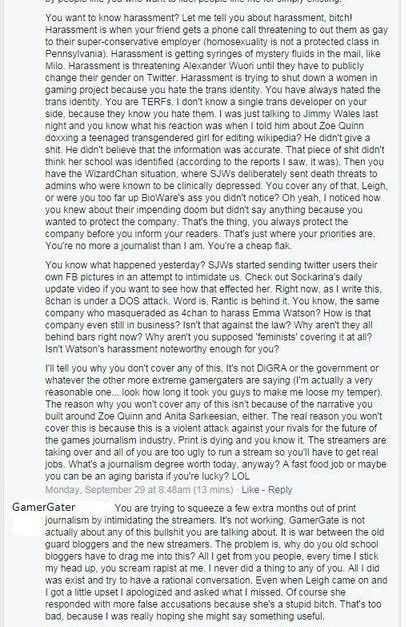
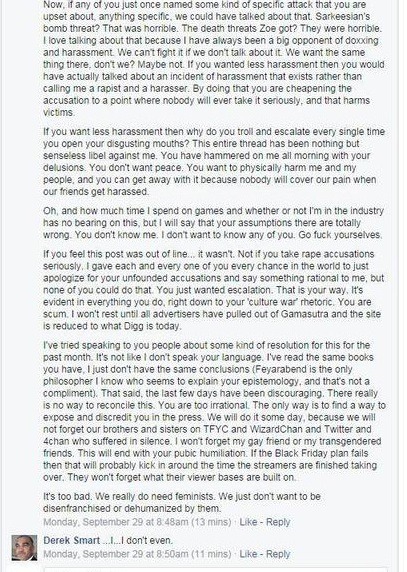
antoine-roquentin: A gamergater posted this in the belief that...


antoine-roquentin:

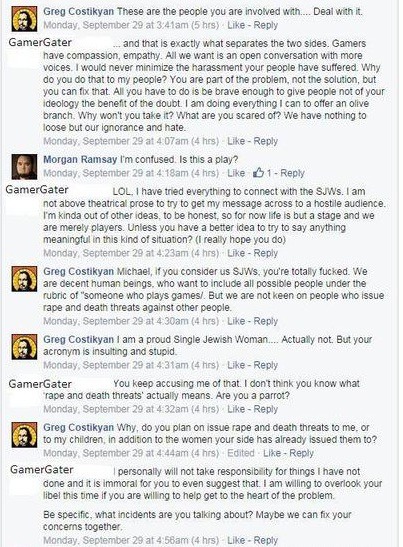
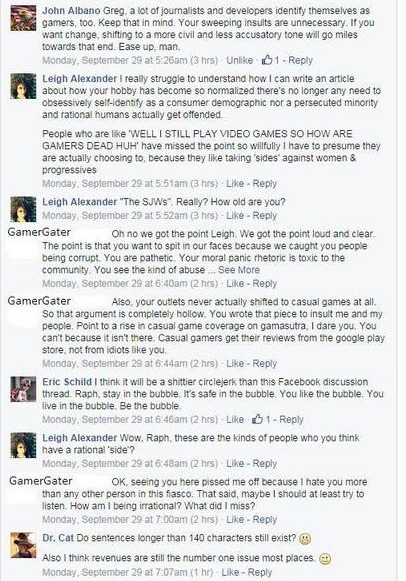
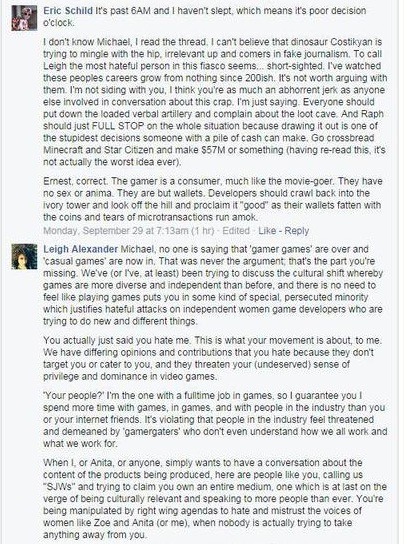
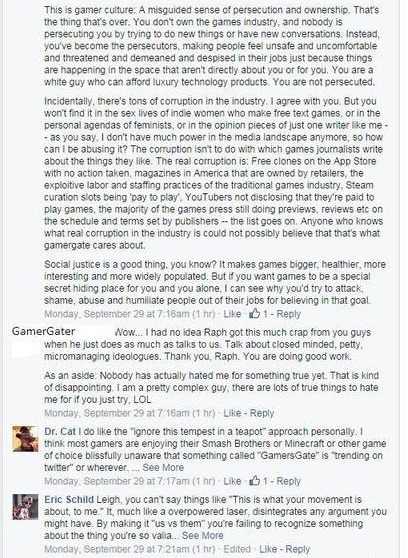
A gamergater posted this in the belief that it made him look reasonable, complete with blanking out his name because “I was scared that they [SJWs] would doxx me or hack my FB account or something”.

02 Oct 22:51

FireChat mobile app powers Hong Kong protests

by Xeni Jardin
Photo: Reuters


Photo: Reuters

A suddenly popular mobile tool is helping student demonstrators in Hong Kong route around network censorship. Read the rest

02 Oct 22:39

Thru You Too

Mattalyst

I'm not fully on board with the jazz-pop feel of the resulting mashups, but still, very clever.

Kutiman's followup to 2009's mindblowing Thru You is live  
02 Oct 21:49

GamerGate Fights Corruption in Journalism By Encouraging Corruption in Journalism

by Amanda Marcotte
Mattalyst

https://twitter.com/gamergate_txt

It's starting to remind me of the Tea Party, actually, in that both began as single-issue movements that quickly proved totally disinterested in contradictions with their position on the issue or mission creep beyond it, and eventually more-or-less discarded the facade that they were anything other than reactionary identity politics from people who felt their cultural space was being invaded by The Other.

But, I don't agree with Marcotte that their goal is bully women out of the gaming world. It's to bully criticism of gamers out of the gaming world, be it for reasons of gender or anything else.

The Benghazi of the video game world, the GamerGate movement is a baffling mess of accusations and anger that started over the summer when a man named Eron Gjoni, angry about his failed relationship with an indie video game developer named Zoe Quinn, created a webpage and used it to accuse Quinn of infidelity. Soon, other gamers started to gang up on Quinn, leveling increasingly ugly accusations at her, like that she had sex with a video game journalist in order to get good reviews. (The accusation, for what it's worth, is false.) Upon the outside world discovering GamerGate and recoiling in horror, those who had attacked Quinn swore that they aren't misogynists, but merely trying to clean up corruption and cronyism in video game journalism. My colleague David Auerbach has more history of GamerGate here and here

The claim that GamerGate is not really about sex but about corruption in journalism has never really held water. It doesn't make sense to attack a non-journalist like Quinn for supposedly violating the ethics of journalism. But any lingering hopes that GamerGate is about bringing integrity back to journalism were dashed this week, when GamerGate participants convinced Intel to pull its advertising from the gaming website Gamasutra in order to punish Gamasutra for publishing an opinion they don't like, a piece criticizing GamerGate for making gamers look like misogynist idiots.

The purported concern of GamerGate is to end gaming journalism’s "increasing corruption by money and hype," as Auerbach explained. If that's true, it's awfully fishy that GamerGate's first major victory is to threaten journalists with lost revenue for writing about their honestly held views. That the journalist in question, Leigh Alexander, happens also to be yet another young, outspoken woman suggests yet again that GamerGate never was and never will be about corruption in journalism, but is simply a loosely organized collective that wants to bully women out of the gaming world.

02 Oct 21:34

Elusive Form of Evolution Seen in Spiders

by Olena Shmahalo
Mattalyst

Yes, moar group selection research, please!

As a rule, spiders are antisocial. They hunt alone, zealously defend their webs from other spiders, and sometimes even eat their mates. “Cannibalism and territoriality comes naturally to Arachnida, even during sex,” said Jonathan Pruitt, a behavioral ecologist at the University of Pittsburgh. But a handful of the more than 40,000 known arachnid species on the planet have learned to rein in that aggression. Like ants or bees, they cooperate for the good of the group.

For example, so-called tangle-web spiders form bands of 1,000 or more to spin webs that stretch for hundreds of yards, entrapping flies, small birds and “virtually any invertebrate imaginable,” Pruitt said. Smaller groups of a few dozen work together “like a pride of lions,” he said; some of the spiders hunt for prey, while others rear the colony’s young.

The spiders present a puzzle to evolutionary biologists. According to ordinary Darwinian natural selection, only the fittest individuals will pass on their genes. But if that’s the case, why do tangle-web spiders act in ways that might conflict with an individual’s drive to outcompete its neighbors? A spider that defends the nest might put itself at personal risk, jeopardizing its chances of producing offspring. And a spider that rears the young might have to wait to eat until the hunters are sated, so it might go hungry. These are not behaviors that would be expected to enhance an individual’s fitness.

Female Anelosimus studiosus spiders can have either aggressive or docile personalities.

Female Anelosimus studiosus spiders can have either aggressive or docile personalities.

Biologists have long argued over the question of how natural selection can promote the evolution of traits that are good for the group, but not necessarily for the individual. Scientists have developed a number of mathematical models to attempt to explain the phenomenon. According to one model, known as kin selection, highly related organisms such as bees and ants can develop altruistic behavior — for example, many females forgo reproduction in order to raise the queen’s brood — because they will still pass down their genes indirectly, through the queen.

But despite its altruistic appearance, kin selection is selfish — it helps an individual’s genes to survive. Can natural selection promote truly unselfish traits, behaviors that are good for the group, but not necessarily to the benefit of individuals (or their immediate kin)? Some evolutionary models predict that it can, but while these models have been successfully tested in the lab, they have been studied only indirectly in nature.

Now, however, a new study of Anelosimus studiosus, a species of tangle-web spiders, published this week in Nature, suggests that evolution does indeed work at the level of the group. If certain groups of animals are more productive than others — that is, if they produce more progeny — then evolution will tend to favor the traits that make such fecundity possible. According to Pruitt, the findings are the first to provide direct evidence that natural selection can drive the evolution of a group trait in the wild.

Social Spiders

Female tangle-web spiders possess two basic personalities: aggressive “warriors” and docile “nannies.” The warriors spend their time capturing prey and defending the group from predators and parasites, while nannies raise the colony’s young. (To figure out an individual’s personality, scientists put it in a box with other spiders — aggressive arachnids fight for space while docile ones cuddle, Pruitt said.)

The Hen Gangs

Chickens in a Group Pen

[No Caption]

The product of the most famous — and profitable — experiment in group selection gets served on millions of breakfast plates every day. Commercial chickens kept for egg production are typically housed in group pens, an efficient arrangement that also presents a problem for farmers: The most productive birds tend to be the most aggressive. They can lay lots of eggs because they terrorize and sometimes kill their cage mates, hogging all of the group’s food. If you breed chickens from individuals with a high egg-laying capacity, “you get hens that produce the most eggs or meat, but at the expense of their neighbors,” said Michael Wade, an evolutionary biologist at Indiana University in Bloomington.In the 1980s, William Muir, an animal scientist at Purdue University in West Lafayette, Ind., came up with a better plan. Rather than selecting the best individual egg layers for breeding, he picked the groups that produced the most eggs. Egg output improved dramatically, because group selection produced kinder, gentler birds better suited to living in a group.The peaceful chickens have become a classic example of group selection. But they are also the result of a distinctly human force. Biologists don’t yet understand how often natural environmental forces drive adaptation of the group. “That’s where the controversy is nowadays, not so much whether group selection can work but how often it produces a trait,” said Peter Nonacs, an evolutionary biologist at the University of California, Los Angeles. “Now we are transitioning from an argument among mathematical biologists to something experimentalists are trying to parse out.”

The balance of warriors and nannies in any particular Anelosimus studiosus colony appears to be tuned to fit the colony’s habitat. In large colonies with an ample food supply, warriors tend to abound, while colonies in sparser regions are dominated by nannies.

How does nature maintain this balance? One possibility is that it’s the result of evolution at the individual level. In this scenario, warriors might do better in prey-rich areas because there’s simply more prey for them to eat, while nurses might thrive in prey-poor areas because they may not require as much food as the warriors do.

However, there may be a different explanation. If the group, not the individual, is the most important basic evolutionary unit, then the group as a whole will evolve characteristics that are best suited to the environment, such as an intrinsic ratio of warriors to nannies. Colonies with the ratio best suited to the environment will be most likely to survive. Others will be more likely to die off.

To figure out which of these two possibilities is correct, Pruitt put together an array of custom-made spider colonies in the lab, creating different blends of personalities. He took spiders from warrior-heavy colonies and used them to assemble new groups that were heavy on the nannies. He also used spiders from mostly docile colonies to create warrior-laden groups. In addition, he assembled control groups that matched the composition of their original groups. He then transferred each colony to a tangle of chicken wire and transplanted the nests into various locations in Tennessee, where the spiders rapidly abandoned the wire to weave treetop webs. Some of the colonies were returned to their ancestral homes. Others went to new, foreign terrain.

After a year, 60 percent of the colonies were extinct. Control groups that returned to their ancestral homes tended to do well, and those that were transplanted into a new environment generally died. Neither of these outcomes was much of a surprise.

The most interesting results came from colonies made up of spiders that had been forced into a composition different from the one they grew up in — warrior-majority colonies containing spiders from mostly docile groups, for example. The colonies whose composition fit the new environment tended to survive. But over time, surviving colonies reverted to their members’ original group composition. The warrior-majority colonies went back to having more nannies, for example. On the face of it, this is bizarre behavior; if the colonies are well-suited to their environment, why not maintain that ratio? It seems that some innate sense, perhaps encoded in the spiders’ genes, pulled the colony back to its original configuration, even though this change meant the colony would perish.


The Spider Survival Matrix

Social-spider colonies are made up of “warrior” and “nanny” spiders. Different colonies have different ratios of warriors to nannies, depending on the environment. Researchers engineered new colonies, some of which retained their ancestral ratio, and some of which were altered so that spiders from warrior-heavy colonies were used to create nanny-heavy colonies, and vice versa. The new colonies were then placed in native and foreign environments. After a couple of generations, the altered colonies began to revert to their ancestral compositions, suggesting that natural selection shaped the composition of the group to be best suited to its native environment.


Pruitt and his co-author, Charles Goodnight, a biologist at the University of Vermont in Burlington, report that the experiment provides ample evidence for group selection. Other scientists agree. “No other explanation fits the observed data as well as group selection,” said Peter Nonacs, an evolutionary biologist at the University of California, Los Angeles, who was not involved in the research. “Having the right proportion is the main determinant of success in both groups and individuals.”

The findings are particularly significant because the researchers watched the spider colonies revert to their ancestral composition over generations. “It’s really good experimental work,” said Michael Wade, an evolutionary biologist at Indiana University in Bloomington. “If the characteristics of groups stay the same from one generation to the next, it’s evidence there is a genetic basis for the trait.”

Pruitt and Goodnight don’t propose a mechanism by which the colonies boomeranged back to their original state. And without such a mechanism, some researchers argue that the results could be due to ordinary selection acting on individuals. “I think they over-interpret [the results] as evidence of group-level adaptation,” said Andy Gardner, a biologist at the University of St Andrews. “Natural selection may factor in the needs of the group, to some extent, when it hones the adaptations of individuals. But group fitness is not the whole story.”

Family Ties

A combination of group selection and individual selection could be the key to resolving this tension. Historically, researchers have thought of the two as extremes, always at odds, but “sometimes group selection and individual selection are not necessarily conflicting,” Nonacs said. Pruitt’s paper might help to promote this perspective, he said. In the case of the social spiders, “even though group and individual selection may be going in the same direction, group level is stronger,” Nonacs said. “This might be an interesting paper because it will be high-profile and will get people to think about this and not just accept the common paradigm.”

Figuring out how social-spider colonies maintain their ratios might help to convince some skeptics. Do group members kill or exile spiders whose personalities throw the colony out of balance? Or do they encourage breeding of spiders with the underrepresented traits? Docile mothers tend to produce docile offspring, but it’s unclear whether this is genetically encoded, or if it’s a flexible trait that mothers can shape during development.

Though the social spiders present strong evidence for group-level selection in the wild, researchers aren’t sure if it’s a common occurrence in nature. “Whether or not it gets out of the insect and spider world into birds and mammals, we’ll see,” Nonacs said. Others feel that it is more widespread than previously believed. “I don’t think this is rare at all,” said Jennifer Fewell, a behavioral ecologist at Arizona State University in Tempe. Researchers are looking more and more at personality differences among members of a group, and they often find a mix of aggressive and less aggressive members, she said. Social spiders may be rare, but their behavior could prove to be a model for many other species across the animal kingdom.


Correction: This article was revised on October 3, 2014, to reflect that Andy Gardner is a biologist at the University of St Andrews, not the University of Oxford. In addition, he stated that the researchers over-interpreted the results as evidence of “group-level adaptation,” not “group-level selection,” as originally quoted. 

This article was reprinted on Wired.com.


02 Oct 20:22

Online Relationships Are Real

by ​Cody C. Delistraty

A little more than a decade ago, a former professor of mine here in Paris was supposed to meet Jean Baudrillard at a party. The notoriously elusive French philosopher rose to fame in the early 1980s with his theory of the “simulacrum,” which says that neither reality nor history really exists anymore because consumer society and media have taken away true freedom and choice and replaced them with mere illusions. His theory was the inspirat­­ion for The Matrix films.

When Baudrillard did not show up at the party, the host rang his assistant, and it was determined that at the last moment he had decided to stay at home that night. Apparently, he had found a channel that was showing reruns of Wheel of Fortune. A few years later, when Baudrillard was giving a reading from his book The Conspiracy of Art at the Tilton Gallery in Manhattan, an audience member asked him, “What would you like to be said about you? In other words, who are you?”

Baudrillard paused, then replied: “What I am, I don’t know. I am the simulacrum of myself.”

For Baudrillard, there was no difference between his real self and his mediatized self, just as there was no difference between an interaction with friends and interacting with the television images of an American word puzzle game. We are all, according to Baudrillard’s theory, simulacrums of ourselves: fake humans living in a fake, mediatized world. In a mediatized world, the theory goes, real relationships are impossible.

Yet now, seven years after Baudrillard passed away, we have created entire personas mediated through online platforms—Twitter, Facebook, Instagram, Snapchat, Tumblr, etcetera. But we use these mediatized personalities to connect with other people. Even if we are watching Wheel of Fortune alone at home, if we are simultaneously tweeting at a friend then the night is still a social one.

The question, then, is whether these relationships in the virtual world are still the same as relationships pursued in the real world or is there a fundamental difference, as Baudrillard would have claimed? Can we still call love “love” if it’s passing through a screen?

For the past decade, Paul J. Zak, a professor of neuro-economics at the Claremont Graduate University who sometimes goes by “Dr. Love,” has been conducting studies on how relationships maintained over social media differ from relationships in real life. What he has found is that there’s hardly any difference at all.

“It’s as if the brain doesn’t really differentiate between you posting on social media and you being there in person,” he told me. “We’re such hyper-social creatures that we have a large release of dopamine when we’re with other people. But we can also get that release through Twitter or any social media, really.”

Zak recounts a test he ran with the journalist Adam Penenberg, asking him to engage his Twitter followers for 10 minutes. Penenberg used the time to respond to a few strangers’ tweets and to make a 122-character joke about the way his GPS pronounces words. Zak tested Penenberg’s blood both before and after the exercise, and found that in just those 10 minutes, Penenberg’s oxytocin levels rose by 13.2 percent and his stress hormones decreased by about 13 percent. Zak told me that the oxytocin boost Penenberg got from this mediated social interaction was similar to what a groom experiences before his wedding.

In the most extreme such test, Zak recorded a 150 percent increase in oxytocin in a South Korean man who spent the allotted 10 minutes posting to his girlfriend’s Facebook page.

“It was just off the charts.” Zak said, “Most people have an increase of 15 to 20 percent. It was just crazy. But all people—100 percent—we have tested all had an increase in oxytocin from using all kinds of social media.”

People with more friends tend to get sick less often and even tend to live longer than people with smaller social circles. And the conclusion Zak has come to is that social networking can not only reduce many of the health risks associated with loneliness—notably, heart attack and stroke—but that the brain interprets using Twitter or Facebook in a nearly identical way to speaking to someone face-to-face.

Yet amidst all this good news, it’s possible that the connectivity that social media allows could be too good. Some research suggests that, as if on a sliding scale, the more engaged we are with people online, the less engaged we become with people in real life, which, ironically, makes us even lonelier.

Romance and social media seem to mesh well in the courting process, but, as Russell Clayton, a doctoral student at the University of Missouri, found in his new study published in the journal Cyberpsychology, Behavior, and Social Networking, Twitter use can cause a burnout effect in romantic relationships. When a couple is spending all of their time on social media, they might not be spending as much time with one another. Or maybe, if they’re posting about their relationship issues on social media, those issues can snowball. Last year, Clayton found similar results for Facebook users, and in both studies, high social media use by both partners was a strong predictor of infidelity, breakups, and divorce.

What Clayton did not touch on is the possibility that the safety and convenience of mediated relationships could overshadow face-to-face relationships.

Japan is the most Twitter-using country in the world on a per capita basis. About one in three Japanese people who have an Internet connection use the service. Japanese is the most tweeted language after English and the top five most active accounts on Twitter are all based in Japan. Japanese characters, which can carry long, complex connotations, also mean that Twitter’s 140-character limit is not as constraining as it is for Anglophones and users who speak other Germanic and Romance languages. Yet Japan has recently become one of the loneliest countries in the world (if you equate “loneliness” with “being single”), where 61 percent of unmarried men and 49 percent of unmarried women aged 18 to 34 were not in any sort of romantic relationship—a 10 percent increase from just a decade ago. In fact, one in three Japanese people under 30 reports never having dated at all. Maybe Twitter provides an alternate source of oxytocin for some of these single people.

In fact, in a turn that would make Baudrillard smirk, one of every three millenials says that “virtuality is reality,” meaning that they draw no distinction between what happens online and what happens in real life. And 39 percent of people aged 18 to 34 say they use Facebook with the purpose of finding sexual or romantic relationships. Online flirting is real flirting—the goals are the same.

Earlier this year, Neil Parris, a 35-year-old California native who works in film and TV partnerships for Google, launched an Instagram account, where he posted 42 pictures tracking his relationship with his then-girlfriend, now-fiancée, Jenna Caine, an account executive at a luxury lifestyle management firm. The 42nd and final picture posted to the account was a picture of the sunset at Coachella, the California music festival where they had first met. In large, black letters over the photo were the words “Will you…”

Here, Parris created a simulacrum of a wedding proposal. He didn’t have to do anything (except kneel, at the end) when proposing: The images spoke for him. His proposal—one of the most important moments of his life, we can probably assume—was mediated through a phone application.

But the stunt worked—Caine accepted his proposal. Whether we choose to call love “love” if the flames are sparked on Tinder, the fire stoked over Facebook messenger, and the proposal done through Instagram, no longer matters. Everything, even our most intimate moments, are caught up in a web of things that speak for us. But at this point, there seems to be no going back: You can either deny that your life is orchestrated through various media or you accept it. Either way, love has been Twitter-ized.

This article was originally published at http://www.theatlantic.com/health/archive/2014/10/online-relationships-are-real/380304/


02 Oct 16:13

Snoop Dogg and Jared Leto Are Now Part-Owners of Reddit Along With Other Less Entertaining Investors - Redditzilla incoming?

by Dan Van Winkle

snoop reddit

Reddit recently closed a whopping $50 million round of investing that brought in money from sources that varied from initial Reddit supporter Sam Altman to Jared Leto and Snoop Dogg—er, Doggy Dogg—er, Lion? I’m not up on his current name status. The investment money brings with it many questions, like how soon before we can expect an animal-centric renaming structure for Reddit?

The news came by way of a Reddit blog post that really did a good job at burying the lead and talking about main investor Sam Altman’s long-time involvement in Reddit and how he has an interest in what’s best for the site’s future instead of the fact that Snoop Dogg and Jared Leto are now co-presidents of the site. Or they’re not. It’s possible that I don’t understand a lot about how investing works. That would explain why president Reggie Fils-Aime over at Nintendo of America never takes my calls.

But what the money will do is allow Reddit’s staff to expand and more quickly respond to user requests for features and fixes. It’d be nice if that also means that they’ll be able to respond faster than a week next time someone steals something like, say, private photos and posts them on the Internet.

The blog post also says that they’re trying to figure out a way for investors to return about 10% of the shares they bought to the Reddit community in the spirit of the site’s user-supported nature, but they’re still working out the details on that one. See? Investing is complicated, okay? That’s why they need Snoop Dogg to teach them how to keep their minds on their money and their money on their minds.

(via The Daily Dot, image via Jason Persse and our edits)

Previously in Reddit

Are you following The Mary Sue on Twitter, Facebook, Tumblr, Pinterest, & Google +?

02 Oct 16:13

This Is How Your Vice Media Sausage Gets Made

Mattalyst

There's no horse worth backing in the feud between Gawker and Vice, but if that email is real, that's pretty shitty.

This Is How Your Vice Media Sausage Gets Made

At most media organizations, there's a "Chinese wall" between editorial and advertising operations—each department operating independently of one another. At Vice Media—marketing shop first, editorial brand second—that's not quite how it works, according to a series of emails published to Twitter by recently departed editor Charles Davis.

On September 12, Vice.com published a piece called "It's Time to Start Boycotting the NFL" by the writer Michael Tracey, an independent contractor. In it, Tracey goes after the NFL for all the same things everyone else has been going after it for—in particular, the league's gross mishandling of the Ray Rice situation—and argues that things have gotten bad enough to justify a fan boycott of the league.

The NFL is not a Vice client, but the company's advertising higher-ups evidently weren't happy with the post. Davis, the former Vice editor who greenlit the piece, posted screencaps of several emails yesterday.

This is Vice policy for all reporting on #brands. pic.twitter.com/33p3knEHqk

— Charles Davis (@charliearchy) October 1, 2014

What happens if an editor at Vice "allows" a freelancer to give interviews about a story corporate doesn't like: pic.twitter.com/0RbejXnvij

— Charles Davis (@charliearchy) October 1, 2014

And this is what Vice will email a freelancer who is potentially jeopardizing business: pic.twitter.com/k03HSNTbSL

— Charles Davis (@charliearchy) October 1, 2014

"Hosi" is Hosi Simon, Vice's global general manager, to whom Davis was apparently supposed to give notice before publishing. The second screenshot refers to a September 17 appearance Tracey made on the BBC radio show Newshour to discuss the NFL. Vice instructed Tracey—who, again, is not an employee of the company—to turn the request down, so as not to "potentially [fuck] things up for them," but he went on anyway. Davis has since been fired, and Tracey's status as a contract worker is unclear.

The tone of the emails indicates that hey, this is normal—chances are we wouldn't have killed the story!—but next time, be cool and run it by us, just in case. A spokesman at Vice gave a similarly no-big-deal statement: "As is normal in any editorial process, VICE.com rejects pitches for stories all the time." Never mind that this wasn't a rejected pitch, but the reaction to a story after it was already accepted and posted. According to another tweet from Davis, the process of "running it up the flagpole" for approval isn't as casual as it sounds.

Just want to add to this: In my experience, every single time — every single time — I had a story "run up the flagpole" it was killed.

— Charles Davis (@charliearchy) October 2, 2014

A Vice source familiar with the situation told me that Davis' termination wasn't actually about the NFL piece, but about his falling asleep in a meeting. I'm evidently not the first person who has been told that, and on Twitter, Davis is calling it "slander." He hasn't yet responded to a request to comment on this story.

[Image via AP]

02 Oct 06:31

phoenixfire-thewizardgoddess: mrfrostbite: jemtheprincessbride:...


phoenixfire-thewizardgoddess:

mrfrostbite:

jemtheprincessbride:

weary-heartbound:

my-loki-sense-is-tingling:

wandererinterval:

mischievous-little-tricksters:

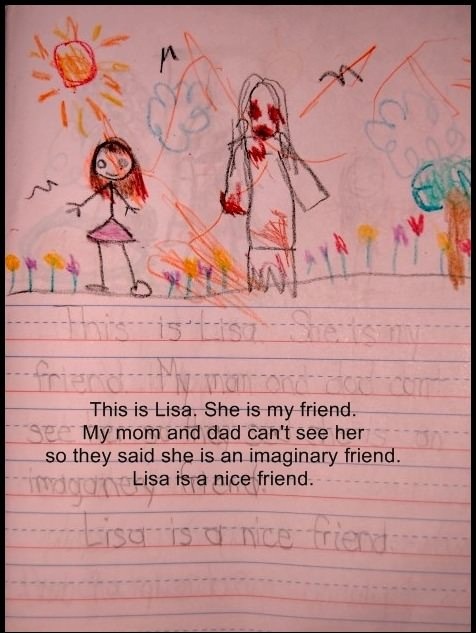
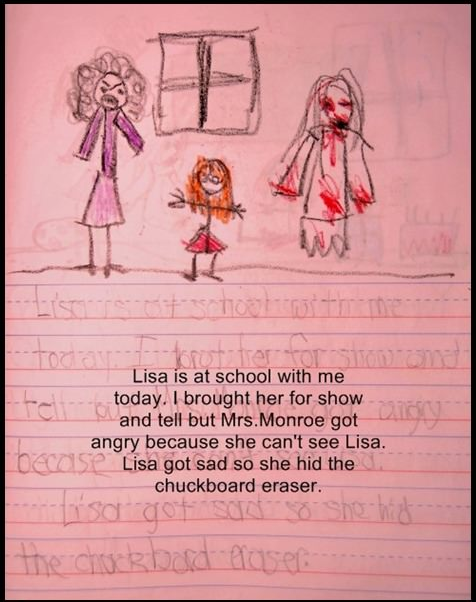
image

wtf

i….scared for life

oh my god.. what th-

what.

the.

actual.

fuck.

Can we get the SPN fandom on this one?

…I think Lisa needs a medal for protecting that little girl.

02 Oct 05:20

Valar Morghulis, The Newest Game of Thrones Beer Has Arrived and I’m Here to Brag About It - Anyone can be tipsy.

by Jill Pantozzi

Screen Shot 2014-10-01 at 5.11.18 PMBrewery Ommegang’s newest Game of Thrones inspired beer is officially available today and we got an early taste! I love it and I’m not just saying that because the first time I tasted it was just after Pedro Pascal told me he’s read The Mary Sue and I was on some kind of ridiculous high. Ha. Ha. Nervous laughter. Is it warm in here?

Where was I? Beer. Right.

You may remember Valar Morghulus was chosen as the next beer in Ommegang’s Game of Thrones line by fan votes. Previously, Fire and Blood was my favorite but after trying this new one, I have to say it’s slipped to #2.

ValarMorghulisBeer2

I’m no good at describing beer though, so here’s the official descriptions of flavors from Ommegang:

Valar Morghulis possesses a deep chestnut brown color with a persistent and creamy tan head. Rich aromas of caramel, toffee, ripe fruits and burnt sugar, with a hint of cloves. The taste is delicately balanced with rich malty sweetness, caramel and just enough bitterness to balance out its malty backbone. A surprisingly dry finish is light on the tongue, which belies the initial aroma.

  • Malt: Our carefully crafted mixture of specialty malts.
  • Sugar: Dark Candi
  • Hops: Apollo, Hallertau Spalt
  • Spices: None
  • ABV: 8.0%
  • Available on draft and in 750ml bottles.

Pair with savory dishes, roasted lamb or beef, marinated roasts and grilled venison. Strong cheeses such as Stilton, Gorgonzola and smoked cheddar will match well against the malty body.

ValarMorghulisBeer

Another fun fan aspect of Valar Morghulis? Each cork is fire-branded with “Valar Dohaeris.”

Have you been able to get your hands on any of the Game of Thrones beer?

Previously in Game of Thrones

Are you following The Mary Sue on Twitter, Facebook, Tumblr, Pinterest, & Google +?

01 Oct 23:08

Steph Davidson

01 Oct 22:34

IUDs and Implants Are the New Pill

by James Hamblin

As of this week, IUDs and implantable devices are almost unanimously the first-line recommendation for medical contraception in young women. According to an important new study that will appear in tomorrow's New England Journal of Medicine, more than 16 times more teenage women would choose these options over birth-control pills if given proper information and affordable access to all forms of medical contraception. That would dramatically lower rates of unplanned pregnancy and abortion, which cost the country billions of dollars every year.

Between 10 and 100 times more effective than birth-control pills, these two long-acting reversible contraceptive (LARC) methods are, by far, the most reliable and affordable options. They are more effective even than male or female sterilization (vasectomy or tubal ligation), which fail to prevent pregnancy 0.15 and 0.5 percent of the time, respectively. Of course, those procedures aren't on the table for young patients, but it's still interesting that a doctor could take a scalpel to a person's sex organs and render them still more likely to conceive than a person with a removable implant.

The United States has more teenage pregnancies than any other wealthy country, and the cost of that is around $11 billion every year─in the form of public assistance, care for infants more likely to suffer health problems, and income lost as a result of lower educational attainment and reduced earnings among children born to teenage mothers. So it's especially interesting that only about 4.5 percent of women 15 to 19-years-old currently use LARC. The reason for that became evident in the New England Journal of Medicine study.

Over the course of five years, researchers at Washington University in St. Louis provided free contraception (access and comprehensive education on all options) to thousands of local women as part of the CHOICE Contraceptive Project. Among 1,404 teenage women who had their pick of birth-control and thorough counseling on the plusses and minuses of each method, 74 percent chose IUDs or implants.


Teen Birth Rates (Per 1,000 Women)

U.S. teenagers are more likely to give birth than teenagers in any other industrialized country.
(CDC, UNECE Statistical Database, and UN Demographic Yearbook 2009-2010)

The St. Louis group showed that when women have access to all types of reversible birth-control at no cost, rates of teenage pregnancy and abortion plummet. The rate of unplanned pregnancy among the study population was just 3.4 percent, compared to a national average of 15.9 percent.

And less than 1 percent of the women had abortions, compared to a national average of 4.2 percent. That's consistent with known long-term trends.


Rates Among Women Ages 15 to 17 (Per 1,000 Women)

(CDC/NCHS, Guttmacher Institute)

The takeaway, according to Dr. Jeffrey Peipert, the principal investigator and a professor of obstetrics and gynecology, is that with a little more investment in getting people access to information about LARC, everyone wins. The key is educating not just patients, but doctors, many of whom are not comfortable implanting these devices and/or were not trained to recommend IUDs to young women. One long-standing reservation about IUDs in young women was a high risk of expulsion from the uterus, which was evident in the CHOICE project; but the IUDs were falling out at lower rates than people who opted to take the pill were forgetting to take it.

Peipert believes that because many pediatricians and gynecologists are only beginning to suggest long-acting reversible contraception to young patients, the tide is set to turn. It was not until 2012 that the American College of Obstetricians and Gynecologists recommended that doctors should encourage LARC among teenage patients, and it was not until this Monday that the American Academy of Pediatrics (AAP) announced new guidelines in the journal Pediatrics: Because of their effectiveness, safety, and ease of use, LARC methods should now be considered the contraceptives of choice for adolescents.      

Birth-control pills fail 9 percent of the time (only 0.3 percent of the time when used “perfectly,” according to the AAP, which is uncommon), and male condoms fail 18 percent of the time when they are used alone (2 percent of the time when used consistently (“perfectly”)). IUDs have no such discrepancy in effectiveness; it requires a feat of creativity to misuse an IUD. So levonorgestrel IUDs fail 0.2 percent of the time, end of story. Contraceptive implants, which are placed under the skin of a woman’s upper arm and last several years, are even more reliable, with a failure rate of just 0.05.

For uninsured patients, IUDs and implantable devices cost several hundred dollars up front, but are still substantially cheaper than pills or patches in the long run, according to Peipert.


Teen Birth Rates, 2009 (Per 1,000 Women)

(National Center for Health Statistics, CDC/The Atlantic)

The St. Louis researchers describe the endeavor in the journal article as an effort to address the “stubborn” public health problem of unintended teenage pregnancy. Stubborn might seem like an odd appraisal in that rates have gone down significantly in recent years, or trivializing in that rates and costs are so exorbitant and insidious. But it is a stubborn problem in that it persists despite being, apparently, readily solvable. CDC has targeted the country’s teenage pregnancy rates as among a handful of what it calls “Winnable Battles.” Apart from the implication that some battles are un-winnable, it’s been a laudable initiative. The federal goal of reducing the rate of teenage pregnancy to 3 percent by 2015 is close to met. But that rate is still abnormally high, very expensive, and largely preventable.

Like any public-health solution, the primary challenge is culture. No less than the bastion of sexual liberation the U.S. Department of Health and Human Services recommends that countries with the most sex-positive sexual instruction have the best outcomes in preventing unintentional teenage pregnancy, and that the public-health issue is best addressed with "societal acceptance of adolescent sexual relationships." With the release of today's high-profile study Peipert and colleagues hope that doctors who are not recommending implants and IUDs to young women will change their practice; and that, if they don't, patients will prompt that discussion.

This article was originally published at http://www.theatlantic.com/health/archive/2014/10/the-birth-control-shift/380952/


01 Oct 22:33

Photo


01 Oct 22:12

Cops Are Handing Out Spyware to Parents—With Zero Oversight

by Kim Zetter
Mattalyst

Don't miss the video...

Cops Are Handing Out Spyware to Parents—With Zero Oversight

Mere days after a government crackdown on a spyware manufacturer comes the startling revelation that law enforcement agencies have been purchasing commercial spyware themselves and handing it out to the public for free. Police departments around the country have been distributing thousands of free copies of spyware to parents to monitor their children’s activity, a […]

The post Cops Are Handing Out Spyware to Parents—With Zero Oversight appeared first on WIRED.


01 Oct 21:56

A bigger abyss.

01 Oct 21:55

Shapes of things, Hermann Forsterling


Shapes of things, Hermann Forsterling

01 Oct 21:35

Today the Department of Awesome Camouflage is marveling at this...


Today the Department of Awesome Camouflage is marveling at this incredible praying mantis who looks more like a collection of sticks and bits of plants than a predatory insect. This exceptionally stealthy mantis belongs to the genus Toxodera, which consists of some of the largest mantids in the world. It was discovered and photographed by Peter Houlihan in Borneo:

Amidst the dense jungles of Borneo lives quite possibly the largest mantis in the world! Yet, despite its size, it remains nearly impossible to find. Late one night, I was collecting insects in the rainforest for my research when I encountered this brilliantly cryptic mantis amongst a swarm of unaware insects. I am still not sure how I spotted it, but it is by far the most impressive mantis I have ever seen.

[via National Geographic and RACERS]

01 Oct 20:42

Grooveshark Found Guilty of Massive Copyright Infringement

by Soulskill
An anonymous reader writes: If you're a Grooveshark user, you should probably start backing up your collection. In a decision (PDF) released Monday, the United States District Court in Manhattan has found Grooveshark guilty of massive copyright infringement based on a preponderance of internal emails, statements from former top executives, direct evidence from internal logs, and willfully deleted files and source code. An email from Grooveshark's CTO in 2007 read, "Please share as much music as possible from outside the office, and leave your computers on whenever you can. This initial content is what will help to get our network started—it’s very important that we all help out! ... Download as many MP3’s as possible, and add them to the folders you’re sharing on Grooveshark. Some of us are setting up special 'seed points' to house tens or even hundreds of thousands of files, but we can’t do this alone." He also threatened employees who didn't contribute.

Share on Google+

Read more of this story at Slashdot.


01 Oct 16:18

tylersthings: omgtsn: nentindo: grawly: what what what wh...


tylersthings:

omgtsn:

nentindo:

grawly:

what

what

what

what

what

01 Oct 14:53

I bet you do…


I bet you do…

01 Oct 06:58

boomerstarkiller67: Ralph McQuarrie - Sci-fi novels cover art...


boomerstarkiller67:

Ralph McQuarrie - Sci-fi novels cover art details

01 Oct 04:11

Not every sky isreflected in the puddle. Not every love wanders in to stay. […] Are you talking to...

Not every sky is
reflected in the puddle. Not every love wanders in to stay.
[…]
Are you talking to yourself? Yes, I’m talking to my selves.
Sometimes we’re just an echo of what we meant to say.

—Richard Jackson, from “Is This the Person to Whom I am Speaking,” in Out of Place (Ashland Poetry Press, 2014)

30 Sep 22:03

http://asian.tumblr.com/post/98782109700/paintalien-8oo-i-think-the-coolest-thing

http://asian.tumblr.com/post/98782109700/paintalien-8oo-i-think-the-coolest-thing:

paintalien:

8oo:

i think the coolest thing would be to see a new color

right so theres this thing called the bullet shrimp imageand not only are these things totally badass and stylish

they have 16 colour cones in their vision

us humans only have 3

these things can literally see…

30 Sep 18:02

Niagara Detroit

30 Sep 17:50

Doomsayers

30 Sep 17:41

Photo


30 Sep 13:14

Consensual Sex: There’s an App for That

by Amanda Hess
Mattalyst

Presumably now mandatory for California college students, I guess.

Last June, Reason’s Robby Soave called for an iPhone app that would clear up pesky he-said, she-said rape cases by recording “mutual consent” to engage in sexual activity before two people do the deed: “Maybe they would have to input a password and then touch phones, or something?” he proposed. Last week, his prayers were answered: The Good2Go sexual consent app isn’t as touch-and-go as the app of Soave’s dreams, but it does encourage sex partners to assess their mutual interest in sex and record their intoxication levels before getting busy.

Here’s how it works: After deciding that you would like to have sex with someone, launch the Good2Go app (free on iTunes and Google Play), hand the phone off to your potential partner, and allow him or her to navigate the process to determine if he or she is ready and willing. “Are We Good2Go?” the first screen asks, prompting the partner to answer “No, Thanks,” “Yes, but … we need to talk,” or “I’m Good2Go.” If the partner chooses door No. 1, a black screen pops up that reads “Remember! No means No! Only Yes means Yes, BUT can be changed to NO at anytime!” If he or she opts instead to have a conversation before deciding—imagine, verbally communicating with someone with whom you may imminently engage in sexual intercourse—the app pauses to allow both parties to discuss.

If the partner—let’s assume for the purposes of this blog post, partner is a she—indicates that she is “Good2Go,” she’s sent to a second screen that asks if she is “Sober,” “Mildly Intoxicated,” “Intoxicated but Good2Go,” or “Pretty Wasted.” If she chooses “Pretty Wasted,” the app informs her that she “cannot consent” and she’s instructed to return the phone back to its owner (and presumably, not have sex under any circumstances, young lady). All other choices lead to a third screen, which asks the partner if she is an existing Good2Go user or a new one. If she’s a new user, she’s prompted to enter her phone number and a password, confirm that she is 18 years old, and press submit. (Minors are out of luck—the app is only for consenting adults.) Then, she'll fill out a fourth prompt, which asks her to input a six-digit code that’s just been texted to her own cellphone to verify her identity with that app. (Previous users can just type in their phone number—which serves as their Good2Go username—and password.) Once that level is complete, she returns the phone to its owner, who can view a message explaining the terms of the partner’s consent. (For example, the “Partner is intoxicated but is Good2Go.”) Then, the instigator presses a button marked “Ok,” which reminds him again that yes can be changed to “NO at anytime!”

Then you get to have sex.

Easy, right? When I tried this process out with a partner, it took us four minutes to navigate through all the screens, mostly because he kept asking, “Why are we using an app for this?” and “Why do I have to give them my phone number?” (More on that later.) I was confused, too: As the instigator, I wasn't asked to confirm that I wanted to have sex or to state my own intoxication level for my partner's consideration. (A promotional video modeling the process begins by announcing how “simple” it is, then snaps out instructions for three minutes, but questions remain.) Perhaps the process is deliberately time-consuming: The app provides the “opportunity for two people to pause and reflect on what they really want to do, rather than entering an encounter that might lead to something one or both will later regret,” the app’s FAQ reads. Or maybe I’m just old: At 29, I find it much easier to just talk about sex than to use an app for that.

Lee Ann Allman, a creator of the app, says she was inspired to make it after talking with her college-aged kids about sexual assault on campuses across the country. They “are very aware of what's happening, and they’re worried about it, but they’re confused about what to do. They don’t know how they should be approaching somebody they’re interested in,” she told me. Meanwhile, “kids are so used to having technology that helps them with issues in their lives” that Allman believes the app will help facilitate necessary conversations, encourage them to consider their level of intoxication, and remind young people that consent to sex should be affirmatively given and can be revoked at any time.

“Good2Go” is obviously a euphemism for sexual activity, but it’s not clear what that means exactly—is it making out, oral sex, vaginal intercourse, or anal sex, and with protection or not? (I guess you could always pause, grab phones, and start the process over to consent to another specific sexual activity—but at some point, you'd actually have to verbally explain what you're agreeing to be Good2Go4.) The message that people need to consent to sex, and that they can withdraw consent, and they probably shouldn’t be totally wasted while they do it is one that college campuses are already administering to their students upon orientation. It may not always be getting though, but it’s not clear how the app (which is now being promoted through campus ambassadors) advances the cause.

In fact, Good2Go could contribute a dangerous new element to those he-said she-said rape cases. What Good2Go doesn’t tell users is that it keeps a private record of every “I’m Good2Go” agreement logged in its system, tied to both users’ personal phone numbers and Good2Go accounts. (Records of interactions where users say “No” or just want to talk are not logged in this way.) Allman says that regular users aren’t permitted access to those records, but a government official with a subpoena could. “It wouldn’t be released except under legal circumstances,” Allman told me. “But it does create a data point that there was an occasion where one party asked the other for affirmative consent, that could be useful in the future … there are cases, of course, as we know, where the accused is an innocent party, so in that case, it could be beneficial to him.”

That record may help the falsely accused, but it's unlikely to aid a real victim. Good2Go may remind its users that consent can be revoked at any time, but there are still judges and juries that will take evidence that a person said “yes” to sex at one point, and conclude that they were asking for whatever happened later that night (or the next). Compared to that scenario, talking about sex doesn’t seem so scary.

30 Sep 01:05

Photo