Shared posts

06 Oct 18:25

Bayesian Prediction for The Winds of Winter

Mattalyst

Full-body nerdgasm

Full-text links:

Current browse context:

stat.AP

new | recent | 1409

Change to browse by:

References & Citations

Bookmark

(what is this?)
CiteULike logo BibSonomy logo Mendeley logo Facebook logo LinkedIn logo del.icio.us logo Digg logo Reddit logo ScienceWISE logo
Authors: Richard Vale

(Submitted on 19 Sep 2014)

Abstract: Predictions are made for the number of chapters told from the point of view of each character in the next two novels in George R. R. Martin's \emph{A Song of Ice and Fire} series by fitting a random effects model to a matrix of point-of-view chapters in the earlier novels using Bayesian methods. {\textbf{SPOILER WARNING: readers who have not read all five existing novels in the series should not read further, as major plot points will be spoiled.}}
Comments: 13 pages, 5 figures
Subjects: Applications (stat.AP)
Cite as: arXiv:1409.5830 [stat.AP]
  (or arXiv:1409.5830v1 [stat.AP] for this version)

Submission history

From: Richard Vale [view email]
[v1] Fri, 19 Sep 2014 22:57:20 GMT (38kb,D)
06 Oct 17:45

Research shows dogs are much smarter than we think

by Joseph Stromberg

Last night, 60 Minutes profiled new research into the intelligence and emotional capabilities of dogs.

The segment, below, confirms what many dog lovers have been saying for years. Ongoing experiments are showing that — in terms of memory, social interactions, and emotional intelligence —  dogs are much smarter than we give them credit for.

Dogs can learn hundreds of words

One striking example of canine intelligence is a border collie named Chaser, who has been trained by a retired psychology professor named John Pilley to recognize over 1000 different words.

As Pilley documented in a 2011 study in the journal Behavioral Processes, Chaser has learned the names of 1,022 different toys — when directed to pick a specific toy up, she retrieves the correct one about 95 percent of the time. More recently, Pilley has trained Chaser to recognize verbs as well: she now knows the difference between picking up something, putting her paw on it, and putting her nose on it.

In experiments, other dogs have shown they're capable of a skill called social inference — the ability to monitor the actions of a human and infer facts about the environment. Specifically, when a treat is hidden under a cup and placed next to an empty cup, and a human points at one of them, dogs can infer that the human is pointing at the one with the treat. This is a skill that other animals considered to be highly intelligent, like bonobos (a type of chimp) do not possess.

dog inference

A dog picks the correct cup, inferring that a human is pointing at the one with a treat under it. (Hare and Tomasello, 2005)

Can dogs feel love?

Meanwhile, neuroscientists have been using fMRI machines to learn about dogs' inner emotions. After months of training, they can get the dogs to lie still for up to 30 seconds in the scanners, which track blood flow to different areas of the brain as a proxy for brain activity.

Greg Berns, an Emory neuroscientist, has found that when dogs sniff a rag soaked in their owner's scent, activity spikes in their caudate nucleus — a reward center involved in emotional attachment. It doesn't when they smell a stranger's scent. He's also found that the same activity occurs when these dogs' owners walk into the room, but not when strangers do.

dog mri

A dog sits in an fMRI machine as part of Berns' experiments. (Berns et. al. 2012)

Berns' conclusion from all this work is still unproven, but provocative. He thinks it shows that when you get home and your dog is excited to see you, it's not just because he or she is using you for food and shelter. In a very real sense, he says, dogs can love humans, just as humans love dogs.

Further readingWhat fMRI can tell us about the thoughts and minds of dogs

06 Oct 17:44

So There’s a Bob’s Burgers Porn Parody Now - Don't judge them, you judgeroo.

by Victoria McNally

qb81_SFW1430688_1

Our favorite *cough* porn parody producer Woodrocket has a new television-inspired surprise in store for us—Bob’s Burgers. No, really. Sadly it’s not an hour of Louise slapping the hell out of that boy band member, but you’ll be happy to know that there is definitely room for some zombie butt fanfiction.

Here’s the official description from Woodrocket:

When the Adult Entertainment Exotic Biz Con XXX Convention comes to town, Bob and Linda prepare the restaurant for a weekend of hungry adult stars, with appetites as big as their boobs and wangs. But fixing the menu isn’t the only hard work the Belchers get up to.

Bob and Linda get down on today’s special, Vaggie Burgers, while Tina writes some sexy slash-fiction about her 18th birthday party, featuring some hot Tina-Jimmy Junior-zombie butt action!

And, of course, there’s also a SFW trailer. I appreciate the attempt to recreate H Jon Benjamin’s subdued performance as Bob, but the actor’s sort of coming off more like he has a cold. Teddy, however, is spot on, and so are a surprising number of the proposed porn-star themed burger puns. I’m just saying, Debbie does Dill-is sounds delicious.

If you are so inclined, you can go check out the full NSFW version at Woodrocket.

Previously in Woodrocket

Are you following The Mary Sue on Twitter, Facebook, Tumblr, Pinterest, & Google +?

06 Oct 16:33

http://elshiki.tumblr.com/post/99264502492/pixiaq-does-anyone-have-any-good-scary-book

Mattalyst

Well so Pixiaq, you've come to the right place...

I think Dissonantmuse is currently working on this, and you should too. Watts' style is, roughly, sci-fi horror? And he's a biologist who's fascinated with abnormal psych?

http://www.amazon.com/Blindsight-Peter-Watts/dp/0765319640

Or this, which is far more intelligent than anything that can be legitimately described as "steampunk horror" should be:

http://www.amazon.com/Perdido-Street-Station-Crobuzon-Book-ebook/dp/B000FBFO8C

http://elshiki.tumblr.com/post/99264502492/pixiaq-does-anyone-have-any-good-scary-book:

dissonantruse:

elshiki:

pixiaq:

Does anyone have any good scary book recommendations?

paging @dissonantmuse

My unironic suggestions here. I occasionally eavesdrop on D’s Audible selections, which may have greater cachet.

I liked John Dies At The End, but that’s more a fantasy comedy based on horror elements….

pixiaq elshiki
I have no idea if I’m doing this right I have never replied to a tumble but ashface if you tell me what kind of scary youre looking for I can give you something in any scary genre i am a spookiologist

Yes, hello Dr. Spooky, very good. I haven’t read a good scary book in a long time! But, in the past I’ve gravitated towards thriller-type scary. But, I’m open to any kind really. I don’t really care for comedy/horror, but other than that maybe you could suggest a few exemplars of a couple of your favorite subgenres?

06 Oct 15:14

baddiegojokes: please read this you will not be disappointed

06 Oct 13:52

Photo


06 Oct 05:41

I feel fine/nothing

06 Oct 05:17

Photo


06 Oct 04:33

dandraco: hollyoakhill: do you ever think about how little...


dandraco:

hollyoakhill:

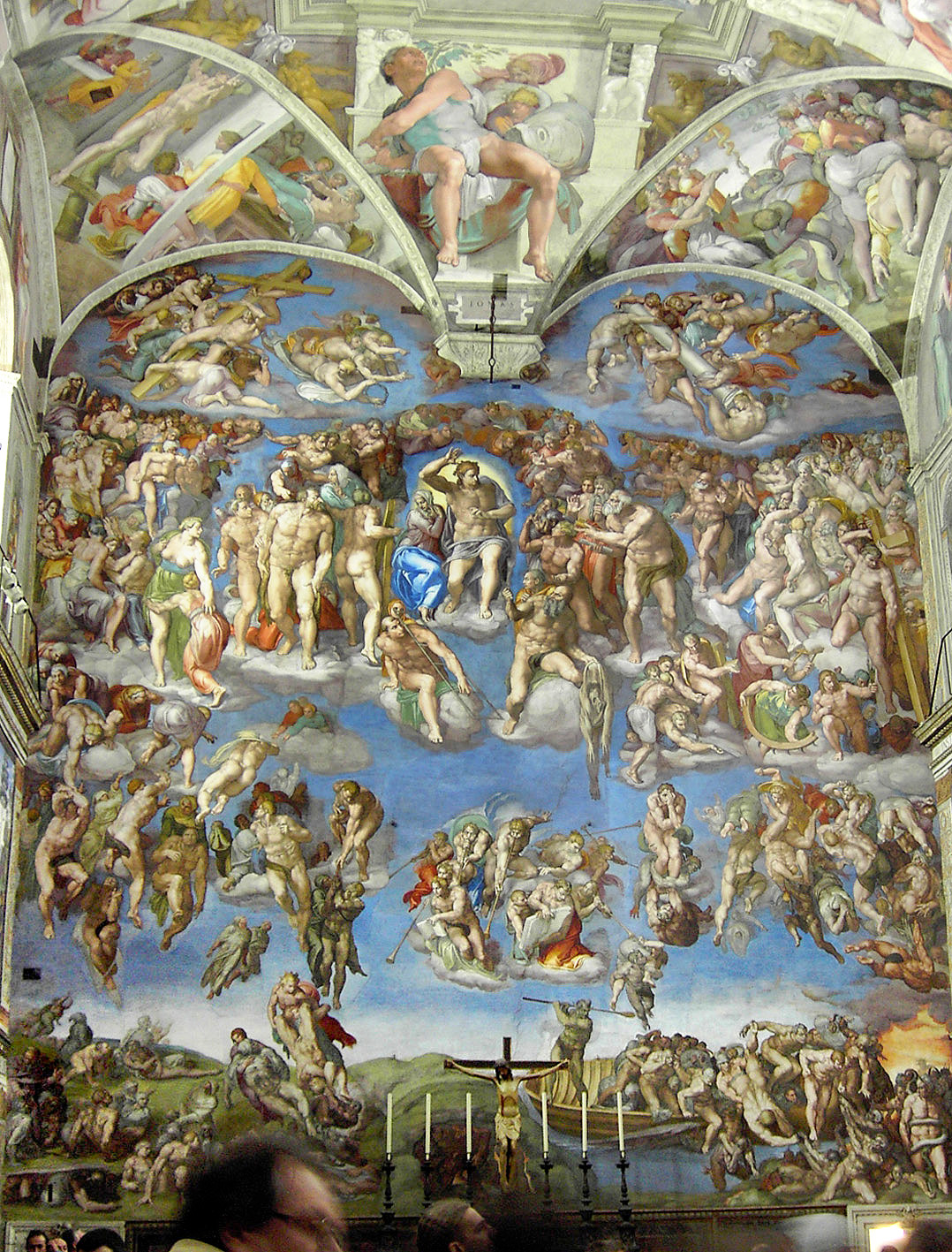
do you ever think about how little Michelangelo cared

All right, everyone, grab a chair and sit back because I’m going to share with you what I learned about Michelangelo and the Sistine Chapel in my Art History Class.

The man NEVER wanted to paint the damn thing. But the pope at the time “forced him to” According to my teacher. Michelangelo hated this man, I MEAN REALLY HATED HIM. So did a majority of people. The pope’s nickname translated literally means “Terrible pope”.

And the working conditions were awful. He had to work on his back with all that paint, which is filled with some toxic shit that gave Michelangelo a limp for the rest of his life.
(Also, our teacher made us get on our backs and try drawing with both hands JUST to prove how bad and uncomfortable it is.)

At the time, the ceiling was so high, you could barely see it. You need binoculars to get a good look at what’s up there, by the time people could see the paintings, there was a lot of weird symbolism that Michelangelo hid up there.

This one? The creation of the sun and moon? God is mooning you. And the pope and all others after him prayed under that without knowing.

This one? At the time, dissecting was sacrilegious and everyone found out how behind God was what looked like half a brain. blah blah, science, science, that pissed everyone off.

And also, ALLLLLLL the men and women in the Sistine Chapel are all on fucking steroids. My teacher described the women’s bodies as "Men bodies with boobs slapped on."

And then there is this:

Now this is the back wall. Michelangelo actually wanted to paint this one after he finished the ceiling. (and there was a different pope too, I believe.) However, originally, EVERYONE in that painting was naked. And they didn’t like it. Adam and Eve naked? That’s cool. But Jesus? Now you crossed the line. So the pope at the time hired someone else to censor it and give the important figures clothes. He worked on it for 6 or 9 months before he died.

And then the symbolism in this one is great. Somewhere in the right, there are homosexuals in heaven. (No matter what, the Vatican will say “Those straight men are happy” I’ll get to that in a second), Michelangelo painted himself near Jesus, and the terrible pope is in hell with a snake biting his balls.

And if you were to point ANY of this out to the Vatican, they will deny all of it and claim Michelangelo was a catholic hero. In fact, when they discovered the symbolism around the 60s or 70s, the guy who told the Vatican was kicked out of the Vatican for life.

TL;DR: Michelangelo hated the pope and made the best “fuck you” of all time.

06 Oct 04:30

scaryjokes: it’s not that i hate you it’s just that i’m funny...


scaryjokes:

it’s not that i hate you it’s just that i’m funny these days

06 Oct 03:58

This amazing original painting by Chris Peters ‘Evening...


This amazing original painting by Chris Peters ‘Evening Walk’ 18” x 24”, Oil on linen over panel 2013 is available via Copro Gallery - full details here http://www.copronason.com/artMenu.html

05 Oct 19:28

The Equations Behind Epidemics

by michaelb@motherboard.tv (Michael Byrne)

Within epidemiology, the SIR model of is a way of predicting the spread of an infectious disease through a closed population using three broad, easily defined categories of individuals: susceptible (S), infectious (I), recovered (R). These three population segments are related by a series of relatively unmessy differential equations that demonstrate some striking things about how a disease can be spread so quickly from so small of a start.

The SIR model was first published in 1927 by W. O. Kermack and A. G. McKendrick, epidemiologists who were looking to explain the observation that epidemics can get very large with extremely humble beginnings. Epidemiologists of the time were at a loss, lacking a single causal factor sufficient to account for the frequent outbreaks tearing through society on a regular basis. Epidemics often just made no sense.

What the duo found in their equations were two fundamental principles: an epidemic may exhaust itself before the susceptible population reaches zero, and that an initial threshold value exists of susceptible members in a population below which an epidemic will not form. The SIR model was accurate enough that it persists today. 

Its description below comes with help from course materials provided by the Mathematical Association of America. The equations are included not to induce pain so much as to illustrate the relative simplicity of the basic relationships.

S-I-R

In the SIR model, people are never added or subtracted from the total population. That is, dying is considered recovery here and no one is ever added to the susceptible group via things like immigration or births. As a member of a population, you either have, had (whether fully recovered, dead, or otherwise no longer infectious), or have not had the disease in question. Immune members can be said to occupy the recovered group.

So, we have three different equations showing the rates of change for each population segment. The rate of change in the susceptible group is modeled as such:

The B coefficient in the above equation corresponds to average number of contacts an average member of population connects with per day. The next piece, the S, is the total number of susceptible members at a given time (as a fraction of the total population) and the last one, I, is what gives us the total number of infected members at a given time (as a bare number, not a fraction).

This tells us the rate of change in susceptible members of a population. If the present fraction of susceptible members is relatively smaller, we can expect a slower rate of change in the susceptible population, as the larger numbers of infected or recovered patients limits the number of people in the population that can become infected (because they can't get sick again and, thus, can't be infectious again).

As the relationship between the susceptible fraction and the infected population changes, the number of daily contacts then takes on less and less weight. At some critical point, however, the rate of change in the susceptible population is basically just the number of infected people times the average number of contacts per day with an ugly negative sign. That's how things get out of control—when there's no buffer of infected or recovered members to absorb some of those daily B contacts.

The "recovered" equation is easier:

The here is the fraction of infected members expected to recover per day for a given illness. That recovery fraction just gets multiplied by the fraction of infected members, leaving those that are recovered, e.g. once but no longer sick. Again, this doesn't mean that these members are healthy and walking around, just that they're no longer infectious (and so don't factor into the first equation anymore). What actually is depends on the specific disease and its specific mortality rate.

So, when you look at the following graph, remember that r(t) might be 90 percent dead people. Again, these are the stakes in catching an outbreak early.

Image: MAA

The whole equation, with all three population segments accounted for, is this, which gives us the rate of change in the fraction of infected individuals.

This one is basically the change in recovery rates subtracted by the change in the susceptible population. Eventually these two terms find some sort of equilibrium, and, as you can see from the graph, the rate of change in the infected population levels off.

The graph above is specifically for the spread of Hong Kong Flu through New York City in the 1960s. In that situation, the number of immune or recovered members of the population was as low as 10 at the start of the outbreak, leaving an enormous susceptible population, and an enormous potential for the disease to spread.

The values for B and in this particular situation were selected somewhat arbitrarily: a given individual contacts a new person every other day, giving us a B of just 1/2. Meanwhile, the recovery rate assumes a recovery period of three days, leaving a value of 1/3. Bigger values of B (contacts per day) and smaller values of (recovery rates) will thus make the spread much worse.

The SIR model hides an important lesson on vaccines. The anti-vax crowd is fond of saying stuff like "my child, my business," but we know that's not true because of models like this. The phenomenon at work is herd immunity.

In our New York model, we had nearly 100 percent percent of the population in the susceptible category, leaving an open playing field for an epidemic to develop and thrive. If Hong Kong Flu had hit the city and there had been some significant population already in the recovered category, the spread of infection would have been dramatically inhibited. Because of how these different populations impact each other, small changes in one population can have huge or seemingly outsized effects on the whole system.

This is reflected in the last equation above, which boils down to subtracting the recovery rate from the susceptible fraction of the population and multiplying it by the number of infected. So, the rate of infection depends on how the the number of infected at a given time interacts with the fraction of susceptible members. That fraction is a crucial limiting factor in the overall growth rate of infections. (By the by, this relationship between the rate of infections and number of infections makes this a differential equation, a way of relating quantities of things with rates of change of quantities of things.)

The result of this is that in order to confer immunity on a population, it doesn't take every single member of the population being immune, just a certain critical mass. Subtracting from that critical mass (by refusing vaccines, say) means a higher likelihood of an epidemic taking off throughout the population. Vaccines protect individuals, sure, but they also protect populations, providing a way to draw down the pool of susceptible individuals without infecting them (or infecting them in a virulent way).

Imagine a drought-stricken forest, a place littered with deadwood, dried leaves, and dead pine needles. If we toss a match into this mess, it's gonna burn and fast. But what if we had some water and dumped it around our tinderbox forest; every wet spot becomes a place much less likely to burn. You might not have enough water to cover the entire forest, but you can spread enough around such that if a dry patch catches fire, it has less dry real estate with which to spread. If you get enough water around, the dry patches stop mattering, and a fire will just burn itself out.

05 Oct 06:48

140910


140910

05 Oct 06:46

140616 Haven’t posted much lately, my bad. Here’s a...

Mattalyst

What yes.


140616

Haven’t posted much lately, my bad. Here’s a crazy piston driven reactor machine. Enjoy!

05 Oct 06:33

a-tem-po-ral: 16th century French cypher machine in the shape...


a-tem-po-ral:

16th century French cypher machine in the shape of a book with coat of arms of Henri II

05 Oct 06:32

My fangirl request: Super bruised and cut up Rick--and Morty in a gas mask? If you're okay with drawing that! Lovin' your art.

image

image

05 Oct 06:26

Photo


05 Oct 06:25

it8bit: Donnie Darko Created by Paulo Doi || Tumblr


it8bit:

Donnie Darko

Created by Paulo Doi || Tumblr

05 Oct 01:47

The Honest Destiny Trailer Celebrates "Gaming's Hottest 7 Out Of 10"

by Mike Fahey

"The storytelling of Halo, the scope of World of Warcraft and the co-operative fun of Borderlands — may eventually get patched in." Thus begins the brutally Honest Trailer for Destiny, "The video game equivalent of a beautiful mansion full of cheap Ikea furniture."

Read more...


04 Oct 22:50

Nick Dewar

04 Oct 21:45

sixpenceee: THE BOY AND HIS ATOM What you see above is the...


sixpenceee:

THE BOY AND HIS ATOM

What you see above is the world’s smallest movie. The following movie is made out of atoms. IBM researchers used a scanning tunneling microscope to move thousands of carbon monoxide molecules (two atoms stacked on top of each other). This movie can only be seen when magnified by 100 million times. 

VIDEO

04 Oct 20:14

Photo

Mattalyst

Words to live by.


04 Oct 19:16

Witness The Epic Battle Between A Tarantula And A Spider-Hunting Wasp

by Lauren Davis

Witness The Epic Battle Between A Tarantula And A Spider-Hunting Wasp

While we typically think of spiders as the ones eating insects, spider wasps (members of the family Pompilidae) prey on spiders. This video captures a showdown between a tarantula and one of these spider-hunting wasps. Who will survive?

Read more...


04 Oct 19:05

Paris


Tristan Eaton paints a giant Napoleon in Paris, France


Tristan Eaton paints a giant Napoleon in Paris, France IG @tristaneaton


Tristan Eaton paints a giant Napoleon in Paris, France

Paris

04 Oct 18:55

Photo

Mattalyst

The Chinese Century, indeed.


04 Oct 02:08

campfiresmell: One-star yelp reviews of national parks are THE...

03 Oct 20:41

How the war on drugs made raves more dangerous

by German Lopez
Mattalyst

Still a dumb fucking law after all these years.

The war on drugs is rife with unintended consequences: from increasing racial disparities in the criminal justice system to exacerbating international drug cartel violence.

A 2014 paper published in Contexts suggests that a decade-old anti-drug policy may have had the unintended consequence of making party drugs, like Molly or ecstasy, more dangerous. The Illicit Drug Anti-Proliferation Act of 2003 aimed to prohibit organizers of electronic dance parties, known as raves, from allowing drugs at their events. But the law made venues and organizers so paranoid about anti-drug crackdowns that they stopped doing anything that would implicate them in illicit drug use, including providing medical or educational services for drug users.

The consequences of neglecting medical services can be life-threatening: Wesleyan University said 11 students were hospitalized on Sunday after an apparent mass overdose on the club drug known as Molly, and one of the students is in critical condition, Bloomberg reported.

Tammy Anderson of the University of Delaware studied the rave scene for years for her book, Rave Culture. Her paper in Context details the issues with the law and its effects on raves.

Biden's law expanded another anti-drug policy

People dance at an Indonesian rave. (Agung Parameswara / Getty Images News)

The RAVE Act threatened commercial enterprises with a $250,000 fine and other civil penalties for knowingly leasing, renting, using, or profiting from a space where illicit drugs are being stored, manufactured, distributed, or used.

"The idea was that you can go after drug use by holding the promoters of events or the owners of nightclubs responsible for drug use that happened within their premises or at their parties," Anderson said.

The law effectively strengthened the crack house law, which was passed as part of the Anti-Drug Abuse Act of 1986. In the middle of the crack cocaine scare of the 1980s, federal lawmakers decided to punish business owners — motel and car repair shop owners in particular — who allowed drug use and distribution at their establishments, which became colloquially known as crack houses.

Law enforcement used the crack house law to punish rave organizers even before the RAVE Act passed. But the RAVE Act made it a lot easier for the Drug Enforcement Administration and other law enforcement agencies to penalize rave promoters for drug use.

Anderson credited the RAVE Act for effectively eliminating the underground rave scene in which "rogue promoters" openly allowed and even encouraged drug use. But raves have gone mainstream since then, and they're now multimillion-dollar dance events that attract thousands of people. It's at these huge events where the unintended effects of the RAVE Act now pop up.

The law's passage made rave organizers paranoid

A rave in the United Kingdom. (Ollie Millington / Redferns via Getty Images)

The RAVE Act and crack house laws only punish organizers who knowingly allow drug use to happen at their events or premises. If a raver uses drugs and the event organizer doesn't appear to be aware of it, the organizer can't get in legal trouble.

Rave organizers told Anderson that, as a result, they try to avoid looking like they're aware of drug use at their events. They don't, for example, offer drug tests, which would let ravers test substances for harmful or deadly contaminants before consuming them. Some organizers don't even offer free bottled water to help prevent heat strokes, a potentially fatal side-effect of some drug use on the dance floor.

"Those precautions would potentially incriminate them," Anderson said. "It would be a sign that they know drug use is happening at their event."

This is an issue Anderson saw first-hand while conducting research for her book. When ravers got sick and even vomited as a result of their drug use, security would sometimes kick the ravers out instead of getting them medical help. Event officials told Anderson they couldn't risk being held liable by acknowledging anyone's drug use, even if it meant endangering some attendees.

Prior to the RAVE Act, Anderson said event organizers, even those who held underground raves, commonly offered medical and educational services for illicit drug users. Many promoters even partnered with harm-reduction service providers, like DanceSafe, as well.

Nineteen-year-old Shelley Goldsmith died of a heat stroke at a rave after she consumed ecstasy. (Amend the RAVE Act)

Some groups have urged rave organizers to provide harm-reduction services despite the risks associated with the law. In Washington state, a local affiliate of DanceSafe petitioned rave organizers to offer education and drug testing to event-goers.

"If we are there educating people about drug use, whether or not they're using drugs at that particular venue, that might indicate to law enforcement that the venue is being operated for the purpose of drug use and might make them liable," Nathan Messer, a spokesperson for DanceSafe, told Washington state TV station KING5. "And so they just want to avoid it all together."

On August 31, a year after her 19-year-old daughter died at a rave, Dede Goldsmith launched Amend the RAVE Act to petition Congress to allow event promoters to host harm-reduction services without risking liability. (Read Vox's in-depth story about Goldsmith's call for reform.)

"I don't believe it was ever the intention of the RAVE Act to discourage commonsense public safety measures at these concerts," Goldsmith said in a statement. "But in today's music scene, that is exactly what is happening. Those measures are not being implemented and organizers point to the RAVE Act as the reason why. By amending the RAVE Act, we will protect millions of young people and prevent the kind of tragedy that happened to me and my family."

Anderson, too, suggested the federal government should acknowledge drug use is going to happen at these events and allow event organizers to set up safeguards for when something goes wrong. She said clubs and promoters should keep security measures, like drug-sniffing dogs, to keep illicit substances out of their events in the first place, but they shouldn't fool themselves into thinking the measures will completely avoid drug use.

"If you can add language to the RAVE Act that makes an exception [for medical care and education], I think that's a very wise course of action," Anderson said. "The club owner ought to be able to call for medical assistance and provide medical assistance at the site without getting in trouble."

03 Oct 18:51

Hong Kong Leader's Daughter Thanks "Silly" Taxpayers for Diamonds

by Andy Cush
Mattalyst

That's the kind of thing that might actually have a significant impact on the direction of the protests...

Hong Kong Leader's Daughter Thanks "Silly" Taxpayers for Diamonds

Hong Kong is currently in the throes of enormous demonstrations calling for democratic reforms and the ouster of Leung Chun-ying, its chief executive. Today, his 22-year-old daughter posted a very stupid thing on Facebook.

Read more...


03 Oct 16:33

Upper West Siders Horrified by Plague of ‘Internet People’

by Jessica Roy
Mattalyst

With their "teledildonics" and their "individualized Tumblr pronouns."


Locals on the Upper West Side are mad as hell and they're not gonna take it anymore. But what, exactly, are they angry about? "Internet people," that's what!DNAinfo reports that some locals are looking to block Riposo 72, a wine bar on 72nd and Central Park West, from getting a liquor ... More »