Mattalyst
Shared posts
NASA Is Turning Black Friday Into "Black Hole Friday"


Bloodsucking video game peripheral suspended by Kickstarter

Kickstarter suspended funding for a project that claimed to match a console game controller to a blood collection unit, ostensibly to draw blood in real life whenever a player was shot in a game such as Call of Duty.
"Blood Sport: The Ultimate in Immersive Gaming" had its funding suspended two hours ago, stopping at $3,390 of the $250,000 (both figures Canadian) sought. The creators, "Brand & Grotesque" pitched the idea as a peripheral to facilitate or enhance blood donation events, but also claimed responsibility for two video-game themed stunts from 2009 and 2010.
Polygon first reported on Blood Sport on Saturday; a message Polygon sent to Brand & Grotesque then through Kickstarter was never answered.
The makers of Blood Sport, on...
These Guys Flew to Liberia to 'Cure' Ebola Patients with Homeopathy
[body_image width='800' height='533' path='images/content-images/2014/11/26/' crop='images/content-images-crops/2014/11/26/' filename='treating-ebola-with-homeopathy-393-body-image-1417004945.jpg' id='6903']
Various homeopathic remedies. Photo via Wikicommons.
This post originally appeared in VICE UK
Dr. Richard Hiltner is a really nice guy. He's in his 60s (but seems younger, in that way Californians often do) and has a very West Coast way of making everything sound super positive all the time, up to and including the fact that, a few weeks ago, he and three other practitioners flew to Liberia to try to treat Ebola patients using homeopathy.
Hiltner says, "We landed in Monrovia on the 17th of October, then had to spend three days training to use the PPEs—the personal protective equipment, those big suits you see everyone wearing—before heading up to the hospital in Ganta."
It was only when they got to Ganta, a province hit hard by the Ebola epidemic, that problems arose.
The team suited up, broke out their homeopathic treatments, and tried to get to work on some patients. At which point the medical staff and administrators at the Ganta Hospital realized what it was they were attempting, before completely banning them from the ETU (Ebola Treatment Unit).
It turned out that no one in the hospital—or, it seems, the entire Liberian medical administration—had any idea that this team would be using homeopathy. The Liberian government had approved the expedition and issued visas on the basis that all four were medical doctors coming to support local staff.
So Hiltner and his colleagues got in their Jeeps and drove back and forth to Monrovia in a continued effort to sort out the paperwork. "It took over five hours to drive one hundred miles—it was probably the scariest part of the trip," he tells me. "We did that journey five times in all."
But the authorities were clear: There was no way they were going to let Ebola patients be treated with what are essentially sugar pills soaked in water.
[body_image width='800' height='600' path='images/content-images/2014/11/26/' crop='images/content-images-crops/2014/11/26/' filename='treating-ebola-with-homeopathy-393-body-image-1417005020.jpg' id='6904']
Non-homeopath Ebola response volunteers in Nigeria. Photo by CDC Global
Homeopathy was developed in 1796 by the German scientist Samuel Hahnemann, based on the idea that "like cures like." It works like this: Hay fever makes your eyes water, right? Guess what else makes your eyes water? Onions! Just soak a minuscule piece of onion in distilled water, then dilute that water a few hundred times, give it a shake, and you're all done—hay fever will trouble you no more.
The Ebola virus kills you by essentially dissolving the walls of your veins, making you bleed to death from the inside in a massive internal hemorrhage. It's absolutely fucking horrific. Dr. Hiltner says his team went to Liberia carrying 110 potential homeopathic Ebola remedies. Based on the "like-cures-like" principle they needed other substances that kill you by hemorrhage. Among their brightest hopes were arsenic and rattlesnake venom. So exactly the kind of thing you want to put in your body when you're already laid out in the ETU.
Aside from the whole deliberately-feeding-sick-people-arsenic thing, the real controversy of homeopathic practice is that the remedies are so heavily diluted that no molecular trace of the supposed active ingredient—be it onion, venom, or any other—actually remains. In chemical terms, it's basically just water dropped onto sugar pills. The theory is that the homeopathic agent "reprograms" the "energy" of the water, in the same way one saves information on a hard drive—and it's the "water memory" that supposedly cures you.
[body_image width='800' height='600' path='images/content-images/2014/11/26/' crop='images/content-images-crops/2014/11/26/' filename='treating-ebola-with-homeopathy-393-body-image-1417004833.jpg' id='6901']
An ETU in Liberia. Photo by CDC Global
Despite the claims of practitioners there is absolutely no peer-reviewed scientific literature indicating that homeopathy works any better than placebos.
So, it is perhaps understandable that, with the eyes of the world upon them, the Liberian authorities were unwilling to let this stuff anywhere near Ebola patients.
The thought of four experienced medical doctors stretching the resources of a poverty-stricken country in the grip of an epidemic, when they could be really helping, is kind of galling. This is certainly the view of Mike Noyes, head of ActionAid, who is quoted on the Daily Mail Online: "With this crisis, you can't be offering false hope. There is no scientific evidence that homeopathy has any impact on dealing with viral disease like Ebola. Coming in from the outside with these unproven approaches is damaging to the response and bringing the disease under control."
The team did eventually get to treat non-Ebola patients in Ganta with homeopathy, and reported good results. Of course, every one of those patients was also receiving all the prescribed conventional treatments, so those results are totally meaningless from any scientific or therapeutic perspective.
[body_image width='640' height='427' path='images/content-images/2014/11/26/' crop='images/content-images-crops/2014/11/26/' filename='treating-ebola-with-homeopathy-393-body-image-1417005121.jpg' id='6907']
Actual real doctors and nurses practicing their medical skills at an army Ebola training center near York, UK. Photo by Simon Davis/DFID
All in all, the whole trip just sounds like a massive disaster—four doctors running around Liberia, banned from peddling their quackery by bemused local medics. Even the obvious question of whether they underwent quarantine on their return—or were just planning on curing themselves with snake venom—is irrelevant, as they never actually came into contact with an Ebola patient.
While the expedition itself may come off as merely chaotic, there's also a slightly sketchier side to the story.
The mission was organized through two organizations: the Liga Medicorum Homeopathica Internationalis, a key institution for homeopathy advocacy, and the German group Freundes Liberias, an organization dedicated to promoting co-operation between Germany and Liberia.
Freundes Liberias raised donations for the trip with this campaign. The page talks about a "team of 20 international doctors," but makes no mention of the fact that they will be operating only as homeopaths. This squares with the fact that the Liberian medical authorities backed the trip when they thought it was a "team of doctors," and were then shocked to learn about the homeopathy.
[body_image width='640' height='427' path='images/content-images/2014/11/26/' crop='images/content-images-crops/2014/11/26/' filename='treating-ebola-with-homeopathy-393-body-image-1417005345.jpg' id='6911']
An actual real doctor removing his PPE as he exits an ETU. Photo by Athalia Christie via Flickr.
So did the organizers of the expedition raise money and obtain visas and support in Liberia by telling people they were sending doctors, before actually sending homeopaths? If so, that would be pretty shoddy business.
When asked for comment, Thomas Köppig, head of Freundes Liberias, was emphatic:
"When LMHI first contacted Freunde Liberias asking if the association would be willing to support a trip, I received the four CVs and confirmation that all members of the group were physicians and obviously experienced in working in disaster areas. Furthermore, LMHI confirmed that the doctors would work as regular doctors and only secondarily as homeopaths."
The response from LMHI is rather less clear, claiming that the doctors "were not able to treat Ebola patients do [ sic] [to] some diplomatic problems... We are not asking for donations for the Ebola relief action any more because the situation changed."
Among the doctors on the expedition, however, there was absolutely no confusion that they were going to Liberia specifically to practice homeopathy, not conventional medicine—and also to use the opportunity to promote homeopathy.
[body_image width='923' height='692' path='images/content-images/2014/11/26/' crop='images/content-images-crops/2014/11/26/' filename='treating-ebola-with-homeopathy-393-body-image-1417005481.jpg' id='6913']
Photo by CDC Global
When this story broke, Karen Allen of Homeopaths Without Borders deleted this message from Dr. Ortrud Lindemann, one of the homeopaths in Liberia, from her Facebook page. Homeopath Dr. Edouard Broussalian also deleted a post from his own site that claimed the mission would ensure "the makers of experimental vaccines will have to pack their bags." In fact, there was a real flurry of deleted pages regarding the mission from people connected to LMHI, which is never a particularly good sign.
Dr. Hiltner himself is very open: "This was a golden opportunity to treat something that conventional medicine couldn't," he says. "Not only to help the people, but to show homeopathy works... There's got to be that day that conventional medicine will respect homeopathy—both have their strengths, both have their weaknesses; they need to stop calling each other names."
Speaking to Dr. Hiltner, it's difficult to hold all this against him. He took the time to volunteer to go to Liberia and paid for his flight from California to Brussels, where the international team of homeopaths assembled and was flown to Monrovia (he does say he may be compensated for the ticket at some point).
For a guy who's been a practicing medical doctor for 44 years, Dr. Hiltner is into some fairly whacky shit, not least iridology and medical astrology, practices that make homeopathy seem positively vanilla. However, he's also clear that he knows these are controversial techniques and would never use them to interfere with conventional medicine—including on the trip to Liberia. Essentially, his heart is in the right place, even if it's making him do some very silly stuff.
Which makes it all the more of a shame that he's been drawn into this fiasco. A couple of doctors pinballing around West Africa carrying cases of highly diluted snake venom has a certain shambolic gallows humor; sneaking a PR stunt for homeopathy into an epidemic under the cover of sending medical help is really pretty tawdry.


autogynephile: don’t dress for the cyberpunk dystopia that you have, dress for the cyberpunk...
don’t dress for the cyberpunk dystopia that you have, dress for the cyberpunk dystopia that you want
"Here in Britain, of course, it’s Thank Fuck We Got Those Weird Jesus Bastards On The Boat Day"
MEMO: There's a Bourbon Shortage, Stock Up
MattalystFucking hell, lock and load

It pains me to have to type that there may actually be a bourbon shortage, but we'll get through this together. The most important question to ask ourselves: Is this news real or bullshit?




A Startup Figured Out How To Print Light Just Like Paper — And It Looks Like Magic
MattalystTotally awesome, except for the most likely applications of it (marketing).

Imagine if light could be emitted by flat, razor-thin surfaces like paper, instead of round, circular bulbs.
That's exactly the type of technology Idaho-based startup Rohinni is working on, and it looks like it has the potential to change how all types of gadgets are made — from smartphones to cars, wearable devices, and of course, the traditional lamp.
Rohinni calls this technology LightPaper, and it can be printed and applied to near any surface, as CMO Nick Smoot recently told Fast Company's Tyler Hayes. To create LightPaper, Rohinni combines ink and small LED lights and prints them out in one single conductive layer, Smoot told Fast Company.
Rohinni's LightPaper is much thinner than current lighting technology such as OLED, which is used to power most super-slim TVs like the ones made by Samsung and LG. But based on what Hayes told Fast Company and the demos shown on Rohinni's website, it seems like the company is more interested in using LightPaper as a new means of backlighting for gadgets and everyday objects.
One of the most obvious use cases, according to Rohinni's website, is illuminating logos on products. Here's how it could look on a smartphone.

And a car:

With technology as thin as LightPaper, you'd ideally be able to install lighting directly into your bedroom wall as shown below.

We'll probably start seeing LightPaper implemented in products sometime in 2015, according to Fast Company, but it's unclear exactly where we'll see it. Check out the video from Rohinni below.
SEE ALSO: This 'Wonder Material' Could Make Your Next Phone Super Thin With Internet That's 100x Faster
Join the conversation about this story »


Complex life may be possible in only 10% of all galaxies
The universe may be a lonelier place than previously thought. Of the estimated 100 billion galaxies in the observable universe, only one in 10 can support complex life like that on Earth, a pair of astrophysicists argues. Everywhere else, stellar explosions known as gamma ray bursts would regularly wipe out any life forms more elaborate than microbes. The detonations also kept the universe lifeless for billions of years after the big bang, the researchers say.
"It's kind of surprising that we can have life only in 10% of galaxies and only after 5 billion years," says Brian Thomas, a physicist at Washburn University in Topeka who was not involved in the work. But "my overall impression is that they are probably right" within the uncertainties in a key parameter in the analysis.
Scientists have long mused over whether a gamma ray burst could harm Earth. The bursts were discovered in 1967 by satellites designed to spot nuclear weapons tests and now turn up at a rate of about one a day. They come in two types. Short gamma ray bursts last less than a second or two; they most likely occur when two neutron stars or black holes spiral into each other. Long gamma ray bursts last for tens of seconds and occur when massive stars burn out, collapse, and explode. They are rarer than the short ones but release roughly 100 times as much energy. A long burst can outshine the rest of the universe in gamma rays, which are highly energetic photons.
That seconds-long flash of radiation itself wouldn't blast away life on a nearby planet. Rather, if the explosion were close enough, the gamma rays would set off a chain of chemical reactions that would destroy the ozone layer in a planet's atmosphere. With that protective gas gone, deadly ultraviolet radiation from a planet’s sun would rain down for months or years—long enough to cause a mass die-off.
How likely is that to happen? Tsvi Piran, a theoretical astrophysicist at the Hebrew University of Jerusalem, and Raul Jimenez, a theoretical astrophysicist at the University of Barcelona in Spain, explore that apocalyptic scenario in a paper in press at Physical Review Letters.
Astrophysicists once thought gamma ray bursts would be most common in regions of galaxies where stars are forming rapidly from gas clouds. But recent data show that the picture is more complex: Long bursts occur mainly in star-forming regions with relatively low levels of elements heavier than hydrogen and helium—low in "metallicity," in astronomers’ jargon.
Using the average metallicity and the rough distribution of stars in our Milky Way galaxy, Piran and Jimenez estimate the rates for long and short bursts across the galaxy. They find that the more-energetic long bursts are the real killers and that the chance Earth has been exposed to a lethal blast in the past billion years is about 50%. Some astrophysicists have suggested a gamma ray burst may have caused the Ordovician extinction, a global cataclysm about 450 million years ago that wiped out 80% of Earth's species, Piran notes.
The researchers then estimate how badly a planet would get fried in different parts of the galaxy. The sheer density of stars in the middle of the galaxy ensures that planets within about 6500 light-years of the galactic center have a greater than 95% chance of having suffered a lethal gamma ray blast in the last billion years, they find. Generally, they conclude, life is possible only in the outer regions of large galaxies. (Our own solar system is about 27,000 light-years from the center.)
Things are even bleaker in other galaxies, the researchers report. Compared with the Milky Way, most galaxies are small and low in metallicity. As a result, 90% of them should have too many long gamma ray bursts to sustain life, they argue. What’s more, for about 5 billion years after the big bang, all galaxies were like that, so long gamma ray bursts would have made life impossible anywhere.
But are 90% of the galaxies barren? That may be going too far, Thomas says. The radiation exposures Piran and Jimenez talk about would do great damage, but they likely wouldn't snuff out every microbe, he contends. "Completely wiping out life?" he says. "Maybe not." But Piran says the real issue is the existence of life with the potential for intelligence. "It's almost certain that bacteria and lower forms of life could survive such an event," he acknowledges. "But [for more complex life] it would be like hitting a reset button. You'd have to start over from scratch."
The analysis could have practical implications for the search for life on other planets, Piran says. For decades, scientists with the SETI Institute in Mountain View, California, have used radio telescopes to search for signals from intelligent life on planets around distant stars. But SETI researchers are looking mostly toward the center of the Milky Way, where the stars are more abundant, Piran says. That's precisely where gamma ray bursts may make intelligent life impossible, he says: "We are saying maybe you should look in the exact opposite direction."
Why Americans Call Turkey 'Turkey'
Within the turkey lies the tangled history of the world.
OK, not quite. But not far off, either.
‘Turkey’ the bird is native to North America. But ‘turkey’ the word is a geographic mess—a tribute to the vagaries of colonial trade and conquest. As you might have suspected, the English term for the avian creature likely comes from Turkey the country. Or, more precisely, from Turkish merchants in the 15th and 16th centuries.
How exactly the word 'turkey' made its way into the English language is in dispute. The linguist Mario Pei theorized that more than five centuries ago, Turks from the commercial hub of Constantinople (which the Ottomans conquered in the mid-15th century) sold wild fowl from Guinea in West Africa to European markets, leading the English to refer to the bird as “turkey cock” or “turkey coq” (coq being French for “rooster”), and eventually “turkey” for short. When British settlers arrived in Massachusetts, they applied the same terms to the wild fowl they spotted in the New World, even though the birds were a different species than their African counterparts. The etymology expert Mark Forsyth, meanwhile, claims that Turkish traders brought guinea fowl to England from Madagascar, off the coast of southeast Africa, and that Spanish conquistadors then introduced American fowl to Europe, where they were conflated with the “turkeys” from Madagascar. Dan Jurafsky, another linguist, argues that Europeans imported guinea fowl from Ethiopia (which was sometimes mixed up with India) via the Mamluk Turks, and then confused the birds with North American fowl shipped across the Atlantic by the Portuguese.

the North American turkey (Wikipedia)
Here’s where things get even more bewildering. Turkey, which has no native turkeys, does not call turkey ‘turkey.’ The Turks “knew the bird wasn’t theirs,” Forsyth explains, so they “made a completely different mistake and called it a hindi, because they thought the bird was probably Indian.” They weren't alone. The French originally called the American bird poulet d’Inde (literally “chicken from India”), which has since been abbreviated to dinde, and similar terms exist in languages ranging from Polish to Hebrew to Catalan. Then there’s the oddly specific Dutch word kalkoen, which, as a contraction of Calicut-hoen, literally means “hen from Calicut,” a major Indian commercial center at the time. These names may have arisen from the mistaken belief at the time that the New World was the Indies, or the sense that the turkey trade passed through India.
So what is the bird called in India? It may be hindi in Turkey, but in Hindi it’s ṭarki. Some Indian dialects, however, use the word piru or peru, the latter being how the Portuguese refer to the American fowl, which is not native to Peru but may have become popular in Portugal as Spanish and Portuguese explorers conquered the New World. The expansion of Western colonialism only complicated matters: Malaysians call turkey ayam blander (“Dutch chicken”), while Cambodians opt for moan barang (“French chicken”).
Then there are the turkey truthers and linguistic revisionists. In the early 1990s, for instance, a debate broke out in the “letter to the editor” section of The New York Times over the possible Hebrew origins of the word ‘turkey.’ On December 13, 1992, Rabbi Harold M. Kamsler suggested (as a follow-up to a Thanksgiving-themed piece titled “One Strange Bird”) that the New World fowl received its English name from Christopher Columbus’s interpreter, Luis de Torres, a Jewish convert to Catholicism. In an October 12, 1492 letter to a friend in Spain, de Torres had referred to the American bird he encountered as a tuki, the word for “peacock” in ancient Hebrew and “parrot” in modern Hebrew (a more dubious version of this story claims that Columbus himself was a Jew who hid his identity in the aftermath of the Spanish Inquisition but drew on his lineage to christen the fowl).
Kamsler’s letter, however, was met with a firm rebuttal from the president of the Association for the Study of Jewish Languages, David L Gold. “Rabbi Kamsler's explanation, not original with him, is an old yarn spun in uninformed Jewish circles,” Gold wrote. “Along with countless other pseudoscientific claims about supposed Hebrew influence on English and other languages, the myth of the Hebrew origin of ‘turkey’ was quietly exploded in volume 2 of Jewish Linguistic Studies (1990).”
The turkey’s scientific name doesn't make much more sense than its vernacular one. Its binomial nomenclature, Meleagris gallopavo, is a hodgepodge. The first name comes from a Greek myth in which the goddess Artemis turned the grieving sisters of the slain Meleager into guinea fowls. The second name is a portmanteau: Gallo is derived from the Latin word for rooster, gallus, while pavo is the Latin word for peacock. So, effectively, the official name for a turkey is guinea-fowl-rooster-peacock.
Reflecting on his interview with Mario Pei, NPR’s Robert Krulwich noted that “for 500 years now, this altogether American, very gallant if not particularly intelligent animal has never once been given an American name.” But the turkey does have many authentically American names—Americans just choose not to use them. After all, pre-Aztec and Aztec peoples domesticated the turkey more than a millennium before Columbus reached the New World (the Aztecs called the bird huehxolotl). There are numerous Native American words for the bird, including the Blackfoot term omahksipi’kssii, which literally means “big bird.” It’s a bit vague, sure, but it certainly beats guinea-fowl-rooster-peacock.
This article was originally published at http://www.theatlantic.com/international/archive/2014/11/why-americans-call-turkey-turkey/383225/





the-goddamazon: zombie1ovejuice: wifighost: mostingeniusparado...


Fantastic Four #611
DOOM
FUCKIN DOOM DUDE
ONLY DOOM

itseasytobemerry: missladymillz: whoever did...
MattalystDamn.

whoever did this….incredible..
The Painting is called A Tale of Two Hoodies, and it was done by Michael D’antuono

Street Warfare and Designing the Modern Barricade
When the New York Times writes about architecture, the design critic's subject is usually located next to an upscale street, but never in the middle of the street.
Such wasn't the case earlier in the week. The article in question details how Hong Kong's out-of-work construction workers are putting their skills to use in the pro-democracy demonstrations rocking the center of the Chinese city. The protesters have been campaigning to retain more political autonomy ever since the central government announced plans to begin screening out undesirable candidates for city offices. Massive sit-ins in Hong Kong's central business district, some of the most expensive real estate in the world, have continued for weeks. Now aiding efforts to stymie the police are construction workers, adept at assembling bamboo scaffolding, who are now building complex bamboo barricades. Their work exemplifies a rare form of temporary, politicized, and vernacular design (vernacular meaning built without an architect, by craftsmen alone) that is the street barricade. However, it's just one element in a perpetual race among protesters and police across the world to design the best equipment and tactics for the urban battlefield.
Add To Collection Save this image to a collection

Add To Collection Save this image to a collection

Top: The bamboo barriers were assembled by protesting construction workers, some of whom also directed other protesters on how to lash the bamboo together. The blockades stymie movement and aid in pushing back police advances. Bottom: Shipping pallets are also a material of choice. Top image by LieutenantDoge via imgur, bottom via South China Morning Post.
For protesters, whether they be in Hong Kong, Kiev, or New York City, the challenge is simple: find readily available materials that work in simple, easily replicable, sturdy designs. While common steel crowd-control barriers have been a common sight in Hong Kong, so have wooden pallets, a ubiquitous item for a city that's also one of the world's busiest ports. Police are the competitors in this impromptu arms race, wielding chainsaws and other tools to dismantle the bamboo defenses, but they also pack their own blockade designs. These are frequently either a modular system whose units are linked together or larger vehicle-deployed systems. The latter are usually several feet deep to create a deep, difficult-to-cross area (see first image below) and to create resiliency: even if one unit is removed, the system stays largely intact.
Add To Collection Save this image to a collection

Add To Collection Save this image to a collection
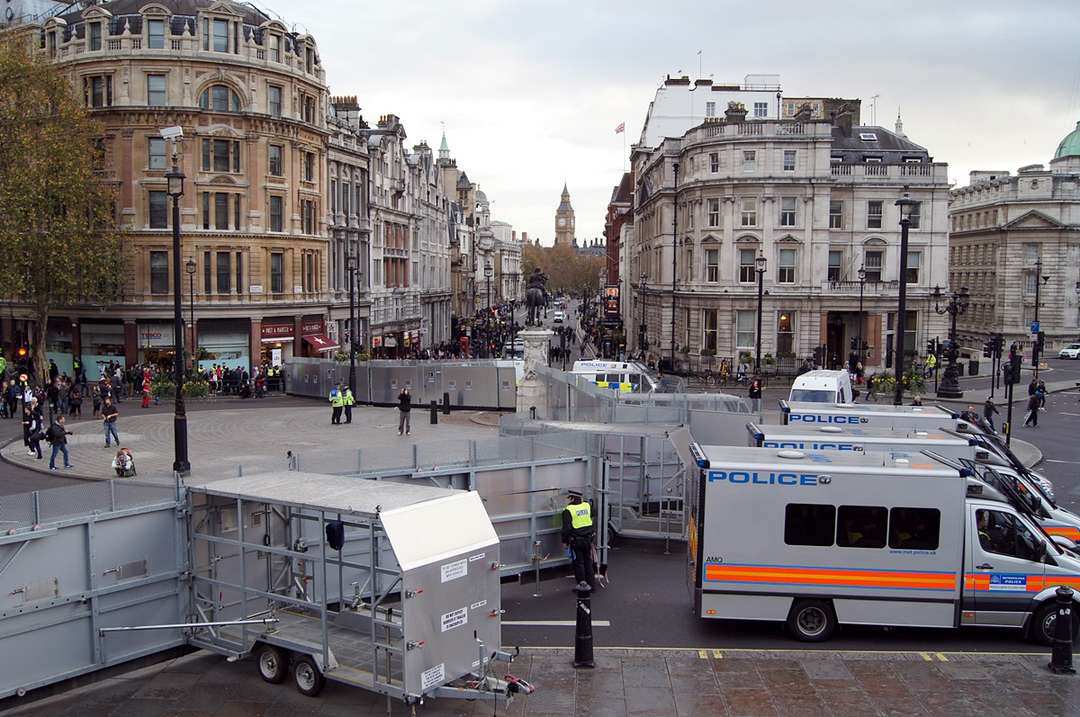
Top: Police barricades at the 2010 Toronto G20 conference. Bottom: Trailers that deploy massive steel walls during Occupy London, 2011. Top image by Steve Lafleur, bottom via indymedia london.
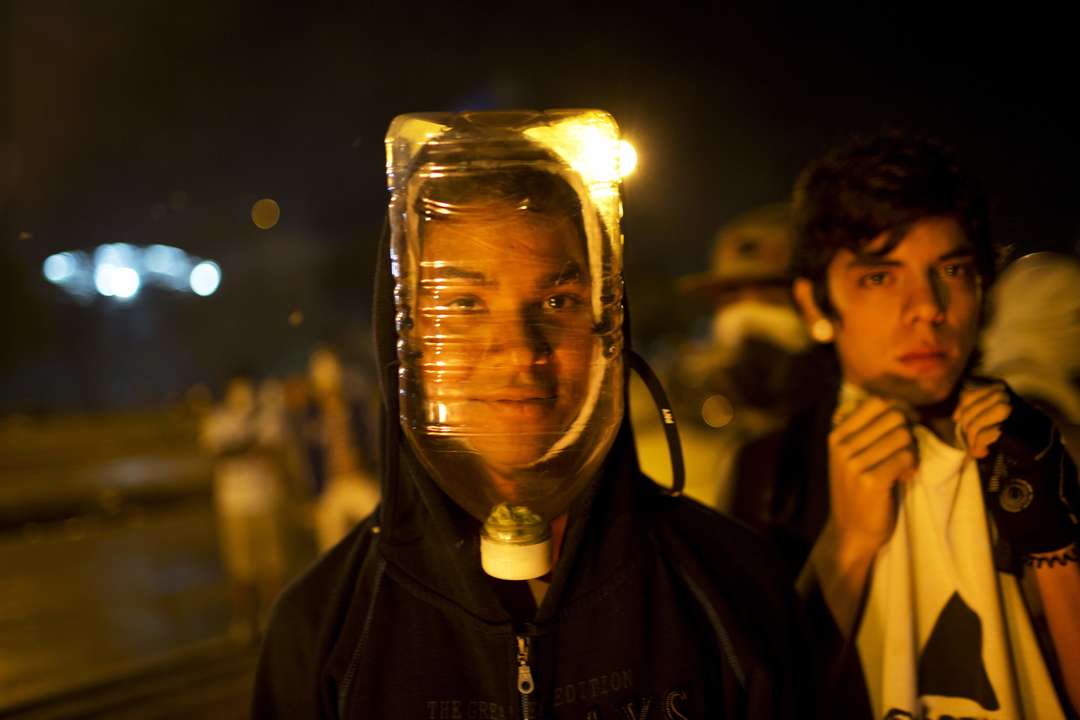
While architecture competitions can be heated, rarely is so much at stake for the participants as in these situations. Barricade construction is perhaps the most architectural manifestation of the protester vs. police design race, but it's not the only category in play. The extensive use of tear gas has prompted a number of makeshift gas-mask designs that are no less ingenious. The objective is to protect the face and eyes from immediate exposure, ensuring a measure of visibility, and furthermore filtering the air of its noxious contents. Fitting custom-cut plastic bottles over one's face, combined with cloth or other filters, has proven to be a popular design.
Add To Collection Save this image to a collection
Add To Collection Save this image to a collection
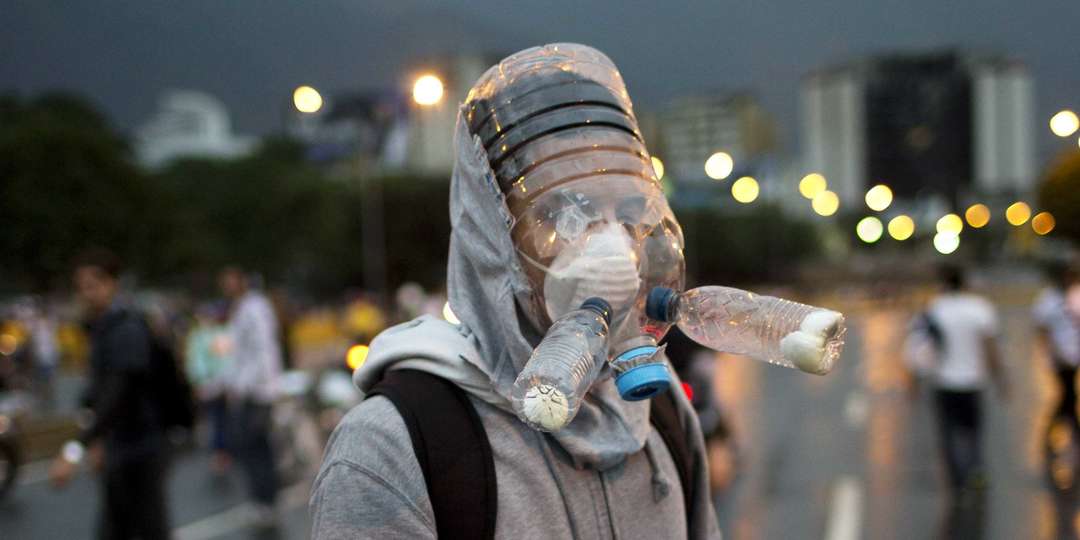
Protesters demonstrating against Venezuelan President Nicholas Maduro in Caracas, February 2014. The lower image shows a protester who may have placed paper towels soaked with chemicals that counter tear gas. Image via Business Insider Australia.
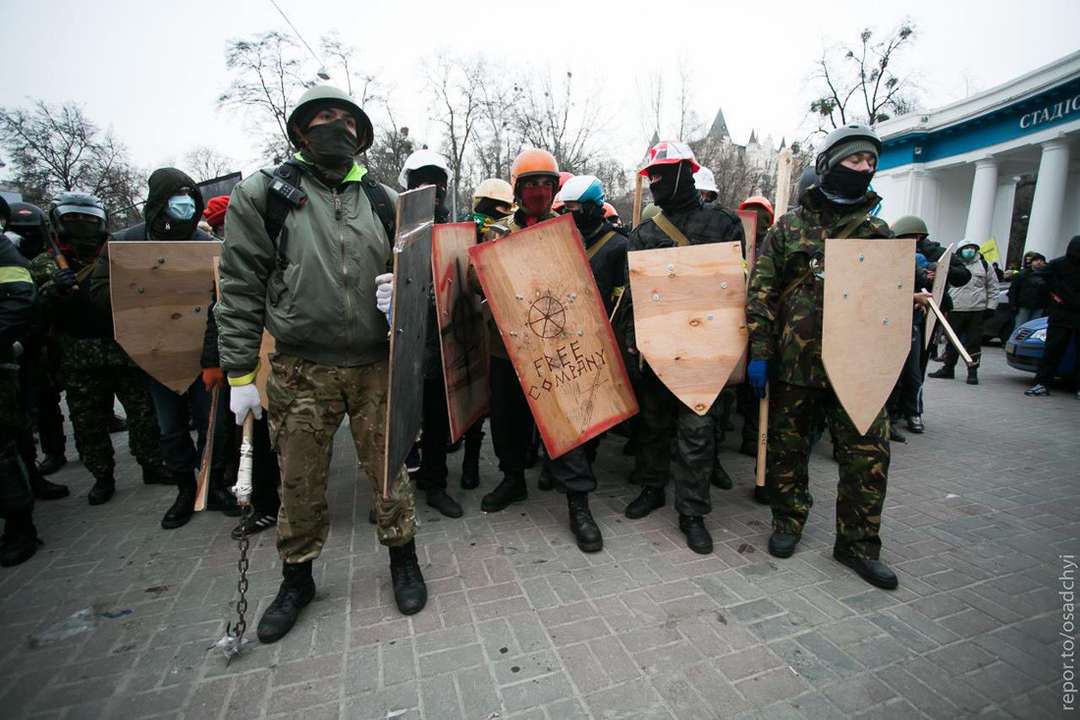
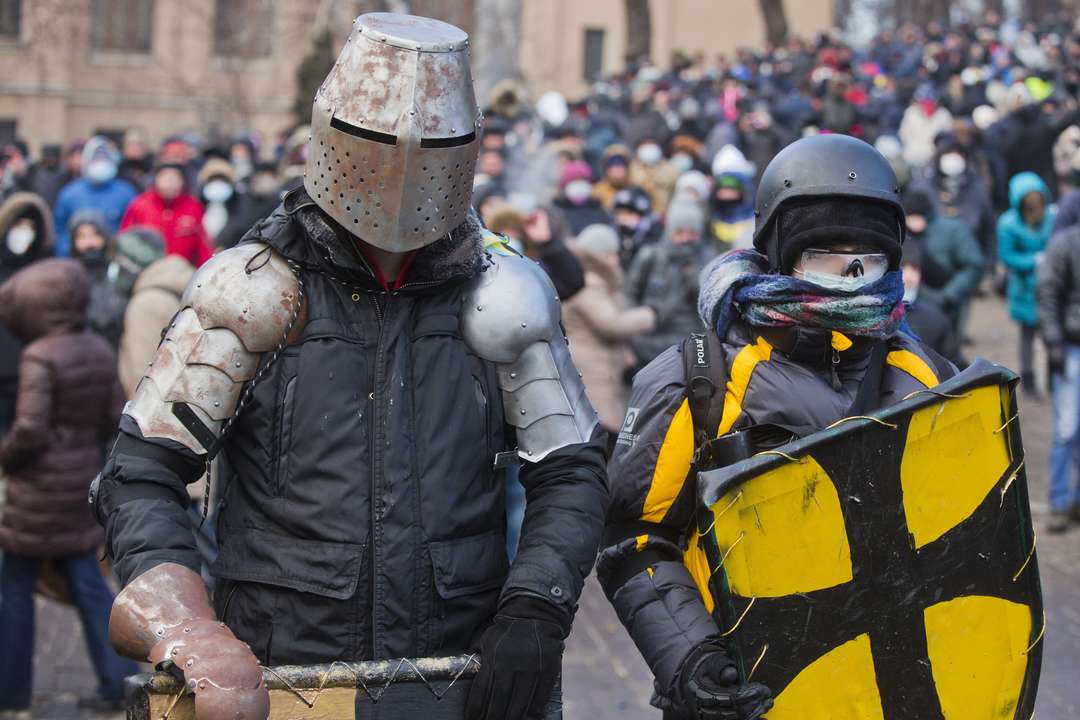
While tear gas and imposing barriers are critical in any mass urban confrontation, most important of all may be body armor. There's nothing more imposing than a faceless bulky figure who knows that he or she has the advantage in a fight. Police armor design isn't too exotic: it's usually padding protected by hard plastic polycarbonate or plastic nylon shells. The shell absorbs a blow whose force is distributed among the padding. Some vests aren't fitted with a specific hard armor but rather pouches that can hold interchangeable plastic, aluminum, or ceramic plates. However, as this winter's violent protests in the Ukraine revealed, protesters were quickly able to assemble their own gear with the same protective properties. Thick downy jackets can absorb hits while skiing and hockey gear (even motorcycle helmets) aren't so dissimilar from riot armor.
Add To Collection Save this image to a collection
Add To Collection Save this image to a collection
Add To Collection Save this image to a collection
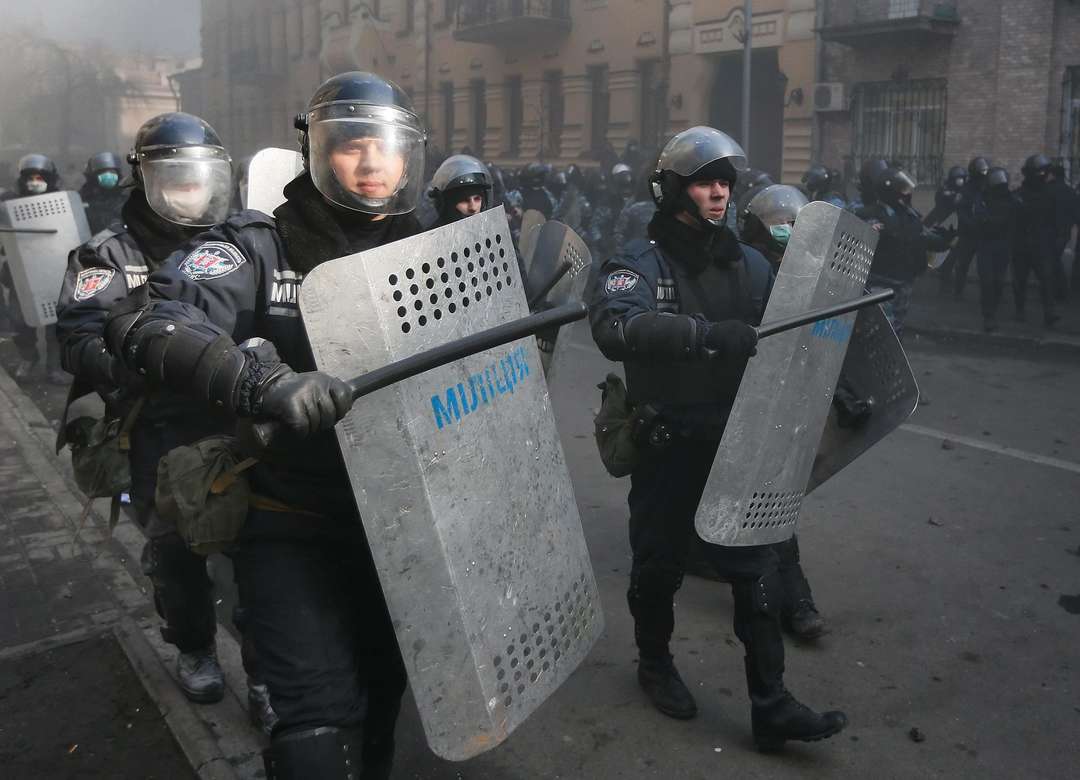
Protesters in Ukraine and the riot police opposing them. Top Image: _danny via reddit, middle image via Metro, bottom image via nbc news.
With Hong Kong currently in the throws of civil disobedience, and with Kiev, Venezuela, and the Occupy movement all in recent memory, there's no sign of this arms race slowing down. While police will usually come prepared with purpose-designed equipment, they're learning that there isn't a design or a function that their opposition can't quickly replicate. For those in the U.K. who are keen to learn about the design of urban confrontation, check out the "Disobedient Objects" exhibition at the Victoria and Albert Museum, now open and running until February 1, 2015.
Kooky creationist lady named Megan Fox freaks out over...
MattalystEukaryotes, the atheist's nightmare.
Kooky creationist lady named Megan Fox freaks out over ‘Evolving Earth’ exhibition at Chicago science museum (For more info, visit Dangerous Minds and Death and Taxes; For a related video, click here http://christiannightmares.tumblr.com/post/69009090387/creationism-vs-evolution-bogus-stats-and-bored)
graycloak: [Anatomy Occultus] Anatomy Occultus is a study of...

Anatomy Occultus is a study of the Tree of Life in its anthropomorphic Adam Kadmon form.
This original piece of fine art, by [Chuk Vinson], is sold exclusively through [Dove & Serpent Oasis]. These are high quality, limited edition prints. Each one is signed and numbered by the artist.
Killer Mike's pre-show Ferguson Grand Jury speech.


More problems for bees: we’ve wiped out their favorite plants
Bees are disappearing—that much is certain. What's unclear is why. Pathogens and pesticides have been posited as potential causes, as has the loss of bees' preferred floral resources. This last reason has intuitive appeal: wildflowers are disappearing because of agriculture, and bees rely on the pollen and nectar in flowers, so the loss of flowers should be causing the loss of bees.
But a demonstration of this seemingly simple idea has been hard to come by. Different species of bees rely on different plants—the bee species that are disappearing have never been analyzed in terms of taste for the plants that are disappearing to see if they match up. And, once the bees or plants are gone, it's hard to figure out what relationship (if any) they might have had. Pesky details.
Researchers in the Netherlands have gotten around this problem by examining museum specimens of bees to figure out which bees like which flowers. They've demonstrated that the bee species that have declined are in fact those that like the pollen from flower species that have also declined.
Read 5 remaining paragraphs | Comments