Shared posts
30 Mar 14:22
"The ad looks really beautiful, but after looking at our competitors’ ads, we think it stands out too..."
“The ad looks really beautiful, but after looking at our competitors’ ads, we think it stands out too much. Can we tone it down? Ours looks like a Vogue cover ad and theirs look like scanned-in business cards.”
22 Mar 11:48
Manga Publishing Update, Spring 2015
North American manga publishers continue to recover from the double whammy of recession and a market correction in the late 2000s.
19 Mar 19:34
D’Orazio v Sims: Dawn of Justice
by Heidi MacDonald
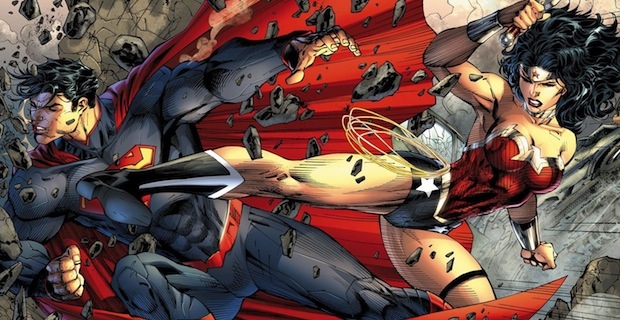
I Have an update already, but you’ll have to scroll all the way down for it.
Or: the harassing call is coming from inside the blog
If you are not up to speed on all this Jude Terror has done an incredible job summing up 90% of the most important points up until about 10 pm last night. I was going to do the same but I would literally do the exact same thing as Terror. So if you just want the juicy links go there and then come back. Teresa Jusino at The Mary Sue (great new hire, btw) also has a great piece up with original comments from Sims and D’Orazio.
If you want the short version, without speaking to the principals, here’s what I think happened in the last few weeks. (For details of what happened 7-8 years ago, you’ll need to scroll down.) First the personae: In one corner, Valerie D’Orazio, a former editor at Valiant and DC, a long time blogger, former editor in chief of MTV Geek, and writer of several comics including a Punisher one shot and the recent Edward Snowden biography.
In this corner, Chris Sims, a long time blogger at his own The Invincible Super Blog and a long time columnist and writer at Comics Alliance known for his “Ask Chris” feature as well as co hosting a podcast and many many humorous pieces on comics over the years. He’s also a comics writer with the gn Down Set Fight to his credit and probably more. (I have to admit I know much less about Sims career than I do D’Orazio’s, so you can fill in the blanks in the comments.)
Okay, let’s get ready to rumble!
@gimpnelly This was the first dude — and he went on a tear afterwards. Blocked and reported, but others followed. pic.twitter.com/SiTM6UxXQV
— David Gallaher (@DavidGallaher) March 18, 2015
• Last week it appears that some G*mergater types unearthed what was a well known at the time feud from 2007-10 between well known blogger Chris Sims and writer/editor Valerie D’Orazio as shown in the above tweet by D’Orazio’s husband, David Gallaher. The GG mischief was aimed at showing how Comics Alliance, a site very well known for its emphasis on creating more diversity and speaking out in often passionate terms against sexism, racism, transphobia and anti-gay sentiments, was in fact harboring a writer (Sims) who had harassed a woman (D’Orazio) online.
• Gallaher wrote to Sims warning him that this was being unearthed. Apparently CA staff also received warnings.
• Sims wrote an apology for his behavior towards D’Orazio to Gallaher in response.
• Earlier this week, Sims was named as the writer of X-Men ’92, a digital first Secret Wars spin-off.
• Without mentioning the GG outing, but mentioning the X-men gig, D’Orazio tweeted that Sims had harassed her online for the period above. You can see the tweets in the link. An excerpt:
Hey Marvel: do you remember when you called me at 8:00 in the morning the day my Punisher book was to hit stands, telling me…
— Valerie D'Orazio (@ValerieDOrazio) March 17, 2015
…"sorry, but it looks like you're going to get a lot of harassment for your book. You should lay low for awhile."
— Valerie D'Orazio (@ValerieDOrazio) March 17, 2015
And now you hired the person who stirred up some of the most vile harassment I've ever received online, that I've had to have therapy for.
— Valerie D'Orazio (@ValerieDOrazio) March 17, 2015
I've got proof of him harassing me on my own blog and then commenting, "you gonna CRY little girl?"
— Valerie D'Orazio (@ValerieDOrazio) March 17, 2015
• Sims blogged about it, apologizing for his past behavior:
If you’ve been reading my work for long enough, then you probably remember that I had what I used to refer to as a “feud” with Valerie D’Orazio a few years ago. That’s the wrong word, since it was more one-sided than anything else, and I was in no uncertain terms the aggressor and a complete jerk. I was needlessly harsh about her comics work, I left jerky comments on her site, I talked trash here and elsewhere, and while in my head I justified it as as purely being critical of her writing, I know I stepped over the line into making it a personal attack more than once. What I said is a matter of public record, and frankly, my intentions at the time don’t change what I actually did. At best, I was making someone’s life harder when I had no reason to, and at worst I was giving others a reason to do the same that went far beyond just me being an asshole and contributed to and validated the harassment of both Ms. D’Orazio and of women in general. When I finally realized that, long after I should’ve, I stopped, and I’ve tried to be better going forward.
• D’Orazio expanded in a blog post.
I had several cyberbullies during that three-year span, but Chris Sims was one of the worst. Not so much for what he said about me directly, but because he had a popular forum from which to direct harassment to me by many other people.
I never could figure out what I did to Chris personally to be singled out for this type of treatment. But week after week, he would have posts focused on me in which he would be a ringleader for others, who would then go off and harass me personally via my blog, social media, and emails.
This hit its peak when it was announced that I was to write a one-shot for The Punisher. Apparently Chris thought this was the wrong choice, and he made his opinions clear.
• MEANWHILE…social media is beginning build up steam like a pressure cooker that’s about to blow. Up until this point, none of the GGate association had been publicly made.
• Yesterday afternoon Janelle Asselin and Andrew Wheeler, the co-editors of Comics Alliance, released a statement, that, while clearly stating that the Sims cyberbullying and harassment was wrong, they felt that Sims had evolved as a human being and he was being targeted by GGaters:
Someone was targeting Chris not out of a sense of justice, but because they wanted to destroy his success. The campaign may also have been one of several efforts we’re aware of to discredit ComicsAlliance. These are not the tactics of progressives concerned about harassment in comics, but of agitators looking to tear down progressive voices — of which Chris is certainly one — using methods of harassment. (Notably, the messages referred to D’Orazio as “David’s wife,” rather than recognizing her as a person in her own right.)
No doubt these people also see themselves as the heroes of their stories. They are not. We cannot lend legitimacy to their behavior.
Chris is not the man he was when he directed his vitriol at Val D’Orazio. If he were that man, or if he felt no remorse for his past actions, he wouldn’t belong at today’s ComicsAlliance, given our strong avocation against harassment in the industry.
• Later in the day Sims wrote a longer blog post at CA, expressing more remorse:
Between 2007 and 2010, I harassed and bullied Valerie D’Orazio online. It’s recently become a topic of discussion, and to the people who weren’t following me then, I know this is at best disappointing, and that I’ve rightfully lost a lot of the respect I’ve built up in the years since. I don’t blame you, and I accept that judgment. To paraphrase a friend of mine, this isn’t about whether I did it (I did) or whether any part of it was remotely okay (it wasn’t), but talking about anything else right now would be disrespectful and disingenuous. Believe it or not, this is something I care about quite a bit, so this week’s question is one that I’ve had to ask myself: What do you do when you realize you’re part of the problem?
OK YOU GOT ALL THAT? that was the short version.
And now the conflict began. Because we all hate harassment and bullying and threats and bad online behavior. But what do you do when it’s from a FRIEND OF YOURS?
Rachel Edidin, a writer and editor, and Laura Hudson, the founding EIC of Comics Alliance, who, I believe, hired Sims in the first place, had their own responses. Edidin is a close friend of Sims’, and learning your friend was (to put it mildly) a total jerk is hard:
So: Chris Sims is one of my best and closest friends, someone I trust implicitly. Chris Sims is also a person who has done some really shitty things that have resulted in some very real and serious harm. I think he’s done a really good job of owning that today; and I think he should have done it much sooner; and I understand why he didn’t; and—at least for me—none of those things cancel each other out. I would absolutely not tell anyone for whom what Chris did was a moral or personal event horizon that they were wrong. That’s a really personal call—for you, and for me.
I don’t know what I’d have to say about this if I weren’t friends with Chris; because I am, and there’s no question that’s influencing the terms in which I am thinking about it.
I will say: my stance in the past has been that harassment is never okay; that public accountability is important; that the loss of nuance is incredibly dangerous and benefits nobody; that significant cultural sea change is less dependent on people not fucking up than on people owning their shit, learning from their mistakes, and working to do better. I stand by those positions.
And I will add: Anyone whose response to this whole thing is to be shitty to Val can go straight to hell.
Hudson stepped in to address online comments about how adding the whole GGate element to the apology was a red herring which deflected attention from the damage done to D’Orazio.
But it’s also hard for me to ignore that this conversation is happening in large part because of an anti-progressive campaign. Valerie has every right to come forward and speak about her experiences, but it’s also true that the conversation was initially sparked by the skeleton digging of people seeking to discredit ComicsAlliance as a progressive site. This is particularly upsetting for me, not only because I created ComicsAlliance, but because I’ve spent the better part of the last year living in fear of these exact sorts of people, receiving death threats from them, and watching them try to destroy my friends and colleagues in games. Some people have expressed that this context should not be mentioned—that doing so is merely a way of mitigating or excusing Chris’s behavior. I disagree. Understanding it or acknowledging it in no way makes Chris less accountable. We can and should have accountability, and I’m glad that we’re seeing that. But I don’t believe holding people accountable has to be mutually exclusive with nuance, or that offering context is necessarily a way of making excuses. I think that it is both possible and important to do both.
So as you see, we now have, by some counts, THREE victims here. D’Orazio, Sims AND Comics Alliance.
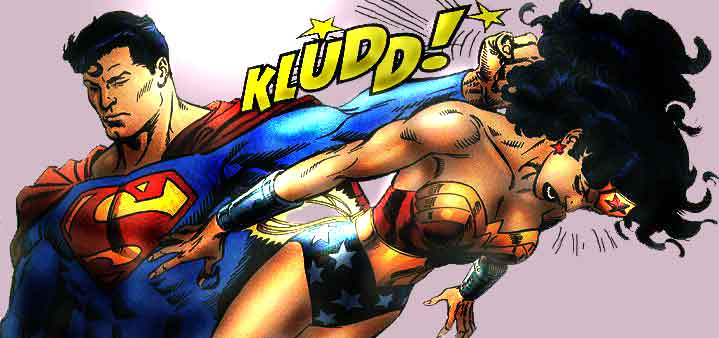
But HOW? WHY????? HOW DID THIS HAPPEN? How was a man allowed to bully a woman in public without anyone caring until now? I mean that happens all the time, but why THIS time?
To understand this, we must return to the Last Days of the Glory Days of Blogging. 2008. Our great nation was wondering if a woman or a black man would be the next president of the US and getting to know a spunky Alaskan governor named Sarah Palin along the way; movie fans thrilled to The Dark Knight even as they mourned Heath Ledger; and comics fans were reeling from Final Crisis! What a time it was. And Blogging, emerging about five years earlier with free, effective platforms like Blogger and Live Journal, was the future of journalism. The comics blogosphere was a lively place, as fans and readers became major voices commenting on the industry, while a few “pros,” such as myself, Tom Spurgeon and Dirk Deppey, were the morning newspaper of the industry, It was also a world where social media was just taking off. People still communicated via message boards, email and blog comments. although all of that would come to an end very soon.
From the early days of blogging in 2002-on it was an easy time to make a name for yourself as a blogger in a community that loved to comment on itself. A strong personality and writing skill went a long way, and people who had just been buying their comics every Wednesday were now independent industry pundits. I actually don’t know when Sims started his site—I never read it, and I’ve never had much interest in his writing because I stopped reading superhero comics before most of the people I’ve quoted in this piece were born. 90s Marvel nostalgia doesn’t hold much interest for me…but it does for a LOT of other people, and Sims’ evident passion knowledge and great sense of humor gained him quite a following.
But one of the weirder sides of blogging in its Golden Age was the whole blogging feud thing. At one point I made up a pretend feud with USA Today’s comics blogger Whitney Matheson, comparing her to the baby with one eyebrow on The Simpsons, Maggie’s mortal enemy. It was a one sided affair (the Beat could never touch McPaper) and after we both appeared on a panel at SPX together it all became a joke. Whitney is one of the nicest sweetest people I’ve EVER met, and the idea of any kind of feud was just stupid.
I have no idea exactly why Sims started his feud with Val. I can sort of guess though. I have to throw in here that I know Val very well, as opposed to having barely interacted with Sims. Val and I worked together at DC, we live in the same town, we’ve had lunch, we’ve been out drinking, and we’ve given each other support at various times…and had some major disagreements as well. We’re not best buds, but I’ve always considered her one of the smartest writers about comics, even when I don’t agree with her, and one of the most naturally talented bloggers in the whole space.
This was not a feeling universally shared. To be fair, Val is not shy about picking her own battles. I believe she had her own blog feud with Johanna Draper Carlson, and she was especially unpopular with Ragnell and Kalinara, two writers who ran a link blog called When Fangirls Attack that is very much the Paleozoic version of today’s geek girl media web. You can read all about it here and here, with Chris Sims actually showing up in the comments to take pot shots. I was going to except these but it’s like reading a transcript of a family gathering with so much calling back and self referencing. But, all that said, I can see why people took umbrage: Val has strong opinions, which although backed up by a lengthy career in the industry, stood out like a sore thumb. She was also always talking about her own victimization, and some people disliked that. TBH, I don’t remember any of the incidents that incited the WFA dislike, but I don’t actually even remember the Sims feud either.
I was a lot more complimentary to D’Orazio in this period, quoting her often because she was eloquent and honest; I’m much more personally interested in how the industry works than in comics nostalgia, but that’s me. Here’s what she wrote about when Diane Nelson took over as head of DC:
You can only place my reaction in context of the massive amount of misogyny I’ve witnessed or heard reported about in selected sectors of DC Comics during the time I’ve worked there. During those four years, I had seen strong women again and again be censured, criticized, grumbled about, and disparaged. I’ve watched my department be emptied out of females one-by-one. I was warned on literally the first day I worked there by two different people to watch my back because I was a woman and not to make any waves. I was told by one boss that females just didn’t have the natural aptitude to edit comic books. I am absolutely thrilled that the buck now stops with a woman at DC Comics. I am overjoyed – nay, almost orgasmic – that certain men will now have to regard Diane Nelson as their boss. It is karma working on the most basic level. Let these men explain to Nelson, who has worked with one of the most famous female fantasy writers in the entire world, how women don’t have the natural aptitude to edit and create comic books. Let these men explain to her the employment and dismissal history of female editors in the DCU over the last ten years. Let these men explain to her the plot of Final Crisis – I dare them. The other shoe has finally dropped. Expect a lot of change before SDCC 2010.
While I’m not sure this post was actually prophetic, it was certainly arguable and candid. But yeah, Val wasn’t out to make friends and she wasn’t popular in the blogosphere.
Sims has removed a lot of posts about D’Orazio I guess but this one survives:
And then there’s Valerie D’Orazio. The fact that I don’t personally care for D’Orazio is one of the ISB’s worst-kept secrets–it was the entire joke behind her interviewing me about Solomon Stone last year–but if Marvel wants to hire loudmouthed comics bloggers to write their comics, that can only be a good thing for me, so good on her for getting the work. But even so, the antipathy’s there, and along with the fact that there’s nothing to keep me from swallowing my own tongue and dying when the inevitable rage-induced aneurysm hit, it’s one of the reasons that I’m opting out of reviewing Punisher Max: Butterfly this week, as you can never really trust someone with an axe to grind. With the Girl Comics story, however, the problem is one that I think I can be a little more objective about.
Ah yes, Punisher Max Butterfly.
Now imagine that you have had a, by any objective standard, difficult tenure at a comics publisher and you leave to follow a writing career. Breaking in to comics writing is never easy and when you’re a woman and a LOUDMOUHED woman it’s almost impossible. But imagine you do it and you have a book come out that may be flawed but it’s your first book and who knows where its going.
And now imagine that a bunch of people on the internet don’t like you and go out of their way to say that this is the worst comic ever made, and personally belittle your efforts any way they can.
Yes, that would be a bummer alright. Because as hard as it is to break into comics writing, it’s even harder to get that second gig when you are a lightning rod for controversy (some of it because you like to stand outside in thunder storms holding a lightning rod, to be sure.)
And imagine that five years later your main accuser has his OWN debut for the SAME publisher announced. How would you feel now? Probably pretty angry. Luckily, now we have twitter and social media to play out every sentence blow by blow.
The D’Orazio/Sims feud wouldn’t have lasted long in a world with twitter…it would have burnt out pretty quick under the weight of lookie loos and people hazarding an opinion. But in the Paleozoic, it could flourish with little or no blowback.
Now, no one has tried to let Sims off the hook in any of this. Asselin, Wheeler, Hudson, Edidin and Sims himself acknowledge just how horrible, petty and damaging his behavior was. And now there are GGate psychopaths waiting in the wings to take it to a new level. Don’t get me wrong. I feel really bad for the Comics Alliance crew, past and present. They’ve come out as one of the strongest voices for a new, inclusive comics industry, one without all the baggage and inane stereotypes that D’Orazio has been writing about since she left DC. But what do you do when the call is coming from inside the house?
What an exhausting week this has been..how emotionally exhausting this job of comics blogging has become. I’ve always been one to prefer the positive to extending finger pointing, but a whole queue of nice art and happy comics news is just sitting there while I weigh in on Batgirl covers, decade old feuds, Erik Larsen, J. Scott Campbell, Pat Broderick, outrages and tone deaf responses to problems that people just began pointing out.
In an era where healthy, needed whistle blowing and speaking out has become more common, I think everyone has had uncomfortable moments. I’ve seen people who are friends of mine called out for their bad behavior, and it’s tough. When someone has been an abuser or a harasser it doesn’t really matter that they like their dog or are fun at parties. Even pointing out that “not all men” are total assholes is not seen as useful, but rather a smoke screen to avoid examining underlying biases. When I see friends nailed for their bad behavior, I hold my tongue because it was bad behavior. Many times I had even warned them about it in the past (which is what you do for a friend) but they couldn’t or didn’t want to engage in self examination and self improvement. And sometimes you just walk away because it’s hopeless. If we’re living in a zero tolerance world, then it needs to be zero tolerance, as difficult as that may be when people are a mix of good and bad and their actions are equally paradoxical.
In 2008 identity politics wasn’t the driving force it is now, and a bunch of bloggers “feuding” with a woman who writes openly about her abuse and sexual trauma would be identified as harassment and not “a difference of opinion. ” Now, it’s important to note that Ragnell, Kalinara Johanna and maybe even Sims did just disagree with Valerie, because that happens as well, but it could have been identified as gaslighting, tone policing and mansplaining.
I don’t know Chris Sims so I have no idea what his level of remorse is. Based on what his friends are saying, people I do know, I’m guessing it’s pretty high. I’ve been genuinely surprised by how many of my friends have come out and told me that Sims was a role model or inspiration for them. They feel sad and confused, and will probably feel that way for a while. I do know that—and this is just me speaking personally—I think the ongoing and petty nature of Sims’ harassment is a more serious matter than a couple of apologies can cover. It was classic “punching down” before that was even a word. It’s also endemic of the whole idea that online life is not real life, an idea from the beginning of the internet that is totally ludicrous in light of how online is intertwined in our lives. Sims would never have engaged with D’Orazio for that long if she was a real human being to him, and not just a bunch of pixels on a screen.
Anyway this is as long as a San Diego con report now, and I’m not even sure what to say any more. I’m sure there’s already dozens more pundits weighing in, more personal axe grinding, and maybe new outrage from some quarters that will make this look like a baby asleep in its crib. I do know that I would like the punishment to fit the crime, so I’ll leave with my tweet from earlier when I first read all of this:
I’m not an eye for an eye type, but I hope @theisb’s marvel debut gets the same online scrutiny as @ValerieDOrazio’s did. That is all.
— Heidi MacDonald (@Comixace) March 18, 2015
UPDATE: D’Orazio has updated her blog with a response to an anonymous latter than asked her to “take a look in the mirror.”
I’m a 41-year-old gender-fluid comic book writer, editor, and blogger. I endorse an expanded feminism that embraces trans women (along with everyone along the vast gender spectrum) and puts more of an emphasis on women of color. I put my feminism into practice in the comics community not just by writing about various issues, but giving women actual paying jobs. I work with female clients to bring their ideas into comic book form, and volunteer my time mentoring female writers and artists who want to break into the business.
I support the greater representation of people—and characters—of color within the comics industry. I support fair wages for people who work in the industry, and making sure older industry veterans continue to get jobs. I also support the greater inclusion of LGBTQ people both in the comics industry and within the comics they produce—particularly the transgender community, who I feel are under-represented and occasionally misrepresented throughout pop-culture in general.
If you think that my gender identification, aesthetics, etc. makes me not “qualify” as a “real victim” (oy) of misogyny…if you seek to rob me of my personal narrative because I don’t fit your image of what a good feminist should be or act or say…if you categorically deny I have had the experiences I have had…please take me off your mailing list. UNSUBSCRIBE.
19 Mar 18:49
Meryl Streep’s Next Role: ‘Suffragette’

This year will be filled with powerful female protagonists, and we can’t wait.
After announcements that we’ll get both a Billie Jean King biopic and a movie about the founding of Ms. Magazine, word is Meryl Streep and Carey Mulligan are now starring in “Suffragette,” a film about UK women who fought for the vote in the early-twentieth-century.
According to IndieWire, Mulligan will play Maud, a working wife and mother who joins a feminist group and begins taking great risks in the face of aggressive police reaction.
But the best part? “Suffragette” is written, produced, and directed by women. British director Sarah Gavron recently directed a documentary about a village in Northern Greenland with more dogs than people. Writer Abi Morgan wrote “The Iron Lady,” and won an Emmy for her 1950s newsroom drama “The Hour,” and producer Alison Owen was Oscar-nominated as a producer of “Elizabeth.”
Helena Bonham-Carter and Ben Wishaw will also star in the film, though no word yet on their roles. We’ll keep you updated!
kate likes this
19 Mar 16:24

These ones are from Bisous Ciao.


Here Are All the Places Giving Away Free Macarons on Friday
by Sierra Tishgart
These ones are from Bisous Ciao.
While Grub Street isn't in the habit of celebrating — or even acknowledging — made-up food holidays, free macarons are a different story altogether. Each year, on the first day of spring, François Payard mobilizes New York bakeries to give away French macarons in honor of City Harvest. All you have to do is announce at the shop that you're there for Macaron Day NYC. Here are all of this year's participants:
Bouchon Bakery
Bisous Ciao Macarons
Chantilly
Eclair Bakery
Epicerie Boulud
Francois Payard Bakery
FP Patisserie
Macaron Café
Macaron Parlour
MadMac Macaron
Mille-Feuille Bakery
Spot Dessert Bar
Sugar & Plumm
Todd English Food Hall
Woops! Unmistakably Delicious
Read more posts by Sierra Tishgart
Filed Under: free stuff, macarons, new york
19 Mar 14:22
Ask Chris: Being Part of the Problem
by Chris Sims
kateI'm glad Chris wrote this. I didn't know anything about the harassment in the past but had definitely become a fan of his in the last few years.
It is really hard to hear that this happened. Understandably, It will probably never be okay for Valerie D’Orazio but it does seem like Chris has really made a big strive to change.
This week's question is one that Chris has had to ask himself: What do you do when you realize you're part of the problem?
Darylsurat, kate and one other like this

19 Mar 13:34
Tonko House to Turn ‘The Dam Keeper’ into a Feature Film
by Darryn King
The Oscar-nominated short is also getting a graphic novel series.
19 Mar 12:41


Bark Beetles Are Decimating Our Forests. That Might Actually Be a Good Thing.
by Maddie Oatman
There is an eerie feel to this grove of lodgepole pines that I can't quite put my finger on as entomologist Diana Six tromps ahead of me, hatchet in hand, scanning the southwestern Montana woods for her target. But as she digs the blade into a towering trunk, it finally hits me: the smell. There's no scent of pine needles, no sharp, minty note wafting through the brisk fall air.
Six hacks away hunks of bark until she reveals an inner layer riddled with wormy passageways. "Hey, looky!" she exclaims, poking at a small black form. "Are you dead? Yeah, you're dead." She extends her hand, holding a tiny oval, maybe a quarter of an inch long. Scientists often compare this insect to a grain of rice, but Six prefers mouse dropping: "Beetle in one hand, mouse turd in another. You can't tell them apart." She turns to the next few trees in search of more traces. Pill-size holes pock their ashen trunks—a sign, along with the missing pine scent, of a forest reeling from an invasion.
These tiny winged beetles have long been culling sickly trees in North American forests. But in recent years, they've been working overtime. Prolonged droughts and shorter winters have spurred bark beetles to kill billions of trees in what's likely the largest forest insect outbreak ever recorded, about 10 times the size of past eruptions. "A doubling would have been remarkable," Six says. "Ten times screams that something is really going wrong."
Mountain pine, spruce, piñon ips, and other kinds of bark beetles have chomped 46 million of the country's 850 million acres of forested land, from the Yukon down the spine of the Rocky Mountains all the way to Mexico. Yellowstone's grizzly bears have run out of pinecones to eat because of the beetles. Skiers and backpackers have watched their brushy green playgrounds fade as trees fall down, sometimes at a rate of 100,000 trunks a day. Real estate agents have seen home prices plummet from "viewshed contamination" in areas ransacked by the bugs. And the devastation isn't likely to let up anytime soon. As climate change warms the North American woods, we can expect these bugs to continue to proliferate and thrive in higher elevations—meaning more beetles in the coming century, preying on bigger chunks of the country.
BEETLEMANIA
From 2000 to 2014, bark beetles destroyed large swaths of forests in the American West—and they're not done yet.
In hopes of staving off complete catastrophe, the United States Forest Service, which oversees 80 percent of the country's woodlands, has launched a beetle offensive, chopping down trees to prevent future infestations. The USFS believes this strategy reduces trees' competition for resources, allowing the few that remain to better resist invading bugs. This theory just so happens to also benefit loggers, who are more than willing to help thin the forests. Politicians, too, have jumped on board, often on behalf of the timber industry: More than 50 bills introduced since 2001 in Congress proposed increasing timber harvests in part to help deal with beetle outbreaks.
But Six believes that the blitz on the bugs could backfire in a big way. For starters, she says, cutting trees "quite often removes more trees than the beetles would"—effectively outbeetling the beetles. But more importantly, intriguing evidence suggests that the bugs might be on the forest's side. Six and other scientists are beginning to wonder: What if the insects that have wrought this devastation actually know more than we do about adapting to a changing climate?
A BUG'S LIFE
An adult mountain pine beetle lays her eggs under the bark. On her way, she disperses fungi that turn the trees' tissue into food for her babies, eventually killing the tree.
Though they're often described as pesky invaders, bark beetles have been a key part of conifer ecosystems for ages, ensuring that groves don't get overcrowded. When a female mountain pine beetle locates a frail tree, she emits a chemical signal to her friends, who swarm to her by the hundreds. Together they chew through the bark until they reach the phloem, a cushy resinous layer between the outer bark and the sapwood that carries sugars through the tree. There, they lay their eggs in tunnels, and eventually a new generation of beetles hatches, grows up, and flies away. But before they do, the mature beetles also spread a special fungus in the center of the trunk. And that's where things get really interesting.
Six focuses on the "evolutionary marriage" of beetle and fungi at her four-person lab at the University of Montana, where she is the chair of the department of ecosystems and conservation sciences. Structures in bark beetles' mouths have evolved to carry certain types of fungi that convert the tree's tissue into nutrients for the bug. The fungi have "figured out how to hail the beetle that will get them to the center of the tree," Six says. "It's like getting a taxi." The fungi leave blue-gray streaks in the trees they kill; "blue-stain pine" has become a specialty product, used to make everything from cabins to coffins to iPod cases.
A healthy tree can usually beat back invading beetles by deploying chemical defenses and flooding them out with sticky resin. But just as dehydration makes humans weaker, heat and drought impede a tree's ability to fight back—less water means less resin. In some areas of the Rocky Mountain West, the mid-2000s was the driest, hottest stretch in 800 years. From 2000 to 2012, bark beetles killed enough trees to cover the entire state of Colorado. "Insects reflect their environment," explains renowned entomologist Ken Raffa—they serve as a barometer of vast changes taking place in an ecosystem.
Under the microscope, Diana Six picks up a dead mountain pine beetle in her Missoula lab. Shawn Gust
Typically, beetle swells subside when they either run out of trees or when long, cold winters freeze them off (though some larvae typically survive, since they produce antifreeze that can keep them safe down to 30 below). But in warm weather the bugs thrive. In 2008, a team of biologists at the University of Colorado observed pine beetles flying and attacking trees in June, a month earlier than previously recorded. With warmer springs, the beetle flight season had doubled, meaning they could mature and lay eggs—and then their babies could mature and lay eggs—all within one summer.
That's not the only big change. Even as the mountain pine beetles run out of lodgepole pines to devour in the United States, in 2011 the insects made their first jump into a new species of tree, the jack pine, in Alberta. "Those trees don't have evolved defenses," Six says, "and they're not fighting back." The ability to invade a new species means the insects could begin a trek east across Canada's boreal forest, then head south into the jack, red, and white pines of Minnesota and the Great Lakes region, and on to the woods of the East Coast. Similarly, last year, the reddish-black spruce beetle infested five times as many acres in Colorado as it did in 2009. And in the last decade, scientists spotted the southern pine beetle north of the Mason-Dixon Line for the first time on record, in New Jersey and later on Long Island. As investigative journalist Andrew Nikiforuk put it in his 2011 book on the outbreaks, we now belong to the "empire of the beetle."
In a weird way, all of this is exciting news for Six: She is not only one of the world's foremost experts in beetle-fungi symbiosis, but proud to be "one of the few people in Montana that thinks bark beetles are cute." (She's even brewed her own beer from beetle fungi.) As a child, she filled her bedroom in Upland, California, with jars of insects and her fungus collection. But as a teenager, she got into drugs, quit high school, and started living on the streets. Nine years later, she attended night school, where teachers urged her to become the first in her family to go to college. And when she finally did, she couldn't get enough: classes in microbiology and integrated pest management led to a master's degree in veterinary entomology, then a Ph.D. in entomology and mycology and a postdoc in chemical ecology, focused on insect pheromones.
Entomologist Diana Six, who has devoted her career to bark beetles, believes that the bugs might hold clues to saving our forests in the face of climate change. Shawn Gust
Six, 58, has light-green eyes ringed with saffron, and long silvery-blond hair streaming down shoulders toned from fly-fishing and bodybuilding. As several fellow researchers stress to me, she is the rare scientist who's also a powerful communicator. "I think about what it means to be a tree," she told a rapt audience at a TEDx talk about global forest die-offs. "Trees can't walk. Trees can't run. Trees can't hide," she continued, her sonorous voice pausing carefully for emphasis. "And that means, when an enemy like the mountain pine beetle shows up, they have no choice but to stand their ground."
To a tree hugger, that might seem a grim prognosis: Since trees can't escape, they'll all eventually be devoured by insects, until we have no forests left. Especially since, with our current climate projections, we might be headed toward a world in which beetle blooms do not subside easily and instead continue to spread through new terrain.
But Six has a different way of looking at the trees' plight: as a battle for survival, with the army of beetles as a helper. She found compelling evidence of this after stumbling across the work of Forest Service researcher Constance Millar, with whom she had crossed paths at beetle conferences.
Millar was comparing tree core measurements of limber pines, a slight species found in the eastern Sierras of California that can live to be 1,000 years old. After mountain pine beetles ravaged one of her study sites in the late 1980s, certain trees survived. They were all around the same size and age as the surrounding trees that the beetles tore through, so Millar looked closer at tree ring records and began to suspect that, though they looked identical on the outside, the stand in fact had contained two genetically distinct groups of trees. One group had fared well during the 1800s, when the globe was still in the Little Ice Age and average temperatures were cooler. But this group weakened during the warmer 1900s, and grew more slowly as a result. Meanwhile, the second group seemed better suited for the warmer climate, and started to grow faster.
Pine beetles have increasingly attacked fragile whitebark pine trees, whose cones are an important food source for grizzly bears, Clark's nutcrackers, red squirrels, and other animals in the Yellowstone area. Maddie Oatman
When beetle populations exploded in the 1980s, this second group mounted a much more successful battle against the bugs. After surviving the epidemic, this group of trees "ratcheted forward rapidly," Millar explains. When an outbreak flared up in the mid-2000s, the bugs failed to infiltrate any of the survivor trees in the stand. The beetles had helped pare down the trees that had adapted to the Little Ice Age, leaving behind the ones better suited to hotter weather. Millar found similar patterns in whitebark pines and thinks it's possible that this type of beetle-assisted natural selection is going on in different types of trees all over the country.
When Six read Millar's studies, she was floored. Was it possible, she wondered, that we've been going about beetle management all wrong? "It just hit me," she says. "There is something amazing happening here."
Last year, Six and Eric Biber, a University of California-Berkeley law professor, published a provocative review paper in the journal Forests that challenged the Forest Service's beetle-busting strategies. After scrutinizing every study about beetle control that they could get their hands on, they concluded that "even after millions of dollars and massive efforts, suppression…has never effectively been achieved, and, at best, the rate of mortality of trees was reduced only marginally."
Six points to a stand of lodgepoles in the University of Montana's Lubrecht Experimental Forest. In the early 2000s, school foresters preened the trees, spacing them out at even distances, and hung signs to note how this would prevent beetle outbreaks. This "prethinned" block was "the pride and joy of the experimental forest," Six remembers. But that stand was the first to get hit by encroaching pine beetles, which took out every last tree. She approached the university forest managers. "I said, 'Boy, you need to document that,'" Six says. "They didn't. They just cut it down. Now there's just a field of stumps."
Six and Biber's paper came as a direct affront to some Forest Service researchers, one of whom told me that he believes changing forest structure through thinning is the only long-term solution to the beetle problem. Politicians tend to agree—and beetle suppression sometimes serves as a convenient excuse: "It is perhaps no accident that the beetle treatments most aggressively pushed for in the political landscape allow for logging activities that provide revenue and jobs for the commercial timber industry," Six and Biber wrote in the Forests review.
Take the Restoring Healthy Forests for Healthy Communities Act, proposed in 2013 by then-Rep. Doc Hastings (R-Wash.) and championed by then-Rep. Steve Daines (R-Mont.). The bill sought to designate "Revenue Areas" in every national forest where, to help address insect infestations, loggers would be required to clear a certain number of trees every year. Loggers could gain access to roadless areas, wilderness study areas, and other conservation sites, and once designated, their acreage could never be reduced. The zones would also be excluded from the standard environmental-review process.
Six and other scientists vehemently opposed these massive timber harvests—as did environmental advocates like the Sierra Club and Defenders of Wildlife, the latter warning that the harvests would take logging to "unprecedented and unsustainable levels." The bill passed the House but died in the Senate last year. But Daines, now a senator and one of 2014's top 10 recipients of timber money, vows to renew the effort so as to "revitalize Montana's timber industry" and "protect the environment for future generations."
This summer, Six plans to start examining the genes of "supertrees"—those that survive beetle onslaughts—in stands of whitebarks in Montana's Big Hole Valley. Her findings could help inform a new kind of forest management guided by a deeper understanding of tree genes—one that beetles have had for millennia.
If we pay close enough attention, someday we may be able to learn how to think like they do. University of California-Davis plant sciences professor David Neale champions a new discipline called "landscape genomics." At his lab in Davis, Neale operates a machine that grinds up a tree's needles and spits out its DNA code. This technology is already being used for fruit tree breeding and planting, but Neale says it could one day be used in wild forests. "As a person, you can take your DNA and have it analyzed, and they can tell you your relative risk to some disease," Neale says. "I'm proposing to do the same thing with a tree: I can estimate the relative risk to a change in temperature, change in moisture, introduction to a pathogen."
Signs of beetle invasion on a whitebark pine tree in Montana's Big Hole Valley Maddie Oatman
Right now, foresters prune woodlands based on the size of trees' trunks and density of their stands. If we knew more about trees' genetic differences, Neale says, "maybe we would thin the ones that have the highest relative risks." This application is still years off, but Neale has already assembled a group of Forest Service officials who want to learn more about landscape genomics.
Six, meanwhile, places her faith in the beetles. Whereas traditional foresters worry that failing to step in now could destroy America's forests, Six points to nature's resilience. Asked at TEDx how she wants to change the world, she responded, "I don't want to change the world. We have changed the world to a point that it is barely recognizable. I think it's time to stop thinking change and try to hold on to what beauty and function remains."
Diana Six in her lab at the University of Montana Shawn Gust
This story was supported by a Middlebury College Fellowship in Environmental Journalism.
19 Mar 12:41
The Government Is Finally Doing Something to End the Rape-Kit Backlog
by Jenna McLaughlin
Across the country, an estimated 400,000 rape kits—the DNA swabs, hair, photographs, and detailed information gathered from victims of sexual assault and used as evidence for the prosecution to convict rapists—have never been tested. Testing kits can be expensive, and in many jurisdictions, a lack of funds has resulted in kits being consigned to dusty shelves, stored in abandoned police warehouses, or stowed away in forensic labs—sometimes for years. As a result, survivors may never see their rapists prosecuted, and repeat offenders continue to commit crimes.
But now a new, $41 million Department of Justice program could finally help localities end this backlog. The money from Congress "goes a long way towards solving the problem," says Linda Fairstein, a former sex crimes prosecutor who serves on the board of the Joyful Heart Foundation, a nonprofit established by Law and Order:SVU actress Mariska Harigtay that does research and advocacy work on the rape-kit backlog.
Last week, the Department of Justice began accepting applications from states, counties, and municipalities that want to use the federal dollars to tackle their rape kit backlogs. Officials in Baltimore, Milwaukee, Detroit, Memphis, Cleveland, and Houston tell Mother Jones that they're planning on applying for some of the funds. "The grant shows an investment on all levels, national to local," says Doug McGowen, a coordinator in the sexual assault response unit in Memphis, Tennessee.
18 Mar 18:57

Welcome back.


Carvel Introduces an Awesome-Sounding Nutella Milkshake
by Clint Rainey
Welcome back.
The future is rather hazy for Nutella offshoot stores, but Carvel's new item is legitimate. Since the company's Nutella ice cream was such a hit last summer, Carvel is upping the ante by adding a milkshake.
The "Thick Shake" includes Nutella soft-serve, whipped cream, and a Nutella drizzle. Plus: Other items — like the Nutella Sundae Dasher — are returning as well. They're available at all Carvel shops through the end of May.
* This post has been updated.
Read more posts by Clint Rainey
Filed Under: totally hazelnuts, carvel, ice cream, nutella, the chain gang
Alainmendez likes this
18 Mar 18:28
'Lighten Up' is Ronald Wimberly's Must-Read Commentary on Race In Comics
by Janelle Asselin
Today, The Nib released a beautiful and evocative comic by cartoonist Ronald Wimberly about race in comics. Wimberly tells the story of how a Marvel editor asked him to change the skin color of a character who had been historically Mexican and African-American. The editor wanted the character's skin tone to be lighter, and in Wimberly's piece he discusses why this is so problematic.
White privilege is absolutely a real thing, and the wide-ranging implications of this editor's request probably never occurred to her. Being an editor at a place like Marvel or DC means putting up with a punishing monthly schedule and many cooks in the same kitchen. Asking an artist to make a color change is pretty routine - and to many editors, this note would seem like a minor request. As Wimberly makes clear in his comic, however, the request has many problems.
Lostphrack, kate likes this
18 Mar 16:50







Take a 3-D Spin Around This Amazing ‘Show Your #DisneySide’ Paper Sculpture
by Jennifer Fickley-Baker
We’ve all felt that rush of excitement or burst of childlike enthusiasm that is your Disney Side — that part of your personality that only comes out when you’re in a Disney Park. Artist Britni Brault had that feeling in mind when she created a dazzling paper sculpture – it depicts the “real world” on one side and the #DisneySide on the other (as revealed by a 180-degree spin).
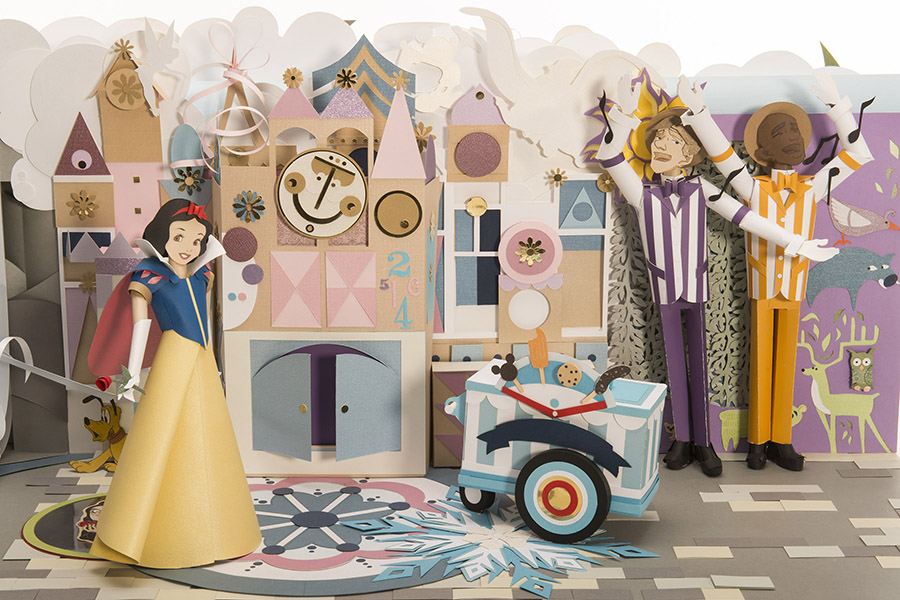
It took Britni more than a year of planning and about three months of work to construct the 3D sculpture you see below, called “Show Your Disney Side.” As you move around it, you see how a little Disney Magic turns a hair salon into Rapunzel’s tower. A travel agency becomes it’s a small world. Snow White and Jungle Cruise make appearances, too.
“I actually was raised in Anaheim and could see the Disneyland [park] fireworks from my house my whole life,” Britni says. “It was something that was a part of my life growing up.” Britni has previously done work for Disney Theme Park Merchandise and created sculptures of Mary Poppins and Bert, the Queen of Hearts from “Alice in Wonderland,” and Maleficent, among others.
 |
 |
Britni says her work is inspired by many artists who have worked on Disney films and Disney Parks – including Disney Legends Ken Anderson, Mary Blair, Alice Davis, Marc Davis and Blaine Gibson.
Below, you can take a a 3D spin around Britni’s “Show Your Disney Side” paper sculpture.
For a behind-the-scenes look at how Britni created this amazing paper sculpture, check out this time-lapse video.
Take a 3-D Spin Around This Amazing ‘Show Your #DisneySide’ Paper Sculpture by Jennifer Fickley-Baker: Originally posted on the Disney Parks Blog
kate likes this
18 Mar 15:58

Danger zone.


Kraft Issues a Massive Macaroni and Cheese Recall After Finding Metal Shards
by Clint Rainey
Danger zone.
Kraft is voluntarily yanking 6.5 million macaroni-and-cheese boxes from stores, owing to a discovery that just eight boxes contained metal shards. There are no reported injuries so far, but props to Kraft for playing it safe.
The eight incidents pertained to 7.25-ounce boxes of the original flavor, with "best used by" dates ranging between September 18 and October 11 of 2015. The flagged boxes are also marked with a "C2" code.
Impacted customers (in the U.S., the Caribbean, and parts of South America) can receive full refunds, of course. But to add one curveball, some recalled boxes came in packs with perfectly fine boxes from other plants, so make sure to check thoroughly.
[AP]
Read more posts by Clint Rainey
Filed Under: food safety, kraft, macaroni & cheese, news, recalls
18 Mar 15:23

38 Killer Taco Spots in New York City
by Robert Sietsema
Robert Sietsema names the best no-frills taquerias in and around the city.
Sure, there are all sorts of talented chefs involved in the taco game today, turning out a spectacular product with some wildly creative fillings. But sometimes you just want a good, unpretentious, inexpensive taco just like they make ‘em in Mexico. Here are the city’s best, organized by borough.
Note: This list favors grab-and-go places over sit-down restaurants on the premise that tacos taste better if you don’t make too much of a fuss over them. But taco trucks are not included, and most places offer some semblance of seating.
This is a revised and expanded version of the guide, originally published as "28 Killer Taco Spots in New York City" in March, 2015.
Alainmendez likes this
18 Mar 13:59

Japanese activists rail against copyright provisions in Trans Pacific Partnership
by james_fudge
Japanese activists have come out swinging against copyright provisions in the Trans-Pacific Partnership. A group of artists, archivists, academics, and activists have formed a coalition to pressure Japanese negotiators to oppose copyright provisions that the U.S. negotiators have pushed hard for in the trade agreement. The point of contention for this coalition is a leak that Japanese negotiators and negotiators from other countries had caved in to U.S. demands that set their copyright terms to the length of an author's life plus 70 years.
18 Mar 13:58


jialingpan:Bravely Default | An Illustration Anthology is Open...
Bravely Default | An Illustration Anthology is Open for Purchase! Click Here!
Hello everyone! I’m proud and extremely excited to present to you the fanbook for purchase at my online store.
- B5 size | Matte Cover with Black and Silver Foil Stamp
- 24 Pages Full Colour + 2 coloured inner covers
Open to international orders as well!
There are many wonderful artists in this book. Participants in no particular order are :
Haku | Jialing Pan | Loika | Leslie Hung | Yoonmi | Finni Chang | Hwei | Sushes | Max | OnoMono | Fenix | Mero | Kim Quim | Blue | Mirukupie | Jemma | SapphirePreorders have all already been shipped out! Please email me if you haven’t received your tracking number.
Thank you so much and much appreciated for sharing if you do : )
I’M IN THIS!!! BUY IT!!!
17 Mar 23:21
Teenage Artist's Self-Published Graphic Novel Gets Big Time Blurbs
kateI read this, definitely a nice travelogue comic.
How a teenager got acclaimed comics artists Jeff Smith, Lucy Knisley and Hope Larson to blurb her self-published book.
17 Mar 23:13
"Galaxy Angel" Celebrates 14th Anniversary with Charatoru Twitter Campaign
by news+feed@crunchyroll.com

To celebrate the 14th Anniversary of the Galaxy Angel TV anime, Charatoru is launching a social media campaign on Twitter. Japanese Twitter users can enter the contest beginning March 20, 2015, by following the official Charatoru (@charatoru) feed on Twitter and then posting tweets about what kind of character goods they wish to see featuring Normad, the mascot character of Galaxy Angel.
The contest runs until April 05, 2015. Five winners will receive a 3-badge set featuring Normad. Charatoru's Normad-themed prizes are scheduled to hit Japanese arcades in August.

Galaxy Angel began in 2000 as a series of bishoujo dating sims, but spun off into a series of science fiction / comedy anime TV shows with animation by Madhouse beginning in 2001. The series features a mostly female cast who venture all over the galaxy trying to prevent powerful “Lost Technology” artifacts from falling into the wrong hands, but mostly this framework is just an excuse to put the ladies in silly situations.

Normad is a mascot character who joins the cast early on. An artificial intelligence program designed to pilot a missile, Normad is initially suicidally depressed that the whole of his existence will end in an explosion. The Angels solve this problem by transferring Normad's consciousness into the body of a stuffed doll, but Normad's sarcastic attitude often results in him being pummeled by the rest of the crew.

Charatoru is a Japanese company that specializes in “crane game” toys. They often collaborate with anime companies to produce prizes for the claw machines that populate Japanese arcades.
More information can be found at the promotion's official home page.
Source: Animate.tv
Paul Chapman is the host of the Greatest Movie EVER! Podcast and GME! Anime Fun Time.
Alainmendez likes this
17 Mar 19:28


The 2020 Tokyo Olympics, Otaku Culture, and the Specter of Censorship
by sdshamshel
This post was sponsored by Johnny Trovato. If you’re interested in submitting topics for the blog, or just like my writing and want to sponsor Ogiue Maniax, check out my Patreon.
—
The 1964 Tokyo Olympics are considered to be one of the most significant moments in Japanese history in terms of symbolism. Having lost World War II a couple of decades prior, and having experienced military occupation by the US as a result, the Olympics were an opportunity to show the world that Japan had gotten back on its feet and climbed out of poverty. One of symbols of this transformation is the famous bullet train, which came into service in time for the Tokyo Olympics.
It’s no surprise then that the 2020 Tokyo Summer Olympics are kind of a big deal. While Japan no longer has issues with proving itself to be a first-world country even in a decades-long economic recession, the government still wants to further its integration in international economy, culture, and politics. The subject of 3.11 will also still be relevant, and if Japan has not “proven” to the world that they have managed to overcome that disaster by 2020, they will certainly assert it by then. However, one particularly large and visible target for cleanup is Japan’s otaku culture, and they’ve already begun their move.
As I’ve learned from a series of public lectures at Temple University’s Japan Campus (thanks to Veef for the link), one of their targets is anime and manga, given their focus on using Japanese pop culture as a form of “soft power” over the past decade. As the Tokyo Olympics get closer, just the fact that the image of Japan as a haven for illegal pornography still persists to some degree means that the Japanese government, or perhaps groups trying to influence the government, will be pushing for lasting change on what can and cannot be depicted in anime and manga. This has a very likely chance of affecting otaku culture in Japan, though the degree to which these changes will last depends on how much creators and supporters of anime and manga can push back.
Any government will naturally want to present itself and what it represents in the best light possible, though keep in mind this does not automatically mean censorship; it is possible for such behavior to only affect media that comes from the government itself. However, because Cool Japan is government-backed, this can create a contradictions. Namely, what has attracted people to anime and manga culture in the first place has been its willingness to be subversive, degenerative, and controversial, both in the context of other cultures and in Japan. Concerns over anime being not just pornography but child pornography in the US and Canada are nothing new at this point, and more recently in Japan has passed the Tokyo Metropolitan Ordinance Regarding the Healthy Development of Youths.
I think one possible scenario is that the worlds of doujinshi and industry works will separate a bit more, maybe regress back to how it was a few decades ago. These days Comic Market is a big deal for both amateurs and professionals, with fan parodies being sold right next to videos displaying promos for the latest upcoming anime. A lot of names working professionally, including Satou Shouji (Highschool of the Dead, Triage X) and Naruco Hanaharu (Gargantia on the Verdurous Planet, Kamichu!) are artists who not only work in the (relatively) mainstream industry but also still produce both professional erotic manga and erotic doujinshi. While I don’t think many creators will go away, they might very well have to pick what side of the die they fall on.
Censorship levels tend to ebb and flow, and are even a bit hard to control even as laws exist in the books. While artist Suwa Yuuji got in serious trouble in the early 2000s for publishing Misshitsu, an erotic manga that was deemed insufficiently censored, Frederik Schodt, in his classic book Manga! Manga! The World of Japanese Comics, explains how Japanese artists in the 1970s and 80s got around the censorship of genitalia through the use of creative visual metaphors through very “trains going through tunnels”-type affairs. Even the use of mosaics in Japanese pornography has changed over the years to be less prominent. Artists find ways. As somewhat of an aside I do think it’s interesting that the series Denkigai no Honya-san features a government censor as a character who is also a fujoshi.
However, although I believe that manga creators are imaginative enough to find loopholes, I think what we’ll see is a serious effort to keep things from reaching this level on the part of the industry itself and otaku as well. In many ways, this situation goes well beyond the subjects of anime, manga, games, and otaku because Japan has a very real history with censorship.
Leading up to and during World War II, dissenters could get arrested or even killed for publishing material that was seen as unfavorable to the Japanese government. This has of course changed, but just as the memory of the war continues to be an influence on the 2020 Olympics due to the connection to the 1964 Olympics and the role it had in showing how Japan had “moved on,” so too does has the danger of censorship remained in the culture of Japan.
While this might seem to contradict the fact that Japanese pornography is indeed censored, that sort of thing is often just lip-service that some take more seriously than others. After all, unlike other countries where pornography is banned, this is an adjustment to the work itself and assumes that making things less visible also draws less attention to them. There’s a strange relationship between forbidding ideas and forbidding images, because at some point one transforms into the other, and with anime and manga we’re seeing one arena in which this ambiguity comes to the forefront. This is why people from manga creators Takemiya Keiko (Toward the Terra) and Akamatsu Ken (UQ Holder) to the maids at the maid cafe Schatzkiste have discussed the subject of censorship and what it can mean.
In the end I can’t predict what will become of otaku culture, but I think that we’ll see that it’s not as passive as is often assumed. People will fight for their right to consume and create the anime and manga that they want, and it will certainly not be a sad joke.
17 Mar 15:16
DC Comics pulls controversial Batgirl variant cover at the creative team’s wish
by Heidi MacDonald
So, June is Joker month in the DCU, with variant covers for all the books featuring the lovable scamp once portrayed by Cesar Romero.
And last Friday, the variant cover for Batgirl #41 was revealed, by artist Rafael Albuquerque.

The image is a call-out to The Killing Joke, the story by Alan Moore and Brian Bolland where the Joker kidnaps Barbara Gordon, strips her, shoots her through the spine, paralyzing her, and send pictures to Batman and Jim Gordon to make them feel bad.
It’s a powerful story, but also very much of its time in that superhero comics were just proving how dark, grim, gritty and painful they could be. And Barbara Gordon paid the price.
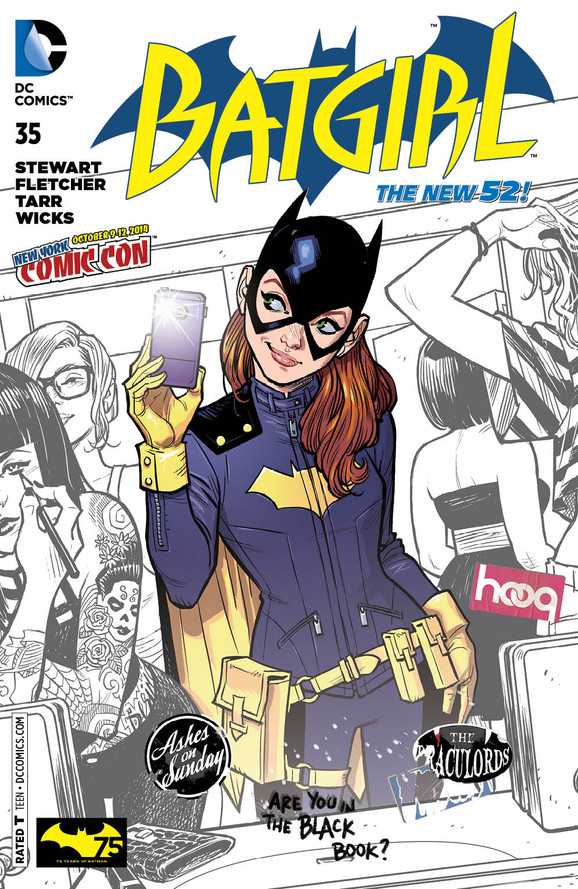
Now, however, she’s the chipper star of a cheerful superhero book, written by Cameron Stewart and Brendan Fletcher and dawn by Babs Tarr, and the book has become the flagship title for a new kind of DC. A new, more inclusive DC.
And on those ground alone, the cover was rather inappropriate. As an image of the star of the book being physically and psychologically assaulted, it was even more disturbing. It’s a tribute to Albuquerque’s talent that the image clearly captures Batgirl’s fear and terror at the hands of the Joker.
Over the weekend, there was great objection. I had already started a round-up post with this storify and DC Women Kicking Ass teeing off.
And things got even more out of hand today with the #changethecover hashtag going up against the #dontchangethecover and all manner of really inane insults, threats and misunderstandings going out. It was less amusing and more heated than the Spider-Woman cover, even, because at the end of the day, a woman being brutalized (possibly sexually) is way more disturbing than a sexy ass.
But in the evening, East Coast time, Albuquerque stepped up and said he had requested the cover be pulled in a statement to CBR:
My Batgirl variant cover artwork was designed to pay homage to a comic that I really admire, and I know is a favorite of many readers. ‘The Killing Joke’ is part of Batgirl’s canon and artistically, I couldn’t avoid portraying the traumatic relationship between Barbara Gordon and the Joker.
For me, it was just a creepy cover that brought up something from the character’s past that I was able to interpret artistically. But it has become clear, that for others, it touched a very important nerve. I respect these opinions and, despite whether the discussion is right or wrong, no opinion should be discredited.
My intention was never to hurt or upset anyone through my art. For that reason, I have recommended to DC that the variant cover be pulled. I’m incredibly pleased that DC Comics is listening to my concerns and will not be publishing the cover art in June as previously announced.
With all due respect,
Rafa
DC Entertainment also released a statement
We publish comic books about the greatest heroes in the world, and the most evil villains imaginable. The Joker variant covers for June are in recognition of the 75th anniversary of the Joker.
Regardless if fans like Rafael Albuquerque’s homage to Alan Moore’s THE KILLING JOKE graphic novel from 25 years ago, or find it inconsistent with the current tonality of the Batgirl books – threats of violence and harassment are wrong and have no place in comics or society.
We stand by our creative talent, and per Rafael’s request, DC Comics will not publish the Batgirl variant. – DC Entertainment
NOW, a few things about that. As laid out by Jude Terror, DC’s statement was incredibly badly worded and made it sound like Albuquerque had been threatened, when in fact PEOPLE OPPOSING THE COVER HAD BEEN THREATENED.
Series writer Cameron Stewart and Albuquerque made it clear on Twitter that Albuquerque had not received any threats.
Something to clarify, because DCs statement was a little unclear. @rafaalbuquerque did not get threats. People OBJECTING to the cover did.
— Cameron Stewart (@cameronMstewart) March 17, 2015
Ill talk more about it tomorrow but I was never threatened. just to make it clear.
— Rafael Abuquerque (@rafaalbuquerque) March 17, 2015
However, it also became VERY CLEAR, that the Batgirl creative team themselves had raised objections to the cover from the start. (Variant covers are produced outside the editorial department.) And Stewart was very clear about this on Twitter. There were a gazilliion tweets about this, the below is just a selection.
If you’re concerned about artistic integrity and creative vision – that’s what we’re doing. Keeping the integrity of our book intact.
— Cameron Stewart (@cameronMstewart) March 17, 2015
@cameronMstewart So you're basically saying that the cover being removed keeps your book's integrity more than if it was available?
— Macattack (@macattack50) March 17, 2015
@macattack50 given that it wasn’t approved by us and contradicts the work we’re doing, yes.
— Cameron Stewart (@cameronMstewart) March 17, 2015
@cameronMstewart I don't agree, but to each his own. I thought it was an evocative cover that depicted Joker at his most terrifying.
— Macattack (@macattack50) March 17, 2015
@macattack50 I’m the writer of the comic. I don’t want it on my book. Defend my vision and integrity, please.
— Cameron Stewart (@cameronMstewart) March 17, 2015
@Akylle it’s not censorship. We the creative team never wanted it.
— Cameron Stewart (@cameronMstewart) March 17, 2015
@GamingAndPandas no, I didn’t. I objected to that cover before there was any backlash.
— Cameron Stewart (@cameronMstewart) March 17, 2015
I stand behind Rafael as an artist and a friend, and think he made the right decision.
— Cameron Stewart (@cameronMstewart) March 17, 2015
@cameronMstewart Nothing can disturb anyone anymore ever.
— Josh Crews (@JoshCrewsReally) March 17, 2015
@JoshCrewsReally we don’t want our book to be “disturbing.”
— Cameron Stewart (@cameronMstewart) March 17, 2015
@cameronMstewart That's the thing though. One variant cover doesn't make your book disturbing. No more than one Lego cover makes it silly.
— Josh Crews (@JoshCrewsReally) March 17, 2015
@JoshCrewsReally @cameronMstewart A cover, variant or no, represents the book to someone who picks it up (that's what they're for!).
— Matthew Southworth (@mattsouthworth) March 17, 2015
@cameronMstewart So you think every variant cover reflects the book? This would be awfully hard to reconcile with variants already existing.
— Josh Crews (@JoshCrewsReally) March 17, 2015
@JoshCrewsReally @cameronMstewart A cover, variant or no, represents the book to someone who picks it up (that's what they're for!).
— Matthew Southworth (@mattsouthworth) March 17, 2015
@mattsouthworth @cameronMstewart You do realize how many variants areout there that don't represent the book in the least though, right?
— Josh Crews (@JoshCrewsReally) March 17, 2015
@JoshCrewsReally @mattsouthworth @cameronMstewart This is representing their book in a way they do not want. It offends fans. Respect that.
— Kates (@KatieScarlett94) March 17, 2015
@KatieScarlett94 @JoshCrewsReally @mattsouthworth @cameronMstewart 2 cents: I didn't agree with pulling it but the 'defenders' were monsters
— random-shane (@mprshane) March 17, 2015
@mprshane @KatieScarlett94 @mattsouthworth @cameronMstewart Agreed. I was never out there defending it myself. Just asking questions now.
— Josh Crews (@JoshCrewsReally) March 17, 2015
@cameronMstewart I don't blame you. I just wish the process could've allowed for it to be stopped sooner? Idk if that makes any sense.
— Josh Crews (@JoshCrewsReally) March 17, 2015
@JoshCrewsReally oh, believe me, so do we
— Cameron Stewart (@cameronMstewart) March 17, 2015
@JoshCrewsReally @mprshane @KatieScarlett94 @mattsouthworth It is so important to understand that we didn’t want this cover though.
— Cameron Stewart (@cameronMstewart) March 17, 2015
Draw whatever the hell you want, but when they're not your characters expect the owners to protect their brand from losing $$.
— Pia Guerra (@PiaGuerra) March 17, 2015
@PiaGuerra Anybody who hopes to work for DC and doesn’t think people will be telling ‘em what they can and can’t draw are in for a shock.
— Kurt Busiek (@KurtBusiek) March 17, 2015
@cameronMstewart No, but he lost his JOB, and earnings.
— David O'Neill (@davejone) March 17, 2015
@davejone I can assure you he didn’t.
— Cameron Stewart (@cameronMstewart) March 17, 2015
um killing joke is a classic story of a clown who paralyzes a woman and takes all her clothes off to take pictures of her to show her father
— Chip Zdarsky, ok. (@zdarsky) March 17, 2015
Props to @cameronMstewart @babsdraws @brendenfletcher for sticking to their guns in the face of much outcry and twitter rage!
— Fiona Staples (@fionastaples) March 17, 2015
@cameronMstewart Nothing can disturb anyone anymore ever.
— Josh Crews (@JoshCrewsReally) March 17, 2015
@cameronMstewart You are correct about that. Everyone saw it. But now no one will get to own it.
— Macattack (@macattack50) March 17, 2015
I suggest all of you "Killing Joke" fans enjoy it like you enjoy Hall & Oates. Alone in your car.
— Henry Barajas (@HenryBarajas) March 17, 2015
Don't get put off by arguments over depictions/tone in comics lately. This means our industry is getting HEALTHY. GROWING!
— Jeff Parker (@jeffparker) March 17, 2015
https://twitter.com/andykhouri/status/577694801417498624
https://twitter.com/andykhouri/status/577695578009706496
I have a few observations about this:
• This isn’t censorship; it’s reversing a bad marketing decision that should never have been made. Why was it a bad marketing decision? Because Batgirl is the standard bearer for a new view of DC and its characters. I wasn’t kidding about Cesar Romero. Before there was all this psycho sadism, face removal, fear of a homosexual relationship between Batman and the Joker, Heath Ledger in a dress and so on, The Joker was a character who used joy buzzers and exploding cigars as weapons, and tried to take over Gotham with a flying saucer.
• The point is, when character run as long as Batman and the Joker and Batgirl have, their portrayal changes to reflect the times. The Killing Joke is a good old story from another era. I know we all like all backs and tributes and homages, but this one was not the right image for a new initiative at a publishing company.
• To the people saying they aren’t going to read DC Comics any more…pandering to the base hasn’t worked for comics for a long time.
• If you really love that cover, download a high res jpeg and make yourself a handy little print of it for you own use in your own home. No one will tell on you.
• The abusive nature of the internet is a blight on our society.
Meanwhile, this may be the truest thing that was said about the whole thing:
Batgirl is the most challenging thing I’ve ever worked on, and not because of the art or story
— Cameron Stewart (@cameronMstewart) March 17, 2015
17 Mar 13:47
Vertical Comics Licenses Inio Asano's A Girl on the Shore Manga
kateYES!!
Company to publish 1-volume omnibus by Solanin author by early 2016
Lostphrack, kate likes this
17 Mar 13:23

Client: I don’t understand. What’s this invoice for?Me: It’s for my work: the design of the...
Client: I don’t understand. What’s this invoice for?
Me: It’s for my work: the design of the brochure and the ads.
Client: But I paid the printer and the newspaper!
17 Mar 13:22

Scream.


It’s Free Cone Day at Dairy Queen
by Clint Rainey
Scream.
Dairy Queen is celebrating its 75th anniversary today exactly how it should be: by handing out free ice cream. Just as it sounds, Free Cone Day entitles customers to one free small vanilla cone at participating locations. (Sorry, no chocolate-dipped.) Even if temperatures aren't exactly tropical in most of the country just yet, soft-serve that screams old-school summer days is a nice way to celebrate finally not wearing your arctic parka. And, if you're feeling generous, DQ has set it up so you can give a donation to a Children's Miracle Network Hospital in your community.
Read more posts by Clint Rainey
Filed Under: the chain gang, dairy queen, free cone day, news
17 Mar 13:06


Undetonated one-ton U.S. bomb found near downtown Osaka
by Master Blaster
 On the morning of March 16, workers at a the construction site for a new condo complex in Osaka were surprised when they hit something hard after excavating about two meters (6.6 feet) deep. They were even more surprised to find that what they found was an unexploded piece of ordnance left over from World War II.
The bomb was found very close to one of Osaka’s more densely populated areas and could cause major disruptions in the city as the Self Defense Force (SDF) considers declaring an evacuation zone during the removal operation.
After finding the explosive device measuring 180 centimeters (5.9 feet) in length and 60 centimeters (2 feet) in diameter, the construction workers notified the Osaka Prefectural Police who in turn called in the ground division of the SDF.
▼ The site of the bomb (Google Street View is a bit outdated, as this is a construction site now)
The SDF went on to confirm it was an American-made bomb with the explosive power of a ton of TNT. During World War II, 843 of these bombs were dropped onto Osaka, the last of which fell a day before the end of the war on August 14, 1945. Osaka was considered a high-priority target due to its contribution to arms manufacturing at the time.
▼ The location of the bomb indicated by a marker, with Osaka’s Namba Station highlighted in orange.
不発弾埋まってたのここやな http://t.co/TaCrfvkDtT
—
すずめ@編む機械。 (@suzume225) March 16, 2015
In 2013, a similar bomb was found in Osaka in the less densely populated area of Nagarahigashi in Kita Ward. At that time the SDF established a 300-meter (980-foot) perimeter into which no one could enter while they defused and disposed of the bomb. As a result about 290 people were evacuated to shelters provided by the municipal government.
If the same 300-meter perimeter is set up around this bomb it would include part of the area around Namba Station, which is only 280 meters (918 feet) away and holds numerous offices, retail businesses, and eateries. The SDF are currently considering how to proceed in this case.
▼ This tweet shows the areas that would be affected by a 300-meter perimeter.
日本橋の不発弾発見場所から半径300mの範囲。南海なんば駅の南半分、なんばパークス、オタロードのほぼ全域は立ち入り禁止区域になりそう。今週末の日本橋ストリートフェスタは中止もあり得るか…… http://t.co/L8rRGeTHGW
—
Reffi (@tomo1109_Reffi) March 16, 2015
There is concern that this bomb could interfere with the upcoming Nipponbashi Street Festa 2015 on March 21. This is a yearly festival celebrating Nipponbashi’s Denden Town district’s distinct businesses such as computer part stores, maid cafes, and anime figurine retailers. The festival is also well-known for its cosplayers.
If a 300-meter perimeter is set up it would close off all of Denden Town to the public. There has been no word yet as to when and how the SDF will proceed to deal with this bomb. It would seem logical that they would act sooner than March 21, but they may want to wait until the weekend to minimize the effect on regular business in the area as well.
We will keep you posted as updates come in.
Source: Sankei West, Nanaiwa Ward via Hachima Kiko (Japanese)
Top Image: Google Maps
Video YouTube – Kashikao
Related Stories
- Sapporo police speechless after discovering one man’s creative use for a bomb: a door stopper
- Man shuts down Beijing airport after joke bombs with security officials
- 5 places in Japan to visit in 2015
- Taiwanese school boy finds real grenade while playing war, presumably wins
- Rising sea levels could cause staggering damage to these cities
Origin: Undetonated one-ton U.S. bomb found near downtown Osaka
Copyright© RocketNews24 / SOCIO CORPORATION. All rights reserved.
17 Mar 13:04

It's going to need its own counter.


World’s Best Robot Makes Pancakes in Literally Any Shape You Want
by Clint Rainey
It's going to need its own counter.
True, this machine looks kind of unwieldy and not exactly apartment-friendly, but Grub still wants one, if only to blow friends' minds with edible Eiffel Towers and Barack Obamas made out of pancake batter. Just look at this thing go:
According to PancakeBot's inventor, a civil engineer named Miguel Valenzuela, users employ the bot's software to essentially trace any image they want; that trace becomes the basis of the pancake. Then all you have to do to make these pancake dreams a reality is transfer that image — via memory card — right to the printer. The machine then handles batter-pouring duties, and so that the flapjack achieves proper shading when you flip it, there's even an option for color.
Of course, PancakeBot is already tearing it up on Kickstarter, and the first batch should be ready to ship in July.
[Kickstarter via NYDN]
Read more posts by Clint Rainey
Filed Under: playing with your food, food art, kickstarter, pancakebot, pancakes
17 Mar 13:04

The US Government Is Pressuring Europe to Dial Back Its Pesticide Rules
by Elizabeth Grossman
This piece was originally published by Civil Eats.
There's an important debate going on in Europe that could dramatically influence how pesticides are used on the United States' 400 million acres of farmland. At the center of the debate are endocrine disruptors, a broad class of chemicals known for their ability to interfere with naturally occurring hormones.
Endocrine disruptors have been linked to a range of health disorders [PDF] that include obesity [PDF], diabetes, behavior, and learning problems [PDF], and to reproductive disorders, including infertility. These chemicals are found in many plastics and countless consumer products, including cosmetics, and building materials. They include bisphenol-A (BPA), certain phthalates, and numerous flame retardants. The active ingredient in some of the pesticides most widely used across the American farm landscape, such as atrazine, 2,4-D, and organophosphates, are also widely believed to fall in this category.
In 2011, due to growing concern, the European Union decided to restrict the use of pesticides that act as endocrine disruptors. But that legislation cannot be fully implemented until members of the European Commission can agree on an official definition of "endocrine disrupting chemicals." That decision is now overdue.

Once in place, these would be the first such regulations anywhere in the world. And given the global market for pesticides—and agricultural products—what happens in Europe will have important implications in the US and beyond.
Case in point: The endocrine disruptor argument is being watched closely by those taking part in—and watch-dogging—the closed-door trans-Atlantic trade talks now going on. As part of those discussions, the US government and pesticide industry groups are reportedly urging for a "harmonization" of US and E.U. policies. But critics, including the Center for International Environmental Law, note that US and E.U. trade groups are pushing to ensure that E.U. environmental standards begin conforming to US regulations. And when it comes to pesticides, many US standards are less stringent than those in Europe.
At the heart of the current E.U. debate is whether to designate chemicals as endocrine disruptors based on either a) science that shows their potential to act as endocrine disruptors or b) science that also includes a risk assessment with data about exposure and documented adverse effects—a scenario that can be challenging in the realm of endocrine disruptors whose effects may take years to become apparent.
If defined as the former—essentially using the E.U.'s precautionary approach—a great many more chemicals could potentially be swept into this category and possibly restricted. The latter would make it considerably more difficult to restrict a chemical's use. In recent comments submitted to the European Commission, the US Department of Agriculture (USDA)'s Foreign Agriculture Service argues strongly for the latter approach, one that would also include an economic cost-benefit analysis, saying that, "imposing unnecessary restrictions" on pesticides "could have far-reaching and particularly detrimental consequences."
The US government's position largely echoes the positions taken by chemical industry groups, including CropLife America and the American Chemistry Council—groups that have a great deal riding on the outcome of this decision. Based on estimates compiled by companies that manufacture pesticides and other agricultural chemicals, the US government says that restricting pesticides as endocrine disruptors based on the broader definition would jeopardize as much as $69 billion worth of imports to Europe, including over $4 billion worth coming from the US Pesticides themselves are also big business, with sales worth billions every year.
More than 90 percent of the corn, soy, wheat, and potatoes grown in the US—many of our prime export crops—are treated with pesticides. Virtually no conventionally grown crops are untouched, but tomatoes, apples, grapes, rice, oranges, and peanuts top the USDA's list for the amount used on the farm level.
Pesticides used most on these crops include glyphosate (the active ingredient in "Roundup"), atrazine, chlorpyrifos, 2,4-D, and two less well-known pesticides called metolachlor and acetochlor. All of these have been identified in various scientific studies as having adverse effects on the endocrine system.
At the same time, exposure to endocrine disruptors appear to be costing Europeans an enormous amount of money. According to several studies published earlier this month, the estimated annual healthcare costs associated with exposure to endocrine disrupting chemicals in pesticides was $126 billion.
This is the estimated annual cost of several neurological disorders linked to these chemical exposures, including lowered IQ and behavioral disorders such as attention deficit hyperactivity disorder. The studies' authors say this is likely an under-estimation and suggest that exposure and costs in the US are comparable or greater.
In information posted to its website, CropLife America says that "to date" the US EPA Endocrine Disruptor Screening Program "has demonstrated that crop protection products do not impact the estrogen axis in people or wildlife."
But Andrea Gore, University of Texas at Austin professor of pharmacology and toxicology whose research focuses on endocrine disruptors, says "there is ample evidence that many kinds of pesticides are endocrine disrupting chemicals" and that "many pesticides are known to act through estrogen systems."
Gore also says she feels "strongly" that the EPA's endocrine disruptor screening test methods are out-of-date and "do not include state-of-the-art approaches to identifying estrogenic chemicals," a view shared by other scientists working in this field. These test methods, she adds, don't address "the most relevant issues to endocrine disruption, such as critical development periods of life when even very low-dose exposures can have permanent and often adverse effects later in life."
The European Commission is now reviewing the more than 27,000 comments received on its proposed definition of endocrine disruptors. Meanwhile, it remains to be seen whether US policy-makers will consider the recent healthcare cost estimates for endocrine-disrupting pesticide exposures as they move forward with these deliberations.
Sweden, Denmark, and the European Council of Ministers have filed a lawsuit against the European Commission over its failure to define endocrine disruptors by its own December 2013 deadline. The E.C. expects to complete this decision-making process in 2016.
Commenting on these policy debates, Paul Towers, spokesperson for Pesticide Action Network, worried that the US position could "lower the bar" and lessen health protections everywhere.
16 Mar 15:14

"Normavore" food.


Everything We Know About Fuku, David Chang’s New Fried-Chicken Restaurant
by Sierra Tishgart
"Normavore" food.
During David Chang's keynote address at the SXSW fest this weekend, he dropped a major bomb: The former Momofuku Ko space at 163 First Avenue will become a fried-chicken concept called Fuku. Details are scarce, but here's the information that's public at the moment:
Chang intends to scale the concept.
The Momofuku Ko space is quite small, so Fuku will serve as a test for a "bigger concept" — like Shake Shack, of course. Chang mentioned that he'd like to bring great food to suburban areas.
There will be an app.
He cited the Taco Bell app, which enables customers to order their food remotely and pick it up as it's prepared, as an inspiration. "The coolest thing ever is the Taco Bell app," he said. "I would love that for Momofuku two years from now. You walk in, no line, sit down, and I have what you want, boom, it’s right there."
He wants to create the next Chick-fil-A or In-N-Out.
He dreams about "spicy chicken, Animal-style."
Fuku will offer a healthy option, too.
"You’re either eating fat-person food or you want a healthy lunch."
Chang is hiring.
The Fuku landing page is totally bare, but there is a "Work With Us" link.
He coined the term normavore.
It refers to someone who likes to eat normal food, like spicy fried-chicken sandwiches. Chang is a normavore.
You can sure bet that bottled Ssäm Sauce will play a big role.
Chang's other brand-new product — which just became available in all of his restaurants and is poised to hit stores soon — will pair perfectly with his chicken.
Nobody knows when Fuku will open.
But knowing Chang, it'll likely be a sneak attack, though he did tweet that it's "coming soon."
Read more posts by Sierra Tishgart
Filed Under: the chain gang, david chang, fried chicken, fuku, momofuku, new york
16 Mar 14:29
 I know a lot of geeky parents like this. It's almost as if they have to have children who are geeky like them or they won't know how to relate. Here's what I say, just share the stuff that you like with your kids and if they like it too, great, and if they don't, well that's fine too. Because you will still love them no matter what.
See more: Leading by Example


Leading by Example
by Steve Napierski
I know a lot of geeky parents like this. It's almost as if they have to have children who are geeky like them or they won't know how to relate. Here's what I say, just share the stuff that you like with your kids and if they like it too, great, and if they don't, well that's fine too. Because you will still love them no matter what.source: Dakota McFadzean
See more: Leading by Example
kate likes this
16 Mar 14:26


Fukui Station, the upcoming Shinkansen station, is also home to roaring dinosaurs!
by Preston Phro

The steady expansion of Japan’s Shinkansen bullet train lines is a project welcomed by everyone from train fans to average citizens who just wants to get around the country as easily as possible. Last Friday saw the opening of the Hokuriku Shinkansen Line, the line connecting Tokyo with the Hokuriku region. The newest train stations are located in Toyama and Ishikawa Prefectures, but all the attention on-line is actually focused on Fukui Station!
Though the Shinkansen line won’t actually make it to Fukui Prefecture until 2025, people still love the station, which currently serves a variety of JR and Echizen lines, thanks to its Jurassic Park-like scenery. That’s right, Fukui Station is overrun by dinosaurs!
北陸新幹線開通するし、富山駅も金沢駅もめっちゃ開発進んでると思うけど、福井駅前だけはどう考えても努力のベクトルが違うと思う http://t.co/PImbGC8O4X
—
つきしょう (@ts_mishurun) March 07, 2015
In the tweet above, you can see Fukui Station and a few of the dinosaur statues that stand outside of it. Note the kick-ass dinosaur painting on the station wall too!
恐竜より福井駅にこんなに人がいることに驚きだよ http://t.co/NurEGeYB6i
—
わゆ@春休み (@eu_tsk) March 08, 2015
The Twitter user above had a slightly different take on the awesomeness pictured, though.
“I’m less surprised by the dinosaurs and more by how many people there are at Fukui Station!”
Well, we admit it isn’t the most populous prefecture in Japan, but we reckon it can still gather a proper dinosaur-loving crowd!
福井駅に恐竜だー!
すげー!動いてる!鳴き声も! http://t.co/WLdLzTZIV4
—
山本崚太 (@ryt_dese) March 08, 2015
While you can’t tell from the photos, the dinosaurs aren’t just normal boring statues. They also move and make noise!
Kind of makes you wonder just how many paleontologists Fukui Prefecture will end up producing in the next few decades…
In addition to the statues, there is plenty of other awesomeness as well, like these murals!
駅前に浮き出て見える恐竜できてたよおおおお福井県恐竜推しすぎじゃあああああ http://t.co/UQa1lx525F
—
つるライスʕ•̫͡•ʔ (@tu_nyaa) March 06, 2015
Though maybe not everyone is a fan? One Twitter user above commented, “On front of the station, there are like 3-D dinosaurs. Heeeeey! Fukui Prefecture! You’re pushing the whole dinosaur thing waaaaaaay too much!”
We have to disagree. It’s simply not possible to get too excited about dinosaurs!
こんばんは
仕事帰り。福井駅に恐竜がいました。 http://t.co/E8yqpek8U8
—
亀谷真児/Shinji Kametani (@snj_) March 07, 2015
There are even dinosaurs inside the station too! The tweet above reads:
“Good evening. I’m heading home from work. There was a dinosaur at Fukui Station.”
But, good sir, that is most definitely no ordinary dinosaur. That is clearly Philosoraptor!
If you’re wondering why Fukui Station is apparently suffering from a dinosaur infestation, there is actually a very good reason. And, no, it wasn’t because they got all their decorating ideas from a room full of 6-year-old kids.
▼ You don’t have to be 6 to enjoy dinosaurs though.
おい福井駅よ
みんなは無駄っていうけど俺は夢があっていーと思うぜ
恐竜かっけーもん http://t.co/Ihhch6LWa2
—
うぉっしゃーい (@orenaradekiru89) March 11, 2015
Actually, Fukui is home to the Fukui Prefectural Dinosaur Museum! Oddly enough, the museum isn’t actually anywhere near Fukui Station though–it’s roughly an hour away by train in Katsuyama City. However, this is Japan’s only museum focused exclusively on dinosaurs, and considered one of the top three dinosaur museums in the world. There have been also a number of dinosaur fossils found in Fukui Prefecture, including a new herbivore discovered in 2008.
So if you love dinosaurs and Japan, Fukui Prefecture might just be the best place in the world for you!
Sources: Togech
Images: Twitter (@ts_mishurun)
Related Stories
- This new convenience store isn’t so convenient for the blind…
- Pretty White Soba Flowers Making Fukui Locals Want to Vomit
- You won’t believe what’s at the end of this 4-hour line
- You’re not seeing things, that’s a cat selling roasted sweet potatoes
- Yahoo! Japan’s “50%-off” campaign isn’t quite what it seems
Origin: Fukui Station, the upcoming Shinkansen station, is also home to roaring dinosaurs!
Copyright© RocketNews24 / SOCIO CORPORATION. All rights reserved.