i didn't even read this but from the trailers i've glimpsed, the existence of this movie makes me angry. i really despise these old actor bro movies.
Two and one-half stars. Rated PG-13. 96 minutes.
“Going in Style,” the 1979 comedy starring George Burns, Art Carney and Lee Strasberg, is treated to a genial, warmhearted upgrade in a remake by director Zach Braff that features Michael Caine, Morgan Freeman and Alan Arkin in roles they slip into like well-worn sweaters.
Written by Ted Melfi, the filmmaker behind the wildly successful “Hidden Figures,” this iteration of “Going in Style” still revolves around three elderly men who pull a bank heist in an attempt, not only to bring in some money, but to stave off the bitter edge of old age. But Melfi has given the story more cheery uplift, while placing it squarely within the grimmest realities of 21st-century life.
As the film opens, Caine’s character, Joe, is battling with his New York bank, which has recently tripled his mortgage payment due to a teaser-rate loophole. Later, he and best buddies Willie (Freeman) and Albert (Arkin) discover that the steel company they worked for is moving overseas and dissolving their pensions.
Today, that act of corporate skulduggery might be solved with one magical-thinking presidential tweet (one of the movie’s executive producers, as it happens, is Treasury Secretary Steven Mnuchin). But within the fanciful recent past of “Going in Style,” it means that three smart, well-seasoned gentlemen will decide to plot their revenge, even while hiding in plain sight as the doddering oldsters everyone keeps taking them for.
Continually patronized, underestimated or plainly ignored, Joe, Willie and Albert resemble the heroes of last year’s similarly themed “Hell or High Water” as they seek retribution for their financial woes and social insignificance. Like that movie, “Going in Style” involves banter with a colorful waitress — played by the wonderful character actress Siobhan Fallon Hogan — but because this is an escapist comedy, the gentlemen will also cross paths with a sexy septuagenarian jazz fan (Ann-Margret), a cowardly bank executive (Josh Pais), a skeptical law enforcement officer (Matt Dillon) and an incredulous supermarket manager (Kenan Thompson).
That’s an impressive supporting cast, and they help give “Going in Style” a pleasant, easygoing fizz, even when Braff resorts to such cliches as an old lady launching f-bombs, a low-speed chase on a motorized scooter and a senile space cadet (played by Christopher Lloyd with characteristic slack-jawed weirdness). The forced slapstick moments are balanced with a gallows humor that pervades the entire enterprise, as the men contemplate illness, loneliness and longing.
Most of those observations come by way of Albert, an amateur sax player and well-practiced grump who makes Eeyore look like a cockeyed optimist. As he did in his standout performances in “Little Miss Sunshine” and “Argo,” Arkin infuses his character with just enough sympathy to be bearable, but without begging to be liked, much less loved.
Caine and Freeman deliver similarly affecting, well-judged portrayals of men who are grappling with a constellation of disappointments that, as befits their generation, they bear with stoic resignation and fiery resolve. The guys have a habit of calling each other “kid” and “young man,” and each time they do, it sounds like a warning shot across an unseen bow of invisibility, irrelevance and death itself.
It’s the chemistry between these three fine actors that keeps “Going in Style” afloat, lifting it from the formulaic and forgettable – which, essentially, it is — and making it genuinely, if modestly, enjoyable. At one point, the partners in crime watch “Dog Day Afternoon,” if only as a primer in what not to do when their big day comes. “Going in Style” will never be remembered as a classic of that order but, as the men who play its crafty central characters know so well, there’s something to admire in simply getting the job done — with restraint, professionalism and a few well-earned laughs along the way.
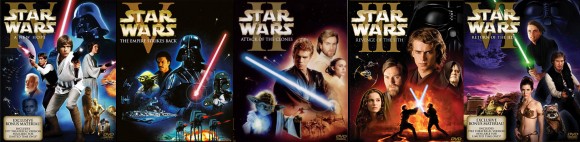
what say you all? we just finished IV for the first time. and one of our friends with a same-aged son believes in this IV-V-II-III-VI order. i'm feeling pretty convinced.
Contents
Brace yourselves, what follows is an amazingly long blog post about the best order in which to watch Star Wars.
First, let me say this: for people that couldn't care less about the prequel trilogy, I suggest Harmy's Despecialized Editions. They are 720p videos that are the result of "Harmy" from The Original Trilogy forums painstakingly reconstructing the theatrical releases of all three films utilizing a wide variety of video sources as well as custom mattes. Downloading, burning, labeling, and printing cases for these films is one of the neckbeardiest things I've done (aside from writing this blog post), and I'm extremely glad I did it. If the "proper order" for Star Wars for you is the original trilogy and nothing else, stop reading now and find the Despecialized Editions.
Harmy, King of the Nerds!
So, with that out of the way, what can you do if you do wish to involve the prequel trilogy? Maybe you don't want to mess around with fan edits or the pirate bay, and you just want to watch the official Blu-rays with your kids. Maybe you've accepted that the original theatrical editions are no longer considered canon, and you're a nerd that cares about things like that. Hell, maybe you actually like the prequels (seriously?).
Whatever your reason, if you are showing someone the official editions of Star Wars for the first time, you have to make a decision about which order to watch the films.
Release Order vs Episode Order
There are two obvious options for watching the Star Wars saga.
Release Order - Watch the films in the order they came out, recreating your experience with the films for someone new to them.
Episode Order - Watch the films in the order George Lucas intends, starting with Episode I and going straight through to Episode VI
There are two critical flaws with both of these orders, unfortunately, that prevent either from being appropriate.
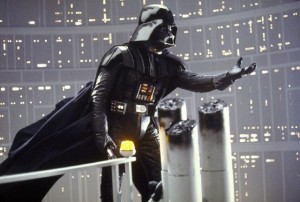
The problem with Episode Order is that it ruins the surprise that Vader is Luke's father. If you think that this reveal doesn't matter since it's common knowledge, I suggest you watch the looks on these kids' faces. This reveal is one of the most shocking in film history, and if a newcomer to the series has managed to avoid having it spoiled for them, watching the films in Episode Order would be like watching the ending of The Sixth Sense first.
The other problem with Episode Order is that the prequels don't really have a story. They're just background for the real story, which is Luke's attempt to destroy the Empire and save his father. Watching 3 films of backstory is boring if you've never seen the films they're the background to. Hell, that's why George Lucas made Star Wars (later renamed A New Hope) first - it was the most interesting story he had in his brain at the time. Starting someone off with Episode I is a surefire way to ensure they don't make it through the entire franchise.
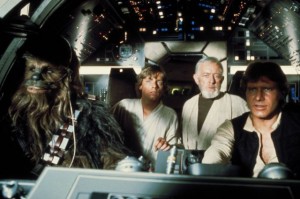
Unfortunately, Release Order is also an instant failure, and the reason is a single shot. If you're watching the official releases and you view the original trilogy first, then after the Empire is destroyed and everyone is celebrating, Luke looks over at his mentors, Ben Kenobi and Yoda, and suddenly they are joined by... some random creepy looking teenager who needs a haircut. Placing Hayden Christensen in the ending of Jedi, since he's not in ANY of the other films, turns an ending that should be celebratory into one that is confusing for the viewer. The fact that Christensen looks like he's undressing someone with his eyes doesn't help.
So neither order really works. What to do?
Introducing: Machete Order
How can you ensure that a viewing keeps the Vader reveal a surprise, while introducing young Anakin before the end of Return of the Jedi?
Simple, watch them in this order: IV, V, II, III, VI. You may notice Episode I is gone. I'll get to that in a second.
I've dubbed this "Machete Order" on the off chance it catches on because I'm a vain asshole. (UPDATE: It did!)
George Lucas seems to believe that Star Wars is the story of Anakin Skywalker, but it's really not - at least, not effectively. Anakin doesn't have an interesting arc - he gives into what is presented as overwhelming temptation. This is relatable, but it's not terribly interesting. Anakin only has an engaging character turn at the end of Jedi when he's redeemed, but that's not as a character, it's as a goal - something for the character we've been invested in for 3 movies (Luke) to accomplish. Anakin is, at this point in the story, a personified proxy for the entire galaxy. Saving Anakin from the Dark Side just puts a human face on saving the Galaxy from the Empire, and it proves Luke right for his unwillingness to give up on his father, even though his attempts to save him risk the entire mission.
Effectively, this order keeps the story Luke's tale. Just when our main man Luke is left with the burning question "did my father really become Darth Vader?" we take an extended flashback to explain that it's true. Once we understand how his father turned to the dark side, we go back to the main storyline and see how Luke is able to rescue him from it and salvage the good in him, which is the only way to destroy the Empire.
Putting the prequels in the middle in general (which a commenter has pointed out is called Ernst Rister order) allows the series to end on the sensible ending point (the destruction of the Empire) while still beginning with Luke's journey. The prequel backstory comes at the perfect time, because The Empire Strikes Back ends on a huge cliffhanger. Han is in carbonite, Vader is Luke's father, and the Empire has hit the rebellion hard. Delaying the resolution of this cliffhanger makes it all the more satisfying when Return of the Jedi is watched.
Narratively, it's just like a movie that starts with a big opening, then fades to "2 years earlier" for most of the movie, until it catches up with the present time and concludes.
Why Skip Episode I?
Look, I'm not going to sit here and bag on how crappy Episode I is. I'm not even going to try and act like Episode II is better or tell you Episode I ruined my childhood or anything like that. It didn't, it's just a movie that isn't very good.
The reason to skip Episode I isn't that it's bad, it's that it's irrelevant. If you accept my suggestion that Star Wars, the saga, is really about Luke's journey and his decision to accept his hero's burden by saving not only the galaxy from the Empire, but his father from the dark side as well, then you'll find that everything that happens in Episode I is a distraction from that story.
Seriously, think about it for a minute. Name as many things as you can that happen in Episode I and actually help flesh out the story in any subsequent episode. I can only think of one thing, which I'll mention later.
Every character established in Episode I is either killed or removed before it ends (Darth Maul, Qui-Gon, Chancellor Valorum), unimportant (Nute Gunray, Watto), or established better in a later episode (Mace Windu, Darth Sidious). Does it ever matter that Palpatine had an apprentice before Count Dooku? Nope, Darth Maul is killed by the end of Episode I and never referenced again. You may as well just start with the assumption that Dooku was the only apprentice. Does it ever matter that Obi-Wan was being trained by Qui-Gon? Nope, Obi-Wan is well into training Anakin at the start of Episode II, Qui-Gon is completely irrelevant.
Search your feelings, you know it to be true! Episode I doesn't matter at all. You can start the prequels with Episode II and miss absolutely nothing. The opening crawl of Episode II establishes everything you need to know about the prequels: a bunch of systems want to leave the Republic, they are led by Count Dooku, and Senator Amidala is a senator who is going to vote on whether the Republic is going to create an army. Natalie Portman is called Senator Amidala twice in the first 4 minutes of the movie, so there's no question of who's who.
Here's some stuff that you no longer have to see as part of your Star Wars viewing experience, thanks to skipping Episode I.
Virtually no Jar-Jar. Jar-Jar has about 5 lines in Episode II, and zero in Episode III.
Buh-bye, Binks!
No midichlorians. There is only one reference to midichlorians after Episode I, and in the context it appears to mean something as benign as "DNA."
No Jake Lloyd. Sorry Jake, your acting is terrible and I never really wanted to see Darth Vader as a little boy.
No confusing Padme/Queen switcheroo. The whole subplot with Padme and her decoy makes absolutely no sense. It's clear that this was just so people could interact with Padme without knowing she was the Queen, but it's incredibly convoluted and pointless.
Less confusing master/apprentice relationships. Darth Sidious is training Count Dooku, Obi-Wan is training Anakin. No other trainer/trainee relationships exist to confuse the backstory. Fewer characters to learn about, so the story is more focused.
Nothing about trade disputes. The "problem" as of Episode II is that a group of systems want to leave the Republic. This is much easier to understand for a kid than trade disputes.
No pod racing. Seriously, who gives a shit? An action sequence for the sake of an action sequence and it goes on forever. A huge number of plot holes surrounding gambling and the subsequent freeing of Anakin are removed as well.
No virgin birth. We simply don't know or care who Anakin's father is, and the botched implication that Palpatine knows is gone.
But like I said, booting Episode I isn't merely about pretending a crappy movie doesn't exist. Viewing Episode II immediately after V and Episode III immediately before VI actually tells the story better than including Episode I does. In fact, I think it tells Luke's story better than leaving the prequels out entirely.
Why Does This Work Better?
As I mentioned, this creates a lot of tension after the cliffhanger ending of Episode V. It also uses the original trilogy as a framing device for the prequel trilogy. Vader drops this huge bomb that he's Luke's father, then we spend two movies proving he's telling the truth, then we see how it gets resolved. When Empire first came out, lots of people thought Vader was lying to Luke. It wasn't "proven" true until Obi-Wan confirms it in Jedi, but then it's immediately followed by Obi-Wan's "a certain point of view" justification. Inserting the prequels turns this reveal into a "show, don't tell" situation - we don't just hear Obi-Wan say it, we see it.
With Machete Order, the Star Wars watching experience gets to start with the film that does the best job of establishing the Star Wars universe, Episode IV, and it ends with the most satisfying ending, Episode VI. It also starts the series off with the two strongest films, and allows you to never have to either start or end your viewing experience with a shitty movie. Two films of Luke's story, two films of Anakin's story, then a single film that intertwines and ends both stories.
Beyond this, Episode I establishes Anakin as a innocent little kid. But Episode II quickly establishes him as impulsive and power-hungry, which keeps his character consistent with eventually becoming Darth Vader. Obi-Wan never really seems to have any control over Anakin, struggling between treating him as a friend (their very first conversation together in Episode II) and treating him as an apprentice (their second conversation, with Padme). Anakin is never a carefree child yelling "yippee", he's a complex teenager nearly boiling over with rage in almost every scene. It makes much more sense for Anakin to have always been this way.
In the opening of Episode II, Padme refers to Anakin as "that little boy I knew on Tatooine." The two of them look approximately the same age in Episode II, so the viewer can naturally conclude that the two of them were friends as children. This completely hides the totally weird age gap between them from Episode I, and lends a lot of believability to the subsequent romance. Scenes in which they fall for each other seem to build on a childhood friendship that we never see but can assume is there. Since their relationship is the eventual reason for Anakin's fall to the dark side, having it be somewhat believable makes a big difference.
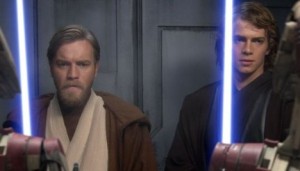
Obi-Wan now always has a beard for the entire duration of the series, and Anakin Skywalker always wears black. Since these two characters are played by different actors (and are the only characters in the series with such a distinction), having them look visually consistent does a great deal toward reinforcing they are the same people.
Update: Den of Geek has also written up an article highlighting some more things that work better in Machete Order that I didn't mention. I particularly like the extra dimension it gives Yoda.
What a Twist!
This order also preserves all twists, and adds a new one (or rather, makes one more effective).
As mentioned, this order preserves the surprise that Darth Vader is Luke's father. For what it's worth, it also preserves the surprise that "Yoda, the Jedi Master who trained [Obi-Wan]" is the tiny green guy on Degobah. Both of these were surprises for moviegoers at the time and, though it's somewhat unlikely that culture and cereal boxes and whatnot won't ruin these surprises for someone, at the very least they aren't ruined by Machete Order.
George Lucas knew that watching the films in Episode Order would remove the Vader and Yoda surprises, so he added the Palpatine twist to compensate - that the friendly Senator Palpatine is actually a Sith Lord and creates the Empire. Since we don't really meet the Emperor until Episode VI (you only see him for one scene, in hologram, in V), this order preserves the prequel's twist. This twist is actually ruined by Episode I, which establishes that Darth Sidious is manipulating the Trade Federation in the opening scene of the film, but he's on screen so much that it's pretty obvious Sidious is Palpatine when we see Palpatine later on.
If you skip Episode I and go straight to II, all we ever see is that Count Dooku is leading a separatist movement, all on his own. Dooku tells Obi-Wan that the Senate is under the control of a Sith lord named "Darth Sidious", who we haven't seen at all yet. At the end of the movie, after Dooku flees from Geonosis, he meets with his "master", who turns out to be Darth Sidious. This is the first time we realize that the separatist movement is actually being controlled by Sidious, and it's so brief that it doesn't give the audience as much of a chance to realize he's Palpatine (remember, nobody has ever referred to "Emperor Palpatine" by this point in the series, he's only called The Emperor in Episode V).
Below is the entirety of Sidious's screen time in Episode II. With Machete Order, this is the only chance you have to realize that Chancellor Palpatine is behind everything until he tries to recruit Anakin to the Dark Side in Episode III. Personally I think it's still a bit of a giveaway given Ian McDiarmid's creepy acting as Palpatine (plus the cleft chin), but at least kids have a chance at not realizing it too early this way.
Machete Order also keeps the fact that Luke and Leia are siblings a surprise, it simply moves the surprise to Episode III instead of VI, when Padme announces her daughter's name. This is actually a more effective twist in this context than when Obi-Wan just tells Luke in Return of the Jedi. We get to find out before Luke, and we discover Padme's carrying twins alongside Obi-Wan when the Gynobot tells him (a surprise at this point). Luke's name is first, so when Padme names the other kid "Leia" it's a pretty shocking reveal. With Release Order, this "twist" happens when Yoda tells Luke there's another Skywalker in Return of the Jedi, and Luke guesses it's Leia with Obi-Wan's ghost one scene later. With Episode Order, it's not a surprise at all, as we have no idea who Luke and Leia are yet. As an added bonus, there are now about 5 hours of film between the discovery that they are siblings and the time they kissed.
What Works Best?
The real value of Machete Order becomes clear when you watch Return of the Jedi.
Remember, we see in Episode V that Luke's vision in the cave on Degobah is that he turns into Darth Vader, then we find out Vader is his father. Then we watch Episodes II and III, in which his father turns to the dark side in order to protect his loved ones. After that we go back to VI, where eventually Luke confronts the Emperor.
With Machete Order, we never saw Anakin as a little kid, he's about the same age the first time we see him as Luke was in Episode IV. Hayden Christensen's incessant whining in Episode II is actually less annoying now, because it's helping to link the character to Luke, who was just as whiny in Episode IV. In other words, because we skipped Episode I, the parallels between Luke and Anakin are much stronger. We've seen Obi-Wan train just the two of them, and never had to see anyone training Obi-Wan himself. The viewer is naturally linking the paths of these two characters together at this point, moreso than if he or she watched Episode I.
The first time we see Luke in Return of the Jedi, he is entering Jabba's palace and the musical cue sounds a bit like the Imperial March. The way he enters with the light behind him makes it unclear if he is Luke or Vader for a bit, and when we finally see him, he's wearing all black. Then, he force chokes Jabba's guards, something only Vader has done in the series! Nobody else sees him do this.
When he confronts Jabba, he warns him that he's taking his friends back. He says Jabba can either profit from this, "or be destroyed." We just heard Anakin make a similar threat to Obi-Wan, "don't make me destroy you." Furthermore, he tells Jabba "not to underestimate my power." The last time this phrase was used, it was in the same duel with Obi-Wan. When watching Jedi on its own, Luke just seems a tad arrogant during these scenes. When watching Jedi immediately after watching Revenge of the Sith, the message is clear: Luke Skywalker is on the path to the Dark Side.
Why does this matter? Because at the end of Jedi, Luke confronts the Emperor. The Emperor explains that the assault on the new Death Star is a trap and that his friends are going to die, and he keeps taunting Luke, telling him to grab his lightsaber and fight him. The film is trying to create a tension that Luke might embrace the Dark Side, but it was never really believable. However, within the context of him following in his father's footsteps and his father using the power of the dark side to save people, with Luke's friends being killed just outside the Death Star window, this is much more believable.
Shortly after, Luke goes apeshit and beats the hell out of Vader, clearly succumbing to his anger. He overpowers Vader with rage and cuts his arm off, just like Anakin did to Windu in Episode III. Having the very real threat of Luke following in his father's path made clear by watching II and III just before VI heightens the tension of this scene, and it actually makes Return of the Jedi better. Yes, watching Revenge of the Sith just before Return of the Jedi makes it a better, more effective film. Considering it's the weakest of the original trilogy films, this improvement is welcome.
What Doesn't Work Better?
Machete Order isn't perfect. There are a few tiny issues that arise watching the films in this order.
The Kamino sequence is a little confusing. Since the cloners seem to have been "expecting" Kenobi, it leads the viewer to wonder if Episode I showed him creating the clone army or something. Hilariously, Episode I doesn't actually explain anything or make this scene less misleading, but the fact that the viewer knows a movie got skipped amplifies the confusion.
Qui-Gon is mentioned once in Episode II and once in Episode III. Luckily, both times he is mentioned, his relationship to the characters is restated, so it works. Dooku explains that Obi-Wan's "old master, Qui-Gon" was once Dooku's apprentice, and then in Episode III Yoda tells Obi-Wan that Qui-Gon has learned to communicate after death. It's alright, just a little weird.
Episodes II and III both talk about Anakin being part of a prophecy which is never really explained (because it was explained in Episode I). This is unfortunate, but on the plus side the last time it's mentioned in Episode III, Yoda says it may have been misinterpreted. Frankly I consider the removal of most of the "prophecy" stuff one of Machete Order's strengths, but there's no denying it's brought up quite a bit in Episode III.
The weakest part of this order is when Anakin returns to Tatooine. We don't know his mother is a slave, and we don't know he built C-3P0. When he has visions of his mother dying and returns, Watto says he sold her. That's not something you expect to hear about a Jedi's mother, so it's a bit jarring. When Anakin goes to the Lars moisture farm, Threepio calls him "the maker" and they act like they know each other, but it's not stated outright that Anakin created Threepio. This definitely draws attention to the fact that one of the films was skipped. This is the one, singular thing made genuinely more confusing by skipping Episode I.
Give It A Shot First
I've tried this order myself, and lots of other folks who happened upon this blog post have tried as well, and for the most part people seem to really enjoy it. Next time you break out the Blu-rays, give it a shot.
You might be wondering if it's worth skipping II and only watching III, just to establish young Anakin in time for Jedi. I don't recommend this, every character you need to know for Episode III who was introduced in Episode I is reintroduced in Episode II with a quick line of dialogue, but Episode III just assumes you know who everyone is. Ham-handed as it is, Anakin's love for Padme is the ultimate reason for his fall to the dark side, and Episode II has most of that. Additionally, without seeing the Clone Army being created in Episode II, seeing the Jedi fight alongside them in III would be extremely confusing, since they look almost exactly like Stormtroopers in III. Narratively, I don't think skipping II works.
Some people claim that Episode I isn't that bad, and shouldn't be removed (again, it's not that it's bad, it's that it's not relevant to Luke's journey in the way that Episode II and III are). Lots of people like the pod race or Darth Maul or Qui-Gon or they were born in 1992. Whatever your reason, if you want to watch Episode I I'd recommend doing so separately, sort of like an "Anthology" film. After all, Machete Order doesn't interfere with canon, everything is canonically compatible with Episode I (or any later ones) because we're not watching fan edits.
Many people also object that you don't understand why Anakin falls to the dark side, since the reason is basically that Obi-Wan wasn't ready to train him, and only did so because Qui-Gon insisted as his dying wish. With Machete Order, there's no Qui-Gon, so this leaves a gap. But the thing is, do we really need to know why Anakin succumbs to the Dark Side? Isn't it enough that it's tempting, and that he thinks he can use it to save his wife? That's what makes it relatable - that it's "more seductive." Besides, you could go "why?" forever back in time, but nobody is demanding everyone read the "Star Wars: Jedi Apprentice" series about Qui-Gon training Obi-Wan so you understand what happens before Episode I.
Shortly after first writing this post, I discovered my college-aged brother-in-law's girlfriend had never seen any Star Wars films and wanted to watch them all over winter break. Armed with the new Blu-rays, we all went about watching them, and I showed them in Machete Order. It honestly works even better than I originally anticipated - it's almost as if this is somehow the intented order. There's a great pattern here, taking the viewer on a series of emotional ups and downs. IV ends with a victory that seems to have some sinister undertones, then V is dark and unresolved with a cliffhanger, II ends with victory with sinister undertones, then III is dark and unresolved with a cliffhanger again. It works incredibly well, and when III ended everyone demanded we immediately watch VI to see how everything gets tied up.
Perhaps most importantly, the flaws with Machete Order seem to not be problematic at all. When Anakin returned to Tatooine in II, the conversation with Watto immediately indicated to her that Anakin's mother was a slave. She asked why Anakin never went back to free her after becoming a Jedi, but Episode I doesn't really provide an answer to that.
The thing she had the most trouble with was when Leia and Luke are talking in ROTJ, and she talks about how she remembers her mother, her "real mother" (so Leia clearly knows she's adopted). With a few movies between III and VI, one might forget about this line, but watching VI right after III made her stop and ask "wait, what? How does she remember her mother?" There's no way around this point of confusion, watching Episode I or watching them in another order doesn't really help.
I asked her if she found Jar-Jar annoying and she asked "who's Jar Jar?" - Mission accomplished.
I've had lots of requests to update this post with various answers to questions, or weigh in on Episode VII. To avoid this post being longer, I've decided to create a second post with all of those updates, so check it out.
The Trump administration is aiming a half-billion-dollar cut at the main U.S. hub for renewable energy research — 25 percent of the agency’s budget, and that’s just for the final five months of this federal fiscal year.
Even deeper cuts are expected to be sought for 2018 — a possibility that has alarmed researchers in clean energy and even some Republicans in Congress.
The Office of Energy Efficiency and Renewable Energy, or EERE, is a $2 billion branch of the Department of Energy. It is credited with helping to drive the rapid expansion of rooftop solar panels, electric vehicle batteries, LED lighting and more.
The proposed $516 million cut for the remainder of fiscal year 2017 was reported earlier this week by E&E News.
The cuts have yet to be approved by Congress, but they remain a clear signal of administration priorities.
The Trump “skinny” budget proposal for the 2018 fiscal year released earlier this month suggested that intended cuts to EERE could run in the order of $1 billion, according to estimates by some office staffers and knowledgeable observers.
Several staffers said cuts of that magnitude would damage U.S. research and technological competitiveness. They suggested much of the brunt of the cuts could fall on the National Renewable Energy Laboratory in Golden, the country’s leading clean energy research facility.
“These are individuals we have in labs throughout the country, and when our funding gets cut, those are postdocs and graduate students and researchers that are gone,” said one EERE employee, who, like another in this article, spoke on the condition of anonymity because they were not cleared to speak on the record and feared possible retribution for doing so. “They’re doing the research. And they won’t have jobs. And we won’t be competitive.”
Virtually all of the lab’s federal funding comes from the Department of Energy’s Office of Energy Efficiency and Renewable Energy — $273 million out of its total federal budget of $292 million in 2016.
“I think overall I would argue that the whole scientific community is a little bit concerned what the direction and what the focus is of this budget and how much it impacts science as a whole,” said Martin Keller, the NREL director.
An official at the White House Office of Management and Budget, who was not authorized to speak for attribution, responded to a query about EERE’s intended fate in 2018 by stating that “the fuller budget in mid-May will contain greater detail.”
“The budget blueprint represents the administration’s top level proposed funding levels. The final proposed FY 2018 budget numbers will become available in May. The budget will then be sent to Congress for review and debate, at which time we will be able to provide more details,” added a DOE spokesperson, who was also not authorized to speak for attribution.
Already, Colorado’s leaders in Congress are pledging to defend their state’s clean energy laboratory.
“There’s no question that we cannot continue on the same trajectory and must identify spending priorities to more efficiently and effectively operate the federal government; however, cutting the research and development done at NREL, where for every $1 of taxpayer money invested through the lab results in $5 of private investment, is not the answer,” Colorado’s Republican U.S. Sen. Cory Gardner said in a statement to The Washington Post. “Congress ultimately controls the power of the purse and I remain committed to putting Colorado interests first.”
The turnabout at EERE is dramatic. During the Obama administration, EERE held a major role in the administration’s clean energy agenda. Obama’s final budget request would have pushed its funding up to nearly $2.9 billion.
From research on new forms of hydropower to wind energy, the office conducts and funds science designed to save energy or promote lower carbon energy. It regularly promulgates new product-specific energy efficiency standards that save consumers money.
EERE played a significant role in driving down the price of solar panels during the Obama administration. NREL research, funded under the stimulus program and other measures, helped contribute to a 74 percent cost decline for utility-scale solar from 2010 to 2016.
“While it is difficult to say quantitatively how much of the cost reduction in photovoltaics modules have come from these programs in particular, all evidence suggests they have been critical,” said Jessika Trancik, an MIT researcher who studies clean energy policies and systems, referring to EERE and NREL.
In the 1990s, the NREL helped pioneer the cadmium telluride solar technology that was eventually commercialized by First Solar, now a $3 billion company.
President Trump’s energy policy is focused on domestic fossil fuels with no mention of wind, solar, or renewables.
His proposed budget would cut previously uncontroversial energy efficiency programs, like the EPA’s Energy Star and the Weatherization Assistance Program (which EERE operates), and discard entirely innovative clean energy research programs like the Advanced Research Projects Agency-Energy, or ARPA-E, also part of the Energy Department.
Like ARPA-E, EERE has been targeted by the conservative Heritage Foundation, which inspired Trump’s budget plan, and which charges that rather than basic research funding, the program supports “outright commercialization.”
The Trump 2018 budget similarly argues that offices like EERE need to be “focuse[d]” on “limited, early-stage applied energy research and development activities where the Federal role is stronger.”
But there is strong disagreement with Heritage’s philosophy about government-funded research. “Early stage applied research is a classic fall back of Republican administrations. It is important work but misses the point of what it takes to get a good idea from lab to market,” said David Friedman, who was the acting assistant director of EERE under Obama.
Friedman explained that EERE does far more than basic research on, say, harnessing solar energy with ever greater efficiency. It funds demonstrations of technologies and even ways of overcoming market barriers to their introduction.
Venkatesh Narayanamurti, a Harvard Kennedy School professor of science and technology policy, also critiques what he calls “this fallacious argument that government should not be in technology.” He argues it is often too risky for private sector energy companies to invest in basic research, and in many cases also in the long process toward commercialization – dubbed a “valley of death.”
“Science and technology feed off of each other,” Narayanamurti said. “You cannot divide them.”
One major solar company, SunPower, told The Post that it had snapped up start-ups supported by the Energy Department and EERE, including SolarBridge Technologies, which received $3.3 million in grants from the EERE SunShot Initiative.
“Energy Department programs have helped to spur innovation and technology R&D, acting as a catalyst to the growth of many U.S. companies,” said SunPower chief executive Tom Werner.
The proposed cuts to the research hub are part of a broader rollback of Obama’s climate actions by the Trump administration.
Before the inauguration, a Trump transition questionnaire circulated to the Energy Department asked for the names of employees involved in meetings related to climate change – raising fears about politicization of the agency. Other questions included, “Which programs within DOE are essential to meeting the goals of President Obama’s Climate Action Plan?”
“If you think climate change is not important, then the importance of what we do goes way way down,” one EERE staffer said.
The American Association for the Advancement of Science has estimated that EERE and several other applied energy research agencies would stand to be cut by more than 45 percent in the 2018 budget.
The W Line‘s first large-scale for-sale housing development is set to rise starting this summer near Sheridan Station in Lakewood.
West Line Village at West 10th Avenue and Depew Street will feature 134 row-homes in its initial phases, a huge infusion of new housing stock in Lakewood’s oldest neighborhood, Two Creeks, just west of Sheridan Boulevard.
Prices in the transit-oriented development will start in the high $200,000s and go up to the mid-$400,000s, developers DIRC Homes, Trailbreak Partners and T.O.D. Properties said. The average unit price will be in the mid-$300,000s,, with about 20 of the 134 row-homes listed below $300,000.
“We really wanted to create a large-scale community here of attainable housing,” said Paul Malone, president of DIRC Homes.
Construction is scheduled to get underway in June on the 5-acre site, which sits between West 10th and West 11th avenues south of the Sheridan light-rail platform. The project’s marketing website was scheduled to launch Friday, and the first units should be completed by the end of 2017.
Floor plans will range in size from 800 to 1,750 square feet, with every row-home street facing and almost all with their own small yard. Studio and one-, two- and three-bedroom layouts will be available.
“An early goal for us was trying to meet the demand in the marketplace for housing that folks can afford to buy and that is well located and provides accessibility into town and out of town,” said Doug Elenowitz, principal of Trailbreak Partners. “This is all market-rate housing. There is no deed restrictions or affordability component.”
In addition to easy access to the W Line, the site is also near the Dry Gulch/Lakewood Gulch trails, which connect into the regional South Platte River Trail system.
“The Two Creeks neighborhood is one of the oldest neighborhoods in Lakewood. It’s a terrific community but it’s hidden behind what’s happened on Colfax over the decades,” Elenowitz said. “We like it because it lives more urban than what most of Lakewood is, being further out and suburban in nature.”
And while Lakewood has seen new apartments pop up along the W Line in recent years, West Line Village is the city’s first major for-sale residential project to take advantage of the public light-rail investment, said Robert Smith, Lakewood’s economic development manager.
Denver and Golden, the other two cities that the W Line crosses, haven’t seen any large for-sale residential transit-oriented development projects since the rail line opened in 2013, either, officials said.
In Golden, new TOD so far has been limited to rental units. In Denver, there have been some for-sale builds near the Perry and Knox stations, but they’ve all been pretty small in scale — a couple of houses scraped to make way for six row-homes, for instance — a city spokeswoman said.
“It’s a really tremendous location, and the light rail made it a much more desirable location,” said Smith, the Lakewood official. “You’ve got the Colfax connection, the U.S. 6 connection and the world-class light rail right between there. We’re excited that Trailbreak is coming out of the ground.”
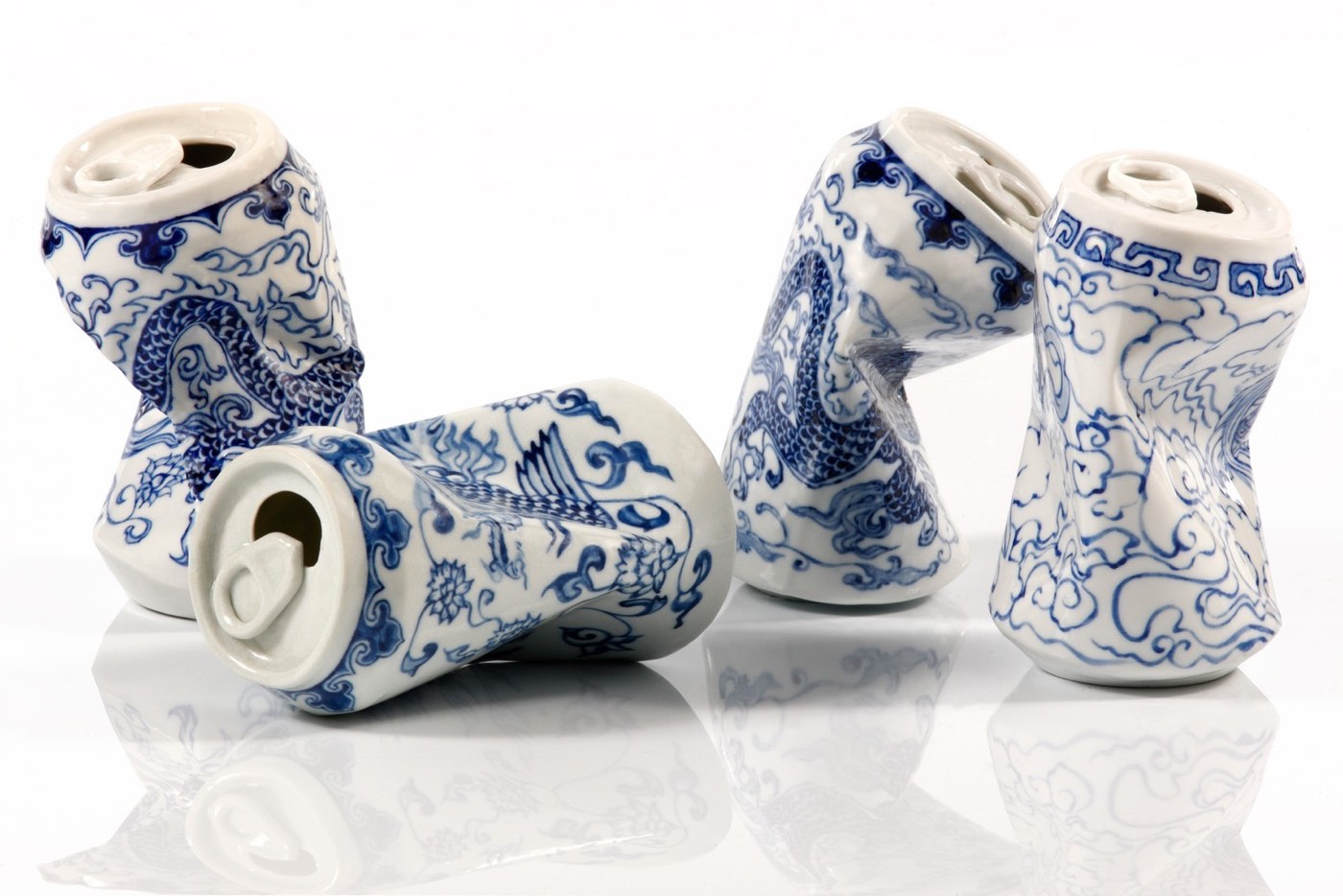
The pieces are part of an ongoing series titled Drinking Tea, and unlike the mechanical process of producing cans, each object is sculpted and painted by hand.
Expect howls of resistance — perhaps even a snarl or two — as backers of a popular Evergreen dog park plan a weekend protest of the imminent closure of Elk Meadow Park by Jefferson County officials.
The battle over the future of the 107-acre park has gone on for weeks, with the county expressing concerns about the vast amount of dog waste left behind at the site and the effect that is having on water quality. The county also wants to retard erosion at the park by keeping people and their pets out so that the land can heal itself.
A citizen group, Friends of Evergreen Dog Park, plans to hold the #BARKBACK rally at 2 p.m. Saturday at Bergen park-n-Ride lot, Hwy 74 & County Road 65, as part of a loud and visible effort to save the park from closure. They say they have proposed a “novel” and “visionary” plan to maintain the park so that it’s a healthy and sustainable amenity.
Growing up in Santa Clara, Calif., as the son of Indian immigrants, Gokul Natesan always sensed he was a bit of a basketball outlier.
“I did feel a little different. When you’re playing basketball on a travel team, people don’t really expect anything because they haven’t really seen an Indian basketball player,” said Natesan, a standout senior guard for Colorado School of Mines. “So it’d definitely catch people by surprise, and there were definitely challenges coming up and establishing myself as a player when there’s not really any notable Indian-American players. But I grew to embrace it.”
Natesan dreamed of playing Division I basketball, but his lone scholarship offer coming out of Cupertino High School in the South San Francisco Bay area was from Mines. Now, four years later, the 6-foot-5 third-team All-American has led the No. 11-ranked Orediggers into their first NCAA Division II Elite Eight appearance. Mines plays Wednesday at 1:30 p.m. in Sioux Falls, S.D., against No. 2-ranked Bellarmine, from Louisville, Ky.
The Orediggers, much like their leader, appear to be outliers.
The school renowned for its engineering program can recruit only players who are elite in the classroom — to the tune of a minimum 27 ACT score — but the high academic hurdles haven’t prevented Mines (30-4) from setting a program record for victories in the midst of its seventh NCAA Tournament appearance in the past eight years.
Natesan leads a patchwork roster of engineering whizzes from all across the county, and two from overseas, on a team that can go 10 deep. The Orediggers have an old-school approach to basketball, placing heavy emphasis on passing and quality shot selection. Mines is fourth among Division II schools in assists, averaging 17.4 per game, and is making 52.6 percent of its field goals.
“If you look at our numbers, we’re playing great team basketball. We’re shooting it at a high percentage and we’re rebounding well,” said coach Pryor Orser, in his 16th season at Mines. “This team is playing as well as any team I’ve ever coached, and that’s all enabled by Gokul Natesan playing the best basketball of his life.”
Natesan, who has scored 2,000 career points, will again take center stage Wednesday in a moment far removed from his early days playing basketball in northern California. It used to be the opposition would look at Natesan and wonder whether the wiry Indian kid had game.
Now he’s usually the center of the opponent’s game plan.
“It couldn’t have played out any better to come into the Elite Eight in my final year, and looking back on how much I’ve developed as a player is really rewarding,” Natesan said. “Those days of people questioning me in club ball are long in the past, and looking back on my freshman year, it seems like light years away, too, because I can see my growth into a more complete player.”
Natesan leads Mines in scoring (18.6) and averaged nine assists in three victories in the South Central Tournament en route to the program’s first regional title. Natesan is also the program’s career steals leader, and his defense catalyzes a balanced team that features the likes of junior guard Luke Schroepfer (who leads Division II with a .500 shooting percentage on 3-pointers) and senior power forward Caleb Waitsman (a first team all-RMAC selection).
Orser is confident the Orediggers’ dream ride isn’t about to end quite yet.
“Bellarmine’s a team that’s similar to us. They pass the ball well, and you can tell from the film that they have gym-rat guys who put in the time,” Orser said. “But we like how we match up. We’ll have to pound the ball inside, and Natesan has to help us control the tempo as well.”
Mines starting lineup
Player, Pos., Ht., Class, Hometown, Key stats
Gokul Natesau, G/F, 6-5 Sr. Santa Clara, Calif., 18.6 PPG, 4.1 APG
Ben Sonnefeld, G, 6-3 Soph., Katy, Texas, 3.5 APG
Luke Schroepfer, G, 6-2 Jr., Washington, Mo., 14.5 PPG
these folks kind of creep me out. i see flatirons stickers on cars constantly.
In an impassioned weekend message to his sizable congregation, Senior Pastor Jim Burgen of Lafayette’s Flatirons Community Church announced plans for two new campuses serving north Longmont-Loveland and the Highlands Ranch-Parker areas.
In a message running more than 53 minutes and titled ” Strategic Maneuvers,” Burgen expressed an urgency to that mission. “We’ve gone and we’ve done a bunch of research. We need to start two campuses, like right away,” said Burgen, sporting a T-shirt featuring the words “me too.”
Urging those who know of a vacant church property, or perhaps a school gymnasium that could be utilized for a kids’ ministry in either of those areas, Burgen urged his congregation members to let church officials know, giving them the name of Executive Pastor Paul Brunner.
In an interview Tuesday, Burgen affirmed the plans he unveiled in his weekly message. “All three of our facilities are pretty much at capacity,” Burgen said. “We have a critical mass of people making long drives from those parts of the city, and it makes it really difficult to get more involved in the life of the church and the life of the community, because of distance.”
In addition to its flagship campus on South Boulder Road in Lafayette, Flatirons also has facilities in Genesee and its most recent addition, a vacant Denver church purchased at 2700 S. Downing St., for about $1.2 million, after Flatirons’ lease at Denver’s Paramount Theater ran out.
Virginia Tech ranked No. 74 out of 75 major-conference teams for shot volume, and the Hokies’ offense was above-average anyway. What is this voodoo that you do, Buzz Williams?
Basketball’s a contest to see who can put the ball in the basket the most times, and for whatever reason fans, media, and, especially, coaches (at least when they speak for public consumption) have always chosen to focus on whether a particular attempt is a make or a miss. We go into exceptional and occasionally tedious detail on the importance of creating one’s own shot, the finer points of pick-and-roll kabuki (particularly on D), proper defensive stance and hand position and such.
All of which is self-evidently important, but all of which also assumes implicitly that the number of times you get to attempt a shot is more or less constant across teams and games. That assumption doesn’t hold up.
In addition to in-play success or failure, the volume of plays is the other 50 percent of the matter that’s getting perhaps five or 10 percent of the words and attention. To redress this imbalance, I’ve been using a shot volume index this season to try to measure which teams generate the most shots. I’ve listed the final results on that metric for 75 major-conference teams below.
North Carolina again leads the way, and I dare say what you see is what you get with the Tar Heels. When you watch a UNC game, you’re probably thinking “Gee, they’re good at offensive rebounding, and that must really help their offense.” True enough. I would only add that the Heels’ very good turnover rate super-charges said offensive rebounding. Baylor, to draw a counter-example, is also outstanding at crashing the offensive glass, but the Bears don’t give themselves nearly as many chances to do so.
One instance where our eyes might be leading us slightly astray is UCLA. When a team shoots historically well, that’s what we’ll be struck by, forcefully, in real time. We can’t help it. That’s fine, but we should also know that the Bruins improved significantly in the back half of the Pac-12 season both in terms of taking care of the ball and as far as offensive rebounding. Steve Alford’s team is now both accurate and high-volume. That’s a really, really exclusive club for offense, one that has Wisconsin in 2015 and not too many teams past or present as members.
Now the truth in advertising. Shot volume is not the end all and be all, and most particularly the existence of Northwestern and Virginia Tech in the same season did the SVI’s credibility no favors.
The Wildcats were shot-volume heroes, but their offense produced points at a level that was slightly below the league average in Big Ten play. Tying with Nebraska for the title of “worst non-Rutgers shooting from the field in B1G play” had a lot to do with that.
Meanwhile the Hokies were drop-dead awful at generating shots, but, particularly late in the season, Buzz Williams’ guys just could not miss. Basically, the ground rules for watching Virginia Tech are fairly straightforward. It really, really matters whether the first shot goes in (and it very often has of late against opponents not named Florida State), because better than four times out of five there will be no second shot.
Here are the final results, with pithy category titles at plus and minus one standard deviation:
Shot volume index (SVI)
Major-conference games only
so apparently conrad is taking a hip hop class taught by this guy. i have no idea how that happened -- it's just an after school thing. the dancing starts about 1/2 way through. crazy.
UNEARTH seeks to discover local talent in San Diego, CA. You cannot unearth what does not already exist, so we are honored with an opportunity to share this piece with you.
A new kind of theater has moved into Jefferson County Fairgrounds: pro wrestling.
“It’s like going to a broadway show. It’s live theater, it’s just high-impact live theater,” said Kayla Lawson, whose boyfriend Ryan Hood is an instructor at the Mercury Pro Wrestling Academy at its new home in the Livestock Arena at the fairgrounds.
The academy and president Matt Yaden’s production company, Rocky Mountain Pro, began leasing the space in October.
Seth McConnell, The Denver Post
Isaac Hull, aka Royce Isaacs, listens on to in ring instruction during a Mercury Pro Wrestling Academy class at the Jefferson County Fairgrounds in Golden, Colorado on January 26, 2017. Mercury Pro Wrestling Academy, a part of Rocky Mountain Pro Wrestling, recently brought its classes for kids, beginners and advanced wrestlings to Jeffco Fairgrounds.
“When I looked at it, I thought this would be perfect for our big shows,” said Yaden, who started the school in January 2013.
The small arena-style space at Jeffco Fairgrounds was formerly home to bull-riding events until they outgrew that space, and then sat mostly unused save for the occasional 4-H event. Now, with a makeover of black and purple paint, theatrical lighting and a wrestling ring, the barn hosts weeknight practices and occasional Friday night performances that draw crowds of up to 500 people.
Pro wrestlers dress in costume, assume characters and learn skilled moves they bring to the ring in dramatic fights with body slams, kicks and punches — without major injury. While moves are rehearsed, they are performed in improvisational storylines.
The academy has around 40 students enrolled in classes for beginners and advanced wrestlers, and even a class for ages 5-13.
“It’s been a great addition to our entertainment offerings over the last few months,” said Scott Gales, director for Jeffco Fairgrounds.
Gales, who has been the fairgrounds’ director since 2013, said the fairgrounds hosts around 1,200 events a year, as well as a year-round campground. Many of the events are for Westernaires, 4-H and the CSU Extension offices that are on site.
Seth McConnell, The Denver Post
Students work in the ring during a Mercury Pro Wrestling Academy class at the Jefferson County Fairgrounds in Golden, Colorado on January 26, 2017. Mercury Pro Wrestling Academy, a part of Rocky Mountain Pro Wrestling, recently brought its classes for kids, beginners and advanced wrestlings to Jeffco Fairgrounds.
Seth McConnell, The Denver Post
Ellis Ebersole, aka Curtis Cole, watches a match during a Mercury Pro Wrestling Academy class at the Jefferson County Fairgrounds in Golden, Colorado on January 26, 2017. Mercury Pro Wrestling Academy, a part of Rocky Mountain Pro Wrestling, recently brought its classes for kids, beginners and advanced wrestlings to Jeffco Fairgrounds.
Seth McConnell, The Denver Post
Zachary Anaya, aka Anaya, and Martin O'Keefe, aka referee Martin Alluisys, talk about the nights matches during a Mercury Pro Wrestling Academy class at the Jefferson County Fairgrounds in Golden, Colorado on January 26, 2017. Mercury Pro Wrestling Academy, a part of Rocky Mountain Pro Wrestling, recently brought its classes for kids, beginners and advanced wrestlings to Jeffco Fairgrounds.
Seth McConnell, The Denver Post
Referee Joel Gestner checks on a stunned Ellis Ebersole, aka Curtis Cole, during his match with Isaac Hull, aka Royce Isaacs, during a Mercury Pro Wrestling Academy class at the Jefferson County Fairgrounds in Golden, Colorado on January 26, 2017. Mercury Pro Wrestling Academy, a part of Rocky Mountain Pro Wrestling, recently brought its classes for kids, beginners and advanced wrestlings to Jeffco Fairgrounds.
Seth McConnell, The Denver Post
Alexandria Ortega, aka Allie Gato, puts a chokehold on Kelli Schymanski, aka Daisy, during a Mercury Pro Wrestling Academy class at the Jefferson County Fairgrounds in Golden, Colorado on January 26, 2017. Mercury Pro Wrestling Academy, a part of Rocky Mountain Pro Wrestling, recently brought its classes for kids, beginners and advanced wrestlings to Jeffco Fairgrounds.
Seth McConnell, The Denver Post
Kevin Solis slowly climbs back onto the ring apron after getting knocked to the floor during a Mercury Pro Wrestling Academy class at the Jefferson County Fairgrounds in Golden, Colorado on January 26, 2017. Mercury Pro Wrestling Academy, a part of Rocky Mountain Pro Wrestling, recently brought its classes for kids, beginners and advanced wrestlings to Jeffco Fairgrounds.
Seth McConnell, The Denver Post
Isaac Hull, aka Royce Isaacs, listens on to in ring instruction during a Mercury Pro Wrestling Academy class at the Jefferson County Fairgrounds in Golden, Colorado on January 26, 2017. Mercury Pro Wrestling Academy, a part of Rocky Mountain Pro Wrestling, recently brought its classes for kids, beginners and advanced wrestlings to Jeffco Fairgrounds.
Seth McConnell, The Denver Post
Isaac Hull, aka Royce Isaacs, holds up three fingers as he yells at the ref for not counting to three fast enough after attempting to pin Ellis Ebersole, aka Curtis Cole, during a Mercury Pro Wrestling Academy class at the Jefferson County Fairgrounds in Golden, Colorado on January 26, 2017. Mercury Pro Wrestling Academy, a part of Rocky Mountain Pro Wrestling, recently brought its classes for kids, beginners and advanced wrestlings to Jeffco Fairgrounds.
Seth McConnell, The Denver Post
Stephen Garan, aka Stephen Ashburn, puts Jason Noel in an arm bar during a Mercury Pro Wrestling Academy class at the Jefferson County Fairgrounds in Golden, Colorado on January 26, 2017. Mercury Pro Wrestling Academy, a part of Rocky Mountain Pro Wrestling, recently brought its classes for kids, beginners and advanced wrestlings to Jeffco Fairgrounds.
Seth McConnell, The Denver Post
Matt Yaden keeps an eye on students form during a Mercury Pro Wrestling Academy kids class at the Jefferson County Fairgrounds in Golden, Colorado on January 26, 2017. Mercury Pro Wrestling Academy, a part of Rocky Mountain Pro Wrestling, recently brought its classes for kids, beginners and advanced wrestlings to Jeffco Fairgrounds.
Seth McConnell, The Denver Post
Austin Shipp whips a classmate into the ropes as they warm up during a Mercury Pro Wrestling Academy class at the Jefferson County Fairgrounds in Golden, Colorado on January 26, 2017. Mercury Pro Wrestling Academy, a part of Rocky Mountain Pro Wrestling, recently brought its classes for kids, beginners and advanced wrestlings to Jeffco Fairgrounds.
Seth McConnell, The Denver Post
Hayden Sheren, 10, tucks as he does a forward roll during a Mercury Pro Wrestling Academy kids class at the Jefferson County Fairgrounds in Golden, Colorado on January 26, 2017. Mercury Pro Wrestling Academy, a part of Rocky Mountain Pro Wrestling, recently brought its classes for kids, beginners and advanced wrestlings to Jeffco Fairgrounds.
Seth McConnell, The Denver Post
Matt Yaden reacts to the action in the ring during a Mercury Pro Wrestling Academy class at the Jefferson County Fairgrounds in Golden, Colorado on January 26, 2017. Mercury Pro Wrestling Academy, a part of Rocky Mountain Pro Wrestling, recently brought its classes for kids, beginners and advanced wrestlings to Jeffco Fairgrounds.
Seth McConnell, The Denver Post
A pair of sneakers sit next to the ring bell during a Mercury Pro Wrestling Academy class at the Jefferson County Fairgrounds in Golden, Colorado on January 26, 2017. Mercury Pro Wrestling Academy, a part of Rocky Mountain Pro Wrestling, recently brought its classes for kids, beginners and advanced wrestlings to Jeffco Fairgrounds.
Seth McConnell, The Denver Post
Jaycene Yaden, left, and Izzy Keilly watch the action in the ring during a Mercury Pro Wrestling Academy kids class at the Jefferson County Fairgrounds in Golden, Colorado on January 26, 2017. Mercury Pro Wrestling Academy, a part of Rocky Mountain Pro Wrestling, recently brought its classes for kids, beginners and advanced wrestlings to Jeffco Fairgrounds.
Seth McConnell, The Denver Post
Matt Yaden puts Bill Gray, aka Hunter Grey, into a choke hold during a Mercury Pro Wrestling Academy class at the Jefferson County Fairgrounds in Golden, Colorado on January 26, 2017. Mercury Pro Wrestling Academy, a part of Rocky Mountain Pro Wrestling, recently brought its classes for kids, beginners and advanced wrestlings to Jeffco Fairgrounds.
Seth McConnell, The Denver Post
Bill Gray, aka Hunter Grey, reacts as he is choked on the ropes by Jason Noel during a Mercury Pro Wrestling Academy class at the Jefferson County Fairgrounds in Golden, Colorado on January 26, 2017. Mercury Pro Wrestling Academy, a part of Rocky Mountain Pro Wrestling, recently brought its classes for kids, beginners and advanced wrestlings to Jeffco Fairgrounds.
Seth McConnell, The Denver Post
Jason Noel grasps the rope during a Mercury Pro Wrestling Academy class at the Jefferson County Fairgrounds in Golden, Colorado on January 26, 2017. Mercury Pro Wrestling Academy, a part of Rocky Mountain Pro Wrestling, recently brought its classes for kids, beginners and advanced wrestlings to Jeffco Fairgrounds.
Jefferson County government offices use the property when they need to host large functions, Gales said, and the rest of the events — about 40-50 percent — are privately held craft shows, gem and mineral shows, circuses, rodeos and more.
Gales said the fairgrounds operate on an annual budget of about $1.3 million and bring in around $530,000 a year.
But his focus is not necessarily on generating revenue; it’s making sure people know what a good public resource the fairgrounds is and to that end, he is always looking to draw in diversity.
“It gets people thinking about, ‘Maybe I could bring my event out there or a different kind of event?’ as that network grows,” he said.
Mercury Pro Wrestling Academy and its production affiliate, Rocky Mountain Pro Wrestling, certainly fits that bill.
“It’s the biggest hodgepodge of different people I’ve ever seen,” Yaden said about his community of wrestling students and performers.
The 20 or so students practicing at the academy on Jan. 25 included Amanda Cole, a former nanny who performs as “Nanny AC,” pursuing her lifelong dream of tapping into her athleticism to turn wrestling into a career.
Seth McConnell, The Denver Post
Jason Noel grasps the rope during a Mercury Pro Wrestling Academy class at the Jefferson County Fairgrounds in Golden, Colorado on January 26, 2017. Mercury Pro Wrestling Academy, a part of Rocky Mountain Pro Wrestling, recently brought its classes for kids, beginners and advanced wrestlings to Jeffco Fairgrounds.
“Obviously, you have to be athletic to do this, but it’s storytelling as well,” Cole said. “It’s not just MMA, where you go out there to kill each other. You actually have to work together and that’s what I love about it — just working together and putting on a show for the audience.”
Cole’s girlfriend Brittney Balestra-Villani was there, too. She said she was skeptical at first, but gave wrestling a shot after sitting on the sidelines at practices. Now, she has set a goal to perform at a show in July.
“It was just a lot more fun than I expected it to be,” Balestra-Villani said.
Damien Richard is living out his love of wrestling.
“It’s not just going in there and doing moves to each other,” he said. “Everything matters and everything has to mesh.”
Lawson, whose boyfriend teaches for the academy, never thought she would be a fan of pro wrestling. But after her first show, she said was hooked.
“It’s a story and it’s a continuing story,” she said. “When you become a fan you stay a fan for a long time.”
Rocky Mountain Pro wrestling performs next at 6 p.m. Feb. 11 in the Livestock Arena at Jeffco Fairgrounds, 15200 W. 6th Ave. They also perform regularly at Rackhouse Pub, 22785 Blake St., Denver. The next show there is at 10 p.m. Feb. 25. Ticket prices range from $10 to $25. For a full list of events and to purchase tickets, go to therockymountainpro.com.
this -- if intentional, and if it goes down like this -- seems like a pretty good strategy for trump. bluster about how great torture is, but don't actually re-start the torture program. all of his supporters will think we're merrily torturing again -- because we're TOUGH -- but nobody will have a real policy objection to make.
By David Nakamura, The Washington Post
WASHINGTON – President Trump said Friday that he continues to believe torture methods can be effective to combat terrorism, but he pledged to defer over whether to implement such tactics to Defense Secretary James Mattis, who has opposed them.
“He will override,” Trump said in a joint news conference with British Prime Minister Theresa May at the White House. “I’m giving him that power.”
During his campaign, Trump had expressed support for enhanced interrogation techniques, in particular simulated drowning known as waterboarding, which was forbidden by the Obama administration. His vow to allow Mattis to set the direction for his administration on the issue came on a day when Trump planned to visit the Pentagon and sign new executive actions related to national security, including the fight against terror groups such as the Islamic State.
“I happen to feel that it does work. I’ve been open about that for a long period of time. But I am going with our leaders. And we’re going to – we’re going to win with or without, but I do disagree,” Trump said about “torture or waterboarding or however you want to define it.”
Trump’s meeting with May was his first with a foreign leader, a summit on trade and security that was being closely watched around the world. It represented a chance for the new American president to demonstrate his administration’s commitment to maintaining close relations with a key U.S. ally while pursuing new trade ties as Britain works to exit the European Union.
May sought to tie Trump more closely to the long-standing U.S.-European security alliance, saying her opening statement that the two leaders were “united in our recognition of NATO as the bulwark of our collective defense.”
Yet there were signs of potential differences. White House aides have said Trump, who is scheduled to speak with Russian President Vladimir Putin on Saturday, is considering lifting U.S. economic sanctions on Russia over its military incursion into Ukraine.
May declared at the news conference that she expects the sanctions imposed jointly by the United States and European countries to remain in place until Moscow abides by the Minsk agreement in 2104 to halt the hostilities.
“It’s very early to be talking about that,” Trump said when asked if he favored lifting the sanctions. “If we can have a great relationship with Russia and with China and with all countries, I’m all for that. That would be a tremendous asset.”
Trump grew defensive about his relationship with Putin, whom he has praised during the campaign as a stronger leader than former president Obama. Trump has said he is willing to work with Putin despite the assessments from U.S. intelligence agencies that Moscow meddled in the presidential elections to help him.
Though the president has acknowledge Russia’s involvement in the hacking of Democratic Party emails, Trump has insisted that he does not believe Putin’s regime wanted him to win.
“I don’t say good, bad or indifferent. I don’t know the gentleman,” Trump said of Putin on Friday. “I hope we have a fantastic relationship. That’s possible and it’s also possible that we won’t. We will see what happens.”
Trump emphasized that in talking with Putin, he would represent the American people “very, very strongly, very forcefully.” Referring to the Islamic State, the president added that “if we have a great relationship with Russia and other countries, and if we go after ISIS together, which has to be stopped — that’s an evil that has to be stopped — I will consider that a good thing, not a bad thing.”
Trump and May vaulted to power last year by speaking to similar strains of populist anxiety over broad global shifts in the economy and immigration that led voters to reject the status quo and take a gamble on forces who promised sweeping change. Trump’s skepticism toward international institutions and multilateral partnerships have raised questions abroad about the future of U.S. leadership on the world stage.
Trump used a prepared opening statement to deliver a forceful defense of “Brexit” – the British vote to leave the European Union. He cast the surprise victory of a populist referendum as a stroke for liberty.
“The United States respects the sovereignty of the British people and their right of self-determination,” Trump said. “A free and independent Britain is a blessing to the world.”
If that wasn’t a clear enough rebuke of the 28-nation European Union and its common market, Trump later praised Brexit as a building block for better trade relationship for Britain, and he noted that his own business dealings with what he called “the consortium” had been arduous and disappointing.
“I think Brexit’s going to be a wonderful thing for your country,” he told May, adding that Britain will be able to “make free trade deals without having somebody watching you.”
And he seemed to agree with political analysts who saw the Brexit vote in June as a harbinger of an anti-establishment, populist wave that carried him to victory five months later.
“Brexit was an example of what was to come,” he said.
Trump has sought to follow through on his promises of change in a whirlwind first week as he signed a flurry of executive actions meant to shake up the United States’s role internationally. He has withdrawn U.S. participation in a 12-nation Pacific Rim trade deal, ordered planning to begin on a border wall with Mexico and floated plans to block refugees and immigrants from Syria and other Muslim-majority countries.
“Now is the dawn of a new era of American independence, a rededication to the idea that the people are in charge of their own destiny,” Trump told Republican lawmakers at a congressional retreat in Philadelphia on Thursday.
His meeting with May, who replaced David Cameron in July, represented Trump’s opening bid to begin pursuing the sort of bilateral negotiations on trade and security that he prefers over the kind of multilateral partnerships that former president Obama favored.
In their first meeting, Trump and May both spoke of the “special relationship” between the United States and the United Kingdom. But when a BBC reporter asked Trump about worries in Britain over Trump’s support of torture, praise of Russia and potential ban on Muslim immigrants, Trump looked at May and joked: “This was your choice of a question?”
Drawing laughs from White House staff and reporters, Trump continued: “There goes that relationship.”
But the question highlighted that Trump’s rapid-fire moves since taking office have prompted a vocal backlash at home and abroad. Mexican President Enrique Peña Nieto on Thursday canceled a visit to the White House scheduled for next week.
Trump aides reacted by suggesting that the United States could pay for the wall, which is projected to cost billions of dollars, through a 20 percent import tax on goods from Mexico, a move that, if carried out, could spark a trade war with the United States’ third-largest trading partner.
On Friday morning, Trump and Peña Nieto spoke by phone for an hour, White House officials said.
Mexico “has out-negotiated us and beat us to a pulp through our past leaders. They’ve made us look foolish,” Trump said during the news conference. “I’m not going to let that happen.”
Anne Gearan, Ashley Parker and Philip Rucker contributed to this report.
“What I think (Bruce Arena) will add is this ability to truly believe in the shirt and I think we lost that a little bit over the last couple of years,” the American goalkeeper told USA Today. “Jurgen Klinsmann had a project to unearth talent around the world that had American roots. But having American roots doesn’t mean you are passionate about playing for that country.”
Some people liked what he had to say, some people did not like what he had to say.
Fellow national team player Jermaine Jones, who happens to know a thing or two about passion, has some thoughts of his own in response to Howard. He told ESPNFC:
"People, especially in this country, they always try to figure out what [are] the mistakes," Jones said, noting the contributions some German-Americans made during the 2014 World Cup in Brazil.
"Now, where everything goes wrong and we lost the first two games, we say maybe the German-Americans are the problem.
"But when we played the World Cup, I scored. [John] Brooks scored, and it's 'oh, the German-Americans are American boys.'
"We played two bad games, yes. That's a fact. All the criticism that comes from outside, that's good. That's soccer. It has to be like that.
"But you have to see the bigger picture, and that's the whole team. There's not an American guy and a German-American. The whole team played bad, so that's the fact. To put it on this guy or this guy, I think it's not correct from nobody."
Howard seems to have started something whether it was intentional or not. He has since tried to clarify his position on dual-national players to include everyone.
Are you worried about two active national team players going back and forth in the media like this? Or is it just a healthy discussion?
edgewater is a ridiculous anachronistic "city" squished in between denver and the western suburbs. it has a population of 5,000 people. but they're going to build a $10 million civic center.
but, they're going to build a library for jeffco in there and i get to negotiate the lease. yay!
Stalf said the city’s six pot shops generate taxes equivalent to those of a big box store. Edgewater, which has a 3.5 percent sales tax rate, has used its marijuana sales tax proceeds to repave all 12 miles of its streets and is planning to dedicate future revenues to building a $10 million state-of-the-art civic center to house its city hall, police headquarters, library and recreation center.
In declaring these scores not substantial enough for Oscar consideration, the Academy draws a line in the sand: they won't reward innovation, only work done within the traditional boundaries of film score composition. That puts the Academy increasingly out of touch with the evolving nature of cinema's creative process.
i just realized the foodyear is about to come to an end, no? will it be renewed?
Bratwurst boiled in water, with sauerkraut. Since I didn’t have the chance over Thanksgiving I made cranberry sauce on the side. You can just boil the cranberries with enough sugar to cover and a little orange juice, and it’s easily the most delicious thing I know how to make in proportion to the effort required.
grayson allen is proof that purely genetically engineered humans exist. he was grown in a laboratory (and named) with the sole purpose of playing basketball for duke.
fuck that guy. he probably voted for trump.
We need your help, basketball internet. Is this a legit foul or a major flop by Duke’s Grayson Allen?
Allen has earned himself a reputation at this point. He drew national attention last year for two separate tripping incidents while also being one of the most productive players in the country. Everyone has an opinion on him.
When this play happened, a lot of people were quick to yell flop. But is it fair? It does look like Allen’s left leg got clipped, but did he consciously stick that leg out?
Sports Authority Field at Mile High will play host to a pair of group stage games in the CONCACAF Gold Cup on July 13, 2017.
Denver will host two Group C matches, including one featuring Mexico. The complete groups and schedule will be announced next year.
“We’re excited to bring the Gold Cup to new markets across the country. These cities have all proved ready and eager to host our region’s marquee soccer championship, and welcome world class international soccer next summer,” CONCACAF general secretary Philippe Moggio said in a news release.
Denver is one of 13 metropolitan areas to host the event. Sports Authority Field at Mile High hosted the Gold Cup in 2013.
oh great, a ginormous TNC piece on obama. that’ll make it easy to do work.
“They’re a rotten crowd,” I shouted across the lawn. “You’re worth the whole damn bunch put together.”
— F. Scott Fitzgerald, The Great Gatsby
I.
“Love Will Make You Do Wrong”
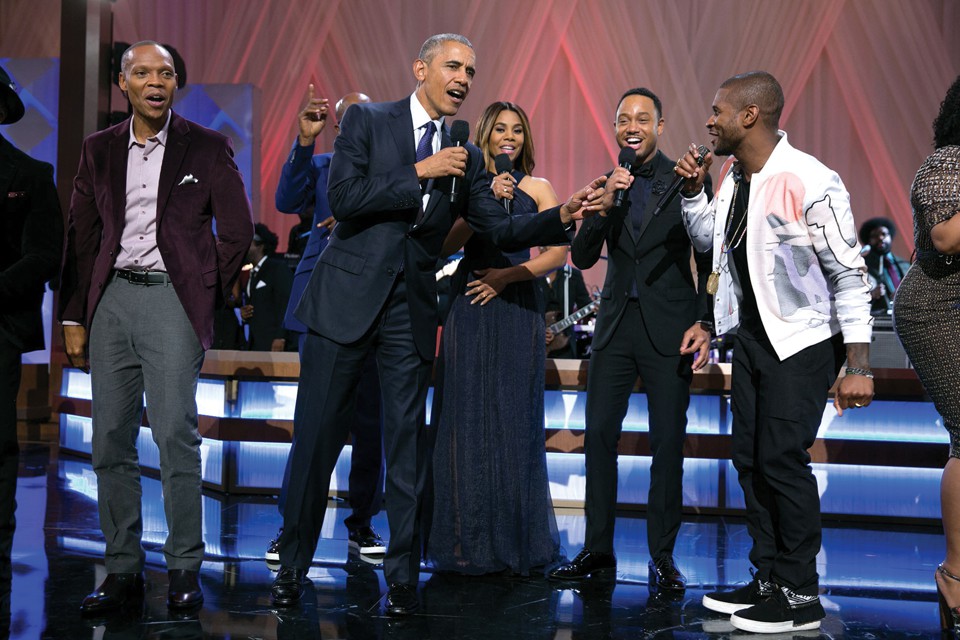
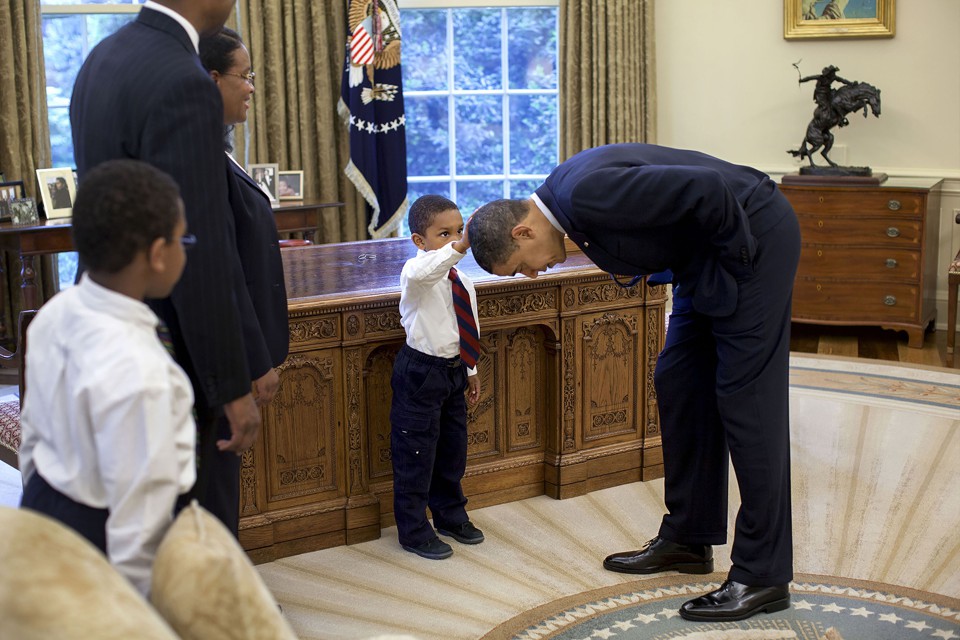
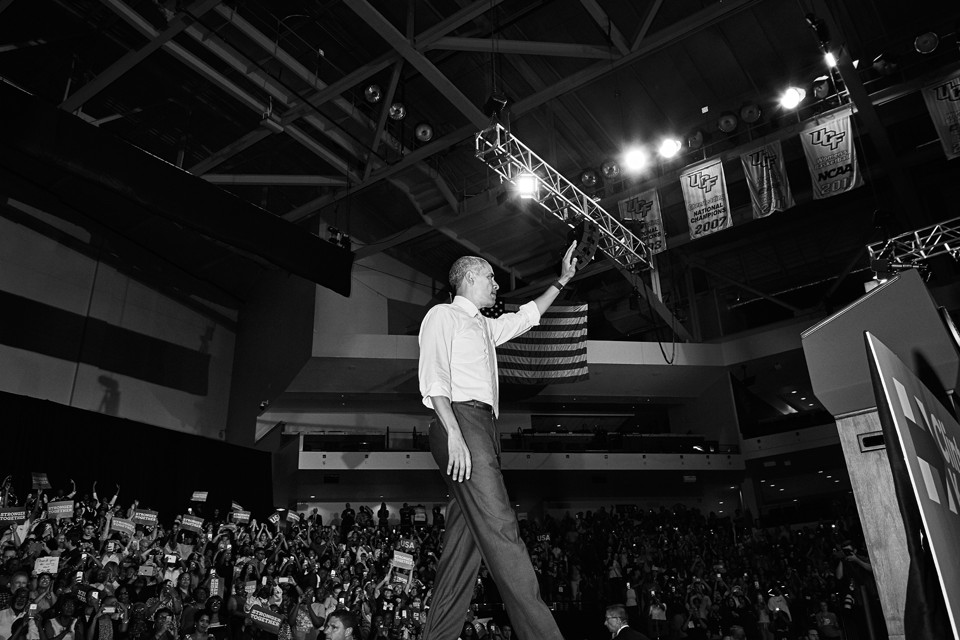
In the waning days of President Barack Obama’s administration, he and his wife, Michelle, hosted a farewell party, the full import of which no one could then grasp. It was late October, Friday the 21st, and the president had spent many of the previous weeks, as he would spend the two subsequent weeks, campaigning for the Democratic presidential nominee, Hillary Clinton. Things were looking up. Polls in the crucial states of Virginia and Pennsylvania showed Clinton with solid advantages. The formidable GOP strongholds of Georgia and Texas were said to be under threat. The moment seemed to buoy Obama. He had been light on his feet in these last few weeks, cracking jokes at the expense of Republican opponents and laughing off hecklers. At a rally in Orlando on October 28, he greeted a student who would be introducing him by dancing toward her and then noting that the song playing over the loudspeakers—the Gap Band’s “Outstanding”—was older than she was. “This is classic!” he said. Then he flashed the smile that had launched America’s first black presidency, and started dancing again. Three months still remained before Inauguration Day, but staffers had already begun to count down the days. They did this with a mix of pride and longing—like college seniors in early May. They had no sense of the world they were graduating into. None of us did.
The farewell party, presented by BET (Black Entertainment Television), was the last in a series of concerts the first couple had hosted at the White House. Guests were asked to arrive at 5:30 p.m. By 6, two long lines stretched behind the Treasury Building, where the Secret Service was checking names. The people in these lines were, in the main, black, and their humor reflected it. The brisker queue was dubbed the “good-hair line” by one guest, and there was laughter at the prospect of the Secret Service subjecting us all to a “brown-paper-bag test.” This did not come to pass, but security was tight. Several guests were told to stand in a makeshift pen and wait to have their backgrounds checked a second time.
Listen to the audio version of this article: Download the Audm app for your iPhone to listen to more titles.
Dave Chappelle was there. He coolly explained the peril and promise of comedy in what was then still only a remotely potential Donald Trump presidency: “I mean, we never had a guy have his own pussygate scandal.” Everyone laughed. A few weeks later, he would be roundly criticized for telling a crowd at the Cutting Room, in New York, that he had voted for Clinton but did not feel good about it. “She’s going to be on a coin someday,” Chappelle said. “And her behavior has not been coinworthy.” But on this crisp October night, everything felt inevitable and grand. There was a slight wind. It had been in the 80s for much of that week. Now, as the sun set, the season remembered its name. Women shivered in their cocktail dresses. Gentlemen chivalrously handed over their suit coats. But when Naomi Campbell strolled past the security pen in a sleeveless number, she seemed as invulnerable as ever.
Cellphones were confiscated to prevent surreptitious recordings from leaking out. (This effort was unsuccessful. The next day, a partygoer would tweet a video of the leader of the free world dancing to Drake’s “Hotline Bling.”) After withstanding the barrage of security, guests were welcomed into the East Wing of the White House, and then ushered back out into the night, where they boarded a succession of orange-and-green trolleys. The singer and actress Janelle Monáe, her famous and fantastic pompadour preceding her, stepped on board and joked with a companion about the historical import of “sitting in the back of the bus.” She took a seat three rows from the front and hummed into the night. The trolley dropped the guests on the South Lawn, in front of a giant tent. The South Lawn’s fountain was lit up with blue lights. The White House proper loomed like a ghost in the distance. I heard the band, inside, beginning to play Al Green’s “Let’s Stay Together.”
“Well, you can tell what type of night this is,” Obama said from the stage, opening the event. “Not the usual ruffles and flourishes!”
The crowd roared.
“This must be a BET event!”
The crowd roared louder still.
Obama placed the concert in the White House’s musical tradition, noting that guests of the Kennedys had once done the twist at the residence—“the twerking of their time,” he said, before adding, “There will be no twerking tonight. At least not by me.”
The Obamas are fervent and eclectic music fans. In the past eight years, they have hosted performances at the White House by everyone from Mavis Staples to Bob Dylan to Tony Bennett to the Blind Boys of Alabama. After the rapper Common was invited to perform in 2011, a small fracas ensued in the right-wing media. He performed anyway—and was invited back again this glorious fall evening and almost stole the show. The crowd sang along to the hook for his hit ballad “The Light.” And when he brought on the gospel singer Yolanda Adams to fill in for John Legend on the Oscar-winning song “Glory,” glee turned to rapture.
De La Soul was there. The hip-hop trio had come of age as boyish B-boys with Gumby-style high-top fades. Now they moved across the stage with a lovely mix of lethargy and grace, like your favorite uncle making his way down the Soul Train line, wary of throwing out a hip. I felt a sense of victory watching them rock the crowd, all while keeping it in the pocket. The victory belonged to hip-hop—an art form birthed in the burning Bronx and now standing full grown, at the White House, unbroken and unedited. Usher led the crowd in a call-and-response: “Say it loud, I’m black and I’m proud.” Jill Scott showed off her operatic chops. Bell Biv DeVoe, contemporaries of De La, made history with their performance by surely becoming the first group to suggest to a presidential audience that one should “never trust a big butt and a smile.”
President Obama onstage at BET’s “Love & Happiness” event in October 2016, the last in a series of concerts the first couple hosted at the White House (Lawrence Jackson / White House)
The ties between the Obama White House and the hip-hop community are genuine. The Obamas are social with Beyoncé and Jay-Z. They hosted Chance the Rapper and Frank Ocean at a state dinner, and last year invited Swizz Beatz, Busta Rhymes, and Ludacris, among others, to discuss criminal-justice reform and other initiatives. Obama once stood in the Rose Garden passing large flash cards to the Hamilton creator and rapper Lin-Manuel Miranda, who then freestyled using each word on the cards. “Drop the beat,” Obama said, inaugurating the session. At 55, Obama is younger than pioneering hip-hop artists like Afrika Bambaataa, DJ Kool Herc, and Kurtis Blow. If Obama’s enormous symbolic power draws primarily from being the country’s first black president, it also draws from his membership in hip-hop’s foundational generation.
That night, the men were sharp in their gray or black suits and optional ties. Those who were not in suits had chosen to make a statement, like the dark-skinned young man who strolled in, sockless, with blue jeans cuffed so as to accentuate his gorgeous black-suede loafers. Everything in his ensemble seemed to say, “My fellow Americans, do not try this at home.” There were women in fur jackets and high heels; others with sculpted naturals, the sides shaved close, the tops blooming into curls; others still in gold bamboo earrings and long blond dreads. When the actor Jesse Williams took the stage, seemingly awed before such black excellence, before such black opulence, assembled just feet from where slaves had once toiled, he simply said, “Look where we are. Look where we are right now.”
This would not happen again, and everyone knew it. It was not just that there might never be another African American president of the United States. It was the feeling that this particular black family, the Obamas, represented the best of black people, the ultimate credit to the race, incomparable in elegance and bearing. “There are no more,” the comedian Sinbad joked back in 2010. “There are no black men raised in Kansas and Hawaii. That’s the last one. Y’all better treat this one right. The next one gonna be from Cleveland. He gonna wear a perm. Then you gonna see what it’s really like.” Throughout their residency, the Obamas had refrained from showing America “what it’s really like,” and had instead followed the first lady’s motto, “When they go low, we go high.” This was the ideal—black and graceful under fire—saluted that evening. The president was lionized as “our crown jewel.” The first lady was praised as the woman “who put the O in Obama.”
Barack Obama’s victories in 2008 and 2012 were dismissed by some of his critics as merely symbolic for African Americans. But there is nothing “mere” about symbols. The power embedded in the word nigger is also symbolic. Burning crosses do not literally raise the black poverty rate, and the Confederate flag does not directly expand the wealth gap.
Much as the unbroken ranks of 43 white male presidents communicated that the highest office of government in the country—indeed, the most powerful political offices in the world—was off-limits to black individuals, the election of Barack Obama communicated that the prohibition had been lifted. It communicated much more. Before Obama triumphed in 2008, the most-famous depictions of black success tended to be entertainers or athletes. But Obama had shown that it was “possible to be smart and cool at the same damn time,” as Jesse Williams put it at the BET party. Moreover, he had not embarrassed his people with a string of scandals. Against the specter of black pathology, against the narrow images of welfare moms and deadbeat dads, his time in the White House had been an eight-year showcase of a healthy and successful black family spanning three generations, with two dogs to boot. In short, he became a symbol of black people’s everyday, extraordinary Americanness.
Whiteness in America is a different symbol—a badge of advantage. In a country of professed meritocratic competition, this badge has long ensured an unerring privilege, represented in a 220-year monopoly on the highest office in the land. For some not-insubstantial sector of the country, the elevation of Barack Obama communicated that the power of the badge had diminished. For eight long years, the badge-holders watched him. They saw footage of the president throwing bounce passes and shooting jumpers. They saw him enter a locker room, give a businesslike handshake to a white staffer, and then greet Kevin Durant with something more soulful. They saw his wife dancing with Jimmy Fallon and posing, resplendent, on the covers of magazines that had, only a decade earlier, been almost exclusively, if unofficially, reserved for ladies imbued with the great power of the badge.
For the preservation of the badge, insidious rumors were concocted to denigrate the first black White House. Obama gave free cellphones to disheveled welfare recipients. Obama went to Europe and complained that “ordinary men and women are too small-minded to govern their own affairs.” Obama had inscribed an Arabic saying on his wedding ring, then stopped wearing the ring, in observance of Ramadan. He canceled the National Day of Prayer; refused to sign certificates for Eagle Scouts; faked his attendance at Columbia University; and used a teleprompter to address a group of elementary-school students. The badge-holders fumed. They wanted their country back. And, though no one at the farewell party knew it, in a couple of weeks they would have it.
On this October night, though, the stage belonged to another America. At the end of the party, Obama looked out into the crowd, searching for Dave Chappelle. “Where’s Dave?” he cried. And then, finding him, the president referenced Chappelle’s legendary Brooklyn concert. “You got your block party. I got my block party.” Then the band struck up Al Green’s “Love and Happiness”—the evening’s theme. The president danced in a line next to Ronnie DeVoe. Together they mouthed the lyrics: “Make you do right. Love will make you do wrong.”
Video: The Making of a Black President
II.
He Walked on Ice but Never Fell
Last spring, I went to the White House to meet the president for lunch. I arrived slightly early and sat in the waiting area. I was introduced to a deaf woman who worked as the president’s receptionist, a black woman who worked in the press office, a Muslim woman in a head scarf who worked on the National Security Council, and an Iranian American woman who worked as a personal aide to the president. This receiving party represented a healthy cross section of the people Donald Trump had been mocking, and would continue to spend his campaign mocking. At the time, the president seemed untroubled by Trump. When I told Obama that I thought Trump’s candidacy was an explicit reaction to the fact of a black president, he said he could see that, but then enumerated other explanations. When assessing Trump’s chances, he was direct: He couldn’t win.
This assessment was born out of the president’s innate optimism and unwavering faith in the ultimate wisdom of the American people—the same traits that had propelled his unlikely five-year ascent from assemblyman in the Illinois state legislature to U.S. senator to leader of the free world. The speech that launched his rise, the keynote address at the 2004 Democratic National Convention, emerged right from this logic. He addressed himself to his “fellow Americans, Democrats, Republicans, independents,” all of whom, he insisted, were more united than they had been led to believe. America was home to devout worshippers and Little League coaches in blue states, civil libertarians and “gay friends” in red states. The presumably white “counties around Chicago” did not want their taxes burned on welfare, but they didn’t want them wasted on a bloated Pentagon budget either. Inner-city black families, no matter their perils, understood “that government alone can’t teach our kids to learn … that children can’t achieve unless we raise their expectations and turn off the television sets and eradicate the slander that says a black youth with a book is acting white.”
Perceived differences were the work of “spinmasters and negative-ad peddlers who embrace the politics of ‘anything goes.’ ” Real America had no use for such categorizations. By Obama’s lights, there was no liberal America, no conservative America, no black America, no white America, no Latino America, no Asian America, only “the United States of America.” All these disparate strands of the American experience were bound together by a common hope:
It’s the hope of slaves sitting around a fire singing freedom songs; the hope of immigrants setting out for distant shores; the hope of a young naval lieutenant bravely patrolling the Mekong Delta; the hope of a mill worker’s son who dares to defy the odds; the hope of a skinny kid with a funny name who believes that America has a place for him, too.
This speech ran counter to the history of the people it sought to address. Some of those same immigrants had firebombed the homes of the children of those same slaves. That young naval lieutenant was an imperial agent for a failed, immoral war. American division was real. In 2004, John Kerry did not win a single southern state. But Obama appealed to a belief in innocence—in particular a white innocence—that ascribed the country’s historical errors more to misunderstanding and the work of a small cabal than to any deliberate malevolence or widespread racism. America was good. America was great.
Over the next 12 years, I came to regard Obama as a skilled politician, a deeply moral human being, and one of the greatest presidents in American history. He was phenomenal—the most agile interpreter and navigator of the color line I had ever seen. He had an ability to emote a deep and sincere connection to the hearts of black people, while never doubting the hearts of white people. This was the core of his 2004 keynote, and it marked his historic race speech during the 2008 campaign at Philadelphia’s National Constitution Center—and blinded him to the appeal of Trump. (“As a general proposition, it’s hard to run for president by telling people how terrible things are,” Obama once said to me.)
But if the president’s inability to cement his legacy in the form of Hillary Clinton proved the limits of his optimism, it also revealed the exceptional nature of his presidential victories. For eight years Barack Obama walked on ice and never fell. Nothing in that time suggested that straight talk on the facts of racism in American life would have given him surer footing.
Obama’s keynote address at the 2004 Democratic National Convention launched his rise from Illinois state senator to president of the United States. (David L. Ryan / The Boston Globe / Getty)
I had met the president a few times before. In his second term, I’d written articles criticizing him for his overriding trust in color-blind policy and his embrace of “personal responsibility” rhetoric when speaking to African Americans. I saw him as playing both sides. He would invoke his identity as a president of all people to decline to advocate for black policy—and then invoke his black identity to lecture black people for continuing to “make bad choices.” In response, Obama had invited me, along with other journalists, to the White House for off-the-record conversations. I attempted to press my points in these sessions. My efforts were laughable and ineffective. I was always inappropriately dressed, and inappropriately calibrated in tone: In one instance, I was too deferential; in another, too bellicose. I was discombobulated by fear—not by fear of the power of his office (though that is a fearsome and impressive thing) but by fear of his obvious brilliance. It is said that Obama speaks “professorially,” a fact that understates the quickness and agility of his mind. These were not like press conferences—the president would speak in depth and with great familiarity about a range of subjects. Once, I watched him effortlessly reply to queries covering everything from electoral politics to the American economy to environmental policy. And then he turned to me. I thought of George Foreman, who once booked an exhibition with multiple opponents in which he pounded five straight journeymen—and I suddenly had some idea of how it felt to be the last of them.
Last spring, we had a light lunch. We talked casually and candidly. He talked about the brilliance of LeBron James and Stephen Curry—not as basketball talents but as grounded individuals. I asked him whether he was angry at his father, who had abandoned him at a young age to move back to Kenya, and whether that motivated any of his rhetoric. He said it did not, and he credited the attitude of his mother and grandparents for this. Then it was my turn to be autobiographical. I told him that I had heard the kind of “straighten up” talk he had been giving to black youth, for instance in his 2013 Morehouse commencement address, all my life. I told him that I thought it was not sensitive to the inner turmoil that can be obscured by the hardness kids often evince. I told him I thought this because I had once been one of those kids. He seemed to concede this point, but I couldn’t tell whether it mattered to him. Nonetheless, he agreed to a series of more formal conversations on this and other topics.
The improbability of a black president had once been so strong that its most vivid representations were comedic. Witness Dave Chappelle’s profane Black Bush from the early 2000s (“This nigger very possibly has weapons of mass destruction! I can’t sleep on that!”) or Richard Pryor’s black president in the 1970s promising black astronauts and black quarterbacks (“Ever since the Rams got rid of James Harris, my jaw’s been uptight!”). In this model, so potent is the force of blackness that the presidency is forced to conform to it. But once the notion advanced out of comedy and into reality, the opposite proved to be true.
Obama’s DNC speech is the key. It does not belong to the literature of “the struggle”; it belongs to the literature of prospective presidents—men (as it turns out) who speak not to gravity and reality, but to aspirations and dreams. When Lincoln invoked the dream of a nation “conceived in liberty” and pledged to the ideal that “all men are created equal,” he erased the near-extermination of one people and the enslavement of another. When Roosevelt told the country that “the only thing we have to fear is fear itself,” he invoked the dream of American omnipotence and boundless capability. But black people, then living under a campaign of terror for more than half a century, had quite a bit to fear, and Roosevelt could not save them. The dream Ronald Reagan invoked in 1984—that “it’s morning again in America”—meant nothing to the inner cities, besieged as they were by decades of redlining policies, not to mention crack and Saturday-night specials. Likewise, Obama’s keynote address conflated the slave and the nation of immigrants who profited from him. To reinforce the majoritarian dream, the nightmare endured by the minority is erased. That is the tradition to which the “skinny kid with a funny name” who would be president belonged. It is also the only tradition in existence that could have possibly put a black person in the White House.
Obama’s embrace of white innocence was demonstrably necessary as a matter of political survival. Whenever he attempted to buck this directive, he was disciplined. His mild objection to the arrest of Henry Louis Gates Jr. in 2009 contributed to his declining favorability numbers among whites—still a majority of voters. His comments after the killing of Trayvon Martin—“If I had a son, he’d look like Trayvon”—helped make that tragedy a rallying point for people who did not care about Martin’s killer as much as they cared about finding ways to oppose the president. Michael Tesler, a political-science professor at UC Irvine, has studied the effect of Obama’s race on the American electorate. “No other factor, in fact, came close to dividing the Democratic primary electorate as powerfully as their feelings about African Americans,” he and his co-author, David O. Sears, concluded in their book, Obama’s Race: The 2008 Election and the Dream of a Post-Racial America. “The impact of racial attitudes on individual vote decisions … was so strong that it appears to have even outstripped the substantive impact of racial attitudes on Jesse Jackson’s more racially charged campaign for the nomination in 1988.” When Tesler looked at the 2012 campaign in his second book, Post-Racial or Most-Racial? Race and Politics in the Obama Era, very little had improved. Analyzing the extent to which racial attitudes affected people associated with Obama during the 2012 election, Tesler concluded that “racial attitudes spilled over from Barack Obama into mass assessments of Mitt Romney, Joe Biden, Hillary Clinton, Charlie Crist, and even the Obama family’s dog Bo.”
This photograph of a 5-year-old boy patting the president’s hair in 2009 became an icon of the Obama White House. (Pete Souza / White House)
Yet despite this entrenched racial resentment, and in the face of complete resistance by congressional Republicans, overtly launched from the moment Obama arrived in the White House, the president accomplished major feats. He remade the nation’s health-care system. He revitalized a Justice Department that vigorously investigated police brutality and discrimination, and he began dismantling the private-prison system for federal inmates. Obama nominated the first Latina justice to the Supreme Court, gave presidential support to marriage equality, and ended the U.S. military’s Don’t Ask, Don’t Tell policy, thus honoring the civil-rights tradition that had inspired him. And if his very existence inflamed America’s racist conscience, it also expanded the country’s anti-racist imagination. Millions of young people now know their only president to have been an African American. Writing for The New Yorker, Jelani Cobb once noted that “until there was a black Presidency it was impossible to conceive of the limitations of one.” This is just as true of the possibilities. In 2014, the Obama administration committed itself to reversing the War on Drugs through the power of presidential commutation. The administration said that it could commute the sentences of as many as 10,000 prisoners. As of November, the president had commuted only 944 sentences. By any measure, Obama’s effort fell woefully short, except for this small one: the measure of almost every other modern president who preceded him. Obama’s 944 commutations are the most in nearly a century—and more than the past 11 presidents’ combined.
Obama was born into a country where laws barring his very conception—let alone his ascendancy to the presidency—had long stood in force. A black president would always be a contradiction for a government that, throughout most of its history, had oppressed black people. The attempt to resolve this contradiction through Obama—a black man with deep roots in the white world—was remarkable. The price it exacted, incredible. The world it gave way to, unthinkable.
III.
“I Decided to Become Part of That World”
When Barack Obama was 10, his father gave him a basketball, a gift that connected the two directly. Obama was born in 1961 in Hawaii and raised by his mother, Ann Dunham, who was white, and her parents, Stanley and Madelyn. They loved him ferociously, supported him emotionally, and encouraged him intellectually. They also told him he was black. Ann gave him books to read about famous black people. When Obama’s mother had begun dating his father, the news had not been greeted with the threat of lynching (as it might have been in various parts of the continental United States), and Obama’s grandparents always spoke positively of his father. This biography makes Obama nearly unique among black people of his era.
In the president’s memoir, Dreams From My Father, he says he was not an especially talented basketball player, but he played with a consuming passion. That passion was directed at something more than just the mastering of the pick-and-roll or the perfecting of his jump shot. Obama came of age during the time of the University of Hawaii basketball team’s “Fabulous Five”—a name given to its all-black starting five, two decades before it would be resurrected at the University of Michigan by the likes of Chris Webber and Jalen Rose. In his memoir, Obama writes that he would watch the University of Hawaii players laughing at “some inside joke,” winking “at the girls on the sidelines,” or “casually flipping lay-ups.” What Obama saw in the Fabulous Five was not just game, but a culture he found attractive:
By the time I reached high school, I was playing on Punahou’s teams, and could take my game to the university courts, where a handful of black men, mostly gym rats and has-beens, would teach me an attitude that didn’t just have to do with the sport. That respect came from what you did and not who your daddy was. That you could talk stuff to rattle an opponent, but that you should shut the hell up if you couldn’t back it up. That you didn’t let anyone sneak up behind you to see emotions—like hurt or fear—you didn’t want them to see.
These are lessons, particularly the last one, that for black people apply as much on the street as they do on the court. Basketball was a link for Obama, a medium for downloading black culture from the mainland that birthed the Fabulous Five. Assessing his own thought process at the time, Obama writes, “I decided to become part of that world.” This is one of the most incredible sentences ever written in the long, decorated history of black memoir, if only because very few black people have ever enjoyed enough power to write it.
Historically, in black autobiography, to be remanded into the black race has meant exposure to a myriad of traumas, often commencing in childhood. Frederick Douglass is separated from his grandmother. The enslaved Harriet Ann Jacobs must constantly cope with the threat of rape before she escapes. After telling his teacher he wants to be a lawyer, Malcolm X is told that the job isn’t for “niggers.” Black culture often serves as the balm for such traumas, or even the means to resist them. Douglass finds the courage to face the “slave-breaker” Edward Covey after being given an allegedly enchanted root by “a genuine African” possessing powers from “the eastern nations.” Malcolm X’s dancing connects him to his “long-suppressed African instincts.” If black racial identity speaks to all the things done to people of recent African ancestry, black cultural identity was created in response to them. The division is not neat; the two are linked, and it is incredibly hard to be a full participant in the world of cultural identity without experiencing the trauma of racial identity.
Obama is somewhat different. He writes of bloodying the nose of a white kid who called him a “coon,” and of chafing at racist remarks from a tennis coach, and of feeling offended after a white woman in his apartment building told the manager that he was following her. But the kinds of traumas that marked African Americans of his generation—beatings at the hands of racist police, being herded into poor schools, grinding out a life in a tenement building—were mostly abstract for him. Moreover, the kind of spatial restriction that most black people feel at an early age—having rocks thrown at you for being on the wrong side of the tracks, for instance—was largely absent from his life. In its place, Obama was gifted with a well-stamped passport and admittance to elite private schools—all of which spoke of other identities, other lives and other worlds where the color line was neither determinative nor especially relevant. Obama could have grown into a raceless cosmopolitan. Surely he would have lived in a world of problems, but problems not embodied by him.
Instead, he decided to enter this world.
“I always felt as if being black was cool,” Obama told me while traveling to a campaign event. He was sitting on Air Force One, his tie loosened, his shirtsleeves rolled up. “[Being black] was not something to run away from but something to embrace. Why that is, I think, is complicated. Part of it is I think that my mother thought black folks were cool, and if your mother loves you and is praising you—and says you look good, are smart—as you are, then you don’t kind of think in terms of How can I avoid this? You feel pretty good about it.”
As a child, Obama’s embrace of blackness was facilitated, not impeded, by white people. Obama’s mother pointed him toward the history and culture of African Americans. Stanley, his grandfather, who came originally from Kansas, took him to basketball games at the University of Hawaii, as well as to black bars. Stanley introduced him to the black writer Frank Marshall Davis. The facilitation was as much indirect as direct. Obama recalls watching his grandfather at those black bars and understanding that “most of the people in the bar weren’t there out of choice,” and that “our presence there felt forced.” From his mother’s life of extensive travel, he learned to value the significance of having a home.
That suspicion of rootlessness extends throughout Dreams From My Father. He describes integration as a “one-way street” on which black people are asked to abandon themselves to fully experience America’s benefits. Confronted with a woman named Joyce, a mixed-race, green-eyed college classmate who insists that she is not “black” but “multiracial,” Obama is scornful. “That was the problem with people like Joyce,” he writes. “They talked about the richness of their multicultural heritage and it sounded real good, until you noticed that they avoided black people.” Later in the memoir, Obama tells the story of falling in love with a white woman. During a visit to her family’s country house, he found himself in the library, which was filled with pictures of the woman’s illustrious relations. But instead of being in awe, Obama realized that he and the woman lived in different worlds. “And I knew that if we stayed together, I’d eventually live in hers,” he writes. “Between the two of us, I was the one who knew how to live as an outsider.”
After college, Obama found a home, as well as a sense of himself, working on the South Side of Chicago as a community organizer. “When I started doing that work, my story merges with a larger story. That happens naturally for a John Lewis,” he told me, referring to the civil-rights hero and Democratic congressman. “That happens more naturally for you. It was less obvious to me. How do I pull all these different strains together: Kenya and Hawaii and Kansas, and white and black and Asian—how does that fit? And through action, through work, I suddenly see myself as part of the bigger process for, yes, delivering justice for the [African American community] and specifically the South Side community, the low-income people—justice on behalf of the African American community. But also thereby promoting my ideas of justice and equality and empathy that my mother taught me were universal. So I’m in a position to understand those essential parts of me not as separate and apart from any particular community but connected to every community. And I can fit the African American struggle for freedom and justice in the context of the universal aspiration for freedom and justice.”
Throughout Obama’s 2008 campaign and into his presidency, this attitude proved key to his deep support in the black community. African Americans, weary of high achievers who distanced themselves from their black roots, understood that Obama had paid a price for checking “black” on his census form, and for living black, for hosting Common, for brushing dirt off his shoulder during the primaries, for marrying a woman who looked like Michelle Obama. If women, as a gender, must suffer the constant evaluations and denigrations of men, black women must suffer that, plus a broad dismissal from the realm of what American society deems to be beautiful. But Michelle Obama is beautiful in the way that black people know themselves to be. Her prominence as first lady directly attacks a poison that diminishes black girls from the moment they are capable of opening a magazine or turning on a television.
The South Side of Chicago, where Obama began his political career, is home to arguably the most prominent and storied black political establishment in the country. In addition to Oscar Stanton De Priest, the first African American elected to Congress in the 20th century, the South Side produced the city’s first black mayor, Harold Washington; Jesse Jackson, who twice ran for president; and Carol Moseley Braun, the first African American woman to win a Senate race. These victories helped give rise to Obama’s own. Harold Washington served as an inspiration to Obama and looms heavily over the Chicago section of Dreams From My Father.
Washington forged the kind of broad coalition that Obama would later assemble nationally. But Washington did this in the mid-1980s in segregated Chicago, and he had not had the luxury, as Obama did, of becoming black with minimal trauma. “There was an edge to Harold that frightened some white voters,” David Axelrod, who worked for both Washington and Obama, told me recently. Axelrod recalled sitting around a conference table with Washington after he had won the Democratic primary for his reelection in 1987, just as the mayor was about to hold a press conference. Washington asked what percentage of Chicago’s white vote he’d received. “And someone said, ‘Well, you got 21 percent. And that’s really good because last time’ ”—in his successful 1983 mayoral campaign—“ ‘you only got 8,’ ” Axelrod recalled. “And he kind of smiled, sadly, and said, ‘You know, I probably spent 70 percent of my time in those white neighborhoods, and I think I’ve been a good mayor for everybody, and I got 21 percent of the white vote and we think it’s good.’ And he just kind of shook his head and said, ‘Ain’t it a bitch to be a black man in the land of the free and the home of the brave?’
“That was Harold. He felt those things. He had fought in an all-black unit in World War II. He had come up in times—and that and the sort of indignities of what you had to do to come up through the machine really seared him.” During his 1983 mayoral campaign, Washington was loudly booed outside a church in northwest Chicago by middle-class Poles, Italians, and Irish, who feared blacks would uproot them. “It was as vicious and ugly as anything you would have seen in the old South,” Axelrod said.
Obama’s ties to the South Side tradition that Washington represented were complicated. Like Washington, Obama attempted to forge a coalition between black South Siders and the broader community. But Obama, despite his adherence to black cultural mores, was, with his roots in Kansas and Hawaii, his Ivy League pedigree, and his ties to the University of Chicago, still an exotic out-of-towner. “They were a bit skeptical of him,” says Salim Muwakkil, a journalist who has covered Obama since before his days in the Illinois state Senate. “Chicago is a very insular community, and he came from nowhere, seemingly.”
Obama compounded people’s suspicions by refusing to humble himself and go along with the political currents of the South Side. “A lot of the politicians, especially the black ones, were just leery of him,” Kaye Wilson, the godmother to Obama’s children and one of the president’s earliest political supporters, told me recently.
But even as many in the black political community were skeptical of Obama, others encouraged him—sometimes when they voted against him. When Obama lost the 2000 Democratic-primary race against Bobby Rush, the African American incumbent congressman representing Illinois’ First Congressional District, the then-still-obscure future president experienced the defeat as having to do more with his age than his exoticism. “I’d go meet people and I’d knock on doors and stuff, and some of the grandmothers who were the folks I’d been organizing and working with doing community stuff, they weren’t parroting back some notion of ‘You’re too Harvard,’ or ‘You’re too Hyde Park,’ or what have you,” Obama told me. “They’d say, ‘You’re a wonderful young man, you’re going to do great things. You just have to be patient.’ So I didn’t feel the loss as a rejection by black people. I felt the loss as ‘politics anywhere is tough.’ Politics in Chicago is especially tough. And being able to break through in the African American community is difficult because of the enormous loyalty that people feel towards anybody who has been around awhile.”
There was no one around to compete for loyalty when Obama ran for Senate in 2004, or for president in 2008. He was no longer competing against other African Americans; he was representing them. “He had that hybridity which told the ‘do-gooders’—in Chicago they call the reformers the do-gooders—that he was acceptable,” Muwakkil told me.
Obama ran for the Senate two decades after the death of Harold Washington. Axelrod checked in on the precinct where Washington had been so loudly booed by white Chicagoans. “Obama carried, against seven candidates for the Senate, almost the entire northwest side and that precinct,” he said. “And I told him, ‘Harold’s smiling down on us tonight.’ ”
Ian Allen
Obama believes that his statewide victory for the Illinois Senate seat held particular portent for the events of 2008. “Illinois is the most demographically representative state in the country,” he told me. “If you took all the percentages of black, white, Latino; rural, urban; agricultural, manufacturing—[if] you took that cross section across the country and you shrank it, it would be Illinois.”
Illinois effectively allowed Obama to play a scrimmage before the big national game in 2008. “When I ran for the Senate I had to go into southern Illinois, downstate Illinois, farming communities—some with very tough racial histories, some areas where there just were no African Americans of any number,” Obama told me. “And when we won that race, not just an African American from Chicago, but an African American with an exotic history and [the] name Barack Hussein Obama, [it showed that I] could connect with and appeal to a much broader audience.”
The mix of Obama’s “hybridity” and the changing times allowed him to extend his appeal beyond the white ethnic corners of Chicago, past the downstate portions of Illinois, and out into the country at large. “Ben Nelson, one of the most conservative Democrats in the Senate, from Nebraska, would only bring in one national Democrat to campaign for him,” Obama recalls. “And it was me. And so part of the reason I was willing to run [for president in 2008] was that I had had two years in which we were generating enormous crowds all across the country—and the majority of those crowds were not African American; and they were in pretty remote places, or unlikely places. They weren’t just big cities or they weren’t just liberal enclaves. So what that told me was, it was possible.”
What those crowds saw was a black candidate unlike any other before him. To simply point to Obama’s white mother, or to his African father, or even to his rearing in Hawaii, is to miss the point. For most African Americans, white people exist either as a direct or an indirect force for bad in their lives. Biraciality is no shield against this; often it just intensifies the problem. What proved key for Barack Obama was not that he was born to a black man and a white woman, but that his white family approved of the union, and approved of the child who came from it. They did this in 1961—a time when sex between black men and white women, in large swaths of the country, was not just illegal but fraught with mortal danger. But that danger is not part of Obama’s story. The first white people he ever knew, the ones who raised him, were decent in a way that very few black people of that era experienced.
I asked Obama what he made of his grandparents’ impressively civilized reception of his father. “It wasn’t Harry Belafonte,” Obama said laughingly of his father. “This was like an African African. And he was like a blue-black brother. Nilotic. And so, yeah, I will always give my grandparents credit for that. I’m not saying they were happy about it. I’m not saying that they were not, after the guy leaves, looking at each other like, ‘What the heck?’ But whatever misgivings they had, they never expressed to me, never spilled over into how they interacted with me.
“Now, part of it, as I say in my book, was we were in this unique environment in Hawaii where I think it was much easier. I don’t know if it would have been as easy for them if they were living in Chicago at the time, because the lines just weren’t as sharply drawn in Hawaii as they were on the mainland.”
Obama’s early positive interactions with his white family members gave him a fundamentally different outlook toward the wider world than most blacks of the 1960s had. Obama told me he rarely had “the working assumption of discrimination, the working assumption that white people would not treat me right or give me an opportunity or judge me [other than] on the basis of merit.” He continued, “The kind of working assumption” that white people would discriminate against him or treat him poorly “is less embedded in my psyche than it is, say, with Michelle.”
In this, the first lady is more representative of black America than her husband is. African Americans typically raise their children to protect themselves against a presumed hostility from white teachers, white police officers, white supervisors, and white co-workers. The need for that defense is, more often than not, reinforced either directly by actual encounters or indirectly by observing the vast differences between one’s own experience and those across the color line. Marty Nesbitt, the president’s longtime best friend, who, like Obama, had positive interactions with whites at a relatively early age, told me that when he and his wife went to buy their first car, she was insistent on buying from a black salesperson. “I’m like, ‘We’ve got to find a salesman,’ ” Nesbitt said. “She’s like, ‘No, no, no. We’re waiting for the brother.’ And I’m like, ‘He’s with a customer.’ They were filling out documents and she was like, ‘We’re going to stay around.’ And a white guy came up to us. ‘Can I help you?’ ‘Nope.’ ” Nesbitt was not out to condemn anyone with this story. He was asserting that “the willingness of African Americans [in Chicago] to help lift each other up is powerful.”
But that willingness to help is also a defense, produced by decades of discrimination. Obama sees race through a different lens, Kaye Wilson told me. “It’s just very different from ours,” she explained. “He’s got buddies that are white, and they’re his buddies, and they love him. And I don’t think they love him just because he’s the president. They love him because they’re his friends from Hawaii, some from college and all.
“So I think he’s got that, whereas I think growing up in the racist United States, we enter this thing with, you know, ‘I’m looking at you. I’m not trusting you to be one hundred with me.’ And I think he grew up in a way that he had to trust [white people]—how can you live under the roof with people and think that they don’t love you? He needs that frame of reference. He needs that lens. If he didn’t have it, it would be … a Jesse Jackson, you know? Or Al Sharpton. Different lens.”
That lens, born of literally relating to whites, allowed Obama to imagine that he could be the country’s first black president. “If I walked into a room and it’s a bunch of white farmers, trade unionists, middle age—I’m not walking in thinking, Man, I’ve got to show them that I’m normal,” Obama explained. “I walk in there, I think, with a set of assumptions: like, these people look just like my grandparents. And I see the same Jell‑O mold that my grandmother served, and they’ve got the same, you know, little stuff on their mantelpieces. And so I am maybe disarming them by just assuming that we’re okay.”
What Obama was able to offer white America is something very few African Americans could—trust. The vast majority of us are, necessarily, too crippled by our defenses to ever consider such a proposition. But Obama, through a mixture of ancestral connections and distance from the poisons of Jim Crow, can credibly and sincerely trust the majority population of this country. That trust is reinforced, not contradicted, by his blackness. Obama isn’t shuffling before white power (Herman Cain’s “shucky ducky” act) or flattering white ego (O. J. Simpson’s listing not being seen as black as a great accomplishment). That, too, is defensive, and deep down, I suspect, white people know it. He stands firm in his own cultural traditions and says to the country something virtually no black person can, but every president must: “I believe you.”
IV.
“You Still Gotta Go Back to the Hood”
Just after Columbus Day, I accompanied the president and his formidable entourage on a visit to North Carolina A&T State University, in Greensboro. Four days earlier, The Washington Post had published an old audio clip that featured Donald Trump lamenting a failed sexual conquest and exhorting the virtues of sexual assault. The next day, Trump claimed that this was “locker room” talk. As we flew to North Carolina, the president was in a state of bemused disbelief. He plopped down in a chair in the staff cabin of Air Force One and said, “I’ve been in a lot of locker rooms. I don’t think I’ve ever heard that one before.” He was casual and relaxed. A feeling of cautious inevitability emanated from his staff, and why not? Every day seemed to bring a new, more shocking revelation or piece of evidence showing Trump to be unfit for the presidency: He had lost nearly $1 billion in a single year. He had likely not paid taxes in 18 years. He was running a “university,” for which he was under formal legal investigation. He had trampled on his own campaign’s messaging by engaging in a Twitter crusade against a former beauty-pageant contestant. He had been denounced by leadership in his own party, and the trickle of prominent Republicans—both in and out of office—who had publicly repudiated him threatened to become a geyser. At this moment, the idea that a campaign so saturated in open bigotry, misogyny, chaos, and possible corruption could win a national election was ludicrous. This was America.
The president was going to North Carolina to keynote a campaign rally for Clinton, but first he was scheduled for a conversation about My Brother’s Keeper, his initiative on behalf of disadvantaged youth. Announcing My Brother’s Keeper—or MBK, as it’s come to be called—in 2014, the president had sought to avoid giving the program a partisan valence, noting that it was “not some big new government program.” Instead, it would involve the government in concert with the nonprofit and business sectors to intervene in the lives of young men of color who were “at risk.” MBK serves as a kind of network for those elements of federal, state, and local government that might already have a presence in the lives of these young men. It is a quintessentially Obama program—conservative in scope, with impacts that are measurable.
“It comes right out of his own life,” Broderick Johnson, the Cabinet secretary and an assistant to the president, who heads MBK, told me recently. “I have heard him say, ‘I don’t want us to have a bunch of forums on race.’ He reminds people, ‘Yeah, we can talk about this. But what are we going to do?’ ” On this afternoon in North Carolina, what Obama did was sit with a group of young men who’d turned their lives around in part because of MBK. They told stories of being in the street, of choosing quick money over school, of their homes being shot up, and—through the help of mentoring or job programs brokered by MBK—transitioning into college or a job. Obama listened solemnly and empathetically to each of them. “It doesn’t take that much,” he told them. “It just takes someone laying hands on you and saying, ‘Hey, man, you count.’ ”
When he asked the young men whether they had a message he should take back to policy makers in Washington, D.C., one observed that despite their best individual efforts, they still had to go back to the very same deprived neighborhoods that had been the sources of trouble for them. “It’s your environment,” the young man said. “You can do what you want, but you still gotta go back to the hood.”
He was correct. The ghettos of America are the direct result of decades of public-policy decisions: the redlining of real-estate zoning maps, the expanded authority given to prosecutors, the increased funding given to prisons. And all of this was done on the backs of people still reeling from the 250-year legacy of slavery. The results of this negative investment are clear—African Americans rank at the bottom of nearly every major socioeconomic measure in the country.
Obama’s formula for closing this chasm between black and white America, like that of many progressive politicians today, proceeded from policy designed for all of America. Blacks disproportionately benefit from this effort, since they are disproportionately in need. The Affordable Care Act, which cut the uninsured rate in the black community by at least a third, was Obama’s most prominent example. Its full benefit has yet to be felt by African Americans, because several states in the South have declined to expand Medicaid. But when the president and I were meeting, the ACA’s advocates believed that pressure on state budgets would force expansion, and there was evidence to support this: Louisiana had expanded Medicaid earlier in 2016, and advocates were gearing up for wars to be waged in Georgia and Virginia.
Obama also emphasized the need for a strong Justice Department with a deep commitment to nondiscrimination. When Obama moved into the White House in 2009, the Justice Department’s Civil Rights Division “was in shambles,” former Attorney General Eric Holder told me recently. “I mean, I had been there for 12 years as a line guy. I started out in ’76, so I served under Republicans and Democrats. And what the [George W.] Bush administration, what the Bush DOJ did, was unlike anything that had ever happened before in terms of politicized hiring.” The career civil servants below the political appointees, Holder said, were not even invited to the meetings in which the key hiring and policy decisions were made. After Obama’s inauguration, Holder told me, “I remember going to tell all the folks at the Civil Rights Division, ‘The Civil Rights Division is open for business again.’ The president gave me additional funds to hire people.”
The political press developed a narrative that because Obama felt he had to modulate his rhetoric on race, Holder was the administration’s true, and thus blacker, conscience. Holder is certainly blunter, and this worried some of the White House staff. Early in Obama’s first term, Holder gave a speech on race in which he said the United States had been a “nation of cowards” on the subject. But positioning the two men as opposites elides an important fact: Holder was appointed by the president, and went only as far as the president allowed. I asked Holder whether he had toned down his rhetoric after that controversial speech. “Nope,” he said. Reflecting on his relationship with the president, Holder said, “We were also kind of different people, you know? He is the Zen guy. And I’m kind of the hot-blooded West Indian. And I thought we made a good team, but there’s nothing that I ever did or said that I don’t think he would have said, ‘I support him 100 percent.’
“Now, the ‘nation of cowards’ speech, the president might have used a different phrase—maybe, probably. But he and I share a worldview, you know? And when I hear people say, ‘Well, you are blacker than him’ or something like that, I think, What are you all talking about?”
For much of his presidency, a standard portion of Obama’s speeches about race riffed on black people’s need to turn off the television, stop eating junk food, and stop blaming white people for their problems. Obama would deliver this lecture to any black audience, regardless of context. It was bizarre, for instance, to see the president warning young men who’d just graduated from Morehouse College, one of the most storied black colleges in the country, about making “excuses” and blaming whites.
This part of the Obama formula is the most troubling, and least thought-out. This judgment emerges from my own biography. I am the product of black parents who encouraged me to read, of black teachers who felt my work ethic did not match my potential, of black college professors who taught me intellectual rigor. And they did this in a world that every day insulted their humanity. It was not so much that the black layabouts and deadbeats Obama invoked in his speeches were unrecognizable. I had seen those people too. But I’d also seen the same among white people. If black men were overrepresented among drug dealers and absentee dads of the world, it was directly related to their being underrepresented among the Bernie Madoffs and Kenneth Lays of the world. Power was what mattered, and what characterized the differences between black and white America was not a difference in work ethic, but a system engineered to place one on top of the other.
The mark of that system is visible at every level of American society, regardless of the quality of one’s choices. For instance, the unemployment rate among black college graduates (4.1 percent) is almost the same as the unemployment rate among white high-school graduates (4.6 percent). But that college degree is generally purchased at a higher price by blacks than by whites. According to research by the Brookings Institution, African Americans tend to carry more student debt four years after graduation ($53,000 versus $28,000) and suffer from a higher default rate on their loans (7.6 percent versus 2.4 percent) than white Americans. This is both the result and the perpetuator of a sprawling wealth gap between the races. White households, on average, hold seven times as much wealth as black households—a difference so large as to make comparing the “black middle class” and “white middle class” meaningless; they’re simply not comparable. According to Patrick Sharkey, a sociologist at New York University who studies economic mobility, black families making $100,000 a year or more live in more-disadvantaged neighborhoods than white families making less than $30,000. This gap didn’t just appear by magic; it’s the result of the government’s effort over many decades to create a pigmentocracy—one that will continue without explicit intervention.
Obama had been on the record as opposing reparations. But now, late in his presidency, he seemed more open to the idea—in theory, at least, if not in practice.
“Theoretically, you can make obviously a powerful argument that centuries of slavery, Jim Crow, discrimination are the primary cause for all those gaps,” Obama said, referencing the gulf in education, wealth, and employment that separates black and white America. “That those were wrongs to the black community as a whole, and black families specifically, and that in order to close that gap, a society has a moral obligation to make a large, aggressive investment, even if it’s not in the form of individual reparations checks but in the form of a Marshall Plan.”
The political problems with turning the argument for reparations into reality are manifold, Obama said. “If you look at countries like South Africa, where you had a black majority, there have been efforts to tax and help that black majority, but it hasn’t come in the form of a formal reparations program. You have countries like India that have tried to help untouchables, with essentially affirmative-action programs, but it hasn’t fundamentally changed the structure of their societies. So the bottom line is that it’s hard to find a model in which you can practically administer and sustain political support for those kinds of efforts.”
Obama went on to say that it would be better, and more realistic, to get the country to rally behind a robust liberal agenda and build on the enormous progress that’s been made toward getting white Americans to accept nondiscrimination as a basic operating premise. But the progress toward nondiscrimination did not appear overnight. It was achieved by people willing to make an unpopular argument and live on the frontier of public opinion. I asked him whether it wasn’t—despite the practical obstacles—worth arguing that the state has a collective responsibility not only for its achievements but for its sins.
“I want my children—I want Malia and Sasha—to understand that they’ve got responsibilities beyond just what they themselves have done,” Obama said. “That they have a responsibility to the larger community and the larger nation, that they should be sensitive to and extra thoughtful about the plight of people who have been oppressed in the past, are oppressed currently. So that’s a wisdom that I want to transmit to my kids … But I would say that’s a high level of enlightenment that you’re looking to have from a majority of the society. And it may be something that future generations are more open to, but I am pretty confident that for the foreseeable future, using the argument of nondiscrimination, and ‘Let’s get it right for the kids who are here right now,’ and giving them the best chance possible, is going to be a more persuasive argument.”
Obama is unfailingly optimistic about the empathy and capabilities of the American people. His job necessitates this: “At some level what the people want to feel is that the person leading them sees the best in them,” he told me. But I found it interesting that that optimism does not extend to the possibility of the public’s accepting wisdoms—such as the moral logic of reparations—that the president, by his own account, has accepted for himself and is willing to teach his children. Obama says he always tells his staff that “better is good.” The notion that a president would attempt to achieve change within the boundaries of the accepted consensus is appropriate. But Obama is almost constitutionally skeptical of those who seek to achieve change outside that consensus.
Obama visited North Carolina A&T State University in early October for a conversation about My Brother’s Keeper, his initiative for disadvantaged youth. (Chip Somodevilla / Getty)
Early in 2016, Obama invited a group of African American leaders to meet with him at the White House. When some of the activists affiliated with Black Lives Matter refused to attend, Obama began calling them out in speeches. “You can’t refuse to meet because that might compromise the purity of your position,” he said. “The value of social movements and activism is to get you at the table, get you in the room, and then start trying to figure out how is this problem going to be solved. You then have a responsibility to prepare an agenda that is achievable—that can institutionalize the changes you seek—and to engage the other side.”
Opal Tometi, a Nigerian American community activist who is one of the three founders of Black Lives Matter, explained to me that the group has a more diffuse structure than most civil-rights organizations. One reason for this is to avoid the cult of personality that has plagued black organizations in the past. So the founders asked its membership in Chicago, the president’s hometown, whether they should meet with Obama. “They felt—and I think many of our members felt—there wouldn’t be the depth of discussion that they wanted to have,” Tometi told me. “And if there wasn’t that space to have a real heart-to-heart, and if it was just surface level, that it would be more of a disservice to the movement.”
Tometi noted that some other activists allied with Black Lives Matter had been planning to attend the meeting, so they felt their views would be represented. Nevertheless, Black Lives Matter sees itself as engaged in a protest against the treatment of black people by the American state, and so Tometi and much of the group’s leadership, concerned about being used for a photo op by the very body they were protesting, opted not to go.
When I asked Obama about this perspective, he fluctuated between understanding where the activists were coming from and being hurt by such brush-offs. “I think that where I’ve gotten frustrated during the course of my presidency has never been because I was getting pushed too hard by activists to see the justness of a cause or the essence of an issue,” he said. “I think where I got frustrated at times was the belief that the president can do anything if he just decides he wants to do it. And that sort of lack of awareness on the part of an activist about the constraints of our political system and the constraints on this office, I think, sometimes would leave me to mutter under my breath. Very rarely did I lose it publicly. Usually I’d just smile.”
He laughed, then continued, “The reason I say that is because those are the times where sometimes you feel actually a little bit hurt. Because you feel like saying to these folks, ‘[Don’t] you think if I could do it, I [would] have just done it? Do you think that the only problem is that I don’t care enough about the plight of poor people, or gay people?’ ”
I asked Obama whether he thought that perhaps protesters’ distrust of the powers that be could ultimately be healthy. “Yes,” he said. “Which is why I don’t get too hurt. I mean, I think there is a benefit to wanting to hold power’s feet to the fire until you actually see the goods. I get that. And I think it is important. And frankly, sometimes it’s useful for activists just to be out there to keep you mindful and not get complacent, even if ultimately you think some of their criticism is misguided.”
Obama himself was an activist and a community organizer, albeit for only two years—but he is not, by temperament, a protester. He is a consensus-builder; consensus, he believes, ultimately drives what gets done. He understands the emotional power of protest, the need to vent before authority—but that kind of approach does not come naturally to him. Regarding reparations, he said, “Sometimes I wonder how much of these debates have to do with the desire, the legitimate desire, for that history to be recognized. Because there is a psychic power to the recognition that is not satisfied with a universal program; it’s not satisfied by the Affordable Care Act, or an expansion of Pell Grants, or an expansion of the earned-income tax credit.” These kinds of programs, effective and disproportionately beneficial to black people though they may be, don’t “speak to the hurt, and the sense of injustice, and the self-doubt that arises out of the fact that [African Americans] are behind now, and it makes us sometimes feel as if there must be something wrong with us—unless you’re able to see the history and say, ‘It’s amazing we got this far given what we went through.’
“So in part, I think the argument sometimes that I’ve had with folks who are much more interested in sort of race-specific programs is less an argument about what is practically achievable and sometimes maybe more an argument of ‘We want society to see what’s happened and internalize it and answer it in demonstrable ways.’ And those impulses I very much understand—but my hope would be that as we’re moving through the world right now, we’re able to get that psychological or emotional peace by seeing very concretely our kids doing better and being more hopeful and having greater opportunities.”
Obama saw—at least at that moment, before the election of Donald Trump—a straight path to that world. “Just play this out as a thought experiment,” he said. “Imagine if you had genuine, high-quality early-childhood education for every child, and suddenly every black child in America—but also every poor white child or Latino [child], but just stick with every black child in America—is getting a really good education. And they’re graduating from high school at the same rates that whites are, and they are going to college at the same rates that whites are, and they are able to afford college at the same rates because the government has universal programs that say that you’re not going to be barred from school just because of how much money your parents have.
“So now they’re all graduating. And let’s also say that the Justice Department and the courts are making sure, as I’ve said in a speech before, that when Jamal sends his résumé in, he’s getting treated the same as when Johnny sends his résumé in. Now, are we going to have suddenly the same number of CEOs, billionaires, etc., as the white community? In 10 years? Probably not, maybe not even in 20 years.
“But I guarantee you that we would be thriving, we would be succeeding. We wouldn’t have huge numbers of young African American men in jail. We’d have more family formation as college-graduated girls are meeting boys who are their peers, which then in turn means the next generation of kids are growing up that much better. And suddenly you’ve got a whole generation that’s in a position to start using the incredible creativity that we see in music, and sports, and frankly even on the streets, channeled into starting all kinds of businesses. I feel pretty good about our odds in that situation.”
The thought experiment doesn’t hold up. The programs Obama favored would advance white America too—and without a specific commitment to equality, there is no guarantee that the programs would eschew discrimination. Obama’s solution relies on a goodwill that his own personal history tells him exists in the larger country. My own history tells me something different. The large numbers of black men in jail, for instance, are not just the result of poor policy, but of not seeing those men as human.
When President Obama and I had this conversation, the target he was aiming to reach seemed to me to be many generations away, and now—as President-Elect Trump prepares for office—seems even many more generations off. Obama’s accomplishments were real: a $1 billion settlement on behalf of black farmers, a Justice Department that exposed Ferguson’s municipal plunder, the increased availability of Pell Grants (and their availability to some prisoners), and the slashing of the crack/cocaine disparity in sentencing guidelines, to name just a few. Obama was also the first sitting president to visit a federal prison. There was a feeling that he’d erected a foundation upon which further progressive policy could be built. It’s tempting to say that foundation is now endangered. The truth is, it was never safe.
V.
“They Rode the Tiger”
Obama’s greatest misstep was born directly out of his greatest insight. Only Obama, a black man who emerged from the best of white America, and thus could sincerely trust white America, could be so certain that he could achieve broad national appeal. And yet only a black man with that same biography could underestimate his opposition’s resolve to destroy him. In some sense an Obama presidency could never have succeeded along the normal presidential lines; he needed a partner, or partners, in Congress who could put governance above party. But he struggled to win over even some of his own allies. Ben Nelson, the Democratic senator from Nebraska whom Obama helped elect, became an obstacle to health-care reform. Joe Lieberman, whom Obama saved from retribution at the hands of Senate Democrats after Lieberman campaigned for Obama’s 2008 opponent, John McCain, similarly obstructed Obamacare. Among Republicans, senators who had seemed amenable to Obama’s agenda—Chuck Grassley, Susan Collins, Richard Lugar, Olympia Snowe—rebuffed him repeatedly.
The obstruction grew out of narrow political incentives. “If Republicans didn’t cooperate,” Obama told me, “and there was not a portrait of bipartisan cooperation and a functional federal government, then the party in power would pay the price and they could win back the Senate and/or the House. That wasn’t an inaccurate political calculation.”
Obama is not sure of the degree to which individual racism played into this calculation. “I do remember watching Bill Clinton get impeached and Hillary Clinton being accused of killing Vince Foster,” he said. “And if you ask them, I’m sure they would say, ‘No, actually what you’re experiencing is not because you’re black, it’s because you’re a Democrat.’ ”
But personal animus is just one manifestation of racism; arguably the more profound animosity occurs at the level of interests. The most recent Congress boasted 138 members from the states that comprised the old Confederacy. Of the 101 Republicans in that group, 96 are white and one is black. Of the 37 Democrats, 18 are black and 15 are white. There are no white congressional Democrats in the Deep South. Exit polls in Mississippi in 2008 found that 96 percent of voters who described themselves as Republicans were white. The Republican Party is not simply the party of whites, but the preferred party of whites who identify their interest as defending the historical privileges of whiteness. The researchers Josh Pasek, Jon A. Krosnick, and Trevor Tompson found that in 2012, 32 percent of Democrats held antiblack views, while 79 percent of Republicans did. These attitudes could even spill over to white Democratic politicians, because they are seen as representing the party of blacks. Studying the 2016 election, the political scientist Philip Klinkner found that the most predictive question for understanding whether a voter favored Hillary Clinton or Donald Trump was “Is Barack Obama a Muslim?”
In our conversations, Obama said he didn’t doubt that there was a sincerely nonracist states’-rights contingent of the GOP. And yet he suspected that there might be more to it. “A rudimentary knowledge of American history tells you that the relationship between the federal government and the states was very much mixed up with attitudes towards slavery, attitudes towards Jim Crow, attitudes towards antipoverty programs and who benefited and who didn’t,” he said.
“And so I’m careful not to attribute any particular resistance or slight or opposition to race. But what I do believe is that if somebody didn’t have a problem with their daddy being employed by the federal government, and didn’t have a problem with the Tennessee Valley Authority electrifying certain communities, and didn’t have a problem with the interstate highway system being built, and didn’t have a problem with the GI Bill, and didn’t have a problem with the [Federal Housing Administration] subsidizing the suburbanization of America, and that all helped you build wealth and create a middle class—and then suddenly as soon as African Americans or Latinos are interested in availing themselves of those same mechanisms as ladders into the middle class, you now have a violent opposition to them—then I think you at least have to ask yourself the question of how consistent you are, and what’s different, and what’s changed.”
Racism greeted Obama in both his primary and general-election campaigns in 2008. Photos were circulated of him in Somali garb. Rush Limbaugh dubbed him “Barack the Magic Negro.” Roger Stone, who would go on to advise the Trump campaign, claimed that Michelle Obama could be heard on tape yelling “Whitey.” Detractors circulated emails claiming that the future first lady had written a racist senior thesis while at Princeton. A fifth of all West Virginia Democratic-primary voters in 2008 openly admitted that race had influenced their vote. Hillary Clinton trounced him 67 to 26 percent.
After Obama won the presidency in defiance of these racial headwinds, traffic to the white-supremacist website Stormfront increased sixfold. Before the election, in August, just before the Democratic National Convention, the FBI uncovered an assassination plot hatched by white supremacists in Denver. Mainstream conservative publications floated the notion that Obama’s memoir was too “stylish and penetrating” to have been written by the candidate, and found a plausible ghostwriter in the radical (and white) former Weatherman Bill Ayers. A Republican women’s club in California dispensed “Obama Bucks” featuring slices of watermelon, ribs, and fried chicken. At the Values Voter Summit that year, conventioneers hawked “Obama Waffles,” a waffle mix whose box featured a bug-eyed caricature of the candidate. Fake hip-hop lyrics were scrawled on the side (“Barry’s Bling Bling Waffle Ring”) and on the top, the same caricature was granted a turban and tagged with the instructions “Point box toward Mecca for tastier waffles.” The display was denounced by the summit’s sponsor, the Family Research Council. One would be forgiven for meeting this denunciation with guffaws: The council’s president, Tony Perkins, had once addressed the white-supremacist Council of Conservative Citizens with a Confederate flag draped behind him. By 2015, Perkins had deemed the debate over Obama’s birth certificate “legitimate” and was saying that it “makes sense” to conclude that Obama was actually a Muslim.
By then, birtherism—inflamed in large part by a real-estate mogul and reality-TV star named Donald Trump—had overtaken the Republican rank and file. In 2015, one poll found that 54 percent of GOP voters thought Obama was a Muslim. Only 29 percent believed he’d been born in America.
Still, in 2008, Obama had been elected. His supporters rejoiced. As Jay-Z commemorated the occasion:
My president is black, in fact he’s half-white,
So even in a racist mind, he’s half-right.
Not quite. A month after Obama entered the White House, a CNBC personality named Rick Santelli took to the trading floor of the Chicago Mercantile Exchange and denounced the president’s efforts to help homeowners endangered by the housing crisis. “How many of you people want to pay for your neighbor’s mortgage that has an extra bathroom and can’t pay their bills?,” Santelli asked the assembled traders. He asserted that Obama should “reward people that could carry the water” as opposed to those who “drink the water,” and denounced those in danger of foreclosure as “losers.” Race was implicit in Santelli’s harangue—the housing crisis and predatory lending had devastated black communities and expanded the wealth gap—and it culminated with a call for a “Tea Party” to resist the Obama presidency. In fact, right-wing ideologues had been planning just such a resistance for decades. They would eagerly answer Santelli’s call.
One of the intellectual forerunners of the Tea Party is said to be Ron Paul, the heterodox two-time Republican presidential candidate, who opposed the war in Iraq and championed civil liberties. On other matters, Paul was more traditional. Throughout the ’90s, he published a series of racist newsletters that referred to New York City as “Welfaria,” called Martin Luther King Jr. Day “Hate Whitey Day,” and asserted that 95 percent of black males in Washington, D.C., were either “semi-criminal or entirely criminal.” Paul’s apologists have claimed that he had no real connection to the newsletters, even though virtually all of them were published in his name (“The Ron Paul Survival Report,” “Ron Paul Political Report,” “Dr. Ron Paul’s Freedom Report”) and written in his voice. Either way, the views of the newsletters have found their expression in his ideological comrades. Throughout Obama’s first term, Tea Party activists voiced their complaints in racist terms. Activists brandished signs warning that Obama would implement “white slavery,” waved the Confederate flag, depicted Obama as a witch doctor, and issued calls for him to “go back to Kenya.” Tea Party supporters wrote “satirical” letters in the name of “We Colored People” and stoked the flames of birtherism. One of the Tea Party’s most prominent sympathizers, the radio host Laura Ingraham, wrote a racist tract depicting Michelle Obama gorging herself on ribs, while Glenn Beck said the president was a “racist” with a “deep-seated hatred for white people.” The Tea Party’s leading exponent, Andrew Breitbart, engineered the smearing of Shirley Sherrod, the U.S. Department of Agriculture’s director of rural development for Georgia, publishing egregiously misleading videos that wrongly made her appear to be engaging in antiwhite racist invective, which led to her dismissal. (In a rare act of cowardice, the Obama administration cravenly submitted to this effort.)
In those rare moments when Obama made any sort of comment attacking racism, firestorms threatened to consume his governing agenda. When, in July 2009, the president objected to the arrest of the eminent Harvard professor Henry Louis Gates Jr. while he was trying to get into his own house, pointing out that the officer had “acted stupidly,” a third of whites said the remark made them feel less favorably toward the president, and nearly two-thirds claimed that Obama had “acted stupidly” by commenting. A chastened Obama then determined to make sure his public statements on race were no longer mere riffs but designed to have an achievable effect. This was smart, but still the invective came. During Obama’s 2009 address on health care before a joint session of Congress, Joe Wilson, a Republican congressman from South Carolina, incredibly, and in defiance of precedent and decorum, disrupted the proceedings by crying out “You lie!” A Missouri congressman equated Obama with a monkey. A California GOP official took up the theme and emailed her friends an image depicting Obama as a chimp, with the accompanying text explaining, “Now you know why [there’s] no birth certificate!” Former vice-presidential candidate Sarah Palin assessed the president’s foreign policy as a “shuck and jive shtick.” Newt Gingrich dubbed him the “food-stamp president.” The rhetorical attacks on Obama were matched by a very real attack on his political base—in 2011 and 2012, 19 states enacted voting restrictions that made it harder for African Americans to vote.
Yet in 2012, as in 2008, Obama won anyway. Prior to the election, Obama, ever the optimist, had claimed that intransigent Republicans would decide to work with him to advance the country. No such collaboration was in the offing. Instead, legislation ground to a halt and familiar themes resurfaced. An Idaho GOP official posted a photo on Facebook depicting a trap waiting for Obama. The bait was a slice of watermelon. The caption read, “Breaking: The secret service just uncovered a plot to kidnap the president. More details as we get them …” In 2014, conservatives assembled in support of Cliven Bundy’s armed protest against federal grazing fees. As reporters descended on the Bundy ranch in Nevada, Bundy offered his opinions on “the Negro.” “They abort their young children, they put their young men in jail, because they never learned how to pick cotton,” Bundy explained. “And I’ve often wondered, are they better off as slaves, picking cotton and having a family life and doing things, or are they better off under government subsidy? They didn’t get no more freedom. They got less freedom.”
That same year, in the wake of Michael Brown’s death, the Justice Department opened an investigation into the police department in Ferguson, Missouri. It found a city that, through racial profiling, arbitrary fines, and wanton harassment, had exploited law enforcement for the purposes of municipal plunder. The plunder was sanctified by racist humor dispensed via internal emails among the police that later came to light. The president of the United States, who during his first year in office had reportedly received three times the number of death threats of any of his predecessors, was a repeat target.
Much ink has been spilled in an attempt to understand the Tea Party protests, and the 2016 presidential candidacy of Donald Trump, which ultimately emerged out of them. One theory popular among (primarily) white intellectuals of varying political persuasions held that this response was largely the discontented rumblings of a white working class threatened by the menace of globalization and crony capitalism. Dismissing these rumblings as racism was said to condescend to this proletariat, which had long suffered the slings and arrows of coastal elites, heartless technocrats, and reformist snobs. Racism was not something to be coolly and empirically assessed but a slander upon the working man. Deindustrialization, globalization, and broad income inequality are real. And they have landed with at least as great a force upon black and Latino people in our country as upon white people. And yet these groups were strangely unrepresented in this new populism.
Christopher S. Parker and Matt A. Barreto, political scientists at the University of Washington and UCLA, respectively, have found a relatively strong relationship between racism and Tea Party membership. “Whites are less likely to be drawn to the Tea Party for material reasons, suggesting that, relative to other groups, it’s really more about social prestige,” they say. The notion that the Tea Party represented the righteous, if unfocused, anger of an aggrieved class allowed everyone from leftists to neoliberals to white nationalists to avoid a horrifying and simple reality: A significant swath of this country did not like the fact that their president was black, and that swath was not composed of those most damaged by an unquestioned faith in the markets. Far better to imagine the grievance put upon the president as the ghost of shambling factories and defunct union halls, as opposed to what it really was—a movement inaugurated by ardent and frightened white capitalists, raging from the commodities-trading floor of one of the great financial centers of the world.
That movement came into full bloom in the summer of 2015, with the candidacy of Donald Trump, a man who’d risen to political prominence by peddling the racist myth that the president was not American. It was birtherism—not trade, not jobs, not isolationism—that launched Trump’s foray into electoral politics. Having risen unexpectedly on this basis into the stratosphere of Republican politics, Trump spent the campaign freely and liberally trafficking in misogyny, Islamophobia, and xenophobia. And on November 8, 2016, he won election to the presidency. Historians will spend the next century analyzing how a country with such allegedly grand democratic traditions was, so swiftly and so easily, brought to the brink of fascism. But one needn’t stretch too far to conclude that an eight-year campaign of consistent and open racism aimed at the leader of the free world helped clear the way.
“They rode the tiger. And now the tiger is eating them,” David Axelrod, speaking of the Republican Party, told me. That was in October. His words proved too optimistic. The tiger would devour us all.
VI.
“When You Left, You Took All of Me With You”
One Saturday morning last May, I joined the presidential motorcade as it slipped out of the southern gate of the White House. A mostly white crowd had assembled. As the motorcade drove by, people cheered, held up their smartphones to record the procession, and waved American flags. To be within feet of the president seemed like the thrill of their lives. I was astounded. An old euphoria, which I could not immediately place, gathered up in me. And then I remembered, it was what I felt through much of 2008, as I watched Barack Obama’s star shoot across the political sky. I had never seen so many white people cheer on a black man who was neither an athlete nor an entertainer. And it seemed that they loved him for this, and I thought in those days, which now feel so long ago, that they might then love me, too, and love my wife, and love my child, and love us all in the manner that the God they so fervently cited had commanded. I had been raised amid a people who wanted badly to believe in the possibility of a Barack Obama, even as their very lives argued against that possibility. So they would praise Martin Luther King Jr. in one breath and curse the white man, “the Great Deceiver,” in the next. Then came Obama and the Obama family, and they were black and beautiful in all the ways we aspired to be, and all that love was showered upon them. But as Obama’s motorcade approached its destination—Howard University, where he would give the commencement address—the complexion of the crowd darkened, and I understood that the love was specific, that even if it allowed Barack Obama, even if it allowed the luckiest of us, to defy the boundaries, then the masses of us, in cities like this one, would still enjoy no such feat.
These were our fitful, spasmodic years.
We were launched into the Obama era with no notion of what to expect, if only because a black presidency had seemed such a dubious proposition. There was no preparation, because it would have meant preparing for the impossible. There were few assessments of its potential import, because such assessments were regarded as speculative fiction. In retrospect it all makes sense, and one can see a jagged but real political lineage running through black Chicago. It originates in Oscar Stanton De Priest; continues through Congressman William Dawson, who, under Roosevelt, switched from the Republican to the Democratic Party; crescendos with the legendary Harold Washington; rises still with Jesse Jackson’s 1988 victory in Michigan’s Democratic caucuses; rises again with Carol Moseley Braun’s triumph; and reaches its recent apex with the election of Barack Obama. If the lineage is apparent in hindsight, so are the limits of presidential power. For a century after emancipation, quasi-slavery haunted the South. And more than half a century after Brown v. Board of Education, schools throughout much of this country remain segregated.
There are no clean victories for black people, nor, perhaps, for any people. The presidency of Barack Obama is no different. One can now say that an African American individual can rise to the same level as a white individual, and yet also say that the number of black individuals who actually qualify for that status will be small. One thinks of Serena Williams, whose dominance and stunning achievements can’t, in and of themselves, ensure equal access to tennis facilities for young black girls. The gate is open and yet so very far away.
Obama campaigning in central Florida before the unthinkable—Donald Trump’s victory—happened (Ian Allen)
I felt a mix of pride and amazement walking onto Howard’s campus that day. Howard alumni, of which I am one, are an obnoxious fraternity, known for yelling the school chant across city blocks, sneering at other historically black colleges and universities, and condescending to black graduates of predominantly white institutions. I like to think I am more reserved, but I felt an immense satisfaction in being in the library where I had once found my history, and now found myself with the first black president of the United States. It seemed providential that he would give the commencement address here in his last year. The same pride I felt radiated out across the Yard, the large green patch in the main area of the campus where the ceremony would take place. When Obama walked out, the audience exploded, and when the time came for the color guard to present arms, a chant arose: “O-Ba-Ma! O-Ba-Ma! O-Ba-Ma!”
He gave a good speech that day, paying heed to Howard’s rituals, calling out its famous alumni, shouting out the university’s various dormitories, and urging young people to vote. (His usual riff on respectability politics was missing.) But I think he could have stood before that crowd, smiled, and said “Good luck,” and they would have loved him anyway. He was their champion, and this was evident in the smallest of things. The national anthem was played first, but then came the black national anthem, “Lift Every Voice and Sing.” As the lyrics rang out over the crowd, the students held up the black-power fist—a symbol of defiance before power. And yet here, in the face of a black man in his last year in power, it scanned not as a protest, but as a salute.
Six months later the awful price of a black presidency would be known to those students, even as the country seemed determined not to acknowledge it. In the days after Donald Trump’s victory, there would be an insistence that something as “simple” as racism could not explain it. As if enslavement had nothing to do with global economics, or as if lynchings said nothing about the idea of women as property. As though the past 400 years could be reduced to the irrational resentment of full lips. No. Racism is never simple. And there was nothing simple about what was coming, or about Obama, the man who had unwittingly summoned this future into being.
It was said that the Americans who’d supported Trump were victims of liberal condescension. The word racist would be dismissed as a profane slur put upon the common man, as opposed to an accurate description of actual men. “We simply don’t yet know how much racism or misogyny motivated Trump voters,” David Brooks would write in The New York Times. “If you were stuck in a jobless town, watching your friends OD on opiates, scrambling every month to pay the electric bill, and then along came a guy who seemed able to fix your problems and hear your voice, maybe you would stomach some ugliness, too.” This strikes me as perfectly logical. Indeed, it could apply just as well to Louis Farrakhan’s appeal to the black poor and working class. But whereas the followers of an Islamophobic white nationalist enjoy the sympathy that must always greet the salt of the earth, the followers of an anti-Semitic black nationalist endure the scorn that must ever greet the children of the enslaved.
Much would be made of blue-collar voters in Wisconsin, Pennsylvania, and Michigan who’d pulled the lever for Obama in 2008 and 2012 and then for Trump in 2016. Surely these voters...
Soccer scouting in America has always been about one major question: how in the world will we find all the talent in this hilariously huge country with so few resources? The answer to that question for decades has been simple: we don’t. We go to the big tournaments around the country that all the traveling youth clubs come to and hope that some day we can bring in more scouts to get a wider net.
This is a poor plan, and the illusion of organization at the youth level in the United States has been one of U.S. Soccer’s greatest achievements. But the thin scouting ranks USSF, MLS, and NCAA soccer combine to create have in large part failed to identify talent across the board, and many, many lower-income and minority players have rushed through the cracks like water through a butterfly net. These are the players who can’t afford to play on a travel team or youth club, where pay-to-play structures price out most non-affluent players, so they don’t get noticed. There isn’t enough money put into talent identification and there aren’t enough scouts.
This is the problem that lies at the heart of the issue Paul Gardner is driving at in his well-intentioned piece for SoccerAmerica. You wouldn’t know it, mostly because Gardner blames the lack of Latino players suiting up for the U.S. on the lack of Latino coaches in the U.S. set-up and the “stylistic” divide that Latino players represent. He ascribes “creativity” as the predominant characteristic of Latino players, while most of American soccer relies on a “Northern European” game that values physical workrate and bruising play. According to Gardner, the failure to incorporate the inherent creativity of Latino players is one of Jurgen Klinsmann’s biggest and most disappointing legacies that he leaves with the U.S. men’s national team.
Fair play to Gardner and everyone else who thinks that Latino players and coaches should be more heavily incorporated into the coaching and development systems of U.S. Soccer and the ranks of professional and amateur teams that fall under its umbrella. They should be. But can we please, for the love of Joe Gaetjens, stop assuming that every single player with a Latin-sounding last name is an attacking midfielder and/or winger that likes to dribble around a bunch, and that we can just magically say the word, hire Latino coaches, and suddenly the U.S. will have a “creative” team?
The main driving force behind the exclusion of many Latino players, in addition to most low-income players of any particular race in the U.S., is economics. The pay-to-play structure has made a lot of money for a lot of different youth clubs, and there has been no great wave of MLS academies or USSF-led development systems that invert that structure to dissuade clubs from keeping pay-to-play in the States. Most of the time, the people who can afford to play (and if they are playing, to be seen and have access to better development structures) are from affluent families. Most of the time, they are white. The “stylistic nuisance” of Latinos having better ball skills and wanting to play a more technical game seems like a red herring. While I can think of many coaches in the U.S. who value things like work rate and “grit,” I also can’t think of many who don’t want players that can move the ball around well. If there are roving packs of youth coaches that don’t want those darn Latinos because their ball skills are so much better than the rest of their gritty team, I must have missed them.
This isn’t an argument about Paul Gardner or anyone else being right or wrong. This is an argument about words, rhetoric, and how we choose to talk about people.
In 2016 America, I can’t overstate the importance of words and how saying something and meaning something are not equivalent. Bruce Arena has been learning this lesson over and over again during the past month. The reason reporters and fans keep bringing up his comments on dual-national players and having an American coach the national team, or making sure everyone is patriotic enough in their decision to play at the international level, is because what his intentions were with those comments (stated after the fact) did not completely align with his words. Everyone listening is forced to either accept his explanation at face value or wonder if he meant everything he said he did the first time. Is that fair? It isn’t fair or un-fair. It’s just the way words work.
Now, with a president-elect who was partially elected on a promise to build a wall between the U.S. and Mexico in order to keep out all the “rapists and murderers” immigrating North, words matter more than ever. If the USSF and the American soccersphere at large is to make an actual push to live up to that “One Nation, One Team” branding they’ve been using for the better part of three years now, and try to consistently include women, Latinos, African-Americans, and any other historically marginalized and disenfranchised group of people, they’re going to have to drop the stereotypes and really examine the things that they say and do.
Just like Gardner said, many MLS teams have seen the light of an exciting Latino attacking midfielder. Many others have seen the benefits of having Latino defenders, and holding midfielders, and goalkeepers as well. You want to see a greater inclusion of Latino influence on the national team? Hire more Latino coaches. Hire more scouts. Tweak and change your development systems that de-emphasize skill and creativity on the field. Bring them all into the fold.
But let’s also talk about Latinos like they’re actually people, too, as opposed to a horde of creatively attack-minded number 10s that U.S. Soccer can co-opt to glory. Maybe if we’re willing to include them not just on the field, but also in the conversation at large, they’ll want to play for the U.S., too.
man i couldn't agree more about carrots. i vetoed my mother's plan to have carrots at t'giving because i KNEW they'd be cooked until destroyed.
was this a recipe or like "casserole night"?
A pan full of carrots, cooked in leftover canned tomatoes and mixed with broken-up tofu to serve over rice. Carrots, I’ve decided, are better undercooked than the reverse; allow them to get too soft and they lose their flavor and turn into discolored mashed potatoes. With hot paprika and chile flakes.
Spanish rice with pork ribs and pork meatballs. It’s a casserole dish that’s fit for a hunting lodge, suffused with the aroma of pork and not much else, and producing a ton of food. I used arborio rice, not knowing where to find the rice they use in paella. Brown about 8 pork spareribs on the stove, then remove them and sauté an onion and three garlic. Add about half a can of tomatoes, cooking until you reduce the sauce. Then add a pinch of saffron, some pimentón dulce, and a handful of raisins, followed by four cups of chicken stock. Add the spareribs and cook until the ribs are tender (and I still have the propensity to overcook pork, but it only takes ten or fifteen minutes).
Then you prepare the meatballs. Soak six tablespoons of bread crumbs in milk and combine with a pound of ground pork, one egg, some parsley, a teaspoon of cinnamon, and salt and pepper. Brown the meatballs in a separate pan; the milk-soaked bread crumbs will hold them together and allow them to keep their shapes. Combine everything by adding 2 cups of rice to the casserole, and 2 cups of chestnuts if you have them. Stir the rice into the broth, but do not stir it again; the rice will come together with the rest of the ingredients like a cake. Place the meatballs on top of the rice and heat for about ten more minutes, until the rice and the meatballs are both cooked.
(Photo: Winter woods, D.C. area. Recipe is from The Food of Spain by Claudia Roden.)
what kind of story is this? they don't even say why he was in court.
(btw, it's a divorce. how do they leave that out?)
Jefferson County Sheriff's Office
State Rep. Timothy Leonard, R-Evergreen.
A Colorado State representative has been jailed for contempt of court.
Timothy J. Leonard, R-Evergreen, who represents House District 25, was sentenced Friday to 14 days in jail for contempt of court, said Jenny Fulton, a Jefferson County Sheriff’s Office spokeswoman.
The Colorado Independent, which first reported the story, said Leonard attempted numerous times to interfere with his ex-wife’s decisions about the education of their four children.
Leonard, 55, was booked into the Jefferson County Jail at 2:30 p.m. Friday, Fulton said.
Leonard appeared in court Friday as part of a dissolution of marriage hearing. The divorce case was filed in June 2012.
On Sept. 13, a motion for contempt citation was filed against Leonard after he made educational decisions regarding one of his children.
“The mother, his ex-wife, has sole decision making on education” regarding the child, said Sharon Liko, Leonard’s attorney.
Leonard tried to excuse the child from a standardized test, and also tried to limit the student’s use of an iPad at school. He believed he could make “minor” decisions about the child’s education, but he was mistaken, Liko said.
Leonard was sentenced to jail Friday by Jefferson County Magistrate Marianne Tims.
“This must be a very difficult time for Rep. Leonard and his family. I know he cares deeply for his children and my thoughts and prayers are with the Leonard family,” Republican Leader Patrick Neville, R-Castle Rock, said Friday in a statement.
Leonard was appointed to the district seat in January by a vacancy committee, to fill the position of Jon Keyser of Morrison. Keyser, a first term legislator, left the house seat to run for the U.S. Senate against incumbent Democrat Michael Bennet.
He was then elected to the HD 25 seat in November. Leonard serves on the public health care and human services committee, as well as state, veterans and military affairs.
House Democrats also reacted to Leonard’s arrest.
“It is my duty to protect the integrity of the House of Representatives, and it is troubling when a member does not uphold the law,” said House Speaker Dickey Lee Hullinghorst, D-Boulder. “It is absurd to imagine Rep. Leonard taking a seat on the House Education Committee, to which he was reappointed just last week by Minority Leader Neville, and making important decisions for Colorado’s students, when a judge has prohibited Rep. Leonard from making educational decisions regarding his own children.”
In the fourth quarter of the Oct. 29 football game between No. 3 Clemson and 12th-ranked Florida State, the Seminoles were thinking upset. FSU led 28-26 when star tailback Dalvin Cook ripped off a 50-yard run into Clemson territory.
Then came a penalty flag for an illegal block, negating the play. FSU Coach Jimbo Fisher stormed the sideline, screaming at the officials, dropping an apparent F-bomb. Then came another flag, for unsportsmanlike conduct. FSU punted. Clemson escaped with a 37-34 win.
Fisher resumed his tantrum at a postgame press conference, blasting the game’s officials as “gutless” and “wrong.” Eyes bulging, Fisher said, “You hold coaches accountable [and] players accountable—hold the damn officials accountable.” The Atlantic Coast Conference, which includes both FSU and Clemson, later fined Fisher $20,000.
Blaming the zebras is hardly novel. But Fisher’s tirade revived a question that has taken on greater significance in the era of lucrative college football playoffs: Do officials paid by the top NCAA conferences slant their calls—even if only unconsciously—to help their employers’ top teams? New research suggests the answer is yes.
The officiating crew discusses a call during the Clemson-Florida State game.
Photographer: Logan Stanford/Icon Sportswire via Getty Images
Unlike in NCAA basketball, which draws referees from pools overseen by groups of conferences, most football referees are hired, trained, rewarded, and disciplined by individual conferences. That means officials are entrusted with making decisions that could hurt their employers—as with the call in the Clemson-FSU game. Clemson was the ACC team with the better shot at making the College Football Playoff and the financial bonanza it dangles.
“This is an incestuous situation,” says Rhett Brymer, a business management professor at Miami University in Oxford, Ohio. He spent more than a year parsing almost 39,000 fouls called in games involving NCAA Football Bowl Subdivision teams in the 2012-2015 seasons. His research finds “ample evidence of biases among conference officials,” including “conference officials showing partiality towards teams with the highest potential to generate revenue for their conference.”
It’s potentially a big deal now that the playoff has become such a rich source of cash for the Power 5 conferences that supply the teams: the Big Ten, Pac-12, Big 12, Southeastern Conference, and ACC. Those conferences split about $275 million in bowl-season television money, and get paid an additional $6 million for each of their teams that qualify for the four-team playoff, plus $2.16 million for expenses. That’s on top of money for game tickets and merchandise, as well as the recruiting bump that can help schools return to the playoff year after year (see Alabama).
The Miami of Ohio research offers no evidence that specific officials intentionally skewed game outcomes. Nor does it assert that conferences would try to manipulate the part-time, independent contractors who officiate for $2,000 to $2,500 a game.
Brymer’s data suggest something more insidious. Across the 3,000-odd regular-season and bowl games he studied, a bit less than half of the fouls called were what he terms “discretionary”—holding, pass interference, unsportsmanlike conduct, and personal fouls like roughing the passer. Refs were on average 10 percent less likely to throw discretionary flags on teams that enjoy both strong playoff prospects and winning traditions. Brymer calls these teams “protected flagships.”
Protected flagships in the Big Ten did especially well with officials, the research shows. Ohio State, the conference’s most competitive flagship team in the years Brymer studied, was 14 percent less likely to be dinged for a discretionary foul than, say, Purdue, a non-flagship team with little chance of contending for a national title. The Buckeyes fared even better with refs in 2014, when it made the first-ever formal playoff and won the national championship on Jan. 12, 2015.
Rogers Redding, national coordinator for NCAA football officiating, says referees are human but unfailingly scrupulous. “I can unequivocally say that I have never seen any sign of bias on the part of officials at any level,” says Redding, who officiated NCAA football for 18 years.
While admitting “my bias is to be defensive about this,” Redding faults Brymer’s research for failing to account for whether the fouls analyzed were correctly called. “Some teams are just better” at avoiding penalties, he says. The study also doesn’t establish a baseline from which to judge variations in calls, Redding says. “What’s the expectation of the number of fouls that would be called in the absence of bias? We don’t know.”
NCAA refs undergo training year-round, from spring practice scrimmages to fortnightly videos prepared by Redding. “This is an avocation,” he says, with refs dreaming of being selected to work a bowl game or, the pinnacle, a national championship. Botching penalty calls can cost refs those opportunities—and their jobs. Spokespeople for the Power 5 conferences either declined to comment or didn’t respond to interview requests.
Barry Mano, founder and president of the 22,000-member National Association of Sports Officials, wishes Brymer had included fouls like offsides and such decisions as ball spots. “Very few things in officiating aren’t discretionary,” he says. However, Mano concedes that officials could be susceptible to unconscious pressures and thinks it reasonable to consider moving refs out from under conference control. “The perception of our impartiality is important,” he says.
If one assumes zero bias on the part of on-field officials, Brymer says, his data should show greater consistency among calls. Instead, “where officials from some conferences are systematically calling it one way, other conference officials call it another way. Individual people and crews will have their own idiosyncratic ways of calling games. But this is more than that.” The refs are subject to the scrutiny of large organizations, he says, “which we in business all know is subject to money and power.”
As an assistant professor at Miami of Ohio’s Farmer School of Business, Brymer, 43, usually writes about such esoterica as the use of human capital in corporations. He grew up in Florida, and became a Florida State fan when he lived on the same block as legendary Seminoles coach Bobby Bowden. Brymer was in the stands for the 2003 “Swindle in the Swamp,” when ACC refs were pilloried for questionable calls that helped his team beat archrival Florida.
While earning his Ph.D. at Texas A&M, he came to sympathize with Aggie fans who believed that all close calls favored the University of Texas. “I reached a breaking point,” Brymer says. Weary of fans whining about refs without empirical evidence, he decided to see if he could find any. “At least I’m bringing myself peace,” he says.
Earlier research he presented at an MIT sports analytics conference drew criticism from the NCAA’s Redding. In an e-mail exchange, Redding told Brymer the study oversimplified things by merely using total penalty yards to gauge bias, without accounting for the different types of fouls called or other factors.
Seeking a more precise measuring stick, Brymer bought four years of data—38,871 penalties, including offsetting and declined calls—from SportSource Analytics, a firm that provides data to the committee that chooses the four playoff teams. Working with Miami business students Mickey Whitford and Michael Macey, he analyzed it against half a dozen variables, including home field, the Las Vegas betting line, and “game outcome uncertainty,” which discounts fouls called in blowouts while accounting for tight games in which refs might be reluctant to toss late flags.
Brymer accounted for officiating crews from different conferences and distinguished games between conference foes from those between teams from different conferences. (The away team’s conference usually provides the on-field officials.) He defined flagship teams as those with an all-time winning percentage above 60 percent and protected teams as those ranked highly in Associated Press polls.
The results show significant variations in penalty calls among conferences and seasons. Pac-12 officials showed the most erratic tendencies, swerving from favoring protected flagship teams in 2012-14 to punishing them in 2015. Playoff contenders lacking the flagship label—such as Wisconsin this year—often draw more subjective penalties than flagship teams, like Michigan, that also happen to generate healthy revenue.
Jim Harbaugh (center), coach of the Michigan Wolverines, argues a call on the sideline during the second half against the Ohio State Buckeyes in Columbus, Ohio, on Nov. 26.
Photographer: Jamie Sabau/Getty Images
Some of the study’s conclusions defy more-cynical views. For instance, teams favored by Vegas tended to get significantly more discretionary calls against them than underdogs. Ref-baiters might be distressed to learn that the SEC—winners of eight of the last 10 national titles—appears to have the least biased officials.
ACC refs actually worked against their top teams in 2012, with discretionary calls against them making up 56 percent of penalties, vs. 41 percent for less-competitive squads. The 56 percent dropped sharply over the next three years, during which two flagships—Clemson and Florida State—went undefeated through the ACC championship game. FSU won the national title after the 2013 regular season.
With a per-game average of about 13 penalties, the alleged bias might apply to only one or two fouls. But a single call or no-call can be disastrous, as Michigan State fans can painfully attest. Last year, the Spartans lost to Nebraska on a controversial touchdown pass to a receiver who stepped out of bounds—illegally, to MSU partisans—before the catch.
Brymer argues that the conferences should yield oversight of officials to an independent national body or regional pools, as with basketball. Redding says, “That’s a reasonable question to ask” but the conferences have worked hard to standardize officiating practices and “are happy with what they’ve got.” Retired Big Ten ref and current ESPN analyst Bill LeMonnier says it wouldn’t hurt to assign more third-conference officiating crews—a Pac-12 group for Alabama vs. Penn State, for instance—especially in big games. “If that eliminates the perception, it’s worth doing,” LeMonnier says.
Last Saturday’s Michigan-Ohio State classic underscored again the outsize role refs can play in big games. After Michigan’s 30-27 loss, Coach Jim Harbaugh said he was “bitterly disappointed” in officials, citing among other things a borderline pass interference call that extended a late Ohio State drive. Both teams came into the game as protected flagships, but Harbaugh might think the Buckeyes were a little more protected than the Wolverines.
An ever increasing share of the world’s population is living in what are known as megaregions—clusters of interconnected cities. The concept of the megaregion is decades old and fairly easy to grasp, but geographically defining them has turned out to be rather tricky.
Now, researchers have attempted to map the megaregions of the contiguous United States by studying the commutes of American workers.
As megaregions grow in size and importance, economists, lawmakers, and urban planners need to work on coordinating policy at this new scale. But when it comes to defining the extent of a megaregion, they find themselves running into the same problems geographers and cartographers have always had when trying to delineate conceptual areas. Because megaregions are defined by connections—things like interlocking economies, transportation links, shared topography, or a common culture—it’s tough to know where their boundaries lie.
To try to solve this geographical problem, Garrett Nelson of Dartmouth College and Alasdair Rae of the University of Sheffield used census data on more than four million commuter paths and applied two different analyses, one based on a visual interpretation and the other rooted in an algorithm developed at MIT. Their results and maps appear today in the open-access journal PLOS ONE.
A map shows all the commutes of 50 miles or less in the greater San Francisco Bay Area.
Illustration by Garrett Dash Nelson and Alasdair Rae, PLoS One
The map above shows all the commutes of 50 miles or less (represented by straight lines between the start and end points) surrounding the San Francisco Bay Area, one of the more iconic megaregions in the country. Shorter, higher volume commutes are in yellow, with longer, lower volume paths in red. In this image it’s easy to see that the main centers of work are in cities, including San Francisco, Oakland, San Jose, and Sacramento, and that they are highly connected. (See "A Commuter Revolution: How Cities Are Collaborating to Solve the Challenges of Sustainable Urban Transport")
But where should planners draw the edges of a megaregion encompassing this activity? Which connections are statistically significant? Which are important for regional transit planning? Should they focus on the cities surrounding the bay, or is Sacramento just as important to the Bay Area economy?
For answers to these questions, Nelson and Rae turned to an algorithm-based tool designed by MIT’s Senseable City Lab to mathematically recognize communities. The algorithm only considers the strength of connections between nodes (more than 70,000 census tracts in this case), ignoring physical locations. This made for a nice test of Waldo Tobler’s “first law of geography”: that things that are near each other are more related than those that are farther apart.
The Minneapolis-St. Paul megaregion looks different when using a visual approach (left) or an algorithmic approach (right).
Illustration by Garrett Dash Nelson and Alasdair Rae, PLoS One
The results of the algorithmic analysis took some cleanup and iterations—such as eliminating superlong commutes between places like New York City and Los Angeles and excluding nodes with only very weak connections—to produce a coherent map of plausible megaregions. The difference between the visual and mathematical approaches can be seen in the map above of the Minneapolis-St. Paul area.
In the visual analysis on the left, activity clearly centers on the twin cities and extends outward concentrically, with weaker connections to surrounding cities. But where does the twin-cities megaregion end? Should St. Cloud be included? What about Rochester? In the smaller-scale map on the right, the algorithm assigned a broad swath of smaller surrounding cities, including Fargo, North Dakota, to the megaregion based on commuting paths. Here, the twin cities area shows up as the largest of multiple centers of activity. (See "The City Solution: Why Cities Are the Best Cure for Our Planet’s Growing Pains")
An algorithm assigned individual census tracts (dots) to 50 megaregions (colors).
Photograph by Garrett Dash Nelson and Alasdair Rae, PLoS One
One of the decisions the researchers made was to limit the algorithm to 50 megaregions, which can be seen in the map above, where every node is colored according to the region it belongs to. This made the map more plausible visually. While 50 may sound like an arbitrary number, it makes sense mathematically because a very high percentage of commutes lie entirely within a megaregion relative to paths that cross boundaries between regions.
These algorithmic megaregions are easier to interpret on the map at the top of the post, which shows the connections. There are a few seemingly odd results, such as the sharp boundary that follows the New York-Connecticut state line or the small, splotchy green megaregion that floats between Birmingham and Dallas. Clearly, by ignoring geographical information and having no understanding of the country’s cultural character, the statistical method didn’t get everything right.
So Nelson and Rae combined the two methods to draw final boundaries around the country’s megaregions. They started by drawing lines around the dots on the map above. They then overlaid those shapes on the flow map at the top of the post and reinterpreted the boundaries to eliminate outliers and emphasize geographic continuity. The result is the map below, which eliminates some visual oddities. For example, the splotchy green area has been absorbed by the New Orleans-Delta megaregion, and a big swath of the west with relatively low population isn’t included in any megaregion.
Combining visual and mathematical approaches yielded this map of U.S. megaregions.
Illustration by Garrett Dash Nelson and Alasdair Rae, PLoS One
The researchers hope their approach is a first step to a better grasp of the economic geography of the country. The map is clearly a work in progress, and some areas still don’t look right—the division of the New York City tri-state area into two megaregions, for example. And I’m not convinced the Bay Area-Sacramento megaregion where I live should extend all the way to Nevada. Does the map assign your home and workplace to a megaregion that makes sense to you?
“Anytime there was some messy societal problem that people wanted to wish away with a silver bullet, that’s when math modelling pops up.” She discovered that all sorts of biases were built into the math-based models, which led to “the many ways that poor people, especially poor people of color, are constantly being sized up and sized down—and sort of shooed off to the ‘losers’ category.”
y'all probably already read this, but just in case.
One of my favorite thinkers, the Jewish historian Simon Dubnow, breathed a sigh of relief in early October 1939: he had moved from Berlin to Latvia, and he wrote to his friends that he was certain that the tiny country wedged between two tyrannies would retain its sovereignty and Dubnow himself would be safe. Shortly after that, Latvia was occupied by the Soviets, then by the Germans, then by the Soviets again—but by that time Dubnow had been killed. Dubnow was well aware that he was living through a catastrophic period in history—it’s just that he thought he had managed to find a pocket of normality within it.
The outcome of the election may change our understanding of federalism. Part of that change is that Democrats will become more keen on states'-rights and Republicans less so, in the grand tradition of political flip-flopping. A theoretical shift, though, may also be in order.
There are many justifications for federalism. One is tradition, which helps explain why many of the fifty states exist and have the boundaries that they do. Another rationale is that states help check federal authority. There is also the thought that states'-rights protect geographically concentrated minorities (think Quebec) or allow minorities to sort themselves into places that protect rights that are important to them but are not guaranteed nationally.
The current operation of the Electoral College, the Senate, and (maybe) the House of Representatives raises another possibility--federalism exists to protect the majority from the minority. Most people voted for President voted for Hillary Clinton, but she carried only twenty of the fifty states (plus DC) and did not carry the combination of twenty states needed to win. The incoming Republican Senate majority also probably represents a minority, though that is complicated by the fact that some states have one Senator from each party. I don't know what the final totals will show for the overall national vote for the House of Representatives, but you get the idea.
If the minority controls the national government, then where are the protections for the majority? The main candidates are some states, the Senate filibuster (which, as people have pointed out, sometimes represents a majority rather than a minority of voters), and the courts. (I say some states because you have to live in a state that the Democrats carried. Hillary Clinton voters in Texas are on the outs both at the national and the state level, though they could move to another state.) There is nothing novel about the thought that courts sometimes protect the majority from a minority, and the same point is sometimes made about the Senate filibuster. When it comes to states, though, I'm not sure this gets discussed, or at least discussed as much as it should be.
I think it’s safe to say that, even if he didn’t intend to, Schragger wrote City Power for people like me – folks who are highly educated, have higher than average incomes, who care about and more than likely live in cities, and who more than likely voted for Hillary Clinton for president. And between the time that I started writing this review – on Monday, November 7 – and now – on November 11, as I am finishing it – my liberal big city bubble has been burst, and Schragger’s book has taken on a somewhat different meaning.
Before I explain how I think the meaning of Schragger’s book has changed, let me say that I think overall it is a great achievement. It brings together a broad and diverse body of scholarship to make a new and important argument regarding the redistributive potential of cities (mostly in Chapters 5 and 6, which I see as the real core of the book). Even if it did not make a new argument, the wealth of scholarship that Schragger weaves together would still make this a valuable contribution.
I am guessing that the title of Schragger’s book is a response to Paul Peterson’s 1981 book City Limits (and here let me add the shallow critique that Schragger could have taken a lesson from Peterson and not used a subtitle – “Urban Governance in a Global Age” doesn’t add much and is a bit misleading). Peterson’s book stirred controversy in urbanist academic circles because it proposed – during a time that the American city was one of the primary subjects of the social sciences – that urban politics simply wasn’t very interesting. Since cities had to compete with other cities for labor and capital they couldn’t realistically pursue redistributive policies, and since the developmental policies that were designed to attract labor and capital benefited all city residents (and here Peterson, reflecting the conservatism of his time made an explicit “trickle down” argument) they were largely consensual and not generally subject to debate. City politics thus focused on the relatively uninteresting patronage struggles regarding who got employed to perform basic housekeeping functions such as policing, fire protection, and picking up the trash.
Schragger’s primary argument is that cities’ fortunes rise and fall as a result of larger social forces over which they have little control, and thus the traditional argument that cities are constrained – or “disciplined” by the marketplace of municipalities – simply doesn’t hold. In fact, city-level policies in pursuit of development (such as business improvement districts, property tax abatements, or tax increment financing) are more often the effect rather than the cause of economic growth. And the big development projects that city officials and growth interests so often like to pursue often end up being notably bad investments, as many others have argued, most recently perhaps Heywood Sanders in Convention Center Follies (2014).
If city-level policies don’t actually have much of an effect on city fortunes, cities are thus free to pursue whatever policies they like, including redistributive policies – or, at the very least, you can’t blame redistributive policies for the failing fortunes of some cities. There is in this argument an echo of Peterson’s argument that urban politics is ultimately not very interesting. That is of course not the direction Schragger intends to go, and so as to not go there, he has to show that in fact the relatively limited impact of current city policies could be made more impactful. In this I think he has mixed success.
Schragger argues that, since cities do better in periods when agglomeration becomes a more important factor in production – as with the “meds and eds” and other high-end service industries that have caused at least some cities to “resurge” – and capital that depends for its value on agglomeration is by definition relatively immobile, the current urban resurgence is a uniquely opportune time for cities to pursue redistribution, as indeed some have. Schragger examines in particular the use in cities of labor regulation through land use policy, community benefit agreements, and mandatory wage floors. He extends this to imagine cities that engage in import substitution strategies to become even less reliant on exports and mobile capital. He concludes that the agglomeration economies that have led to the resurgence of cities creates at least the potential for more autonomous cities that might grow a new middle class and foster a richer form of democratic participation.
And then we elected a new president, which in some respects has revealed cities’ resurgence as one end of a tremendous political, class, and racial divide between the densest parts of metropolitan areas and the rest of the country. And under the incoming administration, and with the current national dialogue, it does not look particularly likely to me that bridges are going to be built across these interlocking chasms in the near future. If cities do indeed currently have the opportunity to gain more autonomy, I hope that autonomy leads to new waves of municipal consolidations and annexations, giving us bigger cities with greater influence in their state legislatures, and once again becoming important forces in national politics.
Richardson Dilworth is Professor of Politics and Director, Center for Public Policy at Drexel University. You can reach him by e-mail at rd43 at drexel.edu