Shared posts

10 Sep 22:05

VIDEO: Matt Besler suspended for USA vs. Mexico for standing in the wrong place

by Ryan Rosenblatt
kurtadb

seriously, skip ahead to 5:39 in the video. unbelievable.

The United States will be without Geoff Cameron, Jozy Altidore and Matt Besler when they meet Mexico on Tuesday after all three were cautioned against Costa Rica, triggering yellow card accumulation suspensions. Cameron earned his suspension with a cynical foul, Altidore acted petulantly and Besler, well apparently he was punished for standing near Joel Campbell.

Seriously, Besler won't get to play against Mexico and possibly help the U.S. book a spot in the World Cup because he was too close to Campbell. Or Marco Antonio Rodriguez was duped by his assistant, who appeared to have said it was a caution-worthy offense and we can only conclude was drunk.

Skip ahead to the 5:39 mark.

And thanks to the lovely folks over at FIFA, there is no appeals process for the U.S. to send video and show that Besler should in no way be suspended.

Before you hurl criticism Rodriguez and CONCACAF's way, note that it's almost certain that the referee relied on his assistant, which was the prudent thing to do. He didn't show Besler a card because he is Mexican and the U.S. is playing Mexico next. He asked his assistant for help and got it. It's not as if he knew his assistant was high as a kite and Rodriguez was generally excellent on the night.

Follow @StarsStripesFC on Twitter | Like Stars and Stripes FC on Facebook

More from SSFC

ESPN’s massive coverage plans for USA vs. Mexico

Jozy cleared for workouts, should play in WCQ’s

Evans out for upcoming WCQ’s

Should AO be trying to standardize support?

Full coverage of the USWNT

09 Sep 02:04

Patience, Mr President. Patience.

by Andrew Sullivan

RUSSIA-G20-SUMMIT

I have to say I found myself shifting a little – not a lot, but a little – after reading the transcript of the president’s press conference at the end of the G20 Summit. Do yourself a favor and read it. It will disappoint those who still believe the man cannot speak without a Teleprompter, but it’s a deep, nuanced, sober and earnest case for a limited military strike to make sure the world does not simply look away when hundreds of children are gassed by a dictator. That seems to me to be Obama’s strongest point:

 My goal is to maintain the international norm on banning chemical weapons.  I want that enforcement to be real.  I want it to be serious.  I want people to understand that gassing innocent people, delivering chemical weapons against children is not something we do.  It’s prohibited in active wars between countries.  We certainly don’t do it against kids.  And we’ve got to stand up for that principle.

Yes, we’ve got to. And none of us are happy with this kind of atrocity being allowed to stand. But the point is: even with Obama’s proposed strike, it would still stand. If the war is restricted to a few strikes as a symbolic act, it may degrade Assad’s ability to use those weapons in the future. But he’d still have them; and he could still use them. Using them after an attack would prove the intervention essentially toothless, and even give Assad the anti-American victim card to play. Obama addresses the point explicitly here:

Is it possible that Assad doubles down in the face of our action and uses chemical weapons more widely?  I suppose anything is possible, but it wouldn’t be wise.  I think at that point, mobilizing the international community would be easier, not harder.  I think it would be pretty hard for the U.N. Security Council at that point to continue to resist the requirement for action, and we would gladly join with an international coalition to make sure that it stops.

There‘s the weak link in the logic. He seems to think it would be crazy for Assad to continue using those weapons. But Assad is a crazy motherfucker with everything to lose. Of course, he could try again as an act of defiance. But he may be less predisposed to do that if we don’t launch a war, but fence him in. And if Obama wants to take a stand against Assad’s breaking of a long-held international norm with respect to using chemical weapons, then he has already. He came close at one point to bragging of it:

Frankly, if we weren’t talking about the need for an international response right now, this wouldn’t be what everybody would be asking about.  There would be some resolutions that were being proffered in the United Nations and the usual hocus-pocus, but the world and the country would have moved on. So trying to impart a sense of urgency about this — why we can’t have an environment in which over time people start thinking we can get away with chemical weapons use — it’s a hard sell, but it’s something I believe in.

And by using the G-20 Summit to insist that this breach of core human morality and decency not be ignored, Obama has already done a lot of what a military strike would do to protect this norm, without any of the bad consequences of intervening in the Syrian civil war. The world is intently watching – and Putin and Iran would be increasingly embarrassed if their client were to use these weapons again.

Another major incident and Russia would be using up a lot of capital to protect the murderous Alawite. Ditto Iran, whose more moderate elements are clearly sending a message that here is perhaps some smidgen of a basis to talk to the Americans again.

The good news is that there was unanimity at the G20 that chemical weapons were indeed used; the forthcoming UN Report will doubtless underline the core facts; and there is also a clear consensus that the use of chemical weapons is anathema. This entire debate has helped buttress these international norms even as Assad has breached them.

Why is that not enough for now? Why does reinforcing this breach of norms have to be executed militarily? Why cannot we have some kind of probation period for Assad, as the world watches more closely? If Assad were to use those weapons again, in Obama’s own words, that would make “mobilizing the international community … easier, not harder.” But it would be harder if America had muddied the waters by previously entering the civil war while there was no international consensus.

In other words, there is a sweet spot here that we could yet reach – a reinforcement of the norm, a gathering of evidence at the UN, a probation period for Assad, and the US guiding the rest of the world to keep on life-support this norm against using chemical weapons. Military action would be deferred and predicated on a clear violation in the future by Assad or, indeed, his opponents, if they get their hands on the stuff. The achievement of threatening to strike was getting the entire international community to wake up and pay attention.

Patience, in other words, is not the same as doing nothing. Sometimes, it is the only way to do something in a way that actually works.

(Photo: US President Barack Obama gestures during a press conference in Saint Petersburg on September 6, 2013 on the sideline of the G20 summit. By Kirill Kudryavtsev/AFP/Getty.)


06 Sep 14:37

Missouri Considering Ban on Publishing Names of Gun Owners or Concealed Carry Permit Holders

by Eugene Volokh
kurtadb

this is some awesome self-foot-shooting, no pun intended.

(Eugene Volokh)

Here’s one part of a Missouri bill that passed both houses of the legislature, that was vetoed by the Governor, and that is now up for a veto override vote:

1. [It shall be a misdemeanor for a] person or entity [to] publish the name, address, or other identifying information of any individual who owns a firearm or who is an applicant for or holder of any license, certificate, permit, or endorsement which allows such individual to own, acquire, possess, or carry a firearm.

2. For purposes of this section, “publish” means to issue information or material in printed or electronic form for distribution or sale to the public.

So this would make it illegal for someone to

  1. Mention in a newspaper article that a named criminal had attacked someone with the criminal’s gun.
  2. Mention in a newspaper article that a named crime victim had defended himself with his own gun.
  3. Mention in a newspaper article that a named defender wasn’t going to be charged because he was properly licensed to carry a gun.
  4. Argue in print or online that some legislator or commentator is being inconsistent in supporting gun bans while owning a gun (or having a concealed carry permit) himself.
  5. Talk in a blog post about your hunting or target-shooting trip with a named friend to which he brought his gun.
  6. Talk in a blog post or newspaper article about your own gun.

And that is even if we read the statute as meaning that it shall be a crime to name a person as the owner of a gun or as a concealed carry license holder. Read literally, the statute makes it a crime to publish the name of anyone who happens to own a gun, even if you don’t say that he’s a gun owner.

In any event, the proposal is clearly unconstitutional (see, e.g., Florida Star v. B.J.F. (1989)), and in my view quite appalling. I recognize that gun owners are concerned that being publicly identified as gun owners (or concealed carry holders) can sometimes lead to social and professional difficulties. But under the First Amendment, speech is protected even when it leads to hostility or ostracism. That you would rather conceal your gun ownership, or your religious preference, or your political ideas can’t justify your using the law to suppress my speech about those matters.

I also understand the argument that identifying someone as a gun owner might give prospective thieves information about who owns a valuable item. But such a concern that the speech might be “crime-facilitating” when heard by the wrong listeners doesn’t generally suffice to justify restricting speech. And in any event, the proposal is wildly underinclusive with regard to that concern, given that people remain free to talk about all sorts of other valuables that someone owns (e.g., what car is parked in someone’s garage, what jewelry someone has been seen wearing, what computers they own, and so on). There really is no constitutionally sufficient reason supporting this speech restriction, and the restriction reflects very badly on the bill’s supporters.

06 Sep 14:32

The American People Tell Washington A Few Things

by Andrew Sullivan
kurtadb

i still haven't gotten my mind around describing syria intervention as a "bush-cheney-style folly." i think it's an incredibly lazy comparison.

An undeclared senator’s office tells me calls have run roughly 1200-7 against intervention in Syria.

— Ramesh Ponnuru (@RameshPonnuru) September 4, 2013

I have yet to talk to anyone – even in this super-liberal little ash-tray of a town – who supports the president’s proposed new war. The polls tell the same story. The NYT has this revealing nugget from the left:

Representative Elijah E. Cummings, who represents a district that includes parts of Baltimore and has not decided how he stands on attacking Syria, said the pressure from his constituents to oppose the president’s plan is unmistakable. When he visited a grocery store on Wednesday, he said, almost a dozen people told him they thought intervening in Syria was a bad idea. None of them expressed support.

“If you’ve got 95 percent of them saying one thing, it becomes far more difficult to go against them,” he said, adding that the president needed to make a more forceful and convincing case to the public if he wanted Congressional consent for an attack. “As a good friend of his and someone who supports him, I think he’s got to help the Congress help him.”

Ezra’s impression?

“The active public is against this,” Rep. Brad Sherman, who supports intervention, told me. “I don’t know a member of Congress whose e-mails and phone calls are in favor of this.” …  Jonathan Allen and Jake Sherman report that House Republicans are not inclined to back President Obama on Syria. “Several lawmakers and aides who have been canvassing support say that nearly 80 percent of the House Republican Conference is, to some degree, opposed to launching strikes in Syria. Informal counts by Obama allies show that support in Congress for Obama’s plans is in the low dozens.”

House Republican leadership, meanwhile, isn’t inclined to change their members’ minds. “Speaker John Boehner’s spokesman said that he ‘expects the White House to provide answers to members’ questions and take the lead on any whipping effort.’”

This ship is sinking fast. And a new constitutional order may be emerging. Call your Senator and representative and let them know you’re against it, if you are. Now is the time for the people to save their president and their country from another Bush-Cheney-style folly.


05 Sep 23:13

Dissents Of The Day, Ctd

by Andrew Sullivan
kurtadb

predictably, i agree with some of the dissenters' points. as always, i'm grateful for sully posting and responding to them.

The pushback from readers continues:

Words are important, so you should use them carefully. You call the proposed action in Syria “war.” Okay, I understand the point that weeks of bombing could be considered a war even though it’s not a traditional ground invasion. No need to quibble there. But you then recklessly compare Syria to Iraq and Afghanistan as if they are close to the same thing (“Or, when push comes to shove, are you actually weaker than McCain and Clinton – and your legacy will be not doomed wars in Iraq and Afghanistan but doomed wars in Syria and Iran?”)

Let’s set aside that nothing has happened in Iran (or Syria) yet. Let’s assume the President gets what he’s asking for in Syria, which is 60 to 90 days of strikes with no troops on the ground. How is that anything – ANYTHING – like Iraq and Afghanistan? Both were full-scale ground invasions costing hundreds of billions of dollars (are we over a trillion?), thousands of American lives, and hundreds of thousands of lives in country. Make the argument you have – that there is no reason to think these limited strikes will accomplish anything – not these stupid rants.

I remember when our entry into Afghanistan would just be for a few months. Ditto Iraq. I can go back right now and read posts assuming just that. And we have boots on the ground in Syria already, as even the president has now conceded. Neither Iraq nor Afghanistan was a “traditional ground invasion” either. The first was conducted with minimal forces alongside the Northern Alliance; the second was accomplished with far fewer troops than required because, yes, we’d be home by Christmas. No one in power anticipated a ten-year occupation. So why do we assume that having entered this awful conflict, we can so easily walk out of it?

I’m sorry but if I’m asked to defend another “this-will-be-over-quickly-no-troops-on-the-ground-ever” war, I have every right to say no. Nothing in my reader’s emails suggest any possible reactions to this war, as if this is entirely a static intellectual exercize. It isn’t. Our opponents can act as well – with a round of possible terrorist attacks in the US, Assad’s forces becoming even more brutal, Iran being forced to support its client state, emboldening its most reactionary elements, attacks on American military targets in the region, and so on. Any single incident could trigger a wider conflict. A little perusal of how the Crimean war broke out would be a useful reminder that what politicians say will happen is usually not what happens, and what they intend can be the last thing they actually accomplish.

Now, of course, not acting could also trigger a conflict, since Israel may infer from the Congress’s refusal on Syria that there is no appetite for war with Iran either, and attack Iran alone. But I doubt Israel will launch a war unilaterally, because it would not do the job. And, besides, at some point, in a democracy, the people must support – preferably overwhelmingly – any war we decide to enter. They don’t in Britain or the US.

Another reader:

Your argument against a Syria strike seems to amount to the assumption that it is an “open-ended” war due to the inherent unpredictability of war and the fact that we can’t guarantee that future circumstances wouldn’t lead to escalation. But by that definition, all war is open-ended. Are you therefore saying that military force is never justified (short of, say, a direct attack on the United States)? If not, I’d like to hear you elaborate more as to when, if ever, a military intervention would be sufficiently close-ended to meet your standard.

Right now, with respect to America’s global interests, I see no war worth fighting. That includes preventing Iran from deterring Israel’s nukes. Another quotes me:

“My point is that foreign policy is not about going around the world preventing bad.” Wow. This is similar to the “America First” arguments used to stay out of WWII and the arguments used to ignore Cambodia and, of course, Rwanda. The US can not be the world’s cop, and I get that. But holy crap – get ready to handle more pictures of dead children and just keep saying “bummer, but we can’t concern ourselves with it.”

I will and have. I opposed intervention in Rwanda and Somalia. Somalia is very instructive. Just a humanitarian mission, which became a war, which became a nightmare. And if only we had only ignored Cambodia instead of waging Kissinger’s vast and vile war crimes against the people of that poor country. Another reader:

I am struck by the lack of discussion of the similarities between the international community’s failed response to the 1995 Srebrenica massacre and the current situation in Syria.

By using chemical weapons, the regime in Syria has indicated that it will use whatever depraved means at its disposal to carry out its policies.  There is no reason to believe that the 8/21 attack will not be repeated, perhaps on a larger scale.  The regime has a the capability to do so and appears likely to do so unless checked by outside forces.

This strikes me as similar to the lead up to the 1995 massacre.  The international community sat by and watched the events unfold in Srebrenica over a period of weeks, and did nothing to intervene, even though it had the capability to stop Serbian armor and artillery that was used to carry out the massacre (actually a series of smaller massacres).  The international community’s inaction in 1995 is rightfully remembered as a grave error – an error that should not be repeated in Syria.  The regime has “crossed a line” and it should be prevented from going further over the line so that the 1,400 dead do not become the 8,000 dead from 1995.  This seems like a blindingly obvious lesson from history to me.

If you genuinely believe that Syria is like Bosnia, fine. I don’t. Europe – even in the Balkans – is a repository of some basic humanitarian norms. The Middle East isn’t – and never has been. And how many people would the Syrian opposition murder if they won this war? They are talking openly about “liquidating” the Alawites. Here’s a little taste of who we’d be supporting:

The Syrian rebels posed casually, standing over their prisoners with firearms pointed down at the shirtless and terrified men. The prisoners, seven in all, were captured Syrian soldiers. Five were trussed, their backs marked with red welts. They kept their faces pressed to the dirt as the rebels’ commander recited a bitter revolutionary verse.

“For fifty years, they are companions to corruption,” he said. “We swear to the Lord of the Throne, that this is our oath: We will take revenge.” The moment the poem ended, the commander, known as “the Uncle,” fired a bullet into the back of the first prisoner’s head. His gunmen followed suit, promptly killing all the men at their feet.

Reader dissent continues into my most recent long post:

“Obama’s case for war is disintegrating fast. And his insistence on a new war – against much of the world and 60 percent of Americans – is easily his biggest misjudgment since taking office.” Really? His case for war? You should be ashamed for saying this repeatedly, like some back bench Republican thinking if only I say it enough, it just might become the truth. He is looking to go to war with Syria as much as he has already declared war on Pakistan by invading it and killing OBL. Has he declared war on Pakistan? Not that I know of. He had a specific intent, and he carried it out. I trust him with this. Yeah, much more than all of you naysayers combined.

It would be a lot better to let the tyrants of the world know that among the undecideds and the “tired of war” criers, there are some who truly will take you to the woodshed for doing something so extraordinarily dreadful to kill over 1400 including 430 children gasping and dying. Will you be saying the same platitudes if Assad dropped a mini nuke on these people – either on purpose or on accident?

Don’t let your enormous bad judgement on the Iraq war cloud your perspective.

If Obama were organizing a meticulously planned and sourced operation of a few men to capture and kill the mass murderer of Americans in Syria, I might agree. He is not. And the resolution Obama sent to the Senate would give him lee-way to do whatever he wanted with respect to chemical weapons. That proposed resolution – and Kerry’s gaffe in the Senate hearing – was clearly open to a broad conflict in the Middle East. As it would have to be. Once you set a train of events in motion, you have to be responsible for the outcome. And we will be.


28 Aug 17:02

Why we shouldn’t shoot missiles or drop bombs in Syria, or even provide support to Europeans who want to do that.

by Soonergrunt
kurtadb

this was so much more useful than john cole's lazy rant.

I don’t think for one minute that the governments of the US, Britain, France, and the UN inspectors, and Doctors Without Borders are falsifying anything about the use of chemical weapons by the government of Syria against their own civilian population.  I think it’s all true. It’s not worth us getting involved in that mess however.  It’s not that I don’t give a shit about people being killed on the other side of the world where the US has little to no direct strategic interest.  It’s that I don’t give ENOUGH of a shit.

So Assad most likely used chemical weapons against his people in Syria.  Well, that’s bad.  It’s pretty fucking horrifying, actually, but those people are no more dead than the people who’ve been killed with bullets, bombs, rockets, and whatever else was at hand.  It is only in the minds of people who’ve never seen incoming that this matters.  Dead people are dead people and every weapon system ever devised including thrown rocks has lasting effects beyond the immediate strike.  My children have never known war, hunger, or want.  But they live with the after effects of war every day of their lives.  I submit to you all that barring some major threat to US National Security that can only be reduced or eliminated by American military action, that we shouldn’t be doing that to people, and we shouldn’t help others do that to people.

Here’s what I think will happen.  We’ll launch some cruise missiles from destroyers and submarines and maybe some JDAM from aircraft from Germany or Italy or carrier decks.  Oh, and drones.  LOTS of drones.  And make no mistake, it WILL involve manned aircraft over Syrian airspace.  There are some things hat pretty much have to be done by manned systems, and suppressing immediate targets is one of them.  We will NOT target the actual chemical weapons facilities because we don’t want to be responsible for the huge contamination that could result from that.  So we’ll hit some military airfields, some headquarters facilities, and some military garrisons.  We won’t do a tremendous amount of damage to the Syrian military because their assets are in the field.  We will kill a few mid-level and low-level officers and enlisted people because we don’t want to kill anyone who can actually give orders to the Syrian military.  We won’t go after Assad himself because he’s the devil we know, and whatever else he may be, he’s not an Islamist.  We won’t do anything that encourages the Kurds in north-east Syria to get frisky because the Turks don’t want that, so again, no hitting the high level command and control assets.  The other people that we will kill?  Civilians.  Many people are against the military use of drones primarily for the reason that the people we kill with them tend to have a lot of civilians around them who also get killed.  This will be no different, regardless of the platform, because high explosive fragmenting warheads and shells can’t tell the difference.  It won’t really deter Assad from using chemical weapons, either.

Bashar Assad only has two realistic outcomes to this situation.  Outcome one: he swings from a lamppost in Damascus alongside his sons and various family members.  Outcome two: the rest of the world has to deal with him because he won.   Since we aren’t going to do enough to guarantee that he doesn’t use chemical weapons again (that is to say, we aren’t going to kill him) then he really has no downside to continuing to use them, does he?  I suppose some mid-level officer might refuse the order to employ them again, but that hasn’t happened yet, and most of the officer corps of the Syrian Army owes their positions and their pay to patronage by Assad and his clan.  For many of them, this fight is also about their lives, as well.

So in the name of American credibility we’re supposed to drop a bunch of weapons that will primarily kill people who don’t really need killing.  If that doesn’t deter Assad, as I think it won’t, then what?  Does credibility demand that we bomb some more?  If that doesn’t work, then what?  Special Operations Forces?  Ground troops?  The fact is that air-power alone has never settled anything.  Our use of air-power in in Libya was successful only because there was a large, relatively powerful, and unified opposition movement on the ground there.   The Syrian rebellion isn’t all that large, relatively speaking, and isn’t unified at all.   Not incidentally, we don’t trust them.   The other historical operation this is being compared to is Kosovo, where after months of threats that did nothing to stop the Serbs ethnic cleansing of Kosovo Albanians, NATO initiated a bombing campaign that lasted from 24 March to 11 June 1999. When that didn’t appear to have the desired effect, the US started making noises about using the USMC MEU and the 3rd BDE/82nd Airborne Division that were staged next door in Albania to take Kosovo from Serbia.  The elements of the US Armored Division in Bosnia began to reorient their posture towards Serbia as well.  British Prime Minister Tony Blair offered virtually the entire available British Army, 50,000 troops.  It was not air-power that ended that conflict, no matter how much the USAF likes to say it was.  It was the threat of a ground invasion.  All those pundits saying that we can do it just like Kosovo have learned the wrong lesson.

No matter what happens in Syria, whether we do anything or not, and no matter who eventually wins, we, the US, are going to get blamed in the Arab street, and by the Arab press, and by Arab governments, most of whom happily buy our weapons and sell us oil as they oppress their people, while blaming us for the oppression.  ”If the Americans wouldn’t support Israel and keep trying to steal our oil, we might be able to give you democracy!”  That there’s some truth to that only makes it all the more effective.   So there’s really nothing to gain for the US.  Even saying “well, punishing the use of chemical weapons is a good in its own right” doesn’t really work because nobody there thinks we do anything at all for the sake of doing good, even when that is exactly what we are doing.  Also the recent revelations that we assisted Saddam Hussein in his use of chemical weapons against Iran (a revelation to whom, exactly?) is going to make us sound especially hypocritical.  All of the aforementioned also applies to providing logistical support to France, Britain, and the rest of NATO.  After all, as stupid people here like to say all the time, they’re our poodles, aren’t they?  Since EVERYBODY KNOWS* that they would only ever move with our permission, then we own whatever they do, too.  So we’re damned if we do, and we’re damned if we don’t, and there’s nothing there for us to gain that will be worth the exertion.  So I personally think we ought to sit back, save the American taxpayers some money in missiles, bombs, jet fuel, spare parts, office supplies, and (hopefully not) and SGLI pay-out or two.

While I think that as a general rule, governments shouldn’t kill their civilian populations, and stopping this meets one the two pillars for military action in my mind–that such action ought to be morally defensible whenever possible, I also think that the US has to have a compelling national security interest as the second pillar, and I haven’t seen anything that meets that requirement, especially when stacked up against the downside.

*Everybody who knows this is fucking stupid, but it only goes to illustrate the very point I’m making.


Share


This space reserved for your ad.

27 Aug 16:42

Forest Swords: Engravings

by Marc Masters
kurtadb

i wanted to like this based on the description, but i couldn't really get into it (at least the 2 sample tracks). seemed like it was missing something to make it something other than just a collection of sounds. like a beat. or a crescendo. or some other kind of organizing force.

On Forest Swords’ 2010 EP Dagger Paths, the web of dub, psych, dance, and drone spun by UK producer Matthew Barnes felt instantly singular. So singular, in fact, that the task of creating a worthy follow-up must have seemed daunting, which I assumed was why it took him a while. It turns out there were other reasons-- for one, he suffered from hearing problems that made his new work sound different with each listen, and forced him to consider ending Forest Swords. But also, in keeping with his music’s slow-growing vibe, he was wary of rushing things. As he admitted in a February interview, “I’m glad I took a step back…I’ve seen so many bands who strike while the iron’s hot and then burn out.”

Barnes’ judgment proved sound, as did his ears, at least in their ability to assess his work. Created at his own pace in his own home in North West England, Engravings is the perfect sequel to Dagger Paths. Barnes steadfastly retains his sturdy loops, simple beats, and evocative guitar lines, refusing to overhaul his potent formula just to dodge accusations that he’s repeating himself. But he also gradually inserts new sounds into that equation, fitting them snugly into his songs’ accumulating layers. The result is both familiar and fresh, cementing Barnes’ knack for creating complex effects with elementary methods.

Engravings also confirms his ability to conjure more than just a chilly, faded-memory vibe. Dagger Paths did that too, but it was easy to get lost in its burned-out echo and miss other ideas and moods that Barnes explored along the way. Here, those diverse facets of his music are unavoidable. Every song is boldly sensual, and each note has a distinct emotional hue. Mixing that intensity with dream-like atmospheres lands Engravings in a unique emotional space, one Barnes accurately describes as a “balance between really intense euphoria and this almost bleakness.”

Trying to balance those opposites could produce disjointed, even jarring art. But one of the biggest strengths of Forest Swords’ music is its fluidity. Although Barnes adds and subtracts loops and beats without hiding the seams, he persistently maintains a DJ-like flow. As a result, following the curving path of his melodies feels more like riding a wave than cutting through choppy waters. So even a track as spliced together as “Onward”-- which opens with a stuttering clang, grafts on glittering guitar, then drifts into strings and a pounding beat-- feels completely logical, as if this is the only way time could march on.

Barnes’ strong sense of flow lets him add new twists to his sound without forcing them in. Often they emerge sneakily, like the radio-static transmissions in “Ljoss”, the New Age piano on “Gathering”, the horn-section accents in “An Hour”, or the near-militaristic beat of ecstatic closer “Friend, You Will Never Learn”. In other places, these additions are clearer, but they’re always well-suited to their environment, as if Barnes had no other choice but to include them in his mix.

That’s especially true of the increased amount of singing on Engravings. The majority of it comes from Barnes’ own voice, which he sampled and then edited down to a nearly molecular level. This digital abstraction of the music’s most human element gives Engravings subliminal warmth, as if the ghosts of long-dead lyrics are watching over the songs. At times, vocals even become the focus: “Gathering” is nothing but overlapped singing for its first half, and the inclusion of Brighton-based vocalist Anneka on “Anneka’s Battle” adds vivid soul to Barnes’ brand of negative-space R&B.

Barnes inviting a guest onto a Forest Swords song is a bit surprising. His one-man music is usually a personal affair: you can practically hear him thinking through the songs as they unfold, and all the reverb and atmosphere make them feel like internal monologues. But compared to Dagger Paths, there’s more acknowledgement of the external world on Engravings. Barnes incorporates field recordings and refers to his locale in song titles; he also mixed the entire album on his laptop while sitting outside. Opening his process up a bit to include his environment perhaps explains how music this skeletal can sound like it has so much blood coursing through it.

It also explains how the one-man world of Forest Swords can feel so universal. Unrestricted by words or verse-chorus structures, Barnes’ songs reflect the way life can feel like an endless loop, growing and building without ever losing its cyclical nature. Maybe that’s why, even though Forest Swords’ sound skirts an array of genres, it doesn’t belong to any single one. Barnes’ work is less concerned with trends or scenes than experiences and memories that everyone has had, regardless of what music they’ve listened to before. On that count, Engravings is a broad success.

26 Aug 22:48

Foraging for Type

by Rachel Arons
kurtadb

some good stuff here

  • type-001.jpg“The [craft] paper brings an earthy, natural tone to all of the ink. I also am in love with the tagline ‘Indescribably Delicious.’ That’s one ballsy statement. One great thing about the type for the word ‘Mounds’ is that it’s not a font that exists today (at least not that I know of). I’m assuming it’s a photo-lettering font, and it’s absolutely beautiful.” —Allan Peters, Badge Hunting
  • type-002.jpg“These days, this would be a left-justified brick of default-set, ugly type. That’s all it really needs to be functional as instructions … The type, the color, and the shapes really help build a simple hierarchy that is understandable at a glance.” —Peters
  • type-003.jpg“I love that everything is part of one badge … including the weight. I love that instead of a ™ it says ‘Trade Mark REG. U.S. PAT. OFF.’ The color palette is restricted because of the type of printing available at the time, so the corn is a beautiful illustration rather than a glossy photo. Plus, the type is one solid color with no cheesy gradients, shadows, or trite effects.” —Peters
  • type-004.jpg“I’m always looking for interesting shapes to use for badges and type lock-ups, and I loved the use of this giant ‘S’ as a container. The extra circle in the center makes it sing for me. It creates a mono-weight ring with the inner ring of the top and bottom of the ‘S’ that works as a great container for ‘California Prune’ and ‘and Apricot Growers Inc.’” —Peters
  • type-005.jpg“I just love that they cared enough to make a washboard look beautiful—so much so that I’d hang it on my wall. They used the shape of the washboard as typography containers to hold ‘Patented,’ ‘VIM,’ and ‘Sept 7 1915.’ The type on top is balanced, and the hierarchy is perfect.” —Peters
  • type-006.jpg“One of the first things I found was this tiny little graphic on a weigh scale. It was probably smaller than one inch by one inch on there, but it was so good! You can tell someone took the time to do that little thing right.” —Jonathan Lawrence, Type Hunting
  • type-007.jpg“You can tell by the ‘N’s and the ‘E’ that it’s a custom job (not a standard font). It’s clean and professional, but just quirky enough to give it some personality.” —Lawrence
  • type-008.jpg“I have no idea what the ‘D,’ ‘M,’ and ‘No. 1’ stand for, but they’re gorgeous. That ‘No. 1’ in particular—the characters are unique, and so is the composition. And this was a can of baby formula! … You’d never find something like that today.” —Lawrence
  • type-009.jpg“The Penrose is an amazing gastropub on the Upper East Side of Manhattan. The logo and branding are beautiful, but once I walked in and saw that tile work, there was no turning back.” —Joe Geis, Street Type
  • type-010.jpg“Stag is a men’s boutique down in Austin, Texas. Inline typefaces are always interesting, and definitely popular right now, but this sign takes it to a whole new level.” —Geis
  • type-011.jpg“Corner-deli signage is some of my favorite in Brooklyn. This one is in my neighborhood, Bushwick. The old deli signs are all very similar, and use the same colors for the most part, so it’s fun to compare the small differences among them. It would be awesome to know who painted them all, and if the same artists did most of them.” —Geis
  • type-012.jpg“This image illustrates the Type vs. Time concept perfectly. I’m intrigued by the way the passing of time has overlaid an artistic splintered texture, rising from the bottom and reaching to envelop the capital ‘O.’” —Ryan Herras, Type vs. Time
  • type-013.jpg“Today, packaging trends are leaning towards the unadorned—there’s a desire to strip away all heritage cues for a more minimal and pared-down look. Every time I find an old package like this one, its typographic personality and visual charm hold my attention longer than any modern version.” —Herras
  • type-014.jpg“Brush lettering alone is an incredible art. In this image, its beauty is still apparent on the tattered, scratched, and grimy surface.” —Herras

Allan Peters is a senior art director at Target who also writes a popular blog highlighting his own work and the work of designers whom he admires. On a section of the site called Badge Hunting, Peters catalogues images of vintage badges—the sections of packaging or signage with a company’s name and logo—that he finds at antique stores, state fairs, museums.

...read more
20 Aug 16:56

Sometimes Villains Do Win: Pierre Pierce, Hyeres-Toulon Beat Iowa in OT, 84-82

by RossWB
kurtadb

insanity.

At BHGP, we have been known, from time to time, to take slight, er, liberties with reality. So far as we are aware, James Morris will not transform into a pandemic-spreading zombie menace later this season. (Then again, we also don't have a time machine, so who knows.) As a service to our readers (especially the more, um, gullible ones), we tag these stories with the "Batshit Insanity" label. This means (SPOILER WARNING) that they are works of fiction.

On occasion, the line between reality and BHGP fever dreams gets blurry, like when we discover that Rob Bruggeman really does collect Beanie Babies or Ricky Stanzi really does have a "Made in the U.S.A." tattoo across his back. Then there are days like yesterday, when the line between reality and BHGP fever dreams gets utterly annihilated and we're reminded that the old saw of "truth being stranger than fiction" is wholly inadequate. Truth is not just stranger than fiction; sometimes it has fiction locked up in an S&M dungeon in its basement.

Iowa headed to the oh-so-lovely, ridiculously picturesque south of France yesterday to see the stunning sights of Marseilles and play the final two exhibition games on their schedule. As had been the case in their previous exhibition games, they were taking on a professional team, Hyeres-Toulon. Unlike those previous professional teams, though, Hyeres-Toulon had a wholly unexpected surprise lurking on their roster:

Playing my former college tonight in a friendly #hawkeyes

— Pierre Pierce (@pierre_pierce) August 19, 2013

Yes, Pierre Pierce. That Pierre Pierce. On Hyeres-Toulon. Playing against Iowa, the team he was dismissed from almost a decade ago under truly sordid circumstances.

ARE YOU FUCKING KIDDING ME?

"Surreal" doesn't even begin to describe this situation. Maybe what happened was inevitable from the moment when the perverse cosmic screenwriter crafting this tale decided to throw Pierre Pierce, one of the most notorious and reviled figures in Iowa basketball history, into this yarn. If you're going to drop a bomb like that, it might as well explode in spectacular fashion, right? Pierce had played for H-T in the past (in December 2012, specifically), but he hadn't played there in months; of course he would make his return to that team for their exhibition game against Iowa. Of course Pierce would go 7/14 from the field and 4/7 from long range, scoring a game-high 19 points. And of course Pierce would not just play well against his former team, but he would hit the game-winning shot, to boot.

Felt pretty good hitting my first game winner today lol wish the #hawkeyes best of luck this season and safe travels back

— Pierre Pierce (@pierre_pierce) August 19, 2013

I say again: ARE YOU FUCKING KIDDING ME?

The fates are cruel. The whole story is so improbable, so implausible, so Hack Screenwriting 101, it's almost impossible to believe that it's true. The whole situation is like a direct-to-DVD sports movie -- or, rather, a Bizarro version of a direct-to-DVD sports movie, since the villain ends up winning in this story.

As for the game itself -- because, oh yeah, there actually was more going on than just the Pierre Pierce sideshow -- it seems like it was easily the most interesting game of Iowa's preseason tour so far... and certainly the most entertaining. It was a back-and-forth game from the tip; Iowa led after the first and third quarters, H-T led after the third, and the game was tied after the fourth quarter. It was also a game of runs, with Iowa using a 7-0 run to take a 50-49 lead after three quarters, H-T using a 13-2 lead to open up a 6-point lead (69-63) with 40 seconds to go, and Iowa closing with a jaw-dropping 8-2 run in those final 40 seconds to tie the game and send it to overtime.

While the game itself was a stunner in its own right, the closing sequence (as best we can reconstruct it from the tweets of @IowaHoops) elevated it to an entire new level of wackiness. Up 69-64 with 40 seconds remaining, H-T made just one free throw. Zach McCabe then drilled a three-pointer to cut the lead to 70-67 -- and followed that up by forcing a turnover on the inbounds pass. So it was Iowa ball, down 3, with 15 seconds left to play. Naturally, after a timeout, Iowa... turned the ball over. H-T again made just one free throw with 10 seconds remaining, clinging to a 71-67 lead. McCabe scored again for Iowa (this time on a putback), cutting the lead to 71-69. Iowa manages to force another turnover, giving them the ball -- but a 2-point deficit and just 0.8 seconds left to play. No problem:

HOLY CRAP!!!!! Aaron White alley-oop tip-in to send the game to overtime!!!!!! #Hawkeyes

— Iowa Basketball (@IowaHoops) August 19, 2013

One more time: ARE YOU FUCKING KIDDING ME?

Marble explains the play in the write-up for Hawkeye Sports:

After forcing a turnover with 0.8 seconds remaining in regulation after a Zach McCabe basket, Iowa had one final opportunity to even the score. Roy Devyn Marble lobbed a perfect in-bounds pass from the sidelines just above the rim, where Aaron White caught it and laid it in to send the game to overtime.

"I had multiple options on that inbounds pass," explained Marble. "I had Peter (Jok) going to the corner, I had Josh (Oglesby) at the top after a screen, and I saw Josh's man follow him so I was able to find Aaron (White) on the lob."

Details on the overtime period are sketchy (to put it kindly), but it seems that the game remained close, only for Pierce to (apparently) hit the game-winning shot at the end. And so there was no joy in Hawkville. Thus ended one of the crazier-sounding games in memory for Iowa hoops. A game overflowing with crazy, and yet a game also seen by... twenty people.

@tandto about 20 people in stands

— Iowa Basketball (@IowaHoops) August 19, 2013

Shit, BHGP had more different people than that post comments in a mid-day open thread about the game. And the @IowaHoops twitter feed literally had thousands more people following the action vicariously through their sporadic Tweets.

The positive from this game is that Iowa was finally challenged by an opponent on this preseason tour, giving the players a chance to perform in tense, crunch-time situations and Fran an opportunity to see what combinations perform well under pressure. Ultimately, a game like this -- loss and all -- should be a useful learning tool for the coaches and the players. 30-point wins are fun for the box scores, but they don't necessarily do much to prepare a team for more competitive fixtures. A close game (like this one) can be much more revealing and provide a much better view of what areas Iowa needs to improve on. The fact that Iowa was able to get that experience in a situation where actual wins and losses are utterly meaningless seems like it could be useful down the road.

And speaking of areas Iowa needs to improve on... for one night, at least, outside shooting remained an Achilles heel for Iowa. Iowa shot just 6/25 from deep in the game, converting fewer than 25% of their chances from distance. That's not good. Josh Oglesby (2/8) and Peter Jok (1/7) were Iowa's main bricklayers in the game. As much as anything, outside shooting will probably determine Iowa's fate this season. A combined 3/15 outing (20%) from the two guys tabbed to rejuvenate Iowa's lackluster long-range shooting is disappointing, but overreacting to one game -- one exhibition game, no less -- would not be a wise response. Both Oglesby and Jok have had better (and, in Oglesby's case, much better) shooting performances on this tour, so it's certainly possible that this was just a particularly bad day at the office. Iowa also got outrebounded (51-49), had 20 turnovers (although they did manage to force 21 turnovers from H-T), and allowed H-T to convert 11/29 (38%) from long range. When Iowa won last year, they typically won by dominating on the glass and playing stingy defense against three-pointers. They failed to do either in yesterday's game, so the fact that they ate a loss as a result is not too surprising.

Roy Devyn Marble led the way for Iowa with a near-triple double: 18 points (on 7/18 shooting), 9 rebounds, and 8 assists, in a game-high 38 minutes. There was a balanced scoring effort behind Marble, with Basabe adding 15 points, Olaseni and McCabe scoring 11 apiece (and McCabe being Mr. Big Shot down the stretch), and Oglesby tallying 10 points. McCabe also had a game-high 10 rebounds, while Oglesby made up for his poor outside shooting somewhat by also handing out five assists.

But this game will be remembered for one thing and one thing only -- the totally unexpected, utterly baffling return of Pierre Pierce. In hindsight, maybe we should applaud the deranged cosmic storyteller who whipped up this tale -- without his handiwork, Iowa's preseason adventures in Europe would have been forgotten in a few weeks. Instead, we now have a story so wild, so unexpected, and so goddamn ridiculous that we won't soon forget it. And we also have a reminder that reality is sometimes not just stranger than fiction -- it's a whole lot stupider, too. I mean, how else do you explain Iowa losing on a buzzer-beater to Pierre freaking Pierce?!

Goddammit.

(H/T to hawk6894 for his assistance with the image up top -- ross)

19 Aug 23:39

Face Of The Day

by Andrew Sullivan
kurtadb

orediggers!

Colorado School of Mines  whitewash the M

Freshmen at Colorado School of Mines, class of 2017, haul 10-pound rocks up to the university’s iconic mountainside M on Mt. Zion, August 19, 2013. The incoming students climb to the university’s M to give the landmark, and their classmates, a fresh coat of whitewash. By RJ Sangosti/The Denver Post via Getty Images.


13 Aug 16:54

Sports of The Times: Back Home, Still Taking On the World

by By GEORGE VECSEY
kurtadb

nice pic on the article

Clint Dempsey, the United States national team captain, will try to raise his level of play and that of Major League Soccer after playing in the Premier League since 2007.


10 Aug 20:30

The Press-Citizen Is Abandoning Iowa Sports, And That's Awful News

by Adam Jacobi
kurtadb

the IC paper isn't going to cover iowa sports? how does that make sense?

Hello, folks. Serious time here, if ever so briefly. As you probably know, we're some real chucklepunks around here, and the goofing off we do brings a lot of readers and for that we're thankful.

But jokes and things are also predicated on common bases of knowledge, and a prime part of that knowledge is the work that the actual media professionals do in covering the Hawkeyes (and, to a lesser but still significant extent, the team's rivals). Before we fire off zingers about, say, Coach X's personality, we have to know what that personality actually is, and we don't really get that without the work that the reporters on the front lines put in on a daily basis. Raw information doesn't gather itself, and that's not a thing that we at BHGP are logistically capable of doing either.

All of which is to say, the Iowa City Press-Citizen is apparently abandoning its Hawkeye coverage and that is very, very bad news.

The reports first started when KCJJ reported that HawkCentral.com's coverage would be handled entirely by the Des Moines Register (which had provided content to HawkCentral and which is owned by the same company as the P-C, Gannett Publishing). Our dear old friend Pat Harty, who has been on the Hawkeye beat since before we first learned the P-C existed, would be reassigned to prep sports.

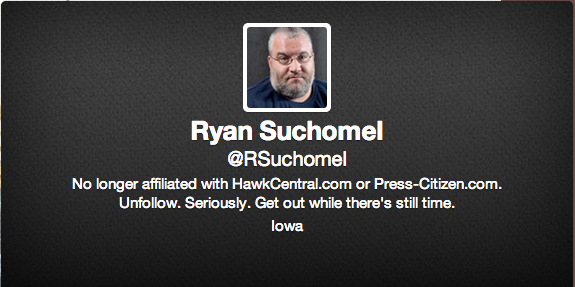
That report was bad enough, though it was put in the "neither confirm nor deny" limbo window by newspaper brass. But anybody doubting the meltdown over there needed only to see the Twitter page of HawkCentral editor (and Iowa sports media fixture) Ryan Suchomel to see what was up. Check that: former editor.

Screen_shot_2013-08-07_at_10

Media expert Jim Romenesko quickly reported on the upcoming moves and confirmed with a "newsroom leader" at the P-C that they were coming. So with Harty and Suchomel already gone (and who know who else to follow), that's two veterans of the Hawkeye sports landscape that just aren't there anymore, and there's no real sense that their jobs will be replaced by anyone of equal talent, if at all. That's chilling news.

@BuckeyeFitzy @Adam_Jacobi @KCJJ It's not good news for me. It's not good for anyone.

— Mike Hlas (@Hlas) August 7, 2013

Decry Gannett's move and business strategy all you want, but it's not an anomaly in the journalistic world these days. And in an era where these companies are constantly finding incremental cutbacks to make, the loss of a direct competitor's beat writer makes your own beat writer just that much more expendable. Businesses don't succeed by competing against themselves, after all, and the moment Newspaper X thinks it can axe a well-paid writer, no matter how beloved that writer is, it probably will.

To put it more bluntly, the jobs of our Hawkeye beat friends at the Gazette are now incrementally more in danger than they were at this point last week. So yes, this is a dark, dark day for fans of the Hawkeyes and fans of Hawkeye coverage.

We don't have any answers. If it were easy to save the newspaper industry someone would have thought it up and done it by now. The bottom line is that careers are disappearing and not coming back, and with those careers go talented, informative writers. And we'd much, much, much rather have Pat Harty on the job than nobody.

Tip one out.

29 Jul 20:02

Francis’ Sunlight: Reax

by Andrew Sullivan
kurtadb

yeah, i think the real weight of this is the departure from Benedict. it remains to be seen whether it will denote any kind of substantively humane policy moving forward. but it's undeniably a nice start. andrew was a little over-the-top in his reaction but not much and he acknowledged the relative nature of it. similarly, i thought mistermix (BJ) was overly-aggressivly skeptical of it. but i guess that's just how they roll over there.

VATICAN-POPE-AUDIENCE

Jimmy Akin thinks the press is reading too much into the Pope’s words on homosexuality:

Disclaiming a right to “judge” others is something that goes back to Jesus. It does not mean a failure to recognize the moral character of others’ actions, however. One can form a moral appraisal that what someone else is doing is wrong (Jesus obviously does not forbid that) without having or showing malice toward them.

The statement that they should not be marginalized is similarly in keeping with the Holy See’s approach to the subject, as 1992 Vatican document On the Pastoral Care of Homosexual Persons. The statement that same-sex attraction “is not the problem,” when understood correctly, is also nothing new. “The problem,” as Pope Francis seems to here be understanding it, is going beyond merely having a sinful tendency–a temptation to which one is subject. Obviously, temptations are a problem, but if we resist temptation we do not sin. “The problem,” on this understanding, is giving into the temptation and sinning or–worse–building an ideology around the sin and trying to advocate the sin.

But this was precisely what Benedict was trying to ratchet back, by arguing in 2005 that, whatever their conduct or faith, gay men should be barred from seminaries because homosexuality itself is objectively disordered and gays’ very being is inherently against the logic of God’s creation. Benedict’s pronouncements on gays were almost a definition of marginalization: “somehow distorted, off center, and … not within the direction of creation.” Isn’t that what the ancient world said of lepers and the Jewish world say of Samaritans? Benedict’s fastidious, obsessive-compulsive need to re-make all Creation in the image of his own hermetically-sealed and completely abstract theology ended up betraying the most important message of Jesus: that the last shall be first, that everyone is invited to God’s table, and that those you call “distorted” and “off-center” are actually at the very center of a loving God’s compassion.

And this interpretation is of a piece with what he said about divorced and re-married Catholics at the same presser:

“This theme always comes up … I believe this is a time of mercy, a change of epoch. It’s a kairos moment for mercy … In terms of Communion for those who have divorced and remarried, it has to be seen within the larger pastoral context of marriage. When the council of eight cardinals meets Oct. 1-3, one of the things they’ll consider is how to move forward with the pastoral care of marriage. Also, just 15 days ago or so, I met the secretary of the Synod of Bishops, and maybe it will also focus on the pastoral care of marriage. It’s complicated.”

I think it’s bizarre to ignore a Pope when he proclaims “a change of epoch,” when he calls our time a “kairos” moment for mercy. That means a turning point, a hinge of history. Why use that language if you are merely insisting on total continuity with the past? And the issue with re-married Catholics is exactly the same as for gays: the licitness of sexual congress outside one, life-long, monogamous, non-contracepted heterosexual marriage. Kevin Clarke agrees that Francis didn’t depart from traditional church teaching but sees a welcome shift regardless:

His citation of current catechism on the treatment of gay and lesbian people was not revolutionary in any sense; what startles may be the spectacle of a pope saying anything out loud on the matter and stressing the importance of church teaching on the human dignity of gay and lesbian people.

Francis was also asked why he did not spend much time speaking about abortion or gay marriage during his trip (church teaching is already clear, he said) and about the difficulties of divorced and remarried Catholics. “I believe this is a time of mercy, a change of epoch,” the pope said.

Likewise, Francis DeBernardo of the gay-friendly New Ways Ministries thinks this language is a sign that things will get better for gay Catholics: “Even if [Francis] doesn’t drop the sin language, this is still a major step forward, and one that can pave the way for further advancements down the road.” One gay Catholic, Michael O’Loughlin, agrees:

In addition to mercy, Francis’ comments also provide hope, hope to those who live on the margins of the church. In a special way, those who live without—without money, without recognized dignity, without full embrace from institutions of power—are called to live prophetic lives. But sometimes being offered some hope from the powerful, in this case Pope Francis and the church, is needed in order to keep moving forward with the struggle. Francis’ comments, however offhand and however easily dismissed they will be by traditionalists, are worth celebrating.

Elizabeth Scalia also applauds Francis’s call to mercy and forgiveness – and tells us all to relax:

I understand some folks’ concerns that perhaps Francis is too heavy on the mercy and too light on the justice side of things — and certainly the cross itself teaches us that both must be held in balance. But this is still a pretty fresh papacy. The sense I’m getting is that Francis means to scrape some long-attached barnacles from the Barque of Peter, so we can see what the deeper hues of Justice and Mercy look like; he’s readying it to travel some rough, challenging waters…

I’ll tell the new hysterics the same thing I told the old hysterics: you’re gonna be surprised who makes it into heaven and who doesn’t, because it’s not going to line up with what you or I think is Catholicism-done-Correctly, so be sweet to everyone, mind your own soul, not theirs, and trust Jesus to sort it out.

Admitting that “I love the guy,” James Martin, a fellow Jesuit, praises Francis and claims he’s initiating real change in the Church:

Praising Francis does not mean denigrating John Paul or Benedict. Each pope brings unique gifts to the office. But Francis’s election as pope has definitely brought change to the church.

The essentials have not changed: each pope preaches the Gospel and proclaims the Risen Christ. But as we saw last week in Rio, Francis speaks in a different way: plainly, simply, with unadorned prose. Francis has a different style: more relaxed, less formal, more familiar. Francis’s appeal is different and, judging from the crowds, effective. The Pope does the same thing–preaches the Gospel and proclaims the Risen Christ–in a new way. Francis is a different person for a different time.

What Pope Francis did and said in Rio de Janeiro, how he did it and said it, and how the crowds reacted to what he did and said, show that things can change. And that God can change them. All this is an answer to despair. It is a reminder that nothing is impossible with God. So every time I see Francis, hear him speak or read one of his homilies I’m reminded of this great truth.

Martin emails the Dish to add:

The lesser-noticed change in the Pope’s revolutionary words during his in-flight interview was, at least according to the translation in the Italian-language “Vatican Insider,” the use of the word “gay,” which is traditionally not used by popes, bishops, or Vatican officials.

This is a sea change.

(Photo by Alberto Pizzoli/AFP/Getty Images)


29 Jul 17:43

Microbrew Maps: Get Your (Good) Beer Here

by Greg Miller
kurtadb

man, i've been looking, on and off, for someone to build a gmaps application that allows you to search for something along a route. now someone has...but it only works for beer! also, not the NYer link -- i hadn't seen that before. cool!

Microbrew Maps: Get Your (Good) Beer Here
Here at WIRED Science we love craft beer. And being in San Francisco, we're fortunate to have lots of great options nearby. What we really need is a way to find a good microbrew when we're on the road. Luckily, ...
26 Jul 17:06

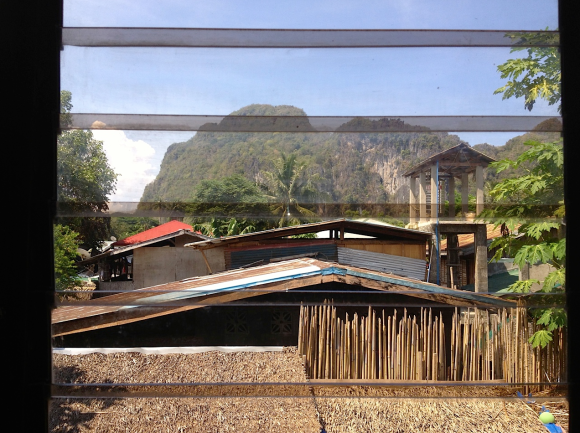
Ask A Window-View Champ Anything

by Andrew Sullivan
kurtadb

heh. the project left for the reader was mildly entertaining. but also it was from Goa, which i had missed originally.

Doug Chini, who nailed the vast majority of the 42 contests he has entered so far, takes questions from readers:

What do you do professionally?

I’m a corporate lawyer in New York City, which actually gives you the discipline to fight through some of the harder searches.

How much time do you typically put in for each contest?

screen-shot-2013-05-10-at-11-26-51-pmIt varies. I typically spend 10-15 minutes just analyzing the image and on occasion, as with last week’s Mostar view, the answer pops right out. But for difficult ones, and if I have time, I can spend several hours over the course of the weekend. In those cases, as with writing, it makes sense to work in small stretches and come back with fresh eyes.

What was your all-time favorite VFYW contest?

Well, in terms of the ones I’ve found it would have to be the El Nido view in the Philippines (VFYW #153). Tracking down the actual window required plotting dozens of images from the local cliffs on a time-line. By the end of that process my computer’s desktop looked like the floor of Baker Street after Sherlock Holmes spent a night digging through a stack of old newspapers.

The most amusing contest, however, was VFYW #116, which I never found. I normally begin a search by adjusting the image’s brightness and contrast, but when I did so that week, boy was I in for a surprise. I’ll let the readers go back and, er, reflect on that one.

What are the most common red herrings?

Recently it’s been red tile roofs. Whenever we get a Mediterranean view, there’s invariably a group of readers who think it’s California because of those roofs, but it rarely is. More broadly, certain architectural characteristics, like shanty construction, are common across a wide swathe of the planet, but people tend to assume they’re specific to regions they’ve previously traveled to. Unless you’re certain, I think it’s better to cast a wide net at the beginning of the search rather than develop tunnel vision.

Do you ever reach a point with some contests when you just admit to yourself that you’re stumped and give up?

Not really, because I rarely push too hard for an extended stretch of time. Instead, I’ll plug away right up to the deadline with whatever snatches of free time are available, even if it means searching on the elliptical at the gym.

Which VFYW victory were you most proud of?

That’s a hard one. Cork (VFYW #117) comes to mind first, as I found it just as I was about to turn the computer off for the night. And the Rohrmoos view (VFYW #148) in Austria required a pure brute-force search because there were no good clues. When I found that one I felt like Rocky running up the steps of the Philly Museum of Art (except swap Stallone with a dork sitting at a computer).

But if we’re talking “pride,” I’d have to say Sarlat-la-Caneda (VFYW #158). I only had one day to work on it, which meant I had to quickly narrow down the likely area using small details until I could locate the final, critical clue. (If the Dish staff allows, I may send in a detailed visual in the next month or so that shows how that one played out.)

What are some photo clues that the average person might not think would be helpful?

The most prosaic of details, like garbage cans, traffic signs and chimneys are often fairly specific to a region or country and can narrow down the search area. Also, the position of satellite dishes and the direction of shadows can give you a sense for the compass direction of the picture, which helps when searching satellite imagery.

Our previous co-champions, who we honored for our 100th contest, also respond:

What do you do professionally?

Mike: Electrical engineer

Yoko: Nursing

How much time do you typically put in for each contest?

Mike: About eight hours, usually a few hours at a time over Saturday and Sunday. About half my time is typically spent documenting the location. (I did most of the documentation – that’s why my time is longer than Yoko’s).

Yoko: It depends… from 15 minutes to the whole weekend.  We usually found the window on Saturday morning, otherwise, we couldn’t go out. Typically, 3 hours or so.

What was your all-time favorite contest?

Mike: Dhaka, Bangladesh. The part I regret is that Yoko was traveling that weekend, so I found it myself. It turned out to be a great win, because it was a solo win – nobody else got the building – but I wish Yoko had been part of it.

Yoko: My favorite was Edinburgh. It was a lovely scene. The cobblestone street in the photo helped me find the window. (Note from Mike: Yoko found this window in about fifteen minutes).

Which VFYW victory were you most proud of?

Mike: #68, Ulaanbaatar. I had found windows before that, but this was the first one Yoko and I solved together. She found the window after we talked about the clues, and I wrote up the entry.

Yoko: Dhaka. Mike found the window by himself. Usually, I helped him too much.

What are some photo clues that the average person might not think would be helpful?

Mike: Curbs and utility poles.

Yoko: Hmm… Electric utility cables (how messy, how old…) can be clues. Also, the window frames sometimes tell me many things.

What are the most common red herrings?

Mike: License plates. There are so many, and they change so quickly. It’s easy to look at a plate and think you know where it’s from (or even to look it up on a license plate site), only to discover that it hasn’t been used for years, or even worse, that the same design is used in myriad countries or states.

Yoko: Mike’s advice. He always says, “It must be China!”


26 Jul 15:02

Dissent Of The Day

by Andrew Sullivan
kurtadb

there was an article in C's latest BU alumni magazine about an alum who's son has Type 1 diabetes. it was completely heartbreaking to hear how difficult that is and how much they all live their lives in fear of blood sugar fluctuations. the upshot was that the guy is busily trying to develop a "bionic pancreas" by the time his child reaches college age. anyway, this reminded me of that.

A reader writes:

Each time I read a post or piece that mentions “obesity and diabetes,” I send along an email in a desperate attempt to get people – many of them medical professionals = to stop using the blanket term “diabetes” with “obesity.” Why? Because my young daughter has Type 1 Diabetes, an autoimmune disease that affects millions of Americans and usually manifests in childhood (used to be called Juvenile Diabetes). Type 1 diabetes has nothing to do with obesity.

In fact, when most children are diagnosed, they are on their way to starvation, as their bodies no longer metabolize their food components. Because people so casually throw around the umbrella term “diabetes” and are so cruel to obese people, Type 1 diabetics get stigmatized by it. My child, who is very slight for her age group (as are many type 1 children), has to constantly answer questions like, “Did you eat too much sugar?” or weather comments like “Only fat people get diabetes.”

Type 1 children already feel different. They either have to wear insulin pumps day and night or take multiple shots each day. They have to take time out of class to prick their fingers multiple times a day to check their blood glucose. They live in fear of life-threatening high and low blood sugars. Their parents have to wake up during the night, often several times, to prick their fingers while they sleep. Is it too much to ask that journalists and medical professionals use the proper nomenclature?

No, it isn’t and we’ll be more careful in future.