The Citizens Equality Act of 2017 consists of three parts: make it as easy as possible to vote, end the gerrymandering of political districts, and base campaign funding on all eligible voters, not just corporations or the wealthy.
Four years ago, Cenk Uygur of The Young Turks told Netroots Nation, "There is only one issue in this country," and he was referring to the corrupt funding of public elections.
That corruption is part of a more fundamental inequality that we've allowed the politicians to create: we don't have a Congress that represents us equally.
Every issue - from climate change to gun safety, from Wall Street reform to defense spending - is tied to this "one issue." Achieving citizens equality in America is our one mission.
oh god. this is literally something i have done and worried about.
Money is pouring in to help the family of a 38-year-old Golden man who was struck and killed on his bike on Lookout Mountain Road Friday evening by a man police say was driving drunk.
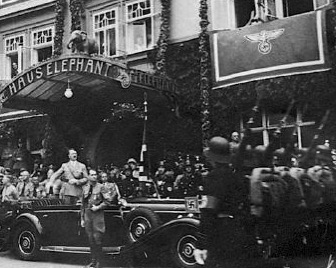
In The New Republic, Jeet Heer says that Donald Trump is not a populist, he’s “the voice of aggrieved privilege—of those who already are doing well but feel threatened by social change from below, whether in the form of Hispanic immigrants or uppity women.” Or the voice of the white American man enraged at the possibility he might lose his ill-gotten privilege. Heer doesn’t use the f-word, but it’s the elephant in the room.
A relevant elephant
For the alleged misunderstanding of Trumpism as “populism,” Heer blames the historian Richard Hofstadter, who in the middle 1950s explained he was interested in “that side of Populism” that sounded to Hofstadter a lot like McCarthyism. Hofstadter was right: there was a side of Populism, and not a trivial side, that sounded like McCarthyism—and Trumpism too.
The Populists, or People’s Party, of the US supported nationalization of railroads and a progressive income tax in the 1890s. You can read about it in the Omaha Platform they composed—where you can also read that the Populists supported keeping out immigrants who competed with American workers for jobs:
we condemn the fallacy of protecting American labor under the present system, which opens our ports to the pauper and criminal classes of the world and crowds out our wage-earners; and we denounce the present ineffective laws against contract labor, and demand the further restriction of undesirable emigration.
Note, please: “criminal classes of the world.” A lot of the historiography (which Heer cites) pointing out that the Populists weren’t solely a party of bigotry would today on Twitter be summed up, uncharitably if not entirely unpithily, as #NotAllPopulists.
I am not trying to say that the Populists were fascists. But they were aggrieved white folks who thought they were entitled to something that they then did not get. The party was strongest in the West, where white people went to farm land taken from the Indians, which the US government gave white people for free, which was supposed to be well served by railroad lines subsidized by the US government… and which turned out to be full of wolves, locusts, and monopolists, and not nearly full enough of rainfall.1
Loans the settlers had taken, to improve the land or efficiently to plow it, became burdensome in bad years. As the railroads consolidated, the cost of shipping products out of the prairies soared.
Promised an Eden and delivered a desert, the pioneers rebelled. They blamed railroad monopolies, international capitalists (not always a code for Jews), and international labor, or immigrants.
The Populists were also strong in the South, where the prewar plantation class was once more in the ascendant, slave labor had been restored in all but name, and the poorer to middling sort of white voters felt themselves similarly oppressed. They could be picked off, though, by an appeal to race—which is a major reason the southern states started disfranchising black folks in the early 1890s. The Democratic Parties of the South, by making legal disfranchisement of black voters their cause and appealing to white racial solidarity, could bring white voters back from the Populist Party.
None of which is to say that the Populists—who eventually came under the leadership of William Jennings Bryan in 1896 and joined with the Democratic Party, where they lost, and lost, and lost—were fascists. But the discontent that led to Populism could easily have become fascism, or something like it: and that is what Hofstadter correctly sensed.2 Without the Christian Bryan at their head—with, say, a figure more like P. T. Barnum, or William Randolph Hearst in the saddle of the party… who knows.
1There was an effort to get homesteads for freedpeople under the 1866 amendments to the Homestead Act, or the Southern Homestead Act—but it did not produce a lot of black homesteaders. So I’m referring to white ones, as they were the large majority.
2Now, “status anxiety” as an explanation for Progressivism—that’s another thing.
You would think that if anything were beyond the pale, even for today’s GOP and its conservative base, it would be chattel slavery.
Seriously. If there were any thought that ought to be simply unthinkable in the twenty first century, America, it would be that it is not simply illegal but actually evil to turn another human being into property. I seem to recall there was something of a disturbance that ended 150 years ago on this matter, and it did not end well for those who lived on stolen labor.
But it turns out that my failure to imagine a comeback for slavery merely reveals my inability to keep up with an American right that seems determined to abandon the last thread of sanity. From Media Matters via Charles Johnson at LGF, meet actual Iowa conservative talk radio host Jan Michelson:
I would just say this: … ’30 to 60 days from now anyone who is in the state of Iowa that who is not here legally and who cannot demonstrate their legal status to the satisfaction of the local and state authorities here in the State of Iowa, become property of the State of Iowa.’ So if you are here without our permission, and we have given you two months to leave, and you’re still here, and we find that you’re still here after we we’ve given you the deadline to leave, then you become property of the State of Iowa. And we have a job for you. And we start using compelled labor, the people who are here illegally would therefore be owned by the state and become an asset of the state rather than a liability and we start inventing jobs for them to do.
This was not a slip of the tongue:
CALLER: Well I think everybody would believe it sounds like slavery?
MICKELSON: Well, what’s wrong with slavery?
…
MICKELSON: No this is pretty simple, actually this is very simple, what my solution is moral and it’s legal. And I can’t think – and it’s also politically doable.
CALLER: So are you going to house all these people who have chosen to be indentured?
MICKELSON: Yes, yes, absolutely in a minimal fashion. We would take a lesson from Sheriff [Joe] Arpaio down in Arizona. Put up a tent village, we feed and water these new assets, we give them minimal shelter, minimal nutrition, and offer them the opportunity to work for the benefit of the taxpayers of the state of Iowa. All they have to do to avoid servitude is to leave.
….
MICKELSON: You think I’m just pulling your leg. I am not….
Ladles and Jellyspoons: your modern Republican party. Somewhere, Abraham Lincoln is weeping.
Activists from Black Lives Matter met with Hillary Clinton last week, and they came away unimpressed. Dara Lind says the disagreement was mostly about Clinton's support for the 1994 crime bill, a centerpiece of her husband Bill Clinton's political agenda:
The crux of the conflict is this: The activists see the 1994 crime bill, and the "tough-on-crime" agenda more generally, as "extensions of white supremacist violence against communities of color." Clinton agrees with them that the criminal justice system needs to be reformed, but refuses to accept that characterization of the bill.
Both Bill and Hillary accept that, in retrospect, the crime bill was probably misguided. But Lind points out that at the time, there was plenty of support for it in the black community:
This is an important point: Many black Americans, including black leaders, welcomed "tough-on-crime" policies as a way to protect their communities. A majority of the Congressional Black Caucus voted for the 1986 law that created the sentencing disparity between crack and powder cocaine. And in 1994, it was the CBC that saved President Clinton's crime bill after an unexpected loss on a procedural vote.
This is a history that's been largely forgotten, partly because many of these leaders regret their positions now or—like former Rep. Kweisi Mfume—deny that they supported the bill at all. And in fairness, there was plenty of black opposition to tough-on-crime policies. There are probably good questions to ask about who is trusted to speak for black communities, and whether black leaders felt politically pressured to denounce the crime in their midst as a condition of being taken seriously…
By 1994, the crime wave had already peaked; the crime rate was starting a quarter-century of decline. Increased incarceration is responsible for a small fraction of that—but by 1994, the people being put in prison, on the margin, had long since stopped being the people who posed a serious threat. The suffering caused by the bill wasn't a caveat, it was the primary consequence of its passage.
There's an important point here, one that I became more deeply aware of when I wrote about childhood lead poisoning and violent crime a couple of years ago. Here it is: There really was a huge crime wave in the '70s and '80s. And it wasn't uncommon for liberals to downplay this at the time, something that turned out to be a political disaster for liberalism. That's because the crime wave wasn't a myth, and it wasn't made up. Rape, assault, and murder skyrocketed far above their previous highs, and inner-city neighborhoods were especially hard hit. This is the reason that so many black leaders supported tough-on-crime bills of various sorts.
And while Lind is right that violent crime had peaked and was starting a long descent by 1994, no one knew it at the time. The peak had only happened a couple of years before, and there was no reason to think a small drop in a single year or two was significant. So it's not right to say that the people being put in prison in 1994 had "long since" stopped posing a threat. They posed a plenty big threat, and literally everyone who studied crime at the time thought they'd continue to do so for years. At the time, there was simply no reason to think violent crime was about to plummet.
Now, everyone knows my take on this: Both the rise and subsequent fall of violent crime was largely due to childhood lead poisoning caused by lead paint and leaded gasoline. Tough-on-crime measures, it turns out, probably didn't contribute much to the fall in crime during the '90s and aughts. But again, at the time no one knew this. In 1994 no one had even an inkling that lead might be the culprit for high crime rates.
This in no way takes race out of the crime picture. It just explains it. Black crime really did soar during the crime wave, and the reason was simple: Black families lived disproportionately in inner cities, where both lead paint and exhaust fumes from cars were rife. Racism is behind this everywhere. Black people lived in these neighborhoods in the first place largely because of redlining and racial animus. The neighborhoods then became worse because politicians built highways through them (the richer, whiter communities fought them tooth and nail). And they were never cleaned up because no one wanted to spend money on them. Paint and automobile lead poisoned black kids at a higher rate than white kids, and the result was higher black crime rates.
But while I hate to be a broken record, no one knew this at the time. And in a way, it didn't matter. Even if we had known lead was responsible, it wouldn't have changed anything. Once the damage was done, it was done. And no matter what caused it, nobody wanted to let rapists and murderers roam the streets.
This was a long and rambling way of getting to my final point. Lind suggests intent doesn't matter. Something is racist if it has racist consequences. But I think you have to be pretty careful about that. Lind is right that, whether racially inspired or not, it's important to face structural racism clearly and work relentlessly to overcome it. Nonetheless, intent does matter. Calling someone racist does nothing except make matters worse unless they really do have racist intent.
So was the 1994 crime bill racist in intent? No. Many black leaders, including black mayors who faced rising crime rates daily, supported it. Violent crime really was a huge problem—and it really was especially severe in black communities. Nobody at the time knew lead might be the culprit for this, so they had to address it as best they could given what they believed. So they did. The 1994 crime bill was not a white supremacist project. It was a crime bill.
At the end of her piece, Lind argues that Hillary Clinton "doesn't need to show she's changed her heart. But she does need to show that she has learned, and changed her mind." This puzzles me. Clinton has defended her support of the 1994 crime bill given what she knew at the time, but she has also proposed criminal justice reforms that make it clear she has learned and has changed her mind. If those reforms are insufficient, fine. Fight for more. But both Clintons have made it clear that their views on crime have changed. There's simply no excuse for pretending that either one of them was involved in a conspiracy of "white supremacist violence" against black communities.
i suppose it's not actually shocking, but this chart, at least, makes it impressively obvious.
This is going to be the most anticlimactic blog post ever, but can you guess how Scott Walker's health care plan compares to Obamacare for the poor? And how it compares for the upper middle class and the wealthy?
Damn. You guessed. But just to make it official, here are a couple of charts that show how the subsidies in the two plans compare at different income levels. I used the Kaiser calculator to estimate Obamacare subsidies and Walker's written document to calculate tax credits under his plan. The chart on the left shows a 3-person family with 30-year-old parents. The chart on the right shows the same thing with older parents.
And have no fear: I chose $30,000 as the minimum income level because most families below that level qualify for Medicaid. And you guessed it: Walker's plan slashes Medicaid too. So the poor and the working class get screwed by Walker no matter what their income level is.
i’m trying ghostery now. definitely speeds up my browsing. the ios browser is nothing to write home about. but it does use duck duck go as its search engine.
More than fifteen years ago, in response to decreasing ad rates and banner blindness , web advertisers and publishers adopted pop-up ads . People hated pop-up…
i've sensed some serious nervousness in local government over this.
Adam Liptak says that Reed v. Town of Gilbert is the sleeper Supreme Court case of the past year. It unanimously struck down an ordinance that discriminated against signs announcing church service times, but only three justices ruled on the basis of existing law. The other six signed an opinion that went further, ruling that many other speech regulations are now subject to "strict scrutiny." How far will this go?
Strict scrutiny requires the government to prove that the challenged law is “narrowly tailored to serve compelling state interests.” You can stare at those words as long as you like, but here is what you need to know: Strict scrutiny, like a Civil War stomach wound, is generally fatal.
“When a court applies strict scrutiny in determining whether a law is consistent with the First Amendment,” said Mr. Abrams, who has represented The New York Times, “only the rarest statute survives the examination.”
Laws based on the content of speech, the Supreme Court has long held, must face such scrutiny. The key move in Justice Thomas’s opinion was the vast expansion of what counts as content-based. The court used to say laws were content-based if they were adopted to suppress speech with which the government disagreed.
Justice Thomas took a different approach. Any law that singles out a topic for regulation, he said, discriminates based on content and is therefore presumptively unconstitutional.
Securities regulation is a topic. Drug labeling is a topic. Consumer protection is a topic.
This is obviously not news to people who follow this stuff carefully, but it was news to me. Apparently the reach of Reed is pretty spectacular: three laws have been struck down by lower courts in just the past two months based on the reasoning in the case. Any law that treats, say, medical records or political robocalls or commercial speech differently from any other kind of speech is in danger—and there are a lot of statutes on the books that do exactly this.
They say that hard cases make bad law. But Reed was an easy case. It failed "the laugh test" said Elena Kagan. And yet, it seems likely to have provided an excuse for an astonishingly broad change in how speech is regulated. So far it's stayed mostly under the radar, but eventually something bigger than panhandling or ballot selfies will get struck down, and suddenly everyone will notice what happened. What then?
Professor [Robert] Post said the majority opinion, read literally, would so destabilize First Amendment law that courts might have to start looking for alternative approaches. Perhaps courts will rethink what counts as speech, he said, or perhaps they will water down the potency of strict scrutiny.
“One or the other will have to give,” he said, “or else the scope of Reed’s application would have to be limited.”
Mark Reay is a former model, actor, and fashion photographer who was homeless in NYC for six years. Homme Less is a documentary on Reay; here's a trailer:
So began a period of my life sleeping rough. It was pretty tiring, and I didn't have much luck with the photos, but I stuck it out. I've never let the lack of money stop me having a good time, and I still had (dwindling) savings from my modelling. It was a happy time. At night I would always treat myself to a rotisserie chicken, but I always wanted a chilled rosé with it. So, in the afternoon, I would sneak into a minimarket, get the cheapest one from the shelf and hide it under the frozen peas. Then, at night, I would put on a fresh shirt and go to one of the fancy bars with my wine in my bag. Again, maybe because I had a certain look, no one ever checked my bag. I'd just go in, nick a glass off the counter and drink my wine surrounded my millionaires.
You can get away with anything if you're confident. Oh, and male, white, and good looking.
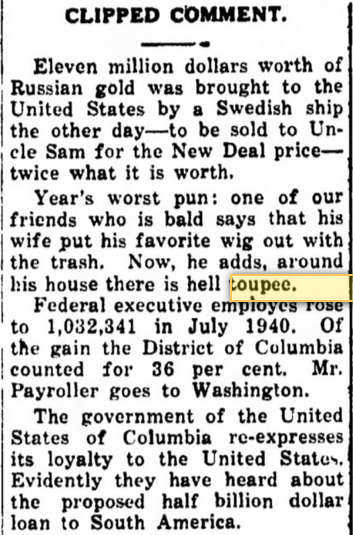
The pun goes back at least to 1986 and probably beyond. [See below for antedating to 1940…] I'm not sure who first applied it to Mr. Trump's campaign, or who created the logo.
The walls of the elevator to the observatory at the top of 1 World Trade Center are covered with screens and when you ride it to the top, you see a time lapse of NYC's development, from 1500 to the present.
A 66-year-old man died Saturday morning while participating in the Red Rocks Century bicycle ride, a 100-mile event that winds through several Front Range communities.
One of the original recordings of Emperor Hirohito's surrender speech (AP / The Imperial Household Agency of Japan )
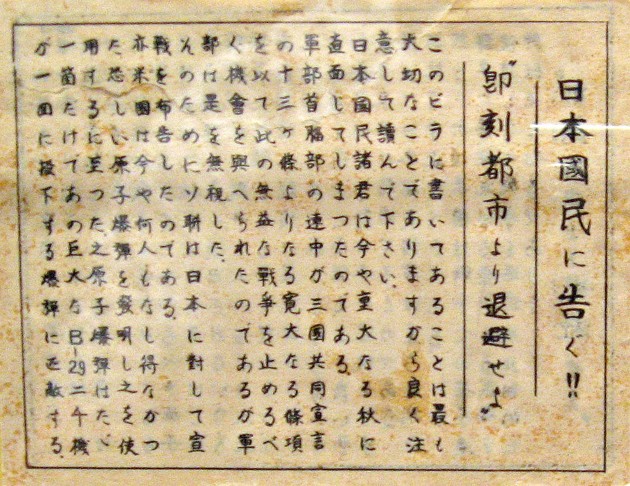
Seventy years ago, on the morning of August 6, 1945, a B-29 Superfortress named Enola Gaydropped an atomic bomb on Hiroshima. A short time later, other B-29s began dropping leaflets on Tokyo. “Because your military leaders have rejected the 13-part surrender declaration,” the leaflets said, “we have employed our atomic bomb. ... Before we use this bomb again and again to destroy every resource of the military by which they are prolonging this useless war, petition the emperor now to end the war.”
There was no way that Japanese civilians could petition Emperor Hirohito to accept the terms of the July 26 Potsdam Declaration outlining the Allies’ surrender demands—among them the complete disarmament of Japanese forces and the elimination “for all time the authority and influence of those who have deceived and misled the people of Japan into embarking on world conquest.” But the leaflets reflected reality: Only the emperor could end the war. To do that, though, he would have to defy his military leaders, knowing that his call for peace would almost certainly inspire a military coup.
When news of the Nagasaki bombing came on August 9, the Supreme War Direction Council reacted not by moving toward peace but by declaring martial law throughout Japan. With the cabinet unable to reach a consensus on whether to accept the surrender terms, and War Minister Korechika Anami leading the opposition, its members finally turned to the emperor for a decision.
Shortly before midnight, Hirohito, a weary, sad-eyed man, walked into the hot, humid air-raid shelter 60 feet below the Imperial Library where his 11-member cabinet was gathered. He sat in a straight-backed chair and wore a field marshal’s uniform, ill-fitting because tailors were not allowed to touch this man revered as a god. The gathering itself was an extraordinary event known as a gozen kaigin—“a meeting in the imperial presence.” Hirohito had been emperor since 1926 and, as commander in chief of the Japanese armed forces, had often been photographed in his uniform astride his white horse during the war. But U.S. propaganda portrayed him as a figurehead and blamed the generals for prolonging the war.
Hirohito patiently listened as each cabinet member presented his argument. At 2 a.m. on Friday, August 10, Prime Minister Kantaro Suzuki did something that no prime minister had ever done: He asked Hirohito for an imperial command—known as the Voice of the Crane since the sacred bird could be heard even when it flew unseen.
Speaking softly, Hirohito said he did not believe that his nation could continue to fight a war. There is no transcript of his address, but historians have pieced together accounts of his rambling words. He concluded: “The time has come when we must bear the unbearable. ... I swallow my own tears and give my sanction to the proposal to accept the Allied proclamation.”
* * *
On August 10, the Japanese Foreign Ministry transmitted a response to the Allies, offering to accept the terms of the Potsdam declaration with the understanding that those terms did not “comprise any demand which prejudices the prerogatives of His Majesty as a Sovereign Ruler.” By August 11, Japan had received the Allied reply, including the U.S. insistence that “the authority of the Emperor and the Japanese Government to rule the state shall be subject to the Supreme Commander of the Allied powers who will take such steps as he deems proper to effectuate the surrender terms.”
In America, most people believed that peace had come. “Japan Offers to Surrender,” bannered The New York Times; another Times story was headlined “GI’s in Pacific Go Wild With Joy ‘Let ‘Em Keep Emperor’ They Say.” In Japan, however, the war went on. The Japanese offer of surrender, and the Allied reply, were known only to high government officials. Morning newspapers in Japan on August 11 carried a statement in the name of General Anami and addressed to the army: “The only thing for us to do is fight doggedly to the end ... though it may mean chewing grass, eating dirt, and sleeping in the field.”
But on the morning of August 14, another blizzard of leaflets swirled over Tokyo and other cities, and this time they contained news of the messages exchanged between Japan and the Allies. Marquis Koichi Kido, Hirohito’s closest advisor, later recorded in his diary that seeing one “caused me to be stricken with consternation” over the possibility that some leaflets could “fall into the hands of the troops and enrage them,” making a military coup d’état “inevitable.”
A coup, in fact, was already underway. If Anami were to give his support to the plot, much of the Japanese Army—a million soldiers in the Home Islands—would almost certainly rise against the cabinet with the claim that the emperor had been duped by cowardly civilians. If Anami resigned from the cabinet, it would fall and Japan would fight on.
At Kido’s frantic urging, the emperor declared another gozen kaigin in the air-raid shelter, where he issued an imperial command: “I desire the cabinet to prepare as soon as possible an imperial rescript announcing the termination of the war.” Hirohito knew that publication of the rescript—a proclamation of the gravest import—would not be enough. He decided to be a true Voice of the Crane. He would step before a microphone and read the rescript to his people, who had never before heard him speak.
* * *
That night, the emperor’s offer to surrender reached Allied governments, and the designated Supreme Commander of the Allied Powers, Army General Douglas MacArthur, began the formalities. About the same time, Anami’s brother-in-law, Lieutenant Colonel Masahiko Takeshita, was urging Anami to lead a coup. Anami refused.
Kido and other aides to the emperor started hurriedly arranging for the imperial broadcast with stunned directors of the Japan Broadcasting Corporation (NHK). The chairman of NHK brought a recording team to the palace complex to capture Hirohito’s words. That afternoon, Kido recorded in his diary, a visitor noticed that far more soldiers than usual were on the palace grounds. “I am afraid of what may be happening at the Imperial Guards Division,” he said, referring to the elite soldiers who guarded the emperor and the palace.
The NHK staff waited while cabinet members haggled over the wording of the rescript. At about 8 p.m., copyists were finally given a scrawled, heavily edited manuscript. But as they began transcribing it into classic calligraphy, they were given more changes. To their aesthetic horror, the copyists had to make corrections on tiny pieces of paper and paste them in.
A leaflet dropped from a B-29 plane after the bombing of Hiroshima, announcing American plans to drop another bomb (Wikimedia)
During the regular 9 p.m. Japanese radio news, listeners were told that an important broadcast would be made at noon the next day. Mimeographed copies of the final text went to newspapers, with a publication embargo until after the emperor’s broadcast.
At 11 p.m., Hirohito was driven the short distance across the palace grounds from his living quarters to the blacked-out building of the Household Ministry, which ran the affairs of the imperial family. In the audience hall on the second floor, the NHK technicians bowed to the emperor. Hirohito, looking perplexed, stepped before the microphone and asked, “How loudly should I speak?” Hesitatingly, an engineer respectfully suggested that he speak in his normal voice. He began:
To our good and loyal subjects: After pondering deeply the general trends of the world and the actual conditions obtaining in our empire today, we have decided to effect a settlement of the present situation. ... Let the entire nation continue as one family from generation to generation, ever firm in its faith in the imperishability of its sacred land.
When he finished, he asked, “Was it all right?”
The chief engineer stammered: “There were no technical errors, but a few words were not entirely clear.”
The emperor read the rescript again, tears in his eyes—and soon in the eyes of others in the room.
Each reading was only four and a half minutes long, but the speech spanned two records. The technicians picked the first set of records for the broadcast, but they kept all four, putting them in metal cases and then into khaki bags. The technicians, like everyone else in the palace, had heard rumors of a coup. They decided to stay there that night rather than attempt a return to the NHK broadcasting studio, out of fear that army mutineers would attempt to steal and destroy the recordings. A chamberlain placed the records in a safe in a small office used by a member of the empress’s retinue, a room normally off-limits to men. Then he hid the safe with a pile of papers.
* * *
In the early hours of August 15, Major Kenji Hatanaka, a fiery-eyed zealot, and Army Air Force Captain Shigetaro Uehara burst into the office of Lieutenant General Takeshi Mori, commander of the Imperial Guards Division. Hatanaka fatally shot and slashed Mori, and Uehara beheaded another officer. Hatanaka affixed Mori’s private seal to a false order directing the Imperial Guards to occupy the palace and its grounds, sever communications with the palace except through Division Headquarters, occupy NHK, and prohibit all broadcasts.
Meanwhile, Major Hidemasa Koga, a staff officer with the Imperial Guards, was trying to recruit other officers into the plot. At the palace, soldiers supporting the coup, with bayonets affixed to their rifles, rounded up the radio technicians and imprisoned them in a barracks. Wearing white bands across their chests to distinguish themselves from guards loyal to the emperor, they stormed the palace and began cutting telephone wires.
Koga, hoping to find and destroy what he thought was the single record of the emperor’s message, ordered a radio technician to find it. The technician, unfamiliar with the palace, led several soldiers into the labyrinth. Soldiers roamed palace buildings, kicking in doors, flinging contents of chests onto the polished floors. The emperor remained in his quarters and watched through a slit in the steel shutters protecting his windows.
Lieutenant Colonel Takeshita, meanwhile, tried again to bring Anami into the plot. Anami once more declined. Instead, with Takeshita in the room, Anami knelt on a mat, drove a dagger into his stomach, and drew it across his waist. Bleeding profusely, he then removed the knife and thrust it into his neck; Takeshita pushed the knife deeper until Anami finally died.
Rebellious soldiers swarmed into the NHK building, locked employees in a studio, and demanded assistance so they could go on the air and urge the nation to fight on. Shortly before 5 a.m. on August 15, Hatanaka walked into Studio 2, put a pistol to the head of Morio Tateno, an announcer, and said he was taking over the 5 o’clock news show.
Tateno refused to let him near the microphone. Hatanaka, who had just killed an army general, cocked his pistol but, impressed by Tateno’s courage, lowered the gun. An engineer, meanwhile, had disconnected the building from the broadcasting tower. If Hatanaka had spoken into the microphone, his words would have gone nowhere.
It took most of the night for troops loyal to the emperor to round up the rebels. At dawn, they finally removed the mutineers from the palace grounds. Now judging it safe to leave, the NHK engineers brought the emperor’s records to the radio station in separate cars using different routes. They hid one set in an underground studio, and prepared to play the other. At 7:21 a.m. Tateno went on the air and, without recounting the adventures of the night before, announced, “His Majesty the emperor has issued a rescript. It will be broadcast at noon today. Let us all respectfully listen to the voice of the emperor. ... Power will be specially transmitted to those districts where it is not usually available during daylight hours. Receivers should be prepared and ready at all railroad stations, postal departments, and offices both government and private.”
At noon, throughout Japan, as the emperor’s voice was heard, people sobbed. “It was a sudden mass hysteria on a national scale,” Kazuo Kawai, editor of Nippon Times, later wrote. The emperor spoke in classical language not readily understandable to most Japanese people. The “war situation,” he said, “has developed not necessarily to Japan’s advantage, while the general trends of the world have turned against her interest. Moreover, the enemy has begun to employ a new and most cruel bomb. ... We have resolved to pave the way for a grand peace for all the generations to come by enduring the unendurable and suffering what is insufferable.” He never used the words “defeat” or “surrender.”
* * *
After the broadcast, Hatanaka ended his mutiny standing outside the palace gates, trying to hand out leaflets that called on civilians to “join with us to fight for the preservation of our country and the elimination of the traitors around the emperor.” No one took the leaflets. Hatanaka shot himself in the head.
In the days that followed the emperor’s radio address, at least eight generals killed themselves. On one afternoon, Vice Admiral Matome Ugaki, commander of the Fifth Air Fleet on the island of Kyushu, drank a farewell cup of sake with his staff and drove to an airfield where 11 D4Y Suisei dive-bombers were lined up, engines roaring. Before him stood 22 young men, each wearing a white headband emblazoned with a red rising sun.
Ugaki climbed onto a platform and, gazing down on them, asked, “Will all of you go with me?”
“Yes, sir!” they all shouted, raising their right hands in the air.
“Many thanks to all of you,” he said. He climbed down from the stand, got into his plane, and took off. The other planes followed him into the sky.
Aloft, he sent back a message: “I am going to proceed to Okinawa, where our men lost their lives like cherry blossoms, and ram into the arrogant American ships, displaying the real spirit of a Japanese warrior.”
Ugaki’s kamikazes flew off toward the expected location of the American fleet. They were never heard from again.
The end finally came on September 2. The emperor was secure in his palace. His voice—the voice of the crane—had been heard throughout the land. Nearby, on the deck of the U.S. battleship Missouri, moored in Tokyo Bay, Japan surrendered to the Allies while a thousand U.S. carrier planes and B-29 bombers flew over. General MacArthur, after presiding over the surrender ceremony, was now the de facto emperor of Japan.
Reed Hastings, Netflix CEO and Dad (Jim Urquhart / Reuters)
A handful of Silicon Valley companies provide employees with generous (at least by American standards) leave policies upon the birth or adoption of a child.
Google offers 18 weeks of paid maternity leave. Facebook gives four months. Twitter, 20 weeks.
Now Netflix has gone and outdone them all—way outdone them all. Yesterday, the company’s chief talent officer announced that it will allow new moms and dads to take as much time off as they’d like in a baby’s first year of life.
That’s a lot. By American standards, all but unheard of. Joan Williams, the director of the Center for WorkLife Law at the University of California, Hastings, applauded Netflix’s move, calling one year of leave “just about ideal.”
“It’s heartening to see an American company giving what is fundamentally the suitable amount of parental leave and making it available equally for men and women,” she said. “To require people as a condition of keeping their jobs to return to work when the baby’s three months old is not civilized behavior.”
Now that Netflix has outlined such a generous option, the difficulties lie in implementing it in a way that both men and women take advantage of it. This is crucial, because if only women employees take Netflix up on its offer, the generosity of the policy could backfire, pushing women onto a “mommy track,” with fewer promotions and fewer raises in the offing. The good news for Netflix, Williams argues, is that this isn’t all that hard to do.
“What you do is,” she says, “when a man announces that his partner is pregnant you just have a really informal meeting with him, congratulate him, and say, ‘By the way around here we expect everybody to take parental leave, and it’s very important to us ... for business reasons.’”
Another challenge will be in ensuring that people up and down the corporate ladder take the time they need. “Expecting your entry-level Netflix employees to do this first is asking them to stick their necks out,” says Caitlyn Collins, a doctoral student at the University of Texas, Austin, who studies parental-leave policies around the world. Managers will have to set an example if they want the policy to be used. “We know that when managers, for example, demonstrate the use of policies themselves, employees feel much more comfortable following suit.”
Williams says that beyond the question of who takes the leave, there’s also the question of how to smooth the transitions out of work and back to work, both for the sake of the new parents and for their colleagues who will be covering for them while they’re away. In preparation for employees to leave, she recommends a system of three meetings—one that’s essentially for congratulating the parent-to-be, another for helping him or her create a transition plan, and a third, just a few weeks before the due date, making sure the transition is on track—and she recommends a similar, formal plan be made for when an employee comes back to work.
“We hear again and again women return from maternity leave and they have a really hard time getting work. Because people think, ‘I can't give her work, she has lots of responsibilities, I don't want to burden her,’ and also, less benevolently, ‘she has other priorities, I don't want to work with her now.’” With a transition plan in place, this process can go much more smoothly, and decrease resentment both toward the employees on leave and the leave policy itself.
Is Netflix’s policy possibly too generous? Will new parents find their careers irreparably set back after a year out of the office?
Collins says that research has shown that one year of leave really strikes the right balance. At one year old, most babies are done breastfeeding (or, at least, can eat cow’s milk and solid food during the day), they’re sleeping more regularly (parents will be a bit better rested for work), and childcare costs drop (daycare centers require fewer providers per one-year-old than per infant). At the same time, one year away from work won’t set parents back too much, in terms of keeping up with new technologies, systems, and organizational changes. This is all the more the case if the transitions are handled thoughtfully, as per Williams’s advice.
Perhaps the worst that can be said of Netflix’s policy is that it’s such a rarity. Without a federal mandate, parental leave in America is unevenly distributed and often grossly inadequate. “Workers who are in the most desirable jobs are the ones who are getting these benefits,” Collins says. “Netflix is a really desirable company to work for and so, they want to attract top talent, and so that means they get access to this paid leave and workers at the bottom of the labor market don't.”
“The fact that the U.S. is one of only two countries in the entire world that doesn't have federally-mandated paid parental leave is a travesty,” she added.
Williams agreed: “What we should have is national parental leave, equally available for men and women, and financed on a federal basis. That’s what virtually every other industrialized country has, and the reason is that the country is not one generation long. We have to raise the next generation—that is a macroeconomic imperative and it is a patriotic imperative.”
Of course, raising the next generation (and supporting their parents) doesn’t merely require generous parental leave following the birth of a baby—kids, after all, aren’t set to go at the ripe old age of one. “If you have a child living at home for 18 years,” Collins says, “it’s really wonderful and really important that you have time to spend with your child in the first year of its birth, but it's also really important that you get to attend their recitals and their soccer games and take them to the doctor when they're sick and those things don't just happen in the first year of a child's birth.”
To get there, companies will need to take steps beyond parental leave in the first year of life and look at ways of protecting employees’ family time when they’re away from the office (such as policies that ban or discourage after-hours email) and providing generous vacation benefits. But those are projects for another day.
My hubby was idled for a few days by the torrential downpours, so he decided to make Sephardic challah bread:
It was/is delish!
I’m not a baker. Unlike cooking, baking seems (to me) more science than art, and I chafe at its restrictions. But I appreciate baked goods produced by others very much.
I’m thinking a couple of slices of that bread slathered in pimento cheese, slapped together, buttered and grilled would make a fine supper, perhaps with a bowl of tomato soup on the side.
What’s for dinner at your house? Please feel free to discuss other topics too — open thread!
The image shows the "dark side" of the Moon, which we can't see from Earth because it's always pointed away from us.
The lunar far side lacks the large, dark, basaltic plains, or maria, that are so prominent on the Earth-facing side. The largest far side features are Mare Moscoviense in the upper left and Tsiolkovskiy crater in the lower left. A thin sliver of shadowed area of moon is visible on its right side.
"It is surprising how much brighter Earth is than the moon," said Adam Szabo, DSCOVR project scientist at NASA's Goddard Space Flight Center in Greenbelt, Maryland. "Our planet is a truly brilliant object in dark space compared to the lunar surface."
I don't know why, but this image gives me chills up my spine! Is anyone else freaking out about this?
A researcher of the report, which looks at gender, race and ethnicity in the most popular films in the United States, says there is an “epidemic” when it comes to diverse representation.
Today’s discerning beer drinkers might be convinced that America’s watery, bland lagers are a recent corporate invention. But the existence of American beers that are, as one industry executive once put it, “less challenging,” has a much longer history. In fact, Thomas Jefferson, himself an accomplished homebrewer, complained that some of his country’s beers were “meagre and often vapid” nearly 200 years ago.
Jefferson never lived to see the worst of it. Starting in about the mid-1800s, American beer has been defined by its dullness. Why? The answer lies in a combination of religious objections to alcohol, hordes of German immigrants, and a bunch of miners who just wanted to drink during their lunch break, says Ranjit Dighe, a professor of economics at the State University of New York at Oswego.
Dighe’s history of the industry, which was published in the journal Business History earlier this year, starts with British colonists in America who preferred dark beers, reminiscent of today’s porters and stouts and similarly alcoholic, containing about 6 percent alcohol by volume. But since those beers required imported hops, they were expensive, and early Americans made the first fateful move toward boring beer: They started brewing with corn, wheat, and molasses instead.
But Americans didn’t develop a more unified taste in beer until the mid-1800s, when huge numbers of German immigrants—including David G. Yuengling, whose brewery still operates today, outside of Philadelphia—arrived and brought lager with them. Less intense in flavor than porters, stouts, and ales, lagers were a hit with America’s growing number of factory workers and miners, who ate at saloons near where they worked. “It was normal to get a beer with your meal, but not allowable to be tipsy on the job,” says Dighe. “So if you wanted a beer, your safest option was a weak beer.” As more and more immigrants came to the U.S. and unemployment stayed high, the stiff competition for jobs made this pressure for sobriety even higher.
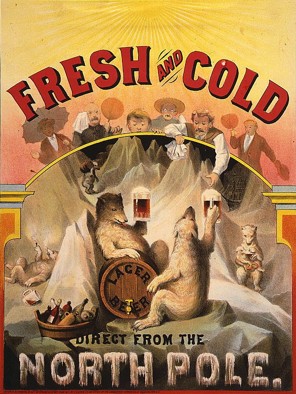
An ad from the 1870s for the lager of A. Hoen & Co., a Baltimore brewer. At the time, brewers emphasized the light, refreshing nature of their product in order to appeal to workers. (Library of Congress)
From this perspective, wateriness was not a bug, but feature. In the late 1800s, when Anheuser-Busch started selling a milder version of Budweiser made with rice, it cost a nickel more than its competitors—and it sold quite well.
At the time, beer labels didn’t include information about alcohol content, so flavor and color were usually the way these workers evaluated beer’s strength. “The milder the taste, the milder the beer, would be a natural assumption,” says Dighe. Lagers were golden-brown in color, leaving room for an even lighter beer to quench American workers. That came in the form of an especially pale lager from the Bohemian city of Pilsen—called a pilsner—that had become popular across Europe. It did the same in the U.S., where beer consumption per capita tripled between 1875 and 1915.
Meanwhile, as miners and factory workers were finding professionally acceptable ways to drink during lunch, the Temperance movement was gaining support. Initially many in the movement, which started in the 1820s, only set out to curb the consumption of liquor, figuring that a ban of all alcohol might repel potential adherents. Brewers, aware that they could be next, trumpeted their products as temperate alternatives to liquor. But as the Temperance movement found success—spirits consumption per adult dropped 80 percent between 1830 and 1900—they pushed for beer bans as well.
In the short term, the Temperance movement triumphed. Prohibition went into effect in 1920 and put 1,568 breweries out of business. In response, some families started brewing their own beer, but most didn’t, and a decade-and-a-half without full-bodied beer, Dighe and other historians have suggested, made Americans lose their taste for it.
By the time Prohibition was repealed, the breweries that opened went with what they knew would sell in the 1910s: light, bland beers. One man who witnessed a batch of particularly strong beer go unsold at the time said, “It is just too much hop for this generation.” And even if Prohibition was over, the Temperance movement’s efforts to ban alcohol at the state and local levels wasn’t: The beer industry’s reluctance to offend it permeated the pages of trade publications for decades; cowed, the industry continued to promote beer as “a beverage of moderation.”
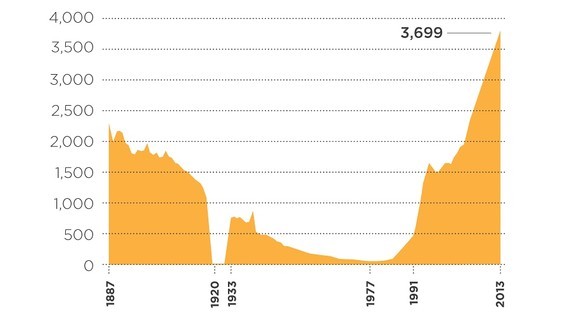
Moderation is the taste that stuck as the industry matured during the 20th century. Restrictions on grain use during wartime ruled out the widespread production of hoppy ales in the ‘40s, and the palates of a generation of American soldiers grew accustomed to the weak beer that was standard in military rations. These preferences were solidified by massive consolidation of the industry, which took place because only big, national producers could survive in a market with such low profit margins. In 1940, there were 684 breweries. In 1979, there were 44.
The Number of Active Breweries in the U.S., by Year
Beer Institute
The ‘70s only made American beer blander. After having tried and failed to launch lite beers in the ‘50s, national producers found success two decades later, when fad diets and calorie-consciousness had taken hold.
Why was it, though, that bland beer came to dominate in America, and not in most of Europe? Dighe says there are two reasons. First, those miners and factory workers who preferred light beers had weaker union protections than European workers, who had a bit more leeway when it came to showing up at work tipsy. The other reason, says Dighe, is the “uncommon strength and puritanism of the 19th century American Temperance movement, which, unlike its European counterparts, did not see beer as a temperate alternative to hard liquor.”
Of course, that’s not the end of the story. In the ‘70s, anyone whose tastes deviated even a tiny bit from the mainstream had few options outside of homebrewing. Glenn Carroll, a professor at UC Berkeley’s business school, saw that this left an important opening, as he wrote in a 1985 study, “Although it is premature to make predictions, the U.S. market appears ready for an upsurge of specialist breweries.” By relying on a passionate customer base that had no qualms spending a few extra dollars for a fuller-flavored beer, craft breweries could compete in a mass market with low margins. Carroll’s assessment proved prescient: The U.S. had two craft breweries in 1977, and 2,751 in 2012. Dighe predicts that this expansion will only continue, and beer will only become hoppier.
But, lest Jefferson finally rest easy, beer today by and large remains meagre and often vapid: Craft beers only account for about a tenth of the market.
GravityLight is an electric light that draws its power from gravity. You lift up a weight attached to the light and as it falls, it generates enough power to light the light for 20 minutes.
GravityLight is installed to provide a 6ft/1.8m drop of a 12kg weight. This weight is lifted and on release starts falling very slowly (about 1mm/second).
This movement powers a drive sprocket, which rotates very slowly with high torque (force). A polymer geartrain running through the product turns this input into a high speed, low torque output that drives a DC generator at thousands of rotations per minute.
This generates just under a tenth of a watt, a deciwatt, to power an onboard LED and ancillary devices. Given the ever-increasing efficiency of LEDs, this produces a light over 5 times brighter (lux) than a typical open-wick kerosene lamp.
Once the weighted bag reaches the floor, which depends on how high it was installed, it is simply lifted to repeat the process.
i did sort of think this wasn't a very well thought out plan, despite the obvious good intentions.
When Dan Price announced he was setting a minimum salary of $70,000 for his 120 employees, he didn’t foresee the turmoil it would cause for his business.
Let me preface this by saying that this article is not a cry out for Jurgen Klinsmann to be fired. Only an explanation of why I've lost faith in him.
Back in June 2011, like many United States supporters, I was completely over Bob Bradley. The 2011 Gold Cup felt like a team that wasn't responding to its manager anymore. A loss to Panama in the group stage, followed by a humiliating beatdown in the final at the hands of our most hated rivals. I, like a lot of other supporters wrote an e-mail to U.S. Soccer President Sunil Gulati pleading for him to find a new manager to change the direction of my favorite soccer team. Don't believe me? Here it is in all of it's typo'd glory:
In hindsight, I regret sending that e-mail. Not because I didn't think we needed a new manager, I still think we did at the time. But it was a childish and immature thing to do. Nevertheless, the e-mail found its way into Gulati's inbox and I received a generic "we'll examine all our options" type of response.
A month after that fanatical email was sent, U.S. Soccer announced that Jurgen Klinsmann would be hired as the new manager of the U.S. men's national team. I was extremely happy. Finally change was upon us and we were going to take that next step as a soccer nation.
From that day on I was a Klinsmann supporter. I truly believed he'd deliver on the promises of a "proactive" style and that he'd pick the perfect system and the right players to fit it. He had been the manager of Bayern Munich and the Germany national team, and one of the best strikers to ever play the game. Surely he'd finally bring the expertise needed to lift our country into soccer prominence after years of knocking at the door.
His first year in charge was a series of ups and downs. He began his tenure with only one win in his first six matches, then followed that with a five game win streak that included an away win against world power Italy. That 11-game stretch is truly a microcosm of Jurgen's time in charge of the national team. Peaks like steamrolling the competition in the 2013 Gold Cup and beating Germany twice in friendlies. Then valleys like the two most important tournaments of his reign, the 2014 World Cup and the most recent Gold Cup.
Heading into the World Cup last summer there was vast amount of pessimism surrounding the USMNT. Between drawing the so-called Group of Death and the way Klinsmann handled the Landon Donovan fiasco, not many had high hopes for our chances in Brazil. Despite the doubters, the U.S. advanced out of their extremely tough group by playing unattractive and desperately defensive soccer. The seemingly impossible task had been accomplished, but the fashion in which it was left a sour taste in many mouths.
The promise of a "proactive" style never came to fruition despite the team showing glances of collective brilliance during the cycle. Many were critical of Klinsmann after the way the U.S. got dominated by Belgium in the round of 16 loss.
I gave him a pass.
It was always the feeling that Klinsmann's tenure as manager was to rebuild the whole program from top to bottom. So, it only makes sense that his decision to bring younger players to the World Cup was a view towards the long term to the 2018 World Cup. So, we played terrible soccer? So, what? Our young players got much needed experience. This will surely help us for the upcoming cycle.
This World Cup cycle was Klinsmann's chance to start fresh. Pick any player in the pool he wants to match any formation or system he wants. I was still a Klinsmann supporter.
As this new cycle began we saw a lot of experimentation. With formations, with personnel, and with tactics. We saw the 4-3-3, the 3-5-2, the diamond midfield, and so on. We saw a plethora of young players get a chance to impress and some of them succeeded.
As we approached this Gold Cup, Klinsmann had a choice to make. Does he stick with the youth movement and continue to build for the future or does he pick the best roster to help him win the tournament at all costs?
Instead of committing to one or the other, he decided to try to kill two birds with one stone. He brought veterans Chris Wondolowski, Kyle Beckerman, and Graham Zusi. Then added DaMarcus Beasley and Alan Gordon to the roster after the group stage. Those names lead you to believe he decided to push all of his chips into the "win now" pile. Except that he chose to give inexperienced defenders John Brooks and Ventura Alvarado the majority of the minutes on the back line over veterans Omar Gonzalez, Tim Ream, and Matt Besler (who wasn't even called in).
This indecisive strategy cost the USMNT big time during the Gold Cup. They didn't look like a cohesive unit at any point during the tournament and we learned nothing about the team's future in this cycle. The inability to commit to a "win now" or "build for the future" plan is what makes the tournament failure such a disappointment. It's this type of inconsistency in strategy and mindset from Klinsmann that has frustrated even his most dedicated supporters.
Now we here we sit in the same exact situation as June of 2011. Embarrassed in the Gold Cup with a whole World Cup qualifying cycle in front of us. The question posed by many fans is this: Has Klinsmann been an improvement over Bob Bradley?
As much as I've defended him in the past, I cannot honestly say we're in a better situation now than we were four years ago. I've certainly lost my faith in him implementing some magical style or philosophy that will make everything better. The talent in the player pool is there. If he can't identify that talent and put it to better use, then what exactly is he being paid to do other than recruit dual-citizens?
Two USA teams and one Canada team, each consisting of four high school students, won eight individual medals and a team medal at the 13th International Linguistics Olympiad, held July 20-24 in Blagoevgrad, Bulgaria. The USA contestants also took five of the top ten places in the individual contest, including three gold medals. USA Red also finished in first place among 44 teams based on the combined score of its members in the individual contest.
The IOL, one of twelve international science olympiads, consists of two events. The first is the individual contest, a six hour exam with five problems, which this year focused on Kabardian, Wambaya, Somali Masafo, Nahuatl, and Arammba, as well as on Soundex, an algorithm for phonetic classification of names. The team contest is the second event of the IOL, in which team members collaborate to solve one particularly challenging problem. This year, teams were tasked with translating excerpts from a Northern Sotho dictionary. Problem solving at the IOL stresses the ability of contestants to decipher the mechanisms of languages by using logic and reasoning to explore a wide range of hypotheses.
Individual Round: Three US contestants, James Wedgwood of Washington, James Bloxham of Massachusetts, and Kevin Yang of Washington, won gold medals in the individual round, with James Wedgwood also earning the top individual score from among 165 contestants from 29 countries. Silver medals went to three US contestants, Kevin M Li of California, Conor Stuart-Roe of North Carolina, and Julian Gau of New Jersey. Nilai Sarda of Georgia and Emma McLean of Nova Scotia won bronze medals. Finally, Kevin Q Li of New Jersey, Ben Zhang of Ontario, and James Hyett of Ontario were awarded honorable mentions. James Bloxham and James Wedgwood received best solution awards for Problem 3 and Problem 5, respectively. Team USA Red’s combined scores on the individual score were the highest of any team. The two US teams (Red and Blue) had a massive average score of 62 points, way above all other teams; the United States has held the 'blue cup' which goes to the highest combined individual score for six of the last nine years.
Team Round: Team USA Red finished second on the team problem, following Team UK West. Team Poland White and Team Netherlands tied for third place.
There were 1,700 participants in total this year.
The USA team's coaches were Dragomir Radev and Lori Levin; the Canadian team's coach was Patrick Littell. This year's problems are here. Information about the program in general, and about past competitions, is available on NACLO's web site.
i probably already mentioned that gabe worked on this. he's sporting a netflix branded WHAS sweatshirt these days.
Netflix
At some point, given time, word of mouth, and endless rewatching, a cult classic evolves into a universally beloved media property. Netflix, it seems, has become the arbiter of that transformation—first and most notably by reviving the adored-but-prematurely-canceled Arrested Development for a fourth season. Now the service is continuing this effort by turning the 2001 comedy Wet Hot American Summer, a critical and commercial bomb on its release, into an eight-episode prequel miniseries. Though it all but vanished without a trace on release, Wet Hot’s shaggy, surreal charm and its cast of future stars have helped it endure over the years, and despite its bizarre positioning, the Netflix edition hasn’t missed a beat, even 14 years later.
The show comes from David Wain and Michael Showalter, who wrote the original film, with Wain directing. Playing into the ridiculousness of making a sequel to a 2001 comedy about summer camp whose actors were already too old to be playing teenagers, Wet Hot American Summer: First Day of Camp doubles down by being set before the original film, even though Showalter (who stars as camp counselor Coop) is now 45 years old, and the rest of the ensemble isn’t far behind. Thus, the show thumbs its nose at anyone who might question its need to exist, but it goes a step further and invests its plot with real purpose. Those watching the first film likely didn’t wonder at the backstories of its ensemble, but First Day of Camp nonetheless has delightfully convoluted arcs for everyone involved. It seems silly at first, but true to the Netflix binge-watch model, the structure fuels the impulse to watch the next episode, and the next.
From the dawn of its original programming, the network has analyzed reams of data from its streaming customers to figure out what kind of shows they’d enjoy best, and no doubt the enduring popularity of Wet Hot American Summer and its now-famous ensemble were reason enough to justify First Day of Camp. Discovering the film was a cult comedy rite of passage for many people: Whether you were a teenager, a college student, or just someone clicking around Comedy Central late at night, it felt like joining a secret club. Some of the cast—Paul Rudd, Molly Shannon, Janeane Garofalo, David Hyde Pierce—were already recognizable. Others—Amy Poehler, Bradley Cooper, Ken Marino, Joe Lo Truglio—became famous later, but their participation in the film was a special badge of honor. The existence of First Day of Camp is the final confirmation of what the film’s fans already knew—that it had evolved past “cult” to just become a regular comedy classic.
But even if you haven’t seen the film, First Day of Camp is probably going to be an enjoyable watch, because it shines with the genial silliness that made the original film so instantly lovable. Not every joke lands, but there’s always more following close behind to make up for it. The ensemble is so vast that there's some fun in waiting whole episodes for some favorite characters to show up. And there’s also a perverse game to be played in seeing just how well or poorly actors have aged in the intervening years—Paul Rudd is clearly possessed of some magical formula for youth, while others struggle to even keep their wigs on their heads.
Netflix’s nefarious metrics aside, Wain and Showalter should be credited for not treating First Day of Camp as an opportunity for a cheap nostalgia cash-in. Much like the ambitious, plot-heavy fourth season of Arrested Development (which Netflix revived in 2013, seven years after Fox cancelled it), they’re aiming high rather than just bouncing around the same jokes fans remember. Remember the talking can of vegetables from the movie? First Day of Camp shows you exactly how that came about. Why was the astrophysicist Henry Newman (David Hyde Pierce) living nearby Camp Firewood? All will be explained. Did you think Elizabeth Banks’s character had a mysterious secret identity? Well, she does, and it’s one of the prequel’s best and most bizarre running threads.
First Day of Camp has avoided other pitfalls. Arrested Development’s fourth season got bogged down in investigating how time passed for its characters during the cancellation period, and was hamstrung by its ensemble’s busy schedules (the main characters barely appeared together onscreen). Whole episodes would concentrate on the story of a single character, robbing the show of its best quality: the cast’s chemistry as a group. First Day of Camp flits between its many cast members with greater ease and dodges any questions of “what have they been up to?” by flashing back in time. The result is ridiculous, but at no point does First Day of Camp feel like it’s struggling to justify its existence. You can put the nostalgia aside, and it’s still the best TV comedy of the summer.
At the end of the summer, teachers across the country will return to work. They’ll clean off old desks in poorly lit classrooms, filled with supplies paid for with their own paychecks. Soon after, kids will arrive, rambunctious from weeks of break but happy to see friends again.
Somehow, I’ll bet those teachers will show their kids this video.
The comedians Keegan-Michael Key and Jordan Peele have produced a pitch-perfect parody of ESPN’s Sports Center, with a twist—it’s not about professional athletics, but about professional educators. The plea that Americans care more about sports than civics is a common one, as Aisha Harris writes at Slate, yet Key and Peele have managed to make it seem fresh through their sheer enthusiasm and attention to detail.
I mean, stick around for that fake BMW ad at the end. Or for the “highlight of the day.” Or for the pair’s remarkable echo of ESPN Anchor Voice. This is a video that rewards multiple viewings.
There’s a double critique here, too. The pair clearly love good teaching, but could their focus on test scores hint that the country’s own obsession with them flows from its obsession with sports? Education, unlike football, is neither a spectator sport nor a zero-sum game.
Professional designers and futurists have a concept called “design fiction.” Design fiction is an object or media product that seems to come from the future, something that lets viewers ask questions about the world in which they live. We’re only halfway through 2015, but I’m ready to predict that, without even meaning to, Key and Peele have produced the year’s most-watched—and possibly most already-beloved—piece of design fiction.
The heavily-used William Frederick Hayden Park in the foothills of Green Mountain were bombarded with artillery shells from roughly 1935 through the end of World War II for Colorado National Guard war-time training exercises.
now he's just feeding the conspiracy theories. awesome!
President Obama took on one of the region’s most enduring obstacles to democratic progress: its history of one-man rule by leaders who enrich themselves and hang onto power.
Something is awry at the Rand Paul campaign. The main super PAC supporting his presidential bid raised just $3.1 million in the first half of 2015....On Sunday, a new NBC News/Marist poll showed support for the Kentucky Republican declining to just 4 percent in New Hampshire (compared with 14 percent in February).
....The more worrying problem for Paul is his favorability numbers: They’re also dropping....Over the first five weeks of 2015, Paul’s favorable rating averaged 62 percent among Republicans. Just 14 percent had an unfavorable view of him. Over the five most recent weeks, though, Paul’s favorable rating has averaged 52 percent, with an unfavorable rating of 27 percent. His net favorability rating (favorable minus unfavorable) has dropped by nearly half, from +48 percentage points to +25 percentage points.
Enten's question: "What’s Wrong With Rand Paul’s Campaign?" I think we all know the answer.
Rand's father, Ron Paul, always attracted a fair amount of money and a fair amount of steady support. Not huge amounts, but respectable. The reason was that he was never seriously running for president. He just liked having a stage for his ideas, and since he wasn't trying to win, he could stay as true to his libertarian beliefs as he wanted. He had no need to waffle.
But son Rand has bigger plans. He is seriously running for president, and that means he has to pay attention to the aspects of his political views that just aren't going to play well with important blocs of Republican voters. From the start he was never quite as pure a libertarian as dad, but now he's discovering that he can't even be as pure a libertarian as he's been in the past. So he waffles. He changes his views. He spends time looking at polls. He worries about saying things that will piss off the white evangelicals, or the elderly, or the pragmatic business set. The result is that the folks who admired him for his principled libertarianism are dropping him, while the rest of the Republican Party has yet to warm up to him. After all, he is the guy who said the ongoing chaos in Iraq was the fault of the Republican president who started the Iraq War, not Barack Obama. He's also the guy who wanted to eliminate aid to Israel. And he's the guy who wanted to gut Medicare for everyone—even the folks currently receiving it.
He's kinda sorta changed his mind on all these things, but that makes him look like a sellout to the libertarian crowd and a opportunistic panderer to the tea party crowd. Is it any wonder his poll numbers have tanked?



 law that created the sentencing disparity between crack and powder cocaine. And in 1994, it was the CBC that saved President Clinton's crime bill after an unexpected loss on a procedural vote.
 and aughts. But again, at the time no one knew this. In 1994 no one had even an inkling that lead might be the culprit for high crime rates.
 opinion that went further, ruling that many other speech regulations are now subject to "strict scrutiny."









/cdn0.vox-cdn.com/uploads/chorus_asset/file/3908250/Untitled.0.png)



 minus unfavorable) has dropped by nearly half, from +48 percentage points to +25 percentage points.