Shared posts

06 Oct 15:03

New Bernie Sanders Polls Show He Could Win

by Jamelle Bouie
kurtadb

i have this idea that once we have a nominee and obama (or both obamas, actually) starts stumping for him/her, a lot of this is going to look academic. i think obama and bill clinton rallying the base is going to be a huge advantage next year.

America’s most famous socialist might be more electable than he looks.

In the swing state of Iowa, according to the latest poll from NBC News and the Wall Street Journal, Bernie Sanders leads Donald Trump by 5 points and trails Jeb Bush by just 2 points. In purple New Hampshire, likewise, Sanders leads Trump by 10 points, and is tied against Bush. By contrast, both Trump and Bush lead Hillary Clinton—the presumptive Democratic nominee—in Iowa, and Bush stands ahead of Clinton in New Hampshire by 7 points.

This comes after a national Quinnipiac survey last month showed Sanders similarly competitive nationally with the most visible Republican presidential candidates: He tied Bush with 44 percent, led Trump by a margin of 47 percent to 42 percent, and barely trailed Carly Fiorina, 44 percent to 43 percent. In each instance, other than against Fiorina, Clinton performed worse. In other words, if Sanders had an electability gap with Hillary, he’s closed it.

Of course, there are caveats. At this point in an election, head-to-head polls gauge sympathy and feeling; they can’t predict an outcome. We don’t know how Sanders would look in a national campaign, against a unified Republican Party. Likewise, when it comes to Clinton’s weakness, we don’t know how she would look if she were the nominee. Given her place in the national Democratic primary—a solid, double-digit lead over Sanders—there’s a chance that her poor numbers reflect ambivalence from potential supporters, not outright opposition. Which is just to say that, to many Americans, the 2016 presidential election is still hypothetical, and when you ask them to choose between candidates, you’re asking for a gut reaction more than a considered choice.

But that’s not to dismiss Sanders. Even if his base—college-educated workers and liberal whites—reflects the extent to which he occupies a traditional left-wing role that has appeared in past Democratic presidential primaries, it’s meaningful that a self-described “democratic socialist” on the periphery of American politics is tied in two swing states with a man who has the same last name as two former presidents. Nor should anyone ignore the massive crowds that flock to every major Sanders campaign event; on Saturday, 20,000 people came to the Boston Convention Center to hear the senator speak, one of the largest presidential primary crowds ever assembled in Massachusetts.

Indeed, there’s evidence that Sanders’ appeal might go beyond liberals. Writing for the Washington Post, David Weigel found a friendly reception for the Vermont senator in working-class West Virginia, where white Democratic voters rejected Barack Obama in the 2008 and 2012 presidential elections.

In Morgantown, home to West Virginia University, a 62-year old activist named Andy Cockburn went to an early organizing meeting for Clinton and found only 10 other people. In July, when Morgantown hosted one of several hundred Sanders house parties, more than 100 people packed a bar basement and started organizing. […]
“The whole feeling is that the parties have left the people,” said Doug Epling, a 73-year old businessman in Beckley with close ties to West Virginia’s elected Democrats. “We do need help from the federal government. Sanders is the only one that’s offered anything that I’ve heard.”

Yes, this is anecdotal, which makes it impossible to extrapolate to the broader general election contest. It’s possible that, outside the contours of a Democratic primary race, Sanders’ left-wing views will alienate white working-class voters. But if you take all the anecdotes and information together, you begin to see the outlines of a “Sanders coalition” in the Democratic Party: Predominantly white, with a connection to the white working class, and forged around core economic concerns. If durable, it’s the kind of coalition that could force Hillary Clinton into a more serious contest for votes, if not delegates.

There are a couple of takeaways from this early dynamic. First, if Sanders is ahead in early primary states, it’s because of men. In Iowa, as of a mid-September poll from YouGov and CBS News, Sanders led Clinton by 18 points among men, compared to just 5 points among women. In New Hampshire, noted the same survey, Sanders led Clinton by a whopping 38 points among men. And in a recent national poll from CNN, Sanders and Vice President Joe Biden combine for 53 percent of the male Democratic vote, to Clinton’s 34 percent. It’s possible that, if Sanders can build a durable coalition for the primary, it will center on moderate and liberal men more than any other demographic group. If Sanders and Clinton continue on their respective trajectories, then the 2016 Democratic primary may fracture on gender in more dramatic ways than it did in 2008.

Second, it’s not clear that Sanders could carry his coalition into a general election. After two terms of Barack Obama and two elections driven by nonwhite voters, the Democratic Party is fully tied to minority voters. As we’ve seen in those elections—as well as in state and local contests across the country—this makes it hard to extend the Democratic coalition to white voters, and working-class whites in particular. Bernie Sanders the Democratic outsider might win with working-class whites, especially those estranged from the GOP. But Bernie Sanders the Democratic standard-bearer—backed by a heavily black and Latino coalition—may have a much harder time.

Read more of Slate’s coverage of the 2016 campaign.

05 Oct 17:01

Blog: At Colorado college, a ban on the words 'God,' 'Jesus,' and 'Lord'

The Colorado School of Mines has taken speech codes to a nonsensical level.  More than that, they are making it up as they go along.

Those are the only conclusions you can draw from a the events surrounding a suit filed by a former football player at the school who wanted to donate money to the athletic department.  What happens next reads like a dystopian nightmare.

Daily Caller:

Michael Lucas donated $2,500 to the Colorado School of Mines for a new athletic facility. In exchange for the donation, the school allows donors to have whatever they like inscribed on a nameplate that will go in the football locker room.

Everything from “Give ‘Em Hell” to “OK Gentlemen, it’s time to gird your loins” has been approved by the university, which receives public funding. But when Lucas submitted two Bible verses for his nameplate, he says the school refused, saying the words “Lord,” “God,” or “Jesus” cannot be on the nameplates. On top of that, he said Bible verses that include those words are also banned.

Lucas wanted Colossians 3:23 and Micah 5:9 on his donor plate, just the verse citations, not the actual text of the verse.

Colossians 3:23 reads “Whatever you do, work at it with all your heart, as working for the Lord, not for human masters.”

Micah 5:9 reads “Your hand will be lifted up in triumph over your enemies, and all your foes will be destroyed.”

That use of the word “Lord” in one verse was too much for the school, so now Lucas has teamed up with the Christian legal group Alliance Defending Freedom to file a federal lawsuit.

“Public colleges and universities should encourage, not shut down, the free exchange of ideas, especially in a forum like this,” ADF Legal Counsel Natalie Decker said in a statement. “The school initially imposed no restrictions – or even guidelines – on the type of message a donor could include, and contrary to what the school is arguing, the First Amendment protects – not restricts – a simple reference to a Bible verse. It’s patently ridiculous to argue that a Bible reference that doesn’t include the text of the verse is somehow inappropriate simply because someone might look it up and see that ‘Lord’ is mentioned there.”

After you pick your jaw off the floor, consider this: about 90% of the country believes in God, and 71% of America calls itself Christian, makling "Jesus" an acceptable word to the overwhelming majority of the country.

And "Lord"?  I suppose writing about "lords and ladies" would be considered verboten at the school.

School administrators are obviously mentally ill.  Perhaps not "straitjacket, bouncing off the walls of a mental institution" mentally ill, but certainly requiring years of therapy.  Only a diseased mind could come up with these strictures – or a radically militant group of hysterical atheists.  Needless to say, they should be sent back to grade school and instructed in the meaning of the First Amendment. 

Are we reaching peak stupidity in speech codes on campus?  It really doesn't get much worse than this, although I wouldn't be surprised if some other school tops it next week.  What's absolutely amazing to me is that most of the docile, sheep-like students and professors on campus are sitting on their hands while their rights are trampled on. 

And the scary thing is that they may even agree with the stance taken by school administrators.

The Colorado School of Mines has taken speech codes to a nonsensical level.  More than that, they are making it up as they go along.

Those are the only conclusions you can draw from a the events surrounding a suit filed by a former football player at the school who wanted to donate money to the athletic department.  What happens next reads like a dystopian nightmare.

Daily Caller:

Michael Lucas donated $2,500 to the Colorado School of Mines for a new athletic facility. In exchange for the donation, the school allows donors to have whatever they like inscribed on a nameplate that will go in the football locker room.

Everything from “Give ‘Em Hell” to “OK Gentlemen, it’s time to gird your loins” has been approved by the university, which receives public funding. But when Lucas submitted two Bible verses for his nameplate, he says the school refused, saying the words “Lord,” “God,” or “Jesus” cannot be on the nameplates. On top of that, he said Bible verses that include those words are also banned.

Lucas wanted Colossians 3:23 and Micah 5:9 on his donor plate, just the verse citations, not the actual text of the verse.

Colossians 3:23 reads “Whatever you do, work at it with all your heart, as working for the Lord, not for human masters.”

Micah 5:9 reads “Your hand will be lifted up in triumph over your enemies, and all your foes will be destroyed.”

That use of the word “Lord” in one verse was too much for the school, so now Lucas has teamed up with the Christian legal group Alliance Defending Freedom to file a federal lawsuit.

“Public colleges and universities should encourage, not shut down, the free exchange of ideas, especially in a forum like this,” ADF Legal Counsel Natalie Decker said in a statement. “The school initially imposed no restrictions – or even guidelines – on the type of message a donor could include, and contrary to what the school is arguing, the First Amendment protects – not restricts – a simple reference to a Bible verse. It’s patently ridiculous to argue that a Bible reference that doesn’t include the text of the verse is somehow inappropriate simply because someone might look it up and see that ‘Lord’ is mentioned there.”

After you pick your jaw off the floor, consider this: about 90% of the country believes in God, and 71% of America calls itself Christian, makling "Jesus" an acceptable word to the overwhelming majority of the country.

And "Lord"?  I suppose writing about "lords and ladies" would be considered verboten at the school.

School administrators are obviously mentally ill.  Perhaps not "straitjacket, bouncing off the walls of a mental institution" mentally ill, but certainly requiring years of therapy.  Only a diseased mind could come up with these strictures – or a radically militant group of hysterical atheists.  Needless to say, they should be sent back to grade school and instructed in the meaning of the First Amendment. 

Are we reaching peak stupidity in speech codes on campus?  It really doesn't get much worse than this, although I wouldn't be surprised if some other school tops it next week.  What's absolutely amazing to me is that most of the docile, sheep-like students and professors on campus are sitting on their hands while their rights are trampled on. 

And the scary thing is that they may even agree with the stance taken by school administrators.

04 Oct 19:13

Jim O'Rourke: Simple Songs

kurtadb

sadly not on spotify.

There was a time, from the late 1990s to the mid–2000s or so, when Jim O’Rourke sat at the center of a peculiar intersection of experimental, indie rock, and…
02 Oct 20:48

Mass Shootings Are Not the Real Problem

by Jamelle Bouie

There are two truths about gun homicide in America.

The first is that we have a mass shooting problem. On Thursday, 26-year-old Chris Harper Mercer opened fire on a community college campus in Roseburg, Oregon. He killed 9 people and wounded 7 others—allegedly singling out Christian students—before he was killed in a shootout with police.* “Roseburg” joins “Charleston, “Isla Vista,” “Newtown,” “Aurora,” and “Oak Creek” on the long list of small towns and quiet cities marred by horrific gun violence.

It’s one reason President Obama was visibly angry in his brief remarks on the shooting. This, after all, was another address to give to another shattered community with another set of grieving families. “[A]s I said just a few months ago, and I said a few months before that, and I said each time we see one of these mass shootings, our thoughts and prayers are not enough. It’s not enough,” said Obama. “[I]t does nothing to prevent this carnage from being inflicted someplace else in America—next week, or a couple of months from now.” He continued: “This is a political choice that we make to allow this to happen every few months in America. We collectively are answerable to those families who lose their loved ones because of our inaction.”

And it’s too many families. Under the broad definition used by ShootingTracker.com, no calendar week during Obama’s second term has passed without a mass shooting incident. In the 274 days between the first of the year and the beginning of October, there were 294 mass shootings, claiming hundreds of lives. Before Roseburg, it was Roanoke, Virginia. Before Ronaoke it was Lafayette, Louisiana. And so on.

Highly visible, these shootings are the focal point for most of our national conversation on gun control. The last serious legislation for universal background checks came just after the murder of 20 6- and 7-year-olds and six adult staff members at an elementary school in Newtown, Connecticut, which resulted in national calls for new action. (It died in the Senate at the hands of a GOP-led and blue-dog Democrat–supported filibuster.) But as much as the attention makes sense, it also obscures that second truth about gun homicides in America: Ending mass shootings won’t solve the problem.

Between 2009 and 2013, 44,077 people were murdered with guns, according to the FBI. Just a fraction of those came from Roseburg-style incidents. Many more were domestic violence against women. But the large majority involved the deaths of men, and of those, most involved poor black Americans in inner cities and other marginalized areas. “From 1980 to 2013, 262,000 black males were killed in America,” writes Jeffrey Goldberg for the Atlantic. In general, when we talk about gun homicide in the United States, we are largely talking about violence between poor black men.

Too many observers treat this as intractable problem, a product of pathologies and indifference. “[Obama] also should have spent 15 minutes on training the [black] community to stop killing each other,” said former New York Mayor Rudy Giuliani after President Obama spoke on Ferguson last year. But there is no pathology or uniquely black problem. Like most social problems, high homicide rates in poor black communities—“black-on-black crime”—are a product of specific, contingent inputs: “[s]egregation, economic isolation, and the flawed workings of American criminal justice,” writes journalist Jill Leovy in Ghettoside: A True Story of Murder in America.

Segregation forces intimacy and creates conflict, while economic isolation leads to illegal markets—like the drug trade—where there is no legal recourse for disputes. These, by themselves, are conditions under which homicide flares. But there’s also the particular history of segregated black communities and law enforcement. For most of America’s post-Emancipation history, officials were indifferent to violence against blacks, either from whites or from other blacks. “When people are stripped of legal protection and placed in desperate straits, they are more, not less, likely to turn on each other,” says Leovy. Taken together, these conditions breed violence, which is why black homicide rates have always been higher than ones for whites. (Or why, to move away from race, the American frontier was defined by its violence—isolation with desperation and without strong legal authority equals homicide.)

To all of that, add guns. Patchwork gun laws within and between states means there’s no way to keep guns out of a given area. Chicago, for instance, has strict gun laws. But surrounding counties and states don’t. Cheap firearms—through theft, illegal sales, or extended networks of legal buyers—make their way into the city, where they’re used for crime. And while guns don’t necessarily cause violence, they (predictably) increase the lethality of conflicts, causing more deaths.

Put simply, our focus on Roseburg-style shootings—as much it makes sense—obscures the extent to which most victims of gun homicide are poor, black, and live in America’s most isolated communities. Moreover, the steps we could take to reduce those homicides—removing millions of handguns from circulation, preventing illegal sales, reforming police departments to solve more homicides (and deter potential shooters)—don’t have much to do with ending mass shootings. Likewise, the steps to reduce mass shootings—universal background checks, stronger mental health services, liability insurance for gun owners—won’t do much to reduce the nation’s gun homicide problem (although it could reduce our other gun problem—suicides).

Here, it’s tempting to quip about the lack of black faces in our gun conversations and how America isn’t energized—or seemingly interested—in bringing its wealth and power to bear on the problems of inner cities. But, as Obama made clear in his Thursday remarks, Americans aren’t prepared to do anything against gun violence, period. We’re not just captive to broken systems and implacable opposition; we’re either paralyzed in the face of one kind of atrocity or blind to another, much more common one.

See more of Slate’s coverage of the Oregon shooting.

*Correction, Oct. 2, 2015: This article originally misstated that Chris Harper Mercer killed 10 people in the attacks. (Return.)

30 Sep 17:09

Broncos to unveil Bud Light Twitter vending machine at Sports Authority Field

by
kurtadb

i refuse to read this because i don't even want to know, but what the eff is a bud light twitter vending machine?

Sports Authority Field at Mile High will have a Bud Light Twitter vending machine. (Doug Pensinger, Getty Images)The Broncos will unveil a new toy at Sports Authority Field on Sunday when they
30 Sep 16:05

70s cocaine paraphernalia advertising

by Jason Kottke
kurtadb

crazy

Before the Reagans cranked up the War on Drugs in the early 80s due to the massive influx of cocaine from Latin America, advertisements offering all kinds of coke paraphernalia could be found in magazines. The World's Best Ever collected a bunch of ads offering spoons, mirrors, straws, knives, and the like for America's coke sniffers.

Cocaine ads

Cocaine ads

I am an episode and a half into Narcos on Netflix. Pretty good (but not great) so far.1 (via adfreak)

  1. They should have found a way to do it without the voiceover. Too much telling and not enough showing. (I have a thing about voiceovers. My first exposure to Blade Runner was Ridley Scott's Director's Cut, which omitted Deckard's voiceover, and when I started watching the original version on TV a few months ago, I nearly threw the remote through the screen...so grating and entirely unnecessary.)

Tags: advertising   Blade Runner   cocaine   drugs   movies
29 Sep 20:05

Beware the kettle sour beer

by
kurtadb

you must have that shirt, mike.

Death to Kettle Sours T-shirt (Photo from http://teespring.com)A small battle has erupted in the craft beer world over one of the hottest styles of beers -- sours.
28 Sep 20:20

Why You Hate Google’s New Logo - The New Yorker

“Why You Hate Google’s New Logo,” by Sarah Larson (September 3rd) Credit PHOTOGRAPH BY JUSTIN SULLIVAN / GETTY At the Forty-second Street F station, in…
28 Sep 15:17

Denali and the Names of the Past

North America’s highest peak, formerly known as Mount McKinley, will now go by its older, First Nations name. Credit PHOTOGRAPH BY BILL BRIDGES / THE LIFE…
28 Sep 15:15

The Three Types Of Anne Hathaway Movies

Anne Hathaway is out this weekend with “The Intern,” a movie that also stars Robert DiNiro in a delightful role-reversal: Hathaway plays a stressed-out boss, and DiNiro an intern. That’s the extent of the joke. And judging by the trailer, the movie doesn’t get any more sophisticated than that.

“The Intern” doesn’t seem like a great movie: It’s earned a middling score of 55 percent fresh on Rotten Tomatoes, and we’re still in September, a traditional dump-month for movies that don’t test well. “The Intern” is, on the other hand, a fantastic opportunity to look at the career of Hathaway, one of the best and, oddly, most polarizing actors working today.

Riffing on our previous Hollywood Taxonomy coverage, I used Rotten Tomatoes and OpusData to find the critical reception and box office performance, respectively, of all the movies that had Hathaway in a starring role. Since Hathaway is adept in an ensemble cast and often still manages to steal the scene even in smaller parts, I also included her supporting roles.

The best I could do was sort them into these three relatively distinct categories:

hickey-datalab-hathaway-1

Failed Rom-Coms

“Welcome to the graveyard of ambition.”

— Emma, “One Day”

Films: “The Other Side of Heaven” (2001); “The Princess Diaries 2: Royal Engagement” (2004); “Passengers” (2008); “Bride Wars” (2009); “Valentine’s Day” (2010); “One Day” (2011); “Song One” (2015).

Alright, so there’s a little more genre nuance going on here than merely failed romantic comedies, but none of these movies were particularly good, and all of them were predictable films with a prominent romantic plot. All of these movies made less than $120 million at the domestic box office and had less than 40 percent fresh on Rotten Tomatoes. Those are not numbers you want to see.

There’s “Song One,” a 36-percent fresh romantic drama about Anne Hathaway and her comatose boyfriend. There’s “The Princess Diaries 2,” a 25-percent fresh romantic comedy about Anne Hathaway and her aristocratic boyfriend.1 There’s “The Other Side of Heaven,” a 29-percent fresh movie about Anne Hathaway and her adventurous Mormon boyfriend.

You get the idea.

At 18 percent fresh,“Valentine’s Day” is the second-lowest rated film Hathaway’s ever appeared in. It’s an ensemble-cast movie, featuring a subplot where Topher Grace can barely cope with Hathaway’s career as a phone sex operator. This film includes some very antiquated views on the agency of sex workers, and, at the same time, strains the viewer’s suspension of disbelief with the idea that Grace could ever consider himself too good for Hathaway.2

All these films are ripe for ridicule, but they’re innocent attempts at classic character arcs that just didn’t work out so well.

Instead, I want to focus on “Bride Wars,” the lowest-rated film (10 percent fresh) that Hathaway has ever appeared in, and which may very well be the worst movie I’ve never seen. Please enjoy the trailer:

That scene where the brides tackle each other is the climax of the film, but somehow made it into the preview. The gist is that Hathaway and Kate Hudson are best friends until the worst wedding planner in America makes a bush-league mistake and schedules their weddings for the same day. No problem, this conflict is easily resolved through a 30-second conversation between rational adults, right?

Wrong. Rather than do what normal humans in a 20-year friendship would do, they decide to sabotage each other’s weddings in this 89 minute3 comedy. Everyone is miscast: One of the couples consists of Hathaway — a go-getter who fights for herself in the real world — playing a meek fiance to Chris Pratt’s character, an unredeemable ass with no endearing qualities or even an iota of charm.4

It comes down to this: Hathaway is very good in the movies she is in, but in retrospect some of those movies aren’t that great.

Inoffensive Family Films

“Me, a princess?“

— Mia Thermopolis, “The Princess Diaries”

Films: “The Princess Diaries” (2001); “Ella Enchanted” (2004); “Hoodwinked” (2006); “Becoming Jane” (2007); “Get Smart” (2008); “Love and Other Drugs” (2010); “Rio 2” (2014).

This cluster of movies is the rock on which the Anne Hathaway™ Brand was built. I don’t even have cable, and I can tell you for a fact that at least one of these movies will soon be airing — or was recently aired — on some network with “family” in the title.

These films each made less than $150 million domestically and got in the ballpark of about 50 percent fresh on Rotten Tomatoes, ranging from 46 percent on the low end (“Hoodwinked”) to 57 percent on the high end (“Becoming Jane”).

You can trace much of Hathaway’s initial work to her breakout role in “The Princess Diaries” as a fish-out-of-water “commoner,” a formula Hathaway would lean on repeatedly in the following several years.

“The Princess Diaries” has a mediocre 47 percent fresh rating and is the ultimate in awful childish wish-fulfillment. It’s “Harry Potter” for a society that realized magic is dead and the only reliable guarantee of happiness on this forsaken earth is inherited dynastic wealth.5

The only film in category that doesn’t neatly fit under “inoffensive family films” is “Love and Other Drugs,” the pharmaceutical romance movie. Let’s be real though, our society’s most watched cable networks are essentially funded by erection pill advertisements, so it’s hard to still be scandalized by this one. (Underrated film, for what it’s worth.)

Hathaway realized, though, that you can only make so many movies like this. Because then she burned down the family-friendly schtick and took her career to a fantastic new level.

She Dreamed A Dream

“No, I don’t want to quit. That’s not fair. But, I, you know, I’m just saying that I would just like a little credit… for the fact that I’m killing myself trying.”

— Andy Sachs, “The Devil Wears Prada”

Films: “Brokeback Mountain” (2005); “The Devil Wears Prada” (2006); “Rachel Getting Married” (2008); “Alice in Wonderland” (2010); “Rio” (2011); “The Dark Knight Rises” (2012); “Les Miserables” (2012); “Girl Rising” (2013); “Interstellar” (2013).

Hathaway got serious, and it’s been amazing.

The turning point is generally considered 2010 or 2011 — probably “Love and Other Drugs” smashed some of the princess vibe she had cultivated in the preceding 10 years — and she’s been on a tear since, with critically acclaimed roles in critically acclaimed movies, entree into director Christopher Nolan’s shortlist of preferred actresses, roles that require immense depth, and an Academy Award all her own for a notoriously short appearance in a notoriously long movie.

What prompted the change? “The Devil Wears Prada,” 75 percent fresh rating, might be the most instructive place to look. It’s the earliest film in the set where Hathaway has a leading role, and it shows the hardening of a doe-eyed newcomer into an achieving machine beset on all sides by adversaries who want nothing more than to sabotage her.

Sound familiar?

Either way, these are fantastic films. “Alice In Wonderland” saw Hathaway once again stand beneath a crown, but this time with some nuance and madness. She was the heart of “The Dark Knight Rises,” a tour-de-force in “Les Miserables,” and acted the hell out of the worst dialogue written in “Interstellar.”6 These films either made a ton of money (“Alice in Wonderland,” $363 million) got great reviews (“Les Miserables,” 70 percent fresh) or both (“The Dark Knight Rises” made $462 million and earned 87 percent positive ratings).

This is the kind of Hathaway that makes people jealous.

Categorizing Hathaway’s filmography comes down to quality much more than money, but it’s very difficult to nail down any kind of trajectory: Hathaway made “Bride Wars” three years after “The Devil Wears Prada,” but then turned around and made “Alice in Wonderland.”

Here’s her box office and Rotten Tomatoes scores plotted as a function of time:

hickey-datalab-hathaway-2

No change over time, no discernable trajectory that isn’t merely related to “The Dark Knight Rises” being really good and making lots of money. In a given year, it’s just as likely Hathaway will star in a frilly turd of a romantic comedy as it is she will appear in an Academy-Award nominated turn of greatness. She’s the Targaryen dynasty of movies — whether it’s great or it’s terrible, she’s going to play it all the way.

That means the “The Intern” may suck (and it probably sucks, barring a brilliant twist or a terrifically inaccurate trailer.) But unlike with other actors, it doesn’t mean that Hathaway is on the way down. It just means she’s doing something different this time, and will be back again sometime next year with a prepared awards speech.

Check out the other actors we’ve profiled in Hollywood Taxonomy.

25 Sep 17:28

*By Steppe, Desert, and Ocean: The Birth of Eurasia*

by Tyler Cowen

By Barry Cunliffe, due out in November.  I’m counting the days…

24 Sep 18:38

The post office needs to fill 900 Front Range jobs

by
kurtadb

900!?!? to clarify, the article says about 1/2 are only seasonal. but still.

USPS mail carrier J.B. Dillon sorts mail to be delivered to customers on his Longmont route.
24 Sep 14:42

It Might Be Time to Rethink How We Do Emissions Testing

by Kevin Drum
kurtadb

yeah, this is very cool. go colorado!

This sounds cool. Max Ehrenfreund writes today about Gary Bishop, a research engineer at the University of Denver, who has been working on real-life emissions testing for cars:

Bishop's laboratory has developed a roadside sensor, which he and his colleagues have been using for more than a decade to see how cars actually do on the street in several major cities....Authorities are now using the sensors in and around Denver and in a few other states as a supplement to conventional testing. The state sets up the sensors at highway on-ramps and elsewhere along the road. Drivers don't stop. They just roll between two rows of cones while a camera records the car's license plate and the equipment registers the emissions from the tailpipe, and go on their way. If a car produces at least two passing grades, the driver is spared the trip to the inspection station.

How about that. Can we get this in California, please? Of course, there's also this:

One of the cities where Bishop has worked is Tulsa, Okla., where emissions tests have never been required. The group has found that emissions from the cars in Tulsa are no worse than emissions in other cities where standards are enforced.

That's true. In a 2007 paper, Bishop concluded that emissions reductions have been about the same everywhere he's tested, regardless of whether periodic inspections are required. So maybe we need to ditch the big-government regulations that mandate the inspection regime altogether. Instead we could rely on spot checks of real-world emissions as a way of holding auto manufacturers accountable for complying with EPA standards, which suddenly seems like it might be the real problem after all. Let's get Jeb Bush on this.

22 Sep 01:06

Slither Inn (Open Thread)

by Betty Cracker
kurtadb

i encountered quite a few garter snakes this weekend doing yardwork. also harmless and beneficial -- but i can't stand them. now i feel like i'm seeing snakes everywhere.

Earlier I went out to retrieve my mail, and when I was passing through the carport, I noticed what looked like a GIANT SNAKE TAIL dangling down from a loose spot in the soffit that lines the carport roof. On the walk to the mailbox, I half convinced myself I was just seeing things, but nope, there it was when I came back by, so I got a picture:

SNAKE carport

The soffit was kind of bulging downward a little where the GIANT SNAKE BODY must be nestled. While I watched in horror, it slithered toward the center, and I saw its awful, scaly tail disappear. I ran inside and slammed and locked the door. But I know it’s out there.

I sent the picture to my husband and implored him to come home right away to rip down the soffit and remove the beast. And to bring lots of bourbon! But he says I’m overreacting and that it’s probably just a “harmless” little black snake that has “beneficial” properties.

Just how harmless will it be when it plops down on my head next time I leave the house and causes me to slam into the side of my vehicle as I attempt to run away in fright, resulting in extensive body work for both me and the car? Will that be beneficial, considering that we’re covered for restorative plastic surgery only?

Goddamn it. I’m tired of these motherfucking snakes in my motherfucking carport. Open thread.

FacebookTwitterGoogle+Share

21 Sep 18:37

Fight brewing between feds and kombucha tea makers

by By Mark K. Matthews The Denver Post
kurtadb

this is weird

As head of Rowdy Mermaid Kombucha, Jamba Dunn said he has to contend constantly with a potent blend of chemistry and bureaucracy that threatens to sink his business.
21 Sep 18:36

What if the world's best goalkeeper...was a cat?

by Jason Kottke

(via @dens)

Tags: soccer   sports   video
18 Sep 19:28

"When Do We Get Rid of the Muslims?" Donald Trump: "We're Going to be Looking at a Lot of Different Things."

by Kevin Drum
kurtadb

this is too ambiguous to cause any trouble at all. if “blood from wherever” didn’t have an effect, this won’t.

So what's the incident that will finally send Donald Trump back to his mansion to mope about not being president? I mean, the guy seems invulnerable. And he's certainly survived a stupendous number of gaffes that would have killed anyone else.

But his latest howler at a town hall in New Hampshire—especially after his weak debate performance last night—might finally be his death knell. Note: The issue isn't the questioner. There are lunatics in every crowd. This one declared, "We have a problem in this country: It's called Muslims....They have training camps growing where they want to kill us." Then he asked, "When do we get rid of them?" Did he mean all the Muslims? Just the fantasy training camps? Who knows. But all Trump said was this: "We're going to be looking at a lot of different things." No pushback, no nothing. I'm sure he'll be walking this back soon, but it might be unwalkable. If there's any justice, this might finally do him in.

15 Sep 15:05

Unicyclist finishes 500-mile Colorado Trail in Durango

by The Associated Press
DURANGO, Colo. (AP) — A 36-year-old Boulder man who rode his mountain unicycle along the 500-mile Colorado Trail says he decided partway through to dedicate the trip to raising money for
09 Sep 20:20

Tennessee mom wants “pornographic” Henrietta Lacks book banned from schools

“The Immortal Life of Henrietta Lacks” — an acclaimed nonfiction book about the woman whose cells changed the course of scientific history after being taken from her without her consent — has come under fire from a Tennessee mom, who calls the book “pornographic” and wants it banned from Knox County Schools.

“I was shocked that there was so much graphic information in the book,” said Jackie Sims, the mother of a 15-year-old boy who attends Knox County’s L&N STEM Academy, in an interview with WBIR. Now, Sims says, she wants the book taken out of all Knox County Schools.

“I consider the book pornographic,” Sims said, before criticizing the book’s wording. “There’s so many ways to say things without being that graphic in nature, and that’s the problem I have with this book.”

The book, of course, is hardly smut; Rather, the bestseller deals with issues of science and race by examining the case of Henrietta Lacks, a poor African American woman whose cells were taken without her knowledge just before she died of cervical cancer in 1951. Her cells (known as HeLa cells) would become the first immortal human cell line and go on to change the face of medical research forever.

On her Facebook page, the book’s author Rebecca Skloot condemned Sims’ campaign. “Just in time for ‪#‎BannedBooksWeek‬, a parent in Tennessee has confused gynecology with pornography and is trying to get my book banned from the Knoxville high school system,” she wrote.

Explaining that the sections of the book deemed “pornographic” involved descriptions of Henrietta’s husband being unfaithful and Henrietta’s discovery of a tumor of her cervix using her finger, Skloot asked, rhetorically, “So is a breast self-exam pornography too? ‪#‎sigh‬.”

“I hope the students of Knoxville will be able to continue to learn about Henrietta and the important lessons her story can teach them,” she continued “Because my book is many things: It’s a story of race and medicine, bioethics, science illiteracy, the importance of education and equality and science and so much more. But it is not anything resembling pornography.”

08 Sep 21:23

https://www.bikeiowa.com/EventPop/8972/pedalers-jamboree-bicyclemusic-festival?lightbox[iframe]=true&lightbox[width]=60p&lightbox[height]=90p&lightbox[move]=false

The Pedaler's Jamboree is a music festival created for bicycle riders and non-riders alike!  The Pedaler's Jamboree Iowa is a addition to the popular Pedaler's Jamboree event in Missouri that has been rocking the Katy Trail since 2009.  

Bicyclists depart from Waukee on the morning of Saturday, September 5th. Drop off your overnight packs at check in and prepare for a weekend of relaxed bike riding, music, and fun. The ride will traverse the "Northern Loop" of the trail on Saturday. The trail encompasses a wide range of landscapes, from wooded stretches, prairies, rivers and farmland. Stop at your convenience at a handful of locations to enjoy live music and entertainment. Bands will play throughout the day in communities across the trail.

The final destination, Jefferson Iowa, will host the feature event with main stage music. Overnight camping at the fairgrounds will be free for all registered riders! Hotel/motel accommodations are available at local establishments. There will be food available at restaurants throughout the town of Jefferson as well as food vendors.

The following day (Sunday, September 6), riders will return to Waukee following the "Southern Loop" of the trail. New terrain and towns will be experienced and the music and festivities will continue to rock until riders complete the ride at the end of the day on Sunday.

MUSIC LINE UP WILL BE ANNOUNCED SOON

08 Sep 20:58

Fuck You, Texas

by John Cole
kurtadb

god how i love this picture. America!

COaBoZuUEAAaIj6

Fuck all of you in that rotten shithole.

FacebookTwitterGoogle+Share

08 Sep 14:59

Pope Francis Decides to Make Divorce Easier

by Kevin Drum
kurtadb

really, this is just making re-marriage easier. divorce is civil. an annulment is required to get re-married in the church. seems like if they don't make it easier, people will just ignore the church.

Here's the latest from the Vatican:

Pope Francis announced new procedures on Tuesday to make it easier for Roman Catholics to obtain marriage annulments, a change intended to streamline a process long criticized by many Catholics as too cumbersome, complicated and expensive.

Under the new rules, the process will be much faster for cases in which a couple is not contesting the annulment.

Such cases had required two separate judgments from a diocesan tribunal. Now, the process, overseen by local bishops, will require only one judgment. Moreover, the new rules require that the hearing process be held within 30 days of application, eliminating a longer waiting period.

Obviously, this is fine with me. But it's difficult to understand theologically. The Bible contains virtually nothing on the subject of abortion, and yet the church considers it a grave sin. Conversely, Jesus could hardly be clearer about his disapproval of divorce, and yet the church is making divorce easier.1 Aside from the fact that men often want divorces, while abortion is limited to women, what accounts for this?

1And let's hear no nonsense about annulment being different from divorce. Even church leaders admit that there's usually little substantive difference.

06 Sep 05:10

Are the F-Bombs Getting Worse Here at Mother Jones? An Exclusive Investigation.

by Kevin Drum
kurtadb

kevin drum is kind of the best

Apropos of my suggested response this morning to the most obnoxious kinds of gotcha questions, David Bailey writes in comments:

Recommended answer: "Oh, go fuck yourself."

This is off-topic, and I may not be the first to bring it up, but it seems as if Kevin's posts have been a bit saltier recently. I have a hard time believing he would have written this a year ago.

Not complaining or criticizing, but I just thought it was interesting.

Come on. This was an homage to Dick Cheney, people! Do our schools teach nothing these days?

But am I, in fact, using the word fuck more often than in the past? This is surprisingly difficult to get a handle on. The problem is that my readers are all such potty mouths. According to Google, there have been 6,330 F-bombs on this blog since its move to Mother Jones, but as near as I can tell, 6,314 of them have been from commenters. Still, that leaves 16 for me. Let's tot them up.
It turns out that David is right: I've already set a new personal best this year. At my current rate I'll double my previous most obscene year (2010). The deeply researched chart on the right tells the tale, and as a personal favor to Swami Bhut Jolokia, I've even labeled the y-axis.

In my defense, I should point out that this total represents only about 0.15 percent of my blog posts, an average of just a bit over two per year. Not bad! What's more, many of those were quotes of illustrious public servants like Dick Cheney. Still, I admit that if it were solely up to me these numbers would be far higher. However, (a) I know that casual F-bombs can put people off, and (b) my mother reads this blog. So I try to stay family-friendly most of the time.

04 Sep 20:16

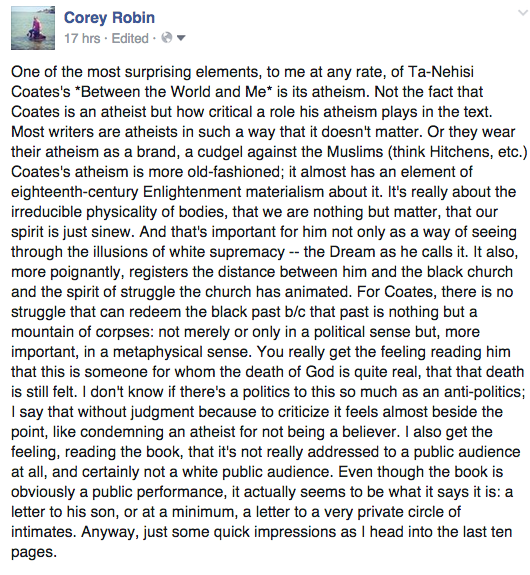
Ta-Nehisi Coates: Three Not-So-Easy Pieces

by Corey Robin

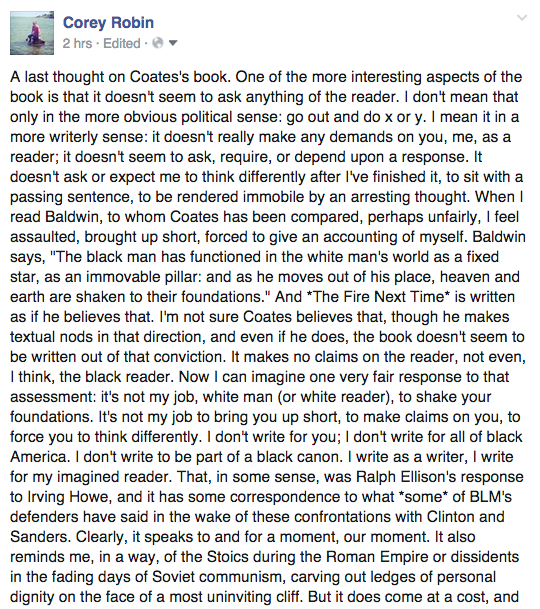
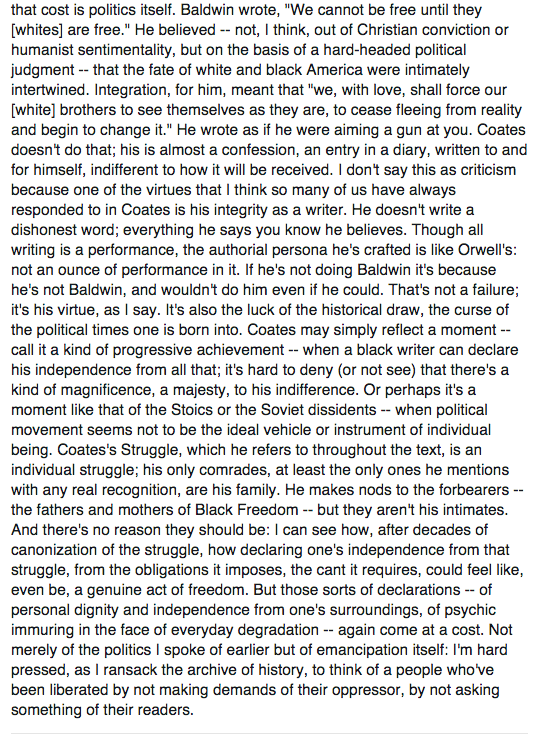
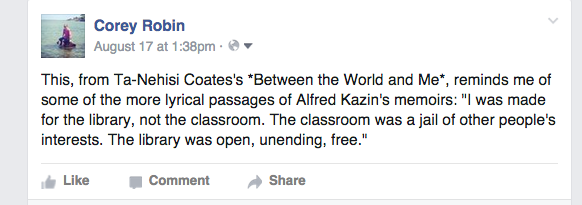
I’ve spent the past few days reading Ta-Nehisi Coates’s Between the World and Me and posting about it on Facebook. Rather than rewriting those posts as a single piece here, I thought I’d take some screen shots, and share them with some additional commentary. A shout-out to my friend Lizzie Donahue, whose queries to me on our daily walk this morning prompted the last and lengthiest post.

Here’s the first post.

Post 1

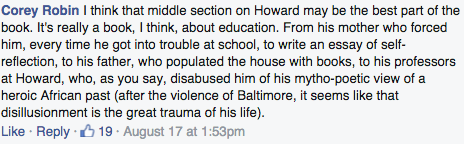
And here’s a short addendum to this post, where I comment further on the theme of education and Coates’s discussion of his time at Howard University.

Addendum 1

I say here that breaking with the mytho-poetic view of a heroic African past was the second great trauma of Coates’s life. I should be more precise. I mean disillusionment. But it was a disillusionment that was immensely productive. More than the loss of a specific view of things, the break with black nationalism made Coates suspicious of all master narratives, all collective platforms of totality. As an alternative, he turned to the specificity and concreteness of poetry, “of small hard things,” as he says: “aunts and uncles, smoke breaks after sex, girls on stoops drinking from mason jars.” And in that specificity “I began to see discord, argument, chaos, perhaps even fear, as a kind of power.” The “gnawing discomfort, the chaos, the intellectual vertigo was not an alarm. It was a beacon.” This is a writer for whom the struggle to see what is in front of his nose is a lifelong effort, a hard-won right to see things as they are, without mediation or adornment or chastising authority. So much so that it has made him, as we’ll see, suspicious of all collectivities, all platforms.

One other note on education. Coates has a wonderful passage on translation as living. He goes to Europe for the first time, lands in Geneva, heads for the train station, and here’s what he says:

I surveyed the railway schedule and became aware that I was one wrong ticket from Vienna, Milan, or some Alpine village that no one I knew had ever heard of. It happened right then. The realization of being far gone, the fear, the unknowable possibilities, all of it—the horror, the wonder, the joy—fused into an erotic thrill. The thrill was not wholly alien. It was close to the wave that came over me in Moorland. It was kin to the narcotic shot I’d gotten watching the people with their wineglasses spill out onto West Broadway. It was all that I’d felt looking at those Parisian doors. And at that moment I realized that those changes, with all their agony, awkwardness, and confusion, were the defining fact of my life, and for the first time I knew not only that I really was alive, that I really was studying and observing, but that I had long been alive—even back in Baltimore. I had always been alive. I was always translating.

That passage reminded me of this exchange between Peter Cole, the poet and translator, and Joshua Cohen, the author in The Paris Review:
Cole: People say such dumb things about translation.

Cohen: Such as?

Cole: Such as that, unlike so-called original composition, it’s always a matter of compromise, of negotiation—that translation is inevitably a failed approximation, or like a black-and-white photograph rather than color. But what in life that’s valuable over time doesn’t involve negotiation or intelligent compromise? Where does friendship come from? Or marriage? Education? Commerce? A culture? Would you colorize Stieglitz? And who says that original composition is fundamentally different from translation? “Ever tried. Ever failed. No matter. Try again. Fail again. Fail better.” Beckett isn’t talking about translation there, he’s talking about life, or writing, period. Poetry isn’t lost in translation, it is translation. It’s lost only in bad or gray translation—and in the mindless repetition of the thin figures of speech we use to talk about it.

Cole: You have to be desperate, at some level, to write anything, no? To move the magic of consciousness and language from one state or place to another. From an itch or an instinct to a line of poetry, and from that line of poetry to the next one, and from these two in combination to a third, and then to a reader. Translation as we normally think of it only raises all that to a higher exponential power. So, yes, there’s desperation, but even more so, at least for me, there’s desire—for nourishment and for pleasure. Translation isn’t some weakly technical craft. It’s a deeply human activity, an essential part of the art of our lives, whether we’re aware of it as such or not. Of course it exists in relation to something, not on its own, and so we think of it as secondary, but hey, so do we exist only in relation to something, as inheritors and animators or deadeners of traditions of all sorts. But that’s my stump speech—deep translation.


Here’s the second post I wrote, on the surprising atheism of Coates’ book.

Post 3

In re-reading this, I’m reminded of something else I wanted to say. In the last several decades, intellectuals of a pragmatist bent have often affirmed a kind of politics of struggle amid the ruins of God, Marx, and other master narratives. Think Cornel West. What strikes me in reading Coates, though, is just how visceral and personal and punch-in-the-gut powerful the death of God is for him. There’s a moment near the end of the book where he looks at the photographs of civil rights protester, and he asks his son:

Have you ever looked at the faces? The faces are neither angry, nor sad, nor joyous. They betray almost no emotion. They look out past their tormentors, past us, and focus on something way beyond anything known to me. I think they are fastened to their god, a god whom I cannot know and in whom I do not believe. But, god or not, the armor is all over them, and it is real. Or perhaps it is not armor at all. Perhaps it is life extension, a kind of loan allowing you to take the assaults heaped upon you now and pay down the debts later.

There’s nothing easy or cheap or distant about this atheism. Coates is fully aware of its costs: not just personal—the existential agony of the unbeliever—but also political: “I thought of my own distance from an institution [the black church] that has, so often, been the only support for our people.” And he’s still willing to pay them. Because he has no other choice. One cannot compel belief, whether it’s in God or the revolution. This is why I’ve been slightly discomfited by the critiques of Coates that take him to task for his political fatalism. In part because I don’t think that’s quite accurate, as we’ll see below, but also because I don’t know that you can will someone to believe in something they don’t believe.

And here we come to the third post, broken up into two screenshots.

Post 4

Post 5

By way of qualification, as Joel Scott Rutstein pointed out to me on Facebook, I should acknowledge that throughout the book, Coates deploys an arresting phrase: the people who believe themselves to be white. Every time I read that, I was indeed brought up short.

Update, 3 pm

Dammit, I meant to include these in my post but forgot. Tressie McMillan Cottom has one of the very few posts that grapple with Coates’s atheism. It’s very smart, though I disagree with her, I think, on the question of the political fallout. Her post led me to this, by Robert Greene, which I also thought quite smart, on the dangers of asking or reading Coates to be a writer other than he is.

02 Sep 19:34

The Wolfpack, the lost tribe of the Lower East Side

by Jason Kottke

The Wolfpack is a documentary that follows the six Angulo brothers, whose father kept them sequestered (along with their sister and mother) inside a four-bedroom apartment on the Lower East Side of Manhattan for fourteen years because he thought the city unsafe, allowing only annual or semi-annual trips outside. The boys' only access to the outside world was through movies, which they recreated in their tiny apartment. The trailer:

With no friends and living on welfare, they feed their curiosity, creativity, and imagination with film, which allows them to escape from their feelings of isolation and loneliness. Everything changes when one of the brothers escapes, and the power dynamics in the house are transformed. The Wolfpack must learn how to integrate into society without disbanding the brotherhood.

They did not mess around when it came to their filmmaking...this is a surprisingly realistic Batman costume made out of cereal boxes and yoga mats:

Wolfpack Batman

The Wolfpack won the Grand Jury Prize at Sundance this year, and the brothers made a few videos to thank the festival for their prize. Here are the Clerks and The Usual Suspects thank yous:

They also filmed a scene from one of their favorite movies of 2014, The Grand Budapest Hotel:

The Wolfpack was out in US theaters earlier this summer and is now on Amazon Instant...I think I'm going to watch this tonight. (via @quinto_quarto)

Tags: Batman   Clerks   movies   The Grand Budapest Hotel   The Usual Suspects   The Wolfpack   trailers   video
02 Sep 16:12

xkcd Survey

The xkcd Survey: Big Data for a Big Planet
31 Aug 22:12

It's Not the Economy, Stupid. The Spanish Language Is the Ur-Motive of Anti-Immigration Sentiment.

by Kevin Drum
kurtadb

i'll admit that i don't think this would be that big of a deal, but it would be SO hard to make common cause with the idiots who think this is a big deal.

Ed Kilgore on the conservative hostility toward illegal immigration:

This very weekend I was reading an advance copy of an upcoming book that includes the results of some intensive focus group work with what might be called the "angry wing" of the GOP base. The author notes that one thing that simply enrages grass-roots conservatives is the use of non-English languages by immigrants.

Yep. You can read all about it from one of Kilgore's predecessors, who wrote about it during our last big try at immigration reform in 2006. It's based on an excellent piece by Chris Hayes, written before he sold out to the bright lights and big paychecks of cable television.

I agree that language is probably the key original driver of anti-immigrant sentiment, though it's long since inspired further animus based around crime, gangs, social services, and other culture-related issues. The odd thing is that this is one of the few areas where I think the anti-immigrationists have a bit of a point. It's not a very big point, since (a) Spanish occupies no official role in the United States, and (b) Latin American immigrants all end up speaking English by the second and third generations anyway. Hell, the third-generation Latino who speaks lousy Spanish is practically a cliche.

That said, I've long believed that having multiple official languages makes it very hard to sustain a united polity. The Swiss manage, but the whole reason they're famous for it is because it's so unusual. Even the Belgians and Canadians have trouble with it, and they're pretty tolerant people.

Would a congressional declaration that English is the official language of the United States do anything to calm anti-immigrant fervor? At this point, probably not. But if it were written narrowly and carefully, I'd probably support it. I figure that if God considered a single common language such a boon that it threatened his dominion, it must be pretty powerful stuff.

28 Aug 20:03

Sarah Palin: No Bible Verses for You!

by Kevin Drum
kurtadb

not to be confused with On Point with Tom Ashbrook.

Great news! Sarah Palin will be interviewing Donald Trump at 10 p.m. Eastern on her brand new show, On Point, which started Monday and airs on the One America News network. It will be the greatest, classiest, rogue-iest interview ever!

Wait. What's that? You don't get OAN on your cable system? Me neither. Bummer. Maybe it'll be on Palin's Facebook page eventually.

What makes this whole thing a little weirder than even the normal Palin weirdness is that she announced her upcoming interview with a standard-issue blast on the lamestream media for asking Trump a gotcha question about his favorite Bible verse. "By the way," she writes, "even with my reading scripture everyday I wouldn't want to answer the guy's question either... it's none of his business; it IS personal." What makes this weird is that Palin has been happy to talk about this before. For example, in this interview:

In dealing with her daily challenges, Palin leans on the Bible verse that says, “God hasn’t given us a spirit of fear, but a spirit of power and might and a sound mind.”

That's 2 Timothy 1:7 (close enough, anyway), and Palin has mentioned it on other occasions too. It really does seem to be one of her favorites. So why is this suddenly so personal that she doesn't think anyone should have to talk about it? Are we now all keeping our favorite Bible verses a deeply held secret?

28 Aug 16:52

Blaming Culture Is a Liberal Thing? Seriously?

by Kevin Drum
kurtadb

shared for the picture, which is just so awesome.

Over at National Review, Charles Cooke writes about the gruesome murder of WDBJ reporters Alison Parker and Adam Ward on Wednesday:

As I have written over and over again during the last few years, I do not believe that we can learn a great deal from the justifications that are forwarded by public killers....Mine, however, is not the only view out there. Indeed, there is a sizeable contingent within the United States that takes the question of what murderers purport to believe extremely seriously indeed. It is because of these people that we had to examine “toxic masculinity” in the wake of the Isla Vista shooting....[etc.]

....Half-joking on Twitter, the Free Beacon’s Sonny Bunch reacted to this news by observing that, “instead of going on a killing spree, this guy should’ve gotten a columnist gig at the Guardian.” As with all humor, there is some truth at the root of this barb....For what reason is this guy exempt? Why do we not need to have a “national conversation” about hypersensitivity?

The answer, I imagine, is politics, for this instinct seems only to run one way.

Generally speaking, I agree with Cooke. Crazy people are always going to find something to justify their worldview, and they're going to find it somewhere out in the real world. The fact that any particular crazy person decides to have it in for the IRS or Greenpeace or women who laughed at him in high school doesn't mean a lot. It only becomes meaningful if some particular excuse starts showing up a lot. Beyond that, I even agree that the culture of hypersensitivity has gotten out of hand in some precincts of the left.

That said....is Cooke kidding? This instinct only runs one way? After the Columbine massacre in 1999, Newt Gingrich denounced the "liberal political elite" for "being afraid to talk about the mess you have made, and being afraid to take responsibility for things you have done." Conservatives have been raising Cain about the pernicious effects of Hollywood liberalism, video games, and the decline of religion for decades. Hysteria about the counterculture and liberal moral decay goes back at least to the 60s. I could go on endlessly in this vein, but I don't want to bore you.

Complaining about the effects of liberal culture—whether on shooters specifically, crime more generally, or on all of society—has been a right-wing mainstay for as long as I've been alive. The left may be catching up, but it still has a ways to go.

28 Aug 16:20

The conservative establishment is in deep denial about Donald Trump's appeal

Scott Olson/Getty Images

National Review editor Rich Lowry has an entertaining column about the rise of Donald Trump whose core thesis is that Trump's rise highlights the unexpected weakness of the GOP's supposedly "strong field" of mainstream contenders. It's an interesting idea (see Daniel Drezner for more on this theme), but it's wrong.

Though Trump is anything but a banal person, his rise in the polls has a very banal explanation — he stands for some ideas that are reasonably popular, but that no other well-financed candidate has previously articulated. Donors don't like these ideas, so candidates normally don't express them. But this bloc of opinion has existed for a long time and represents a huge swath of the Republican Party rank and file. Trump is the egomaniacal opportunist who's finally giving voice to those ideas. And much of the American establishment is in deep denial about their real appeal.

Lots of people agree with Donald Trump

As Lee Drutman has written, the Trump combination of far-right views on immigration plus center or left views on Social Security is pretty popular. More than one-fifth of the electorate endorses the Trump view that "immigration should be decreased a lot" while Social Security should not be cut. All mainstream Republican Party figures, by contrast, hold views in the right-hand column of Drutman's chart — opinions that collectively secure the endorsement of less than 10 percent of the electorate.

With Trump holding a popular opinion while about a dozen other Republicans all crowd into an incredibly unpopular niche, the striking thing is that Trump is punching well below his potential weight. Perhaps all the apparently clownish, seemingly off-putting stuff that he does is, in fact, counterproductive and he would do even better if he combined his ideas with a more mainstream presentation.

But these generally unpopular views are popular with the kind of people who finance the Republican Party. There are a lot of rich people out there who want to see their taxes cut, and most of them understand that in the long term only paring back America's big retirement programs will make those tax cuts possible. Those donors often favor relatively high levels of immigration and are a little put off by excessively hardcore social conservatives, but they demand orthodoxy on economic policy — even when it makes it harder to win elections.

Trump-like movements are popular globally

The Trump phenomenon is, in a way, uniquely American. But to people who follow European politics it's also very familiar.

The big political trend over the past 15 years has been the rise of a series of new populist-rightist parties — UKIP, the Danish People's Party, the Sweden Democrats, the National Front, the True Finns — who emphasize nationalist themes and hostility to immigration while offering a mixed bag on the welfare state.

That a similar movement would gather steam in the United States is not so surprising. The main difference is that the open nature of US political parties and the unforgiving nature of the election system makes it more reasonable for Trump to run in a Republican primary than to start his own political party.

Rick Santorum and Mike Huckabee did well

In retrospect, Trump 2016 was prefigured by the surprisingly resilient presidential campaigns that Mike Huckabee and Rick Santorum ran in 2008 and 2012.

Both Huckabee and Santorum fit into a broadly similar ideological niche to Trump's, one that deemphasized the GOP donor base's tax-cutting and entitlement-slashing priorities in favor of the cultural politics of older, white, working-class Americans. Compared with Trump, both Huckabee and Santorum had a big advantage — they were real Republican Party politicians with practical campaign and governance experience.

But they also had a huge disadvantage — their ideas were anathema to the party's donor base, and they were not, personally, billionaires. Trump, conveniently, is a billionaire, so his lack of fundraising ability isn't a big problem.

The establishment is in denial

The fundamentals are clearly there for a right-populist candidate to secure mass appeal and really move the needle in American politics. What continues to be missing is the appropriate candidate: someone who has both the right résumé (like Huckabee in 2008) and the necessary financing (like Trump in 2016) to be a plausible presidential nominee. And this isn't a coincidence — the Trump ideological niche is not one that appeals to very many rich people.

This @RichLowry piece is essential to getting Trump: He's filling a vacuum left by an unexpectedly impotent field http://t.co/IMeOkZTWj2

— Alex Burns (@alexburnsNYT) August 27, 2015

Still, Lowry's column and its embrace by many in the media show an American establishment that continues to be in denial. Trump is a bit of a freak show, so there is an impulse to say that he is succeeding because he is a freak show, a one-off who provides an amazing story during the doldrums of summer with no wider significance for American politics.

The truth is the opposite. Trump is succeeding because he is articulating views that are widely held among American voters but normally suppressed in the political system due to the power of the donor class. The voting bloc that he's tapping into has been tapped previously, and will be tapped again in the future — possibly in more effective ways by more conventional politicians.


Awesome, share it:

Share Tweet