Shared posts

11 Sep 07:42

REWILD: A Short Film by Splash and Burn and ESCIF Chronicles Rainforest Restoration Efforts in Sumatra

by Laura Staugaitis

To draw attention to the ecological devastation wrought by palm oil farming in Southeast Asia, the Splash and Burn project (previously) creates and documents large and small-scale art activations. The initiative’s most recent endeavor, titled REWILD and executed with Spanish artist ESCIF, involved carving a rewind symbol into a palm oil plantation in Sumatra, Indonesia, and creating a short film documenting the effort. ESCIF explains, “the idea of going back, of rewinding, is an invitation to reconnect with ourselves; to recover awareness and respect for the earth, which is the ecosystem of which we are a part.”

The land art intervention took place on an acquired plantation within a new forest restoration site made possible by the Sumatran Orangutan Society. After clearing the palms, diverse vegetation has been re-planted. In a release about the project, Splash and Burn explains that the restoration site is located on the borders of the Leuser Ecosystem, one of the most biodiverse places on earth. Sumatra’s forests—and the wildlife populations within—have shrunk by 40% in the past two decades, replaced by palm oil, paper pulp, and rubber plantations. Though not commonly known in the U.S. as a cooking oil, palm oil is the most widely consumed oil on the planet, found in everything from chocolate and instant noodles to lipstick and laundry detergent.

You can watch the trailer of REWILD below. It features an abstract soundscape by Indonesian composer Nursalim Yadi Anugerah. If you are interested in contributing, head to moretrees.info, and follow Splash and Burn (comprised of Ernest Zacharevic and Charlotte Pyatt) on Instagram.

10 Sep 14:05

Polaroid launches Polaroid Lab, a new phone-to-analogue device

by Daphne Milner
Thepolaroidlab-photography-itsnicethat-list
The company’s latest product aims to bridge the gap between the digital needs of younger generations and analogue photography. 

Read more

10 Sep 08:37

Steffen Kraft

10 Sep 08:36

A Stadium in Austria is Filled with 300 Trees to Highlight the Tenuous Future of Natural Spaces

by Laura Staugaitis

“FOR FOREST – The Unending Attraction of Nature” (2019), Wörthersee Stadium, Klagenfurt, Austria. All photographs by Gerhard Maurer unless otherwise noted

Beyoncé, Bruce Springsteen, Taylor Swift: all typical headliners for stadium attractions. Less common? 300 trees. In Klaus Littman’s public art installation, “FOR FOREST – The Unending Attraction of Nature”, at Wörthersee Stadium in Klagenfurt, Austria, an arboreal group takes center stage. The Swiss curator worked with landscape architect Enzo Enea to arrange the temporary forest, which is comprised of a range of trees typical in the woods of central Europe.

Littmann was inspired by artist Max Peintner’s work, circa 1970, titled “The Unending Attraction of Nature” (some translations use unbroken instead of unending), which depicts a dystopian future where a group of trees is penned in like zoo animals, as a rare artifact and spectacle. The curator first saw Peintner’s drawing more than 30 years, ago and the concept of bringing it to life remained with Littmann over the past three decades.

Visitors to “FOR FOREST” can stop by any time between 10am and 10pm from today through October 27, 2019. Admission is free. Follow the project on its dedicated website and Instagram.

Max Peintner “The Unending Attraction of Nature” (1970/1971)

Photograph: UNANIMO

Photograph: UNANIMO

10 Sep 07:52

Dogs & Dames

10 Sep 07:52

A New Circular Juice Machine Turns Orange Peels into Bioplastic Cups

by Laura Staugaitis

Freshly squeezed orange juice is a welcome sight at cafes worldwide. The machines often showcase about-to-be-squeezed oranges with pinball machine-esque wire loading racks and clear cases that allow the consumer to see their juice being made in real time. International design firm Carlo Ratti Associati (previously) takes the immediacy of the experience to another level. ‘Feel the Peel’ is a prototype machine that uses orange peels to create bioplastic, shaping bespoke cups to hold the juice made from the cups’ own innards.

In a press release about the project, Carlo Ratti Associati (CRA) explains that the approximately 9-foot tall machine handles 1,500 oranges, and the peels accumulate in the lower level. The peels are dried, milled, and mixed with polylactic acid to form a bioplastic, which is then heated and melted so that an internal 3-D printer can form each recyclable cup. CRA shares that they will continue to iterate, and are considering creating clothing from orange peels as a future functionality.

Follow along with CRA’s wide-ranging projects on Instagram and Twitter. If you enjoy Feel the Peel, also check out the cone-shaped french fry holders made from potato peels, designed by Simone Caronni, Paolo Stefano Gentile and Pietro Gaeli, as well as Mi Zhou’s toiletry containers made of soap. (via designboom)

09 Sep 08:50

Mathematical beauty of nature, Rafael Araujo


Mathematical beauty of nature, Rafael Araujo

09 Sep 08:47

Roberto Cigna

09 Sep 08:47

Andrea Ucini

09 Sep 08:47

Goran Gagic

09 Sep 08:47

Distant lands, Max Mitenkov


Distant lands, Max Mitenkov

09 Sep 08:46

Diego Andrade

05 Sep 12:25

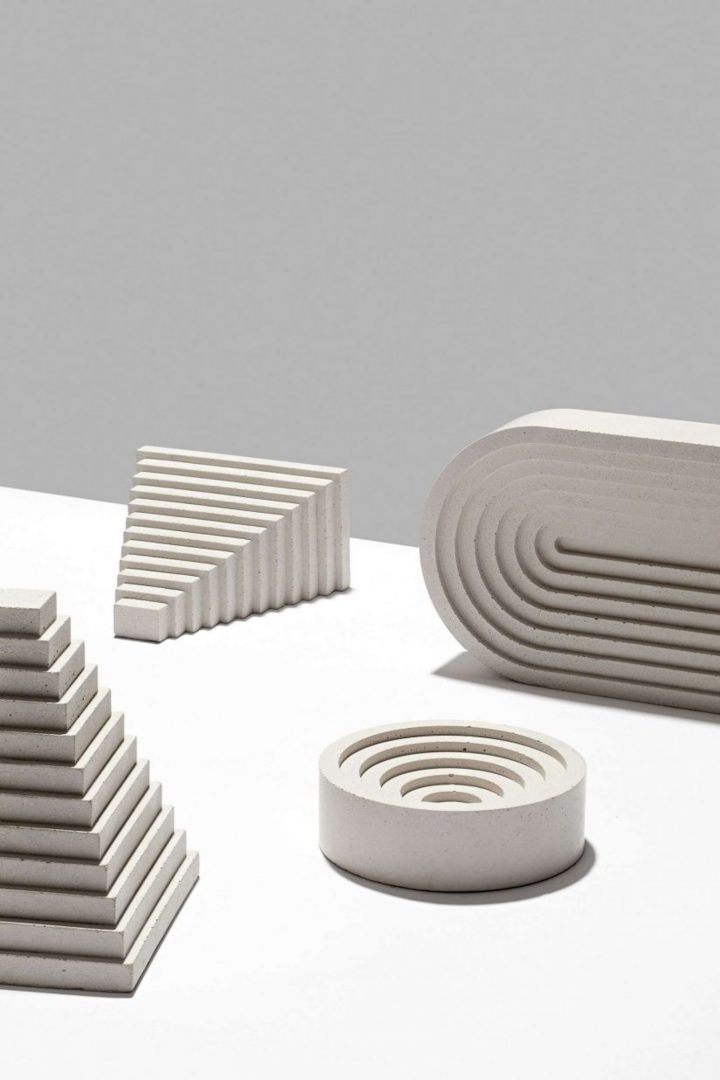
Klemens Schillinger’s Concrete Tabletop Pieces, A Minimal Way To Accessorize Your Personal Space

by Stephanie Wade

The series ‘Landmarks’ by London designer Klemens Schillinger is a set of three concrete-cast table items: two differently-sized bowls, and a set of bookends—all with stepped sides inspired by the shapes of ancient Greek and Mayan architecture.

Read more

The post Klemens Schillinger’s Concrete Tabletop Pieces, A Minimal Way To Accessorize Your Personal Space appeared first on IGNANT.

05 Sep 07:59

Camera Geekery: The Nikon Museum

by Michael Nguyen

Camera Geekery: The Nikon Museum

If you’re a diehard Nikon fan in love with all things Nikon, then be sure to bring extra nether garments to the Nikon Museum in Shinagawa, Tokyo because you will soil them. The Nikon Museum opened at its current location in July 2017 to commemorate Nikon’s 100th anniversary. It is an overwhelming smorgasbord of damn near everything they’ve ever made presented in exhibits about the history, products and technologies of Nikon’s various businesses. It is the stop to gain an appreciation for the aspirations that Nikon has continued to pursue since its foundation and for how Nikon has evolved. And of course you’ll get your fix for pure Nikon gear porn.

Walk right in through the entrance and you’re greeted by this 130cm long synthetic silica glass ingot, the symbol of the Nikon Museum. It is the embodiment of Nikon’s optical material manufacturing technologies. It is developed for use in projection lenses for semiconductor lithography systems.

Nikon Imaging
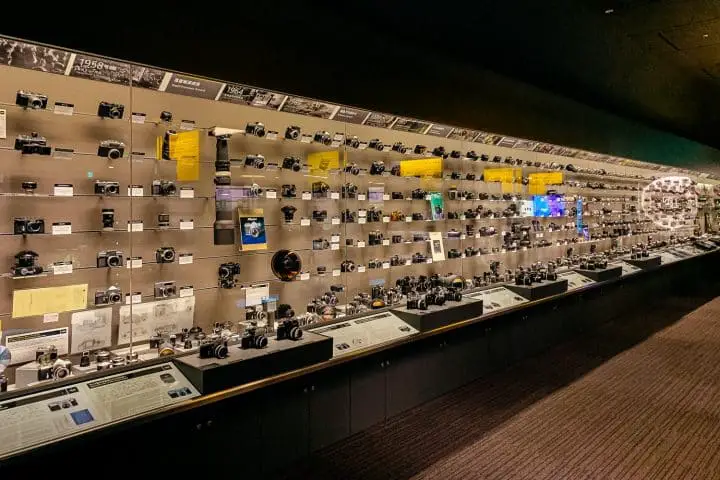
The Nikon Museum is divided into several sections. Make a right, or three lefts if you’re not an ambi-turner, and you will be greeted to the Imaging Section featuring this hugantic, ginormous case. In it you will find almost all of the roughly 500 cameras Nikon has ever made, from the Nikon Model I to latest digital SLR and mirrorless cameras. In addition, in the “Brochure Library”, you can view brochures of Nikon products on a specially designed monitor.

Yes, all the writing on plaques and panels are in English which is supremely helpful. There is an audio guide service (in Japanese and English) that provides explanations about approximately 20 items via a dedicated tablet device. The audio guide fee is 300 yen, all of which is donated to charities.

Learn about the early days of Nikon with valuable items from the prewar era onwards. They have all sorts of cool historical items such as the early lens prototypes designed by the eight German engineers they pinched in the Japanese photographic equivalent of Operation Paperclip.

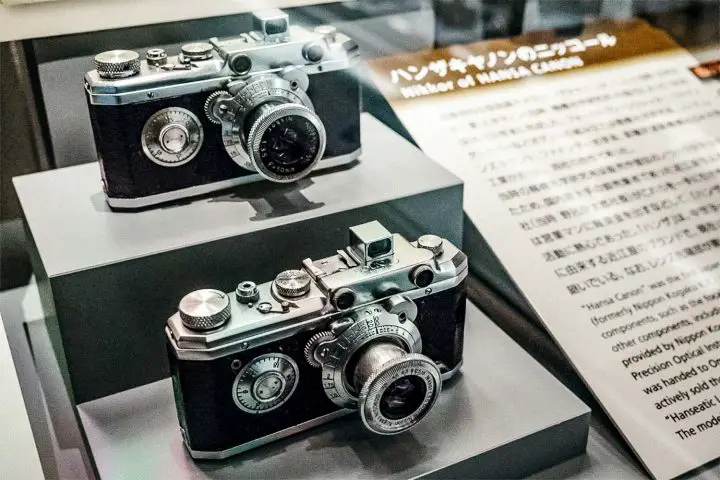
Nikkors made for Hansa Canon. Yes, these rivals actually worked together way back in the day. Seiki-Kōgaku Kenkyusho, which was to become Canon Camera Company had a close relationship with Nippon Kōgaku. Per John Baird in his book The Japanese Camera, the Japanese Imperial Navy and Mitsubishi paid for these licenses to German patents as part of their support for Nippon Kogaku in the early 1930s. Nippon Kogaku had direct access to Zeiss’ designs, producing Tessar-type lenses such as the 5cm 1:3.5 Nikkor for the Hansa Canon in 1934. If you don’t know, now you know.
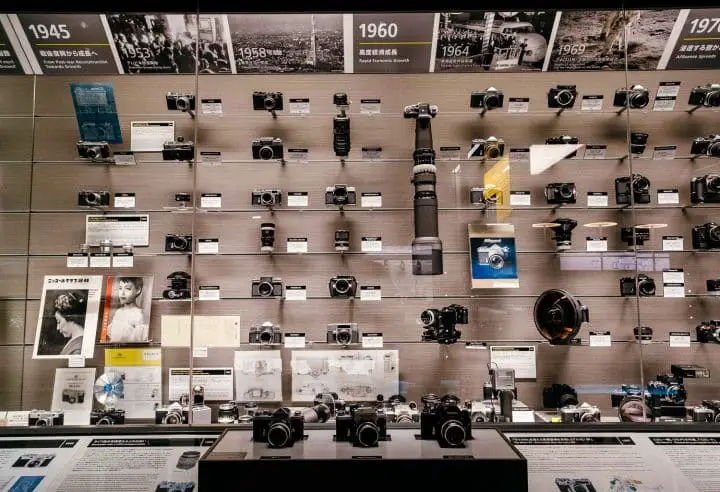
In addition to all the Nikon history and geekery, you can also enjoy a “Hands-on Corner”, where you can handle SLR film cameras from various generations. Go down the line in chronological order and feel/hear the different generations of shutters and winders consecutively. What a treat for us otaku ;)
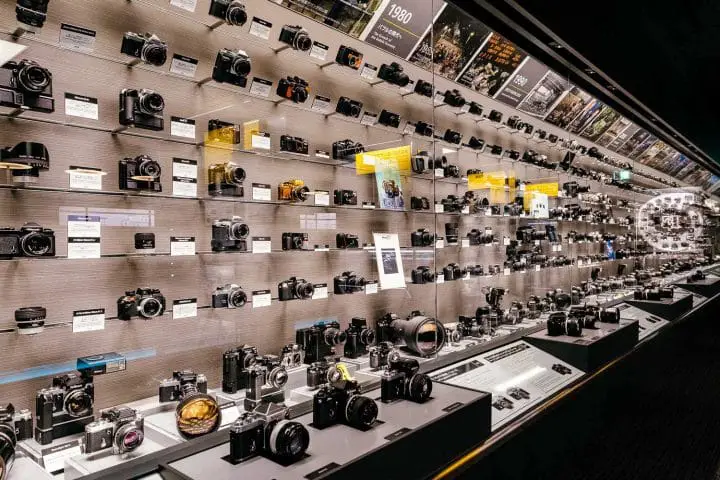
Some interesting items

Nikon F2 750

The MF-2 750 exposure magazine back for Nikon F2MD. When used with 100 feet film, this magazine back enabled the photographer to take approximately 750 photographs. At the time, it was a made-to-order product.

Nikon S Black Life Magazine

This model was painted black at the request of Life magazine, in order to prevent it being identified in battlefields. The height of the film advance knob was increased and the film rewind knob made easier to extract and rotate so that the camera was easy to use even when wearing gloves. Who knows what kind of stuff this guy has seen.

Fisheye-Nikkor Auto 6mm f/2.8

With a 220 degree field of vision and weight of 5.5kg this is truly a super wide boi. Be careful not to get your toes in the shot!

In this case are various prototypes that never made it to production and some items can only be seen here.

Nikkor Lenses Selection

For the Nikkor lens geeks out there these panels showcase a truly dizzying amount of glass that’ll make your mouth drool. Approximately 400 F-mount Nikkor lenses are here, ranging from everything to fisheyes to uber-teles.
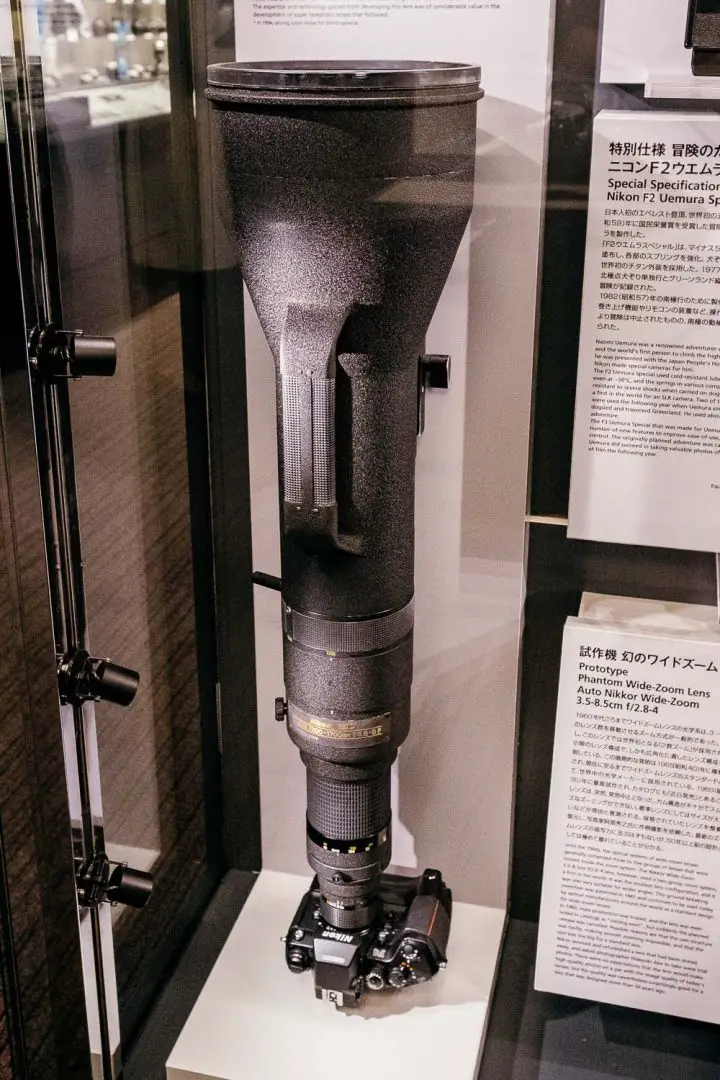
Zoom-Nikkor 1200-1700mm f/5.6-8P IF-ED

Nicknamed “The Tuna,” the Zoom-Nikkor 1200-1700mm f/5.6-8P IF-ED from the early 90’s held the record for the longest ever 35mm zoom for some time. Weighing in at 16kg/35lbs, and 888mm/35 in. long, it was an overcompensating behemoth. It had an asking price of around $60,000-$75,000 when it was released in 1990 and required a unique, two-section lens barrel!

Nikon Industry
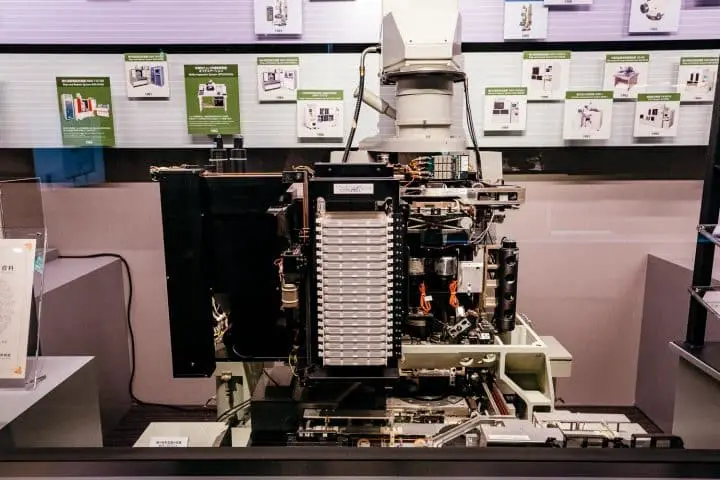
This area features Nikon Industry products and technologies that contribute to various industries, such as Semiconductor Lithography Systems, FPD Lithography Systems, measurement and inspection instruments, and encoders. Many consider the Nikon Semiconductor lithography systems among the most precise equipment in history.

The NSR-1505G2A, an early model of the Nikon semiconductor lithography system is shown here, and is registered as Essential Historical Material for Science and Technology at the National Museum of Nature and Science, Tokyo. In this exhibition, you can watch the machine as it creates circuits.

Nikon Bioscience and Medical

This exhibit introduces Nikon’s activities in the healthcare and medical fields. Through videos and displays of actual equipment, you can learn about the advances in Nikon microscopes, various products used in the latest developments in the medical field, and Nikon’s challenges in even newer areas of medical technology.
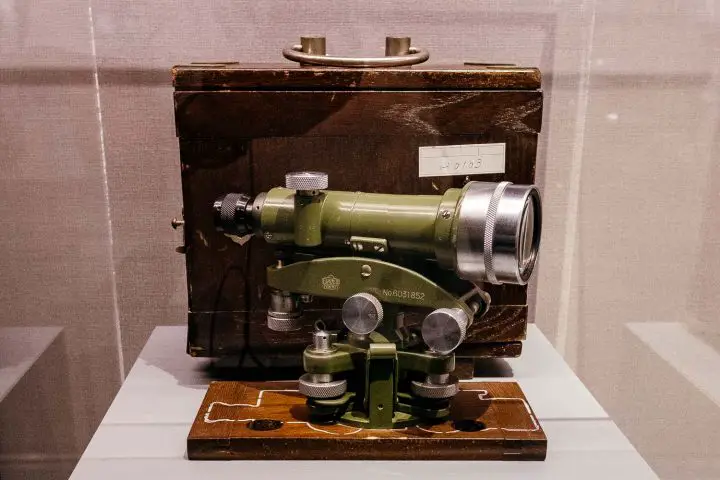
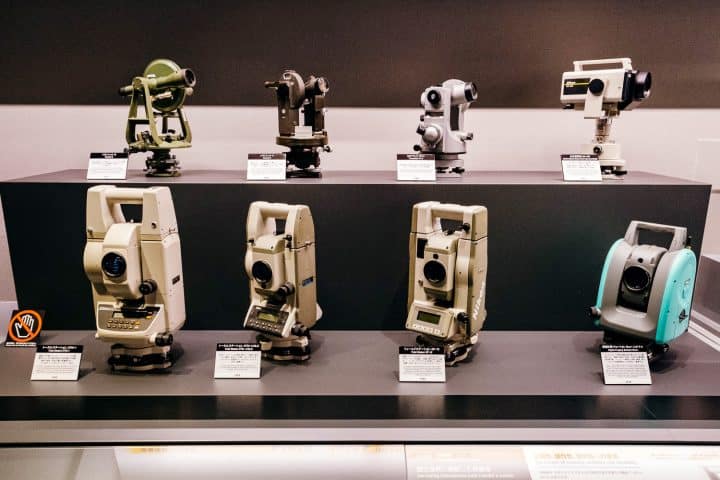
Nikon Space

Here you can trace Nikon’s involvement in Japan’s space observation development from astronomical telescopes to optical probes mounted on satellites. There is also a model of the AKARI infrared astronomy satellite.

So there you have it. Hopefully that gave you a nice glimpse of the church of Nikon. If you have time to kill in Shinagawa and want to acquaint yourself with 100 years of Nikon history, you won’t be disappointed. A true fanboy’s haven and educational to boot. If you’re averse to reality or simply can’t make the trip, a virtual sightseeing trip around the Nikon Museum is being offered by Google Street View.

MN

The post Camera Geekery: The Nikon Museum appeared first on Japan Camera Hunter.

05 Sep 07:54

Muses, Conrad Roset


Muses, Conrad Roset

05 Sep 07:54

re-wild Inspired by the upcoming UN Decade on Ecosystem...


re-wild

Inspired by the upcoming UN Decade on Ecosystem Restoration, the collaboration uses the idea of ‘Rewind’ to call for action before climate change reaches a point that would trigger a global catastrophe. A hopeful message symbolizing that it is NOT too late to reclaim our fate and make meaningful change.

05 Sep 07:53

Dead at 74, Peter Lindbergh

04 Sep 12:07

Yung Cheng Lin

04 Sep 07:58

“Drunkenness and debauchery!”: Peter Dench captures events of English gentility

by Jyni Ong
Peter-dench-the-english-summer-season-work-photography-itsnicethat-list
The English photographer gets up close and personal to the world of the upper classes, from Royal Ascot to Glyndebourne Festival Opera, shedding light on the ins and outs of quintessentially English summer events.

Read more

03 Sep 07:51

‘Running Away from Home’ by Mira Ruido


Running Away from Home by Mira Ruido

03 Sep 07:50

Lake Eyre by Kevin Krautgartner


Lake Eyre by Kevin Krautgartner

03 Sep 07:50

Smash/art, Simon Berger


Smash/art, Simon Berger

03 Sep 07:50

unomoralez

03 Sep 07:49

Labor Day, Norman Fucking Rockwell

03 Sep 07:43

Dungeons & Dragons & Philosophers VIII: the Sci-fi Debate

Description: Descriptions of the player characters and dungeon master.

Simone de Beauvoir, Dungeon Master. Had a moment of existential horror upon realizing PCs have freedom, and didn't have to follow her adventure.

Aristotle, Level13 Warrior, Neutral Good. It's a little known fact, but he's the one who came up with the idea of dividing people into nine essential alignments.

Edmund Burke, Level 12 Bard, Lawful Good. Laments that while he has had many beautiful adventures, he has never had a sublime one.

Thomas Hobbes, Level 12 Paladin, Lawful Neutral. His first character died at sea, after he refused to fight back against an attacking Leviathan.

Donna Haraway, Level 10 Fighter/Mage, Chaotic Good. Once tried to merge minds with an illithid to better understand underdark social structures.


de Beauvoir: \


Harway: \


Burke: \
02 Sep 10:21

Portraits of Emily by Adam White

by onfilm photo
48 years young living in New Mexico, I&E technician by day. Portrait photographer by night. Started my film journey back in 2009 as a fun thing to do. Didn't get serious until 2014. Mainly shoot portraits of the female form in all shapes and sizes, clothed and non clothed. They are all beautiful.
Portraits of Emily by Adam White

This session was shot with Emily while she was traveling thru the town 30 minutes north of me. We met up at the hotel she was staying at ( fun fact, the Hotel is the same name that they filmed "The man who fell to Earth" in 1976 with David Bowie. It's not the same hotel, but may be built on the same location, not to sure of that) and we decided to have some fun with sheets on the bed and used them as reflectors and as cover to make it seem more sensual and playful.

Portraits of Emily by Adam White
02 Sep 10:11

Tiny Metal Plants, Animals, and Buildings are Liberated From Coins by Artist Micah Adams

by Andrew LaSane

Toronto-based artist Micah Adams uses a jeweler’s saw to cut out the embossed animals, figures, and objects from coins of different sizes and denominations. The metal cut-outs are used to create tiny readymades and fun collages. From a growing pile of copper leaves taken from Canadian pennies, to intricate birds and flowers borrowed from foreign currency, each of Micah Adams works are hand cut using the same basic tool. Working at a smaller scale is something that the artist came to in art college while making sculptures and spending his free time in the jewelry and metal smithing department. The practice of cutting coins evolved out of using other materials.

“I was making small assemblages from things I’d collected over the years, tiny things like toys, bottle caps, beach finds and even teeth,” Adams tells Colossal. “Then I cast them in metal. They were like tiny bronzes or miniature monuments. That lead me to look for tiny things that were already metal that I could use. So I looked at coins and their designs for things I could cut-out.”

Micah Adams is currently working on another solo exhibition of his coin collages and other works which will open at MKG127 in Toronto in February 2020. He also has an Etsy shop where he sells earrings, tie tacks, and other keepsakes. For future updates and to see more of his art, follow Adams on Instagram.

02 Sep 10:08

Moments, Ilya Milstein


Moments, Ilya Milstein

30 Aug 10:17

Back to school, Amanda Friedman

30 Aug 10:16

A separate reality, Alex Andreev


A separate reality, Alex Andreev