Shared posts

18 Mar 16:05

The Difference Between Bra Facts and Bra Preference

by noreply@blogger.com (bflycollection)
When you start researching bras and bra fit you quickly realize that it's a pretty huge topic. This is because boobs are as diverse and unique as the women they live on. There are lots of different bra blogs out there and they all have different information depending on their personal style, breast shape and lifestyle. It can be confusing to know which information is right for you.

In general the information breaks down into two groups. Firstly there are facts about what good bra fit looks and feels like; this information is pretty much non-negotiable. Secondly there are bra preferences like style, shape, colour and comfort levels. There are no right or wrongs in the bra preferences, it's totally down to the individual. To help you decipher the must-know bra facts from bra preferences I've put together a quick cheat's list:

Bra Facts
  1. All your breast tissue (including that squidgy bit at your armpit that you think is fat) should sit inside the cup.
  2. Your bra band should stay in place and not ride up your back.
  3. Bra straps should not slip off and should not dig in.
  4. A new bra should fit you on the loosest set of hooks first (unless it's a maternity bra)
  5. Your gore (the part between your breasts) should be flush with your body.
Bra Preferences
  1. Whether you prefer to wear a balconette bra, a plunge, a full cup or a wire-free. There are no hard and fast rules about what you have to wear (other than wearing a sports bra when active)
  2. How tight your band has to be. Some women prefer a really tight band, others like it just firm and some prefer to have it as loose as it can go without compromising fit (as soon as it starts to ride up then your band is too loose).
  3. Shape - some women love rounded cups or lots of cleavage, some like a more minimized look. Whatever shape you like you can find bras that will give you that look.
  4. Price - There is no right price to pay for a bra, it depends on what you're comfortable paying for the amount of wear you will get out of it. A well constructed bra that is worn and cared for well should last between 8 and 18 months (depending on how often you wear it).
  5. Style - There are lots of different styles of bras that fit different breast shapes differently. Working out your breast shape will really help you work out which bra bloggers have reviews that are relevant to your shape. Check out Bratabase's Breast Shape Gallery.
Once you have the bra facts nailed down you can start to explore the bra preferences that suit your body and personal style. When you find bras that tick all the boxes on the bra facts list and have all the things you're looking for in your bra preferences you have found your bra sweet spot! xx
18 Mar 01:28

03.16.2013

Cyanide and Happiness, a daily webcomic
Copy this into your blog, website, etc.
<a href="http://www.explosm.net/comics/3111/"><img alt="Cyanide and Happiness, a daily webcomic" src="http://www.flashasylum.com/db/files/Comics/Matt/BLASPHEMY.png" border=0></a><br />Cyanide & Happiness @ <a href="http://www.explosm.net">Explosm.net</a>
...or into a forum
[URL="http://www.explosm.net/comics/3111/"]
[IMG]http://www.flashasylum.com/db/files/Comics/Matt/BLASPHEMY.png[/IMG][/URL]
Cyanide & Happiness @ [URL="http://www.explosm.net/"]Explosm.net[/URL] <—- Share this comic!
18 Mar 00:41

Better Colleges Failing to Lure Talented Poor

by By DAVID LEONHARDT
Most low-income students who have top test scores and grades do not even apply to the nation’s best colleges, which contributes to widening economic inequality, economists say.
14 Mar 23:43

Photo

by joberholtzer
Justine Marie Sherry

"Confirmed: the Harlem Shake died, now is not popular."


13 Mar 18:52

VMware targets rival “bookseller” Amazon with its own public cloud

by Jon Brodkin
VMware will tear that pesky bookseller apart one of these days! SpectrumsPhotography

VMware this morning confirmed that it will offer a public, infrastructure-as-a-service (IaaS) cloud to compete against the Amazons and Rackspaces of the world.

VMware has long straddled the line between helping service providers build clouds and actually offering a cloud of its own to IT shops. VMware's biggest previous foray in providing its own cloud was Cloud Foundry, a platform-as-a-service network to let customers build and host applications in VMware data centers.

The public cloud confirmed today by VMware marks the first time the company will become an IaaS provider itself, analysts said. Unlike platform-as-a-service, which puts the focus on providing simplified tools to application developers, IaaS clouds let customers (or require them to) manage the underlying infrastructure such as the operating system and virtualization tools.

Read 13 remaining paragraphs | Comments

13 Mar 14:58

“Keep your faith” read the College motto. Well, it was certainly...

by djag2


“Keep your faith” read the College motto. Well, it was certainly catchier than “Cromwell’s coming, hide the silver.”

(The gumshoe is on hiatus. This case note was first taken on 8 August 2012.)

12 Mar 20:24

The Knife - A Tooth For An Eye First, the statement accompanying...


The Knife - A Tooth For An Eye

First, the statement accompanying the video:

‘A Tooth For An Eye’ deconstructs images of maleness, power and leadership. Who are the people we trust as our leaders and why? What do we have to learn from those we consider inferior? In a sport setting where one would traditionally consider a group of men as powerful and in charge, an unexpected leader emerges. A child enters and allows the men to let go of their hierarchies, machismo and fear of intimacy, as they follow her into a dance. Their lack of expertise and vulnerability shines through as they perform the choreography. Amateurs and skilled dancers alike express joy and a sense of freedom; There is no prestige in their performance. The child is powerful, tough and sweet all at once, roaring “I’m telling you stories, trust me”. There is no shame in her girliness, rather she possesses knowledge that the men lost a long time ago.

Second, THE KNIFE IS MAKING ANOTHER ALBUM AND IT’S GOING TO BE RELEASED SOON. It’s their first album in 7 years since their hit “Silent Shout” and I could not be more excited. You can pre-order the album off of the many links on their site, including their own digital store.

More listening Data Airlines’ compilation of chip cover/remixes of The Knife songs.

12 Mar 19:37

In Cambridge, the morning commute can be a killer … (The...

by djag2


In Cambridge, the morning commute can be a killer …

(The gumshoe is on hiatus. This case note was first taken on 25 July 2012.)

11 Mar 19:37

Nipples And The Presentation Of Femininity

by Lisa Wade, PhD

Originally posted in 2009. Re-posted in honor of Women’s History Month.

I still remember when the female characters on the sitcom Friends started the trend of visible nipples:

680f6_celebrity-pictures-jennifer-anniston-nipples-friends

As long as I’d been alive and paying attention, hard nipples were embarrassing. Then, suddenly, they weren’t. I even remember hearing that women could get the all-hard-all-the-time look by buying those tiny rubber bands (that I only associate with the plastic bags aquarium fish come in) and fitting them tightly around your nipples. Nipples are still big, if measured by mannequins (Wicked Anomie noticed too).

It turns out this comes in fits and starts.  This vintage ad (no date on the source), for example, features a bra with built-in hard nipples! (Apparently it had been a trend before I’d been alive and paying attention.)

0_2806c_528ae45_l

In the comments, Dmitriy T.C. added a link to the patent for this device. I can’t resist adding this particular paragraph explaining why a bra with fake nipples is important:

…simulated nipples for a brassiere would offer an acceptable compromise for ladies who do not wish to go without a brassiere and a welcome release from the subconscious effects of the suppression brought on by wearing brassieres of the types variously available, which obliterate the nipple.

LOL.

Anyhow, Tracey at Unapologetically Female wondered about wearing such a bra:

Didn’t anyone ever start to wonder why these women’s nipples were ALWAYS hard? And what if their real nipples (realistically probably located somewhere a bit lower than the bra’s) ever poked through, creating a quadruple effect?! Horrifying.

I find this whole thing especially funny, since, while shopping recently, Katie and I were making fun of these bras with built-in “modesty panels” that provide extra padding so that the nipple will never make an appearance. Times sure have changed.

Except times haven’t changed in the sense that women’s bodies still aren’t allowed to just be. Their nipples either must show, or must not show, or they should show in some contexts, or are allowed to show, but in other contexts they better not show.  (Remember the outcry over Hilary Clinton’s “cleavage”?  Can you imagine if she’d shown some nip!?)

So apparently we’re supposed to have nipple bras, bras with “modesty panels,” and a couple rubber bands in our pockets just in case. The one thing that is clearly less than ideal in all this: actual nipples doing what they do.

Lisa Wade is a professor of sociology at Occidental College. You can follow her on Twitter and Facebook.

(View original at http://thesocietypages.org/socimages)

11 Mar 19:33

USCCB Opposes Violence Against Women Act.

by Lisa Fullam

On March 6, the USCCB issued a statement expressing “concerns” about the Violence Against Women Act, saying the in the end, the USCCB could not support it.

Why their concern, you might ask? Surely the USCCB opposes violence against women?

You guessed it: it’s about same-sex marriage. This is from the USCCB press release:

“All persons must be protected from violence, but codifying the classifications ‘sexual orientation’ and ‘gender identity’ as contained in in S. 47 is problematic,” they wrote. “These two classifications are unnecessary to establish the just protections due to all persons. They undermine the meaning and importance of sexual difference. They are unjustly exploited for purposes of marriage redefinition, and marriage is the only institution that unites a man and a woman with each other and with any children born from their union,” said Bishop Stephen E. Blaire of Stockton, California; Archbishop Salvatore J. Cordileone of San Francisco; Bishop Kevin C. Rhoades of Fort Wayne-South Bend, Indiana; Archbishop William E. Lori of Baltimore; and Archbishop José H. Gomez of Los Angeles.

Here’s what gets to me: the rates of domestic violence in the US are horrific. About 1.3 million women are assaulted by a domestic partner every year. One third of female homicide victims are killed by an intimate partner. One in four women will be victimized in her lifetime. Children are often witnesses to domestic violence: boys who witness domestic violence are twice as likely to become abusers themselves.

What does the VAWA do? According to the WaPo,

the bill provides $660 million over the next five years for programs that provide legal assistance, transitional housing, counseling and support hotlines to victims of rape and domestic abuse.

Advocates for abuse victims credit the Act with a sharp decline in the rates of abuse since it was first signed into law in 1994. According to The National Domestic Abuse Hotline,

Victims of domestic violence, dating violence, sexual assault and stalking have been able to access services, and a new generation of families and justice system professionals has come to understand that domestic violence, dating violence, sexual assault and stalking are crimes that our society will not tolerate.

But the mere fact of explicit inclusion of lesbians is enough for the USCCB to say, in effect, “OK, let’s cut all those programs. Let’s fire the lawyers, let’s discontinue the counseling, let’s get rid of the transitional housing that gives women and kids a safe place to go. Not if lesbians would be recognized as people who might be in need of those services too.”

You know what? It seems to me that it really doesn’t matter that the abuse victim might be gay. Abuse is wrong, regardless of gender. It is a crime that cries to heaven for help. But the USCCB continues on down that road to Jericho and walks right on past that woman left beaten up in a ditch. She’s only a woman, after all, and what if she’s–gay? Helping her might redefine marriage, somehow.

Here’s the kicker. The USCCB issued “When I Call For Help: A Pastoral Response To Domestic Violence Against Women” in 2002. One of their practical suggestions was that women could call the National Domestic Violence Hotline. It’s funding? Yup–it was first established by the VAWA. Thanks guys.

Ordinarily, one should not blog in anger. I’m angry. This is outrageous.

10 Mar 06:24

(Image)

08 Mar 08:14

An Ironic, Low-Key, Unconventional Wedding Is Still a Wedding

by Phoebe Maltz Bovy

An ethically sourced engagement ring doesn't change the fact that you're engaged, just like a girl who got her jewelry at Zales.

bovy_portlandia.gif Bride-to-be Iris from Portlandia does not want anything that "reads as wedding" at her wedding (IFC)

There are, the New York Times reports, engagement rings designed with "'gals'" who "'don't want to look engaged'" in mind. Rings with black diamonds, or a vintage appearance, that look more Brooklyn than Zales. Rings, that is, for women happy to get married, and to wear gendered diamond-and-gold engagement jewelry, but who would rather if the significance of said accessories be kept quiet.

The market for discreet nuptial rings points to a wave of ambivalence operating counter to bridezilladom, the phenomenon of brides-to-be obsessing over every detail of what they view as the biggest day of their lives. It is just one sign of a discomfort on the part of certain women who have heteronormative desires (an opposite-sex partner, a document acknowledging the relationship, a dress...) with what these desires say about them.

When first noticing this phenomenon in 2011, I not un-snarkily referred to it as "fauxbivalence", a term that doesn't quite capture what is really a mix of genuine ambivalence and a performance thereof. Fauxbivalence is to be distinguished from cold feet, or a simple lack of interest in marriage. It refers exclusively to women who do want in on the institution, but who find this somehow embarrassing.

Fauxbivalent anxieties center around engagement rings, so often perceived as the ultimate symbol of wedding narcissism. The rings elicit squeals, but also anti-squeals. Fauxbivalence is central to the strangely compelling Jezebel posts about engagement jewelry. The comment threads can turn into contests over whose ring strays furthest from Tiffany. "I recently got engaged and my fiance got me a beautiful ring - 3 uncut diamonds (ethically sourced) set in silver :)," writes one. Rustic and ethical is good, heirloom and non-diamond better: Writes another: "My engagement ring was a really simple ruby and gold ring that belonged to my husband's grandmother. My wedding ring is a titanium band that matches my husband's. We bought them as a pair from an Etsy vendor who makes their own jewelry." Etsy, of course. But one can do better! Writes another, seemingly in earnest: "I'd take a blueberry ring pop and wear the little plastic piece forever."

Related Story

There's No Perfect Age to Find a Husband

The site does have a sense of humor about this, giving "comment of the day" to the following: "MY engagement ring is made out of an ethically sourced diamond encrusted with lentils on a locally harvested unicorn poop band." The competitiveness one expects women to demonstrate regarding whose ring is flashiest lives on, only in the other direction.

A similar discomfort with wanting the traditional trappings of marriage is present in the comments to Liz McDaniel's clever story of being dumped just prior to her wedding, then landing a job at, of all places, a bridal magazine.

One wrote:

I read this hoping that it there would be a happy ending - that surrounded by the massive consumer industry that brainwashes women into thinking they're supposed to be 'brides', the author would realize that the gazebos, tulle, diamonds, cake, and all the other products she envisioned are completely meaningless.

This commenter, and others less sympathetic, interpreted the story as the justified comeuppance of a woman who wanted a wedding, who lacked the decency to at least feign blasé.

It's easy to see why many women would have qualms about the Wedding Industrial Complex. The symbolism of a wedding can feel not merely anti-feminist but out-of-date, relics of a time when a woman's wedding day was the decisive moment in her life. And bridal beauty! Who could forget the New York Times story on the feeding-tube bride? There are professional concerns as well. What message is conveyed if one shows up for a job interview wearing a ring? Does wedding-talk at work read as announcing one's departure? All nuptial hysteria is assumed to come from the bride until proven otherwise.

It can seem as though no matter how one imagines it will go, a wedding will almost atavistically slide back into traditionalism. There's a temptation quasi-apologize for these slip-ups. Much fauxbivalence results from situations in which a woman wants not just marriage, but some of the not-so-progressive-seeming trappings. If you see yourself as the kind of person who wouldn't want a white dress, say, you may find yourself explaining—to yourself, to friends, or to a mass audience—why you went with one. See one woman's thoughts on changing her name "for pretty idiosyncratic reasons," a piece she wrote after explaining her pre-wedding diet-and-workout regime as not vanity, but also about "getting much, much stronger." A serious woman will have at least thought through these various concerns, but may well end up where she'd have been had she unquestioningly embraced the default.

But fauxbivalence has the potential to be just as alienating and even snobbish as bridezilladom. What first led me to coin the term was an essay by a young woman who married her live-in boyfriend for health-insurance purposes. Certain details (the ironic dive-bar "'reception,'" in quotes in the original) suggest that the author and her husband did want to get married, but that this felt too bourgeois:

My coworkers from the suburbs had been hard-pressed to find anything to talk to me about, but now they were fawning all over me. Buried in their generic 'congratulations!' were little epiphanies—they'd finally found a way to relate to me.

Getting married revealed that the author shared something with suburbanites—and not the hip kind. As life choices go, marriage is the height of square. From her essay, it appears that the author objected less to the commitment of marriage than to the fact that being a married woman made her seem conventional.

But the pressure to be different can be its own conformity. This itself has class implications. As Bourdieu has told us, taste is wrapped up in socioeconomic class. Weddings are expensive, ergo the rich must be the ones going all-out. But it's like a hatred of McMansions. If spending less (and the tasteful choice isn't always the less expensive) is about seeming more intellectual or old-money, then it, too, is a form of showing off.

I sympathize with much of fauxbivalence, and welcome a counterweight to the extremes in the other direction. As excited as I was to marry my now-husband, planning a wedding—let alone going into debt for one—is not something that ever interested me, so I appreciate those who insist that one is no less married for choosing City Hall. And I never did like the idea of "engaged," although this may have been less fauxbivalence and more the effect of many childhood viewings of the Seinfeld where Elaine tells off a woman bragging about her fiancé: "Maybe the dingo ate your baby." I especially sympathize with angst over pre-wedding workouts and name-changing, having noticed myself emphasizing the lower-key aspects of my own wedding—the non-bridal dress, say, but not the absurd amount I spent on shoes. Shoes I have worn several times since—see, the urge to explain away is strong—but still.

Fauxbivalence loses me, however, when it amounts to a refusal to accept a basic fact about weddings, which is that they acknowledge the universal in the particular. Whether you're a hipster or an accountant, straight or gay, chances are you will at some point want a spouse, and your desire for one will echo that of every other human being to be in that situation. Every relationship is unique, but a wedding is a way of momentarily setting aside that uniqueness and accepting that what you're experiencing—the public sanctioning of an intimate relationship—has been felt countless times before. That even if you do not own a North Face or a pair of Uggs, you have not invented some radical new way for two human beings to relate to each other. If what you want is what most everyone else does, better to support those with less conventional desires than to pretend that your own are one of a kind. Rather than playing up the subtle distinction between your alternative, low-key wedding and that of a suburban princess, you might be an ally to those who don't wish to get married at all, or who do but cannot in their jurisdiction.


08 Mar 00:56

Postal Service band auditions from 2002

by David Pescovitz

With all the hubbub around the reuniting of The Postal Service, Sub Pop has released this delightful footage of the band auditions from March 2002. Weird Al! Duff McKagan! Moby! Ben Gibbard?

(Yes, I know it's a joke.)

 
07 Mar 21:58

Rejecting industry dogma, Costco backs calls to lift minimum wage (latimes.com)

07 Mar 06:46

Monsters and Marvels in the Beowulf Manuscript

by Sarah J Biggs

  Cotton_ms_vitellius_a_xv_f132r_detailDetail of the opening words of Beowulf, beginning 'Hwæt' ('Listen!), from Beowulf, England, 4th quarter of the 10th century, Cotton MS Vitellius A XV, f. 132r.


We recently announced – to great fanfare and excitement – the digitisation of the Beowulf manuscript; the famous Cotton MS Vitellius A XV can be viewed online in its entirety here

Although the manuscript has gone by a number of names over the course of its long history, it is most frequently referred to as the Beowulf manuscript in reference to the renowned poem, beloved of Anglo-Saxonists and English students alike.  But Cotton MS Vitellius A XV is in fact a composite codex, made up of a number of different parts, many in Old English.  Paleographical and codicological evidence suggests that these seemingly disparate bits were intended as part of a coherent whole, with a single scribe writing the bulk of the material.  Besides Beowulf, the manuscript includes some texts from St Augustine, The Homily on St Christopher (now incomplete), the Letter of Alexander to Aristotle, the poem Judith, and a number of others as well as the subject of today’s post, The Marvels of the East.


Cotton_ms_vitellius_a_xv_f101r_detailDetail of a miniature of gold-digging ants in the land of Gorgoneus, from the Marvels of the East, England, 4th quarter of the 10th century, Cotton MS Vitellius A XV, f. 101r


The Marvels of the East (sometimes called The Wonders of the East) is a unique and fascinating text which first appeared in the 4th or 5th century.  It is a composite work of long and complicated pedigree, although scholars have been able to track down a number of its sources.  These include the works of Isidore of Seville, St Augustine, Virgil and Pliny, and other texts of ultimately classical origin.


Cotton_ms_vitellius_a_xv_f099v_detailDetail of miniatures of two-headed snakes and deadly horned donkeys, from the Marvels of the East, England, 4th quarter of the 10th century, Cotton MS Vitellius A XV, f. 99v


Copies of the Marvels were apparently produced throughout Europe, but only three survive, all of Anglo-Saxon origin.  The British Library’s version from the Beowulf manuscript is the oldest, dating from c. 1000; the other two are British Library Cotton MS Tiberius B V (first half of the 11th century) and Bodleian Library, Oxford, MS Bodley 614, c. 1120-1140.   All three copies of the Marvels were bound in miscellanies, and all three contain painted or drawn miniatures.  Secular subjects such as these were very rarely illustrated in Anglo-Saxon texts, so the existence of three such copies of the Marvels is no doubt significant.


Cotton_ms_vitellius_a_xv_f098v_detailMiniatures of sheep and rams in the land of Antimolima, from the Marvels of the East, England, 4th quarter of the 10th century, Cotton MS Vitellius A XV, f. 98v


The text of the Marvels begins without preface or explanation, with a description of an area near Babylon, called Antimolima; we are told of this place that ‘there are rams born there as big as oxen.’*  This opening section is typical of the Marvels.  There is no consistent geographical setting to the wonders described therein; the text jumps from marvels in Africa to those in Asia and back again, suggesting that the author’s interest is the strangeness of these creatures themselves, rather than their surroundings.  A series of disconnected descriptions takes the place of any narrative in the Marvels.  They are short and basic, generally consisting of four pieces of information: the name of the marvel or monstrous race, where it can be found, what it looks like, and finally, what it eats. 


Cotton_ms_vitellius_a_xv_f104r_detailDetail of a miniature of the long-eared panotii, from the Marvels of the East, England, 4th quarter of the 10th century, Cotton MS Vitellius A XV, f. 104r


Belief in the existence of monstrous races of human beings was central to medieval thinking, although almost everything about them was open to debate and discussion.  The only characteristic universally agreed upon was that they were always to be found far away, beyond the borders of the world as it was then known.  Almost as common were references to the physical deformities of the monstrous races: there were gigantic races and tiny races, those with extremities misshapen, missing, enlarged, or multiplied, and every variety of human/animal hybrid.  The Marvels provides us with a number of these creatures, many of which are unnamed.  One such is the race that would later be called the panotii (see above), best known for having large ‘ears like fans’, which they were said to wrap themselves in at night to keep warm. The panotii were so timid that they would flee immediately upon seeing a stranger, ‘so swiftly one might think that they flew.’


Cotton_ms_vitellius_a_xv_f102v_detailDetail of a miniature of a blemmya, from the Marvels of the East, England, 4th quarter of the 10th century, Cotton MS Vitellius A XV, f. 102v


The blemmyae are another monstrous race left unnamed by the author of the Marvels of the East (see above).  We are told that ‘on another island, south of the Brixontes…are born men without heads who have their eyes and mouth in their chests.  They are eight feet tall and eight feet wide.’ This short description does little to hint at the later fame of blemmyae; these creatures were extremely popular subjects for later medieval artists.

Physical deformity in monstrous races was of course their most obvious characteristic, and arguably the most visually striking as well.  But other deviations from the European norms of language, dress, social structure, and dietary habits could be just as powerful.  One final example from the Marvels might be useful here.


Cotton_ms_vitellius_a_xv_f103v_detailDetail of a miniature of a donestre consuming his victim, from the Marvels of the East, England, 4th quarter of the 10th century, Cotton MS Vitellius A XV, f. 103v


This race of people is called the donestre, ‘who have grown like soothsayers from the head to the navel, and the other part is human.’ Donestre, we are told, are capable of speaking every human language, and use this knowledge to ‘beguile’ any strangers that approach them.  Having disarmed the travellers, the donestre then attack and eat their bodies below the neck (see above), ‘and then sit and weep over the head.’

Be sure to check out the rest of the manuscript for further marvels, and remember that the Catalogue of Illuminated Manuscripts is an excellent resource for keyword searching (and now Creative Commons images) - I would particularly recommend having a look for blemmyae there.  As always, please follow us on Twitter @blmedieval.


* Translations of The Marvels of the East are taken from the appendix in Andy Orchard’s excellent Pride and Prodigies: Studies in the Monsters of the Beowulf-Manuscript (Toronto: University of Toronto Press, 1995), pp. 184-203.

- Sarah J Biggs

05 Mar 08:02

Portable Radio

by PJM


I enjoyed reading the comments yesterday, and hearing everyone's memories about the old tube radios. For those old holdouts still listening to these vintage radios . . . I wonder how hard it is to get the tubes for them now. Are all the old tubes even made anymore? I know the tubes burned out fairly frequently.
Anyway, today's picture is from the early 1900's and it shows a young lady listening to a radio. Again, massive batteries needed to run the radio. Battery technology was limited back then, so I bet the batteries did not last very long.
02 Mar 08:06

Marissa Mayer's Job Is to Be CEO—Not to Make Life Easier for Working Moms

by Anne-Marie Slaughter

Her decision to ban telecommuting is deeply unpopular, but it could be necessary to save the company she's been hired to lead.

slaughter_mayer_post.jpg Henny Ray Abrams/AP Images

So Marissa Mayer banned telecommuting at Yahoo, telling her employees they either had to work in the office or quit. The howls of protest went up at such a deeply anti-family policy, particularly in the proudly family-friendly (at least rhetorically) Silicon Valley. How on earth could the first pregnant CEO, with a young baby and a nursery in her office, deny her employees the ability to work with their children nearby?

I obviously understand the concerns, given that I'm writing a book on the coming work-family revolution and the steps we must all take to bring it about. But hang on. Marissa Mayer is a CEO first and a woman second. Indeed, she is a role model for many precisely because she made it to the top job. And as a CEO, her first job is to save her company. If she fails in that, the employees she is insisting come in to the office will have no jobs to come in to.

Let's look at this decision a different way. According to one ex-"Yahoo" (the way Yahoo employees describe themselves, which may be one thing that needs to change) who was quoted in Business Insider, "For what it's worth, I support the no working from home rule. There's a ton of abuse of that at Yahoo. Something specific to the company."

The source also said Yahoo's large remote workforce led to "people slacking off like crazy, not being available, and spending a lot of time on non-Yahoo! projects."

Related Story

Marissa Mayer Is Wrong: Working From Home Can Make You More Productive

Another source who spoke to Kara Swisher at All Things D reported that Mayer had tried the carrot approach by offering free food and iPhones (!) at work, but was getting nowhere, as she saw Yahoo employees coming in later and leaving earlier than employees at other Silicon Valley competitors.

Any leader who has had to transform a company or an institution understands that culture change is essential. People have to think differently about their jobs and their employers before they will do their jobs differently. Moreover, when a ship is going down, it is not unreasonable to demand all hands on deck. Mayer tried to go with the existing telecommuting policy, which apparently works elsewhere in Silicon Valley, but concluded that it was contributing to the culture that she needed to change. That does not mean she will not return to that policy if and when Yahoo! recovers. And in the meantime, I for one hope to see much more on-site day care on Yahoo!'s premises.

In particular, Mayer is trying to rebuild a sense of common enterprise. The memo she sent out to employees said: "We need to be one Yahoo!, and that starts with physically being together." Even strong supporters of flexible telecommuting policies worry about what the Boston Globe's Beth Teitell calls the "team dynamic." To illustrate, Teitell quotes the president of a Cambridge-based social media marketing firm: ""Do they get the same personal fulfillment sitting at home in their bathrobe? I don't think they do." Connecting directly with each other face to face is energizing and mobilizing in ways that asynchronous communication cannot match. We spark off each other and when we have the right environment and the right leaders, we sub-consciously align ourselves as part of a common enterprise.

Like countless workers who have lit up Twitter and Facebook with discussions of Mayer's decision, I am in the camp of those who could not possibly do what I do and be a fully engaged parent without the ability to work from home as I need to. But I am deeply self-motivated, and have always generally worked with employees who are equally self-motivated. Once that motivation and sense of common enterprise are lost, drastic measures may well be needed to regain them.

So let's withhold judgment for a while and let Marissa Mayer do her job. Let's evaluate her on whether she can turn Yahoo around. If her instincts are right, and she has to bring everyone back together on site to get the company going in a profitable and sustainable direction, then we will have to adjust our perceptions of when telecommuting makes sense and when it may not. If results really improve, then we have a much harder time convincing the many employers who are afraid of deeply flexible policies to change. If Mayer is wrong, then we will have time enough to dissect the reasons why, and Mayer herself will join the numerous ranks of former Yahoo CEOs.


01 Mar 06:26

Photo


01 Mar 06:26

Photo


26 Feb 08:40

Library

by PJM
Justine Marie Sherry

I'm almost just as interested in this blog for the pictures as for the narration -- the author is an older male white evangelical Christian from Texas. His perceptions are almost a stereotype...


Today's picture shows the reading room at the Tuskegee Institute. It was taken in 1902. It is striking to me the differences between this picture and what you would find today. One of the things is that these people appear to be dressing for success. They are dressing like the people they want to become. One of the distressing things I find about many young people today is that somehow it has become cool to be a thug. You dress like a thug because you want to be a thug, because the thugs are the cool people. I am not exactly sure when that happened, but wish it were different. Yes, I have the privilege to work with some extraordinary young people, but I am distressed by what I see as a growing trend among young people to imitate behavior that is ultimately destructive to themselves and society.
26 Feb 03:44

High Heels and Distinction Among Women

by Lisa Wade, PhD

Cross-posted at AlterNet and Jezebel.

I don’t know about you, but whenever I go shopping for shoes, I’m always stunned by the incredible disproportion of high heels.  I’m just gonna guestimate here, but I’ll bet 85% of the shoes at the average store are high heels so impractical that most women only wear them on special occasions that involve a lot of sitting down.  These shoes, moreover, seem to be pushed to the front of the display.  Women’s shoe stores beckon shoppers by putting their most outrageous shoes out front.  You have to go digging for a practical pump. A quick Google image search for “women’s shoes” reveals the same bias in favor of the four-inch or higher, spindly heeled shoe:

How is it that a shoe that gets 1% of feet time takes up 85% of retail space?  I’m gonna take a shot at offering an answer. In a previous post I reviewed the history of the high heel.  Originally a shoe for high-status men, it was adopted by the lower classes.  Elites responded by heightening the heel.  The higher the heel, the more impractical the shoe.  Eventually the working classes couldn’t keep up with the escalation because they had to, you know, work.  Sociologically, this is an example of what Pierre Bourdieu famously called “distinction.”  The rich work to preserve certain cultural arenas and products for themselves.  This allows them to signify their status; you know, keep them from getting confused with the masses. I think something similar is going on today among women. Certain class advantages make it easier for upper middle class and wealthy women to don high heels.  High heels can really only be worn routinely by women who don’t work on their feet all day (I’ll grant there are dedicated exceptions).  Valet parking makes it a whole lot easier to wear shoes that hurt to walk in, so does not having to take the bus.* Having money, in itself, means that nothing stands between you and buying things that are impractical. So, high heels function to differentiate women who can afford to be impractical with their footwear — both monetarily and in practice — from women who can’t. This, I think, is why the highest, spikiest heels are are the front of the shoe store.  In a certain way, they signify status.  Wearing those shoes promises to differentiate you from other “lesser” women, women who can’t invest in their appearance and get lots of practice looking elegant on their tip toes.  Women of all classes desire such shoes because of the signals they send and they often buy them aspirationally, hoping to be the type of woman who wears them.  It’s primarily women at the top of the class hierarchy that will be able wear them routinely, though, feeding the supply of barely worn spike heels that populate every thrift store in America. So, that’s my theory. But let’s complicate it just a bit more.  Since working class people do, ultimately, have access to high-heeled shoes, the upper classes have to go to extra lengths to effectively use high heels as a marker of distinction.  This can be accomplished by sub-dividing high heels into “classy” and “trashy”: I got the ones on the left by Googling “stripper shoes” and the ones on the right are courtesy of Louis Vuitton, $890 and $1,450 respectively. Now I know that you can get “classy” heels for much cheaper, but the point is to identify this as an arms race.  The rich have the power to control the discourse and can always access the high-status objects.  The poor can copy, but they are often playing catch up because the rich are always changing the rules.  So, as soon as the poor are doing it right, the rules change, otherwise the activity doesn’t function to distinguish the rich from the poor.  And so on. * Men, if you’re reading, high heels really do hurt to walk in.  Yes, pretty much all the time.  Most women are used to it and mild pain may not even register consciously.  Sometimes the pain is quite significant, but women wear them anyway.  You’ve probably seen women in your life kicking off their high heels as soon as they walk in the door, or rub their feet and wince; there’s a reason for that.

Lisa Wade is a professor of sociology at Occidental College. You can follow her on Twitter and Facebook.

(View original at http://thesocietypages.org/socimages)

24 Feb 21:25

False Equivalence in One Tweet

by James Fallows
This is nicely done.
FalseEquiv.png
To anticipate 99 percent of incoming hostile mail and online trollery: the point of this distillation is not what it says about the two political parties. You can reverse them if you want -- although in the struggle over "the sequester," I think it's right as is. The real point is what this says about the predicament and habits of the press. 
> 140-character version here.


23 Feb 01:22

What’s happening with the Gilman Street Interchange?

by Emilie Raguso
Justine Marie Sherry

LOOKS SO SIMPLE!

City staffers say that roundabouts on Gilman Street at I-80 will improve the interchange in several important ways. Image source: City of Berkeley

City staff say roundabouts on Gilman Street at I-80 will improve the interchange in several important ways. This draft design depicts, in white, the roundabouts and roadway that pass under the freeway at ground level. The green lines show the potential alignment of the bike and pedestrian route through the interchange. Image source: City of Berkeley

Earlier this month, after Berkeleyside’s most recent article on Whole Foods coming to Gilman, several readers asked in the comments section about the status of a city project to reconfigure the intersections at Gilman and Interstate 80.

According to a city flier from last fall, the area has become “overwhelmed” due to multiple commercial venues in its vicinity, such as Golden Gate Fields racetrack, Target in Albany, residential neighborhoods in Berkeley and Albany, and major recreational spots such as the Bay Trail and the Gilman Street Fields. Stop signs on highway off-ramps cause back-ups onto the interstate. The right-of-way for motorists “is confusing, leading to conflict and collisions.”

Berkeleyside readers called the area “a ridiculous mess” and ”the most dysfunctional intersection I have seen anywhere in the United States.”(...)

Read the rest of What’s happening with the Gilman Street Interchange? (614 words)

By emilie. | Permalink | 98 comments |
Post tags: Ask Berkeleyside, Farid Javandel, Gilman Street

22 Feb 23:18

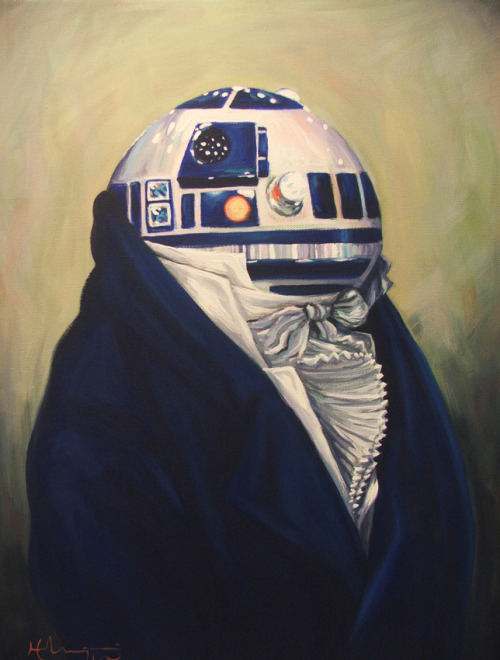
urhajos: Duke R2-D2 by *wytrab8 WHY AM I LAUGHING 


urhajos:

Duke R2-D2 by *wytrab8

WHY AM I LAUGHING 

22 Feb 23:13

Weekend reading on our website

by Dominic Preziosi

A lot of new material just posted on our website.

In “Shock Therapy,” Peter Steinfels discusses what the next pope could learn from Benedict.

The church needs shock treatment, and until the mini-shock of his resignation, Benedict, to the relief of many, did not seem like the man to administer it. Ratzinger, yes; Benedict, no. What shocks have come during his papacy were usually by blunder rather than intention. Evaluations of his tenure have balanced the pros and cons of his deeds according to the lights of the balancer. What is still untallied, except for his failure to unmistakably demand accountability in regard to clerical sexual abuse, is what has remained undone. Underlying conditions like the limitations, in numbers, quality, and age, of the clergy or the massively eroding credibility of church teachings on sexuality are no better than when he took office in 2005. Much of the hierarchy deludes itself with slogans in search of substance like “The New Evangelization,” or rationalizes inaction with the familiar alibi, “The church works in centuries.” In fact, history teaches that the church often suffers for centuries from its failure to act during critical passages.

Read the whole thing here.

Now featured in our “Looking Back” series, Cathleen Kaveny:

Thinking about Pope Benedict’s papacy leaves me saddened and perplexed. His aim, he says, is to lead people to Christ, and to appreciate the intellectual and spiritual riches of the Catholic Christian tradition. …

My concern is not that Pope Benedict doesn’t agree with progressive views on gender and sexuality. It is, rather, the attitude that he takes toward disagreement with different segments of the body of Christ. I do not understand the priorities of a papacy that ruthlessly targets prelates who are prepared to talk about women’s ordination, while doggedly pursuing reconciliation with virulently anti-Semitic priests and bishops. No amount of gentle, pious exhortations about the importance of God’s love, or the centrality of the Gospel, can make sense of this incredible disjunction for me.

You can read her entire reflection here, along with previous contributions from Margaret O’Brien Steinfels, Robert P. Imbelli, and Richard R. Gaillardetz.

And Celia Wren reviews the upcoming HBO mini-series Parade’s End:

The setting and themes of Parade’s End produced in association with the BBC (it aired in Britain last year), have inevitably invited comparisons to Downton Abbey. And indeed, many of the guilty pleasures offered by that Masterpiece Classic potboiler can also be found in this less soapy program. Parade’s End provides glimpses of spectacular mansions, beautiful English country landscapes, and delightfully fussy upper-class habits. …

But whereas the Crawley family saga showcases an unusually large number of likeable, good-hearted characters, Parade’s End teems with figures who are peevish, deluded, insincere, pompous, and self-serving, making for a vibe that is more bracing and unsettling, and less feel-good and weepy. And whereas Downton Abbey spoon-feeds us plot and characterization, this show forces us to pay close attention, less we miss a narrative twist or a telling line or image.

Read it all here.

22 Feb 16:26

Photo


22 Feb 16:25

My Weekend With the Seastar @justinesherry


My Weekend With the Seastar @justinesherry

22 Feb 16:24

Employers Will Beat Obamacare

by Doug Henwood

obamacare-cartoon-2-a

Back in the summer of 2011, McKinsey released results of a survey they’d done of employers showing that many would drop health insurance coverage when Obamacare* takes full effect. The liberal establishment united in loud criticism of the consulting firm’s report — but it’s looking like they were right. I wrote up the original report (“Bye-bye employer health insurance”) and experienced some of the loud criticisms, prompting a follow-up (“McKinsey: more right than wrong”) based on reading the full survey, something that some of the critics, including apparently Paul Krugman, hadn’t done.

Ah, vindication. Today’s Financial Times has has a front-page piece (“US business hits out at ‘Obamacare’ costs”) confirming the central point of the McKinsey survey: for many employers, it will be much cheaper to pay the penalties than cover full-time workers, and cut the hours for others so they fall under the definition of full-time and then don’t have to be covered. Retailers and fast-food chains are the most likely to do that, but there’s no reason that many other employers wouldn’t join in.

David Dillon, CEO of Kroger, put it succinctly: “If you look through the economics of the penalty the companies pay versus the cost to provide coverage, the penalty’s too low, or the cost of coverage is too high.” The penalty for not covering a worker is $2,000 a year — less than half the cost of covering a single worker ($4,664, according to the Kaiser Family Foundation), and less than a fifth the cost of covering a family ($11,429). Uncovered employees will be forced to buy coverage on the new insurance exchanges — with a government subsidy if their income is low enough— or pay the penalty themselves. You don’t need an MBA to figure out the math on that one.

As I said in my first post on the McKinsey survey:

In the short term, this could provoke a real social emergency, as scores of millions are thrown onto the private individual insurance market and forced to pay $1,000 a month for crappy coverage. But this could vastly increase the constituency for a single-payer scheme, such as Medicare for All — assuming our rulers don’t destroy Medicare first.

Still true.

*Usage note: Liberals hate the term “Obamacare,” given its prominence in the right-wing playbook. But he’s the one responsible for this monstrosity. Obamacare. Obamacare. Obamacare.

21 Feb 23:06

International Data on Cosmetic Surgery

by Lisa Wade, PhD

The  International Society of Aesthetic Plastic Surgeons has released new data on the incidence of invasive and non-invasive cosmetic procedures.  The U.S. leads in sheer numbers of procedures but, accounting for population, we fall into 4th place.  South Korea leads for the number of procedures per person, followed by Greece and Italy.

1

By far the most common kinds of surgical cosmetic procedures are lipoplasty and breast augmentation.  Along with fat, breasts seem to be a particular concern: breast lifts and breast reductions for both men and women are also in the top ten.  Abdominoplasty, nose jobs, eyelid surgeries, and facelifts are as well.

2

The incidence of these surgeries is strongly related to everything from the gender binary to global power dynamics.  In 2008 we reported that male breast reductions were the most common cosmetic surgery for 13-19 year olds (boys and girls combined). You would be shocked at what counts as excess breast tissue and how little the before and after photos look.  Boys and men getting breast reductions, alongside women getting augmentations, is obviously about our desire for men and women to be different, not naturally-occurring difference.  See The Story of My Man-Boobs for more.

Likewise, we’ve posted about surgeries that create an epithelial fold, a fold of skin in the eyelid more common in people with White than Asian ethnic backgrounds.  This surgery is a trend among Asians and Asian-Americans, as colonization has left us with an association between Whiteness, attractiveness, and power.

The Economist summarizes some other trends:

Breast augmentation, the second biggest surgical procedure, is most commonly performed in America and Brazil. Buttock implants are also a Brazilian specialty, as is vaginal rejuvenation. Asia is keen on nose jobs: China, Japan and South Korea are among the top five nations for rhinoplasty.

More on where and how many procedures are being performed, but nothing on why, at the ISAPS report.

Image at The Economist; via Global Sociology.

Lisa Wade is a professor of sociology at Occidental College. You can follow her on Twitter and Facebook.

(View original at http://thesocietypages.org/socimages)

21 Feb 23:04

Things you contemplate while washing your hair when you own a...


Things you contemplate while washing your hair when you own a periodic table shower curtain.

-elli m