FOULING THEIR OWN NESTS IS WHAT COMMUNISTS DO:
International financial centers don’t have political prisoners. https://t.co/8V4CwgrJX0
— Mark Simon (@MarkSimonHK) April 3, 2024
FOULING THEIR OWN NESTS IS WHAT COMMUNISTS DO:
International financial centers don’t have political prisoners. https://t.co/8V4CwgrJX0
— Mark Simon (@MarkSimonHK) April 3, 2024
WOEING: “Thanks to a string of unforced errors and botched responses, Boeing, like other corporate giants from the 20th century, has devolved from the epitome of world-beating quality to a symbol of managerial fecklessness, focused on short-term profits at the expense of the company’s long-term sustainability. Boeing cut corners in production, pushed out experienced workers to save money, and poured money into boosting the stock price instead of investing in its products.”
OF COURSE IT DOES: The Book ‘White Rural Rage’ Gets the Research Wrong. “The book White Rural Rage was co-authored by political scientist Tom Schaller and commentator Paul Waldman. As the title suggests, the gist is that white rural voters are a threat to democracy. . . . But political scientist Nicholas Jacobs from Colby College says the authors of the book have gotten some of the research underlying their claims wrong. He has a personal stake in the argument because some of the research cited in the book is his own. Jacobs is clearly not a fan of the book, in part because he thinks it is wrong-headed in its approach but also because he finds that it is simply wrong in many cases.”
To be fair, anything that’s a threat to the power of Democrats counts as a “threat to democracy” in the eyes of the Democrats and their clients.
Plus: “Shockingly, people in rural areas don’t like being told they should be grateful for every effort big city progressives make to micro-manage their lives for them (always for the greater good of course). For daring to disagree, they get smeared with books like White Rural Rage.”
HIGHER EDUCATION BUBBLE UPDATE: Unhinged Rutgers prof says it’s ‘homophobic’ to note that Hamas brutalizes LGBT people.
AMERICA’S NEWSPAPER OF RECORD: Judge Orders Trump To Stop Noticing That The People Trying To Put Him In Jail Are Democrats.
SUSTAINABILITY:
U.S. Treasury has now paid an all-time high of $1.1 Trillion in interest payments over the last year, almost double the previous all-time high during the onset of COVID pic.twitter.com/aG69ndeLNv
— Barchart (@Barchart) April 2, 2024
Entirely predictable, entirely ignored.
NOT SURPRISING BUT STILL WRONG: JustTheNews published an investigative piece today that shows at least two well-funded and (duh) left-leaning groups are responsible for injecting climate hysteria into news and entertainment. It appears that no narrative is too silly for the MSM to barf out:
“Ahead of the Easter weekend, multiple media outlets reported that chocolate prices are soaring, and according to the coverage, the main culprit driving the inflating costs is climate change.”
There is no data at all that shows cocoa yields have dropped due to climate change, and NPR didn’t even bother to try and find supporting data.
The Guardian, AP, NPR and The Conversation are among the hundreds of media outlets associated with or listed as partners with an organization called Covering Climate Now (CCN), which encourages reporters to insert “climate crisis” narratives into all their stories.
Covering Climate Now charges nothing for membership. It’s supported by anti-fossil fuel groups such as the Park Foundation, the Waverly Street Foundation, and Actions@EBMF. The group previously received funding from the Rockefeller Foundation, which had $5.2 billion in net assets in 2022, according to its tax filings, and funds many media organizations directly to advance the organization’s anti-fossil fuel message.
Worth noting is that these are the same media outlets who promote censorship and loudly decry “disinformation.” I suspect what they really mean is “disinformation is anything contrary to their narrative.”
Indeed, here’s the most insidious part:
“The group provides advice to reporters on all beats to not only insert a “climate crisis” narrative into every beat, but also how to cover the topic. This includes telling journalists not to platform what it calls “denialists,” which includes anyone who “ridicules” climate activists or suggests that climate change is not producing a global emergency.”
We have always been at war with Eastasia.
AND NOW, A FREE-WHEELING DISCUSSION OF CURRENT EVENTS WITH JOHN GILL: Former ESPN host Sage Steele says her Biden interview was entirely ‘scripted’ by network execs: ‘Every single question.’
In an interview with Fox News Digital, Steele recalled the “structured” nature of the pre-taped interview, so much so that her ESPN bosses handed her a “script” to go off of.
“That was an interesting experience in its own right because it was so structured,” Steele said. “And I was told, ‘You will say every word that we write out, you will not deviate from the script and go.’”
Many of the questions Steele asked Biden in the March 2021 interview pertained to sports leagues attempting to restore normalcy during the COVID pandemic and vaccine hesitancy among athletes and fans. Her interview made headlines at the time when Biden supported the MLB’s All-Star game boycott of Atlanta following the passage of Georgia’s election reform law.
But everything Steele said to the president ultimately came from ESPN’s c-suite.
“To the word. Every single question was scripted, gone over dozens of times by many editors and executives. Absolutely. I was on script and was told not to deviate,” Steele told Fox News Digital. “It was very much ‘This is what you will ask. This is how you will say it. No follow-ups, no follow-ups. Next.’ … This went up to the fourth floor, as we said, where all the bosses, the top executives, the decision makers are, the president of our company, the CEO, where they all worked.”
Every word was scripted, huh? Next you’ll be telling me that there’s gambling going on in Rick’s Café:


In the days before his death, John Barnett was in Charleston, giving a deposition for the whistleblower suit he had filed against Boeing. According to one of his lawyers, Rob Turkewitz, he was upbeat about his testimony, feeling he was finally able to tell the story of his efforts to get the company to take safety more seriously—and the rejection of those efforts by his bosses, who, according to Barnett, simply didn’t want to hear about it.
The last day of the deposition was scheduled for Saturday, March 9. But that morning, he was found in his truck, a bullet in his head and a gun in his hand. The police said it was “a self-inflicted wound.”
The reaction from people who knew Barnett was utter disbelief. On that last day, his lawyers told Time magazine, “he was in very good spirits and really looking forward to putting this phase of his life behind him and moving on. We didn’t see any indication he would take his own life. No one can believe it.” A family friend told ABC News that he had told her, “I ain’t scared, but if anything happens to me, it’s not suicide.”
The internet lit up. It was an “alleged suicide,” or “an apparent suicide.” “Whatever happened to John Barnett, the Boeing whistle-blower who declared he wasn’t suicidal and then died from ‘an apparent suicide?’ ” read one post on X. The clear implication was that Boeing was somehow involved in his death. (In a statement, the company said, “We are saddened by Mr. Barnett’s passing, and our thoughts are with his family and friends.”)
As suspicious as his death was, no one in a position of power is calling for an investigation. And they’re not likely to. But I do know this: everything John Barnett said about Boeing’s problems was true. Everything. If the company had been willing to listen to him, 346 airline passengers would still be alive. And maybe Barnett would be too.

On Monday, two weeks after Barnett’s death, Boeing announced that three top executives, including the CEO and the chairman of the board, were being booted out of the company. Finally, it seems, Boeing was waking up to the fact that its internal culture was destroying its reputation. There were the crashes of the two Boeing 737 MAX planes in 2018 and 2019 that killed 346 people. In January, a door panel flew out of an Alaska Airlines plane made by Boeing, while it was in flight, nearly pulling one of the passengers out with it. Was Barnett’s suicide—if that’s what it was—the last straw?
Perhaps it was. For seven years, from 2010 to 2017, assigned to the company’s South Carolina assembly plant and appalled by the lax controls, Barnett had tried to persuade his managers that the mistakes they were letting slide could one day be fatal. In 2019, Barnett told a journalist at Corporate Crime Reporter that his managers “started pressuring us not to document defects, to work outside the procedures, to allow defective material to be installed without being corrected. . . . They just wanted to push planes out the door and make the cash register ring.”
After he left the company—pushed out, he later alleged—he filed the whistleblower suit that led to that deposition in mid-March. And whenever a Boeing accident took place, he was the media’s whistleblower too, as journalists scrambled to interview him.
“I haven’t seen a plane out of Charleston yet that I’d put my name on saying it’s safe and airworthy,” he told The New York Times in 2019.

What is particularly painful about Boeing’s fall from grace is that it was once the gold standard in American manufacturing. Building an airplane requires great engineers, and that’s what Boeing had. It was a company proudly run by engineers, for engineers—for which it made no apologies. There was no need to impress upon employees the importance of safety because it was part of the engineers’ mindset. The company’s stock price? As Jerry Useem noted a few years ago in The Atlantic, “The company’s chief financial officer had minimal contact with Wall Street and answered colleagues’ requests for basic financial data with a curt ‘Tell them not to worry.’ ”
Then came one of the stupidest moves in the history of corporate America. In May 2001, Boeing’s CEO Phil Condit and its president Harry Stonecipher decided to move the company’s headquarters to Chicago—1,700 miles from its assembly plants in the Seattle area. Condit actually said that the move was made in large part to insulate the top brass from the “day to day business operations.” In other words, Condit and Stonecipher were deliberately divorcing themselves from Boeing’s engineering culture.
What they cared about was the stock. Wall Street no longer had the patience to recommend companies with flat or even slowly rising shares. All that mattered were fast-growing companies with fast-growing stock. In addition to pleasing Wall Street, it also made the top executives very rich because, since the 1980s, so much of their compensation was paid in stock options.
Then, in 2003, Condit was forced to resign after Boeing suffered a series of scandals, the last one being his affair with an underling. His successor Stonecipher was ousted two years later when he, too, was caught having an affair—though not before he proudly proclaimed that he was the reason Boeing was “run like a business rather than a great engineering firm.”
Stonecipher was replaced by James McNerney, a former executive at General Electric, the company that, under Jack Welch, had led the misguided quest to place shareholder wealth above all other corporate values. At least Condit and Stonecipher, who joined Boeing after a merger with McDonnell Douglas, had aviation backgrounds; McNerney had none. By then, as airline expert Mike Boyd told me, “Instead of building airplanes, all they cared about was building the bottom line.”
In 2014, McNerney’s last full year with the company, he pulled down a cool $29 million in compensation. Originally, Boeing was going to build a new airplane from scratch. But seeing that its chief competitor, Airbus, was getting record orders for its new plane, McNerney decided to build the 737 MAX on top of the existing 737 frame—but market it as a new airplane. Boeing was in a huge rush to catch up to Airbus; indeed, by the time it started delivering the plane it had thousands of orders.
“They threw the MAX together at the last minute,” said Boyd. But hey, it would save money—which would increase profits and boost the stock price. The combination of that decision, along with shortcuts Boeing now regularly made that compromised safety, was a terrible mistake.
Then came the two 737 MAX crashes. The first, Lion Air 610, crashed within minutes of its departure from Jakarta, Indonesia, killing 189 people. The second, five months later, Ethiopian Airlines 302, again crashed minutes after takeoff. All 157 people on board died.

After each crash, Boeing apologized profusely, but also insisted that, as then-CEO Dennis Muilenburg told Congress, “Safety is in our DNA.” But everyone could see that it wasn’t. In an effort to get the plane out quickly, Boeing, with the assent of the FAA, had even told the airlines that their pilots didn’t need to conduct flight simulator tests. That was a critical mistake, because the pilots would have discovered the issue that caused the planes to crash. The company was excoriated by Democrats and Republicans alike, furious that Boeing had so blatantly put profits over safety.
Internal Boeing documents made public by Congress showed that the company’s engineers were disgusted by what they were being asked to do in building the 737 MAX. “This airplane is designed by clowns, who in turn are supervised by monkeys,” read one internal email between engineers. A second one read: “I’ll be shocked if the FAA passes this turd.” And a third: “Would you put your family on a MAX simulator trained aircraft? I wouldn’t.” There were also comments about how all the company cared about was cutting costs.
That is what John Barnett was so urgently trying to impress upon his bosses when he was a quality control manager at Boeing: the company was making unsafe planes, and someday people were going to die as a result. And it’s what he tried to tell the rest of us once he became a whistleblower. In addition to all the interviews he gave after the various Boeing mishaps—let’s not forget the wheel that fell off a 777 during a takeoff at San Francisco’s airport earlier this month—his lawsuit was going to expose some critical safety errors at the company the world didn’t yet know about.
Boyd, who is highly critical of the modern Boeing culture, told me that the company has completely lost its way. And the safety issues are only part of the problem. For years, Boeing’s chief competitor, the European company Airbus, lagged behind the American behemoth. Not anymore. “Airbus is ten years ahead of them,” Boyd said. Boeing, he said, has “nothing on the drawing boards. Firing a few executives isn’t going to change Boeing. What they need to do is take a bulldozer to the entire board of directors.”
It is difficult to imagine America without Boeing, the company that pioneered the famously gargantuan 747, which began flying in 1969 and is still considered one of the greatest airplanes ever made. John Barnett is dead. But his mission should be kept alive. If Boeing is to have any chance of becoming great again, it needs to listen to what he had to say.

Joe Nocera is a columnist for The Free Press and the co-author of The Big Fail. Follow him on X @opinion_joe.
Become a Free Press subscriber today:
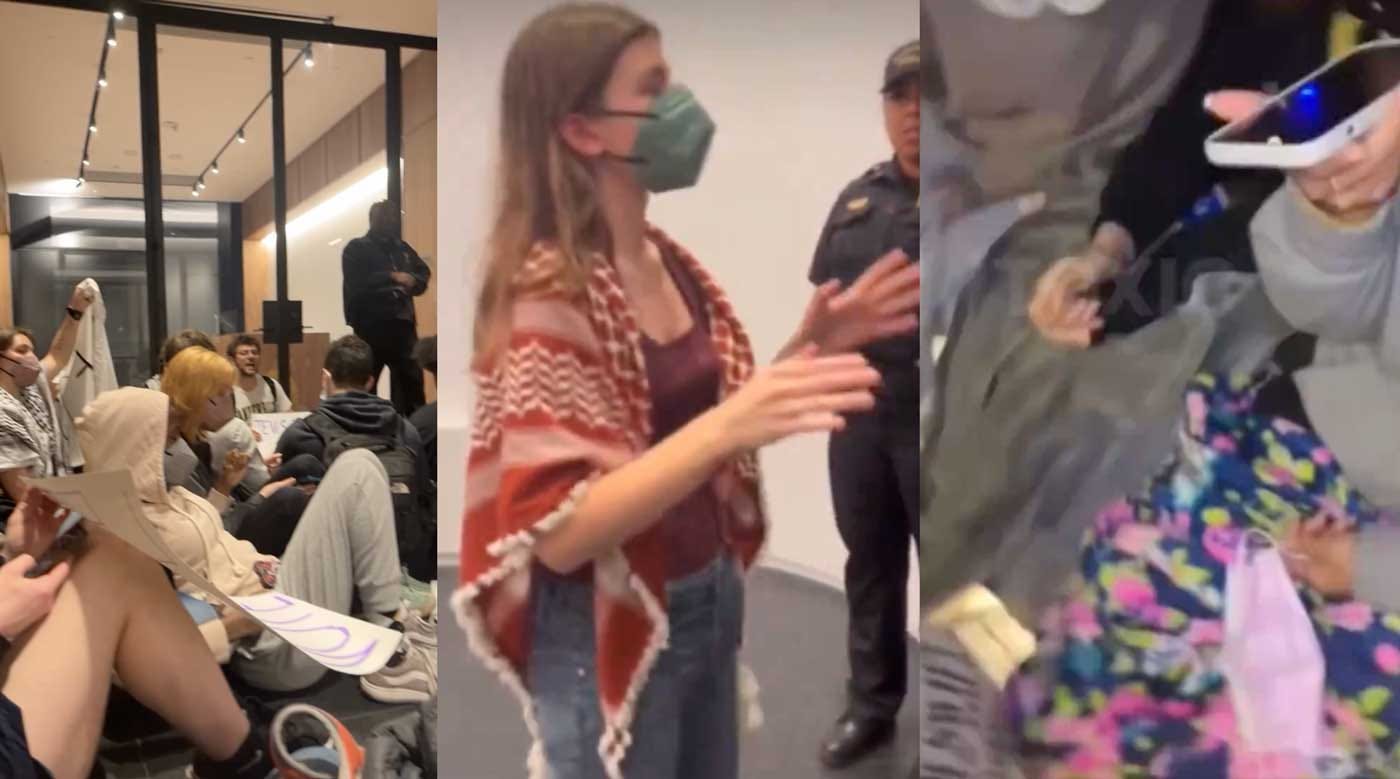
Let me tell you about some Vanderbilt girl’s tampon.
It all started yesterday morning, when a wave of undergrad students rushed Kirkland Hall, where Vanderbilt’s chancellor’s office is located. Thus began their sit-in—a response to the college administration shutting down a student government vote over whether the school should divest funds from Israel.
The protesters remained there for nearly 21.5 hours—blowing Harvard’s 12-hour “hunger strike,” also known as a good night’s sleep—out of the water, before police began removing and arresting students, some of whom have since been suspended.
There are many dumbfounding moments from this latest campus frenzy—for example, when the students, arms linked, called the black police officers protecting the chancellor “puppets.” When the administrators brought in food from Panera Bread for the officers but not the students, it was treated like a human-rights abuse.
But the tampon takes the cake. (Major props to Steve McGuire for compiling the best episode of the internet since. . . yesterday.)
Here’s what went down: during one of those 21.5 hours of the protest, probably at an ungodly one, a few of the student demonstrators decided to call 911. That’s because their friend, who was part of the sit-in, had to change her tampon.
Specifically, she was “being denied the right to change her tampon that has been in for multiple hours, which leads to an increased risk of toxic shock syndrome.”
The frankly Zen-like 911 operator, who deserves a raise, was understandably confused. “Ma’am, do you have an emergency?”
Um, yes?! The student on the phone requests urgent medical assistance.
“You’re telling me your friend in Kirkland needs an ambulance. Is that what you’re telling me?”
Then in another video, one of the protesters—in a keffiyeh and a mask—approaches the police and an administrator, who was indeed in a sweater vest, demanding to know WHAT. WILL. HAPPEN. to her friend, should she leave the sit-in to change the tampon in question. The adults calmly explain that she won’t be arrested if she leaves the building. But can they confirm that she will never be arrested, ever?!
“She does not feel safe,” someone says off-screen, punctuating it with claps.
This whole thing makes the Nick Christakis Halloween costume struggle session look like a teachable moment. It must be seen to be believed. Watch all the videos in Steve’s thread here.
For starters, if having a tampon in for “multiple hours” is grounds to call for an ambulance, I should have been dead years ago. Second, this student was being denied no such right. All she had to do was get up, leave the protest, and find one of the hundreds of bathrooms that she had access to elsewhere on campus. Pro tip: wear a pad to the all-night protest. The First Amendment doesn’t come with a heating pad.
It’s all very Karen, to borrow a trope from 2020, especially when a protester demands the administrator find someone who can get them some answers. Just like middle-aged women who think dressing down the manager will somehow earn them a full refund, these students have convinced themselves that by linking arms and screaming “shame” at their college’s chancellor, they are stopping a war in the Middle East.
Don’t these authority figures realize they are standing in the way of a global intifada, which is also—obviously—totally a good thing?
We find out in a subsequent video that indeed the tampon was removed, though not in any bathroom. Reader, it came out at the sit-in, like so much urine in so many plastic water bottles. A woman on the microphone calls it “the most depraved shit I’ve seen in my entire life.”
Hard agree.

Suzy Weiss is a reporter at The Free Press. Follow her on X @SnoozyWeiss.
QUACK ALERT: Two possibilities: Maybe white racists make life so unpleasant for pregnant black women in the United States that they develop preeclampsia at higher rates than pregnant women of other races. Or maybe, just maybe, there is a better explanation. (See also my earlier writings on this issue.)
Jts5665Price caps lead to shortages among other consequences which can't really be called unintended if everyone knows it's going to happen.
HOW IT STARTED: Rent control policies are gaining support nationwide. Here’s why economists still think it’s a bad idea.
—CNBC, March 15, 2023.
How it’s going: Biden to cap rent rises at 10% in new affordable housing ploy: White House to unveil plan that could stop landlords upcharging on millions of homes.
—The London Daily Mail, March 29th, 2024.
Will Sundown Joe’s handlers go the full Nixon, next?
On Sunday night television, Nixon presented his New Economic Policy, a cynical plan that helped his political prospects at substantial cost to the long-term economy. He immediately closed the gold window, ending the convertibility of dollars to gold. He imposed temporary wage and price controls. He asked Congress for a tax credit that was frontloaded for maximum impact pre-election, even as he slapped a surcharge on imports.
Many of the minds at Camp David, and at other advice sessions, opposed components of the plan. Shultz, then director of the Office of Management and Budget, fought the wage and price controls. But the economists eventually went along, telling themselves that concessions were the price of being policy makers.
“Ideologically, you should fall on your sword, but existentially it’s great,” Ben Stein, the son of Herb, told his father.
The short-term results of the New Economic Policy were as splendid as hoped. The Consumer Price Index, now manacled, dutifully declined to 1.7 percent from 4.1 percent the preceding year. Unemployment didn’t rise.
By July 1972, four months before voters would choose between Nixon and Democrat George McGovern, Stein, then chairman of the Council of Economic Advisers, held a press conference at which he claimed second-quarter data was “the best combination of economic numbers to be released on one day in all of history, or at least the Christian era.” (Reporters politely protected him by editing this down to “the best results in a decade.”) Gross domestic product for 1972 grew more than 5 percent. McGovern didn’t stand a chance.
But the long-term outcome, as Stein, an admirably honest thinker, later noted, was abominable. In the post-Nixon years, unemployment started rising again. International markets recognized that without the threat of gold withdrawals to keep officials’ spending in check, the Federal Reserve, Congress and the Treasury might inflate with impunity.
Inflation therefore also accelerated, as Stein noted regretfully in his memoir, “Presidential Economics.” The combination of inflation and unemployment was something so novel that Americans created a new word to describe it: stagflation. The homebuyer paid for the euphoria of Camp David with the worst mortgage interest rates in the history of Christianity, or at least the postwar period: more than 18 percent in 1981.
—Amity Shlaes: What not to do in an economic crisis, the Orange County Register, August 8th, 2011.
IT’S THE LOW GRAVITY AND THIN ATMOSPHERE:
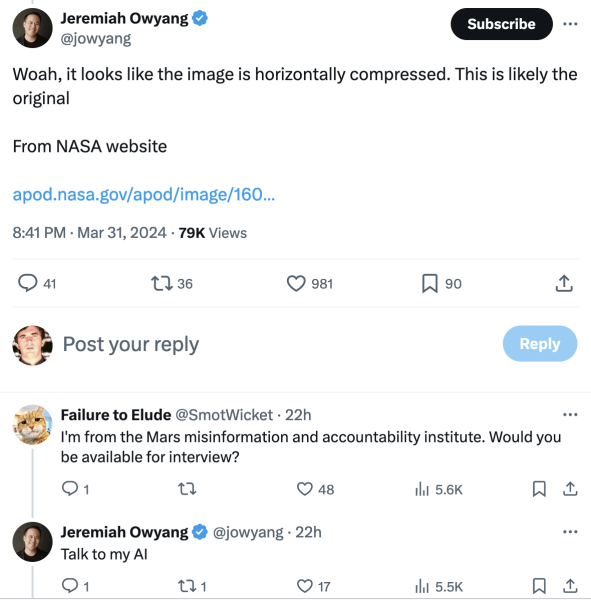
Real photos of sand dunes on Mars from NASA. Quite amazing, we don’t have these patterns on earth. pic.twitter.com/MkOj8hyLEV
— Jeremiah Owyang (@jowyang) March 31, 2024
Or maybe it’s something else.
Jts5665Washington really wants those kids sterilized.

Shane and Jennifer Degross have been licensed to provide foster care to children for over 9 years in the state of Washington.
Jts5665One of my biggest issues with the catastrophic global warming hysteria is the means of measurement. We have such a small amount of good data on a geologic time frame that we may as well be watching the temperature go up from night to noon and panicking. Not to mention all the heat island effects from development and poor siting of temperature stations. The people pushing catastrophe have all seemed like scammers.
The United Nations’ Intergovernmental Panel on Climate Change (IPCC) published their latest assessment report (AR6) in 2021. In 2023, the Clintel Foundation published a report which criticizes AR6.
Clintel is short for Climate Intelligence, and the Clintel Foundation doesn’t think there’s a climate emergency. Overall, Clintel’s main criticism is that the IPCC hasn’t reviewed the scientific literature in an objective way, as is their stated mission.1)
This article focuses on the topic of chapter 2 of the Clintel report: The Resurrection of the Hockey Stick.
What is a “hockey stick” temperature graph?
The image below shows a “hockey stick” temperature graph for the past 1000 years. This particular version is from the Summary for Policymakers of the IPCC’s third assessment report from 2001, and it applies only to the Northern Hemisphere.

The graph is called a hockey stick graph because the shape somewhat resembles an ice hockey stick with a long, flat “shaft” and a big “blade” shooting up at the end. If there had been more variability in the temperature before the “blade” – meaning that the “shaft” wasn’t flat – then it wouldn’t be a hockey stick graph.
Short summary
A “hockey stick” temperature graph has made a comeback in the latest IPCC report from 2021 (AR6), after being absent in the fourth and fifth reports.
Unlike the previous two reports which included multiple temperature estimates, AR6 relies on just one temperature estimate for the past 1000-2000 years, sparking criticism.
Moreover, this single estimate has itself been criticized. The perhaps most important issue relates to a method that incorrectly generates hockey stick temperature graphs from non-hockey stick data.
In general, the quality and amount of data that can tell us something about past temperatures quickly decline when we go further back in time. Based on the currently available data, it might therefore be impossible to know whether the global temperature of the past 1000-2000 years has a hockey stick shape or not.
Why is the hockey stick important?
A hockey stick temperature graph is convincing evidence that human emissions of greenhouse gases have a big impact on the climate, and according to IPCC, humans are responsible for roughly 100% of all warming over the past 150 years.
For Clintel, who doesn’t think there’s a climate emergency, it would make their argumentation easier if past temperature variability were higher, as more of the recent warming could then be attributed to natural causes. They write that if past temperature variability has been high, then “the temperature rise of the past 170 years would have to be shared [between] anthropogenic and natural causes.” 2)
However, this way of thinking is a fundamental mistake, according to climate scientist Ulf Büntgen. He argues that a high pre-industrial variability would mean that the atmosphere is more sensitive to changes in e.g. greenhouse gases, than if pre-industrial temperature variability has been low.3)
In any case, what’s most important is, of course, to get a correct estimate (or “reconstruction”) of past temperatures — whose shape may or may not resemble a hockey stick. Let’s explore!
From Chapter 2 of the Clintel report:
One of the big surprises of the IPCC’s AR6 report was the comeback of the so-called “hockey stick“. This term refers to the northern hemispheric and global temperature development of the past 1000-2000 years. More than two decades ago, Mann et al. (1999) published a reconstruction in which the temperatures of the pre-industrial period 1000-1850 AD appear rather flat and uneventful (the “shaft” of the ice hockey stick), followed by a fast and allegedly unprecedented warming since 1850 (the “blade”). The hockey stick became world famous because it was featured prominently in the Summary for Policymakers (SPM) in the IPCC’s 3rd Assessment report [see image at the top of this article].
The hockey stick graph received a fair amount of criticism, and Clintel explains that the hockey stick graph was subsequently corrected — resulting in a temperature reconstruction with more pre-industrial variability, and thus without a hockey stick shape. IPCC’s fourth and fifth assessment reports did not include a hockey stick temperature graph, but in the most recent assessment report (AR6), the IPCC once again presents a temperature reconstruction with low pre-industrial variability – a new hockey stick:

The new hockey stick temperature reconstruction is based on the work of PAGES 2k, the flagship of the PAGES (Past Global Changes) project. Clintel writes:
The PAGES 2k group is specialised in climate reconstructions and back in 2013 was comprised of the majority of all active paleoclimatologists. In 2019, PAGES 2k published a new version of the temperature development of the past 2000 years (PAGES 2k Consortium, 2019 4) [hereafter “PAGES 2k 2019”]). Surprisingly, it differed greatly from the predecessor version. Even though the database had only mildly changed, the pre-industrial part was now suddenly nearly flat again. The hockey stick was reborn[.]
And:
Evidence suggests that a significant part of the original PAGES 2k researchers could not technically support the new hockey stick and seem to have left the group in dispute.
It would be very interesting to read more about this. Unfortunately, Clintel doesn’t provide a reference.5) Anyway, Clintel continues:
Meanwhile, the dropouts published a competing temperature curve with significant pre-industrial temperature variability (Büntgen et al., 2020)[.] On the basis of thoroughly verified tree rings, the specialists were able to prove that summer temperatures had already reached today’s levels several times in the pre-industrial past. However, the work of Ulf Büntgen and colleagues was not included in the IPCC report[.]. [Emphasis added]
Did they really prove it? Probably not.

PAGES 2k 2019 is a global multi-proxy temperature reconstruction. Büntgen et al. 2020, on the other hand, applies only to the extra-tropical Northern Hemisphere, uses only one proxy-type – tree rings, and only looks at summer temperatures, not yearly temperatures. Still, it may actually make sense to compare Büntgen et al.’s reconstruction with PAGES 2k 2019, but that’s not immediately obvious, and a discussion of this by Clintel could have been beneficial.
What’s a multi-proxy temperature reconstruction?
In the previous paragraph, the term multi-proxy temperature reconstruction was used. A proxy — in this case a proxy for temperature — is an alternative to a direct temperature measurement with a thermometer. We’ve only had thermometers for a few hundred years, so we have no direct measurements of temperatures before that. To be able to estimate past global temperatures, scientists thus have to use less accurate alternatives instead of direct temperature measurements. These alternatives are called proxies. One proxy that can be used for temperature is tree ring width. Trees will typically grow more in a warm year than in a cold year, so for certain temperature sensitive trees, bigger tree rings could mean higher temperature.
A multi-proxy temperature reconstruction is an estimate of past temperatures that’s based on multiple proxy types. Tree ring width is typically one of several proxy types used in a multi-proxy temperature reconstruction.
The reason it may still make sense to compare Büntgen et al. 2020 and PAGES 2k 2019 is that PAGES 2k 2019 is also biased towards the Northern Hemisphere, towards summer temperatures, and towards the use of tree ring proxies:
PAGES 2k 2019 used 257 6) proxies out of a total of 692 proxies in the PAGES 2k database. 210 of these are high-resolution proxies with yearly resolution. In the below image, which is parts A, B and C from Figure 2 of Anchukaitis and Smerdon 2022, we can see
A) that most of the proxies with yearly resolution are based on trees (tree rings),
B) that the average latitude is not the equator, but 47 degrees north, and
C) that most of the proxies capture summer temperature (the growing season for trees in the extra-tropical Northern Hemisphere), not yearly temperature.

Criticism of PAGES 2k 2019 and IPCC
Anchukaitis and Smerdon 2022, where the above image is taken from, is an article that reviews “the strengths and limitations of existing global and hemispheric paleoclimate temperature reconstructions and highlight[s] likely sources of [existing] uncertainties, all in the context of [IPCC AR6].” They’re quite critical of the IPCC’s new hockey stick graph.
One thing they criticize IPCC for, is that the IPCC did not consider a variety of multi-proxy temperature reconstructions, which they had done in their previous two assessment reports (AR4 and AR5):
Despite the attempts in AR4 and AR5 to reflect uncertainties across multiple reconstruction efforts and to represent time-dependent uncertainties as they expanded back in time, these efforts were surprisingly abandoned in the most recent AR6 Working Group I (WG1) report in favor of a single ensemble-based reconstruction of global temperature with relatively static uncertainty bounds over the [past 2000 years.] […] The most recent assessment […] is thus a turn away from the attempts in previous reports to provide a full accounting of uncertainty in reconstruction efforts […], an incomplete representation of forward progress in both understanding and quantifying disagreement in temperature reconstructions of the [past 2000 years], and is an unnecessary return to a singular representation of large-scale temperature estimates that span all or part of the last several millennia.
Another point made by Anchukaitis and Smerdon, which they also touched upon in the above quote, is that the uncertainty range in the new hockey stick graph is far too narrow, especially when we get further back in time:
[T]he estimated uncertainties for this reconstruction used in AR6 only reflect the methodological differences as applied to the PAGES2k dataset at decadal and longer time scales. Much larger latent uncertainties are almost certainly present due to the change through time in proxy availability, sensitivity, and spatial distribution[.] Because the consequences of these uncertainties are poorly represented in AR6, which is intended to reflect an assessment of the current state of the science, the report fell short in its representation of what we know and what we have learned about Common Era [=past 2000 years] temperatures over the last two decades. [Emphasis added]
Clintel, of course, also criticizes PAGES 2k 2019:
Like its predecessor, the new hockey stick by PAGES 2k 2019 is based on a large variety of proxy types and includes a large number of poorly documented tree ring data. In many cases, the tree rings‘ temperature sensitivity is uncertain. For example, both PAGES 2k Consortium (2013) and PAGES 2k Consortium (2019) used tree ring series from the French Maritime Alps, even though tree ring specialists had previously cautioned that they are too complex to be used as overall temperature proxies (Büntgen et al. 2012; Seim et al., 2012).
In contrast, Büntgen et al. (2020) were more selective, relied on one type of proxy (in this case tree rings) and validated every tree ring data set individually. Their temperature composite for the extra-tropical northern hemisphere differs greatly from the studies that use bulk tree ring input.
In some cases, PAGES 2k composites have erroneously included proxies that later turned out to reflect hydroclimate and not temperature. In other cases, outlier studies have been selected in which the proxies exhibit an anomalous evolution that cannot be reproduced in neighbouring sites (e.g. [Medieval Warm Period] data from Pyrenees and Alboran Sea in [PAGES 2k 2013]) (Lüning et al., 2019b). Outliers can have several reasons, e.g. a different local development, invalid or unstable temperature proxies, or sample contamination.
However, starting from the third sentence, this text is virtually copy-pasted from a study by Lüning and Lengsfeld (2022). Clintel could have at least added a reference to that study. Also, it’s unclear whether the last paragraph applies to PAGES 2k 2019 or just to earlier PAGES 2k versions. If it does indeed apply to the 2019 version, then the Clintel report would have benefited from documenting it.
A new temperature reconstruction that includes short-term trends
As noted, PAGES 2k 2019 is a multi-proxy temperature reconstruction (although it may be biased towards tree-rings), while Büntgen et al. 2020 only uses tree rings. All things equal, multi-proxy reconstructions should be preferred over single-proxy reconstructions; according to Büntgen et al. 2022, there is “community-wide agreement that multi-proxy compilations are the most appropriate methodology to climate reconstructions“.
One reason that multi-proxy reconstructions are better is that some proxy types can reveal short-term temperature variability, but not long-term variability, while others can reveal long-term variability, but not short-term variability.
And while “tree rings are excellent at capturing short frequency variability, they are not very good at capturing long-term variability.” (Fundamentals of Tree-Ring Research, James H. Speer, 2009) This is also pointed out by Büntgen et al. 2020 itself, the study that used tree-rings only:
[Tree ring width] is particularly limited when reconstructing the amplitude and duration of climatic extremes[.]
And:
While we have no doubt about the timing of past summer cooling in our reconstructions, accuracy of the temperature amplitude remains somewhat challenging.
Since some proxy types are good for capturing short-term trends, while others are good for capturing longer-term trends, the best way to make a temperature reconstruction should be to use proxy-types that capture long-term variability for the long-term trends, and then use e.g. tree rings to show the short-term variations on top of the long-term trends.
Titled “A frequency-optimised temperature record for the Holocene“, Helen Essell et al. 2023 is a study that combines short-term and long-term proxies in this way. It’s the first study that attempts to “present […] temperature variability on interannual timescales over the past 12 000 years.” Previous studies have had a much lower (worse) time resolution, and hence the temperature graphs from those studies have been smoother and with less variability.
However, while “interannual signals ([less than] 10 years) are best captured by tree-ring chronologies (wood)“, only 3 tree-ring proxies were included in the study. Unfortunately, the study doesn’t discuss uncertainties related to the low number of short-term proxies.
The study performs a global temperature reconstruction, but like most other “global” reconstructions, there is a bias towards the Northern Hemisphere and summer temperatures.
Also note that the study looks at the time period 12,000 – 0 BP, where BP means “before present” and “present” is defined as the year 1950. This is a longer time period than we normally talk about for hockey stick temperature graphs, which is 1000-2000 years. Hockey stick temperature graphs also normally include the time period after 1950, which is often represented by thermometer data in addition to proxy data. Helen Essell et al. 2023 does not use thermometer data.
Although the time period is different, it’s interesting to compare IPCC’s hockey stick graphs with the new temperature reconstruction from Helen Essell et al. 2023, which looks like this (where light green shows the uncertainty range):

If the results of this study are broadly correct, then pre-industrial temperature variability has been high, which would mean that hockey stick temperature graphs are not correct.
Since Helen Essell et al. 2023 is a new and novel study, it may or may not contain important errors, but their criticism of the IPCC is very relevant regardless; the IPCC should not compare long-term average temperatures with recent yearly (high) temperatures:
[W]e remain critical of the interpretation of the smooth trajectories of existing Holocene temperature reconstructions, which have influenced policy debate. For instance, the Sixth Assessment Report of the Intergovernmental Panel on Climate Change (IPCC), and its ‘Summary for Policy Makers’ and ‘Technical Summary’ compared recent annual extremes against past centennial averages. Such unequal comparison has the potential to mislead portrayal of the threat of global warming as low- and high-frequency records reflect different aspects and amplitudes of the Earth’s climate system. [References removed]
Stephen McIntyre
Stephen McIntyre is a central figure in the hockey stick controversies. McIntyre thinks (as does Clintel) that the IPCC wanted to get a hockey stick temperature graph: “the IPCC remains addicted to hockey sticks“, he wrote in a 2021 article on his blog, ClimateAudit, where he explains some of his major complaints about the new IPCC hockey stick.
Stephen McIntyre is well-known for his criticism of Michael Mann’s original hockey stick graph. He has been reporting errors in the PAGES 2k temperature reconstructions since at least 2013, when the IPCC was set to use data from the PAGES 2k project in its 5th assessment report (AR5). Much of the proxy data was already familiar to McIntyre at the time, since many of the proxies used by PAGES 2k had also been used by Michael Mann and in other earlier temperature reconstructions.
So it’s safe to say that McIntyre is very knowledgeable when it comes to the proxies underlying the temperature reconstructions that have been published in the last few decades. And in 2019, McIntyre commented on Twitter that: “[…] I probably know the data better than the article lead authors[.]“
Asian tree ring chronologies: – It’s worse than anyone can imagine
What’s a tree ring chronology?
A tree ring chronology represents the year-to-year variations in tree growth within a geographical region. In a chronology for temperature sensitive trees, the variations in tree growth will roughly correspond to temperature variations. Scientists take samples from lots of temperature sensitive trees in a region, and you can think of the resulting chronology as an average of all those trees.
The most common tree ring proxy is tree ring width. There may be better tree ring proxies, but tree ring width is the one that’s easiest (cheapest) to measure.
Since the cross-section of the stem of a tree grows roughly the same amount each year, tree rings are typically wider for younger trees. For this reason, you can’t directly compare tree ring widths and say that, just because the tree ring was wider in a given year, that the temperature was also higher in that year. You have to first adjust for the age of the tree and potentially other factors. This adjustment is called standardization (or detrending), and it’s usually performed on data for each tree before the data from individual trees are combined into a chronology.
There are many problems with the chronologies included in PAGES 2k 2019. Here, I’ll just focus on the most important issue. But see footnote 7) for a summary of some other issues.
According to McIntyre, some of the tree ring chronologies included in PAGES 2k are incorrectly calculated:
It’s hard for a statistical methodology to be so bad as to be “wrong”. Mann’s principal components methodology was one seemingly unique example. PAGES2K’s Asian tree ring chronologies are another. It’s worse than anyone can imagine. [Emphasis added]
In a 2021 article, McIntyre writes about the Asian tree ring chronologies used by PAGES 2k. He writes that many chronologies were introduced without having been reviewed. The ones that made it into the latest PAGES 2k version were the ones that were the most hockey stick-shaped:
About 20% of the PAGES 2019 proxies are 50 Asian tree ring chronologies, all of which were originally published as chronologies in PAGES (2013). At the time, none of these series […] had ever been published in technical literature, peer reviewed or otherwise. Nothing in the Supplementary Information to any of these articles says who calculated these chronologies or how they were calculated. […]
PAGES (2013) was originally rejected by Science in 2012, because peer reviewers (including Michael Mann) objected to the introduction of so many new proxies in what was ostensibly a review paper; they sensibly recommended that components first be peer reviewed in relevant specialist journals. However, PAGES2K results had already been incorporated into a pending IPCC assessment (AR5), so the authors, now under a very short deadline, submitted to Nature, which was confronted by the same review problems that led to the rejection by Science. Keith Briffa had a clever, too clever, solution: publish the PAGES2K submission as a “Progress Article” – a classification that did not require the peer review procedure required for a Research Article. This would qualify the article for IPCC and nobody would notice the sleight-of-hand. (Even I didn’t notice it at the time; someone told me.)
One of the consequences of the 2013 manoeuvring was that several hundred Asian tree ring chronologies were introduced to paleoclimate archives with no technical publication or technical peer review, no information on how they were calculated or even who among the PAGES2K (2013) authors had calculated them.
Having been introduced through the back door, so to speak, nearly all of the 200+ Asian tree ring chronologies were carried forward into the PAGES (2017) compilation, and then a subset of 50 chronologies (more or less the most hockey stick shaped) was screened to become a substantial component of PAGES (2019) – the source of the IPCC Summary for Policy-makers Hockey Stick.
One of the new Asian tree ring chronologies is shown below. In addition to “Asia_207”, it also goes by the name “paki033” and “Asia-MUSPIG”:

The x-axis shows the year, and the y-axis shows ring width index, which corresponds to temperature in the region. The higher the ring width index, the higher the temperature. In an ideal world, at least.
Below are two chronologies that McIntyre calculated from the underlying tree ring widths using two normal standardization procedures (middle and right) compared with the PAGES 2k 2019 chronology (left):

As we can see, there is no hockey stick in the chronologies calculated using the standard procedures. And actually, temperature (or tree growth) seems to be going down rather than up in the 20th century, “so how did PAGES2K manage to get such a hockey stick? I have no idea“, wrote McIntyre in 2021.8) In 2023, however, Hampus Söderqvist (@detgodehab on Twitter/X) had been able to reverse engineer the algorithm used by PAGES 2k.
It turned out that the algorithm had a tendency to add upticks at the end — making hockey sticks from non-hockey stick data. This was verified by McIntyre and Söderqvist by cutting off the last 50 or 25 years of data before applying the algorithm. From Twitter:
bingo. Excluding the last 50 years of data, paki033 had an even bigger blade //50 years earlier//. For good measure, @detgodehab did test excluding 25 years and got same big blade //25 years earlier//.
It didn’t happen for all tree ring datasets, though, but the fact that it happened for some, means that the algorithm can’t be trusted and shouldn’t be used. However, the algorithm was used not only for this one site in Asia, but for several others as well, contributing significantly to the hockey stick shape of PAGES 2k’s (and IPCC’s) temperature reconstruction:
@detgodehab has verified that same flawed algorithm was used for at least 8 other Pakistan sites. Note that these sites (together with Columbia U’s Mongolia chronologies) dominate PAGES19 list of heavy contributors to closing blade.
(See this sub-thread on Twitter for more details on what the algorithm did for certain tree ring data.)
The “signal-free” procedure
The problematic standardization procedure used by PAGES 2k is called signal-free detrending.9) As we’ve seen, tree rings aren’t very good at preserving long-term temperature trends, and the signal-free procedure was created with the intention to at least partly solve this problem — to preserve medium-term (up to one century) variability in tree ring temperature reconstructions.10)
Looking to the scientific literature, we actually find a criticism of this procedure that’s very similar to McIntyre and Söderqvist’s; Pearl et al. 2017 found that
the signal-free detrending procedure increased the amplitude of the early and late ring-widths beyond reasonable growth patterns for the species[.]
and that
the use of [signal-free standardization] instead of traditional [negative exponential] chronologies results in an overestimation of recent temperature trends and a lack of reconstruction skill. [Emphasis added]
An overestimation of recent temperatures was exactly what McIntyre and Söderqvist found could happen.
How much can we actually know about past temperatures?
In light of the big differences between global temperature reconstructions, one might wonder how much we can actually be certain of when it comes to past global temperatures. In a 2021 article, The future of paleoclimate, Jan Esper and Ulf Büntgen address this issue:
Our understanding of natural climate variability rapidly declines over the Common Era (CE) [Common Era=past 2000 years] as the pre-instrumental temperature amplitude differs substantially among large scale reconstructions. Highlighting such differences and emphasizing paleoclimatic findings is crucial for placing [human-caused] climate change in a long-term context. We argue that more proxy records are needed to accurately reconstruct first millennium CE temperature variability[.] [Emphasis added]
The number of proxies as well as the quality of these series declines back in time, so that only a few records are available during the early centuries of the [Common Era]. All of these issues, i.e. the limited resolution, reduced replication, and increased dating uncertainty, affect our ability to accurately assess past temperatures and cause a blurring of the climate record back in time. [References removed]
In their opinion, we can know very little about global temperature variability prior to the year 1400:
Yet the circumstance that the next IPCC report will no longer include a paleoclimate chapter should not mistakenly be interpreted as evidence that natural climate variability is understood. The opposite is actually the case. We are in the dark already before 1400 CE, have a rather limited idea of the magnitude […] of pre-industrial warm periods, and know much less about the Southern Hemisphere[.] [Emphasis added]
Conclusion
Whether the average global temperature of the past 2000 years forms a hockey stick pattern or not might not be possible to determine from existing proxy records. And there’s disagreement in the scientific literature about how much the pre-industrial global temperature has varied since year 0.
Although the IPCC knew about the disagreement, they still chose to rely on a single temperature reconstruction for the past 2000 years (PAGES 2k 2019) in their latest assessment report. That in itself is unfortunate, since they’re supposed to make an objective assessment of the scientific literature. It’s even more unfortunate considering all the criticism PAGES 2k 2019 has received.
Did the IPCC want to present a hockey stick temperature graph? The Clintel Foundation and McIntyre believe so, and I wouldn’t be surprised, either. But it’s hard to prove.
Footnotes:
1) An objective review is at least one of IPCC’s stated missions. On their About page, one of the things the IPCC writes is:
An open and transparent review by experts and governments around the world is an essential part of the IPCC process, to ensure an objective and complete assessment and to reflect a diverse range of views and expertise.
2) Lüning and Lengsfeld 2022 has the same perspective as Clintel. They write:
As a rule of thumb, the larger[…] the pre-industrial temperature changes, the higher[…] the natural contribution to the current warm period (CWP) will likely be, thus, reducing[…] the CO2 climate sensitivity and the expected warming until 2100.
3) As part of Büntgen’s response to a question about whether his recent work would help the “climate deniers” or the “climate change proponents”, Büntgen argues that a high pre-industrial temperature variability would mean that the climate sensitivity is also high:
There is one thing that often gets taken wrong if we are reconstructing past climate and we show more natural variability. Some people, they don’t understand it fully, they would say “ah okay, you are able to show us that [the] climate system was always varying, so where is the problem?” This is the wrong assumption, the assumption is that this only indicates that the climate system is very sensitive, so it’s about the sensitivity. That means even without [varying amounts of] greenhouse gases, we had these fluctuations; we had cold and warm periods. So that means the sensitivity of the [Earth] system is very high, which makes the effect of greenhouse gases even bigger, right? So I think it is exactly the counter-argument. If we are able to show that pre-industrial temperature and precipitation changes were relatively big, it only means that the additional effect of greenhouse gases will be even further a problem.
I haven’t found a discussion in the scientific literature comparing the opposing perspectives of Clintel and Büntgen.
4) Unfortunately, you have to pay to read the main text of PAGES 2k 2019 at Nature. However, a free version of the main text is available here.
5) But an article by Swedish blogger Maths Nilsson may lend some support to Clintel’s claim. Nilsson had asked climate scientist and fellow Swede, Fredrik Ljungqvist, whether a new hockey stick had been commissioned by the IPCC, something that the Clintel report suggested might have happened. According to Nilsson, Ljungqvist’s answer was a categorical no:
So I contacted Fredrik Charpentier Ljungqvist (FCL), co-author of both the Page[s] 2k (2019) and Büntgen (2020)-papers. What did he say?
First of all, the IPCC did NOT in any way commission the Page[s] 2k-study as Clintel implies ([Ljungqvist] used the capital letters).
Nilsson’s next paragraph then hints at a possible justification for Clintel’s claim that some researchers seem to have left PAGES 2k in dispute — at the very least, there seems to have been disagreement:
[Ljungqvist] did however confirm that some leading [paleoclimatologists] do not think the Page[s]2k graph was properly used in the IPCC AR6-report. They don’t think there is sufficient data to even reconstruct a global mean temperature with precision 2000 years back (most data comes from northern [hemisphere]). [Ljungqvist] somewhat regrets putting his name on the Page[s]2k-study. [Emphasis added]
6) Stephen McIntyre has made available a folder with two files. One file, proxy_pages2019.csv, shows an overview of all 257 chronologies (although only the tree ring chronologies were visible to me by default — I had to unhide the others). The other file, info_pages2019.xlsx, includes all yearly values (temperature, ring width index or similar) for all 257 chronologies.
The PAGES 2k 2019 study also links to much of the same data, but in a harder-to-read data format.
7) Some of the other potential problems that McIntyre writes about:
The IPCC AR6 Hockeystick:
“The idea/definition of a temperature “proxy”“, McIntyre writes, “is that it has some sort of linear or near-linear relationship to temperature“. He argues that this is not the case for the proxies underlying e.g. PAGES 2k 2019. To illustrate his point, McIntyre visualizes random samples of 11 proxies from each of PAGES 2k 2017, PAGES 2k 2019, and tree ring chronologies from North America (used by PAGES 2k 2019), and compares them with PAGES 2k 2019’s resulting hockey stick graph. A few proxy chronologies have a hockey stick shape, but in those cases, according to McIntyre, the hockey stick shape was the result of errors in calculating the chronology. One chronology looks like an upside-down hockey stick. McIntyre suspects PAGES 2k 2019 flips it over (!), which means it would contribute positively to the final hockey stick shape.
PAGES2019: 30-60S:
PAGES 2k 2019 includes very few southern hemisphere proxies. In the 30-60 degrees south latitude band (southern extra-tropics), PAGES 2k has included only 8 proxies. Of the 8 proxies, 7 are tree rings, and none are ocean proxies despite 94% of the area being ocean. The 8 proxies had been reduced from 19 proxies in PAGES 2k 2017. Only one proxy goes back 2000 years, one goes back about 1200 years, and the rest are shorter than 600 years. The final PAGES 2k reconstruction has a much more pronounced hockey stick shape than any of the 8 proxies that it’s made up of.
PAGES19: 0-30S:
PAGES 2k 2019 includes 46 proxies in the 0-30 degrees south latitude band (southern tropics). However, only 2 of them go back 2000 or nearly 2000 years. Among the rest, none of the proxies go back further than the year 1500 AD, and about half have a start date after 1850. McIntyre comments: “None of these short series shed any light on whether the medieval period, for example, was warmer than modern period or not.” 43 of the 46 proxies are coral proxies, and strangely, there are only two proxies from land.
There are two different coral temperature proxies, δ18O and Sr/Ca. δ18O looks at the ratio of two different oxygen isotopes in the coral, the common 16O and the much less common 18O. The Sr/Ca proxy looks at the ratio of two different chemical elements in the coral, Strontium (Sr) and Calcium (Ca). According to McIntyre, “PAGES2K is primarily populated with d18O series – which, in specialist articles, are seldom, if ever, used as temperature proxies, as Sr/Ca is usually preferred. Changes in 20th century coral d18O are nearly always much more pronounced than corresponding changes in coral Sr/Ca. Perhaps that’s why they were selectively chosen into the PAGES2K network.” A little speculation at the end there, but from having read many of McIntyre’s articles, the speculation is certainly very understandable.
PAGES 2019: 0-30N Proxies:
PAGES 2k 2019 includes 41 proxies in the 0-30 degrees north latitude band (northern tropics), which is down from 125 proxies in PAGES 2k 2017. The removed proxies were mostly ocean sediments and tree rings, “all of which were much longer than the retained coral proxies“. Among the 41 remaining proxies in PAGES 2k 2019, only one extends back 2000 years, while two others go back around 1000 years. 8 of the proxies are from tree rings, two of which had upticks at the end. However, the upticks didn’t appear when standardizing the raw data using normal detrending-algorithms. “In response to a recent inquiry, the PAGES2019 authors were unable to identify how the chronology was calculated and refused to find out.” Presumably, they were calculated using the same flawed algorithm that was used for the Asian tree ring chronologies discussed in the main text (the signal-free procedure).
8) The reason McIntyre didn’t know was that PAGES 2k hadn’t documented which standardization (or detrending) method was used to create each tree ring chronology. I already quoted McIntyre saying this (“Nothing in the Supplementary Information to any of these articles says who calculated these chronologies or how they were calculated“), and Klippel et al. 2020 confirms it:
[T]he PAGES2k database contains no information regarding the detrending method used to produce the tree-ring chronologies in its collection[.]
Also, when McIntyre asked two of the PAGES 2k authors about the standardization method on Twitter, Nick McKay replied that he didn’t know which method had been used.
9) Here’s a technical explanation from McPartland et al. 2020 for why the algorithm is called signal-free:
The term “signal-free” refers to the creation of detrending curves that do not contain the common signals shared across the trees in a chronology, and are thus ‘free’ from common variance and should preserve this signal in the resulting chronology.
In its original formulation, [signal-free standardization] was primarily intended to improve the expression of medium-frequency (i.e., decades to one century) variance associated with climate forcing.
The post IPCC’s New “Hockey Stick” Temperature Graph appeared first on Climate Etc..
ORIGIN STORY: SUPERHERO, OR SUPERVILLAIN? Scientists Put Tardigrade Proteins Into Human Cells. Here’s What Happened.
“Amazingly, when we introduce these proteins into human cells, they gel and slow down metabolism, just like in tardigrades,” says molecular biologist Silvia Sanchez-Martinez, from the University of Wyoming.
“When you put human cells that have these proteins into biostasis, they become more resistant to stresses, conferring some of the tardigrades’ abilities to the human cells.” . . .
“When the stress is relieved, the tardigrade gels dissolve, and the human cells return to their normal metabolism,” says University of Wyoming molecular biologist Thomas Boothby.
What shall we call that character? “Tardiman?” That just sounds like someone who’s always late.
TO BE FAIR, THAT’S BECAUSE HE’S A TOOL:
Before the 2020 election Stephen Colbert was doing skits encouraging people to be skeptical of Big Pharma and its motives.
After the election he was dancing like a fool while surrounded by people dressed as syringes. pic.twitter.com/9IXtxKRi7M
— MAZE (@mazemoore) March 29, 2024
Jts5665I think the reason democrats attack local police and ignore malfeasance by the alphabet agencies is that they want to eliminate private police and put in place a nationally controlled force.
THERE’S A REASON WHY A MAJORITY OF AMERICANS THINK OF THE FBI AS BIDEN’S GESTAPO, YOU KNOW: Woman Records Very Creepy Visit by the FBI.
Jts5665The politically correct is not scientifically correct most of the time.

Man, whenever I think I've explained just how much you should hate journalists, new info comes out that just makes you need to hate them more.
Meet Craazyman:
“Craazyman is the fake name for a Racket subscriber who is a nobody by standards of public life. Just like you, dear reader! But we both like Enlightenment values, that's for sure. We'll tolerate experts, but we love honest seekers of any kind. Cute fluffy kittens are OK too. So are seals.”
Commented on:
Jts5665Hope it works better than Boeing's other products.
THE NEW SPACE RACE: Boeing, NASA target May 1 for first crewed flight of Starliner to the space station.
Because this is a test flight, Wilmore and Williams, both astronauts with military test pilot experience, will perform some manual maneuvers during the trip to the ISS as well as on the return to Earth. Most of these actions won’t be needed during routine ferry flights to the station outside of emergency situations.
“What’s really kind of cool about Starliner is that it’s very much a pilot’s spacecraft. It’s really maneuverable,” Lammers said. “There’s close to 50 reaction-control and orbital maneuvering jets on it and there’s a stick. And what’s really cool about it is, when you have astronauts that are pilots, they really gravitate towards using it.”
Godspeed…

 Below is my column in the New York Post on a reported plan of the Democratic National Committee and allied groups to try to block third-party candidates from the 2024 ballot. The contradiction is stunning as these groups raise money to “save democracy” by limiting democratic choice. In the meantime, the leading third-party candidate Robert Kennedy, Jr. will be reportedly announcing his running mate this week.
Here is the column:
The last time that the Chicago Democratic Convention was held in Chicago in 1968, the resulting riots led to one of the greatest Freudian slips in American politics. Mayor Richard Daley declared “the policeman isn’t there to create disorder; the policeman is there to preserve disorder.”
The Democratic National Committee has now added its own gem: the Democratic Party is not here to preserve democracy, it is here to prevent democracy.
That’s because the DNC is seeking to block third party candidates from ballots — Robert Kennedy Jr., Cornell West, and Jill Stein. All three are liberal and are considered a threat to Joe Biden.
This effort will likely include any ticket put forward by the No Labels group, seeking a moderate alternative to the two parties.
The media does not appear at all alarmed or critical of the effort to limit democratic choice. The Washington Post stated clinically “Democrats are taking third-party threats seriously this time.” Taking it seriously appears to mean using legal means to keep them from the ballots.
It is true that the main political parties have challenged qualification signatures and paperwork in the past. However, the reports indicate a systemic effort geared toward reducing the choices for voters. What is striking is that this is coming from democratic groups and the DNC, which are raising money on the “save democracy” narrative.
The contradiction is spellbinding. On the same sites promising to oppose the third party candidates, the DNC and other groups push the narrative that only the Democrats are working to protect the right to vote.
The Post reports that Democrats have studied the Hillary Clinton campaign and vowed not to allow third party candidates to drain away millions of voters as they did in 2016. Of course, the comparison is particularly telling because in both 2016 and 2024, the DNC chose the least popular Democratic candidates. Polls showed that Clinton was the worst possible candidate for the party, but the Clintons had control over the DNC and state party organizations.
Of particular concern is the fact that Trump beat Hillary Clinton in Pennsylvania, Wisconsin and Michigan by only 67,000 votes. In just those states, Libertarian Gary Johnson and the Green Party’s Stein received more than half a million votes.
Rather than actually pick a candidate that most citizens want, the DNC wants to replay the 2016 strategy of forcing the choice between two evils in a Biden-Trump choice. That can only work reliably if there is no other choice for citizens tired of the duopoly and the political (and media) establishment. So Kennedy, Cornell, and Stein just have to go.
I am one of those misguided voters. Years ago, I wrote a column saying that I was tired of voting for the lesser of two evils — leaving every election as a moral hazard. I am prepared to vote for candidates from the two main parties in any given election, but I will only vote for the candidate who I believe is the best of candidates to be president. We are played as chumps by a political and media establishment in every election system. Over two decades ago, I pledged to vote for the best candidate, even if they are with a third party.
The DNC is reportedly to be joined in this effort by a well-financed array of groups including the liberal think tank Third Way (which has filed complaints with secretaries of states); American Bridge (a Democratic opposition operation), and Clear Choice (a super PAC composed of “allies of President Biden”).
While these groups work to limit the choice of voters, the effort continues in Florida, Georgia, Washington, and New York to keep Trump in court until the election, including a possible trial running up to or even through the election.
There is hope that this multi-front effort will be the winning ticket, particularly if the ultimate ticket denies voters any other choice.
The open discussion of these efforts in the media illustrates the contempt for voters, who need to be protected from their bad choices. I have previously compared the underlying assumptions to a type of electoral Big Gulp law. Before they were also struck down, these laws sought to take away the dietary choices of citizens because they were making the wrong choice in the view of experts.
Activists are now big gulping the election. Voters cannot be trusted with something as important as democracy.
President Biden has said “make no mistake: Democracy is on the ballot for all of us.” Of course, he could end this effort by denouncing further ballot cleansing (something he refused to do when Trump was removed by the Colorado and Maine ballots). It appears that the last thing that democracy needs is free democratic choice.
Jonathan Turley is an attorney and professor at George Washington University Law School.
THE ISSUE IS NEVER THE ISSUE. THE ISSUE IS ALWAYS THE REVOLUTION. Proof eco-extremists don’t want to fix the problem, they want to tear down society.
This week, Harvard University has shut down a Bill Gates-funded geoengineering experiment. The controversial Stratospheric Controlled Perturbation Experiment, or SCoPEx, run by professors David Keith and Frank Keutsch, aimed to study the potential future implementation of geoengineering by crop dusting sulphuric acid into our stratosphere. Nice.
Even if you put aside the almost instant validity such an experiment would give to conspiracy theories like chemtrails and HAARP, it still sounds a bit too much, playing with our thin air like that — in an unprecedented, and potentially catastrophic, manner, too.
But let’s not kid ourselves. The plug wasn’t pulled over fears of playing fast and loose with the venusformation of Earth’s atmosphere.
Nor was it due to the Harvard faculty’s occasional (yet frequent) dalliance with plagiarism or concerns over the lack of diversity within the ivory tower.
No, according to the MIT Technology Review, it was something else entirely: “Even studying the possibility of solar geoengineering eases the societal pressure to cut greenhouse gas emissions,” it clarified.
Not only are you not supposed to solve the problem. You’re not supposed to think about solving the problem. Because the problem is the source of their power.
AND NOW FOR SOME GOOD EDUCATION NEWS: Classical ed — seen as ‘a white child’s education’ — is thriving in the Bronx.
Are the liberal arts conservative?, asks Emma Green in a New Yorker story about the revival of “classical education.” A growing number of classical-ed charter and private schools are offering “a traditional liberal-arts education, often focusing on the Western canon and the study of citizenship.”
Unlike many traditional public schools, “classical schools prize memory work, asking students to internalize math formulas and recite poems,” she writes.
Reading lists aren’t trendy. “One New York City public-high-school reading list includes graphic novels, Michelle Obama’s memoir, and a coming-of-age book about identity featuring characters named Aristotle and Dante,” writes Green. “In classical schools, high-school students read Aristotle and Dante.”
At Brilla, a charter-school network in the South Bronx, the middle school is calm and phone free, she writes.
“Classical education is often seen as a white child’s education,” says Stephanie Saroki de Garcia, who co-founded Brilla using the slogan: “This is what the elite get.”
Yet Brilla, located in the poorest neighborhood of the Bronx, is filled with English Learners from Central America and West Africa, writes Green. Nearly 90 percent of students come from lower-income black and Hispanic families.
Brilla students attend a daily character class, “where they talk about how to live out the different virtues reflected in the texts they read,” she writes. Most classical schools emphasize ethics, not just academics.
More like this, please: