Shared posts

15 Nov 20:04

The MPAA's Plan To Piss Off Young Moviegoers And Make Them Less Interested In Going To Theaters

by Mike Masnick
Given how important teenagers and those in their 20s are to the movie industry, you'd think one day they'd learn to stop being complete assholes to that demographic. For example, you'd think that they'd realize that young folks today really, really like their smartphones, and one of the main things they do with those smartphones is snap pictures or videos of just about anything and everything and share it with their friends via whichever platform they prefer, be it SnapChat, WhatsApp, Instagram, Vine, Facebook, Twitter or whatever else they might be using. It's just what they do -- and they seem to be doing it more and more often. Yet, the MPAA wants to make sure that if kids do this, theaters should call the police to have them arrested as quickly as possible.

The thing is, the MPAA should know that this is a recipe for disaster. In 2007, Jhannet Sejas went to see Transformers, and filmed 20-seconds to send to her brother to get him excited to go see the movie. The result? Police were called, she was arrested and threatened with jailtime. She was eventually pressured into pleading guilty to avoid jailtime. Samantha Tumpach wasn't quite so lucky. She, along with her sister and her friends, went out to the movies in 2009 to celebrate her sister's birthday. Since they were all having fun, she decided to film some of the group while they were watching the movie. Once again, police were called and she was arrested and spent two nights in jail. After widespread public outcry, prosecutors dropped the charges.

Given those high profile cases, combined with the fact that smartphones have become more ubiquitous, and the pastime of taking photos and videos has become ever more popular, you'd think that maybe, just maybe, someone at the MPAA would think to teach theater owners to be a bit more lenient about the kid just taking a photo or filming a couple seconds of a video. But that's not how the MPAA operates. Its goal in life seems to be to think up ways of how it must have been wronged, and its weird and stupid obsession with movies captured by people filming in the theaters is really quite ridiculous.

The MPAA has now released its latest "best practices" for theaters, and it's basically exactly what you should do if you want to piss off the demographic of folks who actually go to theaters. You can see the whole thing here if you want to see exactly what not to do.

And the MPAA is Obnoxious The MPAA recommends theaters institute a "zero tolerance" policy, which appears to mean calling in the police if anyone so much as raises a smartphone. Here are a few snippets:
The MPAA recommends that theaters adopt a Zero Tolerance policy that prohibits the video or audio recording and the taking of photographs of any portion of a movie.

Theater managers should immediately alert law enforcement authorities whenever they suspect prohibited activity is taking place. Do not assume that a cell phone or digital camera is being used to take still photographs and not a full-length video recording. Let the proper authorities determine what laws may have been violated and what enforcement action should be taken.

Theater management should determine whether a theater employee or any other competent authority is empowered to confiscate recording devices, interrupt or interfere with the camcording, and/or ask the patron to leave the auditorium.
Even better, the MPAA reminds theaters that they should tell employees about their "TAKE ACTION! REWARD," in which employees who capture an evil pirate in action get a whopping $500. In order to get the award, one of the requirements is "immediate notification to the police." The theaters have to have posters, like the one above, on display if they want their employees to get the cash, so expect to see that kind of crap in theaters everywhere. And expect that employees seeking to cash in on that TAKE ACTION! REWARD to be calling the cops all the freaking time, because some kid raises his iPhone to take a quick picture of his buddies or something cool on screen.

Could the MPAA really be so out of touch and so completely oblivious that they think this is a good idea? Do they not employ anyone who has spent any time around teens and folks in their 20s? Do they honestly think that most police officers don't have better things to do than rush to the local theater every 15 minutes because some employee is trying to get his $500 and the way to do that is to turn in the kids having fun and trying to share the experience (not the movie itself)? And, most importantly, does no one at the MPAA think that maybe, just maybe, turning theater employees into complete assholes will make fewer people want to go see movies?

Of course they don't. That's because the MPAA is made up of lawyers, like this guy, who are obsessed with one thing, and one thing only: "evil pirates who must be stopped." It really seems like when the movie industry does well, it's in spite of the MPAA. What a disastrous organization, working against the industry's actual interests.

Permalink | Comments | Email This Story


15 Nov 19:43

Venezuela’s House of Cards

by Steve H. Hanke

Steve H. Hanke

The story of the Venezuelan economy and its troubled currency, the bolivar, can be summed up with the following phrase: “From bad to worse”—over and over again. Yes, the ever deteriorating situation in Venezuela has taken yet another turn for the worse.

In a panicked, misguided response to the country’s economic woes, Venezuelan president Nicolas Maduro has requested emergency powers over the economy. And the Maduro government recently announced plans to institute a new exchange rate for tourists in an attempt to quash arbitrage-driven currency smuggling.

These measures will likely prove too little, too late for the Venezuelan economy and its troubled currency, the bolivar. Indeed, the country’s economy has been in decline since Hugo Chavez imposed his unique brand of socialism on Venezuela.

For years, Venezuela has sustained a massive social spending program, combined with costly price and labor controls, as well as an aggressive annual foreign aid strategy. This fiscal house of cards has been kept afloat—barely—by oil revenues.

But as the price tag of the Chavez/Maduro regime has grown, the country has dipped more and more into the coffers of its state-owned oil company, PDVSA, and (increasingly) the country’s central bank.

Since Chavez’s death, this house of cards has begun to collapse, and the black market exchange rate between the bolivar (VEF) and the U.S. dollar (USD) tells the tale. Since Chavez’s death on March 5, 2013, the bolivar has lost 62.36% of its value on the black market, as shown in the chart below the jump.


This, in turn has brought about very high inflation in Venezuela. The government has responded by imposing ever tougher price controls to suppress the inflation. But those policies have failed, resulting in shortages of critical goods, such as toilet paper, without addressing the root cause of Venezuela’s inflation woes.

The Maduro government has responded to this problem with the very same tactics employed by other regimes with troubled currencies. Yes, from Mugabe’s Zimbabwe to North Korea today, the playbook is simple, if misguided: deny and deceive.

Currently, official government data put Venezuela’s inflation rate at a mere 50% (a woefully inaccurate figure to begin with). Yet, on Tuesday October 22nd, finance minister Nelson Merentes submitted a proposed 2014 budget to the National Assembly that projected inflation at a level nearly half of the current official inflation rate.

At present, it seems doubtful that the Maduro government has any reason for optimism about Venezuela’s economy in the coming year. Indeed, this latest budget figure is simply an attempt to hide the truth about the Venezuela’s massive inflation problem.

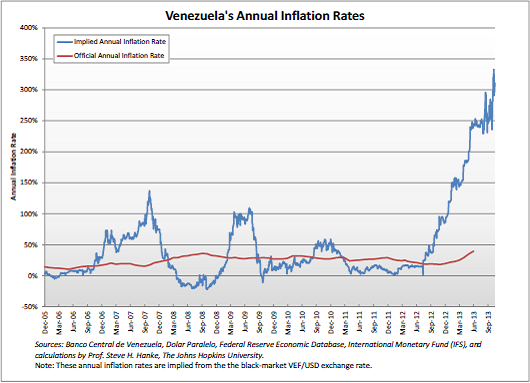
Just how big of a problem is inflation in Venezuela? The implied annual inflation rate in Venezuela is actually now in the triple digits, coming in at a whopping 283%, as shown in the chart below.


What’s more, the implied monthly inflation rate has now ramped up to 36%, as shown in the chart below. That’s dangerously close to the hyperinflation threshold of 50% per month. This is due to an accelerating depreciation of the bolivar, reflecting Venezuelan’s deteriorating economic outlook.

At this pace, Venezuela could join the Hall of Shame as the world’s 60th episode of hyperinflation. Alas, it seems the Maduro government is determined to double down on its failed policies, rather than face the music about the failed chavismo economic experiment.

15 Nov 16:39

FLASHBACK: Obama 2007: 'I was a constitutional law professor, which means unlike the current president I actually respect the Constitution'...

Jts5665

Either a laugher or a tear inducer.


FLASHBACK: Obama 2007: 'I was a constitutional law professor, which means unlike the current president I actually respect the Constitution'...


(Third column, 8th story, link)
Related stories:
15 Nov 16:12

I Am Strong, Energized, Off All Medications, and Feel Wonderful!

by Guest

It’s Friday, everyone! And that means another Primal Blueprint Real Life Story from a Mark’s Daily Apple reader. If you have your own success story and would like to share it with me and the Mark’s Daily Apple community please contact me here. I’ll continue to publish these each Friday as long as they keep coming in. Thank you for reading!

real life stories stories 1 2Mark,

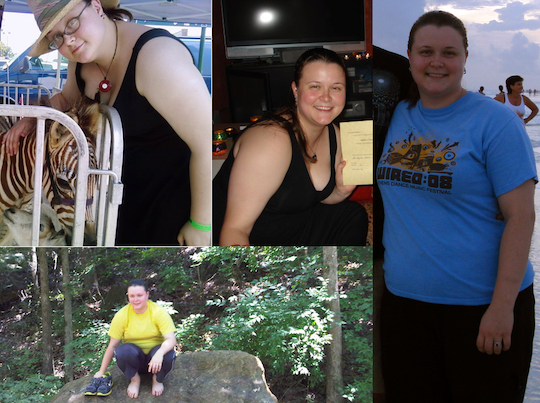
In December 2009, I was 25 years old and weighed 210 lbs. I was obese for my 5’5″ frame, never felt well, and was popping handfuls of pills every day just to get by. I was taking 2 anti-depressants, anxiolytics, prescription sleeping pills, courses of Prilosec once or twice a month, acid-blocking pills or antacid tablets 1-3 times a day, anti-diarrhea pills several days a week, and I was constantly catching respiratory infections and frequently took courses of antibiotics. In fact, I was put on chronic antibiotics by a dermatologist to treat rosacea, acne, and a truly horrible condition known as hidradenitis suppurativa (acne inversa). I would take them for several weeks at a time until everything calmed down, but inevitably within a few weeks more I would end up with another debilitatingly painful HS boil and would need to start up the antibiotics again. I also got either a yeast infection or a urinary tract infection almost once a month (and sometimes both in the same month). I had dysmenorrhea and would typically miss one day of work per month due to my cycle. In the summer of 2008 I was diagnosed as pre-daibetic with metabolic syndrome and hypertension, so by the end of 2009 I was quite probably a full-fledged type II diabetic, I just never got an official diagnosis. I was falling apart mentally and physically, and scared to death of a miserable future full of multiple chronic illnesses and scary prescription medications, so I decided to make some drastic changes to my lifestyle. I resolved to do my research over the holidays and begin in 2010 with a new way of life.

I read up on all the conventional wisdom suggestions for weight loss, and believed in the now debunked theories of “a calorie is a calorie” (calories are all created equally, so just eat fewer of them and you’ll lose weight!) and “calories in, calories out” (just exercise to create a calorie deficit, you’ll lose weight!); that fat, especially saturated fat, was to be avoided at all costs; whole grains, especially whole wheat, were the ultimate health foods; meat should be avoided except for chicken breasts and fish, and meat replacement products are healthy sources of protein. I limited my portions, restricted calories, started up chronic cardio exercise (3-5x/week, 30-60 min at a time) with some machine work for strength training once or twice a week, too. My choice for cardio was running, because I couldn’t stand the idea of using some man-made machine for that purpose. Just like with the food recommendations, I followed conventional wisdom for purchasing the “best” running shoes. They were motion control and ultra-squishy (or as I like to call them, marshmallow shoes). They were designed to “correct” over-pronation and protect my body from the shock of repeatedly pounding my heels into the ground.

I kept up this new “healthy” eating and exercising routine for several months, and in that time I didn’t really see the scale budge (it would fluctuate down maybe 5-10 lbs but then creep up again) or notice my clothes fitting any better. But I sure did notice that I was hungry all the time, sore all the time, and almost felt worse than before I started! I felt so helpless and discouraged, and started to wonder if I would ever see any results.

pre primalcollage

If you’ve ever done this kind of routine, you know – it is miserable ! No WONDER so many people who “go on a diet” and “start exercising” fail to achieve results or maintain the regimen for very long. It simply isn’t sustainable, and all of that exercise isn’t good for an overweight or obese body. I learned that the hard way: I hurt myself running. It turns out, though, that getting hurt was one of the best things that ever happened to me and ended up leading me to the Primal lifestyle.

I was so frustrated when I had to stop exercising. I felt so betrayed by the bad advice I had gotten about running and shoes, so I started seeking alternative advice. I searched for things like “how to run without injury,” “are motion control shoes necessary,” etc., and I found Danny Dreyer’s Chi Running, and soon thereafter Chris McDougall’s fabulous book Born to Run, and from there found Barefoot Ted’s Google group. I devoured all of the information I could on barefoot running and immediately converted. The mechanics of proper barefoot running made so much sense to me, as I had always walked with a forefoot strike when barefoot (I have vivid memories of being teased for this as a child, but I didn’t care, and continued with my “cat walking”, as I called it). I was a regular on the Google group, and one fateful day somebody posted a link to Mark’s Daily Apple.

I was completely blown away. Everything I thought I knew to be true about diet, health, and weight loss was all wrong. I spent the next few weeks reading as many articles as I could on the website and spending time in the forums asking questions. I cross-checked references and read what was published in the scientific literature at the time to verify that the site contained valid information. Ultimately, it was the success stories that gave me the final push to try it myself. All of this coincided perfectly with the September 2010 30-day Primal Blueprint Challenge, which is when I took the plunge (albeit a few days late, due to travel), and I haven’t looked back since.

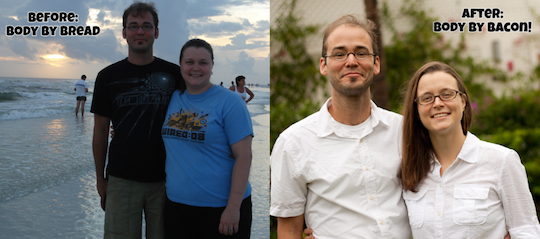
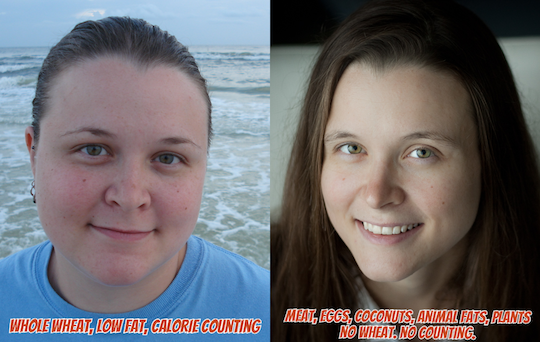
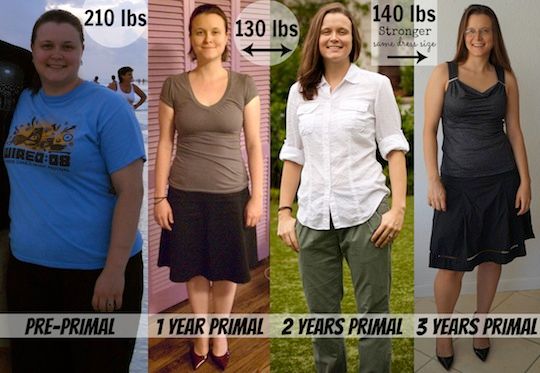
I lost 10 lbs and 2 inches off my waist in the first 12 days. By 1 month I was down 15 lbs and went from my pre-Primal size of 18 down to a 12. The weight continued to fly off after that. I didn’t keep super careful records of all my milestones, but by 1 year I was 80 lbs lighter (130 lbs) and in a size 6 and sometimes a 4. Just after my 2 year anniversary, I was pretty much the same weight but leaner and smaller, generally wearing size 2 or 4 but sometimes a 6, depending on the brand. Now, just after my 3 year anniversary, I actually weigh in at 140 lbs but I’m still wearing sizes 2-6 (and the same clothes I was wearing a year ago). I’ve added lots more body weight exercise to my routine and am definitely stronger. Also, I have also had an increase in breast size. I’m not exactly sure what to attribute this to, but I think it’s due to some positive hormonal changes, because I now typically have zero negative symptoms associated with my monthly cycle. While I saw huge improvements in this area shortly after going Primal, I would still occasionally have a bad one (although it was mild in comparison to pre-Primal – I stopped missing work over it!) So, despite weighing a bit more, I’m still the same dress size, and the weight is due to some muscle gain and breast size increase (can’t complain about either!). As I continue to progress, I expect to gain more weight (as lean mass) while my dress size stays the same or decreases.

2yearbefore after bread bacon

Regarding my health, I noticed tremendous alleviation of my multiple gastrointestinal ailments within just a few days of being Primal. I never realized how used to feeling bloated I had gotten – it felt so wonderful to have a calm tummy! By the end of the first week, I no longer needed my antacids and acid-blockers. Within a few days I also noticed incredible new mental clarity, improved mood, lower anxiety, and improved sleep. I stopped getting acne outbreaks, and best of all: I had immediate relief from hidradenitis suppurativa, and eventually enjoyed remission of the condition. My blood pressure normalized and I regained insulin sensitivity.

2yearfacepost primalcollage

In middle and high school, I was always between 115-130 lbs, but I was anywhere from a size 6-10. I now realize I was always “thin fat”: so-called normal weight but very flabby and weak. I have also always had low self-esteem and been very critical of my body, even before I became obese. Finally, I am able to feel confident and beautiful despite my flaws (losing 80 lbs of fat does a number on your skin), and I am strong, energized, off all medications, have reversed all of my pre-Primal ailments, and feel wonderful! From the bottom of my heart, thanks Mark!

3yearsprimal final

Best,

Amanda T.

Read Amanda’s full story on her blog The Curious Coconut

Order The Primal Blueprint Starter Kit and Take Control of Your Health Today!

15 Nov 15:57

Intelligence Lawyer Robert Litt Claims Searching For Possible Privacy Violations Will Violate Privacy

by Tim Cushing
Jts5665

No. 1 Why do people willingly share data with friends and/or with the social media they use and yet cringe at sharing with the potential sociopath in the government intelligence bureaucracy? hmmm, that's a tough one.

The ODNI's head counsel, Robert Litt, had made statements over the past few months that seem to hint that he's actually some sort of android, rather than a living, breathing human being. Maybe this is what happens to anyone who spends too long on the inside of the intelligence panopticon. When delivered in the real world, arguments that sounded plausible in the echo chamber give off the eerie tone of a not-quite-human "being" badly in need of an empathy chip upgrade.

Case(s) in point:

1. July 23rd - Robert Litt delivers a speech in which he asks this question:

"Why is it that people are willing to expose large quantities of information to private parties but don't want the Government to have the same information?"
It almost sounds reasonable until you consider what's being asked. "Why do people voluntarily give up information in exchange for services they find appealing/ useful but remain opposed to involuntarily having their data harvested by a secretive government agency?" There's a huge difference between the two, but Litt's cyborg mind fails to spot the gap. Data is data, he argues. If you're already sharing, why not let the government have a taste? [Of course, the whole argument is largely moot as the government already has access to this data anyway.]

2. November 5th - While meeting with the Privacy and Civil Liberties Oversight Board, Litt makes this claim:
In theory, storing the data with the companies, instead of at the NSA, would allow the telcos to serve as a kind of privacy watchdog. They'd be in a position to examine the government's requests for information about their customers and possibly to object to them in court.

But the intelligence lawyers warned that Americans' would be subject to even greater privacy incursions if their personal information were stripped from NSA's control.
In short, storing metadata at a neutral site would somehow result in more privacy violations than it would in the [LOL] careful stewardship of the NSA. Limited access to metadata, according to robotic-overlord-in-waiting Robert Litt, is more harmful to Americans' privacy than potentially unlimited access to data stores onsite.

Less than ten days later and I, Robert is at it again.
Robert Litt, the general counsel for the Office of the Director of National Intelligence, and Bradford Wiegmann, deputy assistant attorney general, told the Committee on Privacy, Technology and the Law today that it would have a “privacy diminishing effect” if intelligence officials were forced to review every piece of data vacuumed up under its internet and phone surveillance programs...

“Attempting to make this determination [identify the number of US persons whose data has been "inadvertently" swept up by various NSA collections] would require the intelligence community to research and review personally identifying information solely for the purpose of complying with the reporting requirements, even if the information has not been determined to contain foreign intelligence,” they argued. “Such an effort would conflict with our efforts to protect privacy...”

Litt, while addressing the panel, added that such a requirement “would perversely” undermine privacy.
There's a hole in Litt's argument you could drive a truckload of logic through. Kevin Bankston steps up and takes the wheel.
“The privacy has already been violated,” he said.
Litt must be an adherent of the Rogers Theorem, which states that privacy violations don't actually occur until they're noticed. That's the only way he could make such an argument with a straight face (although being not quite human probably helps).

The ODNI's arguments are beginning to resemble the outer limits of quantum mechanics, in which privacy violations are caused not by the wholesale amassing of pterabytes of data, but by NSA analysts checking to see if anything American has been inadvertently snagged in the NSA's enormous baleen. [ALL METAPHORS ARE GO.]

In other words, the outcome is changed by the measurement. Tons of data grabbed indiscriminately? No privacy issues. Peering into said tonnage for specifics? Privacy violations galore.

No mention is made of maybe putting some effort into refining its programs or dialing back its collections. Nope, to do so is to subject America to somewhere between 0 and 54 terrorist attacks over the next dozen years. This much we can be sure of because… well, just believe the nice "man" in suit, OK? The NSA's defenders have worked very hard to come up with dozens of tenuous justifications for its data dragnet and they don't need the very violated American public casting aspersion on the agency's lack of finesse.

This is what happens when the talking points begin suffering routine catastrophic failure. The NSA's defenders are reduced to responding like quarreling schoolchildren: "No, you're violating privacy!" How pathetic.


Permalink | Comments | Email This Story


15 Nov 03:50

Waaaaaaaay Too Late, And I Bet Obama Knows It

by admin

Via the WSJ:

President Barack Obama said Thursday that insurers will be able to continue health-insurance coverage next year for current policy holders that otherwise would be canceled under the new health-care law....

"Insurers can offer consumers the option to renew their 2013 health plans in 2014 without change, allowing these individuals to keep their plans," a senior White House official said, previewing Mr. Obama's announcement. These consumers will be given the opportunity to re-enroll, the official said, essentially extending the so-called grandfather clause in the 2010 health overhaul that allowed people to keep their plans if they were in place before the law passed.

"This step today is in the interest of fixing some of the challenges that have arisen" since then, the official said.

Under the plan, insurers are required to notify consumers whether their renewed plans don't include coverage that was required under the new health law, which set minimum coverage standards. They must tell consumers that new insurance options and possibly tax subsidies may be available for policies bought through online federal marketplace.

1.  The President announced this today to try to head off Congressional legislation to do the same thing.  Have we just given up on the rule of law?  Can the President unilaterally modify any law he pleases?  Shouldn't a modification in existing legislation have to come from the Legislature?  Can we just make it official and change the Constitution to say that the President can alter any legislation he wants as long as his party originally passed it?

2.  How is this even going to be possible?   My understanding is that insurance companies spend months preparing the pricing and features of their products for the next year.  The have done no preparation to offer these plans in 2014, because, you know, they were (and still are, whatever the President says in a news conference) illegal.   Its like your wife telling you to take the next exit when you are in the left lane driving 75 miles an hour in heavy traffic and the exit is about 100 yards away.  With 31 business days between now and the new year, how are they supposed to do this?  Or are they even expected to be able to do so?  Is this the President's way to blame shift to insurance companies?

Update:

Insurance source: WH fix places "onus on us even tho they know we can't" effectively extend cancelled policies given rates/logistics probs

— John Harwood (@JohnJHarwood) November 14, 2013

More from insurance industry source on WH O-care fix: "This is a joke - doesn't change anything but allow WH to blame insurance companies"

— John Harwood (@JohnJHarwood) November 14, 2013

14 Nov 21:29

4 Terrible Things About the Intellectual Property Section of the Leaked Trans-Pacific Partnership Agreement

by Zenon Evans

Yesterday, Wikileaks published a draft of the intellectual property chapter of the secretive and controversial Trans-Pacific Partnership Agreement (TPP).

This document is the first full chapter to be leaked. The TPP is billed as a free-trade agreement that will prepare the US and 11 other Pacific-rim nations. This leak gives clearer insight about how far-reaching and potentially damaging this agreement, which the Obama Administration hopes to hammer out by the of the year, could be. Here are some of the worst features discovered in the Intellectual Property chapter.

1. Loose Language Means Worse Laws: Earlier this week, Reason contacted Simon Lester, a trade policy analyst with Cato, regarding the TPP. Having read prior leaks, he cautioned that “the problem is, a lot of [TPP] rules are very vague."

The newly released document shows the same trend. Addressing how this group of nations will deal with everything from copyrights, to domain names, to Internet service provider liability, and even border enforcement, the language throughout this 95-page chapter is dangerously broad. Governments have enough trouble reconciling technology and the law in a productive way, and allowing a centralized body of authority to make sweeping, international decisions is a poor foundation to remedy that issue.

2. You Don't Really Own Your Phone…Or Any Electronic Device: Although unlocking your phone has been illegal for nearly two decades in the US, legislators have been working this year to do away with the outdated, innovation-stifling Digital Millenium Copyright Act. The TPP would crush these efforts and extend the same bad legislation abroad.

The draft states that the 12 nations would “provide adequate legal protection and effective legal remedies against the circumvention of effective technological measures.” This means that despite having paid for an iPhone or Xbox One, you would not legally be allowed to tinker with the device, because the TPP would make it illegal to tamper with manufacturers' digital locks that prevent you from from changing carriers or share copies of your video games.

3. Copyrights and Cronyist Collusion: It's no secret that CEOs from the Recording Industry Association of America (RIAA), Pharmaceutical Research and Manufacturers of America (PhRMA), International Trademark Association (INTA), and many others voiced their support for the TPP in an open letter to Obama. Luckily for these large copyright holders, the agreement would extend copyright terms up to 100 years after an author's death and as much as 120 years for unpublished corporate works.

The Electronic Frontier Foundation (EFF) explains that “such bloated term lengths benefit only a vanishingly small portion of available works, and impoverish the public domain of our collective history,” and points out that “the U.S. will see no new published works enter the public domain until 2019.”

Compounding this problem, the TPP intends to make service providers liable for copyright-infringing material that they host. This would essentially force Comcast, Time Warner Cable, others to become private Internet police not just for the U.S. government, but for all 12 countries in the agreement.

4. The U.S. Government is the Leading the Charge: The draft lets readers see where nations disagreed about terms of the agreement. Thus, we know that the US pushed for 120-year copyrights, Chile opposed the idea, and Australia and others proposed 70-year terms. This is consistent throughout. More than any other, it is the US government that pushed in favor of stricter rules and regulations. Peter Peter Maybarduk, a director at the advocacy group Public Citizen, said it's “the Obama administration’s shameful bullying” that dominates the TPP negotiations. The EFF lauds the "numerous heroic proposals for fixes, most notably from Canada and Chile" to strike down the US's "dangerous provisions."

14 Nov 19:41

Google Can Go Ahead And Keep Scanning Copyrighted Books, It's Fair Use, Says Court

by Brian Doherty

Capping off a lawsuit running since 2005, the U.S. District Court for the Southern District of New York today granted summary judgment to Google  to end the case of Authors Guild v. Google.

Choice excerpt from the decision:

by helping readers and researchers identify books, Google Books benefits authors and publishers. When a user clicks on a search result and is directed to an "About the Book" page, the page will offer links to sellers of the book and/or libraries listing the book as part of their collections.....The About the Book page for Ball Four [whose author is one of the parties suing Google Books], for example,provides links to Amazon.com, Barnes&Noble.com, Books-A-Million, and IndieBound....

A user could simply click on any of these links to be directed to a website where she could purchase the book. Hence, Google Books will generate new audiences and create new sources of income. As amici observe: "Thanks to . . . [Google Books], librarians can identify and efficiently sift through possible research sources, amateur historians have access to a wealth of previously obscure material, and everyday readers and researchers can find books that were once buried in research library archives."

The full decision in Author's Guild v. Google as a whole gives a pretty good mini history of Google's book scanning projects and a good defense of its many uses to literary and scholarly achievements and culture. But the legal nub of why Judge Denny Chin decided the authors can go pound sand and Google triumphs is:

I assume that plaintiffs have established a prima facie case of copyright infringement against Google...Google has digitally reproduced millions of copyrighted books, including the individual plaintiffs' books, maintaining copies for itself on its servers and backup tapes.....Google has made digital copies available for its Library Project partners to download.....Google has displayed snippets from the books to the public....Google has done all of this, with respect to in-copyright books in the Library Project, without license or permission from the copyright owners. The sole issue now before the Court is whether Google's use of the copyrighted works is "fair use" under the copyright laws. For the reasons set forth below, I conclude that it is.

The Judge then breaks down the four factors usually considered in "fair use" determinations and finds Google wins. (This excerpt doesn't deal with all four points):

The use of book text to facilitate search through the display of snippets is transformative....to a broad selection of books. Similarly, Google Books is also transformative in the sense that it has transformed book text into data for purposes of substantive research, including data mining and text mining in new areas, thereby opening up new fields of research. Words in books are being used in a way they have not been used before. Google Books has created something new in the use of book text....Google Books does not supersede or supplant books because it is not a tool to be used to read books. Instead, it "adds value to the original" and allows for "the creation of new information, new aesthetics, new insights and understandings."...

Google does not sell the scans it has made of books for Google Books; it does not sell the snippets that it displays; and it does not run ads on the About the Book pages that contain snippets. It does not engage in the direct commercialization of copyrighted works...Accordingly, I conclude that the first factor [basically, is the use transformative?] strongly favors a finding of fair use.


And the Judge thinks Google Books isn't hurting the book sales business:

plaintiffs argue that Google Books will negatively impact the market for books and that Google's scans will serve as a "market replacement" for books.....It also argues that users could put in multiple searches,varying slightly the search terms, to access an entire book....Neither suggestion makes sense. Google does not sell its scans, and the scans do not replace the books. While partner libraries have the ability to download a scan of a book from their collections, they owned the books already -- they provided the original book to Google to scan. Nor is it likely that someone would take the time and energy to input countless searches to try and get enough snippets to comprise an entire book. Not only is that not possible as certain pages and snippets are blacklisted, the individual would have to have a copy of the book in his possession already to be able to piece the different snippets together in coherent fashion....

a reasonable fact finder could only find that Google Books enhances the sales of books to the benefit of copyright holders. An important factor in the success of an individual title is whether it is discovered -- whether potential readers learn of its existence....Google Books provides a way for authors' works to become noticed, much like traditional in-store book displays....Indeed, both librarians and their patrons use Google Books to identify books to purchase.....Many authors have noted that online browsing in general and Google Books in particular helps readers find their work, thus increasing their audiences. Further, Google provides convenient links to booksellers to make it easy for a reader to order a book. In this day and age of on-line shopping, there can be no doubt but that Google Books improves books sales.....

Google Books provides significant public benefits. It advances the progress of the arts and sciences, while maintaining respectful consideration for the rights of authors and other creative individuals, and without adversely impacting the rights of copyright holders. It has become an invaluable research tool that permits students, teachers, librarians, and others to more efficiently identify and locate books. It has given scholars the ability, for the first time, to conduct full-text searches of tens of millions of books. It preserves books, in particular out-of-print and old books that have been forgotten in the bowels of libraries, and it gives them new life. It facilitates access to books for print-disabled and remote or underserved populations. It generates new audiences and creates new sources of income for authors and publishers. Indeed, all society benefits.

It's a court decision so there are lots of interesting complications in the whole thing, but that's the jist. Google Books as it stands can keep on truckin' without compensating authors.

14 Nov 14:57

Prosecutor Asks That She Not Be Called 'the Government' Because the Term Is 'Derogatory'

by Jacob Sullum

Last month a Tennessee judge overseeing a burglary case rejected a pretrial motion in which the prosecution requested that it not be referred to as "the Government" because that term is "derogatory." In the May 22 motion, Assistant District Attorney General Tammy J. Rettig noted with alarm that "it has become commonplace during trials for attorneys for defendants, and especially Mr. [Drew] Justice [the defendant's lawyer], to refer to State's attorneys as 'the Government' repeatedly during trial." Rettig worried that "such a reference is used in a derogatory way and is meant to make the State's attorneys seem oppressive and to inflame the jury." She added that "attempts to make the jury dislike the State's attorney have no place in the courtroom." She therefore urged Williamson County Circuit Court Judge Michael Binkley to bar Justice from using the g-word during the trial and instead refer to her as "General Rettig, the Assistant District Attorney General, Mrs. Rettig, or simply the State of Tennessee."

In his response, Justice argued that such an order would violate the First Amendment. Should Judge Binkley nevertheless see fit to comply with Rettig's request, Justice said, he also should consider a few other speech limits in the interest of avoiding prejudicial terminology:

First, the Defendant no longer wants to be called "the Defendant." This rather archaic term of art, obviously has a fairly negative connotation. It unfairly demeans, and dehumanizes Mr. Donald Powell. The word "defendant" should be banned. At trial, Mr. Powell hereby demands be addressed only by his full name, preceded by the title "Mister." Alternatively, he may be called simply "the Citizen Accused." This latter title sounds more respectable than the criminal "Defendant." The designation "That innocent man" would also be acceptable.

Moreover, defense counsel does not wish to be referred to as a "lawyer," or a "defense attorney." Those terms are substantially more prejudicial than probative....Rather, counsel for the Citizen Accused should be referred to primarily as the "Defender of the Innocent." This title seems particularly appropriate, because every Citizen Accused is presumed innocent. Alternatively, counsel would also accept the designation "Guardian of the Realm." Further, the Citizen Accused humbly requests an appropriate military title for his own representative, to match that of the opposing counsel. Whenever addressed by name, the name "Captain Justice" will be appropriate. While less impressive than "General," still, the more humble term seems suitable. After all, the Captain represents only a Citizen Accused, whereas the General represents an entire State.

Along these same lines, even the term "defense" does not sound very likeable. The whole idea of being defensive, comes across to most people as suspicious. So to prevent the jury from being unfairly misled by this ancient English terminology, the opposition to the Plaintiff hereby names itself "the Resistance." Obviously, this terminology need only extend throughout the duration of the trial—not to any pre-trial motions. During its heroic struggle against the State, the Resistance goes on the attack, not just the defense.

The good news is not only that Justice triumphed but that even the Government concedes "the Government" has a negative connotation.

[Thanks to Allen St. Pierre for the tip.]

13 Nov 22:07

Boston Police Department Claims Contacting Its Public Affairs Number Is A Criminal Act

by Tim Cushing

Most long-term Techdirt readers will be familiar with Carlos Miller, the man behind the Photography Is Not A Crime blog (usually shorthanded to simply "PINAC"). Miller, along with several other citizen photographers, have challenged local law enforcement officials repeatedly on their baseless claims that recording them is a crime.

Miller himself has been repeatedly arrested, harassed and charged with various dubious misdemeanors in an effort to curb his First Amendment rights. Now, Miller is being charged with something much more serious, thanks to the Boston Police Department's uncontrollable urge to silence critics and shutdown photographers.

Ken White at Popehat has this handy summary of the events leading up to the BPD's decision to charge Miller with "witness intimidation," a felony that carries with it a possible 10-year sentence.

The story begins typically for Photography Is Not A Crime with a story about a Boston Police Department sergeant thuggishly assaulting a photographer recording a traffic stop. A PINAC fan and journalism student named Taylor Hardy called the Boston PD's Bureau of Public Information on its public line to ask about the story. Hardy spoke with Angelene Richardson, a spokesperson for the Boston Police Department who provides information to the media and public. When Hardy published a recording of that call, the Boston Police Department arranged for him to be charged with wiretapping. Hardy claims that he informed Richardson that he was recording the call (though he did not successfully record that part of the conversation), apparently Richardson claims that he did not.
Boston's PD has received a lot of PINAC attention lately thanks to its officers' insistence on ignoring the outcome of the 2011 Glik decision, which saw the city pay out $170,000 to a citizen after the police wrongfully arrested him for violating the state's wiretapping statutes by recording them in public. The decision sent a message to citizens and citizen photographers, but apparently that message has yet to reach the ears of the city's police officers.

Now, as to the more problematic issue as to whether or not Hardy informed the BPD's public relations person that the conversation would be recorded (Massachusetts is a two-party consent state), it ultimately shouldn't matter.

A public relations person, whose sole purpose is to interact with the public, should assume that each and every conversation it has with citizens and journalists is being recorded -- especially the latter. There's no "expectation of privacy" inherent to public relations. Also, as Miller points out, the BPD is likely recording the calls on its end (the detective charging Miller has threatened to do the same to other callers, meaning someone's gathering info in Boston) which would make the two-party question moot.

After being informed that the BPD was pursuing Hardy on wiretapping charges, Carlos Miller posted the following to PINAC.
Maybe we can call or email Richardson to persuade her to drop the charges against Hardy considering she should assume all her conversations with reporters are on the record unless otherwise stated. Her listed number is (617) 343-4520.

Maybe we can build up an entire collection of recorded conversations with her. After informing her, of course.
The BPD's response to this action -- Miller posting a publicly available contact number (something Miller has done dozens of times previously without issue) -- was to charge him with a felony.
[T]hat led to Detective Moore filing a criminal complaint against me for witness intimidation, which I received Friday and is posted below, claiming that I caused Richardson all kinds of pain and grief because I posted her publicly available work contact info on my blog.

He also threatened to charge any readers who called her, making me think that perhaps the Boston Police Department is recording all incoming calls because how else would they gather the evidence to charge my readers for witness intimidation?
Ken White says there's some intimidation happening here alright, but not the way the BPD imagines it.
Indeed — an act of intimidation is involved. But it's an act of intimidation by the BPD, which is sending a clear message about how it will handle citizen dissent.

What an accomplishment: the Boston Police Department has discovered a way to make it a crime for citizens to contact the person it designates to talk to citizens.
The BPD has managed to dig itself a colossal hole in a very short period of time and it looks as if it has no interest in relinquishing its many shovels. Ordering someone from Miami (where Miller lives) to face charges in Boston over something so legally specious as declaring the posting of publicly available numbers to be "witness intimidation" is a prime example of how far some police officers will go to avoid having to admit they screwed up.

The Boston cops featured in PINAC's multiple stories all share the same attitude -- the law is whatever they declare it is, judicial decisions and the Constitution be damned. And when forced to confront the fact that they have it completely wrong, they simply ratchet up their intimidation tactics.

Defending yourself against clearly bogus charges isn't cheap. Carlos Miller has set up an Indiegogo campaign to pay for his legal representation. He's only seeking $2,200 ($2k for the lawyer plus $200 for indiegogo fees). Two bits of good news: 1) he's cleared that with several hours left to go and 2) he seems to have found himself an excellent attorney.
David Duncan, a partner at [Zalkind Duncan & Bernstein LLP], will take on both Taylor Hardy’s case of illegal wiretapping and my case for witness intimidation for that price, which is much lower than he would normally charge for two felony cases.

He was referred to us by my friends at the Digital Media Law Project, which is a site every one of you should become familiar with because it contains a wealth of legal information regarding media law, which in this day and age, applies to every single one of us who uses the internet…
$2,000 is good start but expenses could increase significantly if Duncan is unable to get the case tossed.
But Duncan doesn’t come cheap. Most good attorneys don’t. He is charging $2,000 to attend the hearing on our behalf. Then he will charge $6,000 to attend three hearings after that if it does continue.

And that might not even include the actual trial, if it comes down to that. Nor does it include travel expenses.
Now, some people can find Carlos Miller's tactics to be a bit on the aggressive side. But even those who find he somehow crosses the line in his pursuit of strengthening the First Amendment rights of American citizens have to find the above ridiculous, at the very least. This all began with BPD officers intimidating a photographer using false claims that his actions were illegal. Now, due to the BPD's insistence on compounding its errors, a blogger in Florida is facing felony witness intimidation charges in Massachusetts.

The longer this bizarrely wrongheaded crusade against the First Amendment continues, the longer the Boston Police Dept. will have to deal with irate citizens from all over the nation contacting its public phone numbers to complain about its intimidating actions. A simple apology and an offer to drop charges would have done wonders for the PD several days ago, but now, it's far too late. Detective Moore's actions -- basically declaring that contacting BPD's public numbers is a criminal act -- have put him and those involved in a position that only allows them to actively make things worse. The bells have been rung and no amount of additional LEO blustering will un-ring them.


Permalink | Comments | Email This Story


13 Nov 03:32

Obama Translated

by Tyler Durden

Sadly, only in our new normal world is this funny...


(h/t @DCMFutures)

12 Nov 23:03

Cool Sci-Fi Future Is Nigh: Dad Builds Son 3-D Printed Prosthetic Hand for $10

by Jess Remington

Shirking $30,000 in medical fees for a traditional prosthetic hand, videographer Paul McCarthy built a multi-colored “Robohand” for his son using a friend’s 3-D printer. McCarthy says he spent, “Five, maybe, ten bucks.”

The boy, 12-year-old Leon McCarthy, was born without fingers on his left hand. Once he turned ten, Paul started searching for an inexpensive and functional prosthetic alternative.

What he found changed his son’s life. A YouTube video by Washington-based special effects artist and puppeteer, Ivan Owen, shows the results of the artist's collaborative effort to build a Robohand for a disabled boy in South Africa. Like McCarthy, Owen was not an engineer, computer scientist, or doctor. However, he was passionate about helping to develop affordable, DIY prosthetics. In an interview with CBS News, Owen said:

I’ve always had this vision of people being able to build their own prosthetic device at home.

To help him accomplish this goal, MakerBot, a firm that produces 3-D printing equipment, offered Owen and his South African design partner, Richard Van As, free printers. From there, Owen and Van As honed the Robohand and posted the design and instructions for free download on Thingiverse, a website for sharing digital designs.

According to NPR, once the McCarthy’s discovered Owens’ video and the Robohand instructions, they decided to make one for Leon:

Printing the parts (using a friend's borrowed 3-D printer) was easy, the two say. But it took them a month to figure out how to string, screw and bolt together what they describe as the "Frankenstein" version. It's still a work in progress, they say, but several weeks ago, Leon wore it to school for a tryout.

"I'm able to hold a pencil and piece of paper," Leon says. "I've done a lot more than I ever thought I could, so it's opened up a lot of new doors in my life."

Van As is now raising money through a crowdfunding site to build more Robohands for disabled children at no cost to their families. In the meantime, the latest version of Robohand is available for free download – and the materials cost just $5.

While many are lauding these developments as an awesome way to revolutionize healthcare and DIY projects, some are concerned that lobbyists and politicians may try to stop their proliferation. In Forbes:

Because a 3D printer can make perfect replicas of many kinds of object, manufacturers may seek to brand it a “piracy machine” and demand additional measures to protect their traditional way of doing business. Mr Weinberg worries that they may behave rather like the record industry did when its own business model—based on selling pricey CD albums that few music fans wanted, instead of cheap single tracks they craved—came under attack from Napster and other file-swapping networks.

12 Nov 15:37

Video of NYPD’s Futile Attempt to Stop Skateboarding Event Goes Viral

by Ed Krayewski

token bustThe “Broadway Bomb” is an annual event where skateboarders race down Broadway in New York City. Last year’s “official” event was canceled because of a court order according to the Broadway Bomb website. Nevertheless it appears to have continued, with this year’s event, which happened last month, leading to the arrest or summons of 38 participants by the NYPD and a hilarious attempt by cops to stop the skateboarders, which you can watch below, set to appropriate music:

12 Nov 15:36

Boston Charges "Photography is Not a Crime" Activist with Felony Witness Intimidation for Publishing a Public Information Officers' Work Phone Number, Suggesting Maybe People Use It

by Brian Doherty

The lead up to this classic case of police intimidation is a long convoluted story, told in detail at Carlos Miller's Photography is Not a Crime blog, involving a case of a Boston cop roughing up someone videotaping him in public. 

The investigation into that case led to an associate of Miller's, Taylor Hardy, being charged with violating wiretapping statues for allegedly taping a conversation on the phone with Angelene Richardson, a Boston police public information officer. Hardy insists he did tell her he was taping. (He had posted on YouTube, but since taken down, a portion of their taped conversation.)

Miller now explains:

When Hardy informed me had received the notice of complaint from the Boston Police Department, ordering him to attend a hearing in front of a magistrate judge, I wrote about it on this site, encouraging readers to call Richardson and ask her to drop the complaint.

Screen Shot 2013-11-01 at 10.07.48 PM

After all, as a media spokeswoman, she should understand that all conversations with the media, unless other stated, are on the record. In fact, she should insist reporters record her comments to ensure accuracy.

That led to numerous PINAC readers calling Richardson, which obviously is something that unsettles this public information officer, suggesting that perhaps she is in the wrong line of work.

And that led to Detective Moore filing a criminal complaint against me for witness intimidation, which I received Friday and is posted below, claiming that I caused Richardson all kinds of pain and grief because I posted her publicly available work contact info on my blog.

He also threatened to charge any readers who called her, making me think that perhaps the Boston Police Department is recording all incoming calls because how else would they gather the evidence to charge my readers for witness intimidation?

Richardson's office number is on the Boston police department's public web site. She's a public information officer. Encouraging people to call her and giving our her number is a felony in the Boston police department's mind, because she has previously decided to use her powers to file a complaint to intimidate a journalist.

Honestly, once we know and understand that "the police are our friends," what other questions would there be to ask, really?

Reason on Carlos Miller. Our January 2011 Radley Balko Reason classic on "The War on Cameras."

12 Nov 15:34

Anti-Libertarian Philosophers Warned: Undermining Nozick Doesn't Mean Undermining Libertarianism

by Brian Doherty

Political philosopher Matt "Bleeding Heart Libertarian" Zwolinski, writing at 3 a.m. Magazine, tells his colleagues in that field that they can't think of themselves as having disposed of libertarianism if they think they've disposed of Robert Nozick's particular arguments for it.

To the likely surprise of some who think of the bleeding-hearts as squishes when it comes to hardcore libertarianism, Zwolinski even had kind words for aspects of the "taxation is theft" argument.

Choice excerpts:

Libertarians recognize that their favored political and economic institutions are social constructs. But to note that an institution is a social contract is not the same as showing that it is arbitrary. As libertarians like John Hasnas have pointed out, institutions of private property and free exchange have evolved repeatedly throughout history as an effective means of resolving social conflict in a world of scarce resources and limited benevolence. Property rights give individuals and groups a kind of jurisdiction in which they can pursue their own goals and values without first seeking the approval of any political superior. Market prices emerge even when state authorities actively attempt to stamp them out because the information and incentives they convey play an essential role in social coordination and cooperation....

.....Actual governments, like actual businesses, are run by human beings with imperfect knowledge, imperfect rationality, and sometimes impure motives. But unlike businesses, who make their mistakes on a decentralized scale with their own money, and who face the constant discipline of a system of profit and loss, government plays its game on a grand scale, and with other people’s resources. Rent-seeking and cronyism are thus not temporary problems that we have only because the wrong people, or the wrong party, hold office. They are deep, structural problems with politics....

.....Some libertarians think that morality imposes an absolute prohibition on interfering with the persons or property of others, no matter how minor the infringement, and no matter how great the benefits to be gained from it. I have argued elsewhere that this position is implausible. But even if it is, it does not follow that coercive interference with the persons or possessions of others is morally trivial. Common sense morality supports the belief that coercion is a serious prima facie wrong: one that can sometimes be justified, but only in special circumstances and by very weighty considerations. Why, then, should we be any less critical of the kinds of coercion that governments employ? What governments call “taxation,” most of us would call “theft” if it were done by private individuals – even if it were done to support a very good cause like providing for the common defense.....how confident should we be that the coercion government currently employs is truly necessary for the interests of the public, and not the interests of the state itself or its cronies?

The libertarian vision of a society is one of free and responsible individuals, cooperating on their own terms for purposes of mutual benefit. It is a vision that draws its support from a wide variety of moral and empirical beliefs with deep roots in the public political culture. And it is one that contemporary critics of the market would do well to take much more seriously.

Reason on bleeding-heart libertarians.

12 Nov 15:31

First 3D-Printed Metal Gun! That Addresses Politicians' Detectability Worries, Right?

by J.D. Tuccille

Solid Concepts gunJust months after the first 3D-printed gun appeared in un-lovely but very workable plastic, Solid Concepts, an engineering firm that specialized in rapid prototyping and custom manufacturing, says it 3D-printed a gun in 17-4 Stainless Steel and Inconel 625 (a nickel-chromium alloy). Politicians have fretted since Cody Wilson and Defense Distributed unveiled the first 3D-printed gun that plastic pistols raised concerns about DIY undetectable firearms. Do you think the Solid Concepts announcement will allay their concerns and set them to worrying over something else? Hmmm...

On the company blog, Solid Concepts' Alyssa Parkinson notes:

Solid Concepts is a world leader of 3D Printing services, and our ability to 3D Print the world’s first metal gun solidifies our standing. The gun is a classic 1911, a model that is at once timeless and public domain. It functions beautifully: Our resident gun expert has fired 50 successful rounds and hit a few bull’s eyes at over 30 yards. The gun is composed of 30+ 3D Printed components with 17-4 Stainless Steel and Inconel 625 materials. We completed it with a Selective Laser Sintered (SLS) 3D Printed hand grip, because we’re kind of crazy about 3D Printing.

I like the combination of old-school 1911 (a model of gun I enjoy shooting) and new technology, although the century-plus old design also enabled the company to fashion something that went bang in a time-proven way without treading on anybody's intellectual property rights. Interestingly, the barrel rifling was printed right into the gun, not machined. In fact, no machining was used, although there was some hand finishing on the final product.

For Solid Concepts, a California-based firm with offices in Arizona, Texas, and Michigan, (the gun was printed in Texas) the 3D-printed gun, more than anything else, was an attention-grabbing way of demonstrating the company's ability to use new technology to construct tough and durable products. As Parkinson points out, this feat isn't likely to be replicated in the home workshop anytime soon. "The industrial printer we used costs more than my college tuition (and I went to a private university) and the engineers who run our machines are top of the line; they are experts who know what they’re doing and understand 3D Printing better than anyone in this business."

But new technology has a way of coming down in price as it matures and spreads—a phenomenon that can only be encouraged when laser-sintering patents expire in a few months. That won't necessarily put laser-sintering printers within range of your budget in the short term, but it's certainly a step in that direction.

Somehow, I don't see Sen. Charles Schumer, Rep. Steve Israel, and the other politicians who have been publicly rending their garments over plastic guns being entirely satisfied by this development.

09 Nov 18:17

Schlock Mercenary: November 9, 2013

by Howard Tayler
Schlock MercenaryFirstPreviousArchiveShop

08 Nov 17:18

Adam Kokesh, Anarcho-Libertarian Activist, Pleads Guilty on Weapons Charges Based on Video He Shot

by Brian Doherty

I blogged back in July on anarcho-libertarian media figure and activist Adam Kokesh being arrested and held without bond on crummy charges of carrying a shotgun in D.C.'s Freedom Plaza, an act he videoed as deliberate political provocation theater.

After rotting in jail for months, Kokesh finally pleaded guilty this week and got out pending sentencing, the Washington Post reports:

Wednesday, standing next to his new [court-appointed] attorney, Kokesh pleaded guilty to carrying a rifle or shotgun, possession of an unregistered firearm and unlawful possession of ammunition. In a separate case, Kokesh pleaded guilty to marijuana possession.

Court papers show that prosecutors offered the plea deal in a Monday letter sent to Kokesh’s attorney. In the letter, Assistant U.S. Attorney Natalia Medina said prosecutors believed that Kokesh tried to sneak a cellphone into the jail Oct. 22. Medina wrote that if Kokesh accepted the plea, he would not face additional charges regarding the phone.

Kokesh’s attorney, Larry Copeland, said it was the second plea deal presented to his client. Copeland said he and Kokesh “weren’t concerned” about the cellphone allegation but weighed the offer.

“We evaluated the case against him and the likely outcome and made a judgment that this was the best thing to do,” Copeland said.

Pending a Jan. 17 sentencing hearing, Broderick ordered Kokesh to stay out of the District and said he must report with supervising authorities weekly. The judge also ordered that Kokesh not possess any firearms. Kokesh faces a maximum of more than six years in prison on the combined charges.

It was a bad charge, though I'm not going to question a man's decisions to get himself out of a cage he's been unjustly locked into. May any eventual sentencing be light, though I wouldn't count on it.

Kokesh wrote on his Facebook page, as reported by Opposing Views.com:

“I'm incredibly grateful for everyone who supported me during my recent challenges by volunteering, donating, and writing letters to me in jail, and to the judge and the prosecutors,” Kokesh posted on his Facebook. “We will continue using this as a teachable moment to illuminate the nature of government and spread the message of liberty, self-ownership and civil rights.”

Reason on Kokesh.

08 Nov 17:17

President Obama’s Worthless Apology

by Peter Suderman

To the millions of Americans who have lost their health plans this year as a result of Obamacare, despite his pledge that they could keep their plans if they liked them, President Obama has something he’d like to say. He’s sorry…sort of.

In an interview with NBC News last night, the president was asked whether he owed an apology to the millions of people who have already lost plans this year. Here’s what he said: “I am sorry that they are finding themselves in this situation based on assurances they got from me.”  

To the extent that it matters, this is not a very good apology. For one thing, it gets the cause and effect wrong: People aren’t “finding themselves” in “this situation”—the situation of having insurance plans they liked cancelled—because of Obama’s “assurances.” They are finding themselves in that situation because of legislation that his party crafted, rules his administration drafted, and a bill that he promoted vigorously and then signed into law. His assurances misled people about what would happen under that law, but did not cause the plans to be terminated. 

But Obama isn’t sorry for the law, or its intended effects. Notice also what Obama is carefully not apologizing for: the actual cancellation notices now being sent to millions of Americans. There’s a reason for that. As The Washington Post’s Sarah Kliff writes, “eliminating certain health plans from the market—ones that the White House thinks are too skimpy—is a feature, not a bug, of the Affordable Care Act.”

Obama isn’t sorry about the cancellations, in other words, because they were intended all along. Despite his recent rhetorical revisionism, Obama explicitly promised otherwise, repeatedly, in order to help make the case for passing the law. It was a calculated and intentional deception. But apparently the president remains unrepentant about that. If there’s news here, it’s not that he apologized. It’s that he does not appear to be sorry that he lied. 

08 Nov 14:49

The Sugar Program Is Central Planning

by Chris Edwards

Chris Edwards

House and Senate negotiators are working out details of a big farm bill that may pass this year. No industry in America is as coddled as farming, and no industry is as centrally planned from Washington. The federal sugar program is perhaps the most Soviet of all. Here’s a sketch of the sugar program, which the supposedly conservative, tea party-dominated lower chamber may soon ratify:

  • Purpose. The federal sugar program is designed to enrich sugar producers, such as the wealthy Fanjuls, and rip off sugar consumers by keeping domestic prices artificially high. In recent decades, U.S. sugar prices have often been two or more times world prices. The federal government achieves that result by price guarantees, trade restrictions, production quotas, and ethanol giveaways.
  • Guaranteed Prices. The Department of Agriculture runs a complex loan program to support sugar prices. Essentially, the government promises to buy sugar from processors at a set price per pound. Processors can sell to the government, or they can sell in the marketplace if the (manipulated) market price is higher.
  • Trade Restrictions. Complex import barriers called “tariff rate quotas” help to maintain high domestic sugar prices. Imports are restricted to about one quarter of the U.S. market, and each foreign country (except Mexico) is allocated a particular share of imports.
  • Production Quotas. The government imposes quotas, or “marketing allotments,” on U.S. producers. The United States Department of Agriculture decides what total U.S. sugar production ought to be and then allots quotas to beet and cane sugar producers. Most sugar beet production is in Minnesota, Idaho, North Dakota, Michigan, and California. Most sugar cane production is in Florida and Louisiana.
  • Ethanol Giveaway. If prices fall below certain levels, the USDA is required to fire up a sugar-for-ethanol program to channel sugar away from the food industry.

The USDA is supposed to run the sugar program at no taxpayer cost, which makes the central planning even trickier. The agency must fiddle to adjust imports, quotas, and the ethanol giveaway to optimally fatten the wallets of sugar producers, while not allowing the domestic (manipulated) market price to fall so low as to impose taxpayer costs.

A possible wrench in the works of the current farm bill is that the sugar program is on track to cost taxpayers perhaps hundreds of millions of dollars this year (see here and here). So if conservatives in Congress vote for an unreformed sugar program this year, they would be not only voting for central planning, corporate welfare, higher consumer prices, harm to U.S. food manufacturers, and environmental damage, they would be voting for higher taxes as well.

The Congressional Research Service gives a brief overview of the central planning here. You can see that sugar beets are allotted exactly 54.35 percent of production (definitely not 54.34 or 54.36), and that federal planners have decreed that the just price (“loan rate”) for sugar cane is 18.75 cents per pound (not 18.74 or 18.76). 

The USDA has more on the program here. This table shows that the Fanjuls’ Florida Crystals company received a quota in 2013 of exactly 910,521 tons. So 910,521 is certainly too little and 910,522 is absolutely too much. Now if only the planners at HHS had used such precision in designing the Obamacare website! 

For more on the sugar racket, see here and here.

08 Nov 04:36

Obamacare Lafs Courtesy of My Favorite Fat Head Tom Naughton

by Richard Nikoley

Unless asleep, you're aware that all is not wine, roses, nosey cheese and dark chocolate in Napa Valley, with millions nationwide receiving non-renewal notices from healthcare insurers they've done business with for years. Seems that owing to mandated coverage minimums in the "Affordable Care Act," their existing policies will not be renewed—but they can opt for an alternative policy that's substantially less affordable—or face a penalty next time they file a tax return.

People were quick to conveniently jump on Obama's multiple, affirmative, reassuring quotes in video where, on his marketing tour, he repeatedly stressed that if YOU like the coverage you have, you can keep it. It's 1.5 minutes. As you'll see, there's a simpler explanation.

Unlike me, Tom Naughton is a gentle soul, a generous man of good will and strong character. He saw an opportunity to help Our Personal Lord and Savior. Did you see his documentary (Fat Head-Director's Cut) that's helped many thousands?

In a style reminiscent of his very popular documentary, Tom jumps in and it's basically: "There, I fixed it." Equally 1.5 minutes.

So easy, too. It's so clear to me that the President simply misspoke 29 times in a row (force of habit, probably) when all that's needed to to turn an apparent lie into absolute truth is a single word: 'you', to 'I' or 'we'. Simple. Tom is a genius. Did I mention benevolent? You can trust your barely legal, hot teenage daughters with him—and there's no greater metaphor to describe a man of strong character.

OK, take a minute; watch and listen. The elegance and simplicity by which he turns an apparent complete lie into absolute truth—by means of a single word—had me thinking that energy equals mass times the square of the speed of light.

I'm not sure whether Tom did that specifically for my Facebook post (I'm not seeing it on his blog), or has some other designs in mind. I'm guessing the former, since Tom's just a generous man all around and probably enjoys surprising people with a helping hand (even the President—with thousands of people helping him already, at your expense).

In fact, Tom is so very generous, he'll even take time out of his day to help people who are all stuck on what Barack said literally, hopelessly trying to defend it, wiggle out of it, etc. Hey folks: He just misspoke, ok, and that's all. It's just one word jeez-lols. Just watch the video. Relax.

OK, so here's the comment thread on my personal profile Facebook post, now open for public following and commenting. It began with this comment, and I'm not putting a name up here, because that would be mean and I'm taking Tom's benevolent lead, here. Plus, why expose someone for simply failing to grasp that the President simply misspoke by one word, 29 times in a row?

For the first time in 15 years I'm able to buy medical insurance, and I'm glad to have it. I've been paying my own doctor bills for years, so I just care about something big happening and being covered.

"I just care about something big happening and being covered." Not to go all Godwin on you (that's a NikoLie), but something big happened in 1942 and lots of people were pretty overjoyed about it, especially if they didn't particularly care for Jews. At any rate Tom, in his ever vigilant diligence in correcting misinterpretations, helps not only the President of the United States, but the "little people," too.

Solving the uninsured problem was a good idea, X. "Solving" it by forcibly canceling the policy that perfectly suited my family's needs was a lousy idea. Nearly 4 million people who were insured a month ago are now uninsured, thanks to their policies being outlawed. ("If you like your policy, you can keep it! Period!") I'll be joining them soon, since my insurer can't legally renew my policy.

But that's how government works. Winners are only created by creating an equal or greater number of losers.

Tom then received another comment from a misguided soul, yet to realize that the President had simply misspoken.

I am going to jump in here to correct a few things. First of all, the government is not cancelling these policies, the insurance companies are. It is there right to do so if they are not making a profit. This was a perfect opportunity for them turn the blame on the government. Second, the insurance companies absolutely have the right to decide who and what they are going to cover and at what price. It is there policy and business.

Now that strikes me as hard correcting, when Tom made it so simple in his video. One. Single. Word. ...Miraculous Truth. That's efficiency, and if Barack was smarter than allowing himself to misspeak 29 times in a row, he'd hire Tom as his right-hand consultant immediately.

Personally, I think Tom would look great in the Oval Office at one of those 3am, all-hands-on-board crisis sessions (in the Clinton era, they were called Bimbo Eruptions) with coats tossed aside, dress shirts unbuttoned, ties relaxed, and the most important of all: sleeves rolled up!

Go Tom!

The Democrat talking point that it's the insurance companies choosing to cancel policies is exactly that: a Democrat talking point. It's also utter b.s. Policies are being canceled because they don't comply with ACA requirements. My policy, for example, doesn't cover maternity care. That means it doesn't comply and my insurer can't -- the word is CAN'T, not WON'T -- offer it to me again when it expires, by order of His Highness. That's the law. You can look it up in the Federal Register for June 17, 2010. Start at around page 34,540. My insurer could only legally offer me the "non-compliant" policy again if I'd signed it before March 23, 2010. Joke's on me ... I signed the day after that. Too bad I wasted a week or so shopping around. Of course, His Highness at time was assuring me that if I liked my policy, I could keep it.

I actually thought he was joking about the page number of the Federal Registry. Nope. I'm sobered.

Here, I'll save you the trouble of reading. This is the relevant section from the Federal Register:

Plan sponsors and issuers can decide to:

  1. Continue offering the plan or coverage in effect on March 23, 2010 with limited changes, and thereby retain grandfather status;
  2. Significantly change the terms of the plan or coverage and comply with Affordable Care Act provisions from which grandfathered health plans are excepted; or
  3. In the case of a plan sponsor, cease to offer any plan.

Catch that part where is says issuers can decide to continue offering a plan IN EFFECT ON MARCH 23, 2010? Got that? Can you set aside the Democrat talking points long enough to use your brain and grasp what that means? It means they CAN'T continue offering a "non-compliant" plan that wasn't in effect by that date. They can only offer me a plan that meets with the approval of His Highness. That's why my insurance plan is being canceled, not because my eeeeevil insurance company is "choosing" to drop me.

...

More from the Federal Register, X -- since you decided to jump in and express your strong opinions about subjects you haven't researched beyond repeating Democrat talking points. You can look this up if you don't believe me. Federal Register, June 17, 2010, page 34,566.

Preservation of right to maintain existing coverage.

Definition of grandfathered health plan coverage

In general—(i) Grandfathered health plan coverage means coverage provided by a group health plan, or a group or individual health insurance issuer, in which an individual was enrolled on March 23, 2010 (for as long as it maintains that status under the rules of this section).

Subject to the rules of paragraph (f) of this section for collectively bargained plans, if an employer or employee organization enters into a new policy, certificate, or contract of insurance after March 23, 2010 (because, for example, any previous policy, certificate, or contract of insurance is not being renewed), then that policy, certificate, or contract of insurance is not a grandfathered health plan with respect to the individuals in the group health plan.

So people like me who signed our policies after March 23, 2010 aren't in a grandfathered plan. That means we don't get to keep it and the insurer can't re-issue it. They can only offer us "compliant" policies that meet with approval of His Highness and are much more expensive -- $10,000+ per year more expensive in my case.

So you want to repeat the Democrat talking point that my insurer is "choosing" to drop my plan now?

Tom, ever generous, delivers a final benevolent explanation in order to correct this impression that Obama lied rather than simply misspoke 29 times in a row and that as such, Democrats need to fix that, when Tom did it with a single word change. Like, DU-UH!

For anyone still paying attention, here's why this is happening. For Obamacare to work financially, they need to suck healthy people into it to pay higher premiums and support all the sick people. The individual market is full of high-deductible and catastrophic plans. Guess who buys those plans? You got it: healthy people like me who prefer low premiums and high deductibles because we rarely use medical services anyway. So the Obama administration decided to write rules that would effectively destroy the individual market, thus pushing us healthy folks into Obamacare. It wasn't an accident or an oversight. That was the plan all along.

And that's why the Democrat talking point that insurers are "choosing" to cancel those policies is utter b.s. Why the hell would insurers choose to dump hundreds of thousands of customers who pay premiums but rarely file a claim for medical services that the insurers have to actually pay? (High deductible, remember? When we do visit a doctor, we usually end up paying out of pocket.) We were the ones who supported their profits. Obama wants us to support Obamacare instead.

Alright then. Are all you Democrats clear on that? You don't have to concern yourself that the President lied to the American People 29 or more times in a row on national TV. He simply misspoke so there's no need to defend it and as Tom has shown, it's very clear from the letter of the law that Barack meant to be saying 'I' and 'We' when he was saying 'You.'

08 Nov 02:51

22-Year-Old Jailed for Pot Possession Dies While Guards Ignore His Pleas for Help

by Jess Remington

A mother has finally obtained video footage proving that her 22-year-old son died when guards in a Snohomish County, Washington jail ignored his desperate pleas for help. The victim, Michael Saffioti, was serving time after missing a court date for a misdemeanor marijuana possession charge. To make the awful story even worse, Saffioti's mother alleges that her son was killed by a severe allergic reaction to oatmeal that prison officials erroneously told him was safe to eat and then later covered up. She has spent the past year fighting with the jail to obtain footage that might help explain his death.  

The incident began in July of last year. Saffioti turned himself in to the authorities in order to be “held accountable for his legal issues” and was promptly thrown behind bars. He died less than 24 hours later.

As described by KIRO TV:

Around 5:46, a group of inmates arrived to serve breakfast and men began lining up. While others sat to eat, the camera first captured Saffioti at the guard's desk, holding his tray. Saffioti suffered from extreme dairy allergies and took regular pains to protect himself.

The video shows Saffioti apparently discussing his food [and whether it contained dairy] with the guard, servers and fellow inmates. Eventually, he took a few bites. Within a few minutes, Saffioti was back at the guard desk, using his inhaler. According to the legal claim, he asked to see a nurse. Instead, he was sent to his cell.

Over the next half hour, the video shows other inmates looking in Saffioti's cell as he jumped up and down. The legal claim says he pressed his call button and was ignored.

A fellow inmate who witnessed the incident claimed that a corrections officer took Saffioti's inhaler away and accused him of "faking" his sickness. 

KIRO TV continued:

About 35 minutes after he ate, a guard found Saffioti unconscious in his cell. The guard called for help and Saffioti was dragged him out.

Nurses arrived and performed CPR. Everett firefighters took over and rushed Saffioti to the hospital where he was pronounced dead a half hour later.

Rose Saffioti, Michael's mother, has insisted that the jail was negligent in caring for her son's health needs. According to Rose and Cheryl Snow, the attorney representing his case, Michael was always vigilant about checking his food and would have told the guards about his allergies. Additionally, the prison had his medical condition on file and was supposed to place him in a separate medical unit.

"Our theory is that they absolutely knew about Michael's medical needs," Cheryl Snow told KIRO TV.

However, when Saffioti’s mother stated her belief that the guards’ negligence caused her son’s death last year, the jail retorted that it had not. In a report compiled by the Snohomish County Sheriff's Office Major Crimes Unit, they claimed that Michael died from bronchial asthma rather than an allergic reaction. Consequently, county prosecutors decided not to press criminal charges against any guards.

Once Michael’s mother filed a request for video footage of her son’s death though, jail officials engaged in an intentional cover-up. First, officials denied the existence of any footage. When his mother discovered that this wasn’t true, officials edited out incriminating portions of the video.

The full video, which confirms much of what inmate witnesses told investigators in interviews last year, is finally available.  

Saffioti's mother, who has filed suit against the county for $10 million, is unfortunately not alone. Over the past three years, eight inmates have died in Snohomish County Jail.

Just four months after Michael's death, Washington state legalized recreational marijuana.

07 Nov 20:35

Quotation of the day: Thomas Sowell on Obamacare

by Mark J. Perry

From Thomas Sowell’s column this week “An Old ‘New’ Program“:

Like so many things that seem new, ObamaCare is in many ways old wine in new bottles. What is older than the idea that some exalted elite know what is good for us better than we know ourselves? Obama uses the rhetoric of going “forward,” but he is in fact going backward to an age when despots told everybody what they had better do and better not do.

Yet another way in which ObamaCare is an old political story is that it began as supposedly a way to deal with the problem of a segment of the population — those without health insurance. But, instead of directly helping those particular people to get insurance, the “solution” was to expand the government’s power over everybody, including people who already had health insurance that they wanted to keep.

Since there has never been a society of human beings without at least some segment with some problem, this is a formula for a never-ending expansion of government power.

07 Nov 20:29

Why Malala Didn't Go to Public School

by Andrew J. Coulson

Andrew J. Coulson

Since she was shot in the head by a would-be Taliban assassin, Malala Yousafzai has become one of the most recognizable and admired young people on the planet. But in a new piece in the British Spectator magazine, education scholar and Cato Institute adjunct fellow James Tooley points out that “something curious is going on.”

http://abcnews.go.com/International/malala-yousafzai-death-kill/story?id=20489800Something crucial to her experience is always omitted when her life and mission are described by international agencies and the media… it wasn’t to governments that Malala and her family turned (or are turning now) to get an education…. In fact, she’s scathing about government education: it means ‘learning by rote’ and pupils not questioning teachers. It means high teacher absenteeism and abuse from government teachers, who, reluctantly posted to remote schools, ‘make a deal with their colleagues so that only one of them has to go to work each day’; on their unwilling days in school, ‘All they do is keep the children quiet with a long stick as they cannot imagine education will be any use to them.’ She’s surely not fighting for the right of children to an education like that.

But if not government education, what is she standing for? In fact, Malala’s life story shows her standing up for the right to private education.

For the school she attended, on her way to which she was famously shot by the Taleban, was in fact a low-cost private school set up by her father. This reality gets hidden in some reports: not untypically, Education International describes her father as a ‘headmaster’. Time magazine describes him as a ‘school administrator’. Headmaster, school administrator: these obscure the truth. In fact, her father was an educational entrepreneur.

Read the whole thing. James Tooley is the Indiana Jones of education, splitting his life between his professorial duties at the University of Newcastle and scouring the globe for something “experts” used to think was a myth: private schools serving poorest of the poor. He’s found them all across India, Africa, and even China—and they work. You can pick up the mind-blowing story in his book The Beautiful Tree.

06 Nov 21:31

UK Gov't: David Miranda Might Be A Terrorist Because Journalism Can Be Terrorism; Also: We Had No Idea He Was A Journalist

by Mike Masnick
Jts5665

Acts of Journalism which do not promote the state are terrorism? Is this the new paradigm?

Following the initial argument that Glenn Greenwald's partner, David Miranda, was detained for nine hours at Heathrow under an anti-terrorism law because he might be a terrorist, it appears that the UK government is doubling down on this argument. The Miranda case was in court today, with the UK government arguing that publishing the documents Ed Snowden leaked "is capable of being an act of terrorism." Yes, the UK has declared that journalism can be an act of terrorism. The Metropolitan Police further argue that Miranda was engaged in espionage, first saying that they stopped Miranda because the Security Service had alerted them that Miranda was "likely to be involved in espionage activity."
Intelligence indicates that MIRANDA is likely to be involved in espionage activity which has the potential to act against the interests of UK national security. We therefore wish to establish the nature of MIRANDA's activity, assess the risk that poses to UK national security and mitigate as appropriate. We are requesting that you exercise your powers to carry out a ports stop against MIRANDA.

We assess that MIRANDA is knowingly carrying material, the release of which would endanger people's lives. Additionally the disclosure, or threat of disclosure, is designed to influence a government, and is made for the purpose of promoting a political or ideological cause. This therefore falls within the definition of terrorism and as such we request that the subject is examined under Schedule 7.
Now here's where it gets even more bizarre. When confronted by the issue of human rights and the right to free expression, the UK government is arguing that didn't apply because didn't know he was involved in journalism.
The exercise of powers in this case did not engage either Article 10 ECHR [European Convention on Human Rights] or the protections accorded to journalistic material under Schedule 5 to TACT [Terrorism Act 2000] because (a) the MPS did not know or believe that Mr Miranda had acquired the material for the purposes of journalism; and (b) Mr Miranda did not when questioned claim to be a journalist or to be carrying the material on behalf of anyone else who was a journalist or to have acquired the material for the purposes of journalism.
So, let's get this straight. The UK is arguing (1) that it knew enough that Miranda was carrying the Snowden documents, such that they believed he might help them get published and that's terrorism, but (2) they had no idea he might be involved in journalism, so there was no human rights issue.

Anyone else notice a problem with these two lines of thought? Acts of journalism may be acts of terror, and the UK government can stop it... if they don't know it's journalism.

Clearly, the UK government is lying. They knew what Miranda was doing, because that's how they knew he had documents on him. To then claim they had no idea he was engaged in journalism is impossible to believe. Hopefully the court recognizes just how insane this claim is.

Permalink | Comments | Email This Story


06 Nov 16:53

How to Manufacture the Best Night of Sleep in Your Life

by Mark Sisson

sleep2Ah, sleep: is there anything quite like it? So easily discarded and discounted when nighttime attractions present themselves and yet so dearly missed and pined after the next morning. You’ve heard me say it enough, so I’ll keep it short. A good night’s sleep is the foundation for a healthy, happy, productive existence. Good sleep keeps us lean and thinking clearly. And without good, regular sleep, we just go through life in a scattered daze, everything foggy, slightly confusing, and less enjoyable. We’re not really ourselves if we haven’t slept. We desperately need a good night’s sleep, every night.

So how do you get one? What would a day of optimal sleep promotion look like?

Let’s start from the beginning. Let’s start with the morning.

Early Morning

Use a dawn simulator alarm clock. These are alarms with lamps that slowly and gradually brighten as your wake time approaches. It’s not the same as having the majestic sunrise beam into your room and very soul, but these contraptions have been shown to improve sleep quality. Another advantage: waking up won’t be so jarring.

When you wake up, get up. Do not hit snooze, sleep for five minutes, hit it again, sleep for five more, and keep doing that until you can will yourself to rise and stumble off to begin your day. You may think you’re effectively chipping away at sleep debt with those little bits and pieces of “sleep,” but you’re really just fragmenting your sleep (PDF), which leads to “sleepiness-related daytime impairment,” compulsory afternoon caffeine infusions, and less productivity. If you hit snooze today, you’ll probably end up sleeping badly enough to have to hit it again tomorrow.

Upon getting up, you expose yourself to bright light. Ideally, this is the sun. If it’s still dark out, you can use the brightest artificial light you have. 10,000 lux lamps are best (and in fact are used to effectively treat Seasonal Affective Disorder), but anything is better than no light at all. Our bodies, brains, and biological clocks expect bright light during the day, and meeting those expectations has been shown to improve sleep (as well as alertness and productivity during the day), even if the light is artificial.

Before “the day” starts, you get some physical activity. Go for a short walk (great way to get some light, too!) with the dog, do a light stretching or movement routine for five minutes, have sex, dance to your morning playlist as you get ready for work, roughhouse with your kids, swing a light kettlebell for a few minutes, read your email on the treadmill, ride your bike around the block, whatever. You don’t even have to work up a sweat or anything if you don’t want to. Just move a little. There’s some evidence (albeit uneven) that morning activity can improve sleep later on that night.

Brew your coffee, tea, or legal stimulant-containing beverage now if you’re going to have any today. Caffeine has a half life of up to six hours, so having that Americano after lunch could disrupt your sleep tonight.

If you eat breakfast, eat a good portion of animal. Meat (and not just turkey) is a good source of the amino acid tryptophan, and high-tryptophan breakfasts have been shown to improve sleep quality. Steak, eggs, and whey protein, anyone?

If you don’t typically eat breakfast, you probably don’t need to start. Intermittent fasting can also improve sleep. If your sleep is suffering, you might want to try the meat breakfast, though.

Mid-Morning

Work hard, be proactive, and stay focused. Getting as much work done as you can before noon will take the mental load off the rest of your day, allowing you to relax a bit. Procrastination will only make you stressed out, and stress is the enemy of good sleep.

While you’re working, take a minute to install f.lux on your computer. F.lux is a free program that changes your computer’s color spectrum automatically according to the time of day. When it’s dark out, an f.lux-enabled computer gives off very little sleep-disrupting blue light.

Last call for caffeine. If you do go for coffee, grab a cup of good green tea to go with it; green tea contains L-theanine, which can partially counteract the sleep disturbances caused by caffeine. Primal Calm also contains L-theanine, as well as other stress-modulating ingredients, so that’s another option.

Midday

Sometime after lunch, meditate for twenty minutes. Several studies have shown that meditation practice can improve sleep, including cyclic meditation (a kind of yoga-meditation fusion) and mindfulness meditation. There’s even evidence that meditation can decrease the amount of sleep you need to function.

When and if you nap, do it closer to midday than to your bedtime. A nap taken too close to nighttime can interfere with your sleep.

Go for a barefoot stroll in the grass, dirt, sand, or the natural surface of your choice. Even a quick walk on the lawn outside the office works. Though earthing is controversial, its proponents may be overstating its benefits, and the studies connecting it to better sleep may not be the best-designed, who doesn’t feel better and more relaxed after letting the leaves of grass trace their way between your toes, feeling the cool damp earth underneath, or tromping an uneven unsteady path through soft white sand? It certainly doesn’t hurt.

Early Evening

If you plan on drinking, do so around this time. Alcohol too close to bed – even just a couple glasses of wine – can impact sleep. You’ll sleep, but it’ll be poor quality sleep fraught with frequent disturbances. This validates both happy hours and day drinking, in a way.

Eat most of your carbs at dinner. A recent study showed that eating carbs, even high-glycemic ones, at the last meal shortened the sleep onset. In other words, packing your carbs into dinner can help you fall asleep faster.

Eat animal fat and/or olive oil at dinner (and lunch, and breakfast). Both animal fat like lard or beef fat and olive oil (or macadamia nuts, for that matter) are excellent sources of oleic acid, a precursor to the sleep-inducing oleamide.

Dim the lights when darkness falls. If it’s dark outside, your body needs to start winding down, and excessive artificial lighting will get in the way of that.

Turn off the screens an hour or two before bed. Smartphones, laptops, computers, TVs, tablets – they all emit melatonin-disrupting blue light directly into our staring, transfixed eyeballs. If you miss the entertainment factor, play board games. Heck, start a board game night and invite people over.

Use blue blocking goggles after dark. These, coupled with the f.lux you installed earlier, should block out the harmful blue light when you need (or “need”) to use electronics. I like this pair, while this pair fits over glasses.

Bedtime

Drink some bone broth, eat some gelatin, or take glycine. All of those things either contain or are glycine, an amino acid with sleep promoting effects.

Clear your mind. Meditation can work here, again, or you could make a to-do list for the following day so that you don’t lie awake obsessing over everything.

Rub your body down with magnesium oil or lotion. I go for the softest areas, like under my arms or along my rib cage. If it stings, you know it’s working. Bonus: it gives you (or me, at least) really cool, really vivid dreams. Some people are paradoxical responders who actually sleep worse on this stuff, just so you’re aware.

Read some dense fiction in bed, in actual physical book form (nothing against ebooks at any other time, but they represent a light source that can disrupt sleep). Don’t read easily digestible stuff like an old John le Carre spy novel. Instead, go for something like Cormac McCarthy’s Blood Meridian that has you parsing paragraph-long sentences. Great book, but you’ll be asleep in no time.

Eliminate, remove, or cover up any sources of light in your bedroom, even the tiny blinking ones. Black-out blinds over your windows, duct tape over your blinking lights, and towels under doors may be warranted to achieve true darkness.

Use white/brown noise or nature sounds before bed. Falling rain is a good sound to fall asleep to, as are the somewhat haunting but eerily beautiful whale songs.

Guided meditation can help you get to sleep. Search iTunes for “guided meditation” and a bunch of podcasts will pop up. Just don your blue blocking goggles before using your phone to play one.

Take a tablespoon of honey, preferably raw, right before bed. Seth Roberts has shown through rigorous self-experimentation how it might very well improve sleep, perhaps by keeping liver glycogen full.

Middle of the Night

Improve your aim and reduce your reliance on lights. If you get up in the night to urinate, don’t flip on every light as you pass them. Most people can adjust to the darkness if they let themselves.

Don’t check your email just because you woke up. It’s not that important (if it were, they’d call), and whatever you read is only going to keep you up. Also, blue light!

General Advice

Make sure to eat enough salt throughout the day, since a depletion of bodily sodium stores can trigger overtraining-like symptoms, raise blood pressure, and impair the quality of your sleep. I won’t give an absolute amount, because that will differ based on size, activity level, stress, and many other factors. Just salt your food until it tastes good. So much for total salt avoidance, eh?

Exercise regularly. Regular exercisers report getting better sleep than people who don’t exercise at all, even on the same number of hours. In people with sleep disorders like insomnia, exercise can make things worse in the short term or have no effect at all. Working out once probably won’t help once. It’s over the long term (4 months) that exercise can improve sleep quality in insomnia patients. Exercise also increases sleep quality in sleep apnea patients.

Exercising at night is generally fine. Get it in whenever you can fit it. However, really intense pulse-pounding glycolytic work an hour before bed (like Crossfit or HIIT) might impact your sleep onset, simply because your cortisol is momentarily elevated. Proper cool downs should help get you back to baseline, as should food and a cold shower.

Align your life schedule with your chronotype. This isn’t possible for everyone to do perfectly – we all have to pay the bills, and that often means working on someone else’s schedule – but even small strides in the general direction of our genetic chronotype can help.

Obviously, not everyone needs to do or try every suggestion on here. I just combed through the research and put everything out on the table so you could pick and choose and experiment to see what works and what doesn’t. We’re all different.

Thanks for reading, everyone. Let me know what works for you and what does not work. I can always use better sleep, so I’ll definitely be keeping an eye out for new tips.

Order The Primal Blueprint Starter Kit and Take Control of Your Health Today!

06 Nov 14:43

GOG – Using Games to Make the World a Better Place

by Pat
Jts5665

Support World Builders by buying games.

As y’all know, Worldbuilders is steadily growing into something much bigger than I ever dreamed.

Last year, for example, we had to design inventory software for all the books we were giving away as prizes. We’ve brought in competent, organized staff to replace my incompetent, disorganized self, and we started seeking out corporate sponsorships.

This year, companies have started to seek *us* out, looking to have superhero team-ups up for fundraising purposes. Big companies like GOG.com.

GOG is really cool. They sell games that you can download off the internet.

Boy, that doesn’t do the job of explaining how cool they are at *all.*

I think of GOG as the place that saves cool old games from the abyss. Looking through their stock, I see pretty much every game that I *loved* to play back in the day. Games I remember 10, even 20 years after I played them.

Games like the original Fallouts (Fallout 1 and 2, not Tactics.) The original Deus Ex. Arcanum. Anachronox. System Shock Two. King’s Quest. Planescape….

Looking through GOG’s inventory, you’ll see a huge piece of my childhood. You’ll see a lot of the games that made me *love* games. You’ll see games that helped make me the person I am today.

I’m guessing a lot of you with a history of gaming will feel the same way.

Oh, look at that. They have the Zork games too.

The original trilogy and a few of the follow-ups. Raw text badassery. Zork III was the first game that I ever played on my very first computer. It took me, quite literally, YEARS to solve. There was no internet back then, you figured shit out or you choked on your own frustration….

Zork_III_box_art

Oh god. It’s been thirty years since I played it.

But that’s exactly what I’m talking about. GOG has saved this beautiful old game from the dustbin of history. They even make sure it’s compatible with current operating systems. Want to play Zork III on Windows 8? Go right ahead. That’s what GOG does, and that’s why I love them.

Well, that’s *one* of the reasons I love them.

The other reason is that they’ve decided to include Worldbuilders in a fundraiser they’re running this week: from November 5th to November 12th.

There are two ways you can help bring in money to Worldbuilders.

1.  One is to simply sign up for an account on GOG.com.  When you sign up for a GOG account through our affiliate link (that was it), they will donate 10% of everything you purchase for the rest of the year to Worldbuilders.

You need some reccomendations? Just scroll up a bit, and you’ll see the begining of my list….

You owe it to yourself to try Zork if nothing else.  Seeing it there makes my fingers itch. I’m not even kiddling, half of my current problem-solving skills came from playing those early Infocom games. I learned to type so I could play that game….

2. The second way is to buy some games off of the Worldbuilders Fundraising Page on GOG’s website.

For the next week, you can pick three games from a selected list of GOG’s titles and it will only cost you five bucks.

You have to agree that’s a good deal. And even better, 100% of the money collected will come to Worldbuilders.  ALL of it. GOG will even pay for the transaction fees themselves, using their own money.

That means if you buy a $5 game, Worldbuilders will get $5.  Period.

The games that were chosen for Worldbuilders in particular are Driftmoon, The Whispered World, and Oddworld: Abe’s Oddysee.  That said, on our page, your purchase comes to us on *all* of the games listed, so you could also get Walking Mars, Botanicula, Incredipede, Faster Than Light, Darwinia, and Pid.

Did I mention that Amanda loves Faster Than Light? She does. She told me to tell you that…

Be warned: this second option only lasts for a week.

So. There you go.

I really can’t stress enough how big an opportunity this is for Worldbuilders, folks. We stand a chance to raise some serious money on this one….

But only if we can get the word out. Would you mind helping me with that?

Thanks again, everyone. I’ll see some of you tonight in Barcelona.


05 Nov 16:46

Don't Appear to Be Clenching Your Buttocks When Pulled Over For Not Coming to a Complete Stop or Be Tortured by Doctors: America, This is Your War on Drugs

by Brian Doherty

From the "folks, this is just wrong" department of our War on Drugs, reported by KOB-TV 4 in New Mexico. They are reporting on a lawsuit that arose from an:

incident [that] began January 2, 2013 after David Eckert finished shopping at the Wal-Mart in Deming.  According to a federal lawsuit, Eckert didn't make a complete stop at a stop sign coming out of the parking lot and was immediately stopped by law enforcement.      

Eckert's attorney, Shannon Kennedy, said in an interview with KOB that after law enforcement asked him to step out of the vehicle, he appeared to be clenching his buttocks.  Law enforcement thought that was probable cause to suspect that Eckert was hiding narcotics in his anal cavity.  While officers detained Eckert, they secured a search warrant from a judge that allowed for an anal cavity search.  

The lawsuit claims that Deming Police tried taking Eckert to an emergency room in Deming, but a doctor there refused to perform the anal cavity search citing it was "unethical."

But physicians at the Gila Regional Medical Center in Silver City agreed to perform the procedure and a few hours later, Eckert was admitted.

While there...

1. Eckert's abdominal area was x-rayed; no narcotics were found.  

2. Doctors then performed an exam of Eckert's anus with their fingers; no narcotics were found.

3. Doctors performed a second exam of Eckert's anus with their fingers; no narcotics were found.  

4. Doctors penetrated Eckert's anus to insert an enema.  Eckert was forced to defecate in front of doctors and police officers.  Eckert watched as doctors searched his stool.  No narcotics were found.

5. Doctors penetrated Eckert's anus to insert an enema a second time.  Eckert was forced to defecate in front of doctors and police officers.  Eckert watched as doctors searched his stool.  No narcotics were found.

6. Doctors penetrated Eckert's anus to insert an enema a third time.  Eckert was forced to defecate in front of doctors and police officers.  Eckert watched as doctors searched his stool.  No narcotics were found.

7. Doctors then x-rayed Eckert again; no narcotics were found.  

8. Doctors prepared Eckert for surgery, sedated him, and then performed a colonoscopy where a scope with a camera was inserted into Eckert's anus, rectum, colon, and large intestines.  No narcotics were found.  

Throughout this ordeal, Eckert protested and never gave doctors at the Gila Regional Medical Center consent to perform any of these medical procedures....

There are major concerns about the way the search warrant was carried out.  Kennedy argues that the search warrant was overly broad and lacked probable cause.  But beyond that, the warrant was only valid in Luna County, where Deming is located.  The Gila Regional Medical Center is in Grant County.  That means all of the medical procedures were performed illegally and the doctors who performed the procedures did so with no legal basis and no consent from the patient.  ....

The warrant also had expired in time when the "medical procedures" were carried out. Eckert is suing the city of Deming and Deming Police Officers Bobby Orosco, Robert Chavez and Officer Hernandez, as well as three Hidalgo County Deputies and two doctors from the Gila Regional Medical Center.

The petty legalities of time and place of the carrying out of these hideous tortures will, I hope, be sufficient for Eckert to win his suit. But the entire event is an abomination from beginning to end. If only he could just sue for "police being petty officious asshole morons, and doctors violating their professional standards and all human decency by going along."

I blogged yesterday on military doctors also violating their oaths and decency in the name of orders.

UPDATE: Eckert's lawsuit. And yes: they are trying to bill him for medical services rendered. From the suit: "Defendant Gila Regional has billed Plaintiff for the “services” it provided at the request of law enforcement....Plaintiff still receives medical bills for thousands of dollars for these illegal, invasive and painful medical procedures."

05 Nov 14:51

Obama-don't-care

by Shikha Dalmia

The Health and Human Services Secretary Kathleen Sebelius last got a good grilling in Congress about the Obamacare debacle. But if she were the CEO of a company, she might have faced not Congress but a grand jury for launching an unsafe product without proper testing based on a fraudulent sales pitch and misleading information.

Sebelius has admitted that Healthcare.gov—the federal online shopping exchange that is the lynchpin of the program—required one year of successful testing before launch. Instead it got two weeks of failed testing. If an automaker had knowingly put a vehicle on the road without appropriate crash tests, this administration, the self-appointed guardian of consumers, would have taken it to the mat.

But just like a defective car, Obamacare’s defective exchange is not just a nuisance; it will destabilize the health insurance industry and jeopardize coverage. Yet the administration’s march to enforce its law continues unabated.

The “glitches” in the exchange, many fear, will accelerate Obamacare’s insurance death spiral. The folks who’ll take the trouble to sign up will be the sick and poor who qualify for subsidies. The rest—especially the young invincibles—will likely go elsewhere, forcing them to raise rates.

But because Obamacare bars participating companies from offering different prices to their exchange and non-exchange customers, these rates will go up for all their customers. This will allow non-participating competitors—that face no similar stricture—to bid away their healthier and wealthier customers.

The participating companies will then face this choice: Stay in the exchange and risk extinction or quit. Either way, exchange patients will have fewer choices and pricier plans compared to non-exchange patients—defeating the whole purpose of Obamacare.

To head off this dynamic, the administration has engaged in what can only be described as deception.

The exchange initially wouldn’t let people even window shop without first submitting their income information so that it could offer them subsidized quotes and prevent them from walking away in sticker shock. But when this crashed the website, the administration switched tactics.

The exchange lumped all shoppers into two groups—those under 49 and those over 50. The first group got quotes based on what a healthy 27-year-old would pay and the older group what a 50-year-old pay. The actual prices for specific policies obtained from the websites of insurance companies were much higher, prompting an expert interviewed by CBS, which broke the story, to call this feature “incredibly misleading.” 

But the administration’s lies don’t end there.

President Obama had been claiming till as recently as last year that his law would force no one to give up coverage. “If you like your plan, you can keep it.” But the administration’s own internal communication shows that it knew back in 2010 that 12 to 93 million policy holders might well lose their policies.

That’s when Sebelius issued regulations grandfathering policies so long as they didn’t change. If insurers so much as inflation-adjusted premiums, they lost their protected status, becoming subject to Obamacare’s mandates requiring them to cover everything from maternity services for elderly couples to drug rehab for teetotalers.

All of this prompted even Washington Post’s “fact” checkers this week to give Obama Four Pinocchios.

The whole point of Obamacare—aka the Patient Protection and Affordable Care Act—was to protect patients from greedy insurers who lure them when they are healthy only to use some arcane fine print to jack prices or dump them when they fall sick.

But the administration has engaged in similar subterfuge, showing that the profit motive is not the only corrupter in human affairs. Partisanship, ideology and—above all—a president’s need to leave a legacy are even more so.

When companies put profits ahead of people, the government can go after them for fraud and falsehood. But what should people do when the government puts politics ahead of people?

Don’t ask this president because Obama-don’t-care.

This column was originally published in the Washington Examiner

05 Nov 14:36

Obama denies health care comments...

Jts5665

This guy has an insanely low opinion of the American electorate. Can't say as I blame him. They did reelect him after all...