Shared posts

09 Dec 15:43

The Most Dramatic Resistant Starch Success Story Yet

by Richard Nikoley

No introduction necessary.

~~~

Mr. Nikoley,

You and Tatertot Tim have stumbled, if that’s the correct word, onto something having more repercussions of which we “resistant-starchers” may be aware. The following is of course anecdotal, strictly an N=1 experiment.

Some relevant background: I am 61 years old, weigh 240 pounds (still obese but 60 pounds less so), and my menu is 99% very-low carb, less than 20 gm/day. In the past I ate sugar and its variants with abandon, to the point of gluttony; I love the stuff. As a result I had very high blood pressure and I was on the verge of becoming a full-blown T2 diabetic. My sugar cravings are now under control, my blood pressure is way down, the diabetes threat is non-existent, and blah, blah, blah, you know the story. However, a couple of things have continued to bother me.

Diarrhea has been a curse for many years, due no doubt to my pre-paleo menu, and any amount of sugar would result in an impressive blood glucose spike with an attendant spike in my blood pressure. Even if I spent the day completely avoiding carbohydrates, a single cookie or sliver of pie would result in the spikes and a bad night in bed with heartburn and small regurgitations of stomach contents. It’s been this way for the past few years.

Until your posts about resistant starches...

I have a degree in geology—part of my course of study was paleoarcheology—and I have been interested in our evolutionary ancestors’ diet since those days forty years ago, though I’m more a dilettante than an actual student of the subject. Your post on resistant starches, like Mark Sisson’s book Primal Blueprint, opened doors in my mind that had heretofore been invisible. I immediately saw the implications on blood glucose, the gut biome, etc., including the reason why a lot of people, such as modern “primitives,” can eat primarily fruits and such with no apparent ill effect. (The fiber content, supposedly blunting the sugar effect, has never fully explained, to me, the lack of damage that might be caused by a fruit diet. Are there resistant starches in fruit? Is there such a thing as a resistant sugar?)

I immediately purchased two bags of potato starch. I have been using milk kefir for many months and while it did reduce the diarrhea, the problem was not cured. Adding your proposed two tablespoons of potato starch twice per day helped a bit more but the curse persisted. The almost immediate effect of the potato starch though was the blunting of my blood glucose spikes if I ate any sugar. Another effect was a minor lowering of my blood pressure.

I have a self-imposed upper limit of 90 mg/dL (5 mmol/L) blood glucose. If it rises above that I get mad, obsessively tracking down the reason. I feel really, really good when my blood glucose stays between 73 and 80 mg/dL (4 to 4.4 mmol/L). Pre-paleo my blood pressure was in the area of 140/105 mmHg, post-paleo the pressure had stayed around 118/80 mmHg. About a week after starting potato starch my blood pressure dropped to an average of 113/75 mmHg and my blood glucose averaged 80 mg/dL (4.4 mmol/L) daily. But, as I said, my diarrhea continued to be a problem.

The Monday before Thanksgiving I got pissed off about my diarrhea situation and decided to double the dosage of the potato starch. That morning I put four tablespoons of starch in my usual pint of kefir and again Monday night before I went to bed. And Tuesday and Wednesday. Thursday, Thanksgiving Day, no more diarrhea; and the problem has not returned in the 2 1/2 weeks since.

Now to the point of this story. On Thanksgiving Day I ate cornbread dressing, ONE roll with butter, and a SLIVER of pumpkin pie with whipped cream. My blood glucose did spike of course but not as high as my history indicates. I figured it was one of those anomalies one gets from day-to-day and ignored the reduced numbers (four measurements over four hours). What did get my attention was sleeping soundly that night with no regurgitations at all; I slept the entire night, not awakening once.

Damned interesting that, and my attention was heightened. I’ve continued the protocol of 8 tablespoons of potato starch—4 in morning and 4 before bed—since Thanksgiving, wondering whether or not I’d meandered into something meaningful but I couldn’t figure out how to test it. Two days ago, Friday, Dec. 5, I decided to just do my usual stupid act of a full-speed-ahead experiment. I fixed a large amount of white rice, about three cups, and ate the entire amount. This meal should have put me in a light coma, spiking my blood sugar into the heavens and elevating my blood pressure. Well, my blood glucose did of course rise but only to a max of 140 mg/dL (7.8 mmol). My blood pressure did rise but since I didn’t log it I can’t report the number but it didn’t go as high as I expected. Friday night I slept like a dead man, rising only once to urinate but immediately returning to sleep, and NO regurgitation.

Okay cool, fine, I’m onto something maybe. Now for an acid test; lets really stress this N=1 theory. Yesterday, Friday, Dec. 6, I went to the grocery store and purchased a large-ish chocolate bar, a package of Nabisco’s Fig Newtons, and a small bag of sugar cookies. After returning home I settled into my chair, turned the TV to one of those bad, but hilarious, science fiction movies wherein a beast is killing young people and the lone survivor is a 110 pound, axe-wielding teenage girl, and proceeded to eat the chocolate, one sleeve of the Fig Newtons, and the whole bag of Snickerdoodle cookies. I then waited for the consequences.

Over six hours my blood glucose peaked at 160 mg/dL from 78 mg/dL (4.3 to 8.9 mmol) and my blood pressure went from 105/69 to 136/88 mmHg. Whoa! The BG should have gone to the moon and the BP should have popped an artery like an overfilled balloon. One weird thing though, my head felt inflated as if it were indeed a balloon; a really strange sensation. I did fall asleep but I didn’t pass out as I would have in the past. (Unfortunately I cannot report the number of pieces into which the teenage heroine chopped the beast.) My stomach was not happy of course but I wasn’t suffering the usual torments either, another really weird non-event. Of course I didn’t eat anything for the rest of the day until bedtime when I drank a pint of kefir with four tablespoons of potato starch.

Now for the final act. I went to bed last night at midnight, expecting a really tough night. The amount of sugar and flour and bad, cheap oils I had eaten should have put me through unmitigated hell, Dante’s Third Ring as it were. I should have lain there for a couple of hours with heartburn, eventually falling asleep but awakening after an hour with a mouthful of stomach acid. In the past I would have brushed my teeth, drank a potion of water and baking soda to alleviate the acid stomach, and fallen back into a restless sleep. But not last night. I was asleep within minutes, even after having napped for a couple of hours, and didn’t awaken until 7:00 this morning. I did not have the usual heartburn, I was fully rested, and the usual morning-after bout of diarrhea was absent. My stomach is still somewhat annoyed but what does one expect after such goings on?

The really big news though is my blood glucose this morning was only 78 mg/dL (4.3 mmol), my blood pressure was at 103/65 mmHg, and my resting heart rate was 67 bpm. Genuinely startling numbers in light of my history. There is definitely something else occurring with the resistant starch protocol other than helping the gut biome. If the good bugs are way down in the colon and the spiking of insulin/blood glucose starts in the stomach or the mouth, why did my various numbers stay low? Why did my usual heartburn stay away, allowing a restful sleep? Obviously a high population of good gut bugs effects the entire body but I cannot connect the dots of a healthy colon and bad food in the mouth or stomach.

Regardless, whatever is going on, my life has gotten much better thanks to your posts on resistant starch. I sleep very well, my blood glucose stays in the 70 – 80 mg/dL (3.9 – 4.4 mmol), my blood pressure is usually around 105/65 mmHg, and the diarrhea has disappeared, all in just three weeks of a large intake of a resistant starch. Simply amazing and astounding and all the other synonyms.

My kefir protocol.

Morning:

  • 1 pint milk kefir (my fermentation of course)
  • 4 tbls potato starch
  • 2 tbls cocoa powder (not Dutch-processed)
  • 1/4 tsp ascorbic acid powder (Vitamin C)
  • 1 tsp (2.5 gm) ground Ceylon cinnamon (anecdotally said to lower blood pressure, which I believe has some veracity)
  • 1/3-scoop veggie powder (Garden of Life’s “Perfect Food – Super Green Formula.” I am simply incapable of eating lots of vegetables, I don’t like them.)
  • Occasionally 1/4-cup of heavy cream for taste and mouth-feel
  • Occasionally 2 raw egg yolks for quickie protein
  • Occasionally pureed raw liver for all the benefits (contributes no discernable flavor but the color of the final mix is, um, unusual)

Shake/mix/blend well and allow it to sit for 20 minutes to let everything get soaked or dissolved or whatever. (Immediate ingestion doesn’t seem to do have much effect in the gut except impressive flatulence. For me, allowing the mix to sit for a while eliminates the flatulence. NB: I have been using the starch for several months so reduced flatulence may be due to my gut bugs having acclimated but if I drink the mix without the suggested soaking time I will sing a different tune. This fact is very important at night. Sweet Thang, on some matters, is so narrow-minded she can look through a keyhole with both eyes.)

Before bed:

  • 1 pint kefir
  • 4 tbls potato starch
  • 1/3-scoop veggie powder

Mix well, etc.

Thanks for your blog,

James

~~~

Nothing left to say. Your turn. Please share it. You never know who might be helped, a life veritably saved...just because you did, right in time and on time. ...And to get caught up, here's all the many posts on Resistant Starch.

07 Dec 21:47

Joe Biden Tells Chinese Citizens To 'Challenge The Government,' Neglects To Mention His Administration Doesn't Like Being Challenged

by Tim Cushing

Vice President Joe Biden is in China and as usual, he took the opportunity to try to insert his foot in his mouth. China may be veering towards its own brand of capitalism simply because it's a manufacturing powerhouse, but it's still a long way from being an open country in any other respect.

Biden's pep talk to some Chinese citizens gathered at the US embassy included this "empowering" exhortation.

“Innovation can only occur when you can breathe free, challenge the government, challenge your teachers, challenge religious leaders.”
All well and good, I suppose. Of course, it's much easier said than done, and Biden's contribution only included the "saying" part. These sort of challenges have actual repercussions in China, which still wishes unruly citizens into high-walled political cornfields prisons.

But what's even more irritating about his blithe statement is the fact that his own administration isn't really keen on being challenged by its citizens.

Case in point: the NSA leaks. For a long time, the administration stood firm in its support of the agency. It only stepped back when it realized the situation was going to get a whole lot worse before it got any better and that the NSA itself wasn't just lying to the public, but to the president and the rest of the government as well. It also smelled blood in the water after amendments and bills targeting the NSA and its programs began gathering bipartisan support and wanted to be as far away from the massacre on the horizon.

This administration has also prosecuted more whistleblowers than all other administrations combined. This is what happens to people who challenge the administration. They end up broken by the system, the same system that tells them it wants to be "open" and "transparent."

The administration has also shown a fondness for shutting out inquiring minds with the overuse of state secret exceptions. Sure, information may want to be free, but its overseers won't let it roam without being covered in black ink. Its track record on civil liberties has eclipsed the awfulness of the Bush administration, which at least had the courtesy to be openly evil in its intentions.

Even the press has grown disillusioned with Obama's administration, recently complaining that it controls the narrative by handing out approved promo shots rather than allowing press photographers to do their jobs.

Now, I realize that as vice president, Biden doesn't truly represent the administration. He may be second-in-command, but the reality of the job demands someone who can stay out of the way while whipping up support for the administration's policies and pet legislation behind the scenes. It requires him to make appearances on behalf of the administration but kindly asks him not to embarrass it while doing so. Biden has failed to hold up his end of the bargain with his statements.

Here he hands Chinese citizens advice they can't possibly use while simultaneously highlighting the hypocrisy inherent in the administration's treatment of criticism. "Challenge your government," he tells people who can be ripped from their families for doing so before retreating to the safety of an administration that actively seeks out and punishes those who challenge its methods and actions. With this mindless bit of "go team!" posturing, Joe Biden is hurling stones from the balcony of the administration's glass house.


Permalink | Comments | Email This Story


07 Dec 18:46

An institution begins the slide

by noreply@blogger.com (Vox)
I suppose there are many who will lament the first step in the demise of New York magazine. I tend to see it more as reason for good cheer:
This week’s announcement that New York magazine was becoming a biweekly was greeted, in my profession, with the sort of cheer that might herald the announcement of a sewer line backup or a mid-honeymoon appendectomy.

New York magazine is very successful. Its editor is very well regarded, and it wins lots of awards. It gets scads of Web traffic. It publishes magazine features that win the admiration of fellow journalists and has also become practically ubiquitous on social media. And, apparently, it still can’t pay the bills as a weekly publication. Hearing that New York magazine can’t make it as a weekly is, for a professional journalist, rather like being told that your teddy bear has cancer. How is that even possible?

The answer is that the circulation of print magazines is declining, while advertising revenue has taken a suicidal plunge. Companies who wanted to inform people about their firm’s activities used to have basically three choices: print media, television or radio. (OK, four if you count billboards.) These were all media companies, and they used the money corporations gave them to produce news.
What I find remarkable is how many of these institutions will glumly permit themselves to sink into oblivion without ever doing anything to significantly address the core issues. CNN is going to try to compete with every other network showing reality shows rather than make any attempt to appeal to the other half of the ideological spectrum. New York magazine has gone to a biweekly rather than attempt to broaden its appeal beyond liberals who live in New York and liberals who wish they did.

As technology gradually kills the liberal media's ability to maintain its monopoly, it becomes ever more obvious that media was never first and foremost a business, but rather a giant propaganda machine wherein profit was an incidental bonus rather than its fundamental rationale.

Posted by Vox Day.
07 Dec 15:24

Obamacare's Hidden Tax on Your Health Insurance

by J.D. Tuccille

Healthcare.govOn November 29, as most Americans staggered through a tryptophan-induced haze, the federal government published final rules (PDF) for the Health Insurance Providers Fee—or Health Insurance Tax, to be more honest. It's a strange fee; one for which the amount to be collected is predetermined, and then parceled out among each "covered entity" that charges premiums for health coverage, proportionate to the insurer’s share of net premiums. Which is to say, it's a tax that hits individuals, and small-to-medium-sized businesses that have to pool risks, but explicitly excludes the sort of "self-insured plan" offered by large employers. Unless you work for a large company that self-insures, you can expect the fee to be passed on and to add a couple of percent to the cost of your health coverage.

Health Insurance TaxHow much the tax will add to your bill is a bit of a guessing game, since the government has already decided how much it will collect, but the size of the market is a bit up in the air in the age of crashing government Websites and legally required policy cancellations. Buried on page 832 (yes, really) of the Patient Protection and Affordable Care Act (PDF) is Section 9010(e), which announces, bluntly, that the IRS will collect:
  • $8 billion in 2014
  • $11.3 billion in 2015
  • $11.3 billion in 2016
  • $13.9 billion in 2017
  • $14.3 billion in 2018

After that, "the applicable amount shall be the applicable amount for the preceding calendar year increased by the rate of premium growth."

It's good to have confidence in how much revenue you'll collect, isn't it? I'll bet the health insurance providers who will be passing this tax on to their customers wish they had the same confidence.

In fact, the new tax is enough of a concern that insurers, like Aetna, are distributing brochures (PDF) explaining why premiums are subject to a somewhat unpredictable new levy. "Because the new federal fee will impact the cost of plans going forward," cautions Aetna, "we feel it’s important for you to understand this fee. By doing so, you can better anticipate and plan for the expected impacts."

How much will the new tax add to the average health coverage bill? The Heritage Foundation's David R. Burton says it "will increase individual and small group health insurance premiums by an additional 2–3 percent."

Douglas Holtz-Eakin, president of the American Action Forum and former director of the Congressional Budget Office, performed detailed calculations of the costs Obamacare is likely to inflict on health care, and predicts the "anticipated impact is as much as 3 percent or nearly $5,000 per family over a decade."

When the Obama administration promised us cost control on health care, we should have realized that meant upwards.

06 Dec 22:31

Chicago bureaucrats stiffle innovation, business creation and job growth, and the Institute for Justice fights back

by Mark J. Perry

Watch the video above to find out how inflexible bureaucrats successfully manged to stifle, kill and shut down an entrepreneur’s (Zina Murray) successful (temporarily), innovative small food business in a rough Chicago neighborhood, and put 15 people out of work.

Here’s some background from the Institute for Justice’s (IJ) Clinic on Entrepreneurship at the University of Chicago, which produced the video above.

Zina Murray turned a vacant building in her neighborhood into a beautiful, eco-friendly business, Logan Square Kitchen. It allowed entrepreneurs to start food enterprises in a safe, legal and licensed environment. But constant delays, holdups and expenses from city hall – including 14 separate inspections – proved deadly to Zina’s Little American Dream Factory. She was forced to close her doors.

In the video, Zina summarizes her frustration dealing with “city hall” and its army of bureaucrats that couldn’t accommodate innovation:

Our experience has been with the city of Chicago has been that innovation and things that are new are to be treated with extreme caution and as always potentially harmful, and I’m here to say that sometimes those things can be really good.  

The IJ Clinic on Entrepreneurship at the University of Chicago Law School has helped hundreds of low- and moderate-income entrepreneurs across the city of Chicago who need legal assistance but cannot afford it. Recently, the director of the IJ Center Beth Kregor authored a paper, Space to Work: Opening Job Opportunities by Reducing Regulation, profiling several Chicago entrepreneurs and the problems they face from city regulations. For more on IJ’s “Space to Work” project and today’s video, go here.

Thanks to the Institute for Justice for its legal advocacy on behalf of hundreds of politically-unconnected entrepreneurs and small business owners across the US, and for its ongoing efforts:

a) advancing the human rights of entrepreneurs struggling to survive against oppressive city, state and federal government regulations;

b) defending the economic liberty of small business owners and their right to earn an honest living and create jobs;

c) bringing legal challenges to anti-competitive industry cartels that use government force to enrich politically-connected industry insiders at the expense of small business owners, entrepreneurs, and the general public;

d) protecting the rights of consumers to have access to the greatest amount of market competition and the lowest possible prices; and

e) challenging the many cases of economic protectionism across the country that stifle competition, drive up prices for consumers, and reduce economic growth and job creation.

06 Dec 19:36

SIX HOSPITALIZED IN MEX NUKE EXPOSURE...


SIX HOSPITALIZED IN MEX NUKE EXPOSURE...


(First column, 5th story, link)

06 Dec 19:07

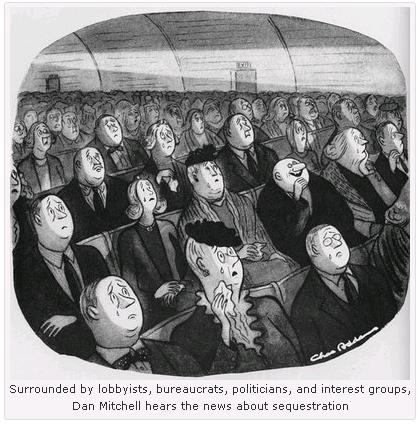
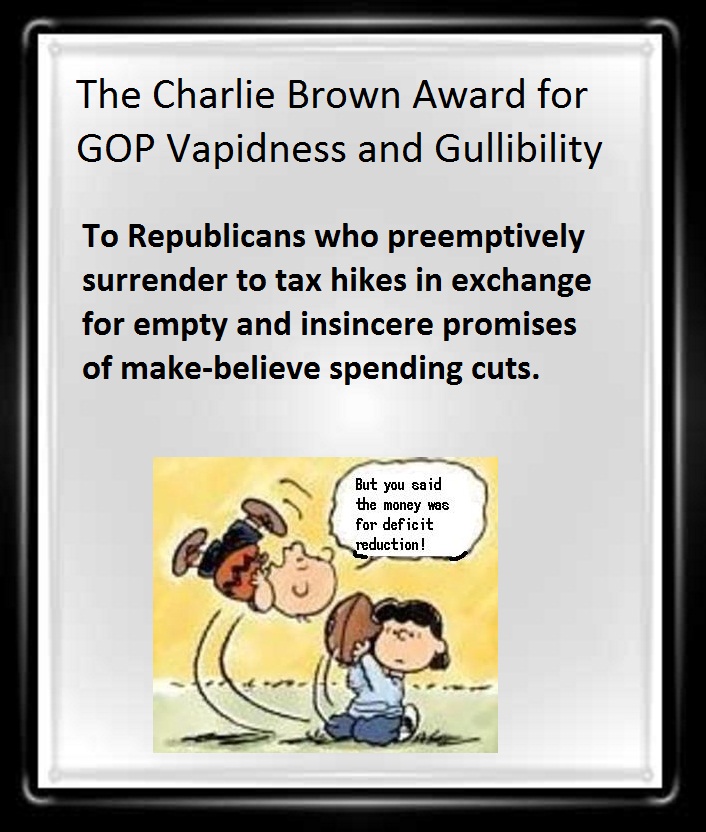
The 'Stupid Party' Strikes Again: Congressional Republicans Poised to Give Up Sequester Victory

by Daniel J. Mitchell
Jts5665

sigh...

Daniel J. Mitchell

There’s a saying in sports that teams that come back to win in the final minutes often “snatch victory from the jaws of defeat .”

I don’t like that phrase because it reminds me of the painful way my beloved Georgia Bulldogs were defeated a couple of weeks ago by Auburn. But I also don’t like the saying because it describes what President Obama and other advocates of big government must be thinking now that Republicans apparently are about to do away with the sequester.

Specifically, the GOP appears willing to give away the sequester’s real and meaningful spending restraint and replace that fiscal discipline with a package of gimmicks and new revenues.

I warned last month that something like this might happen, but even a pessimist like me didn’t envision such a big defeat for fiscal responsibility.

You may be thinking to yourself that even the “stupid party” couldn’t be foolish enough to save Obama from his biggest defeat, but check out these excerpts from a Wall Street Journal report.

Sen. Patty Murray (D., Wash.) and Rep. Paul Ryan (R., Wis.), chief negotiators for their parties, are closing in on a deal… At issue are efforts to craft a compromise that would ease across-the-board spending cuts due to take effect in January, known as the sequester, and replace them with a mix of increased fees and cuts in mandatory spending programs.

The supposed cuts wouldn’t include any genuine entitlement reform. And there would be back-door tax hikes.

Officials familiar with the talks say negotiators are stitching together a package of offsets to the planned sequester cuts that would include none of the major cuts in Medicare or other entitlement programs that Mr. Ryan has wanted… Instead, it would include more targeted and arcane measures, such as increased fees for airport-security and federal guarantees of private pensions.

The package may get even worse before the ink is dry.

Democrats on Thursday stepped up their demands in advance of the closing days of negotiations between Ms. Murray and Mr. Ryan. House Democratic Leader Nancy Pelosi (D., Calif.) brought a fresh demand to the table by saying she wouldn’t support any budget deal unless in included or was accompanied by an agreement to renew expanded unemployment benefits that expire before the end of the year—which would be a major threat to any deal.

Gee, wouldn’t that be wonderful. Not only would the GOPers surrender the sequester and acquiesce to some tax hikes, but they could also condemn unemployed people to further joblessness and despair.

That’s even worse than the part of the plan that would increase taxes on airline travel to further subsidize the Keystone Cops of the TSA.

But look at the bright side—for D.C. insiders. If the sequester is gutted, that will be a big victory for lobbyists. That means they’ll get larger bonuses, which means their kids will have even more presents under the Christmas tree.

As for the rest of the nation? Well, you can’t make an omelet without breaking a few eggs.

P.S.: I suppose we should consider ourselves lucky that this looming agreement isn’t as bad as some past budget deals, such as the read-my-lips fiasco of 1990.

06 Dec 16:03

The Real US Unemployment Rate: 11.5%

by Tyler Durden

While it may appear at first glance that the first chart below shows just one data series, what we have shown are two data sets: one presents, on an inverted axis, the Civilian Employment-to-Population rate, which unlike the unemployment rate as a fraction of the labor force (most recently printing at just 7%), has barely budged since the Lehman collapse. The other data set shows what an implied unemployment rate as calculated by Zero Hedge would be assuming a long-term average of 65.8% worker labor participation rate.

As we reported earlier, according to the BLS this number most recently was 63.0%: a 20 bps rebound from the 35 year low posted in October, but still woefully wrong. The chart shows much more accurately what the real unemployment rate would be when looking at the overall noninstitutional population instead of the ever rising amount of Americans who for one reason or another are not in the labor force.


On the next chart, we then proceed to juxtapose the implied unemployment rate with the officially reported BLS data.

In short: applying a realistic labor force participation rate to the unemployment rate series, shows that the real US unemployment rate is now 11.5%, a 4.5% difference from the reported number, and the second highest ever, only better compared to October's 4.7%.

Of course, don't inform the Fed of this discrepancy: if aware, the Fed's monetary mandarins would likely never taper. Then again, if indeed the Fed never does taper as many suggest (since it is the flow, not the stock), we will know just which series of unemployment data the Fed is looking at.

06 Dec 14:15

IRS Floats Rule Changes to Tip 2014 Elections

The Internal Revenue Service quietly proposed new regulations aimed at 501(c)(4) organizations during the Thanksgiving recess that Rep. Darrell Issa (R-CA), Chairman of the House Oversight Committee, called "a crass political effort by the Administration to get what political advantage they can, when they can." 

Tea Party groups and other conservative organizations were apparently singled out by the IRS starting in 2010, and the heavy hand of government suppression of these groups may have greatly attributed to Obama's re-election, an American Enterprise Institute study revealed in October. 

The Washington Post reported last week the Treasury Department said the new rules “may be both more restrictive and more permissive than the current approach.” The new rules focus on organizations known as "social welfare" groups that regulated within section 501(c)(4) of the tax code. Conservative political operations, liberal groups before them, began to organize under the 501 (c)(4) umbrella in the past ten years, and having such a tax status would allow these organizations from disclosing their donors. 

A 54-year-old rule says that an organization can become a social welfare organization “if it is primarily engaged in promoting in some way the common good and general welfare of the people of the community.” The new IRS regulation now says “campaign-related political activity” cannot count towards a group’s social welfare mission. Such a regulation would discount numerous conservative advocacy groups either seeking for or wanting to maintain a 501(c)(4) tax status. According to the Post:

“The phone and e-mail exploded,” said Dan Backer, an Alexandria lawyer specializing in election law who represents many nonprofit groups on the right. “We are all going to spend a tremendous amount of time and energy fighting back against this.”

“The IRS is approaching this as, ‘We are giving you the right to speak and you are going to speak within the confines we tell you,’ ” Backer added. “And that’s wrong. This whole effort is simply a way to empower government to regulate speech.” ...

“Treasury and the IRS drew a very deep and troubling line in the sand,” the Alliance for Justice, an association of more than 100 nonprofit groups on the left, said in a statement. “Though the new definitions attempt to clarify existing rules, they also create a danger to citizen participation in our democracy.”

Issa's Committee has been investigating evidence this past year showing the IRS targeted Tea Party, religious, and other conservative organizations. In a statement released by Issa's Committee office last week, the chairman said: 

This new effort by the Obama Administration to limit traditional advocacy efforts by social welfare organizations will have a much more profound impact on grassroots and community organizations than on the well-heeled groups it supposedly targets. The fact that the Administration’s new effort only applies to social welfare organizations — and not powerful unions or business groups — underscores that this is a crass political effort by the Administration to get what political advantage they can, when they can. 

The Committee’s interim report into the IRS’s targeting scandal explained how the Citizens United decision caused the IRS to handle conservative tax-exempt applicants in a distinct and unfair manner. The regulation released today continues this Administration’s unfortunate pattern of stifling constitutional free speech.

Rep. Elijah Cummings (D-MD), Ranking Member of the Committee, saw the new IRS regulations as a positive step forward. Cummings' office released a statement last week expressing the congressman's satisfaction with the new rules:

Today by clarifying the confusing regulations governing the amount of political campaign activity that tax-exempt organizations can conduct, the Internal Revenue Service and the Treasury Department have taken another important step in implementing the recommendations made by the Inspector General earlier this year.   Our investigation has shown that reforming these tax rules is essential, and I hope that we can put aside partisan politics and work together to ensure that these reforms work for everyone.

In the meantime, the Oversight Committee, according to Issa, continues to be stonewalled by the FBI over the Committee's investigation  into whether the IRS targeted the conservative group True the Vote. Issa is now threatening to subpoena FBI director James Comey to get the information he says Oversight needs. 


05 Dec 16:40

The Hunger Games: Dispatches From District 48

by admin

Household Income DC vs US_2_0


(source)

The original subtitle of my blog has long-ago been eclipsed.  I am trying out a new one.  Our tributes usually wear a lot of copper.

05 Dec 16:32

How Do You Charge an Unarmed Man with Shooting People? Get the NYPD Involved.

by Scott Shackford

Surprised they didn't demand the women they shot pay to replace the bulletsIn September, New York Police officers responded to an emotionally disturbed man causing a ruckus at a Times Square bus terminal by opening fire on him while they were surrounded by crowds and traffic. They missed him and hit two innocent bystanders (one of whom was in a walker). Police said at the time they thought the man, Glenn Broadnax, was reaching for a gun, but he turned out to be unarmed.

Even though Broadnax was not armed, an indictment unsealed Wednesday is charging him with assault for the injuries caused by police gunfire. From the New York Times:

The man, Glenn Broadnax, 35, of Brooklyn, created a disturbance on Sept. 14, wading into traffic at 42nd Street and Eighth Avenue and throwing himself into the path of oncoming cars.

A curious crowd grew. Police officers arrived and tried to corral Mr. Broadnax, a 250-pound man. When he reached into his pants pocket, two officers, who, the police said, thought he was pulling a gun, opened fire, missing Mr. Broadnax, but hitting two nearby women. Finally, a police sergeant knocked Mr. Broadnax down with a Taser. …

Initially Mr. Broadnax was arrested on misdemeanor charges of menacing, drug possession and resisting arrest. But the Manhattan district attorney’s office persuaded a grand jury to charge Mr. Broadnax with assault, a felony carrying a maximum sentence of 25 years. Specifically, the nine-count indictment unsealed on Wednesday said Mr. Broadnax “recklessly engaged in conduct which created a grave risk of death.”

“The defendant is the one that created the situation that injured innocent bystanders,” said an assistant district attorney, Shannon Lucey.

Broadnax was taken to Bellevue Hospital after they got him down and told police he was hearing voices of dead relatives and was trying to commit suicide. But a psychologist has nevertheless found him competent to stand trial.

One of the women shot by the police is absolutely not having it:

Mariann Wang, a lawyer representing Sahar Khoshakhlagh, one of the women who was wounded, said the district attorney should be pursuing charges against the two officers who fired their weapons in a crowd, not against Mr. Broadnax. “It’s an incredibly unfortunate use of prosecutorial discretion to be prosecuting a man who didn’t even injure my client,” she said. “It’s the police who injured my client.”

New York City spends hundreds of millions of dollars every year settling claims against the city (though not all are tied to police behavior). Despite trying to redirect responsibility Broadnax’s way, it should not be a surprise to see six figures or more of city money heading in the direction of Khoshakhlagh and the other woman shot.

05 Dec 00:16

More Questions for Proponents of Pricing Low-Skilled Workers Out of Jobs

by Don Boudreaux
(Don Boudreaux)

Like philosopher Michael Huemer and my colleague Bryan Caplan, my libertarian ethics grow from, and remain grounded in, what Huemer calls “common sense morality” – a common sense that understands the homage that statism pays to liberty.  With this short background in mind, I have yet other questions for proponents of minimum-wage legislation – namely:

Suppose that you’re at a McDonald’s restaurant or at a Safeway supermarket or at the office of a maid-service company and you see a 20-something young woman.  The woman is obviously poor by American standards and her English is broken and heavily accented.  She has no certifiable job experience.  She applies for a job and is rejected.  She – with entrepreneurial gumption – responds to the rejection by offering to work, not for the minimum wage of $7.25 per hour but, instead, for $5.00 per hour.  You observe the manager’s evident interest in her counteroffer.  The manager ponders for a minute or two and then whispers to her – yet loud enough for you to overhear – “Look, that’s against the law, but I can use you at $5.00 per hour.  So, okay, you’re hired!  But please don’t tell anyone or else I’ll be in serious trouble and you’ll lose this job.”

Would you – you personally – intervene to stop this woman from taking this job?  Would you – you personally - be willing to look her in the eyes and tell her that she may not take that job?  Would you – you personally – inform this young woman (with regret, of course) that she must remain unemployed for the time being and resume her job search elsewhere?  And would you – you personally - be willing to use force against this woman to prevent her from working at $5.00 per hour if she stubbornly ignores your demands?  Would you be willing, if her stubborn refusal to refuse the job persists, to poke a gun in her face to prevent her from working at an hourly wage of $5.00 per hour?

I have little doubt that many of you would willingly – even happily – take action against the manager who offers to employ this woman at $5.00 per hour (although you’d probably prefer to take this action out of eyesight and earshot of the woman whose job you’ll destroy by bringing the scofflaw manager to ‘justice’; you don’t want the woman to know that you, personally, are responsible for her misfortune).  And I have no doubt that even more of you would be eager to rush home to call the police to report this incident and demand that armed cops intervene to punish the manager and to keep this woman from working at $5.00 per hour.  But I wonder how many of you – you personally - have the courage of your moral convictions to be able to look the woman in her eyes and expose yourself personally, to her, as someone willing to deny her the opportunity to work at the highest wage she can now earn.

And if I’m correct, how can you, in good conscience, continue to feel that minimum-wage legislation is ethically justified?

04 Dec 16:10

Retired police captain speaks out about America’s cruel, senseless, and failed War on Drugs

by Mark J. Perry

The video above features an interview with retired police captain Peter Christ on WGRZ-TV in Buffalo, NY. Captain Christ is co-founder and vice-chair of Law Enforcement Against Prohibition (LEAP), a nonprofit organization made up of current and former members of the law enforcement and criminal justice communities who are speaking out about the failures of America’s War on Drugs.

Starting at about 2:45, Captain Christ makes a key point:

When you institute a prohibition like we have with drugs in this country, what you are doing is not protecting people from other people, you are attempting to use law enforcement to protect people from themselves. Protecting you from yourself is a function of family, church, education, and the health care system. It never is, and never should have been intended to be, a law enforcement function. We are out there enforcing morality when we enforce drug laws, and that is not our job. We were not trained to do it, we are not capable of doing it, and if anything else you see the failure of it.

We’ve been doing this for over 40 years since Nixon kicked it off, and the drugs are more available, of purer quality and cheaper than they’ve ever been before on the streets of America. And we’ve had 40,000 deaths in Mexico over the last five years fighting over this drug trade. Plus we’ve destroyed more lives than the drugs have by incarcerating people and hanging felony convictions on them and denying them college educations, denying them jobs, for no good reason.

And one other thing I want to point out in case people think that if we do it hard enough that this will actually be doable to make drugs go away. We have the largest prison system on the planet, and the most efficient prison systems on the planet. And in that huge efficient prison system, we do not have one drug-free prison in America. And if you cannot keep drugs out of prisons, who is going to be delusional enough to think you can keep them out of a free society?

04 Dec 12:54

DailyDirt: Solar System Factoids

by Michael Ho
Every so often, it's good to take a look up into the sky and think about how small our troubles are -- compared to the size of the universe. Our little planet orbits a second (or maybe third) generation star, burning up heavier elements from previous stars that no longer exist. As Carl Sagan famously said, "We're made of star stuff." So as some of us take a couple days off to be thankful for the things we have, check out some of these links about our solar system. If you'd like to read more awesome and interesting stuff, check out this unrelated (but not entirely random!) Techdirt post via StumbleUpon.

Permalink | Comments | Email This Story


03 Dec 22:02

New York Critics Name Best Picture...

Jts5665

This is an Obamacare documentary, right?


New York Critics Name Best Picture...


(First column, 7th story, link)

03 Dec 19:10

Why Walmart is the Big Winner in DC's Minimum Wage Increase

by Nick Gillespie

Earlier this year, Washington, D.C. flirted with the idea of creating a punitive "living wage" specifically designed to hit Walmart stores and a few other big-box retailers. Walmart threatened to pull out of the Capital City if they were forced to pay that wage. Mayor Vincent Gray vetoed the bill but promised to back in its place a general increase in the District's minimum wage. Now, the city council has responded with a bill to gradually increase the minimum wage for all businesses from $8.25 to $11.50 in 2016. The mayor has countered with $10 an hour but doesn't have the votes to stave off the higher number.

At the Washington Examiner,  Sean Higgins explains how "America's Place for Savings" is the real winner if and when the minimum wage gets jacked up by government dictate:

In 2006, Walmart’s then-CEO Lee Scott said... "Though we do not intend to take a position on any single piece of legislation, we believe Congress should increase the minimum wage.”

In the case of the D.C. bill, Walmart often already does pay a $10 or $11.50 wage. According to Payscale.com, Walmart’s cashiers on average make between $7.50 and $10.77 and sales associates make between $7.63 and $11.83. Overall, its wages are just five percent below the retail industry average.

It is a different story for D.C.’s small neighborhood stores — which already face the daunting prospect of competing with Walmart. “Small businesses are the least able to absorb ... a dramatic increase in their labor costs,” notes the National Federation of Independent Business.

Read more.

Score this a win for Walmart then. They can absorb the higher wage relatively easily while their smaller competitors cannot. And if faced with job loss or cutbacks at mom-and-pops, expect the City Council to try and pass an even-higher wage in order to help their constituents out.

Watch Reason TV's coverage of "The War on Walmart" (2011) which features future New York City Mayor Bill de Blasio bloviating about how Walmart stores are "Trojan horses" that sneak into cities and destroy their economies (really):


03 Dec 16:04

Washington Post takes free trade stand against Big Sugar and the protectionism it receives, at the expense of US consumers

by Mark J. Perry

From the Washington Post editorial “Congress needs to roll back subsidies to sugar producers“:

Federal policy coddles the U.S. sugar industry through import controls, soft loans and price targets. The result is higher consumer prices — and fewer jobs in the U.S. food industry. Still, for many years Big Sugar and its defenders could claim that the program was designed to avoid any direct expenditure of taxpayer funds and that it had, in fact, achieved that goal.

Not anymore. The Agriculture Department lost $280 million on the sugar program in fiscal year 2013, with more losses expected next year. A surge of imports from Mexico has driven down U.S. sugar prices — to the point where it’s profitable for processors to take advantage of a U.S. law that lets them forfeit the sugar they posted as collateral for government loans and keep the cash. Stuck with mountains of excess sweetener, the government has two choices: hoard it until prices go up or sell it at a huge loss to the few ethanol makers willing to take it.

Even before this latest evidence of the sugar program’s irrationality, bipartisan critics in Congress had been trying to add reforms to the next five-year farm bill, which Congress is still debating. They failed.

Big Sugar argues that ending U.S. sugar protections would be unilateral disarmament, since Mexico subsidizes its industry, primarily through state ownership of one-fifth of the country’s sugar mills. That didn’t matter much as long as Mexico had to compete with other sugar exporters for an allotted quota of the U.S. market. But five years ago a provision of NAFTA took effect, allowing unlimited imports from Mexico. Now, the sugar lobby says, the United States should adopt a “zero-for-zero” policy: We’ll stop fiddling with the sugar market when everyone else in the world does the same.

It sounds reasonable. Indeed, though the world sugar trade has liberalized in recent years, about a tenth of it is still subject to bilateral agreements and preferential arrangements. Economics 101 says everyone would be better off if these controls were abolished.

Alas, Politics 101 says that’s not going to happen soon, so demanding “zero-for-zero” amounts to an excuse for perpetuating policies that benefit U.S. producers at the expense of food processors and consumers. The U.S. sugar industry has known since NAFTA’s ratification in 1993 that Mexican imports were coming; it could have used the time preparing to compete instead of lobbying for protection.

The United States should stand for free trade in sugar and against protectionism. Setting a better example would help.

MP: Might be a good time to quote Frederic Bastiat, who sent this message to a friend four days before the noted, free-market French economist died in 1850: “Treat all economic questions from the viewpoint of the consumer, for the interests of the consumer are the interests of the human race.”

Anti-consumer, protectionist US sugar policy has a long history, going back to 1789 when the First Congress of the United States imposed a tariff on foreign sugar, and is a perfect illustration of trade protection that ignores the viewpoint of disorganized, dispersed consumers in favor of the concentrated, well-organized interests of producers. US sugar policy violates the interests of consumers, and by doing so, violates the interests of the human race, in favor of a politically favored special interest group – “Big Sugar.” Kudos to the Washington Post for speaking up on behalf of the hundreds of millions of US consumers who pay about $3 billion in higher prices every year to Big Sugar because of the ongoing government-sanctioned protection that industry receives from more efficient foreign rivals.

03 Dec 16:02

Energy fact of the day: As a separate oil-producing nation, Texas would be the 10th largest oil-producer in the world

by Mark J. Perry
Rank Country Oil Production in July (Barrels/day)
1 Russia 10,052,000
2 Saudi Arabia 10,040,000
3 United States 7,487,000
4 China 4,043,000
5 Canada 3,586,000
6 Iran 3,200,000
7 Iraq 3,100,000
8 UAE 2,820,000
9 Kuwait 2,650,000
10 Texas 2,625,000
11 Mexico 2,522,000
12 Nigeria 2,400,000
13 Venezuela 2,300,000
14 Brazil 1,974,452
15 Angola 1,790,000

Source: Energy Information Administration (here and here).

As I reported last week, Texas produced 2.726 million barrels per day (bpd) in September, and is on track to surpass 3 million bpd in early 2014, and then surpass 4 million bpd in the spring of 2015. With those projected increases in Texas oil output, the Lone Star State could soon surpass Kuwait, UAE, Iraq, Iran and even Canada to move up in the international oil production rankings to become the world’s No. 5 or No. 6 oil producer within the next few years.

“Saudi Texas” continues to be the shining star of The Great American Energy Boom.

02 Dec 23:36

IRS Auditing Cancer Patient Who Lost Coverage, Spoke Out...

Jts5665

An entire administration of hammers just looking for nails to crush...


IRS Auditing Cancer Patient Who Lost Coverage, Spoke Out...


(Third column, 21st story, link)
Related stories:
02 Dec 20:18

Are We Safer?

by Marian L. Tupy

Marian L. Tupy

The leaders of the congressional intelligence committees say that the United States is not safer today than in recent years.

Sen. Dianne Feinstein (D-Calif.), chairwoman of the Senate Intelligence Committee, and Rep. Mike Rogers (R-Mich.), chairman of the House Intelligence Committee, said in an interview aired Sunday on CNN’s State of the Union that terrorism is up worldwide and the United States needs to be vigilant to combat the growing threats.

CNN’s Candy Crowley kicked off her sit-down interview, asking, “Are we safer now than we were a year ago, two years ago?”

“I don’t think so,” Feinstein replied. “I think terror is up worldwide, the statistics indicate that. The fatalities are way up. The numbers are way up.” Rogers concurred. “I absolutely agree that we’re not safer today … the pressure on our intelligence services to get it right to prevent an attack are enormous. And it’s getting more difficult.”

The recent uptick in terrorism reminds us of the need to remain vigilant. But it is also important to keep in mind long term trends. Below are two graphs generated by Cato’s new website, www.humanprogress.org, using Harvard University Professor Steven Pinker’s data. According to Pinker, there has been a sustained downward trend in deaths from terrorism.


02 Dec 17:30

Allen West: EPA Engaging in Backdoor Gun Control

From Allen West:

I am one who steers very clear of tinfoil hat conspiracy theories. I often believe progressives plant stories in order to distract and disrupt, enabling them to pursue their true goals and objectives. That’s why I stress the importance of staying focused on the modern liberal socialist policies of the Obama administration, not the sideshow antics.

However, as a former combat commander, I have been trained to look for trends. And I believe we’ve found a very disturbing one. It seems that backdoor gun control is in full effect in the United States. Why? Thanks to Obama’s Environmental Protection Agency (EPA), we can no longer smelt lead from ore in the United States.

The first contact the EPA made with The Doe Run Lead Smelter in Herculaneum, Missouri (population 2,800) was in 2008, but it was in 2010 that the EPA finally forced Doe Run to plan a shutdown. This plant has been in operation since 1892 but will finally close its doors this month. It was the last primary lead smelting plant in the U.S.

The closedown is due to new, extremely tight air quality restrictions placed on this specific plant. President Obama and his EPA raised the regulations tenfold, and it would have cost the plant $100 million to comply.

In response to the Doe Run lead smelter shutdown, the U.S. Environmental Protection Agency said the Doe Run Company “made a business decision” to shut down the smelter instead of installing pollution control technologies needed to reduce sulfur dioxide and lead emissions as required by the Clean Air Act.

...

What this all means is that after December 2013, any ammunition that will be available to US citizens will have to be imported, which will surely increase the price and possibly come under government control. It seems this is fully in concert with the US Military and Homeland Defense recent purchase of large quantities of ammunition.

The effect is chilling: you can own all the guns you want, but if you can’t get ammo, you are out of luck. Remember when President Obama promised his minions that he was working on gun control behind the scenes? Welcome to it. The result is that all domestically mined lead ore will have to be shipped overseas, refined and then shipped back to the US.

Read the rest of the article at allenbwest.com.


02 Dec 17:27

How Football Fleeces Taxpayers: Gregg Easterbrook on The King of Sports

by Nick Gillespie

Whether you like football or not - whether you've ever bought a ticket to a high school, college, or NFL game - you're paying for it.

That's one of the takeaways from The King of Sports: Football’s Impact on America, Gregg Easterbrook's fascinating new book on the cultural, economic, and political impact of America's most popular and lucrative sport.

“The [state-supported] University of Maryland charges each...undergraduate $400 a year to subsidize the football program," says Easterbrook, who notes that only a half-dozen or so college teams are truly self-supporting. Even powerhouse programs such as the University of Florida's pull money from students and taxpayers. "They do it," he says, "because they can get away with it.”

At the pro level, billionaire team owners such as Paul Allen of the Seattle Seahawks and Shahid Khan of the Jacksonville Jaguars benefit from publicly financed stadiums for which they pay little or nothing while reaping all revenue. Easterbrook also talks about how the lobbyists managed to get the NFL chartered as a nonprofit by amending tax codes designed for chambers of commerce and trade organizations.

As ESPN.com's Tuesday Morning Quarterback columnist, Easterbrook absolutely loves football but also isn't slow to throw penalty flags at the game he thinks is uniquely America. In fact, he sees the hypocrisy at the center of the business of football as "one of the ways that football synchs [with] American culture....Everyone in football talks rock-ribbed conservatism, self-reliance. Then their economic structure is subsidies and guaranteed benefits. Isn't that America?"

Easterbrook sat down with Reason's Nick Gillespie to discuss The King of Sports, how the business of football burns taxpayers, and whether increased worries about brain injuries and other problems spell eventual doom for the NFL and other levels of play.

Produced by Todd Krainin. Cameras by Meredith Bragg and Krainin.

Runs about 8:45 minutes.

Scroll down for downloadable versions and subscribe to ReasonTV's YouTube Channel to receive notification when new material goes live.

02 Dec 14:22

Quotation of the Day…

by Don Boudreaux
(Don Boudreaux)

… is from page 103 of the 1983 re-issue of Ludwig von Mises’s 1944 volume, Bureaucracy:

Bureaucratization is necessarily rigid because it involves the observation of established rules and practices.  But in social life rigidity amounts to petrification and death.  It is a very significant fact that stability and security are the most cherished slogans of present-day “reformers.”  If primitive men had adopted the principle of stability, they would never have gained security; they would long since have been wiped out by beasts of prey and microbes.

01 Dec 21:05

Top Ten Signs You Could Be Suffering From Autoimmunity

by Squatchy

Guest post written by Tara Grant:

You’ve been Paleo for a couple years and things are great. Your weight is down, your energy’s up, your hormones are balanced—diet and exercise are locked down tight. You’re PAF 90% of the time and feel like a rock star most days. Things are much better than they’ve ever been—but not everything’s perfect. There’s the matter of the skin on your upper arms, which gets these tiny, hard little bumps on it from time to time. And the fact that sometimes you break out in an itchy rash on your legs, or get hives/bug bites that no one else seems to get.  There’s the occasional bout of dandruff for no reason, that weird, inflamed ingrown hair in your armpit, the severely painful menstrual cycle from time to time, and the seasonal allergies you just can’t shake. Still, you’re tons better than you used to be.

When I first went Paleo, I was so metabolically deranged that it would be easier to tell you what wasn’t wrong with me, instead of what was. (I actually spent an hour trying to come up with something that wasn’t wrong with me. Couldn’t. Didn’t have cancer. That’s about it.) The longer I stuck with an ancestral lifestyle, the more I began to heal. The symptoms, problems, and maladies just faded away, one by one, until all I was left with were the minor issues. For me, most of these symptoms involved my skin.

Although it had gotten drastically better when I first changed my diet, my Hidradenitis suppurativa (HS) still wasn’t in complete remission. I continued to get cystic acne occasionally, and sometimes my scalp itched. I was way better than I had been before, but I still wasn’t 100 percent. My energy wasn’t where I wanted it to be, my muscles ached a lot, and I was having problems with my sleep, too.

I started biohacking myself and doing research. I looked into known autoimmune conditions and was shocked to find that I had already “healed” from a few. Who knew that things like endometriosis and restless legs syndrome were autoimmune? Not my doctor, that’s for sure. As I discovered more and more “conditions” and “syndromes” were actually autoimmune in nature, a family tree littered with autoimmunity revealed itself to me—on both sides. I, too, had been suffering from autoimmunity (a whole bunch of it) but I had had no idea. By treating the disease like the autoimmune condition it was and coming up with a specific HS protocol, I found that not only did the HS go into complete remission, all the other annoying symptoms I’d been having did too. It was all absolutely connected.

tara_before_after

So what about those nagging symptoms you’re still plagued with? Or new ones that “pop up” out of nowhere? Are you suffering from a fungal infection, as your naturopath suggests? A bacterial infection, as your doctor repeatedly states? Is it all in your head, as the psychiatrist says? Perhaps your yoga instructor is right—you simply need to detox. Or maybe—just maybe—you’re actually experiencing symptoms of early autoimmunity. According to Sarah Ballantyne, a biophysicist and author of The Paleo Approach, symptoms of autoimmune conditions can be very mild for years—even decades—before they start to worsen and develop into full-blown disease.[1] Here’s how to tell if those nagging symptoms are part of something bigger:

Top Ten Signs You Could Be Suffering From Autoimmunity

1.     Your symptoms have not resolved with a standard Paleo diet. They may be less frequent and less painful, but they still appear occasionally.

2.     Your doctor has said that your symptoms are “unexplained,” “incurable,” “untreatable,” “chronic,” or “in your head.” Standard treatments, antibiotics, and western medicine have failed to “cure” you.

3.     Your symptoms involve inflammation in some way—whether that inflammation is in your joints, your colon, your nerves, or your hair follicles makes no difference.

4.     Your symptoms relapse and remit—they’ll get better for a while, and then get worse for (seemingly) no reason at all.

5.    You have a family history of not only disease, but of conditions, symptoms, syndromes, and unexplained illnesses.

6.     Sugar makes your symptoms worse.

7.     Stress and hormones make your symptoms worse.

8.     You’re also facing some sort of mental disturbance, whether it’s depression, hopelessness, anxiety, fog, or memory problems. You may be having issues with your sleep.

9.     You have, or used to have, metabolic syndrome, or resistance to weight loss.

10.  You are susceptible to infections, have digestive issues, allergies, or have been diagnosed with some sort of “syndrome,” including PMS, PMDD, IBS, PCOS, CFS, etc.

Just reading this list can be overwhelming—let alone figuring out where to start if you do think you’re facing autoimmunity. I faced a sense of excitement at first, but was confused about how to go about getting started. This is where I’d like to offer my help. My journey to health was successful, but it was painstaking and challenging in many ways. In my book, The Hidden Plague, I make things easier for you by presenting a systematic approach to healing. While the book has a special focus on Hidradenitis suppurativa (because this is the area of most desperate need), my dietary protocol for identifying trigger foods and healing your digestive tract applies to all autoimmune conditions that are diet related.

Microsoft Word - HS BOOK Nov12

The Hidden Plague is organized into two sections: The Whys and Wherefores of HS and The HS Autoimmune Protocol. In the first section, you will learn the clinical definition of HS, how the medical community typically treats it, the root cause of HS (autoimmunity, caused by leaky gut), how stress and hormones can play a role, and how to care for your wounds. This stuff is very relatable to other autoimmune skin conditions, like acne, eczema, and psoriasis.

The second part of the book addresses the practical methods of kicking your autoimmune skin condition into remission through diet. We’ll discuss how to start an elimination diet to zero in on your personal food triggers. You’ll receive detailed instructions on what to include in your self-designed Paleo autoimmune diet—and what to avoid—and be introduced to some new and tasty recipes, including Tomato-Free Ketchup, to help you find substitutes for your favorite foods. I’ve also included a couple of sample journal pages from Mark Sisson’s Primal Blueprint 90-Day Journal in the back of the book to get you started on tracking your progress.

By following this approach, you can take all of the guesswork out of your journey to health. You will know with great certainty what you can and cannot have—and why. You will know what to do to get out of trouble if you have a flare-up or any sort of health setback. If you are interested in personal support, I also offer consultations through my web site PrimalGirl.com

01 Dec 01:14

Maps: How Thanksgiving Day dinner varies across America

by Mark J. Perry

mapThe graphic above is from The Economist, inspired by this interactive graphic from Tableau Software “A Nation Divided: The US can’t agree on a pie flavor, but everybody loves cranberry sauce.”

01 Dec 01:13

Quotation of the day

by Mark J. Perry

… is from Friedrich A. Hayek writing to President Obama about the “fatal conceit” of Obamacare…. just kidding, it’s from Hayek’s acceptance speech accepting the Nobel Prize in economics in 1974 (and featured in today’s WSJ section “Notable and Quotable“), but it does apply very appropriately to President Obama’s “striving to control society” and points to the deficiencies of the Unaffordable Care Act:

We are only beginning to understand on how subtle a communication system the functioning of an advanced industrial society is based—a communications system which we call the market and which turns out to be a more efficient mechanism for digesting dispersed information than any that man has deliberately designed.

If man is not to do more harm than good in his efforts to improve the social order, he will have to learn that in this … he cannot acquire the full knowledge which would make mastery of the events possible. He will therefore have to use what knowledge he can achieve, not to shape the results as the craftsman shapes his handiwork, but rather to cultivate a growth by providing the appropriate environment, in the manner in which the gardener does this for his plants.

There is danger in the exuberant feeling of ever growing power which the advance of the physical sciences has engendered and which tempts man to try to subject not only our natural but also our human environment to the control of a human will. The recognition of the insuperable limits to his knowledge ought indeed to teach the student of society a lesson of humility which should guard him against becoming an accomplice in men’s fatal striving to control society — a striving which makes him not only a tyrant over his fellows, but which may well make him the destroyer of a civilization which no brain has designed but which has grown from the free efforts of millions of individuals.

30 Nov 22:10

Fear of the hand that feeds

by noreply@blogger.com (Vox)
The fact that government bureaucrats are literally silencing scientists doesn't appear to bother science fetishists anywhere nearly as much as the idea that somewhere, someone has a textbook with an evolution sticker on it.
Hundreds of federal scientists said in a survey that they had been asked to exclude or alter technical information in government documents for non-scientific reasons, and thousands said they had been prevented from responding to the media or the public.

The Professional Institute of the Public Service of Canada (PIPSC), which commissioned the survey from Environics Research "to gauge the scale and impact of 'muzzling' and political interference among federal scientists," released the results Monday at a news conference. PIPSC represents 60,000 public servants across the country, including 20,000 scientists, in federal departments and agencies, including scientists involved in food and consumer product safety and environmental monitoring.

In all, the union sent invitations to participate in the survey to 15,398 federal scientists in June. A total of 4,069 responded.

Twenty four per cent of respondents said they “sometimes” or “often” were asked to exclude or alter technical information in federal government documents for non-scientific reasons. Most often, the request came from their direct supervisors, followed by business or industry, other government departments, politically appointed staff and public interest advocates.
He that pays the gold makes the rules. Science prostituted itself when it got in bed with government and now it has to pay the price. Big science is bad science.

Posted by Vox Day.
30 Nov 18:49

Quotation of the Day…

by Don Boudreaux
(Don Boudreaux)

… is from Thomas Sowell’s recent syndicated column, “Random Thoughts“; while I don’t agree with all that Sowell says in that column (Sowell remains, in my view, far too trusting of both the intentions and the abilities of U.S. politicians who deploy American military might abroad), he is spot-on insightful with this observation:

Those who want to “spread the wealth” almost invariably seek to concentrate the power.  It happens too often, and in too many different countries around the world, to be a coincidence.  Which is more dangerous, inequalities of wealth or concentrations of power?

(HT Mark Perry)

27 Nov 22:55

Law Prof Writing Revenge Porn Legislation Wants To Upend Safe Harbors On The Internet 'For The Children'

by Tim Cushing

It's pretty much universally accepted that "revenge porn" is a bad thing and that steps should be taken to prevent the posting of someone's private photos (usually along with contact info) at various websites that entertain the small minds that find this cathartic or fascinating or hilarious (and, of course, it's even worse that many of these sites then try to charge people to take down their photos).

Unfortunately, because it's so thoroughly reviled, attempts to curtail revenge porn tend to be poorly thought out. One bad law can do an awful lot of collateral damage -- something those actively pushing legislative solutions tend to forget in their hurry to rid society of unpleasantness.

Mary Anne Franks, a law professor at the University of Miami, has been pushing to get revenge porn criminalized. To that end, she is helping draft a bill with an (unnamed) member of Congress. The problems with her proposed legislation are several. Houston defense attorney Mark Bennett has unpacked the First Amendment implications (mostly negative) of her proposed law in two excellent and thorough posts over at his blog, Defending People.

A overly-simplified reduction of Franks' arguments in favor of the proposed law boils down to this: because it's unpleasant and most people would find it offensive, it isn't protected by the First Amendment. Bennett disassembles each point she makes and they all seem to come back to this.

Franks: "The First Amend­ment does not serve as a blan­ket pro­tec­tion for mali­cious, harm­ful con­duct sim­ply because such con­duct may have an expres­sive dimen­sion. Stalk­ing, harass­ment, voyeurism, and threats can all take the form of speech or expres­sion, yet the crim­i­nal­iza­tion of such con­duct is com­mon and care­fully crafted crim­i­nal statutes pro­hibit­ing this con­duct have not been held to vio­late First Amend­ment prin­ci­ples. The non-consensual dis­clo­sure of sex­u­ally inti­mate images is no different."
There is a world of dif­fer­ence between “The First Amend­ment does not serve as a blan­ket pro­tec­tion for mali­cious, harm­ful con­duct” and “mali­cious, harm­ful con­duct is unprotected.”

Franks makes a num­ber of such asser­tions as “the non-consensual dis­clo­sure of sex­u­ally inti­mate images is no dif­fer­ent,” but stamp­ing her foot and insist­ing that it’s so doesn’t make it so. Even if a law pro­fes­sor is inca­pable, a com­pe­tent lawyer can always find a dif­fer­ence between two things. One impor­tant dif­fer­ence between the dis­clo­sure of sex­u­ally inti­mate images on the one hand, and the con­duct of harass­ment, threats, and stalk­ing on the other, is that a statute for­bid­ding the for­mer is nec­es­sar­ily content-based, so it must meet strict scrutiny.

“It’s kinda like harass­ment” doesn’t over­come the obsta­cle of strict scrutiny, espe­cially since the Supreme Court has never upheld a crim­i­nal harassment statute.
As Bennett details, Franks has approached this largely in the "activist" role, rather than a scholarly role. In doing so, she's made arguments current case law just doesn't back up. That itself is problematic considering she's working with a Congress member to draft a law that will address an already-emotionally charged issue.

But it gets worse. Scott Greenfield points out a recent interview Franks did with US News and World Report, where she makes this troubling statement.
Websites that specialize in revenge pornography cannot currently be forced by state law to remove content because Section 230 of the federal Communications Decency Act grants Internet companies legal immunity if third-party content doesn't violate federal copyright or criminal law.

"A lot of companies are under the impression they can't be touched by state criminal laws," Franks said, because "Section 230 trumps any state criminal law."

The Communications Decency Act, however, doesn't trump federal criminal law, she said, pointing to child pornography.

"The impact [of a federal law] for victims would be immediate," Franks said. "If it became a federal criminal law that you can't engage in this type of behavior, potentially Google, any website, Verizon, any of these entities might have to face liability for violations."

"Hopefully," she said, "we would develop a similar take-down notice regime that we see in a copyright context, which means that anytime a victim becomes aware that [their] picture is on one of these websites without their consent, [they] can notify the website, [they] can notify Google, [they] could notify all the people inadvertently helping the image get shown... that this is nonconsensual material and needs to be taken down."
Having earlier questioned how long it would take Section 230 to fall in the face of anti-revenge porn efforts, Greenfield now has his answer.
Well, that didn’t take long at all. In their zeal to end revenge porn, which no one disputes is a blight on the internet, Franks and her ilk are more than happy to destroy free speech on the internet. After all, what’s free speech when compared to their feelings?
The US News article also contains quotes from Matt Zimmerman, senior staff attorney at the EFF, who logically points out that targeting intermediaries by bypassing (or removing) Section 230 protection is a terrible idea and will inflict collateral damage all over the internet. As he points out, companies will simply remove user content as quickly as possible whenever requested rather than be held legally or criminally accountable for hosting it. Additionally, there's a good chance some platforms and hosting services will simply shut down altogether rather than have to play internet police 24/7.

Franks "rebutted" Zimmerman's assertion, but from an oblique angle.
I do want to point out that neither the EFF nor the ACLU has expressed opposition to any specific law that I have personally drafted. I have sent my draft statutes to members of both organizations and am awaiting their responses.
Well, if the EFF and ACLU don't think it's a bad idea… Oh, wait. That's not what she actually said. Greenfield breaks it down.
Notice the attempt to weasel out of reality, “any specific law that I have personally drafted”? Franks neglects to mention that she sent an email to an EFF non-lawyer advocate, who was never an appropriate person to contact and who didn’t respond to her personal email, and has tried to parlay this by claiming these organizations don’t oppose her, in a deliberate effort to mislead.
Franks is looking to do some serious damage to free speech with her proposed law. While it could be theorized that courts will buy her arguments about what the First Amendment does and doesn't protect (troubling in its own way), this proposed attack on Section 230 Safe Harbor is bad news no matter how you look at it. The fact that she brings up child pornography is another indication that advocating for this law has very little to do with ensuring standing protections remain as unscathed as possible.

Politicians and special interest groups have often used "for the children" as an excuse for all sorts of legislative havoc. After all, who's going to defend child pornography? It's a disingenuous rhetorical tactic that equates Pet Issue A with The Worst Thing on the Internet in order to paint opponents as child porn sympathizers. But as Greenfield says, what are rights compared to feelings? Revenge porn is bad, and those arguing against legislative measures like Franks' are frequently portrayed as misogynists trying to ensure their abuse of women continues uninterrupted. Here's Franks herself on the subject:
But then there’s a whole category of people who aren’t confused at all – let’s call this the “threatened sexist” category. To explain this, we have to back up a bit and take note of the fact that non-consensual pornography, like rape, domestic violence, and sexual harassment, is overwhelmingly (though of course not exclusively) targeted at women and girls. So you get some people who might cynically invoke the First Amendment or raise disingenuous questions about scope, but who are really just hostile to anything that makes it harder to treat women as second-class citizens, especially when it comes to sex.
There's also some indication that Franks, like many others who aggressively advocate for laws that will fundamentally alter the way the internet runs, doesn't have a solid grasp on the very area she's attempting to regulate. She makes the following statement, which follows shortly after her above assertion that opponents will make "cynical arguments" about the First Amendment.
These are people who fully understand that a great number of our personal, social, and legal interactions are premised on the idea of contextual consent. They would never argue that a customer who gives his credit card to a waiter has given the waiter the right to use that credit card to buy himself a motorcycle. They would never argue that the fact that a person voluntarily gave personal information to a cellphone gives that provider the right to hand that information over to, say, the NSA.
As commenter Ken Arromdee points out, this statement is beyond obtuse.
You do realize that this is known as the third party doctrine, and is the actual reason used to justify government spying, right?
Greenfield asks when other law professors are going to step up and call Franks out for her bullshit. The answer, sadly, may be "never." Franks' own statements show she's more than willing to call any opponent a misogynist, something that can easily spell the end of an academic career. No one in this field is in a hurry to get smeared as a revenge/child porn proponent. Even more discouraging -- if this legislation ever hits the floor for a vote -- very few politicians will be willing to oppose this and end up labeled misogynist or simply "soft" on revenge porn, no matter how damaging the outcome will be for the First Amendment and the Section 230 Safe Harbors.


Permalink | Comments | Email This Story


27 Nov 16:24

COPS: Man butt-dialed by former boss, overhears plans to murder him...


COPS: Man butt-dialed by former boss, overhears plans to murder him...


(First column, 12th story, link)