Shared posts

10 Feb 19:34

IRS Officials Created a New Entitlement Program, Because They Felt Like It

by Michael F. Cannon

Michael F. Cannon

Over at DarwinsFool.com, I summarize a lengthy report issued by two congressional committees on how the Treasury Department, the Internal Revenue Service, and the Department of Health and Human Services conspired to create a new entitlement program that is authorized nowhere in federal law. Here’s an excerpt in which I summarize the summary:

Here is what seven key Treasury and IRS officials told investigators.

In early 2011, Treasury and IRS officials realized they had a problem. They unanimously believed Congress had intended to authorize certain taxes and subsidies in all states, whether or not a state opted to establish a health insurance “exchange” under the Patient Protection and Affordable Care Act. At the same time, agency officials recognized: (1) the PPACA plainly does not allow those taxes and subsidies in non-establishing states; (2) the law’s legislative history offers no support for their theory that Congress intended to allow them in non-establishing states; and (3) Congress had not given the agencies authority to treat non-establishing states the same as establishing states.

Nevertheless, agency officials agreed, again with apparent unanimity, to impose those taxes and dispense those subsidies in states with federal Exchanges, the undisputed plain meaning of the PPACA notwithstanding. Treasury, IRS, and HHS officials simply rewrote the law to create a new, unauthorized entitlement program whose cost “may exceed $500 billion dollars over 10 years.” (My own estimate puts the 10-year cost closer to $700 billion.)

The full post includes details some pretty stunning examples of how agency officials were derelict in their duty to execute faithfully the laws Congress enacts.

10 Feb 19:32

A message from Matt Ridley: ‘Dare to be an optimist’

by Mark J. Perry

worldpoverty1From Matt Ridley’s article “17 Reasons to Be Cheerful“:

1. The rich get richer, but the poor do even better. Between 1980 and 2000, the poor doubled their consumption. The Chinese are ten times richer and live about 25 years longer than they did 50 years ago. Nigerians are twice as rich and live nine more years. The percentage of the world’s people living in absolute poverty has dropped by over half. The United Nations estimates that poverty was reduced more in the past 50 years than in the previous 500 (see chart above showing the amazing 80% reduction in poverty between 1970 and 2006).

2. One reason we are richer, healthier, taller, cleverer, longer-lived, and freer than ever before is that the four most basic human needs-food, clothing, fuel, and shelter-have grown markedly cheaper. Take one example: In 1800, a candle providing one hour’s light cost six hours’ work. In the 1880s, the same light from a kerosene lamp took 15 minutes’ work to pay for. In 1950, it was eight seconds. Today, it’s half a second. In these terms, we are 43,200 times better off than in 1800.

3. By 9 a.m., I have shaved with an American razor, eaten bread made with French wheat and spread with New Zealand butter and Spanish marmalade, brewed tea from Sri Lanka, dressed in clothes made from Indian cotton and Australian wool, put on shoes of Chinese leather and Malaysian rubber, and read a newspaper printed on Finnish paper with Chinese ink. I have consumed minuscule fractions of the productive labor of hundreds of people. This is the magic of trade and specialization. Self-sufficiency is poverty.

4. This generation has experienced more peace, freedom, leisure time, education, medicine, and travel than any in history. Yet it laps up gloom at every opportunity. For 200 years, pessimists have had all the headlines-even though optimists have far more often been right. There is immense vested interest in pessimism. No charity ever raised money by saying things are getting better. No journalist ever got the front page writing a story about how disaster was now less likely. Pressure groups and their customers in the media search even the most cheerful statistics for glimmers of doom. Don’t be browbeaten – dare to be an optimist!

HT: Dennis Gartman

07 Feb 20:42

Laffer Curve Explains Why Obama's Class-Warfare Tax Policy Won't Work

by Daniel J. Mitchell

Daniel J. Mitchell

My main goal for fiscal policy is shrinking the size and scope of the federal government and lowering the burden of government spending. But I’m also motivated by a desire for better tax policy, which means lower tax rates, less double taxation, and fewer corrupting loopholes and other distortions.

One of the big obstacles to good tax policy is that many statists think that higher tax rates on the rich are a simple and easy way of financing bigger government. I’ve tried to explain that soak-the-rich tax policies won’t work because upper-income taxpayers have considerable ability to change the timing, level, and composition of their income.

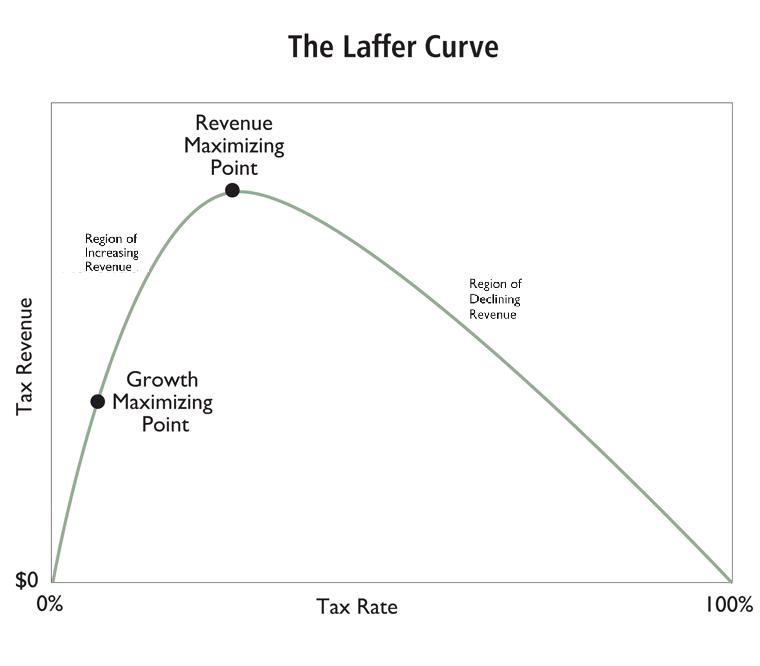
Simply stated, when the tax rate goes up, their taxable income goes down. And that means it’s not clear whether higher tax rates lead to more revenue or less revenue. This is the underlying principle of the Laffer Curve.For more information, here’s a video from Prager University, narrated by UCLA Professor of Economics Tim Groseclose:

Groseclose does an excellent job, and I particularly like the data showing that the rich paid more to the IRS following Reagan’s tax cuts.

But I do have one minor complaint: The video would have been even better if it emphasized that the tax rate shouldn’t be at the top of the “hump.” Why? Because as tax rates get closer and closer to the revenue-maximizing point, the economic damage becomes very significant. Here’s some of what I wrote about that topic back in 2012.

[L]abor taxes could be approximately doubled before getting to the downward-sloping portion of the curve. But notice that this means that tax revenues only increase by about 10 percent. …[T]his study implies that the government would reduce private-sector taxable income by about $20 for every $1 of new tax revenue. Does that seem like good public policy? Ask yourself what sort of politicians are willing to destroy so much private sector output to get their greedy paws on a bit more revenue.

The key point to remember is that we want to be at the growth-maximizing point of the Laffer Curve, not the revenue-maximizing point.

P.S.: Here’s my own video on the Laffer Curve:

Since it was basically a do-it-yourself production, the graphics aren’t as fancy as the ones you find in the Prager University video, but I’m pleased that I emphasized on more than one occasion that it’s bad to be at the revenue-maximizing point on the Laffer Curve.

Not as bad as raising rates even higher, as some envy-motivated leftists would prefer, but still an example of bad tax policy.

07 Feb 18:29

Future Deficits Now Projected to be Even Bigger

by Peter Suderman

America’s current budget deficits have shrunk dramatically over the past few years. But its future deficits are now projected to be bigger than previously expected. When the Congressional Budget Office (CBO) released its updated economic outlook earlier this week, it painted a gloomier picture than it did the previous year. The deficit is now projected to rise by $7.3 trillion over the next decade, a $1 trillion increase since the CBO’s last estimates were published. 

That’s not great news. But it’s actually worse than it sounds. As the budget analysts at the Committee for a Responsible Federal Budget explain, this actually understates the size of the increase.

That’s because last year’s deficit totals were artificially inflated because of a scoring convention that required the budget office to count $425 billion worth of one-time spending on Hurricane Sandy as a recurring annual expense. That assumption is gone this year, but it means that last year’s 10-year deficit total was actually more like $5.9 trillion.

The projections worsen further if you update the time frame. Last year’s projections looked at the 2014-2023 budget window. This week’s report stretches from 2015-2024. Since annual deficits are now expected to grow at a greater clip, that makes for a bigger change. Here’s the CRFB’s graph showing the actual size of the change:

The main reason for the update is that the CBO now foresees slower economic growth over the next decade than it used to. “By 2017,” the budget office report said, “CBO expects that economic growth will diminish to a pace that is well below the average seen over the past several decades.” And the accumulating debt won’t exactly help. The “large and growing federal debt” the CBO expects the nation to shoulder could have “serious negative consequences, including restraining economic growth in the long term.”

So because economic debt is expected to slow, we’ll take on more debt—which could slow growth even further. It’s potentially a rather ugly feedback loop of slow growth and higher debt. 

07 Feb 15:09

President Obama and the Case of the Missing Research

by Jason Bedrick

Jason Bedrick

One of President Obama’s favorite rhetorical tactics is to claim that there is no serious evidence pointing in any direction other than his preferred policy. The president had occasion to deploy this tactic in an interview earlier this week, when Bill O’Reilly asked him why he opposed school vouchers:

O’REILLY - The secret to getting a … good job is education. … Now, school vouchers is a way to level the playing field. Why do you oppose school vouchers when it would give poor people a chance to go to better schools?

PRESIDENT OBAMA - Actually — every study that’s been done on school vouchers, Bill, says that it has very limited impact if any —

O’REILLY - Try it.

PRESIDENT OBAMA - On — it has been tried, it’s been tried in Milwaukee, it’s been tried right here in DC —

O’REILLY [OVERLAP] - And it worked here.

PRESIDENT OBAMA - No, actually it didn’t. When you end up taking a look at it, it didn’t actually make that much of a difference. ... As a general proposition, vouchers has not significantly improved the performance of kids that are in these poorest communities —

The most charitable interpretation of the president’s blatantly false remarks is that he’s simply unaware that 11 of 12 gold-standard studies of school choice programs found a positive impact while only one found no statistically significant difference and none found a negative outcome. Jason Riley summarized the findings of a few recent studies:

A 2013 study by Matthew Chingos of the Brookings Institution and Paul E. Peterson of Harvard found that school vouchers boost college enrollment for blacks by 24%. A 2006 evaluation of a school choice program in Dayton, Ohio, found that “after two years, black voucher students had combined reading and math scores 6.5 percentile points higher than the control group.” A 2010 study in the Journal of Educational and Behavioral Statistics found that voucher recipients had math scores 5 points higher than the control group after just one year. A 2008 study of vouchers in Charlotte, N.C., found that “after one year, voucher students had reading scores 8 percentile points higher than the control group and math scores 7 points higher.”

What about the voucher programs in Milwaukee and Washington that Mr. Obama dismissed as ineffective? A 1998 Brookings Institution study found that “After four years, voucher students had reading scores 6 Normal Curve Equivalent (NCE) points higher than the control group, and math scores 11 points higher. NCE points are similar to percentile points.” And the Obama administration itself released a report on the D.C. voucher program in 2010. “The students offered vouchers graduated from high school at a rate 12 percentage points higher (82 percent) than students in the control group (70 percent), an impact that was statistically significant at the highest level,” according to a summary. “Students in three of six subgroups tested showed significant reading gains because of the voucher offer after four or more years.”

But even Obama’s own faulty reading of the evidence does not warrant opposing school choice. Putting aside the fact that voucher students are more likely to perform better academically and to graduate high school, even if their academic outcomes were roughly the same as government school students, as Obama claims, he should still support school choice because it expands freedom, parents are more satisfied, the schools are safer, and it costs so much less.

According to the U.S. Census Bureau, Washington D.C. spends nearly $30,000 per pupil annually at its government-run schools, more than double the national average. For this “investment” they get practically the worst schools in the nation. By contrast, the low-income D.C. voucher students receive up to $8,256 for K-8 students and $12,385 for students in grades 9-12. 

Perversely, whereas the Obama administration ignores mountains of evidence when opposing school choice programs, the president once again promised universal pre-school in his State of the Union address despite the overwhelming evidence that federal preschool programs do not work. And that’s according to the federal government’s own research!  

It takes a special kind of chutzpah for the Obama administration to repeatedly tout their “evidence-based approach” to policy when they so consistently adopt policies that run counter to the evidence. 

06 Feb 20:47

Edwards’ Law of Government Cost Overruns

by Chris Edwards

Chris Edwards

Here is a rule of thumb to remember when you hear about a proposed government project: If a politician says that it will cost $1, it will end up costing $2 or more. Call it Edwards’ Law.

A never-ending stream of articles reveals the chronic cost overrun problems of government weapon systems, computer upgrades, highway projects, and many other things. The government said that a ship would cost $220 million, and it ended costing $440 million. The government said that a bridge would cost $1.4 billion, and it ended up costing $6.4 billion. The government said that an office consolidation would cost $1.1 billion, and it ended up costing $2.6 billion.

What is the hidden force behind Edwards’ Law? Are governments simply inept, or do they deliberately low-ball initial cost estimates in order to get projects approved? After reading about dozens—probably hundreds—of such incidents over the years, I think the answer is both.

Regarding low-balling, David Boaz pointed out to me this admission from former San Francisco Mayor Willie Brown:

“News that the Transbay Terminal is something like $300 million over budget should not come as a shock to anyone.”

We always knew the initial estimate was way under the real cost. Just like we never had a real cost for the Central Subway or the Bay Bridge or any other massive construction project. So get off it.

In the world of civic projects, the first budget is really just a down payment. If people knew the real cost from the start, nothing would ever be approved.

The idea is to get going. Start digging a hole and make it so big, there’s no alternative to coming up with the money to fill it in.”

Based on Brown’s insight, Edwards’ Law can be reformulated: If a politician says that a project will cost $1, that’s just the down payment. The balance due will be at least another $1.

See here for more on cost overruns.


06 Feb 14:40

Quotation of the Day…

by Don Boudreaux
(Don Boudreaux)

… is from pages 622 of H.L. Mencken’s indispensable A Mencken Chrestomathy –

The kind of man who demands that government enforce his ideas is always the kind whose ideas are idiotic.

05 Feb 19:45

How much would it have cost to duplicate an iPhone in 1991? Amazingly, more than $3,500,000

by Mark J. Perry

radioshackadCD post a few weeks ago featured a comparison of the cost of 13 products advertised by Radio Shack in 1991 ($3,055 in 1991, $5,255 in 2013 dollars) to today’s iPhone (see photo above).

Earlier this week, Bret Swanson expanded the analysis and crunched some numbers to answer the question: “How Much Would an iPhone Have Cost in 1991?” Here’s what he found:

Considering only memory, processing, and broadband communications power, duplicating the iPhone back in 1991 would have (very roughly) cost: $1.44 million + $620,000 + $1.5 million = $3.56 million.

This doesn’t even account for the MEMS motion detectors, the camera, the iOS operating system, the brilliant display, or the endless worlds of the Internet and apps to which the iPhone connects us.

This account also ignores the crucial fact that no matter how much money one spent, it would have been impossible in 1991 to pack that much technological power into a form factor the size of the iPhone, or even a refrigerator.

But the fact that so many were so impressed by an assertion that an iPhone possesses the capabilities of $3,000 worth of 1991 electronics products – when the actual figure exceeds $3 million – reveals how fundamentally difficult it is to think in exponential terms.

HT: Colin Grabow

05 Feb 19:29

Argentine Banking System Archives Destroyed By Deadly Fire

by Tyler Durden

While we are sure it is a very sad coincidence, on the day when Argentina decrees limits on the FX positions banks can hold and the Argentine Central Bank's reserves accounting is questioned publically, a massive fire - killing 9 people - has destroyed a warehouse archiving banking system documents. As The Washington Post reports, the fire at the Iron Mountain warehouse (which purportedly had multiple protections against fire, including advanced systems that can detect and quench flames without damaging important documents) took hours to control and the sprawling building appeared to be ruined. The cause of the fire wasn’t immediately clear - though we suggest smelling Fernandez' hands...


We noted yesterday that there are major questions over Argentina's reserve honesty...

While first print is preliminary and subject to revision, the size of recent discrepancies have no precedent. This suggest that the government may be attempting to manage expectations by temporarily fudging the "estimate " of reserve numbers (first print) while not compromising "actual" final reported numbers. If this is so, it is a dangerous game to play and one likely to back-fire.


During a balance of payments crisis - as Argentina is undergoing - such manipulation of official statistics (and one so critical for market sentiment) is detrimental to the needed confidence building around the transition in the FX regime.

And today the government decrees limits on FX holdings for the banks...

Argentina’s central bank published resolution late yday on website limiting fx position for banks to 30% of assets.


Banks will have to limit fx futures contracts to 10% of assets: resolution


Banks must comply with resolution by April 30

And then this happens...

Via WaPo,

Nine first-responders were killed, seven others injured and two were missing as they battled a fire of unknown origin that destroyed an archive of bank documents in Argentina’s capital on Wednesday.


The fire at the Iron Mountain warehouse took hours to control...


The destroyed archives included documents stored for Argentina’s banking industry, said Buenos Aires security minister Guillermo Montenegro.


The cause of the fire wasn’t immediately clear.


Boston-based Iron Mountain manages, stores and protects information for more than 156,000 companies and organizations in 36 countries. Its Argentina subsidiary advertises that its facilities have multiple protections against fire, including advanced systems that can detect and quench flames without damaging important documents.


...


“There are cameras in the area, and these videos will be added to the judicial investigation, to clear up the motive of the fire and collapse,” Montenegro told the Diarios y Noticias agency.

04 Feb 16:52

Edward Snowden Interview At LiveLeak: On Clapper Lying to Congress and the Possibility of Clemency

by Ronald Bailey

Snowden ObamaGerman TV interviewed NSA whistleblower Edward Snowden and the video of the 30 minute interview is now available at LiveLeak. Not surprisingly, a good bit of the interview focused on NSA spying alliances, activities and capabilities in Europe.

The German reporter did, however, ask if Snowden was worried about threats to his life. Given the BuzzFeed report in which anonymous government functionaries asserted that they would be happy to kill him, Snowden sensibly replied yes, but that he still slept well at night.

Below are some selected quotations from the interview. For example, the interviewer asked Snowden if there was a specific "breaking point" at which he decided to go public with his revelations?

Snowden: The breaking point is seeing the Director of National Intelligence, James Clapper, directly lie under oath to Congress – there is no saving an intelligence community that believes that it can lie to the public and to legislators who need to be able to trust it and regulate its actions. Seeing that really meant for me there was no going back. Beyond that, it was the creeping realization that no one else was going to do this. The public had a right to know about these programs. The public had a right to know that which the government is doing in its name.

The interviewer mentioned that the New York Times had urged clemency for Snowden and that President Obama had ruled that out. The interviewer then cited the president as noting that Snowden had been charged with three felonies and then declared: "If you, Edward Snowden, believe in what you did, you should come back to America and appear before the court with your lawyer and make your case."

In the interview, Snowden replied:

It’s interesting because he mentions three felonies. What he doesn’t say is that the crimes that he’s charged me with are crimes that don’t allow me to make my case; they don’t allow me to defend myself in an open court to the public and convince a jury that what I did was to their benefit. The Espionage Act … was never intended to prosecute journalistic sources, people who are informing the newspapers about information that is in the public interest. It was intended for people who are selling documents in secret to foreign governments, who are bombing bridges, who are sabotaging communications, not for people who are serving the public good. So it’s, I would say illustrative, that the president would choose to say that someone should face the music when he knows that the music is a show trial.

For more background, see my blogpost, "Should Snowden Have Run Away?" and my articles, "Thank You Edward Snowden," and "President Obama: Pardon Edward Snowden."

H/T David Ford.

03 Feb 21:18

Kindly Inquisitors

by Jason Kuznicki

Jason Kuznicki

This week Jonathan Rauch celebrates the new, expanded edition of his book Kindly Inquisitors: The New Attacks on Free ThoughtHe’s also guest-blogging at the Volokh Conspiracy, itself newly hosted at the Washington Post. In his first post, Rauch sums up a key point of his book and also why its reissue is so timely:

Over the past 20 years, the idea that minorities need protection from hateful or discriminatory speech has gained ground, both in American universities’ speech codes and in national laws abroad. In fact, I argue, minorities are much better off in a system that protects hateful or discriminatory speech than in a system that protects them from it.

Kindly Inquistors offers a moral defense of free inquiry, with a focus on how minorities fare under different approaches to controversial speech. Rauch concludes that when individuals disagree, the only proper approach is the “checking of each by each through public criticism.” 

He terms this approach liberal science, and he recommends it not just in science, but in public policy. One of the most interesting facets of Kindly Inquisitors is the way that Rauch links the free inquiry of science to the free inquiry found in liberal democratic societies; both, he argues, are also akin to the free inquiry found in capitalism.

In all these areas, free inquiry can nevertheless cause genuine harm. Why not restrict, just a bit, if it will prevent some suffering? In the book, Rauch answers:

The truth is that liberal science demands discipline as well as license… It does not give a damn about your feelings and happily tramples them in the name of finding truth. It allows and – here we should be honest – sometimes encourages offense. Self-esteem, sensitivity, respect for others’ beliefs, renunciation of prejudice are all good as far as they go. But as primary social goals they are incompatible with the peaceful and productive advancement of human knowledge. To advance knowledge, we must all sometimes suffer. Worse than that, we must inflict suffering on others.

For many, these words will not be welcome. And for a few truly loathsome people, they will be all too welcome. Undeniably, words a lot like these have been used as a pretext to hurt, which they should not be.

Yet we classical liberals have always welcomed the progress that comes from free minds, from the free exchange of ideas, and from the freedoms of travel and commerce, even if at times they bring disruption, embarrassment, or loss. In science, in public opinion, and in the marketplace, there will always be failures. And yet for a society to succeed, such failures cannot be avoided.

Our faith in mankind’s ability to find and act upon the truth is key: We trust that the process of inquiry, with its defeats as well as its victories, will bring a better and better life for us all. 

03 Feb 19:23

‘Carpe century’: 50 reasons we’re living through the greatest period in world history

by Mark J. Perry

Morgan Housel at The Motley Fool lists the 50 reasons we’re living through the greatest period in world history (free registration may be required), and here are 25 of my favorites:

1. U.S. life expectancy at birth was 39 years in 1800, 49 years in 1900, 68 years in 1950, and 79 years today. The average newborn today can expect to live an entire generation longer than his great-grandparents could.

2. In 1949, Popular Mechanics magazine made the bold prediction that someday a computer could weigh less than 1 ton. I wrote this sentence on an iPad that weighs 0.73 pounds.

3. The average American now retires at age 62. One hundred years ago, the average American died at age 51. Enjoy your golden years — your ancestors didn’t get any of them.

4. Despite a surge in airline travel, there were half as many fatal plane accidents in 2012 than there were in 1960, according to the Aviation Safety Network.

5. People worry that the U.S. economy will end up stagnant like Japan’s. Next time you hear that, remember that unemployment in Japan hasn’t been above 5.6% in the past 25 years, its government corruption ranking has consistently improved, incomes per capita adjusted for purchasing power have grown at a decent rate, and life expectancy has risen by nearly five years. I can think of worse scenarios.

6. Two percent of American homes had electricity in 1900. J.P Morgan (the man) was one of the first to install electricity in his home, and it required a private power plant on his property. Even by 1950, close to 30% of American homes didn’t have electricity. It wasn’t until the 1970s that virtually all homes were powered. Adjusted for wage growth, electricity cost more than 10 times as much in 1900 as it does today, according to professor Julian Simon.

7. According to the Federal Reserve, the number of lifetime years spent in leisure — retirement plus time off during your working years — rose from 11 years in 1870 to 35 years by 1990. Given the rise in life expectancy, it’s probably close to 40 years today. Which is amazing: The average American spends nearly half his life in leisure. If you had told this to the average American 100 years ago, that person would have considered you wealthy beyond imagination.

8. Median household income adjusted for inflation was around $25,000 per year during the 1950s. It’s nearly double that amount today. We have false nostalgia about the prosperity of the 1950s because our definition of what counts as “middle class” has been inflated — see the 34% rise in the size of the median American home in just the past 25 years. If you dig into how the average “prosperous” American family lived in the 1950s, I think you’ll find a standard of living we’d call “poverty” today.

9. According to the Census Bureau, only one in 10 American homes had air conditioning in 1960. That rose to 49% in 1973, and 89% today — the 11% that don’t are mostly in cold climates. Simple improvements like this have changed our lives in immeasurable ways.

10. Almost no homes had a refrigerator in 1900, according to Frederick Lewis Allan’s The Big Change, let alone a car. Today they sell cars with refrigerators in them.

11. Adjusted for overall inflation, the cost of an average round-trip airline ticket fell 50% from 1978 to 2011, according to Airlines for America.

12. According to the Census Bureau, the average new home now has more bathrooms than occupants.

13. According to the Census Bureau, in 1900 there was one housing unit for every five Americans. Today, there’s one for every three. In 1910 the average home had 1.13 occupants per room. By 1997 it was down to 0.42 occupants per room.

14. Relative to hourly wages, the cost of an average new car has fallen fourfold since 1915, according to professor Julian Simon.

15. Google Maps is free. If you think about this for a few moments, it’s really astounding. It’s probably the single most useful piece of software ever invented, and it’s free for anyone to use.

16. The average American work week has declined from 66 hours in 1850, to 51 hours in 1909, to 34.8 today, according to the Federal Reserve. Enjoy your weekend.

17. Incomes have grown so much faster than food prices that the average American household now spends less than half as much of its income on food as it did in the 1950s. Relative to wages, the price of food has declined more than 90% since the 19th century, according to the Bureau of Labor Statistics.

18. As of March 2013, there were 8.99 million millionaire households in the U.S., according to the Spectrum Group. Put them together and they would make the largest city in the country, and the 18th largest city in the world, just behind Tokyo. We talk a lot about wealth concentration in the United States, but it’s not just the very top that has done well.

19. In 1900, 44% of all American jobs were in farming. Today, around 2% are. We’ve become so efficient at the basic need of feeding ourselves that nearly half the population can now work on other stuff.

20. U.S. oil production in September was the highest it’s been since 1989, and growth shows no sign of slowing. We produced 57% more oil in America in September 2013 than we did in September 2007. The International Energy Agency projects that America will be the world’s largest oil producer as soon as 2015.

21. The average American car got 13 miles per gallon in 1975, and more than 26 miles per gallon in 2013, according to the Energy Protection Agency. This has an effect identical to cutting the cost of gasoline in half.

22. Annual inflation in the United States hasn’t been above 10% since 1981 and has been below 5% in 77% of years over the past seven decades. When you consider all the hatred directed toward the Federal Reserve, this is astounding.

23. According to AT&T archives and the Dallas Fed, a three-minute phone call from New York to San Francisco cost $341 in 1915, and $12.66 in 1960, adjusted for inflation. Today, Republic Wireless offers unlimited talk, text, and data for $5 a month.

24. You need an annual income of $34,000 a year to be in the richest 1% of the world, according to World Bank economist Branko Milanovic’s 2010 book The Haves and the Have-Nots. To be in the top half of the globe you need to earn just $1,225 a year. For the top 20%, it’s $5,000 per year. Enter the top 10% with $12,000 a year. To be included in the top 0.1% requires an annual income of $70,000. America’s poorest are some of the world’s richest.

25. Only 4% of humans get to live in America. Odds are you’re one of them. We’ve got it made. Be thankful.

Bonus: Louis CK explains to Conan O’brien why “everything’s amazing but nobody’s happy”:

03 Feb 14:33

Socialism in Venezuela, like Socialism Everywhere, Means Shortages

by David Boaz

David Boaz

After 15 years, Hugo Chavez’s socialist revolution is finally reaching socialism’s signature achievement: shortages of toilet paper. The Washington Post reports:

CARACAS, Venezuela — On aisle seven, among the diapers and fabric softener, the socialist dreams of the late Venezuelan president Hugo Chávez looked as ragged as the toilet paper display.

Employees at the Excelsior Gama supermarket had set out a load of extra-soft six-roll packs so large that it nearly blocked the aisle. To stock the shelves with it would have been pointless. Soon word spread that the long-awaited rolls had arrived, and despite a government-imposed limit of one package per person, the checkout lines stretched all the way to the decimated dairy case in the back of the store.

“This is so depressing,” said Maria Plaza, 30, a lawyer, an hour and a half into her wait….

Why is it always toilet paper? I understand why a poorly coordinated economy isn’t likely to produce complicated goods like cars (see the Soviet Lada, the East German Trabant, or the gleaming 1950s American cars still in use on the streets of Havana) or computers. But how hard is it to produce toilet paper? Not that toilet paper is the only thing in short supply:

Each day the arrival of a new item at Excelsior Gama brought Venezuelans flooding into the store: for flour, beef, sugar. Store employees and security guards helped themselves to the goods first, clogging the checkout lines, and then had to barricade the doors to hold back the surge at the entrance.

Meanwhile, as long as you can blame the Americans, the capitalists, Snowball, or Emmanuel Goldstein, you can retain the support of at least some of the people:

“The store owners are doing this on purpose, to increase sales,” said Marjorie Urdaneta, a government supporter who said she believes Maduro when he accuses businesses of colluding with foreign powers to wage “economic war” against him.

“He should tell the stores: Make these items available — or else,” she said.

The regime takes credit for what it can, making sure that

products sold by recently nationalized companies carried little heart symbols and the phrase “Made in Socialism.”

The queues in front of the stores should carry the same symbol.

31 Jan 19:55

David Cameron Says Snooper's Charter Is Necessary Because Fictional Crime Dramas He Watches Prove It

by Mike Masnick
You may recall the stories from the past couple years about the so-called "snooper's charter" in the UK -- a system to further legalize the government's ability to spy on pretty much all communications. It was setting up basically a total surveillance system, even beyond what we've since learned is already being done today. Thankfully, that plan was killed off by Deputy Prime Minister Nick Clegg.

However, Prime Minister David Cameron is back to pushing for the snooper's charter -- and his reasoning is as stupid as it is unbelievable. Apparently, he thinks it's necessary because the fictional crime dramas he watches on TV show why it's necessary. I am not joking, even though I wish I was:
In the most serious crimes [such as] child abduction communications data... is absolutely vital. I love watching, as I probably should stop telling people, crime dramas on the television. There's hardly a crime drama where a crime is solved without using the data of a mobile communications device.

What we have to explain to people is that... if we don't modernise the practice and the law, over time we will have the communications data to solve these horrible crimes on a shrinking proportion of the total use of devices and that is a real problem for keeping people safe.
Yes, he just said that. Because fictional characters on crime drama TV shows make use of data, that's somehow proof that it's necessary. Perhaps someone can send Cameron a copy of Enemy of the State or any other fictional work showing how the government can abuse such information. Or, better yet, let's have our side stick with reality, and we can just point to real historical events of governments abusing such information.

Permalink | Comments | Email This Story


31 Jan 19:09

Obama's Trade Deal Is Massive Crony Giveaway

In the Netflix show “House of Cards,” Kevin Spacey plays a powerful member of Congress who stacks the deck in order dispense favors and to help those who help him. The show may be fiction, but a real life, bigger version of the power play is happening out right before our eyes--The Trans Pacific Partnership (TPP).

The TPP is supposed to be a free trade deal that stimulates economically beneficial trade with the Asia-Pacific region. Few can exceed me in support of free trade. However, in reality, the TPP is not shaping up to be a free trade deal. Rather, it is a regulatory wish list for various special interests from food safety regulations and financial services regulations to internet freedom and medicine costs to skirt the legislative process.  

The agreement is being negotiated in secret. Members of Congress don’t even know the precise details of this deal. Thanks to recent WikiLeaks disclosure of a partial draft of the deal, however, Congress and the rest of America are discovering the devilish details of this so called trade deal.

The deal could even resurrect SOPA, the Stop Online Privacy Act that Congress rejected after massive grass roots and online protest. This isn't surprising because Hollywood and the recording industry appear to be  particularly large beneficiaries of this deal. This isn't surprising. 

While Congress may not be privy to the details but some lobbyists are and are allowed to offer input.  One of the lobbyists serving as an “advisor” to USTR with access to both view the details of the trade deal and shape its contents is Neil Turkewitz--Executive Vice President for the Recording Industry Artists of America (RIAA).

An outright goal of the content industry is to, as described by the movie industry’s former chief lobbyist, extend the terms of copyright to “forever minus one day.” The TPP takes that another step closer with an extension of copyright terms that would be binding on all countries that sign the treaty. The industry’s goal of censoring the internet is also apparently included with provisions that authorize the government to shut down websites alleged to have infringed a copyright without due process and apply criminal penalties.

While the industry’s power grab is egregious, there is no mystery as to how it happened. 

Hollywood is one of President Obama's biggest supporters. Celebrities and stars played a significant role in assisting his re-election effort.  Some raised big bucks for the president. Others, like Katy Perry held concerts to promote the president.  Others yet gave money and lent their names to ads designed to target certain swing voters who were undecided. 

The USTR negotiating the treaty is an executive branch agency, answerable to the president. Inclusion of Hollywood’s wish list on such a grand scale is no accident that has simply escaped the president’s notice. In a perfect House of Cards plot line, the president is returning the favor with the TPP and stacking the deck for those who helped him.  His call for Congress to confer fast track status on TPP would lock in the stacked deck by blocking any amendments when the agreement comes before Congress for final approval.

But this is not the first such payback to Hollywood. On numerous occasions the White House has endorsed a key RIAA priority, mandating radio stations pay artists performance royalties for songs played on the air. In August of 2013, the Department of Commerce released a green paper that reiterates the administration’s support for legislation “creating a public performance right for the broadcasting of sound recordings.”

The legislation to do just that was introduced by Rep. Mel Watt (D-NC) around the same time the green paper was released. The bill , now championed by Rep. Judy Chu (D-CA), known as the Free Market Royalty Act, is another grand give away to the recording industry. In addition to requiring radio stations to pay royalties, the bill also grants monopoly power to the industry to collude to set prices and functionally outlaws independent negotiations between individual labels or artists and broadcasters. The FMRA is as much free market as the TPP is free trade.

Wrapping these bills in the rhetoric of “free trade” and “free market” do little to obscure the reality that it is political payback and are little salve for the damage they ultimately inflict. There is a reason why America is changing from one where people can invent the next great thing in their parents’ garage to one where one ends up living in their parents’ garage. As my Breitbart colleague Peter Schweizer has documented in two recent books, the type of cronyism and patronage being displayed in TPP and FMRA is destroying America from within and must be rejected by Congress.


31 Jan 17:29

Why No Smart City Would Want the NFL

by Alexis Garcia

“The NFL is good at fleecing taxpayers,” says ESPN columnist Gregg Easterbrook, author of The King of Sports: Football’s Impact on America. “It’s about a billion dollars a year I’ve calculated in public subsidies to NFL owners and this is a group that consists almost entirely of billionaires and yet receiving significant public subsidies every year.”

The NFL raked in over $9 billion in revenues last season and the league is pushing team owners to triple that mark over the next decade. 

With the league’s overwhelming success, many cities are eager to get a piece of the action, often offering billions in public subsidies to attract (or keep) football in their localities. 

But with the NFL making record profits, is it right for cities to spend public money on these type of projects? Especially when over half of NFL team owners are ranked on the Forbes billionaire list?

No where is this illustrated more than in Los Angeles, which has been trying to lure the league back to the area ever since the Raiders and Rams left town 20 years ago. And though numerous economists have demonstrated that sports stadia don’t increase local economic activity, it hasn’t stopped debt-ridden cities like L.A. from approving a $1.2 billion dollar stadium deal that would be financed with nearly $350 million in taxpayer-backed bonds. 

Los Angeles City Councilman Tom LaBonge has been an advocate of bringing the NFL back to Los Angeles and voted along with the rest of his colleagues to approve the stadium deal (whether it ever gets built is remained to be seen). “There’s a beauty to the game and I’d like to see the beauty in Los Angeles. I like what it does for a city when their team wins,” says LaBonge. 

The irony is that even if Los Angeles did manage to build a stadium, there’s no reason to think the NFL may bite. The league has remained notoriously vague on the subject, with NFL spokesman Brian McCarthy telling Reason: “We would like to return to the Los Angeles area, but only if it works for the community and the NFL. There is no timeline but we continue to monitor all stadium-related developments in the area.”

Sports stadiums not only appear to be a bad deal for tax payers, but having a franchise could also hurt loyal fans by making it difficult to watch their hometown team play thanks to the expansion of sports broadcasts and the complexities of NFL blackout rules. 

“If you have a team in Los Angeles and it doesn’t sell out, they can blackout the game in Los Angeles which means you often lose games…and as a fan there’s no payback in that,” says Daniel Durbin, Director of the University of Southern California’s Institute of Sports Media and Society. 

Though local boosters like LaBonge may continue to dream of having the NFL in the city, it’s becoming increasingly clear that not having a team may be the best deal for tax payers and fans alike. 

About 7 minutes.

Produced by Alexis Garcia.

Camera by Tracy Oppenheimer, Zach Weissmueller, Paul Detrick, William Neff, Sharif Matar and Todd Krainin.

“Scroll down for downloadable versions and subscribe to ReasonTV's YouTube Channel to receive notification when new material goes live.”

30 Jan 21:46

Rebuttal of Senator Sessions’ Anti-Immigration Talking Points

by Alex Nowrasteh

Alex Nowrasteh

On Tuesday, Senator Jeff Sessions (R-AL) sent out an email memo with talking points for opponents of immigration reform.  Most of the points are based on misinterpretations of government reports, cherry-picked findings by organizations that engage in statistical chicanery, or just flat-out incorrect.  These anti-immigration arguments do not advance a logical argument against immigration.  Here is a point by point rebuttal of the major claims of this memo:

Claim:  No immigration reform proposals will halt unauthorized immigration.

Fact:  Guest worker visas are the most effective way of halting unauthorized immigration because it provides a lawful pathway for low-skilled immigrants to enter instead of overstaying a visa, running across a desert, or being smuggled in.  Providing a lawful immigration pathway will funnel peaceful migrant workers into the legal system leaving immigration enforcement to deal with a much smaller pool of unlawful immigrants.  Italian immigrants in 1910 did not crash boats in to the Jersey Shore to avoid Border Patrol.  They entered legally through Ellis Island because there was a legal way to enter.  Let’s reopen that pathway – at least partly.      

Congress did open it a little bit in the 1950s which ended up cutting unauthorized immigration by over 90 percent by creating a low-skilled guest worker visa called the Bracero Program.  That program later ended due to union pressure, causing unauthorized immigration to immediately skyrocket. The program was shut down after domestic unions, especially Cesar Chavez’s United Farm Workers, mounted a national campaign against it.

According to Stuart Anderson of the National Foundation for American Policy, a February 1958 Border Patrol document from the El Centro, California district states, “Should Public Law 78 [Bracero Program) be repealed or a restriction placed on the number of braceros allowed to enter the United States, we can look forward to a large increase in the number of illegal alien entrants into the United States.”  That is exactly what happened.

The government cannot regulate immigration if much of it is illegal.  Legalizing the flow of workers into the United States is a simple and cost-effective way to control the border.


Sources: United States Citizenship and Immigration Services

Further reading:

How to Make a Guest Worker Visa Work

Immigration Reform Should Boost All Skill Levels

Claim:  Immigration reform will increase the budget deficit.

Fact:  Immigration has a very small impact on the size of budget deficits. For what it’s worth, a Congressional Budget Office’s dynamic score of the Senate immigration reform plan found that it would reduce federal government budget deficits by about $1.2 trillion over the next 20 years. Extra growth to the economy and tax revenue from more legal immigrants more than offsets the additional cost of government benefits.  Poor immigrants consume government benefits at a lower rate than poor natives and they also pay taxes.  Highly skilled immigrants make a more positive contribution to government budgets.  According to a survey of countries, the impact is rarely more than plus or minus 1 percent of GDP.  In the U.S. case it is generally positive over the long run but the numbers are very small.  In short, according to economist Robert Rowthorn, “[t]he desirability of large-scale immigration should be decided on other grounds.”

Further readings:

Poor Immigrants Use Public Benefits at a Lower Rate than Poor Native-Born Citizens

CBO Dynamically Scores Immigration Bill

The Fiscal Impact of Immigration on the Advanced Economies 

Claim: New immigrant workers are mostly lesser-skilled and will compete in every sector, industry, and occupation in the U.S. economy.

Fact:  Few immigrants compete with U.S.-born workers. To compete, immigrant workers need to have similar characteristics to U.S.-born workers. But as the anti-immigration talking points admit, immigrants are more likely to be lesser-skilled than Americans. Immigrants with lesser-skills do not compete against Americans with higher skills. For instance, an immigrant worker in a meat-packing plant does not compete with an American accountant anymore than Senator Sessions does. 

Immigrants are much more likely to be lower skilled and higher skilled than Americans so there isn’t much competition. Because immigrants and the U.S.-born mostly have different skills, they are more likely to be complementary – meaning that they work with Americans rather than compete against Americans. 

It takes years for many immigrants to learn English to the point where they could potentially compete with English speaking U.S.-born workers. As a result, the labor market splits in two: One where English is spoken and the second where other languages are spoken. Jobs where English is required are higher paid professions while jobs that don’t require English language skills are typically lower paid. A restaurant offers a perfect example. Low-skilled immigrant workers are primarily the dishwashers, busboys, and cooks – jobs that don’t require much English language ability and are lower paid. The low-skilled Americans who used to do those jobs instead specialized in restaurant jobs that require English. Lower-skilled Americans became the waiters, hosts, and managers – all jobs that require English and are higher paying. Lower-skilled immigrants helps push up those lower-skilled Americans through the economic process described above, also known as complementary task specialization. 

Immigrants are not just workers though, they are also consumers and entrepreneurs. Hispanic and Asian Americans, the two most recent ethnic and racial immigrant groups, spend about $2 trillion dollars a year. That spending, made possible by immigrant work and entrepreneurship, creates job opportunities for Americans elsewhere in the economy. Immigrants are also about twice as likely as their U.S.-born counterparts to start a business – a remarkable achievement in a country as entrepreneurial as the United States.     

Further readings:

How Does Immigration Impact Wages?

Kauffman Index of Entrepreneurial Activity

Claim:  Immigrants take American jobs.

Fact:  Immigrants come when there are jobs available and leave when there aren’t many. There has been a slow-down in unauthorized immigration since the beginning of the Great Recession because many of the jobs immigrants used to work evaporated during the housing collapse. The collapse in new housing construction tracks very closely with the decrease in unauthorized immigrant crossings. Throughout American history, immigration increases during times of economic prosperity or decreases and sometimes reverses during bad times. More guest workers and lawful immigrants will ensure that when the economy recovers, Americans will be able to find enough workers to fill positions and enough customers for new goods and services.  But due to the economics of immigration, we will not be overwhelmed by immigrants when there are no jobs for them.   

Further readings:

Immigrants Are Attracted to Jobs, Not Welfare    

Immigrants Did Not Take Your Job

Invisible Hands: Immigration and American Economic Growth

Claim:  The last 40 years has been a period of record immigration to the United States.

Fact:  About 13 percent of America’s population is foreign born, below the all time peak of 14.7 percent in 1910. The average percent of the population that was foreign born between 1860 and 1920 was about 14 percent – higher than it is today. As a percentage of the U.S.-born population, yearly immigrant flows to the U.S. are half of what they were during the 19th century and early 20th centuries.  Rich countries like Canada, Australia, and Switzerland all let in far more immigrants as a percentage of their population every year and have far larger immigrant populations. Switzerland, for instance, lets in about five times as many immigrants as the U.S. does every year as a percentage of their population. The percent of the U.S. population that is foreign born is also below the OECD average. In and of itself, that is not an argument for opening lawful immigration but it should damper the notion that the U.S. has the most immigrant friendly policies in the world. The numerical numbers of immigrants who come here yearly is large, about the same annual number as a hundred years ago, the U.S. has the third largest population in the world to absorb them.     

Further readings:

Frequently Requested Statistics on Immigrants and Immigration in the United States

Where Does the U.S. Rank in Welcoming Immigrants?

Immigrant Inflows Among OECD Nations

Claim:  A sensible immigration policy would also listen to the opinions of the American people and not paid lobbyists.

Fact:  A sensible immigration policy should absolutely be based on the opinions of the American people. Every day tens of millions of Americans willingly live near immigrants, employ them, sell them goods and services, and deal with them peacefully and voluntarily. The daily actions of the U.S.-born show how comfortable they are living with New Americans, in direct contrast to the few very loud opponents of immigration. Let the economic demands of Americans set immigration policy, not bureaucrats in Washington.

Claim:  We must enforce every immigration law before reforming them, otherwise we destroy the rule of law. 

Fact:  Bad laws should be reformed, not enforced at all costs. Congress didn’t wait until it caught every bootlegger before ending Prohibition or prosecuted every tax cheat before it instituted the Reagan tax cuts. Congress doesn’t have to keep trying to enforce immigration laws that are fundamentally at odds with our pro-immigration traditions, counter economic growth, and increase unauthorized immigration. 

Immigration laws themselves undermine the rule of law. The rule of law means that lawmakers, judges, and individuals are all subject to the same laws and that the laws must be nonarbitrary, consistent with our traditions as a free society, and as free as possible from government ad hoc actions.

Current immigration laws abjectly fall far short of these standards. Our immigration laws are complex and give the government bureaucrats administering them arbitrary power. Most businesses applying for a worker visa have to deal with arbitrary and changing application standards. For instance, government regulatory changes to streamline work visas were adopted in the closing days of the Bush administration. The Obama administration, after taking office, changed portions of those regulations to satisfy union demands. Who knows what regulations will change next year or the year after? Current immigration laws are much more restrictive than the open immigration system our country had from the founding until the early 20th century (with some exceptions), so they aren’t consistent with our traditions.  If the rule of law requires predictability as well as respect for America’s traditions, the immigration system fails. 

U.S. states are finally relenting, slightly, in the War on Drugs. Let’s not start a new War on Immigrants just as the previous fiasco is starting to wind down. 

Further reading:

Saying the Law is the Law Isn’t Enough

Claim:  The House plan provides legal status and work authorization first – the fundamental grant of amnesty.

Fact:  The legal definition of amnesty is an act of forgiveness for past offenses, especially to a class of persons as a whole. The 1986 Reagan amnesty can be accurately described as an amnesty but no proposal in 2013 is because the regulatory hoops, fees, and fines serve as a punishment and not a forgiveness for past offenses.  As Mark Krikorian, head of the anti-immigration Center for Immigration Studies, wrote in 2001 in National Review, “Both the retrospective and prospective approaches [of amnesty] grant legal residence, and eventually citizenship, to illegal aliens — the defining characteristics [emphasis added] of an amnesty.”  A House version of legalization would likely not include a path to citizenship for most legalized unauthorized immigrants meaning that for them, according to Mark Krikorian’s definition, they would not be amnestied

Further reading:

Immigration Reform is Not Amnesty    

Claim:  Most immigrants who are legalized will get access to welfare immediately.

Fact:  Under the proposed Senate version of reform, the legalized immigrants wouldn’t have access to means-tested welfare for 13 years – at a minimum. But if welfare is a genuine concern, it is far easier to deny non-citizens access to welfare than it is to stop all immigration.  I co-authored a Cato policy analysis on this very topic that is simple to implement and Constitutional. 

Furthermore, there is no evidence that immigrants and their descendants drive increases in the benefit levels and total size of welfare programs regulated on the state level.  For every state like California and New York that has many immigrants and a large welfare state, there is a state like Texas or Florida with many immigrants and a shrinking (individual benefit levels in real terms) or smaller welfare state.  There is no relationship between immigration and growth of welfare spending in the U.S. over time.

Further reading:

Building a Wall around the Welfare State, Instead of around the Country

The Political Externalities of Immigration: Evidence from the United States

Claim:  President Obama has been openly and aggressively defying immigration law.

Fact:  President Obama has presided over a large immigration enforcement apparatus that is on track to deport its 2 millionth person in the next few months – something that took President George W. Bush a full 8 years to accomplish.  With the notable exception of deferring deportation for some childhood arrivals and some recent reorganization of enforcement priorities, President Obama has been a noted enforcer of immigration laws.

Further readings:

President Obama: Deporter-In-Chief

President Obama Is Still the Deporter-In-Chief

In conclusion, the memo that Senator Sessions’ staff emailed around had many charts showing how the Great Recession affected Americans.  Those charts are as accurate as they are scary but there is no connection between them and immigration, nor is there any indication that immigrants are the cause of our economic problems. 

30 Jan 16:09

Quotation of the Day…

by Don Boudreaux
Jts5665

Statists: more civilized than the pillaging hordes of old, yet no less determined to take all you own...

(Don Boudreaux)

… is from Book II, Chapter 1 – on pages 284-285, Vol. 1, of the 1981 Liberty Fund edition – of Adam Smith’s 1776 An Inquiry Into the Nature and Causes of the Wealth of Nations:

In all countries where there is tolerable security, every man of common understanding will endeavour to employ whatever stock he can command in procuring either present enjoyment or future profit….

In those unfortunate countries, indeed, where men are continually afraid of the violence of their superiors, they frequently bury and conceal a great part of their stock, in order to have it always at hand to carry with them to some place of safety, in case of their being threatened with any of those disasters to which they consider themselves as at all times exposed.

In modern commercial economies, enterprising people who are “continually afraid of the violence of their superiors” are victims of what Bob Higgs calls “regime uncertainty.”  In response, of course, these people don’t literally bury their wealth as they would have done in more primitive times and as they likely do still in more primitive societies.  Instead, they refuse to invest (or they invest much less than they would were their property, and their claims to the fruits of the productive uses of their property, more secure).  Enterprise shrinks.  Economies stagnate.  And the consequent reduction in spending is mistakenly accused of being the cause of these economic woes rather than recognized for what it is: a symptom of a deeper, more ‘real’ problem.

The violence that is threatened and unleashed by “superiors” in today’s modern commercial societies is – compared to such violence in more primitive societies – often less blatant and always more elaborately cloaked with philosophical justifications meant to dupe the gullible into mistaking force for consent, theft for (social) contracting, corruption for integrity, private greed for public spirit, and destructive intrusions into market arrangements for productive enhancements of those arrangements.

29 Jan 17:12

Another Possible Reason for Obama's Minimum Wage Push

by admin

Obama's minimum wage push could be an honest attempt to reduce poverty, but since only a trivial percentage of the American work force earns the minimum wage, and most of those are in starter jobs rather than trying to support a family, it does not make a lot of sense.

On the other hand, it could be another cynical payoff to unions that form the backbone of Obama's political support

Organized labor's instantaneous support for President Obama's recent proposal to hike the minimum wage doesn't make much sense at first glance. The average private-sector union member—at least one who still has a job—earns $22 an hour according to the Bureau of Labor Statistics. That's a far cry from the current $7.25 per hour federal minimum wage, or the $9 per hour the president has proposed. Altruistic solidarity with lower-paid workers isn't the reason for organized labor's cheerleading, either.

The real reason is that some unions and their members directly benefit from minimum wage increases—even when nary a union member actually makes the minimum wage.

The Center for Union Facts analyzed collective-bargaining agreements obtained from the Department of Labor's Office of Labor-Management Standards. The data indicate that a number of unions in the service, retail and hospitality industries peg their base-line wages to the minimum wage.

The Labor Department's collective-bargaining agreements file has a limited number of contracts available, so we were unable to determine how widespread the practice is. But the United Food and Commercial Workers International Union says that pegging its wages to the federal minimum is commonplace. On its website, the UFCW notes that "oftentimes, union contracts are triggered to implement wage hikes in the case of minimum wage increases." Such increases, the UFCW says, are "one of the many advantages of being a union member."

The labor contracts that we examined used a variety of methods to trigger the increases. The two most popular formulas were setting baseline union wages as a percentage above the state or federal minimum wage or mandating a flat wage premium above the minimum wage.

29 Jan 14:43

Obama Administration Seeks to Head Off Spending Transparency

by Jim Harper

Jim Harper

Congratulations to Cato’s media staff who worked though the night last night to produce an excellent Cato response to the State of the Union speech. It’s a lot of work, and they make it look easy.

At minute 10:00, my appearance in the video pivots from NSA spying and secrecy to a transparency issue that is just as important to the long-term maintenance of freedom in our country. It’s an issue you might not have heard about.

Leaked documents revealed this week that President Obama’s Office of Management and Budget is seeking to gut spending transparency legislation that is making its way through Congress. The DATA Act is intended to transform the U.S. government’s spending information from inaccessible documents buried in the executive branch into open data, available for the public to use. The House has passed one version. A Senate committee has forwarded another version of the bill to the floor.

Open spending data has potential to improve public oversight of the government massively. You can see a hint of that potential at the Washington Examiner’s “Appropriate Appropriations?” web page. There, for the first time ever, you can easily find what bills in Congress would spend taxpayers dollars. You can look up who from your state has introduced bills that plan to spend your money. The page is powered by Cato data.

While bipartisan support for spending transparency has built up over years in the House and Senate, the Obama Administration has never taken an official position on the DATA Act. Now we’ve learned that the Obama OMB is working to undercut this transparency legislation. The chief Senate sponsor of the DATA Act, Senator Mark Warner (D-VA), has rejected the administration’s moves in no uncertain terms.

President Obama didn’t talk about transparency in the State of the Union, but it’s a 2008 campaign promise he could still deliver on. His OMB is working behind the scenes to prevent that.

28 Jan 16:01

Senate Prepares to Roll Back Flood Insurance Reforms

by Mark A. Calabria

Mark A. Calabria

A funny thing happened in 2012, Congress actually passed a bill that intentionally cut subsidies.  In this case subsidies given to homeowners under the National Flood Insurance Program (NFIP).  The Biggert-Waters Act of 2012, if fully implemented, would eliminate almost half of the annual billion in estimated subsidies under the NFIP.  Now before your opinion of Congress suddenly improves, its important to remember that subsidies reductions were done only because the NFIP had expired and some responsible members objected to extending the program without reform.  Now that the program is up and running again, beach front homeowners and their friends in the real estate industry want their subsidies back.

The Senate is currently moving towards that goal.  Not even wanting to bother with the normal process of hearings and a Committee vote, Senate Majority Leader Harry Reid has brought S.1926 directly to the floor for a vote, likely to occur this week.  S.1926 would indefinitely delay the premium increases passed in Waters-Biggert, effectively hitting the taxpayer for $100s of millions annually.  But hey there’s a close Senate race going on it Louisiana, so regular order can wait.

Now I have every sympathy for households facing rate increases under NFIP.  They’ve been getting a subsidy for years and have grown used to it.  Given the sometimes high cost of NFIP, it might not even feel like a subsidy.  But then part of that is because almost a third of the premium income is pocketed by the insurance companies (at no risk to them I might add).  The solution is to let those households either get out of NFIP altogether or to purchase private insurance, that would likely be cheaper given the inefficiencies of the NFIP.  If one feels that maintaining flood coverage is vital for these households, yet they cannot bear the higher raters, another option would be a significantly higher deductible.  Rolling back the premium reforms in Biggert-Waters is simply short-sighted and irresponsible, but then that’s nothing new for Washington.

27 Jan 22:10

Deirdre McCloskey on Oxfam’s Calculation of World Wealth ‘Distribution’

by Don Boudreaux
(Don Boudreaux)

Deirdre McCloskey honored me by attending my talk, sponsored by the Illinois Policy Institute, in Chicago last Thursday evening.  (By the way, thanks – so much – John, Rebecca, and everyone at IPI!)  My talk was on some myths about the ‘distribution’ of incomes in the United States.  This morning, Deirdre sent to me some of her related thoughts on Oxfam’s mismeasure of the ‘distribution’ of incomes worldwide.  I share Deirdre’s thoughts with you just below, with her kind permission:

Such was the zero-sum rhetoric of the Democrats in the U.S. in their 2014 congressional campaigns and of the Oxfam report early in 2014 noting that 85 super rich people own as much as the entire bottom half of the world population.  But would taxing or expropriating the filthy rich alleviate the misery of the bottom half? The Oxfam figure for the 85 richest was taken from the 2013 Forbes magazine list, ranging from the richest, Carlos Slim, the Mexican cell phone magnate, at $73 billion of wealth, down to the merely $11.7 billion each of the Malaysian cell phone guy, the Colombian beer king, the American hedge funder, and the Thai soft drinks fellow, tied for ranks 82-85. Together the wealth of the 85 was about $1.5 trillion.

But if the $1.5 trillion was seized and distributed to the bottom 3.5 billion people in the world it would amount to only $428 per person.  That appears at first thought a nice, 10 percent supplement to the average yearly income per person of the bottom half of something like $4,000 a year (about 8 percent of U.S. real income per person). But of course, on second thought, if distributed this way the expropriation would give nothing at all next year and the next and the next.  Expropriation of wealth can happen only once, unless we arrange somehow to make Carlos Slim into a slave who keeps slowly re-accumulating his $73 billion, to have it taken in a while again.  On the other hand, if the $1.5 trillion expropriation was invested at, say, 5 percent it would be a perpetual gain of $21.40 a year to each person in the poor half.  Good, and prudent.  But wait: it is a gain of only about half of 1 percent per year of the $4000 of present-day annual income per person, and less and less as the poor countries grow towards the blade of the hockey stick.  We can’t make the poor much better off by taking wealth or income from the rich.  We need the economies in which they work to be vastly more productive—which is what happened 1800 to the present.

Most of the income of the poor, of course, comes from their work, making voluntary deals for their labor with their customers in the local marketplace or with their bosses in field or factory, not from their investible assets such as land or donkeys or mud huts.  Yet the Forbes list tells the same story, at a rather fancier level.  There are princes and heiresses in it, to be sure, who got their wealth the old-fashioned way, by inheriting it, or stealing it through the monopoly of violence. and now sit in Riyadh or Knightsbridge clipping coupons.  But most of the billionaires earned it themselves, by buying low and selling high.  They and their customers and suppliers made voluntary deals in cell phones, oil, cosmetics, groceries, clothing, gambling, merchandising, information transmittal, chocolates, media, real estate, mining, beer, steel, candy, cement, sugar, flour, and so forth.  They didn’t inherit it or steal it from anybody, including the bottom half.  They made deals, in particular the Bourgeois one.

Yep.  A thousand times yep.

Wealth does not exist naturally; it does not rain down from the skies or bubble up from the ground.  It is, as it has always been, a flow of consumable stuff that is created by human ingenuity, enterprise, and effort.  Some people – again as always – do succeed in stealing wealth from others.  But all wealth must first be created before it can be stolen or used and enjoyed honestly.  Wealth in the vast quantities that we moderns enjoy it – quantities so vast that we moderns mostly take our prosperity for granted, mistaking it for being rather like gravity or breathable air – must be created and produced, all through incalculably huge and ceaseless outpourings of enterprise and effort.  Such wealth can’t possibly have all, or even mostly, been stolen or ‘expropriated’ unjustly.  Not even close.

27 Jan 21:43

Don’t Worry About Cholesterol

by Richard Nikoley
Jts5665

The researchers found that having higher than recommended levels of total cholesterol was associated with a reduced risk of death. So they looked at the death rates amongst men who had a total cholesterol level of less than 5 mmol/l and compared that figure with the death rates of men who had total cholesterol levels between 5 and 5.99, and those between 6 and 7.99, and those with levels of 8 and above.

They found that in men aged 60-70 when compared to those who had a total cholesterol level of less than 5...
those with levels of 5.00-5.99 had a 32% reduced risk of death; and
those with levels 6.0-7.99 had a 33% reduced risk of death.

A comment by Dr. Charlie, biochemist.

~~~

Sorry for delay in getting back to you re TC/ apoB and Gabriella’s concern over a patient who had a blip in her LDL readings. In a way I’m glad that I did because just by chance I watched again the Wisdom of Clouds speech by Tom Naughton and the lecture by Prof Tim Noakes on YouTube, entitled “The Great Diet Controversy: UCT taught me to Challenge Beliefs”.

Although we could discuss the size and shape of the cholesterol bearing particles and whether it’s the number or total quantity that should be considered, I think that it is more important to consider whether the whole concept of the cholesterol hypothesis is correct. In the early days of the hypothesis many trials attempted but failed to establish a clear link between cholesterol and CHD – yet the medical profession were eventually persuaded that there was a very positive relationship.

I would agree with Noakes’ response to a question concerning cholesterol levels and say that women should not pay any attention to them – no work has shown any link for them and for men over 50, high cholesterol levels have been shown to be protective. For example, many studies, including the famous Framingham study begun in 1948, have shown that in people over 50/60, higher levels of cholesterol are protective (ie the death rate comes down with higher cholesterol). I just happen to have to hand the results of a recent Scandinavian study. This study published in the Scandinavian Journal of Health Care [I think that's the one - Ed] looked at the levels of cholesterol and risk of death in almost 120,000 adults living in Denmark.

The researchers found that having higher than recommended levels of total cholesterol was associated with a reduced risk of death. So they looked at the death rates amongst men who had a total cholesterol level of less than 5 mmol/l and compared that figure with the death rates of men who had total cholesterol levels between 5 and 5.99, and those between 6 and 7.99, and those with levels of 8 and above.

  • They found that in men aged 60-70 when compared to those who had a total cholesterol level of less than 5...
  • those with levels of 5.00-5.99 had a 32% reduced risk of death; and
  • those with levels 6.0-7.99 had a 33% reduced risk of death.

Even in individuals with levels of 8.00 mmol/l and above, the risk of death was no higher than it was for those with levels less than 5.0 mmol/l.

The results were similar for women too. In women aged 60-70, levels of 5.0-5.99 and 6.0-7.99 were associated with a 43 and 41 per cent reduced risk of death respectively.

In individuals aged 70 and over, the results were similar, except here, levels of total cholesterol of 8.00 mmol/l or more were associated with a reduced risk of death too (in both men and women).

Together, these findings suggest that the current total cholesterol recommended by medics and other health professionals are way off beam. And the authors of this study suggested –rather meekly that - these associations indicate that high lipoprotein levels do not seem to be harmful to the general population.

So I hope you appreciate that for me the minutiae of particles may be of academic interest but not of medical interest – apart from the fact that higher levels are protective!

~~~

It has been 2007 since I have blogged on this topic, saying essentially the same thing, and nothing seems to change.

Thanks, Dr. Charlie!

27 Jan 19:22

New Snowden Revelation: NSA, GCHQ Look Through Apps To Find Personal Data

by Matthew Feeney

According to reporting from The New York Times, the NSA and the British GCHQ have been gathering information on individuals from smartphone apps.

From The New York Times:

The N.S.A. and Britain’s Government Communications Headquarters were working together on how to collect and store data from dozens of smartphone apps by 2007, according to the documents, provided by Edward J. Snowden, the former N.S.A. contractor. Since then, the agencies have traded recipes for grabbing location and planning data when a target uses Google Maps, and for vacuuming up address books, buddy lists, phone logs and the geographic data embedded in photos when someone sends a post to the mobile versions of Facebook, Flickr, LinkedIn, Twitter and other services.

The eavesdroppers’ pursuit of mobile networks has been outlined in earlier reports, but the secret documents, shared by The New York Times, The Guardian and ProPublica, offer far more details of their ambitions for smartphones and the apps that run on them. The efforts were part of an initiative called “the mobile surge,” according to a 2011 British document, an analogy to the troop surges in Iraq and Afghanistan. One N.S.A. analyst’s enthusiasm was evident in the breathless title — “Golden Nugget!” — given to one slide for a top-secret 2010 talk describing iPhones and Android phones as rich resources, one document notes.

The New York Times mentions one document that highlights the sort of information spy agencies can obtain through examining apps:

A secret 2012 British intelligence document says that spies can scrub smartphone apps that contain details like a user’s “political alignment” and sexual orientation.

More from Reason.com on the NSA here.

27 Jan 19:17

Paleo: My Solution

by Squatchy

Testimonial written by: Nicole Cochran


Six months ago I visited the wheelchair clinic at Vanderbilt in Nashville to get fitted for my new wheelchair which would mark a major negative milestone in my almost decade long battle with multiple sclerosis.  Part of me was absolutely grief stricken that I was “here” in my digression.  Also, a small part of me had expected this day to come…you see, I had seen this “movie” before.

My mother was diagnosed with MS in 1983 at the age of 38. I was 13 and she was a triathlete that had been experiencing worrisome symptoms during her training rituals.  She is now quadriplegic and confined to bed and a wheelchair operated by her head.

So there I was, in July of 2013, sad because I felt my fate was sealed and inevitable.  As I was trying out the different electric chairs and getting my measurements I had a moment where I said out loud what I though was only in my head “HELL NO!”  I just wasn’t ready…this could not happen to me.  So, I took my walker and stumbled out of there without completing the evaluation.  I went home and cried and cried because I just wasn’t ready.  There was so much more I wanted to do, to see, to experience…walking.  A year prior I had adopted a 9-year-old child who had a trauma background and deserved a mom that could do everything that full mobility afforded.  I could not let this happen.  So, I made the most important decision of my lifetime.Nic and William doay of Custody

My good friend, Melonee Hurt, was a Paleo devotee and had gently tried to introduce me to it in the past, which unfortunately fell on deaf ears.  That very day I called her and confidently told her,“I’m ready!”  She responded with a well-organized notebook with recipes, instructions, shopping lists and homework.  The first thing on the homework list was to read the The Paleo Solution and to begin following Robb Wolf on various social media outlets.

When I told my friend I was ready….I was.  I dove in hard.  She advised that I do a hardcore Paleo diet (including the auto-immune protocol) for at least 30 days and see how it made me feel.  I knew 2 weeks into eating Paleo that I would never eat any other way. Paleo was my solution!

Today, 6 months later I am walking unassisted, exercising regularly, I still have some balance issues but they are minimal, and I have lost 45 pounds.  Last week I had my bi-annual appointment with my neurologist who I had last seen when he wrote the order for the wheelchair.   He was genuinely impressed with my significant progress but I must say he was extremely reluctant to give Paleo the credit it deserves and that was really disappointing for me.  I gave myself about a day to be sad/mad over his reaction and then I realized how lucky I am to have a friend as wise as mine that shared the diet me.  With the help of Robb Wolf, my friend, the people who taught her and my own willingness I CREATED THIS SHIFT in my health and I am never going back!


27 Jan 14:38

Another Cost Overrun on Government Infrastructure

by Chris Edwards

Chris Edwards

From the Wall Street Journal, here’s the latest evidence on quality and efficiency in government infrastructure spending:

New questions were raised about the construction quality of one of the nation’s most vital commuter links when engineers who worked on a Bay-area bridge that replaced one damaged in a 1989 earthquake said Friday that bridge officials routinely brushed aside their concerns.

The engineers’ testimony came at a hearing in Sacramento, where lawmakers also grilled bridge officials about the $6.4 billion eastern span of the San Francisco-Oakland Bay Bridge, which ran into long delays and cost overruns before opening last fall.

The project was beset by political wrangling, delays, construction issues, and cost overruns. The original estimate for the bridge was $1.4 billion, according to the report.

James Merrill, an engineer hired for quality assurance, testified that his firm raised concerns about cracked welds on steel deck pieces being built in China. But he said bridge officials discounted the reports and instructed him “multiple times” that “you’re not to put it in writing.” Mr. Merrill said the request was made so that the concerns would not become public.

See here for more on infrastructure investment. And see here for more on government cost overruns.

27 Jan 04:28

Quotation of the day…

by Mark J. Perry

…. is from Lew Rockwell from a recent talk delivered to the Mises Circle in Houston, Texas titled “American Facism” (emphasis added)

We know about the transformation of the American police, with their paramilitary equipment, their SWAT team raids, and incentive to terrorize people over drug offenses rather than pursue crimes against person and property. We know about the National Security Agency, which can access every American’s e-mails, phone calls, or text messages. And yet too many average Americans have greeted all this with indifference.

This indifference, I suggest, derives from the widespread public acceptance of the myth of the state that Americans are taught from the moment they step into a government classroom. The myth is this: the state is a public-service institution established to provide you with security, both personal and economic. And after years of indoctrination into this myth, it is little wonder that so many Americans are prepared to give the state the benefit of the doubt, and to look upon dissidents as incorrigible troublemakers. The police and the military, the most celebrated public faces of the state, are to be questioned least of all.

The propaganda has worked, to some extent at least. When Edward Snowden revealed the extent to which their government was spying on and lying to them, many listeners of right-wing radio demanded not that these activities cease, but that the leaker himself be silenced. The man who had embarrassed their rulers should be tried for treason and executed. I have heard this phenomenon described as a case of society-wide Stockholm Syndrome, and I don’t think that’s far from the mark.

Americans today give the police the benefit of the doubt, consenting to searches and tolerating behavior that would have elicited revolt in centuries past. For the fascist regime as for our own, the public must be overawed by the state’s shows of force. And although more people are beginning to stand up against police abuse, those who speak up for the rights of individuals against the tactics of a police state are widely thought of as the blameworthy parties. We must be united as one against the Enemy, we are told, for he lurks everywhere. Those who insist too strongly on their individual rights in times of danger do not properly appreciate the righteous cause on which their righteous government is embarked.

24 Jan 21:41

STUDY: Cancer patients who exercise could halve risk of death...


STUDY: Cancer patients who exercise could halve risk of death...


(Second column, 16th story, link)

24 Jan 21:09

Judge Orders Sperm Donor To Pay Child Support

by Zenon Evans

A Kansas court ruled on Wednesday that a sperm donor must pay child support for his offspring, because he and the mother did not conduct their transaction through a state-approved channel.

In 2009, Jennifer Schreiner and her then-partner, Angela Bauer, wanted to have child but didn't want to deal with the prohibitive costs of having a doctor manage the artificial insemination. They posted an advertisement on Craigslist looking for a man to donate his sperm. William Marotta rose to the occasion.

Marotta had no intention of fathering the child. He signed a contract with the couple to relieve himself of any parental responsibilities. He handed over a plastic cup of sperm, and Schriener and Bauer handled the insemination process from there.

Schriener gave birth to a girl, and eventually applied for her daughter to receive health insurance from the state. In an exchange that Bauer described as “threatening,” state officials demanded to know the identity of the donor before allowing the child to receive any benefits. The state wouldn't accept child support from Bauer, since she is not a legal guardian.

The Kansas Department for Children and Families (DCP) contacted Marotta, insisting that he be legally declared the girl's father, so he could pay back $6,000 in child support and then make all future payments. The DCP and Marotta went to court in 2012.

Solidarity from Shriener and Bauer and proof of their contract with Marotta wasn't enough for the Shawnee County District Court. Judge Mary Mattiva ruled that the donor would have to bear the financial burden of his biological daughter, because he gave his sperm directly to the couple instead of a properly licensed doctor. She explains:

In this case, quite simply, the parties failed to conform to the statutory requirements of the Kansas Parentage Act in not enlisting a licensed physician at some point in the artificial insemination process, and the parties’ self-designation of (Marotta) as a sperm donor is insufficient to relieve (Marotta) of parental rights and responsibilities.

“The Marotta decision 'appears' to be a case of first impression in Kansas, the judge said. That means a specific issue in the ruling hasn't been dealt with before in that court, and there isn't binding authority on the matter,” explains the Capital-Journal.

Marotta's lawyer was critical of not only the outcome, but of the DCP's behavior. "The cost to the state to bring this case far outweighs any benefit the state would get,” he told CNN.

Marotta announced today that he plans to appeal the decision.

24 Jan 05:30

MOVIEMAKER INDICTED...