Shared posts

17 Sep 16:27

Top U.S. Military Official: Our Arab “Allies” Support ISIS

by George Washington

America’s top military official – the Chairman of the Joint Chiefs of Staff, General Martin E. Dempsey – just admitted in a Senate Armed Services Committee hearing what we’ve been saying for months … America’s closest allies are supporting ISIS:

SEN. LINDSEY GRAHAM (R), SOUTH CAROLINA, MEMBER OF ARMED SERVICES COMMITTEE:   Do you know any major Arab ally that embraces ISIL?


GEN. MARTIN DEMPSEY, CHAIRMAN, JOINT CHIEFS OF STAFF: I know major Arab allies who fund them.


GRAHAM: Yeah, but do they embrace them? They fund them because the Free Syrian Army couldn’t fight Assad. They were trying to beat Assad. I think they realized the folly of their ways.

Maybe a good start for defeating ISIS would be to stop funding them and their BFFs?

Call your Congress Critter TODAY: Vote ‘NO’ on Military Aid to Syrian ‘Rebels’


17 Sep 16:04

New Study Says There's No Evidence That Terrorists Changed How They Communicate Post-Snowden

by Mike Masnick
One of the standard talking points right after the Ed Snowden revelations first started coming out was that the leaks were causing terrorists to change how they communicated, meaning that US intelligence was somehow "losing track" of important information on the whereabouts and plans of terrorists. The most obvious example of this was from CNN "reporter" Barbara Starr (who has a long track record of repeating Defense Department talking points) who directly claimed: "terrorists are trying to change the way they communicate because of what they learned from Edward Snowden's admitted leaks of classified information about government surveillance programs." We questioned this claim on a number of points -- in part because there was plenty of evidence that most terrorists already suspected such surveillance and acted accordingly. Meanwhile, in private, James Clapper (who publicly was claiming massive damage from terrorists changing how they communicate) admitted that he really wasn't that worried.
Clapper has said repeatedly in public that the leaks did great damage, but in private he has taken a more nuanced stance. A review of early damage assessments in previous espionage cases, he said in one closed-door briefing this fall, found that dire forecasts of harm were seldom borne out.
So it should come as no surprise at all that a new research report more or less confirms that there is no evidence of terrorists changing how they communicate post-Snowden. You can read the full report from Flashpoint Partners yourself, but it's pretty clear:
  • The underlying public encryption methods employed by online jihadists do not appear to have significantly changed since the emergence of Edward Snowden. Major recent technological advancements have focused primarily on expanding the use of encryption to instant messenger and mobile communications mediums.
  • Aside from warning of tampered copies of “Asrar al-Mujahideen” that were deliberately infected with spyware, none of the prominent jihadi logistical units have expressed any public doubt as to the continued effectiveness of encryption methods employed in their software packages that were released prior to the Snowden leaks.
  • The actual release of new jihadi-themed encryption software packages, like “Asrar al-Dardashah,” seems to have had a far more noticeable impact in terms of driving waves of interest in the subject of encryption among users of jihadi web forums than the publication of the Snowden NSA revelations in June 2013.
  • Well prior to Edward Snowden, online jihadists were already aware that law enforcement and intelligence agencies were attempting to monitor them. As a result, the Snowden revelations likely merely confirmed the suspicions of many of these actors, the more advanced of which were already making use of – and developing –secure communications software.
In other words, as we said, most terrorists already assumed their electronic communications were at risk and acted accordingly. There is little to no evidence that Snowden's leaks had any significant impact at all. The report shows that encryption packages were popular well before the Snowden leaks, and little seems to have changed after the Snowden leaks.

The report also looked at forum discussions on various encryption techniques on forums frequented by terrorist groups. As you can see from the following two charts, there doesn't appear to be any bump in discussions about encryption or related software post Snowden (the leaks began in June of 2013). If anything there was much more discussion before the Snowden revelations started:

The full report is quite interesting, though I doubt we'll see any NSA defenders/Snowden haters admitting that their doom and gloom claims turned out to be false.

Permalink | Comments | Email This Story


17 Sep 15:30

Google Donates $1 Million in Supplies to Los Angeles Public School Teachers

On Monday, Google surprised hundreds of teachers from the Los Angeles Unified School District (LAUSD) with donations of pencils, books, printers, and other school supplies, totaling nearly $1 million, says local ABC news affiliate ABC7.

The donations came via a nonprofit website called Donors Choose, which allows public school teachers to post classroom project requests that can range from pencils to microscopes. Donors can give any amount to the project of their choice. When a project reaches its funding goal, the materials are shipped to the school.

Donors Choose states it serves as an online charity to public schools and public charter schools in all 50 states and Washington, D.C., and vets every classroom project request. Donors Choose partners include Google, Chevron, the Bill and Melinda Gates Foundation, Disney, Staples, Horace Mann, and the National Education Association Foundation (NEA).

"Anything from pencils to technology, it's going to help the kids in the classroom. Any professional with a well-supplied toolbox will be more effective," said history teacher David George. "I'm blown away by the generosity. It's super cool."

As ABC7 reports, Google’s nearly $1 million donation assisted each of the 769 LAUSD teachers who used Donors Choose for financial help. In total, the company covered 1,071 requests, including funding for an eighth-grade class trip to Washington, D.C.

"We know it can be a lot of hard work. We're happy to help when we can," said Thomas Williams, senior director of engineering at Google.

Actor Kevin McHale of Glee, a graduate of LAUSD, joined Mayor Eric Garcetti at the donation event held at Marina Del Rey Middle School in Los Angeles.

"Go on DonorsChoose.org and see the work that they're doing, because I don't think people realize how much money teachers spend out of their own pocket to provide for their students," said McHale.


17 Sep 15:27

Texas Wants to Execute Man Who Killed Home Intruder Who Turned Out to Be SWAT Member

by Scott Shackford

Marvin Louis GuyAttempting to serve a search warrant by entering a house through a window got Killeen, Texas, Police Detective Charles Dinwiddie shot in the face and killed last May.  It was yet another SWAT raid organized for a purpose other than the reason they were invented. The police had a search warrant looking for narcotics at the home of Marvin Louis Guy, 49. They decided to serve this warrant at 5:30 in the morning and without knocking on his door. He opened fire on them, killing Dinwiddie and injuring three others.

Though they found a glass pipe, a grinder, and a pistol, they did not find any drugs. Former Reason Editor Radley Balko took note of the deadly raid in May at The Washington Post. A police informant apparently told them there were bags of cocaine inside the house, which sounds a lot like another familiar drug raid in Virginia that got an officer killed.

The Virginia case ended with Ryan Frederick in prison for 10 years despite his insistence he thought he was defending himself against in home intruders. He may end up lucky compared to Guy. Prosecutors in Texas are going to seek the death penalty against him. KWTX offers a dreadfully written summary that says next to nothing about the circumstances of the raid but gives Dinwiddie’s whole life story. Guy faces three additional charges of attempted capital murder for shooting the other officers. The story mentions the no-knock raid but fails to explain why it happened or the failure to find any drugs.

A search for Guy in the jail inmate locator for Bell County, Texas, shows that he is being charged only for the shootings. There are no drug-related charges listed. He is being held on a bond totaling $4.5 million.

17 Sep 14:29

Scottish Independence Will Kill Socialism on Both Sides of the Border

by Marian L. Tupy

Marian L. Tupy

Much has been said about the impact of Scottish independence on British politics. With the predominantly socialist parliamentarians from Scotland gone, the Conservative Party would likely come to dominate British politics for the foreseeable future. The much needed economic reforms and, perhaps, withdrawal from the European Union would become very likely. 

What about the impact of independence on Scotland? The breakup of the Czech and Slovak Federal Republic some 21 years ago provides an interesting example.

The 1992 elections produced dramatically different results in the two parts of the former Czechoslovak federation. In the Czech Republic, the election was won by the Civic Democratic Party (ODS) led by Vaclav Klaus. Klaus was a highly regarded former federal Finance Minister, who later became Prime Minister and President of the independent Czech Republic. The ODS was dominated by economic reformers whose main goal was a speedy transition of the Czech Republic from a centrally planned economy to capitalism.

In Slovakia, the election was won by the left-leaning Movement for Democratic Slovakia (HZDS) led by Vladimir Meciar. Meciar, a former communist who instinctively opposed dramatic economic reforms favored by Klaus, won by promising the increasingly nationalistic Slovaks some type of a confederal arrangement with the Czechs, but not outright independence. Since the HZDS, with support of smaller Slovak National Party, had enough votes to block all legislation in the Federal Parliament, the future of the federation would depend on an agreement between the ODS and the HZDS.

While demanding an increased autonomy for Slovakia, the Slovak leadership did not bother to find out how far the Czechs were prepared to go. The Slovak leadership seemed to believe that the Czechs, who were more emotionally attached to the continuation of the Czechoslovak federation than the Slovaks, would simply accede to whatever demands the Slovaks chose to make. That turned out to be a colossal miscalculation.

The Czechs were determined not to have their economic reforms hindered by the more socialist Slovaks. If the federal government in Prague were to be rendered ineffective by the Slovak veto and thus prevented from reforming the socialist economies of both parts of the federation, then the two nations would have to go their separate ways. As such, the Czechs flatly rejected a confederal arrangement that would provide for a common currency, but autonomy of economic decision-making in the two parts of the federation. As the Czechs saw it, Slovak statism would destabilize the Czechoslovak crown, and thus harm the Czech economic prospects.

The Czechs called the Slovak bluff and the two republics went their separate ways. 

It turned out that many of the concerns that the anti-independence Slovaks had were well founded. Slovakia was not ready for independence. Virtually all the ministries of government were in Prague and the Slovaks working there did not return to Slovakia. While the Czechs simply “repainted” the signs on government buildings from “Czechoslovak” to “Czech,” the Slovaks would have to do everything from the scratch.

The Czechoslovak federation was dissolved on January 31, 1993. In the Czech Republic, Klaus introduced his far-reaching economic reforms. The Czech Republic pulled ahead and became one of the early post-communist success stories. Even better, the Czechs no longer had to feel that they were subsidizing their “younger sibling.” 

Slovakia, in contrast, suffered years of economic and political decline. Meciar’s style of government became increasingly authoritarian, leading the U.S. Secretary of State Madeleine Albright refer to Slovakia as the “black hole in the heart of Europe.” The Slovak economy remained unreformed. While some of the more lucrative enterprises were sold off to Meciar’s friends (who, in turn, financed his political campaigns), most of the obsolete state-owned firms kept on losing money. By 1998, when Meciar left office, Slovakia was near bankruptcy. 

Following the change of government, Slovakia returned to a full-fledged democracy and embraced far-reaching economic reforms. The Slovaks partially privatized their pension system, introduced a flat income tax and reduced regulation. In recognition of those improvements, the World Bank’s “Doing Business in 2005” report declared Slovakia the world’s leading reformer and ranked it among the top 20 countries with the best business conditions. By 2006, the Slovak economy was growing at 10 percent per annum and Slovakia was the world’s largest exporter of cars per capita. 

Independence forced Slovaks to realize that they had no one to blame for their misfortunes but themselves. Likewise, the success of the “Tatra Tiger,” as Slovakia came to be known in the mid-2000s, imbued the Slovaks with optimism and confidence. As for the relationship between the Czechs and Slovaks: it has never been better.

Since Scottish devolution in 1997, the socialists in the Scottish National and Labor parties have been busily over-regulating those parts of the Scottish economy that were unfortunate enough to fall under their control. According to the 2010 United Kingdom Competitiveness Index, the region with “the largest fall in relative competitiveness” between 1997 and 2010 was Scotland. 

Scotland’s greater statism and, ironically for the birth place of Adam Smith, suspicion of capitalism, is a potent obstacle to reform in England and Wales. It is also a serious danger to economic prosperity north of the border. Sooner or later, Scotland will need to introduce reforms that it would never accept from a Westminster government. The end of the Union maybe a high price to pay for the end of socialism on the British isles, but the rewards from a more robust, long-term economic growth are not negligible either. 

17 Sep 13:51

Austin Police Officer Tries To Paint Police Accountability Groups As 'Domestic Extremists' In FOIA'ed Emails

by Tim Cushing
An activist is a terrorist, at least according to Senior Police Officer Justin Berry of the Austin Police Dept. While the terms aren't mutually exclusive, a person can be one without being the other. In Berry's mind, they're both, and he feeds off the FBI's paranoia to reach his conclusion.


If you can't read it, it basically says that Berry has come across some information on a "national domestic extremism trend" that is echoed by local activist groups. He claims to have found "mirror warning signs" in "FBI intel." From there, his own report follows, naming such unlikely domestic extremists as CopBlock, CopWatch and Peaceful Streets. Also included are sovereign citizens groups and government accountability activists. [pdf link]

A nationwide movement has begun against the United States Government and all government officials including those at the local level and the police officers employed by these agencies (Anonymous, 2012). Locally, numerous activists have combined their programs to work together towards the same agenda, which seems similarly in line with that of the national revolution movement…
Here's the list of groups Berry believes are an imminent threat.

Peaceful Streets Project Austin, TX- Leader and Founder Antonio Buehler

Cop Block- Austin, TX

Cop Watch- National and Local

Texans for Accountable Government Austin, TX (State and Local legislative front) - Leader and Co-Founder John Bush

Occupy Austin- Austin, TX (Political)

Lone Star Sovereign Mutual Aid Response Team Austin, TX (legal aid and blanket calling) - Leader and Founder John Bush

Anonymous- Global (Computer Hacking and obtaining of personal and banking information)- Unknown


Oath Keepers- A first responder and military organization supporter group- National (Police Information Source)- Unidentified Members, one known member within the Austin Police Department

Institute for Justice- National. Texas Chapter Headquarters in downtown Austin, TX (Legislative Arm)- Unidentified at this time
His report goes on to say that these disparate groups share common members and acknowledges that the operations themselves are often peaceful -- or at least, not directly violent. But he calls out individual members for social media posts containing broad threats or other antagonistic behavior as being indicative of these groups' latent potential for violence.
Below is several screen shots that show these organizations intentions, statements, and goals that should not be discredited as mere chatter, but considered an active threat until after November 5, 2012...
Unfortunately, the screenshots are not among the documents posted at antimedia.org [which also include discussion of an online impersonation charge that likely went nowhere], but anyone who's perused a few comment threads or Facebook posts can probably imagine what was included. In any group, there are always a few commenters who will advocate for violence in response to police misconduct and abuse. These are generally not indicative of the group in total, but do tend to skew higher in certain activist groups. Rather than address the threats as words of individuals, Berry tries to tie the whole thing together as a revolutionary force composed of sovereign citizens, police accountability activists and Anonymous itself. Then he uses a movie to illustrate the severity of the situation.
A good visual of what they are hoping for can be seen in the movie for V for Vendetta. basically what they are basing all their movements off of. At time marker 1 hour 42 minutes a detective is heard telling the plan which is basically hoping one police officer will make a mistake and poor decision, in the case of the movie killing an unarmed child committing a minor offense. They then used that event to bring out regular people to support their cause. Though in real life they do not have numbers needed to pull anything like that off, which is why they will have to create a problem by claiming one-thing ahead of time, then forcing police to take a certain action. My concern is that John Bush has already stockpiled up weapons…
… and so on. Fortunately, Justin Berry's hysteria (possibly prompted by some recorded run-ins with members of these groups) falls mostly on deaf ears. Much more measured responses are given by other law enforcement officers and supervisors.

Following the notification that Peaceful Streets was planning to hand out free cameras to citizens to record police activity, Lt. Robert Richman had this to say.
Please see Tom's email below. It summarizes a very good approach to use while discussing the recent "video" activist movement with our officers. If our officers encounter any problems with the activists. please have them bookmark the incident via DMAV and send me a copy of the case number.

Although we don't anticipate any issues, officers should always be cognizant of their officer safety and the safety of the citizens on scene. If problems do arise. officers should be well versed on the various tools available within the law that may assist them. A few examples are:

Texas Penal Code 38.15 Interference with Public Duties
Texas Transportation Code. Section 552.006 Use of Sidewalk (Le. Pedestrian in Roadway)
Calming, but with a hint of authority behind it. He references "Tom's email," which is even more forthright in its assertion that recording police officers is perfectly acceptable behavior.
I have reminded my officers that there is nothing wrong with citizens recording us while we work. Don't let someone bait us into a negative confrontation.

The would-be camera-persons are to keep their distance and not interfere with the Incident. I have told my guys that 30' is a fair guideline for acceptable distance, since any closer and the subject becomes a potential immediate threat, which causes an officer to divide their attention. However this will be up to the officer to reasonably articulate if they decide to enforce this. Ultimately, maintain officer safety and if the person attempting to records us legitimately interferes with a police incident, arrest them.


I have encouraged my officers to welcome the recordings and present a pleasant professional image for the cameras. "Smile and wave, gang. Smile and wave" - The less our officers respond to the baiting, the more quickly they will tire of their game.
Lt. Tom Sweeney's advice is sound, although he's a bit wrong to belittle recording police officers as a "game." To some, it undoubtedly is, but to many others, it's one of the only forms of officer accountability available to average citizens.

As to Justin Berry's breathless statements that activists are endangering police officers by posting their personal information online, Lt. Richman chills his heated assertion with obvious facts.
Additionally. some officers have complained about the activists posting links on Face Book tothe officer's pay and other personal data. Officers should be reminded that our pay is actually public record and easily found as is many other bits of information via a simple Google search. Officers should be reminded to lock down the security settings on their Face Book accounts and to cleanse any personal data they find on the internet by contacting the site which shows the data.
Antimedia.org portrays this as a wholesale libeling of these activist groups, but what's released here appears to be nothing more than the fruits of one officers' personal, um, vendetta. As was briefly mentioned earlier, Berry has had multiple run-ins with one of these activist groups -- Peaceful Streets -- and appears to be hoping to find a "legal" way to mute their presence (note how it's listed first and explained in the greatest detail). The other cops in the thread appear to be much more pragmatic, even up to the point of feeling citizen recordings are a "game" that activists will tire of if officers refuse to rise to the "bait." Berry's inferences are objectionable but he seems to be finding little support. Without that, there's not much he can do.

Permalink | Comments | Email This Story


17 Sep 13:16

The Older Brother gets deja vu all over again

by The Older Brother

Here’s another callback for you longtime Fatheads. It’s from the end of a two-parter I wrote on the State of Illinois’ attempt last year to regulate raw milk producers out of business, “The Older Brother’s notes from the sausage factory floor…” At the end, after over a hundred people showed up to politely but loudly protest the state’s heavy-handed actions, I noted:

“I’ve heard from a couple of folks who think the regulators got an education on raw milk… Maybe the bureaucrats would change things up substantially.  Maybe even remove impediments to raw milk while setting a few common-sense protocols, as it fits in with the buy local/real foods programs the state and others talk up.”

Feeling I had a better understanding of bureaucratic sausage-making than those good, honest people, I ended with…

“I’m guessing they’ll lay low for a few months or more, and then pass pretty much all of those rules as is, maybe without the 100 gallon limit.  Or maybe they’ll bump the limit to 500 gallons.  But they didn’t learn anything, and they’re there to pass those rules.

It’s what they do.”

… Well. Sorry to be right again, but really, it was an easy call.

Apparently, in the last week or so, the FDA-funded lickspittles at the Illinois Department of Public Health went ahead and promulgated new rules concerning raw milk because… well, because there were no rules and how can you just let people mind their own business without someone writing rules to give them permission to do their own business and regulations detailing how that business is to be minded.

This go-round, they’ve posted for comment regulations that will require anyone selling raw milk to gather the name, address, and phone number of anyone they sell raw milk to and turn it over to the state on request. They will also be prohibited from milking a cow with any dirt on its udder or belly, and be required to only milk cows in a building with floors and walls that can be cleaned. In other words, you can’t milk a cow outdoors, and you’ll have to build a building for several tens of thousands of dollars to do it in.

These are, of course, only a start. Once they get some regulations on the books, they can keep expanding them and “re-interpreting” them until they’ve driven all raw milk producers out of the market.  Mission accomplished!

I wouldn’t have known about this as my local paper — the one in the state capital and the middle of ag country — didn’t actually mention any of this. It did, however, helpfully print a letter to the editor from one of the FDA’s useful idiots – the (prepare to be impressed) president of The Illinois State Medical Society. Here’s a few of what the medical establishment’s public mouthpiece seems to think are compelling arguments on why educated, intelligent, health-conscious people shouldn’t be allowed to choose to consume milk in the way it’s been consumed for the last 7,500 years or so…


As the Illinois Department of Public Health advances rules governing the sale of raw milk, the Illinois State Medical Society remains opposed to the sale and distribution of “raw” or unpasteurized milk in any form. Federal law prohibits dairies from distributing raw milk across state lines in final package form and about half of U.S. states prohibit the sale of raw milk completely.

Correct answer: So what?

According to the Centers for Disease Control and Prevention, the U.S. Food and Drug Administration and other medical and health organizations, raw milk that is not pasteurized may contain a wide variety of harmful bacteria, including Salmonella, E. coli, Listeria and other bacteria, that can cause serious illness and, in extreme cases, death. And studies show that children, particularly, are most susceptible to illness due to consuming unpasteurized raw milk.

You mean, there might be germs in milk? Like just about any other food out there. Only as the statistics show, not so much. The nice thing about raw milk is that, unlike pasteurized milk, it also contains all kinds of good bacteria that, in addition to controlling the baddies mentioned, also brings both documented and anecdotal benefits. Probably in about another twenty years, the adherents to the type of medicine practiced by the Illinois State Medical Society will discover the wonders of the gut biome. (Don’t tell them now – you’ll ruin the surprise!)

Pasteurization, simply put, is heating milk to a high temperature and then rapidly cooling it to eliminate harmful bacteria, yet maintaining the milk’s freshness for an extended period of time. Even the Illinois Farm Bureau advocates that individuals drink pasteurized milk.

Wow. You mean, the industry group representing the commodity dairy producers who keep their livestock in confinement pens, inject them with hormones and antibiotics, then mix milk from thousands of cows from different producers, to be shipped hundreds of miles, think people should only drink pasteurized milk? The ones who also put artificial coloring and aspartame in their products?

Now, if you’re going to drink milk from one of these producers, you damned well better want it to be pasteurized. That has nothing to do with the environment of healthy dairy cows raised on pasture with sales going to people within driving distance, who can walk around those fields if they want to see what conditions their food is being produced in.

(Don’t worry about that aspartame thing though. The FDA of which the guardian of our health at the Illinois State Medical Society speaks is engaged in an effort, at the behest of these same producers, to allow aspartame to not be listed in the ingredients of your store-bought, “healthy” milk.)

And these commodity producers, having seen milk sales drop over 20% to the lowest levels in thirty years, are more than happy to advise the FDA, the USDA, the Medical Society, and any other economic illiterates, on how to best put small farmers — who are producing a healthy, ethical, vastly superior product at premium prices — out of business.

I’d say that if the good doctor’s medical expertise is in line with his depth of understanding exhibited in the areas of epidemiology and economics, it would explain why there are over 90,000 medical malpractice-related hospital deaths a year.

That’s an interesting number, because coincidentally, according to an excellent breakdown of the real numbers done by Chris Kesser here, that’s about the odds (1 in 94,000) of a person even getting ill from raw milk (not dead – just a reportable tummy ache). The odds of being hospitalized due to raw milk are around 1 in 6 million, or about three times less than dying in an airplane crash. As for dying, well that’s hard to calculate, since the last reportable deaths associated with raw milk were in the late 1990’s, and those were from homemade “bathtub” queso cheese, which was assuredly contaminated by the maker.

Now, back in 1985, both the worst case of food poisoning deaths (52) and the worst case of salmonella poisoning deaths (possibly up to 12) since the CDC began keeping records in 1970 resulted from consuming dairy products. However, both of those cases involved pasteurized milk. You know — the safe kind.

In fact, there has never been a death reported from just drinking raw milk. That’s according to the CDC. But it took a Freedom of Information Act request to get that out of them, cause it tends to mess with their mission, which is to produce press releases that say “Majority of dairy-related disease outbreaks linked to raw milk.”

Not that food can’t kill you. Since that last death associated with raw milk products, people have died from spinach, green onions, cantaloupe, peanuts, drinking water, apple juice, various types of meats, and again, pasteurized milk products, among others.

If the sundry State Medical Societies worked on “physician, heal thyself” and “first, do no harm” instead of acting as the PR wing for the FDA, CDC, USDA and other Big Ag-owned agencies, they could save countless lives. Up to 90,000 just for starts. That’s without even touching all the havoc and suffering they create helping out their other good buddies over at the pharmaceutical companies.

NOTE: If you live in Illinois, you’ve got until October 20th to let your elected representatives know that you’re not interested in less freedom, crappier food choices, and putting small farmers out of business. Remember, nothing gets a bureaucrat’s attention like a lawmaker who’s getting an earful from irritated (but polite, please) constituents two months before an election.

Cheers,

the Older Brother

Share

17 Sep 13:11

Decrying "Wishful Science" on NPR(!)

by Patrick J. Michaels

Patrick J. Michaels

Global Science Report is a feature from the Center for the Study of Science, where we highlight one or two important new items in the scientific literature or the popular media. For broader and more technical perspectives, consult our monthly “Current Wisdom.”


First, a disclaimer. I don’t listen to NPR. “State radio” bugs me. But I have friends who do, and I was bowled over when one sent me a seemingly innocuous story about the search for a pharmaceutical treatment for Amyotrophic Lateral Sclerosis [ALS], the horrific ailment also known as Lou Gehrig’s Disease.

I knew something big was about to happen when correspondent Richard Harris led off with this zinger:

There’s a funding crunch for biomedical research in the United States—and it’s not just causing pain for scientists and universities.  It’s also creating incentives for researchers to cut corners—and that’s affecting people who are seriously ill.

Predictably, NPR, itself a federally (and privately) funded creature, said the problem was a lack of funding, even titling the piece, “Patients Vulnerable When Cash-Strapped Scientists Cut Corners.”

Allow NPR its sins, because what’s in the article is one key to a very disturbing trend, not just in biomedical science, but in “most disciplines and countries.” It seems that negative results are systematically disappearing from science. Those words appear in the title of a blockbuster 2012 article by University of Montreal’s Daniele Fanelli, more completely, “Negative Results are Disappearing from Most Disciplines and Countries.”

Memo to NPR:  Scientists  are always “cash-strapped.” Just ask one. The reason is very simple, and can be illustrated by my area, climate science.

There are actually very few people formally trained at the doctoral level in this field (yours truly being one of them).  One reason was that, prior to the specter of anthropogenerated climate change, there wasn’t very much money from the federal government. It was about a $50 million a year operation, if that much. We didn’t have enough research dough. 

Now the federal outlay is $2.3 billion. Guess what: we’re all climate scientists now. So ecologists, plant biologists, and even psychologists hitched their wagons to this gravy train. Today’s shocker: we don’t have enough research dough.

What Harris found out about ALS really does apply in a Fanelli-like fashion. It seems that drugs that work fine on mice and rats flop miserably when tested on humans. It turns out that the animal studies were all pretty shoddy.

Story Landis, director of the National Institute of Neurological Disorders and Stroke, explained why.  According to NPR, “There is no single answer, she says, but part of the explanation relates to a growing issue in biomedical science: the mad scramble for scarce research dollars.”  She went on: “The field has become hypercompetitive,” and NPR added, “Many excellent grant proposals get turned down, simply because there’s not enough money to go around. So Landis says scientists are tempted to oversell weak results.”  

“Getting a grant requires that you have an exciting story to tell, that you have preliminary data and you have published”, she says. “In the rush, to be perfectly honest, to get a wonderful story out on the street in a journal, and preferably with some publicity to match, scientists can cut corners.”

According to a research paper published earlier this year, corner-cutting turned out to be the rule, rather than the exception, in animal studies of ALS.

Stefano Bertuzzi, the executive director of the American Society for Cell Biology, says that’s because there is little incentive for scientists to take the time to go back and verify results from other labs;

“You want to be the first one to show something”, he says—not the one to verify or dispute a finding, “because you won’t get a big prize for that.”

Landis noted that “ALS is not the only example of this type of wishful science [emphasis added].”  She found similar problems with other drugs for other diseases.

It’s too bad that NPR didn’t then go to Montreal’s Fanelli, because they would have found that similar problems are infecting science everywhere, which is why Cato now has a Center for the Study of Science.

Coming up: I’ll be posting soon on what this does to science itself.  Teaser: if there’s little incentive to publish negative results, whatever reigning paradigm is operating in a given field will be very resistant to change. As the Center for the Study of Science’s Richard Lindzen has observed, there has been a remarkable lack of paradigm substitution in overall science as research budgets ballooned. Ironically, the more we spend on science, the more science can be harmed.


17 Sep 13:08

Prof. Krugman Snared By 364 Trap

by Steve H. Hanke

Steve H. Hanke

In his New York Times column of September 15, 2014, How to Get It Wrong,Paul Krugman pleas for open-mindedness and reason. From whence did Prof. Krugman convert from his embrace of dogmatism?

Well, it’s clear that he has not converted. Indeed, the evidence resides about three quarters of the way through his column:

“The great majority of policy-oriented economists believe that increasing government spending in a depressed economy creates jobs, and that slashing it destroys jobs — but European leaders and U.S. Republicans decided to believe the handful of economists asserting the opposite. Neither theory nor history justifies panic over current levels of government debt, but politicians decided to panic anyway, citing unvetted (and, it turned out, flawed) research as justification.”

This passage brings back vivid memories of the 364. In 1981, Margaret Thatcher was prime minister and my friend and collaborator, the late Sir Alan Walters, was her economic guru. Britain’s fiscal deficit was relatively large, 5.6% of its gross domestic product, and the economy was in the middle of a nasty slump. To restart the economy, Thatcher instituted a fierce fiscal squeeze, coupled with an expansionary monetary policy. This was immediately condemned by 364 dyed-in-the-wool Keynesian economists - virtually all of the British establishment. In a letter to the Times, they wrote, “Present policies will deepen the depression, erode the industrial base of our economy and threaten its social and political stability.”

Thatcher and Walters were vindicated quickly. No sooner had the 364 affixed their signatures than the economy turned around and boomed for the next five years. That result provoked disbelief among the Keynesians. After all, according to their dogma, the relationship between the direction of a fiscal impulse and economic activity is supposed to be positive, not negative.

The 364’s dogma was proven wrong. Thatcher and Walters were right.

17 Sep 13:06

Understanding America’s ridiculously large $17 trillion economy by comparing US metro areas to entire countries

by Mark J. Perry
Rank Top 20 US Metro Area Economies, 2013 2013 GDP (Billions) Comparable Countries 2013 GDP (billions)
1 New York-Newark-Jersey City, NY-NJ-PA $1,471,170 Australia $1,505,270
2 Los Angeles-Long Beach-Anaheim, CA 826,826 Turkey 827,200
3 Chicago-Naperville-Elgin, IL-IN-WI 590,248 Sweden 557,000
4 Houston-The Woodlands-Sugar Land, TX 517,367 Poland 516,120
5 Washington-Arlington-Alexandria, DC-VA-MD-WV 463,925 Argentina 488,000
6 Dallas-Fort Worth-Arlington, TX 447,574 Austria 415,000
7 San Francisco-Oakland-Hayward, CA 388,272 Thailand 387,000
8 Philadelphia-Camden-Wilmington, PA-NJ-DE-MD 383,401 Colombia 381,000
9 Boston-Cambridge-Newton, MA-NH 370,769 Venezuela 374,000
10 Atlanta-Sandy Springs-Roswell, GA 307,233 Malaysia 312,000
11 Seattle-Tacoma-Bellevue, WA 284,967 Nigeria 286,000
12 Miami-Fort Lauderdale-West Palm Beach, FL 281,076 Chile 277,000
13 Minneapolis-St. Paul-Bloomington, MN-WI 227,793 Iraq 229,000
14 Detroit-Warren-Dearborn, MI 224,726 Kazakhstan 220,000
15 Phoenix-Mesa-Scottsdale, AZ 209,523 Peru 206,000
16 San Diego-Carlsbad, CA 197,886 Czech Republic 198,000
17 San Jose-Sunnyvale-Santa Clara, CA 196,829 Romania 189,000
18 Denver-Aurora-Lakewood, CO 178,860 New Zealand 181,000
19 Baltimore-Columbia-Towson, MD 168,845 Ukraine 176,000
20 Portland-Vancouver-Hillsboro, OR-WA 163,692 Vietnam 170,000

The table above helps to put America’s ridiculously large $17 trillion economy (GDP in 2013) into perspective by comparing America’s largest 20 metro economies in 2013 based on data released today by the BEA) to the economies of entire countries with similar GDPs in 2013 (IMF data here via Wikipedia).

For example, the larger New York metro area produced almost as much economic output last year ($1.47 trillion) as the entire country of Australia ($1.5 trillion) and New York would be the 13th largest economy in the world as a separate nation; the LA metro area produced slightly about the same amount of economic output ($826 billion) in 2013 as the entire country of Turkey ($827 trillion) and LA would be the 18th largest economy in the world as a separate country; Chicago’s economy ($590 billion) is 6% larger than Sweden’s ($557 billion) and it would be the 20th largest national economy in the world, etc.

MP: This comparison provides another demonstration of how ridiculously large America’s $17 trillion economy really is by showing that the economies of America’s largest metropolitan areas are equivalent in economic size to the GDP of entire countries. In fact, 15 of America’s largest metro economies as separate nations would rank in the top 50 largest economies in the world and all 20 countries above would rank in the world’s 60 largest economies. It’s a demonstration that “free market capitalism is the best path to prosperity” because it was largely free markets and capitalism that propelled the nation from being a minor British colony into an economic superpower and the world’s largest economy.

16 Sep 18:40

California Destroys Winery Over Use of Volunteers

by Scott Shackford

Enough a drive a guy to drink. Oh, WAIT!Apparently your labor is the opposite of your sexuality in California: You can sell it, but you can't give it away for free.

California has a state law that prohibits for-profit companies from using volunteer labor. Anybody who knows anything about employment economics knows that this isn't going to hit those big, dastardly corporations that people hate. No, it's going to end up destroying small wineries like Westover Winery in Castro Valley. From the Mercury News:

A small-time vintner's use of volunteer workers has put him out of business after the state squeezed him like a late-summer grape for $115,000 in fines — and sent a chill through the wine industry.

The volunteers, some of them learning to make wine while helping out, were illegally unpaid laborers, and Westover Winery should have been paying them and paying worker taxes, the state Department of Industrial Relations said.

"I didn't know it was illegal to use volunteers at a winery; it's a common practice," said winery owner Bill Smyth.

So instead, the place will shut down. It was open only 10 hours of week and earned about $11,000 a year in profits for the owning couple. The story notes that half of these volunteers were actually students taking a class about making wine and were benefiting from what they were learning. Essentially they were interns:

This was an incredible opportunity for me," said Peter Goodwin, a home winemaker from Walnut Creek who said he dreams of opening a winery with some friends. "I got to learn from someone who knows the business."

The winery sometimes asked Goodwin if he wanted to assist in different tasks.

"That's what I wanted, to be as involved as much as possible — it was all about learning," he said. "I don't understand the state's action. It was my time, and I volunteered."

A state spokesperson's response was to whine about what might happen if there were a "catastrophic accident" (lawsuits?) and that it wasn't "fair" for wineries that have to pay employees to compete with wineries who don't. I don't think anybody was worried that this $11,000-a-year empire was going to put anybody out of business, and it's the state that mandated this system in the first place. Whenever anybody who works in government talks about creating a level field for the marketplace, you know some small business owner somewhere is about to get screwed over. The story notes that there are many small wineries like this one in the area who rely on volunteers. They had to send them all home.  

(Hat tip to Hit and Run commenter Old Man With Candy.)

16 Sep 18:34

This Seems To Be Going Well...

by Tyler Durden

Submitted by Simon Black via Sovereign Man blog,

Gallup released a new poll late last week showing how many (or few, as it were) Americans are ‘satisfied’ with the direction of the country. 23%. That’s it. 76% are NOT satisfied. Only 1% aren’t sure.

The chart below shows the astounding, long-term decline since 2000.

Note, this is a trend that has outlasted three Presidents and six Congresses. It’s not about a single politician, or even ALL the politicians. It’s about the system itself.

Bottom line, people are fed up. The system has failed. And people are starting to realize it. Where do you think this goes?

16 Sep 18:26

Common Core Will Make Schools in U.S. More Like China and That's Not a Good Thing

by Robby Soave

Chinese studentsOne of the supposed selling points of the Common Core standards is that they are "internationally benchmarked" in order to make the U.S. education system more competitive with better systems in other countries. Implement Common Core, and U.S. students will catch up to Chinese students in no time—or so proponents of national standards claim.

Even if that's true, it may not be a good thing. The New York Times recently published a fascinating interview with Yong Zhao, a professor of education at the University of Oregon. Zhao was born in China; unlike many American intellectuals, he does not think U.S. schools should try to emulate China.

"If the United States and the rest of the West are concerned about being overtaken by China, the best solution is to avoid becoming China," he said.

Chinese schools stamp out individuality and make kids spend all their time preparing for exams that are focused on "narrow intelligence." This produces fewer creative and entrepreneurial people, which is precisely what the authoritarian national government of China wants, according to Zhao.

Zhao warned that the kind of standardization offered by Common Core is a danger to a free culture and a free economy. Relevant excerpts from the interview below:

Q. You have said that traditional Chinese education actively “harms” children. How?

A. It basically ignores children’s uniqueness, interests and passion, which results in homogenization. It forces them to spend almost all the time preparing for tests, leaving little time for social and physical activities. It also places them under tremendous stress through intense competition, which can damage their confidence and lowers their self-esteem.

Q. Is the United States becoming like China in education? How?

A. The U.S. has certainly become more like China in recent years. The No Child Left Behind Act has increased the stakes and usage of standardized testing. President Obama’s Race to the Top and other initiatives continue to push testing into schools and classrooms by associating test scores with teacher evaluation. The Common Core State Standards Initiative has been pushed to many states, creating de facto national standards in math and English language arts. So American education today has become more centralized, standardized and test-driven, with an increasingly narrow educational experience, which characterizes Chinese education.

Q. Will this damage America?

A. I believe so. Because a narrow education experience that is centrally dictated, uniformly programmed and constantly monitored by standardized tests is unlikely to value individual talents, respect students’ interest and passion, cultivate creativity or entrepreneurial thinking, or foster the development of noncognitive capacities. But it is the diversity of talents, passion-driven creativity and entrepreneurship, and social-emotional well-being of individuals that are needed for the future economy.

16 Sep 18:07

Share Better Coalition Takes Aim at Airbnb

by Matthew Feeney

Matthew Feeney

Airbnb, which allows for homeowners to temporarily rent some or all of their property, is the target of “Share Better,” a New York City-based campaign group launched last Friday which claims that the company worsens the affordable housing crisis, allows for tenants to violate lease agreements, and poses a safety risk to property owners and guests.

Share Better is a coalition of predictable groups: New York state and NYC elected officials, activists, and hotel industry representatives.

The Share Better campaign is a notable example of established market participants (hotels) working to stifle competition. Airbnb has proven popular in NYC, and many New Yorkers believe that the type of short-term renting facilitated by Airbnb should be permitted. A Quinnipiac poll from earlier this month shows that only 36 percent of NYC voters believe that residents should not be “permitted to rent rooms in their homes for a few days at a time to strangers, similar to a hotel.”

Given Airbnb’s popularity some in the NYC hotel industry are understandably concerned. However, some of the claims made by the group are unfounded. 

Is Airbnb contributing to NYC’s affordable housing crisis? It’s hard to see how given the number of Airbnb rentals and the number of households in NYC. Airbnb claims that there are approximately 25,000 listings in NYC. In a city of roughly 3 million households it’s hard to see how Airbnb could be significantly contributing to a lack of affordable housing in NYC.

If New York and NYC elected officials and activists are concerned about affordable housing in NYC they should turn their attention to rent controls, which economists almost universally agree are bad policy. As Swedish economist Assar Lindbeck noted, “In many cases rent control appears to be the most efficient technique presently known to destroy a city—except for bombing.”

Read Cato’s Policy Analysis “How Rent Control Drives Out Affordable Housing” by William Tucker here.

The Share Better campaign released a video highlighting negative reviews of Airbnb rentals imposed over footage of grim-looking properties. No one who supports the sharing economy claims that every Airbnb experience will be good, just as no one will claim that every hotel visit will enjoyed by every guest. However, given the rise of the Internet it is easy for those interested in staying at a hotel to look up reviews of hotels made by previous guests. Similarly, Airbnb hosts and guests review each other, making it unlikely that a host offering dirty or unsafe accommodation will be able to use Airbnb’s services for long. 

Libertarians and Share Better can agree that, if an apartment tenant has signed a lease with a landlord that forbids him from temporarily renting his apartment, he should not be hosting Airbnb guests.

16 Sep 18:04

Thoughts On Campus Speech 1: Hitler Would Have Been The Most Valuable Campus Speaker

by admin

Yesterday,  Yale did not cave to pressure from certain parts of the student body and Ayaan Hirsi Ali spoke on campus.  As with many controversial speakers, mostly consisting of folks not on the political Left, a number of campus groups tried to force Yale to cancel her speech because they expressed themselves offended by her.   Among politically correct colleges, there has been a growing trend towards enforcing a right not to be offended, though this enforcement tends to be asymmetric -- Muslims apparently have a right not to be offended, but Christians do not.  Women have it but men do not.  Greenpeace has it but Exxon does not.

People of prominence who offend us or with whom we violently disagree should not be the least but the most welcome speakers on campus.  I will demonstrate this by using the most extreme of all possible examples:  An imaginary speaking tour by Adolph Hitler, say in December of 1938.  Could there be a more distasteful person, the leader of Nazi Germany just weeks after the Reichskristallnacht?  But I think he would have been the most valuable speaker I could possibly imagine.

If he were honest, which Hitler likely couldn't have stopped himself from being, what valuable insights we could have gained.  The West made numerous mistakes in the late thirties and even into the forties because it just could not believe the full extent of Hitler's objectives and hatreds**.   Perhaps we would have understood sooner and better exactly what we were dealing with.

Even if he were dishonest, and tried to "convert" the office without discussing specific plans, that would still be fascinating.  What arguments did he use?  Could we get insights into why he struck a chord among the German people?  Would his rhetoric be compelling to American audiences?  I despise the guy and almost everything he stood for but I would have loved to have him on campus as a speaker.

I will tell one of my favorite stories about the rise of Hitler.   You have heard the story of Jesse Owens at the Berlin Olympics.   Supposedly this was a slap in the face to Hitler, to have a black man winning medals.  But one of the last events of the games was a four man relay race.  The US was certainly going to win.  But one of the US runners was Jewish and the US pulled the runner from the race and substituted Owens.  The US didn't want to embarrass Hitler by making him hand a medal to a Jew.  This sounds odd to put it this way, but one of the problems we had in really taking the worst of the Holocaust seriously as it was happening is that we were not able to see that Hitler's anti-semitism was so much more dangerous than the ubiquitous and run-of-the-mill anti-semitism that obtained all over Britain and America.  We should always have a policy of letting even the most extreme people talk as much as they like.  We might learn that they have a point and adjust our thinking on something, or we might learn that they are even batshit crazier than we thought.  Either outcome is useful.

15 Sep 16:26

Chile's Proposed Education Reforms Would Kill the Goose that Lays the Golden Eggs

by Andrew J. Coulson

Andrew J. Coulson

For the past three decades, Chile has had a nationwide voucher-like school choice program. Parents can choose among public and private schools, and the government picks up most or all of the tab. But, since the election last fall of a left-leaning government led by Michelle Bachelet, the future of the program has been in doubt. In May, President Bachelet introduced a first round of reforms aimed at dismantling aspects of the program, though these are still under debate. I’ve written about what that could mean for Chile’s educational performance and equality in today’s edition of the Santiago-based El Mercurio. Here’s the original English version:

Chile’s elementary and secondary education system has been harshly criticized in recent years for academic underperformance and for having large gaps in achievement between lower-income and higher-income students. There is significant truth to both charges. What is less widely known is that Chile has been improving substantially in both respects for at least a decade, and that president Bachelet’s proposed reforms are likely to reverse that improvement.

Though Chilean students perform in the bottom half of countries on the Programme for International Student Assessment (PISA) test, many of the nations that participate in that test are rich and fully industrialized. When compared to other Latin American countries, Chile is number one across all subjects. More importantly, Chile is one of the fastest-improving countries in the world on international tests, and so it is gradually closing the gap with rich nations.

Crucially, the bulk of Chile’s improvement has been coming from traditionally lower-performing, lower-income students, so the nation has also been narrowing its own achievement gap between rich and poor. One way that researchers measure inequality is to compare the performance of students who have many economic and educational resources in the home with the performance of those who lack such resources. By 2009, the gap in performance between the high- and low-resource students was already smaller in Chile than in most industrialized countries, including Australia, Denmark, France, Germany, and the United States. Another measure of inequality is the difference in the number of years of schooling that high- and low-income children complete. By that measure, Chile has the least inequality of any country in Latin America.

Chile, in other words, is the top performer in the region and one of the fastest improving in the world. Not only have researchers noticed these golden eggs of Chilean education, they have also begun to understand the goose that lays them. Most studies find that Chilean private schools outperform municipal schools, but the difference is sometimes quite small. A more important discovery, by Professor Francisco Gallego and others, is that increased competition from private schools improves outcomes across the board. As the ratio of private to municipal schools in a given area rises, so too does the performance of students in both sectors.

Professor Gregory Elacqua has added another important insight: chains of private schools tend to outperform independent private schools. On top of that, the larger chains outperform the smaller ones.

And which type of private schools are the most likely to grow and form new chains? The answer is for-profit schools. Though Catholic schools can also be thought of as a network or chain, and though they, too, perform well academically, they have not expanded as rapidly as for-profit schools in recent decades and they have been less likely to locate in the very poorest neighborhoods.

So an obvious recipe for continuing Chile’s pattern of educational improvement and the shrinking of its educational gaps is to encourage the growth of networks of high-performing for-profit schools. This is of course the precise opposite of the reforms proposed by president Bachelet, who wishes to ban for-profit schools and forbid parental co-payments. If implemented, schools serving roughly one million students would have to shut down.

Sadly, the government seems unaware of how successful the existing system has been. It wants to kill the goose that lays the golden eggs without even having noticed the eggs. The Bachelet government, and the student leaders who encouraged it to adopt these reforms, want to believe that a centrally planned school system would work better than the more free enterprise approach that exists today. Camila Vallejo, for instance, once said that Venezuela’s centrally planned education system is more advanced than Chile’s. But on the famous PISA international test, Venezuela’s most developed state performs far below Chile’s national average. And the avowed mission of Venezuela’s system is to indoctrinate youth with the government’s ideology. There seems to be little appetite for that sort of system in Chile.

It is good that Chileans are unsatisfied with the status quo and eager to improve it. High standards are crucial for the advancement of nations as well as individuals. But if the desire for improvement is to be satisfied, it must be accompanied by an honest appraisal of what works and what does not—in the real world. Chile’s entrepreneurial approach to education has elevated it above its regional peers, narrowed its educational gaps, and is helping it to improve overall. Central planning, as Venezuelans are rediscovering, has a less encouraging record.

15 Sep 16:11

Child Services to Mom Who Did Nothing Wrong: 'Just Don't Let Your Kids Play Outside'

by Lenore Skenazy

Kari Anne RoyChildren's book author Kari Anne Roy was recently visited by the Austin police and Child Protective Services for allowing her son Isaac, age 6, to do the unthinkable: Play outside, up her street, unsupervised.

He'd been out there for about 10 minutes when Roy's doorbell rang. She opened it to find her son —and a woman she didn't know. As Roy wrote on her blog HaikuMama last week, the mystery woman asked: "Is this your son?"

I nodded, still trying to figure out what was happening.

"He said this was his house. I brought him home." She was wearing dark glasses. I couldn't see her eyes, couldn't gauge her expression.

"You brought..."

"Yes. He was all the way down there, with no adult." She motioned to a park bench about 150 yards from my house. A bench that is visible from my front porch. A bench where he had been playing with my 8-year-old daughter, and where he decided to stay and play when she brought our dog home from the walk they'd gone on.

"You brought him home... from playing outside?" I continued to be baffled.

And then the woman smiled condescendingly, explained that he was OUTSIDE. And he was ALONE. And she was RETURNING HIM SAFELY. To stay INSIDE. With an ADULT. I thanked her for her concern, quickly shut the door and tried to figure out what just happened.

What happened? The usual. A busybody saw that rarest of sights—a child playing outside without a security detail—and wanted to teach his parents a lesson. Roy might not have given the incident a whole lot more thought except that shortly afterward, her doorbell rang again.

This time it was a policewoman. "She wanted to know if my son had been lost and how long he'd been gone," Roy told me by phone. She also took Roy's I.D. and the names of her kids.

That night Isaac cried when he went to bed and couldn't immediately fall asleep. "He thought someone was going to call the police because it was past bedtime and he was still awake."

free-range-kidsAs it turns out, he was almost right. About a week later, an investigator from Child Protective Services came to the house and interrogated each of Roy's three children separately, without their parents, about their upbringing.

"She asked my 12 year old if he had ever done drugs or alcohol. She asked my 8-year-old daughter if she had ever seen movies with people's private parts, so my daughter, who didn't know that things like that exist, does now," says Roy. "Thank you, CPS."

It was only last week, about a month after it all began, that the case was officially closed. That's when Roy felt safe enough to write about it. But safe is a relative term. In her last conversation with the CPS investigator, who actually seemed to be on her side, Roy asked, "What do I do now?"

Replied the investigator, "You just don't let them play outside."

There you have it. You are free to raise your children as you like, except if you want to actually give them a childhood. Fail to incarcerate your child and you could face incarceration yourself.

15 Sep 15:01

Smartphone Experiment Shows How Your Metadata Tells Your Story

by Scott Shackford

Somebody tell Siri that snitches get stitches.For one short week, a Dutch volunteer named Ton Siedsma with the digital rights group Bits of Freedom agreed to allow researchers to have full access to all his smartphone metadata. This is the information the National Security Agency (NSA) and other governments have been collecting from its own citizens while insisting the information did not violate our privacy.
Few actually believe the government's arguments, but how much can somebody figure out just from smartphone data? Thus, the experiment with Siedsma. It turns out, as has been growing increasingly clear, you can figure out a lot. According to an article subsequently published in Dutch media, researchers (from a university and a separate security firm) gathered 15,000 records in a week, complete with timestamps. Each time he did pretty much anything on the cell phone they were able to determine physically where he was. And they were able to figure out a lot about both his personal and professional life:

This is what we were able to find out from just one week of metadata from Ton Siedsma's life. Ton is a recent graduate in his early twenties. He receives e-mails about student housing and part-time jobs, which can be concluded from the subject lines and the senders. He works long hours, in part because of his lengthy train commute. He often doesn't get home until eight o'clock in the evening. Once home, he continues to work until late.

His girlfriend's name is Merel. It cannot be said for sure whether the two live together. They send each other an average of a hundred WhatsApp messages a day, mostly when Ton is away from home. Before he gets on the train at Amsterdam Central Station, Merel gives him a call. Ton has a sister named Annemieke. She is still a student: one of her e-mails is about her thesis, judging by the subject line.

They were able to determine what kind of silly viral videos Siedsma had been watching and what sort of companies were sending him email newsletters offering deals (apparently some folks don't automatically opt out of those). From the data they were able to determine that Siedsma worked as a lawyer for Bits of Freedom. They were able to make a fairly good estimate of what sort of issues he handles for the organization and what he does for the Bits of Freedom website.

In response to the "So what?" crowd there's more to be concerned about. Because Bits of Freedom is a politically involved organization, access to Siedsma's metadata provides a window into what Siedsma and his co-workers are doing that would be of interest to those in government who may see the group as adversaries. Researchers discovered an active e-mail thread with the subject title "Van Delden must go," referring to the head of the chairman of a Dutch intelligence supervisory body. They can see which members of parliament the Siedsma has contacted to discuss issues related to international trade agreements. They can see that he is likely a supporter of the Dutch "green left" party on the basis of him receiving e-mails from them at a private address, not as part of his political work. They could see which journalists he has been corresponding with via e-mail. All of this information has all sorts of potential to be abused politically.

And, they figured out how to hack his other accounts to get even more information about him:

The analysts from the Belgian iMinds compared Ton's data with a file containing leaked passwords. In early November, Adobe (the company behind the Acrobat PDF reader, Photoshop and Flash Player) announced that a file containing 150 million user names and passwords had been hacked. While the passwords were encrypted, the password hints were not. The analysts could see that some users had the same password as Ton, and their password hints were known to be 'punk metal', 'astrolux' and 'another day in paradise'. 'This quickly led us to Ton Siedsma's favourite band, Strung Out, and the password "strungout",' the analysts write.

With this password, they were able to access Ton's Twitter, Google and Amazon accounts. The analysts provided a screenshot of the direct messages on Twitter which are normally protected, meaning that they could see with whom Ton communicated in confidence. They also showed a few settings of his Google account. And they could order items using Ton's Amazon account – something which they didn't actually do. The analysts simply wanted to show how easy it is to access highly sensitive data with just a little information.

Read the Dutch report here.

(Hat tip to TechDirt)

15 Sep 13:00

Quotation of the Day…

by Don Boudreaux
(Don Boudreaux)

… is from pages 11-12 of Hayek’s 1948 collection, Individualism and Economic Order; in particular, it’s from one of Hayek’s most profound and important essays, namely, his December 1945 Finlay Lecture in Dublin, “Individualism: True and False”:

[Adam] Smith’s chief concern was not so much with what man might occasionally achieve when he was at his best but that he should have as little opportunity as possible to do harm when he was at his worst.  It would scarcely be too much to claim that the main merit of individualism which he and his contemporaries advocated is that it is a system under which bad men can do least harm.  It is a social system which does not depend for its functioning on our finding good men for running it, or on all men becoming better than they now are, but which makes use of men in all their given variety and complexity, sometimes good and sometimes bad, sometimes intelligent and more often stupid.

14 Sep 21:32

What We Saw at NYC's Fast Food Strike

by Jim Epstein

Thousands of fast food workers in dozens of cities went on strike last week, with the announced goal of raising the minimum wage for employees of burger chains such as McDonald's, Burger King and Wendy's. 

In late 2013, Reason TV covered the sparsely-attended New York City edition of one of these fast food strikes:

"What We Saw at NYC's Fast Food Strike." About 2.30 minutes. Produced by Jim Epstein and hosted by Naomi Brockwell.

Original release date was December 6, 2013 and the original writeup is below.

Yesterday, Naomi Brockwell and I attended a demonstration demanding that fast-food restaurants boost their minimum wage to $15 per hour, or a little more than double the current federal minimum wage. The strike, which was led by a group called Fast Food Forward that’s affiliated with the Service Employees International Union (SEIU), was one of more than a 100 similar demonstrations held in cities across the country.

The New York demonstration had about 150 people, but the number of actual fast food employees participating in the strike was small. It was business as usual at every restaurant we dropped by yesterday morning and, at a McDonald’s restaurant on 23rd Street and Madison Avenue in Manhattan, employees behind the counter said they had heard nothing about a strike.

We caught up with the protesters in front of a Wendy’s in downtown Brooklyn, where the crowd consisted of union organizers, fast-food workers, and their sympathizers. An estimated one-third of the demonstrators were fast-food employees, meaning that less than one-tenth of 1 percent of New York City's 57,000 fast-food workforce participated in the strike.

The group was traveling from one fast-food restaurant to another, before winding up at Foley Square in Manhattan around 1pm.

Multiple strikers told us they had received compensation through a union strike fund to appear, but declined to say the amount they were paid.

Artificially doubling wages to $15 an hour would change many things in the fast food industry, including the easy path it provides for low-skilled employees to break into the labor market. Substantially higher wages would mean that existing employees would be less apt to look for other positions, and senior staffers would be more inclined to hog shift hours. Franchisees would likely move more aggressively to replace human service workers with automated cash registers, which is already happening in European McDonald's. Evidence of how artificially boosting wages destroys opportunities for entry level workers was best documented in a 2006 study by economists David Neumark and William Wascher, which was updated in 2013

In interviews, several striking workers described how it had been relatively easy for them to get a job in fast-food service. Shenita Simon, who works as a shift supervisor at KFC, told us that she doesn’t know where else she would have been able to find a position, because fast food is the only industry that "will allow you to have minimum education.” Isaac Wallace, a Burger King employee, described how he was able to get his job immediately after moving to New York from Jamaica by simply walking into a Burger King in Brooklyn and approaching the manager. 

Once the strike moved to Foley Square, organizers from Fast Food Forward began obstructing our efforts to talk with protesters.

For more on why doubling wages for fast food workers would hurt entry-level workers, read Nick Gillespie's “Big Labor’s Big Mac Attack” at The Daily Beast.

Produced by Jim Epstein and hosted by Naomi Brockwell.

About 2.30 minutes.


View this article.

13 Sep 01:43

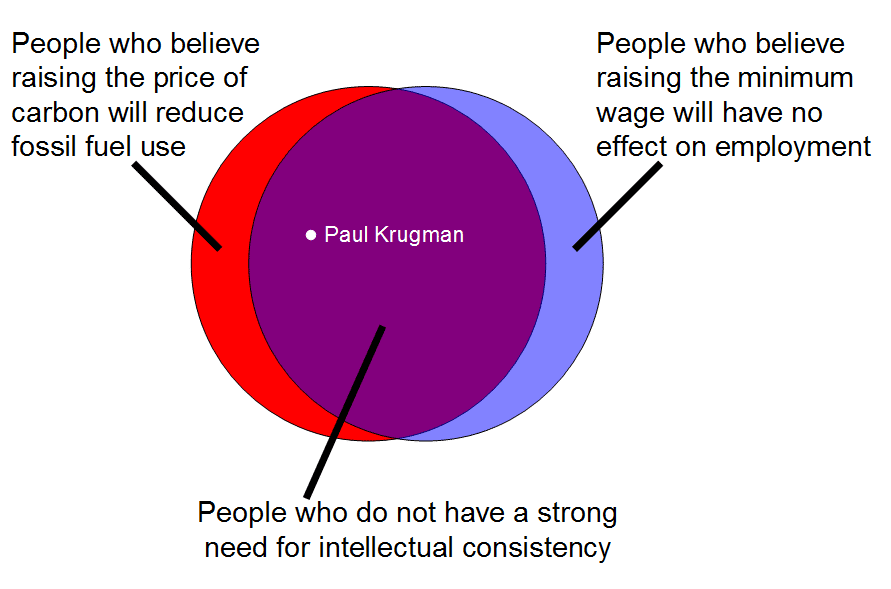
Prices, Paul Krugman, and Consistency

by admin

click to enlarge

12 Sep 13:41

Immunoprotection of Bifidobacteria and Vaccine Injury: The Biological Plausibility of Microbial Predisposition, By Keith Bell (Green Med Info)

by Dr. B G
Source


Earlier I had posted a science-driven presentation by Dr Tetyana Obukhanych, Ph.D. on Natural Immunity and Vaccination. She reviewed the literature (scanty) on the efficacy of herd immunity and the fallacies of protection, specifically how mothers are not conferring full and complete immunity against rare, but devastating whooping cough and measles to their newborns when breastfeeding. This is not ancestral and may have consequences. Additionally she reviewed the potentials of vaccine injury, including gut dysbiosis and multiple food allergies (peanut, gluten, dairy).


Green Med Info just published an article written by the knowledgable and brilliant student of the gut, Mr Keith Bell: Vaccine Injury: The Biological Plausibility of Microbial Predisposition

Page 1 (GREEN MED INFO)

You may not have heard the news due to media censorship of the vaccine-autism debate, but apparently childhood vaccines can and do cause autism. Last month, a CDC Senior Scientist issued an apologetic press release admitting data omission from a 2004 study.  The ditched data suggested African American boys are at increased risk of autism when given the MMR vaccine.

CDC's Director of Immunization Safety, co-author of the fraudulent 2004 study, has also admittedvaccines can result in autism.  Moreover, autism is listed as side effect in the DTaP vaccinepackage insert.

Brian Hooker received the CDC confession directly from Senior Scientist, William Thompson. Hooker reanalyzed the data and found a 2.4x increased risk of autism in African American boys. The CDC states a lack of biological plausibility, but there's plenty.
Why would certain children be vulnerable to autism or any vaccine injury such as tic and seizure disorders? What makes them different from others who somehow escape injury?
First let's address gender inequality. Boys are up to five times more likely than girls to become autistic, perhaps because estrogen is crucial to immune response. Girls are primed at birth. But why African American boys? How tragic that over ten years ago the CDC decided this wasn't important enough to study further. How many African American boys have been damaged?

Other populations at risk of autism by vaccination include Koreans, Somali immigrants, perhaps much of Africa and Caucasians, too. Somali immigrants of Minneapolis and Sweden suffer high rates of autism when there is no word for "autism" in Somalia. In Sweden, they call it "Swedish disease."

Everyone on Earth is vulnerable to vaccine damage, but some populations appear especially at risk. These groups are different than others based on generations of dietary habits resulting in the underlying beauty of diversity: microbial predisposition. Their flora is naturally different!

Scientists have found gut microbiota play an important role in how well vaccines are absorbed. Imbalanced flora leads to vaccine failure. In sanitation-challenged, toxic nations such as Pakistan, for example, the polio vaccine can be ineffective due to compromised guts known asenvironmental enteropathy. How ironic that if we made sanitation and toxic pollution a priority, we could also reduce vaccination and its risk of injury. Instead, children suffer malabsorption syndrome misdiagnosed as malnutrition. They can't properly absorb nutrients or vaccines. Meanwhile, less than 2% of Bill & Melinda Gates Foundation budget goes toward improving sanitation; the lion's share toward vaccination in concert with major pharmaceuticals andGAVI. The United Nations, UNICEF and the World Bank promote wastewater treatment without any priority on the real solution of dry toilet technology.

One of the differences is reduced or absent bifidobacteria.


According to a Bangladeshi microbiota study published last month, poor vaccine efficacy is associated with systemic inflammation due to gut dysbiosis. Bifidobacteria were found a key factor in improving vaccine responsiveness. There are many known strains of bifidobacteria, some considered better than others. Bifidobacteria levels in the USA vary widely among individuals. Studies report much lower levels of bifidobacteria in children with autism.

Vaccine scientists are focused on improving vaccine absorption, promoting probiotic adjuvants. Bifidobacteria appear to have a leading role as future adjuvant.  But this work may also reveal a mechanism of vaccine injury: lack of an important species. Bifidobacteria are known to attenuatesevere intestinal inflammation. One study found their numbers naturally multiply in magnesium deficiency to calm inflammation.
Many Africans are missing bifidobacteria. And so are Koreans where autism rates were founddouble those in the USA. The traditional diet of these populations doesn't include dairy, which feeds bifidobacteria. It should be noted not all Africans are reduced or absent in bifidobacteria. Onestudy found bifidobacteria far more dominant in Malawian than Finnish infants while another studyfinds eightfold autism increases in Finland. Another vulnerable group appears to be vegans and vegetarians, known significantly reduced in bifidobacteria.

Breastfeeding is another important clue about bifidobacteria and autism avoidance. Breast milk is known to contain 700 types of bacteria with bifidobacteria the star of the show. Gerber includes bifidobacteria in their infant formula for good reason as "they make up 80–90% of the total intestinal flora of breastfed infants." Several studies indicate breastfeeding deters autism. What's not commonly recognized is how microbes both produce and stimulate release of fatty acids in breast milk crucial to brain development. These lipids include endocannabinoids now making waves in the epilepsy community (seizure is a common feature in autism).

A new study reinforces what's known about the global C-section epidemic and neurodevelopmental problems including autism. A third of women give birth by C-section in the USA, exceeded by other nations such as China and Brazil. C-section is known to result indifferences in infant intestinal flora, but what are the actual differences and how might this relate to potential for vaccine injury? This group of scientists found significantly lower bifidobacteria counts in C-section babies than in vaginally delivered infants. The bifidobacteria, however, are thought to originate in the mother's intestines.


Page 2 (GREEN MED INFO)

Are girls higher in bifidobacteria than boys? Might this be another way girls escape autism? Recent studies reveal another way to view gender differences. Men and women can eat the same diet, but have distinctly different gut microbiota.
In the Hazda people of Africa, bifidobacteria is absent and so is dairy, however, some forms of resistant starch and inulin may also feed bifidobacteria. The Hazda microbiome is more diverse, so they don't require bifidobacteria. Other microbes are doing the job for their healthy human hosts, but perhaps not if confronted with vaccination.
Then again, the Hazda immune system may be better able to withstand vaccination than African Americans. The immune system is reliant on flora balance where gut dysbiosis, such as high clostridia, and low bifidobacteria counts may predispose a newborn toward vaccine injury. Alternatively, high clostridia counts known in autism may be the result of vaccination. Vaccines may lead to such imbalances, similar to antibiotics known to cause C. difficile infections.

The fact is there are still no studies about how any of the childhood vaccines affect flora balance. Why not? Does anyone fear the results? Solving this mystery may require crowdfunding. There are many complexities to be unraveled. How are mercury and aluminum adjuvants affecting flora? How might vaccine-induced immune responses affect flora balance?

There are a sparse few studies approaching the subject such as this 2004 study from China showing significantly increased gram-negative bacteria caused by the cholera vaccine, not a good thing. This 2013 typhoid vaccine study states:
"However, to date, no comprehensive studies have been undertaken to examine the gastrointestinal microbiota in relation to vaccine administration and if there is a discernible alteration in the community following vaccine administration."
How would a shift in flora or absent bifidobacteria lead to autism? This falls under the category of gut-brain phenomenon and probably begins in the womb. Dozens of peer-reviewed studies impudently state colonization begins at birth, a fallacy without evidence akin to believing Earth is flat. The new paradigm points toward a fetal gastrointestinal tract teeming with life, developing long before the fetal brain, even driving brain development with polyunsaturated fatty acids of microbial origin. The maternal microbiome shifts toward a diabetic state in the third trimester while the fetal brain triples in weight.

Children are born colonized and then vaccinated within 12 hours of birth per cruel CDC schedule without any understanding of how this affects flora balance. The gut-brain connection is a two-way street where what happens in the gut may lead to an inflammatory reaction in the brain.Bifidobacteria may be a factor in helping to avoid this reaction. Indeed, probiotics of many types have been tested alongside vaccines to improve vaccine response because it's known microbiotainfluence immune response. Might probiotics also help to avoid extreme immune response resulting in autism? Too many parents of autistic children have witnessed the arched back and high-pitched scream of their infants post-vaccination, a condition signaling brain inflammation.

I suspect bifidobacteria will become biomarkers to help avoid vaccine injuries. Every child would have microbial DNA (PCR) stool testing to determine flora balance prior to vaccination. If bifidobacteria are low or absent, this may serve as warning not to vaccinate. This applies to all children because everyone is at risk. Children may be born compromised with imbalanced flora where vaccines add insult to injury.

We should begin the process of reducing CDC vaccine protocol, beginning the protocol much later in life to allow the immune system, reliant on flora, time to develop. This would reduce vaccine injuries while improving vaccine effectiveness. Or, we can choose not to vaccinate and concentrate on improving innate immunity. Many believe our natural immunity is waning due to vaccination, so we're seeing a comeback of childhood diseases such as measles and mumps.

Either way, we need to reduce heartbreaking injuries as well as consider the subtle, insidious possibility of widespread flora shift in the wrong direction. We're already seeing mysterious childhood type-1 diabetes and obesity epidemics along with eating disorders such as anorexia in very young children. Half our children suffer chronic disease, an unacceptable situation where everyone is vulnerable based on flora balance.
Florida Congressman, Bill Posey, is investigating CDC fraud amid an incestuous relationship with the pharmaceutical industry. Contact your Congressman to ask support for Posey's congressional hearings to learn more about extent of damage. The CDC "whistleblower" may receive immunityfrom prosecution so that underlying truth may finally be revealed, just as microbial genetic testing is taking us toward a new understanding of our place in the environment. 

Keith Bell is a 25 year veteran of the recycling industry with interest in sanitation and health. During the 1980s, he was a UNICEF radio spokesperson in Chicago for the annual release of State of the World's Children Report. He’s particularly interested in gut-brain connection including gut-origin of seizure, underdiagnosed in epilepsy. Sanitation is Sanity poster 

12 Sep 13:01

Quotation of the Day…

by Don Boudreaux
(Don Boudreaux)

… is from page 10 of the 1996 Liberty Fund collection of Frank Meyer’s essays, In Defense of Freedom (William C. Dennis, ed.); specifically, it’s from Meyer’s July 1955 Freeman article, “Collectivism Rebaptized” – an essay critical of the “New Conservatism” as embodied then in the thought of Russell Kirk (original emphasis):

It can be admitted that the long experience crystallized in traditional human wisdom is a necessary make-weight to the conclusions which reason would seem to dictate to a single group or even to the conscience of a whole generation  But to make tradition, “prejudice and prescription,” not along with reason but against reason, the sole foundation of one’s position is to enshrine the maxim, “Whatever is, is right,” as the first principle of thought about politics and society.  Such a position is immoral from any point of view….

11 Sep 18:46

‘Equal pay day’ this year fell on April 14; the next ‘equal occupational fatality day’ will occur on July 31, 2025

by Mark J. Perry

Every year the National Committee on Pay Equity (NCPE) publicizes its “Equal Pay Day” to bring public attention to the gender pay gap. “Equal Pay Day” this year fell on April 14, and allegedly represents how far into 2014 the average woman had to continue working to earn the same income that the average man earned last year. Inspired by Equal Pay Day, I introduced “Equal Occupational Fatality Day” in 2010 to bring public attention to the huge gender disparity in work-related deaths every year in the United States. “Equal Occupational Fatality Day” tells us how many years into the future women would have to work before they would experience the same number of occupational fatalities that occurred in the previous year for men.

The Bureau of Labor Statistics (BLS) released new data today on workplace fatalities for 2013, and a new “Equal Occupational Fatality Day” can now be calculated. As in previous years, the chart above shows the significant gender disparity in workplace fatalities in 2013: 4,101 men died on the job (93.1% of the total) compared to only 302 women (6.9% of the total). The “gender occupational fatality gap” in 2013 was considerable — nearly 14 men died on the job last year for every woman who died while working.

Based on the new BLS data, the next “Equal Occupational Fatality Day” will occur about 11 years from now ­­– on July 31, 2025. That date symbolizes how far into the future women will be able to continue working before they experience the same loss of life that men experienced in 2013 from work-related deaths. Because women tend to work in safer occupations than men on average, they have the advantage of being able to work for more than a decade longer than men before they experience the same number of male occupational fatalities in a single year.

Economic theory tells us that the “gender occupational fatality gap” explains part of the “gender pay gap” because a disproportionate number of men work in higher-risk, but higher-paid occupations like coal mining (almost 100 % male), fire fighters (96.5% male), police officers (86.6% male), correctional officers (72.8% male), logging (97.9% male), refuse collectors (95.2%), truck drivers (94.8%), roofers (99.3% male), highway maintenance (98.9%) and construction (97.4% male); BLS data here. On the other hand, women far outnumber men in relatively low-risk industries, often with lower pay to partially compensate for the safer, more comfortable indoor office environments in occupations like office and administrative support (73.3% female), education, training, and library occupations (73.8% female), and healthcare (74.4% female). The higher concentrations of men in riskier occupations with greater occurrences of workplace injuries and fatalities suggest that more men than women are willing to expose themselves to work-related injury or death in exchange for higher wages. In contrast, women more than men prefer lower risk occupations with greater workplace safety, and are frequently willing to accept lower wages for the reduced probability of work-related injury or death.

Bottom Line: Groups like the NCPE use “Equal Pay Day” to promote a goal of perfect gender pay equity, probably not realizing that they are simultaneously advocating an increase in the number of women working in higher-paying, but higher-risk occupations like fire-fighting, roofing, construction, farming, and coal mining. The reality is that a reduction in the gender pay gap would come at a huge cost: several thousand more women will be killed each year working in dangerous occupations.

Here’s a question for the NCPE that I ask every year: Closing the “gender pay gap” can only be achieved by closing the “occupational fatality gap.” Would achieving the goal of perfect pay equity really be worth the loss of life for thousands of additional women each year who would die in work-related accidents?

11 Sep 15:22

How Exercise Makes Us Feel

by Mark Sisson

exercisefeelingHow did you feel after your last workout? (Apply as many adjectives as fit the occasion.) Now think about how others perceive exercise. Let’s say you stop a random hundred people on the street and ask them how exercise makes/would make them feel. I’m going to guess you’d get an interesting cross-section of answers, likely slanted toward the negative (mostly from people who don’t regularly exercise, but – hey – that’s just MY guess, right?). Call me cynical, but when many people think about exercise, I think their minds go directly to pain, soreness, sweat, and the general unpleasantness of it all. That’s unfortunate to say the least. I’m not going to claim that my most intensive workouts don’t leave me tired or even slightly sore (genuine pain is something different). Nonetheless, I get way too much out of my Primal exercise to feel it’s something to be “endured” – or even avoided. This brings me to those other answers – the ones more likely from folks who exercise on a regular basis (whether their workouts involve gym time, outdoor play, an active hobby or something else). What else does exercise make us feel – in the moment, after the workout and later once the results start showing?

Let’s just jump right in, shall we?

The Release

A friend of Carrie’s described it this way: “I walk out the door and leave all the day’s stress – the work pressures, the kids’ whining, the messy kitchen, the school paperwork. As I walk faster and quickly begin to run, it’s like shedding layers of weight and moving into flight.” I love that observation. When we’re in our bodies, we have a better chance of being in the present. We get a break from neurotic worry and obsessive planning that can drive too many of our waking hours. (If we find ourselves still mired in self-talk during workouts, we either need to find something more intense or figure out a way to truly play. It’s thankfully difficult to make a mental shopping list while playing a game of Ultimate.)

When we strip exercise of “obligation,” we can appreciate the opportunities it gives us to live differently for a time. When we start to see our workouts as the break we look forward to – or a seamless part of enjoying life and socialization – instead of a personal task to cram in, something essential opens. It’s a threshold I would see my clients cross (and one I rediscovered for myself when fitness again became personal rather than primarily professional). In my opinion, the best rewards – both physical and psychological – come past that threshold.

The Pride

It doesn’t matter in the moment whether you skipped five workouts before this one. Right now you’re moving, and (barring a serious penchant for self-flagellation) there’s a real gratification to this fact that cancels out the rest. You’re lapping everyone who’s at home sitting on the couch. This matters. And the sense of accomplishment only grows with time. Each additional mile run, every better race time, each increase in poundage lifted boosts the feeling. It’s not just a fitness increase. It’s a victory over our perceived limitations as well as a win for discipline and self-management.

The “High”

We work for it, to be sure, but it can feel like a peak experience when it does. At times, I’d say, it puts me at the very center of being, which is kind of a Zen take on what is really an activation of the body’s endorphin release and endocannabinoid system. (PDF) (Whose attention perked up at the mention of cannabinoid?) The fact is, when we’re exercising, we’re shifting all kinds of biochemical gears (everything from neurotransmitter levels, BDNF release and endocannabinoid engagement) because the body perceives our efforts as a physical stress and responds with natural pain-relieving strategies. In longer duration, high intensity activity, the response (whether a primary cause of the endorphin or the endocannabinoid system) can impact emotion as well as physical sensation. Those who have felt the full-on high won’t forget it.

The Clarity

When I’m stuck on something – a work issue, writer’s block, a personal question – moving is about the only thing that makes sense. My best ideas come when I’m biking or walking – or just after a good workout. While my focus during lifting or sprinting is definitely on the action itself, other less intense activities allow me to wander mentally. (It’s like being able to view a star out of the corner of your eye but missing it when you’re searching for it head on.) The result, as research illuminates, is a surprisingly unconscious productivity.

If we’re talking about the post-workout window, it doesn’t matter what I did for exercise. My mind is again firing on all cylinders. Of course, there’s real physical sense to this phenomenon. Exercise literally and figuratively gets “the blood flowing” to our brains. It stimulates the processes that support new neuronal growth and connections as well as brain plasticity and better recall. It’s the kind of thing that makes you re-envision how you should spend that afternoon break.

The Confidence

There’s a certain self-assurance that comes from improving and pushing yourself physically. You know you’re taking responsibility for your health, but it’s something else, too. I think it’s owning your own power as a physical being. I’ve seen thousands of people – clients and readers (hello, success stories!) who said getting fit led to a major emotional and even social transformation in their lives. Likewise, it goes the other way. Over the years I’ve worked with a number of people who have overcome personal crises and come to me for advice saying “I want the outside to be as strong as I feel on the inside now.” Either way, the connection is the same. Physical resilience goes hand-in-hand with self-possession.

The Calm

I call this the “good exhaustion.” It’s in large part the sedative aspect of the runner’s high chemical cascade. Once we’re not moving anymore and there’s no “pain” to alleviate, we’re left for a while with the tail end of feel-good chemicals and can just bask in the contentment. For myself, I think the calm also comes from the sensation that my muscles have been used and stretched. I’ve lived my animal purpose for the day. A neighbor who walks her dog several times a day said once, “A good dog is a tired dog.” I’d add happy dog – and hominid to that.

The Energy

Sure, we’re riding the surge right after a workout, but I’m also thinking of the growing constancy of energy when exercise becomes a regular habit. Perhaps it’s the better sleep we enjoy or maybe the memory of feeling so energized during the workout itself. Or maybe it’s something more. University of Georgia researchers found exercise substantially reduced the fatigue symptoms of sedentary subjects all while it increased their energy (20% according to their estimates). It turns out it doesn’t take much. The low-level cardio folks actually experienced more of a reduction in fatigue (65%) than those who did more intense work (49%).

The Sexiness

Admit it: you feel better about your body after you work out. (Why do we ever feel guilty about this – like it’s a secret we have to keep under wraps?) It’s part of the energy surge but something “more.” Feeling good naked continually develops over time, with research suggesting our body image can change within mere weeks. However, I think it can begin to shift the moment we let it. Few things – other than sex itself, have the power to put us back in our bodies in quite the same way as exercise. All of the aforementioned benefits come together – the sense of energy, power, release, the high – and converge to make us feel more alive, impassioned and maybe even virile. You might end gym time sweaty and fatigued, but after a shower you might find yourself walking differently and “working” that workout. No?

Well, I’d say the short-term discomfort pales in comparison to exercise’s bigger benefits. (Am I wrong?) How does exercise make YOU feel? Any of the above? Something not on the list? Thanks for reading, everybody, and have a good end to your week.

Prefer listening to reading? Get an audio recording of this blog post, and subscribe to the Primal Blueprint Podcast on iTunes for instant access to all past, present and future episodes here.

Further Your Knowledge. Deepen Your Impact. Become an Expert! Learn More About the Primal Blueprint Expert Certification

11 Sep 14:33

Donald Trump offers president lifetime of free golf to resign...


Donald Trump offers president lifetime of free golf to resign...


(Third column, 1st story, link)

11 Sep 14:32

What the President Said about ISIS, and What I Heard

by Christopher A. Preble

Christopher A. Preble

It seems particularly appropriate, on this 13th anniversary of the 9/11 attacks, to ponder anew what counterterrorism steps are prudent and effective, and what measures are reckless and counterproductive.

With this in mind, I was moderately inclined to go along with President Obama’s plan to attack the Islamic State in Iraq and Syria (ISIS), provided that he defined a limited and achievable set of goals, and therefore established limits on the size and scope of the U.S. military mission.

But when the president says this:

“We will hunt down terrorists who threaten our country, wherever they are.” 

I hear this:

“All that we have to do is to send two mujahedeen to the furthest point east to raise a piece of cloth on which is written al Qaeda, in order to make generals race there to cause America to suffer human, economic and political losses without their achieving anything of note…”

Though they didn’t race there, a team of U.S. special forces eventually made their way to Pakistan and pumped a couple of bullets into bin Laden, so he’s not making these videos any more. That seems worthy. If we can repeat these sorts of operations elsewhere, and shut up a few more loudmouths, we should.

But the larger point stands. We shouldn’t terrorize ourselves. We shouldn’t exaggerate the threat posed by terrorism. And we shouldn’t react in ways that feed the terrorists’ narrative, or serve the terrorists’ goals.

11 Sep 13:26

The Era Of Widespread Biometric Indentification And Microchip Implants Is Here

by Tyler Durden

Submitted by Michael Snyder of The Economic Collapse blog,

Are you ready to have your veins scanned every time you use your bank account?  Are you ready to use a "digital tattoo" or a microchip implant to unlock your telephone?  Once upon a time we read about such technologies in science fiction novels, but now they are here.  The era of widespread biometric identification and microchip implants is upon us, and it is going to change the way that we live.  Proponents of these new technologies say that they will make our private information and our bank accounts much more secure.  But there are others that warn that these kinds of "Big Brother technologies" will set the stage for even more government intrusion into our lives.  In the wrong hands, such technologies could prove to be an absolute nightmare.

Barclays has just announced that it is going to become the first major bank in the western world to use vein scanning technology to control access to bank accounts.  There will even be a biometric reader that customers plug into their computers at home...

Barclays is launching a vein scanner for customers as it steps up use of biometric recognition technology to combat banking fraud.


The bank has teamed up with Japanese technology firm Hitachi to develop a biometric reader that scans a customer's finger to access accounts, instead of using a password or PIN.


The biometric reader, which plugs into a customer’s computer at home, uses infrared lights to scan blood flow in a person’s finger. The user must then scan the same finger a second time to confirm a transaction. Each “vein profile” will be stored on a SIM card inside the device.


Vein recognition technology is used by some banks in Japan and elsewhere at ATM machines, but Barclays said it is the first bank globally to use it for significant account transactions.

But Barclays is not the only one that is making a big move into biometric identification.

Online retailing behemoth Alibaba is going to start using fingerprint scanning in an attempt to make their transactions more secure...

Alibaba, the giant Chinese online retailer, is integrating fingerprint scanning into its Alipay Wallet app. Foxconn, the Taiwanese manufacturer of the iPhone and iPad, threw nearly $5 million at Norway’s NEXT Biometrics, which develops fingerprint scanning technology, back in May. And earlier this month it took a 10% stake for $2 million in AirSig, a Taiwanese company that uses smartphones’ built-in gyroscopes to track air handwriting. The company says AirSig provides three-factor authentication: your signature, your phone, and the way you sign with a flourish in mid-air.

It is only a matter of time before more banks, online retailers and major websites start using this kind of technology.  We live at a time when theft on the Internet threatens to spiral out of control, and big corporations are going to be continually looking for answers.

Cell phone security is another area of great concern these days.  If someone can get a hold of your phone and unlock it, that person can potentially do all sorts of damage.

So Motorola has developed a "digital tattoo" that will be used to ensure that only the owner of a phone is able to unlock it.  The following is how  Motorola described these new digital tattoos...

Made of super thin, flexible materials, based on VivaLnk’s eSkinTM technology, each digital tattoo is designed to unlock your phone with just a touch of your Moto X to the tattoo, no passwords required. The nickel-sized tattoo is adhesive, lasts for five days, and is made to stay on through showering, swimming, and vigorous activities like jogging. And it’s beautiful—with a shimmering, intricate design.


It’s another step in making it easier to unlock your phone on the go and keep your personal information safe. An average user takes 2.3 seconds to unlock their phone and does this about 39 times a day—a process that some people find so inconvenient that they do not lock their phones at all. Using NFC technology, digital tattoos make it faster to safely unlock your phone anywhere without having to enter a password.

And below I have posted the video that Motorola shared on YouTube about these tattoos...

Pretty bizarre stuff, eh?

But others are taking cell phone security to even greater extremes.

For example, some people were actually implanting themselves with microchips in anticipation of the release of the iPhone 6 on September 9th...

With a wave of his left hand, Ben Slater can open his front door, turn on the lights and will soon be able to start his car. Without even a touch he can link to databases containing limitless information, including personal details such as names, addresses and health records.


The digital advertising director has joined a small number of Australians who have inserted microchips into their skin to be at the cutting edge of the next stage of the evolution of technology.


Slater was prompted to be implanted in anticipation of the iPhone 6 release on September 9.


The conjecture among pundits and fans worldwide over what chief executive Tim Cook will reveal is building.


At present the iPhone cannot read microchip implants. However, Mr Slater believes the new version will have that capability. His confidence is now lodged between his thumb and forefinger.

Of course this kind of thing is not new.  People have been getting implanted with microchips for years.  If you doubt this, just do an Internet search for "biohackers" and see what you find.

But it is starting to become more mainstream, and there are already some thinkers that are quite eager to use such technology for very authoritarian purposes.

For example, one prominent philosopher recently suggested that we should use implantable microchips to prevent anyone that is "deemed unworthy" from becoming a parent...

Although he admits it “sounds blatantly authoritarian” and “violates just about every core value we possess in a free society,” a noted transhumanist author has said a world government body should forcibly sterilize anyone “deemed unworthy” of parenthood by using implanted microchips.


Constitutional attorney and civil liberties expert John W. Whitehead, founder of The Rutherford Institute, warned LifeSiteNews earlier this year that political officials would long to use this seminal technology.


In an article for Wired.com today, philosopher Zoltan Istvan wrote that the notion first crossed his mind when he heard a blonde nurse say, “with 10,000 kids dying everyday around the world from starvation, you'd think we'd put birth control in the water.”


After careful thought, in an effort to “give hundreds of millions of future kids a better life, I cautiously endorse the idea of licensing parents,” Istvan wrote today.

You might be tempted to think that this is crazy talk.

But the truth is that this kind of technology is already being developed.

In a previous article, I quoted a news article which discussed how billionaire Bill Gates is funding the development of a birth control microchip that "acts as a contraceptive for 16 years"

Helped along by one of the world’s most notable billionaires, a U.S. firm is developing a tiny implant that acts as a contraceptive for 16 years — and can be turned on or off using a remote control.


The birth control microchip, funded by the Bill and Melinda Gates Foundation, would hold nearly two decades worth of a hormone commonly used in contraceptives and dispense 30 micrograms a day, according to a report from the MIT Technology Review.


The new birth control, which is set to begin preclinical testing next year with hopes of putting it on shelves in 2018, can be implanted in the buttocks, upper arm or abdomen.

Yes, I know that a lot of the things that I have talked about in this article sound really weird.

But the reality of the matter is that technology is changing at an exponential rate, and our world is going to get crazier and crazier as time goes by.

Are you ready for what comes next?

11 Sep 01:15

IRS Testifies to Congress: "Wherever We Can, We Follow The Law"

by Michael F. Cannon
10 Sep 21:51

Final Chapter of Cash Seizure Series a Repulsive Accounting of Police Misbehavior

by Scott Shackford

"I sense a 50 percent increase in overtime claims coming."On Monday I noted The Washington Post had put together a series of stories offering a deep look at the abuse by law enforcement agencies across the country of civil asset forfeiture laws and how they’ve been able to line their pockets with citizens’ money without ever actually proving said citizens had committed any crime.

The final chapter is, as teased, a collection of terrible stories of American citizens who happen to be transporting cash being stopped by law enforcement officers for relatively minor reasons and conclude with these people having said cash taken away from them. Here’s just one of several stories highlighted:

Matt Lee of Clare, Mich., got snared in an interdiction net in 2011 on Interstate 80 in Humboldt County, Nev. Lee was a 31-year-old college graduate who had struggled to find work and had moved back in with his parents to save money. When a friend promised him an entry-level job as a sales rep at a photo studio in California, Lee’s father, a postal employee, loaned him $2,500 in cash and Lee drove west in a decade-old Pontiac Bonneville.

On his third day, Lee was passing through the Nevada desert, wearing aviator sunglasses. A sheriff’s deputy raced up alongside the Bonneville, stared at Lee and then pulled him over.

Humboldt County Sheriff’s Deputy L.A. Dove, a member of the K-9 drug interdiction unit, has received instruction from the 4:20 Group, a contractor for the DEA and one of the leading interdiction trainers in the country.

Dove asked whether Lee was carrying any currency and summoned a K-9 officer. Dove told Lee, who is white, to get out of the car and stand at the edge of the desert, while a dog sniffed for drugs. The deputy told Lee that he didn’t believe his story that he was moving to California, because he was carrying so little baggage, Lee told The Post. Lee has no criminal record.

When a search turned up Lee’s remaining $2,400 in cash, Dove and his colleague exchanged high-fives, Lee said. Dove said he was taking the money under state law because he was convinced that Lee was involved in a drug run. Lee was left with only the $151 in his pocket.

Lee got an attorney and eventually they agreed to give him his money back. But his attorney ended up taking half in fees.

For other cases, when challenged, officials offer to give the citizen half the money they’ve taken back if their victim will shut up and go away. Another victim, despite winning his battle and getting all his money back (and forcing the government to pay his legal fees) still ended up screwed over. The seized cash was to be used for costs of operating his small Virginia restaurant. Without the money, he ended up having to shut it down during the course of fighting for his property back.

Read the full story here. That at least nobody got beaten or shot is about the best you can say about the tales.