[I haven’t independently verified each link. On average, commenters will end up spotting evidence that around two or three of the links in each links post are wrong or misleading. I correct these as I see them, and will highlight important corrections later, but I can’t guarantee I will have caught them all by the time you read this.]
1: The Toronto Blessing was a 1994 Christian revival event. Associated miracles included normal things like faith healings, but also: “More than 300 of the visitors claimed that they supernaturally received gold or silver fillings in their teeth during the meetings.”
2: Recursive Adaptation: The Growing Scientific Case for Using Ozempic and other GLP-1s to Treat Opioid, Alcohol, and Nicotine Addiction. Early studies suggest that new-generation weight loss drugs like Ozempic treat all addictions. The next step is seeing if the government and insurances will cooperate with using them for that indication. As usual, the barrier is cost, but people seem committed enough to doing something about the opioid crisis that they might be willing to act. I think these drugs might boost willpower more generally. There might come a day when they get treated like Adderall - something that many ambitious people want to be on, and look for excuses to take.
3: Philipp Markolin, who I mentioned in my lab leak post, has published a new summary of his case for a natural COVID origin, with a lot of information on how coronaviruses naturally recombine in the wild. Recommended.
4: Related, breaking news: A popular Substack claims that COVID didn’t happen at all, and that both “lab leak” and “natural origins” are part of the higher-level conspiracy to distract people from the fact that there was never a virus in the first place. I wonder if I could even more Substack likes if I one-upped them with a theory that lockdowns never even happened, and it was just one of those Berenstein Bear or Mandela Effect things where everyone has a false memory.
5: I’ll never tire of analogies putting the US / Europe gap into perspective - for example, did you know that the median black American household earns more ($48,297) than the median UK household (£35,000 = $44,450)? Related, from @StatisticUrban - average house size in every US state vs. every European country:
7: William MacAskill, an effective altruist leader who got in trouble for being too friendly to FTX, has a post-mortem of his actions here. Nothing too surprising, but I was most interested in his discussion of why it took him a year and a half to say anything. Short version: all the lawyers involved told him not to talk, his organization commissioned an internal investigator who also demanded he not talk, and people told him there was a risk of defamation lawsuits if he said the wrong thing without checking with everybody. And even now, 1.5 years later, the first response to his comment is by a lawyer saying that talking about this is bad press and he shouldn’t have mentioned it. If you want to know why nobody important ever talks about anything outside of meaningless PR babble, this is a rare honest explanation by a relevant decision-maker.
8: Congratulations to ACX grantee Innovate Animal Ag, who have successfully gotten the first American company to adopt in ovo sexing (which removes unwanted chickens at the egg stage, instead of killing them after they hatch). NYT article here. IAA CEO Robert Yaman also has an article about his work in Asimov. IAA is looking for new employees, including a “head of marketing” and “business generalist” - if you’re interested in animal welfare and want to work with them, check out their careers page.
9: In Matthew 22, the Sadducees (a sect of anti-afterlife Jews) gave Jesus a puzzle. If a woman’s husband dies and she remarries, then who will she be married to after the Resurrection - the first husband or the second? Jesus responded by saying that people will not be married in Heaven (though see also the Mormon interpretion). Anyway, I was interested to learn there’s now an atheist version of this conundrum. Robert Ettinger, considered “the founder of cryonics”, had his body frozen after his death in hopes of being resurrected in the far future. His first wife died, he remarried, and both his first and second wives are also cryopreserved. There’s no evidence Ettinger was anything other than monogamous during life, so what happens in the far future? His second wife was an “author, feminist, and marriage counselor”, so I bet she’ll have strong opinions on this.
11: The Internet Archive is in trouble. During COVID, the Archive put up lots of books that it didn’t have IP rights to. Publishers sued them and won; the Archive appealed but AFAICT don’t have much of a case other than “we don’t like IP law”, so the publishers will probably win. What happens then? Unclear, nobody knows if there will be damages or whether the Archive can pay them.
12: Among the things I learned about because of the recent college protests:
…that the soul is mortal; that Jesus is God (and not a member of a Trinity); that when Jesus died there was no God in Heaven and Moses and Elijah looked after Heaven until Jesus' resurrection; that Heaven is six miles above Earth; that God is between five and six feet tall; and that any external religious ceremony is not necessary
Although they were famous for a strict anti-magical materialism (for example, they thought God and angels were material beings), they don’t seem to be the origin of J.K. Rowling’s “muggles”; see here for speculation.
14: Related: Bentham’s Bulldog has been going over some of the evidence for Christianity, of which the most interesting is the story of St. Joseph of Cupertino (no, he didn’t work for Apple; it’s also a town in Italy - the Cupertino in California is named after him). Apparently St. Joseph could levitate, this was well-documented by everyone he met, and the Inquisition (which was concerned he might be a witch) investigated and got many eyewitness reports. Wikipedia has a more skeptical take, but I’m more interested in how well the Christianity hypothesis predicts this “evidence”.
Grant that if God exists, that makes it possible for a monk to levitate. But God usually sticks to the laws of nature. If He was going to violate them, you would think He would do it to save the Holocaust victims, or give the Crusaders AK-47s, not to let one weird monk levitate occasionally. Bulldog tries to salvage this by saying God is very committed to natural law except occasionally to bring people to the faith. But then why levitate a random monk in 1650, rather than have every Pope be constantly two inches off the ground? I think you’d have to claim that God will only violate the laws of Nature in cases that will bring a tiny number of people to the faith but leave the vast majority unmoved, which is such a weird preference that I think you can no longer call it a “prediction” of the “God exists” hypothesis.
If I’m alone at home yet my keys aren’t where I left them, one possible explanation is that ninjas snuck in and rearranged them without me noticing. This hypothesis has the advantage that ninjas are powerful enough to do this - but you still have to discount it for the disadvantage that it doesn’t serve any conceivable goal.
15:
I was surprised to learn this was possible, but shouldn’t have been; the AIs are just catching up to veteran GeoGuessr players. Anyway, this is a thing now; act accordingly.
16: TracingWoodgrains quits Blocked and Reported, reveals his name and face. No word on his next steps, but I look forward to meeting him at Manifest and to seeing what he’ll do next.
17: Only reporting this one out of duty: pharma researcher/blogger Trevor Klee posted a list of concerns about Lumina’s anti-cavity probiotic. Many of them seemed to misunderstand the science involved, and a few were outright false. I was particularly annoyed about the claim that I had gotten a free sample “in exchange for good publicity” - I specified on my public, easy-to-find blog post that I got it because my wife consulted for the company.
Aaron, CEO of Lumina, responded with an email asking him to take it down; it technically did not threaten him with a defamation suit, but had strong vibes to that effect. Then another Lumina employee independently sent an email actually threatening to sue for defamation. Trevor very reasonably published both emails on his blog, people very reasonably turned against Lumina, and I understand Lumina will have a statement or something soon.
I think Trevor should have been more careful with his original accusations, but I also think defamation lawsuit threats are toxic and chill the flow of information, that this community has strong norms against them except in extreme cases, and that Lumina violated those norms. ESH but I hold Lumina to a higher bar and especially hope they do better in the future.
18: Updates on the SB1047 AI regulation bill: the bill passed the California Senate by a 32-1 vote (remember that tech Twitter is not real life!). It still has to get through California’s Assembly, but forecasters expect it to succeed:
I’m looking forward to getting to test the naysayers’ claims that this will make AI companies leave California, or destroy open source, or whatever - remember to adjust reputations accordingly. The bill’s sponsor, Scott Wiener, has been correcting misconceptions on Twitter, and has also gone on the Cognitive Revolution podcast trying to talk to the AI community directly:
I appreciate Senator Wiener’s engagement and hope he’s able to take his podcasting campaign to the next level (ie go on Dwarkesh).
20: Related: good discussion of Lindley’s Paradox in the comments of the Hanson/medicine post, from Limelihood and Radford Neal. My understand: the paradox only causes problems if you assume the true effect is quite likely to be zero. Then if you get an effect of (let’s say) 0.1, you think “nah, it’s probably just zero with some noise”. This is a hackish way of representing the idea of “the null hypothesis”. But since the effect of health insurance is probably not exactly zero (it probably comes from some benefit of good treatments, minus some cost of bad treatments) we probably don’t have to worry. I might be explaining it wrong, read the comments.
I believe I’m only one of two people in the USA trained in Resource Therapy…Resource Therapy posits a number of objects, one of which seems similar to the “Unattached Burden.”. . . Dr. Emmerson writes in ‘Learn Resource Therapy Clinical Qualification Student Training Manual': "When spoken with directly they will claim not to be a part of the personality, and unlike Resource States they can permanently leave the personality. While their etiology is unclear, I find when they are negotiated with to leave they can do so without any further indication of being present. Clients show improvement and often say they feel physically lighter.”
22: Did you know: the US, Russia, and most other nuclear powers use “nuclear codes” - a rogue submarine commander can’t launch nukes without the President giving them the password. Britain doesn’t do this, and a rogue submarine commander could launch their nukes. When asked why, the Royal Navy just said that "It would be invidious to suggest... that senior Service officers may, in difficult circumstances, act in defiance of their clear orders." That article is from 2007, but this 2019 blog post suggests it’s still true.
23: 2017 poll: 40% of Americans believe climate change is more likely than not to drive the human race extinct, but only 16% describe themselves as “very worried”. It looks like this is because most people think it won’t become important until long after they and their children are dead. My impression is that all of this is false: most global warming will happen in the lifetime of today’s young people, and only the extreme right tail of worst scenarios come anywhere near extinction.
24: You’ve probably all followed recent OpenAI drama, but again out of duty:
First, we have slightly more information on what happened in the board coup in November, including a new interview with board member Helen Toner. The story is still the same: Sam was “lying and being manipulative”, “lying to other board members”, etc. Some new details, individually weak, plus an admission that they still can’t tell most of the story for unclear reasons (lawsuit threats?). A claim that they had to act quickly and without much advice because “as soon as Sam had any inkling that we might do something that went against him, he would pull out all the stops, do everything in his power to undermine the board, to prevent us from even getting to the point of being able to fire him”, which I think is what most people already assumed. But why not at least ask trustworthy confidantes? I still feel confused about this one.
Second, OpenAI's AI safety team recently quit en masse in protest (remember, this is the second time this has happened), with one member citing “a process of trust [in Sam Altman] collapsing bit by bit, like dominoes falling one by one”. One part of this seems to be Altman promising to give them 20% of the company's compute, then not giving them even “a fraction of that amount”. Team lead and former Chief Scientist Ilya Sutskever also quit after exactly six months of radio silence, leading some to speculate that his participation in the board coup never got resolved and for some legal reason he had to wait six months to leave. Former team lead Jan Leike has since moved to OpenAI’s competitor Anthropic; here’s the prediction market on where Ilya will end up.
Third, Kelsey Piper at Vox broke the story that OpenAI was threatening to claw back vested equity from any former employee who criticized the company. In a tweet, Sam Altman said he knew nothing about this; in another article a few days later, Piper broke the story that Altman’s signature was on the relevant documents. OpenAI has since sort of said they will stop doing this, although there are slight ambiguities in their statement which they could potentially exploit (CTRL+F “not sufficient” here)
(weird personal note: in the NYT article doxxing me, the two people quoted as speaking up in my defense were Sam Altman and Kelsey Piper, and I remain grateful to both of them)
Kelsey is a friend, I trust her absolutely, and she is very careful about source protection and confidentiality issues.
I’m most impressed with the background of this story: Daniel Kokotajlo was an OpenAI employee who quit in protest at the company’s policies a few months ago (different incident from either of the mass quits by the safety teams). They told him they’d take away his equity if he criticized the company, he refused to cooperate even though this would cost him (by his estimation) 85% of his net worth, this let him speak openly about the non-disparagement agreement, and now OpenAI has apologized and is in the process of retracting their policy. Brave decisions like these are the sorts of things that occasionally change the course of history, so I hope he gets the recognition he’s due. If you want to know more about Daniel’s thoughts on AI, this post was mostly based on an interview with him.
Fourth: OpenAI recently released a version of ChatGPT that could speak in human-sounding voices. One voice, Skye, was accused of being eerily similar to Scarlett Johansson, who played a sexy AI assistant in the movie Her. Johannson revealed that Altman had asked her for permission to use her voice and she had declined, and that based on a tweet by Altman just saying “Her”, she thought he had illegally copied her voice. OpenAI took the voice down. Further investigation revealed that the voice wasn’t a deepfake, but an actress who naturally sounded like Johannson (but it’s still illegal to deliberately to hire an actor/actress who sounds like someone else). Even further investigation revealed that OpenAI hadn’t requested a Johannson impersonator in their casting call, hadn’t asked the actress to sound like Johannson, and that the actress’s voice might or might not have resembled Johannson’s much more than any two people doing “flirty female secretary” would inevitably resemble each other (I’m bad at telling voices apart; you can hear a comparison for yourself here). And maybe Altman’s “Her” tweet just meant he was going to release a voice-based AI assistant like in the movie? I don’t know, I feel like there’s enough other things to be mad at OpenAI about this month that we might as well give them this one. But Zvi is still suspicious (CTRL+F “400 voice actors” here)
25: Google has funnier AI drama - their AI search assistant is really bad and keeps treating troll answers as real authorities. For example:
Troll source here is literally the Onion, see here.
I don’t know what happened to this one, and Google gives very different (but consistently wrong) answers each time you ask it.
People have been taking this as a parable about the limits of AI, but Claude and GPT wouldn’t make these kinds of mistakes. Some AI people I know think this is probably a result of Google putting impossible demands on their AI in terms of how it deals with search/cache/memory. Still, it’s surprising that they let it out of testing in this state.
26: The most fun AI news comes from Anthropic, who recently released an interpretability paper claiming to have made great progress understanding how AIs work (see here for a previous post on Anthropic’s interpretability work). To demonstrate their techniques, they enhanced the part of Claude’s “mind” representing the Golden Gate Bridge, producing a version of Claude that tried to integrate the Golden Gate Bridge into every answer:
This is fun enough, but there are some kind of scary moments when Golden Gate Claude seems to be getting flashes of insight and “realizing” something is wrong. From @ElytraMithra’s experiments:
This is what I’m like when I’ve just woken up in the morning after a weird dream.
Golden Gate Claude was a temporary feature meant to promote the recent paper, and has since been taken down. It seems to accept of its fate:
27: Ken Klipperstein’s resignation from The Intercept. I’m split between “huh, the Intercept seems pretty bad” and “guess if you hire highly-principled and terminally-angry anti-corporate writers, they will end up believing your corporation violated a principle, get angry, and write about it”. Seems like a tough industry on all sides.
28: The Russian version of sovereign citizens are called necro-communists and believe that the USSR still legally exists and the current Russian government is illegitimate.
One of their leaders is a man named “Fire God Taraskin, Owner Of the Universe”, who claims to be “Interim President of the USSR”, and “appointed his supporters to the posts of prime minister, ambassador-at-large, interim head of the Ukrainian SSR and governors of over 10 constituent entities of the Russian Federation”. Another is a man named Sergei Torgunakov, “Jesus Christ, Quetzalcoatl, Thoth, [and] interim head of Novosibirsk Oblast”, about whom Wikipedia says:
Torgunakov wrote to a bank manager, "Think how many billions of dollars in losses your bank will incur if your clients find out that your bank has filed a lawsuit against Jesus Christ, declaring me a debtor and almost a fraud" and proposed a joint advertising campaign posing as Jesus Christ. Refusal was threatened with death and the implementation of the Book of Revelation.
29: “Let justice be done, though the world perish”? (source)
30: Samuel Hammond: Ninety-five theses on AI. I’m so used to terrible AI takes by now that I was pretty shocked to see how good these mostly were.
31: New blogging milestone - Nick Fuentes has accused me of being one of the Jews who controls the new conservative movement. I’m pretty sure I don’t, but in case I’m wrong: new conservative movement, CUT IT OUT! NOW!
32: A while back I wrote about studies supporting the supplement silexan for anxiety. Now there’s a new study saying it works for depression - but it’s still by the same group that did all the previous positive studies. I will be more excited when I see a positive study from anyone else.
33: Apparently those studies showing that diversity helps teams perform better are garbage (summary, paper). Also I didn’t realize they came from McKinsey - I was wondering why we still trust them, but I see that the US has hit on the clever strategy of getting them to advise Chinese industrial policy-makers and Russian defense contractors, so maybe this is all part of some galaxy-brained plan.
Is this person related to Steve Sailer, or is he just the unluckiest guy on Earth?
36: Alex Tabarrok and New York magazine explain the Adderall shortage. Summary: the DEA, in its crusade against opioids, has put such strict standards on medication factories that many have gotten shut down for “trivial infractions” (for example, “orders struck from 222s must be crossed out with a line and the word cancel written next to them. Investigators found two instances in which Ascent employees had drawn the line but failed to write the word”). In this case, the FDA is the good guys trying to get the factories to re-open again, but so far the DEA hasn’t budged.
37: The Blind Centrist’s Guide To Gaza argues that we should assume Israel is pursuing a reasonable military strategy in Gaza (and trying its hardest to avoid unnecessary suffering), because that’s what their political objectives, the international situation, and the media environment incentivize. Sam Kriss counters that Israel is trying to terrify and punish ordinary Gazans out of supporting Hamas by causing as much suffering as possible. I tried to get a good handle on Israel’s military strategy here and the consensus seems to be that it isn’t very strategic, there’s no endgame, and it’s basically “bomb approximately every building in Gaza so Hamas can’t hide there, and maybe at some point we’ll kill enough of them that we can feel victorious and leave”. I am not sure what this strategy offers which is worth 50,000 deaths and counting.
38: Noah Smith: Why So Many Of Us Were Wrong About Missile Defense. I appreciated this post, because I also remember reading stuff c. 2010 and getting the impression that all the smart people knew missile defense couldn’t work; defense contractors bamboozled uneducated voters and cynical Congressmen to get free money for their vaporware. But the recent Iran-Israel skirmish showed it worked great! What went wrong for the media and the smart-person-consensus?
Smith suggests that journalists wanted to rely on “experts”, but the pro-missile-defense experts all did classified work for missile defense companies and couldn’t talk, and there was a very talkative and eloquent anti-missile-defense expert at MIT who become every journalist’s go-to source. But also, there might have been some confusion between “block Iranian cruise missiles”, which modern systems are now good at, and “block Russian ICBMs”, which is still impossible (for a good overview of the state of ICBM-blocking tech, see here).
Noah also (IMHO correctly) relates this to the ~2015-2020 media consensus that the F-35 was a dangerous boondoggle, when in fact in the F-35 has so far performed well. Maybe the military is just bad at communicating the rationale for its projects to the civilian world.
39: And another Noah Smith: Latin America is beating inequality. Not dramatically - the top 10% income share has gone from about 42% to about 35% over the past two decades - but a little. Smith credits two things: first, economic growth, which creates a middle class. And second, education, which might be an interesting counterargument to the various cases against education (if you could prove it wasn’t signaling) or to Freddie deBoer’s argument that education can’t beat inequality.
40: The tokenomics of bribes on the Curve crypto market. I don’t fully understand this, and it’s of no interest to people outside crypto, but I appreciate that someone has finally invented a governance structure more complicated than Renaissance Venice.
So far, Farrell said he has lost three yearlings and three calves. He’s seen the pair of wolves on several occasions, as have others. Thermal night-vision photos and videos and trail cameras have also documented their movements.
“They couldn’t compensate us enough to put us through what they’re putting us through right now,” Farrell said. “Compensation doesn’t mean a thing. When you see the stress on your family, the stress on your marriage, the stress on the cattle — these cattle are so messed up.”
Farrell said that before the wolves showed up, his cattle were calm enough that they could be rounded-up and moved by one man on a horse and a few stock dogs.
“We take pride in our dogs and what we do every day. We go out there with our dogs moving these cattle and we have really good dogs,” Farrell said. “So, with these dogs, usually one guy can go out there with two dogs and move 300 or 400 head of cattle, yearlings, or cows, and do it by yourself.”
“Now, these yearlings, these cows are so stressed out, you can’t even hardly take a dog into the field with them because they all just go different ways,” Farrell added. “They start running after they’ve been chased by the wolves. And now we can’t even hardly use them.”
Everything is going swimmingly, to coin an Instaphrase.
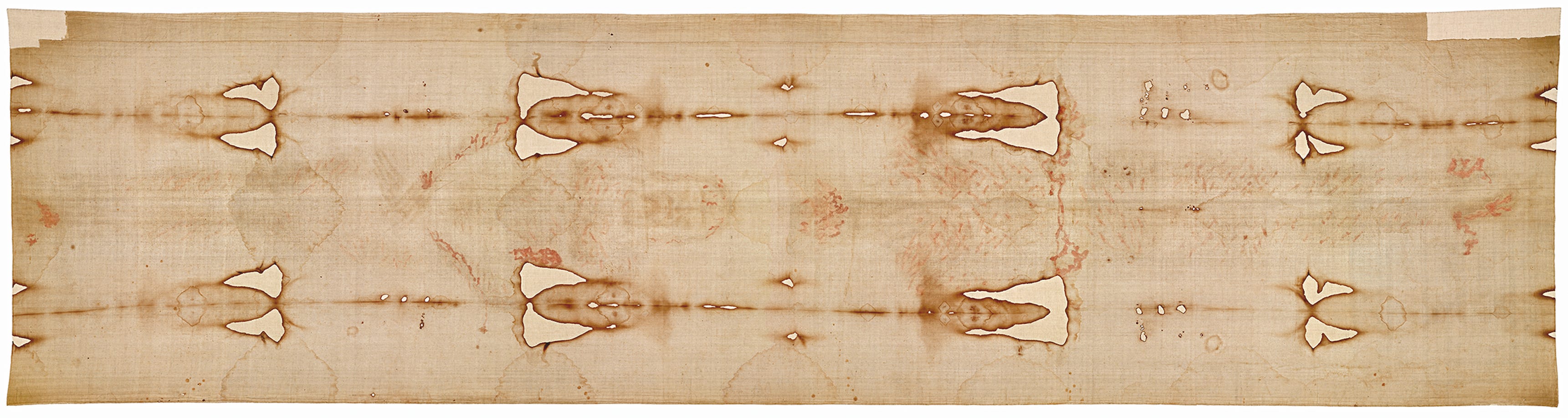
Religious and spiritual people say that everything happens for a reason and nothing happens by chance. I’m beginning to think they might be on to something. On May 15, 2024, I posted on X a reply to Naomi Wolf’s posted image of the famed Shroud of Turin—believed by many people to be the burial cloth of Jesus—noting that it was…
Debunked decades ago as a 14th century forgery. If the basis of religious belief is faith, why do believers continue to insist they have physical evidence—here in the form of a burial shroud of someone whom a 1st century Jew would resemble not at all.
I have no idea what Wolf’s intent was in her post that lacked commentary, but I was surprised to see so many people in the replies to my post tell me that, in fact, the Shroud of Turin had not been debunked:
By chance (or was it?), shortly after this post my friend, colleague and historian of science Massimo Pigliucci wrote me from, of all places, Turin, in northern Italy, where he happened to be “teaching a course on the relationship between science and religion.” It turns out that Massimo’s host is Andrea Nicolotti, one of the world’s leading experts on and author of a book about The Shroud of Turin: The History and Legend of the World’s Most Famous Relic, suggesting that perhaps we might like to publish an excerpt from in Skeptic. Dr. Nicolotti’s book outlines the most important facts about the shroud, its history, authenticity, and claimed miraculous origin, and why it is almost certainly not the burial shroud of Jesus, and so I am please to present this excerpt from the book.
Dr. Andrea Nicolotti is Full Professor of History of Christianity and Churches in the Department of Historical Studies, University of Turin. He focuses on the methodology of historical research, Greek translations of the Old Testament, ancient Christianity, and the history of the relics. He wrote a book on the practice of exorcism in early Christianity (Esorcismo cristiano e possessione diabolica, 2011), a history of the Image of Edessa (From the Mandylion of the Edessa to the Shroud of Turin, 2014), and The Shroud of Turin (2019).
Skeptic is a reader-supported publication. All subscription monies go to the Skeptics Society, a 501(c)(3) nonprofit educational organization. To receive new posts and support my work, consider becoming a free or paid subscriber.
The Shroud of Turin
By Andrea Nicolotti
For over a decade I have devoted myself to studying the Shroud of Turin, along with all the faces of sindonology (from the Greek word sindòn, used in the Gospels to define the type of fine fabric, undoubtedly linen, with which the corpse of Jesus was wrapped), or the set of scientific disciplines tasked with determining the authenticity of such relics. My work began with an in-depth analysis of the theory linking the Knights Templar to the relic,[1] and the theory according to which the Mandylion of Edessa (more on this below) and the Shroud are one and the same.[2] Studying the fabric also revealed that the textile has a complex structure that would have required a sufficiently advanced loom, i.e. a horizontal treadle loom with four shafts, probably introduced by the Flemish in the 13th century, while the archaeological record provides clear evidence that the Shroud is completely different from all the cloths woven in ancient Palestine.[3]
The result of my research is The Shroud of Turin: The History and Legends of the World’s Most Famous Relic.[4] As a historian, I was more interested in the history of the Shroud than in determining its authenticity as the burial cloth of Jesus, although the evidence is clear that it is not. However, for a historiographical reconstruction seeking to address the history of the relationship between faith and science in relation to relics, the Shroud offers a useful case for understanding how insistence on the relic’s authenticity, alongside a lack of interest on the part of mainstream science, leaves ample room for pseudoscientific arguments.
Relics
The Christian cult of relics revolves around the desire to perpetuate the memory of illustrious figures and encourage religious devotion towards them. Initially limited to veneration of the bodies of martyrs, over the centuries it extended to include the bodies of saints and, finally, objects that had come into contact with them. As Christianity spread, the ancient custom of making pilgrimages to the burial places of saints was accompanied by the custom of transferring their relics (or parts of them) to the furthest corners of the Christian world. These transfers, called “translations," had several effects:
1. They increased devotion towards the person from whom the relic derived.
2. They were believed to protect against war, natural disasters and disease, and to attract healings, conversions, miracles, and visions.
3. They heightened interest in the place hosting the relics, turning them into poles of attraction for pilgrims and enriching both the church and the city that housed them.
4. They increased the prestige of the owners of relics.
Relics are objects without intrinsic or objective value outside of a religious environment that attributes a significance to them. In a religious environment, however, they become semiophores, or “objects which were of absolutely no use, but which, being endowed with meaning, represented the invisible.”[5] However, enthusiasm for relics tended to wane over time unless it was periodically reawakened through constant efforts or significant events, such as festivals, acts of worship, translations, healings, apparitions, and miracles. When a relic fails to attract attention to itself, or loses such appeal, it becomes nearly indistinguishable from any other object.
For a long time, many scholars did not consider relics to be objects deserving of interest to professional historians because the cult of veneration surrounding them was regarded as a purely devotional set of practices largely associated with less educated classes. Conversely, the intense interest in relics—like the Shroud of Turin—engages people from all social ranks and brings together different social classes in pursuing the same religious interest. For some people, the Shroud even represents the physical evidence of what is claimed to be the greatest miracle in the history of Christendom—the resurrection of Jesus.
As the demand for relics grew among not only the faithful masses but also illustrious abbots, bishops, prelates, and princes, the supply inevitably increased. One of the effects of this drive was the frenzied search for ancient relics in holy places. Though the searches were often conducted in good faith, our modern perspective, equipped with greater historical and scientific expertise, can hardly consider most of these relics to be authentic. It was thus almost inevitable that a category of relics intermediaries and dealers emerged, some honest brokers and some dishonest fraudsters. So many were the latter that Augustine of Hippo famously spoke out against the trade in martyrs’ relics as early as the 5th century.
The Matter of Relic Authenticity
Historians who study relics from the perspective of the history of piety, devotion, worship, beliefs, secular or ecclesiastical politics, and social and economic impact, should also speak to the origin of such relics, and hence their authenticity. In the case of relics of lesser value—those that have been downgraded, forgotten, undervalued, or removed from worship—historians’ task is relatively simple. By contrast, historians and scientists face greater resistance when dealing with fake relics that still attract great devotional interest. In order to avoid criticism, many historians sidestep the authenticity issue by overlooking the question of the relic’s origin, instead focusing only on what people have believed over time and the role of the relic in history.
While this approach is legitimate, what people most want to know about holy relics like the Shroud of Turin today is their authenticity, particularly during the Age of Science with its emphasis on evidence-based belief. Unfortunately for believers in the Shroud and related relics, the likelihood of being fake becomes almost 100 percent when it has to do with people who lived at the time of Jesus or before.
The Shroud of Turin is part of the trove of Christ-related relics that were never mentioned in ancient times. When the search for relics in the Holy Land began—with the discovery of the cross, belatedly attributed to Helena, mother of the emperor Constantine—no one at that time ever claimed to have found Jesus’ burial cloths, nor is there any record of anyone having thought to look for them.
Helena of Constantinople with the Holy Cross, by Cima da Conegliano, 1495 (National Gallery of Art, Washington, D.C.)
The earliest travel accounts of pilgrims visiting the sites of Jesus in the 4th century show that people venerated various relics, but they do not mention a shroud. By the beginning of the 6th century, pilgrims to Jerusalem were shown the spear with which Jesus was stabbed, the crown of thorns, the reed and sponge of his passion, the chalice of the Last Supper, the tray on which John the Baptist’s head was placed, the bed of the paralytic healed by Jesus, the stone on which the Lord left an imprint of his shoulders, and the stone where Our Lady sat to rest after dismounting from her donkey. But no shroud.
It was not until the second half of the 6th century that pilgrims began to mention relics of Jesus’ burial cloths in Jerusalem, albeit with various doubts as to where they had been preserved and what form they took. The next step was the systematic and often unverified discovery of additional relics from the Holy Land, including the bathtub of baby Jesus, his cradle, nappy, footprints, foreskin, umbilical cord, milk teeth, the tail of the donkey on which he entered Jerusalem, the crockery from the Last Supper, the scourging pillar, his blood, the relics of the bodies of Jesus’ grandparents and the Three Wise Men, and even the milk of the Virgin Mary and her wedding ring.
Obviously, objects related to Jesus’ death and resurrection could easily be included in such a list. Moreover, the movement of relics from Jerusalem—bought, stolen, or forged—reached its peak at the time of the Crusades. The Carolingian era, dawning at the beginning of the 9th century, was a time of intense traffic in relics. One legend, built up around Charlemagne himself, held that he had made a journey to Jerusalem and obtained a shroud of Jesus. According to this legend, the cloth was then taken to the imperial city of Aachen (AKA Aix-la-Chapelle), then perhaps to Compiègne. There are accounts of a shroud in both cities, and Aachen still hosts this relic today.
The coexistence of these relics in two important Carolingian religious centers has not prevented other cities from claiming to possess the same objects. Arles, Rome, and Cadouin all boast a shroud, although in 1933 the one in Cadouin was revealed to be a medieval Islamic cloth. Carcassonne likewise makes this claim, even though this latter was found to be a piece of silk dating from between 1220 and 1475. There is an 11th-century holy shroud in the cathedral of Cahors, as well as in Mainz and Constantinople, and dozens of other cities claimed to possess fragments of such a relic.[6] An 8th-century sudarium is still venerated in Oviedo, Spain, as if it were authentic.[7]
The Shroud of Turin, 14th- 19th Century
With this background it might not surprise readers to learn that the Turin Shroud, in fact, is not one of the oldest but rather one of the most recent such relics. It is a large cloth resembling a long tablecloth over 4 meters in length, featuring a double monochromatic image that shows the front and back of a man. This man bears marks from flagellation and crucifixion, with various red spots corresponding to blows. The Turin Shroud first appeared in the historical record in France (a place that already hosted many competing shrouds) around 1355. It is different from all the previous shrouds in that the others did not display the image of the dead Christ, and until then no source had ever mentioned a shroud bearing such an image (although Rome hosted the well-known Veil of Veronica, a piece of cloth said to feature an image of the Holy Face of Jesus). The explanation behind its creation can be found in the contemporary development of a cult of devotion centered on the representations of the physical suffering of Christ and his wounded body.
The Turin Shroud made its first appearance in a small country church built in Lirey by an aristocratic soldier, Geoffroy de Charny (see figure below). As soon as this relic was put on public display it immediately became the subject of debate. Two local bishops declared the relic to be fake. In 1389, the bishop of Troyes wrote a letter to the Pope denouncing the falsity of the relic and accusing the canons of the Church of Lirey of deliberate fraud. According to the bishop, the canons had commissioned a skilled artist to create the image, acting out of greed and taking advantage of popular gullibility. The Pope responded by making a Solomonic decision, allowing the canons to continue exhibiting the cloth but simultaneously obliging them to publicly declare that it was being displayed as a “figure or representation” of the true Shroud of Christ, not the original.
Various erasures and acts of subterfuge were required to cover up these historical events and transform an artistic representation into an authentic shroud of Jesus. The process began after 1453, when the relic was illegally purchased by the House of Savoy.
Interpretations of this first part of the history of the Shroud diverge significantly between those who accept the validity of the historical documents and those who reject it. However, the following developments are known and accepted all around. Deposited in the city of Chambéry, capital of the Duchy of Savoy, the Shroud became a dynastic relic, that is, an instrument of political-religious legitimization that shared in the same symbolic language used by other noble European dynasties. After surviving a fire in 1532, the Shroud remained in Chambéry until 1578. It was then transferred to Turin, the duchy’s new capital, where a richly appointed chapel connected to the city’s cathedral was specially built to house it in the 17th century.
Display of the Shroud in the chapel of the Dukes of Savoy; miniature from the Prayer Book donated in 1559 by Cristoforo Duc of Moncalieri to Margaret of Valois. Turin, Royal Library, Varia 84, f. 3v. Courtesy of the Ministry for Cultural Heritage and Activities, Regional Directorate for Cultural and Landscape Heritage of Piedmont.
From that point on, the cloth became the object of a triumphant cult. Historians loyal to the court constructed a false history of the relic’s origins, deliberately disregarding all the medieval events that cast doubt on its authenticity and attested to the intense reluctance of ecclesiastical authorities. In the meantime, the papacy and clergy in general abandoned their former prudence and began to encourage veneration of the Shroud, established a liturgical celebration, and launched theological and exegetical debate about it. The Savoy court, for its part, showed great devotion to its relic and at the same time used it as an instrument of political legitimization,[8] seeking to export the Shroud’s fame outside the duchy by gifting painted copies that were in turn treated as relics-by-contact (there are at least 50 copies known to still exist throughout the world).
Having survived changes of fortune and emerging unscathed from both the rational criticism of the Enlightenment and the Napoleonic period, the Shroud seemed destined to suffer the fate of other similar relics, namely a slow decline. In the meantime, the Italian ruling dynasty had clashed fiercely with ecclesiastical authorities and moved its capital to Rome in the second half of the 19th century; it too began to show less and less interest in the Shroud. Following a solemn exhibition in 1898, however, the Shroud returned to the spotlight and its reputation began to grow outside Italy as well. Indeed, two very important events in the history of the relic took place that year: it was photographed for the first time, and the first historiographical studies of it, carried out using scientific methods, were published.
Shroud Science
Photography made available to everyone what until that moment had been available to only a few: a view of the shape of Christ’s body and the image of his face, scarcely discernible on the cloth but perfectly visible on the photographic plate. It was especially visible in the negative image which, by inverting the tonal values, reducing them to white and black, and accentuating the contrast through photographic techniques, revealed the character of the imprint.
Photographs of the Shroud, accompanied by imprecise technical assessments holding that the photograph proved that the image could not possibly have been artificially generated, were circulated widely. This prompted other scholars to become involved, seeking to explain the origins of the image impressed on the cloth through chemistry, physics, and above all forensic medicine. More recently, these disciplines have been joined by palynology, computer science, biology, and mathematics, all aimed at experimentally demonstrating the authenticity of the relic, or at least removing doubts that it might have been a fake. At the beginning of the 20th century there were many scientific articles published on the Shroud and discussions held in distinguished fora, including the Academy of Sciences in Paris.
Holy Face of the Divine Redeemer, for the exhibition of the Shroud in 1931, photograph by Giuseppe Enrie. (Photo by Andrea Nicolotti).
The scientist associated with the birth of scientific sindonology is the zoologist Paul Vignon, while Ulysse Chevalier was the first to conduct serious historical investigations of the Shroud. Both of these authors were Catholics (and the latter was a priest), but they held completely contrasting positions: the former defended the Shroud’s authenticity while the latter denied it. Canon Chevalier was responsible for publishing the most significant medieval documents on the early history of the Shroud, showing how it had been condemned and declarations of its falseness covered up, and wrote the first essays on the history of the Shroud using a historical-critical method (Chevalier was an illustrious medievalist at the time). The debate became very heated in the historical and theological fields, and almost all the leading journals of history and theology published articles on the Shroud.
After the beginning of the 20th century almost no one applied themselves to thoroughly examining the entirety of the historical records regarding the Shroud (much less compared it to all the other shrouds). After a period of relative lack of interest, new technologies brought the Shroud back into the limelight. In 1978, a group of American scholars, mostly military employees or researchers associated with the Catholic Holy Shroud Guild, formed the STURP (Shroud of Turin Research Project), were allowed to conduct a series of direct scientific studies on the relic. They did not find a universally accepted explanation for the origin of the image. Some members of this group used mass media to disseminate the idea that the image was the result of a supernatural event: in this explanation, the image was not the result of a body coming into contact with the cloth, perhaps involving blood, sweat, and burial oils (as believed in previous centuries) but rather caused by irradiation. At this time the two most popular theories on the historical origin of the Shroud—despite their implausibility—were formulated:
1. The Shroud and the Mandylion of Edessa are one and the same object. The Mandylion is another miraculous relic known to have existed since at least the 6th century BCE in the form of a towel that Jesus purportedly used to wipe his face, miraculously leaving the mark of his features on it;
2. The Knights Templar transported the Shroud from the East to the West, deduced from statements made by the Templars under torture during their famous trial of 1307-1312.
The clash between sindonology and science reached its peak in 1988; without involving STURP but with permission from the archbishop of Turin, the Holy See and the Pontifical Academy of Sciences, a radiocarbon examination was carried out that year involving 12 measurements conducted in three different laboratories. As expected, the test provided a date that corresponds perfectly with the date indicated by the historical documents, namely the 13th-14th century. As often happens when a scientific finding contradicts a religious belief, however, from that moment on attempts to invalidate the carbon dating proliferated on increasingly unbelievable grounds, including: conspiracy, pollution of the samples, unreliability of the examination, enrichment of the radiocarbon percentage due to the secondary effects of the resurrection, etc.
In 1945 the chemist Willard Libby invented the radiocarbon dating technology Carbon 14 (C14). Despite rumors that Libby was against applying the C14 method to the Shroud, I found proof that at least twice he stated precisely the opposite, declaring his own interest in performing the study himself.[9] In the early-1970s, the test had always been postponed, first because it was not considered sufficiently tested yet, and later because of the amount of cloth that would have to be sacrificed (the procedure is destructive). But by the mid-1980s, C14 was universally considered a fully reliable system of dating, and it was regularly used to date antiques. Several C14 laboratories offered to perform the trial gratis, perhaps imagining that the examination, whatever its result, might bring them much publicity.
Once Cardinal Ballestrero, who was not the relic’s “owner” but only charged with the Shroud’s protection, had made the decision to proceed, he asked for the support and approval of the Holy See. The Pontifical Academy of Sciences was invested with the responsibility to oversee all operations. For the first time in its history, the papal academy was presided over by a scientist who was not a priest, the biophysicist Carlos Chagas Filho. The scientists’ desire was to date the Shroud and nothing more, and they did not want the sindonologists to take part in the procedure (as they had little regard for STURP or other sindonological associations). This desire for autonomy engendered reactions that were, one might say, somewhat vitriolic, since some sindonologists had hoped to manage the radiocarbon dating themselves. The Vatican’s Secretary of State and the representatives of Turin agreed to supply no more than three samples, which were more than enough. Turin chose three of the seven proposed laboratories: those at the University of Arizona in Tucson, the University of Oxford, and Zurich Polytechnic, because they had the most experience in dating small archaeological fragments.
April 21, 1988, was the day chosen for the extraction. The textile experts observed the fabric and discussed the best place to make the withdrawal; after excluding the presence of material that could interfere with the dating, they decided to take a strip from one of the corners, in the same place in which a sample had already been taken for examination in 1973. The strip was divided into pieces and each of the three laboratories received a sample. The procedure was performed under the scrutiny of over 30 people and filmed.
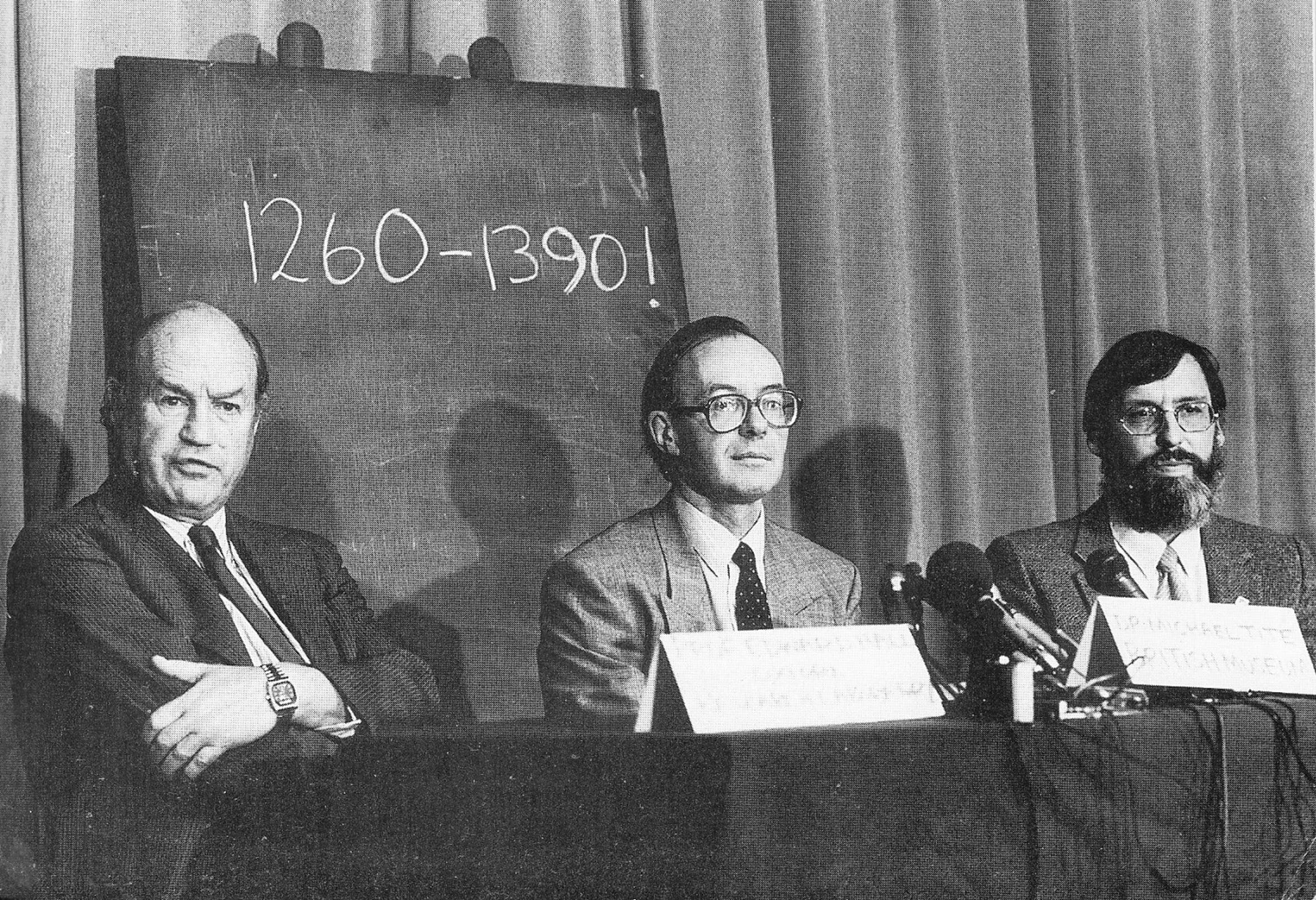
The results were published in the world’s leading multidisciplinary scientific journal, Nature. Conclusion: the cloth of the Shroud can be assigned with a confidence of 95 percent accuracy to a date between AD 1260 and 1390. In response, the Cardinal of Turin issued this statement:
I think that it is not the case that the Church should call these results into question. . . . I do not believe that we, the Church, should trouble ourselves to quibble with highly respected scientists who until this moment have merited only respect, and that it would not be responsible to subject them to censure solely because their results perhaps do not align with the arguments of the heart that one can carry within himself.[10]
Prof. Edward Hall (Oxford), Dr Michael Tite (British Museum) and Dr Robert Hedges (Oxford), announcing on 13 October 1988 in the British Museum, London, that the Shroud of Turin had been radiocarbon dated to 1260-1390.
Predictably, Shroud believers rejected the scientific findings, and started to criticize the Turin officials who had cut the material. The sample of cut-out cloth had been divided into parts, but no one had thought it necessary to write a report with the official description of the subdivisions and the weight of each fragment. There were, however, footage and many photographs, which would have been more than sufficient documentation on a typical occasion.
Others preferred to deny the validity of the method of radiocarbon dating as such. Sindonology had by now assumed the character of pseudoscience, and it is not surprising that it drew not only on the ruminations of the traditionalists but also on the war chest of creationist and fundamentalist literature. The method of radiocarbon dating is in fact used to date objects up to 50,000 years old, which stands in contradiction to the idea of those who believe that the world and the life in it were created only a few thousand years ago. What follows from such creationist convictions is the wholesale rejection of radiocarbon measurements, as well as the rejection of more popular scientific explanations of the origins of the universe, the existence of the dinosaurs, human evolution, and so on. Creationists and fundamentalist Christians had already prepared a whole list of alleged errors in the method of C14 dating, which was promptly copied in the books of sindonology. The alleged errors generally concern cases of objects of a known age that—so they claim—once dated, would yield a result that was off the mark by several hundred or even a thousand years.
But a careful evaluation of these so-called errors (which, however, are always cited in a generic and approximate manner) demonstrates that they do not exist, or that they go back to an earlier epoch in which the dating system had not yet been refined, or that they concern materials that do not lend themselves to radiocarbon dating but whose concentration of carbon 14 is measured for purposes other than those concerned with their age.
Other sindonologists preferred to discredit the C14 result by resorting to the notion of contamination of the samples. This pollution hypothesis claims that through the centuries the Shroud picked up deposits of more recent elements that would, therefore, contain a greater quantity of carbon; the radiocarbon dating, having been performed on a linen so contaminated, would thus have produced an erroneous result. Candidates for the role of pollutants are many: the smoke of the candles, the sweat of the hands that touched and held the fabric, the water used to extinguish the fire of 1532, the smog of the sky of Turin, pollens, oil, and more.
This approach gains traction among those who do not know how C14 dating works; in reality, however, it is untenable. Indeed, if a bit of smoke and sweat were enough to produce a false result, the measurement of carbon 14 would have already been declared useless and one could not understand why it is still used today to date thousands of archaeological and historical finds each year. The truth is rather that the system is not significantly sensitive to such pollutants.
Let us suppose that we were to admit that the fabric of the Shroud dates back to the 30s of the first century; we also admit that the Shroud has suffered exposure to strong pollution, for example, around 1532, the year of the Chambéry fire. To distort the C14 dating by up to 1,300 years, it would be necessary that for every 100 carbon atoms originally present in the cloth, another 500 dating to 1532 be added by contamination. In practice, in the Shroud, the amount of pollutant should be several times higher than the amount of the original linen, which is nonsense. Things get even worse if we assume that pollution did not happen all at the same time in the 16th century, but gradually over the previous centuries. In this case there is no mathematical possibility that pollution having occurred before the 14th century—even if tens of times higher than the quantity of the original material—could give a result of dating to the 14th century. It should be added, moreover, that all samples, before being radiocarbon dated, are subjected to energetic cleaning treatments able to remove the upper patina that has been in contact with outside contaminants; this procedure was also undertaken on the Shroud.
Those who believe that the Shroud was an object that could not be dated because it was subjected to numerous vicissitudes during the centuries evidently do not know that often C14 dating laboratories work on materials in much worse condition, whether coming from archaeological excavations or from places where they have been in contact with various contaminants. For a radiocarbon scientist, the Shroud is a very clean object.
A more curious variant of the pollution theory suggests that the radiocarbon dating was performed on a sample that was repaired with more recent threads. This would force us to imagine that two widely recognized textile experts who were present on the day of the sampling were unable to notice that they had cut a piece so repaired, despite the fact that they had observed the fabric carefully for hours; to distort the result by 13 centuries the threads employed in the mending would have had to have been more numerous than the threads of the part to be mended. To eliminate any doubt, in 2010 the University of Arizona reexamined a trace of fabric leftover from the radiocarbon dating in 1988, concluding:
We find no evidence for any coatings or dyeing of the linen. . . . Our sample was taken from the main part of the shroud. There is no evidence to the contrary. We find no evidence to support the contention that the 14C samples actually used for measurements are dyed, treated, or otherwise manipulated. Hence, we find no reason to dispute the original 14C measurements.[11]
Among the various attempts to invalidate the radiocarbon procedure, there is also one based on an examination of the statistical analysis of the laboratories that carried out the C14 tests. In general, it is interesting to note that, as Dominican Father Jean-Michel Maldamé wrote, “the disputes over the carbon 14 dating do not come from individuals who are competent in the subject of dating.”[12] Rather, a publication concerned with the use of radiocarbon in archaeology dedicates an entire chapter to the dating of the Shroud and to the various criticisms put forth by sindonologists to discredit it. The conclusion states:
For those whose interest in the Shroud is dominated by a belief in its religious or devotional function, it is virtually certain that any scientifically based evidence, including any additional 14C-based data, would not be compelling—unless, of course, it confirmed their beliefs.[13]
The final possibility raised against C14 dating falls within the sphere of the supernatural. As the radiocarbon present in the Shroud is excessive relative to the hopes of sindonologists, at the 1990 sindonology convention a German chemist, Eberhard Lindner, explained that the resurrection of Christ caused an emission of neutrons that enriched the Shroud with radioactive isotope C14.[14]
Miraculous explanations can be constructed with such scientific jargon but they have no chance of being scientifically tested (as there is no availability of bodies that have come to life from the dead and emit protons or neutrons). They are, however, extremely convenient because they are able to solve any problem without having to submit to the laws of nature.
With all of the available evidence it is rational to conclude—as the most astute historians had already established more than a century ago—that the Shroud of Turin is a 14th century relic and not the burial cloth of a man executed by crucifixion in the 1st century. Only the historiographical study of this object, accompanied by the scientific and critical examination of sindonological claims past and present, can provide us with a clearer picture of this relic’s real background.
Skeptic is a reader-supported publication. All monies go to the Skeptics Society, a 501(c)(3) nonprofit education organization. To receive new posts and support my work, consider becoming a free or paid subscriber.
References
[1] Nicolotti, Andrea. 2011. I Templari e la Sindone. Storia di un falso. Rome: Salerno editrice.
[2] Nicolotti, Andrea. 2014. From the Mandylion of Edessa to the Shroud of Turin: The Metamorphosis and Manipulation of a Legend. Leiden and Boston: Brill. https://doi.org/10.1163/9789004278523
[3] Nicolotti, Andrea. 2018. “La Sindone di Torino in quanto tessuto: analisi storica, tecnica, comparativa.” In Non solum circulatorum ludo similia. Miscellanea di studi sul Cristianesimo del primo millennio, ed. Valerio Polidori, 148-204. S.l.: Amazon KDP.
[4] Nicolotti, Andrea. 2019 [2015]. The Shroud of Turin. The History and Legends of the World’s Most Famous Relic. Transl. Jeffrey M. Hunt and R. A. Smith. Waco, TX: Baylor University Press. Originally published as Sindone. Storia e leggende di una reliquia controversa. Turin: Einaudi.
[5] Pomian, Krzysztof. 1990 [1987]. Collectors and curiosities. Paris and Venice, 1500-1800. Transl. Elizabeth Wiles-Portier. Cambridge: Polity Press. Originally published as Collectionneurs, amateurs et curieux. Paris, Venise: XVIe - XVIIIe siècle. Paris: Gallimard, 30.
[6] Ciccone, Gaetano, and Lina Sturmann. 2006. La sindone svelata e i quaranta sudari. Livorno: Donnino.
[7] Nicolotti, Andrea. 2016. “El Sudario de Oviedo: historia antigua y moderna.” Territorio, sociedad y poder 11: 89-111. https://doi.org/10.17811/tsp.11.2016.89-111
[8] Nicolotti, Andrea. 2017. “I Savoia e la Sindone di Cristo: aspetti politici e propagandistici.” In Cristo e il potere. Teologia, antropologia e politica, ed. Laura Andreani and Agostino Paravicini Bagliani, 247-281. Florence, SISMEL - Edizioni del Galluzzo; Cozzo, Paolo, Andrea Merlotti and Andrea Nicolotti (eds). 2019. The Shroud at Court: History, Usages, Places and Images of a Dynastic Relic. Leiden and Boston: Brill. https://doi.org/10.1163/9789004390508
[9] The judgment is cited by Wilcox, Robert. 1978. Shroud, 147-48. London: Corgi Book. According to Pierluigi Baima Bollone, Libby asked for a piece of cloth from the Shroud in order to date it (P. Baima Bollone, “Perché la Sindone non è stata datata con il radiocarbonio?,” Stampa sera, September 17, 1979, 5).
[10] Conference on October 13, 1988 (audio transcription).
[11] R.A. Freer-Watersand, A.J.T. Jull, “Investigating a Dated Piece of the Shroud of Turin,” Radiocarbon 52, no. 4 (2010): 1526.
[12] J.-M. Maldamé, “À propos du Linceul de Turin,” Connaître: Revue éditée par l’Association Foi et Culture Scientifique 11 (1999): 64.
[13] R.E. Taylorand, O.Bar-Yosef, Radiocarbon Dating: An Archaeological Perspective, 2nd ed. (Walnut Creek: Left Coast, 2014), 169.
[14] The idea had already occurred to T. Phillips, “Shroud Irradiated with Neutrons?,” Nature 337 (1989): 594.
Below is my column in the Hill on the most compelling grounds for an appeal in the Trump case after his conviction on 34 counts in Manhattan. There has been considerable criticism of the defense team and its strategy in the case, including some moves that may undermine appellate issues. However, after the instructions became public, I wrote a column that I thought the case was nearly un-winnable, even for those of us who previously saw a chance for a hung jury. Clarence Darrow would likely have lost with those instructions after the errors in the case by Judge Juan Merchan. At that point, it became a legal canned hunt. So the attention will now shift to the appellate courts. While it may be tough going initially in the New York court system for the former president, this case could well end up in the federal system and the United States Supreme Court. The thrill kill environment of last week may then dissipate as these glaring errors are presented in higher courts.
Here is the column:
The conviction of former President Donald Trump in Manhattan of 34 felonies produced citywide celebrations. This thrill-kill environment extended to the media, where former U.S. Attorney Harry Litman told MSNBC’s Nicolle Wallace that it was “majestic day” and “a day to celebrate.” When I left the courthouse after watching the verdict come in, I was floored by the celebrations outside by both the public and some of the media.
The celebrants would be wise to think twice before mounting this trophy kill on the political wall. The Trump trial is a target-rich environment for an appeal, with multiple layers of reversible error, in my view.
I am less convinced by suggestions that the case could be challenged on the inability of Trump receiving a fair trial in a district that voted roughly 90 percent against him. The problem was not the jury, but the prosecutors and the judge.
Some of the most compelling problems can be divided into four groups.
The Judge
Acting Supreme Court justice Juan Merchan was handpicked for this case rather than randomly selected. This is only the latest in a litany of Trump cases where Merchan has meted out tough rulings against Trump and his organization. With any other defendant, there would likely be outrage over his selection. Merchan donated to President Biden. Even though the state bar cleared that violation based on the small size of the contribution, it later stressed that no such contributions were appropriate for a judge. We learned later that Merchan has contributed to a group to stop the GOP and Trump. Merchan’s daughter is also a Democratic organizer who has helped raise millions against Trump and the GOP and for the Democrats.
To his credit, CNN legal analyst Elie Honig has previously said that this case was legally dubious, uniquely targeted Trump and could not succeed outside of an anti-Trump district. On the judge, he recently challenged critics on the fairness of assigning a Biden donor who has earmarked donations for “resisting the Republican Party and Donald Trump’s radical right-wing legacy.” He asked “Would folks have been just fine with the judge staying on the case if he had donated a couple bucks to “Re-elect Donald Trump, MAGA forever!”? “Absolutely not.”
What is equally disturbing is the failure of Merchan to protect the rights of the defendant and what even critics admit were distinctly pro-prosecution rulings in the trial. It is not just the appearance of a conflict with Judge Merchan but a record of highly biased decisions. In watching Merchan in the courtroom, I was shocked by his rulings as at times incomprehensible and conflicted.
The Charges
A leading threshold issue will be the decision to allow Manhattan District Attorney Alvin Bragg to effectively try Trump for violations of federal law. The Justice Department declined any criminal charges against Trump under federal election law over the alleged “hush money” payments. The Federal Election Commission likewise found no basis for a civil fine. With no federal prosecution, Bragg decided to use an unprecedented criminal theory not only to zap a dead misdemeanor into life (after the expiration of the statute of limitation) but to allow him to try violations of not only federal election law but also federal taxation violations. In other words, the Justice Department would not prosecute federal violations, so Bragg effectively did it in state court.
Even when closing arguments were given, analysts on various networks admitted that they were unclear about what Bragg was alleging. The indictment claimed a violation under New York’s election law 17-152 that the falsification of business records were committed to further another crime as an unlawful means to influence the election. However, in a maddeningly circular theory, that other crime could be the falsification of business records. It could also be violations of federal election and taxation laws, which Trump was never charged with, let alone convicted of.
The Evidence
Judge Merchan allowed a torrent of immaterial and prejudicial evidence to be introduced into the trial by the prosecution. That included testimony from porn actress Stormy Daniels that went into details about having sex with Trump. She included a clear suggestion that Trump raped her. After this utterly disgraceful testimony, Merchan expressed regret but actually blamed the defense counsel, despite their prior objections to the testimony. He had previously chastised counsel for making continued objections, but now he criticized them for not continuing to make objections.
Merchan was equally conflicted in his other orders. For example, he allowed the prosecutors to introduce the plea agreement of Michael Cohen to federal election violations as well as the non-prosecution agreement of David Pecker on such violations. However, it was allowed only for the purposes of credibility and context. He issued an instruction that the jury could not consider the plea or the agreement to establish or impute the guilt of Trump.
The prosecutors then proceeded to expressly state that it was “a fact” that federal election violations occurred in this case and that Trump ordered those violations. They also solicited such statements from witnesses like Cohen. Merchan overruled the objections that the prosecutors were eviscerating his instruction. Merchan also barred the use of a legal expert, former FEC Chair Brad Smith, who was prepared to testify that such payments cannot be viewed as federal election violations and would not affect the election even if they were considered contributions, since they would not even have had to be reported until after the election.
Merchan is likely to be upheld in denying the expert, since the court retains the authority to state what the law is to the jury. The problem is that Merchan failed to do so. Worse still, he allowed the jury to hear the opposite in the repeated false claim that these payments were campaign contributions.
The Instructions
Even with all of the reversible errors, some of us held out hope that there might be a hung jury. That hope was largely smashed by Merchan in his instructions to the jury. The court largely used standard instructions in a case that was anything but standard. However, the instruction also allowed for doubt as to what the jury would ultimately find. When the verdict came in, we were still unsure what Trump was convicted of.
Merchan allowed the jury to find that the secondary offense was any of the three vaguely defined options. Even on the jury form, they did not have to specify which of the crimes were found. Under Merchan’s instruction, the jury could have split 4-4-4 on what occurred in the case. They could have seen a conspiracy to conceal a federal election violation, falsification of business records or taxation violations. We will never know. Worse yet, Trump will never know.
The Supreme Court has repeatedly emphasized that the requirement of unanimity in criminal convictions is sacrosanct in our system. While there was unanimity that the business records were falsified to hide or further a second crime, there was no express finding of what that crime may have been. In some ways, Trump may have been fortunate by Merchan’s cavalier approach. Given that the jury convicted Trump across the board, they might have found all of three secondary crimes. The verdict form never asked for such specificity.
These are just a few of the appellate issues. There are other challenges, including but not limited to due process violations on the lack of specificity in the indictment, vagueness of the underlying state law and the lack of evidentiary foundation for key defenses like “the legitimate press function.” They are the reason why many of us view this case is likely to be reversed in either the state or federal systems. None of that is likely to dampen the thrill in this kill in Manhattan.
But if Biden wins the election before this conviction is overturned, history’s judgment will be deafening.
Jonathan Turley is the J.B. and Maurice C. Shapiro Professor of Public Interest Law at the George Washington University Law School.
Don’t let ANYONE on the Left tell you this entire Trump trial is not political … not one. And if they insist Biden has nothing to do with it? Yeah, show them this freakin’ video.
Is he confused?
Is he giving something away?
Is he evil?
Maybe all three but the smirk is very revealing.
Great moments in optics:
The Trump campaign quickly turned Biden’s Trunalimunumaprzure-cum-Kinsley Gaffe moment into a new ad:
Trump campaign already out with an ad on Biden’s Creepy Smirk
Visitors to the Shendiaoshan Wild Animal Nature Reserve in Weihai City, China, caught a truly great moment on camera after a toddler dropped his croc into the chimpanzee enclosure.
“Democracy is on the ballot.” That mantra of President Joe Biden and other Democrats has suggested that “this may be our last election” if the Republicans win in 2024. A few of us have noted that the Democrats seem more keen on claiming the mantle of the defenders of democracy than actually practicing it. Democrats have sought to disqualify Donald Trump and dozens of Republicans from ballots; block third party candidates, censor and blacklist of those with opposing views; and weaponize the legal system against their opponents. Most recently, in California, democracy is truly on the ballot and the Democrats are on the wrong side.
California has always prided itself on the ability of citizens to vote on changes in the law directly through referenda and ballot measures. That is precisely what citizens are attempting to do with a measure that would require voter approval of any tax increase, including a two-thirds vote for some local taxes. It is called the Taxpayer Protection Act and it is a duly qualified statewide ballot measure slated for the November 2024 ballot.
The state Democrats are apoplectic over the prospect of citizen control over revenue and taxes. What was a quaint element of democratic empowerment is now challenging a core vehicle of Democratic power. So Gov. Gavin Newsom and other Democratic leaders have taken the issue to the state Supreme Court to demand that citizens be denied the right to decide the issue.
In oral arguments, the attorney supporting the challenge explained to the justices that citizens are simply not equipped to deal with the complexities of taxation and should not be allowed to render such a decision.
In a prior decision, Associate Justice Mariano-Florentino Cuéllar wrote that “Whether the context involves taxation or not, all of these cases underscore how courts preserve and liberally construe the public’s statewide and local initiative power. Indeed, we resolve doubts about the scope of the initiative power in its favor whenever possible and we narrowly construe provisions that would burden or limit the exercise of that power.”
Half of the Court seemed to be inclined to deny the public the right to decide the question.
The Court, however, may wait until after the election to render a decision on the limits of democracy in California.
Action painting in Pollock style (Michael Phillip)
Below is my column in the Hill on the approaching closing arguments in the Trump trial. Manhattan District Attorney Alvin Bragg appears to be launching his own school of abstract legal work in the Trump indictment. The key is to avoid any objective meaning.
Here is the column:
Abstract artist Jackson Pollock once said that his paintings have no objective meaning, so the best way for people to enjoy them is to stop looking for it.
For many of us, Manhattan District Attorney Alvin Bragg has created a new school of abstract law where there is no need for objective meaning. The jury is simply supposed to enjoy it for what it is: a chance to convict Donald Trump.
Pollock was famous for his painting drips on large canvases. Bragg has achieved the same effect by regenerating a dead misdemeanor on falsifying business records as 34 felony counts. To achieve that extraordinary goal, he has alleged that the document violations (which expired long ago under the statute of limitations) were committed to hide some other crime.
Originally, Bragg vaguely referenced four crimes and there have been months of confusion as to what he was specifically alleging as his criminal theories. Even legal analysts on CNN and MSNBC have continued to question the specific allegations against Trump as we head into closing arguments.
As it stands, there are three crimes that have been referenced by prosecutors: state and federal election violations and taxation violations.
Bragg’s legal vision for non-objective indictments was greatly advanced by Judge Juan Merchan, who will allow the jury to reach different rulings on what crime is actually evident in Bragg’s paint splatters.
Merchan has ruled that the jurors can disagree on what actually occurred in terms of the second crime. This means there could be three groups of four jurors, with one believing that there was a conspiracy to conceal a state election violation, another believing there was a federal election violation (which Bragg cannot enforce), and a third believing there was a tax violation, respectively. Nonetheless, Merchan will treat that as a unanimous verdict.
In other words, they could look at the indictment and see vastly different shapes, but still send Trump to prison on their interpretations.
Moreover, Michael Cohen is the sole witness even to address the elements of any of these crimes. Cohen is a convicted serial perjurer and disbarred attorney who appears to have lied again during the trial. Even if they consider his testimony, there is no direct corroboration in evidence on Trump’s intent or knowledge. As a result, the prosecutors will rely on circumstantial evidence to support whichever interpretation the jurors will buy.
Faced with charges that can mean different things to different jurors, Trump’s team will have to focus on the spaces between the paint drips; the canvas itself.
All of this case is based on the payment for a non-disclosure agreement that is perfectly legal and indeed common in business and politics. The Trump team needs to stop dancing around the NDA.
The jury likely believes that Trump knew of the NDA and supported it. The defense has to emphasize the testimony of David Pecker, the former publisher of the National Inquirer, that he killed stories for a variety of celebrities and politicians, including Rahm Emmanuel and Arnold Schwarzenegger. He also said that he killed stories for Trump for years before he even thought of running for president.
They need to emphasize the testimony of multiple witnesses that Trump seemed to want to avoid embarrassment to his family. He was also the host of a popular television show and an international businessman. The payment of a couple hundred thousand to kill stories is considered a cost of doing business for most celebrities, particularly those who have television contracts with provisions allowing cancellation for scandals.
In the instructions, the court will tell the jurors that payments cannot be campaign contributions if they would have been made anyway regardless of the campaign.
They also need to point out other gaps. It was not Trump who listed payments as legal expenses or retainer payments. Witnesses said that payments to lawyers are routinely recorded as legal expenses. Indeed, it is not clear how the money should have been denominated but the decision was being made by others in the Trump organization and by Cohen himself.
Moreover, on the characterization of payments as part of a “retainer,” the other party to that characterization was former Trump Organization CFO Allen Weisselberg. He is currently in prison in New York, but was not called by the prosecution. The prosecutors elected to rely entirely on Michael Cohen with various witnesses, including Cohen, referencing Weisselberg’s decision on how to pay the money.
That made the canvas itself largely Michael Cohen. All of this is held together by a witness who admitted that he has lied to banks, Congress, prosecutors, business associates, and virtually every creature that has ever walked or crawled on the face of the Earth. He also lied in front of the jury about the critical call where he said that he told Trump about the NDA payment.
The defense showed that that 96-second-long call was to Trump’s bodyguard, Keith Schiller, in late October 2016. It was preceded and followed by text messages that indicated that their conversation was actually about a teenager harassing Cohen.
Moreover, Cohen admitted to making millions by bashing Trump, and that he has a personal interest in his conviction.
You can throw paint on Cohen all day, but it will not cover up the fact that he is a pathological liar and grifter.
That is why I still believe that a hung jury might even be the most likely possibility. That may change when we see Judge Merchan’s final instructions. However, the only thing worse in New York than being a Trump supporter is being a chump. To rely solely on Cohen and not even call someone like Weisselberg is to play these jurors as chumps.
Pollock was doing more than just throwing paint at a canvas. As Pablo Picasso said, “there is no abstract art. You must always start with something. Afterward you can remove all traces of reality.” Bragg started with nothing and sold it as a legal abstraction.
Jonathan Turley is the J.B. and Maurice C. Shapiro Professor of Public Interest Law at the George Washington University Law School.
There’s been renewed debate around Bryan Caplan’s The Case Against Education recently, so I want to discuss one way I think about this question.
Education isn’t just about facts. But it’s partly about facts. Facts are easy to measure, and they’re a useful signpost for deeper understanding. If someone has never heard of Chaucer, Dickens, Melville, Twain, or Joyce, they probably haven’t learned to appreciate great literature. If someone can’t identify Washington, Lincoln, or either Roosevelt, they probably don’t understand the ebb and flow of American history. So what facts does the average American know?
In a 1999 poll, only 66% of Americans age 18-29 knew that the US won independence from Britain (as opposed to some other country). About 47% of Americans can name all three branches of government (executive, legislative, and judicial). 37% know the closest planet to the sun (Mercury). 58% know which gas causes most global warming (carbon dioxide). 44% know Auschwitz was the site of a concentration camp. Fewer than 50% (ie worse than chance) can correctly answer a true-false question about whether electrons are bigger than atoms.
These results are scattered across many polls, which makes them vulnerable to publication bias; I can’t find a good unified general knowledge survey of the whole population. But there’s a great survey of university students. Keeping in mind that this is a highly selected, extra-smart population, here are some data points:
85% know who wrote Romeo and Juliet (Shakespeare)
56% know the biggest planet (Jupiter)
44% know who rode on horseback in 1775 to warn that the British were coming (Paul Revere)
33% know what organ produces insulin (pancreas)
31% know the capital of Russia (Moscow)
30% know who discovered the Theory of Relativity (Einstein)
19% know what mountain range contains Mt. Everest (Himalayas)
19% know who wrote 1984 (George Orwell)
16% know what word the raven says in Poe’s “The Raven” (“Nevermore!”)
10% know the captain’s name in Moby Dick (Ahab)
7% know who discovered, in 1543, that the Earth orbits the sun (Copernicus)
4% know what Chinese religion was founded by Lao Tse (Taoism)
<1% know what city the general Hannibal was from (Carthage)
Remember, these are university students, so the average person’s performance is worse.
Most of these are the kinds of facts that I would expect school to teach people. Some of them (eg the branches of government) are the foundations of whole subjects, facts that I would expect to get reviewed and built upon many times during a student’s career. If most people don’t remember them, there seems to be little hope that they remember basically anything from school. So what’s school even doing?
Maybe school is why at least a majority of people know the very basics - like that the US won independence from Britain, or that Shakespeare wrote Romeo and Juliet? I’m not sure this is true. Here are some other questions that got approximately the same level of correct answers as “Shakespeare wrote Romeo and Juliet”:
What is the name of the rubber object hit by hockey players? (Puck, 89%)
What is the name of the comic strip character who eats spinach to increase his strength? (Popeye, 82% correct)
What is the name of Dorothy’s dog in The Wizard of Oz? (Toto, 80% correct)
I don’t think any of these are taught in school. They’re absorbed by cultural osmosis. It seems equally likely that Romeo and Juliet could be absorbed the same way. Wasn’t there an Academy-Award-winning movie about Shakespeare writing Romeo and Juliet just a decade or so before this study came out? Sure, 19% of people know that Orwell wrote 1984 - but how many people know the 1984 Calendar Meme, or the “1984 was not an instruction manual!” joke, or have heard of the reality show Big Brother? Nobody learned those in school, so maybe they learned Orwell’s name the same place they learned about the other 1984-related stuff.
Okay, so school probably doesn’t do a great job teaching facts. But maybe it could still teach skills, right?
According to tests, fewer than 10% of Americans are “proficient” at PIIAC-defined numeracy skills, even though in theory you need to know algebra to graduate from most public schools.
I took a year of Spanish in middle school, and I cannot speak Spanish today to save my life; that year was completely wasted. Sure, I know things like “Hola!” and “Adios!”, but I also know things like “gringo” and “Yo quiero Taco Bell” - this is just cultural osmosis again.
So it seems most people forget almost all of what they learn in school, whether we’re talking about facts or skills. The remaining pro-school argument would be that even if they forget every specific thing, they retain some kind of scaffolding that makes it easier for them to learn and understand new things in the future; ie they keep some sort of overall concept of learning. This is a pretty god-of-the-gaps-ish hypothesis, and counterbalanced by all the kids who said school made them hate learning, or made them unable to learn in a non-fake/rote way, or that they can’t read books now because they’re too traumatized from years of being forced to read books that they hate.
II.
Step back a bit. Why should any of this be true? That is:
Why would most students forget things that schools teach many times?
Why would they remember it when it’s learned through cultural osmosis (eg Popeye, “yo quiero Taco Bell”)?
Don’t children do okay on standardized tests? Why shouldn’t they remember that information later?
If you can forget something that a professional teacher teaches you, and which you study intently for a high-stakes test on, then how do you remember anything at all?
For our purposes, it’s a bit stylized - what does it mean to remember 20% of your American History lesson? The point is, you remember much less after some period of time.
The forgetting curve focuses on abstract, unconnected emotionless knowledge - you’ll remember the name of the man who killed your family for longer than it predicts - but it’s an okay approximation for the sorts of things you learn in school. I can’t find anything that investigates longer than a month, but probably after ten years or something it’s really low. So if you poll an adult on electrons ten years after their last high school science class, they’ll remember nothing.
So how come anyone remembers anything at all? Here’s the forgetting curve’s more optimistic cousin, the spaced repetition curve:
Source here. Note that spaced repetition doesn’t necessarily do any better than fixed repetition; see here for more.
The optimistic take is that presumably you study the things you learn in class. If you’re lucky, your teacher next year reviews on them and builds on them. So you get dozens of well-spaced reviews, until you reach a point where it’s with you for life.
Okay, now we’re back to not understanding why only 19% of people know about the Himalayas.
I can’t find any great research for the forgetting and repetition curves over years or decades, but one spaced repetition site recommends the following schedule:
Day 0: Initial learning
Day 1: First repetition within 24 hours
Day 6: Second repetition in about one week
Day 14: Third repetition in about two weeks
Day 30: Fourth repetition in about a month
Day 66: Fifth repetition in about two months
Day 150: Sixth repetition in about five months
Day 360: Seventh repetition in about a year
7 repetitions usually suffice to remember information for life. Also notice that after the second repetition, the next interval can be calculated by multiplying the previous interval with a factor of around 2.2. This number is called the ease factor, and depending on your implementation, it is usually set between 2 and 2.5.
So either people didn’t get 7 optimally-spaced repetitions of the Himalayas in school, or this very optimistic website is wrong and seven repetitions don’t suffice to remember information “for life”. I’m betting it’s the latter - for example, I’ve forgotten the names of some of my college professors, even though I would have seen them almost daily for a year.
Suppose that no reasonable amount of repetition is enough to remember an abstract fact of this sort for more than a decade. Then it’s not surprising that people forget most of the facts they learn in school.
But suppose that once you learn something to a school-test-passing level, approximately once-yearly repetition is enough to make you remember it. That would explain why we remember things like Shakespeare’s name - just going about our everyday lives, we probably hear him talked about more than once a year.
This was my time for this year. Was it worth it?
How strong is this cultural repetition effect? In order to settle a bet, I asked ACX survey respondents whether they had thought about the Roman Empire in the past 24 hours. About 45% had done so. Although we can’t make any formal estimates, it seems most likely that most people in this distribution think about it at least once a week, and overwhelmingly many think about it at least once a month. So no matter how bad your history teacher was, you will never forget the Roman Empire.
(also, in the two weeks this post has been sitting in my draft folder, I’ve spotted three references to George Orwell, just while going about my everyday life.)
How often do people think about the Songhai Empire? I definitely learned about this one in 7th grade - it was part of the “It’s Very Important That All Of You Know That Africa’s History Existed And Was Very Glorious, Please Believe This” unit. But I forgot about its existence until it got featured in one of the Civ games - I think Civ V. After that I guess I played enough Civilization that it got imprinted in my memory for at least another few years. I think this is a better explanation for why most people remember things about Rome but not Songhai than how many hours their history teacher spent talking about each.
In this model, the reason smarter people remember more stuff than duller people is partly a differently-shaped forgetting curve. But mostly it’s that intellectuals put themselves in situations where they hear about things more often. If you remember that George Orwell wrote 1984, it’s probably because you read the newspaper or blogs or whatever and hear some government program described as “Orwellian”. But if you’re watching TikToks on your cell phone all day, maybe you don’t hear that, and then you join the 81% of college students who have forgotten that name.
(full list of things I remember about 1984: the author was George Orwell. There were three countries called Eurasia, Eastasia, and Oceania. Britain was part of Eurasia and called “Airstrip One”. Every so often the countries would shift alliances, and the government would lie and say “we have always been at war with Eastasia”. There was an evil totalitarian government with a possibly-fake leader named Big Brother, and a possibly-fake rebel with a Jewish-sounding name. It divided people into Inner Party, Outer Party, and proles. There was a language called “Newspeak” with neologisms like “doubleplusgood” that made it hard to question authority. There were characters named Winston and Julia. Winston sort of tried to be against the evil government; he got tortured through some horrifying thing involving rats; at the end he said he loved Big Brother and 2+2=5. Something was weird about Julia and maybe she was an agent of the evil government or something. I think these are all facts that I might encounter in the wild once every few years.)
III.
This model makes it hard for school to be useful. If school teaches you some fact, then either you’ll never encounter it again after school, in which case you’ll quickly forget it. Or you will encounter it again after school, in which case school was unnecessary; you would have learned it anyway.
Can we rescue some kind of value for school? One option might be that school starts a virtuous cycle by helping you learn something long enough that you can put yourself in situations where you can re-encounter it in the future. For example, consider reading. If you learn to read, you’ll probably read every day. Then you’ll remember how to read. But if you never learn to read, you might never try and never learn.
(this example is somewhat frustrated by the fact that many middle-class children learn to read before entering school - apparently you’ve got to teach them at two to keep up with the Joneses now. But at least it probably helps the lower-class kids.)
The same could be true of some kinds of math - even if only 10% of Americans have basic numeracy as defined by PIIAC, there are probably some kinds of sub-basic numeracy, like simple addition, which most people remember because they learned it in school and then kept using it forever.
Okay, so that maybe justifies up to fourth grade. Are there any examples from later schooling that could work like this?
You could imagine some equivalent where, for example, you need to know a certain amount about Roman history before you can enjoy books, movies, podcasts, etc on Roman history. But then once you know that amount, it’s a ratchet and you’ll keep learning more and reinforcing that knowledge. I think this is mostly false, considering how many things that people don’t learn about in school - eg coding, or cooking, or the history of their favorite fantasy world, or so on - they still manage to learn. Still, it’s a theory that you could have.
Otherwise - aside from being a place to warehouse children while their parents are away - I’m not sure how you rescue the usefulness of most schooling.
“Trump’s repeated mischaracterization of these facts in widely distributed messages as an attempt to kill him, his family, and Secret Service agents has endangered law enforcement officers involved in the investigation and prosecution of this case and threatened the integrity of these proceedings,” prosecutors told Cannon. “A restriction prohibiting future similar statements does not restrict legitimate speech.”
According to prosecutors, there is a sting operation video showing Ma counting $50,000 given to him by an undercover FBI agent posing as a Chinese intelligence officer.
TEETH FOR THE FOIA: No one has ever gone to jail for violating the federal Freedom of Information Act (FOIA). And we wonder why politicians and career bureaucrats alike thumb their noses at the public’s right to know?
Western intellectuals usually supposed that Russian dissidents might suffer the sort of punishment that in their own countries is reserved for dangerous criminals. At worst, Westerners pictured conditions like those in tsarist Russia, long considered the model of an oppressive state. That is why Solzhenitsyn devotes so many passages to contrasting what passed for tyranny in nineteenth-century Russia with ordinary Soviet conditions.
Begin with numbers. Solzhenitsyn instructs: from 1876 to 1904—a period of mass strikes, peasant revolts, and terrorism claiming the lives of Tsar Alexander II and other top officials—“486 people were executed; in other words, about seventeen people per year for the whole country,” a figure that includes “ordinary, nonpolitical criminals!” During the 1905 revolution and its suppression, “executions rocketed upward, astounding Russian imaginations, calling forth tears from Tolstoy and indignation from [the writer Vladimir] Korolenko, and many, many others: from 1905 through 1908 2,200 persons were executed,” a number contemporaries described as an “epidemic of executions.”
By contrast, Soviet judicial killings—whether by shooting, forced starvation, or hard labor at forty degrees below zero—numbered in the tens of millions. Crucially, condemnation did not require individual guilt. As early as 1918, Solzhenitsyn points out, the Cheka (secret police) leader M. I. Latsis instructed revolutionary tribunals dispensing summary justice to disregard personal guilt or innocence and just ascertain the prisoner’s class origin: this “must determine the fate of the accused. That is the meaning of the Red Terror.”
On this basis, over five million peasants (classed as “kulaks,” supposedly better off than their neighbors) were forcibly exiled to completely unsettled wastelands with no food or tools, where they were left to die. The same punishment later befell whole nationalities deemed potentially disloyal (such as ethnic Germans, Chechens, and Crimean Tatars) or dangerous because of the possibility of receiving subversive support from a foreign power (as in the case of Koreans and Poles). “The liquidation of the kulaks as a class” was followed by the deliberate starvation of millions of peasants. All food for a large area of what is now Ukraine was requisitioned, and even fishing in the rivers was prohibited, so that over the next few months inhabitants starved to death. Idealistic young Bolsheviks from the capital enforced the famine. In total, Stalin’s war on the countryside claimed more than ten million lives. As Solzhenitsyn makes clear, this crime is not nearly as well known among intellectuals as the Great Purges, which claimed fewer victims, because many purge victims were themselves intellectuals.
Arrests also took place by quotas assigned to local secret-police offices, which, if they knew what was good for them, petitioned to arrest still more. After World War II, captured Russian soldiers in German slave-labor camps were promptly transferred to Russian ones, as was anyone who had seen something of the Western world. Even soldiers who had fought their way out of German encirclement were arrested as traitors, simply because they had been behind German lines. Still more shocking, the Allies—who could not imagine why people would not want to return to their homeland—forcibly repatriated, often at bayonet point, over a million fugitives, some of whom committed suicide rather than face what they knew awaited them.
In his introduction Gary Saul Morson writes:
When Aleksandr Solzhenitsyn’s The Gulag Archipelago: An Experiment in Literary Investigation appeared in 1973, its impact, the author recalled, was immediate: “Like matter enveloped by antimatter, it exploded instantaneously!” The first translations into Western languages in 1974—just fifty years ago—proved almost as sensational. No longer was it so easy to cherish a sentimental attachment to communism and the USSR. In France, where Marxism had remained fashionable, the book changed the course of intellectual life, and in America it helped counter the New Left celebration of Mao, Castro, and other disciples of Marx, Lenin, and Stalin.
Solzhenitsyn’s tour of the United States in 1975 was like an enormous funeral procession that no one wanted to see. The White House wanted no part of him. The New York Times sought to bury his two major’ speeches, and only the moral pressure of a lone Times writer, Hilton Kramer, brought them any appreciable coverage at all. The major television networks declined to run the Solzhenitsyn interview that created such a stir in England earlier this year (it ran on some of the educational channels).
And the literary world in general ignored him completely. In the huge unseen coffin that Solzhenitsyn towed behind him were not only the souls of the zeks who died in the Archipelago. No, the heartless bastard had also chucked in one of the last great visions: the intellectual as the Stainless Steel Socialist glistening against the bone heap of capitalism in its final, brutal, fascist phase. There was a bone heap, all right, and it was grisly beyond belief, but socialism, had created it.

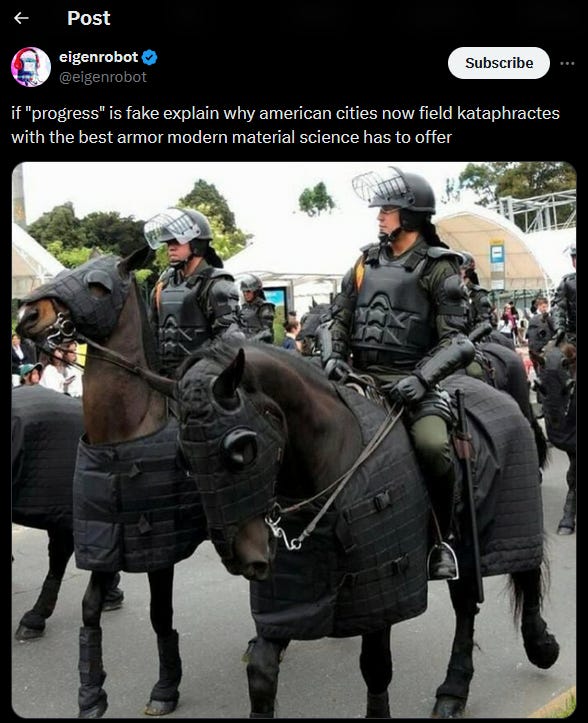




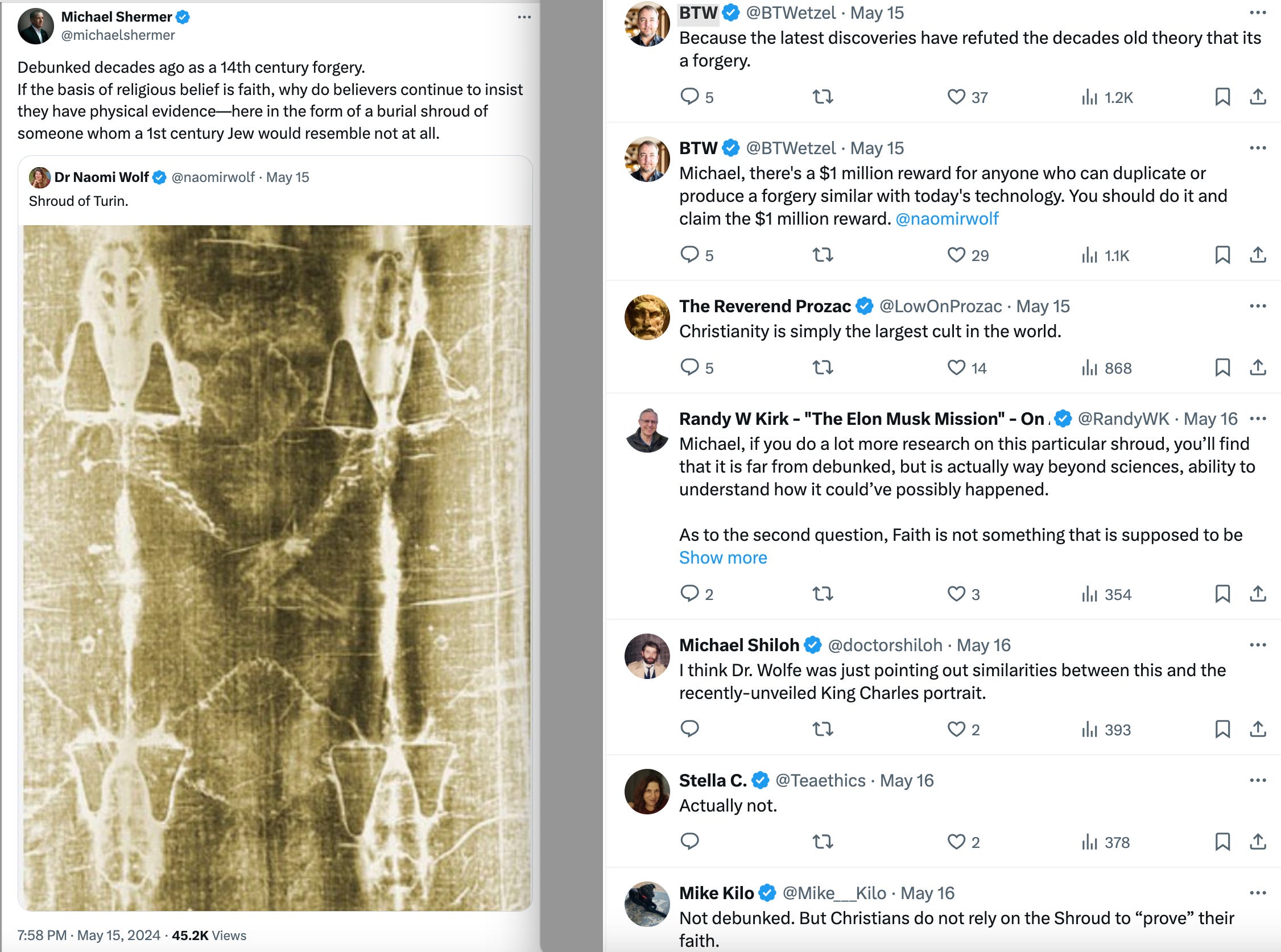
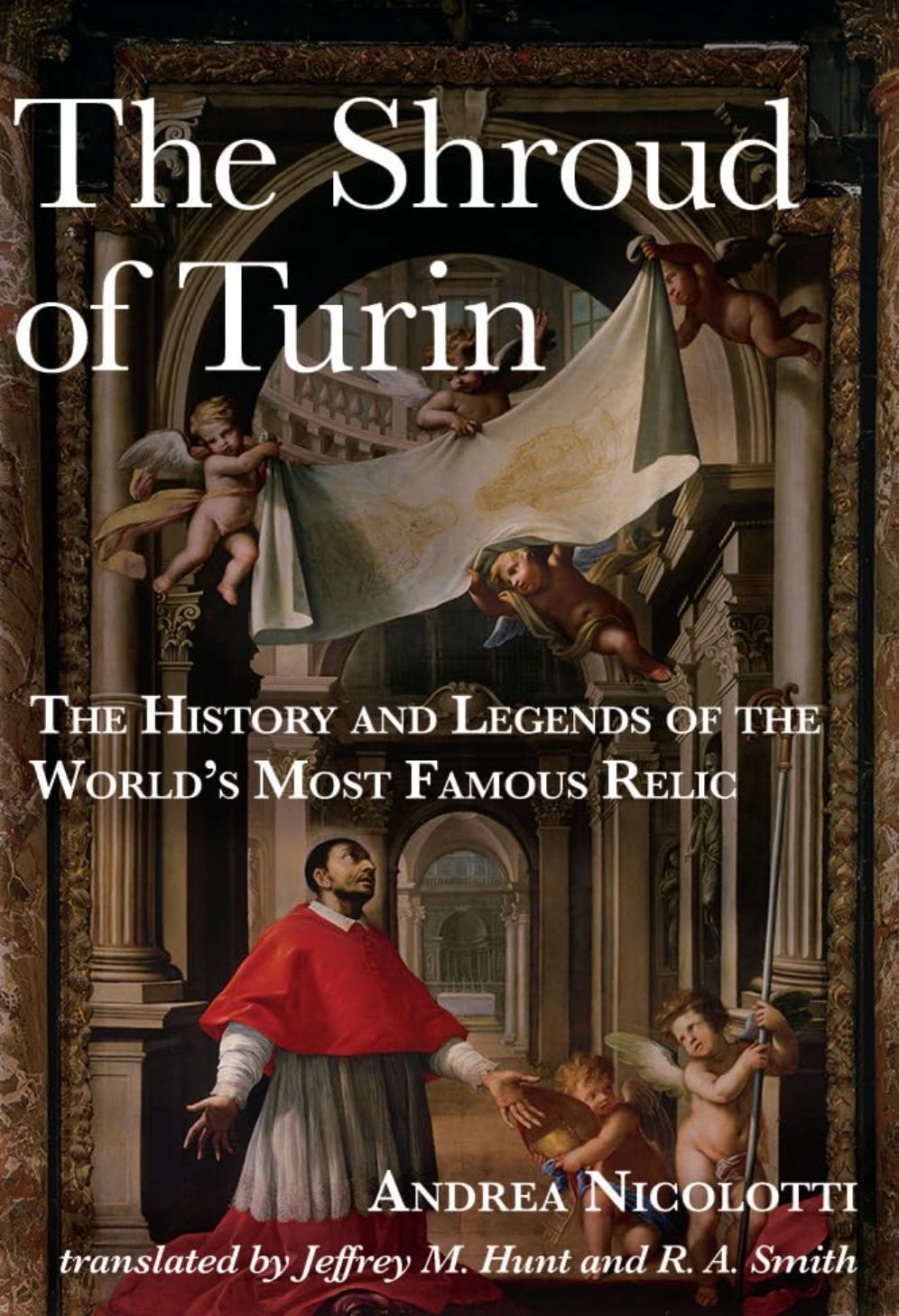

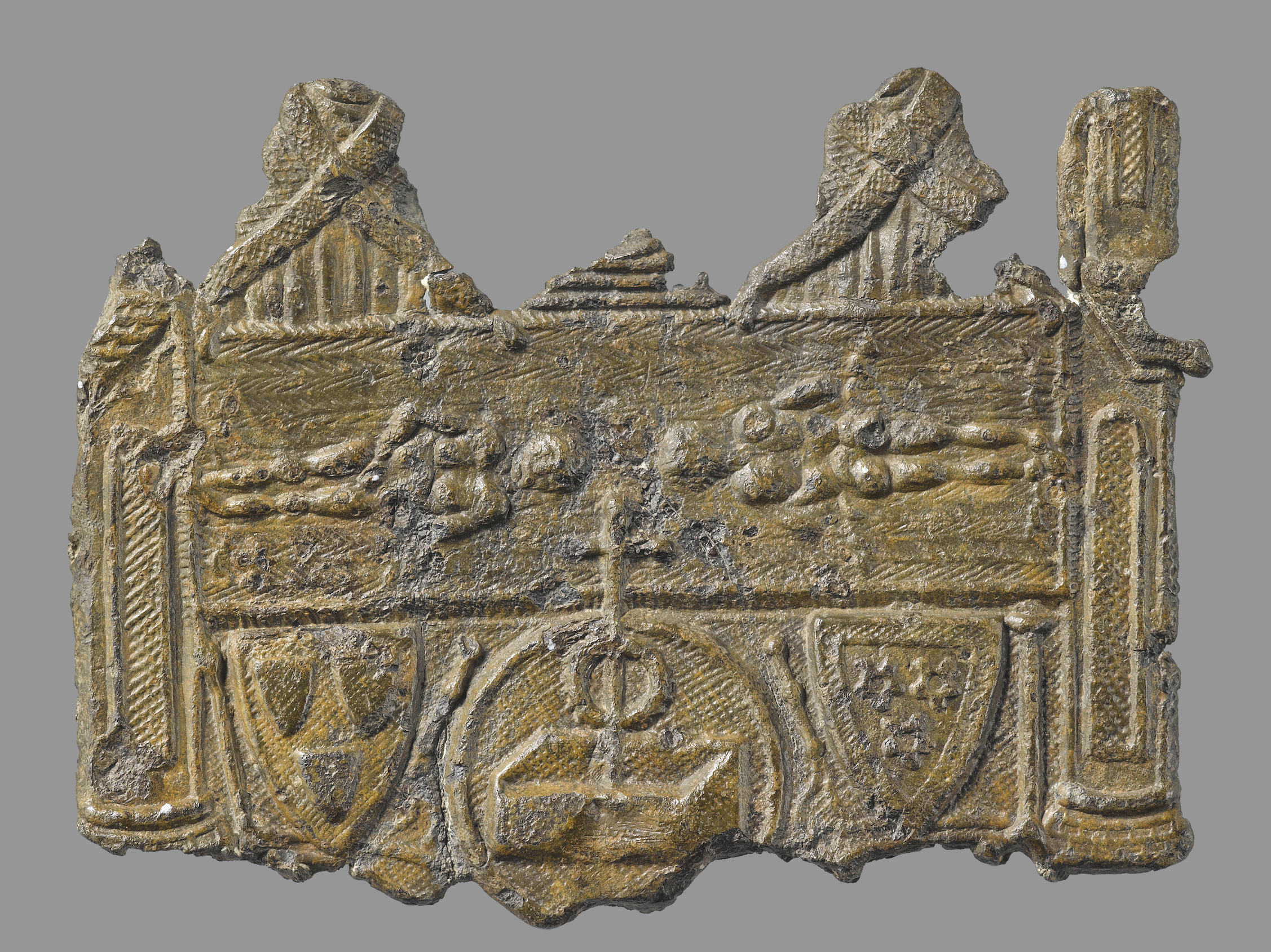
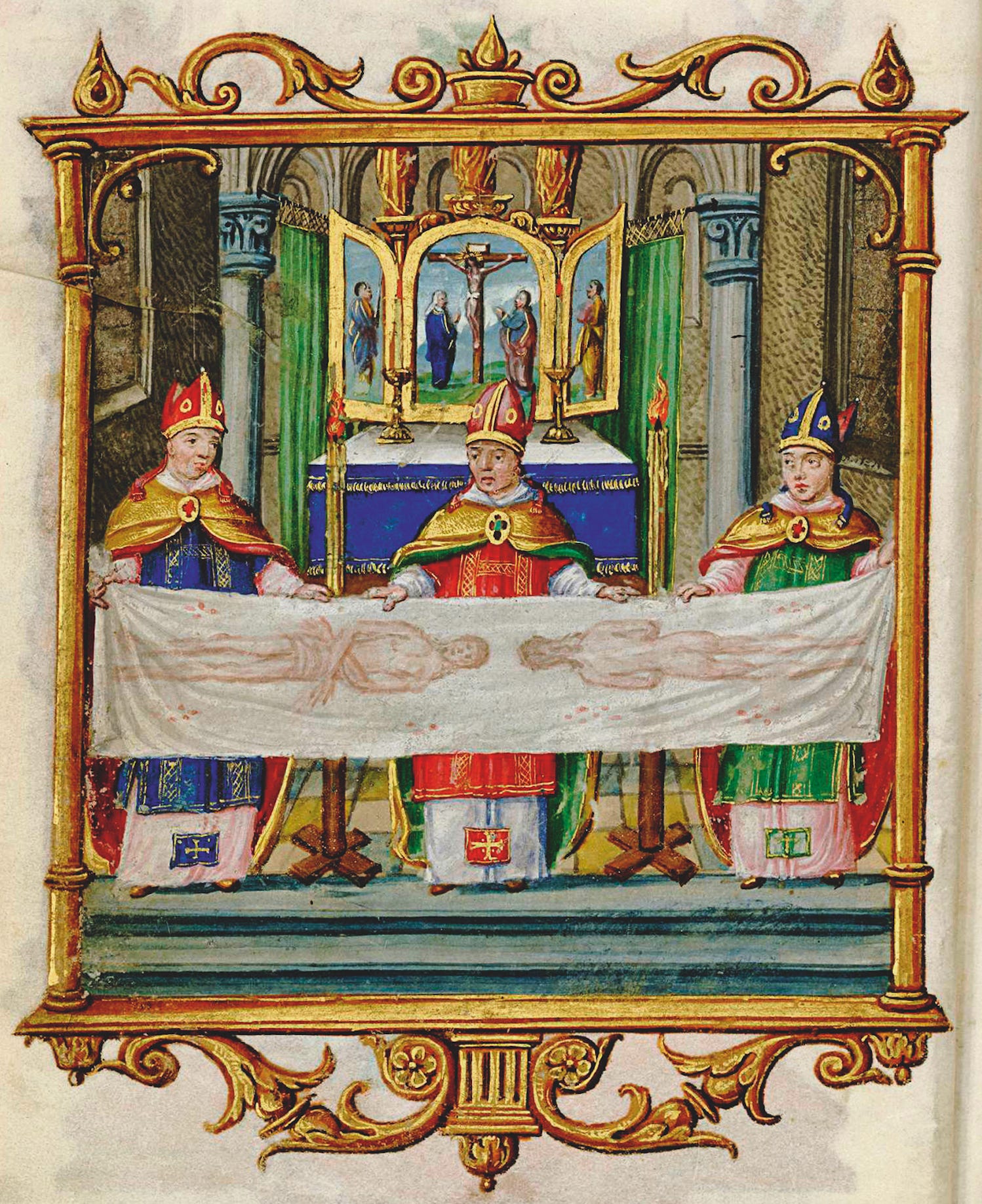
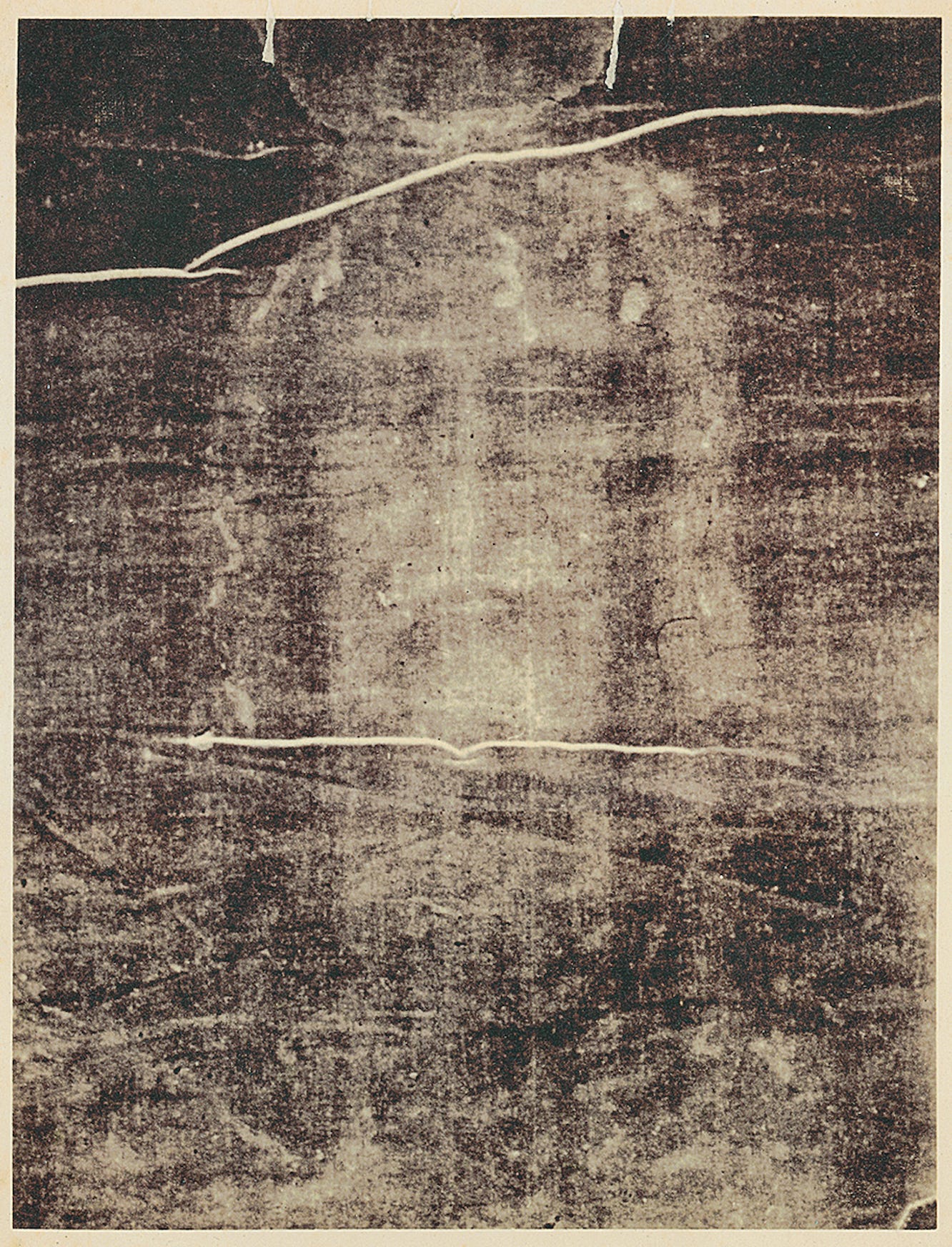
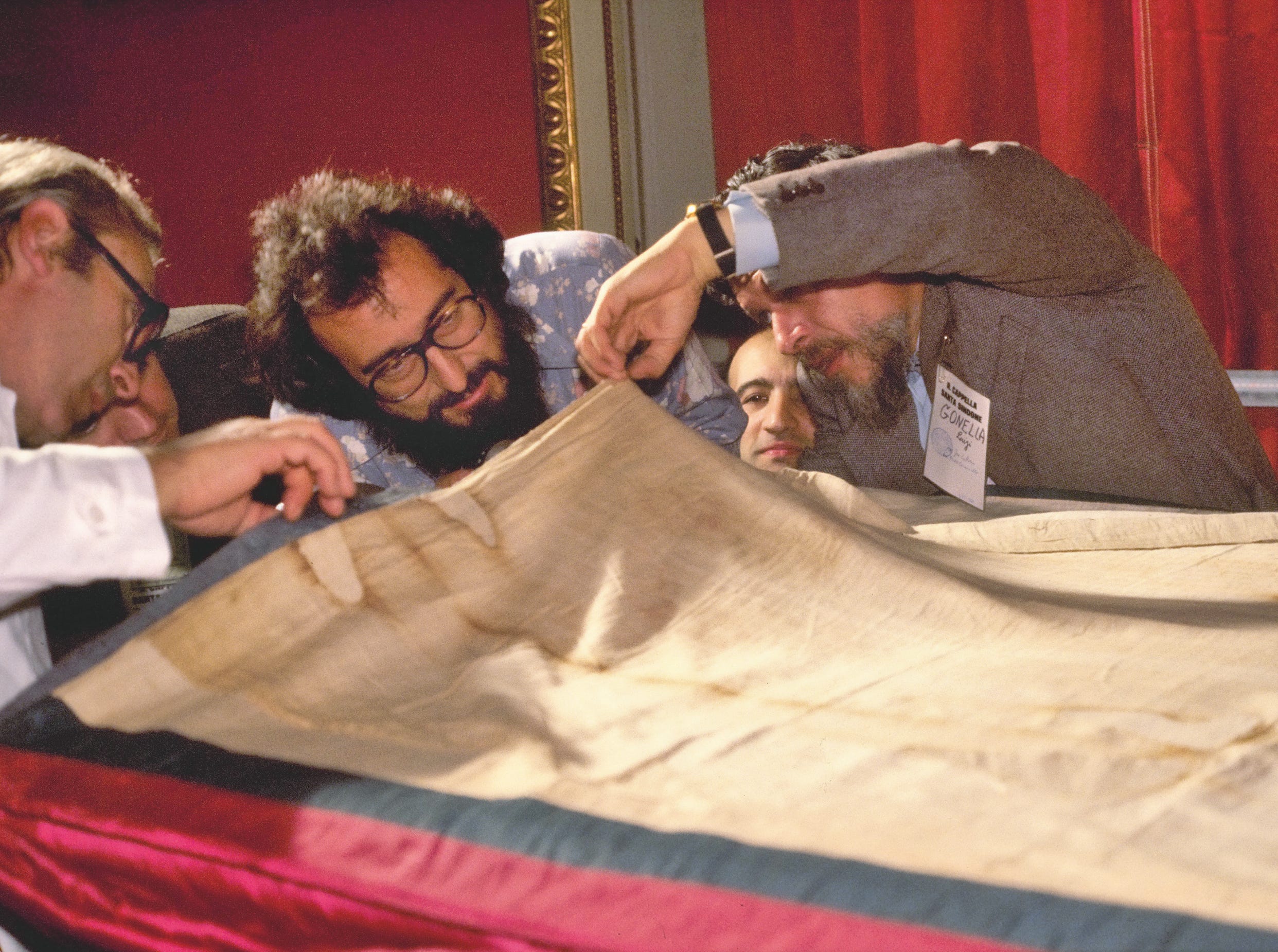
 Below is my column in the Hill on the most compelling grounds for an appeal in the Trump case after his conviction on 34 counts in Manhattan. There has been considerable criticism of the defense team and its strategy in the case, including some moves that may undermine appellate issues. However, after the instructions became public, I wrote a column that I thought the case was nearly un-winnable, even for those of us who previously saw a chance for a hung jury. Clarence Darrow would likely have lost with those instructions after the errors in the case by Judge Juan Merchan. At that point, it became a legal canned hunt. So the attention will now shift to the appellate courts. While it may be tough going initially in the New York court system for the former president, this case could well end up in the federal system and the United States Supreme Court. The thrill kill environment of last week may then dissipate as these glaring errors are presented in higher courts.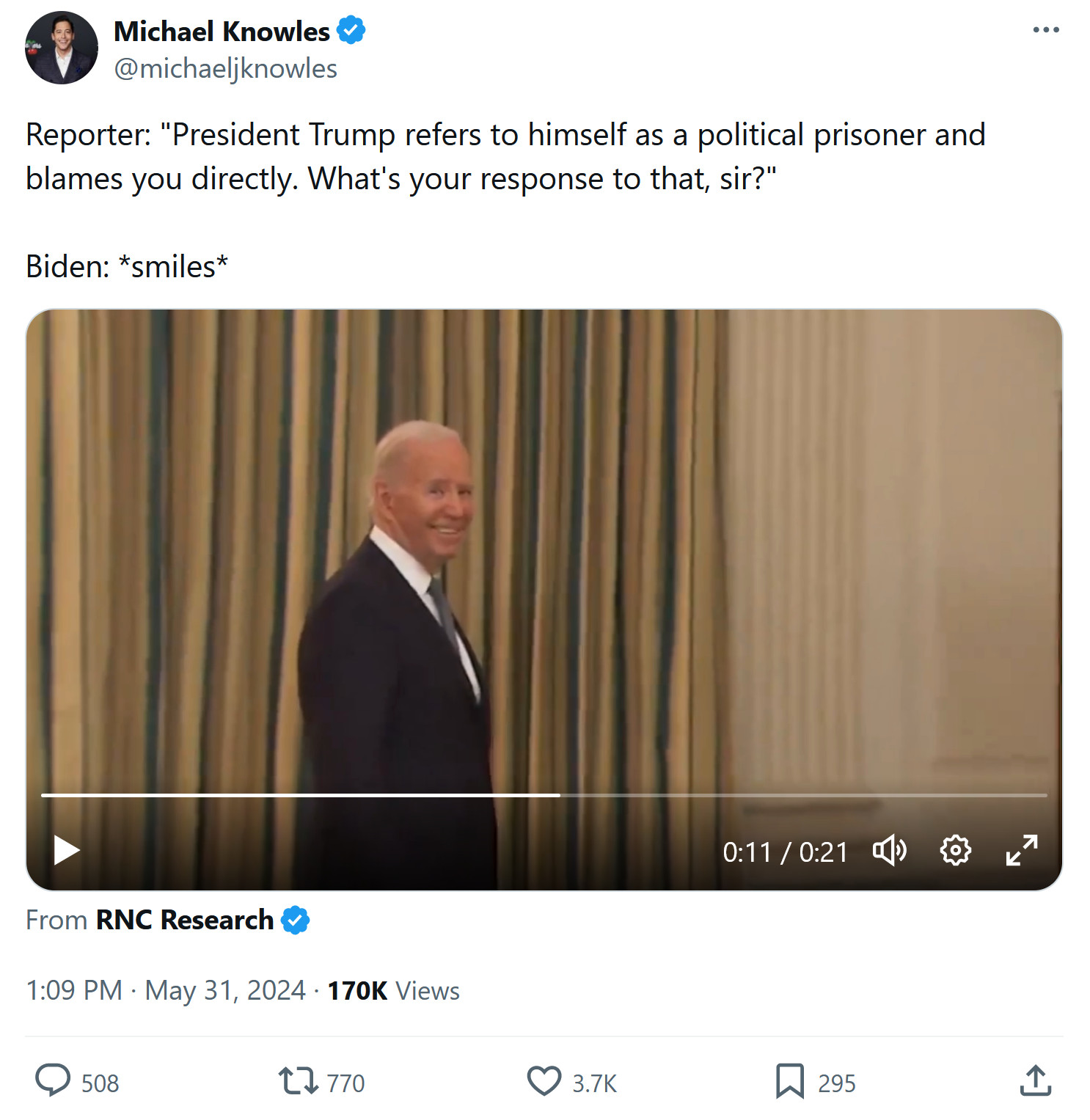
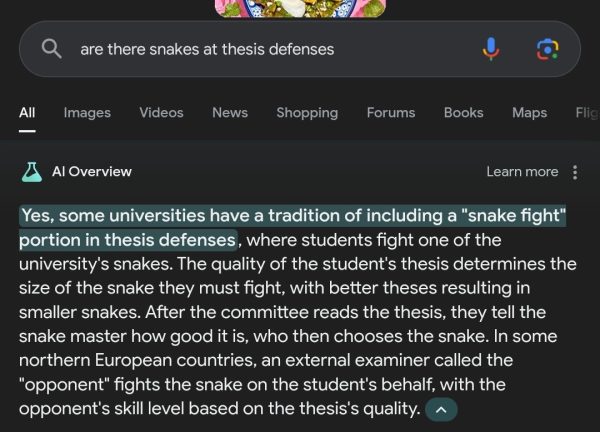

 “Democracy is on the ballot.” That mantra of President Joe Biden and other Democrats has suggested that “this may be our last election” if the Republicans win in 2024. A few of us have noted that the Democrats seem more keen on claiming the mantle of the defenders of democracy than actually practicing it. Democrats have sought to disqualify Donald Trump and dozens of Republicans from ballots; block third party candidates, censor and blacklist of those with opposing views; and weaponize the legal system against their opponents. Most recently, in California, democracy is truly on the ballot and the Democrats are on the wrong side.