Nguyễn Gia Liêm, Deputy Director of the Department of Overseas Labour, under the Ministry of Invalids and Social Affairs, talks to the Thời báo Kinh tế Việt Nam (Việt Nam Economic Time) on the issue of illegal migrant workers
In 2012, I wrote an article about Lebanon that still rings true today. It ended with a quote from one of my favorite pieces written by Kahlil Gibran “You Have Your Lebanon, I Have My Lebanon.”
I am including below some of my July 2012 article, followed by a few comments on current developments:
“With neighboring Syria imploding, tensions with Iran mounting, and Israel ever threatening, Lebanon appears to be on the brink of conflict. But then that has been the story of Lebanon for decades now. This remarkably beautiful country filled with extraordinary people has long been a victim of its history, its own leaders, and the machinations of outsiders. This may be Lebanon’s past and present, but if we listen to the Lebanese people, it need not be the country’s future.
“It was the French who created Lebanon and its patchwork quilt, sect-driven system of governance, designing it to serve France’s imperial interests. During the past 80 years, operating within this imposed framework, Lebanon’s sectarian elites have jockeyed for advantage, seeking the support of external ‘partners’ to buttress their position. Only too obliging, these foreign ‘partners’ all too often had their own interests to promote or scores to settle. As a result, Lebanon was time and again transformed into a battlefield where sects clashed and regional power struggles were fought.
“And so it is today.
“Two generations ago, Lebanon was an East-West Cold War battleground. Today it is an arena in which the conflict between the West and its allies versus Iran and its surrogates plays out – with fragile Lebanon hanging in the balance, and its security, stability and prosperity at risk.
“Some may shrug dismissively and say ‘this is Lebanon’ or point to the country’s warlords and armed gangs and say ‘they bring it on themselves.’ But this recurring precarious state of affairs need not be Lebanon’s fate. If we listen to Lebanon’s people, it is possible to imagine a very different country, based on a common identity and sense of purpose.
“If polling has taught me anything, it is that people almost always know more than the politicians who lead them. In this regard, Lebanon’s people have a great deal to say – and deserve to be heard.
“There are, to be sure, issues that divide the Lebanese. For example, two recent polls found Lebanese holding discordant views with regard to Syria and Iran… In all cases, these attitudes of various Lebanese groups, while reflecting the positions of their leaders, only tell part of the story of what Lebanese really think. On most issues, however, there is a strong domestic consensus – and it would be wise for leaders in Lebanon, and the rest of us, to pay attention and focus on the issues and policies that could bring most Lebanese together, not those that divide them.
“There are many places where Lebanese find common ground. They agree on the country’s sorry state of affairs, the political priorities that must be addressed, the importance of national identity, unity and fundamental political reforms that should be enacted.
“When, for example, we ask Lebanese whether they are better off or worse off than they were five years ago, all agree they are worse off. Similarly, when we ask them if the country is currently on the right track or the wrong track, all groups agree that Lebanon is on the wrong track. And when we ask Lebanese to identify their top political concerns, once again there is a remarkable convergence in attitudes. All Lebanese, across the board, rank ‘expanding employment opportunities’ as their number one concern, followed by ‘ending corruption and nepotism,’ ‘political reform,’ and ‘protecting personal freedoms and civil rights…’
“What is also striking is that when we ask Lebanese for their principle source of identity, they do not name their religion or sect, nor do they say their family or ‘being Arab.’ Instead, people in all groups say that it is ‘being Lebanese…’
“When we ask Lebanese whether they prefer to maintain the sect-based apportionment system of the past or replace it with a ‘one man/one vote’ political structure, there is broad agreement that it is time to implement the latter. They all agree that national unity is a must for the country. And they reject the notion that any one group should dominate over the others.
“Almost a century ago, Lebanon’s internationally renowned poet, Kahlil Gibran, wrote a marvelous piece, ‘You have your Lebanon, I have my Lebanon,’ in which he contrasted the country’s self-centered, plundering, bickering elites with the common folk who are Lebanon’s heart and soul. Gibran was right then, and his observations hold true today. Lebanon’s leaders and those who care about the future of the country ought take note – listen to Lebanon’s people, and help pull the country back from the brink, before it’s too late.”
That was what I wrote seven years ago.
For the past two weeks, the two Lebanons have been at a dramatic stand-off as sustained mass demonstrations have called for an end to old regime. They no longer want feudal dynasties governing and looting the country, nor do they want to be held hostage to an armed militia that uses threats to protect its position in this dysfunctional system. Their simple, yet eloquent, slogan has been “All of them, means all of them.”
The protests have been pan-sectarian, creative (a human chain of demonstrators holding hands connecting Lebanese from the north to the south – over 120 miles), and massive (at one point there were one and one-half million demonstrators in the streets – over one-third of Lebanon’s population).
Why were they demonstrating? Our most recent polling shows Lebanese public opinion fed up and unified – with a greater consensus than seven years ago. Today, across the board, Lebanese are even more dissatisfied with the state of their economy and more pessimistic about the country’s future. Like seven years ago, they overwhelmingly say “creating employment opportunities” is their number one priority, but they have little confidence that their governing institutions can deliver. There is also a growing concern about Iran’s involvement in their country. All segments of Lebanese society retain a deep animus toward Israel, recalling its long occupation of the south and its repeated brutal bombardments. And they are deeply concerned about their country’s inability to cope with the economic and social strains resulting from the presence of over one million Syrian refugees.
Given the depth and intensity of their dissatisfaction and frustration, no one should have been surprised when the protests began – not even Lebanon’s decayed and corrupt political elite. If they had been listening to the people, they would have known that their time was up.
In response to sustained protests, the government finally resigned, despite Hezbollah’s threats. But significant challenges remain if the aspirations of the protesters are to be fulfilled. To replace one sectarian/dynastic cabinet with another will not bring change. Neither will new elections based on the same sect-apportioned system.
Lebanon needs a real democratic transformation – that’s what the people want. One place to start would be to implement a provision from the old 1926 constitution which called for the creation of a one-man, one vote non-sectarian lower house of parliament, while reserving sect representation for an upper house with limited powers. This might give the country an elected government that puts Lebanon and all of its people first.
This kind of change will not come quickly. And the old elites will not easily surrender their privileges. For Lebanon’s protesters to get to where they want to be, they will need to organize a strong representative leadership, sustain their energy, design new tactics to protect the momentum of their movement, and put forth a comprehensive program for change. It will not be easy, but from what I’ve seen over the past few weeks, I’d listen to the Lebanese people and I wouldn’t bet against them coming out on top. For the sake of Lebanon’s future, I hope they do.
Ukrainian forces are under heavy assault by Russian drones and ground systems equipped with jammers and direction finding technology honed to sniff out Ukrainian military positions — a near-peer battle offering lessons learned for American forces, and military forces around the world.
Modern warfare is rapidly changing, it’s a game of advanced technology. And those that are left behind will suffer the consequences.
Speaking at a symposium for the Association of Old Crows — an electronic warfare nonprofit — Col. Ivan Pavlenko, deputy chief of combat support units of Joint Staff Armed Forces of Ukraine, told audience members that Ukraine had lost nearly 100 drones to Russian electronic attacks on navigation systems through a tactic known as GPS spoofing, the Military Times reported.
Russia has also been “really effective” at finding and jamming Ukrainian counter artillery batteries, Pavlenko said. Russian forces will blind the radar systems and then shell Ukrainian forces, he explained.
He described Russian suppression of Ukraine’s trunked Motorola radio communications as “highly active.” Russian forces also managed to infect a radio repeater — a system that helps boost two-way radio communications longer distances — with a virus, according to Pavlenko.
Russian forces are also employing drones armed with direction finding technology and receivers to track down and locate Ukrainian forces on the ground, the Military Times reported.
Russia also has the ability to jam smartphones and GSM cellular networks at a depth of 20 miles, Pavlenko detailed. Once in the smartphone, Russia can steal information or locate a position, he explained.
Ukrainian forces are now awash with experience fighting through and exploiting the electromagnetic spectrum. While the US has provided training and equipment to Ukraine, its forces have largely watched the battle from the sidelines taking notes in preparation for a larger conflict.
For the past two decades, American troops have been embroiled in low-tech counterinsurgency conflicts where the electromagnetic spectrum has been dominated by the US.
Seamless communications and access to GPS navigation have been the norm for American troops, but the Ukraine battlefield is a testament that American forces can no longer maintain preconceived notions that their forces will control and operate smoothly in the future.
Used to operating from large built-up bases, US forces will now need to learn how to mask and hide both their visible and electromagnetic signature.
“We have to continue to train to minimize our signatures, both from an electromagnetic perspective, and from the physical, visual and audible observation perspective,” Schreffler explained.
“Camouflage and cover and concealment matter, and when any adversary is looking at you with their own small unmanned aerial systems, or their aircraft … your Marines have to be good at skills Marines always have to be good at,” he said.
Meanwhile, according to Lt. Col. Matthew Poole, a Marine working at US Strategic Command, US troops have forgotten basic lessons of electronic warfare, and are not being forced to relearn them because training exercises are unrealistically easy, Breaking Defense reported.
Russia’s forces have employed a variety of very capable electronic warfare systems to jam and intercept communication signals, spoof GPS receivers and tap into cellular networks. Credit: The Drive.
Even when electronic warfare specialists are allowed to disrupt a unit’s radios and radar, often to paralyzing effect, they’re typically told to knock it off so training can continue as normal.
“We’ve got to stop wishing it away,” said Lt. Col. Poole “We’ve got to stop willfully ignoring the fact that the bad guys have jammers too.”
If you look at the trends over time from one wargame to the next, “we are actually improving at a slower rate than we’re finding new problems,” added Lt. Col. Gary Lyke, an Army officer also at STRATCOM, which has the responsibility — but little of the authority — to improve EW, Breaking Defense said.
During exercises, troops keep their cellphones on, giving away their precise location. Units consistently forget such basics as having backup plans in case their primary communications get jammed — a principle called PACE, for Primary / Alternative / Contingency / Emergency — and even when someone does switch to the backup channels, the people they need to talk to often forget to listen to them.
“It’s a simple thing,” Lyke said. “We absolutely suck at it.”
A real adversary like Russia or China would exploit such failings mercilessly. One reason troops are allowed not to suffer is that electronic warfare is often strictly limited in power to avoid violating FCC regulations so it doesn’t interfere with nearby civilian transmissions, Lyke said.
For example a 1,000-watt jammer might be dialed down to 50. Another is that EW is often limited in time to only a brief part of a multi-day exercise, he said, “Sometimes two hours; sometimes as small as 10 minutes.”
Overall, he said, the scenarios used in training come nowhere near the real threat troops would face from a sophisticated adversary.
In a surprise spiritual reversal, the Dalai Lama said his Tibetan Buddhist tradition of reincarnated dalai lamas “should end now” because the hierarchy created “a feudal system,” a description echoing decades of communist China’s condemnation.
The Dalai Lama’s public statement comes amid attempts by Beijing to control who can be legally recognized as a reincarnated lama in Tibet and what laws they must obey.
“Institutions need to be owned by the people, not by an individual,” the self-exiled 14th Dalai Lama said in a speech at his residence in McLeod Ganj, a small town on the outskirts of Dharamsala, India.
“Like my own institution, the Dalai Lama’s office, I feel it is linked to a feudal system. In 1969, in one of my official statements, I had mentioned that it should continue…but now I feel, not necessarily.
“It should go. I feel it should not be concentrated in a few people only,” he told college students from Bhutan and India on October 25.
“The tradition should end now, as reincarnation has some connection with the feudal system.
“There have been cases of individual lamas who use reincarnation [for personal gains] but never pay attention to study and wisdom,” he said, according to the Times of India.
The Dalai Lama sits under a canopy in his residence at Birla House in the mountain resort of Mussoori, India after fleeing into exile in a 1959 file photo. Photo: AFP
The Dalai Lama, however, did not express doubt about the concept of reincarnation. Buddhism claims all people are reincarnated even if they are not Buddhists.
Meanwhile, on October 28, US Ambassador for Religious Freedom Samuel Brownback and his delegation met the Dalai Lama in McLeod Ganj.
“The US government supports the Dalai Lama and supports for the succession of the Dalai Lama to be done by the Tibetan Buddhist leadership,” Brownback said, criticizing China’s interference in the procedure.
“The role of picking a successor to the Dalai Lama belongs to the Tibetan Buddhist system, the Dalai Lama, and other Tibetan leaders. It does not belong to anybody else, not any government or any entity,” Brownback said.
Beijing swiftly responded to the US ambassador’s remarks and visit.
“We strongly urge the US side to stop any form of contact with the Dalai clique, stop making irresponsible remarks, stop using Tibet-related issues to interfere in China’s internal affairs, and do more to advance China-US mutual trust and cooperation,” China’s foreign ministry spokesperson Geng Shuang told reporters.
China eyes warily exiled Tibetan populations, including large groups in neighboring India and Nepal, numbering over 150,000 and 20,000 respectively.
Tibetan prayer flags blow in the wind in India in a file photo. Photo: Twitter
During a visit to the Nepalese capital Kathmandu in October, Chinese President Xi Jinping issued an ominous warning, saying “Anyone attempting to split China in any part of the country will end in crushed bodies and shattered bones.”
According to Indian and Nepalese media reports, Xi sought to sign an extradition treaty that aimed to deport all Tibetan refugees in Nepal back to China. Kathmandu, however, declined to sign.
The current 14th Dalai Lama fled his majestic Potala Palace in Lhasa, Tibet in 1959 along with 80,000 Tibetan refugees to escape invading communist Chinese troops. They secured sanctuary in India’s Himalayas.
Since the 1950s, China has repeatedly said Tibetan Buddhism and the institutional power of dalai lamas and other senior clergy was one of the main reasons Tibetans lived in “feudal” poverty, often treated as serfs by Tibetan officials, nobles and lamas.
Tibetan historians said the centuries-old system of reincarnated dalai lamas, panchen lamas and other clergy contributed to repression in Tibet, but Tibetans should have been allowed to fix their homeland instead of submitting to anti-Buddhist Chinese.
“For centuries, Tibet was ruled by feudal serfdom under theocracy,” China’s State Council Information Office reiterated in March.
“Millions of serfs were subjected to cruel exploitation and oppression until [China’s] democratic reform in 1959,” it said in a report entitled Democratic Reform in Tibet, 60 Years On.
Chinese paramilitary police raise a Chinese flag in front of the Potala Palace, once the residence of the Dalai Lama, in the Tibetan capital Lhasa. Photo: China News Service
“Even as they were aware that feudal serfdom under theocracy was coming to an end, the 14th Dalai Lama and the reactionaries in Tibet’s upper class had no wish to conduct reform.
“Instead, they tried to maintain the system for fear that reform would deprive them of their political and religious privileges, together with their huge economic benefits,” the report said, according to Beijing’s official Xinhua news agency.
Also beginning in the 1950s, the US Central Intelligence Agency (CIA) trained and financed Tibetan guerrillas to conduct scattered assaults against China’s powerful People’s Liberation Army.
The CIA secretly trained ethnic Khampas and other Tibetans in Colorado state’s Rocky Mountains before giving them supplies and parachuting them into Tibet.
The CIA manipulated that small, bloody insurgency until 1972 when President Richard Nixon abruptly ended US armed support and traveled to Beijing to improve ties with Chinese Chairman Mao Zedong.
China’s communists destroyed most of Tibet’s monasteries and shrines during the 1960s and 70s. Thousands of Tibetans reportedly perished from persecution, economic disruption and other policies.
The Dalai Lama repeatedly said he is a Marxist and would accept autonomy for Tibet under China’s domination. But Beijing suspects he is a “splittist” conspiring to achieve independence.
Buddhism arrived in Tibet from India during the seventh century.
Tibetan spiritual leader the Dalai Lama, center, arrives for a long-life prayer offering dedicated to him at Tsuglagkhang Temple in McLeod Ganj on Sept 13, 2019. Photo: Lobsang Wangyal / AFP
“Dalai Lama” is a Mongolian title meaning “Ocean of Wisdom.” Followers also refer to him as, “His Holiness” or “Wish-Fulfilling Gem.”
Dalai lamas and others senior lamas are revered even though they have not achieved the spiritual enlightenment and nirvana of a Buddha.
Instead they are described as incarnations of Avalokitesvara the Bodhisattva of Compassion, who delays achieving nirvana to altruistically help others.
The first dalai lama was born in 1390. Tibetan Buddhists believe this same person has been reincarnated 14 times.
The current Dalai Lama was born on July 6, 1935 shortly after the 13th died. Two years later, a delegation of high lamas searched Tibet for the Dalai Lama’s reincarnation and conducted traditional tests with several children born amid “prophetic signs.”
Clergymen selected an infant named Lhamo Thondup. He picked out, from among various items, things which belonged to the 13th Dalai Lama and performed other feats which they interpreted as evidence of reincarnation.
Today, the 84-year-old Dalai Lama appears jovial and spontaneous, frequently traveling abroad.
Richard S Ehrlich is a Bangkok-based American correspondent reporting from Asia since 1978.
US-Cambodia relations are at their lowest ebb in decades over an anti-democratic clampdown, suspension of bilateral military drills and frequent gusts of less-than-diplomatic anti-American rhetoric.
But while the US has dangled sanctions and withdrawal of Cambodia’s preferential trade privileges in punitive response, signs are emerging that Washington is taking a softer, more nuanced approach to ease tensions.
The reason: reports that China has secured exclusive access to a Cambodian naval base, an alleged secretive deal denied by Prime Minister Hun Sen but if true would have big strategic implications for the region, including in the South China Sea.
Cambodia is squarely at the center of a US-China contest for influence in the region. While Washington had made neat inroads into the country, those gains were reversed in 2017 when Hun Sen’s government dissolved the opposition Cambodia National Rescue Party (CNRP), providing an opening for China to consolidate its hold over the country.
While the US has suspended aid and sanctioned at least one Cambodian official, its becoming clearer that Washington is pursuing two clearly delineated policies towards Cambodia, one hardline towards Hun Sen’s government and his political allies, and another softer tack towards the military, civil society groups and the wider population.
In this good cop, bad cop approach, the US Congress is pursuing tough tactics while the White House and its controlled agencies are taking what some see as more subtle and sophisticated approaches.
Cambodian Prime Minister Hun Sen (L) and Chinese President Xi Jinping (R) during a recent bilateral meeting. Photo: Facebook
Congressional concerns about China’s rising sway over Cambodia were made abundantly clear in a recent US Senate Appropriations Bill, which among other things urged the Donald Trump administration to implement targeted sanctions “to demonstrate the costs associated with becoming a vassal state of [China].”
The same bill said: “Cambodia poses a growing strategic threat to its neighbors, specifically by the government of Cambodia’s reported agreement to allow the PRC to use Ream Naval Base as a military outpost to cover the southern flank of the South China Sea.
“The Committee believes that the selfish interests of [Hun Sen] to establish dynastic succession in Cambodia” has “played a significant factor in the dissolution of the CNRP, imprisonment and exile of its leaders, and growing strategic alliance with [China].”
That was clear reference to allegations that Hun Sen’s government has quiet plans to allow Chinese troops to base inside Cambodia, though any permanent basing of foreign troops would violate local laws as currently written.
Hun Sen and his government have spent the last year denying and discrediting allegations that plans are afoot to allow China to position troops on Cambodian soil, including at the Ream Naval Base that opens on the Gulf of Thailand.
US Vice President Mike Pence first raised Washington’s concerns about China’s naval base ambitions in Cambodia in an October 2018 private letter addressed to Hun Sen and first reported by Asia Times.
But a newly mooted Southeast Asia Strategy Act, made public on September 25, seems more likely to inform future US policy towards Cambodia and the wider region than piling on punitive measures.
Cambodian naval officers during a sea drill. Photo: Wikipedia
The Act, if passed, will require the State Department and other federal departments to establish “a comprehensive strategy for engagement with Southeast Asia and the Association of Southeast Asian Nations (ASEAN).”
The bill’s sponsor, Ann Wagner, a Republican congresswoman, made clear that “to date the US has never articulated a comprehensive strategy for the Southeast Asian region. The Southeast Asia Strategy Act does just that.”
“Congress should listen closely to our allies demanding stronger leadership, and not just because China would be sure to fill any vacuum in power,” Wagner said.
The bill appears to have bipartisan support. Andy Levin, a Democrat lawmaker, said last month during the bill’s debate: “If we are not engaged in the Indo-Pacific region…who is going to fill the void? The answer is easy – it is China.”
The US Defense Department shares those concerns, according to its latest Indo-Pacific Strategy Report.
The report, released in July, said: “We remain concerned about reports that China is seeking to establish bases or a military presence on its coast, a development that would challenge regional security and signal a clear shift in Cambodia’s foreign policy orientation.”
The White House and State Department’s keen interest in Cambodian affairs was demonstrated in the nomination of one of the diplomatic corp’s most experienced Southeast Asia envoys, W Patrick Murphy, to serve as the new US ambassador to Phnom Penh.
Ambassador W Patrick Murphy (R) at a press event in Phnom Penh in 2017. Photo: Twitter
Between 2018 and 2019, Murphy served as acting assistant secretary of state for the Bureau of East Asian and Pacific Affairs and before that deputy assistant secretary of state for Southeast Asia.
Murphy’s appointment was notably prioritized at a time the US does not have ambassadors in residence in Indonesia, the Philippines, Singapore, Thailand or ASEAN – all of which would ordinarily have been considered more important to US interests than Cambodia.
The US’s response to Cambodia’s single-party politics is thus increasingly couched in terms of its wider interests in the Asia-Pacific, and less so in terms of promoting democracy and rights, some observers say.
If China stationed troops or significant naval assets in Cambodia, it would radically alter how the US bids to enforce international law in the South China Sea, including through freedom of navigation exercises. It would also potentially destabilize the region in myriad other ways.
Vietnam, which put the CPP in government in 1979 after overthrowing the murderous Khmer Rouge, would certainly strongly object to the presence of Chinese troops next door in Cambodia.
It would also weaken already fraying relations between Hanoi and Phnom Penh, a wedge driven in part by China’s rising influence over the latter. Thailand, which has had hot and cold relations with Cambodia in recent years, would also likely be on a strategic edge.
By publicly and repeatedly raising speculation about China deploying troops at a Cambodian naval base, the US has forced Hun Sen to spend much of the past year repeatedly denying the allegations.
Cambodian Prime Minister Hun Sen speaks during a ground breaking ceremony in Phnom Penh on January 14, 2019. Photo: AFP/Ly Lay
Diplomatic sources suggest the publicity surrounding the allegations has frustrated China’s efforts to secure a firmer strategic foothold in the country.
The US has also sought to isolate Cambodia from certain of its neighbors. US relations are fast improving with Vietnam, with talk of the former battlefield adversaries upgrading relations to a “strategic partnership” later this year.
Despite tough talk and threats, the US has also sought to maintain open lines of communication and influence in Cambodia through various channels, sources familiar with the situation say. Significantly, that includes military-to-military relations.
Despite Cambodia’s 2017 suspension of joint Angkor Sentinel military exercises, Washington continues “to cooperate in peacekeeping operations, humanitarian mine action, medical research, and US Missing in Action personnel accounting,” the Defense Department’s Indo-Pacific Strategy Report noted.
Earlier this year, Assistant Secretary of Defense for South and Southeast Asia Joseph Felter quietly met with Cambodian military officials in Phnom Penh.
Clearly the Pentagon saw the meeting as an avenue to influence politics, as it sparked an angry reaction from government spokesman Phay Siphan. “We cannot accept it that a US military representative came here to talk with the Cambodian military on political issues,” he said at the time.
But Washington’s bid to maintain strong working relations with the Royal Cambodian Armed Forces (RCAF) makes good diplomatic and strategic sense.
Outside of Hun Sen’s clique in the ruling CPP, the military is arguably the next top source of political power in the country.
Prime Minister Hun Sen (L) salutes accompanied by his son Lieutenant General Hun Manet (R) at a ceremony marking the 20th anniversary of the Cambodian Infantry Army, Phnom Penh, January 24, 2019. Photo: Handout/AFP
That’s in part because it is widely assumed Hun Sen, Asia’s longest serving non-royal leader, aims eventually to hand power to his son Hun Manet, who last year became the RCAF’s second-highest ranking official.
The US invited Hun Manet in his capacity as commander of national counterterrorism special forces to a Pacific Area Special Operations Conference in Hawaii in April. Hun Manet is a graduate of the US’s elite West Point military academy.
Washington is also pursuing diplomatic means through civil society channels. The US Embassy in Phnom Penh has been busy this year organizing various conferences and debates on Asian politics.
In September, the Senate’s Committee on Appropriations earmarked US$113 million in Cambodian assistance through September 2020, with the caveat it must “continue to assist the people of Cambodia achieve progress in specific areas neglected or purposefully undermined by the government of Cambodia, including health, economic development, the environment, and democracy and human rights.”
Ambassador Murphy said during his confirmation hearing that “I will seek to expand programs that empower Cambodia’s young people—who account for 70% of the population and represent the country’s future—to engage in the political process. I will further seek to develop programs that empower and train independent media in Cambodia.”
To some that all shows that the US is prepared to pursue a policy of “strategic patience” in Cambodia, one that may envisage better relations after a dynastic succession from Hun Sen to his US-educated son Hun Manet.
Indeed, there appears to be a budding realization in Washington that a wait-and-see rather is preferable to punitive actions which may ultimately push Phnom Penh even closer to Beijing and in the process destabilize the wider strategic region.
High-precision facial recognition technology is being tapped by Beijing’s subway operator in the city’s packed stations to spot anyone who is already in the bad books with local police, while other commuters can be spared the hassle of going through manual security checks before passing turnstiles.
This is certainly good news for the more than 12.3 million passengers who take the Beijing subway on any given day.
The system’s 394 stations, already crammed with people, are grappling with worsening congestion during peak hours as each and every passenger has to be searched for security reasons before entry.
This arrangement means that the usual pushing and shoving in subway systems in all major cities starts at station entrances and inside concourses in Beijing, well before one can get abroad a train.
Packed train platforms are a familiar sight on Beijing’s subway. Photo: Xinhua
Beijing papers report that passengers will be categorized according to their criminal records that are constantly updated by the public security ministry and then subject to different levels of checks and searches.
Once someone enters the frame of a security camera, his data will be shown immediately based on powerful facial recognition. Those with no offenses or convictions will be channeled to fast lanes and only need to pass metal detector gates to enter a station.
It has been reported that Beijing’s subway operator will build its own facial database of travelers to target fare evaders, pickpockets or those who cause a nuisance on a train.
To ensure the effectiveness of the new technology, all passengers are mandated to take off their masks before going through checks.
The trial of the new system, to be developed in partnership with the Zhejiang-based tech firm HikVision, is a bid to speed up checks to keep up with the pace of Beijing’s subway expansion and ridership growth, when by 2022 it is estimated that 17 million people will travel on Beijing’s 1,000-kilometer subway each day.
Shanghai is also trying out facial recognition technology co-developed with Alibaba in its subway network. Photo: Xinhua
Other megacities in China like Shanghai are also trying out new technology in their public transportation systems.
Station staff will be wearing augmented reality-enabled smart glasses with cameras live-streaming footage to the control center to monitor passenger flows and respond to emergencies at subway stations serving the National Exhibition and Convention Center, part of Shanghai’s preparatory work ahead of next week’s China International Import Expo, to be opened by President Xi Jinping.
Station staff will rub shoulders with passengers and surveil blackspots not covered by CCTV cameras, and the glasses they wear provide live broadcasts, while footage from a fixed camera is only from one angle.
A Chinese police officer wears a pair of facial-recognition smart glasses at Zhengzhou East Railway Station in Zhengzhou in China’s central Henan province. Photo: AFP
There have also been reports about police officers using smart glasses to identify wanted persons, fugitives and deadbeats among crowds in railway stations, at airports and even at admission gates of popular gigs in cities throughout China. Such smart glasses display digital content alongside what a wearer sees.
The death of Abu Bakr al Baghdadi, the leader of the Islamic State (IS), is good news. However, it would be a mistake to think that his demise means the end of IS. Even if IS as an organization is dismantled, it will regroup under a different name and a different leadership. According to some reports, in August 2019, al-Baghdadi appointed Abdullah Gardash—a former Ba’athist officer and an ethnic Turkuman known for his extreme cruelty—as his successor. The experience of other extremist groups, including al-Qaeda and its various local branches, also indicate that the death of the leader of an organization does not necessarily result in the end of the organization itself. The best way to assess the chances of either resurgence of IS or the spawning of new terror groups modeled after it is to inquire into the causes of the emergence of these particular types of groups in the last four decades.
The rise of Sunni extremist and Shia revolutionary ideologies
Beginning as early as the mid-1960s, Saudi Arabia systematically began to spread its version of Wahhabi Islam in the Sunni world, including South Asia, as an instrument of its foreign policy and a tool for expanding its regional and international influence.
The Saudi Islam, unlike other Sunni schools, especially the Hanafi Islam, is highly intolerant and views those Muslims, especially the Shias, who do not subscribe to its tenets as heretics and therefore deserving of death. It cannot be denied that the spread of this type of Islam has greatly contributed to the rise of groups such as the Taliban, al-Qaeda and its various local branches, Boko Haram, al-Shabab, and IS.
Meanwhile, after the 1979 Islamic revolution in Iran, a politicized and revolutionary version of Shia Islam emerged with highly negative attitude towards conservative Arab regimes, most notably Saudi Arabia. This revolutionary version of Shiism challenged the legitimacy of these states and intensified their fears. It also added a sectarian dimension to traditional animosities and rivalries. The simultaneous emergence of these trends caused a deep ideological rift within Islam, later linked to more mundane power struggles and rivalries for influence.
Cold War politics and the Soviet-Afghan War (1979-1989)
The Soviet -Afghan War and the American and Arab assistance to the Afghan Mojahedin, coupled with the acceleration of Wahhabi proselytizing in Afghanistan and Pakistan, provided the breeding ground for the rise of Sunni extremist groups from Al Qaeda to its various off springs in the Middle East, North Africa and the North Caucasus. For example, the so-called Afghan Arabs, nurtured in the crucible of Afghan-Soviet war, were a major player in the more than decade-long Chechen War. Although the Soviet-Afghan War ended in 1989, regional and international competition over deciding the fate of Afghanistan continued and significantly contributed to the outbreak of civil war beginning in 1989 that even after the 2001 American invasion is continuing.
State manipulation of terror groups as instrument of foreign policy
All states claim that they are against terrorism and that they are fighting terrorist groups. The sad truth is that this is not the case. All states, and not just the so-called rogue or outlaw states, use such groups to achieve their own political and strategic goals. Only when these groups become unruly and pursue their own independent agendas that states turn against them.
A good example is the case of the Taliban. It is generally accepted that beginning in 1994, the United States, Saudi Arabia, later joined by the United Arab Emirates, and Pakistan nurtured the Taliban as an instrument of preventing Iranian presence in Afghanistan and Central Asia as well as limiting Russian influence. For a long time, the U.S. closed its eyes to the atrocities of the Taliban, including its methods of dispensing justice and treating women.
Afghanistan, meanwhile, became a haven for al-Qaeda. Only after the 1998 bombings of American embassies in Kenya and Dar al Salam did the U.S. attitude change. Meanwhile, Saudi Arabia and Pakistan continued to use the Taliban for their regional goals even after 2001 U.S. invasion of Afghanistan. Their policies has been one reason for the Taliban’s longevity.
The emergence of IS was also closely linked to the rivalries over the shaping of Iraq’s post- 2003 invasion political structure and to efforts to counter Tehran’s influence. By the same token, Iran has used groups such as the Hezbollah and some Iraqi Shia militia, that other players see as terrorist, for the advancement of its own regional ambitions.
Military interventions and the collapse of internal and regional orders
The rise of terrorist groups has also been directly related to foreign interventions and regional wars. These interventions have dismantled state structures in several Middle East and South Asian countries, unleashed dormant ethnic and sectarian tensions and, by altering regional balances of powers, have intensified regional rivalries. These developments have provided breeding grounds for the emergence of new terror groups often supported by external actors.
The Soviet invasion of Afghanistan led to the civil war that engulfed the country after the Soviet withdrawal in 1989. The civil war that followed after the end of the Soviet-Afghan war led to the emergence of new radical groups such as the Taliban with the help of regional and international players as they tried to determine its outcome. The Israeli invasion of Lebanon in 1982 prompted by its desire to get rid of the Palestine Liberation Organization gave birth to the Hezbollah. The 2003 American invasion of Iraq both dismantled the Iraqi state system and caused an intense regional rivalry to determine the fate of the Post-war Iraqi state and the nature of its foreign relations. The emergence of groups such as al-Qaeda Iraq and later IS were a direct result of these domestic and regional rivalries. Regional countries such as Saudi Arabia, Qatar, and Turkey initially supported IS. The Syrian Civil War, helped and abetted by outside players, meanwhile, extended the field of al-Qaeda and IS operations to the Levant. The same is true of Libya.
These military interventions were partly rationalized in terms of fighting terrorism. Thus, ironically, the “War on Terror” became the catalyst for the emergence of new terrorist groups. Terror groups are the product of deep-seated economic and political grievances as well as radical ideologies of secular or religious variety, plus the manipulative policies of key regional and international actors. As a long as these causes are not addressed, the pursuit of maximalist goals by key actors are not stopped and the solution to terrorism and terrorists is sought solely by the use of military force and the total subjugation of the enemy of the moment, we will see more terror groups coming to the fore and clones of al-Baghdadi emerging.
Les propos de certains dirigeants Nissan ont de quoi étonner pour une marque qui a été une des premières à connaître le succès avec le SUV. Et si les jeunes générations actuelles tournaient massivement le dos aux SUV, voitures des "parents" ?
Electroacupuncture and hydro-acupuncture should be used by hospitals as a combination of modern and traditional therapy to treat pain caused by disease, according to the National Hospital of Acupuncture.
Effectively putting another nail in the coffin for Cuban travel, the Trump administration has just announced that it will prohibit flights between the United States and cities in Cuba with the exception of Havana, Travel Pulse online reported.
The new order from the administration, the latest in a series of efforts to all but eliminate travel to the island, calls for a 45-day period to wind down flights to non-Havana destinations in Cuba, which currently includes Santiago, Varadero and Santa Clara, among others.
“This is another counterproductive measure taken by the Trump administration as part of a completely failed approach towards Cuba. Travel between the US and Cuba benefits Cuban families, Cuban entrepreneurs and many US companies and these measures will greatly harm a lot of people,” Collin Laverty, president of Cuba Educational Travel, said.
“Ending flights to cities that are mostly frequented by Cubans traveling to see loved ones is another blow to Cuban families on both sides of the Florida straits.”
The Trump Administration has taken a series of measures to make it harder for Cubans to travel to the US and Americans and Cuban Americans to Cuba, leading to family separation, harm to Cuba’s private sector and general hardships for the Cuban people, the special report by Mia Taylor said.
“Guided by Senator Marco Rubio, the Trump Administration has subscribed to the same failed policy of over 50 years that has caused suffering to the Cuban people with the goal of causing civil unrest that would topple the Cuban government,” CET said in a statement. “The Trump Administration’s policy has led to significant suffering amongst Cuban families, entrepreneurs and average Cubans without achieving its objective of regime change.”
In June, the Trump administration announced yet another crackdown on travel to the country for US citizens. The administration issued a ban on “people to people” travel, which is the most common way Americans had visited the island.
The administration also put a stop to all cruises visiting the country, which had been a boon for the small island nation, bringing in some 800,000 travelers last year who had plenty of money to spend, the report said.
Those measures caused severe damage to the tourist economy in Cuba and to countless small Cuban businesses and average citizens. All of the policy changes have left Americans unclear about how to visit the island and as a result, many have opted to take their vacations in destinations that do not present such challenges.
Since those initial changes by the Trump administration, visitation to the island has plummeted.
The National Office of Statistics and Information of Cuba released data showing that there was a sharp decline in tourism activity to the Caribbean island in June, which local officials attributed to the sanctions imposed by the Trump administration, the report said.
Though the island saw a 2.4% increase in international passenger arrivals, there was an abrupt 20% drop in visitation once the US sanctions took effect.
In addition to losing ground among American visitors, Cuba has also lost ground with tourists from Russia, China, and Europe. Visitation from Canada, its main provider of tourists, also fell.
The Trump administration has said its measures are aimed at punishing the Cuban government, when in fact, just the opposite is taking place.
During a visit to the island this year, TravelPulse found that numerous average citizens are being hurt by the new measures from the administration.
Restaurant owners, local freelance tour guides, marketing agency owners and taxi drivers, all have seen their business come to a near standstill amid the new US policy, the report said.
“Trump is having an impact on a sector that had a high number of private business operators, the money was going directly to the people,” Cuban hotel owner Andrea Gallina told TravelPulse earlier this year during a reporter’s visit to the island. “So, of course, people are very disappointed.”
Giulio Ricci, a young Cuban economist who holds a master’s degree from the London School of Economics told TravelPulse that the decline of American visitors under the current American presidential administration has had an impact on the overall national income and on entrepreneurs in the country.
“In the end, it’s all people who are impacted,” Ricci told TravelPulse. “It’s kind of cynical to say we’re not affecting the people, we’re just affecting the government.”
This latest turn of events is one that will only make life even more difficult for Cubans, said Laverty, of CET, who told TravelPulse that the new measure is another attempt by the Trump Administration to “confuse and instill fear in US travelers with regard to Cuba.”
“How long are the politicians in South Florida and Washington going to kick around the Cuban people? Starving the Cuban people into submission is terrible for Cubans, contrary to national interests, and cruel,” added Laverty. “While Trump officials and Trump associates fly private jets and first-class to Saudi Arabia, Turkey, and North Korea, the Cuban people are not allowed to visit their family members in Holguin.”
British police investigating the deaths of 39 people in a refrigerated truck charged the driver on Saturday with manslaughter and people trafficking, as families in Vietnam expressed fear their loved ones were among the dead.
Maurice Robinson was arrested shortly after the bodies of eight women and 31 men were discovered in the truck in an industrial zone in Grays in Essex, south-east England.
The 25-year-old from Northern Ireland was “charged with 39 counts of manslaughter, conspiracy to traffic people, conspiracy to assist unlawful immigration and money laundering,” Essex police said.
Three more people are in custody in Britain over the investigation, the country’s largest murder probe since the 2005 London suicide bombings.
A Northern Irish man was also arrested in Dublin on Saturday.
Police initially said the victims – believed to have arrived on a ferry from the Belgian port of Zeebrugge – were Chinese, but retracted this and now many are feared to be Vietnamese.
Vietnam’s ambassador, Tran Ngoc An, visited police investigating the case on Saturday and also spoke on the phone to British interior minister Priti Patel, the embassy said.
In Vietnam, several families said Saturday that their relatives had gone missing on route to Britain, a prime destination for migrants seeking better lives abroad.
All the families come from impoverished and remote corners of central Vietnam, a hotspot for people willing to embark on dangerous journeys in the hope of striking it rich abroad.
Many are smuggled illegally through Russia or China, often owing tens of thousands of dollars to their traffickers and carrying falsified documents, and end up working off the books on cannabis farms or in nail salons.
‘Fell to the ground’
In central Ha Tinh province, the father of 20-year-old Nguyen Dinh Luong said he received a call from a Vietnamese man in the UK this week saying his son had died en route to Britain.
“I fell to the ground when I heard that,” Nguyen Dinh Gia said. “It seemed that he was in the truck with the accident, all of them dead.”
Britain-based community group VietHome said it had received “photos of nearly 20 people reported missing, age 15-45” from Vietnam.
Families of missing Vietnamese migrants on Saturday held vigil and set up makeshift altars in their homes in central Nghe An province, where many of the suspected victims came from, praying for news from missing relatives.
The family of a 26-year-old Vietnamese woman, Pham Thi Tra My, said on Friday they received a chilling text message from her in the hours before she is believed to have died.
“I’m sorry Mom. My path to abroad doesn’t succeed. Mom, I love you so much! I’m dying because I can’t breathe,” she said in the message confirmed by her brother Pham Manh Cuong.
Their home province of Ha Tinh was devastated by a massive fish kill in 2016 when a Taiwanese steel firm dumped toxic waste into the ocean.
Migrants can pay smugglers up to US$40,000 for the dangerous journey, an enormous sum in Vietnam, where the annual per capita income is about $2,400, according to the World Bank.
Vulnerable people
The truck’s driver is due in court on Monday.
Among the suspects still in custody is a 38-year-old woman reported to be the registered owner of the truck, and her husband, also 38. They denied any involvement, according to media reports.
“We’ve got to be realistic. We know that … we have people coming into the country, either being trafficked or as asylum seekers,” British police Detective Chief Inspector Martin Pasmore told reporters earlier Saturday.
“It must be clear that criminals – and that’s what we’re dealing with, criminals, murderers – are taking more and more chances with these vulnerable people,” he added.
He appealed to the Vietnamese community in Britain for information, saying his force would take no action against anyone there illegally who came forward to claim a friend or relative.
Pasmore said he had discussed with Vietnam’s ambassador how to fast-track the process of fingerprint identification and DNA testing, but said identification would take time.
Austerity measures have triggered countrywide unrest in Lebanon. In this Q&A, Crisis Group expert Heiko Wimmen says the prime minister’s emergency measures may be too little, too late. Most protesters appear bent on the government’s resignation if not the political system‘s complete overhaul.
What are the drivers of Lebanon’s mass unrest?
Lebanese have suffered for years from failing public services and state negligence, most visibly dismal electricity supply, massive pollution and the breakdown of garbage disposal, all apparently connected to deeply engrained clientelism and graft. Political polarisation has compounded the problem by repeatedly paralysing government institutions. The cost of living has ballooned, salaries have stagnated and unemployment rates have risen, prompting a significant proportion of the country’s well-educated youth to emigrate. A planned tax on free phone calls over popular social media applications, announced on 17 October along with other austerity measures, was the straw that broke the camel’s back.
Immediately before it announced the new taxes, the state put the failure of its institutions on display when firefighters were unable to control raging bush and forest fires. Their equipment had not been maintained and was unusable. On the evening of 17 October, groups of youths – apparently coordinating among each other over spontaneously formed networks on social media – took to the streets and closed major intersections in and around Beirut with burning tires. On 18 October, the phenomenon spread to other areas, bringing most of the country to a standstill.
What is new about these protests? How do they relate to other recent protests in the region, for instance in Iraq?
Lebanon has seen recurrent waves of mostly youth-led mass protest since 2005, when the so-called Beirut spring forced the departure of Syrian troops that had occupied the country for nearly 30 years. In the past, the country’s traditional leaders have typically co-opted the movements to draw the youth into their respective political camps. Sometimes these leaders have even initiated the movements. The leaders present themselves as the defenders of the numerous sectarian communities around which the Lebanese political system has been built since 1923.
The current protests, however, are so far free of sectarian undertones. In fact, protests have been marked by expressions of solidarity between localities and communities supposedly on opposite sides of the country’s political/sectarian divides. Protesters have voiced rejection of the ruling political elites of all sects, often, explicitly, their own. This rejection of incumbent leaders viewed as inept and corrupt is something the Lebanese protests share with the wave of demonstrations that engulfed Iraq earlier this month. Both countries have experienced rending sectarian conflict, and while in Iraq the scars are still fresh, protests there, as in other parts of the region, now also focus on the increasing alienation of people – underemployed youth, in particular – from political leaders and systems that seem unable to promise them a better future.
How serious is the economic and fiscal crisis?
Lebanese governments have for years relied on deficit spending and borrowing, with the budget deficit peaking at 11.5 per cent of GDP in 2018, running what some have called a state-sponsored “pyramid scheme”. Much of Lebanon’s public debt is held by the country’s private commercial banks; many of those banks are, in turn, owned by the country’s politicians and their relatives. Public debt now exceeds 150 per cent of GDP and debt service consumes around 50 per cent of state revenues. Major rating agencies have graded Lebanese sovereign bonds as “junk”, ie, coming with a serious risk of default, driving the interest rates the state must pay to attract fresh money up to 15 per cent. These high interest rates suck liquidity out of the economy and stifle incentive to invest in businesses that could create economic growth (which turned negative this year) or gainful employment. Shortly before the protests, an acute shortage of U.S. dollars threatened to disrupt supplies of imported gasoline, medicine and food, and suggested that devaluation of the local currency could be imminent – and with it, a significant loss of income for lower social strata in particular.
How have political parties reacted to the protests? And the security forces?
Even as protesters curse the country’s political parties, those same parties claim to support the protests. But protesters are not fooled: attempts by parties and leaders to assume an active role by calling on their supporters to join or even lead the movement in areas they dominate have largely fallen flat. In some areas of the south, armed thugs allegedly affiliated with the Shiite Amal Movement led by Speaker of Parliament Nabih Berri attacked protesters and attempted to clear blocked roads by force on 19 and 20 October. These gunmen were apparently subsequently withdrawn, and the movement distanced itself from “undisciplined elements”.
On the evening of 18 October, an escalation appeared possible. Protesters vandalised businesses in downtown Beirut and security forces used tear gas and water cannons to clear Riyadh Solh Square, a centre of protest in the immediate vicinity of parliament and the government palace. According to a General Security statement, 52 members of the security forces sustained mostly light injuries that evening and the authorities arrested 70 protesters. But the escalation seems to have been averted for now: on 19 October, increasingly massive throngs congregated in downtown Beirut, including a growing number of families; security forces adopted a conciliatory posture; and crowds quickly surrounded and dissuaded protesters who displayed aggressive attitudes. On 20 October, the demonstrations took on the air of a national celebration, with no violence recorded.
At least four casualties have been reported since the start of the protests; two were related to confrontations and accidents around roadblocks, while two Syrian workers died in a building accidentally set on fire the first night.
Where do we go from here? Will the government resign?
So far, only the Christian Lebanese Forces led by Samir Geagea have withdrawn their four ministers from the national unity government, citing a “lack of will to reform”. (The cabinet has 30 ministers in total.) The Christian Free Patriotic Movement (FPM) headed by Foreign Minister Jibran Bassil and the Shiite movement Hizbollah led by Hassan Nasrallah want to carry on. They argue that immediate emergency measures are required to stave off a financial meltdown. Forming a new government or holding early elections is unlikely to bring significant change, they say, and will instead waste time Lebanon does not have. In his 18 October address, Prime Minister Saad Hariri, leader of the Sunni Future Movement, gave himself a 72-hour grace period to sound out his partners in government and work toward consensus on an emergency action plan – asking the Lebanese people, implicitly, to wait at least that long. Druze leader Walid Jumblatt, who initially pushed for the government’s resignation, backpedalled in the meantime and expressed support for such an emergency plan.
While genuine concern for the country’s stability may motivate these politicians, larger strategic, as well as narrow political, interests are also at stake. Both Geagea and Jumblatt have long opposed the dominant Hizbollah-FPM-Future alliance, as they reject Lebanon’s implicit alignment with Iran that flows from Hizbollah’s dominant role. Both nonetheless accepted to serve in the national unity government to preserve some political influence, but Geagea loathes the FPM’s competition in the Christian community, and Jumblatt has seen his position undermined by Druze rivals allegedly propped up by Hizbollah. The FPM, at this point, has achieved the largest representation in government ever and stands to lose from any change; party leader Bassil is capitalising on this position of strength to position himself to inherit the presidency from his father-in-law, party founder Michel Aoun, whose term expires in 2022. Hizbollah is in the comfortable position of wielding large influence in a government that represents nearly all the country’s political currents, thus partly shielding Lebanon from international pressures and, potentially, U.S. sanctions that could target a government it would form with loyal allies alone. Finally, Prime Minister Hariri found his position among Sunnis eroded in the last elections; retaining government positions that protect his constituents’ interests and taking charge of economic recovery is his best bet for holding on to his claim to leadership.
So is there a solution to the crisis?
Some six weeks ago, on 2 September, all the relevant political parties agreed on an economic action plan known as the Baabda paper. The economic plan seems to tick all the right boxes, initiating the reform measures demanded by international donors and institutions to unlock $11 billion in soft loans and grants pledged at the CEDRE donor conference in Paris in April 2018. Yet it remains vague on implementation. Differences about how and at whose expense budget cuts would be executed and additional revenue raised have stalled budget negotiations and may have led the government to see the new taxes and cuts to salaries and pensions as the easiest way out, prompting the current uproar.
After announcing his 72-hour grace period, Prime Minister Hariri undertook intense deliberations with relevant political forces, leading up to a cabinet session on 21 October. In the afternoon of the same day, the prime minister announced that the 2020 budget would bring down the deficit to 0.6 per cent of GDP, provide $160 million for subsidised housing loans and $16 million in assistance to underprivileged families, and forge ahead with new power plants, all without raising taxes on average Lebanese. To finance these steps, two special government funds (for the south and the civil war displaced) widely seen as vehicles for clientelism would see their budgets slashed by 70 per cent, the salaries of ministers and members of parliament would be cut in half, and unnecessary spending would be ended.
Most significantly, Lebanese banks are supposed to contribute $3.4 billion to resolving the crisis. This contribution may take the form of taxes on bank profits and interest payments, or a restructuring of public debt, which is mostly held by local Lebanese banks. In other words, the Lebanese banking sector, which has realised solid profits by financing deficit spending for nearly three decades, will be asked to contribute to a bailout to avoid the much larger losses it would incur if the state were to default on its obligations.
Will this be enough to mollify the people in the streets?
These mostly technical solutions may put the country on a sounder fiscal footing, but they appear inadequate to the challenge of the protests, which now demand broader, systemic change. Hariri’s statement on Monday afternoon met largely with rejection in the streets; the overwhelming sentiment appears to be to throw out the political elite as a whole. Numerous manifestoes of demands are circulating, which appear to converge on the government’s immediate resignation in favour of a new one that would be independent of the political parties. That new government would then address the economic crisis and perhaps prepare for new elections.
If this mood prevails and protests continue at the current pace and scale, the country may be in for a prolonged period of unrest. No alternative political leadership or real opposition to the ruling parties exists. Earlier rounds of spontaneous movements, such as the 2015 protests against the collapse of garbage collection under the label “You Stink”, have spawned attempts to form anti-establishment platforms that achieved minor successes in recent municipal and national elections. Yet it is unclear if these groups are ready to participate meaningfully in political change, let alone shape a radical reform of political institutions. If sizeable numbers of protesters stay in the streets and continue to block circulation, businesses and public institutions that have been on lockdown since 18 October will remain paralysed. Attempts to restore order, for instance by deploying the army, may lead to another flare-up of violence.
Trains running on the Beijing-Zhangjiakou High-speed Railway reached a record speed of 385 kilometers per hour, 10% higher than the designed speed, in a test run carried out on Sunday, reported Chinanew.com.
Linking Beijing and Zhangjiakou in the northern province of Hebei, the 174-kilometer railway scheduled to go into operation by the end of the year will shorten the travel time between the two cities from the current three hours to less than one hour.
With a designed top speed of 350 km/h, the line is expected to be the world’s first autonomous, driver-monitored railway.
Joint debugging started earlier this month at a maintenance station in Changping District in Beijing to check all aspects of its operation through dynamic testing, and the train finally achieved the running speed of 385 km/h after adjustments.
Real-time data analysis from the monitoring center showed it performed well during the running process. More detections and examinations will be carried out for the whole line in subsequent tests, the report said.
According to the China Railway Electrification Bureau Group, the whole railway line will be equipped with intelligent substations, which can monitor the status of running trains in real time and deal with malfunctions online, improving the stability and safety of train operations.
A variety of intelligent robots will also be used at high-speed rail stations to guide passengers and help them carry their baggage.
It represents an important project for the 2022 Beijing Winter Olympic Games, and also has significant meaning for enhancing the integrated development of Beijing, Tianjin and Hebei province, as well as connecting the western region of the country.
According to Wikipedia, High-speed rail (HSR) in China consists of a network of passenger-dedicated railways designed for speeds of 250–350 km/h (155–217 mph).
It is the world’s longest high speed railway network, and is also the most extensively used. China’s HSR accounts for two-thirds of the world’s total high-speed railway networks.
While other countries have struggled to make HSR a reality, state-owned China Railway Corp (CRC) has busied itself in laying down over 25,000 km of high-speed track over the last decade, according to Railway Technology online.
No nation comes close to rivalling China’s HSR construction story. According to a recent report published by The World Bank — which, itself, has financed around 2,600km of Chinese track — other countries would do well to follow Beijing’s example.
China has built the largest high-speed rail network in the world,” said Martin Raiser, the World Bank’s country director for China.
“The impacts go well beyond the railway sector and include changed patterns of urban development, increases in tourism, and promotion of regional economic growth. Large numbers of people are now able to travel more easily and reliably than ever before, and the network has laid the groundwork for future reductions in greenhouse gas emissions.”
According to a recent report, China has also managed to build its high-speed network at an average cost of US$17M-US$21M per km – about two-thirds of the cost found in other countries. This cost-effectiveness is attributed to the standardization of designs and procedures.
Il y a 22 ans, Toyota créait une rupture avec sa première génération d'hybride, et avec le résultat que l'on connaît aujourd'hui. Et si la marque parvenait à reproduire l'exploit d'une nouvelle rupture technologique avec les batteries dites "solides" ?
En deux ans, la marine bangladaise a construit 1 440 baraquements entourés de digues et susceptibles d’héberger, loin de la terre ferme, jusqu’à 102 000 réfugiés musulmans originaires de Birmanie.
Le président Museveni, au pouvoir depuis trente-trois ans, s’est mis en tête d’interdire le port des bérets rouges popularisés par l’opposant et chanteur Bobi Wine. Il perpétue ainsi une longue tradition, raconte ce quotidien de Kampala.
En grand fan d'Arrêt sur Images, je n'ai pas raté la chronique de Daniel Schneidermann annonçant, heureux comme tout, qu'il avait décidé d'intégrer son flux Twitter à la page d'accueil de son site. L'utilisation du pronom possessif de cette première phrase est importante : on parle bien de son site. Il fait ce qu'il veut chez lui.
Chez moi, cette annonce m'a glacé le sang. Même si je sais très bien que c'est un accro de l'oiseau bleu et qu'il s'en sert pour nous fournir des articles critiques fabuleux, je ne peux m'empêcher d'être déçu.
@SI, comme on dit, est d'une qualité remarquable. J'adore tout y lire pour comprendre comment le monde tourne en décortiquant le traitement des sujets à la télévision, à la radio et sur les réseaux sociaux. Ceci-dit, je ne veux pas voir ces réseaux sociaux. Ils m'exaspèrent, me rendent furieux, me traumatisent. En lire les critiques en bien ou en mal, c'est ce que je viens chercher chez @SI. Les lire brutalement, sans recul : non. Pourquoi ? Parce que je sais très bien que ces sites sont calibrés pour me rentrer dans le crâne, pour me faire perdre mes repères et ma capacité critique : je ne suis pas taillé pour lutter contre leurs effets et c'est pour ça que j'ai décidé de les fuir.
En les fuyant, j'ai d'abord trouvé refuge sur diaspora* mais c'est sur Mastodon que je me sens le mieux. Ça va faire deux ans que je gère mon instance et que j'y traîne très régulièrement. Ce réseau n'est pas taillé pour me rentrer dans le crâne. Là-bas, rien n'est fait pour anesthésier ma fragile pensée critique et mon recul. Les infos circulent librement, les gens débattent, les points de vues se croisent : on y est bien malgré les seulement quelques millions d'utilisateurs à l'échelle de la planète.
Depuis quelques semaines, pourtant, j'ai le sentiment que nous sommes en train de perdre. Nous, les utilisateurs de Mastodon, n'avons pas réussi à clairement expliquer ce que nous y cherchions. Je me permets de dire ça en ayant un œil sur la timeline publique. Qu'est-ce que j'y vois ? Des messages provenant de Twitter.
Une quantité non négligeable de messages calibrés pour Twitter que des utilisateurs de Mastodon peu scrupuleux nous glissent sous les yeux.
Bien sur, ils ne sont pas triés par les algorithmes du géant américain avant de venir se caler sous nos yeux. Ça n'est pas possible. Par contre, ils sont calibrés, taillés, rédigés, construits pour bénéficier de cet algo magique dont seul Twitter a le secret. Et ça, pour moi, c'est non.
Je ne peux pas m'empêcher de vous refourguer cette vidéo de Datagueule. Elle nous rappelle le ciblage efficace des citoyens par le politique à travers des outils numériques. Tout le monde s'en sert, pas que les politiques. Ces derniers veulent simplement vous connaître pour mieux récupérer votre bulletin de vote. C'est le jeu, dirons-nous.
Par contre, avec l'aide des grandes plateformes, ils sont capable de vous retourner le cerveau avec une précision terrifiante. Quand les GAFAM s'amusent à récolter des données, c'est souvent pour les revendre à des statisticiens, qui feront des courbes, dégageront des tendances et refileront tout ça à ceux que ça intéresse : les producteurs de films, de musiques, des publicitaires, les constructeurs automobiles et, vous le devinez : les politiques.
Une discussion avec mon frère m'a fait comprendre que les gens restent persuadés d'avoir le contrôle sur ce qu'ils déballent dans l'Internet. J'ai mis du temps avant de comprendre qu'il ne pouvait tout simplement pas imaginer que Twitter, Facebook, Google et les autres ne peuvent être utilisés sereinement. C'est impossible. Vous ne pouvez pas avoir un usage serein des anciens réseaux sociaux tout comme vous ne pouvez pas voler avec une voiture. Ce n'est pas fait pour. Que vous le vouliez ou non, d'autres personnes que vous ont décidé de leur fonctionnement.
Twitter a permis l'émergence de choses fabuleuses : que ce soit le mouvement Metoo, les violences policières, les révolutions arabes et tous ces autres événements sociétaux passionnants dont les noms m'échappent. Malgré ça, j'ai besoin de calme et d'un traitement de fond comme sont capables de m'offrir les articles d'@SI ou des Jours.
La boite noire Twitter fait émerger des sujets puis les enterre. C'est son fonctionnement. C'est comme ça. Tant pis pour la diffusion de l'analyse de fond. Il faut renouveler l'engagement du twittos alors on met en avant ce qui provoque le plus de réactions sanguines, impulsives.
Il existe des vidéastes qui en jouent très bien, comme le patron de la
chaîne Astronogeek. Il utilise des titres provocateurs pour sortir la tête
de l'eau de Youtube et ça semble marcher. Il le fait d'une façon
intelligente et de nombreux témoignages remercient ses coups de pubs sur
le dos de l'algo de Youtube. M'enfin, à l'échelle de Youtube, cette intelligence ne pèse malheureusement pas grand chose.
C'est la masse des gens soumis à ces réseaux qui, je le crois, cassent en partie
le fonctionnement de notre société. Ce n'est pas jouer au vieux con que de
dire ça : il devient difficile de ne plus trouver d'article de presse
en ligne populaire n'affichant pas le contenu d'un tweet ou d'un poste Instagram
dans son corps. Ces réseaux deviennent le point de départ de sujet qui
vous passeront sous les yeux et alimenteront les discussions autour de
la machine à café. On est tous touchés par ces monstres, qu'on y ait un
compte ou pas. Ils influencent massivement le débat public à cause de
leurs utilisateurs. Ils déforment ce débat. Un sujet qui apparaît à la
une de la presse en ligne, provenant d'un tweet, est affuté pour sortir
la tête de l'eau de l'océan Twitter. Il est déjà sélectionné de par son
respect des règles. C'est trop tard.
Je ne veux pas de ça sur Mastodon. Je veux que vous veniez débattre, échanger, râler mais je ne veux surtout pas du mode du fonctionnant d'un Twitter sous mes yeux. Si vous venez nous rejoindre, gardez ça a l'esprit et ne cherchez pas à devenir celui ou celle qui buzzera avec le bon mot. Devenez un passeur de connaissances, actif, c'est déjà énorme.
Ne vous méprenez pas : Les réseaux neutres comme Mastodon ne sont pas la solution à tous les problèmes qui traversent notre société. Ils sont simplement là pour vous rappeler que vous pouvez vous enfermer tout seul, sans l'aide de personne ni d'algos, comme un grand, dans votre bulle et l'assumer.
Russian President Vladimir Putin has just wrapped up an important visit to Saudi Arabia.
From the immediate Russian and Saudi point of view, the visit was fruitful, yielding 21 important agreements and undertakings, and getting support for significant Saudi investments in Russia, including investments by the Saudi Arabian Public Fund of US$10 billion for joint foreign direct investment projects in Russia.
Nothing was said about weapons sales, but there can be little doubt that Putin raised the issue privately with the Saudi leadership.
Given that the US is in the midst of deploying additional Patriot missile defense batteries to the Kingdom along with 3,000 more troops, it would not have been opportune to openly speak about arms sales from Russia, being counter-productive to both sides.
Russia’s economic woes
Putin needs foreign investment badly because the Russian economy continues to be wobbly. Particularly hard hit is the manufacturing sector.
According to the Moscow Times: “The manufacturing PMI (Purchasing Manufacturing Index) fell to its lowest level since the global recession of 2009 – 46.3 on a score where anything below 50 indicates contraction.”
Moreover, “exports remain a dark spot for the second quarter in a row,” said Tatiana Evdokimova, chief Russia economist at Nordea, a prominent Nordic financial group.
Net exports fell by 4.9% in the year to June 2019, knocking almost two percentage points from Russia’s overall growth, added Dolgin. Even in the service industry, “exports were a drag compared to domestic performance.”
While domestic consumption is rising, this bit of optimism is overshadowed by lagging export trade and the downturn China is experiencing because of US tariffs, part of the US-China trade dispute. With less ready cash, China is curtailing its purchasing, including from Russia, at least for now.
As a practical matter, improved economic ties between Saudi and Russia, and cooperation on oil pricing issues, probably would constitute a good victory for Putin. Saudi Arabia would see it as an effective step in moderating Russia’s support for Iran.
Iran is a problem
From the Russian perspective, Iran is a problematic friend. While Iran has been quite useful in destroying Syria’s Assad’s opponents, aggressive military operations by the Iranian Revolutionary Guard and its proxy Hezbollah could trigger a war with Israel, which is much against Russia’s short- and long-term interests.
Russia wants to be the power broker par excellence in Syria, and Russia also wants a good relationship with Israel. Putin understands that Israel is a technology and military powerhouse, and good relations means cooperation.
There is another motive too – Putin knows Israel is the bridge between itself and the United States, and down the road the Russians badly need to repair the relationship with the United States. Whether that may or may not mean sacrificing Iran in the bargain is still an open and unanswered question.
Looked at from a totally practical point of view, Iran’s economy is a basket case, and surely Russian intelligence knows the country is a tinder box that could explode at any moment.
In Iran, bartering and secret deals are replacing cash, because Iran’s currency is in trouble. Iran is not in a position to work multi-billion dollar arms deals with Russia, unless it is on credit.
Unpaid debts?
But the Russians can’t really extend much credit to Iran, assuming they would want to do so. And if Iran’s economy collapses, the prospect of unpaid debts is not good news for Russia’s balance of trade or its domestic budget.
No doubt Russia’s leaders understand this, and they are probably wondering why Iran keeps using whatever cash it has on a military buildup, stressing an already weak economy and undermining domestic order. Any war between Iran and its major enemies – Saudi Arabia, Israel and the United States – would mean the end of the Mullahs.
Saudi Arabia, of course, hopes that Russia can calm the tension between the Kingdom and Iran, starting with putting an end to missile and drone attacks either from Iranian territory or the Yemeni Houthis.
Certainly that formed part of the private talks with Putin, although how much influence Putin really has with Iran isn’t clear. What seems to be the case is that the Iranian central government increasingly is a tool of the Islamic Revolutionary Guard Corps, or IRGC, which is utterly ruthless and aggressive and appears to do whatever it wants.
The central government is left with making excuses and denying reality, or simply supporting IRGC operations even when they cross various red lines that could trigger retaliation against the regime.
The only ace Iran has are nuclear weapons, but it is still anyone’s guess that if Iran actually tests a nuke, what would the United States and Israel do? If the IRGC takes over the nuclear program, then the chance for a general war will rise exponentially.
Thus on balance, in the big picture as it is today, the Russians are probably just as anxious to develop better economic and political ties with Saudi Arabia as the Kingdom is anxious to enlist the Russians in stabilizing the area.
The wild card is not either Russia or Saudi Arabia, but the United States, which has lost a lot of influence and credibility in the entire region. Worst of all, no one any longer trusts Trump, a huge reversal from even a year ago.
In an escalating campaign of harassment, seven Filipino rights activists were arrested this month while conducting a fact-finding mission into alleged military abuses on the island province of Palawan.
The warrantless arrests claimed the activists illegally possessed firearms and explosives, security-related claims their affiliated human rights group and others observers have said are fabricated and false.
They, like scores of other activists, face an uncertain future as the Philippines tilts towards what some see as an emerging new dictatorship under populist President Rodrigo Duterte.
Karapatan, an acronym for Alliance of the Advancement of People’s Rights, a group that has campaigned for rights since the Ferdinand Marcos martial law dictatorship (1972-81), says the arrests of its members are increasingly par for the course.
Tinay Palabay, the group’s secretary general, says that 285 activists have been arrested and detained under the Duterte administration.
From June 2016 to March 2019, Palabay claims approximately 250 activists, many of them critical of the government’s lethal anti-drug war, have themselves been the victims of extrajudicial killings.
Karapatan is at the forefront of documenting alleged rights abuses under Duterte’s three-year-old government, notably at a time his administration has blocked international investigators from entering the country to do on-the-ground research.
Filipino President Rodrigo Duterte gestures while delivering a speech in the southern Philippines, October 17, 2017. Photo: AFP/Stringer
Karapatan’s most recent human rights report from 2018 characterizes the government’s campaign to silence critical activists, students and opposition members, among others, as a “blueprint for dictatorship”, similar to the consolidation of absolute power under Marcos.
The human rights situation in the Philippines is under an intensifying international microscope, with the United Nations, International Criminal Court and Western governments all applying rising pressure on Duterte to hold perpetrators of abuses to account.
Since Duterte rose to power in mid-2016, his “war on drugs” campaign has come under particular scrutiny for the high number of extrajudicial killings it has incurred.
Last year, the local Commission on Human Rights (CHR) chairman Chito Gascon claimed that the campaign’s death toll could be as high as 27,000, a claim government officials have hotly contested as overstated and inaccurate.
The Philippines is home to a plethora of social movements and human rights networks that closely monitor and probe alleged state abuses, a testament to the nation’s hard-won fight for democracy.
Now, however, those same groups and their members are increasingly the ones being targeted for harassment and abuse.
A boy walks past pictures of victims of extrajudicial killings during a vigil in Quezon city, Metro Manila, Philippines, December 1, 2017. Photo: Ezra Acayan/NurPhoto
Last year, a United Nations report tagged the Philippines, along with 37 other countries, as having “an alarming and shameful level of harsh reprisals and intimidation” against human rights defenders.
It’s a trend that has continued apace this year. A few days before the above-mentioned activists were arrested, three other rights-related researchers were also arrested and brutally beaten by security officials in public, according to witnesses in the Eastern Visayas region.
In August, an activist working with peasant groups in northern Ifugao province was shot and critically wounded in the face after being accused of being a communist sympathizer.
Palabay attributes the alarming trend to the formation of the Inter-Agency Legal Committee on Legal Action (IACLA), formed in October 2017, and the more draconian Executive Order (EO) 70 penned by Duterte last December.
The IACLA, she says, “has been in the business of planting evidence and producing false witnesses, tag-teaming with prosecutors and courts for the release of defective warrants, and the over-all concoction of baseless and ridiculous stories to justify illegal arrests.”
The EO, meanwhile, mandates the creation of a “National Task Force on the Local Communist Armed Conflict” to contend with the 50-year-old civil war against the Communist Party of the Philippines (CPP) and its New People’s Army (NPA) armed wing.
The Philippine army considers the NPA as a terrorist organization and treats its members as enemies of the state. But left-leaning activists are often wrongly labeled as collaborators or supporters, a practice known as “red-tagging”, that makes them vulnerable to state-sponsored attacks.
Tinay Palabay (C) of Karapatan, an alliance for the advancement of Filipino rights, speaks during a press conference in Manila, July 13, 2019. Photo: AFP/Ted Aljibe
The new task force has “has intensified surveillance and harassment against human rights defenders,” says Palabay. “The conduct of this surveillance has been systematic, using all agencies of the state.”
Palabay says that Duterte has on six occasions called out Karapatan as an NPA “front organization” during live media broadcasts.
Apart from killings and arrests, officials have also endeavored to restrict critical organizations’ ability to raise funds.
Karapatan and four other organizations, Kadamay, Katribu and Rural Missionaries of the Philippines and the Concerned Artists of the Philippines, have all recently had their registrations with the Securities and Exchange Commission revoked, cutting their ability to legally raise funds.
National Security Adviser Hermogenes Esperon pointed to all of the groups as being “supportive and sympathetic” with the the CPP-NPA.
The same organizations have all faced harassment, intimidation and arrests for allegedly collaborating with the communist cause. Speculation of association is increasingly sufficient grounds to be considered a terrorist, activists say.
Since March, top security officials have also traveled to Europe in a diplomatic bid to convince international funding agencies to stop providing financial aid to organizations they accuse of aligning with the NPA.
Since May, the Armed Forces of the Philippines (AFP) has also attempted to prove to the Supreme Court that both Karapatan and the National Union of People’s Lawyers (NUPL) have ties to the revolutionaries.
Brigadier General Edgard Arevalo has challenged the NUPL to provide evidence denying the accusations against them, and to publicly “condemn the NPA’s killing of innocents and civilians including women and children.”
Members of the Philippines’ Special Weapons and Tactics (SWAT) patrol a neighborhood in Iligan City on June 16, 2017. Photo: AFP/Noel Celis
It’s a propaganda tactic that aims to equate human rights defenders who track AFP abuses with terrorists, says Palabay.
“Since 2019, entire organizations have been targeted and maligned incessantly through petty efforts such as vandalisms, to actual threats of raids and an orchestrated junket to ‘red-tag’ and constrict the movement and machinery of human rights organizations,” she said.
The government’s rising use of “red-tagging” against activists is particularly dangerous in the current violent environment perpetuated by the war on drugs, according to the CHR.
“Labelling groups before an objective judgment violates the constitutional guarantee of presumption of innocence and may have serious implications on the security and movement of individuals and groups involved,” said the state-run institution.
Arevalo counters that the new anti-communism task force allows armed forces to implement “security, development and good governance with the help of other state agencies. We need to respond to the fact that so many of our countrymen are choosing to join and support the terrorists of the NPA.”
According to the task force’s “12 operational pillars” defined in the EO, the work of human rights defenders is seen as a direct hindrance to the AFP’s objectives against the “communist-terrorist groups”, or CTGs.
New People’s Army (NPA) fighters in formation in the Sierra Madre mountain range, located east of Manila. Photo: AFP/Noel Cialis
The document states categorically that the “campaign to defend human rights defenders is in its totality hardening the operational objectives against the CTG insurgents.”
Furthermore, the document states that human rights campaigns are “aimed to paralyze the police power of the state to address the CTG insurgency.”
Those official orders – and the recent rash of arrests and killings – are driving more and more activists underground. Karapatan has said that several activists have already taken sanctuary to escape open threats on their lives.
The activists who are still above-ground say they expect the situation to get worse before it gets better, particularly as a new Human Rights Defenders Protection Bill stalls in Congress.
The bill seeks to mandate the creation of an independent body to be known as the Human Rights Defenders Protection Committee, of which both Karapatan and NUPL would be among the groups tasked with nominating its members.
If the bill ever becomes law, which seems increasingly doubtful, the committee’s appointments would be finalized by the CHR.
A protester wears an anti-Duterte sign on a headband during Human Rights Day protests in Manila, December 10, 2017. Photo: Ezra Acayan/NurPhoto via AFP Forum
Palabay says that many rights groups are also working to highlight their rising plight at a global level, including at the UN. They have appealed to rapporteurs and members of the UN Human Rights Council, among other groups and agencies, to probe the situation.
Palabay doesn’t expect those foreign channels to produce immediate results and says the most important push back will come from local grass roots movements that continue to call for accountability and justice.
“With one foot in the grave, we put our trust in the people’s movement and move forward despite challenges,” she said.
Renforcer la souveraineté et l’unité de la Syrie, éloigner encore plus la Turquie des États-Unis, l’intervention turque au nord de la Syrie devrait servir les intérêts de Moscou et de Damas.
Nguyễn Thị Phương Thảo, who is one of 25 women on Forbes’ 2019 Asia’s Power Businesswomen’s list, is admired for her friendly manner and desire to support and inspire younger generations.
Having experienced WW II internment camps as a child, George Takei hopes that his graphic memoir will resonate with and inspire younger generations to oppose ...
On October 3, Saudi newspaper Asharq al-Awsat published a wide-ranging interview with Russian Foreign Minister Sergei Lavrov. In this interview, Lavrov reiterated Russia’s support for Syria’s return to the Arab League and extolled Saudi Arabia’s ability to impact Syria’s future. As Russian President Vladimir Putin is scheduled to visit Riyadh next week, Lavrov’s interview sparked speculation that Putin will raise the issue of Syria’s Arab League membership with Saudi officials.
Although Saudi Arabia has refused to re-establish diplomatic relations with Syrian President Bashar al-Assad’s government, Russian policymakers view the increasingly moderate tone of Riyadh’s rhetoric on Syria since early 2018 with optimism. In March 2018, Saudi Crown Prince Mohammed bin Salman stated that “Bashar is staying” as Syria’s leader, and in August 2018, Saudi Foreign Minister Adel al-Jubeir told Lavrov that Saudi Arabia would cooperate with Russia on the Syrian peace process. These statements, combined with the decision of two of Saudi Arabia’s closest allies, Bahrain and the United Arab Emirates (UAE), to re-establish diplomatic relations with Damascus, has caused Russia to intensify its outreach to Riyadh on Syria’s Arab League membership.
In spite of Russia’s outreach efforts and Riyadh’s expression of solidarity with Damascus against Turkey’s military incursions, Saudi Arabia is unlikely to change its thinking on Syria’s Arab League membership in the short-term. As Saudi Arabia has insisted that the Syrian civil war cannot be resolved until Iranian militias are expelled from southern Syria, Saudi policymakers fear that changing their position on Assad could convince Iran of the effectiveness of its maximum resistance strategy. Severe mistrust between the Saudi monarchy and Assad’s government could also impede a genuine normalization between Saudi Arabia and Syria. Andrei Baklanov, Russia’s ambassador to Saudi Arabia from 2000 to 2005, told Lobelog that Bashar al-Assad views Saudi Arabia’s efforts to overthrow his government as an act of betrayal, after Damascus stood by Riyadh during the 1991 Gulf War, and Assad’s negative perceptions of Riyadh continue to restrict potential cooperation between the two countries.
While these issues could remain sticking points for the foreseeable future, there are clear strategic benefits associated with Saudi Arabia normalizing relations with Assad. Re-establishing diplomatic ties with Damascus could allow Saudi Arabia to invest in Syria’s reconstruction process, in tandem with Egypt and the UAE. Egypt believes that construction and engineering projects in Syria are potentially lucrative and would welcome Saudi Arabia’s entry into the Syrian market. The UAE is also taking steps to invest in Syria’s reconstruction process, as a Syrian delegation met with leading Emirati investors in Dubai in January and a large group of Emirati businesspeople travelled to Damascus on August 30. A Saudi-UAE-Egypt investment partnership in Syria could counter Iran’s influence over the Syrian reconstruction process and over time, help soften Assad’s staunch alliance with Tehran.
Supporting Assad’s return to the Arab League would also be an effective way for Saudi Arabia to strengthen its relationship with Russia, without risking the potential backlash associated with a purchase of Russia’s S-400 missile defense system. The stability of the OPEC+ oil price stability pact and the Russian Direct Investment Fund (RDFIF)’s growing interest in collaborating with Saudi companies underscore Russia’s value as a potential international partner for Saudi Arabia. Much like how Russia-UAE relations strengthened after Abu Dhabi normalized relations with Assad, Saudi Arabia’s relationship with Moscow could similarly improve and allow Riyadh to partially hedge against growing strains in its relationship with the U.S. Congress.
In spite of these strategic benefits, Riyadh’s policy towards Damascus is more likely to be impacted by the progress of Saudi Arabia-Iran dialogue than conditions on the ground in Syria. While Saudi Arabia has many preconditions for serious engagement with Iran, which include an end to Tehran’s support for the Houthis in Yemen and a cessation of Iran’s attacks on Saudi oil facilities, it has comparatively few bargaining chips to offer Iran in return. The most valuable inducement that Saudi Arabia could make to Iran, if bilateral negotiations proceed in Baghdad, is a reversal of its long-standing opposition to Assad’s retention of power in Syria.
Given the high levels of distrust between Saudi Arabia and Iran, Riyadh is unlikely to make a unilateral concession to Tehran on Syria, but instead use a normalization with Damascus as a quid-pro-quo for Iran’s cancellation of support for the Houthis in Yemen. The recent offer by the Houthis to suspend drone strikes on Saudi territory and indications that the Southern Transitional Council (STC), a UAE-aligned south Yemeni separatist movement, will withdraw from Aden have created a rare opening for Saudi Arabia to extricate itself from its military intervention in Yemen. If Saudi Arabia takes tangible steps towards de-escalating its two-front confrontation with Yemen, it could bargain for a Syria-for-Yemen deal with Iran to restore a baseline of stability to the Persian Gulf.
While a Syria-for-Yemen quid pro quo might advance Saudi Arabia’s interests, Iran views this prospect with skepticism. Hamidreza Azizi, a professor at Shahid Beheshti University in Tehran, told Lobelog that Iran feels that Saudi Arabia is in a weak position in both Syria and Yemen, so it might not see a Saudi pivot on Syria as a decisive development. Azizi also noted that the dominant view in Iran is that Bahrain and the UAE normalized relations with Assad in coordination with Saudi Arabia, so Riyadh recognizing Assad’s legitimacy would not be viewed as a good will gesture, but as a pragmatic recognition that Assad has won the Syrian civil war. Azizi concluded by stating that the “interpretations by Iran and Saudi Arabia of wins and losses in the region are totally different,” and this chasm impedes genuine dialogue between Riyadh and Tehran.
Although Putin will likely urge Saudi Arabia to normalize relations with Syria and advertise Russia’s role as a potential backchannel facilitator of dialogue with Iran, Moscow will struggle to secure Riyadh’s immediate support for Assad’s return to the Arab League. For strategic reasons, Saudi Arabia’s position could converge more closely with Russia’s in the long-term. But as long as Saudi Arabia and Iran maintain a zero-sum approach to regional diplomacy, a Saudi policy shift on Syria might not result in reciprocal compromises from Tehran or a substantial relaxation of tensions in the Persian Gulf.
Samuel Ramani is a doctoral researcher at the University of Oxford specializing on Russian foreign policy towards the Middle East and the protracted conflicts in Syria and Yemen. Follow him on Twitter@samramani2.
Coup dur pour General Motors au moment du lancement de certains modèles importants, comme la Corvette C8 : la grève générale, qui touche l'entreprise depuis un mois, ne semble pas trouver d'issue. Et le géant de Detroit perdrait au passage 100 millions de dollars, par jour.
l'Asie reste pourtant le continent le plus peuplé et polué
The Swedish concept of flygskam or “flight shame” appears to be going global after a survey by Swiss bank UBS revealed that environmental concerns have led many people to change how they travel. However, will it have any effect on travelers in China or the rest of Asia?
Out of 6,000 people questioned in the UK, France, Germany and the US, a surprising 21% reported that they had cut their flying in 2018, with the figure among US travelers being 24%, and if that trend continued, expected growth in passenger numbers could end up being halved.
Aeroplane manufacturers Boeing and Airbus had projected that current annual growth rates of between 4 and 5% will continue at that level until 2035, which would mean passenger numbers doubling every 15 years.
Last month Airbus SE unveiled its Global Market Forecast 2019-2038 report, the strength of which was largely dependent upon significant anticipated growth in countries such as China and India.
But in the US and Europe, increased awareness of issues such as climate change, largely brought about by the efforts of campaigner Greta Thunberg, are leading to significant changes.
UBS said that as a result of this, flight numbers within the European Union were only likely to increase by 1.5% per annum, half the figure expected by Airbus, while in the US the figure would be 1.3%, rather than the anticipated 2.1%, which could have serious knock-on effects for aircraft manufacturers’ business.
Airbus, which controls around 57% of the global aviation manufacturing market, could see revenue reduced by around 2.8 billion euros (US$3.05 billion) per year, with the fall in demand for small aircraft seeing Boeing and Airbus cut their annual productivity by around 110 craft.
The flygskam movement was started in 2017 by musician Staffan Lindberg and a group of high-profile friends, including Thunberg’s mother, opera singer Malena Ernman, and soon had a major impact.
In summer 2018 there was a 3% fall in passenger numbers at Sweden’s 10 busiest airports, with a further 8% reduction between January and April this year, something the chief executive of SAS, one of Scandinavia’s biggest airlines, said he is “convinced” is down to flightshaming.
At the same time, the number of journeys in Sweden by rail, which has a much smaller environmental impact, rose by 5% last year and 8% in the first quarter of 2019, with sales of international rail tickets going up hugely.
While China does have a rapidly expanding and efficient rail system — something the US doesn’t have — few analysts see any major changes in Asia, the world’s fastest growing aviation market.
According to the Japan Times, aviation industry estimates suggest that global passenger numbers will double by 2037, led primarily by new middle-class consumers in China, India and Southeast Asia. Sometime in the next decade, China will surpass the US as the world’s biggest aviation market.
This growth has been driven partly by population size — China’s middle class alone includes at least 400 million members — and partly by strategy. Rather than waiting for these consumers to become rich enough to afford traditional airfares, Asian low-cost carriers sprung up to meet them where they were economically, the Japan Times reported.
In 2008, airlines in Southeast Asia flew 200 million seats. A decade later, they flew 530 million seats; during that time, low-cost carriers expanded their market share from 30% to nearly 50%. The region’s leading such airline, Malaysia-based AirAsia Group, uses the slogan “Now Everyone Can Fly!” It’s on track to become Southeast Asia’s largest carrier — period — in 2019.
Neither the airline industry, passengers — many of whom are flying for the first time — nor local governments have any intention of slowing this growth, despite all the efforts of the Swedish teen sensation.
Thunberg, who last flew in 2015, shot to international prominence, going from staging a lone protest at her school to addressing the United Nations in New York in the course of just 12 months.
On se croyait en start-up nation. On se retrouve à Tchernobyl. Qu'en un instant tout le glamour de pacotille de la Station F et des écrans tactiles s'écroule pour faire revenir d'un coup des images d'URSS n'aura pas été le moindre des paradoxes de l'explosion Lubrizol. Mais plus encore que les bottes et les masques, il y a le mensonge, le mensonge énorme, le mensonge partout.
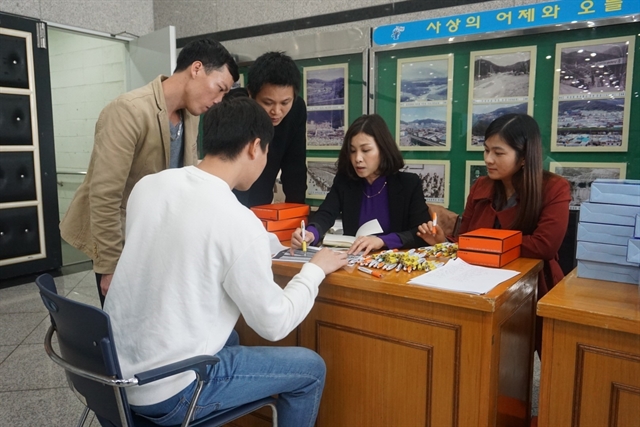 Nguyễn Gia Liêm, Deputy Director of the Department of Overseas Labour, under the Ministry of Invalids and Social Affairs, talks to the Thời báo Kinh tế Việt Nam (Việt Nam Economic Time) on the issue of illegal migrant workers


 Les propos de certains dirigeants Nissan ont de quoi étonner pour une marque qui a été une des premières à connaître le succès avec le SUV. Et si les jeunes générations actuelles tournaient massivement le dos aux SUV, voitures des "parents" ?
 Electroacupuncture and hydro-acupuncture should be used by hospitals as a combination of modern and traditional therapy to treat pain caused by disease, according to the National Hospital of Acupuncture.


 Il y a 22 ans, Toyota créait une rupture avec sa première génération d'hybride, et avec le résultat que l'on connaît aujourd'hui. Et si la marque parvenait à reproduire l'exploit d'une nouvelle rupture technologique avec les batteries dites "solides" ?


 Coup dur pour General Motors au moment du lancement de certains modèles importants, comme la Corvette C8 : la grève générale, qui touche l'entreprise depuis un mois, ne semble pas trouver d'issue. Et le géant de Detroit perdrait au passage 100 millions de dollars, par jour.