Didier “Ice” Iceman
Shared posts
From Black Death to fatal flu, past pandemics show why people on the margins suffer most
Didier “Ice” IcemanUn sain rappel

The Wuhan lab theory: Activist military brass, their media allies, and manufacturing public opinion
Didier “Ice” Icemanun peu plus documenté que la moyenne

Admiral Philip Davidson has had a distinguished military career. In May 2018, he was appointed commander of the United States Indo-Pacific Command. One of six unified combat commands (UCCs) that together cover the entire globe, Admiral Davidson is responsible for preparing for a potential conflict with China, the country that has come to be seen by many as the main geopolitical rival of the United States. Created by statutory authority, UCCs are there to plan and carry out military operations as directed by the president and secretary of defense — at least in theory.
Few characteristics of democracy are as important as civilian control of the military. Yet commanders of the various UCCs have taken on the role of public advocates for certain policies, putting pressure on and in effect lobbying the civilian leaders that are supposed to be making political decisions. Admiral Davidson’s actions since taking control of the Indo-Pacific Command is a clear example of this, and raises troubling questions about the extent to which the heads of UCCs and others in the national security bureaucracy have come to erode the concept of civilian control of the military and drive public discussion and the policy making process. Media reporting over the last two years also indicates that those who have a bureaucratic or ideological interest in a more belligerent American policy towards China have been leaking information to sympathetic journalists in order to manipulate public opinion.
Admiral Davidson’s actions clearly demonstrate this process. In his confirmation hearing in April of 2018, he stressed the necessity of “expanding the competitive space” to meet a rising China. In June of last year, Admiral Davidson did an interview with hawkish Washington Post reporter Josh Rogin that was published under the headline, “To avoid conflict, the United States must deter Chinese aggression.”
Without any evidence, Admiral Davidson warned about Chinese global ambitions, and a new world order “with Chinese characteristics” that should “send a chill down everybody’s spine across the globe.” Davidson also complained that the United States still was not funding capabilities he had called for two months prior. Six months after the Post article,,he similarly advocated for spending on new technologies to counter China in an interview with Defense One.
Admiral Davidson’s media campaign has had its intended effect. Usually, requests for funding come through the secretary of defense. The 2020 National Defense Authorization Act, however, called for Admiral Davidson himself to submit a report for what the Indo-Pacific Command needed, in which he asked for $20 billion in additional funds.
With the novel coronavirus hitting the United States, members of Congress took up Admiral Davidson’s cause for a confrontational posture toward China and they found support in a series of anonymous leaks that in one case went to Rogin, who had advanced Admiral Davidson’s campaign for more funding before the coronavirus hit.
On April 14, Rogin reported that the State Department had previously warned about security issues at the Wuhan lab studying coronaviruses. The next day, Fox News, which has often been fed information from the most hawkish members of the national security establishment, reported that sources had come to believe that the Wuhan lab was indeed the source of the novel coronavirus. That same day, in a seemingly unrelated story, The Wall Street Journal told of an upcoming State Department report that China may be violating treaty obligations by testing small-scale nuclear weapons.
There is no evidence that Admiral Davidson knew about or was involved in any of these leaks. Nonetheless, certain members of the national security establishment were clearly working towards the same goals, and collaborating with reporters like Rogin in order to shape public opinion, just as Admiral Davidson has been doing more openly since taking over the Indo-Pacific Command. Almost on cue, less than one week after a series of leaks meant to stir up animosity towards China, Senator Tom Cotton wrote an op-ed published in the Wall Street Journal promoting the theory that the virus escaped from a lab and introduced the FORCE Act, which would give $43 billion to the Indo-Pacific Command, more than double what Admiral Davidson had asked for.
These leaks easily manipulate public opinion. Government officials never leak all the information needed to help the public make an informed decision about the supposed threat coming from a foreign state. Rather, pieces of data and intelligence judgments are provided on a selective basis, clearly for the express purpose of achieving budgetary or ideological goals. Once Congress decides to spend the money, whether the original reporting was factual or not, or whether it looks different in another context, is rarely checked. Scientists almost immediately began expressing skepticism about the Wuhan lab theory, and The New York Times recently reported that intelligence agencies have felt pressure to arrive at that conclusion. According to Australian intelligence officials, American evidence of the Wuhan lab theory consists largely of publicly available news reports. Given that, as we have seen, American national security officials are usually the sources for such reporting, what we see is a self-referential cycle that in effect has created a narrative out of thin air.
While de jure civilian control of the military remains a bedrock principle of the American system of government, the reality is quite different. Hawks within the national security bureaucracy often seem to focus just as much time on manipulating public opinion as they do preparing for war.
The late James McCartney pointed out that, as of 2010, there were only 10 reporters covering the Pentagon full time, compared to thousands of military and civilian personnel in the DOD that worked on managing public opinion. The few journalists that pay attention to military issues rely on good relationships with those in power to provide information to them, some of which they are not legally entitled to. The only thing more concerning than a government that withholds important information from the public is one that provides it selectively. Activist generals and members of the national security apparatus are like all bureaucrats in desiring larger budgets; when collaborating with a media willing and eager to do their bidding, and politicians looking to find scapegoats for problems, it is all too easy for this class to engage in threat inflation and ultimately put us on a path that, at best will lead to more debt and strained relations with another great power, and at worst war.
The post The Wuhan lab theory: Activist military brass, their media allies, and manufacturing public opinion appeared first on Responsible Statecraft.
Why is the US removing its Patriot missile systems from Saudi Arabia?
Didier “Ice” IcemanThéorie a verifier

The U.S. is removing Patriot anti-missile systems from Saudi Arabia as part of a broader drawdown of its military capacity placed there to counter Iran. While the military characterized the move as part of a planned withdrawal that reflects the view that Iran now poses less of a threat, the news has prompted debate over the timing of the decision.
In general, the Trump administration and especially Secretary of State Mike Pompeo have repeatedly emphasized the danger to regional security posed by Iran. To suddenly acknowledge that the Islamic Republic is less of a threat than it was previously portrayed to be appears to undermine the case that hawks like Pompeo and Special Representative for Iran Brian Hook have made, that the U.S. needs to maintain a posture of heightened vigilance and even pre-emptive aggression in order to deter military actions by Iran. Tensions between Iran and the U.S. remain high, which was why the reduction of U.S. military presence in Saudi Arabia prompted speculation among observers. Given Trump’s transactional approach to policymaking and his tendency for showmanship, the assertion that the decision merely reflects the need for maintenance of the Patriot system seems incomplete.
One interpretation reads that the Trump administration feels that Saudi Arabia needs to be reminded that its enjoyment of U.S.-guaranteed security is predicated on its adherence to America’s oil price preferences. Reuters revealed that Saudi Crown Prince Mohammed bin Salman agreed to cut Saudi oil production after Trump called to say that he would otherwise be unable to prevent a bill sanctioning Saudi Arabia from being introduced by representatives of oil producing states, most of whom are Republicans. Although MBS did agree to cut production, Trump may have felt that the Crown Prince would benefit from a reminder of his kingdom’s dependence on the U.S. military umbrella.
Alternatively, Trump just issued the seventh veto of his presidency in order to defeat a bi-partisan bill that would have required him to gain Congressional approval before launching military action against Iran. Although Trump was unwilling to acknowledge any limit to his executive authority, the drawdown of the U.S. military presence in Saudi Arabia may serve to reassure members of Congress, especially Trump’s GOP allies, that they need not fear his belligerence against Iran.
One final interpretation of the decision to reduce U.S. military capacity in Saudi Arabia takes the opposite view: that it could be intended to tempt the Iranians into a military action that would justify a more robust response from the United States. As explained by officials quoted in the Wall Street Journal article, the build-up of U.S. forces in Saudi Arabia was undertaken in response to attacks on Saudi oil facilities in September 2019 that Riyadh and Washington blamed on Iran. However, Iran has generally avoided escalation, even following the killing of Qassem Soleimani in early January, the “unprofessionalism” of Iranian boat captains notwithstanding. Hawks within the Trump White House have maintained that they view the Iranian regime as weak and near collapse and may hope that reducing U.S. forces could tempt Tehran into more aggressive moves that would justify an intimidating U.S. military response.
The drawdown of U.S. military presence in the Middle East, and especially from Saudi Arabia, is a welcome development. However, given this administration’s track record of belligerence towards Iran and its transaction approach towards even its closest security partners, it is hardly surprising that the timing of the move is provoking considerable speculation.
The post Why is the US removing its Patriot missile systems from Saudi Arabia? appeared first on Responsible Statecraft.
Five ways to reset US foreign policy amid the COVID-19 crisis
Didier “Ice” Icemana lire

Each night many of us are transfixed to our television screens, watching in fear and dismay as politicians and epidemiologists recite the latest statistics on COVID-19. With our daily lives upended by stay-at-home orders, sickness, and job loss, it is easy to turn inward and ignore what’s happening far from our shores. But the crisis presents numerous opportunities to build a better, safer world – and to avoid actions that will compound the dangers. Here are just five of them:
1. Seize the day for diplomacy. Out of the pain and suffering comes a rare opportunity for world leaders to join together against a common, mortal foe. Coronavirus sees no geographic boundaries; it favors no political systems; it exempts no race, religion, gender, or creed. To save lives, nations must share data, resources, knowledge, and equipment. If calls for ceasefires in Yemen, Colombia, the Philippines, and globally are heeded, they could break long-running cycles of violence and pave the way for negotiated settlements. Now is the moment to recommit to multilateralism, building the foundation of treaties and international agreements that reduce the chances of war, and enable broader cooperation on transnational challenges.
2. Remember we’re all in this together – but we’re not all at equal risk. This is not the time for xenophobia, finger-pointing and blame. It is not an either-or choice for the United States, helping ourselves or helping others. No one country can flourish at another’s expense. Most of the world will suffer a greater toll from COVID-19 than the United States, given their limited access to clean water, food, sanitation, housing, medicine, and health care. Failing to mobilize a robust international response will only come back to haunt us as hundreds of millions, perhaps billions, face the loss of lives and livelihoods.
3. Look beyond the health emergency. The coronavirus is causing far more than a disease pandemic – it could also set off a violence epidemic. Domestic violence has surged as women and children are trapped at home with their abusers. Authoritarian regimes are using the crisis as an excuse to crack down on free speech and human rights. The sickness and death of leaders – particularly in states without strong democratic institutions – will almost certainly result in power struggles and civil strife. Pre-existing conflicts over rights and resources could flare into genocide and mass atrocities as COVID-19 exacerbates communal division and weakens command and control over armed forces. This is the time to invest in long-term, comprehensive peacebuilding and conflict mitigation networks.
4. First, do no harm. At a time of such intense and universal suffering, it is immoral as well as self-defeating for the United States to continue policies that were designed to pummel other countries into submission. Economic sanctions intended to isolate and weaken “rogue” states are compounding the suffering of innocent civilians. They must be lifted as a purely humanitarian matter, especially in Iran, Venezuela, and North Korea. At the same time, drone wars and militarized counterterrorism operations – which have aided the growth of terror networks – should be terminated and replaced by civilian efforts to address underlying grievances and strengthen systems of justice.
5. Shift the paradigm. At the very least, the COVID-19 pandemic should make it obvious that our “defense” spending is utterly out of sync with the real challenges to the health and safety of Americans. Already more than twenty times as many Americans have died from COVID-19 as in the 9/11 attacks, and even the best-case scenarios show more dying than in all the wars since World War II combined. A new report from the International Campaign to Abolish Nuclear Weapons calculates that the amount we spend in one year on nuclear weapons would be enough to cover 300,000 Intensive Care Unit beds, 35,000 ventilators, and 75,000 doctors’ salaries. Even the most sophisticated weapons on the planet can’t protect our armed forces – or anyone else – from this virus.
In some ways the COVID-19 pandemic is but a dress rehearsal for climate change, and the world has been granted a golden opportunity to change its ways before the worst is upon us. Before Congress sleepwalks into another $750 billion or more in Pentagon spending, the American public should give it a wake-up call about the investments that are truly needed to keep everyone safe for the long haul.
The post Five ways to reset US foreign policy amid the COVID-19 crisis appeared first on Responsible Statecraft.
Messagerie email éthique : comment préserver sa vie privée en 2020 (et celle de son entourage)
Didier “Ice” Icemanc'est complet
Ce billet est une mise à jour de celui publié en septembre 2017 sur le petit monde des messageries email.
L’email reste un outil majeur malgré l’usage massif des réseaux sociaux et des messageries instantanées. Nous avons besoin d’un email pour communiquer avec nos semblables et pour nous inscrire à des services web divers et variés dans le cadre de nos usages numériques éducatifs, ludiques, administratifs et professionnels.
Une boite email comporte une grande partie de nous mêmes : il s’agit de notre correspondance numérique, qui va de l’email le plus banal (confirmation d’une commande d’achat) au plus intime (échanges familiaux et amoureux) au plus confidentiel (email officiel des impôts !).
A qui confier la responsabilité de conserver avec respect notre vie numérique ? Je vais tenter de répondre à cette question 🙂
Une histoire de critères
Je fais le choix d’un service email selon plusieurs critères :
- Les conditions générales d’utilisation du service, les fameuses CGU que personne ne lit jamais : à quoi s’engage la structure hébergeant mes emails au niveau confidentialité ? Est-ce que le secret de ma correspondance est respecté ?
- Structure légale : quelle est le format juridique de la structure gérant le service email ? Est-ce une entreprise commerciale anonyme, une coopérative ou une association ? Quel est son modèle économique, c’est-à-dire comment la structure se rémunère ?
- La localisation : Où est légalement basée cette structure juridique ? Dans quel pays sont les serveurs informatiques hébergeant mes données privées ? Comment ce pays se comporte-t-il vis-à-vis de la vie privée de ses citoyens ?
Dans les CGU, je cherche le niveau de respect accordé à mes correspondances : le fournisseur email ne lit pas mes données, ne le revend pas à des entreprises commerciales et ne laisse pas de porte ouverte volontairement à aucun Etat. J’écarte les services qui lisent le contenu de mes emails pour me profiler afin de les revendre à des entreprises commerciales ou des régies publicitaires pour améliorer leur offre marketing. Je favorise les services plus éthiques.
Concernant la structure légale, je m’intéresse au modèle économique de l’entité étudiée. Comment se finance l’entité ? Quel est son écosystème économique, social et écologique ? L’idéal serait les modèles coopératif et associatif dans lesquels les bénéfices sont utilisés pour financer le projet et rétribuer les salariés correctement.
La localisation physique de l’entreprise et de serveurs informatiques me permet d’évaluer le degré de respect de la vie privée des citoyens par l’Etat. Je vais préciser les choses : les révélations d’Edward Snowden ont changé beaucoup de choses. Les USA utilisent les entreprises US de la tech pour leur objectif de collecte massive des données numériques de tous et de toutes. De nombreux pays leur ont emboité en adoptant des lois de surveillance numérique de plus en plus intrusives comme la France (là et là) et le Royaume-Uni. Loin de moi l’idée d’échapper à la surveillance de masse en jouant les hackers en carton mais plutôt de signifier mon désaccord en évitant les services hébergés dans ces pays et en favorisant des alternatives plus respectueuses.
1. Résultats courts
1.1. Les services emails que je conseille
- Infomaniak
- Kolab Now
-
Mailfence
- Mailbox
- Mailden (ajout 2 mai 2020)
- Migadu
- Neomailbox
- Posteo
- Protonmail
- Runbox
- Soverin
- Tutanota
- Vivaldi
1.2. Les services de messagerie qu’on peut utiliser, éventuellement…
-
Autistici
-
Disroot
- Fastmail
- Gandi
- Gozmail.bzh
- Infini
- La Poste
- Mail Lilo
-
Mailo (anciennement NetCourrier)
- Mail.fr
-
Mail.be
- Ouvaton
-
OVH
- Postale.io
-
Riseup
- Sud Ouest
-
Yulpa
- Zaclys
1.3. Les services à ne pas utiliser
- Gmail
-
GMX
- GreenNet
- Msgsafe.io
- Newmanity
- Novo Ordo
- Openmailbox
-
Outlook / Hotmail
- Scryptmail
- Startmail
-
Yahoo
-
YandexMail
- Zoho
2. Résultats en détails
2.1 Les services de messagerie conseillés
Ce sont des services qui respectent la vie privée de l’utilisateur et dont le pays hôte respecte lui aussi la vie privée de ses concitoyens.
Hébergeur Suisse fournissant un certain nombre de services internet classiques : hébergement, nom de domaines, serveurs et pour la partie qui nous intéresse service email + calendrier + carnet de contacts. Il faut acheter un nom de domaine et la prestation email adequat. Cela revient à une trentaine d’euros par an. C’est ma solution préférée.
Basé en Suisse, un service payant très complet avec calendrier et suite logiciels (traitement de texte et tableur en ligne, stockage de fichiers en ligne). Du solide.
Service allemand complet : email, agenda, traitement de texte et tableur en ligne, espace de stockage. Payant à partir de 12 € par an. Là aussi, un bon choix très complet. Peer Henlein, créateur du service, est très connu pour son activisme au sein du logicie libre et de Linux depuis presque 20 ans.
Mailden (ajout 2 mai 2020 suite à une suggestion venue des commentaires)
Et oui, je ne connaissais pas ce service tout à fait respectueux de ses utilisateurs, avec chiffrement de bout en bout des données utilisateurs. Made in France.
Basé en Belgique, avec également calendrier et stockage de documents possible. l’offre de base est gratuite et possibilité de payer une somme modique pour plus d’options. Il reverse 15% de leurs revenus à des organismes comme l’Electronic Frontier Foundation et European Digital Rights Foundation.
Midagu (ajout 2 mai 2020 suite à une suggestion venue des commentaires)
Un fournisseur militant et alternatif basé en Suisse. Beaucoup d’informations sur leurs projet et positionnement sur leur site. Intéressant.
Service payant Suisse proposant email, VPN et achat de nom de domaine.
L’email le plus écologique et éthique de la liste. Leur énergie est fournie par Greenpeace Energy, Posteo fait également des dons à des organismes à but non lucratif tous les ans. Basé en Allemagne. A partir de 12 euros par an. Irréprochable.
Service basé en Suisse avec options payantes. Les emails sont chiffrés de bout en bout entre utilisateurs Protonmail. Intègre également un calendrier.
Service payant basé en Norvège. Les conditions d’utilisation sont claires et ce service est assez réputé. Critère écologique très important, ils viennent d’obtenir le label éthique par Ethical Consumer.
Service payant basé aux Pays-Bas promouvant la protection des données. Efficace.
Service basé en Allemagne avec options payantes. Les emails sont chiffrés de bout en bout entre utilisateurs de Tutanota. Possibilité de mettre un mot de passe aux emails envoyés en externe. Intègre un calendrier.
Service gratuit basé en Norvège et Islande. Le Vivaldi présenté ici est à mettre en lien avec le navigateur internet lancé par Jon von Tetzchner du même nom. A noter que ce service est très complet avec calendrier et carnet d’adresses. Gros refresh visuel il y a peu de temps. Un compte chez Vivaldi vous donnera accès à leurs forums et à un profil pour créer un blog hébergé chez eux.
2.2 Les services de messagerie qu’on peut utiliser, éventuellement…
Ici se retrouvent de nombreux services qui ne remplissent pas mes critères à 100%. Souvent, c’est parce que le service réside dans un pays qui respecte peu la vie privée et l’intimité de ses citoyens. C’est le cas pour tous les services basés en France ou au Royaume-Uni.
Service militant altermondialiste gratuit basé en Italie. Le service est respectueux des utilisateurs mais de par sa nature, je me demande s’ils ne sont largement surveillés. De nombreux services sont proposés (blog, mailing list, messagerie instantanée…).
Dans le même esprit qu’Autistici, assez alternatif et plus récent, Disroot propose de nombreux services dont un email. Basé aux Pays-Bas.
Je crois que c’est visuellement et graphiquement ma suite email préférée : email, calendrier, stockage de documents, tout est magnifique. Le service est efficace et leur offre payante vaut vraiment le coup pour 32 € par an. Malheureusement, leurs serveurs sont basés aux USA.
Autre grand de l’internet français, Gandi propose lors de l’achat d’un nom de domaine 2 boites emails de 3 Go et il y a aussi un calendrier disponible. Ca fonctionne via le client web Sogo (pour ceux qui connaissent). Pas mal mais l’entreprise Gandi est également soumise aux lois françaises.
Association loi 1901 basée en Bretagne. Même philosophie que Zaclys et Framasoft, acteur engagé. Il faut être membre de l’association pour accéder au service. A partir de 9 € par an.
Hébergeur associatif français. L’adhésion ouvre une série de prestations numériques et de formations de l’adhérent dont une adresse email de type nom@infini.fr (et ça, c’est la classe).
Les conditions de la Poste ont également changé depuis mon dernier billet ! L’entreprise est beaucoup plus respectueuse des données privées dans ses CGU (merci le RGPD ?) et s’engage même à les protéger. Le partage avec ses filiales et partenaires commerciaux a disparu. Reste que le service est basé en France.
Service email lié au bien connu méta moteur de recherche Lilo, hébergé par Scaleway (Free), anciennement appelé Online SA, en Ile-de-France. Inscription cloturée pour l’instant.
Service similaire à Mailfence, basé lui aussi en Belgique. Regroupe plusieurs services en plus de l’email : calendrier et stockage de documents. Offres gratuite et payante. Les inscriptions sont clôturées en ce moment.
Mail.fr est la devanture francophone de Mail.de, entreprise allemande. Leurs CGU sont très claires et leurs explications sont très transparentes. L’offre email gratuite basique est financée par une newsletter imposée et que certains données seront partagées avec des tiers pour vous soumettre d’autres éventuelles newsletters commerciales (avec possibilité de se désinscrire à celles ci). L’offre payante à 12€/an permet de se débarrasser de la publicité et d’avoir plus d’options. Explications honnêtes.
Anciennement Net Courrier, Mailo est un service hebergé en France chez Ecritel. Soumis aux lois françaises.
Ce service basé en France permet de créer des boites emails à partir d’un nom de domaine dont vous êtes le propriétaire. Une initiative entre copains qui a pris de l’ampleur !
Incontournable géant français du numérique. En achetant un nom de domaine, vous aurez droit à un boite email de 5 Go de base (sans calendrier). Il est possible de souscrire à des formules emails plus poussées et donc payantes. Je vous déconseille l’offre « email Pro » https://www.ovh.com/fr/mail/ chez OVH qui ne se synchronise avec rien, qui n’autorise pas l’export de votre calendrier, ni de votre liste de contacts. C’est ce que j’appellerais une offre « cul de sac », je me suis fait avoir et je ne la conseille à personne. Pour le reste des offres Pro, c’est assez cher avec des produits Microsoft Exchange. OVH est soumis aux lois françaises. Je suis moyen chaud pour utiliser un service basé en France pour tout vous dire.
C’est une coopérative française qui permet d’acheter un nom de domaine et d’utiliser ce nom de domaine pour ses emails. Rappelons que le modèle d’entreprise coopérative est de mon point de vue le meilleur modèle d’entreprise : démocratique, éthique et outil fort du développement local.
Service militant engagé basé aux USA. Le service est très respectueux des libertés et droits des utilisateurs. De part sa nature militante, j’imagine que ce service doit être scruté de près par divers organisations officielles aux USA.
Un des hébergeurs associatifs lié au collectif CHATONS. Il faut adhérer à l’association (2€) et donner ensuite le montant qu’on désire, c’est le principe du prix libre. Hébergé en France.
Anciennement Web4all, association devenue entreprise basée en France. Cette entreprise propose les mêmes choses qu’OVH ou Gandi : noms de domaine, hébergement, produits email. Le client mail est basé sur Zimbra avec calendrier, carnet d’adresses et stockage de documents. A noter un espace de 50 Go pour les comptes emails. Service payant. Soumis eux aussi aux lois française (voir OVH et Gandi).
C’est une association loi 1901 qui, à l’image de Framasoft, propose de nombreux services en ligne. Le service mail utilise l’interface Roundcube. A partir de 5 € par an. Belle initiative du monde associatif qui propose également de nombreux services numériques (du nuage à la française).
2.3 Les services de messagerie à ne pas utiliser
Certains services sont à éviter : ils lisent vos contenus en ligne et génèrent de l’argent en vous profilant. Ils peuvent également vendre vos données personnelles à n’importe quelle entreprise commerciale.
Autre raison supplémentaire de les éviter : leurs serveurs informatique sont accessibles aux autorités administratives du pays par défaut sans aucune demande légale. C’est le cas du territoire étasunien couvert par le Patriot Act et le Cloud Act qui permettent au gouvernement US d’accéder librement à vos données sans votre consentement, ni avertissement.
Les pires services cumulent tous les problèmes à la fois (Gmail, Yahoo) : profilage et revente de vos données + libre accès des autorités US à vos données en ligne.
Startmail
ervice basé aux Pays-Bas. Propose du chiffrement facilement utilisable. Par les créateurs d’Ixquick et de Startpage. Acheté en octobre 2019 par Privacy One Group, propriété de System1, une entreprise publicitaire. A éviter.
Gmail
Je ne présente même plus le service mail de Google. Cette compagnie vit de la publicité qui découle du profilage des utilisateurs de ses services. En clair, vous payez Gmail et le moteur de recherche Google avec vos données privées et celle de vos correspondants qui échangent des emails avec vous. Bref, vous mettez tout le monde dans l’embarras en utilisant Gmail.
De plus, basée aux USA, Google combine de nombreux désavantages quant au respect de votre vie privée. Gênant.
GMX
Service email allemand qui collecte vos données personnelles. Même si elle laisse la possibilité de sortir du piège, c’est de base pour moi assez négatif. voir le chapitre 4.1.2 Catégories et provenance des données personnelles. De plus, GMX utilise Google Analytics pour mesurer les audiences et l’utilisation de son site. Gmx a également recours à Optimizely comme service d’analyse web. Bref, fuyez.
Yahoo
Là encore, un service médiocre quant au respect de la vie privée de ses utilisateurs. Les Conditions Générales d’Utilisation et les ratés techniques (fuites de données récurrentes) doivent vous faire fuir ce service. Sans parler de leurs changements de stratégie incessants et de leur rachat raté de Tumblr. Petit extrait sympathique de leur CGU : « Les systèmes de Verizon Media analysent et stockent tout le contenu des communications, notamment le contenu des emails entrants et sortants, ainsi que les messages entrants et sortants des applications de messagerie« . Génial, non ? Basée aux USA, encore une raison de fuir.
YandexMail
Yandex est le Google russe. De nombreux services en lignes sont proposés. Les CGU indiquent qu’ils collectent un grand nombre d’informations de connexion et peuvent les proposer à leurs partenaires commerciaux. Fun fact : la Russie n’a pas été prise en flagrant délit d’espionnage comme la NSA 
Msgsafe.io
Service de messagerie email basé au Panama avec semble-t-il un haut niveau de protection de la vie privée des utisateurs. Ca démarrait pas mal mais personne chez eux ne répond sur leurs Reddit et Twitter. Je n’ai pas poursuivi plus.
Zoho
Email, suite bureautique en ligne, stockage de documents. Zoho fait tout. J’ai remarqué que les conditions de traitement des informations des utilisateurs avaient changé depuis le dernier billet en 2017. Zoho s’engage à protéger les données des utilisateurs. Il reste que Zoho est une société basée aux USA.
Outlook / Hotmail
Le service email de Microsoft, lié à Office 365 en ligne. Basé aux USA. On peut passer.
GreenNet
Hébergeur coopératif britannique engagé socialement et écologiquement, ils fournissent un service email payant. Ils se réservent le droit de lire le contenu de vos fichiers et emails, voir Point 6. De plus, le Royaume-Uni est un partenaire privilégié dans le cadre du programme de surveillance numérique mis en place par les USA.
Novo Ordo
Service prétendant être hebergé en Suisse mais avec un siège social est au Nevada, USA. En regardant d’un peu plus près, Epiphyte LLC, la maison mère, dispose de plusieurs succursales aux USA. Pas très clair. A éviter.
Scryptmail
Aucun background sur cette entreprise, aucune réponse aux commentaires postés… On sait que c’est basé aux USA (Washington). Pas de mise à jour de leur site depuis 2014. Je déconseille vivement de l’utiliser.
Newmanity
Le service indique ne plus prendre de nouvelles inscriptions. A suivre…
OpenMailBox
N’existe plus.
Conclusion
La mise à jour est maintenant terminée. Je vous laisse apporter votre pierre à l’édifice en commentaire car il y a certainement des choses à rajouter !
PS : promis, je n’attendrais pas 3 ans avant la prochaine mise à jour 🙂
How Turkey sees COVID-19 as a foreign policy opportunity
Didier “Ice” IcemanComme la chine

Whereas the entire world seems to have turned in on itself trying desperately to deal with the COVID-19 pandemic, interestingly Turkey’s foreign policy is displaying signs of an outward dynamism.
In Libya, for example, in early April, the Turkish-backed, and the United Nations-recognized Government of National Accord (GNA) struck a serious blow against the rebel warlord Khalifa Haftar’s Libyan National Army (LNA). The GNA captured strategic cities of Surman, Sabratha and al-Ajaylat in West Libya.
The GNA victory came at a time when Haftar had become the most likely winner of the now 6-year old Libyan civil war since his forces captured the strategic coastal town of Sirte in January, a vital outlet to the Mediterranean Sea for Libya’s oil export.
Turkey’s deep involvement in the Libyan civil war is closely related to Ankara’s perception that Greece and the Greek Cypriots are trying to divide up the Eastern Mediterranean, rendering Turkish maritime navigation difficult without Greek consent.
Furthermore, the lucrative hydrocarbon deposits around the island of Cyprus, Ankara posits, would be exploited ignoring the island’s Turkish population. France, Russia, and the United Arab Emirates (UAE) have also thrown their political and material support behind Haftar. By propping up a pro-Turkish government in Libya, Ankara hopes to save the maritime deal it signed with GNA prime minister Fayez al-Sarraj , and spoil any plan in which it is not included.
Turkey’s recent critical gains in Libya are the direct result of the anti-Turkey coalition being rendered debilitated by a variety of factors closely associated with COVID-19. Simply put, Turkey, which has fared the pandemic relatively unharmed, used this opportunity to advance its interests in Libya.
The UAE, Haftar’s main financial backer, has been hit hard by the all-time low oil prices due to plummeting demand because of COVID-19, which has made its involvement in Libya even more costly. Abu Dhabi announced on April 20 that it had borrowed $7 billion to counter slumping oil prices.
Moreover, for Russia, as if having to fund its costly involvements in Syria and Ukraine as well as the constricting U.S. sanctions were not enough, the plummeting oil prices and the ruble’s simultaneous nosedive has had Moscow reevaluate the purpose of its Libya commitment.
The withdrawal from Libya of the majority of forces from the Russian paramilitary group Wagner corresponded with the beginning of the declining oil prices in late February. “Syria has become Putin’s headache” says Alexander Shumilin, a former Russian diplomat who runs the state-financed Europe-Middle East Center in Moscow. Finally, Putin’s abrupt decision to pull the Russian oil giant Rosneft from Venezuela in March is a clear sign of Russia being overstretched.
French President Emmanuel Macron has thrown his support behind Haftar with the conviction that a pro-French authoritarian regime in Libya would facilitate Paris’s policies towards its former colonies in North and West Africa.
However, a series of predicaments have forced Paris to recalibrate its Africa policies. The signs of France getting bogged down in West Africa abound. The French military’s mounting casualties in Operation Barkhane, which it started in the Sahel in 2014 with some 5,000 troops, is obstructing Paris’s ability to fully commit in Libya.
In November 2019, two French helicopters in pursuit of militants in Mali collided, killing all 13 French soldiers aboard. To make things worse for France, its only nuclear-powered aircraft carrier Charles De Gaulle, which it has used as a deterrent against Turkey’s naval and air advances in Libya, is currently out of commission as more than 1,000 French sailors are believed to be infected with COVID-19. Having been hit hard by the pandemic at home, coupled with the ever increasing mission creep in the Sahel, France has shifted its priority away from Libya.
Turkey has seemingly seen this as a window of opportunity. Last week, in an unprecedented show of resolve, it sent 11 F-16s accompanied by refueling, early warning radar, and other support aircraft to Haftar controlled airspace in a clear message that Turkey is ready to escalate its involvement in Libya.
Turkey has over the past year already shipped a multitude of weapons including drones, armored vehicles, electronic warfare tools, laser weapons, and other arms and ammunition to the GNA. Of these, the low cost but extremely effective armed drones are rapidly changing the face of the Libyan battlefield. With the help of Turkey’s proven armed drone supremacy, Sarraj’s militia inflicted serious damage on Haftar, turning the tide in Libya.
Turkey has further scored points in its foreign policy by sending, in early April, medical supplies to Italy and Spain, two of the most important Mediterranean countries, of which Ankara would very much want to see on its side against the France-Greece block. Ankara’s gesture came at a time when Italy and Spain had been imploring the European Union for supplies, only to get a cold shoulder from Brussels. The situation further eroded when France confiscated much-needed masks, some six million, destined for Italy and Spain.
Even before the pandemic outbreak, Italy had moved closer to Turkey’s Libya policies, expressing its support for Sarraj and voiced concern with Macron’s support for Haftar.
It appears the COVID-19 pandemic has bestowed Turkey with favorable foreign policy opportunities by reducing the ability of its rivals to meaningfully sway Ankara’s advancements in the East Mediterranean, particularly in Libya and reinforce its position vis-a-vis the European Union. One should expect a more active foreign policy of Ankara in the post-COVID19 era.
The post How Turkey sees COVID-19 as a foreign policy opportunity appeared first on Responsible Statecraft.
Reopening puts Germany’s much-praised coronavirus response at risk
Didier “Ice” IcemanEn question

Covid 19 in Algeria: dangers, risks and opportunities
Didier “Ice” IcemanEffectivement un impact potentiellement fort.

Arab leaders have long evinced an ability to reinvigorate their ruling institutions when confronted with tough challenges. While state collapse or civil war have wreaked havoc in Libya, Iraq, Syria, and Yemen (with the exception of Tunisia and the partial exception of Iraq and Lebanon), it is authoritarian survival—and the unceasing struggle against it—that define the political contours of much of the Arab world today.
Will COVID-19 change these realities? Like their cohorts in powerful positions around the world, Arab leaders are using the coronavirus pandemic to increase political control. This crisis, however, has unique features that could complicate efforts to defend autocracy, creating both headaches and opportunities. What is at stake now is not only regimes but myriad state institutions whose mission should be to ensure a basic level of economic, personal, and human security for their citizens. The nightmare facing many Arab leaders is that the rapid spread of COVID-19 might outpace their capacity to adapt state institutions to an unprecedented and dangerous threat.
Algeria provides a telling example of the challenges posed by the coronavirus where, as of April 21, 2,811 cases of infection and 392 deaths have been reported. The virus arrived just as Algeria was about to mark a full year of weekly street protests; as the anniversary of the Hirak movement, the protesting group’s political future was unclear. That uncertainty had much to do with the regime’s shrewd decision to tolerate rather than repress the protesters. But COVID-19 seemed to remove any uncertainty about the regime’s calculations. Seizing on the undeniable—if useful—imperative of enforcing social isolation, and gradually imposing lockdowns on different sectors and areas of the country, Algeria finally declared a national lockdown on April 5. This gave authorities a range of powers, including the right to ban all streets protests. As for the Hirak movement, its forced retreat into the uncertain sanctuary of home and family will weaken an already weak hand. Nevertheless, some Algerian activists also see in this crisis a chance to create the kind of wider political strategy and capacity that Hirak has thus far failed to forge.
The military’s (flattening) learning curve
Algeria’s military and political power is rooted in far more than its capacity to repress: it also derives from the imposing fact that the military controls the state and the distribution of the goods and benefits provided by the state-owned oil sector. Because revenues from oil and gas resources are channeled through an array of formal state institutions and informal networks that are controlled by allies of the military, the generals assume that the weakening of any part of this sprawling infrastructure will lead to a collapse of the entire system. This intertwining or “pillaring” of Algeria’s vertical division of state power inclines the military and its allies in state institutions to view even modest political reform as threatening. Moreover, during moments of crisis or menace the generals have ample incentive to put aside clan or personal divisions and close ranks. As a result, opposition groups—including the Hirak movement—have no reliable interlocutors within the military, no soft-line faction that might negotiate the terms of political reform. At the end of the day, the Algerian military is a hard-line united front that will not abide any serious talk of political change.
Why, then, did a military that is deeply allergic to any hint of real opposition tolerate a year of massive street protests that were centered in Algiers but echoed throughout the country? While it is impossible to answer this question precisely, the most likely explanation is that the generals calculated it was better to tolerate the protests than try to repress them. Waiting out the demonstrators was preferable to taking measures that might only provoke a violent response that would, in turn, require greater force to suppress successfully. Going down this slippery slope risked provoking the kind of civil strife that engulfed Algeria following the military’s decision to shut down democratic elections in 1991.
Moreover, the Hirak lacked an authoritative leadership that could draw on the protests to create negotiating leverage with the regime. The one thing on which the protesters agreed was demanding the fall of the regime; beyond that, there was no consensus as to what kind of government—or democracy—should follow, or the demands that would advance a democratic bargain the opposition could envision. Last but not least, the demonstrations did not translate into wider public support for democratic change. Indeed, in 2019 only 41 percent of Algerians who were polled indicated that they believed that democracy was always superior to other forms of government. In short, however inspirational, the Hirak did not pose the kind of threat that would have justified a decision to favor confrontation over regime caution and patience.
In addition to waiting the opposition out, by emulating many of the tactical reforms that other Arab leaders had taken to contain opposition, the regime displayed its resiliency. For example, it initiated a national dialogue while insisting on maintaining its control during negotiations with protesters. At the same time, the military maneuvered to defend its long-term interests. Thus Lt. General Ahmed Gaid Saleh—who was widely viewed as the country’s most powerful military leader—forced Bouteflika to resign in April 2019 and then purged the former president’s allies. Having neutralized his potential internal rivals, Salah presided over the election of a new president. Elected on December 12, 2019 in a low turnout election (40 percent of eligible voters participated), Abdelmajid Tebboune (who had briefly served as prime minister in 2017) provided a paper thin veneer of civilian legitimacy for the military’s institutional primacy.
Saleh’s sudden passing on December 23 did not change one basic fact, namely that the new president could make no move that threatened the generals. Thus while Tebboune pledged to pursue radical political reforms, he in fact had little room for maneuver. Similarly, the release of 76 protest detainees—along with Tebboune’s creation, in January 2020, of a new committee to reform the constitution—inspired little confidence, especially in the formal opposition, whose leaders pushed for what turned out to be a widespread boycott of the December election. But the Hirak was not well positioned to leverage the potential opportunity presented by a newly elected president who was struggling to gain popular support. Lacking allies in the military and an authoritative leadership, the Hirak’s only alternative was to continue relying on Friday protests. When the coronavirus crisis eliminated this option, it seemed only a matter of time before the regime would begin a comprehensive clampdown on all forms of political and social dissent.
COVID-19 creates dangers and possible opportunities for the regime
The arrests of several social and political activists in February and March seemed to signal the beginning of just such a campaign. Not surprisingly, these activists were charged with an array of vague alleged crimes, not least of which was making statements that endangered the reputation of the military. But the onset of the COVID-19 crisis in Algeria generated a number of challenges that complicated any bid by the regime to widen the net of repression. While enforcing social isolation also worked in favor of political isolation, the regime had ample justification to advance these measures as necessary for protecting the general welfare. But COVID-19 is an equal opportunity virus whose rapid spread could literally weaken the human and institutional infrastructure that is at the heart of a repressive apparatus. Such a prospect was hardly on the radar screens of Algeria’s leaders in early February, when only a handful of coronavirus-related cases were officially reported.
The ability of the regime to address this growing threat has been hampered by a national health system that lacked the resources to fight the spreading disease, by widespread distrust of the regime, and—last but not least—by a steep decline in oil revenues. What could worsen this situation is the collapse in oil prices, which would result in serious cuts in spending because of the country’s dependence on the hydrocarbon sector. Algeria has been suffering from 12.35 percent unemployment in 2019 (26.9 percent among the youth). Its regime’s capacity to channel subsidies and other support to the vast urban middle class and to state employed workers had already been weakened. The country is now facing an even deeper social crisis.
The military’s fate will depend in part on how well it manages the current challenges. The regime has tried to relieve the burden on the state’s overcrowded prison system by releasing 10,000 prisoners in February and more than 5,000 others in April. This has left some 43,000 prisoners in 150 prisons, 30 of which are now being used to produce face masks for a health system that is unprepared for the COVID-19 onslaught. But political prisoners are not among those who have been released, a fact that has prompted demands from the official political parties that the government release “all prisoners of conscience” and to take measures to create a genuine state of law and real democracy. Of course, the military and its allies in the police and intelligence services will dismiss or ignore these demands, not only because they clash with the security sector’s interests but also because Algeria’s escalating health crisis might just give military leaders the opportunity to prove that they are the most effective institution in the country. Given the widespread perception that economic and social problems, rather than democracy, should be the first order priority of the regime, Algeria’s actual rulers might be well poised to regain public trust, which only a few short years ago remained strongly behind the military.
Whatever its intentions, the fact of the matter is that the security apparatus is vulnerable to COVID-19. While it is hard to secure a definitive estimate of the size of this sector, in 2019 the defense budget stood at $9.6 billion, far higher than any other ministry. With a security sector that, according to a 2016 NATO report, employs over half a million troops and a vast intelligence apparatus, the generals will have their hands full containing a virus that could sap the capacity and will of the military to address myriad domestic challenges, not to mention abiding security threats along its border with Libya, Morocco, as well as the Sahel region.
The Hirak: reassessing, retreating, or both?
The Hirak’s anniversary provided a moment of introspection. Scholars and activists would do well to reevaluate their position within the body politic. What it needed, first and foremost, is the creation of the institutional basis for an enduring presence in the political terrain. For this purpose, it appears that the Hirak not only has to secure closer ties with formal political parties, but also more enduring linkages to civil society organizations and to organized labor, whose unions have often depended on state support for their very survival.
This could be a tall order, one that would require considerable imagination from a community of activists who are now more physically isolated or fragmented than ever before. Anticipating or reflecting these challenges, Hirak activists issued calls for the people to remain at home, thus suggesting that the real authority behind the campaign for social distancing emanated from the people rather than the regime. Thus the Hirak-linked Student Rally for Change (REC) proclaimed1 that in light of the regime’s failures and “the weakness of our health system,” the REC was announcing the temporary suspension of its participation in the popular protests.
Amplifying this theme, Hirak-linked activists have mounted online campaigns to underscore their determination to frame popular concerns about the health crisis into a wider message of social activism and political solidarity. Not surprisingly, the government-linked media has responded with reports clearly designed to discredit these new initiatives. But the regime must be careful what it wishes for. Given the scope of the escalating health crisis, the claim that these social activists have been “infiltrated by certain political currents” who are trying to “make it divert from its civic, patriotic, democratic and plural vocation” could boomerang. After all, the regime will not be able to fight the coronavirus without some partnership with the wider society. It thus faces a conundrum: how to secure the trust and cooperation of society without inadvertently empowering a beleaguered opposition. At the same time, social activists face the tricky task of seizing the social and ideological terrain without giving credence to claims that they are merely advancing their own narrow interests, and without provoking a backlash from the security apparatus. In Algeria, as in the wider Middle East, the dance of state power and social resistance continues, but now under conditions that are creating multiple dilemmas for all the key forces and leaders.
Where next?
Given the global challenges posed by COVID-19, Algeria’s leaders will have a tough time mobilizing international assistance. For the United States and for the European Union as well, any failure by Algeria to meet this challenge could have serious security implications for North Africa and the Sahel. But given the troubles the EU faced following Brexit and COVID-19—and in light of the multiple challenges that the Trump Administration is now confronting—Algeria will probably have to fend for itself as it struggles with threats to all aspects of what we might broadly call human security.
This article was republished with permission from the Arab Center Washington DC.
The post Covid 19 in Algeria: dangers, risks and opportunities appeared first on Responsible Statecraft.
Le coronavirus rebat les cartes entre les États-Unis et la Chine
Didier “Ice” IcemanC'est un peu le cas mais nous n'avons pas tout vu
Did Japan miss its chance to keep the coronavirus in check?
Didier “Ice” IcemanVu les derniers développement. ..

Enquête - Pourquoi recharger sa voiture électrique sur l’autoroute va devenir très compliqué
Didier “Ice” IcemanAh ah, je ris
 La vie des utilisateurs de voitures électriques va sérieusement se compliquer. Entre la fermeture de Corri-Door, le principal réseau de recharge rapide sur autoroute et le changement de politique tarifaire de Ionity, son concurrent, les longs trajets sur l’autoroute ne seront pas aussi rapides et attractifs qu’avant.
COVID-19 has forced Afghan refugees in Iran to flee back to Afghanistan
Didier “Ice” IcemanÇa réjouira certains

The exodus of Afghan immigrants fleeing Iran in the recent weeks because of the novel coronavirus outbreak in the Islamic Republic has largely gone off the radar of global media, but is actually a tragedy that has the potential of spawning broad, devastating consequences.
Iran has been hosting between 3 and 4 million Afghans, of whom only 1 million are registered refugees with legal status and entitlement to government support. Afghans in Iran have faced discrimination on different levels, and unequal access to healthcare services is one of them.
For decades, international organizations have been offering financial assistance to Iran to subsidize its support for the Afghan refugees.
However, the brunt of the debilitating international sanctions, coupled with the Iranian government’s lack of attention and proper policymaking have rendered the Afghans living in Iran a highly vulnerable group deprived of equal opportunities, situated at the bottom of the social hierarchy.
Around 200,000 Afghans have reportedly fled the coronavirus crisis submerging Iran, mostly on account of being denied medical care and also because their low-paid jobs have vanished by the pandemic induced global economic collapse.
The global humanitarian community is now concerned the massive cross-border movement may result in widespread infections across Afghanistan, as those who have decamped from Iran and dispersed throughout Afghanistan can potentially spread the virus.
The Afghan Ministry of Public Health has issued a stern warning, cautioning that some 16 million people could become infected, and tens of thousands could die. Afghanistan’s Herat province, bordering Iran, has the most confirmed cases of COVID-19.
Many Afghan citizens with symptoms of coronavirus who fled Iran say the overburdened health system there and the overstretched, under-equipped hospitals explicitly refused to admit them, because all of them are facing an unprecedented flooding of Iranian patients and caring for suffering Afghans doesn’t appear to be a priority.
Afghanistan’s own healthcare system is in a state of near total despair, thrashed by decades of war and conflict. According to official figures, the death toll in the war-wrecked country stands at 36, and a total of 1036 cases have been reported thus far. However, considering the scarcity of testing kits and related equipment, the actual numbers are likely far higher.
In a press briefing on April 14, U.N. Refugee Agency spokesperson Babar Baloch called for support to Iran and Pakistan as the two countries are hosting the largest populations of Afghan refugees.
“Leaving Afghans and their host communities behind will have a far-reaching and negative impact on global efforts to fight the virus,” he said.
Afghanistan’s Minister for Refugees and Repatriation Sayed Hussain Alemi Balkhi has said at least 10 Afghans have died in Iran from coronavirus. But here again, the actual figures are likely much higher, as there is a shortage of testing kids and Iran hasn’t provided accurate statistics.
In an interview with BBC Persian, the Afghan ambassador to Iran Abdul Ghafoor Lewal complained of the Iranian authorities refusing to provide the embassy with precise or estimated numbers of Afghan citizens inflicted with the coronavirus.
Afghans in Iran
Discrimination against Afghans in Iran is not a novelty, and unavailability or scarcity of healthcare services is only one instance of the travails they endure. More than 99 percent of Afghan employees across different economic pursuits, including in construction sector, which exposes them to serious health hazards, do not have any type of work-related insurance. When doing the same jobs, Iranian workers “benefit from 10-23% higher wages compared to Afghans.”
International human rights organizations have been repeatedly warning against the abuse and discrimination targeted at Afghans living in Iran. According to Human Rights Watch, the Iranian government deports thousands of Afghans indiscriminately, without giving them the chance to legally defend their right to stay or lodge asylum applications.
In November 2012, Mahmoud Ahmadinejad’s government issued a regulation, allowing for the expulsion of “1.6 million foreigners ‘illegally residing in Iran’ by the end of 2015.” The decision also mandated the Interior Ministry with facilitating the voluntary repatriation of an additional 200,000 Afghans bearing legal status as refugees and terminating the refugee status of 700,000 other Afghans.
There are also barriers to the social integration of Afghans and their development. For example, Afghans cannot enter or reside in 16 of Iran’s 31 provinces, they cannot enroll in certain university programs, and many mixed Iranian/Afghan couples find it difficult to get married as a result of government restrictions. Afghan husbands of Iranian women and children of such couples are denied citizenship and there are a limited number of professions Afghans in Iran can practice, which mostly include manual labor with extremely low wages.
The economic sanctions against Iran, which have woefully shrunk Tehran’s revenues, and impaired its ability to maintain international banking relations, are often cited by the Iranian authorities as the reasons why the Islamic Republic is not able to cater to the needs of the Afghans living in the country.
This, however, can never justify the abuse and indignity that Afghan migrants in Iran, especially children, live through. International organizations have reported police violence against Afghan youths, bullying against them in public sphere and racist assaults aimed at them, which are often left unaddressed.
In May 2019, the Iranian owner of a retail store in the city of Nazarabad received a suspended jail term after putting a racist sign on the window of his shop, reading, “The entry of Afghan residents into this store is forbidden.” The move was met with fury and frustration among both Iranians and Afghans.
In July 2019, an Afghan boy was severely pummeled and hurled on the pavement by a member of the board of trustees of a holy shrine near the city of Bushehr in southern Iran after he was caught tampering with a locked donation box outside the shrine. The man later on offered an apology to the boy’s family, and no litigation was brought against him.
The life of Afghans in Iran over the past three decades has been saturated with hardships. Although some of them have been able to thrive, find prestigious jobs, and set up families, many of them have constantly found themselves in dire straits, defenseless in a battle with government policies that overtly discriminate against them, and a poor public image that centers on linkages to crime, illiteracy, poverty, and addiction.
The departure of thousands of Afghans from Iran to their homeland to enjoy protection from the coronavirus pandemic that has battered Iran more than any other nation in the Middle East and West Asia is only a reminder that a sizeable population of immigrants and refugees are living in a country ruined by an international economic blockade while suffering from corruption and mismanagement, and they need meaningful and efficient help.
The post COVID-19 has forced Afghan refugees in Iran to flee back to Afghanistan appeared first on Responsible Statecraft.
How does coronavirus kill? Clinicians trace a ferocious rampage through the body, from brain to toes

How the Military-Industrial Complex is Using the Coronavirus https://www.thenation.com/article/world/coronavirus-defense-budget-spending/ … our @CIPolicy duo @BenFreemanDC @WilliamHartung write for @thenation
Didier “Ice” IcemanA lire
How the Military-Industrial Complex is Using the Coronavirus https://www.thenation.com/article/world/coronavirus-defense-budget-spending/ … our @CIPolicy duo @BenFreemanDC @WilliamHartung write for @thenation
À propos de « Le monde qui vient », de Christophe Victor
Les publications françaises sur l’intelligence artificielle et ses conséquences sociétales ou stratégiques sont généralement extrêmement pessimistes. Le tableau général est l’entrée dans un monde inhumain dirigé par des algorithmes, marqué par une explosion des inégalités tant dans le domaine de la richesse que de la santé.
Un monde dans lequel les États-Unis et la Chine se disputent le leadership tandis que l’Europe – et la France – serait réduite à un rôle de spectatrice impuissante n’ayant pour seul choix que celui du protecteur dominateur derrière lequel se ranger.
Le livre de Christophe Victor Le monde qui vient, publié chez Plon en août 2019, vient à contre-courant de cette tendance majoritaire. Selon lui, les jeux ne sont pas faits et l’avenir reste à écrire : « Le monde qui vient n’est pas par nature pire ou meilleur que le monde que nous quittons, il sera ce que nous en ferons. Il existe un chemin entre l’utopie techno-libertarienne de la Silicon Valley, le modèle techno-dirigiste qui se construit en Chine et la tentation du retour en arrière ou du repli sur soi des populistes de tous bords. À nous Européens de le construire. »
Certes, le tableau actuel est saisissant et la percée des géants digitaux américains et chinois pourrait conduire au découragement et laisser penser que les places sont prises et que le rapport de force est désormais établi. L’auteur liste d’ailleurs les huit premières capitalisations boursières mondiales au 31 décembre 2018 selon le Financial times global 500 : 1- Microsoft ; 2 – Apple ; 3- Amazon ; 4 – Alphabet (Google) ; 5 – Berkshire Hathaway ; 6 – Facebook ; 7 – Tencent ; 8 – Ali Baba. Sur ces huit valeurs, sept sont donc des valeurs technologiques liées directement à la révolution numérique. Cinq n’existaient pas ou se lançaient tout juste il y a 20 ans. Aucune n’a encore atteint l’âge de 35 ans.
Christophe Victor évoque d’autres chiffres marquants :
- 3 000 milliards de dollars, c’est la capitalisation boursière combinée des GAFAM (Google, Apple, Facebook, Amazon, Microsoft)
- 600 milliards de dollars de trésorerie dans leurs caisses
- 58,2 milliards de dollars de dépenses en recherche-développement en 2016, soit plus que les dépenses intérieures de la France dans ce domaine
- 2,3 milliards d’utilisateurs actifs mensuels de Facebook dans le monde
- 147 milliards de dollars de volume brut de marchandises échangées via Amazon en 2016 sur le marché américain, soit deux fois plus que le volume du commerce entre les États-Unis et la France.
- 1 000 000 000 d’heures de vidéo visionnées chaque jour sur YouTube
On sait aussi qu’Elon Musk, co-fondateur et PDG de Tesla, a dans un premier temps levé des fonds considérables pour envoyer des êtres humains sur Mars. Ce nouveau milliardaire se place sur un terrain qui n’était ouvert auparavant qu’aux États, et encore, seulement aux superpuissances. Les États sont donc désormais directement concurrencés par des entrepreneurs du numérique qui se financent sur les marchés privés. Ils ont imposé leur priorité et leur agenda. Au passage, ils emmagasinent les données personnelles.
Le « grand remplacement », à l’origine thèse d’extrême droite, qui consisterait en l’évincement des Blancs d’Europe et de France par des « envahisseurs » venus du continent africain-, peut également être interprété, dans un contexte de déploiement de l’IA, comme celui des emplois salariés par des machines, des robots, des algorithmes… Le piège serait d’aboutir à une société dirigée par une poignée de personnes, polarisée entre quelques activités à haute valeur ajoutée et des activités à très faible valeur ajoutée, notamment dans la sphère domestique, effectuées par le reste de la population.
Où en est l’Europe ? En 2000 elle lançait la stratégie de Lisbonne avec pour ambition de devenir « l’économie de la connaissance la plus compétitive et la plus dynamique. »
Au regard de la situation actuelle, l’échec est patent, les financements ne sont pas au rendez-vous. On a sacrifié le long terme au profit du court terme, on a manqué d’ambition. Résultat, il n’existe aujourd’hui aucune plate-forme Internet d’origine européenne – ni africaine ou latino-américaine d’ailleurs.
La Commission européenne a lancé un bras de fer avec les géants digitaux américains sur le thème de l’atteinte à la libre concurrence, mais il a fallu sept ans à la Commission pour condamner Google pour son comparateur de prix, sept années pendant lesquelles les concurrents du géant américain ont souffert, ou même disparus.
« Finalement, le modèle que nous propose la Chine de Xi Jinping n’est pas si éloigné de celui que veulent construire Mark Zuckerberg, Peter Thiel ou Sergey Brin. Ils organisent chacun un contrôle de plus en plus absolu des individus, l’un au bénéfice du pouvoir politique, l’autre au profit du pouvoir économique. » écrit Christophe Victor.
« Ce face-à-face entre les États-Unis et la Chine pourrait bien être la chance de l’Europe. Distancée ces dernières années dans le domaine de l’innovation, elle pourrait incarner à l’avenir un modèle de société, mettant le progrès technologique au service d’un développement durable et plus solidaire, où l’homme serait mieux respecté dans ses libertés. Un modèle équilibré entre celui techno-dirigiste de l’Empire du Milieu et celui techno-libertarien de la Silicon Valley. » estime Christophe Victor.
« La place de l’Europe peut être dans le monde celle d’une gardienne de l’éthique et des libertés, une « vigie » du progrès technologique qui n’abandonne pas pour autant l’efficacité économique ». Cette conclusion est optimiste. Mais l’Europe et la France sont-elles en mesure d’agir vite et fort en ce domaine ? Pour le moment tout le monde est d’accord avec le constat d’une indispensable action volontariste – sauf à être déclassé – mais pas sur la nature et l’ampleur que cette action doit prendre, sans parler de son financement.
Cet article est également disponible sur MédiapartLeClub.
Les sources d’information pour Debian
Une présentation des sources d’information principales pour Debian.
Sources officielles bien connues
La base reste évidemment le site officiel https://www.debian.org/index.html (en Français https://www.debian.org/index.fr.html) où l’on retrouve les liens vers les Mailing Lists, le Wiki, le téléchargement…
Un article récent Les canaux de communication officiels de Debian revenait sur quelques sources à suivre pour avoir de l’info. À titre personnel je suis uniquement https://www.debian.org/News/ qui a le bon goût d’avoir un flux RSS et informe de la publication des mises à jour Debian (Debian 10.3, Debian 9.12…), je remonte ensuite l’info sur le Jdh.
Les packages
On rentre dans le dur et indispensable pour les sysadmins, devs, power users tournant sur Debian.
Debian Packages permet de faire une recherche sur le nom d’un package https://packages.debian.org/search?keywords=smartmontools, on retrouve le numéro de version pour chaque distrib, la disponibilité pour chaque architecture.
À partir de là en cliquant sur la version Debian qui nous intéresse (jessie, stretch, buster, buster-backports, bullseye, sid) on arrive par exemple sur https://packages.debian.org/buster/smartmontools avec un descriptif, les dépendances du package, la possibilité de le télécharger directement en bas de page ainsi que des informations précieuses à droite : Rapports de bogues, Journal des modifications Debian, Page d’accueil (le site/dépôt principal du projet).
J’y vais plusieurs fois par jour, voir la version proposée, me renseigner sur la disponibilité d’un package, son descriptif, éventuellement son poids et dépendances.


snapshot.debian.org plus pointu surtout utile pour faire du packaging, à partir de https://snapshot.debian.org/package/smartmontools/ on retrouve les versions du package au fil du temps (très utile pour packager une version avant un bug gênant) puis https://snapshot.debian.org/package/smartmontools/7.1-1/ donne accès aux sources et binary packages.


On arrive au must pour moi le Debian Package Tracker, initialement pour les développeurs je le considère comme le point central et d’entrée pour avoir toutes les informations sur un paquet car tous les liens importants y sont centralisés.
À gauche sur https://tracker.debian.org/pkg/smartmontools general avec la source du paquet, son maintainer, les uploaders. versions avec les liens vers qa.debian.org (Debian Quality Assurance) et les snapshots. Les versioned links donnant accès directement aux fichiers .dsc, changelog, copyright, .rules et control.
À droite les bugs triés (I&N : Important and Normal, M&N : Minor and Wishlist, F&P : Fixed and Pending, etc.), les links avec la homepage du projet, les logs des builds, le popcon (Popularity contest, « concours de popularité » du package), browse source code, parfois quelques screenshots et enfin ubuntu où on peut suivre les bugs notamment.
La partie centrale news qui offre un flux RSS https://tracker.debian.org/pkg/smartmontools/rss permet de suivre le cycle de vie du package : Publication d’une nouvelle version du package sur le site/dépôt principal du projet, arrivée d’une nouvelle version dans unstable, migration dans testing, elle en est parfois retirée, etc. Très très utile notamment grâce au flux RSS, plus besoin d’aller voir si une nouvelle version est arrivée, l’information vient à nous.

La sécurité et les manpages
En tant que sysadmin il faut être au minimum inscrit sur debian-security-announce pour être prévenu par mail des problèmes de sécurité, en mode « actif » pour aller voir quels problèmes de sécurité touchent un package on se dirigera vers le Security Bug Tracker par exemple https://security-tracker.debian.org/tracker/source-package/bash.

Les manpages sont souvent oubliées à tort, une commande peut avoir un fonctionnement et des features différentes suivant sa version. https://manpages.debian.org/buster/bash/bash.1.en.html propose les manpages pour buster, testing, unstable et en d’autres langues parfois (Espagnol, Italien, etc.).

Les autres sources de qualité
Les cahiers du débutant par arpinux, Le cahier de l’administrateur Debian (pour Debian 8, on pourrait se dire que c’est périmé mais je vous le conseille encore vous apprendrez des choses), j’ai envie de souligner l’existence de DontBreakDebian en Français également.
Difficile ensuite de ne pas s’éparpiller mais on peut aussi citer les sites/forums/wikis gravitant autour de Debian (Debian-facile, debian-fr.org), les conférences (MiniDebConf), les vidéos (DebConf Videos).
Résumons
En ce qui me concerne je suis abonné à debian-security-announce, je suis via RSS les news et les packages (exemple smartmontools), je vais régulièrement sur Debian Package Tracker et Debian Packages.
Le maillage des informations chez Debian est complet et de qualité, j’y trouve tout ce dont j’ai besoin (et je suis très exigeant). Il est finalement possible d’avoir la totalité des informations traitant de cette distrib assez simplement moyennant la compréhension de l’Anglais (ce qui reste un point négatif).
Enseignants : Comment faciliter la continuité pédagogique pendant le confinement
Didier “Ice” Icemandes astuces

Le confinement a transformé tous les profs en télé-prof et les parents, en prof-à-la-maison. En un week-end profs et parents ont dû se réinventer...
Voici quelques astuces simples pour collaborer efficacement, via une solution open source française, pour aider les profs, parents et élèves confinés !
Afin de vous aider dans ce contexte particulier de confinement, nous vous proposons quelques astuces pour partager des ressources facilement à l'aide de Cozy.
Astuce n°1 - Mettre vos contenus à un clic de vos élèves
Contexte
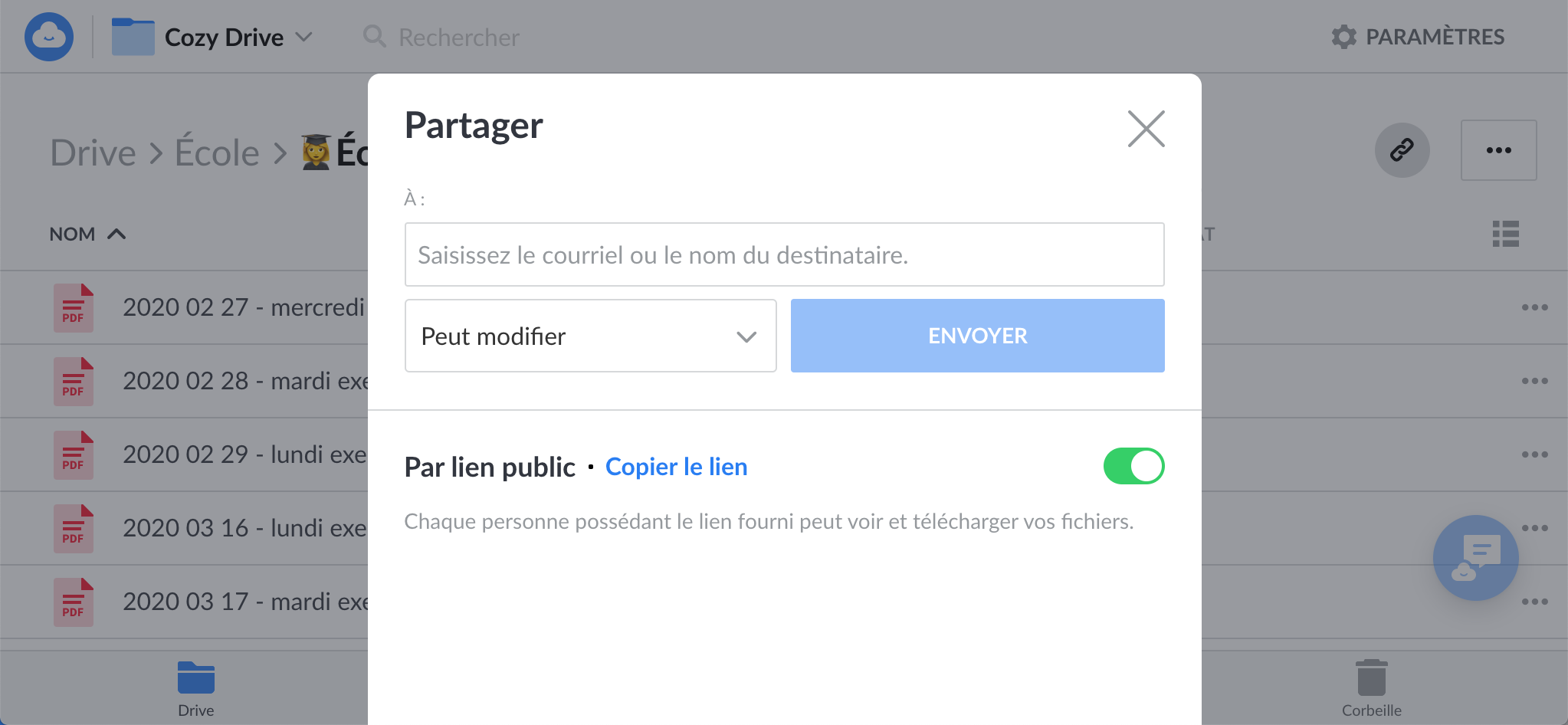
Vous devez envoyer l'agenda de la journée, l'énoncé d'un problème de mathématiques ou un sujet de rédaction en format word ? Il vous suffit de le sauvegarder dans votre Cozy dans un répertoire créé à cet effet puis suivre la méthodologie ci-dessus.
Méthode
Pour partager facilement des ressources à vos élèves, il vous suffit de partager via un lien un répertoire à toute votre classe. Une fois le lien généré, vous pouvez le transmettre via le canal de votre choix à l'ensemble de votre classe. Les élèves pourront ainsi accéder au dossier.
Avantages
-
Les élèves accèdent simplement en cliquant sur le lien que vous leur avez transmis par le support de votre choix (mail, cahier de texte de l'ENT, ...).
-
En partageant un dossier, vous pouvez ajouter des éléments ou corriger les contenus au fur et à mesure de la semaine. Plus besoin d'envoyer ces documents un par un par mail et risquer d'en oublier.
-
Les élèves n’ont aucun compte à créer, ils cliquent sur le lien que vous leur aurez envoyé et accèdent directement à votre répertoire de contenus.
-
Ils utilisent le terminal de leur choix (PC personnel ou partagé, smartphones).
Pré-requis
👤 Disposer d'un Cozy (contactez votre académie ou utilisez notre site cozy.io) pour en créer un. C'est sécurisé, facile et rapide.
Astuce n°2 - Proposer des contenus variés de n'importe quelle source
Contexte
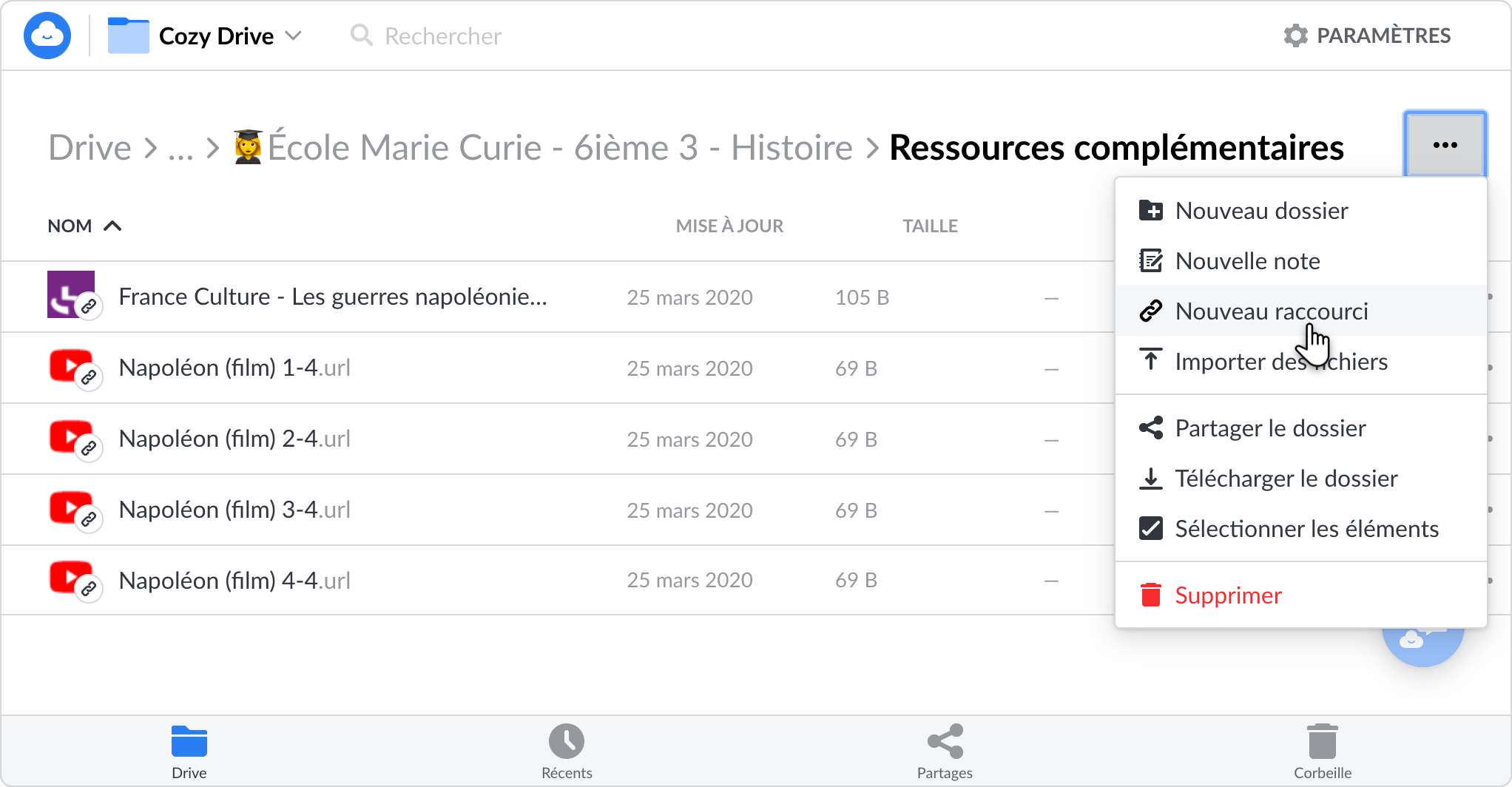
Vous venez de visionner une vidéo sur Louis XVI sur YouTube qui pourrait intéresser vos élèves en cours d'histoire, lire une fiche Wikipédia très bien documentée ou encore écouter un podcast sur France Culture ? Enregistrez les URLs et mettez les à disposition dans le répertoire dédié à votre classe.
Méthode
Dans un répertoire Cozy, vous pouvez très simplement insérer des liens web vers tout type de contenu, par exemple, des liens Wikipedia, France Culture et autres podcasts. Pour cela, il vous suffit d'ajouter un raccourci et insérer votre lien.
Avantages
-
Plus d’incompatibilité et de limite d’intégration entre les différents outils fournis.
-
Vos élèves n’ont qu’une interface pour tout trouver.
Pré-requis
👤 Disposer d'un Cozy (contactez votre académie ou utilisez notre site cozy.io) pour en créer un.
Astuce n°3 - Rédiger vite et simplement des notes à destination de vos élèves
Contexte
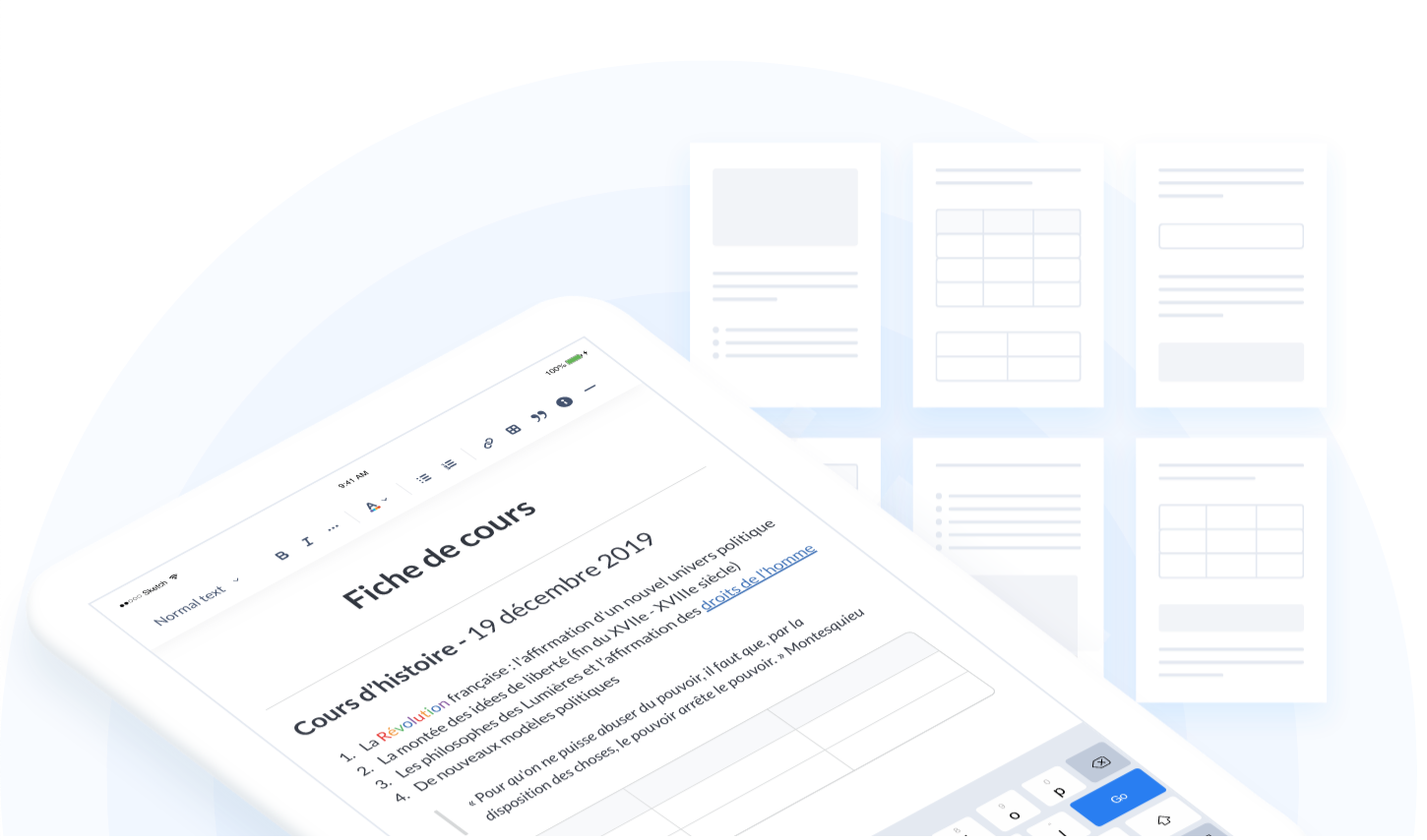
Vos fichiers .doc se multiplient sur votre ordinateur et vous vous mélangez entre vos différentes classes. L'application Notes vous permet de créer des notes que vous pourrez facilement éditer et classer directement dans votre drive Cozy.
Méthode
Utiliser Notes, l'application de notes collaboratives de Cozy directement depuis votre Drive. L'éditeur de notes vous permettra de mettre du style dans vos textes, d'insérer des tableaux, de mettre des citations, d'ajouter des liens vers des ressources extérieurs...
Avantages
-
Vos notes peuvent être insérées directement dans vos répertoires partagés avec vos élèves.
-
L'écriture est directe, rapide, claire et simple : pas de logiciel complexe à apprendre.
-
À noter que si votre répertoire est partagé à toute la classe et que vous ne le souhaitez pas (voir Astuce 1), la note ne sera pas modifiable par les élèves.
Pré-requis
👤 Disposer d'un Cozy (contactez votre académie ou utilisez notre site cozy.io) pour en créer un.
Astuce n°4 - Ajouter des documents numérisés à votre dossier partagé

Contexte
Vous avez chez vous des exercices, préparation de cours ou autre document sur des feuilles de papier. Vous souhaitez partager simplement ces ressources à vos élèves sans avoir à ré-écrire tout depuis votre ordinateur.
Méthode
Pour cela, il vous suffit d'aller dans votre application mobile Cozy Drive. Vous rentrez le dossier qui vous intéresse, par exemple, celui partagé avec vos élèves. Vous scannez votre document et celui-ci est directement ajouté dans votre dossier...
Avantages
- Vous pouvez partager des ressources non numériques.
- Pas besoin de retaper l'ensemble de vos documents pour les partager à vos élèves.
Pré-requis
👤 Installer l'application mobile de Cozy Drive
D'autres astuces à venir
Parce que nous ne nous arrêtons pas en si bon chemin, d'autres astuces vont voir le jour prochainement.
- Proposer à vos élèves un répertoire pour rendre leurs copies
- Retrouver en un clic les copies déposées tout au long de la journée
- Travailler directement depuis votre ordinateur, sans devoir continuellement faire des uploads et downloads WEB
- Collaborer simultanément sur la même note avec vos élèves avec, ou sans vous
Synthèse de ce que contient Cozy
Vous disposez désormais de toutes les cartes en main pour partager efficacement vos ressources à vos élèves pour assurer la continuité pédagogique pendant cette période de confinement.
Il ne vous reste plus qu'à créer votre Cozy pour mettre en application nos astuces et préparer votre semaine de cours sereinement. Mais qu'est-ce que Cozy concrétement ?
Cozy offre aux utilisateurs un espace de stockage intelligent, décentralisé et sécurisé qui permet de récupérer tout type de données (documents, photos, factures d’opérateurs, d’e-commerçants etc). Cet environnement privé et personnalisable est accessible depuis n’importe quel périphérique. En plus du stockage, les utilisateurs ont accès à des applications très simples à utiliser pour gérer et organiser automatiquement leurs données.
A ce jour, quand vous créez un Cozy, vous bénéficiez des applications suivantes :
• Drive : stockage de fichiers, dossiers ou toutes autres ressources numériques que vous pouvez ensuite partager. Vous aurez aussi la possibilité de synchroniser votre Drive sur vos différents appareils personnels comme votre mobile ou votre PC.
• Notes : éditeur de notes collaboratives. Cette application permet de rédiger à plusieurs une même note, en même temps, et retrouver cette dernière dans son Drive habituel, même après une perte de réseau.
• Pass : application et extension de gestion de mots de passe. Les mots de passe de tous vos comptes en ligne sont stockés, sauvegardés et synchronisés. Cela vous permet de sécuriser en toute simplicité l’ensemble de votre activité en ligne. Finie la galère des mots de passe avec l'application Pass.
• Store : chaque utilisateur peut choisir parmi les applications disponibles et se connecter à ses comptes afin d’y accéder directement. Ces applications permettent de récupérer les données personnelles chez des sites tiers : ENSAP, École directe, banques, assureurs, mutuelles, opérateurs de téléphonie, fournisseurs d’accès Internet, transport...
• Banks : permet de réunir en une vue synthétique ses différents comptes bancaires.
• Divers : une application de contacts ou encore de photos sont également disponibles dans Cozy.

Pour en discuter avec nous
- Zoé Bellot, Product Owner répondra à vos questions sur notre forum Cozy
- Claude du Service Client
- Notre Twitter
Articles, liens et ressources
- Notre aide en ligne accessible
- Notre partenariat avec l'Académie de Rennes
- Découvrir Cozy sur cozy.io
Le Covid-19, la Chine et les autres
Didier “Ice” IcemanIntéressant
Du point de vue de l'analyse de l'État et de la société chinoise, l'épidémie de Covid-19 apporte un certain nombre d'informations. Nous avons la possibilité de comparer les situations et les réponses face à une crise qui est, a priori, la même pour tous.
- Planète Asie / Chine, Médecine, Mondialisation, Politique, Santé, État, Citoyenneté, RépressionSaudi Arabia is launching an oil price war. That’s risky. https://wapo.st/2xllYbi
Didier “Ice” IcemanEt pendant ce temps
Saudi Arabia is launching an oil price war. That’s risky. https://wapo.st/2xllYbi
Coronavirus: comprendre la « méthode » de Wuhan, où le confinement continue
Didier “Ice” Icemantremblez
« Les connards qui nous gouvernent »
Didier “Ice” IcemanLe mot est faible
En réalité, une pandémie du format de celle d'aujourd'hui est le test fatal pour toute la logique du néolibéralisme. Elle met à l'arrêt ce que ce capitalisme demande de garder constamment en mouvement frénétique. Elle rappelle surtout cette évidence qu'une société étant une entité collective, elle ne fonctionne pas sans des constructions collectives — on appelle ça usuellement des services publics.
- La pompe à phynance / France, Politique, Protection sociale, Santé, Médecine, Recherche, Société, Service publicThe immoral cruelty of the Trump administration’s refusal to grant Iran sanctions relief amid its COVID-19 crisis
Didier “Ice” IcemanOui de la cruauté

There is a growing consensus that — to prevent Iran from spiraling out of control from the coronavirus epidemic and causing untold harm to the Iranian people — the Trump administration must immediately relent in its use of sanctions and allow Iran the ability to combat the epidemic through the purchase of necessary medical supplies overseas and the provision of a robust social safety net for the average Iranian facing economic catastrophe.
On Tuesday, the Trump administration responded to these calls by increasing sanctions on Iran with Secretary of State Mike Pompeo accusing “[t]he Iranian leadership [of] trying to avoid responsibility for their grossly incompetent and deadly governance” and by alleging that “[t]he Wuhan virus is a killer and the Iranian regime is an accomplice.” Perhaps Secretary Pompeo would have some fair ground to stand on if not for the fact that the Trump administration’s own response to the epidemic will prove the most consequential failure of the modern American presidency, leading to the unnecessary deaths of tens, if not hundreds, of thousands of Americans. But Secretary Pompeo — acting consistent with protocol — lacked the shame to recognize his own failings and instead used the Iranian people’s suffering from an unrelenting medical crisis to further propagandize against Iran.
Secretary Pompeo offered a few throwaway lines on the U.S.’s willingness to assist the Iranian people in their time of immense and unmitigated suffering, stating that the Trump administration “continue[s] to offer assistance to Iran in numerous ways” and citing “an open humanitarian channel to facilitate legitimate transactions even while ensuring [the U.S.’s] maximum pressure campaign denies terrorists money.” But these offers of assistance, if real at all, amount to little more than a cruel joke so long as the Trump administration targets all productive sectors of Iran’s economy with sanctions, denies Iran the ability to accrue and repatriate any export revenue, and severs Iran’s access to global markets for sanctionable and non-sanctionable goods alike, including medicine and medical supplies.
Untold numbers of Iranians will succumb to the disease, and some because Iran lacks the medical capacity, including the medical equipment, necessary to provide care for all who acquire the virus. Iran’s medical sector has long been in turmoil, and U.S. sanctions are a chief reason for this. But, as tragic as this will be — and some analysts suggest that the death toll in Iran from coronavirus could reach the millions before all is said and done — the fate of those who survive the disease will be hardly better, as Iran faces absolute economic ruin in the months ahead. While other countries, including the United States, provide for far broader social safety nets and adopt macroeconomic policies to buffer key industries from collapse, Iran will be prevented from doing so due entirely to U.S. sanctions. Iran, which was already in the midst of a massive economic recession, will be presumptively barred from providing a safety net for their people through these catastrophic times.
Some in Washington rejoice at this prospect. For them, what matters is that Iran is kept weak. Watching Iranian society spiral out of control and the country start to tear at the seams is a blessing in their estimation — a sign that “maximum pressure” worked to achieve at least some of its objectives. For this reason, hawks are urging the Trump administration to avoid “bailing out the mullahs,” in their racist-speak, by lifting sanctions or permitting the International Monetary Fund to extend a loan so that Iran can purchase the medical supplies it needs to combat the virus. Iranian suffering, after all, is the necessary byproduct of keeping Iran weak, isolated, and alien to itself and the world.
Such depravity has no limits. Not only is the Trump administration’s policy to Iran wrongheaded and ignorant, it is also fundamentally immoral — and nowhere has this been more clear than in the present crisis. Holding an entire people hostage in the moment of their deepest crisis is what the most thuggish of regimes do the world over. Yet that is the policy Secretary Pompeo advances towards Iran today.
The post The immoral cruelty of the Trump administration’s refusal to grant Iran sanctions relief amid its COVID-19 crisis appeared first on Responsible Statecraft.
Coronavirus cases have dropped sharply in South Korea. What’s the secret to its success?
Didier “Ice” Icemanpour castagnette

Will the coronavirus kill globalization?
Didier “Ice” IcemanUne bonne question

At a dinner party in mid-February, an architect told me that he was having a problem finishing his building projects. It was the carpets.
Most wall-to-wall carpeting for big construction projects in the United States, he explained, comes from China. The coronavirus outbreak in Wuhan — and the subsequent shutdown of many Chinese factories — was having a ripple effect across the global economy all the way down to the carpeting in U.S. buildings.
The global spread of a new pathogen has exposed the fragility of modern life. As it moves around the world, the coronavirus has compromised the circulatory system of globalization, dramatically reducing the international flow of money, goods, and people. The disease has done so rather economically, by infecting fewer than 100,000 people so far. Extrapolation and fear have done most of the work for it.
In the world of things, the coronavirus has infected the global supply chains that connect manufacturers and consumers. Port traffic in Los Angeles, the largest U.S. port, declined by 25 percent in February. Container traffic in general was down over 10 percent last month.
Manufacturers that depend on the sourcing of components in far-off countries had already been rethinking their participation in the global assembly line because of tariffs, the costs of transport, and increased automation. This “reshoring” will get a boost from the disruptions of the coronavirus.
People, too, are not moving around as much. Airline service in and out of emerging hot spots — South Korea, Italy — has been cancelled. Airline ticket sales last week were down 10 percent over the same period last year. The cruise industry, after outbreaks on a couple big ships, has taken a major hit.
After blithely ignoring the coronavirus outbreak in China for most of February, markets took a major dive in the final week of the month. The stock market lost $6 trillion in value last week, its worst showing since the financial crisis of a decade ago. This is testament to both the persistence of the disease and the incompetence of certain national leaders, notably Donald Trump. Despite the intervention of the Federal Reserve and other central banks, market volatility continues.
It might seem ridiculous to expect that a pathogen, even one that spreads at the rate of a pandemic, could reverse an economic trajectory that’s more than a century in the making. But the coronavirus outbreak coincides with attacks on economic globalization from many different quarters.
Environmentalists, for instance, have long been skeptical of unrestrained global economic growth. The threat of climate change has sharpened that critique and placed it squarely in the middle of mainstream debate.
Meanwhile, worsening economic inequality has called into question the capacity of economic globalization to lift all boats in a rising tide. Even the IMF has acknowledged the pernicious impact of this inequality (but without engaging in the necessary institutional overhaul to address the problem).
Finally, a slowing of global economic integration over the last decade suggests that the world may already have passed peak globalization.
On top of these systemic challenges, a rising political populism has targeted the global economic elite as the enemy of “the people.” Donald Trump challenged this elite and their orthodoxy of free trade by imposing tariffs on allies and adversaries alike and by withdrawing U.S. participation in big trade pacts, like the Trans Pacific Partnership.
The trade war he began with China has had perhaps the greatest impact. It has hit both economies hard, with job loss, higher bills for consumers, and lost markets for manufacturers and farmers. The recent agreement between Beijing and Washington notwithstanding, most of the tariffs remain in place.
Meanwhile, the UK finally pulled out of the European Union this year, which was a victory for economic nationalists. Populists elsewhere have railed against what Steve Bannon calls the “Davos class.” Neoliberal orthodoxy has given way to pronouncements of America First, Brazil First, and the like.
Such a setback is not necessarily fatal. Globalization has been challenged before by financial crises, pandemics like the Hong Kong Flu, even the specter of Y2K.
This time around, however, the failure of the global community to establish new rules of the road for the economy, the environment, and health care is creating a perfect storm of international disfunction. If something with a relatively low mortality rate like the coronavirus — between one percent and four percent, compared to 50 percent for Ebola — can do such a number on the global economy, perhaps the patient was already suffering from some pretty dire underlying conditions.
Pandemic
When people travel, they bring all sorts of luggage, including pathogens.
Thus was the great era of exploration also the dismal era of genocide. Explorers to the New World brought a panoply of diseases like smallpox and measles that were new to the indigenous communities. The colonial invaders subjected the Americas to war and slavery. But it was those diseases that were largely responsible for a catastrophic reduction in populations up and down the Americas. As many as 56 million people, or 10 percent of the world population at the time, died by the beginning of the 1600s. The mortality rate for the indigenous communities was an astonishing 90 percent.
In exchange, the explorers returned to their native countries with syphilis, a horrible disease to be sure, but it didn’t radically depopulate Europe.
Pandemics are closely associated with the movement of traders and soldiers. Roman soldiers returning from Mesopotamia were responsible for the plague that ravaged the empire in the second century AD, one of several pandemics that helped end Rome’s global dominance. The bubonic plague of the fourteenth century began in China and reached Europe via merchant ships carrying flea-infested rats. In the modern era, soldiers returning home from fighting in World War I spread the Spanish flu, killing up to 50 million people.
This last pandemic was one of the factors behind the collapse of the first wave of modern globalization. Prior to the outbreak of World War I in 1914, the world had never been more tightly connected with steamships, trains, and the telegraph serving as the connective tissue. Trade as a proportion of GDP stood at 14 percent on the eve of the war.
The devastation of World War I followed by the flu epidemic dealt a heavy blow to world trade and economic integration. The global economic depression of the 1920s, the rise of various types of nationalism, and a second world war ensured that, by 1945, trade as a proportion of GDP had dropped to a mere 5 percent.
Modern globalization is made possible by modern medicine. A couple of pandemics have broken out since 1945, but they haven’t disrupted the global circulatory system. In the ancient Akkadian language, the word for epidemic disease meant “certain death.” Only recently have medical professionals been able to handle outbreaks of disease on such a scale.
Thanks to a second wave of globalization, trade would rise again to the levels it registered in 1914 — but only by the late 1980s. With the collapse of the Soviet bloc, a third wave of globalization removed more barriers to the movement of goods and money. Even China, a nominally Communist country, joined the World Trade Organization at the end of 2001. It has since offered its own version of globalization through the Belt and Road initiative that places China at the center of a burgeoning network of trade and finance.
The coronavirus, by itself, will not put an end to this most recent wave of globalization. Like the flu pandemic of 1918, it could contribute to a trend of greater fragmentation. Or, by serving as a reminder of how the health of humanity has been mutually dependent across borders for millennia, the latest outbreak could prompt a rethinking of how the world works together.
Things fall apart?
China will prove pivotal in determining which direction the world heads.
At the moment, economic pundits in the West are exhibiting a degree of schadenfreude at Beijing’s difficulties. Kenneth Rapoza, for instance, argues in Forbes that “The new coronavirus Covid-19 will end up being the final curtain on China’s nearly 30 year role as the world’s leading manufacturer.” The global assembly line was already shifting away from Chinese sources as a result of Trump’s tariffs, so the pandemic only reinforces this trend.
China could still come out a winner in all of this. No longer dependent on low-end manufacturing, it could invest its surplus capital into an even greater push toward higher value-added production, particularly in the digital sphere. This shift could facilitate a major reduction in the country’s carbon footprint as well.
Much depends on the U.S.-China relationship. Long before the coronavirus crisis, the U.S. policy elite had already moved away from supporting engagement with China. China was already prepared for disengagement. It had laid the groundwork for an alternative globalization, denominated in the renminbi and financed by the country’s considerable trade surpluses. Many countries in China’s vicinity opted to participate in the Belt and Road Initiative and receive financing from the Asian Infrastructure Investment Bank.
At the very moment that China and the United States need to forge a new consensus on economy and environment, the two countries are heading in different directions. And that will make it very difficult for the international community, such that it is, to come up with global solutions to what are increasingly global problems such as climate change and pandemics.
Because of the coronavirus, China has rediscovered how dependent it is on the rest of the world — to buy Chinese products, to supply Chinese consumers, to provide raw materials for Chinese business, to service Chinese tourists.
China’s projected growth rate for 2020 has been revised down from 6 percent to 5 percent, but it might drop even further. Sociologist Walden Bello has long argued that the Chinese economy is in fact quite fragile — with overcapacity in the manufacturing sector, a real-estate bubble, high rates of debt, and growing inequality.
With the Belt and Road Initiative, Beijing was hoping it could grow its way out of these problems. That strategy depends on a number of unknown variables, which in the short term include the persistence of the pandemic and the results of the upcoming presidential election in the United States.
The coronavirus is a wake-up call for both Beijing and Washington. The new status quo of a revived Cold War between the two hegemons is unworkable. It’s time for another wave of globalization, but this time one that reduces carbon emissions, proceeds more equitably, and strengthens the capacity of international institutions to fight pandemics.
It won’t happen without U.S.-China cooperation. And that won’t happen without a different U.S. president and a different approach in Beijing.
This article has been republished with permission from Foreign Policy in Focus.
The post Will the coronavirus kill globalization? appeared first on Responsible Statecraft.
Gestionnaire de mots de passe : introduction cryptographique
Didier “Ice” IcemanJ'attends de voir

L’idée de base : Tous les mots de passe sont chiffrés. Personne d’autre que vous ne peut les relire sans votre accord. Ni le serveur sur lequel vous les envoyez, ni quelqu’un qui a accès au disque où vous les stockez, ni quelqu’un qui a ponctuellement accès à votre poste de travail.
Chiffrer c’est simple
Pour chiffrer on a le choix. On va séparer deux catégories principales de chiffrement : les chiffrements symétriques et les asymétriques.
La plupart des gestionnaires de mots de passe ont choisi un chiffrement symétrique (une seule clef secrète qui sert à la fois à chiffrer et à déchiffrer). C’est simple à gérer, rapide à l’exécution, et il n’y a pas besoin de clef de grande taille. Tous ceux que j’ai vu utilisent de l’AES avec une clef de 256 bits. Au moins pour Bitwarden et Keepass, c’est le mode CBC, et un contrôle HMAC avec SHA256 comme fonction de hachage (mais vous pouvez ignorer tous ces détails s’ils ne vous disent rien).
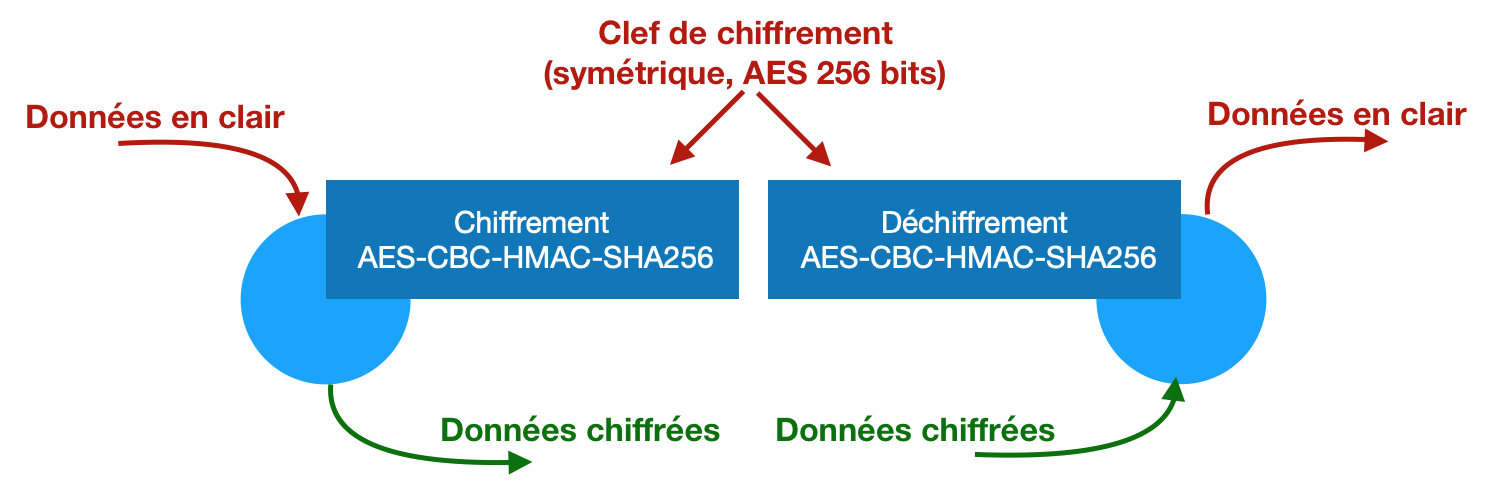
J’ai dit « la plupart des gestionnaires de mots de passe ». Un projet au moins a fait un choix différent. L’outil Pass utilise un chiffrement asymétrique (une clef publique et une clef privée, l’une sert à chiffrer et l’autre à déchiffrer). Plus exactement, ils utilisent l’outil GnuPG. Même si le choix de la clef est libre, par défaut on y utilise généralement une clef RSA de 2048 bits. Pass a fait ce choix en considérant le partage de mots de passes comme la fonctionnalité principale. On verra pourquoi quand on parlera partage. Entre temps on va se concentrer sur ceux qui font du chiffrement symétrique.
Dans les deux cas, on est là dans de l’ultra-standard au niveau cryptographie. Je serais étonné de voir autre chose ailleurs (et c’est une bonne chose).
Une clef ? quelle clef ?
Ok, nos mots de passe sont chiffrés mais où est la clef ?
Impossible de demander à l’utilisateur de se rappeler une clef de 256 bits. Ce serait plus de 40 signes entre minuscules, majuscules, chiffres et caractères spéciaux. Même avec une très bonne mémoire, ce serait ingérable à l’usage.
Stocker la clef de chiffrement en clair sur le disque n’est pas beaucoup mieux. Ce serait comme avoir coffre-fort haute sécurité dont on cache la clef sous le paillasson.
Ce qu’on demande à l’utilisateur c’est un mot de passe principal. Vu qu’il va permettre de déchiffrer tous les autres, on va l’appeler « mot de passe maître ». Il faut qu’il soit assez long et complexe pour éviter qu’un tiers ne puisse le deviner ou le trouver en essayant toutes les combinaisons une à une, mais assez court pour pouvoir s’en rappeler et le taper sans erreur.
Le mot de passe maître ne chiffre rien lui-même. Accompagné d’autres paramètres, il sert à calculer une clef de taille suffisante qui, elle, servira au chiffrement décrit plus haut et qu’on va appeler « clef maîtresse ». La fonction qui fait cette opération est dite fonction de dérivation de clef.
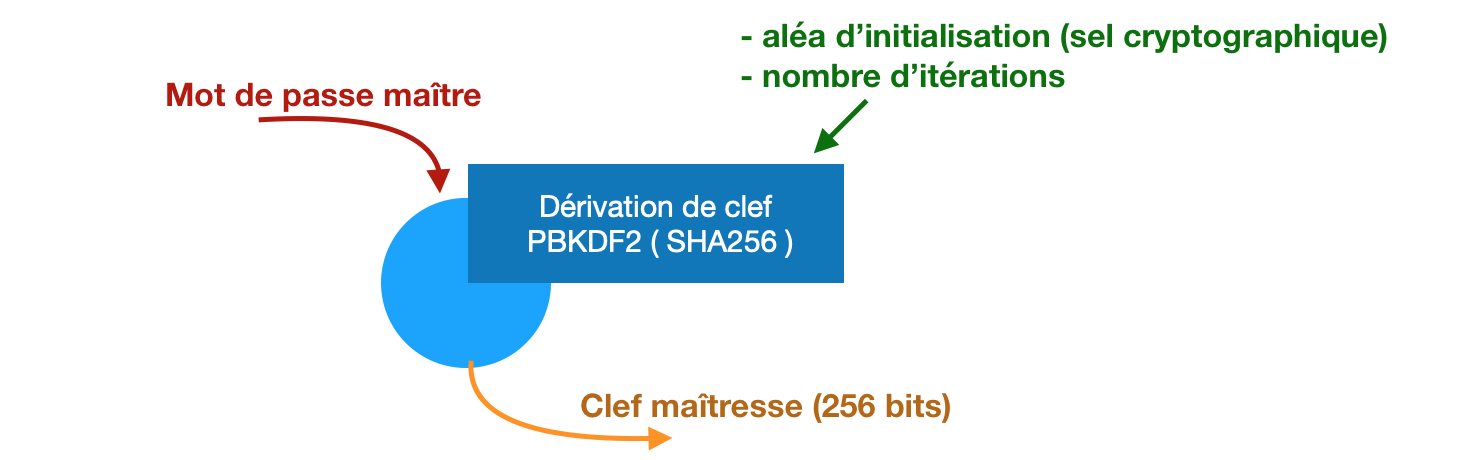
Bitwarden utilise le très classique PBKDF2 avec un hachage SHA256. Pour faire simple on prend le mot de passe, on le mélange à une chaîne aléatoire (stockée quelque part pour réutiliser la même à chaque fois), et on opère la fonction de hachage prévue. Normalement ça suffit pour avoir un résultat considéré comme relativement aléatoire et impossible à remonter en sens inverse.
En pratique on cherche aussi à ralentir quelqu’un qui chercherait à tester tous les mots de passe possibles un à un. Pour ça on va simplement répéter l’opération précédente un certain nombre de fois. Chaque itération prend en entrée le résultat de l’étape précédente. Si je fais 10 itérations, il faudra 10 fois plus de temps à un attaquant pour tester toutes les combinaisons. Ici on considère le résultat comme assez confortable à partir de 100.000 itérations.
Keepass utilise une fonction plus récente et considérée comme plus robuste aux possibilités des matériels actuels : Argon2.
Là aussi tout est très classique. Je n’ai pas regardé tous les gestionnaires de mots de passe mais je serais étonné de trouver autre chose que ces deux solutions standards.
On résume
À l’ouverture le gestionnaire de mots de passe vous demande votre mot de passe maître. À partir de ce mot de passe et de paramètres prédéterminés, il utilise une fonction de dérivation de clef et en sort une clef maitresse.
C’est cette clef maitresse qui permet de chiffrer ou déchiffrer vos mots de passe. Celui qui n’a pas accès à votre clef ne pourra rien faire des mots de passe chiffrés sur le disque.
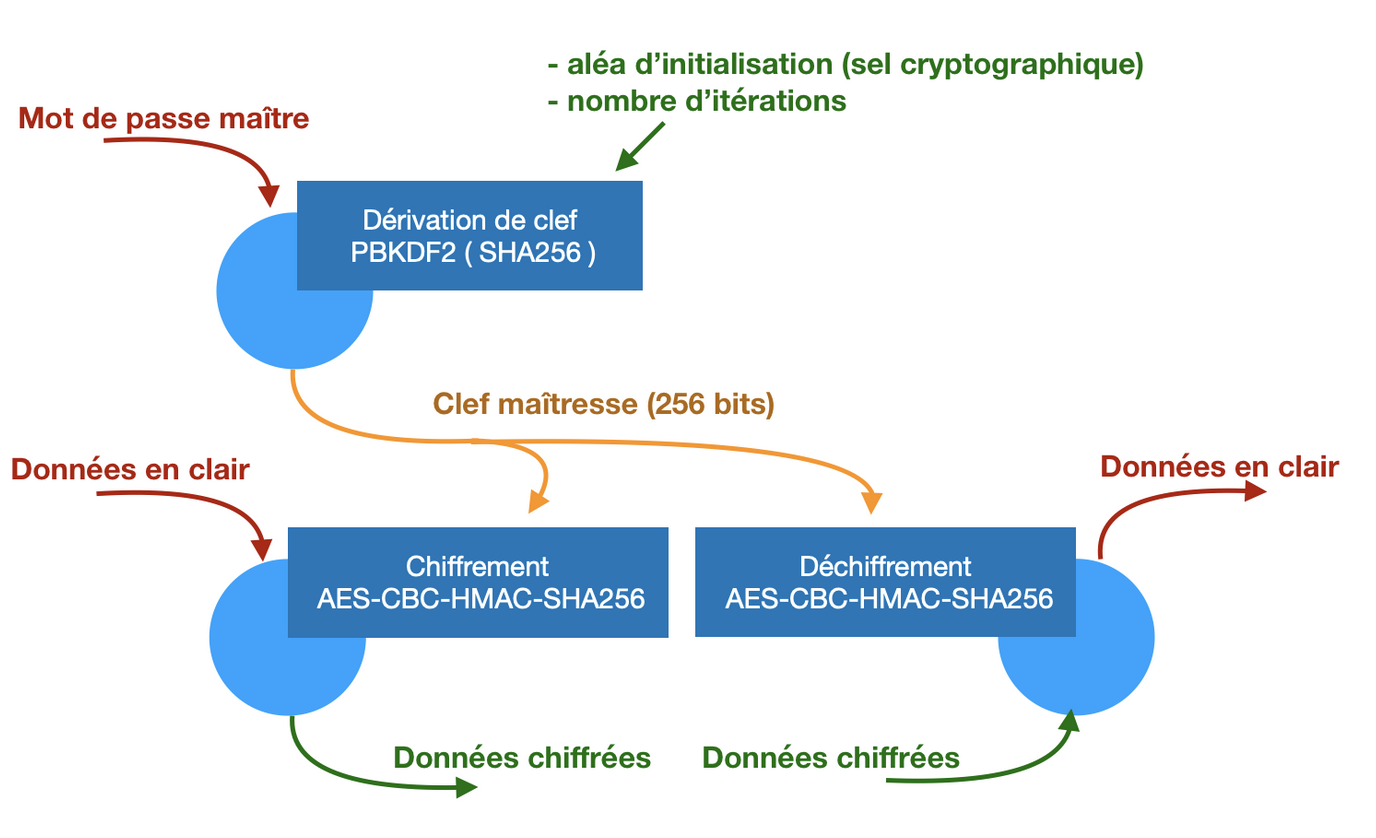
Sécurité
À l’ouverture, le gestionnaire de mot de passe vous demandera votre mot de passe maître que pour calculer la clef maîtresse à l’aide d’une fonction de dérivation de clef. Une fois ceci fait, il garde la clef maîtresse en mémoire et oublie le reste. Quoi qu’il se passe, personne ne connaîtra votre mot de passe maître.
Le logiciel utilise cette clef maîtresse pour chiffrer et déchiffrer vos mots de passe. Cette clef maîtresse n’est jamais écrite nulle part. La plupart des gestionnaires de mots de passe oublieront volontairement cette clef en mémoire après un certain temps d’inactivité, ou à la mise en veille de votre poste de travail. L’idée c’est de limiter le risque de laisser qui que ce soit d’autre que vous y avoir accès. Dans ces cas là, on vous invitera à saisir de nouveau votre mot de passe maître pour retrouver la clef oubliée.
Une fois la clef maîtresse hors de la mémoire, vous n’avez que des blocs chiffrés que personne ne pourra déchiffrer sans le mot de passe maître. Pas même vous. Si vous oubliez votre mot de passe maître, vous ne pourrez plus jamais relire ce que vous avez stocké. Même votre ami qui s’y connait ne pourra rien pour vous.
Ne vous laissez toutefois par leurrer. On parle sécurité, chiffrement, complexité des fonctions de dérivation de clef, mais en réalité tout ça a peu d’importance comparé à votre mot de passe maître. C’est un peu comme un coffre-fort : Discuter du diamètre des barres de renfort n’a aucun intérêt s’il s’ouvre avec une combinaison de trois chiffres seulement.
S’il est possible de trouver votre mot de passe avec un nombre de tentatives limité, tout le reste ne servira à rien. « Limité » dans ce cas, ça dépasse la centaine de milliards de combinaisons. Il vaut mieux un mot de passe maître complexe avec une fonction de dérivation simple qu’un mot de passe maître simple avec une fonction de dérivation complexe.
Changer le mot de passe
Les plus alertes d’entre vous auront remarqué que si tout est déchiffré indirectement à partir du mot de passe, changer le mot de passe fait perdre l’accès à tout ce qui est déjà chiffré.
Quand vous changez votre mot de passe maître, Keepass déchiffre toutes les données en mémoire, calcule la nouvelle clef et rechiffre l’intégralité des données. Même si vous gérez une centaine de mots de passe, c’est quelque chose qui se fait rapidement sans avoir besoin de vous faire patienter longtemps.
Bitwarden utilise lui une clef intermédiaire totalement aléatoire appelée clef de chiffrement. C’est cette clef qui sert en réalité à chiffrer et déchiffrer les données stockées. Elle est elle-même chiffrée, à partir de la clef maîtresse, et stockée à côté des données.
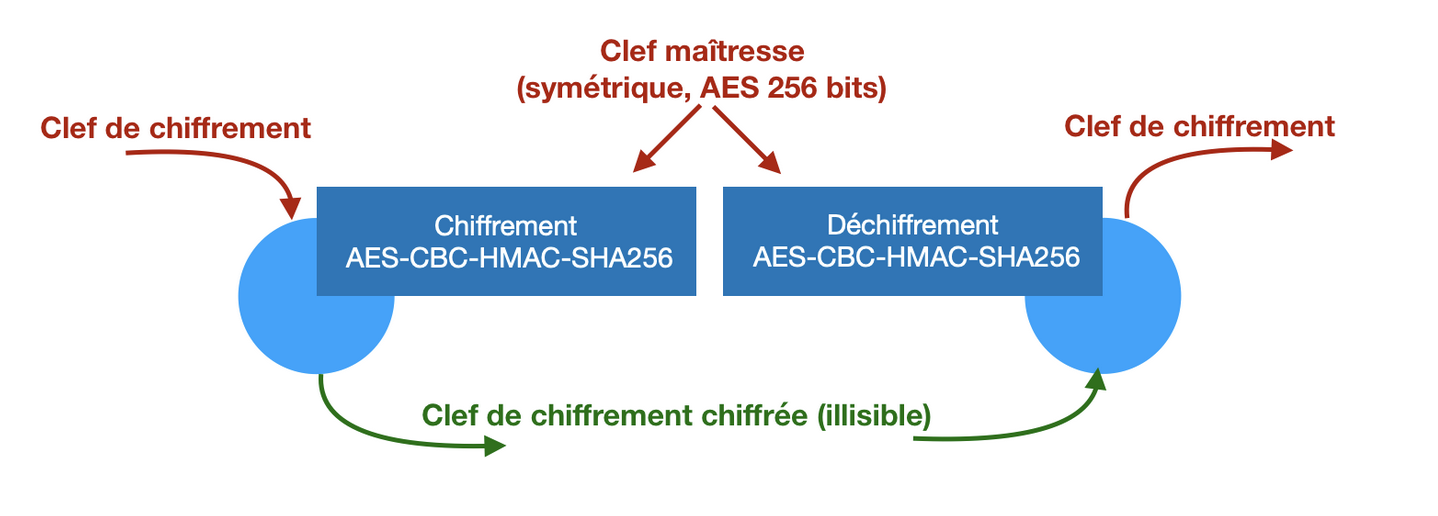
On a donc un mot de passe maître qui sert à calculer une clef maîtresse. La clef maîtresse sert à déchiffrer la clef de chiffrement. La clef de chiffrement sert à chiffrer et déchiffrer les données sur le disque.
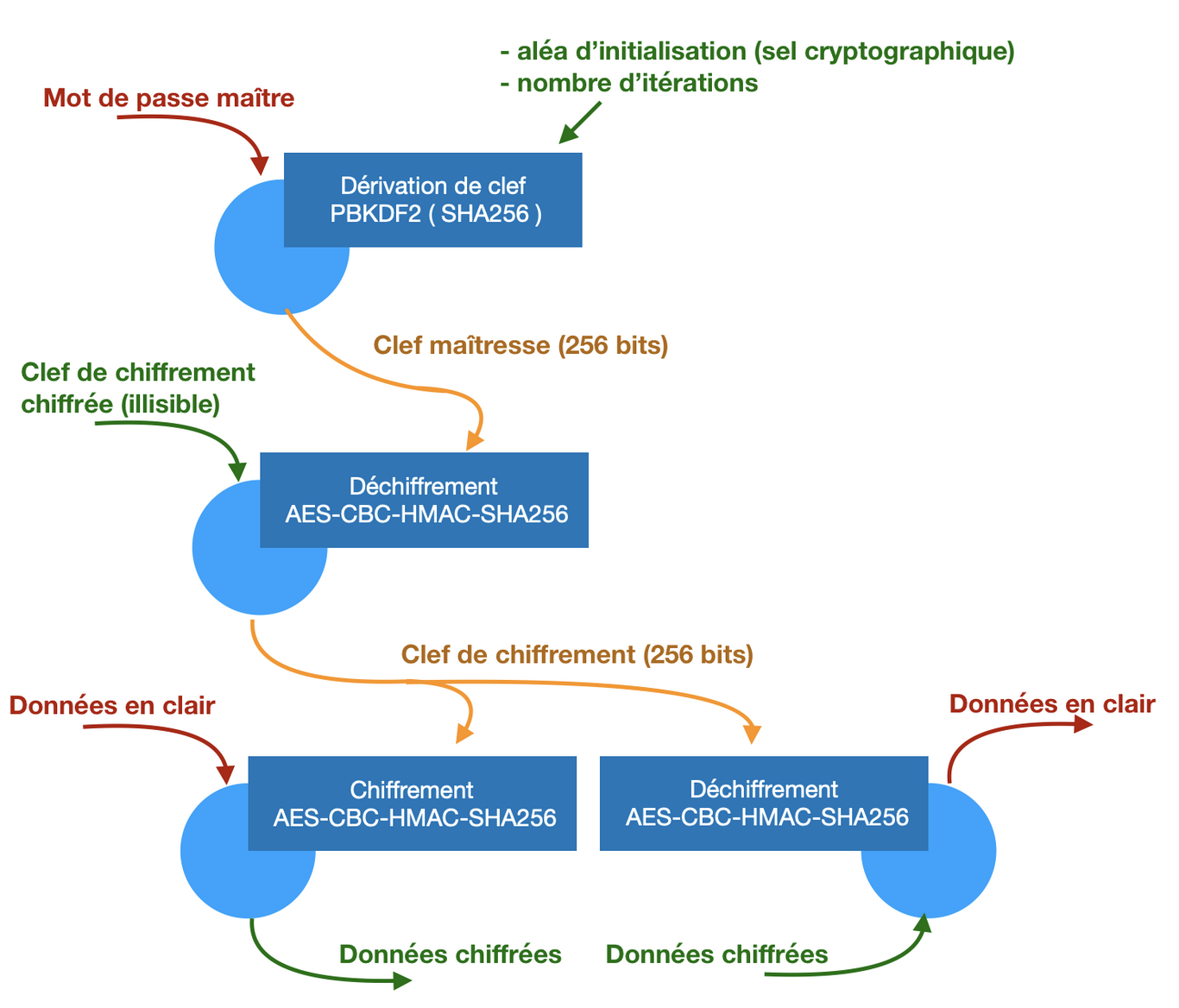
Lorsqu’on veut changer de mot de passe il suffit de chiffrer la clef de chiffrement avec la nouvelle clef maitresse. Il n’y a pas besoin de rechiffrer chaque donnée (vu que la clef de chiffrement ne change pas, elle).
L’avantage n’est pas tant dans le temps gagné (peu significatif) mais dans la résistance aux accès concurrents : On peut avoir plusieurs clients qui lisent et écrivent en parallèle des données différentes dans le même trousseau sans crainte que l’un d’eux n’utilise encore une ancienne clef de chiffrement et envoie des données illisibles par les autres.
Et justement, et si je partage ?
Avec ce qu’on a vu jusqu’à présent, si je partage des mots de passe je dois aussi partager la clef de chiffrement utilisée.
Bitwarden permet de partager des mots de passe à un groupe de plusieurs personnes (appelé « organisation »). Au lieu d’être chiffrés avec ma clef de chiffrement personnelle, ces mots de passe sont chiffrés avec une clef de chiffrement dédiée à l’organisation.
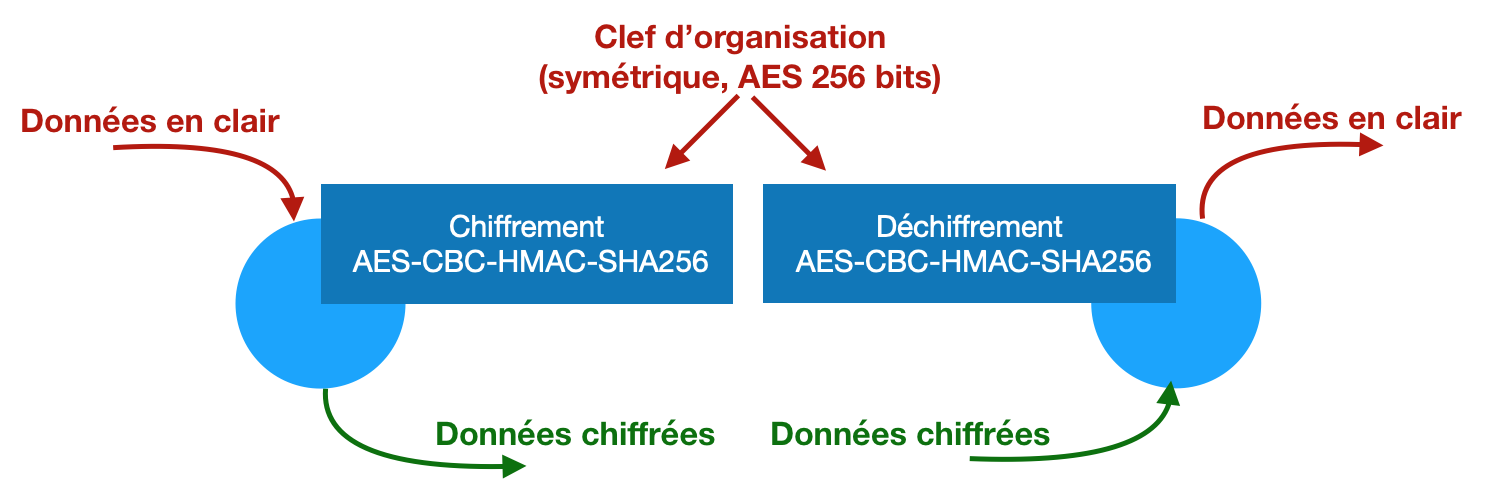
Le gros enjeu n’est pas dans le chiffrement mais dans comment transmettre cette clef d’organisation à chaque utilisateur de l’organisation.
Il faut un moyen pour que l’administrateur de l’organisation chiffre la clef d’organisation, me l’envoie sur le serveur d’une façon que seul moi puisse la relire.
Jusqu’à maintenant c’est impossible parce que nous utilisons des clefs symétriques. C’est la même clef qui sert au chiffrement et au déchiffrement. Si l’administrateur pouvait chiffrer avec ma clef, il pourrait aussi déchiffrer tous mes mots de passes personnels et ça c’est inacceptable.
C’est donc ici qu’on reparle des clefs asymétriques RSA. Chacun a une clef publique (diffusée à tout le monde) et une clef privée (garder secrète par chaque utilisateur). La clef publique sert à chiffrer. La clef privée sert à déchiffrer. Tout le monde est donc capable de chiffrer quelque chose avec ma clef publique, mais seul moi pourrait le déchiffrer.
La clef RSA fait 2048 bits mais ne vous laissez pas impressionner, ces 2048 bits sont en fait moins robustes que les 256 bits d’AES.
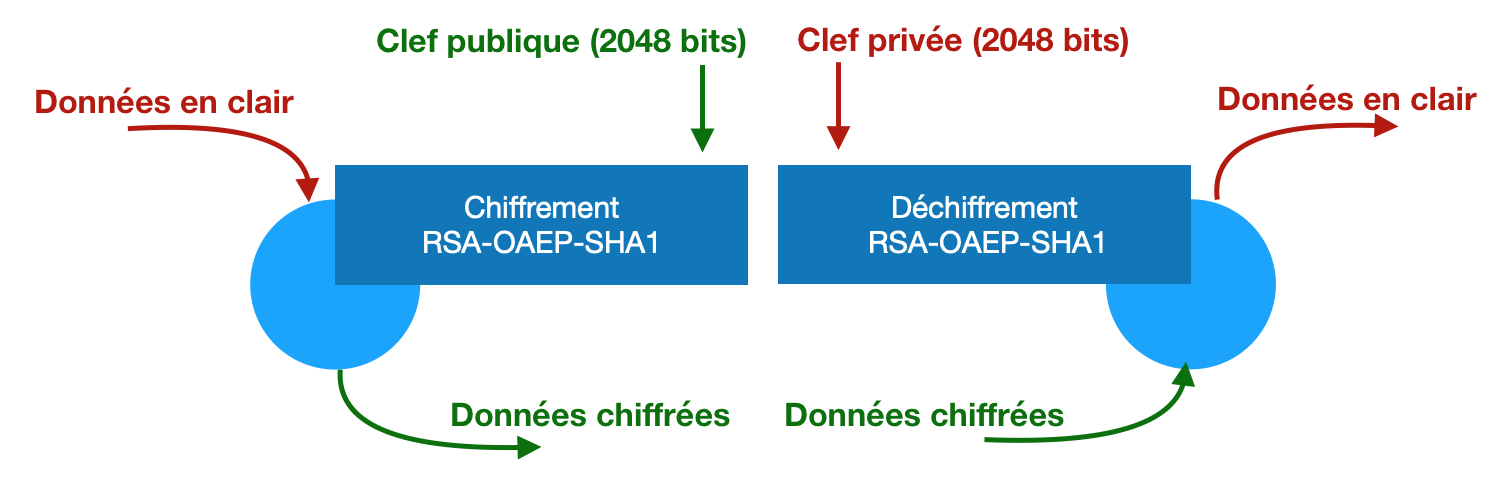
L’administrateur de l’organisation récupère ma clef publique, chiffre la clef d’organisation à l’aide de ma clef publique, et envoie ça sur le serveur. Quand je voudrais chiffrer ou déchiffrer quelque chose dans l’organisation, je récupère la clef d’organisation chiffrée avec ma clef publique, je la déchiffre avec ma clef privée, et je m’en sers dans mes opérations de chiffrement.
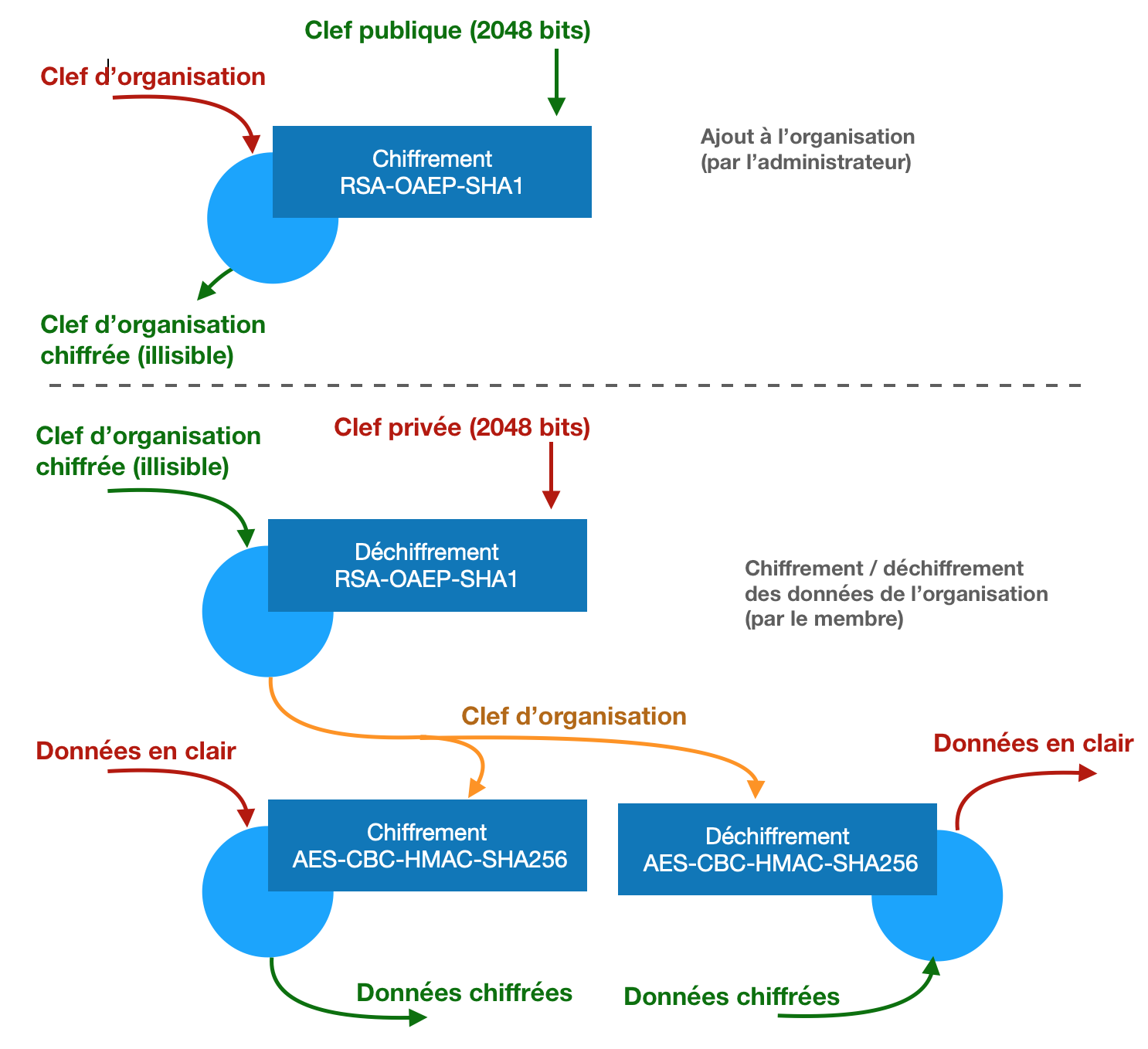
Ok, mais il va me falloir sécuriser ma clef privée. On a déjà les outils pour ça, il suffit de la chiffrer ! Bitwarden la chiffre donc avec la clef de chiffrement, celle dont on a déjà parlé plus haut.
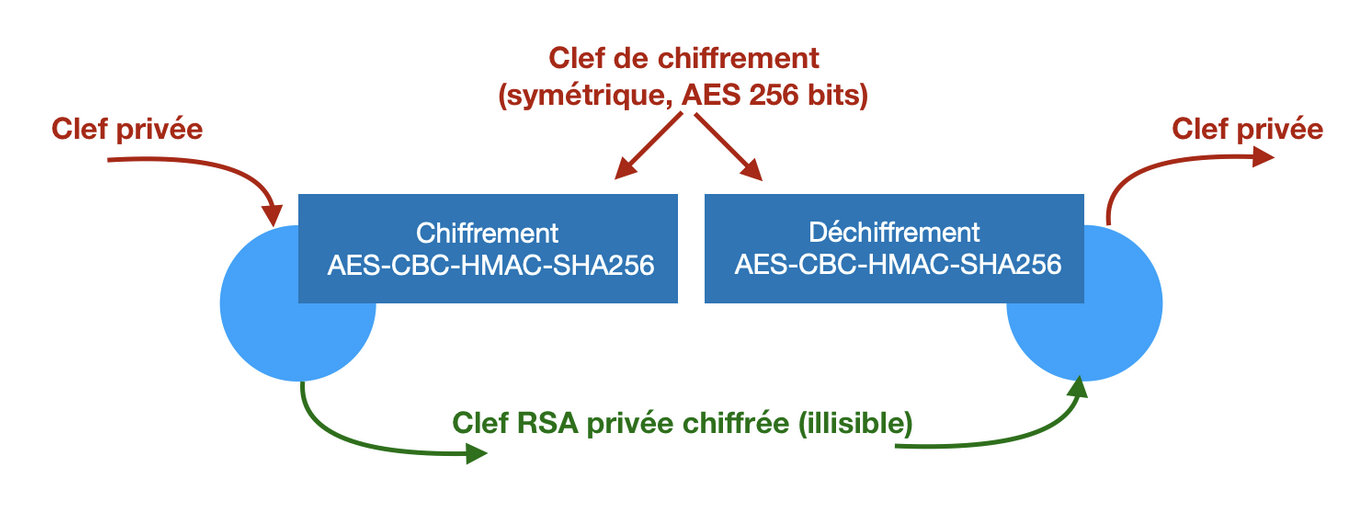
On a donc un mot de passe maître qui sert à calculer une clef maîtresse. La clef maîtresse sert à déchiffrer la clef de chiffrement. La clef de chiffrement sert à déchiffrer ma clef RSA privée. La clef RSA privée sert à déchiffrer la clef d’organisation. La clef d’organisation sert à chiffrer et déchiffrer les données.
Pfiou! Ça semble long et complexe mais tout utilise toujours le même principe et la plupart de ces opérations ne servent qu’à l’initialisation logiciel quand vous le déverrouillez.
Rappelez-vous, votre clef de chiffrement ne change pas quand vous changez votre mot de passe. Pas besoin donc de changer ou rechiffrer vos clefs RSA non plus.
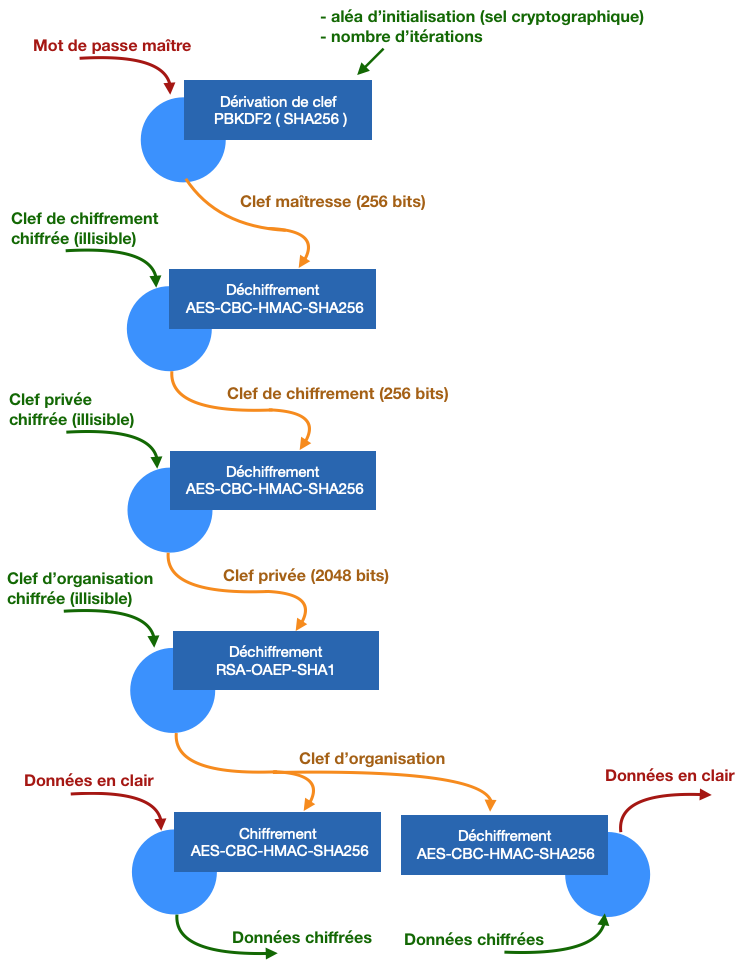
Et Cozy Pass alors ?
Aujourd'hui, une nouvelle application est disponible dans Cozy : Cozy Pass, un gestionnaire de mots de passe intégré.
Pour Cozy Pass, nous avons préféré repartir de protocoles établis plutôt que de réinventer la roue. C'est une garantie de sécurité pour vous. Nous croyons aussi dans le logiciel libre et sommes ravis d'y contribuer en remontant nos corrections.
Pour ces raisons nous avons choisi de nous baser sur le protocole ouvert de Bitwarden, en réimplémentant une partie du logiciel et en adaptant d'autres. Tout ce qui est expliqué plus haut s'applique donc parfaitement au gestionnaire de mots de passe embarqué dans votre Cozy.
Articles, liens et ressources
- Article écrit et publié originalement sur https://n.survol.fr par Eric Daspet, CTO Cozy Cloud.
- Plus de détails sur le chiffrement dans Cozy sur Github
- Article Petit guide en terre inconnue : le chiffrement par Paul Tran-Van
- Découvrir Cozy sur cozy.io et Cozy Pass
Encore une odroid HC2 !
Didier “Ice” IcemanInteressant
Encore une ?!
Je vais encore ajouter une ptite odroid dans mon harem. Ce coup-ci elle ne sera pas à la maison mais un peu éloignée à la campagne. Le but est de remplacer un disque dur externe mal en point. Et tant qu'à remplacer un disque dur à l'agonie autant en mettre un vrai, plus robuste en réseau.
Mais pourquoi toute une Odroid ?
Le disque dur externe ne servait à peu près jamais en mobilité mais à 95% pour du backup. Du coup je me suis dit que ça ferait une pierre deux coups : un disque pour le backup maternelle et … un disque pour mon backup. Et pour ça, une Odroid HC2 c'est nickel : c'est tout petit, ça fait pas de bruit, ça consomme vraiment rien, le disque est bien au frais, c'est juste un peu moche (pas selon mes critères cela dit).
En plus ça me permettra de faire l'occasionnel SAV plus facilement qu'en passant par TeamViewer. Même si j'en ai de moins en moins besoin, c'est toujours chiant.
Objectif
Du coup le but, c'est de monter une ptite Alpine Linux dessus, y installer un skeudur, Samba et voilà pour le moment. J'ai opté pour un skeudur de 4To qui sera tranquille pour au moins dix ans vu la volumétrie à stocker… Une ptite carte SD de 64Go (vu le prix, prendre moins aurait été con).
Comme d'hab je choisis Alpine car c'est tout ptit, la surface d'attaque est minimale. Le risque de bug est d'autant plus amenuisé, que je n'utiliserai quasiment aucun soft. Je me contenterai vraiment du strict minimum. Les updates seront rares et très rapides.
Je n'exposerai rien sur les Internets en plus. Moins de risque de mauvaise surprise.
Une fois qu'elle aura mis le gros de ses données dessus, selon la volumétrie, j'en ferai un backup versionné chez moi. Comme ça, même en cas de crypto locker vorace, je devrais être à même d'avoir une version clean des données.
Retroussage de manches
Au début j'ai voulu faire le gros flemmard en faisant un gros dd du début de la carte SD de l'odroid existante. Puis vu les débits pitoyables j'ai capitulé.
Je me suis donc rabattu sur une option à peine plus complexe : j'ai déjà une hc2 à la maison, je vous avais raconté son installation à l'époque. Du coup, bha j'ai pas refait pareil mais en sautant les étapes du rootfs !
- J'ai créé une partition sur la carte SD en ext4 (le moins d'emmerde à court terme).
- Dessus, j'ai juste passé un coup de rsync depuis l'HC2 qui tourne actuellement.
- J'ai ensuite remis les bouts du bootloader à base de /boot/sd_fusing.sh /dev/sdi.
- Une fois fait j'ai corrigé customisé deux trois trucs (la conf réseau, le hostname, généré des clés ssh).
- Le moment crucial de coller la SD dans la nouvelle Odroid.
L'accès réseau à distance
Bon, ma mère, avoir une machine dispo en SSH, ça lui fait une belle jambe. Et installer les mises à jour et tout ça va clairement pas lui plaire. Du coup, non seulement je vais lui offrir la SBC, mais la lui installer et surtout lui maintenir (“I'm a generous god”).
Du coup, il va me falloir un accès distant sécurisé. Bon, je mets ça en place aujourd'hui, je croise les doigts pour que ça tienne mais je vais tenter de faire un truc le plus simple possible pour que ça ait le moins de chance de casser possible. Je dois tout préparer en amont pour n'avoir qu'à brancher chez elle.
VPN
La première idée est de partir sur un VPN. Si je le fais ça sera à base de Wireguard, sauf que bon, le kernel du truc est plutôt du genre pré-colombien… du coup on peut oublier. Et je compte pas mettre autre chose niveau VPN.
Accès SSH
La seconde idée c'est l'accès SSH direct. L'idée me plait sauf que bon, je sais pas trop comment fonctionne sa connexion. Est-ce qu'elle est en IP dynamique ? fixe ? NAT ? CGN ? Bref, plein de risque que ça ne marche pas où qu'il faille tripotter son routeur et tout. Et ça sans avoir la certitude qu'à la première update du routeur ça se fasse jarter. Bref, ça ne m'enchante pas et j'ai pas super confiance.
Tunnel SSH inversé
La troisième idée c'est l'accès SSH inverse. Ouaip. Ça ne veut rien dire. En gros, c'est l'Odroid qui va initier la connexion et non l'inverse. Mais du coup par quelle diablerie ça fonctionne ?
Et bien, ma ptite dame je vous le dit tout de go, ça sera facile et automatique. Et comment ça fonctionne ? Par la magie d’un tunnel TCP et d'une connexion automatique de SSH. Et tout ça pour le prix d'un seul logiciel du doux nom de AutoSSH.
Et c'est cette solution qui est choisie !
AutoSSH
Ce petit logiciel est super simple, il initie une connexion SSH. Et dès qu'elle pète, il recommence. Voilà, ça ne fait que ça.
Donc si jamais la connexion déconne, si le serveur déconne ou autre, dès que ça sera de nouveau opérationnel, la connexion sera rétablie. C'est super pratique. Le seul inconvénient, c'est qu'Alpine ne fournit pas le ptit fichier d'init nécessaire pour OpenRC. Mais vous allez voir que c'est super simple.
#!/sbin/openrc-run

name="AutoSSH"
command="/usr/bin/autossh"
command_args="-M 0 -f -NR localhost:23:localhost:22 user@serveur"
command_user="root"

depend() {
        need net localmount
}
Le premier tour de force c'est de lancer ça au boot et le fait qu'autossh s'acharne à ce que ce soit tout le temps up.
La seconde partie de la magie réside dans le tunnel qui est défini par -R localhost:23:localhost:22. Cette option de SSH indique que le port localhost:23 sur le serveur SSH, est relié au port localhost:22 du client.
Dans ce cas, les deux occurences de localhost n'indiquent pas la même machine. Le premier est le localhost du serveur, potentiellement, on peut ne pas le mettre, ce qui aurait pour conséquence que l'entrée du tunnel serait disponible sur toutes les interfaces réseau du serveur SSH. Ça voudrait dire que n'importe qui tentant une connexion SSH sur le port 23 du serveur arriverait réellement sur le port 22 de l'odroid. Perso, je préfère restreindre ça uniquement aux connexions provenant de localhost (donc le serveur). Le second localhost est l'odroid du coup.
Bref, avec ce petit montage, je suis à peu près sûr de toujours parvenir à récupérer la main sur la machine. Il me suffira de me connecter au serveur intermédiaire et sur celui-ci de me connecter avec ssh -p 23 root@localhost ce qui me connectera via le tunnel à l'odroid.
Samba
Bon, un ptit partage Samba des plus basique.
Je crée un utilisateur nunux, un utilisateur samba avec le même nom avec smbpasswd -a lutilisateur. Dans le montage, je file le dossier du skeudur à lutilisateur avec chown lutilisateur:lutilisateur /mnt/sata/samba -R.
Le fichier de conf Samba qui va avec :
[global]
 workgroup            = WORKGROUP
 force user           = lutilisateur
 bind interfaces only = yes

[skeudur]
 browseable = yes
 writeable  = yes
 path       = /mnt/sata/samba
Voilà, il ne devrait plus qu'à le rajouter dans le Window.
Trouver l'IP
Bon et si SSH a un souci ? Peu probable mais ça pourrait arriver. Un problème de clé ou le serveur ssh qui déconne.
Ça serait pas mal si je pouvais avoir ne serait-ce que l'IP. Du coup, j'ai pondu un ptit script d'une ligne à foutre dans le cron.
Le but est juste de faire une connexion http comme ça on récupère dans les logs du serveur web (une autre machine que le serveur SSH, comme ça c'est plus redondant).
Donc un ptit wget http://ip.du.serveur -O /dev/null -q . C'est chouette, avec ça je pourrai trouver l'adresse IP publique que la machine va utiliser.
Pas mal, pas mal du tout mais… Et si on chopait aussi les IP locales et tout ?
Allez j'arrête le teasing : wget http://ip.du.serveur -O /dev/null -q -U odroid-$(ip a s eth0 | grep inet | awk ‘{print $2}’ | tr ‘\n’ ‘-') et voilà. On récolte toutes les IP directement assignées à eth0 (donc pas d'IPv4 publique, mais on l'a via le log.
Voilà c'était la ptite ruse de sioux.
Bon bha ça c'est fait. Reste le plus difficile : configurer le windows. Configurer le décodeur TV de la freebox, pour pouvoir y accéder.
Et expliquer un peu comment ça marche :-)
Petit guide en terre inconnue : le chiffrement
Didier “Ice” IcemanBonne nouvelle

À l'occasion du lancement du gestionnaire de mots de passe, Cozy Pass, Paul Tran-Van, Responsable R&D et Data Scientist chez Cozy Cloud a décidé de rentrer dans le vif du sujet en vous parlant de chiffrement. Comment marche le gestionnaire de mots de passe dans votre Cozy ? Quel est son protocole de chiffrement ? Dans moins de cinq minutes, le chiffrement dans Cozy n'aura plus de secrets pour vous et vous n'aurez qu'une hâte : installer Cozy Pass.
Définition
Selon Wikipedia :
Le chiffrement est un procédé grâce auquel on souhaite rendre la compréhension d'un document impossible à toute personne qui n'a pas la clé de déchiffrement.
Prenons pour exemple de chiffrement un échange de message entre deux correspondants.
- Un message clairement lisible est chiffré en un message incompréhensible pour quiconque le voit. Par exemple,
Bonjour Cozyest chiffré enWHa?&iehgzy8W9aehml5. - Le message chiffré est envoyé au destinataire. Si ce message est intercepté, il restera chiffré et donc illisible par un attaquant.
- Quand il arrive à destination, le destinataire, et seulement lui, possède un moyen de déchiffrer le message original :
Bonjour Cozy.
Cette façon de protéger les messages entre correspondants ne date pas d’hier.
On peut prendre pour exemple le Code César, du nom du célèbre Imperator Romain. Ce dernier, lors de la guerre des Gaules, utilisait un système de chiffrement pour transmettre ses messages : chaque lettre y était substituée par une autre, par un décalage fixe dans l’alphabet. Par exemple, Cozy avec un décalage de 1 donne Dpaz : le C est transformé en D, le o en p, etc.
Aujourd’hui, les systèmes de chiffrement sont bien plus complexes, mais pas si différents. Ils reposent toujours sur deux principes fondamentaux :
-
Un algorithme de chiffrement, c’est-à-dire la façon dont seront transformées les données. Dans le cas du Code César, il s’agit de la permutation des lettres de l’alphabet.
-
Une clé de chiffrement : la valeur secrète qui sera utilisée par l’algorithme pour effectuer le chiffrement. Dans notre exemple du Code César, la clé est simplement “1” et peut prendre 26 valeurs différentes, la taille de l’alphabet.
Quand César chiffrait ses messages, la sécurité reposait plus sur la non-connaissance de l’algorithme par les espions que sur la clé. En effet, une fois l’algorithme percé à jour, il est relativement aisé d’en déduire la clé à partir d’un message.
Dans la sécurité moderne, on considère plutôt l’inverse : la clé est le socle de la sécurité, tandis que l’algorithme de chiffrement doit être public afin qu’il puisse être audité par des experts.
Il y a généralement différentes étapes dans un système de chiffrement, avec différents échanges de messages, et souvent plusieurs algorithmes et plusieurs clés utilisés. On parle alors de protocole de chiffrement, que nous détaillons ici plus précisément dans le cadre du gestionnaire de mots de passe.
Chiffrement des données
Comment ça marche ?
Dans votre Cozy, le gestionnaire de mots de passe est utilisé pour stocker vos identifiants, carte bleues et identités.
- Lors de la création du mot de passe Cozy, une clé de chiffrement en est dérivée par un enchaînement d’opérations mathématiques. Nous l’appelons la clé maître et n’est jamais stockée. Il est important de signaler que le mot de passe n’est jamais transmis en clair au serveur Cozy, qui ne connaît donc jamais cette clé.
- Une autre clé est générée aléatoirement et chiffrée par la clé maître, qu’on appelle clé de trousseau (ou clé de chiffrement). Cette dernière reste stockée chiffrée dans la base de données et servira à chiffrer toutes les futures clés. Là encore, le serveur Cozy n'y a jamais accès en clair.
Et côté utilisateur ?
-
Lorsque l’utilisateur se connecte à son gestionnaire de mots de passe, la clé maître est recalculée à partir du mot de passe Cozy et la clé de trousseau déchiffrée.
-
Si l’utilisateur ajoute un nouvel identifiant, typiquement le nom d’utilisateur et le mot de passe, il est immédiatemment chiffré avec la clé de trousseau.
-
Le nouvel identifiant chiffré est envoyé au serveur qui le stockera, sans avoir aucun moyen de connaître son contenu.
-
Chaque donnée gérée par le gestionnaire de mot de passe (identifiant, carte bleue, identité) est ainsi récupérée depuis le serveur Cozy et déchiffrée dans l'application grâce à la clé de trousseau.
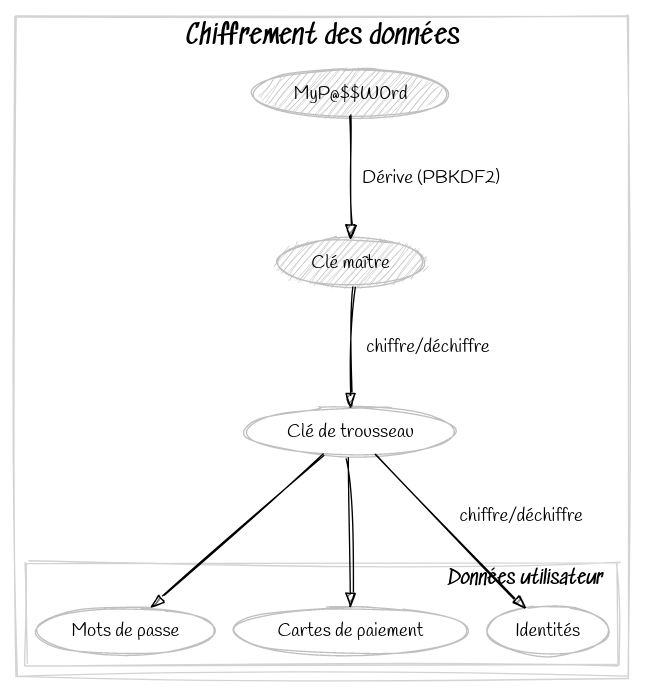
Cas particulier des services connectés dans Cozy
Dans le cas où des identifiants sont utilisés par un connecteur (=pour récupérer les données d'un service en ligne), un chiffrement particulier est mis en place. En effet, il est nécessaire que les identifiants (et seulement ceux-là) puissent être déchiffrés sans action de la part de l’utilisateur, afin de pouvoir récupérer automatiquement les données de vos services en ligne de façon périodique.
Il est primordial de préciser ici que les connecteurs sont exécutés chez Cozy Cloud dans un environnement isolé et sécurisé, qui est le seul à avoir les droits pour déchiffrer les identifiants des connecteurs.
Pour cela, nous utilisons un principe appelé chiffrement asymétrique :
- Une paire de clé est utilisée : l’une servira exclusivement à chiffrer tandis que l’autre ne servira qu’à déchiffrer.
- On appelle “clé publique” la clé de chiffrement qui, comme son nom l'indique, n’a pas besoin d’être protégée et “clé privée” la clé de déchiffrement qui doit rester secrète. Cette dernière est stockée dans le gestionnaire de mots de passe et chiffrée avec la clé de trousseau.
Le principe du chiffrement des connecteurs est le suivant :
-
Lors de la création du mot de passe du Cozy, une clé particulière est générée, qu’on appelle clé d'organisation. Cette clé est partagée entre le serveur Cozy et le gestionnaire de mot de passe et sert pour le (dé)chiffrement des connecteurs.
1.1. La clé d’organisation est transmise au gestionnaire de mot de passe, en la chiffrant avec la clé publique. Elle sera déchiffrée grâce à la clé privée.
1.2. Elle est également stockée dans le Cozy de l’utilisateur, chiffrée avec une clé propre à l'environnement isolé, qu’on appelle clé Cozy.
-
A la création d’un connecteur, les identifiants sont stockés chiffrés avec la clé d'organisation partagée.
-
Lors de l’exécution du connecteur, le déchiffrement des identifiants se fait grâce à la clé d'organisation, elle-même déchiffrée via la clé Cozy dans l'environnement isolé.
-
Tous les identifiants utilisés par les connecteurs sont accessibles dans le gestionnaire de mots de passe et déchiffrés grâce à la clé d'organisation partagée.

Et Cozy Pass alors ?
Aujourd'hui, une nouvelle application est disponible dans votre Cozy : Cozy Pass, un gestionnaire de mots de passe intégré basé sur le protocole de chiffrement ainsi décrit auparavant.
Pour Cozy Pass, nous avons préféré repartir de protocoles établis plutôt que de réinventer la roue. C'est une garantie de sécurité pour vous.
Pour ces raisons nous avons choisi de nous baser sur le protocole ouvert de Bitwarden, en réimplémentant une partie du logiciel et en adaptant d'autres.

A l'ouverture de votre Cozy, vous découvrirez vos identifiants de comptes en ligne déjà connectés à votre Cozy synchronisés et accessibles à tout moment dans Cozy Pass mais pas seulement :
- vous pourrez enregistrer tous vos mots de passe et identifiants (une bonne fois pour toutes) lorsque vous naviguez sur Internet ;
- vous pourrez importer tous vos mots de passe enregistrés dans un autre gestionnaire de mots de passe ;
- vous pourrez vous connecter sans saisie de mot de passe sur vos comptes en ligne (et ainsi arrêter de cliquer sur le lien “Mot de passe oublié ?”) ;
- vous pourrez générer un remplissage instantané des formulaires des sites internet, pour une connexion facilitée à vos services préférés (au revoir la saisie manuelle longue et compliquée) ;
- vous pourrez faciliter vos achats sur le web en enregistrant vos cartes bancaires.
Finis les mots de passe oubliés !
Pour en discuter avec notre Responsable R&D
Paul Tran-Van : son LinkedIn ou Twitter
Articles, liens et ressources
- Plus de détails sur le chiffrement dans Cozy sur Github
- Article "Introduction cryptographique" écrit par Eric Daspet, CTO Cozy Cloud
- En savoir plus sur le Code César
- Découvrir Cozy sur cozy.io et Cozy Pass
Publication d’un nouveau court-métrage appelant à la fin de l'élevage d'ours
Didier “Ice” IcemanOn avance
Hanoi (VNA) – Le centre Education for Nature - Vietnam (ENV) a rendu public un nouveau court-métrage appelant à la fin de l'élevage d'ours pour leur bile.
Intitulé « Extraction de bile d'ours », le film raconte l'histoire du point de vue d'un ours en captivité. Il fait partie d'un projet de coopération à long terme entre ENV, Four Paws International, World Animal Protection et le gouvernement vietnamien pour mettre fin à l'élevage d'ours et promouvoir la protection de cette espèce sauvage.
Le film commence sur un ours couché à l'intérieur d'une cage froide et rouillée, dans une douleur extrême et à moitié conscient à cause de l'anesthésie. Il est ensuite libéré par son regrettable propriétaire de ferme qui décide de l'emmener dans un centre de secours pour une vie meilleure.
Selon la directrice adjointe d’ENV Nguyen Thi Phuong Dung, en raison de la forte demande, le trafic de bile d’ours était une activité rentable. Mais comme de plus en plus de personnes tournent le dos à la bile d'ours, et donc de plus en plus de propriétaires remettent volontairement leurs ours à des centres de secours.
''Grâce à ce film, nous nous attendons à ce que davantage de propriétaires transfèrent volontairement leurs ours afin que ces derniers puissent recevoir de meilleurs soins le reste de leur vie,'' a-t-elle ajouté.
Rien qu'en 2019, ENV a signalé que 34 ours avaient été transférés dans des centres de secours à travers le pays, dont 23 volontairement.
Le nombre d'ours en captivité au Vietnam a baissé de 4.300 en 2005 à 432 en décembre de l'année dernière. Jusqu'à présent, 34 villes et provinces du pays ont déclaré la fin de cet élevage. -VNA

Des rues de Hanoï stérilisées après le signalement d'un nouveau cas de COVID-19
Didier “Ice” IcemanIls ne font pas ca a moitie

How the Iran nuclear deal can be saved
Didier “Ice” IcemanA lire

Several parties to the 2015 Iran nuclear deal (Joint Comprehensive Plan of Action or JCPOA) have engaged in actions that threaten to undermine the agreement. The Iranians have now undertaken five calculated breaches of their commitments. In response, the European signatories France, Germany, and the United Kingdom (“E3”) temporarily triggered the deal’s dispute resolution mechanism (DRM) on 14 January 2020. The loss of trust between the three European states and Iran is very clear — the Europeans have attempted to play a mediating role vis-à-vis the United States, which withdrew from the JCPOA in 2018, but in Iran’s view have not done enough to preserve the benefits it was promised under the deal.
Moreover, France, Germany and the United Kingdom have lost their face-saving capacity which will be required to get the Iranians to the table. All of this is happening while the U.S. continues to escalate its sanctions pressure against Tehran, with the ostensible goal of getting the Iranians to the table to negotiate a new deal. From Washington’s point of view, two other topics should be discussed in addition to Iran’s nuclear program: its missile programs and its destabilizing external behavior.
Credible new actors
A lot is at stake. New actors and an expanded discussion format are needed to reduce tensions, to account for U.S. concerns, and to maintain the substance of the agreement. In terms of new actors, Austria, Finland, and Switzerland could provide important diplomatic support (“good offices”). None are encumbered by previous association with the JCPOA. On the diplomatic stage, they are recognized as experienced, credible, and honest top-class brokers. These “New 3” are also Europeans.
Switzerland is not a member of the European Union, but it does represent U.S. interests in Iran. Their political advantage compared to Germany, France, and the U.K. is in their lower profile, which could make them seem less threatening to U.S. President Donald Trump — though all three would need to resist any attempts at economic blackmail from the United States.
An important first symbolic step would be for Austria and Switzerland to join the Instrument in Support of Trade Exchanges (INSTEX) that France, Germany, and the U.K. established last year to facilitate trade between Europe and Iran by circumventing U.S. sanctions.
Fresh ideas
The “New 3” are neither there to “fill in” the deficits of the three European members of the JCPOA, nor to carry out a parallel foreign policy agenda. The momentum of new EU Foreign Policy High Representative Josep Borrell needs to be coordinated and enriched with fresh ideas. All agree that they are opposed to increased hostility from Washington. Overall, the European position must be visibly strengthened and expanded. The “New 3” will only be heard if they — with all obvious limits — have a recognizable added value to offer.
The “New 3” could bring a renewed push to deescalate tensions. The ”E3” pulled the ripcord on their decision to invoke the DRM in early February by suspending the mechanism that would most likely have led the dispute to the United Nations Security Council and thus to the reimposition of international sanctions against Iran.
Despite their breaches of the JCPOA’s terms regarding uranium enrichment, the Iranians continue to allow the controls and inspections of the International Atomic Energy Agency without restrictions, apparently until just recently. The agreement is currently hanging by this thread. Both sides looked into the abyss and are afraid of the measures they have themselves undertaken. But does this look like conflict management? A coolly calculated procedure by the “E3” cannot be granted. The most urgent role of Austria, Finland, and Switzerland would therefore be as a corrective to the course the “E3” has chosen.
Bern, Helsinki, and Vienna could also act as face-saving relay stations between the JCPOA parties for the purposes of confidence-building. For example, they could be the ones to suggest to the Iranians that their expectations of the Europeans cannot be met structurally under the conditions that have been created by the Trump administration — in other words, that it is impossible for the “E3” to find a way to allow Tehran to continue selling oil despite U.S. sanctions.In addition, Bern, Vienna, and Helsinki could be asked to provide a confidential discussion framework in their capitals for official contacts between the main counterparts. The importance of this function, similar to the role Oman played in the preparatory talks between Iran and the U.S. that led to the JCPOA, cannot be overestimated in the current difficult situation.
A broader scope
There are two avenues for expanding the scope of the discussion format beyond Iran’s nuclear program. First, the JCPOA, with all its unprecedented requirements in the nuclear field, serves as a kind of “nuclear-weapon-free zone” agreement for Iran. At the upcoming Review Conference of the Nuclear Non-Proliferation Treaty (NPT) in New York, it would be a leap forward if the JCPOA, with the help of the Iranians, became the model for talks on the Middle East-wide nuclear weapons-free zone that has been sought for decades, without results.
Second, the “New 3” could play a pioneering role for an innovative path on Iran’s missile program that encourages discussion in Tehran, in order to compensate for the failure of the “E3” to protect Iran’s benefits under the JCPOA. Iran will sooner or later have to include its missile programs in diplomatic talks simply because of Washington’s demands. However, the proposals from Europe on this issue lack an understanding of the historically determined central role of ballistic missiles in Iran’s military strategy. Tehran’s missile arsenal cannot be seen in isolation from the region’s political constellations and military dynamics. This is where the arsenals of Iran’s main opponents, Saudi Arabia and Israel, come into play, in addition to the U.S. military presence.
It therefore makes sense to refrain from focusing exclusively on Iran’s capacities in this area and to pursue a regional approach that also includes the capacities of these two main opponents and thus increases the number of actors (Iran’s ally Syria should also be part of this setting). The discussion format is thus not only thematic, but also expanded to include important regional players. In short, no stone should be left unturned to save the nuclear deal with Iran, including the involvement of more parties and a broader scope for negotiations.
The post How the Iran nuclear deal can be saved appeared first on Responsible Statecraft.