08 Nov 08:41
by Arindam Indra, Prashanth W. Menezes, Ivelina Zaharieva, Elham Baktash, Johannes Pfrommer, Michael Schwarze, Holger Dau, Matthias Driess

Teilweise Cer-setzt: Die partielle Oxidation inaktiver MnO-Nanopartikel mit CeIV führt zu einem effektiven MnOx-Katalysator für die photo- und elektrochemische Wasseroxidation. Im aktiven MnOx liegen gemischtvalente MnII-, MnIII- und MnIV-Spezies (grün und violett im Bild) mit Oxidobrücken (rot) sowie Defekten und Fehlstellen vor. MnOx ist analog zu Calcium-Manganoxid-Systemen, wobei die Ca-Positionen hier von MnII- oder MnIII-Ionen (grün) besetzt werden.
07 Nov 03:32
by Ji Ha Lee, Sunwoo Kang, Jin Yong Lee, Justyn Jaworski, Jong Hwa Jung
Abstract
There is an ongoing need for explosive detection strategies to uncover threats to human security including illegal transport and terrorist activities. The widespread military use of the explosive trinitrotoluene (TNT) for landmines poses another particular threat to human health in the form of contamination of the surrounding environment and groundwater. The detection of explosives, particularly at low picogram levels, by using a molecular sensor is seen as an important challenge. Herein, we report on the use of a fluorescent metal–organic framework hydrogel that exhibits a higher detection capability for TNT in the gel state compared with that in the solution state. A portable sensor prepared from filter paper coated by the hydrogel was able to detect TNT at the picogram level with a detection limit of 1.82 ppt (parts per trillon). Our results present a simple and new means to provide selective detection of TNT on a surface or in aqueous solution, as afforded by the unique molecular packing through the metal–organic framework structure in the gel formation and the associated photophysical properties. Furthermore, the rheological properties of the MOF-based gel were similar to those of a typical hydrogel.

Sense and sensitivity on paper: A fluorescent metal–organic framework hydrogel exhibits greater detection capability for TNT in the gel state compared with that in the solution state. A portable sensor prepared from filter paper coated by the hydrogel was able to detect TNT at the picogram level with a detection limit of 1.82 ppt (parts per trillon; see figure).
06 Nov 03:25
Chem. Commun., 2013, 49,11155-11157
DOI: 10.1039/C3CC43383H, Communication
Libo Sun, Hongzhu Xing, Zhiqiang Liang, Jihong Yu, Ruren Xu
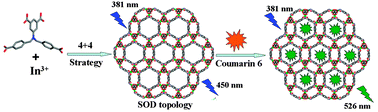
A zeolitic SOD-type MOF has been constructed by a 4 + 4 synthetic strategy from tetrahedral organic building units and In3+ ions, and this compound could adsorb organic dyes and be used as a light-harvesting antenna.
The content of this RSS Feed (c) The Royal Society of Chemistry

06 Nov 00:58
by Mian Li, Dan Li, Michael O’Keeffe and Omar M. Yaghi

Chemical Reviews
DOI: 10.1021/cr400392k

06 Nov 00:57
by Sasanka Dalapati, Shangbin Jin, Jia Gao, Yanhong Xu, Atsushi Nagai and Donglin Jiang

Journal of the American Chemical Society
DOI: 10.1021/ja4103293

05 Nov 02:04
by Maw Lin Foo, Ryotaro Matsuda and Susumu Kitagawa

Chemistry of Materials
DOI: 10.1021/cm402136z

04 Nov 01:34
by Paul Rumbach, Megan Witzke, R. Mohan Sankaran and David B. Go

Journal of the American Chemical Society
DOI: 10.1021/ja407149y

04 Nov 01:26
by Ryu Abe, Kenichi Shinmei, Nagatoshi Koumura, Kohjiro Hara and Bunsho Ohtani

Journal of the American Chemical Society
DOI: 10.1021/ja4048637

04 Nov 01:06
by Pravas Deria, Joseph E. Mondloch, Emmanuel Tylianakis, Pritha Ghosh, Wojciech Bury, Randall Q. Snurr, Joseph T. Hupp and Omar K. Farha

Journal of the American Chemical Society
DOI: 10.1021/ja408959g

02 Nov 07:36
Dalton Trans., 2013, Accepted Manuscript
DOI: 10.1039/C3DT52604F, Paper
Carolin E. Frey, Mathias Wiechen, Philipp Kurz
Layered manganese oxides from the birnessite mineral family have been identified as promising heterogeneous compounds for water-oxidation catalysis (WOC), a key reaction for the conversion of renewable energy into storable...
The content of this RSS Feed (c) The Royal Society of Chemistry

02 Nov 07:35
Chem. Soc. Rev., 2013, Advance Article
DOI: 10.1039/C3CS60323G, Review Article
Jinli Qiao, Yuyu Liu, Feng Hong, Jiujun Zhang
This paper reviews recent progress made in identifying electrocatalysts for carbon dioxide (CO2) reduction to produce low-carbon fuels, including CO, HCOOH/HCOO-, CH2O, CH4, H2C2O4/HC2O4-, C2H4, CH3OH, CH3CH2OH and others.
To cite this article before page numbers are assigned, use the DOI form of citation above.
The content of this RSS Feed (c) The Royal Society of Chemistry

01 Nov 14:28
by Markus D. Kärkäs, Eric V. Johnston, Oscar Verho and Björn Åkermark

Accounts of Chemical Research
DOI: 10.1021/ar400076j

31 Oct 00:58
by Charles C. L. McCrory, Suho Jung, Jonas C. Peters and Thomas F. Jaramillo

Journal of the American Chemical Society
DOI: 10.1021/ja407115p

29 Oct 01:07
by Jake W. Ginsbach, Ryan L. Peterson, Ryan E. Cowley, Kenneth D. Karlin and Edward I. Solomon

Inorganic Chemistry
DOI: 10.1021/ic402357u

29 Oct 01:05
by Ryan L. Peterson, Jake W. Ginsbach, Ryan E. Cowley, Munzarin F. Qayyum, Richard A. Himes, Maxime A. Siegler, Cathy D. Moore, Britt Hedman, Keith O. Hodgson, Shunichi Fukuzumi, Edward I. Solomon and Kenneth D. Karlin

Journal of the American Chemical Society
DOI: 10.1021/ja4065377

25 Oct 12:38
New J. Chem., 2013, Accepted Manuscript
DOI: 10.1039/C3NJ01012K, Letter
Matthias Driess, Arindam Indra, Prashanth Menezes, Michael Schwarze
The convenient synthesis of multi-faceted versus irregularly shaped Ag3PO4 micro particles for the visible light driven non-sacrificial water oxidation is reported. Strikingly, the multi-faceted particles are found to be more...
The content of this RSS Feed (c) The Royal Society of Chemistry

25 Oct 12:35
Dalton Trans., 2013, 42,16683-16686
DOI: 10.1039/C3DT52304G, Communication
Mohammad Mahdi Najafpour, Behzad Haghighi, Davood Jafarian Sedigh, Mohadeseh Zarei Ghobadi
Some Mn oxides convert to a nanolayered Mn oxide when used as water-oxidizing catalysts in a water electrolysis device at near neutral pH with LiClO4.
The content of this RSS Feed (c) The Royal Society of Chemistry

25 Oct 00:50
by Francesc Sastre, Avelino Corma, Hermenegildo García

Solare Brennstoffe: Verschiedene n- und p-Halbleiter wurden für die Herstellung nachhaltiger solarer Brennstoffe getestet. p-Halbleiter wie NiO, Fe3O4, Co3O4 und CuO können Kohlenmonoxid mit Wasser oder Wasserstoff zu Methan reduzieren (siehe Bild). Die höchste Methanausbeute lag bei 17.26 mmol Methan pro Katalysatorgramm und wurde mit einem NiO-Katalysator und überschüssigem Wasserstoff erhalten.
25 Oct 00:38
by Anthony Shoji Hall, Atsushi Kondo, Kazuyuki Maeda and Thomas E. Mallouk

Journal of the American Chemical Society
DOI: 10.1021/ja4083254

24 Oct 12:53
CrystEngComm, 2013, Accepted Manuscript
DOI: 10.1039/C3CE42001A, Paper
Weiqiang Fan, Xiaoqiang Yu, Shuyan Song, Hongye Bai, Xhao Zhang, Dan Yan, Xhunbo Liu, Qian Wang, Weidong Shi
A kind of novel TiO2-BiOCl double-layer nanostructures arrays (rutile nanowires@anatase/BiOCl nanosheets) was successfully designed and prepared. The obtained samples were systematically characterized by scanning electron microscopy, X-Ray diffraction, the UV-Vis...
The content of this RSS Feed (c) The Royal Society of Chemistry

24 Oct 07:52
Chem. Commun., 2013, 49,11695-11697
DOI: 10.1039/C3CC46853D, Communication
Li Peng, Jianling Zhang, Zhimin Xue, Buxing Han, Jianshen Li, Guanying Yang
The large-pore mesoporous Mn3O4 crystals with tunable morphologies, size and porosities were synthesized via the conversion of the Mn-MOFs.
The content of this RSS Feed (c) The Royal Society of Chemistry

24 Oct 03:40
by Dengrong Sun, Yanghe Fu, Wenjun Liu, Lin Ye, Dengke Wang, Lin Yang, Xianzhi Fu, Zhaohui Li
Abstract
Metal–organic framework (MOF) NH2-Uio-66(Zr) exhibits photocatalytic activity for CO2 reduction in the presence of triethanolamine as sacrificial agent under visible-light irradiation. Photoinduced electron transfer from the excited 2-aminoterephthalate (ATA) to Zr oxo clusters in NH2-Uio-66(Zr) was for the first time revealed by photoluminescence studies. Generation of ZrIII and its involvement in photocatalytic CO2 reduction was confirmed by ESR analysis. Moreover, NH2-Uio-66(Zr) with mixed ATA and 2,5-diaminoterephthalate (DTA) ligands was prepared and shown to exhibit higher performance for photocatalytic CO2 reduction due to its enhanced light adsorption and increased adsorption of CO2. This study provides a better understanding of photocatalytic CO2 reduction over MOF-based photocatalysts and also demonstrates the great potential of using MOFs as highly stable, molecularly tunable, and recyclable photocatalysts in CO2 reduction.

Higher CO2 photoreduction activity than previously studied metal–organic framework (MOF) NH2-MIL-125(Ti) in the presence of triethanolamine (TEOA) as the sacrificial agent under visible light is exhibited by the amino-functionalized MOF NH2-Uio-66(Zr). The photoinduced electron transfer from 2-aminoterephthalate linkers to Zr oxo clusters was revealed for the first time by photoluminescence studies, and the generated ZrIII was detected by ESR analysis (see figure).
24 Oct 02:48
by Casey R. Wade, Minyuan Li, Mircea Dincă

Metall-organische Gerüste: Eine Solvothermalsynthese mit Zn2+-Ionen und Bis(pyrazolyl)naphthalin lieferte stark haftende, elektroaktive, dünne Filme Metall-organischer Gerüste auf leitfähigen Glassubstraten (siehe Bild). Die elektrochemische Zyklierung der Filme und anschließende UV/Vis-Spektroskopie offenbaren auffallende mehrfarbige elektrochrome Charakteristika.
24 Oct 00:55
by Rajat Saha, Biplab Joarder, Anupam Singha Roy, Sk. Manirul Islam, Sanjay Kumar
Abstract
Assimilation of open metal sites (OMSs) and free functional organic sites (FOSs) with a framework strut has opened up a new route for the fabrication of novel metal–organic materials, thereby providing a unique opportunity to explore their multiple functionalities. A new metal–organic framework (MOF), {[Cu(ina)2(H2O)][Cu(ina)2(bipy)]⋅2 H2O}n (1) (ina=isonicotinate, bipy=4,4′-bipyridine), has been synthesized and characterized. Complex 1 is crystallized in the orthorhombic noncentrosymmetric space group Aba2 and consists of two different 2D coordination polymers, [Cu(ina)2(H2O)]n and [Cu(ina)2(bipy)]n, with entrapped solvent water molecules. Hydrogen-bonding interactions assemble these two different 2D coordination layers in a single-crystal structure with interdigitation of pendant 4,4′-bipy from one layer into the groove of another. Upon removal of guest molecules, 1 undergoes a structural transformation in single-crystal-to-single-crystal fashion with expansion of the effective void space. Each metal center is five-coordinated and thus can potentially behave as an OMS, and the free pyridyl groups of pendant 4,4′-bipy moieties and free ![[BOND]](http://onlinelibrarystatic.wiley.com/undisplayable_characters/00f8ff.gif) C
C![[DOUBLE BOND]](http://onlinelibrarystatic.wiley.com/undisplayable_characters/00f8fe.gif) O groups can act as free FOSs. Thus, owing to presence of both OMSs and free FOSs, the framework exhibits multifunctional properties. Owing to the presence of OMSs, the framework can act as a Lewis acid catalyst as well as a small-molecule sensor material, and in a similar way, owing to the presence of free FOSs, it performs as a Lewis base catalyst and a cation sensor material. Furthermore, owing to noncentrosymmetry with large polarity along a particular direction, it shows strong second-harmonic generation/nonlinear optical (SHG-NLO) activity.
O groups can act as free FOSs. Thus, owing to presence of both OMSs and free FOSs, the framework exhibits multifunctional properties. Owing to the presence of OMSs, the framework can act as a Lewis acid catalyst as well as a small-molecule sensor material, and in a similar way, owing to the presence of free FOSs, it performs as a Lewis base catalyst and a cation sensor material. Furthermore, owing to noncentrosymmetry with large polarity along a particular direction, it shows strong second-harmonic generation/nonlinear optical (SHG-NLO) activity.

Double duty: A strong second-harmonic generation/nonlinear optical (SHG-NLO)-active dynamic cocrystalline metal–organic framework (MOF) with both open metal sites and free pyridyl groups shows both Lewis acidic and Lewis basic catalytic activities along with small-solvent-molecule and cation sensing abilities (see figure; FOS = functional organic sites, OMS = open metal sites).
24 Oct 00:53
by Arshad Aijaz, Tomoki Akita, Nobuko Tsumori and Qiang Xu

Journal of the American Chemical Society
DOI: 10.1021/ja4093055

23 Oct 12:40
Chem. Sci., 2013, Accepted Manuscript
DOI: 10.1039/C3SC52546E, Edge Article
Yufei Zhao, Bei Li, Qiang Wang, Wa Gao, Chengle Wang, Lirong Zheng, Min Wei, David G Evans, Xue Duan, Dermot OHare
NiTi-Layered double hydroxides (LDH) nanosheets with lateral dimensions in the range 30-60 nm have been prepared using a reverse microemulsion method. These materials exhibit excellent photocatalytic activity (~2148 [small mu ]mol[middle dot]g-1h-1) for...
The content of this RSS Feed (c) The Royal Society of Chemistry

23 Oct 09:00
by Daniel Beaudoin

Nature Chemistry 5, 830 (2013).
doi:10.1038/nchem.1730
Authors: Daniel Beaudoin, Thierry Maris & James D. Wuest
Modular construction using connectable molecular subunits is a powerful strategy for making new carbon-based materials. So far, large crystals have been produced only from subunits linked by weak interactions. Covalently bonded analogues have now been prepared by reversible self-addition polymerization of suitable monomers and structurally characterized by single-crystal X-ray diffraction.
23 Oct 02:27
by Aiguo Kong, Bing Dong, Xiaofang Zhu, Yingying Kong, Junliang Zhang, Yongkui Shan

Iron ORR: An ordered, mesoporous, Fe-porphyrin-like material was created through the nanocasting and pyrolysis of traditional Fe–N4 porphyrins. The resulting nonprecious metal electrocatalyst was used for the oxygen reduction reaction in both alkaline and acidic media.
23 Oct 02:07
by Isaac Garcia-Bosch, Savita K. Sharma and Kenneth D. Karlin

Journal of the American Chemical Society
DOI: 10.1021/ja405739m

26 Sep 08:16
by Yabing He, Zhiyong Guo, Shengchang Xiang, Zhangjing Zhang, Wei Zhou, Frank R. Fronczek, Sean Parkin, Stephen T. Hyde, Michael O’Keeffe and Banglin Chen

Inorganic Chemistry
DOI: 10.1021/ic401870e