As platforms such as Facebook and Apple News slowlystrangle the media industry, the NYT Now app for a moment provided a glimmer of hope. The app curated the best of the New York Times' stories, as well as stories from other publications. Maybe a news outlet could create its own highly entertaining news feed! Maybe it didn't have to depend on a third-party platform to distribute its content!
According to Swedish book "Modeslavar" ("Fashion Slaves" in English), mammoth chain store H&M has kids as young as 14 years old working 12-hour days in their Myanmar factories. Along with H&M, retailers including Primark, Gap, Marks & Spencer, Tesco......
Continue Reading...
As a student and observer of meteorology, it constantly bums me out that people do not understand what it means when someone says there’s an “X% chance of rain” tomorrow. A 50 percent chance of rain does not mean there’s a 1-in-2 chance that you’re going to get wet.
To be fair, this confusion cannot entirely be blamed on the general public. The terminology most used by people is “There’s a 80 percent chance of rain,” which reasonably leads people to think there’s an 80 percent chance it’s going to rain on them. And when they don’t see it, they think their local meteorologists are huffing glue.
The factor that’s missing in the comprehension of Probability of Precipitation (PoP)? Area. To quote the National Weather Service (NWS), what PoP is actually describing is the chance of rain at any point over an area.
Here’s the math:
PoP = C x A where “C” = the confidence that precipitation will occur somewhere in the forecast area, and where “A” = the percent of the area that will receive measurable precipitation, if it occurs at all.
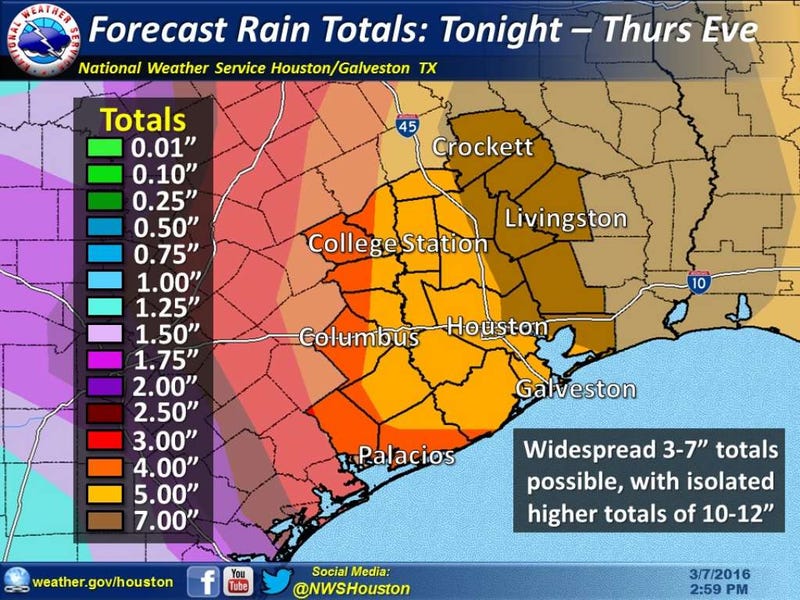
Let’s break that down. Using various models and data a meteorologist will look at the chances that rain will happen somewhere in their forecast area and determine how much of that area is likely to get rain. For the National Weather Service this can mean a large area. For instance, look at the Houston-Galveston NWS Forecast area outlined below:
Photo: NWS Houston
For those of you who haven’t driven from Palacios to Crockett or Galveston to College Station it’s a big area. If NWS forecasters were 100 percent certain that it was going to rain in the lower third of counties and 100 percent certain it wouldn’t rain in the upper third, then there would be a 30 percent chance of rain for the whole area.
That rarely happens, again, as the NWS points out:
[M]ost of the time, the forecaster is expressing a combination of degree of confidence and areal coverage. If the forecaster is only 50% sure that precipitation will occur, and expects that, if it does occur, it will produce measurable rain over about 80 percent of the area, the PoP (chance of rain) is 40%. ( PoP = .5 x .8 which equals .4 or 40%. )
So, your local TV weather person isn’t a moron if they say there’s a 50 percent chance of rain every day and it never rains. It’s possibly that for some of the area he or she was referring to, there’s someone on the other end of your viewing area who got rained on every day.
The standing out in floods, though, that’s just good television.
Ad-supported? I don't think that's the right terminology.
Long-time reader geek writes: Facebook is going to start forcing ads to appear for all users of its desktop website, even if they use ad-blocking software (Could be paywalled; alternate source). The social network said on Tuesday that it will change the way advertising is loaded into its desktop website to make its ad units considerably more difficult for ad blockers to detect. "Facebook is ad-supported. Ads are a part of the Facebook experience; they're not a tack on," said Andrew "Boz" Bosworth, Facebook's vice president of engineering for advertising and pages.
If you’re an Internet of Things skeptic or look askance at fitness trackers and connected home products of all sorts, then Grover, an online marketplace that lets consumers try out devices before they commit to a purchase (if they commit to one at all), may be for you. Founded in Germany as ByeBuy in 2015, Grover offers trial runs of about 300 products, from smartwatches to other wearables, phones, and laptops. At present, for example, you can rent a Samsung Gear VR virtual reality headset for $19.90 a month or a Netatmo Weather Station for $9.99 a month.
This new expansion into the U.S. market has only brought the newly rebranded Grover to New York City for now, though plans to make landfall in other stateside locations are underway. And if you’re in Germany, the U.K., Austria, or the Netherlands, you’re in luck: Grover is readily available in each of those countries.
Learning any artistic process takes a mental adjustment. Learning to draw requires a different mindset that making a spreadsheet. This graphic helps you recognize the broad steps to get started.
Most “Learn to Draw” books begin by making you draw things. However, as Betty Edwards, author of Drawing on the Right Side of the Brain explains, learning to draw begins with learning how to see the world. You start by paying attention to the edges and shapes of the things around you and practice translating those into an image.
The graphic below, created by information designer Anna Vital, is a basic outline of these key steps. You can find a more detailed explanation of each step at the source link below.
Adult Swim cartoon Squidbillies has a different artist cover the theme song every week -- past participants have included Lambchop, Neko Case, and King Khan & the Shrines, among many others -- and the next season's roster of guest performers has been announced, as Paste points out. Father John Misty, Kurt … More »
This morning, Facebook VP of product management Adam Mosseri
announced that the social network is tweaking its News Feed
algorithm to show more stories from friends and family members —
a move that indicates Facebook is worried professional publishers
are crowding out the normal people in your life you care about.
The decision, according to the post, is based on “research,” which
is a way to say that Facebook has been listening to the myriad
signals of the real people who use its platform each day.
Facebook doesn’t really care about the news industry. The idea that Facebook was going to “save” the news industry, or even that Facebook traffic is something that news organizations should bank on for the future, is just goofy. Facebook’s first goal is to keep users using Facebook — as many users as possible for as much time as possible. If videos of cats walking around on two legs are more popular than analyses of the United Kingdom’s vote to leave the EU, well, that’s what they’re going to prioritize. Secondarily, Facebook’s goal is to monetize the aggregate attention from priority one. That’s it. So, going forward, news organizations are going to have to pay more for worse placement in Facebook news feeds.
You can call this unsettling if you want. I’d call it unsurprising.
The same running workout feels harder on a hot day than on a cool one, and it’s not just your imagination. We really do slow down in the heat—at least until we’ve adapted to it—and it’s possible to calculate exactly how much.
The temperature calculator at Runners Connect is built with race times in mind, but it works just as well for figuring what’s up with your everyday run. Today, for example, I missed my early morning run and made it up later in the day in the 80 degree heat. The calculator tells me that at my speed, about 10 minute miles, I should expect each mile to take about 15 seconds longer today than it did on a 65-degree morning last week.
The heat of an 80-degree day adds 20 percent to your time compared to your pace on the perfect 45 degree day, while a 70 degree day only adds 7 percent. That means your exact slowdown will depend on your original time. Because it’s a hassle to do percentage math with minutes and seconds, this calculator is a handy tool.
Humidity above 60 percent will slow you down even further, but that’s not reflected in the temperature calculator. Take it easy out there on hot days, and don’t be disappointed if your runs aren’t as fast as usual.
Summer is here. It’s time to do what men do: grill meat. That often includes some hot dogs, which is good because the hot dog is almost universally liked, generally fits anywhere on the grill,…
Kellen Beck, writing for Mashable: Video must be doing well on Facebook, because an executive at the company just predicted that's all Facebook will be in five years. Nicola Mendelsohn, Facebook's vice president of European, Middle Eastern and African operations, said at a conference Tuesday that in five years, Facebook "will be probably all video," Quartz reported. Mendelsohn added that video is "the best way to tell stories in this world" and "helps us to digest much more information." Mendelsohn is predicting the obsolescence of the written word, at least on Facebook, according to Quartz. That sounds far-fetched, but consider the way Facebook is decreasing an emphasis on text and diving headfirst into video with numerous recent updates and features.
This is bad ass... Anyway we could do text through tor?
Instagram is finally taking advantage of iOS share extensions so that you can post photos without ever opening Instagram itself. But then you wouldn’t get to play with all those nice filters, and I’m all about the filters.
The latest update to Instagram on iOS adds a sharing extension—meaning that you can, for example, browse the default Photos app, tap share on your desired photo, and post directly to Instagram without having to go through the app. You still need to launch the full Instagram app if you want to add filters or edit the photo, though. [9to5Mac]
Facebook is giving you the option to publish a post on the News Feed that does not appear on your own Timeline. People have been posting fewer updates to Facebook so they probably want to encourage users to publish updates without regard to their permanence—but the posts will still appear in search results, so it’s not that ephemeral. (Technically you could already do this if you just edit a post after the fact to “Hide from Timeline”.) [TNW]
Facebook is also inching into Twitch territory with gaming livestreams. They’re working with Blizzard to implement the Facebook Live API into every Blizzard game, meaning you’ll soon be able to stream your Overwatch gameplay directly to Facebook. You’ll also soon be able to login to Blizzard games using just your Facebook credentials. [BusinessWire]
In April, the internet seemed to abruptly discover a trend that had been lurking in its midst for years: Brutalism, an aesthetic borrowed from architecture and applied to minimally designed, bare-knuckle websites. After Hacker News — itself arguably a Brutalist website — discovered a Brutalist website devoted to otherBrutalist websites, discussion surrounding the trend caught on and spread.
But what is a Brutalist website? That question is easier asked than answered.
dreamsjung (Flickr)
Example of Brutalist architecture at the Salk Institute in La Jolla, California.The website endless.horse.The website Blank Slate.
So far, there's not really a consensus on what a Brutalist website is
On Hacker News, a giant debate broke out about whether the websites listed on Brutalist Websites are actually Brutalist. Maybe they're just minimalist, or perhaps "vernacular," a term once used to describe the eternally "under construction" nature of the web in the mid- to late '90s. Or maybe they're part of the vaporwave movement,a twofold visual and music subculture that evolved on the internet alongside seapunk and thrives on retro aesthetics, early glitchy computer art, and the intersection between yuppie-era capitalism and kitsch. (Think Lisa Frank meets mall elevator music meets Geocities meets pixel art meets loud Hawaiian shirts.)
As a descriptor, "Brutalist"seems to imply that the sites are somehow ugly or offensive to the viewer, but this isn't always the case. Often, it just means a website is constructed from essential coding elements and very little else — no frills, redundant images, or advertising. But Brutalist Websites goes further in its definition of the movement by issuing a short, blunt manifesto:
In its ruggedness and lack of concern to look comfortable or easy, Brutalism can be seen as a reaction by a younger generation to the lightness, optimism, and frivolity of today's web design.
Plenty of people have argued that this definition doesn't take into account the huge number of websites that look crude and Brutalist not because of some self-conscious aesthetic choice, but because they haven't been updated in several years. So far, there's no real consensus on whether a page "becomes" Brutalist by aging into it, or whether it only qualifies if the design is intentional.
However, we do know what a Brutalist website is not
Pinterest — perhaps the polar opposite of a brutalist website.
In architecture, Brutalism tends to refer to buildings that are in some way stark, that don't make any effort to blend into the urban landscape or environment surrounding them. (Take these Brutalist sandcastles, for example.) On the web, we might say Brutalist sites have refused to blend in with the many changes and trends that have impacted website design over the years.
To that extent, it's easy to talk about what a brutalist website is not. The evolving internet is well beyond its middle period in terms of design, which we might describe as mid-2000s websites characterized by over-engineering (think huge corporate websites with sidebars and navigation bars for clicking through their giant mazes of links, or complicated splash pages you had to load before entering), innovations in cascading style sheets (remember the Zen Garden?), and fun with javascripting (think image-heavy backgrounds with animated objects and "dynamic" layouts that change as you scroll down the page or mouse through the website — oh, and who can forget horizontal scrolls and "content sliders"?!).
These days, interactivity is a given, complex multimedia platforms like Facebook and YouTube have largely superseded individual websites, and individual sites, when they do exist, are frequentlytemplate-based and built on platforms like WordPress and Squarespace. Usability wars are waged, not over things like whether your site navigation should be vertical or horizontal but over things like intrusive target-based advertising, trackers, and other forms of browser malware, and buggy plug-ins.
Designer-engineer Jon Gold's fatigue with the cookie-cutter nature of modern templated web design is a cousin to the impulse behind Brutalism on the web. A Brutalist website is basically the simplest version of said website — either a response to a reactionary dislike of the modern, overcommercialized, and overdesigned web or a byproduct of the website being built during the stone age and no one ever bothering to update the code.
Famed computer culture journalist and programmerPaul Ford has pointed out that most Brutalist sites aren't profit-driving websites, and that Brutalism clearly isn't about feeding a capitalist or corporate view of the internet.
Here are six examples that illustrate the Brutalist movement, either intentionally or otherwise.
Drudge Report
Drudge Report accumulates 9 billion hits per year and mostly links to external websites. The implication is that owner Matt Drudge can't be troubled with maintaining a more complex design because he's too busy scouring the web for conservative news, which adds to its feeling of legitimacy.
However, while the site may be Brutalist, it predates the rise of Brutalism as a distinct internet aesthetic, and it's highly unlikely Drudgeis making any particular artistic statement.
Suckless
Suckless.org.
Suckless is a tiny open source coding and developer community that's been active for a cool decade. With a plain and simple style and an FAQ section that contains only three questions/answers, it stands as an example of Brutalist design that's flexible enough to look as modern in 2016 as it did in 2006.
Craigslist
Craigslist.
The popular classifieds site is perhaps the most famous example of Brutalism in practice. Though Craigslist runs on plenty of engineering, its navigation is among the web's simplest and plainest.
Belong.io
Belong.io.
Belong is kind of like Digg for the weird internet, except it aggregates interesting links from Twitter. With its ever-changing but consistently garish animated header, Belong seems to deliver a tongue-in-cheek homage to the aforementioned vaporwave movement as well as to Brutalism.
Belong is run by web developer Andy Baio, who also owns another Brutalist website, Playfic. Playfic houses hundreds of interactive text-based games — which are arguably among the most Brutalist "items" on the web.
Pinboard
Pinboard.in.
Although Pinboard owner Maciej Ceglowski has said he’s "not too fond of the parallel" between his website and Brutalist architecture, he has plenty of opinions about the need for simplicity and low density in web design, starting with his aversion to "megabytes of cruft." His no-frills bookmarking site has become a cult favorite in part because of its low-key, clean aesthetic.
NPR's "thin" version
NPR.
Like many websites, NPR offers its users a handful of different options for viewing its website. There's the "graphical" version, or the main homepage that most users see by default, and then there's the image-free, link-only version, which is designed to deliver content to the reader as quickly and simply as possible. The latter, which NPR has labeled its "thin" version, is totally devoid of pictures, plug-ins, trackers, style sheets, or anything else you might expect to see on a highly trafficked popular media site.
The "thin" version of NPR serves to help out readers with slower connections and older computers, because it doesn't require much time to load. It's also more legible and accessible for readers who have trouble reading image-heavy websites. But beyond those functionalities, it reflects the needs of a crucial segment of internet users — the ones who show up not for interactive plug-and-play design or elaborate graphical interfaces, but primarily for the nuts and bolts of what the web can do.
These users might range from busy developers eager to build and interact with a more efficient web to readers who want to know more about what code is to users who prefer to sink their teeth into the philosophical ideas behind design. To these groups, convoluted aesthetics just get in the way; a webpage that takes too long to load is a page that's already proven its uselessness.
Brutalism reminds us that more isn't always better — especially on the web
If you're one of these design-curioustypes of internet users — or even if you've ever looked at a totally blank, uncrowded webpage and felt a sense of relief — you can probably understand the basic appeal of Brutalism, starting with the idea that the text-based focus of the internet's early development wasn't actually bad.
The simplicity of these websites isn't only aesthetic in nature. The code for NPR's thin version, on this particular day, is only 21 lines long. Pinboard's streamlined nature is due in part to its owner's philosophy that no text-based website should be larger in file size than the average Russian novel is as a text file — that is, only a few hundred kilobytes. (Anything larger impedes page load time and essentially means you've started to include plug-ins and bells and whistles, all of which ultimately obscure the text, a.k.a. the reason for building the site to begin with).
Most of the internet's websites vastly exceed this size, a phenomenon often referred to as "bloat." Meanwhile, the average person who spends time on the web has to regularly contend with a barrage of obstacles to their primary goals of finding information and communicating: everything from cookies and ad trackers to privacy-invading search tools and strategically engineered user interfaces designed to make you stay as long as possible.
Brutalist sites, in contrast, are fast to load and intuitive to use and comprehend. It's no wonder pages like these are gaining popularity. In an increasingly overdesigned internet, Brutalism is a welcome respite from the noise of the modern web.
This weekend saw the release of Roots, a four-part miniseries remake of the landmark saga of American slavery that originally aired in the ’70s. It has been receiving rave reviews from critics and audiences alike, though it is now facing a particularly biting piece of backlash. Snoop Dogg took to Instagram last night to lambast the show in an incredibly pointed critique on our media’s big problem with representing black oppression.
“No disrespect, but I can’t watch no motherf***ing more black movies… I can’t watch none of that shit,” he begins. “I don’t understand America. They just want to keep showing the abuse that we took hundreds and hundreds of years ago. But guess what? We taking the same abuse! Think about that part.”
In essence, his point is that the only media depicting black culture that receives high praise or funding from the industry are stories centered on black oppression. “Why don’t ya’ll go make a series about the success black folks are having?” he continues exasperatedly. And to Snoop’s credit, his arguments are strikingly acute.
The recent #OscarsSoWhite controversy is a prime example of this issue. The past two years at the Academy Awards saw not a single person of color nominated in the 20 slots available in the acting categories. The last time people of color were nominated was for 2013’s 12 Years a Slave, which even led to a win for Best Supporting Actress Lupita N’yongo.
Even more damning are the results of the films that do represent the success being enjoyed by black culture. Two of the most-praised films from last year, Straight Outta Compton and Creed, both portray realistic, contemporary portrayals of success for African-Americans. Straight Outta Compton was even one of the highest grossing films of the year. Except for a nod for screenplay, the film was entirely shut out at the Academy Awards. Creed, the reboot of the Rocky series, featured a bravura performance from Michael B. Jordan and directing and writing from Ryan Coogler. Both were snubbed during awards season, the only recognition going to the token white performance in the film, Sylvester Stallone.
The issue lies not with media such as Roots continuing to be released, many have pointed out what a poignant and artistic work it is. But as Snoop Dogg says, the representation of black culture in our media continues to be egregiously one-sided. The best way to incite change, as the Doggfather says in the video, is to start making the media that needs to be seen ourselves.
In related news, here are our 5 African Fashion Subcultures you should know about.
Bad news is blowing for bike builders and us who love them: True Temper is discontinuing its line of steel tubing designed for bikes. The True Temper name might recall some less racy products, but it has also been a stamp of quality on some of the fastest, coolest, and sexiest bikes of the last 30+ years.
True Temper is one of very few steel manufacturers producing the thin, variable-walled and precision balanced tubing that nice bikes require. But despite its oversized share of this steadily growing niche market, the Memphis, TN, company recently went public with the decision that bicycle products no longer fit into its greater business strategy... which instead appears to be increasingly aimed at golfers.
Like in all small industries, opinions on bike frame materials can vary widely and passionately, but True Temper has long been seen as an industry-leader for quality, variety and strength. Supported in enormous part by frame builder-slash-supplier Henry James' adoption and promotion of the line in the 1970s, True Temper tubes are found on bikes that have ground up the Alps, through Giros d'several countries, and pounded over the Paris-Roubaix.
They also show up on world touring rigs, light but tough cyclocross bikes, and heavily abused mountain bikes. Their tubes have been used in large brands' production runs, and on the absurdly intricate hand brazed and lugged bikes of Henry James and other pioneering designers.
Though steel isn't the primary choice for racers these days, it's a beloved favorite for riders and custom builders thanks to its plasticity, reparability, and variety of ride characteristics. The current True Temper offerings are hardly old school - their range of 120 tube types shows up on contemporary favorites from cult brands like Rock Lobster, Ahearne, Indy Fab, Waterford, Vanilla/Speedvagen, Rodriguez, and Yamaguchi, all of whom have used TT tubing for decades.
This decision will sting just as much if not more for the innumerable tiny independent builders around the world, who are required to buy tube stock in smaller quantities and will be less able to stockpile for a TT-free future. It's no hyperbole to note that the works on display at shows like NAHBS would be pretty different without True Temper in the picture.
In the company's official statement senior vice president Jeremy Erspamer provided a few vague points of reason.
"Based on a thorough review of all aspects within this business unit, it has become evident that bicycle products no longer fit into our core strategy," and elsewhere, "Expensive manufacturing process upgrades [are] required to address several concerns."
This tepid release appears to be saying that the other lines within the company's Performance Products division are more easy and profitable to pursue. Golf equipment, it would seem, pays better. This move makes sense from a simple bottom line perspective, given that high quality domestic bike production is incredibly time-intensive, and that wealthy people are more likely to collect nice golf clubs than join a cycling club.
But it's still surprising, given the continued growth of the domestic bike manufacturing industry. Commenting on the original Bicycle Retailer announcement, Paul Skilbeck, Founder at Handbuilt Bicycle Guide, had this to say:
While this will undoubtedly be a challenge to the custom handbuilt sector of the [industry] in particular, Henry James Bicycles, who did much work in creating the True Temper brand in terms of tubing specification as well as distribution channels, is working hard to find a manufacturer to replace True Temper, and despite potential existential questions is seeing a potential silver lining. The handbuilt custom sector, as we have seen in the past 15 years, is very resilient!
Orders can be placed for some more months, production won't end until March 2017, and other options will remain, but the announcement is frankly a sad one. American-made materials are increasingly hard to come by, and it's always bittersweet to see a champion go after generations in the game.
Despite the beautiful bikes they leave us with, True Temper is moving on. By golf cart, I assume.
"Farewell, Mr. Bunting," starring Fred Armisen, marries timeless non-topical humor with the weird, slow comedy style that's been infiltrating the SNL repertoire.
In case your next vacation is too far away for your own peace of mind, the Tumblr Oessa's gorgeous Street View images can help you feel like you're on a getaway.
Here's a stunning tour of the seven continents on the blog, which was featured as a reader's choice in Time Magazine's 30 Tumblrs to follow in 2013:
North America
Dry Tortugas National Park, Key West, FL 24°37'41.5"N 82°52'28.6"W
Saturna Island, British Columbia, Canada 48°47'05.0"N, 123°02'42.0"W
Monterey, California 36°22'19.60", -121°54'8.21"
South America
Puente Gral Carrera XI Región, Chile -46°50'45.39", -72°48'9.86"
Galapagos Islands, -0°46'43.10", -89°31'10.44"
Salvador, Bahia, Brazil -12°55'52.35", -38°19'18.61"
Africa
Cape Peninsula, Cape Town, South Africa -34°19'23.08", 18°27'48.83"
Tsodilo Hills, Botswana -18°46'4.90", 21°44'8.75"
Europe
Paris, France 48°51'30.07", 2°17'39.72"
Fredvang, Norway 68°5'4.55", 13°11'17.03"
Bellinzona, Switzerland 46°11'36.21", 9°1'21.51"
Asia
Seongsan Park, South Korea 33.461503, 126.939297
Hotaka Mountains, Japan 36.294195, 137.662033
Varanasi, India 25.307614, 83.010855
Australia
Great Barrier Reef -18.246795, 147.386806
Wilson Island -23°18'12.91", 151°54'53.84"
Mount Gunson -31.536145, 137.126962
Antarctica
Cape Royds -77.554514, 166.162701
Black Island -77.528165, 161.753769
Petermann Island -65.172467, -64.136907
If you want to see more amazing images, Google Maps Street View offers collections of landmarks and natural wonders from around the world. These are a few of the categories available to explore:
Is this going to become a thing? It'll be interesting to watch.
Last week, Radiohead — one of the biggest bands on the planet — “disappeared” from the internet.
Only, they didn’t really… Their albums were still available for purchase, their Discogs profile was still live, their rare press interviews were still searchable via Google, their videos remained on YouTube. All they did was delete a few years of social media posts and place a cool fading/decaying filter on their homepage. Considering their well-publicised distrust of social media and very private media profile, it wasn’t much of a disappearance.
But as imperfect as it was, it got us thinking… Is it possible to disappear from the internet completely? Not just wiping your socials, but everything. Every image. Every mention. Every account. Everything.
“In theory yes. But don’t expect it to happen overnight. Or even over a number of weeks,” explains London-based social media lawyer Yair Cohen. “If you’ve spent a large chunk of your life on the internet then it could take months and a lot of creative negotiating…”
Yair should know; his firm The Internet Law Centre specialize in removing all traces of identity from the internet, and often work with ex-adult entertainment industry clients who are looking to put the past behind them and start a new chapter in their lives.
“In some cases we’ve had to remove tens of thousands of images and videos for just one client alone,” he explains. “You can do it, but you have to work hard and delicately. Remove them one by one. Each case has unique circumstances. Some images can be removed on copyright grounds, some can be removed on privacy grounds, some could be removed on harassment. Some projects take eight months to a year. We have to be very stubborn.”
Luckily, for those of us who aren’t pornstars, it’s not quite so tricky to achieve online anonymity. That said, there’s still a huge amount of work to do and — unless you hire a legal team, which could costs thousands, if not tens of thousands, of dollars — there’s a lot of leg-work to do yourself.
Here’s how to commit internet suicide in five not-so-easy steps.
Well, duh. From Facebook right the way through to your long lost MySpace page, by way of that Pinterest phase you went through and the Linkedin page you never use — all of these should be the first to go.
We won’t waste time explaining the delete route on every social media site because you’re not stupid and the information is already out there. However, be aware that “delete” and “deactivate” are two very different things; deactivate means your data, images and profile are still active, just no longer public.
Facebook, for example, will still show posts and comments from deactivated profiles in archived posts. If you want real full-strength internet suicide, you’re going to need to delete all day long. Facebook doesn’t make it very clear how to do that, so here’s the direct link to cancel your account.
If you use Gmail then be careful when deleting your G+ profile. You’ll need an email address until the very last step of this erasure process, so make sure you do things in the correct order. To delete G+ but not your entire Google profile visit this link to select the Google services you want to delete.
Once that’s done, write a list of every social media account you’ve ever set up and go through it systematically. Services like Account Killer are handy portals for information on how to delete accounts on the majority of popular social media sites.
Dating, gaming and gambling site profiles. Blogs you’ve written, content sites you’ve uploaded articles to. Forum accounts, freelance job sites, Paypal, Amazon, eBay, YouTube, Skype… it’s all gotta go.
Delete every site you’ve ever signed up to, commented on, played on, hooked-up through, bought products from, found work through… From recent shopping sites to old forums you got pwned on 10 years ago. The works.
“There is no quick and easy route here,” states New York-based web privacy expert Robert Siciliano. “It’s not in these site’s interest to delete your data. Data is an asset you’ve agreed to give to them by signing up. Some of these sites will involve you getting in touch directly and having to state your case several times over.”
A great tip, if your inbox housekeeping game isn’t strong, is to search your inbox for the terms “confirm email address” and “validate email address” to remind yourself of various sites you’ve signed up to and used in the past. Then search for your email addresses on Pipl and see what it brings up. It’s not 100 percent comprehensive, but it is pretty thorough.
If you’ve created a profile or account using an old email address that is no longer active, Robert suggests getting in touch with the website directly. Unfortunately, they won’t always play ball.
“In these cases sometimes your only course of action revolves around deploying the legal system,” says Robert. “By putting legal pressure on them via your attorney you may get them to budge.”
“This isn’t ideal advice for people who want to do it personally,” agrees Yair. “But once you’re stuck you really get stuck – there’s no telephone number or live chat with so many of these sites.”
Finally, if you can’t remove the account but can log-in, falsify all information on yourself.
With all social traces of yourself removed, now you need to find and delete all mentions of your name, images and profiles stored by background check/data collection agencies.
Sign out of your search engine accounts (being signed in will skew the results), search for your name on every search engine (not just Google) and try different combinations, such as your name + places you’ve worked, your name + places you’ve lived, your name + date of birth etc.
Spend time ruthlessly checking every search engine for every mention, and make a note of each site that holds your details or image as you’re going to need to contact them individually.
You need to check the press, forum chats, newsletters and other miscellaneous articles for anything mentioning you. Wherever you see your name or personal details, take note of the site.
If you’re aware of the use of your image, or you’re the subject of a meme that’s somehow gone viral, using reverse image searches either on Google or sites such as Image Raider will identify the locations where your image has been stored or shared.
Like it or not, there are hundreds of companies out there storing your data. Some are wholesome phone directories that will just require a polite unlist request; others trawl the web, creating profiles on you for employment background checks, sales and marketing research companies and the public to find you.
Finding out which company has information on you and what info they have is a needle-in-haystack scenario. Robert reckons the best way to find out is by performing the same searches described above.
This is the hardest and most labor-intensive step of the process: Get in touch with the companies, site editors, webmasters or whoever is contactable and politely request all data on you is removed. Most websites have clear contact details listed somewhere, while others may take a little digging using sites such as WhoIs to locate the domain owner.
On contact, some sites will respond accordingly. Others may take a little persuading and request all manner of ID as proof. Others may completely ignore you. In these instances, legal action may be required.
Just to make things more complicated, depending where you live, you can request removals based on different laws. In Europe, under the European Human Rights Act, people have the right to their own likeness, which effectively provides copyright over use of your image anywhere online.
“Every individual owns the image of their complexion,” explains Yair. “You own the image of your face. It’s a new concept that under the right to a private life, which is part of the Human Rights Act, you have the right to demand that image can’t be used on that website.
“It’s harder in the US; they can issue the right to take-down under the DMCA which is copyright-related and was created for the benefit of the entertainment industry. Individuals can use it but they have to make a statement to say they have copyright over the image.”
Other legal techniques used to remove content include blocking from countries via internet service providers (if the content can be proved to lead to harassment or be an infringement of privacy) or contacting the server which is often in another country.
“We’ve had instances where an image is placed in a website in eastern Europe and the webmaster doesn’t want to work with us. So we find a source who will listen to us,” explains Yair. “The website might not, but the server will… And they may be based in America or Europe, so they’re more receptive to our requests. The hosts don’t have a choice as they’re liable. So they’ll try and communicate with the website owner, if they don’t hear back then they shut it down.”
When removing yourself from data collection and background check companies you can take a shortcut and employ the services of a third party company who will endure the many hoops that data brokers and background checkers require you to jump through. For just over a hundred dollars per year, companies such as Delete Me can ensure you are removed from the major data collection agencies and remain removed as long as your subscription is paid and up-to-date.
However, these companies can’t offer 100 percent removal, so you still need to ensure you’re also aware of every location your data is held.
If you want to completely disappear from the entire internet, that means tackling archived content on the Wayback Machine, too. First you need to find the content, which is tricky, considering the search database is URL-based. Then you need to find the host or the owner of the domain.
“It’s possible, but very difficult. Most cases I’ve had with Wayback Machine content removal has been on the grounds of privacy,” states Yair. “If you can get hold of the website that has the content, if it’s still live, then you have to go to them and ask them to remove it. There is a code that the operator of the website can add to the URL and that will effectively remove it from the way back machine. It’s complicated, but possible.”
The final — and easiest — stage of your digital Houdini act. If you’ve completed all the stages above, you’ve had proof or actively identified that your data, image and profile has been removed you have no need for your email address any more. It shouldn’t surprise you that deleting an account with major email providers such isn’t the most straightforward process. But, compared to what you’ve just been through, it’s a walk in the park.
If you’ve managed to successfully complete all these steps, then congratulations! You are now effectively anonymous online. However, staying that way is anything but straightforward, and you’ll need to be very careful about what data you enter into websites from now on.
Still, if you’ve gone to this level of effort, you probably have better things to be doing than using the internet. Switch off the computer, step outside, and bask in your newfound nameless freedom…
It's not every day you see a grandma ripping a bong.
The video above, from Cut Video, shows three grandmothers smoking marijuana for the first time in Washington state, where recreational pot is legal, and enjoying some conversation, card games, and snacks.
"I'm feeling like I really don't care," one of the three grandmothers explained, as the other women laughed.
It's relatively uncommon for people to try or use drugs for the first time at an older age. DrugAbuse.com analyzed federal household surveys dating back to the 1970s, tracking the age and rate of recreational drug users across several generations. It found that throughout different generations, almost all drug use tends to peak around a person's early 20s and fall off after that:
Was there ever a literary friendship as charmingly incongruous as that of Truman Capote and Harper Lee?
She was most famous for writing a book so simultaneously brilliant and inoffensively uplifting that it became required reading for every eighth-grader in the country, and then retiring to live a life of quiet seclusion in a small town.
He was a prolific writer, famous, among other things, for inventing the true crime novel and for writing a serialized roman à clef so scandalous that he had to abandon it halfway through or risk being dropped by his wealthy friends after he revealed all their sordid secrets.
But Lee and Capote grew up together, and were so close that Lee used Capote as the basis for the character of Dill in To Kill a Mockingbird. Capote, in turn, used Lee as the basis for Idabel Thompkins in Other Voices, Other Rooms.
And now Smithsonian magazine has exclusively republished an article by Lee on one of Capote's most famous subjects: the Clutter family murder, the core of Capote's true crime masterpiece, In Cold Blood. They're republishing it under Lee's byline for the first time.
Capote and Lee researched the Clutter family murder together in 1959, shortly after To Kill a Mockingbird was published. Capote published the resulting piece in the New Yorker in 1965, and expanded it into one of his most celebrated books in 1966.
But in 1960, Lee wrote a profile of Kansas Bureau of Investigation agent Alvin Dewey, the hero of In Cold Blood, for Grapevine magazine — anonymously, five years before In Cold Blood was published. Lee’s biographer Charles Shields, who uncovered the story of Lee's anonymous article, theorizes that she didn't want to take anything away from Capote. As he told the Atlanta Journal-Constitution, "Harper Lee was so protective of Truman, the Clutter case was his gig … She didn’t want to steal from him."
Lee's profile of Dewey devotes a full paragraph to Capote's forthcoming coverage of the story, referring to her friend as a "well-known novelist, playwright, and reporter." Lee had her BFF's back, as always.
More than 10,000 people attended the Lincoln Douglas debates, and yet they debated without amplification.
It's only quite recently that we began to disassociate talking-to-many from talking loudly. Having a large and varied audience used to mean yelling, it used to be physically taxing, it would put our entire body on alert.
Now, of course, all of us have a microphone.
The instinct remains, though. When we know that hundreds or thousands of people will read our words online, we tense up. When we get on stage, we follow that pattern and tense our vocal cords.
We shout.
The problem with shouting is that it pushes people away. WHEN YOU SHOUT IN EMAIL, IT SEEMS ANGRY. Shouting creates a wall between us and the person at the other end (even though it seems like many people, sooner or later, there's one person at the other end).
Shouting destroys intimacy, and it hurts our impact, the impact that comes from authenticity.
We feel speech and words long before we hear the words, and we hear the words long before we understand them.
The solution is simple: whisper.
Practice whispering.
Whisper when you type, whisper when you address a meeting.
Lower your voice, slow your pace, and talk more quietly.
The microphone will amplify your words. And we'll hear them.




 Adult Swim cartoon Squidbillies has a different artist cover the theme song every week -- past participants have included



/cdn0.vox-cdn.com/uploads/chorus_asset/file/6472267/22973111760_e352ff1bff_h.jpg)
/cdn0.vox-cdn.com/uploads/chorus_asset/file/6472739/Screen%20Shot%202016-05-11%20at%203.40.56%20PM.png)
/cdn0.vox-cdn.com/uploads/chorus_asset/file/6473193/Screen%20Shot%202016-05-11%20at%205.01.39%20PM.png)
/cdn0.vox-cdn.com/uploads/chorus_asset/file/6472807/Screen%20Shot%202016-05-11%20at%203.58.01%20PM.png)
/cdn0.vox-cdn.com/uploads/chorus_asset/file/6471955/Screen%20Shot%202016-05-11%20at%201.40.49%20PM.png)
/cdn0.vox-cdn.com/uploads/chorus_asset/file/6472195/Screen%20Shot%202016-05-11%20at%202.43.11%20PM.png)
/cdn0.vox-cdn.com/uploads/chorus_asset/file/6472889/Screen%20Shot%202016-05-11%20at%203.17.22%20PM.png)
/cdn0.vox-cdn.com/uploads/chorus_asset/file/6472895/Screen%20Shot%202016-05-11%20at%203.41.51%20PM.png)
/cdn0.vox-cdn.com/uploads/chorus_asset/file/6473035/Screen%20Shot%202016-05-11%20at%203.44.00%20PM.png)
/cdn0.vox-cdn.com/uploads/chorus_asset/file/6473131/Screen%20Shot%202016-05-11%20at%204.49.35%20PM.png)

 Photo via


 True Temper tubes and insane lugwork by Love Baum
 Photo via




/cdn0.vox-cdn.com/uploads/chorus_asset/file/3449648/drugabusecom_drugs.0.png)


