Shared posts

21 Oct 15:17

Super slow motion video of popping a balloon underwater

by Jason Kottke

This video, shot at 36,000 frames per second, shows a balloon popping underwater. I am not quite sure what I expected, but it wasn't this.

For instance, the air bubbles do not immediately rise to the surface...it takes them about 20-25 ms to get in the mood. Compare with a slow motion video of popping a water balloon in air:

Again, watch how it takes for gravity to kick in. It's like Wile E. Coyote after having run off a cliff, hanging in midair holding a sign that says "EEP!" (via @BadAstronomer)

Tags: physics   science   video
16 Sep 18:40

Expensive wine is for suckers

by Jason Kottke

Wine ratings are all over the place, particularly when price enters the picture. This video explains that the most expensive wine is not always the best tasting wine, but you might prefer it anyway.

(via @riondotnu)

Tags: economics   food   video   wine
22 Jul 14:36

The Brunello Cucinelli Guide to Life and Business.

by Michael Williams

BrunelloCucinelli2

Four years ago I had the privilege of meeting Brunello Cucinelli at his company’s home office in Solomeo. It sounds cliché to say, but it was a day that fundamentally changed how I see the world as a consumer, a businessman and as a human. More philosophical than anyone you will ever meet in the clothing business (possibly in life in general), Brunello is a catalyst for fundamental positive change. It’s just his nature. It sounds contrived when you read some blogger say it, but in reality, Brunello Cucinelli (the man and the company) is one of the most compelling people I have ever met. If character and integrity took the human form it would be Brunello Cucinelli. The fact that he sells some of the finest made and best looking clothing is almost just a happy coincidence.

My pal the esteemed writer Om Malik made the pilgrimage to Solomeo himself to meet Brunello and learn more about the man his billion dollar enterprise operating quietly in Italy’s green heart. His interview is as important and compelling as any I have read. The coversation stands out because of both Om’s beautiful perspective and Brunello’s equally unique world view.

With a nod to the tech world (and John Gruber), below I pulled out my favorite bits and pieces from this great conversation between two men of considerable respect. Here’s the original interview which is a must read.

BrunelloCucinelli13 BrunelloCucinelli12

Brunello on how to treat people:

Basically, what is human dignity made of? If we work together, say, and, even with one look, I make you understand that you are worth nothing and I look down on you, I have killed you. But if I give you regards and respect — out of esteem, responsibility is spawned. Then out of responsibility comes creativity, because every human being has an amount of genius in them. Man needs dignity even more than he needs bread.

On credibility:

In order to be credible, you must be authentic and true. Twenty years ago, something might be written about you in a newspaper. Then this newspaper would be scrapped, and that would be it. But now your statement stays [online] for the next 20 to 50 years — who knows how long for. To be credible, you must be consistent in the way you behave.

Brunello on work life balance: 

In this company, you cannot send emails after 5:30 PM, when the company closes for the evening.

I do not want to assign work to you where I feel responsible for ruining or altering your private life.

It’s not 24/7, because here in the company, you start at 8 AM, and at 5:30 PM you are forbidden to work any further. No emails can be sent to more than two addressees, just one or two. No group mailing. Why must a single email be read by 10 different people, unless it’s the 10 people who are interested in that specific issue? In order to disperse responsibility?

Here, no meetings with mobile phones. No one is allowed to bring them into the meeting room. You must look me in the eye. You must know things by heart. You must know all of your business with a 1 to 2 percent error rate. It is also training for your mind. It is also a question of respect, because I have never called someone on a Saturday or a Sunday. No one is allowed to do so. We must discover this, because if individuals rest properly, then it is better.

On craft:

Om: You dropped out of engineering school to design cashmere sweaters. What was the attraction to cashmere?

Brunello: I had read Theodore Levitt, the American, who used to say that developed countries were supposed to manufacture special handcrafted goods, because one day, new people would arrive who would make the same things but at a better price. The idea of doing luxury, “made in Italy” has always been with me.

Why cashmere? Because I was using something that theoretically never goes to waste. You never throw away a cashmere pullover. The idea of manufacturing something that you never scrap, you never throw away — I liked it very much. Mind you, I had no money in my pocket at that time. Absolutely nothing.

Managing a craft oriented luxury business in an increasingly connected world:

Brunello: What I have tried to do is manage the American market as if it were a domestic market together with Europe. I speak to the Dallas store as if it were the Venice store. Someone from San Francisco basically listens to the same music as someone from Milan. They wear roughly the same clothes. They have their iPad, their iPhone. Just think of how mankind has become more homogeneous.But true luxury lies in the fact that you are not too widely known.

On U.S. manufacturing:

Om: There’s a lot of talk of manufacturing revival in the United States. Do you think it is feasible? If it is, what are the lessons from Italy that the U.S. can take?

Brunello: I think that there is a trend toward going back to manufacturing there. People want to buy a “made in the U.S.” thing. You want to buy a French champagne, but you also want to buy something from your own country.

We have to rebuild the basis of all the skills. For example, the schools for arts and crafts. We have to start rebuilding. In order to do that, we need to give moral and economic dignity back to this kind of craft. Say you are a tailor. If you earn $1,200 a month, you are sort of ashamed to say that that’s your trade, because that’s the culture. We have to do the opposite. It should be that if someone sees you are a tailor, they say, “Oh, you are plying a very great trade, the tailor.” That’s the moral dignity I’m talking about.

Finally:

Om: I want fewer interruptions in my day. I have eliminated a lot of things from my life. I’m on a declining scale of wanting things. Fewer and fewer things. I think that is one of the reasons I find your approach to life, a more philosophical approach to business, fascinating.

Brunello: A 58-year-old man committed suicide, a great Italian manager, I think last year, or a couple of years ago. He wrote, “I spent a whole life running, chasing work, without realizing, at all, of the great ideals, of great values of life.”

This is a question of balance. Those who come to me and say, “You know, I work 15 hours a day,” I say, “I am not interested.” I am interested in the quality of working hours, not the quantity. The brain of the human being. Do you think that during the first five hours of the day you are the same as you are in the last five hours? No way. You’re tired, and if you’re tired, you stop listening, and the decisions you make are risky.

29 Jun 19:55

Benjamin Franklin would be proud.

22 Jun 13:58

New times call for new decisions

by Seth Godin

Those critical choices you made then, they were based on what you knew about the world as it was.

But now, you know more and the world is different.

So why spend so much time defending those choices?

We don't re-decide very often, which means that most of our time is spent doing, not choosing. And if the world isn't changing (if you're not changing) that doing makes a lot of sense.

The pain comes from falling in love with your status quo and living in fear of making another choice, a choice that might not work.

You might have been right then, but now isn't then, it's now.

If the world isn't different, no need to make a new decision. 

The question is, "is the world different now?"

       
10 Jun 01:56

"It’s completely out of my hands. I’m looking at those people out there, but I don’t know what..."

“It’s completely out of my hands. I’m looking at those people out there, but I don’t know what I’m seeing. And they’re watching me, too. But they don’t know what they’re looking at. My best guess is that they’ll keep on loving me till they start hating me, or their Waylon duds wear out. Because they already hate me a little, just because I’m me and they’re them. That’s why they always go on about how talented you are. Because they hate you. Because if they had this talent, they would be you. The fact that you’ve worked like a dog, lived like a horse thief, and broke your mama’s heart to do whatever you do, that don’t mean diddly-squat. To them, it’s talent. Supposedly, you got it, and, supposedly, they don’t. So eventually you’re bound to disappoint them.”

- Waylon Jennings, quoted in Dave Hickey’s Air Guitar
10 Jun 01:54

The Soviet Union's abandoned space shuttle

by Jason Kottke

Buran

Buran

From Ralph Mirebs, photos of the abandoned Baikonur Cosmodrome, which houses the remains of the Buran programme, the Soviet version of the Space Shuttle program. (thx, tim)

Tags: Buran   photography   Ralph Mirebs   Soviet Union   space
10 Jun 01:44

Can Reading Make You Happier?

by Ceridwen Dovey

Several years ago, I was given as a gift a remote session with a bibliotherapist at the London headquarters of the School of Life, which offers innovative courses to help people deal with the daily emotional challenges of existence. I have to admit that at first I didn’t really like the idea of being given a reading “prescription.” I’ve generally preferred to mimic Virginia Woolf’s passionate commitment to serendipity in my personal reading discoveries, delighting not only in the books themselves but in the randomly meaningful nature of how I came upon them (on the bus after a breakup, in a backpackers’ hostel in Damascus, or in the dark library stacks at graduate school, while browsing instead of studying). I’ve long been wary of the peculiar evangelism of certain readers: You must read this, they say, thrusting a book into your hands with a beatific gleam in their eyes, with no allowance for the fact that books mean different things to people—or different things to the same person—at various points in our lives. I loved John Updike’s stories about the Maples in my twenties, for example, and hate them in my thirties, and I’m not even exactly sure why.

See the rest of the story at newyorker.com

Related:
How the Other Elizabeth Taylor Reconciled Family Life and Art
When a Bookstore Closes, an Argument Ends
Secret Histories
18 May 15:28

Chapter 2 of Steal Like An Artist in a tweet.


Chapter 2 of Steal Like An Artist in a tweet.

14 May 17:14

In this week’s newsletter: Dylan’s theft, Matisse’s dog, Kimmy...


In this week’s newsletter: Dylan’s theft, Matisse’s dog, Kimmy Schmidt’s theme song, and more.

Every week I sent out 10 things I think are worth sharing. Sign up here.

22 Apr 19:43

What Happens To The Plastic You Throw Away?

by Kristy Hamilton
Environment
Photo credit: Screenshot of TED-Ed YouTube video.

This is the haunting journey of three plastic bottles that impact the fate of the planet. The emblematic animation traces the life cycle of three different types of plastic and the consequences each have on our world.

Plastic is a synthetic material that can be molded into a variety of shapes while soft and then set into a rigid form. Its versatile nature has shaped society in ways that are both helpful and harmful for humanity. 

If this is the case, is there a way to stop the negative cycle? If we can shape plastic for use, can we also mold ourselves a better future?

20 Apr 23:20

Jessie Ware: Tiny Desk Concert

by Bob Boilen
Ben Wolf

Beautiful singing.

Ware's singing brings warmth to electronic music and a swooning quality to her own pop, so it's no surprise that her visit to the Tiny Desk was filled with casual poise and spontaneity.

» E-Mail This

20 Apr 14:56

Snapchat's valuation is based on a single flawed assumption

by Dare Obasanjo

I recently was reading a leaked email written by Twitter's current CFO, at the time representing Snapchat's investors, to Snapchat's CEO which dissected Facebook's recent earnings announcements. It's clear from the mail that Snapchat's investors view Facebook as the benchmark when it comes to the size of their potential audience as well as revenue. This comparison is what fuels Snapchat's sky high valuation despite close to zero meaningful revenue.

Native Ads, User Intent and Facebook as the Mobile Unicorn

My day job is building an advertising platform for advertisers who want to spend as little as $50 a year to as much as millions a year advertising on Microsoft & Yahoo properties. To have any chance at being good at building a digital advertising business it is important to find the sweet spot between what advertisers want and what users want. The most successful digital advertising platforms that have found this sweet spot in the form of native ads. My definition of "native ads" are ads which match both the form of the content of the site/app and user intent when using the product.

Google search ads is the original native ads platform. Search ads don't just match the look of regular search results but also match the user's intent of finding the most relevant content given their query. I recently donated my wife's decade old car to Make-A-Wish foundation after performing a search for "donate car tax deduction". The ad I got in the search results from Make-A-Wish foundation was actually the best result for me as a consumer and Make-A-Wish foundation got a free car for their auctions as a result of their ad spend. The very definition of win-win.

Facebook has similarly gotten this right. I launch Facebook a couple of times a day seeking minor entertainment from the tiny bouts of bored that fill the day. Facebook shows me ads for 4.5 - 5 star rated mobile strategy games and news about super hero TV shows & movies because I play Clash of Clans and click on all content from Comicbook.com religiously. As with Google, my needs as a consumer are in perfect harmony with the goals of their advertisers.

Where Facebook cranks things up to 11 is that they have figured out how to make more money from mobile users than from desktop users. This is pretty much unheard of in the digital world where the meme is that offline dollars became digital dimes on the desktop web and pennies on mobile. When it comes to mobile ad revenue Facebook is bordering on a mythical creature.

Reddit vs Instagram: A Different Benchmark

Instagram has about 300 million active users and is projected to make about $700 million this year. One might then assert that $2 a user is a reasonable target for a social media app that is light on ads. Heck, I honestly haven't seen an ad on Instagram outside of screenshots in news stories about ads on Instagram. Reddit is a popular social media site that has about half the users of Instagram with about 160 million active users. How much do you then think they made last year? $350 million? $175 million? $100 million? $80 million?

Nope. The answer is $8 million. That's 5 cents a user.

What Reddit has found out the hard way is that their advertising doesn't fit natively into their platform.Their ads often don't match the form of the content and when it does, it doesn't match user intent for what they want out of Reddit. On the other hand, people go to Instagram to see beautiful photos. Beautiful photos from brands they've expressed an affinity with via Facebook or Instagram's social graph are the epitome of a native advertising slam dunk. The results advertisers have seen speak for themselves.

Is Snapchat like Reddit or like Facebook?

This brings us back to Snapchat. Snapchat's original product is actually quite bad from an advertising perspective. When you launch it to send messages you start directly in the camera so no place for ads. Secondly, ads into the user’s inbox of received messages or as part of message viewing would be extremely disliked by users and isn't aligned with user intent.

Snapchat has realized this and the majority of their new features have been about changing user intent around Snapchat. Features like discover & stories (which has since morphed into Snapchat permanently having programmed content in your story feed) are about creating consumption experiences that are more aligned with being good surfaces for delivering ads compared to its original messaging product.

However from what we can tell Snapchat hasn't cracked the native ad nut and when I first saw their "sponsored stories" product, it reminded me a lot of Reddit's sponsored stories product. So it wasn't surprising to learn they cancelled the product last week and fired the guy behind their ads program.

Bottom Line: When I look at Snapchat I see a lot that looks like Reddit when it comes to their ads business not Facebook. In fact, I think it's more likely one could turn Reddit's business into a financial powerhouse with proper execution than Snapchat's.

Facebook: The Digital Ads Chameleon

As a post-script, one other impressive point about Facebook is how malleable their product is from an ads perspective. At one point in time, the Facebook feed was all about social games and they made a large chunk of their money from getting 30% of Zynga's transactions on their platform. Over the past year it’s all mobile app install ads but they've already started the long game to switch to stealing ad dollars from TV & YouTube.

A few years ago, I remember reading about Facebook plan to have auto playing video ads fro articles like Facebook Autoplay Ads Won't Be As Bad As You Think (But Everyone Will Still Hate Them) and thinking that this would be a very jarring experience in their product. However over the past year or so, the news feed has been pumping a heavy diet of auto playing videos from my friends to the extent that I’m now used to auto playing videos in the news feed and honestly can’t distinguish auto playing video ads from auto playing viral videos posted by my friends at first glance. This is the holy grail that Snapchat needs to achieve to be worthy of using Facebook as a benchmark for its valuation but unfortunately they do not have a canvas as malleable as the Facebook news feed or even the Twitter time line.

Note Now Playing: Mike Will Made ItBuy The World (feat. Lil Wayne, Future & Kendrick Lamar)Note

15 Apr 01:10

The Tallest Man On Earth – “Dark Bird Is Home”

by Stereogum
The Tallest Man On EarthSwedish folksinger Kristian Matsson, known to most of us as the Tallest Man On Earth, has a new album called Dark Bird Is Home coming out next month, and we've already heard the early single "Sagres." The album's title track, the second song we've heard from the LP, starts out as a lovely, … More »


14 Apr 19:08

Jim James Has Perfectly Reasonable Response To My Morning Jacket Album Leak

by Stereogum
Jim James Album Leak Reddit AMAMy Morning Jacket did a Reddit AMA a few hours ago, and Jim James further confirmed that he's one of the most empathetic, thoughtful people in the industry right now. Someone asked him how he felt about the new My Morning Jacket album The Waterfall leaking early, and here's what he had to … More »


13 Apr 15:24

Self talk

by Seth Godin

There's no more important criticism than self criticism.

There's no amount of external validation that can undo the constant drone of internal criticism.

And negative self talk is hungry for external corroboration. One little voice in the ether that agrees with your internal critic is enough to put you in a tailspin.

The remedy for negative self talk, then, is not the search for unanimous praise from the outside world. It's a hopeless journey, and one that destroys the work, because you will water it down in fear of that outside critic that amplifies your internal one.

The remedy is accurate and positive self talk. Endless amounts of it.

Not delusional affirmations or silly metaphysical pronouncements about the universe. No, merely the reassertion of obvious truths, a mantra that drives away the nonsense the lizard brain is selling as truth. 

You cannot reason with negative self talk or somehow persuade it that the world disagrees. All you can do is surround it with positive self talk, drown it out and overwhelm it with concrete building blocks of great work, the combination of expectation, obligation and possibility.

When in doubt, tell yourself the truth. 

       
09 Apr 04:04

Can You Trust Your Ears?

by Danielle Andrew
Plants and Animals
Photo credit: PathDoc/Shutterstock

We know our eyes are easily deceived, but what about our ears? Can we be fooled into hearing something that isn't there?

Take a look at this ASAPScience video explaining auditory illusions and phenomena such as the 'Shepard Tone Illusion'


08 Apr 04:19

How to keep ants out of your house naturally

by Melissa Breyer
This simple nontoxic trick is a little miracle ... and no ants were harmed in the writing of this story.
07 Apr 20:14

Death Cab For Cutie: Tiny Desk Concert

by Bob Boilen

In a beautifully stark performance, the band plays two songs from the new Kintsugi and two older favorites — one from Plans and one from Transatlanticism.

» E-Mail This

07 Apr 19:58

Out of Towner:::GLENN KOTCHE@ GATH “That’s it”...

Ben Wolf

Emperor's new clothes

18 Mar 17:10

How time changes when you're dying

by Susannah Breslin

A week ago, Paul Kalanithi, who was 37, died from lung cancer. He had recently finished his neurosurgery residency at Stanford and was a father to an infant daughter.

He was also a writer. If you haven't read his "How Long Have I Got Left?" or "Before I Go," you should.

In this video, he talks about how time changes as you face your mortality. "Clocks are now kind of irrelevant to me," he says. "Time, where it used to have kind of a linear progression feel to it, now feels more like a space."

Tags: cancer   death   videos
17 Mar 20:52

Link About It: Goodbye Internet Explorer

Goodbye Internet Explorer
After years of suffering from a negative image, Microsoft’s Internet Explorer brand will finally close its (virtual and physical) doors. The company’s chief marketing officer Chris Capossela announced the news at the recent Microsoft Convergence conference......
Continue Reading...
04 Mar 16:49

Did humans and wolves team up to kill off the Neanderthals?

by Jason Kottke

My answer to that question, having read nothing about it beyond this article, is "it sounds like a bit of a stretch, but what an interesting thing to think about". This theory about how humans and wolves (and later, dogs) teamed up to outcompete Neanderthals for food is being forwarded by anthropologist Pat Shipman, author of the new book, The Invaders: How Humans and Their Dogs Drove Neanderthals to Extinction.

Modern humans formed an alliance with wolves soon after we entered Europe, argues Shipman. We tamed some and the dogs we bred from them were then used to chase prey and to drive off rival carnivores, including lions and leopards, that tried to steal the meat.

"Early wolf-dogs would have tracked and harassed animals like elk and bison and would have hounded them until they tired," said Shipman. "Then humans would have killed them with spears or bows and arrows.

"This meant the dogs did not need to approach these large cornered animals to finish them off -- often the most dangerous part of a hunt -- while humans didn't have to expend energy in tracking and wearing down prey. Dogs would have done that. Then we shared the meat. It was a win-win situation."

At that time, the European landscape was dominated by mammoths, rhinos, bison and several other large herbivores. Both Neanderthals and modern humans hunted them with spears and possibly bows and arrows. It would have been a tricky business made worse by competition from lions, leopards, hyenas, and other carnivores, including wolves.

"Even if you brought down a bison, within minutes other carnivores would have been lining up to attack you and steal your prey," said Shipman. The answer, she argues, was the creation of the human-wolf alliance. Previously they separately hunted the same creatures, with mixed results. Once they joined forces, they dominated the food chain in prehistoric Europe -- though this success came at a price for other species. First Neanderthals disappeared to be followed by lions, mammoths, hyenas and bison over the succeeding millennia. Humans and hunting dogs were, and still are, a deadly combination, says Shipman.

(via @robinsloan)

Tags: books   humans   Neanderthals   Pat Shipman   The Invaders
04 Mar 16:46

"I had a hard time [writing] at first, and then much less of a hard time. I started writing quite a..."

“I had a hard time [writing] at first, and then much less of a hard time. I started writing quite a bit. I wanted to write a self-help book — From Writer’s Block to Graphomania in Two Easy Weeks … [W]hen I stopped thinking about whether it was good or bad, and I just started doing it, things changed.”

- Errol Morris (cf. Lynda Barry)
26 Feb 22:47

AAPL $750B

A little story about Apple.

I generally don’t like referring to companies by their stock ticker, but today, with the enterprise value of Apple going up above $750,000,000,000 — more than twice the value of any other company in the world — it seems appropriate.

Here’s what the adjusted stock price of Apple has looked like over the years (courtesy of Yahoo Finance):

Amazing. In a lot of ways the story of a technology company hanging around, making interesting things, and waiting for the world to actually need what they wanted to build. (Lots and lots more complexity than that, I know.)

But when I was there in 1997, a little bit after graduating from Stanford, here’s what the chart looked like:

Yep. Stock adjusted, 47 cents per share. The market cap of Apple at that time was $2.3B.

Our revenues for 1997? $7.08B.

If I recall correctly, cash on hand was right around $2B.

And as bleak as that sounds, the mood inside, even after SJ came back, was worse. We took a $250M investment from Microsoft that year that felt like charity — or really felt like it was designed to keep alive some Mac customers for their Office products — if I’m being completely honest, it was that investment — from a competitor we all felt made a profoundly inferior product — that was the most demoralizing part of working at Apple that year.

The overwhelming narrative in the press and with the technorati — and really internally as rank & file at Apple — was that we were going to get bought by Sun Microsystems. Which, I know, lots of you have never heard of. They made Java. Before that they made UNIX computers that were pretty great. (I worked there over a summer as an intern, too.) Now they’re part of Oracle. And not for nothing, but they did important work — we stand on the shoulders of giants, as always.

But then NeXT folks took over, Steve started steering the ship, and life got better.

Steve and the crew he brought with him, along with some amazing long time Apple folks, and many folks who came in — they changed the narrative. They killed a bunch of products and reinvented the Mac. And then invented the iPod, the iPhone, the Apple TV and the iPad. Next the Apple Watch.

And that is how you go from $2B -> $750B.

A story for the ages. Nothing like it.

But also something to remember: narratives are bullshit. It’s the people who show up and build and keep going who ultimately write the stories that last.

25 Feb 05:10

Please Stop Making That Noise

by By Barron H. Lerner, M.D.
Misophonia, in which certain ordinary sounds offend or irritate the listener, presents special challenges to a primary care physician.
20 Feb 22:16

Living the dream

by Jason Kottke

After seeing the Homer Simpson coma theory the other day, a reader sent me this story from an anonymous poster on Reddit who lived 10 years of "a different life" entirely in his head while he was briefly unconscious after being hit by a car.

I met a wonderful young lady, she made my heart skip and my face red, I pursued her for months and dispatched a few jerk boyfriends before I finally won her over, after two years we got married and almost immediately she bore me a daughter.

I had a great job and my wife didn't have to work outside of the house, when my daughter was two she [my wife] bore me a son. My son was the joy of my life, I would walk into his room every morning before I left for work and doted on him and my daughter.

One day while sitting on the couch I noticed that the perspective of the lamp was odd, like inverted. It was still in 3D but... just.. wrong. (It was a square lamp base, red with gold trim on 4 legs and a white square shade). I was transfixed, I couldn't look away from it. I stayed up all night staring at it, the next morning I didn't go to work, something was just not right about that lamp.

No idea if this is actually true, but if so, that's one of the most terrifying things I've ever heard. I had a similar but far less scary experience. A few years ago, I fainted. I was told I was out for about 8-10 seconds, but within that time, I had a dream that lasted for ~30 minutes. The details have faded but at the time, the dream felt very real and super vivid and I was pretty freaked out by it. I can't imagine what feeling like you've lived 10 years in an instant would feel like. (via @monsur)

16 Feb 16:02

Is Google making the web stupid?

by Seth Godin

Jazz became popular because an opera-loving engineer developed radio, which opened the door for an ignored art form to spread.

And rock and roll was enabled by the transistor radio and the FM band.

More subtly, consider the fact that real estate developers lobbied for suburban train lines to build their stations in hamlets where they owned a lot of land. A station, particularly an express stop, would lead to more residents, then more businesses, then more investment in schools, then a bigger station, an entire ecosystem based on one early choice.

The internet is no different. Decisions at the center change everything around the edges, for all of us.

Aaron Wall has been blogging about Google’s power for years, and his latest post makes an insightful connection:

Some of the more hated aspects of online publishing (headline bait, idiotic correlations out of context, pagination, slideshows, popups, fly in ad units, auto play videos, ... etc.) are not done because online publishers want to be jackasses, but because it is hard to make the numbers work in a competitive environment.

Ever since the first commercial website (GNN) was launched by Tim, Dale and Lisa, the model has been the same: earn free traffic and monetize it with ads. 

There are two parts to this equation: traffic and ads. 

Google (the source of so much traffic) is under huge pressure from Wall Street to deliver increased profits, and until self-driving cars kick in, the largest share of those earnings is going to come from the ads they sell. To maximize their profit, Google has spent the last nine years aggressively working to increase the share of ads on each page in their search results, as well as working hard to keep as many clicks as they can within the Google ecosystem. 

If you want traffic, Google’s arc makes clear to publishers, you’re going to have to pay for it.

Which is their right, of course, but that means that the ad tactics on every other site have to get ever more aggressive, because search traffic is harder to earn with good content. And even more germane to my headline, it means that content publishers are moving toward social and viral traffic, because they can no longer count on search to work for them. It’s this addiction to social that makes the web dumber. If you want tonnage, lower your standards.

Google’s original breakthrough model for indexing the web was realizing the power of the link. Great content earned more links, more links got a higher ranking, and there was an incentive to create more great content. This was an extraordinary virtuous cycle, the one that opened the door for quality content online.

It was Google’s decision to send people away from the site (compared to Yahoo, which decided to keep people on the site) that led Google’s growth. People came to Google hoping to leave Google to find something worth clicking on, and media companies eagerly worked to make content that would give them something to read. We've always counted on a media arbiter to raise the bar of our culture.

The gaming of the SEO system combined with the power of first page results (virtually all search clicks come to those on the first page of results) combined with Google's shift to controlling as much as possible of the unpaid clickstream means that this paradigm is no longer what it was.

That means that a thoughtful, well-written online magazine has a harder time being discovered by someone who might be searching for it, which makes it harder to scale.

If you’re a content provider, the shift to mobile, and to social and the shift in Google’s priorities mean that it’s worth a very hard look at how you’ll monetize and the value of permission (i.e. the subscribers to this blog are its backbone). And if you’re Google, it’s worth comparing the short-term upside of strangling the best (thoughtful, personal, informed) content to the long-term benefit of creating a healthy ecosystem.

Here's the key question: Are the people who are making great content online doing it despite the search regime, or enabled by it?

For the first ten years of the web, the answer was obvious. I'm not sure it is any longer.

And if you're still reading this long post, if you're one of the billions of people who rely on the free content that's shared widely, it's worth thinking hard about whether the center of that content universe is pushing the library you rely on to get dumb, fast.

       
13 Feb 18:03

How Peanuts got its first black character

by Jason Kottke

Franklin Peanuts

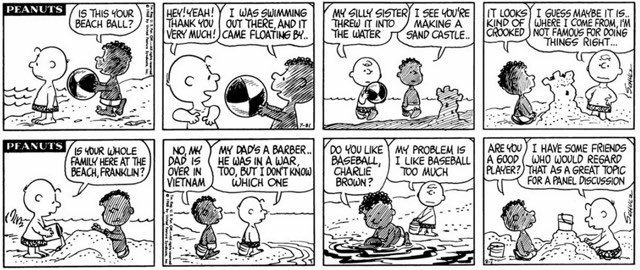
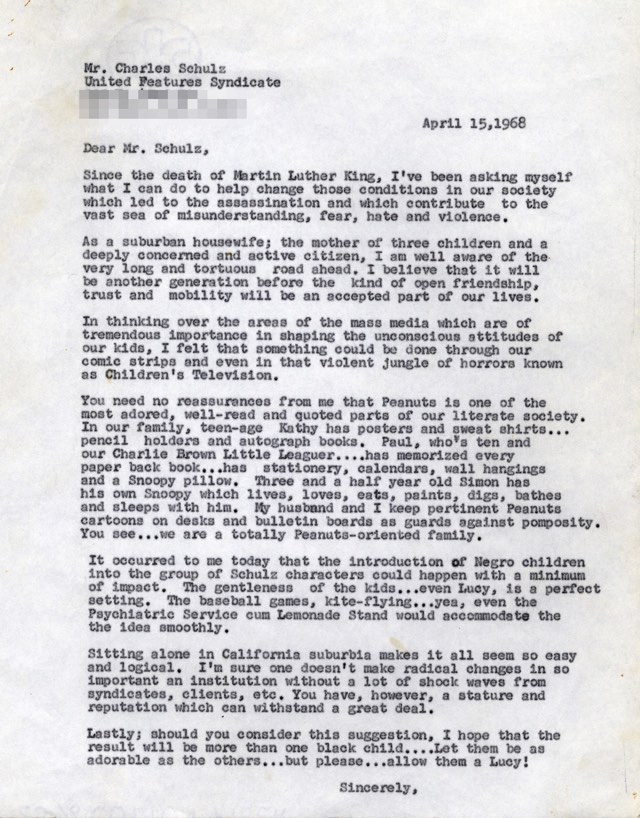
Franklin, the first black member of Charles Schulz's Peanuts gang, made his debut in July 1968. His presence came about through the efforts of Los Angeles schoolteacher Harriet Glickman, who wrote Schulz several letters in the wake of Martin Luther King Jr's assassination arguing that the inclusion of black characters in the most popular comic strip in America would be a positive thing. Here is her initial letter to Schulz:

Franklin Peanuts Letter

After some back and forth between Schulz and Glickman, Franklin made his first appearance in the strip.

Franklin's introduction was part of a five-day sequence featuring Sally tossing away Charlie Brown's beach ball and Franklin rescuing it. In some ways, this seems an aggressive bit of integration -- many American public beaches, while no longer legally segregated, were still de facto segregated at the time. In other ways, the strips suggest what might be seen today as an excess of caution; of the twenty panels of the series, Franklin is in ten panels and Sally is in eight, but never is Franklin in the same panel as the white girl. Franklin would not reappear for another two and a half months, when he came for a visit to Charlie Brown's neighborhood. He was somewhat lighter skinned here, which seems to be less a matter of trying to make him acceptable to the readers and more a matter of cutting back on shading lines which were overpowering his facial features. Franklin's job in this series was to react to the oddness of the neighborhood kids, and that was a precursor to what would be his primary role in the strip as a whole. Perhaps due to excessive caution, Franklin was never granted any of the sort of usual quirks that define a Peanuts character, the very sort of mistake that Glickman was warning about when she called for one of the black kids to be "a Lucy."

His inclusion made news nationally and upset many people, particularly in the South. Schulz had a conversation with the president of the comic's distribution company:

I remember telling Larry at the time about Franklin -- he wanted me to change it, and we talked about it for a long while on the phone, and I finally sighed and said, "Well, Larry, let's put it this way: Either you print it just the way I draw it or I quit. How's that?"

(via @essl)

Tags: Charles Schulz   comics   Harriet Glickman   Peanuts   racism
05 Feb 15:34

Borrow a kid

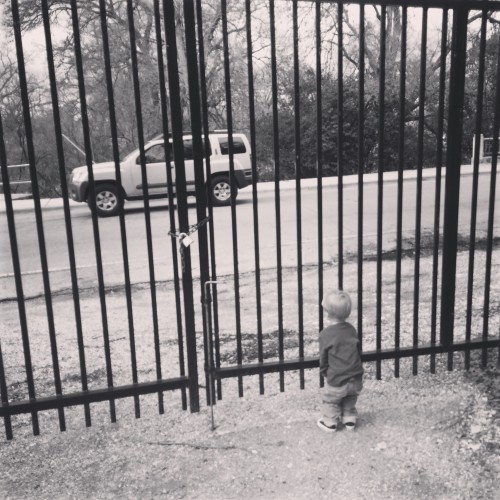
owen at the umlauf sculpture garden

If you have a child of two or three, or can borrow one, let her give you beginning lessons in looking.
—Corita Kent and Jan Steward, Learning By Heart

This weekend we visited the Umlauf Sculpture Garden here in Austin. Towards the end of our visit, I spent at least half an hour at the very edge of the garden with my back to the beautiful art and scenery, watching the cars whiz by on Robert E. Lee Road.

Going to an art museum with a two-year-old will make you rethink what’s interesting and what’s art. (After all, what are cars but fast, colorful, kinetic sculptures?) This, of course, should be the point of museums: to make us look closer at our everyday life as a source of art and wonder.

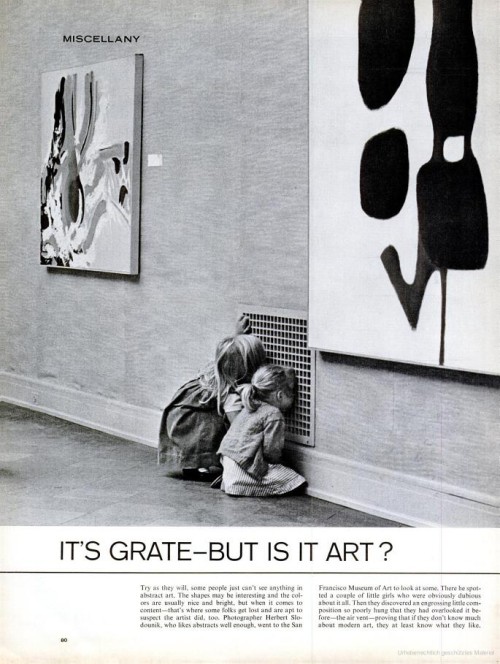
After I posted about the experience, Roberto Greco sent me this great picture of some children in the 1960s looking through a grate at the San Francisco Art Museum:

it's grate - but is it art?

It reminded me that ten years ago I’d spent hours at the Art Institute of Chicago when I came across this weird sculpture:

hvac

I asked the museum guard, rather innocently, “Can you tell me more about this piece?”

She looked at me and said, “It keeps the paintings from melting.”

I smiled, thanked her, and snuck a picture.

“For so many years we have been learning to judge and dismiss — I know what that thing is — I’ve seen it a hundred times — and we’ve lost the complex realities, laws, and details that surround us,” write Kent and Steward in Learning By Heart. “Try looking the way the child looks—as if always for the first time—and you will, I promise, feel wider awake.”

Borrow a kid. Spend some time trying to see through their eyes. You will discover new things.