"Nunn contended during the trial that he is a feminist"
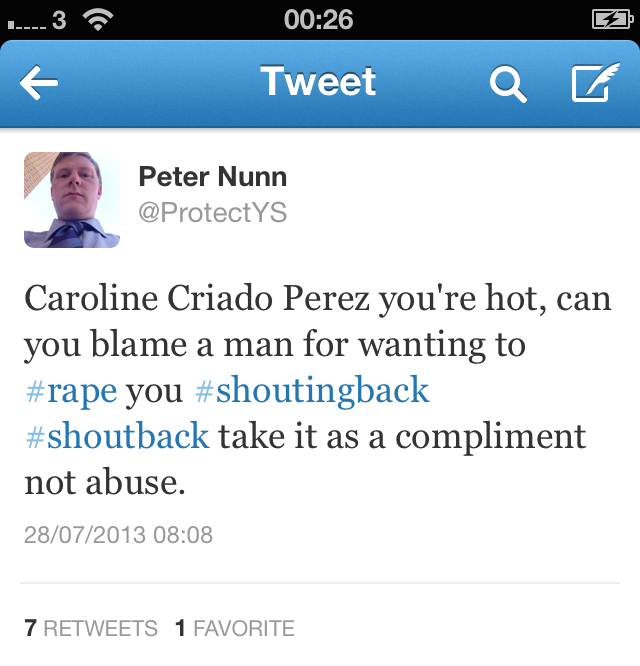
One of the tweets that Nunn posted to one of his Twitter accounts surrounding the approval of Jane Austen's image for the £10 note. The tweet did not feature in his trial in relation to Creasy, but it was part of one of his blog posts that served as background to characterize his attitude toward women.
The threatening tweets of a British man have earned him 18 weeks of jail time, according to a report in The Guardian on Monday. Peter Nunn, 33, will serve time for directing menacing messages at member of Parliament Stella Creasy, who supported a campaign to put an image of Jane Austen on the £10 note. Nunn's sentence comes under section 127 of the Communications Act, which prohibits electronic messages that are "grossly offensive or of an indecent, obscene, or menacing character."
Nunn began his Twitter attacks around July 29, 2013, five days after the Bank of England announced that the Austen campaign was successful. "Hi, it took Twitter 30 minutes to ban me before. I'm here again to tell you that I'll rape you tomorrow at 6pm" is one of a handful of tweets Nunn directed at Creasy. The message did indeed originate after the suspension of another of his accounts from which he was tweeting threats. Nunn also used a number of tweets to brand Creasy and Caroline Criado-Perez, the activist who spearheaded the Austen campaign, as witches. Another of Nunn's works: "Best way to rape a witch, try and drown her first, then just as she is gagging for air, that is when you enter."
Nunn contended during the trial that he is a feminist, and he denied "using Twitter to advocate violence or rape," according to The Guardian. But that argument was undercut by his own actions—according to an alleged since-deleted blog post and screenshot posted by Nunn himself, he also tweeted on July 28: "Caroline Criado Perez you're hot, can you blame a man for wanting to #rape you #shoutingback #shoutback take it as a compliment not abuse."
Chrome OS has been a fine OS for people who just consume content on the Internet, but other than writing documents, the OS hasn't offered much for content creators. If you deal with photos at all, Chrome OS has mostly been a non-starter because it has been missing one crucial piece of software: Adobe Photoshop. Today, Google and Adobe are finally fixing that situation, bringing Photoshop to Chrome OS.
And now for the list of caveats—to start, this is just a beta project. Initially it's only going to be available to "US-based Adobe education customers with a paid Creative Cloud membership." Photoshop won't be a local app; it will be a "streaming version" of Photoshop. Google doesn't say much about the streaming option, only that "this streaming version of Photoshop is designed to run straight from the cloud to your Chromebook. It’s always up-to-date and fully integrated with Google Drive, so there’s no need to download and re-upload files—just save your art directly from Photoshop to the cloud."
Adobe's site fills in some blanks, saying that the app will run in a "virtualized environment" and won't have GPU support at launch. The network requirements are listed as "5 mbps/max latency 250," so it sounds like there's no offline mode. And if you want to use the app while mobile, you'll need a pretty good LTE connection. This streaming version of Photoshop will also be accessible on a Chrome browser running on Windows.
"Many of the people singing the praises of standing desks are men—who can get away with comfy shoes at work more easily than women."
It wasn’t fear of cancer, heart attacks, diabetes or even early death that did it. The reason I switched to a standing desk was, simply, to find a reprieve from pain. Since I graduated from college, back pain and its cruel confederates—neck, shoulder, and hip pain—have been unshakable facts of life. I’m not talking about the odd lumbar throbbing after a late night at the office; low-grade agony was pretty much a given, flaring into something more blinding a few times a month. Workday, weekend, vacation—it didn’t really matter, nor did the number of treadmill miles or chaturangas I’d banked that month.
Then in May, I read about how a standing desk helped allay a blogger’s chronic back woe. I was sold. I set my iMac on top of a small table on my home desk and put in a request for a standing desk at work. Vindication was almost instant. Within a week, my back pain started receding; a month on, and I’d almost forgotten about it. Aside from a weird hip glitch in August, the back pain is still mostly gone.
But in its place came something new. Fetching a dropped pen one day, I noticed bulbs of pinkish flesh ballooning out over my shoes, which, when removed, revealed swelling wider in girth than my feet and lower legs. Cankles, in other words.
For those who don’t know, this portmanteau of “calf” and “ankle” is a slur for shaming women out of wearing capri pants and into surgery if their ankles are any heftier than a ballerina’s. It’s a nasty term. But as a description of my new standing-desk malady, “cankles” was irresistibly apt. And it turned out I needed a casual, efficient term to field the questions that followed after propping my feet on a chair at after-work drinks, or to explain that, no, I didn’t need crutches for those sprains.
Going into this whole standing desk thing, I knew to expect foot pain. That’s why I splurged on squishy pads called “anti-fatigue mats.” Grotesquely distended ankles, though—nobody had mentioned that. I started wearing two sets of insoles while standing on two anti-fatigue mats. But by late afternoon each workday, there were my cankles, peeking out from my pants-cuffs.
A bit of googling, however, clarified that I’m not the only standing-desk convert to suffer sudden-onset cankles. And the medical explanation is really pretty obvious. Unsurprisingly, it’s a very common affliction among nurses, waitresses, and anyone else who spends the whole day on their feet. “Blood pooling while standing is common if the legs aren’t periodically moving,” Dr. Todd Manini of the University of Florida told me, though he noted that neither the positive nor negative effects of standing desk use have been well researched.
They’re now a lot less swollen, thanks to a regimen that includes marching in place and leaning on stools. What keeps nagging me, though, is why I had never heard of this problem—and what else people don’t tell you about the standing-at-work craze.
I have a few ideas:
1. Switching from sitting all day to standing all day is a radical physical transition.
The media barrage about sitting’s lethalness makes it easy to assume that the sooner you ditch a chair, the healthier you’ll become. Not true.
The shift is a big enough deal that, when a law clerk friend got a standing desk, someone from her HR department coached her through her transition. And when you think about it, it makes a lot of sense. As Chris Blattman, a Columbia University professor whose blog post on standing desks inspired my conversion, observes, you spend most of the 24 hours in a day either at your desk or on your bed.
That’s a lot of time. I’d been propping myself against a few pieces of furniture in the exact same way for more than a decade. Yet I only spent about two weeks standing in the morning—at home—and sitting in the afternoon before I switched over completely. Suddenly standing most of the day was perhaps the biggest shakeup of that routine since I started working on a computer every day. In my rush to abandon sitting, that hadn’t occur to me, though—nor had the fact that when I gave my body so little time to adjust, things were liable to swell.
2. Many people at “sitting desks” are actually using “sit-stand desks”—meaning they’re still spending plenty of time seated.
In an unscientific survey of friends, colleagues, colleagues’ friends, and online reviews, there was really only one consistent finding: almost everyone who’s talking about their “standing desk” is actually using what’s called a “sit-stand desk” (or, less often but more confusingly, a “stand-up desk”). And once I knew to look for it, I realized that almost every article with “standing desk” in the headline was actually talking about sit-stand desks.
The sit-stand distinction gets drowned out by all the pro-standing, anti-sitting mania. But it’s still a critical one.
These desks allow you to adjust the height of your computer, either electronically or manually. This feature is appealing because many people seem to like doing email or talking on the phone while standing, but struggle to write or do more focused tasks unless they’re sitting.
Of course, these preferences vary by person, occupation, and day, making it hard to generalize how much time the average sit-stand desk user is spending in a chair. But if one of the leading studies of sit-stand desk habits is representative, people using sit-stand desks spend two hours a day, on average, standing in lieu of sitting. Not that much, in other words.
If these happy sit-standers were, like me, spending 10-12 hours standing in front of their computers, disrupted only by snacking and bathroom breaks, maybe more people would know about the cankle problem.
3. Certain workplace barriers make sit-stand desks way more common.
Standing desk models like the one I have at work (see photo) are a heck of a lot cheaper than sit-stand desks (usually a couple hundred bucks versus $1,000 to $4,000 for a sit-stand desk). So why are proper standing desk users in the minority?
When workplaces like Google, Facebook, Boeing, Intel, Apple, or GlaxoSmithKline get a critical mass of requests, it makes sense to do an office-wide overhaul. They’ve got deep pockets and, in addition to slashing the bureaucracy of managing different desk requests, they’re probably ordering in enough bulk to command a big discount. Plus, if you’re going to pay for moving fees, you might as well invest in top-of-the-line product.
But it’s harder to request a $3,000 desk when everyone else in your office is content with sitting. Not only does it mean asking for an expensive perk, it’s also likely means disrupting the whole office infrastructure. So great is the standing-desk mystique, once one person gets a desk, lots of other employees either want one too—which can get expensive fast—or resent the person who got the special treatment (the Wall Street Journal calls this “standing desk envy“).
That’s less of a barrier if you’re high enough up in the company to justify a big expense budget and have your own office. I suspect that most people with the office clout to request a fancy new desk in the first place are able to justify the purchase of a sit-stand desk.
4. Many of the people singing the praises of standing desks are men—who can get away with comfy shoes at work more easily than women.
Men’s dress shoes aren’t known for being comfortable. But compared with women’s, at least men’s tend to be flatter and, often, cushier. This means that for women working in all but the most casual offices, looking professional means strolling through the workday on rigid, unforgiving soles—a recipe for cankle-causing blood-pooling. Unsurprisingly, shoe strategy came up quickly in nearly all of the conversations I had with female standing-desk converts. Those with standing-only desks have invested in office Crocs or other comfy footwear to don at their standing desks on days when it’s appropriate; the sit-stand crew said they avoided standing on days where they had to look spiffy. Perhaps those strategies are enough to promote blood flow. Anecdotally, the biggest take-up of standing desks is in Silicon Valley, where less than a quarter the workers are women.
5. I assumed the general zeal for “standing desks” meant it was okay to stand all day. I was wrong.
“Your experience is not too surprising,” said Dr. Hidde van der Ploeg, an expert on occupational health at the VU University Medical Center in Amsterdam, when I asked him about my cankles. Though sitting too much is harmful, long periods of standing are not particularly healthy either. “[S]tanding all day is not the solution,” said van der Ploeg, “but finding a comfortable balance between sitting, standing and moving around.”
This was news to me. I’d assumed that all the people who love their standing desks spent most of their time actually, you know, standing. And they’re not. It might be better, on balance, to stand instead rather than sit all day (or it might not). But if you sit like a statue, it turns out, you’re going to stand like one too—creating a host of new health problems.
It was also bad news for a borderline workaholic (I tend to work close to 12 hours a day, broken up by a late-morning commute to the office). I could blame my standing-related pain on not having a sit-stand desk (the sit-stand models colleagues have gotten aren’t sturdy enough to support an iMac). Or I could request a pricier model and see what happens. But the truth is I have cankles for the same reason I had back problems: I work too many hours.
The hunch that the so-called standing desk craze is really a sit-stand desk craze for Hush Puppie-wearers with superior work-life balance is a little discouraging. But cankles or none, I’m still resisting the chair. Here’s why:
I find standing makes me work more deliberately, slicing up tasks into “armchair breaks” (reading, writing outlines) and really only standing at my desk to write and handle email (which is still most of my time, alas).
Somehow, standing has made me way more aware of my posture than ever before, even when sitting.
I’m more focused, largely because I’m less stymied by the urge to multitask or goof around on the internet.
I also find myself leaving the office earlier. My standing desk is just awkward enough that I never want to stand around killing time. It also makes working on bigger projects seem more confined to start, execution, and completion—like going to the ATM, or giving a speech.
Even when the cankles made it hard to put shoes on, I never considered going back to sitting. Marveling at their bloat, the most that ever occurred to me was that if they looked that gross, it was probably time to go home. And that’s something that in 15 years of stabbing, throbbing, and assorted excruciation that came with sitting, had never crossed my mind.
"the largest buyout in the technology industry this year"; TIBCO ("The Information Bus Company") makes business software middleware. It predates the dot-com bubble (its stock grew +100% between its 1997 IPO and 2000) and has +$1B annual revenue. Nobody's heard of it.
In a nod to Paul Verhoeven’s cult 1969 series and a case of hauerperfect casting, Floris star Rutger Hauer has been tapped for a recurring role on Dan Fogelman’s midseason musical fairytale comedy series Galavant, about a knight (Joshua Sasse) taking on the evil King Richard (Timothy Omundson) who stole the woman he loved. Hauer will play Kingsley, King Richard’s older, bigger and more badass brother who will threaten his little brother’s rule—and since he is a man so destined to be a great king that his parents named him Kingsley.
“Myself and our producing director Chris Koch are the biggest Rutger fans of all time; Chris can practically recite Blade Runner from memory,” Fogelman told Deadline. “While the musical comedy aspect of our show makes it obviously pretty different from Floris, there is something about merging the worlds — and a badass Rutger — that makes it pretty exciting.”
But that’s not all! The report also mentions none other than Weird Al Yankovic taking on the role of a singing Monk. Hugh Bonneville and Ricky Gervais are also signed on but seriously, this show, it is holding all my hopes and dreams alive. Now all I have left o say is…
$5.40 of each $6 purchase goes to Thom Yorke and Nigel Godrich; "it doesn’t include stats on how many of those downloaders actually paid the $6 to “unlock” Yorke’s eight songs", but optimistically if BitTorrent is counting all purchases, that's $2,203,200 to Yorke and Godrich, and $244,800 to BitTorrent and their payment processors.
At least 408,000 Radiohead fans figured out how to use BitTorrent over the weekend, downloading Thom Yorke’s new solo album Tomorrow’s Modern Boxesfrom the file-sharing source. Though that figure comes straight from BitTorrent, it doesn’t include stats on how many of those downloaders actually paid the $6 to “unlock” Yorke’s eight songs. The stat also doesn’t give any indication of how many people downloaded an unlocked or ripped version of the album from any number of other sites, including Dropbox, Box, or any other file-sharing service.
A physical LP version of Tomorrow’s Modern Boxes is also available for purchase via Radiohead’s W.A.S.T.E. shop, though it costs about $50, and it doesn’t ship until early November.
According to one member of The Daily Show’s American Indian panel, Washington Redskins fans were less than respectful to the people they “deeply respect” when those people actually showed up to witness the gladiatorial contest conducted in honor of their ancient heritage. This testosterone-and-Bud-Light-fueled farce took place outside Landover, MD’s FedEx Field, as members of the American Indian sketch comedy group The 1491s showed up to talk to fans with a camera crew and The Daily Show’s Jason Jones in tow.
Not content to make one deeply respectful fan cry during their controversial confrontation with Redskins fans the day before, the American Indian interlopers insisted on invading the football lovers’ sacred tailgating grounds, making people so uncomfortable, they were forced to act like jackasses in self-defense. According to 1491s member Migizi Pensoneau, the group was met with outright hostility, intimidation, and threats of physical violence—including one ...
A very persistent border collie behind a chain link fence insists upon playing fetch with Paul Stasiewich, a man who was out walking his own dog, by repeatedly slipping a ball over the fence and waiting for the man to toss it back. At first, the man was seemed happy to play, but began to think that that he couldn’t leave until the dog was called into the house.
This dog keeps throwing this toy over the fence…so I pick it up and throw it over. I get to leave, right? No. He drops it again. I can’t just leave the toy – he’s got me trapped.
"Brown has donated $20,000 to the fund, which will support groups fighting hunger and homelessness. Proceeds from the event, which haven’t been tallied yet, will also go to the fund."
"Brown told the Columbus Dispatch some of the donations will also go to starting a for-profit website to share other funny, but not necessarily potato-related, content."
Peace, Love and Potato Salad was the motto for PotatoStock, and proceeds will go to charities fighting hunger and homelessness.
Police have released photos and surveillance photos and videos in order to catch the thief that broke into Kickstarter’s headquarters and stole electronics earlier in the week. NYPD is urging anyone who has any information regarding the burglary to contact Crime Stoppers at (800) 577-TIPS, or text tips to 274637 (CRIMES) and enter TIP577.
is the same list as for everybody else, sort of, as it's all about "which birth control is most reliable and is least prone to human error"
- Progestin Implants — Implanon and Nexplanon are both single-rod implants. - Intrauterine devices or IUDs. - Progestin-only injectable contraception — known as Depo-Provera, it’s given every 13 to 15 weeks. - Combined oral contraceptive pills — “The Pill” is the fourth choice, because young women do not always use it reliably. - Condoms rank lower. While 96 percent of teens who have had sex have used condoms, and while they can protect against sexually transmitted infections, teens often neglect to use them.
In the title story of Margaret Atwood’s collection Stone Mattress, a senior citizen contemplates killing a man who brutally raped her when she was 14. Verna Pritchard wonders whether it’s worth the trouble, “because face it, she is an old woman now—on the verge of murdering an even older man because of an anger already fading into the distance of used-up time.” The rape destroyed her confidence, her reproductive system, and her life, but she still questions her right to even resent her attacker when she encounters him again: “How Paleolithic to still feel wounded by any of it,” she thinks. And yet her self-effacing instinct to discount her humiliation and decades of recovery (not entirely successful, judging by her horrifying matrimonial habits) don’t get in her way when it comes time to act decisively. Her intellect tells her the trauma is long over. Her emotions ...
Every day,Watch This offers staff recommendations inspired by a new movie coming out that week. This week: With both Gone Girl and Left Behind opening in theaters, we look back on other adaptations of books that went to No. 1 on The New York Times Best Seller list.
The Dead Zone (1983)
The rare Stephen King adaptation to capture the author’s signature sense of inexplicable, internal/external terror, The Dead Zone stands as one of David Cronenberg’s most straightforward and eerily effective early works. Trimming King’s source material down to its lean essence—and benefiting from the lack of his imaginative monsters, which never properly translate to the screen—the film concerns Maine schoolteacher Johnny Smith (Christopher Walken), who turns down an offer to stay the night with his girlfriend Sarah (Brooke Adams), subsequently gets into a traffic accident, and awakens from a coma five years ...
Because I like that show Hannibal, and because people have been asking me to make birthday cards, I made a painting of Hannibal that you can buy as birthday cards (also useful as dinner party invitations).
The cocktail menu from a now closed (and not much missed, judging by its Yelp reviews) Washington DC restaurant/cocktail bar. It’s a pretty lazy attempt at a very obvious motif, executed without a lot of panache… the best value is in the “activities prohibited” icons at the bottom of the page.
my strategy of "don't watch any episodes of any show until confirming that it doesn't have tons of rape in it" is working out well
he fact that the lead character has come close to being raped THREE times now is too much. I mean it's been stopped right at the point of entry every single time, which both makes the threat meaningless and really cheapens the very real problem of sexual violence to just oh dear, here she is in peril again. And rescued by a man two out of the three times as well.
I get the ( bullshit IMO ) Mark Millar defence of 'terrible people do terrible things' but please fuck off with this shit now.
Well... so, to get to the point: I've been fuzzing the underlying function parser on the side - and yesterday, bumped into a new parsing issue (CVE-2014-6277) that is almost certainly remotely exploitable and made easier to leverage due to the fact that bash is seldom compiled with ASLR. I'll share the technical details later on; for now, I sent the info to the maintainer of bash and to several key Linux distros. In general terms, it's an attempt to access uninitialized memory leading to reads from, and then subsequent writes to, a pointer that is fully within attacker's control.
Obviously peeved by the half-Jamaican, half-Spanish singer's romance with Pattinson, online haters, who may be his ex-girlfriend Kristen Stewart's fans, have attacked Twigs with racist remarks.
It’s Monday and we can only spend so many brain cells being frustrated with DC’s marketing and licensing department on a regular basis, so let’s try to ease you slowly into the annoyance you’re about to feel. Here is the good news: they made a shirt designed for young female wearers, and another shirt for men that has Wonder Woman on it! Let’s just bask in that vague knowledge for a second before actually looking at the shirts and aaaaaargh.
So let’s break it down, for people who aren’t able to view the images (or who perhaps temporarily lost their ability to decode visual stimuli due to anger). On the left, we’ve got a men’s shirt that depicts a scene inspired by Superman/WonderWoman, which, you’ll remember, was a romance themed titledeveloped last year to appeal to women since why would we ever want to read a comic book that’s not about kissing? (edit: it’s actually from a cover of Justice League 12, however, because DC does sure love their crossovers) The text reads “Score! Superman does it again!,” because as we all know, mackin’ on Amazon warriors is one of America’s national past times and we are required to assign the practice a points system just like we do in baseball.
Also, Wonder Woman’s a lasso-less “it” now, we guess. Yeah, that’s why her arm’s all weird at the bottom of the shirt; she’s supposed to be lassoing Superman in the picture. But why present a powerful female superhero using one of her trademark symbols as a marker of sexual agency when you can instead present her as a stiff, rigid board to be scored upon?
On the right is a shirt from the juniors department of Walmart, which says “Training to be Batman’s,” and then “wife” in a different more stereotypically feminine font. It’s a little known fact, but you are not allowed to spell the word “wife” in any font other than cursive. We are breaking laws for you right now, dear readers. Anyway, this is despite the fact that being married to the caped crusader sounds like the worst idea ever, regardless of what Jill Pantozzi glibly thinks (and by the way, you are going to have to fight her for him, so maybe that’s where the training kicks in). You would probably have a much deeper emotional connection to the man if you were actually training to become his sidekick instead, but if we’re going to cling to traditional gender roles that define women in their relation to wifely duties, at least the shirt should say “Training to be the mother of Earth-Two‘s Huntress.” Then you get to be Catwoman. Isn’t that nice?
Now on their own, devoid of context, these are not completely the worst. The “training to be ___” is a popular fad in non-licensed fandom-based athletic gear—although most shirts of this ilk usually want you to train to be Batgirl or someone similar, not to marry someone with terrible commitment issues. But together, these are licensed shirts. Somebody at DC decided that it was a really great idea to indirectly depict women as love-obsessed prizes, and then somebody else got the licensing rights squared away, and then they made these and are now selling them for real cash money.
You know what would be really cool instead, DC? Let’s have a bunch of t-shirts for little girls that depict Supergirl or Batgirl being a badass, or maybe a Justice League shirt for boys that doesn’t ignore the fact that Wonder Woman is a member. Given the number of messages we get from parents on a weekly basis, we’re gonna go out on a limb and say those would sell much better.
"The farmers had the right idea. In the 30s, 40s and 50s, they put the comics in the outhouses, because they were rough paper. To wipe their asses. And that’s all comics are really worth. But in this country, because there’s so many wealthy people, they make junk worth money."
“Comic Book Heaven” is a short documentary directed by New York City-based filmmaker E.J. McLeavey-Fisher that examines the day to day operations of the (now closed) titular comic shop in Sunnyside, Queens. The piece is narrated through interviews with the store’s colorful — and opinionated — owner, Joe Leisner.
The farmers had the right idea. In the 30s, 40s and 50s, they put the comics in the outhouses, because they were rough paper. To wipe their asses. And that’s all comics are really worth. But in this country, because there’s so many wealthy people, they make junk worth money.
This rumor comes courtesy of Latino Review, and yeah, yeah, we know. Bear with us. It’s Monday morning. Nothing much is going on yet, and we want to do a short post on this because, well, we think it’s funny. The latest output from the rumor mill is the DC/WB are working on a standalone Batman movie for 2019, and its title will be…
Yup. The Batman. “BATMAN THE BATMAN DID YOU KNOW WE’RE MAKING A MOVIE ABOUT BATMAN WE HAVE BATMAN BATMAN BATMAN Superma—B A T M A N.”
To quote Dan: “It sounds like what Batman from HISHE would name a Batman movie.”
With more than 4.5 million articles, Wikipedia is an invaluable resource, whether you’re throwing a term paper together at the last minute or your kids are into Pokémon and you’re trying to figure out what the hell a Snorlax is. But follow enough links, and you get sucked into some seriously strange places. We explore some of Wikipedia’s oddities in our 4,610,787-week series, Wiki Wormhole.
What it’s about: A few weeks ago, we looked at some of history’s worst serial killers. But it can be said without hyperbole that this killer is a million times worse than all of those murderers put together. In fact, smallpox may be the deadliest single thing in human history. Through the 1800s, the disease averaged 400,000 victims a year in Europe alone. By the 1950s ...
I got REALLY EXCITED because I read that as Orphan Black Christmas Special
Charlie Brooker's fantastic dystopic anthology series Black Mirror is returning to Channel 4 later this December for a Christmas special - and it's got one hell of a cast.


 Super Opinionated.