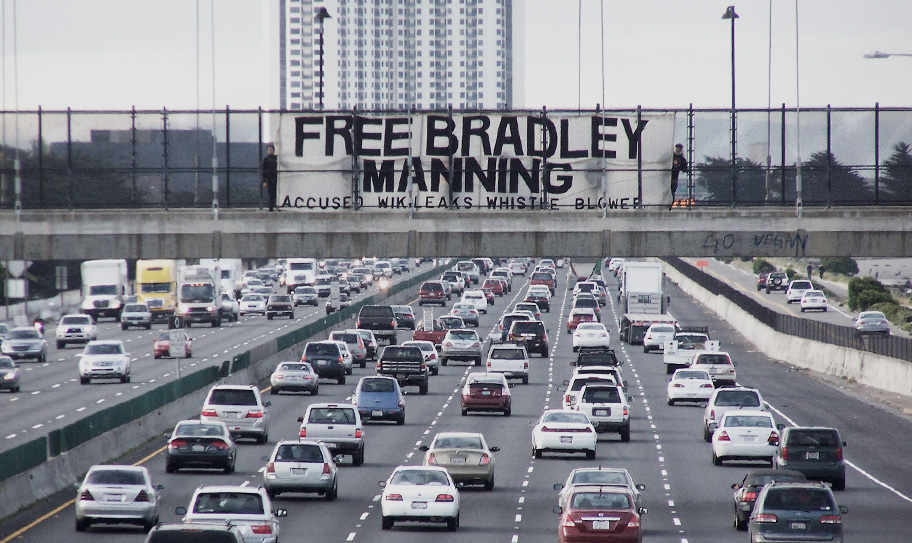
You could be forgiven if you’ve forgotten Bradley Manning.
Even before his arrest in May 2010, the 25-year-old Army intelligence analyst could go unnoticed. He was of slight stature, just over five feet tall, a self-proclaimed nerd who’d come to the Army, and then come to Iraq. While there, it is alleged, he downloaded a massive trove of information using his access to classified military databases. That information — including videos of two airstrikes that killed civilians; a collection of over 250,000 United States diplomatic cables; and a half-million logs from the U.S. wars in Iraq and Afghanistan — he passed on to WikiLeaks, the disclosure portal founded by Julian Assange. As WikiLeaks began publishing the material, Manning allegedly confessed his role in the leak to Adrian Lamo, a hacker who promptly alerted the authorities. Manning was arrested soon after.
Manning has spent over 1,000 days awaiting his trial, longer than any accused in the history of U.S. military law


Since then, Bradley Manning has virtually disappeared. He has spent over 1,000 days awaiting his trial, longer than any accused in the history of U.S. military law. He has spent that time in "military confinement," a term the government concedes as synonymous with "jail," partly under conditions his defense attorney describes as "degrading and humiliating" — Manning at one point spent seven months under Prevention of Injury (POI) Watch, during which his clothes were removed from him nightly, leaving him to sleep naked in his cell. State Department spokesman P.J. Crowley called the treatment "ridiculous and counterproductive and stupid." The White House criticized his remarks, and Crowley resigned soon after.
Meanwhile, Bradley Manning’s case has slowly crept closer to trial. He faces 22 charges, including revealing classified information to unauthorized persons, violating orders, and aiding the enemy. If convicted of aiding the enemy, he could be executed, though prosecutors have recommended life imprisonment. Citing the conditions of Manning’s confinement, his defense had asked to have the charges dropped; the judge ruled that while the conditions were excessive, they did not warrant dropping the case. Instead, Manning should get 112 days cut from any sentence he receives if convicted.
the trial is about the mere possibility of controlling access to information when secrets can be so easily copied and disseminated
Pretrial hearings resumed today. Manning’s defense had again asked for a dismissal, arguing that his right to a speedy trial had been abridged. The court disagreed, rejecting the motion. The remainder of the hearing, scheduled to run through March 1, will likely address Manning’s offer to plead guilty to some charges.
Again, you’d be forgiven if you’ve forgotten all of this. After all, the trial of the largest leak of government documents in history has happened in relative obscurity, behind closed doors and with little press coverage. Bradley Manning, unlike Julian Assange, has virtually disappeared. Yet his case goes to the heart of the national security state in America, post-9/11. In the soundproofed courtroom in Fort Meade, Maryland, questions are being debated about government’s claims to secrecy, the ability of whistleblowers breach that secrecy, and the role of a free press in publishing such disclosures. On an abstract level, the trial is about the mere possibility of controlling access to information when secrets can be so easily copied and disseminated. It’s also about the laws a democracy chooses to enact when guarding its secrets — and how it punishes those who transgress those same laws.
And it all centers on Bradley Manning.
Who is Bradley Manning?
The Espionage Act became a weapon against anyone who shared classified information with the press

In the chat logs of his alleged conversations with Adrian Lamo, Manning writes, "im such a ghost" — suggesting that he has very little presence, few connections that might make him knowable. For the public, that’s in many ways true; with his friends and family understandably wary of talking to the media, and the man himself largely silenced, only a sketchy picture has emerged of Bradley Manning. Perhaps fittingly, it’s emerged primarily through digital artifacts Manning left behind: specifically, chat transcripts.
Through the transcripts, and particularly thanks to Denver Nicks’ profile in This Land, based on conversations with Manning’s childhood friends, we see the kind of man who’d once been a quiet, bookish kid in small-town, rural Oklahoma, competing in science fairs and starring on the quiz team. Growing up he spent hours on the computer, playing SimCity and exploring the internet. He read encyclopedias and played with LEGOs, or watched the lone television channel he could receive — PBS.
With just a few details you can imagine young Manning in his self-protective isolation, among his books and his computer, among the fuel he fed his brain; you can recognize why he gravitated to Immanuel Kant, the Enlightenment philosopher who challenged readers to know the world, to apprehend it through the intellect — and with that intellect build a moral code by which one could live. (Awaiting trial, he still has copies of Kant’s Critique of Pure Reason and Critique of Practical Reason.)
"He was basically really into America," a friend and former roommate named Jordan Davis told This Land. "He wanted to serve his country." The boy became a conservative, patriotic young man; his father had been in the Navy, and he’d long dreamed of military service. In another chat, Bradley Manning wrote,"i actually believe what the army tries to make itself out to be: a diverse place full of people defending the country… male, female, black, white, gay, straight, christian, jewish, asian, old or young, it doesnt matter to me; we all wear the same green uniform…"
But his real experience with military life fell short of that ideal. He describes bullying of the same type he’d known in civilian life: being singled out for his size, his intelligence, and his sexuality. He describes fighting back. He describes his growing political activism, particularly around gay rights.
And to Adrian Lamo he describes "the thing that got me the most… that made me rethink the world more than anything." In Iraq he found his idealism shaken in another way:
was watching 15 detainees taken by the Iraqi Federal Police… for printing "anti-Iraqi literature"… the iraqi federal police wouldn’t cooperate with US forces, so i was instructed to investigate the matter, find out who the "bad guys" were, and how significant this was for the FPs… it turned out, they had printed a scholarly critique against PM Maliki… i had an interpreter read it for me… and when i found out that it was a benign political critique titled "Where did the money go?" and following the corruption trail within the PM’s cabinet… i immediately took that information and *ran* to the officer to explain what was going on… he didn’t want to hear any of it… he told me to shut up and explain how we could assist the FPs in finding *MORE* detainees…
He describes realizing that "i was a *part* of something… i was actively involved in something that i was completely against." Previously Lamo had commented, "Your MICE seems to be ideology," employing spy jargon for the reasons someone might engage in espionage (Money, Ideology, Compromise, or Ego). Manning, Lamo speculated, was motivated by abstract ideals.
Depending on your notions of justice and punishment, this might affect how you judge Bradley Manning. His defense attorney sought to portray the leaker as a whistleblower acting out of conscience. When pressed by Lamo as to why he didn’t simply sell the information to Russia or China, Manning had responded, "because it’s public data. It belongs in the public domain." But the court prohibited any discussion of Manning’s political motives.
Do motives matter? In 1985, the Reagan administration prosecuted Samuel Loring Morison, an intelligence analyst who’d leaked information about a Soviet shipyard to Jane’s Fighting Ships, a British reference work on the world’s navies. Morison justified himself in part by saying "if the American people knew what the Soviets were doing, they would increase the defense budget." While the British declared Morison a patriot (patriotism falling under the "I" in MICE), prosecutors argued he’d been influenced more by frustration with his government job and the promise of a Jane’s paycheck. Morison was convicted.
The Reagan administration had used Morison as test case for a novel reading of the Espionage Act of 1917. Originally intended to prosecute spies for delivering information to the enemy, under these new way of thinking, the Espionage Act became a weapon against anyone who shared classified information with the press. Morison’s conviction made the threat very real; CIA Director William Casey later leveraged it against five major news organizations.
If this sounds familiar, it should: the Obama administration has since used the Espionage Act to prosecute more whistleblower leaks to the media than in all previous administrations combined.


Adrian Lamo

Enter the espionage act
Never before has the simultaneous crackdown on "unauthorized" leaks been so severe
The Espionage Act of 1917 arrived at the beginning of World War I, based on earlier law that included the British Official Secrets Act. President Woodrow Wilson had lobbied hard for the bill, though in its final form the law lacked the censorship authority he’d sought for the executive branch. The act made conveying information with intent to interfere with the operations of the U.S. military, a crime punishable by up to 30 years imprisonment — or death.
Socialists were among the first to be prosecuted under the law; Kate Richards O’Hare delivered an anti-war speech in North Dakota and received a five-year prison sentence. Similarly, Socialist Party presidential candidate, Eugene Debs, gave a speech encouraging listeners to resist the draft; he soon found himself sentenced to ten years. (Both were later pardoned by President Warren Harding.) The act was also used for mass arrests and deportations.
In 1950 the government indicted Julius and Ethel Rosenberg under the act. The husband and wife stood accused not just of making speeches, but of passing information to the Soviets, including technical details about the atomic bomb. They were convicted and executed in 1953, the only spies ever put to death in the U.S.
Daniel Ellsberg, who leaked the Pentagon Papers to the New York Times, faced espionage charges in 1971. "I felt that as an American citizen, as a responsible citizen, I could no longer cooperate in concealing this information from the American public," he said upon surrendering himself to a U.S. District Attorney. "I did this clearly at my own jeopardy and I am prepared to answer to all the consequences of this decision." The government’s case imploded when it surfaced that the Nixon administration had illegally wiretapped Ellsberg’s phone and broken into his psychiatrist’s office.
The Ellsberg and Manning cases share a number of similarities, and Ellsberg has voiced his support for Manning. But in the intervening years the court decided the case against Morison, broadening the use of the statute from "classic espionage" of the type practiced by the Rosenbergs — providing information directly to the enemy — to cover disclosures to the press as well. (Ellsberg’s case never got far enough to test a similar interpretation of the law.)
The Obama administration has made particularly strong use of the Espionage Act
That expansion has proven a boon to the executive branch, and the Obama administration has made particularly strong use of the Espionage Act. Thomas Drake for example, was a senior executive at the National Security Agency. In 2006, he began disclosing unclassified information to The Baltimore Sun, detailing billions of dollars lost to fraud and waste. He was subsequently charged with espionage — a charge which, by statute, can carry the death penalty. Drake lost his job and his pension; meanwhile, he had to deal with the skyrocketing legal costs of fighting the Department of Justice. He eventually pleaded to a minor charge and now works in an Apple store.
Such prosecutions, Drake told journalist Alexa O’Brien, send "the strongest possible message to those who would dare hold up the mirror from within and without regarding government misconduct, fraud, waste, abuse, war crimes, and wrongdoing, while also sending the real message to the Fourth Estate that they cannot hide behind the First Amendment as protection or refuge when printing the same."
Former CIA officer John Kiriakou faced a similar situation as one of the first people to make public the agency’s use of waterboarding. Convicted of revealing a covert operative’s name to a reporter, he’ll soon be entering prison for a 30-month sentence. Initially charged under the Espionage Act, he pled guilty to lesser charges under the Intelligence Identities Protection Act.
Meanwhile, selective leaks continue about the raid on Osama bin Laden’s compound, the use of drone strikes around the world, and the cyberwarfare program that created Stuxnet as a weapon against Iran’s nuclear program. As always, members of the government use leaks to serve their own ends, but never before has the simultaneous crackdown on "unauthorized" leaks been so severe. The use of the Espionage Act against Manning is generally seen as an attempt to leverage him against Julian Assange, who is likely the subject of grand jury proceedings. But the increasingly expansive use of a nearly century-old law — the constitutionality of which legal scholars still debate — has journalists such as Raffi Khatchadourian concerned. An Espionage Act indictment against Assange would be unprecedented, and could erode freedoms that reporters enjoy during their normal work of cultivating sources in government," he writes, "I, like other journalists, oppose the idea entirely."
Time magazine encapsulated the problem way back in 1985, writing of the Morison case, “The Government does need to protect military secrets, the public does need information to judge defense policies, and the line between the two is surpassingly difficult to draw.” Today, Thomas Drake says, that line increasingly favors government secrecy. "There are secrets in the public interest worth knowing and those who disclose those secrets (in a manner deemed unauthorized by the government)," he writes via email, "are violating the Prime Directive of the national security state — silence is loyalty and secrecy keeps you employed and out of trouble — so keep your trap shut."
A regime of overclassification
A regime of overclassification
Much of the government’s case against him will be classified, not offered for public adjudication
Yet even complaints about a lack of government transparency are not new. Ellsberg believed the Pentagon Papers, had they been released sooner, would have turned Americans against the war. In 1999, Senator Daniel Patrick Moynihan published Secrecy: The American Experience, arguing that since World War I, secrecy had become a mode of regulation in American government — controlling information meant controlling the understanding by which democratic citizens manage their self-governance. "The culture of secrecy that evolved," Moynihan wrote, "was intended as a defense against two antagonists, by now familiar ones: the enemy abroad and the enemy within."
The umbrella of secrecy now approaches an absurd width and breadth. According to The Washington Post, nearly half a million government employees and contractors had access to the diplomatic cables published by WikiLeaks; 4.2 million had the security clearance necessary to access the highest level of classified information allegedly leaked by Manning. A secret shared among 4.2 million people, one might suggest, is not much of a secret at all. Yet a legal regime enabling harsh penalties for anyone who spills such "secrets" sends a very clear message about authority and control of information.
Conversely, while Daniel Ellsberg had to spend a year collecting and disseminating the Pentagon Papers, the WikiLeaks documents were exfiltrated likely in a matter of hours. Many of them were published directly to the web, with no need for a traditional journalist outlet such as The New York Times. The same technology that enables collecting secrets often allows their diffusion — "The lesson of WikiLeaks is that shared secrets leak," says journalist Andy Greenberg. And yet as Chase Madar notes, the massive WikiLeaks document dumps are a miniscule percentage of the 92 million items classified by the government last year.
The Manning defense plans to emphasize this theme, arguing that much of the WikiLeaks material should not have been classified at all — that it was primarily open-source intelligence from publicly available sources. A description of the "Collateral Murder" airstrike video, for example, appeared in The Good Soldiers, a book by Washington Post journalist David Finkel. The account appeared before the date Manning is accused of leaking the video, but Finkel will not be on trial.
Instead, Bradley Manning will be tried in a small room in Fort Meade. By June 13, when his trial is scheduled to begin, he will have spent over 1,100 days in military confinement, and he will enter a courtroom that allows no recording devices, audio or visual, to participate in proceedings for which no official transcript will be offered. Much of the government’s case against him will be classified, not offered for public adjudication. Bradley Manning — the ghost — will ultimately be judged under the same veil of secrecy he sought to pierce.
Photos courtesy Bradley Manning Support Network, Gwydion M. Williams, Ryan Somma, and the Center for American Progress / Thinkprogress.org.

Thomas Drake

John Kiriakou
 There are two categories of bitters: tinctures and potables. Tincture bitters include common suspects such as Angostura, Peychaud's, and Bittermens, while potable bitters are exemplified by brands like Campari, Cynar, and Jagermeister. All are from the same construct—alcohol is the base, there is a bittering agent in the middle—anything from gentian to quinine to angelica (or any combination of roots and herbs)—and the top note provides the flavor component.
The most famous tincture bitter is Angostura. It is made with alcohol, gentian, and quinine, then flavored with cinnamon and cardamom. The most well-known potable bitter is Campari, which features gentian for bittering and burnt orange for flavor.
As a general rule, tincture bitters are much higher in alcohol than potable bitters. They are also more concentrated in flavor, which is why you only need a few drops (these are the ones bartenders dash into your drink from small bottles or vials). Potable bitters are lower in alcohol, softer in flavor, and always involve some sugar—whether it's burnt sugar, or honey, they will have something in them that makes them potable, or drinkable, on their own. Teague refers to all potables and spirits as the soup, while tinctures are the seasoning. "You’d no sooner eat a bowl of soup that wasn’t seasoned, so why are you drinking drinks that you’re not seasoning?"
There are two categories of bitters: tinctures and potables. Tincture bitters include common suspects such as Angostura, Peychaud's, and Bittermens, while potable bitters are exemplified by brands like Campari, Cynar, and Jagermeister. All are from the same construct—alcohol is the base, there is a bittering agent in the middle—anything from gentian to quinine to angelica (or any combination of roots and herbs)—and the top note provides the flavor component.
The most famous tincture bitter is Angostura. It is made with alcohol, gentian, and quinine, then flavored with cinnamon and cardamom. The most well-known potable bitter is Campari, which features gentian for bittering and burnt orange for flavor.
As a general rule, tincture bitters are much higher in alcohol than potable bitters. They are also more concentrated in flavor, which is why you only need a few drops (these are the ones bartenders dash into your drink from small bottles or vials). Potable bitters are lower in alcohol, softer in flavor, and always involve some sugar—whether it's burnt sugar, or honey, they will have something in them that makes them potable, or drinkable, on their own. Teague refers to all potables and spirits as the soup, while tinctures are the seasoning. "You’d no sooner eat a bowl of soup that wasn’t seasoned, so why are you drinking drinks that you’re not seasoning?" Liqueurs like Cardamaro or Sauvignon from France are wine-based liqueurs where as typical amari are spirit-based, made with a neutral alcohol. Amaros can also be made from thistles and beets—which is common with Fernet styles. "That’s the big difference and beyond that, I think stuff just gets swept into the category because it is, in fact, bitter," says Teague. "Cardamaro is a wine-based product so it technically falls more into the fortified wines, or vermouth, category more than it does amaro. The word vermouth, however, comes from the German word vermut, which literally means wormwood, a bitter itself. I think vermouths, amari, and bitters all get lumped together because they all have bittering agents and bittering properties."
 By asking questions like “Do you drink coffee?" and "Do you put sugar in it?” Teague can help determine which amari customers will enjoy. "Once they answer the coffee questions, I can tell them that they already drink bitters. Coffee is bitter as hell, so you’re in the right place," he explains.
"If you are a first timer, aren’t a coffee drinker, and I can connect with talk of food—questions like, 'do you eat escarole or radicchio?'. Then, I typically reach for Campari and Gran Classico. The Gran Classico legend (which I don’t believe) has it that it is the original Campari. It’s a little bit softer, and I’ll do a little side by side tasting, or I will make a cocktail using one or both of those items because they are approachable. Both have flavor notes that people recognize right a way—orange, quinine, and gentian—so at least you have a comfort zone to work from. Campari is also the most well-known potable bitter on earth. It’s like, 'I'm not trying to take you down the clandestine road on your first trip. Let’s walk right up there a get a Coca Cola. Everybody comfortable, everybody familar? All right, now we’ll try something weird.'"
By asking questions like “Do you drink coffee?" and "Do you put sugar in it?” Teague can help determine which amari customers will enjoy. "Once they answer the coffee questions, I can tell them that they already drink bitters. Coffee is bitter as hell, so you’re in the right place," he explains.
"If you are a first timer, aren’t a coffee drinker, and I can connect with talk of food—questions like, 'do you eat escarole or radicchio?'. Then, I typically reach for Campari and Gran Classico. The Gran Classico legend (which I don’t believe) has it that it is the original Campari. It’s a little bit softer, and I’ll do a little side by side tasting, or I will make a cocktail using one or both of those items because they are approachable. Both have flavor notes that people recognize right a way—orange, quinine, and gentian—so at least you have a comfort zone to work from. Campari is also the most well-known potable bitter on earth. It’s like, 'I'm not trying to take you down the clandestine road on your first trip. Let’s walk right up there a get a Coca Cola. Everybody comfortable, everybody familar? All right, now we’ll try something weird.'" Teague says: "Only three? I want you to get them all! I would say that if this is someone starting the process, begin with a bottle of Campari because it is the most well-known and the most called for in recipes that you are going to see. It is the amaro that is going to make every standard cocktail, or what we call neo-classic Campari-variants, by just substituting a base spirit. Staying with Angostura, sweet vermouth, and Campari, you can make a Boulevardier, an Old Pal, a Kingston, and more. Definitely go for Campari.
"I also really like thistles, so I would say Cynar would be a good one to keep around. This amaro is made from artichokes. Here, you get a more savory style. So now you’ve got a citrusy amaro and a savory amaro. I love Cynar with anything dark—brandy, apple brandy, bourbon, and rye.
"And then I would say Zucca, which is a rich and dark rhubarb amaro. The producers take a portion of the rhubarb aside and smoke it prior to the maturation, so there is a lightly smokey element towards the end, on the bottom notes of the amaro. This will offer you something that will bring in more earthy elements with cocktails. It is delicious with rum.
So, Campari for a citrusy amaro, Cynar for something more savory, and Zucca for something more earthy and dark."
Teague says: "Only three? I want you to get them all! I would say that if this is someone starting the process, begin with a bottle of Campari because it is the most well-known and the most called for in recipes that you are going to see. It is the amaro that is going to make every standard cocktail, or what we call neo-classic Campari-variants, by just substituting a base spirit. Staying with Angostura, sweet vermouth, and Campari, you can make a Boulevardier, an Old Pal, a Kingston, and more. Definitely go for Campari.
"I also really like thistles, so I would say Cynar would be a good one to keep around. This amaro is made from artichokes. Here, you get a more savory style. So now you’ve got a citrusy amaro and a savory amaro. I love Cynar with anything dark—brandy, apple brandy, bourbon, and rye.
"And then I would say Zucca, which is a rich and dark rhubarb amaro. The producers take a portion of the rhubarb aside and smoke it prior to the maturation, so there is a lightly smokey element towards the end, on the bottom notes of the amaro. This will offer you something that will bring in more earthy elements with cocktails. It is delicious with rum.
So, Campari for a citrusy amaro, Cynar for something more savory, and Zucca for something more earthy and dark." Teague says: "Almost across the board amaros and bitter liqueurs from around the world are a very secretive and proprietary business. I think the decision to [not disclose any of the ingredients] is to these proprietors' detriment. Even if they just provided three or four of the top notes of an amaro to grab someone’s attention, it would be helpful.
"It is an unfortunate situation. If someone is making something somewhere and putting it in a bottle, then I want to drink it. If you don't have anything to tell me about it, I probably don't care—I still want you to pour me some, and I will make my own assumptions. I wish more people were like that about spirits and amari, the way they are about food. I know the same person who is weary of even tasting a new bourbon—maybe they are a bourbon drinker, but they are brand loyal for whatever reason—is not the kind of person who wouldn’t go to a sushi restaurant and try something new without knowing much about it. 'Oh you’re making it and it’s delicious, oh I’ll have it.' I don't know why we are so fearful of spirits.
"I view everything I do the way I view food. I was a chef for 12 years before I got behind a bar. Notably, I was the research chef on the show Good Eats with Alton Brown. I cooked in New Orleans and taught at the Culinary Institute in Montclair, CT, so I relate what I do behind the bar to what I used to do in the kitchen. People ask me all the time, 'What's your favorite drink?' I always say, 'I drink like I eat. First for the season, second for the occasion and third for the atmosphere. It all depends on where I’m at, who I’m with, and what’s going on.'"
Teague says: "Almost across the board amaros and bitter liqueurs from around the world are a very secretive and proprietary business. I think the decision to [not disclose any of the ingredients] is to these proprietors' detriment. Even if they just provided three or four of the top notes of an amaro to grab someone’s attention, it would be helpful.
"It is an unfortunate situation. If someone is making something somewhere and putting it in a bottle, then I want to drink it. If you don't have anything to tell me about it, I probably don't care—I still want you to pour me some, and I will make my own assumptions. I wish more people were like that about spirits and amari, the way they are about food. I know the same person who is weary of even tasting a new bourbon—maybe they are a bourbon drinker, but they are brand loyal for whatever reason—is not the kind of person who wouldn’t go to a sushi restaurant and try something new without knowing much about it. 'Oh you’re making it and it’s delicious, oh I’ll have it.' I don't know why we are so fearful of spirits.
"I view everything I do the way I view food. I was a chef for 12 years before I got behind a bar. Notably, I was the research chef on the show Good Eats with Alton Brown. I cooked in New Orleans and taught at the Culinary Institute in Montclair, CT, so I relate what I do behind the bar to what I used to do in the kitchen. People ask me all the time, 'What's your favorite drink?' I always say, 'I drink like I eat. First for the season, second for the occasion and third for the atmosphere. It all depends on where I’m at, who I’m with, and what’s going on.'" Teague says: "I think that we create our own monsters in whatever fields we are in. In this field right now, we are creating a more educated consumer. For example, maybe I went to Clover Club and [bartender] Brad Farran was very nice to me and he talked me into a drink that I had never heard of before. It was something called amaro and I liked it. Now, I want to pursue information about it and gain more knowledge. In New York over the last maybe 10 to 12 years, a sort of cocktail revolution has been going on. People are [moving away] from big sugary drinks, unless it’s an occasional thing. If I am sitting at a bar and convening with friends and being congenial, I’m not looking to be wasted on sugar-heavy cocktails. I’m not downing swizzle after swizzle after swizzle. I want a richer drink that isn’t shaken, something that sits on the tongue and doesn't float over it unnoticed. I want a drink that is more spirit forward and more bitter, frankly. If we are evolving away from sweet, we are evolving towards bitter."
 Teague says: "At Amor y Amargo, we really make three drinks (especially because we don't shake anything). We make an Old-Fashioned (spirit, bitters), a Manhattan (spirit, bitters, vermouth), and a Negroni (spirit, bitters, vermouth, amaro). We have a set template for each drink, and we can go in any direction with anyone of those [elements].
"We don't have to make a standard whiskey Old-Fashioned, but can make whatever. Like using genever in place of the whiskey and Boston Bittahs (which is chamomile and citrus) in place of Angostura. We can do that with the templates for each of the remaining recipes. Often I give people the recipe—two ounces, two dashes, and some sugar—that’s your Old-Fashioned. Two ounces, one ounce, and two dashes—that’s your Manhattan. And 1.5 ounces, .75 ounces, .75 ounces, and two dashes—that's your Negroni. Plug and play.
"You can change the gin for bourbon in a Negroni, or you can say, 'I want to change the Campari, the vermouth, and the bitters,' and then we have a brand new Negroni-style cocktail that will be balanced and that will work across the board. You can change one item, two, or all items—that's when you start getting crazy. You can take those fractions and split them in half, and maybe add bourbon, and an infused Scotch whisky, and then take the amaro and split that in two as well. Really mixing some crazy omelets."
Teague says: "At Amor y Amargo, we really make three drinks (especially because we don't shake anything). We make an Old-Fashioned (spirit, bitters), a Manhattan (spirit, bitters, vermouth), and a Negroni (spirit, bitters, vermouth, amaro). We have a set template for each drink, and we can go in any direction with anyone of those [elements].
"We don't have to make a standard whiskey Old-Fashioned, but can make whatever. Like using genever in place of the whiskey and Boston Bittahs (which is chamomile and citrus) in place of Angostura. We can do that with the templates for each of the remaining recipes. Often I give people the recipe—two ounces, two dashes, and some sugar—that’s your Old-Fashioned. Two ounces, one ounce, and two dashes—that’s your Manhattan. And 1.5 ounces, .75 ounces, .75 ounces, and two dashes—that's your Negroni. Plug and play.
"You can change the gin for bourbon in a Negroni, or you can say, 'I want to change the Campari, the vermouth, and the bitters,' and then we have a brand new Negroni-style cocktail that will be balanced and that will work across the board. You can change one item, two, or all items—that's when you start getting crazy. You can take those fractions and split them in half, and maybe add bourbon, and an infused Scotch whisky, and then take the amaro and split that in two as well. Really mixing some crazy omelets."