|
Viewpoint: Oprah as Harvard's Commencement Speaker Is Another Assault on ...
TIME Oprah Winfrey receives an honorary Doctor of Laws degree from Harvard University during commencement ceremonies in Cambridge, Mass., May 30, 2013. Related. Boy Scouts of America Has A Lot To Learn From the Girl Scouts · Amherst Rape Scandal: ... Oprah Winfrey tells Harvard graduates to learn from mistakesReuters Fresh from commencement duties, Middlesex sheriff foils Harvard Yard assaultBoston Herald Boston Mayor Thomas M. Menino, Oprah Winfrey receive honorary degrees from ...Boston.com San Jose Mercury News -NECN all 131 news articles » |
firehose
Shared posts
31 May 14:35
Viewpoint: Oprah as Harvard's Commencement Speaker Is Another Assault on ... - TIME
firehoseas these GNews shares are squirrely, sharing for
http://ideas.time.com/2013/05/31/viewpoint-oprah-as-harvards-commencement-speaker-another-assault-on-science/
"Oprah’s particular brand of celebrity is not a good fit for the values of a university whose motto, Veritas, means truth."
w/r/t her endorsement of links between autism and vaccines
31 May 14:33
Flint woman, 33, killed by Syrian government forces, family says - Detroit Free Press
NEWS.com.au |
Flint woman, 33, killed by Syrian government forces, family says
Detroit Free Press A 33-year-old Flint woman who converted to Islam after meeting an Arab immigrant was killed in Syria while fighting for opposition forces, family members told the Free Press on Thursday night. Two FBI agents interviewed family members of Nicole Lynn ... The 'true-blooded American girl' who died fighting for 'jihadists' in Syria: How a ...Daily Mail Canadian may be among those killed in Syria attack: ReportToronto Star American killed fighting for Syrian oppositionSydney Morning Herald Newsday -Huffington Post -Daily Beast all 101 news articles » |
31 May 14:32


Relazioni by Lorenzo Morandi Interpretation of urban space as a...
Relazioni by Lorenzo Morandi
Interpretation of urban space as a set of elements in mutual relationship, whose stylistic and formal dissonances define contemporary sites.
firehose likes this

31 May 14:31

London V&A museum appoints resident game designer
by Emily Gera
London's V&A museum is promoting games as a creative activity by announcing the hiring of its first Game Designer in Residence, BAFTA-winning game developer Sophia George.
Over her six month-long post, the 22-year-old will work to develop a game that will be shown at the art and design museum and released next summer.
George previously won the "Ones to Watch Award" at last year's BAFTA following the founding of indie studio Swallowtail Games and release of iOS puzzle title Tick Tock Toys after completing a Masters degree in Games Development at Abertay University.
31 May 14:31
India's ICBM Will Carry Multiple Nuclear Warheads
by samzenpus
firehosegreat
I know firsthand how dangerous MIRVs can be having played Scorched Earth
An anonymous reader writes "India is equipping its longest range nuclear-capable missile, the Agni-V, with Multiple Independently Targetable Re-entry Vehicles (MIRVs), The Diplomat reports. A MIRVed Intercontinental Ballistic Missile (ICBM) carries multiple nuclear warheads on a single missile, which it dispenses towards numerous or a single target after the final stage of the ICBM boosts off. MIRVed missiles destabilized the Cold War nuclear balance and are likely to do so again: 'Because they give nations greater confidence in being able to destroy an adversary's hardened missile silo sites in a first strike by launching multiple, lower yield warheads at the sites.'" 


Read more of this story at Slashdot.
Scott Weigand likes this
31 May 14:30


If your mackerel came from Thailand, an enslaved migrant probably caught it
by Gwynn Guilford
Thailand’s fishing industry is a global powerhouse. It exports around $7.3 billion worth of seafood annually, making it the planet’s third-biggest exporter after China and Norway. But the length of its coastline alone isn’t what got Thailand there. Instead, it probably has more to do with the fantastic profitability of its business model. Specifically, the labor inputs: brutally underpaid laborers, and often outright slavery.
Nearly all of Thai long-haul fishing vessels are crewed by migrants from neighboring countries, says a new report from the Environmental Justice Foundation (pdf)—many of whom are trafficked. They do backbreaking work for as many as 22 hours a day, for little or no pay. At sea for five or more months at a time, migrants have nowhere to escape to, and are sometimes moved from boat to boat while at sea to keep them captive.
The threat of violence is constant. One escaped migrant tells of captains beating them with a stingray tail (pdf, p.61); others tell of torture and even murder. One Thai fisherman saw a captain execute his 14-man crew; it was easier than paying wages.
A booming economy sandwiched between much poorer neighbors—Laos, Cambodia and Myanmar—Thailand is now a major destination for human trafficking (pdf). But the Thai authorities are doing little, or are even taking a cut. This reluctance to protect migrants goes all the way to the top, as a former commander in the Thai marine police told NPR. “[The government] says it’s too many and will affect the stability of the country,” said Surapol Thuanthong. ”So they don’t do anything.”
High demand for migrant fisherman isn’t simply because pay is optional. Thailand long ago overfished its own waters. Now trawlers must travel much further. But even in other countries’ waters, the return on investment is falling as fish grow scarcer.
Unsurprisingly, native-born Thais don’t want these jobs. The industry faced a labor shortfall of around 10,000 workers in 2011, according to EJF. Instead of paying higher wages to attract local workers, Thai fishing syndicates will spend $3oo-1,000 per migrant (pdf), usually to immigration brokers who lured the migrants with the promise of formal jobs.
And Americans are benefiting from this slave labor. The US imported $2.5 billion in seafood from Thailand in 2012 (though a lot of that is shrimp and tuna, which aren’t caught by slave-labor trawlers). More than one-fifth of America’s mackerel and sardines came from Thailand last year, as did 36% of fish balls and fish cakes.
That might not be the case for long. The US State Department will soon release its annual “Trafficking in Persons” report. In last year’s report, it found that the Thai government does not fully “comply with the minimum standards for the elimination of trafficking” (pdf., p.339), which earned it a “Tier 2 Watchlist” categorization, the second-worst grade a country can get.
The Thai government is not immune to the criticism from the US and activist groups. It unveiled a plan to stamp out human trafficking in March, but it focused primarily on child beggars and women forced into the sex trade; no mention was made of fishermen. And with the country’s seafood business continuing to buoy its exports, there’s little hope that Thailand will fully clean its decks any time soon.
31 May 14:28
Asus will release a 4K 30.5-inch monitor in the US this June
by Aaron Souppouris
4K Ultra High-Definition TVs are already on their way to our living rooms, but Asus is planning on giving users the option to connect a next-gen monitor up to their laptops and desktops next month. Scheduled for release in late June, the Asus PQ321 is a 31.5-inch IGZO monitor with 3840 x 2160 resolution. For context, you could fit four 1080p videos on the PQ321's 140 ppi screen without missing a pixel, assuming you have a graphics card that could support such a task. Asus claims the monitor will be "the thinnest 4K UHD monitor available," measuring 35mm at its thickest point.
Only the latest computers will be able to take advantage of all those pixels
The PQ321 has a DisplayPort for hooking up with most PCs and modern Macs, and in the US at least will come with dual HDMI ports. It'll be able to combine two inputs at the same time to offer picture-by-picture support. Although it's unlikely to be supported by current-generation MacBooks and ultrabooks, the next wave of laptops should include Intel's new built-in HD Graphics 5000, which offers 4K resolution support and can output via DisplayPort 1.2, a newer standard that supports higher resolutions. Don't expect to be playing any games at that resolution, but Intel claims its graphics chip does support 4K video playback. As for software, Windows 8.1 will be able to output to 4K displays, and it's likely the OS X 10.9 will also include support for Ultra High-Definition displays.
Asus tells us that the monitor is mostly targeted at creative and professional users, but it also anticipates the monitor will be popular with PC gamers. "Enthusiasts who have dual, triple, or quad GPU" configurations may also "find it more suited to their needs" than using multiple monitors, says Asus. We were unable to confirm a price or exact release date, but rest assured this will be a very expensive monitor. Asus will be showing off the PQ321, along with a larger 39-inch model, at Computex next week, and with a retail launch just weeks away, we don't imagine we'll be waiting too long for a price.
- Via Engadget
- Source Asus PR(Hexus)
- Related Items asus 4k uhd uhdtv pq321 displayport hdmi displayport 1.2 windows 8.1 os x 10.9 hd graphics 5000
31 May 14:28
Bashar al-Assad gets Russia to sell at least 10 MiG fighters to Syria - Indian Express
firehosegreat
Indian Express |
Bashar al-Assad gets Russia to sell at least 10 MiG fighters to Syria
Indian Express Bashar Assad Russia has shielded Assad from UN sanctions and has continued to provide his regime with weapons. (Reuters). Related. Bashar al-Assad says Syria has received Russian missile shipment: reports · Bashar al-Assad: Syria has received S-300 ... Russia to sell MiG fighter jets to SyriaThe Hindu Russia suggests it will now sell 'offensive' weapons to SyriaChristian Science Monitor Russia to sell at least 10 MiG fighters to SyriaNewsday Reuters all 92 news articles » |
31 May 14:27
White House Press Corps Website, Twitter Feed Appears To Have Been Hacked
The White House Press Corps homepage and Twitter feed appears to have been hacked early Friday. Just before 2 a.m., tweets began flowing into @whpresscorps, complaining about bias in the media.
31 May 14:26
10 Minute Loop of Jeff Goldblum Laughing Bizarrely
by Justin Page
Westminster, Maryland-based Elizabeth O’Neill (aka “IzzyMaiden“) created an infectious 10 minute long video loop of Jeff Goldblum laughing bizarrely. The clip used in this loops is from the 1993 Steven Spielberg film, Jurassic Park.
Thanks The Yetee!
firehose likes this
31 May 14:26
You've Got Mail
firehoserofl
Box office [edit]
![[icon]](http://en.wikipedia.org/wiki/File:Wiki_letter_w_cropped.svg) This section requiresexpansion with: reviews and additional citations. (September 2011)
This section requiresexpansion with: reviews and additional citations. (September 2011)
The film was a financial success, grossing more than three times its $65m budget.[4] It grossed $115,821,495 from the domestic market and $135,000,000 from foreign markets for a worldwide total of $250,821,495.[1]
A Movie Review by Bobbi Ysmael
I made a connection between all three movies and I don’t think anyone else in the world has made this connection EVER. Plus the movie is connected to the Godfather only in a little ways. OK so, here goes. All three movies, Shop around the Corner, In the Good Ole Summertime, and You’ve Got Mail is one story really spread out over 4 generations. All three movies come down to the one character that Meg Ryan plays. All of the women in Meg Ryan’s characters family have all gotten their spouses by writing letters first. It all starts in Shop around the Corner where Meg Ryan’s Great Grandfather is the one romancing Meg Ryan’s Great Grandmother (I will prove this to you as we go). Then the story continues in the movie In the Good Ole Summertime when Meg Ryan’s Grandmother (Judy Garland) is romanced through the mail by Meg Ryan’s Grandfather. (I will also prove this as we go.)
I don’t think they made a movie about Meg Ryan’s mom, which was the baby girl at the end of the movie In the Good Ole Summertime. If you notice in the movie You’ve Got Mail. Meg lives in the same apartment house as Judy Garland did in the movie In the Good Ole Summertime. She has the same bed. She has the quilt that was being worked on by her Grandmother (Judy Garland) and Great Aunt. Meg Ryan has the same store in You’ve Got Mail as her Grandmother did in the movie In the Good Ole Summertime. Now I am just assuming that something happened with the rightful owner of the store in In the Good Ole Summertime and the store became owned by Meg Ryan’s Grandfather. I remember the little girl Bertie from the movie In the Good Ole Summertime being the little girl at the door of Judy Garland’s apartment with the baby Julian that time when Judy Garland was sick at home. Now during the time when Joe Fox takes his niece and brother to the Shop around the Corner and he mentions the photo of Meg Ryan’s mom, if you look at the photo, Meg Ryan’s mom has the characteristics of Judy Garland.
Now if you watch where Meg Ryan is unpacking her Christmas Ornaments, you will see her pulling out a pair of Ruby Red Slippers belonging to Judy Garland in the movie Wizard of Oz. Then she pulls out an Ornament of a photo of the baby girl that Judy Garland and her husband had at the end of the movie In the Good Ole Summertime and then Meg says that she misses her mother during Christmas at that same time. You have to watch carefully or you miss all of this. That baby girl at the end of the movie Good Ole Summertime was Meg Ryan’s MOM. You have to listen carefully too or you miss all of this. At the end of the movie the song Somewhere over the Rainbow plays. The movie ends with Meg and Tom meeting in the same Summer Park as was portrayed In the Good Ole Summertime when the character of that movie had a Summer Picnic.
Now referring to the Godfather. In the movie You’ve Got Mail Tom Hanks refers to the movie Godfather as being the I Ching. In the movie The Godfather the I Ching of Business goes like this, when Vito Corleone’s son (James Caan) was meeting with the family Attorney after Al Pacino was done wrong by the Police Chief he was very angry with the Police Chief(PC) and wanted to take the PC out by “taking it to the mattresses” which means “fight to the death”.
He basically wanted to take the PC out. The Attorney was saying “No, You don’t want to do this because then you are making it personal and this is just business, you don’t ever want to make things personal by taking it to the mattress, never show your emotions to your business enemies, never let them see you angry because then you will fall and your empire will fall” He didn’t say that word for word but you know what I mean. In You’ve Got Mail Tom Hanks had the I Ching all backwards. He was telling Meg to take it to the mattresses, that it’s not personal, its business and you need to take it to the mattresses. Too funny. In the Godfather the Attorney was also saying that you never want to take out the Police Chief EVER because that is a real downfall if you do because of the basic fact that there is way too many cops and they’re all connected.
So, Tom Hanks was telling Meg Ryan that if you pack you know what to take “leave the guns, take the Cannoli” In the Godfather, 4 men were going to take out a driver and he said to his cohorts to not leave the gun but to put it in the glove box and don’t forget to pack the cannoli because his wife wanted the cannoli. Then when they got to the grain field he took the gun from the glove box and shot the driver BUT they didn’t forget to take the cannoli with them when they left the vehicle because the guy was shouting the cohorts in the back of the car “Did you get the Cannoli?” Too funny. Then Tom Hanks talks to Meg about the days of the week, “Monday, Tuesday, Thursday, Wednesday” this was said by Al Pacino’s Italian wife when he was teaching her how to drive a car before the car got bombed. When Tom Hanks was referring to the part in the Godfather about the Headless Horse when he said “I didn’t know who you were with” to Meg Ryan at the party where she just finds out he’s Joe Fox. If you listen, there’s a song that Louis Armstrong sings about a horse without a head. The song was called “The Dummy Song”. I think that this may be one of the ideas that the makers of the Godfather decided to put into the movie Godfather. You know what part I’m talking about EWW. Yes, see?
It all connects through 4 generations. Now THAT is movie Genius and I think, out of all the people who have EVER watched You’ve Got Mail, I’m the only one who got all of this. YES. I’m blessed. ;=) Now you may want to check this out for yourselves now. I highly recommend it.
firehose likes this
31 May 14:23
Shall I project a world?
by but does it float
firehosevia Kara Jean
Cenotaphs by Étienne-Louis Boullée
Title: Oedipa Maas






 Will 50 Watts
Will 50 Watts
sitdownsun, daggerfield and -1 others like this
31 May 14:16


Whey Too Much: Greek Yogurt’s Dark Side
by Justin Elliott
firehosevia saucie
Twice a day, seven days a week, a tractor trailer carrying 8,000 gallons of watery, cloudy slop rolls past the bucolic countryside, finally arriving at Neil Rejman’s dairy farm in upstate New York. The trucks are coming from the Chobani plant two hours east of Rejman’s Sunnyside Farms, and they’re hauling a distinctive byproduct of the Greek yogurt making process—acid whey.
For every three or four ounces of milk, Chobani and other companies can produce only one ounce of creamy Greek yogurt. The rest becomes acid whey. It’s a thin, runny waste product that can’t simply be dumped. Not only would that be illegal, but whey decomposition is toxic to the natural environment, robbing oxygen from streams and rivers. That could turn a waterway into what one expert calls a “dead sea,” destroying aquatic life over potentially large areas. Spills of cheese whey, a cousin of Greek yogurt whey, have killed tens of thousands of fish around the country in recent years.
The scale of the problem—or opportunity, depending on who you ask—is daunting. The $2 billion Greek yogurt market has become one of the biggest success stories in food over the past few years and total yogurt production in New York nearly tripled between 2007 and 2013. New plants continue to open all over the country. The Northeast alone, led by New York, produced more than 150 million gallons of acid whey last year, according to one estimate.
And as the nation’s hunger grows for strained yogurt, which produces more byproduct than traditional varieties, the issue of its acid runoff becomes more pressing. Greek yogurt companies, food scientists, and state government officials are scrambling not just to figure out uses for whey, but how to make a profit off of it.
A cow munches on feed mixed with acid whey.
Chobani is so desperate to get rid of the whey, they pay farmers to take it off their hands.
Rejman, a blonde-haired 37-year-old, and third-generation dairy farmer with a Cornell animal science degree, started accepting the stuff a few years ago after a Chobani representative called him out of the blue.
Rejman’s workers take the shipments and try to find uses for the whey: mix it with silage to feed to the farm’s 3,300 cows; combine it with manure in a giant pit for fertilizer; and even convert some into biogas to make electricity.
‘How do you handle all the whey without screwing up the environment?’
But it’s not so easy to integrate acid whey into the workings of the farm. The silage Rejman feeds his cows, for example, can only soak up so much before becoming unmanageable slop — “like dropping water on your pizza,” he says. It’s also sort of like feeding your cows candy bars — they like it, but shouldn’t eat too much or it upsets their digestive system. It’s a problem that Rejman admits defies easy solutions. “How do you handle all the whey without screwing up the environment?”
The root of the whey problem is the very process that gives Greek yogurt its high protein content and lush mouthfeel.
Unlike traditional yogurt, Greek yogurt is strained after cultures have been added to milk. In home kitchens, this can be done with a cloth. Greek yogurt companies still throw around the term “strained,” but in reality industrial operations typically remove the whey with mechanical separators that use centrifugal force.
The resulting whey is roughly as acidic as orange juice. It’s almost entirely made up of water, but scientists studying the whey say it contains five to eight percent other materials: mostly lactose, or milk sugar; some minerals; and a very small amount of proteins.
Greek yogurt companies trying to keep up with exploding consumer demand in the last few years didn’t have a good plan to deal with the ocean of whey they were producing. Now they’re racing to find solutions, all the while keeping mum about the results, if there are any: the yogurt industry is highly secretive and competitive.
There are no industry-wide statistics on where all the whey is going, but a typical option is paying to have it hauled to farms near the yogurt factories. There, it is often mixed into feed or fertilizer. Chobani, for example, says more than 70 percent of its whey ends up as a supplement for livestock feed.
***
But there is another possible consumer — babies.
“Because the Greek yogurt production grew so rapidly, no one really had the time to step back and look at the other viable options,” says Dave Barbano, a dairy scientist at Cornell.
State and industry officials reached out to Barbano last year following the first-ever Yogurt Summit, convened by New York Gov. Andrew Cuomo.
Barbano, who specializes in filtration methods for separation and recovery of protein, has his sights set on the tiny amount of protein in acid whey. He believes it might be usable as an infant formula ingredient. But first Barbano has to figure out how to extract the protein in a cost-effective way, and his research is just getting underway.
The concept is roughly modeled on the success that cheese-makers have had selling products derived from their own byproduct — sweet whey. Sweet whey is more valuable and easier to handle than acid whey, as it has a lot more protein, and is easier to dry because it isn’t as acidic as Greek yogurt whey. Cheese-makers have developed a lucrative business selling whey protein for use in body-building supplements and as a food ingredient. And Greek yogurt makers are eager to follow suit.
“There are a lot of people coming in and out of New York state looking at whether this is a good opportunity for investment,” Barbano says.
***
While Barbano focuses on proteins, researchers in Wisconsin are studying how to extract whey’s dominant ingredient: sugar.
Scientists at the Center for Dairy Research at the University of Wisconsin, Madison, have been experimenting for nearly a year on how to get edible-grade lactose out of acid whey. Such lactose is valuable as an ingredient in things like icing and as a browning agent in bread. “It’s kind of like oil refining: from crude oil you get gas and diesel and other products,” says Dean Sommer, a food technologist at the center. “This is the same concept. You figure out what’s in there and how to grab it and get value out of it.”
Sommer wouldn’t describe the filtration process to extract lactose because the industry-financed research is proprietary. But he believes some third-party companies are now considering building plants to convert acid whey into lactose.
Neil Rejman, an Upstate New York dairy farmer, stands before a lagoon of manure mixed with acid whey. This slurry has passed through a system called an ‘anaerobic digester,’ which converted some of it into electricity.
Meanwhile, back at Rejman’s farm in Scipio Center, N.Y., they’re converting the lactose into methane that can generate electricity.
When the whey arrives from Chobani, some of it is mixed with the vast quantity of manure the farm produces daily. From the manure pit, the light brown soup (basically a river of shit) flows into a 16-foot-deep underground concrete tank known as an anaerobic digester. An innocent looking expanse of cement in a big, green field dotted with dandelions, there’s a lot going on inside, where a fetid mix of manure and whey percolate.
The material is heated up and kept in the tank for about 20 days, during which time bacteria break up the organic material — the lactose, in the case of whey — and release gases, including methane. The gas is fed into generators that produce electricity to power the farm and to sell to the local utility for use elsewhere.
But the setup, which Rejman and his brother had installed five years ago, required a big capital investment that would be out of reach for small farms. It cost $4.5 million, $1 million of which the Rejmans got back through a state subsidy.
Rejman’s anaerobic digester.
They primarily built the digester for what Rejman calls “odor control” for their neighbors, as digested manure smells much less than the raw stuff (“You ever take a shit in the toilet and leave it in there?” Rejman asks, by way of explanation.) The whey is an afterthought. In any case, just 20 of New York’s the state’s 5,200 dairy farms have an operating digester, according to Curt Gooch, a waste management engineer at Cornell.
And if any of the big yogurt companies have come up with a better whey solution, they’re being cagey about it. “We are currently exploring other options for our whey, but nothing we are ready to discuss at this time,” says Chobani spokeswoman Lindsay Kos. Dannon spokesman Michael Neuwirth says the company is looking at the nutritional possibilities of whey, but “we don’t have any plans to announce at this point.”
Home Greek yogurt makers have experimented with using whey in baking and pickling. But no one expects a bread or pickle factory to be able to absorb tens of millions of gallons of it.
Meanwhile, the tidal wave of acid whey is not slowing down. As one producer said at New York’s Yogurt Summit: “If we can figure out how to handle acid whey, we’ll become a hero.”
Photos by Justin Elliott. Photo illustration by Andy Wright.
31 May 14:14
THE TRUE MEANING OF MATH METAL: A STATISTICAL ANALYSIS
by Islander
firehosevia Snorkmaiden
Finland "is not only first in the general ranking, it’s also the most metal country in every granular metal sub-genre defined for purposes of this analysis!"
Also love the doom/sludge map, thank you homestate, also good to see Oregon holding it up pretty good (with Idaho????)

EDITOR’S NOTE: A French reader of this site whose moniker is Eldhoraz has devoted an impressive amount of effort gathering and analyzing data from Encyclopaedia Metallum about the release of metal albums over an extended period of time. He has organized the information both within geographic regions and according to eight metal genres and has created a variety of interactive charts displaying the results. At the end of this article, you’ll have the chance to download a spreadsheet file containing his analysis, along with a document describing his methodology in further detail. Very interesting stuff, and we’re very happy to share it with you.
Well. Although I spend all my spare time listening to and fun-facting about metal, I’m basically a graduate student in a scientific field. And when these two aspects of my personality spend a night together, there comes, sometime later, this cute and cheeky baby.
Here and there, I often read sentences such as, “Finland is definitely the most metal country on Earth,” or “I knew Southeastern Asia was mostly death metal,” and it inspired me to quantify “metalness” in time and in space, in order to distinguish the factual from the fictional.
So I spent some days – and some nights – on the amazing database of Encyclopaedia Metallum, collecting data to satisfy my curiosity. And here are some of the interesting things that came out of that analysis.
First, I’d like to denounce an urban legend: Finland is NOT the most metal country on Earth. It’s Luxembourg! Well, if we don’t consider countries with fewer than 500,000 people, Finland wins up the irons, with 1780 bands per million people. Finland is followed by Sweden (1129), Norway (781), Denmark (363), and… Estonia (342) ! Needless to say, it seems that Northern Europe has the touch. In comparison, the United States ranks 25th with only 150 bands per million people, the UK ranks 24th, France is 27th, Germany 9th, etc. But Finland is even more impressive. It is not only first in the general ranking, it’s also the most metal country in every granular metal sub-genre defined for purposes of this analysis!
But these insights are not the only ones that the data give us. We also obtain interesting charts like this one:
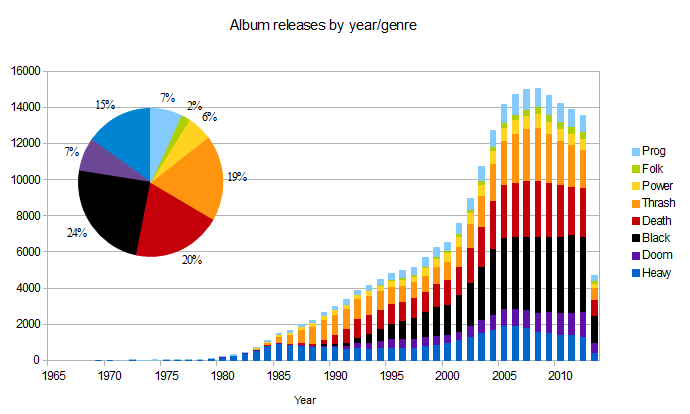
It shows us the evolution of album releases across the whole world. We see that metal is highly dependent on the dynamism of the music industry and the medium in which it propagates. The invention and popularity of CDs in the late 70′s and early 80′s triggered an impressive acceleration of record releases across the world, thanks to the increased ease of producing and obtaining albums. It also demonstrably led to the accelerated growth of metal scenes in countries distant from the West.
Similarly, the invention of the Internet boosted the growth of metal in the late 90′s and early 00′s, and in even more recent years the availability of metal has again boomed due to the increase in digitally self-released albums, and the increased ability of new bands to disseminate their music via a widespread broadcast. We can also see in the data the dramatic influence of the most recent global economic crisis, which has had a dampening effect on releases despite the development of the Internet and the rapidly growing number of digital-only releases.
The data also show the varying effects of the crisis on releases by bands in different countries:
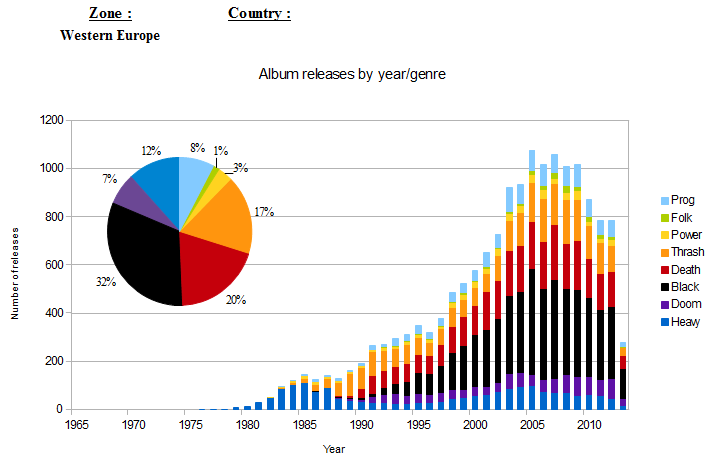
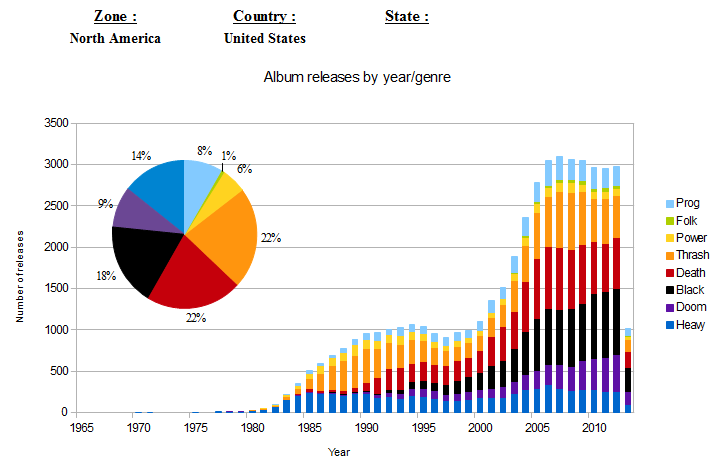
For example, we note that American bands on average seem to be more independent of the labels (whose business we would expect to have suffered from the economic downturn), and therefore production of albums didn’t decrease during the recession, while it shrank in an unprepared Europe.
Another interesting thing about the American chart is the diminution of album releases from 1994 to 1997. This may be explained by the sudden expansion of the grunge scene and the creation of a large alternative rock/metal offspring that largely wiped out metal from the mainstream, and partly from the underground, for five years.
The Metal Archives information is also revealing about local preferences among metal subgenres. For example, in the US, the scenes are mostly thrash and death oriented, while in Western Europe, black metal wins. And as Islander would say, “black metal is the most saturated subgenre”.
The reasons for these variations in local preferences remain to be discussed and explained, as do the differing musical evolutions within each of the various geographic zones and their link to local economic, societal, and political conditions. Metal is in opposition with society, but, as the subgenres embody different philosophical positions, their distribution among countries may give us information about the mood of the underground and its impact on the country in which it evolves. If Norway’s and Sweden’s metal preferencies are so different, for example, it is because Norwegian and Swedish societies must somehow be drastically different.
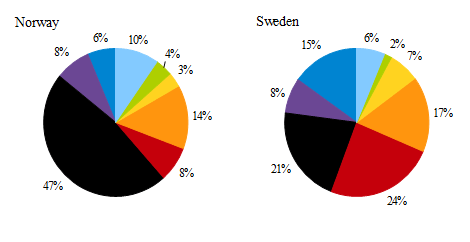
And by the way, yes, black metal IS the main export product of Norway.
One last important feature of the database is that it also allows us to study the dynamics of the expansion of an underground trend. For example, the following map enables us to monitor the expansion of doom metal in the last decade across the United States:

We can observe the expansion of doom/sludge, apparently originating in New Orleans and spreading around in the neighboring states. I haven’t tried it yet, but it would be interesting to visualize the expansion of death metal from Florida, or the second wave of black metal from Norway, etc.
For those who are interested, the file I worked with can be downloaded from here:
https://www.dropbox.com/s/ye3kfkm7e2da711/Metal%20World%20Map.rar
In the archive, you’ll find a “Read Me” explaining how the file works and how you can play with it. Don’t do as usual. Read it.
31 May 14:11
The Cocktail Gardener Cultivates Garden Pop-Up Bar on London Rooftop
by Robin Plaskoff Horton
firehosevia saucie

Photo via Eleanor Salton Thorne.
Known for her seasonal garden cocktails and infusions using cultivated and foraged herbs and flowers, Lottie Muir (aka The Cocktail Gardener), mixes it up at Midnight Apothecary, the London roof garden pop-up cocktail bar … Read More...
31 May 14:11
Lonely Island Teams Up with Robyn Because Robyn Improves Everything
by Madeleine Davies
firehosevia Diane


31 May 14:05


Small batch artisanal high-fructose corn syrup
by Cory Doctorow
firehosevia multitasksuicide
Matt sez, "Maya Weinstein is an artist who just finished her MFA at Parsons, with the awesomest thesis ever: a DIY kit for making your own High-Fructose Corn Syrup, the industrial sweetener that is, well, let's say problematic these days.
 "Amazingly, HFCS is not available for consumers to buy, and as Weinstein discovered, making it yourself requires some pretty unusual (and expensive) components, like Glucose Isomerase. But it's a totally fascinating process, and only the first in what Weinstein hopes will be a series of 'citizen food science' kits."
DIY High-Fructose Corn Syrup by Artist Maya Weinstein 
    
|
31 May 07:14
Tyrion and the Hound
firehosevia Christoper Lantz
Dani.friedland, Tertiarymatt likes this
30 May 23:58


Gorgeous Vintage Advertisements for Heroin, Cannabis and Cocaine
by Vincze Miklós

Drugs such as cocaine and heroin aren't just glamorous because they're illegal. Even when you could buy them at any pharmacy or grocery store, they still had a certain cool factor. Just look at these fantastic vintage advertisements for opium, coca-laced wine and "medicinal tonics."
|
|
firehose likes this
30 May 23:46

If Bethesda's detailed GDC presentation about modular level design kits for Fallout / Skyrim showed me anything, it's that modularity is actually a huge pain in the ass -- and not the good kind of ass pain either. Why should we keep building 3D levels in this slow, totally unnecessary way, with a workflow that's at least a decade old?
I remember a time when level design was slightly faster, and that time was the time of the brush. What if we could combine the benefits of modularity (variety / adaptability / abstract detail out of design) with the benefits of a brush-based workflow (simplicity / speed / focus on "platonic forms" of design)?
The Unreal Engine has a "procedural building" tool that automatically makes buildings based on a brush volume and it seems ideal, but you can't actually use it to design levels -- in the way that Epic appears to use the tool, these buildings don't have interiors and so they exist mainly as elaborate set dressing instead of something functional that affords exploration. That isn't what I want because I think it's way too specific to be useful. Instead, I want something one conceptual level lower: instead of a building that assembles itself, how about a floor or a wall that can detail itself?
These "AutoBrushes" would basically be design primitives that can be programmed to detail or deform themselves. Imagine a "rock" brush that automatically tessellates / deforms itself to make seamless caves, or a "forest" brush that randomly places trees and plants and birds, or a "Call of Duty" brush that scatters rubble along corridors, etc.
An AAA studio might divide the work like this: (1) an environment artist builds a tileset of 3D meshes, (2) a "world coder" would program a brush solid that automatically tiles, subdivides, deforms, and mutates these meshes -- and (3) the level designer would place these procedural brushes to make buildings and environments.
An indie workflow might look more like this: (1) an environment artist builds a tileset and shares them freely, (2) developers hold a "proc jam" to code the most interesting procedural brushes, (3) the brush data is stored in a special platform-agnostic XML format that can be fed into UDK, Unity, or any 3D game engine for people to use.
This is my current AutoBrush prototype in Unity:

So in this example, I have a STOREFRONT rule that spawns a storefront piece on the bottom level, and a WALL rule that spawns windowed pieces above the storefront, and a FIRE_ESCAPE rule that spawns fire escapes haphazardly. I could also add an OCCUPANTS rule that could automatically spawn an NPC in each window, or maybe a PATHFINDING rule that automatically spawns pathing nodes for each floor, etc.
The exciting thing about AutoBrushes would be their procedurality and possible recursion: they could instantiate other AutoBrushes, so you could probably program a floor to grow its own walls. However, chances are that this building probably wouldn't look "real", i.e. crafted by a human. Handcraftedness and humanity is great and all, but they are just tools -- and if we worship tools as ideology, they become oppressive standards. I think a lot of the difficulty in using procedural generation is less about the engineering, and more about the politics / context that frame procedural generation in games. It's about ceding control to an algorithm and learning to be okay with the results, or even valuing strange glitches over "what looks right as crafted by humans."
When procedurality tries to pretend it's human, you get Oblivion's randomized NPC faces, jarring and grotesque. But when it stops pretending, then we can accept it for what it is and learn to value how utterly strange and surreal the faces are. The lack of humanity is what makes these things compelling, e.g. dungeon design in the roguelike genre, or the infinite landscapes in Minecraft.
There, the politics of procedural level design imposes a certain flavor of harsh realism. I marvel in the beauty of getting fucked, how all these random coincidences snowballed with my choices into calamity... into me, being utterly unable to find a single block of coal in Minecraft for an hour. Now, was that an unbalance to be eradicated, or did it produce a fantastic desperation of dark fire-less nights spent huddled in damp caves? Unfortunately, Mojang treated it as an unbalance and added charcoal in Beta 1.2, thus removing the possibility of that edge of experience from the game, forever.

Yeah, the ProcWorld guy, Miguel Ceprano, is doing great work... but I don't know if I care for the results so far. So far he's just focusing on another safe idyllic landscape that anyone could've pulled out of World Machine; at this point, you're basically training a computer to make a Thomas Kinkade painting.

A procedurally generated Thomas Kinkade painting cannot fuck me. They fuck no one. These landscapes are utterly incapable of fucking. That's why my mom decorates her house with them.
(Counterpoint: Joan Didion would disagree with me, and argue that Kinkade was actually the most cynical / sinister painter in the history of evil who fucked everyone and everything. "... Every window was lit, to lurid effect, as if the interior of the structure might be on fire." Oooh, creepy!)
To me, the most important question to ask is, "what are the politics of procedurality?" What values do certain uses of procedurality connote to us? What does it mean to players, developers, and communities, and what are our futures? What are the actual images and visions that we will produce -- a Kinkadian hellscape of pastoral 1950s American utopias, or something that's actually interesting?
PREVIOUSLY: "On Joiner, detail, and the cult of greeble."
Design futures: AutoBrushes, levels that build themselves, and the politics of procedurality.
by noreply@blogger.com (Robert Yang)
firehose"A procedurally generated Thomas Kinkade painting cannot fuck me. They fuck no one. These landscapes are utterly incapable of fucking."
If Bethesda's detailed GDC presentation about modular level design kits for Fallout / Skyrim showed me anything, it's that modularity is actually a huge pain in the ass -- and not the good kind of ass pain either. Why should we keep building 3D levels in this slow, totally unnecessary way, with a workflow that's at least a decade old?
I remember a time when level design was slightly faster, and that time was the time of the brush. What if we could combine the benefits of modularity (variety / adaptability / abstract detail out of design) with the benefits of a brush-based workflow (simplicity / speed / focus on "platonic forms" of design)?
The Unreal Engine has a "procedural building" tool that automatically makes buildings based on a brush volume and it seems ideal, but you can't actually use it to design levels -- in the way that Epic appears to use the tool, these buildings don't have interiors and so they exist mainly as elaborate set dressing instead of something functional that affords exploration. That isn't what I want because I think it's way too specific to be useful. Instead, I want something one conceptual level lower: instead of a building that assembles itself, how about a floor or a wall that can detail itself?
These "AutoBrushes" would basically be design primitives that can be programmed to detail or deform themselves. Imagine a "rock" brush that automatically tessellates / deforms itself to make seamless caves, or a "forest" brush that randomly places trees and plants and birds, or a "Call of Duty" brush that scatters rubble along corridors, etc.
An AAA studio might divide the work like this: (1) an environment artist builds a tileset of 3D meshes, (2) a "world coder" would program a brush solid that automatically tiles, subdivides, deforms, and mutates these meshes -- and (3) the level designer would place these procedural brushes to make buildings and environments.
An indie workflow might look more like this: (1) an environment artist builds a tileset and shares them freely, (2) developers hold a "proc jam" to code the most interesting procedural brushes, (3) the brush data is stored in a special platform-agnostic XML format that can be fed into UDK, Unity, or any 3D game engine for people to use.
This is my current AutoBrush prototype in Unity:
- Each brush is technically planar and takes its rotation / scaling into account.
- Brushes have sets of "rules", which each spawn a random object every X units within the brush volume.
- In Unity, I hide all the resulting objects from the hierarchy and inspector, so I only deal with the brush object itself.
- Spawned objects are just regular Unity gameObjects; they could be NPCs, or particle systems, or even other brushes.
So in this example, I have a STOREFRONT rule that spawns a storefront piece on the bottom level, and a WALL rule that spawns windowed pieces above the storefront, and a FIRE_ESCAPE rule that spawns fire escapes haphazardly. I could also add an OCCUPANTS rule that could automatically spawn an NPC in each window, or maybe a PATHFINDING rule that automatically spawns pathing nodes for each floor, etc.
The exciting thing about AutoBrushes would be their procedurality and possible recursion: they could instantiate other AutoBrushes, so you could probably program a floor to grow its own walls. However, chances are that this building probably wouldn't look "real", i.e. crafted by a human. Handcraftedness and humanity is great and all, but they are just tools -- and if we worship tools as ideology, they become oppressive standards. I think a lot of the difficulty in using procedural generation is less about the engineering, and more about the politics / context that frame procedural generation in games. It's about ceding control to an algorithm and learning to be okay with the results, or even valuing strange glitches over "what looks right as crafted by humans."
When procedurality tries to pretend it's human, you get Oblivion's randomized NPC faces, jarring and grotesque. But when it stops pretending, then we can accept it for what it is and learn to value how utterly strange and surreal the faces are. The lack of humanity is what makes these things compelling, e.g. dungeon design in the roguelike genre, or the infinite landscapes in Minecraft.
There, the politics of procedural level design imposes a certain flavor of harsh realism. I marvel in the beauty of getting fucked, how all these random coincidences snowballed with my choices into calamity... into me, being utterly unable to find a single block of coal in Minecraft for an hour. Now, was that an unbalance to be eradicated, or did it produce a fantastic desperation of dark fire-less nights spent huddled in damp caves? Unfortunately, Mojang treated it as an unbalance and added charcoal in Beta 1.2, thus removing the possibility of that edge of experience from the game, forever.
Yeah, the ProcWorld guy, Miguel Ceprano, is doing great work... but I don't know if I care for the results so far. So far he's just focusing on another safe idyllic landscape that anyone could've pulled out of World Machine; at this point, you're basically training a computer to make a Thomas Kinkade painting.
A procedurally generated Thomas Kinkade painting cannot fuck me. They fuck no one. These landscapes are utterly incapable of fucking. That's why my mom decorates her house with them.
(Counterpoint: Joan Didion would disagree with me, and argue that Kinkade was actually the most cynical / sinister painter in the history of evil who fucked everyone and everything. "... Every window was lit, to lurid effect, as if the interior of the structure might be on fire." Oooh, creepy!)
To me, the most important question to ask is, "what are the politics of procedurality?" What values do certain uses of procedurality connote to us? What does it mean to players, developers, and communities, and what are our futures? What are the actual images and visions that we will produce -- a Kinkadian hellscape of pastoral 1950s American utopias, or something that's actually interesting?
PREVIOUSLY: "On Joiner, detail, and the cult of greeble."

30 May 23:05
James Lipton Used To Be A Parisian Pimp
James Lipton opened up about his youth as a Paris hustler, and shared details about how he ran an entire bordello.
30 May 22:53
TSA eliminates graphic X-ray shots
by klaing@thehill.com (Keith Laing)
Images taken by the old machines had been heavily criticized as an invasion of privacy.
30 May 22:49
Samsung reportedly turning to Intel to power next-gen Galaxy Tab
by Bryan Bishop
firehosehuh
Reuters reports that an upcoming Android tablet from Samsung will be powered by none other than Intel. According to its sources, the Galaxy Tab 3 10.1 will use Intel's Clover Trail+ chip — alternatively known as the Atom Z2580 — in at least one of its configurations. It's not specified when the new tablet will be announced, but Samsung does have a media event scheduled for June 20th where it will debut new products in both its Galaxy and Ativ lines. The product would join the low-end 7-inch Galaxy Tab 3 that Samsung introduced last month.
It would also mark a shift for Samsung, which has previously used ARM chips in the 10.1-inch Tab line (it does use Intel processors in its Ativ Windows products). While Reuters doesn't delve into just what's behind the change, it would no doubt be a welcome development for Intel, which has struggled in mobile with its x86 silicon thus far.
- Source Reuters
- Related Items galaxy tab 3 intel clover trail plus clover trail arm x86 chip silicon android 10.1 Samsung Intel
30 May 22:48
Sonar image may show Amelia Earhart's plane - Detroit Free Press
Telegraph.co.uk |
Sonar image may show Amelia Earhart's plane
Detroit Free Press A team of experts that has been chasing Amelia Earhart's elusive trail for years may be closer than ever to solving the mystery of her 1937 disappearance. The International Group for Historic Aircraft Recovery (TIGHAR) had more than a decade ago pinpointed ... Researchers Believe They Have Found Amelia Earhart's PlaneGadling all 57 news articles » |
30 May 22:15
Infographic: Features Of Motorola’s New Moto X Smartphone
firehosewat
All right, so, The Onion would like to sincerely apologize for not putting together this infographic about the new Moto X smartphone, since we frankly did not expect anyone to actually click on it.
30 May 22:14
Man On Cusp Of Having Fun Suddenly Remembers Every Single One Of His Responsibilities
GAITHERSBURG, MD—Local man Marshall Platt, 34, came tantalizingly close to kicking back and having a good time while attending a friend’s barbeque last night before remembering each and every one of his professional and personal obligations, b...
firehose and -1 others like this
30 May 22:12
"There may come a day when we need not come out of the closet, and need not remind others of the..."
“
- George Takei on his Facebook page. Pass this around, everyone! (via veggiezombiex)
There may come a day when we need not come out of the closet, and need not remind others of the terrible violence, inequity, and ostracism that LGBT people face daily simply because of who we are and who we love. But that day is not here, and more importantly will never get here, unless people continue to step forward and offer themselves as examples, often at great personal cost. I am called “faggot,” “degenerate,” “queer” and “homo” by misguided people every day of my life, even on my own page, but this does not discourage me. It only reminds me of how far we have to go.
Once upon a time I was called a “Jap” and put into a prison for four years with my entire family, for no reason other than who we were and who we looked like. It is my life’s mission to fight against the dark forces of fear and intolerance that could ever lead again to such an injustice.
Thank you for taking the time to listen. The next time you feel fatigue from hearing about LGBT issues, ask yourself this: Do we live yet in the kind of society where violence, hate and prejudice is not an issue? Until we do, be part of the solution, and stand always for justice and equality for all people.
”- George Takei on his Facebook page. Pass this around, everyone! (via veggiezombiex)