Shared posts

05 Jun 17:32

The 15-millisecond head start that led to $28 million in trades

by Simone Foxman
firehose

christ

Blink and you've missed it.

Thomson Reuters is taking the heat for a glitch that on Monday (June 3) caused the US’s ISM manufacturing data to go out to high-frequency traders 15 milliseconds before it was supposed to.

Nanex LLC pointed out that trading in futures for the S&P 500 on June 3 exploded before the release was even supposed to have hit the tape–at 09:59:59.985. The release should have gone out at 10:00:00 on the dot.

ISM is short for Institute for Supply Management, the firm which compiles data from manufacturers. It normally distributes its data with PR Newswire, which publishes the ISM reports online. CNBC reports that ISM also inked a deal with Thomson Reuters, which wanted to distribute the data for “low-latency systems” (read: high-frequency trading networks).

If you’re a high-frequency trader, a few milliseconds is a big deal. And in this case, a 15-millisecond head-start meant that $28 million in shares traded hands before the number was even published, according to Nanex’s calculations. Algorithms positioned to trade on data within a split second immediately reacted to the news release. This would have put those traders receiving data from another provider–say, PR Newswire, which also releases the data–at a disadvantage.

The data also happened to be particularly important. Monday’s ISM report showed the weakest level of general manufacturing activity since June 2009.

Now Thomson Reuters is coming clean about the data leak, in a statement released to CNBC:

We have identified that there was a minor clock synchronization issue Monday causing this data to be released 15 milliseconds early…We are taking measures to minimize clock synchronization issues in order to ensure that release of the data is as close as possible to the official release time of 10am ET.


05 Jun 17:26

Han Solo in Carbonite With a Force-Filled Erection Light Switch Plate

by Justin Page
firehose

"I love you."
"I KNOW HAN I CAN TELL BY YOUR PENIS"

Star Wars Han Solo in Carbonite Light Switch

The Force is hard with this one.

Valrico, Florida-based WickedStudio hand-sculpted a custom Star Wars light switch plate featuring Han Solo in carbonite with a force-filled erection. The plate is “an appropriate scale for the switch.” Cover your eyes young padawans! It is available to purchase online.

This is a working UL approved switch installed in the crotch of an icon of pop culture, Han Solo in Carbon Freeze.

Star Wars Han Solo in Carbonite Light Switch

Star Wars Han Solo in Carbonite Light Switch

Star Wars Han Solo in Carbonite Light Switch

images via WickedStudio

via This Is Why I’m Broke, Technabob

05 Jun 17:10

The Charted Cheese Wheel

A chart of 66 delightful cheeses from around the world, assembled into one wondrous wheel.
05 Jun 17:09

Photo


05 Jun 17:09

Tiny Brains' developer 'no design doc' policy allows for more creative freedom

by Alexa Ray Corriea
firehose

if design docs are affecting flexibility in service of the player, you don't know how to use design docs

Tiny Brains developer Spearhead Games builds without design documents, which the studio feels allows them to focus on creating the "best game experience" at all times during development, according to a post on the PlayStation Blog from Spearhead co-founder Simon Darveau.

Spearhead Games, a studio made up of former Assassin's Creed 3 and Dead Space 3 developers, is currently working on co-op puzzler Tiny Brains for launch on PlayStation 4. Darveau wrote that the company's "no design doc" policy has allowed designers to freely develop any "cool ideas" they have for levels and puzzles as they go.

After creating it the team will play the level together and decide whether or not to incude it in the finished product. Having this flexibility during the development of Tiny Brains allowed the title to "[emerge] almost by itself."

"Being able to do this has been one of the best things about going indie, and the philosophy helps us make significant creative developments in a short amount of time," Darveau wrote. "With no design docs, we can think about how to make the best experience at all times."

At PAX East in March, Spearhead watched attendees play Tiny Brains and took note of their behavior. Darveau noted that the game is designed to force player interaction, and no one can solve the puzzles without talking to their teammates.

"Since our design flexibility lets us make updates quickly and we're committed to trying different things until we have the best game possible, we've already incorporated feedback and ideas from the surveys into our latest build," he wrote.

Check out Polygon's interview with Spearhead Games here.

05 Jun 17:08

Photo


05 Jun 17:08

Photo


05 Jun 17:08

Photo


05 Jun 17:08

Photo

firehose

we need another internet party


05 Jun 17:07

Photo


05 Jun 17:07

Privacy concerns threaten to overshadow Microsoft's new console

by Brian Crecente
firehose

"However, the new Kinect could bring with it new privacy policies, something Microsoft officials continue to decline to comment about in the lead up to the annual E3 video game conference. In the vacuum of fact created by Microsoft's decision to go silent on the topic, internet sleuths dug up a pair of troubling patents filed by Microsoft over the past 12 months. One is for a device adjusting the rental price of a movie based on the number of people in your living room. The other would reward users for watching advertisements. It's unclear if either patents would be used for the Xbox One, because Microsoft has declined to comment about them."

The Xbox One brings with it a required peripheral packed with microphones and cameras that can monitor a person's every movement and word spoken and could be used to track not just what a person plays, watches and listens to, but exactly how they do so.

During last month's unveiling of the Xbox One on Microsoft's Redmond campus, developers showed off how the Kinect can track eye movement to monitor how attentive a player is, use "blush technology" to monitor a player's heart rate, see movements in the dark and even extrapolate a person's mood by watching their face closely.

What Microsoft officials didn't detail, and continue to decline to talk about, is exactly how that data will be used and if any of it will leave a player's home to either be processed by Microsoft's cloud service or collected for other reasons.

Because the Xbox One will also deliver ads, stream movies and provide cable television access, there is the potential for the company to marry those technologies together to create a sort of next-gen focus group system that could theoretically provide everyone from the people who want to sell you a soda to the creators of television shows, movies and games, very precise information about how you react to their creations.

The notion of a device that can be so intrusive, even with a consumer's consent, is drawing concern from a number of international privacy activists and at least one government official.

Tim Vines, a director at Civil Liberties Australia, told the Syndey Morning Herald that Microsoft has an obligation to be "honest about what information's being collected and how it's going to be used."

Peter Schaar, Germany's federal commissioner for data protection and freedom of information, is also concerned about the privacy implications of the Xbox One, telling German news magazine Der Spiegel that it is a monitoring device.

"No privacy policy can stop a hacker from breaking into things."

While the new Kinect brings with it quite a number of new abilities and innovations, and will be a requirement for the Xbox One, the original Kinect foreshadowed both some of this technology and concerns.

Microsoft created an entire page dedicated to privacy and online safety for the current device. In it, the company addresses what "safeguards are provided to help [families and parents] manage their family's entertainment experiences and protect their privacy and online safety.

"As leaders in the video game industry, Microsoft is proud to have led the effort to create and build in safety and privacy measures and today virtually all of Microsoft's consumer products feature family safety features, including Kinect."

In Microsoft's general public online privacy statement, the company says it "collects and uses your personal information to operate and improve its sites and services." That includes, according to the statement, "performing research and analysis aimed at improving our products, services and technologies; and displaying content and advertising that are customized to your interests and preferences." But Microsoft specifically says on a different page, that the policy for the current Kinect does not allow Kinect data to be used for marketing purposes or for personalized advertising. Collected anonymous aggregate data, though, can be used to help plan "new experiences."

However, the new Kinect could bring with it new privacy policies, something Microsoft officials continue to decline to comment about in the lead up to the annual E3 video game conference. In the vacuum of fact created by Microsoft's decision to go silent on the topic, internet sleuths dug up a pair of troubling patents filed by Microsoft over the past 12 months. One is for a device adjusting the rental price of a movie based on the number of people in your living room. The other would reward users for watching advertisements. It's unclear if either patents would be used for the Xbox One, because Microsoft has declined to comment about them.

Jennifer A. Rode, an assistant professor at Drexel University who specializes in human computer interaction, says some of the privacy concerns surrounding the Xbox One are very reminiscent of the issues raised when Tivo was first announced. At the time, she said, people were concerned about how the company would be using information about television watching habits.

The difference here, she said, is that it's not just viewing habits raising concerns, but the ability to stream video and audio and track very precise information about a person. That data, if it ever leaves a person's home, could be compromised.

"I'm always concerned about the effects of an unknown sensor."

"No privacy policy can stop a hacker from breaking into things," she said. "It it's being processed on the cloud, it's liable to be grabbed."

She also raised concerns about the technology being abused in ways the engineers never considered, a common problem when new sensors are introduced into the marketplace.

For instance, she said, a company once introduced bed sensors into an eldercare home. The sensors were designed to show if a person wasn't moving so a family member could alert health care staff. But to the chagrin of family, it also provided data that showed when the elderly were having sex.

"This is another input sensor," she said about the Xbox One's Kinect. "I'm always concerned about the effects of an unknown sensor."

With a clear, public-facing privacy policy and user agreement still lacking, it remains unclear whether Microsoft's innovative new console is designed with consumers in mind or as the ultimate gatekeeper for an entertainment conglomerate.

Good Game is an internationally syndicated news and opinion column about the big stories of the week in the gaming industry and their bigger impact on things to come. Brian Crecente is a founding News Editor of Polygon.

05 Jun 17:06

Facebook Silently Removes Ability To Download Your Posts

by Unknown Lamer
firehose

rofl

dcollins writes "Facebook has a 'Download Info' capability that I've used regularly since 2010 to archive, backup, and search all the information that I've written and shared there (called 'wall posts'). But I've discovered that sometime in the last few months, Facebook silently removed this largest component from the Downloaded Info, locking up all of your posted information internally where it can no longer be exported or digitally searched. Will they reverse course if this is publicized and they're pressured on the matter?" It does appear that the archive of your wall posts is now only available through the not-very-useful Activity Log.

Share on Google+

Read more of this story at Slashdot.


05 Jun 17:06

Happiness

05 Jun 17:05

The secret to a relaxing vacation: Send all your email to the trash

by Commentary
The computer beckons

This originally appeared on LinkedIn. You can follow Danah Boyd here 

Have you ever returned from vacation more stressed out than when you left? Is the reason because you came home to 10,000 email messages that managed to convey high pitched anxiety even in text (with a few exclamation points to add pressure)? Vacations should be a break from the insanity, not a procrastination of it.

Years ago, I realized that when I went on vacation, I needed a real break. I didn’t want to be tethered via email or social media. I wanted to go offline. But I also wanted to come back without the onslaught of messages that would take me weeks to unbury myself from. So I started instituting email sabbaticals. The idea is simple: turn off your email. Set up a filter and Send all messages to /dev/null (a.k.a. the Trash). Send a bounce message telling people their message wasn’t received and that they should resend it after X date or send you the contents via snail mail.

Of course, if you just turn off your email with no warning, you’re bound to piss off your friends, family, colleagues, and clients. So here are some tips to successfully taking an email sabbatical:

  • Step 1: Schedule a vacation. A vacation is not a long weekend. You need time to decompress. Schedule it ahead of time. I recommend at least two weeks so that you can really relax. You’ll spend the first week of it still shell-shocked from stepping away from the computer anyhow.
  • Step 2: Communicate with colleagues. Long before you’re headed out on vacation, tell people that you intend to be gone from X to Y dates. I tell collaborators months in advance so that I can make sure that we’re on the same page and that they have everything they need.
  • Step 3: Manage expectations. Talk to everyone who relies on you. Schedule a meeting before you leave and schedule one for when you return. Agree on the to-dos and create a contingency plan for issues that might arise while you’re unreachable.
  • Step 4: Create a backdoor for emergencies. Identify someone that is willing to serve as a buffer for you that you can check in with every 3 or so days who people will be afraid to contact unless it’s an emergency. I use my mother for this one. Colleagues feel weird about calling your mother, but they’ll do it if it’s an emergency. This is a good safety net if you don’t feel like you can be out-of-reach for that long.
  • Step 5: Send a final warning note. A week or two before you depart, send a note out to everyone reminding them that you’re about to leave in case they need anything from you. And then turn on your out-of-office notice to warn people that you’re about to disappear into the void. That way, you catch any notable issues.
  • Step 6: Make your email go poof! I’m a geek. My procmail file is absurd, but you don’t need to be a geek to make your email go into a blackhole. Add an away message / auto-responder that will catch people’s attention and inform them that you’re gone and that their message will never be received. Then filter ALL of your email like you would if it were spam. Use your favorite mail program to send everything straight to the Trash. Bye-bye!
  • Step 7: Disappear. For realz. Seriously, take a vacation. You need it. There’s nothing like a vacation to rejuvenate and make you better at your job. If you come back refreshed, you’ll have better ideas and be more on top of your game. This isn’t a gimmick to sell you a self-help manual. This is basic logic. We’re all overworked and maxed out and when we’re stressed, we don’t function well. Use your vacation days. Use them well. Cherish them. And don’t work while you’re on vacation. That. Defeats. The. Point.
  • Step 8: Re-entry. When you’re back, quietly turn everything off. Reach out to the people who depend on you the most for a check-in. Make sure to schedule time to give them what they need. Be attentive, be supportive, be vacation-refreshed calm.

Communication is the key to an email sabbatical. Disappearing without properly making certain that everyone has what they need is irresponsible and disrespectful and people will get pissed off. They’ll be offended. They’ll think you’re all high and mighty. But when you go through steps to make sure everyone’s covered, it’s amazing at how well people respond. And, often, they too start taking email sabbaticals, guaranteeing everyone gets the reset they need.

People often ask me if I’m frantic about the thousands of emails I must’ve missed. Again, because I’m a geek and use procmail, I have log data. What’s funny is that, aside from the first 48 hours where people like to test my bounce message, people stop sending me email. With all of these steps in place, people actually leave me alone.

Are there things I miss? Sure. But I don’t fear missing out because I know how important it is to truly, genuinely, actually take a break. Being burnt out sucks. When I’m burnt out, I’m a crappy employee, a dreadful friend, and a terrible person to be around. It’s well worth missing out on a few things in order to make sure that I’m who I want to be.

So go ahead, don’t be afraid, don’t make excuses. Take a vacation. And take an email sabbatical!


05 Jun 17:04

These vintage Dutch safety posters are stunning, completely terrifying

by Robert T. Gonzalez

These vintage Dutch safety posters are stunning, completely terrifying

These are way more eye-catching than those televised public service announcements about carbon monoxide leaks and downed power lines. They're also straight-up ghoulish.

Read more...


05 Jun 17:04

'The Last of Us' review: making the post-apocalypse even darker

by Philip Kollar
firehose

"at increasingly frequent points in the narrative, I had to buckle down and deal with the messy gunplay and repeated checkpoint restarts ... too many conventional design choices" -- every 3rd-person shooter review ever

By Philip Kollar
on June 05, 2013 at 10:00a

Game Info
Platform PS3
Publisher Sony Computer Entertainment
Developer Naughty Dog
Release Date 06/14/2013
Price at Launch 59.99

The Last of Us made me feel sick to my stomach.

The Last of Us mines the same post-apocalyptic scenario as dozens of other games, but its approach is starkly its own. It paints a vision of a near-future that is cold, heartless and, in many cases, downright evil. It's not a fun place to be, and likewise, the game isn't really a fun thing to play.

Developer Naughty Dog's commitment to this dark, depressing tone is alternately impressive and frustrating. The Last of Us actively fought any enjoyment I might have gained from it — from its oppressive world to its inconsistent mechanics. Being anything but fun might be the point, but The Last of Us doesn't always make that point gracefully.

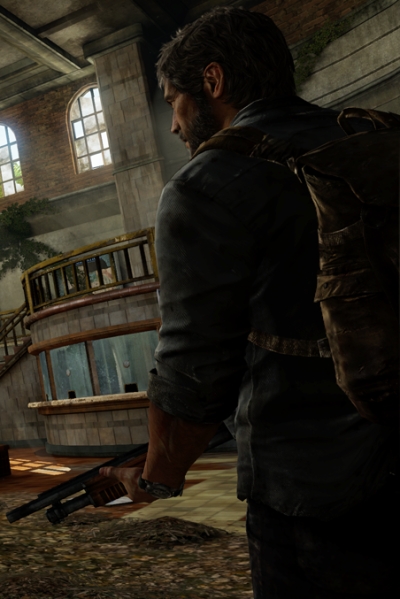
The Last of Us stars Joel, a grizzled, middle-aged survivor of a fungal plague which turns its victims into homicidal monsters. Joel is living out his life in a military-protected quarantine zone on the east coast. In the midst of a smuggling operation, he meets Ellie, a 14-year-old girl trying to make her way west for mysterious reasons. Circumstance brings them together, and they set off on a dangerous cross-country journey.

The best parts of The Last of Us are devoted to building these two characters, and their relationship with one another. Ellie's development is especially powerful. Though hardened by the world she lives in, she talks and acts like a believable teenage girl. When she gets mad at Joel, her anger is apparent outside of cutscenes — she noticeably hangs back and rebuffs Joel's commands. At other times she'll skip, hum to herself and banter about random topics you'd expect a 14-year-old to be concerned with. She reminded me of my sister when she was in high school, and it made it easy to build a connection to her.

Joel and Ellie's relationship is antagonistic at first and more affectionate later, but its development doesn't feel forced. The Last of Us is full of incidental dialogue and short, optional conversations that flesh them out tremendously, as well as the handful of other survivors they come across on their journey. Because the game spent so much time convincing me to care about these characters, its emotional high notes were even more effective, and its many sad scenes even more devastating.

Thelastofus_review_b_550

Thelastofus_review_a_400

There's a slow, brutal pace to The Last of Us that establishes an exhausting kind of tension

A sense of melancholy pervades The Last of Us, starting with the script and seeping out of every moment in the game. As Ellie and Joel explore schools, coffee shops, hotels and other abandoned, overgrown remnants of the old world, they find themselves pitted against hundreds of people — both infected and not — who want them dead. In many of these situations, sneaking while killing as little as possible is the only means of survival.

There's a slow, brutal pace to the stealth that establishes an exhausting kind of tension very different from other third-person action games. In its most interesting scenarios, The Last of Us allows you to crawl through whole levels without needing to engage any enemies if you play it smart. The seconds that I spent waiting for enemies to walk past felt like white-knuckle, on-edge eternities. These instances left my nerves frayed, but I also felt good about progressing without forcing my young traveling companion to witness even more horrifying violence.

I wanted to avoid that violence in part because of its disgusting detail. The Last of Us' graphics, animation and sound design are some of the best I've ever experienced. But amid those high production values, small things stand out more. AI partners often attempt to follow you and stay behind cover nearby, but sometimes they screw up and get stuck out in the open. These moments don't result in detection by enemy AI, which is a wise concession to the stealth gameplay. But it looks ridiculous and shatters the atmosphere Naughty Dog works so hard to build.

Thelastofus_review_c_400

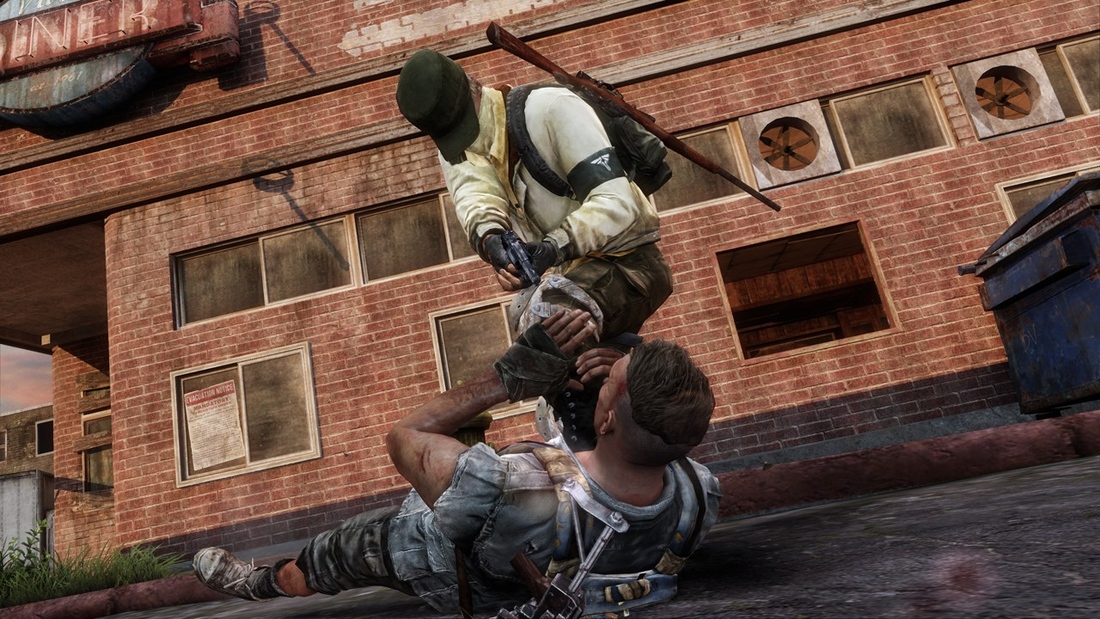
More notable problems with The Last of Us manifest as it leans more on the traditional trappings of third-person shooters — fights against waves of enemies or arenas full of waist-high cover where your only recourse is to kill everyone in your way. These sequences sit at odds with the rest of the game. Joel can't take much damage from enemies, which isn't such a big deal when you're sneaking past them without incident. But at increasingly frequent points in the narrative, I had to buckle down and deal with the messy gunplay and repeated checkpoint restarts.

Combat against the zombie-esque infected is especially frustrating. Not only are they faster, more aggressive and more unpredictable than human enemies, but multiple types of infected have an instant, one-hit kill if they get in melee range.

Did I mention that Joel isn't terribly good with guns? Naughty Dog has given Joel's aim a semi-realistic shakiness which, when mixed with the erratic movement of the infected, makes keeping enemies at bay a serious — and not terribly entertaining — challenge. Eventual upgrades allow Joel to hold his aim slightly better, but the annoyance never disappeared.

At first, these limitations and frustration made me view gunplay as a last resort. It wasn't an exciting adrenaline rush. It wasn't something to seek out. It was an awful, uncomfortable act reserved for the worst situations, and that felt right in this world. At one point, Joel tells Ellie that they only do terrible things because "we have no other choice." For half of the game, at least, I bought it. But Joel's definition of "no other choice" broadens.

I later faced greater numbers of uninfected humans with less certainty that they were actually "bad guys." Early on, I slowed down between encounters to ease The Last of Us' tension; by the end, I was pausing because I felt like a bad person doing bad things. It's a seemingly intentional choice, but the game struggles to justify it with the same ease that Joel justifies murder. I want games to strive for more than pure entertainment value, and Naughty Dog is trying. But I couldn't find any deeper meaning in the horrible events in The Last of Us.

Thelastofus_review_d_1280

group effort

The moral dilemmas are blessedly missing from The Last of Us' surprisingly competent multiplayer mode. Titled "Factions," the multiplayer expands on by-the-numbers deathmatch and team deathmatch scenarios by providing an intriguing meta-system. Performing well in matches earns you more supplies, which grows your personal camp of survivors. Hitting certain community milestones also unlocks more guns, perks and outfits for your character. It's an engaging system that gave me a world-appropriate reason to care about my moment-to-moment performance beyond the scoreboard. And the shakiness to aiming is gone as well.

Wrap Up:

The Last of Us has some incredible moments but too many conventional design choices

There are hints of a nuanced message in The Last of Us, but convention wins out too often to easily find them. Naughty Dog commits to a somber tone that affects every piece of the game for better and worse. It achieves incredible emotional high points about as often as it bumps up against tired scenario design that doesn't fit its world. Survival in the post-apocalypse requires compromise, but The Last of Us has given up something vital.

The Last of Us was reviewed using pre-release debug PlayStation 3 code provided by Sony. You can read more about Polygon's ethics policy here.

About Polygon's Reviews
05 Jun 17:01

Modesty

In Underdog a partly animated anthropomorphized dog is shown with penis when a real dog is filmed, and without penis in the animated parts.

Link (Thanks, rememberlivejournal)

05 Jun 16:59

Fired Zynga Staff Hits Reddit To Talk Life Before The Massacre

A few game-makers who got the axe on Monday have already recovered—enough to dish on Reddit, at least. They're answering questions right now—and talking severance packages, game theft, and of course, corporate perks.
05 Jun 16:59

Yahoo revamps search with new look that 'combines utility with beauty'

by Chris Welch
firehose

now more Googly than ever with shitloads of white space

Yahoo has redesigned its search page for those in the United States, claiming that the new look "puts your results front and center." Search results are now placed higher on the page, according to a Tumblr post on the visual makeover, and Yahoo is also promising faster performance thanks to some undisclosed under-the-hood improvements. The company has also brought the top navigation bar — which links to other Yahoo services — from the homepage to web search. The changes are admittedly small, but nonetheless important for Yahoo as it attempts to implement a shared and recognizable design language that "combines utility with beauty." The company has promised that today's changes are "just our first step" in continuing towards that goal.

05 Jun 16:54

OMGPOP closure was not a surprise to staff, says former employee

by Emily Gera
firehose

"Everyone was just like, 'Yep.' Not surprised at all. It was like the weight had been lifted off our shoulders, that a decision had finally been made."

The closure of Zynga's OMGPOP studio was not a surprise to staff who worked there, one former employee told Business Insider.

According to the unnamed staff member, work at the company slowed prior to the studio's eventual closure. While previously the team, led by former studio head Dan Porter, managed up to five individual IP, now team members were primarily tasked with performing bug fixes on the company's popular Draw Something 2.

"You could almost feel things were slowing down," said the employee. "We were all champing at the bit for something new."

According to the employee, staff members were informed immediately of the studio's closure after being called for a meeting by a Zynga executive and office HR personnel.

"There were no hard facts or figures. No real explanation. Just typical corporate BS," said the employee. "Everyone was just like, 'Yep.' Not surprised at all. It was like the weight had been lifted off our shoulders, that a decision had finally been made."

OMGPOP was acquired by Zynga for $183 million in March 2012. Several OMGPOP employees, including community manager Joseph Alminawi and VP of outreach Ali Nicolas, tweeted this week about the studio's closure and the resulting layoffs.

Former CEO of OMGPOP Dan Porter left Zynga just several days before the Draw Something 2 launch, which was released in April in the U.S. as a free-to-play app for iPhone, iPod Touch and iPad.

05 Jun 16:54

iwantmoretoys: If you’re a fan of The Big Lebowski you’ll laugh...


iwantmoretoys:

If you’re a fan of The Big Lebowski you’ll laugh at this mirror. It’s a prop replica from the movie. Start your day off the right, man.
http://www.iwantmoretoys.com/the-big-lebowski-time-mirror

05 Jun 16:53

Former FCC Chairman Julius Genachowski: 'people have the right to send and receive information over the internet, period'

by Nilay Patel
firehose

""There's no question that the US is leading the world in mobile innovation.""

earth sucks

It's been just over two weeks since Julius Genachowski stepped down as FCC Chairman after four years in charge of the nation's communications policy, and he looks extremely relaxed. You would too: in the past four years Genachowski's FCC has dealt with everything from the rise of LTE networks and the explosion of mobile devices to the net neutrality debate and the government's coordinated opposition to the AT&T / T-Mobile merger. And significant challenges and changes remain: someone will eventually buy Sprint, demand for spectrum continues to rise, and the TV industry feels ripe for disruption. Obama appointee Tom Wheeler will have plenty to do once he's confirmed by the Senate and takes over from interim Chairwoman Mignon Clyburn.

But even though Genachowski is out of politics now — and seriously planning to play in the World Series of Poker — he's still passionate about telecommunications and the internet. I caught up with him at the D11 conference in LA last week, where we discussed his tenure as Chairman and the challenges that lay ahead for the broadband industry.

So what have you been up to?

Spending time with my kids! And working on the list of house husband activities that my wife has set aside for me.

You also joined the Aspen Institute?

Yes, I joined the Aspen Institute, which is a terrific nonpartisan center. They have a wonderful effort that focuses on the impact of communications technology on society and our economy. They do great analyses of different issues and convene people to get things done. I've done many projects with them in the past, and I'm really excited to be affiliated with Aspen.

You made tremendous strides during your term, but broadband still lags behind in the US. Now that you have a little perspective, what are the changes you would have liked to see?

Four years ago, key US broadband metrics were moving in the wrong direction, and now they're moving in the right direction. That's a very healthy thing for the country.

You see the change in mobile broadband. Four years ago, there was no question that we were behind South Korea and Japan in mobile innovation. In mobile infrastructure we were behind Europe. Four years later, the tables have turned. There's no question that the US is leading the world in mobile innovation.

"There's no question that the US is leading the world in mobile innovation."

But wouldn't that have happened anyway? It's not like Verizon and AT&T didn't know they needed to build faster networks.

(Laughs) To the extent that there has been correlation during my tenure at the FCC, that's fine.

But so much credit for the turnaround goes to the folks at the large network companies who are investing at faster rates than anywhere else in the world. So much credit goes to the entrepreneurs building all the cool stuff we're using on mobile platforms and devices.

"Networks don't get faster without capital investment."

We focused the FCC on broadband to help. The agency had previously been unfocused — working on older communications technologies, yesterday's technologies. When I came in I said the mission of this agency is to unleash the opportunities of broadband.

When you do that, you ask yourself, "what are the kinds of things we can do to encourage more and faster investment in networks?" Networks don't get faster without capital investment. We did a series of things early in my tenure to signal to the major potential investors and broadband networks that this administration would be friendly and encouraging to private investment. So we did things like tackle obstacles to broadband investment like the difficulties around tower sites. We made it easier and much faster and less costly to place towers.

You just won a Supreme Court case validating that policy.

Yes, we won that at the Supreme Court just recently. We adopted rules to make it easier for companies to attach wires to utility poles. We pushed through initiatives like digging once — when someone's digging up a street, fiber can get laid at the same time. We took on the controversial issue of net neutrality, and resolved it in a way that provided incentives for investment to innovators, entrepreneurs, investors, internet services and applications, as well as investors in networks.

So what we've seen in the last four years is an increase in private investment across the ecosystem both for internet applications and service companies and the networks. And major investment decisions were accelerated. A big and important example of that is the investment in 4G LTE. Verizon accelerated a decision to roll out 4G LTE, after people questioned when and whether they would ever do it. That led to other companies saying "we're in a competitive environment, we have to invest in in 4G LTE too."

You look at the US now, and on wireless capital expenditure we're growing faster than any other country in the world, including China.

One of the challenges for the FCC is that you work with industry to help develop products and services, but you also focused the agency on protecting consumers. You said to AT&T that if they bought T-Mobile, they'd ruin the market. Net neutrality is still a contentious issue that's being litigated.

What's the balance between creating policy that enables companies to create a big profitable services and protecting consumer interests?

From the very start, I thought there were four key principles that the agency should focus on: driving private investment, driving innovation, promoting competition, and protecting consumers.

The process that we tried to run on every issue went through all four. Sometimes they're in tension, and you have to think through the costs and benefits and make the right decision. But they're in tension less frequently than one might think: when policies are adopted that improve the speeds of our networks, or drive faster innovation, they're very important consumer initiatives.

"The FCC issued more fines over the last four years than it did in any other four-year period in its history."

At the same time, I thought it was critical to make clear to the companies that operated in the space that the rules were the rules and violations of the rules would be treated very seriously. Measured by dollar amount, the FCC issued more fines over the last four years than it did in any other four-year period in its history. Record-setting fines and settlements, including settlements over mystery fees and other consumer ripoffs. So it's a fundamental part of what we do, and I think it's understood by everyone that it's core to the FCC's mission.

You were very active, but it was almost a soft power. I asked you about AT&T and FaceTime the last time we spoke and you weren't happy with that, but there wasn't a lawsuit, or a big public statement. Then there were things like net neutrality and AT&T / T-Mobile that were very public. How did you find the balance?

If you're in government, the right thing to do is be focused on solving real problems, and asking what's the best solution to a particular problem. I tend to be non-ideological about it. Sometimes the solution is a very clear, very strong, very forceful set of rules. Sometimes the solution is convening outside stakeholders and encouraging them to work things out. I think it would be a mistake to say there's only one technique and that the debate should be about the technique.

You mentioned some examples. I thought it was important that we have enforceable rules on the books to preserve internet freedom. We were in a time of changing business models around the sector. A lot of questions had been raised. We just needed to make clear that we would have an enforceable right to send and receive information over the internet, period.

Was that messaged the right way? Because I agree with you on net neutrality, but there's an entire other half of the political spectrum which thinks that's ridiculous. Did you sell that the right way?

Historically, there was argument about even that fundamental proposition. There was one telecom CEO [AT&T's Ed Whitacre] who famously said "these are our networks, no one is going to tell us what to do with them."

"people have a right to send and receive information on the internet."

One of the things that came out of the intense and loud public debate that we had in 2009 and 2010 was that we won the proposition that people have a right to send and receive information on the internet. We won another debate, which is that the government has a role in enforcing that right. That was also a controversial proposition. But by the end of the day, when we put the framework in place, it was supported by a very broad array of stakeholders including the bulk of companies both on the internet side and on the network side. I think people get it now, and I think more importantly, the business and social norms around internet openness are settling into the cement of the industry.

Except for mobile. The handsets aren't open, and except for the iPhone, they come loaded with carrier software. What's the next step in mobile?

The most important thing for people to understand is that the basic rule that people have a right to send information over the internet even — when they are using wireless devices — is part of the framework. If a carrier blocks a consumer's access to the internet, they are violating our rules.

Now, there are some elements of the rules around network management where the rules adopted were different for wireless than wired. And we had our reasons, and people can debate them. One, technically, managing a wireless network is different than a wired network. The capacity issues are much more complex and we concluded it was appropriate to take that into account. Second, the wireless broadband market is more competitive than the wired broadband market, and the more competition there is in a market, the less need there is for regulation.

"If a carrier blocks a consumer's access to the internet, they are violating our rules."

We were very clear in the order we adopted that the agency would continue to monitor issues that arose in and around wireless broadband and get engaged as things came up if there were threats to openness. So when something like AT&T blocking FaceTime came up, the commission played a role of convening the parties. And there were very strong feelings on all sides.

When I've ask you about TV, you've generally brushed me off, which is finebut there is change happening in the market. Aereo, whether or not it's successful, is irritating the shit out of the broadcasters. They're saying they'll drop broadcast and go cable-only. Do you want that spectrum back? Do you think it's a viable plan?

"Let's reduce regulatory barriers to other spectrum."

One, there's been a tremendous amount of focus on over-the-top video because I think that's a key part of the future of a healthy TV market. By healthy TV market, I mean healthy for viewers, for innovation, and for all companies participating in it. That's why from the beginning, when we were reviewing the Comcast / NBC transaction and net neutrality rules, protecting over-the-top video was a high priority. Two, spectrum. I've made it clear that the country has a significant challenge around freeing up spectrum for mobile broadband. I developed an idea called incentive auctions to transfer spectrum from broadcasting to mobile broadband.

We did a piece on that. Is the idea of broadcasters selling spectrum to go cable-only what you envisioned happening because of incentive auctions? Is that a good outcome?

Over time, the US is going to have to be creative and forceful in freeing up spectrum for mobile broadband. We need to be looking everywhere: military spectrum. Inefficient uses in the commercial market. New ideas like spectrum sharing. We should be looking at dramatically increasing the amount and the nature of unlicensed spectrum on the market.

The first step to me was very clear: reducing the number of broadcasters using spectrum. Over the years there's been a very significant overallocation of over-the-air TV stations — in a market like New York there are 28 full power 6MHZ licenses. There's no one who argues that's not too much.

So we can have the debate about network affiliates in markets like NY, and thats fine. I can see strong arguments on both sides. But let's not have that debate hold up this very sensible idea to take as many of the non-network affiliates as we can and provide a way for them to exit or share spectrum. And that's now happening with the support of the major TV networks. They recognize that they are multiplatform content companies that will benefit from being able to distribute over multiple platforms including mobile broadband, and that can't happen without more spectrum.

Shouldn't we use all the spectrum for the [internet]?

In the foreseeable future, I think the agency and government are on the right track. Let's see this incentive auction recover a lot of spectrum. Let's reduce regulatory barriers to other spectrum, let's recover more spectrum from government.

"The mobile market can only absorb a certain amount of spectrum at a time."

The mobile market can only absorb a certain amount of spectrum at a time, and I think the agency's on the right track now. We'll hit the target of 300 MHz by 2015. It'll take some work, but I believe the government will hit the 500 MHz target by 2020. I'm a big believer in focus. Let's focus on executing the initiatives that are in place that will free up between 300-500 MHz over the next seven years.

I do want to say one thing, just to be clear about this: the last four years have been a very exciting period in tech / media / telecom sector, in and around wired and wireless broadband. That doesn't mean that the country has solved all of the challenges — in fact the the challenges ahead are very significant. We need to keep pushing to increase broadband speeds and capacity. The country will need to continue to stay focused on competition and consumers. Preserving internet freedom and openness will continue to be an issue at home and internationally, where it is very much a significant issue. We have to implement major policies like incentive auctions and universal service reform. There's a lot of important work ahead. I think what I'm proud of is that the train is moving in the right direction.

Actually, I should say the bits are moving in the right direction.

Your successor, Tom Wheeler, what would you say to him?

Tom is going to be great. He's strong and smart and knowledgeable. I've known him for many years. He's really focused on doing what's right for the country, for the sector, for innovation, for investment, for competition and consumers. I'm really excited about his nomination. I'm very pleased that Mignon Clyburn is acting chairman now. She's done a great job. I think he commission is in great hands.

"The bits are moving in the right direction."

Last thing: when you were the Chairman, I always asked what phone you had, and you were always switching. Now you're a private citizen. What're you carrying?

(Laughs) This is an iPhone on Verizon.

Is that what you're sticking with?

You know, it's a competitive market.

05 Jun 16:52

sherlock-in-heels: Shoe: Charlotte Olympia Film shoes!!

firehose

fuck your film


sherlock-in-heels:

Shoe: Charlotte Olympia

Film shoes!!

05 Jun 16:51

Data dogs: how a new startup, Whistle, is building a Fitbit for your pooch

by Ben Popper

For Dr. Jeff Weber, a veterinarian at the Century Group in Los Angeles, there has always been a gap between what he can see in his office and what's really going on with a dog. "The thing is, animals act very differently behind closed doors, when they are alone, than they do around people, especially their owners." Often, Weber says, an owner will notice a dog is limping. But when he examines the animal at his office, it walks normally. "All the adrenaline and the desire to show off overcome the injury."

Whistle, a new gadget that tracks your dog's activity, hopes to solve that problem. It's a small circular device about the size of a watch face that attaches to the dog's collar. It uses an accelerometer to tell if the dog is walking, playing or sleeping. Whistle sells for $99.95, including a companion app and free web service. The unit relies on Bluetooth for the mobile app and Wi-Fi for remote monitoring. Like Fitbit and the Nike FuelBand, it measures daily activity and charts changes in exercise. If there is a sudden change, it alerts the owner, who can share a detailed report with their vet.

Dogs are good at hiding illness from their owners

Ben Jacobs, the CEO and co-founder of Whistle, has been a dog owner his whole life. "When I was a young, I had a German Shepherd who passed away at five. It's one of those things you never really let go of." He's had stints in tech and finance, working at Rapleaf and Bain Capital before turning entrepreneur. "It turned out my dog died from intestinal issues, which seemed really sudden to us." The inspiration for Whistle was to track the micro-signals, the early warning signs an owner might miss.

"By the time most owners see the problem, it has gotten quite acute," says Dr. Weber. "Dogs are very good at hiding the signs from owners. If you can see a change in activity or sleep, it makes it possible to spot problems sooner, and get them treated with less expensive, more preventative measures."

The company announced today that it has raised $6 million in funding. The round was led by DCM Ventures; Jason Krikorian, a general partner at DCM and co-founder of the company behind the Slingbox television place-shifter, will join Whistle's board. "There are more dogs than children in the US, and we spend over $50 billion a year on pets," said Krikorian. "Bringing a suite of smart products to the space is an extraordinary opportunity."

"There are more dogs than children in the US."

There are competing products on the market, like the Tagg tracker from Qualcomm, but they are focused primarily on your individual pet. Whistle not only shows the average weekly routine for your dog, but compares that to the activity of dogs of the same weight and breed, so owners can tell if their pooch is keeping up with the pack. "This is going to create a pretty incredible data set," says Weber. "It's the kind of big picture we just haven't had access to before." Currently Whistle is being tested across several hundred dogs from all major breeds. Whistle has partnered with the Veterinary Center at the University of Pennsylvania to collect data from dog owners and conduct a long-term study on canine health.

Tatiana Turan owns Zoe, a three year old Lab-Pitt mix, and has been beta testing an early version of Whistle. "I'm a pilates instructor and dancer, so I am a little bit paranoid about making sure she gets enough exercise." Whistle was able to show Turan how much Zoe walked, played, and rested. After a few weeks of using the device, Turan noticed a surprising pattern. "We saw that Zoe was getting a lot less activity on Friday and Saturdays. My husband and I both work those nights, and we just hadn't realized how much it was impacting her." The couple extended Zoe's morning walks on those days to get her level of exercise back up to normal.

Overweight pets live, on average, two and half years less than their healthy peers, and in America, more than half of dogs and cats are considered overweight or obese. The extra weight can lead to a litany of health conditions, including diabetes, high blood pressure, arthritis, and kidney failure. Dog owners can expect an average of more than $600 a year in bills from the vet, and that number increases for dogs in poor health.

Dr. Weber hopes having activity data on hand will help to confront another common problem for vets: pets' owners. "A lot of the time, if the dog is obese, so is the owner. Many vets are embarrassed to say the dog is getting fat if the the owner is too. But when you have the data right in front of you, telling the story of a decline in activity, that makes it much easier."

05 Jun 16:50

John Galliano On His Firing, Addiction, His Outburst, And His Future In Fashion

firehose

etc.

Fashion designer John Galliano, in his first-ever sober interview, tells "Vanity Fair" contributing editor Ingrid Sischy that, in spite of his words, he is not an anti-Semite or a racist.
05 Jun 16:50

Bill O'Reilly: President Obama does an amazing thing - Fox News

firehose

Susan Riiiiiiiice


Philly.com

Bill O'Reilly: President Obama does an amazing thing
Fox News
As alert Americans know, former Ambassador Susan Rice misled the world about the assassination of the American Ambassador to Libya Christopher Stevens. Despite being told by the CIA that an organized terror attack may have killed the Ambassador and ...
DRAMA, OBAMA! NATIONAL SECURITY PICKS CREATE A MORE COLORFUL ...Politico
Defending Samantha Power on IsraelHuffington Post
Why I'm Going to Suspend my Worries about Samantha PowerThe Jewish Journal of Greater L.A.
CBS News -Newsmax.com -BBC News
all 875 news articles »
05 Jun 16:50

eBay brings giant touchscreens to New York City storefronts, shop from the street with one-hour delivery

by Aaron Souppouris

eBay is launching "Shoppable Windows" that will let people buy products and have them delivered within an hour, according to Retuers. The windows are actually giant interactive touchscreens measuring around 9 feet by 2 feet, and will be installed in the street-facing windows of a number of New York City stores this month. The first screens will sell items from fashion brand Kate Spade Saturday, and the company is currently working on putting the screens into Juicy Couture store. eBay originally demoed the concept in New York back in 2011, but the pilot screen wasn't able to take orders. Orders placed on the new screens will, unsurprisingly, be handled by eBay's online payments system PayPal.

Once solely an online auctions company, eBay has been expanding its efforts to act as a middleman between customers and retailers. Last year it launched eBay Now, which saw it partner with local companies to offer same-day delivery. It's also attracted big-name retailers like Target to its marketplace, as well as partnering with Macy's for mobile payments. There's no demo of the new Shoppable Windows available yet, but they should start popping up around New York's lower east side and Soho starting this weekend.

05 Jun 16:50

Hacking high school exams and foiling them with statistics

by Brian Benchoff
firehose

wow

graph

A few weeks ago, [Debarghya Das] had two friends eagerly awaiting the results of their High School exit exams, the ISC national examination, taken by 65,000 12th graders in India. This exam is vitally important for each student’s future; a few points determines which university will accept you and which will reject you. One of [Debraghya]‘s friends was a little anxious about his grade and asked if it was possible to hack into the board of education’s servers to see the grades before they were posted. [Debraghya] did just that, and was able to download the exam records of nearly every student that took the test.. Looking even closer at the data, he also found evidence these grades were changed in some way.

Getting the grades off the CISCE board of education’s servers was very simple; each school has a separate code, and each student is given an individual number. With the simplest javascript magic, [Debraghya] discovered that individual grades could be accessed by pointing a script to /[4 digit school ID]/[3 digit student ID] on the CISCE server. There was absolutely no security here, an impressive oversight indeed.

After writing a small script and running it on a few machines, [Debraghya] had the exam results, names, and national IDs of 65,000 students. Taking a closer look at the data, he plotted all the scores and came up with a very strange-looking graph (seen above). It looked like a hedgehog, when nearly any test with a population this large should be a continuous curve.

[Debraghya] is convinced he’s discovered evidence of grade tampering. Nearly a third of all possible scores aren’t represented in the data, but scores from 94 to 100 are accounted for, making the hedgehog shape of the graph statistically impossible. Of course [Debraghya] only has the raw scores, and doesn’t know exactly how the tests were scored or how they were manipulated. He does know the scores were altered, though, either through normalizing the raw scores or something stranger and more sinister.

While scraping data off an unencrypted server isn’t much of a hack, despite what the news will tell you, we’re awfully impressed with [Debraghya]‘s analysis of the data and his ability to blow the whistle and put this data out in the open. Without any information on how these scores were changed, it doesn’t really change anything, and we’ll welcome any speculation in the comments.


Filed under: security hacks
05 Jun 16:49

Foot in Mouth Syndrome [Link]

by Gabe
firehose

tl;dr: It's the Society of Professional Journalists' code of ethics

least helpful tl;dr ever lol

What a jerk.1

When I’m considering saying something via voice or text I try (and often fail) to follow these five guidelines


  1. Erik's actually one of the nicest people I know. That makes him a great co-host and good guy to chat with. I have no idea why he thinks he has a big mouth. 

05 Jun 16:47

DF’s Massive Chalice Funded, Skipping Stretch Goals

by Nathan Grayson
firehose

my second-favorite part of this Kickstarter is the lack of stretch goals

By Nathan Grayson on June 5th, 2013 at 11:00 am.

It must take a pretty cool grandma to knit someone a scarf made of ghosts.

We live in a terrifyingly inconsistent, frequently unpredictable world. Whether it’s a walk in the park or the ending to a Game of Thrones season, nothing goes according to plan and usually lots of people die. But there is some solace to be found – a few unflinching bastions of stability in a swirling storm of madness. I guess what I’m trying to say is, I wasn’t particularly worried that Double Fine’s second Kickstarter would fail. Given the rather groundbreaking history that preceded it, Massive Chalice seemed destined for success. $725,000 (and counting) later, here we are. So then, what’s next? Why, a stretch goal mountain that only ski lifts made of money can scale, right? Wrong, surprisingly.

The short version? Massive Chalice is still in the “amorphous cloud of ideas” phase of game development, and Double Fine would rather leave the door open for more fundamental changes to its scope and systems. So instead of etching a roadmap of promises in Kickstarter’s crystalline hide, the developer’s letting everyone in on the ground floor.

“The exciting thing about taking the game to you guys at this early stage is that some of your ideas are even better than ours. As we go through pre-production into production, some of these ideas are going to trump ours, leading to a game that’s more in line with what our community wants. That’s amazing and we love having you involved in the process!”

Optimistic, certainly – but then, I’d be feeling optimistic too if I just materialized more than half a million dollars out of thin air. There is precedent, though. Double Fine tells me that user suggestions have led to some pretty huge changes throughout Broken Age’s development, and apparently Massive Chalice has already avoided a massive pitfall or two thanks to backers who said, “OK sure, but what about… ?”

I recently swung by Double Fine’s offices for a chat about Massive Chalice, Broken Age, ska music, and animal husbandry, and you’ll be seeing all of that soon. In the meantime, who’s hoping to fight alongside this one on the battlefield and then later bear its children to continue a never-ending cycle of bloodshed and sacrifice?