Shared posts

27 Jul 18:38

persian-slipper: mapsontheweb: 1868 Map of Central Park,...


persian-slipper:

mapsontheweb:

1868 Map of Central Park, NYC

When you look at this map, you need to understand what a radical accomplishment Central Park was. It was conceived at the dawn of the era when parks were just starting to be thought of as a public good. It was made of a huge chunk of land from what was then the upper end of New York. The creators had the forethought to get the land before most of it was developed since the city hadn’t spread that far north yet. The leading park designers of the age, Fredrick Law Olmsted and Calvin Vaux*, terraformed a slice of mostly virgin Manhattan into a park that combined elements of an old fashioned common, a classic English garden, and a planned wilderness. It was an instant hit and has remained so ever since.


*Vaux later designed the grounds of Bryn Mawr College.

27 Jul 18:36

betype: Hey ! check out my other work :) Submitted...


betype:

Hey ! check out my other work :)

Submitted by crazythewizard.tumblr.com

27 Jul 18:36

nevver: The End

27 Jul 18:36

vivianfa: Ole Ukena - Giving up is not an option / Zinc letters...


vivianfa:

Ole Ukena - Giving up is not an option / Zinc letters with black laquer paint, 2012

(via Art, Ctrl, Del)

27 Jul 17:17

Instagram users complain after being struck by mysterious 'smoothie hack'

by Nathan Olivarez-Giles

Instagram users are taking to Twitter tonight to complain that they have been hacked, with photos of smoothies posted to their accounts without permission. Those affected also say that a strange URL has been placed in their Instagram profile bios. Reports first started surfacing about the issue on Twitter around 11PM ET. Some Instagram users began tweeting that they were locked out of their user profiles after trying to reset their passwords. Others said that photos from the breach disappeared before they had a chance to remove them. In most cases, the added bio URLs remained in place even after the photos were taken down.


At this point it's unclear how many users are affected, and whether this is a case of someone breaking into Instagram servers, password harvesting, or something else. In the meantime, we'd recommend against tapping on the mysterious URLs, which are constructed to look like BBC news links. We've reached out to Instagram and its parent company, Facebook, for comment — and we'll update you here with any further details.

27 Jul 17:17

Photo


27 Jul 17:16

pbs-food: "I’m drying lettuce!" More Julia Child fun!


pbs-food:

"I’m drying lettuce!"

More Julia Child fun!

27 Jul 17:15

Jay Z's six-hour New York art gallery performance is now an HBO special

by Nathan Olivarez-Giles

Earlier this month, Jay Z gave a six-hour lip syncing performance at New York's Pace Gallery — and now it's going to be an HBO special. Jay Z's Picasso Baby: A Performance Art Film documents the largely unannounced show that took place before a select crowd that shared the show with the world in real time over Vine, Instagram, and Twitter. During the taping, the rapper mouthed just one song: "Picasso Baby," off his new album Magna Carta... Holy Grail.


The special will air August 2nd at 11PM ET, but before the premiere Jay Z will be guesting on HBO's talk show, Real Time with Bill Maher. The artist formerly known as Jay-Z — note the hyphen — knows how to grab attention, and it looks like Picasso Baby won't disappoint. Check out the trailer to Picasso Baby below, and keep an eye out for Alan Cumming, Judd Apatow, and performance artist Marina Abramović, all of whom get in on the act.

27 Jul 17:06

How 'Sword and Sworcery' became a global, cross-platform hit

by Nathan Ingraham
firehose

iOS revenue: 55%
Steam + Humble Bundle 5 (which included Steam codes): 35%

Steam and HB5 releases happened a year after iOS

PC gaming is dead lol

It's been over two years since Capybara Games launched the outstanding Superbrothers: Sword and Sworcery EP for the iPad, and since then it's moved far beyond a game just built for Apple's iOS platform — subsequent launches for the iPhone, Mac, PC, Linux, and eventually Android helped the game continue to reach new audiences. Capybara Games took a moment today to celebrate the games' success by announcing that over 1.5 million copies of the game have been sold with over 550,000 on iOS alone. That's a significant bump over the 350K that were sold as of March 2012 — to note its achievements, Capybara went into extreme detail to show exactly how Superbrothers got to where it is today.

One of the biggest indie gaming success stories

Unsurprisingly, iOS was a major force — the first platform the game launched on accounts for 33 percent of all sales and 55 percent of all net revenue for Superbrothers. However, the Humble Bundles the game has appeared as part of were also a major force in spreading the game around. Humble Indie Bundle 5 accounted for 34 percent of all sales, just beating out iOS as the top platform — since the bundle included copies for Windows, Mac, and Linux, there's no way to attribute the sales to any one platform. However, due to the "pay what you want" nature of the Humble Bundle, it only accounted for 16 percent of all revenue.

As for Android, the numbers back up the perception that Google's OS users aren't typically willing to pay much for their apps. Only five percent of sales and revenue came from Google Play sales, though the game just launched there this past December. The two Android Humble Bundles the game was part of were more successful — making up a total of 21 percent of sales but only four percent of all revenue. Regardless of the platform, it seems pretty clear that the strategy of expanding to as many screens as possible and offering a variety of different purchase and price points worked wonders for Capybara. For all the nitty-gritty details, check out the infographic below.

S_s_infographic_resize
27 Jul 17:02

variablejabberwocky: jumpingjacktrash: frikadeller: iamtonysex...

firehose

dickcloth


variablejabberwocky:

jumpingjacktrash:

frikadeller:

iamtonysexual:

painted-bees:

tmirai:

hallokatzchen:

sourcedumal:

countessnoir:

countessnoir:

Is this circulating because if it’s not it needs to be, this armor is totally practical. 

Bringing it back the totally suitable lace dick sheet armor 

So can he be on my team?

I’m a cleric so I’m good backup I swear…

Who do I have to pay to get this armor design into a game?

Now this is the sort of sexism and objectification I could shove money at.

Hunter, Steph, all your demon characters now wear this.

I AM SEVERELY UNCOMFORTABLE

WHICH, I SUPPOSE, IS PROBABLY THE POINT, FOR A MALE VIEWER

GOOD JOB, ARTIST.

EQUALITY FOR SKIMPY ARMOURS YESSSSSSSSSS

this male viewer thinks this armor is hilarious and kind of hot :D

hahahahhaha yes this

I’m all for skimpy armor if it’s for everyone equally

I’m also all for practical armor for everyone equally

so I’d be happiest if games would have BOTH kinds of armor for everyone equally or some kind of switch on ALL armor so you could go “skimpy/practical" as you please

(also I am totally ganking this design for character pin-ups of my OC dudes)

(laughing uproariously) Oh God, I hope I didn’t wake Peter, laughing at this. That loin- …you couldn’t call it a “cloth" … that drapery is waaaaay too eloquent of schlong. (wanders off snickering)

27 Jul 17:01

V4 - Micro Maniacs (Codemasters - PSX - 2000) requested by...


V4 - Micro Maniacs (Codemasters - PSX - 2000)

requested by shadgandel

from wikipedia:

"V4 is a biker that got severely injured in a motorcycle accident. Dr. Minimizer stuck parts of his destroyed motorcycle inside him so he could stay alive, then he shrank him so he could compete in races. He wears a leather biking suit with a zip over his mouth and an engine on his back. His attacks are Plasma Punch and Energy Trail"

27 Jul 17:00

tompeyer: Why they call him SHOE! (Contributed by Agent...


tompeyer:

Why they call him SHOE! 
(Contributed by Agent Double-Four)

27 Jul 17:00

Photo


27 Jul 17:00

Brazilian street artist Herbert Baglione has somehow managed to...


Brazilian street artist Herbert Baglione has somehow managed to make an abandoned psychiatric hospital in Parma, Italy even creepier with his paintings of shadows. 

The way Baglione’s ‘shadows’ creep out from disused wheelchairs and lurk ominously on the walls makes it easy to imagine that they belonged to the tortured souls that used to inhabit the place. 

The work is part of Baglione’s ‘1000 Shadows’ project, where he paints silhouettes on floors and walls. 

(via)

27 Jul 17:00

Photo


27 Jul 17:00

Photo


27 Jul 17:00

Tech Romancer (Capcom - Dreamcast - 1998) port of the polygonal...


Tech Romancer (Capcom - Dreamcast - 1998)

port of the polygonal arcade fighting game

27 Jul 16:56

"Those who cannot conceive of Friendship as a substantive love but only as a disguise or elaboration..."

firehose

"Even C.S. Lewis thinks the FriendZone is an idiotic concept."

“Those who cannot conceive of Friendship as a substantive love but only as a disguise or elaboration of Eros betray the fact that they have never had a Friend.”

-

C.S. Lewis, The Four Loves, “Friendship”  (via outlawroad)

Even C.S. Lewis thinks the FriendZone is an idiotic concept.

27 Jul 16:56

Lindy Boggs, Longtime Representative And Champion of Women, Is Dead at 97 - New York Times


ABC News

Lindy Boggs, Longtime Representative And Champion of Women, Is Dead at 97
New York Times
Lindy Boggs, who succeeded her husband in the House of Representatives after his plane crashed in Alaska and who went on to serve nine terms on Capitol Hill, notably as a champion of women's rights, died on Saturday at her home in Chevy Chase, Md.
Former Congresswoman and Ambassador Lindy Boggs Dies at 97ABC News
Statement from New Orleans Mayor Mitch Landrieu on Passing of Lindy BoggsKATC Lafayette News
Former congresswoman Lindy Boggs dies at 97New York Daily News
NOLA.com -Bloomberg -Houston Chronicle
all 41 news articles »
27 Jul 16:55

Things That Make Me Feel Lazy, Unproductive, and Terribly Inadequate.

firehose

via Toaster Strudel

things that might make you feel better:

- None of the co-writers on _Citizen Kane_, credited or otherwise, was under 40. Welles' pitch was rejected twice until he brought on 43-year-old Herman Mankiewicz to co-write. Despite years of success on stage, Welles' name only carried enough public clout to get him creative freedom from the studios because he unintentionally invented the mass-media viral hoax a year before signing a studio contract, and two years before filming started. And _Kane_ was a box-office flop!

- Anderson worked on Boogie Nights, in one way or another, for almost 10 years, starting with a short film with the Dirk Diggler character in 1988.

- "The Great Gatsby received mixed reviews and sold poorly; in its first year, the book only sold 20,000 copies. Fitzgerald died in 1940, believing himself to be a failure and his work forgotten." While working on it, he also published a play that failed catastrophically and left him in debt writing "trash" for magazines. Fitzgerald's editor, Max Perkins, was 40 and is singlehandedly responsible for a thorough repacing of the story as well as pushing the novel through the rest of the publishing house, who hated or were disappointed by Fitzgerald's previous novels.

- Got nothing on the Beatles, but who the fuck else are the Beatles of anything?

Orson Welles made Citizen Kane at age 25.

Paul Thomas Anderson made Boogie Nights at 25.

The Great Gatsby was published when F. Scott Fitzgerald was 29. 

Every Beatles song ever written was written by someone under 30.

27 Jul 16:54

Go to Hales

by Anonymous
firehose

worm's already turning against Charlie Hales

Bring back Sam. So far:

- Two scandals with corrupt government officials
- A lot of shit just not being done

And now you fucking dicks want to raise the arts tax to sliding scale. Do you not understand that because of your fucked up idiocy about what counts as affordable housing, rising utility bills and frozen wages WE CAN'T AFFORD YOUR FUCKING BULLSHIT?

As far as the Hales campaign goes, good job fucking over the opponents with a drill. Looking forward to your golden boy driving the city into the ground over the next few years.

Cocks

[ Subscribe to the comments on this story ]

27 Jul 16:52

Photo


27 Jul 16:52

Photo


27 Jul 16:52

Photo

firehose

via Nathan Fhtagn
sorry, everybody
thanks for the reminder


27 Jul 16:50

Oenosthesia

by Nicola
firehose

via saucie
trains, tangentially

Recording-a-fermentation 460

Jo Burzynska, aka Stanier Black-Five, dropping her hydrophone into a wine barrel. Photograph from the Stanier Black-Five website.

Jo Burzynska is a New Zealand-based wine critic who also happens to be an experimental sound artist working under the name Stanier Black-Five (in honour of her favourite-sounding steam locomotive). Her most recent work is a twenty-one-minute multisensory experience that combines both her lines of work.

Titled “Oenosthesia,” a portmanteau built from oeno- and synasthesia, the piece has its origins in a curious observation. As Burzynska explained to Radio New Zealand:

I started noticing that what I was listening to as I was tasting was actually having an impact on my perception of what I was tasting, That led me to do some experiments, which led me to do a series of workshops where I would match music with different wines and show how different sounds and types of music could enhance people’s enjoyment by bringing out the really good characters in a wine—or, conversely, they could do some damage to the wine and make it taste not as good as it should do.

These changes in taste perception are not simply the product of alcohol and wishful thinking: Charles Spence, professor of experimental psychology at Oxford University, has amassed a substantial body of evidence demonstrating “sensation transference,” in which “the brain uses cues from one sense — such as the music we hear—to inform another: taste.”

“We cannot ever eat or drink without being influenced by the environment,” Spence explained to Globe and Mail reporter Ann Hui earlier this year. “Your brain can’t do it. Your brain is always picking up all these other cues and using them to infer what your experience is – how sweet, how tasty, how much do I like it?”

Sound of the Sea 460

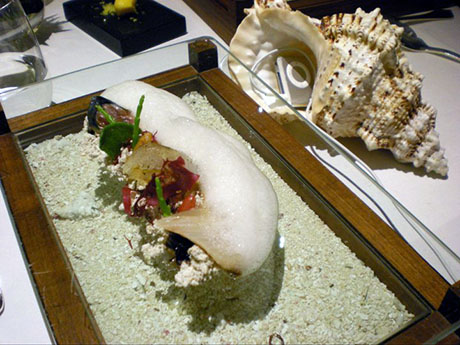
Inspired by Charles Spence’s research, chef Heston Blumenthal’s “Sound of the Sea” dish (oysters, razor clams, and uni served on a “sand” of tapioca and fried panko, then topped with seafood foam) is served with an iPod so that diners can listen to the sound of crashing waves as they eat. Photograph by Naeem Kapadia.

In addition to his IgNobel prize-winning finding that Pringles actually taste crispier when your consumption is accompanied by an amplified recording of in-mouth Pringle crunching, Spence has also demonstrated that higher pitches enhance sweet tastes, while lower tones emphasise bitterness. In The Globe and Mail, Spence speculates that this effect has a biological basis: the tongue naturally curls upward to produce higher-pitched sounds and to draw in sweeter tastes, and downward to make lower tones and to expel bitter food.

Burzynska had noticed a similar effect, finding that higher frequency sounds paired well with both sweet and acidic wines, while lower notes complemented the bitterness of a full-bodied tannic wine.

“Oenosthesia” takes that observation a couple of steps further, resulting in a soundtrack that is not only specially designed to accompany a sequence of wines, but is also made from field-recordings from the vineyards and wineries in which the grapes were originally grown and fermented.

Recording vines 460

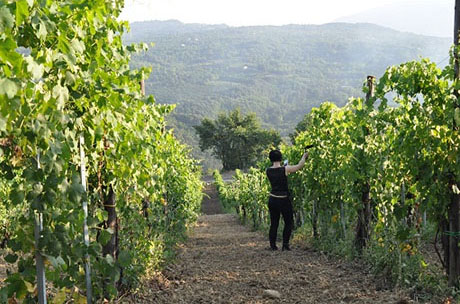
Jo Burzynska, aka Stanier Black-Five, recording in the vineyards near Tufo, Italy. Photograph from the Stanier Black-Five website.

During a week-long residency in the Campania region of Italy in June, Burzynska made extensive field recordings, burying microphones in the soil, hooking them to the wires that the vines are trained on, and even dropping them into vats of fermenting wine. She explained to Radio New Zealand that the process of fermentation can supply an entire acoustic palette by itself:

It was a revelation to me, when I first started recording fermenting barrels of wine, I didn’t realise that different fermentations at different stages sound different. Some winemakers just go and listen to their barrels, and they will be able to tell what stage the fermentation is at.

Based on her own tasting notes, Burzynska then orchestrated the sounds — minimally processed, so as not to distort them — into a composition to accompany, and, at least in theory, enhance three different wines.

The final work has been performed twice — once at the end of the residency, in Italy, and once just a few days ago in New Zealand.

Experiencing Oenosthesia 460

Oenosthesia’s first audience included the local winemakers whose wine and winery sounds were being sampled. Photograph from the Stanier Black-Five website.

The piece begins with the dry, crispy rustling of leaves interspersed with muffled, subterranean gurglings, and a rising chorus of crickets. To accompany this pastoral collage of medium frequencies, Burzynska calls for “a mature Greco di Tufo or similar mid-weight white wine with some richness,” such as Chardonnay.

After six minutes, a series of pops intrudes, gaining speed over the next few minutes to reach a high-pitched, buzzing crescendo that almost sounds like a summer hailstorm on glass, over a backdrop of swirling, rushing liquid. These sounds, of wine-making processes such as agitation and fermentation, will enhance a “youthful Greco di Tufo, spumante/sparkling or comparable minerally high acid white, e.g. Riesling.”

Finally, the piece ends with a lower and deeper sounds, such as the subtle, cyclical drone of the vat cooling systems and the plink-plunk rhythms of the bottling line, and should be accompanied by a full-bodied red, such a Taurasi or a Cabernet Sauvignon.


You can listen to the work in full above; I can attest to the fact that it’s enjoyable even when only paired with a cup of tea, but look forward to improving my next glass of cheap plonk using its synaesthetic qualities. Meanwhile, Burzynska is planning to continue blurring the lines between her two areas of expertise, and has already begun to build an archive of New Zealand winery field recordings. Musical wine labels cannot be far off….

I think I found this via @disquiet, who is worth following either way. 


27 Jul 16:28

CityTarget opens with bikes on billboards, but access an afterthought (UPDATED)

by Michael Andersen (News Editor)
firehose

via saucie
"Given the location of the store, we recognize that many of our guests will arrive on foot or via mass transit."
LOL WHOOPS FORGOT TO RESEARCH~

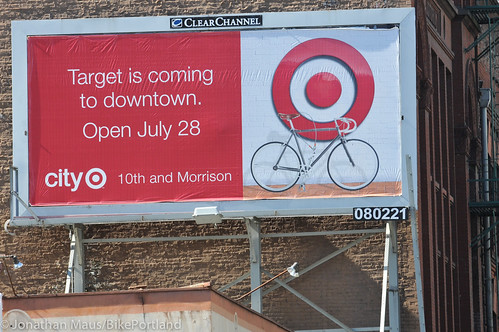
City Target billboard
City Target is using bikes to market their new downtown Portland store.
(Photo © J. Maus/BikePortland)

The nation's smallest Target, which opened its doors on the west end of Portland's downtown Wednesday, was happy to use bikes in their marketing campaign.

"I'm all for Target jumping on the bike bandwagon, but you'd think they'd put some parking in."
— David Backes, customer

That makes sense — the store's urban location and lack of free auto parking mean that the retail giant is banking on bikes to bring in plenty of its customers.

But making it easy to park a bike nearby? Maybe the site managers never got the memo.

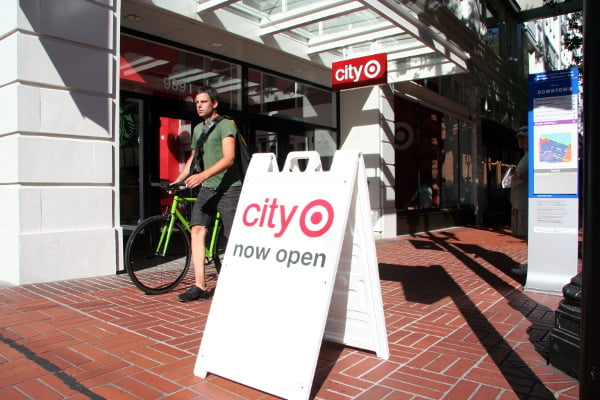
Three days before its grand opening Sunday is expected to swamp the joint with bargain-hunters, bikes had already filled the three bike staples and all the sidewalk fixtures outside the new store at Southwest 10th Avenue and Morrison.

David Backes, who works nearby, stopped by Thursday afternoon to check the place out. He ended up wheeling his bike up and down the sidewalk outside.

"I'm all for Target jumping on the bike bandwagon, but you'd think they'd put some parking in," Backes said.

Looking for parking.
(Photos © M.Andersen/BikePortland)

The two-floor discount store, which the retailer calls a "CityTarget" for its compact urban feel and neighborhood-oriented product selection, is big news for Portland's already-bustling downtown, the city's most prosperous retail area. Portland Monthly reported this month that former Mayor Sam Adams "once described practically stalking company execs" in order to land the tenant, which has signed a 15-year lease for the space and is expected to serve as an anchor for the string of smaller retailers on 10th Avenue.

And there is, in fact, bike parking near the new site. It just happens to be down the ramp into an underground parking garage on the other side of the block. It's not marked — the parking attendant I talked to was confused when I asked him about it — but it is there. There's a pair of elevators nearby — but they don't currently stop at Target's floors, so the only way to reach the store after parking a bike there is to walk up the parking ramp, which includes a painted stripe that seems to be intended for pedestrians, and back around the block.

Here's the bike parking entrance:

And here's the bike parking (presumably intended for employees):

It's possible that there are big plans in the works for bike parking near CityTarget. Like any business in Portland, Target can request an on-street bike corral and would almost certainly get one if it asked; maybe they're on the waiting list. It's also possible that there are unusual restrictions on the sidewalks surrounding the Galleria that somehow prevent more than the three existing staples from being installed outside this major new retailer.

Or maybe not. Three days ago, Target's lead spokeswoman for the launch said she'd need to "gather some bike-specific details" before answering any questions about parking. If she ever gets back in touch, we'll let you know.

Update: Target spokeswoman Erika Winkels did get in touch this morning with an apology for the delay to clarify that there's no bike parking on the site. "What is available is what the city has provided," she said. "Given the location of the store, we recognize that many of our guests will arrive on foot or via mass transit."

27 Jul 16:26

Photo

firehose

via Kara Jean


27 Jul 16:19

Harry Potter on a Sunday Morning

by Matt Thompson
firehose

via Tertiarymatt
UU beat

Public anthropology is something any of us can do and its a practice we can engage in at any scale. I’ve written before about how anthropology helped me speak in front of city council to save the bookmobile and I’ve advocated for a public anthropology that is “fast, cheap, and out of control” — meaning it can be local, easy, and not professionally oriented.

This past Sunday I had the opportunity to do something new that was very rewarding for me. I gave a sermon! I’ve included the text of it here. It’s a long read (I had 20 minutes to fill), but if turning cultural relativism into a religion is your cup of tea you might enjoy it. What a treat it was for me to deliver it.

071

If you’re nostalgic about church but are too anti-authoritarian to put your kids in Sunday school, if you’re interested in your spiritual well-being but can’t stand rules, if you don’t mind a little New Age hugging then check out your local UU. You’ll meet a lot of misfits, hippies, New Englanders, and people who for whatever reason had to walk away from other religions. As my friend Ayla, who grew up in the UU, describes it, “It’s a little bit of Christianity, a little bit of rock and roll.”

Chances are you’ll find other anthropologists, scientists, and professors too. For example my minister has a PhD in physics from Princeton. When I shared with him this story about how some Christian fundamentalists reject Set Theory he said, “Well then, they must object to Godel’s incompleteness theorem as well.” UU’s are a bunch of smartypants.

This sermon was part of a month long series on the theme of Harry Potter…

Harry Potter and Magical Thinking

I must admit I was a little baffled at first when I was invited to give a sermon on the theme of Harry Potter. Why me? Had I lost some kind of bet? I am a cultural anthropologist by training and if there’s one thing we anthropologists are good at it is not feeling uncomfortable in places where we don’t belong and muddling our way through things we have no business doing. “Just figure it out along the way,” is the anthropologist’s maxim.

Imagine that the inhabitants of Hogwarts are like some far-flung tribe and after an exhausting journey from Newport News to this hidden and out of the way place; after having successfully navigated a humiliating and Kafka-esque gauntlet through the Ministry of Magic’s bureaucracy of customs and inspections you, the anthropologist, have arrived in khakis and pith helmet to study this community you know nothing about. You are lonely, far from your friends and family, your bed is hard and the food here tastes funny. You’re a stranger to everyone and can’t seem to make it through a single day without embarrassing yourself by transgressing some to you as yet unknown code of conduct.

Your mission is to learn what you can about this community, about its culture. A slippery topic that. Every human community has a culture and if you made a list of what that entailed exactly, well, you’d have a very long list. But whatever angle you use to get ahold of it, anthropologists are in agreement that culture is by definition something you learn by virtue of your membership in a group. For example, everybody needs to eat. That’s a biological fact. But what you eat, that’s culture. Proteins, carbs, and vitamins are inherent qualities of food. But who is cooking and cleaning, and who is being served, that’s culture.

So out of sheer boredom and loneliness you go out to be with your tribe and make some observations. You observe that everyone at Hogwarts is engaged in this activity called “magic.” You start to look for a pattern and notice that magic always has practical application. There’s a point to it, you’re trying to achieve some end. The function of Alohomora is to unlock doors, the function of Oculus Reparo is to mend eyeglasses. Now you’re ready to make a generalization, magical spells serve a purpose. The magician is trying to achieve something by means of magic. In this way magic replicates what in our culture we call “technology” it is a tool that allows you to do something in the world.

Being that you are at a school for the training of witches and wizards you are able to observe apprentice magicians being trained by masters. It becomes clear that magic is systematic and rule bound, the masters know how to do it properly and must teach technique to their young charges. There is a right way to cast a spell and a wrong way. The first time Harry Potter travels by flue powder he goes with the Weasley family to Diagon Alley he mispronounces the name of his destination (Diagon Illy) and winds up in the wrong place by mistake. When Gilderoy Lockhart attempts to mend Harry Potter’s broken arm he only succeeds in removing the bones from his arm altogether. So, spells can fail.

If there is a right and wrong way to do magic, there must be certain rules a proper spell should follow. Being ignorant of magic you ask, “Where do these rules of magic come from?” Judging from the behavior of the inhabitants of Hogwarts, magic is an inherent property of the universe. Like gravity, magic is an invisible force that is omnipresent and real although intangible. Through concentrated study one can learn the rules of magic in order to command its power, it reveals to the student something about the nature of the universe. In this way the study of magic has much in common with the study of what we call “science,” if one only follows some basic assumptions magic provides an orderly and logical way to understand and explore the universe. Magic, being rule bound, produces outcomes that are, to a wizard at least, predictable and repeatable.

You notice that in order for the witches and wizards of Hogwarts to do magic properly they must be in possession of certain required artifacts. All the students and professors have their various books, some of them have animal familiars too: a cat, an owl, a toad, a rat. To cast a spell a wizard must have a wand. To concoct a potion a witch must have a caldron. When Ronald Weasley’s wand breaks and he pathetically tries to tape the bits back together he can no longer cast a proper spell. So while it may be that magic is invisible, it is still definitely bound up in important ways with tangible objects. Things.

So far we’ve got magic requiring certain mental operations – knowledges and beliefs that you must learn, casting a spell requires certain behaviors that you must practice – principally speech, and to do magic you need to be in possession of magical artifacts like wands, brooms, and caldrons.

II.

Of course, there are also important differences between magic and science in terms of how they explain cause and effect. In today’s children’s focus we saw how sensible Frog gave his moody friend Toad practical advice on how to grow a garden. You give it water and sun and leave it alone. But the way Toad acts is more in keeping with magic. Starting from the base assumption that his seeds are scared Toad proceeds in a logical manner to make them feel safe with stories, poems, and songs. In the end Toad’s garden grows, although he and Frog might have different explanations for what caused the flowers to grow. We might call Toad’s conclusion that it was in fact, very hard work a correct misinterpretation.

Everyone goes through life making certain assumptions about the world and magic is no exception. And though magical thinking may seem exotic at first, as it turns out, it is not so unfamiliar. Sir James George Frazer lays out some good advice for us in his book “The Golden Bough.” Generally speaking there are two sorts of magic: the sympathetic and the contagious, although there is so much overlap it is nearly pointless to keep them separate as discreet categories.

The sympathetic principle states that like produces like and it allows for action at a distance. So, for example, while Harry Potter fights the basilisk in the Chamber of Secrets and things are going quite badly for him Fawkes the Phoenix flies in and drops the Sorting Hat into their melee. Harry draws from the Hat the sword of Godrick Gryffindor. He is only able to do this because of the great similarity, or sympathy, between his bravery and the bravery of Godrick Gryffindor.

Harry also shares many uncanny similarities with Lord Voldemort, his ambition makes the Sorting Hat pause and consider placing him in Syltherin House, his parselmouth allows him to talk to snakes, his rage leads him to seek revenge against Sirius Black before he learns his innocence. When Harry first departs for Hogwarts at age eleven, the proprietor of Ollivander’s Wand Shop selects for him the same magic wand that Lord Voldemort possesses. Harry Potter’s lightening bolt scar throbs painfully on his forehead when Voldemort is near.

This is action at a distance. Harry shares this sympathetic relationship with Voldemort, one which binds them together even when they are apart, because something of his essence transferred to Harry when The Dark Lord first attacked him as an infant. Contagious magic explains why this should happen. The contagious principle allows for transference and transformation, a wave of a wand and one thing changes into another. In killing Voldemort as an infant, Harry Potter takes on some of his qualities by virtue of having made contact with him.

Another example of contagious magic is the Polyjuice Potion brewed up by Hermione Granger. In order to dupe class bully Draco Malfoy into revealing who has opened up the Chamber of Secrets, Harry and Ron transform themselves into Draco’s henchmen, Crab and Goyle. The Polyjuice Potion allows one to temporarily take on the physical appearance of another and the final ingredient the boys need to collect is a bit of their hair. By virtue of having been in contact with Crab and Goyle the victim’s hair transfers their essence to the potion, the potion then transfers that to the boys who drink it and transforms them into Draco’s cronies. One thing passes to another like a contagion. Contagious magic.

What magical thinking allows is for one to recognize connections where there are no obvious connections, to create likeness where the likeness is not necessarily real. In poetic contexts we would call such reasoning metaphorical. Why exactly humans have evolved the ability to think in terms of metaphor is an interesting question to ponder. Maybe it goes back to the way we learn language and culture as children, that gift of mimicry is physical – learning to copy the sounds coming out of adult’s mouths is how we all learned to speak – but also intellectual – that is we learned to copy their thoughts and values as well. In anthropology we call the human disposition towards interaction with the world by copying it “mimesis” and it is what allows us the gift of creating representations in art, in poetry, in play.

The German philosopher Walter Benjamin muses, “Children’s play is everywhere permeated by mimetic modes of behavior, and its realm is by no means limited to what one person can imitate in another. The child plays at being not only a shopkeeper or teacher but also a windmill and a train. Of what use to him is this schooling of his mimetic faculty?”

There is a close relationship between the human propensity towards magical thinking and the fact that we all possess a language. What language is and where it came from is rather mysterious. And being that, like magic or gravity it too is intangible, we are in need of a way to get a hold of this immateriality. We need to focus on speech because through speech language becomes observable. I cannot know what other people are thinking, but I can observe people engaged in conversation and get a pretty good idea.

As we noted earlier every magical spell includes words that must be spoken and, moreover, they must be spoken correctly. If I were to wave a wand and say the words of a spell before you right now that would not necessarily “cause” anything to happen. But then again, maybe I’m just not doing it right. After all, there is a type of speech act the linguists call performatives where this actually does happen.

Along with magical spells the performatives include bets, promises, oaths, and curses – they are speech acts that are neither true nor false but instead do things by virtue of being spoken. The classic example of this is wedding vows, which now that we look at them from this new perspective seem a lot like something from Hogwarts. Here’s how it went at my wedding. My fiancée and I had been living together for some time yet on the day of the wedding we were forbidden to see each other, that would be “bad luck” so she did not sleep in my bed the night before. Then at the wedding I got dressed up in these strange clothes that I would never wear in ordinary life. I was standing in front of this ritual official whose job it is to mediate between the living and the supernatural, he was also wearing strange clothes. I spoke some ritualized words and gave her a ring made of yellow metal, she did the same to me.

Abracadabra! We were married. What happened? All we did was speak a few words! In Hogwarts using words to transform on thing into another requires a passing grade in Professor McGonagall’s Transfiguration class. Through the speaking of words we were transformed. Performativity allows you to do the greatest magic trick of all, create something out of nothing – watch me pull a rabbit out of my hat – or make something real disappear. Now you see it, now you don’t. Just a boyfriend and girlfriend, nothing up my sleeves, and then presto-changeo, a married couple. Performatives make the man-made seem natural. Of course saying “I do” and exchanging metal circles with rocks in them is how you get married. Isn’t that how everyone does it?

Perhaps nowhere is the power of productive speech on clearer display than in giving a person, place, or thing its name. Like a spell our ability to name creates something out nothing and in many folkloric traditions knowledge of a person or thing’s True Name allows power over them. Of course the seminal instance of this in the European cannon is Rumplestiltskin. And it continues to be common element in fantasy fiction from “The Hobbit” to Ursula LeGuin’s “Earthsea” series.

Names play a prominent role in the Harry Potter series as well. In the first book, Harry is suffering under the petty tyranny of the Dursley family, he is nothing, a nobody. With the revelation that he is a wizard Harry is stunned to find that there exists an alternate reality where everyone already knows his name. He’s not a nobody, he’s famous. He is The Boy Who Lived. Likewise, Lord Voldemort wields power over wizarding kind as You Know Who and He Who Shall Not Be Named. They do not speak his name, of course, because names summon. Who has not heard a person cry out to God in a moment of pain, shock, or irritation? Saying the name of God draws him nearer to you. Speak of the Devil and he shall appear. Harry does speak the name of Lord Voldemort because he is not afraid of him, his disdain for his enemy is manifested in his refusal to acknowledge his power.

III.

Does the strange world of the Hogwarts tribe now seem more familiar? The fantastic feats of magic that permeate the fictional world of Harry Potter have much in common with the way real people think and act, even if, most of the time, we don’t notice we’ve been doing it since childhood. And we’re left to ponder, what’s the difference between magic and religion anyway? Not much it turns out. JK Rowling anticipated this too. In an attempt to head off accusations that her novels were pagan propaganda Christmas was made to figure prominently in the early books. The Fundamentalists skewered her anyway.

From anthropological standpoint casting transfiguration spells is no different than turning bread into the body of Christ, but then the power of magic to heal is no less than that of the Eucharist. Both magic and religion give the user a sense of confidence in moments when the world seems beyond control. And who wouldn’t want a little extra control when it seems utterly random that one job applicant is picked over another or that one person can be healed of cancer while another dies? Who wouldn’t want the hurricane winds to spare that tree branch that hangs precipitously over the roof or for their team to score one more goal? Magic helps us feel better about living in a world where chance and risk can have costly consequences.

The difference between magic and religion is all in the rhetoric, it is part of the story Europeans told themselves about the rest of the world in the age of empire. We have religion, they magic. We have history, they have myth. We are modern, they are primitive. Magic is as perfectly utilitarian as any technology and magical thinking as logical as any science although, clearly, they fare better in different domains. Why are we here? What is a good life? What is the difference between right and wrong? Science isn’t very effective at answering those sorts of questions.

It’s a funny thing belief. It would seem there’s something about us humans such that we can’t not to do it. We have to believe. There’s a great diversity, of course, in terms of what that is. In what fills that belief shaped slot in our heads. And if you’ve tuned into any of the public debates around politics and religion, two domains where belief is paramount, it would seem that there’s nothing more important than what you believe in. Sticking to your principles! Having strong convictions! But do your convictions serve a practical end? Are they a way for you to do something in the world?

To me the Unitarian Universalist church offers a refreshing, comforting, almost Zen-like alternative. It says: what you believe doesn’t matter so much as how you treat others. The UU ethic is, like magic, focused on the practical. What good are your principles and convictions if you can’t treat others with civility, if they lead to the self instead of towards feeding the world? Through our ethical mode of being we seek to transform the world, to create something out of nothing.

Two weeks ago Reverend Andrew advised us to turn our concentration away from what we believe and towards what we do. Remember that magic is active, that it is something to be performed in particular by means of carefully chosen and powerful words. I think this is the great promise of our UU fellowship and the way in which we lay claim to our own kind of magic. By being conscious and intentional in the way that we act and the way that we speak. Those beliefs are but intangible, your deeds are for everyone to see.


27 Jul 07:22

Photo


27 Jul 05:39

Pope Francis's Lessons for the GOP - Daily Beast


Daily Beast

Pope Francis's Lessons for the GOP
Daily Beast
The new pope hasn't been afraid to challenge the entrenched interests that have sullied his church's perception. His style of reaching out is just what might save the Republican Party. Like · Tweet. On the heels of Pope Francis's triumphant visit to Brazil for ...
Pope Francis' social reform message is exactly what Brazil needs to hearThe Guardian

all 797 news articles »