
I can’t believe there are only that many Maccies in Northern Ireland???


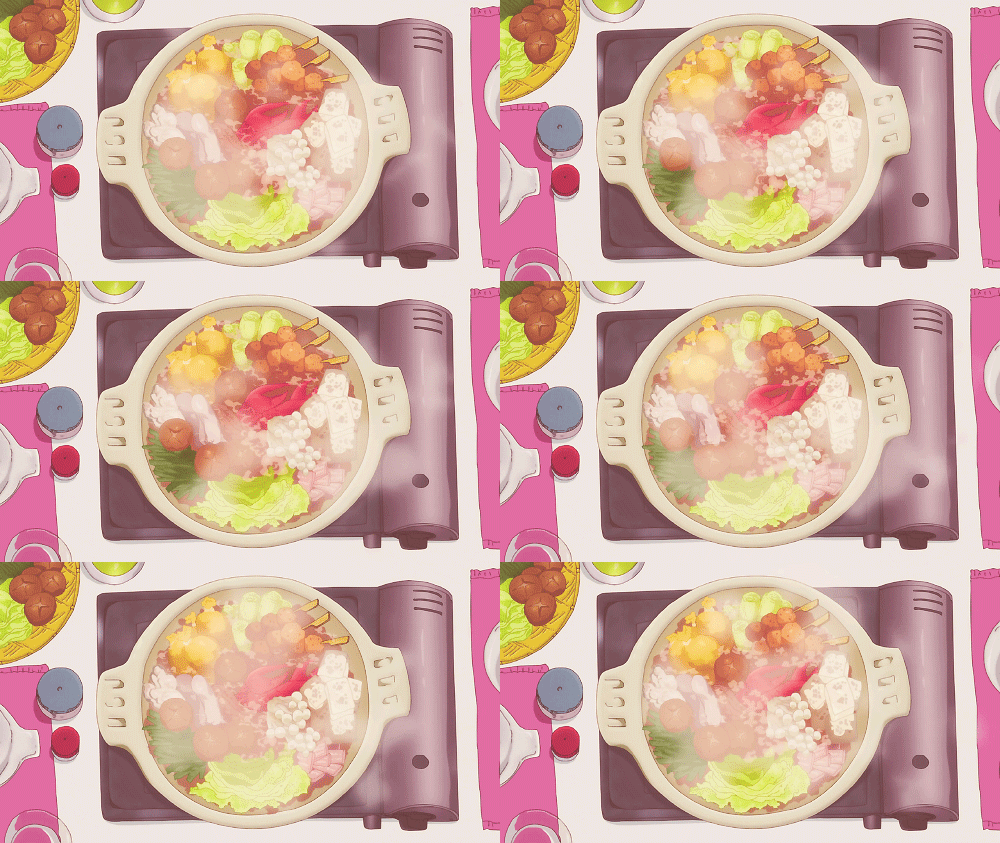


I don’t even know what half of this food is supposed to be but I don’t fucking care, I want it. look at how fucking delicious everything looks. if you dare to even say looking at this doesn’t make you hungry, I know you’re a lying little piece of shit.



By Emily Gera on Aug 09, 2013 at 6:56a
A real-world go-kart based on Luigi's bumblebee vehicle from Mario Kart is currently being sold on eBay by user Heather651, with bidding ending later tomorrow.
The two-year old kart was part of a grand prize for a Disney Mario Kart 7 3DS sweepstake in 2011. The kart, which weighs in at around 100 lbs, was part of a prize valued at $14,000. Now it's currently priced at $1,000 on the eBay marketplace.
Check it out in full right here.
Tap for more stories


Singapore-based photographer Fong Qi Wei has created a series of composite images that portray the passage of time in beautifully imaginative fashion.

    
|
At the intersection of wearable electronics and heart-rate monitors are results that tell us not just where humans do and do not like to be touched, but also how our bodies betray the fact that some of the touches we find “uncomfortable” can in fact calm us down.
The video above, which has just been posted online, depicts research first published two years ago by Sylvia Hou-Yan Cheng of the Human Media Lab at Queens University in Kingston, Ontario. The point of the study, conducted with shirts covered in 24 touch-sensitive patches on the shoulders, arms, back, chest and abdomen, was to determine where players of an electronically-enhanced game of tag would be comfortable touching one another.
Cheng’s results are straightforward: People report that they aren’t comfortable being touched anywhere but their shoulders, arms, and upper back. But all participants in the study were wired with heart rate monitors, and those monitors told a different story.
It’s long been known that humans’ heart-rate decelerates when we are touched in certain ways. Psychologists have taken this to signify the calming effects of touch. But many types of touch are off limits, culturally. Indeed, two of the participants in Hou-Yan Cheng’s research—a man who was asked to touch sensors on the upper chest of a woman, and the woman herself—nervously reported that in their own cultures they would have to be married before this kind of touch would be acceptable.
Yet while both male and female subjects reported that they were uncomfortable being touched on the chest, and their heart rates sometimes went up before being touched there, the touch itself caused their heart rates to decrease.
The study shows what you might not need a research grant to work out: When future interaction designers come up with clothes that can be used to communicate information through touch, they’ll have to be careful where they place the sensors. But it also shows that even as culture determines what kind of touch we find acceptable, its ability to calm us is fairly universal.


Tipping, as a compensation scheme, is great for everyone.
Restaurant customers like tipping because it puts them in the driver’s seat. As a diner, you control your experience, using the power of your tip to make sure your server works hard for you.
Restaurant servers like tipping because it means their talent is rewarded. As a great server, you get paid more than your peers, because you are a better worker.
Restaurant owners like tipping because it means they don’t have to pay for managers to closely supervise their servers. With customers using tips to enforce good service, owners can be confident that servers will do their best work.
There’s only one problem: none of this is actually true. I know because I ran the experiment myself.
For over eight years, I was the owner and operator of San Diego’s farm-to-table restaurant The Linkery, until we closed it this summer to move to San Francisco. At first, we ran the Linkery like every other restaurant in America, letting tips provide compensation and motivation for our team. In our second year, however, we tired of the tip system, and we eliminated tipping from our restaurant. We instead applied a straight 18% service charge to all dining-in checks, and refused to accept any further payment. We became the first and, for years, the only table-service restaurant in America where you couldn’t pay more money than the amount we charged you.
You can guess what happened. Our service improved, our revenue went up, and both our business and our employees made more money. Here’s why:
You can see that tipping promotes and facilitates bad service. It gives servers the choice between doing their best work and making the most money. While most servers choose to do their best work, making them choose one or the other is bad business.
By removing tipping from the Linkery, we aligned ourselves with every other business model in America. Servers and management could work together toward one goal: giving all of our guests the best possible experience. When we did it well, we all made more money. As you can imagine, it was easy for us to find people who wanted to work in this environment, with clear goals and rewards for succeeding as a team.
Maybe it wouldn’t work in every restaurant, in every city. Maybe the fact that it worked so well for us was due to some unique set of circumstances. Then again, other service industries like health care and law aren’t exactly lining up to adopt tips as their primary method of compensation. So maybe we’re all just being suckered into believing tipping works.
It’s something you can think about, at least, the next time you’re waiting on a refill of iced tea.
Result of various workplace behaviors in normal workplace versus in tipped restaurant:

Follow Jay on Twitter at @eltakeiteasy. We welcome your comments at ideas@qz.com.


I recently spotted what appeared to be remarkably modern looking haircuts in Albrecht Druer’s woodcut of 1521 AD[i]. This image shows a group of Irish soldiers[ii], most likely mercenaries, who were fighting on the European continent during the early 1520s. I soon discovered that, far from being unusual, this distinctive hairstyle was actually very popular amongst the native Irish during the 16th century.
Referred to as a ‘glib’ this style involved the hair at the back and side of the head being trimmed short, while at the front and top it was allowed to grow long, resulting in a large fringe, which fell down over the face.

The Beijing That Never Was: A Two-Center Beijing Under the 1950 Liang-Chen Proposal http://bit.ly/1bhXJEX
firehoseburied lede: the Post's pension is running a half-billion-dollar surplus
firehoseone of many weird things that happened while I was in LA
firehoseone of many weird things that happened while I was in LA
Hot on the heels of my menu donation to the New York Public Library comes this intriguing news story about a team of ecologists using Hawaiian restaurant menus to reconstruct long-term changes in local marine populations. The menus provided the evidence needed to trace historical ecological shifts during “a critical 45-year gap” in the state’s early twentieth-century fishery records.
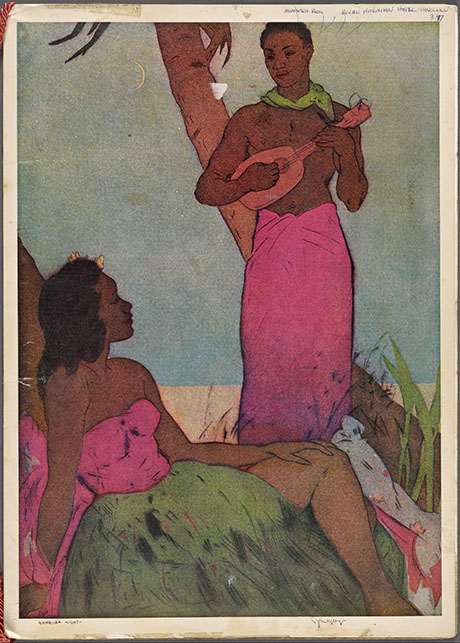
IMAGE: Menu cover, Monarch Room, Royal Hawaiian Hotel, March 25, 1977. NYPL Menu Collection.
Drawing on library and museum collections, but mostly on souvenirs saved by friends and colleagues, Kyle S. Van Houtan of Duke’s Nicholas School of the Environment, Loren McClenachan, assistant professor of environmental studies at Colby College, and Jack Kittinger of Stanford University’s Center for Ocean Solutions analysed 376 menus from 154 different restaurants in Hawaii, dated from 1928 to 1974.
The menus, Van Houtan et. al. explain in a peer-reviewed letter in the August 2013 issue of Frontiers in Ecology and the Environment, came from “a range of eateries from local businesses to larger restaurants serving tourists (we excluded 60 cruise-ship menus because their pantries were not locally sourced).”
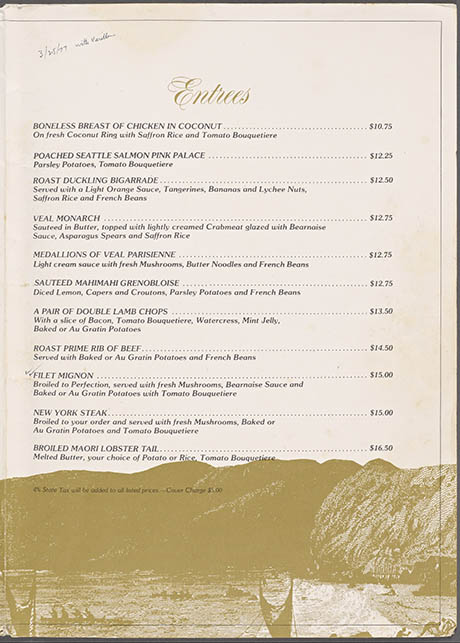
IMAGE: Entrees, Monarch Room, Royal Hawaiian Hotel, March 25, 1977. NYPL Menu Collection.
By counting the mentions of different species on the menus over time, the team were able to track a striking decline in Hawaii’s nearshore fishery stocks and an increasing reliance on larger, oceanic species. Reef fish, jacks, and bottomfish went from being extremely common before 1940 to appearing on less than 10 percent of menus by 1959, the year Hawaii became a state. Restaurants filled the gap by serving large pelagic fish, such as tuna and swordfish, which appeared on 95 percent of menus by 1970.
The scientists benchmarked their menu-derived data against early market surveys and later government fishery statistics from either side of the gap in the historical record, giving them confidence that their findings accurately reflected shifts in wild fish populations rather than just consumer preference or culinary trends.
Hawaii, the team admitted, was particularly well suited for their experiment in menu archaeology as historical ecology because “its remote location meant most locally consumed seafood was locally sourced.”
Nonetheless, the menu presence of some species didn’t accurately reflect changes in the marine environment: molluscs and shrimps were mostly imported from the mainland United States, frogs were sourced from local aquaculture operations, and the majority of the islands’ sea-turtle harvest was sold in fish markets rather than restaurants. “These latter instances,” Van Houtan noted, “may still present important information, such as the market forces supporting wildlife harvests.”

IMAGE: Menu occurrence of fishery items follows the rise and fall of local fisheries: wild-caught offshore fish species (top panel), imported and aquaculture species (middle panel), and wild-caught inshore species (bottom panel). Chart from Kyle S. Van Houtan, Loren McClenachan, and John N Kittinger, 2013, “Seafood menus reflect long-term ocean changes,” Frontiers in Ecology and the Environment 11: 289–290.
The team conclude their report by comparing restaurant menu analysis to the archaeological excavation of a midden in terms of its potential contribution to the historical environmental record — an unwitting testament to over-consumption, ecological pressures, and resource shifts. These menus “were often beautifully crafted, date-stamped, and cherished by their owners as art,” Van Houtan added, but “the point of our study is that they are also data.”


