Shared posts

15 Aug 22:58

Crazy Glitch town in Animal Crossing: New Leaf ⊟ I have no idea...

by ericisawesome


Crazy Glitch town in Animal Crossing: New Leaf

I have no idea how this town’s mayor managed it, but they created a ridic town where flowers and public works projects are placed under water, and where a structures are smushed together to form a mega fountain. 

You can visit the glitch town with this dream code: 3000-0845-9227. Big ups to the Daily Chupon for the screenshots.

BUY Animal Crossing: New Leaf, AC:NL guide, upcoming games
15 Aug 19:57

Photo


15 Aug 18:26

'The Daily Show' Would Be Fine Without Jon Stewart

People weren't necessarily expecting John Oliver to fail, but no one was predicting he'd be this good this quickly.
15 Aug 17:51

Wealthy, Famous Individual Described As ‘Totally Down-To-Earth’ By Thousands Of Acquaintances, All Of Whom Are Lying

LOS ANGELES—A high-powered, rich, and famous industry player is routinely described as “low-key” and “totally down-to-earth” by countless acquaintances and friends, each and every one of whom is lying through their teeth, sou...


15 Aug 17:51

Man’s Fantasy Football Team Names Over Past 5 Years Depict Slow Descent Into Madness

CHICAGO—Competitors in Yahoo! Sports Fantasy Football league Super Bowl Shuffle expressed concern Thursday about the mental state of league member Evan Reeves, whose choice of team names over the past five years reportedly paints a picture of a man ...


15 Aug 17:51

London has way too many bees, and they’re hungry

by Todd Woody
London bees

London is killing bees with kindness.

As honey bee populations have crashed in Europe and the US in recent years, Londoners have taken to raising bees in their backyards with all the enthusiasm of Californians saving the whales in the 1970s. Over the past five years, the number of urban beehives in the UK capital has more than doubled to 3,745, with 10 beehives per square kilometer (.39 square miles), according to an article published in the latest issue of the journal The Biologist.

Good for the bees, right? Not quite. At such densities, there simply isn’t enough pollen currently available in Greater London to feed the bees, argue University of Sussex scientists Francis Ratnieks and Karin Alton.

“If there is a growing shortage of flowers due to agricultural intensification and urbanization, will increasing the number of hives help honey bees?” the researchers write. “Would we try to help the population of elephants in a region of Africa by introducing more elephants if it was known that there was a food shortage?”

Ratnieks and Alton calculate that each additional beehive in London needs enough pollen produced by 1 hectare (2.47 acres) of borage or 8.3 hectares (20.5 acres) of lavender. “Clearly, this, or the equivalent in other flower varieties, has not been provided, and neither would it be practical to do so,” according to the scientists.

The consequence of London’s bee boom is growing competition for food that crowds out other apian species, leading to smaller, hungrier bees.

So what’s the solution? The scientists urge bee-loving Londoners to keep fewer hives and plant more flowers to feed the existing population.

Though as Quartz reported yesterday, that could be problematic.

A study by the Pesticide Research Institute and Friends of the Earth in the US found that plants sold by nurseries as bee-friendly were contaminated with the same agricultural pesticides linked to Colony Collapse Disorder. The still-unexplained affliction has wiped out 10 million hives in the US over the past six years. Those honey bees pollinate an estimated $30 billion worth of American crops that supply a third of the country’s food.

But Britain’s backyards are likely a safer place for bees given the Friends of the Earth’s successful campaign to persuade some of the country’s largest nurseries to stop selling plants pre-treated or grown with a class of agricultural chemicals called neonicotinoids.


15 Aug 17:49

Some Lawbreakers the Russians Have Overlooked

by Eli Sanders

Spotted by Colbert:

You go to jail in Russia for being gay. Someone better arrest those nesting dolls. They're ladies inside other ladies!
— Stephen Colbert (@StephenAtHome) August 15, 2013

[ Subscribe to the comments on this story ]

15 Aug 16:58

Dartmouth rescinds offer to dean over past anti-gay statements | Inside Higher Ed

by hodad
77302ab1d83ab19dcc5841ff37e3cf2e
hodad

Local drama

Some associates of Tengatenga have said that, in the context of his church, he was a supporter of more moderate policies toward gay people. One Anglican priest told The Boston Globe: “You are asking the impossible of someone coming out of that African situation.... Just rescinding that [appointment] is to show a lamentable lack of understanding of circumstances that are outside the confines of privileged North America.”

But many at Dartmouth said that the key question for the college was whether a position seen as providing moral and ethical leadership at the college should go to someone who had advocated anti-gay policies. A draft letter circulated on campus by the Dartmouth NAACP said: "The LGBTQ community at Dartmouth is a historically subordinated one, and it is disturbing and reprehensible that the leader of Dartmouth's premier spiritual and social justice organization might harbor discriminatory thoughts about those who might look to him and the Tucker Foundation for guidance."

Original Source

15 Aug 16:56

Photo


15 Aug 16:43

Capital Letters! Space Hulk Launch Trailer

by Craig Pearson

By Craig Pearson on August 15th, 2013 at 5:00 pm.

What's it called again?
Deep breath. Take it right in. Expand those lungs, fill them with air until you feel like you’re going to burst. Now exhale. Feel your body contract as your breath heaves out of it. Remember that feeling, because it was taken in a pre-Space Hulk world. At midnight the game unlocks on Steam, and from then on each breath will be tainted with the smell of oil, death, burning Genestealer flesh, and if you live anywhere near a Lush shop, the lingering aroma of boutique soap. Not even death and war can cover that smell up.

I know a fair few people who are watching their clocks right now. Their expectations for Full Control’s recreation of the classic board game seem ridiculously high, but then Alec’s short time with it was enough for him to quit RPS for three months and sit at Steam just waiting for it. He’ll be back, but he won’t be the same man. Everyone who sees it comes away goggley eyed and dripping with the enthusiasm. Lead developer Thomas Lund has that effect when he demos it.

Here’s his baby’s launch trailer.

Where will you be at 12.01am on Friday the 16th of August?

15 Aug 16:33

Microsoft confirms Skype is bundled with Windows 8.1

by Tom Warren
firehose

great
uninstall

Microsoft is revealing the next part of its Skype strategy today by confirming it plans to bundle its voice and video calling service into Windows 8.1. While the plans had been previously rumored, and a recently leaked near-final Windows 8.1 build demonstrated the integration, Microsoft is officially confirming the bundling today. The Skype application will take the place of Microsoft's Windows 8 Messaging app, providing voice, video, and instant messaging.

The announcement isn't surprising given the company's integration with the Xbox One, Outlook.com, and even the Office Outlook desktop email client. Windows 8.1's Skype integration includes the ability to answer voice and video calls from the lock screen, a change that's designed for the upcoming 7- and 8-inch tablets. Microsoft says the Skype bundling is part of "more than 20 new and improved Microsoft apps and services that come as part of Windows 8.1."

15 Aug 16:32

Fired for help in exonerating wrongly convicted man, court clerk says she 'would do it again'

by Chris Welch

A court clerk who helped exonerate a man wrongly imprisoned for rape was fired in June, and now she's speaking out about the ordeal. Robert Nelson was convicted of rape in 1984. After two previous motions for DNA tests that could clear his name were rejected, 70-year-old clerk Sharon Snyder decided to step in and better his odds. She provided Nelson's sister with a successful DNA motion from another case, giving Nelson a better idea of how to properly seek the tests. His third request was granted, and ultimately Nelson was cleared of a 1984 rape conviction; he'd been serving time for the crime since 2006.


Fired for providing a public document

But for her good deed, Snyder was fired from her position nine months before she was due to retire. Jackson County Circuit Judge David Byrn said Snyder had gone too far in assisting Nelson, violating a number of court rules in the process. Specifically, by providing Nelson's sister with a motion that could help her brother's case, Snyder was found to violate Canon Seven, which the judge said "warns against the risk of offering an opinion or suggested course of action." Thankfully Snyder's pension remained intact despite the forced exit, and in an interview on MSNBC, she says she'd do it all over again. "I think that the law should be changed, that judges should be taken out of the mix on deciding these DNA motions, and they should automatically be granted."

Last month, the FBI launched an internal investigation that will see the bureau revisit over 2,000 cases that hinged on hair sample evidence. The study will examine "whether analysts exaggerated the significance" of those samples and seek to uncover any cases where results were reported inaccurately. DNA tests, the same tool that helped Robert Nelson find freedom, will be provided in instances where the FBI discovers itself to be at fault.

15 Aug 16:19

BattleHawk wants to be your own personal kamikaze robot

by Sean Gallagher
firehose

everything is always exploding beat

BattleHawk, a five-pound flying bomb that can wait for a half-hour before striking its GPS- and video-designated victim.
Sean Gallagher

WASHINGTON—At this week's AUVSI Unmanned Systems conference in Washington DC, while flocks of vendors vied for attention with their small unmanned systems technology, Textron Defense Systems unveiled a small drone with an added special surprise—it's also a flying hand grenade.

Designed to be carried by an infantry squad, the BattleHawk is an approximately five-pound collapsible drone with an onboard video camera, all packed in a spring-loaded launch tube. The battery-powered BattleHawk can stay in the air for as long as 30 minutes and can be controlled from up to five kilometers away.

Those characteristics alone don't match some of the other small-unit surveillance drones that have been in service for much of the past decade. But that's because BattleHawk isn't designed to be a persistent eye in the sky—it's a "loitering munition."

Read 6 remaining paragraphs | Comments


15 Aug 16:18

Astronomers discover an insanely strong magnetic field

by George Dvorsky
firehose

"fridge magnet" as a unit of measurement

Astronomers discover an insanely strong magnetic field

The dead core of a once massive star is producing one of the most powerful magnetic fields ever recorded by scientists. Measuring a mere 12 miles across, the "magnetar" is exerting a force 20 trillion times stronger than a fridge magnet.

Read more...


15 Aug 16:18

Yahoo's beautiful new weather app comes to Android

by Dan Seifert

Yahoo's redesigned weather app for iOS has been receiving praise and accolades for its gorgeous design and usability all year. In fact, the updated weather app included with iOS 7 appears to borrow more than a few ideas from Yahoo's version. Apple even recognized Yahoo's design chops with a Design Award at this year's WWDC. Now Yahoo is bringing that same design sense and feature set to Android.

The updated Yahoo Weather for Android, available across the world today, offers the same full bleed design as its iOS counterpart, and similarly crisp typography. Background images are handled by Flickr, and are specific to each location. In addition to the basic weather reports it previously offered, the app now provides a wealth of weather data, including 10-day forecasts, hour-by-hour predictions, chance of precipitation, wind and pressure, moon phases, UV patterns, sunrise and sunset times, an an interactive map. It also has a set of widgets that work on the home or lock screen, as well as a persistent notification in the status bar if you want it.

Yahoo Weather can sync saved locations from a Yahoo account and provide severe weather alerts. It also supports landscape viewing to get a better look at the Flickr photos on display. Needless to say, weather reports on Android just got a whole lot better looking. The updated Yahoo Weather will be available for free in the Google Play Store today.

15 Aug 16:17

Editorial for iPad is the new text editor to beat

by Jeff Blagdon
firehose

"Under the hood of Editorial is a complete Python interpreter and more than a dozen libraries for operating on images, scripting the editor, making HTTP requests, and using the iPad’s clipboard. As long as you know a little bit of the language, the only thing holding you back is your imagination. But if you've never written a line of code (or even if you have), Editorial has another, more accessible way to create custom actions called Workflows."

A+
somebody throw together a markdown grep styler

I realize I’m probably in the minority, but to me, the iPad is a lot more than a consumption device; it’s a real computer. Sure, it has all the benefits that usually get touted whenever tablets come up — light weight, small size, long battery life. But there's more to it. There's the clarity and focus you get from the single window, and the speed and ease of the touch interface. There are limitations, like the lack of sophisticated software you need to really be efficient when you're working at a computer. But developer Ole Zorn is showing the world just how powerful of a tool the iPad can be for getting "real" work done with his Markdown editing opus, Editorial.


It makes automation simple enough that non-programmers can do it

This isn't a simple app, but that’s not what it sets out to be. It is an incredibly nimble and customizable editor and previewer for writing in Markdown, a lightweight markup language that makes it easy to add the kinds of formatting you see on the web and in rich text documents (bold, italics, hyperlinks, etc). But even that sells it short. I would call Editorial a laboratory for carving up and reassembling text in the fastest, most flexible, most natural way possible. The comparisons to desktop text editors like Sublime Text are obvious, but Editorial succeeds where Sublime doesn’t; it makes automation simple enough that non-programmers can do it.

Because the text you write in Editorial can easily be converted into HTML, it’s an ideal tool for writing on the web, but Markdown is readable enough that it's suitable for everyday tasks, too. Over the past couple of years, there has been an explosion in the popularity of Markdown editing apps for both OS X and iOS, but where Editorial stands apart is in its embrace of power, giving experienced users the tools to work with the speed and comfort you’d ordinarily find only in a desktop editor.

Theverge1_560

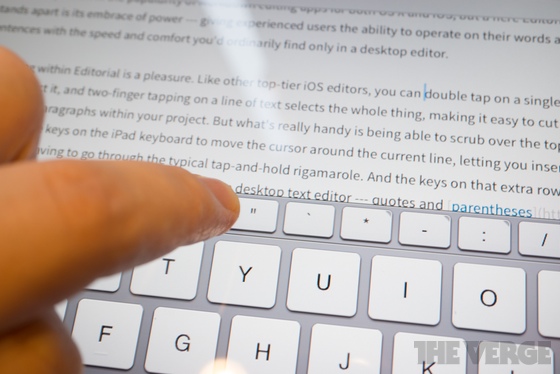
Navigating inside Editorial is quick and simple once you figure out where everything is. An immediate standout feature is being able to scrub over the row of convenience keys on top of the keyboard to slide the cursor along the current line, letting you insert text without having to go through Apple's tap-and-hold rigamarole. (The idea works so well, it makes me wonder why Apple hasn’t implemented the feature itself.) The convenience keys behave how you’d expect from a real text editor with quotes, parentheses, and asterisks wrapping the selected content. And just like implementations in iA Writer, Byword, and others, the text in the editor gives you a live preview. Formatting characters like asterisks don’t disappear, but they’re rendered in faint grey, bold text appears bold, links are blue, etc.

The only thing holding you back is your imagination

The basic editing functions are great, but the really impressive part of Editorial is its support for scripting and automation. The developer, Ole Zorn, is the man behind the groundbreaking Pythonista for iOS, and the app’s fingerprints are visible everywhere. Under the hood of Editorial is a complete Python interpreter and more than a dozen libraries for operating on images, scripting the editor, making HTTP requests, and using the iPad’s clipboard. As long as you know a little bit of the language, the only thing holding you back is your imagination. But if you've never written a line of code (or even if you have), Editorial has another, more accessible way to create custom actions called Workflows.

Theverge1_560

If you’ve ever used OS X's Automator you know everything you need about Workflows. Tapping on the wrench in the top-right corner of the editor brings up a list of pre-fabbed actions for doing things like emailing the contents of your document (as nicely formatted HTML, if you prefer), producing a list of statistics including word and character counts, and searching Wikipedia. Tapping the "+" button pulls up a drag-and-drop interface for building your own actions out of configurable blocks. Exploring the built-in options is a great way to start building your own; for example, it’s trivial to tweak the Wikipedia workflow to search the domain of your choice, like theverge.com. And there are tons of other features I don't have the space to talk about in detail: a bookmarks bar for quickly getting at your favorite workflows, Dropbox support (including a great interface for diffing versions of a file), and TextExpander-style snippets.

It would be hard to imagine a better editor

So is Editorial right for you? Honestly, even though it works well as a basic editor for plain text, people looking for something simple to jot down ideas with might be more at home with something like Byword. But if you want to turn your iPad into an efficient writing tool and have five minutes to learn the Markdown syntax, it would be hard to imagine a better editor, let alone recommend one that actually exists. The flexibility you get from the combination of workflows, Python scripting, and snippets is truly transformative, and as more applications begin to implement URL schemes for inter-app communication, the possibilities will continue to grow.

In the brief time I’ve spent with the app I feel like I’ve barely scratched the surface of what it can do. Editorial is the new king of iPad text editors, and at $4.99, is easily one of the best values in the App Store.

15 Aug 16:15

Google Street View driver detained by Thai villagers on suspicion of spying

by Dante D'Orazio
firehose

"A group of 20 villagers from Sa-eab, in Northern Thailand, blocked one of the cars, interrogated the driver, and then demanded he swear on a statue of Buddha that he wasn't up to no good"
YES; yitb

Google's controversial Street View project has photographed millions of miles of roads and paths across the world, but that doesn't mean everyone has accepted the company's camera-equipped cars with open arms. A group of 20 villagers from Sa-eab, in Northern Thailand, blocked one of the cars, interrogated the driver, and then demanded he swear on a statue of Buddha that he wasn't up to no good, according to the Associated Press. Why the hostile response? The villagers weren't opposed to Google's mission, but they were concerned that the driver may have been scouting for a planned dam project that locals have vehemently protested. A representative for the villagers told the wire agency in a written apology that they were "extremely worried and there had been so many repeated cases that convinced the villagers to believe someone was trying to survey the area in disguise."

Google's official response to the incident suggests the company is unsurprised by such disturbances at this point: "Embarking on new projects, we sometimes encounter unexpected challenges, and Street View has been no exception." Earlier this year, imagery discovered by Street View users suggesting one of the cars plowed over a donkey sparked a bit of controversy, but Google's harshest criticism has come from US and UK regulators after it was discovered that the cars were snooping on Wi-FI networks as they passed through neighborhoods.

15 Aug 16:15

The creation of Missile Command and the haunting of its creator, Dave Theurer

by Alex Rubens
firehose

Polygon is crushing it when they want to

By Alex Rubens on August 15, 2013 at 12:00p

How a game about nuclear war stuck in the head of its lead developer.

S

weat dripping down your forehead, soaking your entire body. Waking up, relieved the horror you just experienced wasn't real. Seeing nuclear missiles drop from the sky, streaking to the ground, toward the city you live in, impacting as the nuclear wave sweeps toward your Northern California home and brutally kills you and everyone you love.

Dedication to creating one of history's most popular video games caused horrific and graphic visions for its creator.

Dreams such as this haunted Dave Theurer for years, both during and after production of Missile Command, a game he worked on at Atari in the early 1980s; a game that tasks players with defending six unnamed cities from incoming nuclear missiles fired by an unnamed enemy.

Without Theurer, the game industry wouldn't have one of its iconic games. A game that shaped the perception of games in the 1980s, allowing them to become a staple of pop culture.

But at what cost to its creator?

Reactive days at Atari

Reactive days at Atari

Dave Theurer didn't come up with the idea for Missile Command. It came from a magazine story about satellites showcasing a radar screen that caught the eye of then-president of coin-op and VP of sales at Atari, Gene Lipkin. Lipkin passed the magazine clippings to Theurer's boss, Steve Calfee, who put Theurer in charge of the project.

"Make me a game that looks like this," said Calfee, as Theurer recalls. "Here's the idea: you've got these missile trails coming in from the top and you've got these bases at the bottom. The trails are missiles coming in and you shoot missiles from your bases to intercept them. You try to save your bases."
Mc_1

"That's about the depth of description given for the game," recalls Rich Adam, Theurer's junior programmer on Missile Command, who was in Calfee's office during the pitch.

When Atari commissioned the game, it was simple: a game where there are nuclear missiles fired from the USSR attacking the California coast and the player has to defend the coast. But as Theurer finished working on his previous project, a game called Four Player Soccer, and got to thinking about what Missile Command could become, his excitement grew exponentially.

"I walked out of [Calfee's] office and my spine was tingling because I just had this feeling that this was going to be fun and it was going to be hot," says Theurer.

Theurer made it clear when agreeing to the concept that Missile Command would only be a defensive game, never offensive. "Realizing that the bombs would kill all of the people in the targeted city, I did not want to put the player in the position of being a genocidal maniac," says Theurer.

He refused to do anything that had players firing missiles at other countries, especially the USSR, which was a hot issue at the time, landing right in the midst of the Cold War. To him, this made it moral. You're defending your country against attack, and "defending against such an attack would be a noble effort." The idea of defense was one that players could take pride in, while slowly realizing what the game was forcing them to do: choose between the death of the few or survival of the many.

This was one of the earliest instances of presenting a player-created narrative almost entirely through gameplay. It was up to the player to decide how they wanted to go about things and whether they would save one city in order to ensure the temporary survival of another.

Mc_back

0n1

Continued simplification

Continued simplification

Missile Command was never supposed to be a complicated game, but under Theurer's original design, it turned out to be. Partway into development, Adam and Theurer realized that some of the game's features took away from the game's impact, so they removed them to make the experience a tighter series of choices and decisions.

During initial development, for instance, the cities were listed as Eureka, San Francisco, San Luis Obispo, Santa Barbara, Los Angeles and San Diego. Six major cities in California, where the Atari offices were located.

Mc_5

"We were so egocentric that we had the missiles coming across the Pacific aimed at us," says Adam.

Once he realized that changes needed to be made, one of the first things Theurer did was to drop the identification of the geographical location and leave it up to the player to internalize it, to subconsciously think of the cities as local to them.

Instantly, with just this one small change, Thuerer believes game became more universally applicable and real to players. The cities changed from player to player.

In the original design document, Theurer had also implemented railroads that players had to protect, which carried missiles from factories to the military bases. This was the original design for ammunition control, which later just became a matter of timing — one that Theurer used to curb rampant abuse of endless missiles. If a railroad was destroyed, the base could no longer receive missiles, essentially putting it out of commission.

In the end, Theurer says, "it was too complicated."

Theurer and Adam got rid of all the unnecessary components — including a radar idea, which had an arm sweeping across the screen, only revealing a portion of it at a time — and started putting that manpower and time into polishing the other areas of the game.

"To make it simple, we got rid of everything except for the cities and the bases," Theurer says. "Turns out, that was the right way to do it." Missile Command went on to become one of the most successful arcade machines of all time, cementing its place in pop culture for decades to come.

Dreams and nightmares

Dreams and nightmares

Dreams and nightmares are often cited as inspiration for creative works, but aren't often shared as a consequence of them.

For Theurer, nightmares were both an inspiration for and a direct consequence of the creation of Missile Command.

"In the dream, I'd see the missile streaks coming in and know that the blast would hit me."

"Missile Command embodied the Cold War nightmare the world lived in," says Theurer.

Working on the game for six months, he had done exactly what the team had hoped players would do: he had internalized the events. "I had nightmares about nuclear attacks," he says. "During that time, I lived near Moffett Field, where the Air Force would randomly launch spy planes, which made a tremendous roar when taking off. I'd wake up, and while half asleep, hear the launch sounds and for a moment wonder if it was an atomic blast.

"I would dream that I was hiking in the mountains above the Bay Area, with the fabulous views of the San Francisco Bay. In the dream, I'd see the missile streaks coming in and know that the blast would hit me while hiking there on the mountain.

"These nightmares were common occurrences during the development of Missile Command and continued after development was finished. "It tapered off after the game, but still, I had them for a couple years afterward, maybe one every two or three months.

"It was a sobering experience."

Obsession and internalization of Missile Command

Obsession and internalization of Missile Command

Theurer's internalization throughout all this stemmed from spending every waking minute of his life on Missile Command for nearly six months, he says. "When I make a game, that game is what I think about almost exclusively for the entire development period of that game."

"For each section of the game, I imagine it in many different scenarios; I design and program the more promising scenarios and in the end, choose the one that feels the best," he says. "I imagined missiles streaking in, imagined the explosions, both with the sounds and the visuals, over and over, day after day until it felt just right."

For him, this wasn't just obsessing over every line of code, but doing so for days at a time without sleeping. "It's hard to get into that state of mind and once you get there, I hate to leave," he says.

To combat the need of constantly starting and stopping his workflow, Theurer chose to forgo the typical eight-hour workday to work on Missile Command until he couldn't stay awake any longer.

When he finally reached the point of exhaustion and sleep deprivation, he would go home and sleep for a while before returning to Atari to do it all over again.

This was only amplified during field test periods.

During this time at Atari, each game had to be field tested before it was greenlit for general arcade audiences. This meant that a build had to be up and running so that a machine could quietly be placed in an unsuspecting bar or arcade.

At the time, this was a great deal for arcade owners. They were able to keep all quarters from the machine — which, at the time, were normally split between the owner and cabinet operator — and, in return, all the arcade owner had to do was keep a tally of the players that used the machine during a certain period of time, and do so quietly. As soon as word got around that a machine was being field tested, competitors would attempt to come in and research the machine to create and distribute a clone prior to full release.

This field test allowed the team to silently track how players were reacting to not only the base game, but also changes made to the gameplay in between field tests conducted over the course of development.

One of the biggest changes made because of reactions gathered during a standard field test was the removal of a light-filled panel on the Missile Command cabinet above the player's head. This panel displayed flashing lights that served as status indicators for each of the in-game bases, but during the field test, Theurer found that it distracted players too much. "They kept looking up to check the status lights and stuff, so we just chopped off the whole top of the cabinet and saved ourselves a whole lot of money and it didn't hurt the gameplay any," says Theurer.

As evidenced by this major cabinet redesign, this was a vital phase in testing how the game would be received by the average arcade player, but often left Theurer working for days on end without any sleep, almost ceasing to function at one point. "I remember one time where I had a field test and I had been up for four days in a row. I actually got the game ready to go, I was tired and I couldn't work the machine that burned the ROMs anymore, because I couldn't remember how to punch the buttons on the keyboard."

Instead of sleeping and coming back another day, Theurer continued to work at it, opting to call in a favor to finish the job on time. "I had to invite one of my buddies in to work the keys. I explained and he worked the buttons for me," he says.

Theurer's constant strides for perfection left him working his body to the point that Missile Command's premise started to manifest itself in his subconscious, sneaking into his dreams and turning them to nightmares.

Tempest

Theurer's penchant for taking creative influence from nightmares continued in his 1981 release of arcade classic Tempest. In fact, the game was ultimately saved from the cutting-room floor by a redesign that spawned from a recurring nightmare of his.

Tempest started as a completely different game than the game we know today; it was first-person Space Invaders. It was something that Theurer had always wanted to do, so he started on it after the completion of Missile Command.

Theurer met with marketing and engineering teams at Atari multiple times throughout development to show them a working prototype build of the game. Everyone played it and thought it was OK, but it didn't stand out.

At the time, if it wasn't going to be the hottest game in the arcade, they weren't going to make it, says Theurer. Theurer's team and the marketing team had a serious discussion about scrapping the idea completely halfway through the development cycle.

Theurer stepped in. "Well, I've got this other idea that's sort of related," he recalls saying.

Theurer grew up in a home where he was not allowed to watch movies. However, one summer in the fifth grade while away at patrol camp, he saw a movie about monsters coming out of a hole from the center of the Earth and attacking humans. This imagery stuck with him.

"That movie haunted me over the years," says Theurer. "When I was pondering what to do with my first-person Space Invaders prototype, the thought struck me that I could simply take the 3D plane with its vanishing point, wrap it into a cylinder (the hole in the ground) and have the monsters come up and out of the cylinder, much like the monsters in that old movie."

It didn't take long for him to convert the initial prototype to this new idea and for it to become a hit internally.

He kept his initial design philosophy in the back of his head and made some core changes to the fundamental nature of it to construct what players know today as Tempest.

"I basically just took Space Invaders and wrapped the surface into a circle," Theurer says. "Monsters come down the tunnel at you, out of the hole, and you [try] to kill them before they [get] out."

Plane

missile command

The mental toll

The mental toll

Barry Krakow, M.D., a sleep disorder specialist and authority on nightmares, says that Theurer's reoccurring nightmares of a nuclear war likely have to do with his constant dedication to working on the game for days on end during this six-month period. "Things attended to with great intensity during the day frequently appear in our dreams," Krakow says.

With Theurer's days no longer confined to 24-hour periods, the mixture of horrific imagery and constant internalization caused Theurer's nightmares to surface. "I think the haunting nightmares were a byproduct of working on the subject matter," says Theurer.

These nightmares weren't all bad though, as Theurer eventually used their influence to shape the direction and tone of the game's ending.

Forgoing the traditional "game over" taunt after a loss, Missile Command opted for something much more ominous, simply "THE END" as your cities lay destroyed in an endless nuclear war. "[These nightmares] probably motivated me to create the final 'THE END' explosion," says Theurer.

The message of Missile Command — straight from Theurer — was simple: In the end, all is lost. There is no winner.

Armageddon

Missile Command wasn't originally supposed to be called Missile Command, but rather, Armageddon.

As Calfee pointed out, no one knew what armageddon meant at the time. "The management, themselves, didn't know what the word meant and they thought none of the kids would."

The team loved the name, but eventually, the decision was no longer its to make. "From the very top came the message, 'We can't use that name, nobody'll know what it means, and nobody can spell it,'" said Calfee, Theurer recalls.

The name didn't just sound cool. It was meant to drive home just what nuclear war meant.

Montain

Fun within dread

Fun within dread

Theurer always meant for Missile Command to be a fun experience for players while also conveying the serious nature of the events found within.

Placing players in a purely defensive role changes the mindset that players often associate with their role in games. Instead of putting them in the role of the oppressor, they're placed into a situation where they can do nothing but react.

Mc_8

There's no firing back on their oppressor, only destroying the shots fired upon the player's cities in an attempt to save them. It instantly creates a different feel of immense responsibility rather than heroism.

It's a mechanic that is used to assign sole responsibility of handling an extremely important situation to one player. All hope relies on them defending their cities and bases from oncoming attack, but in the end, they can't do it.

Despite the large responsibility provided to the player, there's a limited scope of what they can actually do to protect their country from the attack. The missiles won't stop and the player is operating on limited ammunition, giving them no real alternative to just keep defending themselves for as long as they can until they can't hold out anymore.

These invisible boundaries force the player to think of humans in terms of raw numbers. At a certain point, each player realizes that they can't go on protecting each city and that they'll need to sacrifice one in order to continue to protect and serve the needs of others.

This sense of endless, impactful and sacrificial dread was both purposeful and intended to affect the player as deeply as possible, especially for a game meant to be consumed by the mass public. "That was the whole point of the game," Theurer says, "to show that if there was ever a nuclear war, you'd never win."

Missile Command was a social commentary ahead of its time. One that resulted in the haunting of its creator through constant nightmares, punishing him with a reminder of the value of human life and just how quickly that can be taken from us. Babykayak

Images: Atari
Editing: Matt Leone, Russ Pitts
Design / Layout: Warren Schultheis, Matthew Sullivan

15 Aug 15:57

Cate Blanchett and Julie Delpy To Star/Write Cancer Vixen

Julie Delpy (co-writer/star of Before Midnight) is set to pen a screen adaptation of Marisa Acocella Marchetto's graphic novel memoir Cancer Vixen: A True Story, about Marchetto's experience battling breast cancer as told through her medium of choice: comics. Head under the cut for more details!
15 Aug 15:52

Well-meaning ninja scares neighbours, gets arrested - Globe and Mail

firehose

IRL superhero beat


Well-meaning ninja scares neighbours, gets arrested
Globe and Mail
A 19-year-old U.S. man who dressed as a ninja and lurked near homes says he meant no harm and was just trying to help police catch bad guys, according to local television station WJAC-TV. But neighbours who saw him called police. Todd Kapcsos was in ...

and more »
15 Aug 15:43

Photo


15 Aug 15:26

Who needs Kickstarter? Projects look outside the box for new crowdfunding

by Russell Brandom
firehose

Soylent beat

On August 1st, a space simulator called Star Citizen raised their 15 millionth dollar. It was enough to fund the first installment of the game and put the developers on track for the full $21 million they need to finish the whole thing. Along the way, backers will get access to exclusive ships and early peeks at game modes that are still in development.


The story has all the elements of a classic Kickstarter or Indiegogo success story: an established name (Roberts created the classic Wing Commander series) comes back from obscurity and reconnects with a rabid fan base that decides to fund a new project directly.

"It's mostly meant for one-off creative projects."

The only difference is, they didn't need a platform. Star Citizen did have a Kickstarter, netting a full $2 million, but the bulk of the fundraising happened on their own site, where the team built its own donation meter and collected donations directly. That required a little more logistical work, but also let them wriggle out of Kickstarter's 5 percent fee — which in this case, would have cost the project a hefty $750,000.

With the concept and process of a successful crowdfunding campaign now established in the mainstream, projects are increasingly bypassing the services that pioneered large-scale crowdfunding and simply going to the fans directly. Soylent, the infamous food substitute, raised $700,000 on its own site. "We didn't really fit into Kickstarter's design," says Soylent CEO Rob Rhinehart. "It's mostly meant for one-off creative projects. If you want to raise funding for an idea or a business like us, then Kickstarter is not really amenable to that."

Kickstarter's fee would have cost the project $750,000

Rhinehart turned to his Y Combinator classmates at Crowdhoster, which was working on its own plug-and-play crowdfunding software. Soylent still had to pay for the software, but the fee was much lower than it would have been for a marketplace like Kickstarter or Indiegogo — and most funders never knew the difference. "A lot of people still referred to it as a Kickstarter, even if it wasn't on the site," Rhinehart says.

"It will be a simple thing, as simple as launching a blog."

In other cases, projects have turned to independent crowdfunding to get around Kickstarter's tightening terms of service. Scout CEO Dan Roberts launched his smart-lock project just weeks after a similar product, Lockitron, had been kicked off the platform for terms-of-service violations. In a clarifying blog post, Kickstarter placed new restrictions on hardware projects, banning product simulations or renderings and placing Scout in a difficult spot. But after moving the campaign to an independent platform, Roberts found the alternative wasn't as bad as he thought. "You do give up Kickstarter's established base of users," Roberts says, "but you gain more flexibility, and you're saving a decent chunk of money." In addition to the money, Scout was able to keep pre-orders open after the project hit its fundraising goal, as well as hold onto valuable customer data that Kickstarter blocks on privacy grounds.

At the same time, the market for white-label crowdfunding software has seen surprising growth in recent years. InvestedIn makes crowdfunding software on a licensing model, and has hosted $31 million in crowdfunding deals since it launched in 2011. CEO Alon Goren says most of that has come in the last year. It's not much compared to the $320 million that was pledged through Kickstarter in 2012, but as crowdfunders learn more about their options, Goren thinks the independent option will become the default. "It will be a simple thing, as simple as launching a blog," he says, "It’s just a matter of time."

Crowdfunding doesn't belong to Kickstarter

The hardest work has already been done, now that Kickstarter has pioneered the idea of crowdfunding. In the four years since the company's launched, it’s become a commonly used term — but crowdfunding doesn’t belong to Kickstarter. Now that the practice is established, anyone can try their luck, and Kickstarter will be competing with all the newcomers for market dominance.

The site still has plenty of advantages. Both Scout and Soylent pointed to Kickstarter's aggressive marketing efforts as a potential benefit. When contacted by The Verge, Kickstarter reps pointed to the site's active internal community as worth the price of admission, with more than one in four backers returning to back another project, along with an array of anti-fraud tools and economies of scale. If you’re not a coder or you don’t want to deal with payment processing, there are many reasons to stay in a manicured marketplace. But the days when people refer to every campaign as "a Kickstarter" may be numbered.

15 Aug 15:16

Is J.J. Abrams taking complete control of the Star Wars universe?

by Alasdair Wilkins
firehose

shared for nightmare hed

Is J.J. Abrams taking complete control of the Star Wars universe?Kick-Ass star Aaron Taylor-Johnson says he isn't officially an Avenger yet, but he's optimistic. Director Alan Taylor explains how Thor: The Dark World combines genres like never before. Keri Russell describes the world of Dawn of the Planet of the Apes. Plus how is the world of Arrow big enough for The Flash? Spoilers ahoy!

Read more...


15 Aug 15:15

Game of Thrones is still pretty damned good at VFX

by Rob Bricken
firehose

VFX/post reels beat

If you've seen any of the Game of Thrones CG special effects videos before, this new one covering SpinVFX's marvels of season 3 is more of the same. But since that "same" includes beautiful digital environments and special effects seamlessly integrated into its live-action, "more of the same" just means "more awesomeness."

Read more...


15 Aug 15:13

First Flight of the Phantom, Aerial Footage of NYC Captured With a Quadcopter

by Kimber Streams
firehose

drones

Using a DJI Phantom quadcopter, a Zenmuse H3-SD Gimbal, and a GoPro HERO3 camera, filmmaker Nicolas Doldinger created “First Flight of the Phantom,” beautiful aerial footage of different locations across New York City.

video via Nicolas Doldinger

via Jeffrey Zeldman

15 Aug 15:13

Activision Publishing CEO on Call of Duty: Ghosts investment, pre-order pacing and death threats

by Xav de Matos
firehose

'Hirshberg also took a moment to respond to overly aggressive (and downright scary) players, such as those that threatened physical harm upon Treyarch's studio design director David Vonderhaar after announcing slight tweaks to weapons and skills in Black Ops 2, calling their actions "unacceptable." '
#gamerculture

Activision Publishing CEO on Call of Duty Ghosts, nextgen slowing down preorders and death threats

After dropping the mic and cutting to the first multiplayer reveal for Call of Duty: Ghosts yesterday, Activision Publishing CEO, Eric Hirshberg, spoke with Joystiq about the franchise's first console cycle refresh as a cultural icon.

Earlier this month, Hirshberg noted that the transition to a new generation of consoles had negatively impacted pre-order sales. Yesterday he expanded on that thought, explaining that much of the hesitation is because players have not yet decided on their next platform or even if they will join the next-generation at launch.

Hirshberg also took a moment to respond to overly aggressive (and downright scary) players, such as those that threatened physical harm upon Treyarch's studio design director David Vonderhaar after announcing slight tweaks to weapons and skills in Black Ops 2, calling their actions "unacceptable."

Call of Duty: Ghosts will be available "across all the platforms" on November 5, Hirshberg says.

JoystiqActivision Publishing CEO on Call of Duty: Ghosts investment, pre-order pacing and death threats originally appeared on Joystiq on Thu, 15 Aug 2013 11:00:00 EST. Please see our terms for use of feeds.

Permalink | Email this | Comments
15 Aug 15:01

From Val Kilmer to Mark Twain in 28 photos

by Aaron Souppouris

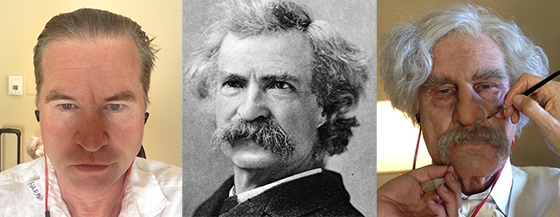
A photo series has shown the dramatic transformation that Val Kilmer undergoes to become one of the country's most-famous authors, Mark Twain. Over the course of two hours, Kilmer has prosthetics, hair, make up, and a very Twain-like moustache applied until only his eyes reveal his true identity.

The transformation is for Citizen Twaina one-man show currently playing at the Pasadena Playhouse, California. "There's a part of the makeup that starts to become the way I understand Mark Twain," Kilmer tells the LA Times, "he's old in my story... old people are often frustrated because their movement becomes restricted." You can see the full transformation take place in a 28-photo album over on Imgur.


Marktwainkilmer

15 Aug 14:54

Welcome To Deerlandia, Where We Kill Deer And They Kill Us

firehose

nothing to do with Portland

We've created this problem ourselves, and we're suffering the consequences: Car collisions make deer the most deadly animal in the United States; these sweet ungulates are also vectors for diseases—chiefly Lyme's disease; and voracious eaters, deer throw ecosystems severely out of whack, if left unchecked.
15 Aug 14:54

Futurama, “Game Of Tones”

by Zack Handlen
firehose

"not even the brief gag of a talking dog with Seth MacFarlane’s voice can ruin the sincerity."
oh thank god

How effective does a moment have to be to make up for an uneven episode? Can a few minutes of affecting sentiment make up for some not-so-great plotting? This is an issue that’s come up more than a few times in Futurama’s later seasons; the writers’ gift for finding just the right way to break our hearts hasn’t faded much, but their knack for tightly plotted episodes has. That means that, with a few exceptions, the most moving reveals and character beats haven’t been well-supported by the stories around them. The show will be moving through a reasonably clever but not hugely thrilling sequence of events, and then all of a sudden it’ll bust out a quiet song and some hugging completely out of the blue, and it just kind of guts you. How do you rate something like that? The average would raise the ...

Read more
15 Aug 14:51

Film: Movie Review: Austenland

by A.A. Dowd
firehose

"a truly half-assed satire, one whose senseless sensibility seems less informed by the best of English literature than the worst of Saturday Night Live."

“What separates the casual Jane Austen fan from the aficionado?” Jane Seymour asks in an advertisement for her Westworld-style theme park, where devotees of the English novelist can live out their fantasies of corsets and courtship. If Austenland is any indication, filmmaker Jerusha Hess is neither fan nor aficionado; it’s not even clear that she’s cracked one of the author’s books. The writing and producing partner of husband Jared Hess, Jerusha specializes in merciless mockery, with jokes made at the expense of Idaho farm boys (Napoleon Dynamite), Mexican wrestlers (Nacho Libre), fantasy novelists (Gentlemen Broncos), and other easy-target eccentrics. In Austenland, her directorial debut, Hess adapts a 2007 beach book into another broad comedy of caricature. It’s a truly half-assed satire, one whose senseless sensibility seems less informed by the best of English literature than the worst of Saturday Night Live

Introduced during a prologue ...

Read more