Shared posts

18 Oct 18:54

Beating Up Bad Guys Is Element-ary In 'Bravest Warriors' #13 [Preview]

by Caleb Goellner
firehose

Ryan Pequin beat

Bravest Warriors #13 PreviewBoom! Studios

Pen Ward’s surprisingly well-adjusted teens from the year 3085 look like they’ll be cutting loose on October 23 in Bravest Warriors #13. Writer Eric M. Esquivel, artist Mike Holmes, colorist Lisa Moore, and letterer Steve Wands pit the team against the fierce ”Periodic Table of Evil” on page one, and don’t let up from there with a plot that involves Danny experimenting with insect poison during a perilous vision quest. You know, the usual kind of deal. Boom! Studios has provided CA with a first look at the latest assembly of adventure, which you can click through to preview in full.

From Boom!’s official solicitation info:

IT’S A GREAT PAIR OF SOCKS! BRAVEST WARRIORS is like throwing a whole thing of mentos into a 2liter of diet soda. You know what will happen, but you still have to do it…don’t fight that urge. The aftermath might be a little messy, but you know you had a blast all the way to the end.

You can check out five pages from Bravest Warriors #13 below.

Bravest Warriors 13 preview page 2

Bravest Warriors 13 preview page 2

Bravest Warriors 13 preview page 3

Bravest Warriors 13 preview page 4

Bravest Warriors 13 preview page 5

Bravest Warriors 13 preview page 6

Bravest Warriors 13 preview page 7

Bravest Warriors 13 preview page 8

Bravest Warriors 13 preview page 9

Bravest Warriors 13 preview page 10

18 Oct 18:49

Let's Talk About SNL's Diversity Problem | Splitsider

by djempirical

Kenan Thompson has been taking a lot of heat this week for a comment he made in a TV Guide interview about SNL's lack of a black female cast member, despite the recent hiring of six white performers. Following Jay Pharoah's rather blunt remark to theGrio that "They need to pay attention" and cast a black woman like Darmirra Brunson, Thompson had a more ambiguous response:

Instead of blaming showrunner Lorne Michaels or the series, which currently only employs three actors of color out of 16 cast members (Thompson, Pharaoh and the Iranian Nasim Pedrad), Thompson blames the lack of quality black female comedians. "It's just a tough part of the business," Thompson says. "Like in auditions, they just never find ones that are ready."

Following the comment was a frenzy of articles, tweets, and talking heads furious over Thompson saying that there aren't any black women out there who are talented enough to be on SNL. (It should be noted that Thompson didn't say those words exactly; rather, he seemed to imply that the black comediennes who have auditioned for the show lately simply haven't made the cut, as has been the case for any number of hilarious performers over the years.) The responses were far less nuanced. Buzzfeed ran an article titled "4 Black Women SNL's Kenan Thompson Should Meet," and one of those women, Nyima Funk (a Second City veteran who has auditioned for SNL in the past) posted a video that mocked Thompson's statement by suggesting the only way she could be ready for SNL would be to transform herself into a white man.

The lack of diversity on SNL has always been a thorn in the paw for the show's progressive fan base. Since SNL premiered in 1975, only 15 black performers have been in the cast (and only two Latinos and zero Asian-Americans), and only four of those black performers have been women: Yvonne Hudson (1980-81), Danitra Vance (1985-86), Ellen Cleghorne (1991-95) and Maya Rudolph (2000-2007). Since Rudolph left, viewers have complained that SNL has no one to play zeitgeist celebrities like Michelle Obama, Oprah Winfrey, or Beyonce — not to mention a wealth of original black female characters. In the past, Thompson donned drag to play Whoopi Goldberg and Star Jones, but he now refuses to play such roles.

SNL's casting process is notoriously secretive, leaving outsiders wondering why the show hasn't diversified its cast. Is it, as Thompson suggested, simply a matter of the SNL's producers being unable to find black women who are "ready"? How is that possible when those of us in the alternative comedy scene know hilarious black women who have auditioned, only to be mysteriously rejected? Is anyone ever "ready" for SNL?

In fairness, we can't make any accusations without knowing the gatekeepers' motives. Still, the ongoing lack of a black female in the cast continues to baffle viewers. In hopes of shedding some light on this controversial issue, we took a look at the comedy communities that feed talent to SNL, crunched some numbers, and made some interesting discoveries.

The major comedy theaters that SNL recruits from aren't very diverse, either.

Let's do some math. Currently, SNL's cast contains 16 performers: eight white men, five white women, two black men, and one Iranian-American woman*. (Nasim Pedrad's Middle Eastern ancestry technically classifies her as "white" in modern racial definitions, though because we're examining ethnic diversity, it would be to our benefit to define "white" as persons with European heritage.) This makes the cast 18.8% non-white. That number is down from 35.7% in 2004, when five of the cast's 14 performers were either black (Maya Rudolph, Kenan Thompson, Finesse Mitchell) or Latino (Horatio Sanz, Fred Armisen). What caused this drop? Perhaps we can look at the show's traditional sources for new talent.

Last March, Splitsider looked into the comedy training grounds where many SNL cast members honed their skills to see which communities tend to be the most popular feeders of talent to the show. We found that a nearly half of all cast members started at improv/sketch comedy theaters like the Second City in Chicago (as well its sister-schools, the Improv Olympic and the Annoyance), the Groundlings in Los Angeles, and the Upright Citizens Brigade (UCB) theaters in New York and LA. In the past decade, only two cast members have been hired from standup (Jay Pharoah and Brooks Wheelan), with the rest having backgrounds in improv and sketch. So with SNL relying so heavily on these communities, it's worth looking at them again… specifically, how diverse they are.

The communities and alumni bases of Second City, the Groundlings, and the UCB are so extensive that it's difficult to measure a sample group. So we narrowed our scope by examining each of the theater's current performers. For the Second City, we looked at Chicago's current Mainstage company, the ETC company, and the touring companies (US, Canada, and the cruise lines). For the Groundlings, we looked at the Main Company, the Sunday Company, and all other performers doing shows at the theater in October 2013. For the UCB, we looked at the Chelsea theater in New York and the theater in Los Angeles, tracking all the UCB performers scheduled for shows in October 2013. Note that this does not take into account these theaters' training centers or alumni, or in the UCB's case, its theater in the East Village. It does, however, give us a sense of who is representing these communities on stage in front of audiences right now. Also, (spoiler alert) the prevalence of white performers in these communities over other ethnic groups — black, Latino, Asian-American, etc. — is so huge that the results are best conveyed into categories of "white" and "non-white." This isn't meant to suggest that all non-white races are the same, but simply to show that the major improv and sketch theaters in this country are even more whitewashed than SNL is.

(The numbers have been scaled to give you a sense of the ratio of white to non-white performers in these communities. So, for example, for every one non-white female Second City performer, there are five white females, and about six white males. Non-white women make up about 7.3% of the current performers in that theater community.)

While the disparity between whites and nonwhites may make some people in these communities cringe, it shouldn't come as too big a surprise. The Second City has been better than most when it comes to diversity — by practice, the theater casts companies with a balance of men and women, with few exclusively white casts. But despite the Second City's extensive community outreach and diversity program, the decisive majority of the performers in the community are white. This trend is reflected in the Groundlings — currently, both the Main Company and the Sunday Company are all-white, with black and Latino alums doing other shows at the theater. The UCB similarly has a reputation for mostly white performers, though its lower diversity rate is likely a result of its greater number of house teams and performers.

It's not exactly clear why minorities are so underrepresented in the improv and sketch communities, though it's likely the answer is less institutional than it is cultural. These theaters aren't blind. They have taken steps to diversify and have been somewhat successful. Both the Second City and the UCB training centers offer diversity programs to incentivize ethnic minorities to take classes. And although affirmative action is not an official policy at any of these theaters and comedic talent always comes first, it is clear that directors are excited to see minorities taking classes and auditioning for teams, and they try their best to assemble diverse casts. In fact, most theaters we spoke to noticed an increase in the number of minorities registering for classes over the past decade, and an increase in those performers being cast on house ensembles. Furthermore, every year, these theaters put up "showcases" for Lorne Michaels and other SNL producers, which feature a mix of the theaters' top talent — and an array of ethnic backgrounds.

And that only covers some of the major talent streams into the SNL audition process. With Brooks Wheelan getting cast this year, standup is obviously still a reliable stepping stone to an SNL audition. Most of the black performers on SNL over the years have come from standup (Eddie Murphy, Chris Rock, Tracy Morgan, and Jay Pharoah, as well as writers Hannibal Buress, J.B. Smoove, and Michael Che), perhaps because standup, as opposed to improv or sketch, forces a performer to hone his/her comedic voice and stand out as an individual talent, allowing black performers to better make their mark and not get lost in the crowd of a large improv/sketch community. SNL has also proven to be fairly savvy about the world of online videos — its hiring of Kyle Mooney and Beck Bennett of Good Neighbor, and before them, Andy Samberg and his fellow members of Lonely Island and CollegeHumor's Sarah Schneider as a writer, tells us that SNL has its ears to the ground all over the place. Indeed, the popularity of Jay Pharoah's impressions on YouTube were a major factor in his landing a job on the show.

So yes, the pool of performers SNL looks at every year is mostly white, but with the gradually diversifying improv and sketch communities, as well as the channels for performers of color in standup and online, how is SNL not seeing any black women? And if SNL is seeing them, why doesn't the show seem to want to hire them?

SNL does not feel an overwhelming need to diversify.

SNL has weathered its share of controversy — far worse than this current "crisis." When In Living Color and MADtv hit the late night airwaves in the 1990s with colorful casts that appealed to more diverse demo groups, SNL was criticized — by both the media and its own cast — for its lack of diversity in the staff, as well as in the subject matter of its sketches. A scathing New Yorker profile in 1995 described the show's writers as predominantly white, sheltered, Ivy League-educated men — an attitude echoed by Ellen Cleghorne (an In Living Color alum and one of the four four black female cast members in SNL history):

Pale, overwhelmingly male, and raised on comic books, the main writers are very short on experience in the world beyond pop culture. The most productive young writer, David Mandel, 24, still lives at home with his family. Mandel grew up worshiping the show, collecting old SNL scripts and memorabilia at bookstores, and memorizing dozens of sketches. He went on to Harvard, where he says he devoted more time to the Lampoon than to his academic work.

“There’s only one writer who didn’t go to Harvard or Yale or Cornell or Brown,” Ellen Cleghorne says, overstating the case only slightly. “There’s no black writers on the show — this is 1995, and I feel like I’m in a really bad sci-fi movie where all the black people already got killed, and I’m next. I’m not a separatist, I’d like to be able to jam with somebody who’s had the same experiences I find funny.”

The show cleaned shop in the year that followed, with several staff members either leaving or getting fired (including Cleghorne, who left SNL to star in a short-lived WB sitcom). But SNL hired no new black writers or actors to replace them, leaving Tim Meadows as the only minority cast member until Tracy Morgan was added a year later.

SNL's answer to MADtv and In Living Color was to stay the course and further brand itself as a pop culture-driven New York sketch show with a lot of funny white people. Lorne Michaels's willfulness to ignore political correctness in racial casting bordered on stubbornness at times — he cast the half-Venezuelan Fred Armisen (under skin-darkening face makeup) as Barack Obama, and despite critics claiming the caricature amounted to blackface, Armisen played the role for four seasons, even for a year after Jay Pharoah joined the cast. Michaels explained his decision to The Washington Post in 2008:

Michaels said that the show auditioned "four to five" actors for the Obama role, including Thompson [and Donald Glover and Jordan Peele]. And the winner, he says, was based on merit. "When it came down to it, I went with the person with the cleanest comedy 'take' on" Obama," Michaels said.

Michaels said he liked how Armisen caught the tilt of Obama's head, the rhythm of his speaking style, "the essence" of his look. "It's not about race," Michaels insisted via phone. "It's about getting a take on Obama, where it serves the comedy and the writing. . . . Believe me, when we read 40 or 50 pieces [for the show] on Wednesday, no one says, 'This is a very good way of getting our political points across.' We're simply asking ourselves: Is it fresh? Is it funny? Fred just had best take on Obama."

This quote gives us an insight into Lorne Michaels's mindset. For him, SNL isn't about diversity. It's about comedy, pure and simple. He doesn't care if his show accurately reflects the various racial groups in America, so long as it still gets laughs. And for the most part, Michaels has gotten away with this approach. All these years later, while its colorful competitors are long gone, eternally Wonder-Bread SNL is still bringing in big ratings, earning critical praise, churning out box office stars, writers, and directors that go on to dominate Hollywood, producing sketches that are among the most shared and talked about videos online, and remaining at the heart of American pop culture… all by sticking closely to Michaels's blueprint. This isn't an attempt to defend SNL's hiring practices, but simply to try to justify why Michaels isn't feeling any particular pressure to change the show's image. The diversity for diversity's sake argument doesn't apply here; for Michaels, the fact that a black woman has broken through barriers and landed an SNL audition isn't enough. She still has to be funnier than all the white people in the room.

Of course, anyone who performs comedy in New York, Chicago, or Los Angeles can name dozens of black women who are as talented as anyone currently in the SNL cast. The addition of a talented black woman to the cast is a necessary move — not because sketch comedy ensembles require racial diversity to function, but because currently, SNL is limiting itself creatively by not having someone who can play certain roles, like the First Lady. That said, we're kidding ourselves if we think the casting process on SNL has ever been that simple.

This brings us back to Kenan Thompson's statement to TV Guide. It actually makes sense, when it's not being taken out of context. Yes, it was poorly-worded. (Honestly, has any new cast member — Thompson included — ever been "ready" to be on SNL?) But consider the first part of Thompson's remark: "It's just a tough part of the business." If there's one thing Thompson understands, after a lifetime of performing sketch comedy on TV, it's how much a casting decision is purely a business deal. Sometimes, a deal makes perfect sense, but then the timing's not right, or some small detail surfaces and unravels the whole arrangement. We don't know what happens when Lorne Michaels sees a black woman audition, but we do know that he sees far fewer black women than he does white men, and if he feels no urgent need to diversify his cast, he's going to make the easiest business deal possible.

It's time we all stopped viewing SNL as the counter-cultural bellwether that we somehow convinced ourselves it was supposed to be. It's a mainstream sketch comedy show with mostly-white performers, fed by mostly-white comedy training grounds, reflecting a broad, mostly-white comedy industry. Thankfully, that industry looks like it's starting to change. Just don't expect to see SNL leading the charge.

Erik Voss is a writer and performer living in Los Angeles. He has been writing about SNL for Splitsider since 2010. He hosts the Evil Blond Kid podcast and performs improv on the Harold team The Cartel at the iO West Theater.

Original Source

18 Oct 18:37

Lomography Experimental Lens Kit, A Kit of Three Micro Four Thirds Lenses With Filter Slots

by Kimber Streams
firehose

attn: Russian Sledges

Lomography Experimental Lens Kit

The Lomography Experimental Lens Kit is a collection of three lenses — a fisheye, a wide-angle 12mm, and a standard 24mm — with slots for colored filters. The lenses are compatible with Micro Four Thirds digital cameras, and are available to purchase online from Lomography.

photo and video via Lomography

via The Phoblographer, PetaPixel

18 Oct 18:31

Why the government unpublished the source code for Healthcare.gov

by Adrianne Jeffries
firehose

'People were using the GitHub repository — which contained only frontend code — to report issues with the backend, according to CMS. Because the backend had extensive technical problems, the GitHub repository was overwhelmed with misdirected bug reports.'

When the government first launched Healthcare.gov as an informational site back in June, open source advocates were delighted to hear that the code would be available for anyone to see on the public programming library GitHub. "This new flagship federal .gov website is 'open by design, open by default,'" The Atlantic wrote at the time. "That's a huge win for the American people."

But after a storm of criticism over the healthcare exchange — the second, more complex part of Healthcare.gov that launched on October 1 — the code was removed from GitHub without explanation.

Centers for Medicare and Medicaid Services, the agency administering Healthcare.gov, has finally responded to a query from The Verge about the change. The code was pulled due to confusion over the difference between the two parts of the site, CMS says.

The code for the informational part of Healthcare.gov — the "frontend" of the site — was written by a Washington, D.C. startup and a small team of innovative consultants. The code for the healthcare exchange — the "backend" of Healthcare.gov — was built by more than 50 contractors and was never made public.

People were using the GitHub repository  — which contained only frontend code — to report issues with the backend, according to CMS. Because the backend had extensive technical problems, the GitHub repository was overwhelmed with misdirected bug reports.

The GitHub repository was overwhelmed with misdirected bug reports

Seventeen million people tried to access Healthcare.gov in the first two weeks, CMS says. But only a reported 245,000 have been able to sign up. That's because of technical issues that resulted in long wait times, inaccurately calculated subsidies, and glitches that prevented people from completing applications. Even the applications that did get processed had problems; insurers say they are having to manually correct some of the data submitted through the marketplace.

CMS says it has made progress reducing wait times and allowing users to complete applications, and continues to work to resolve the issues. But as issues with the site persist, time is running out. Americans have until March 31st to enroll in a plan or wait until the next open enrollment period; however, those who don't register by December 15th to get coverage starting January 1st may be subject to a fine.

18 Oct 18:25

Tonight in Music: Your Rival, Phantogram, Melt-Banana & More

by Ned Lannamann
firehose

Melt-Banana and Kinski


YOUR RIVAL, LEE COREY OSWALD, OUR FIRST BRAINS, SOFT SKILLS
(Anna Bannanas, 2403 NE Alberta) Let's get the tricky part out of the way first: Your Rival's Mo Troper is a frequent and valuable contributor to this section. You may have noticed that he really, really, really likes power pop and emo. These affections are plainly evident on the snap-and-crackle songs he's written for Here's to Me, the new full-length from his sometimes-solo-act, sometimes-a-band project Your Rival. Released on nascent local label Party Damage (home to Wild Ones), it crams a discography's worth of Big Star-spangled melody into its 31 brief minutes, with further echoes of Superchunk, Badfinger, and Teenage Fanclub happily gumming up the sidewalk. Interspersed are some tender, Ben Folds-y moments (opening track "Autobiography," the beginning of "Sydney") and one soaring mini-epic ("What I Look for in a Man"), all of which add to Here's to Me's air of splendid, full-volume melancholy. It's a flat-out great album, and while it deserves to send Troper to the next level of the pro-musicianship stratosphere (and all the tour dates and opportunities that come with it), I don't want too many of you to buy it—good music writers are hard to find. NED LANNAMANN


PHANTOGRAM, GIRAFFAGE
(Crystal Ballroom, 1332 W Burnside) Sarah Barthel and Josh Carter of Phantogram have a lock on nonchalantly cool rhythm and slightly druggy mystique. Their electronic music is well suited to similarly beat-driven pursuits like walking purposefully or swaying knowingly at one of their spacily transportive live performances. MARJORIE SKINNER


MELT-BANANA, KINSKI, NASALROD
(Dante's, 350 W Burnside) Tonight, Japanese noise-rock veterans Melt-Banana return to Portland for the first time in two years, touring off Fetch, their first studio album since 2007. This time, vocalist Yasuko "Yako" Onuki and guitarist Ichirou Agata are hitting the road as a duo, opting to flesh out their sugar-rush aural attack with computer-controlled synths and samples. Melt-Banana continue to create music that only they could make work. Over the years they've been adding more pop and experimental elements on top of the speedy, playful, half-minute grindcore bursts that they became known for two decades ago, and everything falls right into place on Fetch. "Candy Gun" opens the album with waves lapping up on the shore, and before long it's off to the races as Agata begins to scrape and scratch all over his palette, and Yako's trademark barks and chirps manage to keep pace with the workout. CHIPP TERWILLIGER


PDX-ANTICS: VINCE CLARKE, MARTIN REV, AUTHOR AND PUNISHER, & MORE
(Alhambra Theatre, 4811 SE Hawthorne) Ranging from industrial noise to electro-pop, the wide swathe of synthesized sounds at PDX-Antics covers many corners of electronic music. Headlining the mini-fest is Vince Clarke, best known as the mastermind behind Erasure and a former member of Depeche Mode. Also on the docket is Martin Rev, the synthesizing and beat-making half of the proto-punk legends Suicide. But be sure to show up early to catch Author and Punisher, the one-man industrial/drone-metal project of Tristan Shone and his array of custom-built noisemaking machinery. Imagine the soundtrack for a hostile robot takeover, and you've got a pretty good idea of what to expect. MATTHEW W. SULLIVAN


SAN FERMIN, US LIGHTS
(Bunk Bar, 1028 SE Water) The pedigree of Brooklyn outfit San Fermin sounds highbrow to the point of hoity-toityness: Yale graduate Ellis Ludwig-Leone composed what is described in the press materials as "a pastiche of post-rock, chamber-pop, and contemporary classical composition." Ludwig-Leone wrote San Fermin's self-titled album in six weeks in a cabin in the mountains of Canada, drawing inspiration from Hemingway's The Sun Also Rises. The result is an elegant, almost starched-stiff affair with strings, horns, and the album's various roles portrayed by a number of guest singers (including members of fellow Brooklyn band Lucius, who burned up Bunk Bar last week in their phenomenal Portland debut). Still, the sheer skill on display is impressive, and if the album occasionally sounds like a thesis for some history-of-musical-theater course that you would never take in a million years, more often it's a fascinating, involving record that effortlessly bounds over typical constraints of creativity. Fans of Dirty Projectors and those bereft by Sufjan Stevens' abandonment of his 50 states project will find much to cherish on San Fermin. NL

[ Subscribe to the comments on this story ]

18 Oct 18:24

What Each Country Leads the World In

by Kimber Streams

What Each Country Leads the World In

Doghouse Diaries has created a funny and informative world map that shows “What Each Country Leads The World In.” According to the map, Japan leads the world in robots, and the United States leads in Nobel laureates and people getting killed by lawnmowers. A larger, zoomable version of the world map is available on the Doghouse Diaries website, as is a full list of sources.

18 Oct 18:19

tuesday-johnson: ca. 1850, [daguerreotype portrait of a...

firehose

via Russian Sledges
check out my baller wish-ancestor


tuesday-johnson:

ca. 1850, [daguerreotype portrait of a gentleman, possibly a medical student or anthropologist, among a collection of skulls]

via the Nelson-Atkins Museum of Art

18 Oct 18:19

Sanskrit manuscripts lost with the Titanic

by Dominik Wujastyk
firehose

via Overbey


Adheesh Sathaye mentioned today that the terrible sinking of the Titanic in 1912 was also the occasion of the loss of fourteen Sanskrit manuscripts of the Vikramacarita.  The MSS were on their way from Bombay to Edgerton in the USA.

Here is Edgerton's account, also kindly supplied by Adheesh.

There's an uncomfortable ambiguity in Edgerton's prose, regarding the predicate of his expression "terrible disaster."
18 Oct 18:11

notablegamebox: This cover is for a game simply called Shit for...


notablegamebox:

This cover is for a game simply called Shit for the MSX by Eurosoft. It was also called Oh Shit in another release. For Europe, they renamed it to Oh No.

I know this box art looks completely fake, but this is a real Pac-Man clone released in 1987.

18 Oct 17:56

Supercut of Rappers Introducing Themselves During Songs

by Justin Page

So just let me introduce myself. My name is Humpty, pronounced with a ‘umpty’

New York City-based writer, comedian, and video editor Bryan Menegus has created a supercut video for Slacktory of rappers introducing themselves during songs. Here is a list of the hip-hop artists and songs, in order of appearance.

Hip-hop artists are known for being polite.

submitted via Laughing Squid Tips

18 Oct 17:45

Men may face felony charges after toppling Goblin Valley formation - Salt Lake Tribune

firehose

this is the boy scouts? then those rocks can't possibly be any older than a couple thousand years, duh


Men may face felony charges after toppling Goblin Valley formation
Salt Lake Tribune
A group of Boy Scout leaders is potentially facing felony charges for destroying a rock formation nearly 200 million years old in Emery County. The trio of men was adventuring in Goblin Valley State Park when they decided to film themselves knocking over ...

and more »
18 Oct 17:22

D-Link Router Backdoor

by Bruce Schneier
firehose

have been getting hits for this on my dev server just about nonstop

Several versions of D-Link router firmware contain a backdoor. Just set the browser's user agent string to "xmlset_roodkcableoj28840ybtide," and you're in. (Hint, remove the number and read it backwards.)

It was probably put there for debugging purposes, but has all sorts of applications for surveillance.

Good article on the subject.

18 Oct 17:21

Jaebum Joo

18 Oct 17:16

Wind Sprints for Your Arms: 15 Battle Rope Exercises

by Brett
firehose

i love how fitness bros make everything that kids naturally do on their own sound like things warriors do to prepare to kill

When it comes to cardio, I’m one of those people who like to get it done as fast as possible. Jogging long-distance or spending thirty minutes on an elliptical isn’t my thing. That’s why I love high intensity interval training (HIIT). The basic idea of HIIT is to alternate between periods of short, intense anaerobic exercise (like sprinting, kettlebell swings, or burpees) with less intense resting periods. You repeat this sequence of short, intense exercise and resting for as little as four minutes or as long as thirty minutes. Research has shown that HIIT improves both aerobic and anaerobic conditioning, boosts testosterone levels, and ramps up your metabolism and keeps it ramped up hours after you’ve finished exercising.

I’m always on the lookout for new HIIT routines, and I’ve recently discovered one that has become my new favorite: battle ropes.

I’ve heard battle rope exercises described as “wind sprints for your arms.”

That’s a perfect way to describe it.

In just twenty seconds of intense battle-roping, your heart rate will reach its peak and your arms will feel like battery acid is coursing through them. In short, you’ll feel great. I don’t know what it is, but battle rope exercises are incredibly satisfying. And effective: the intense anaerobic and aerobic conditioning that battle rope exercises provide has made them a staple in the training of professional athletes and mixed martial artists.

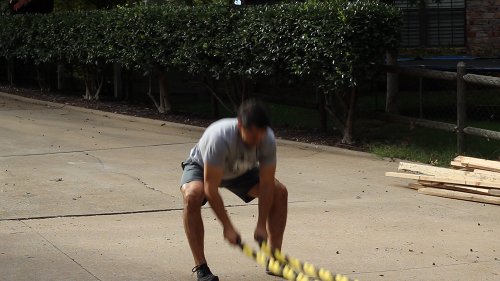
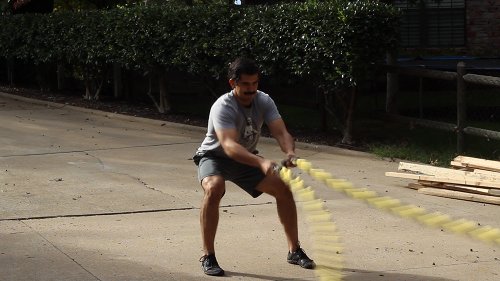
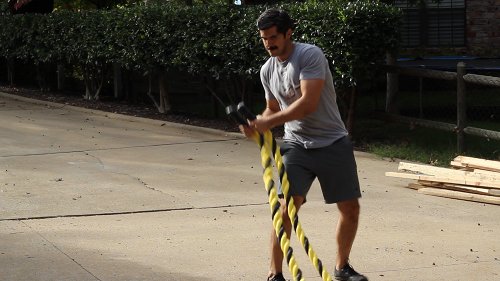
There’s not much to battle rope exercises. You just hold a thick, long rope by the ends and move your arms up and down or in circles as fast as you can. In essence, you’re “battling” the ropes.

Today, I’m going to give you the lowdown on 15 different battle rope exercises you can do, along with a suggested workout.

The Equipment

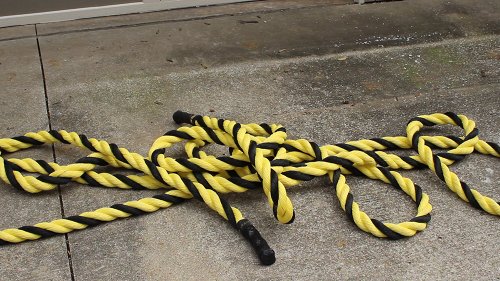
battlerope1

Because of the increasing popularity of battle ropes, you can easily find them online with a quick Google or Amazon search.

The battle rope I use is from Onnit.

The longer and thicker your rope is, the harder it is to battle. Go for a rope that’s around 2 inches thick and 50 feet long. That will give you a nicely challenging workout.

2″ x 50′ rope will run you around $125-$150, which isn’t cheap. Fitness companies will sometimes boost the price of something you can get at a hardware store (minus that fancy packaging/marketing), so I looked around for cheaper alternatives. But even basic manila rope of that size from contractor websites costs the same. If you know a source of cheaper rope, let us know in the comments.

anchor

I used my basketball goal post as an anchor for my battle rope.

Once you have your rope, you’ll need to find an anchor to wrap it around. Basketball goal posts, fence posts, and trees all work. You can even thread your rope through the handle of a heavy kettlebell and use that as an anchor.

The Workout

Battle rope exercises are an excellent addition to any high-intensity interval training routine. My suggested workout goes thusly:

15 rounds — each round do one of the battle rope exercises described below. Each round consists of two parts:

  • 20 seconds all-out, high-intensity exercise. Don’t stop until the buzzer goes off.
  • 20 seconds rest.

The whole routine will only take you 10 minutes. I use a HIIT Timer app on my smartphone to mark off my time and rest periods. You could also use something like Gym Boss.

The Exercises

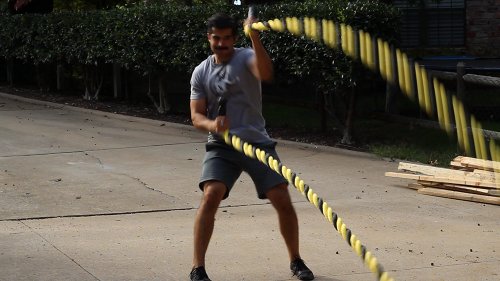
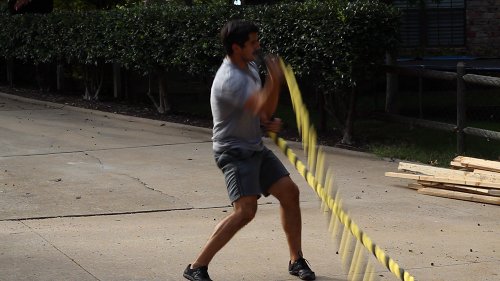
Alternating Waves

altwave

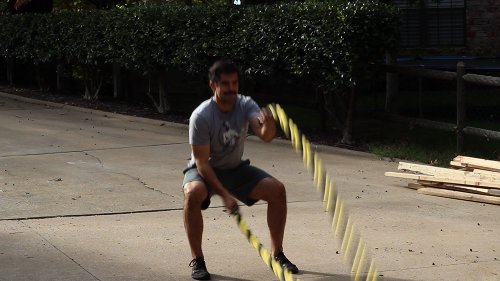
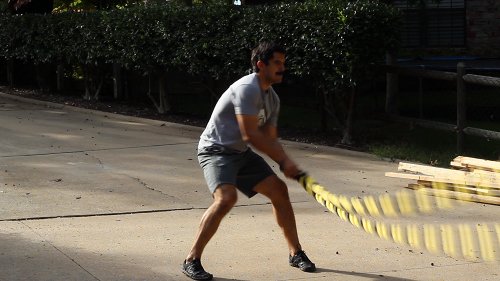
Alternate moving your arms up and down as fast as you can.

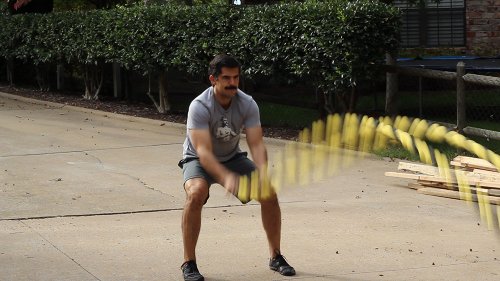
Double Arm Waves

doublearm1

doublearm2

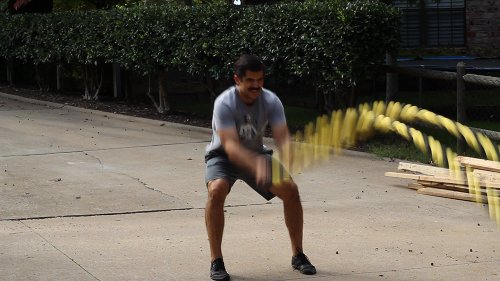
Instead of alternating your arms up and down, move them up and down together.

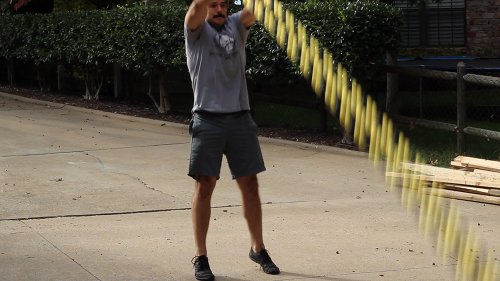
Double Arm Slam

slams1

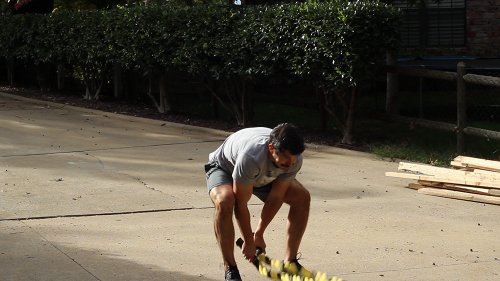
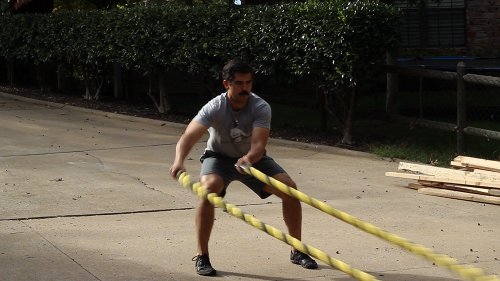
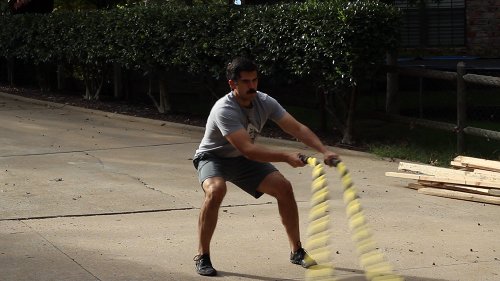
slams2Lift both arms as high as you can and then slam the ropes down to the ground as hard as you can. Go as fast as possible.
Double Arm Slam Jump

jumpslam1

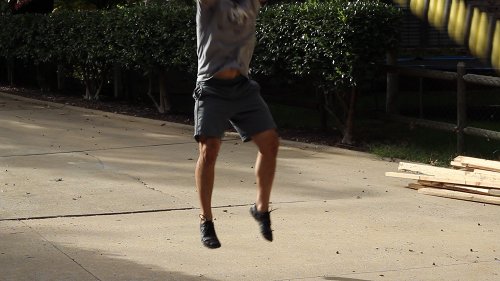
jumpslam2Same thing as the double arm slam, except when you lift your arms up as high as you can, you also jump.
Snakes

snakes1

snakes2

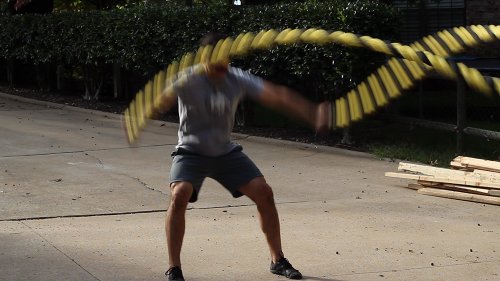
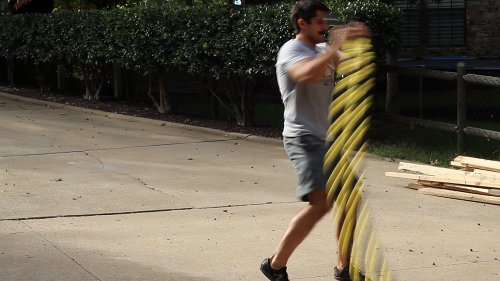
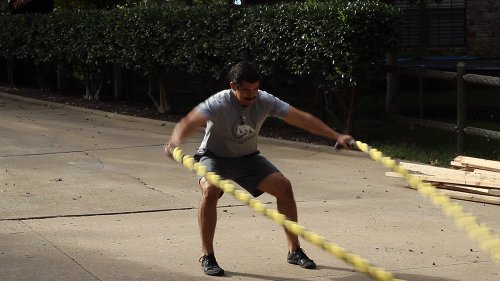
Swing your arms together side-to-side and make your rope slither like a snake.

Claps

clap1

claps2

Move your arms in and out like you’re clapping your hands together.

Outside Circles

circles1

circles2

circles3

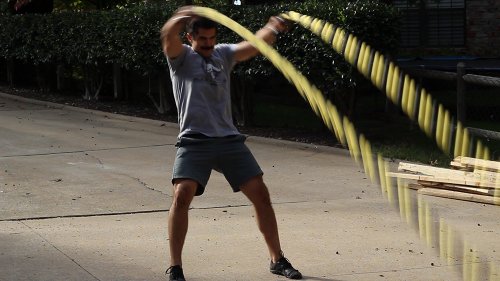
Make big circles with your arms. Your right arm circles clockwise and your left arm circles counter-clockwise.

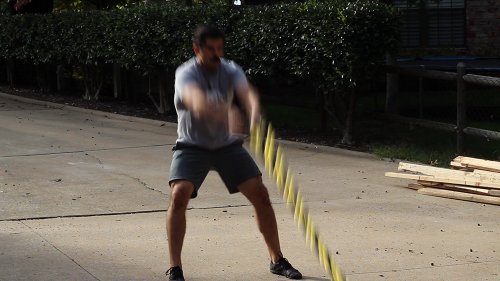
Ultimate Warrior

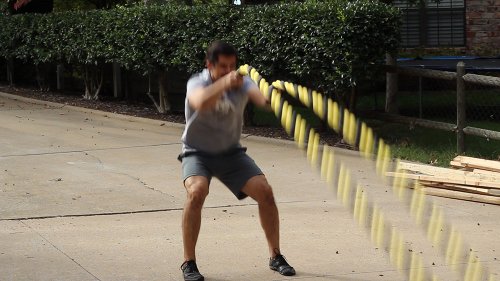
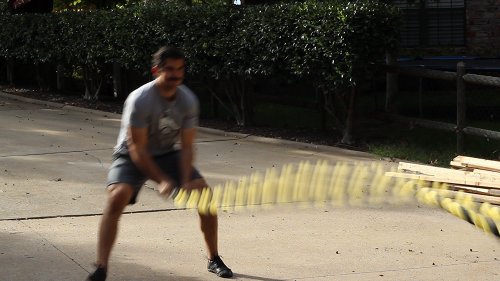
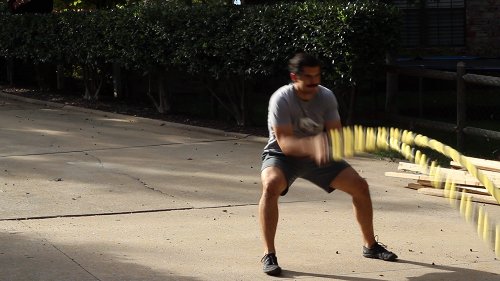
warrior1

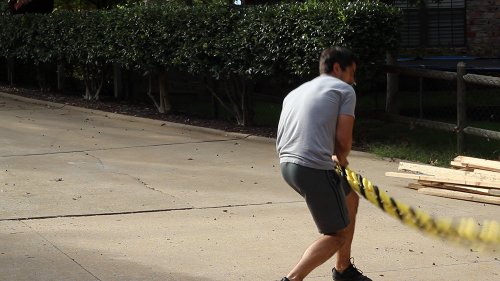
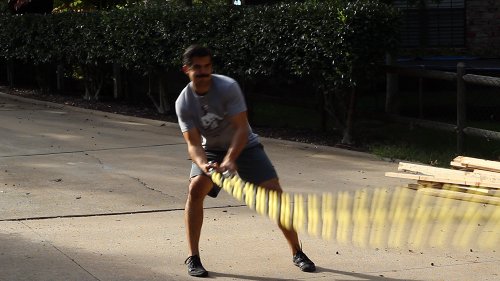
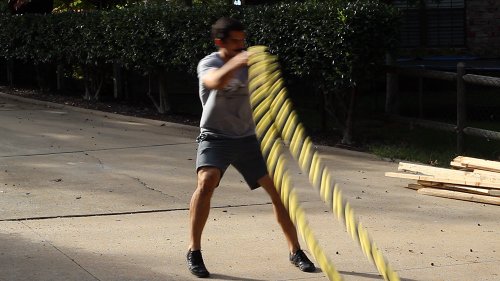
Turn your body to the right with your feet perpendicular to your anchor. Hold the battle rope ends together in your hands as if you were gripping a baseball bat — right hand on top of the left. Raise your arms up and down as fast as you can. Midway through the round, switch your stance and face the left, and reverse your grip so that your left hand is on top of your right hand. Continue lifting your arms up and down as fast as you can.

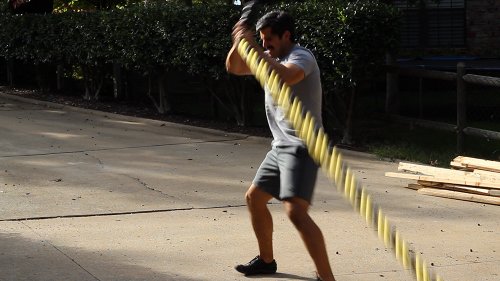
Grappler Hip-to-Hip Toss

grappler1

grappler2

grappler3

This is a fun battle rope exercise. It mimics the movement a grappler makes when they toss someone over their hip. Grab the rope so the ends are sticking out from between your thumb and index fingers and hold the ends down by your right hip.  Pivot your torso to the left. During the pivot, flip the ropes over your hip as if you were throwing a grappling opponent to the ground. Pivot back and forth like this until time is up.

Alternating Waves + Squat

altsquats

Just your basic alternating arm wave movement with air squats thrown in the mix.

5 Double Arm Waves + Burpee

burpee1

burpee2

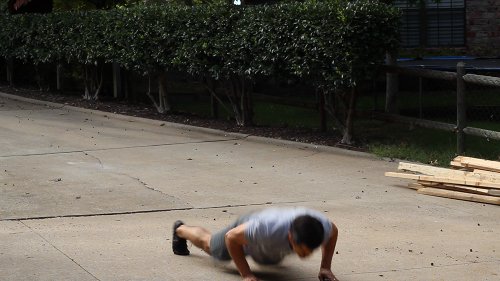
This exercise combines my two favorite high-intensity cardio movements. Perform five double arm waves and then perform a burpee. Repeat the 5+1 sequence until your time is up.

Double Arm Side-to-Side Shuffle

waveshuffle

waveshuffle2

Perform a double arm wave while shuffling side to side.

Uppercuts

uppercuts1

uppercuts2

Harness your inner Rocky with a series of alternating uppercuts while holding the ropes.

Figure Eight Circles

eight1

eight2

eight3

Make a figure eight shape in the air while holding the ropes. Feel free to reverse direction in the middle of your round.

Jumping Jacks

jumpingjacks

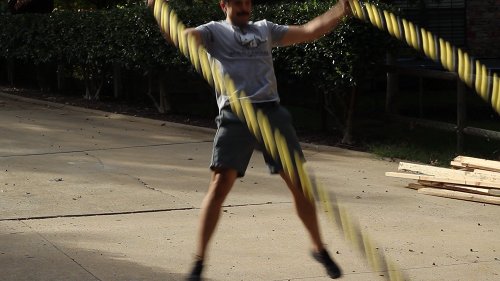
Just hold the ropes by the end and perform some old-school jumping jacks.

Have you tried battle ropes before? Have any favorite exercises we didn’t include here? Share them with us in the comments!


18 Oct 17:12

Reverse Identity Theft

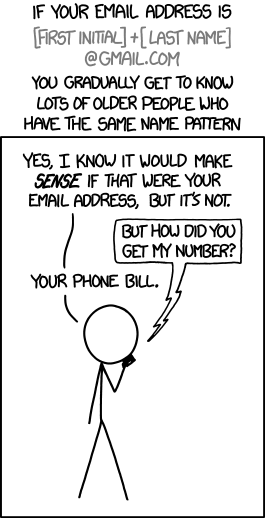
I asked a few friends whether they'd had this happen, then looked up the popularity of their initials/names over time.  Based on those numbers, it looks like there must be at least 750,000 people in the US alone who think 'Sure, that's probably my email address' on a regular basis.
18 Oct 17:06

Grand Theft Auto V accounted for 50% of all games software sold last month—and that’s bad news

by Leo Mirani
GTA's Trevor foresees a grim fate for the industry if it doesn't adapt.

Two sets of numbers out this week show just how quickly the ground is shifting in the videogame industry. Figures from the NPD Group, released monthly and watched closely, show a bumper September for videogame retail sales. Total US sales came in at $1.08 billion across hardware (such as consoles) and software (such as games). That’s up 27% from September last year. Yet there is reason to be cautious: more than a third of that amount comes from sales of one single game, Grand Theft Auto V (GTA). It accounted for more than 50% of the $754 million in software sales. (GTA’s worldwide sales including the US exceeded $1 billion.)

Looked at another way, without GTA V total industry sales would have been down roughly a fifth from $848 million last year and physical software sales would have declined a staggering 75%.

The shift to free

Where is that money going? Are gamers bored of gaming? The numbers makes sense when you look at another set of figures, which come from SuperData, a research firm that looks only at digital sales. It found that digital sales of videogames stood at $970 million, up 6% from last year. Big-publisher games for PCs and consoles managed to make less than $200 million of that, a 23% decline from last year. Paid-for online multiplayer games were also down a fifth.

Fastest growing were free games on social networks, mobile phones and online, which made $691 million in September, up a quarter from last year. Mobile alone is up 52% year on year, with King.com’s Candy Crush Saga and Pet Rescue Saga the two most profitable games and Clash of Clans from Supercell at number 3. King last month filed for an IPO thought to be valued at $5 billion. Japan’s SoftBank Corp this week paid 150 billion yen ($1.53 billion) for a 51% stake in Supercell.

It is important not to overstate the decline of physical distribution: gamers are spending less because they know that both the major consoles—Xbox and Playstation—will be out with new generation machines in November. Expect to see numbers rise once that happens.

Yet it is clear that the money in videogames is moving from big, expensive console games to free apps and social games that make their sales from in-game micro-payments, such as $1 here to gain an extra life or a $0.69 there for a booster of some sort. All those cents add up to a lot of millions.


18 Oct 17:06

I Fact-Checked Sean Hannity On Obamacare

firehose

'First I spoke with Paul Cox of Leicester, N.C. He and his wife Michelle had lamented to Hannity that because of Obamacare, they can’t grow their construction business and they have kept their employees below a certain number of hours, so that they are part-timers.

Obamacare has no effect on businesses with 49 employees or less. But in our brief conversation on the phone, Paul revealed that he has only four employees. Why the cutback on his workforce? “Well,” he said, “I haven’t been forced to do so, it’s just that I’ve chosen to do so. I have to deal with increased costs.” What costs? And how, I asked him, is any of it due to Obamacare? There was a long pause, after which he said he’d call me back. He never did.'
...
'Next I called Allison Denijs. She’d told Hannity that she pays over $13,000 a year in premiums. Like the other guests, she said she had recently gotten a letter from Blue Cross saying that her policy was being terminated and a new, ACA-compliant policy would take its place. She says this shows that Obama lied when he promised Americans that we could keep our existing policies.
...
I tried an experiment and shopped on the exchange for Allison and Kurt. Assuming they don’t smoke and have a household income too high to be eligible for subsidies, I found that they would be able to get a plan for around $7,600, which would include coverage for their uninsured daughter. This would be about a 60 percent reduction from what they would have to pay on the pre-Obamacare market.'

'Robbie is self-employed as a Christian youth motivational speaker. (You can see his work here.) On Hannity, the couple said that they, too, were recently notified that their Blue Cross policy would be expiring for lack of ACA compliance. They told Hannity that the replacement plans Blue Cross was offering would come with a rate increase of 50 percent or even 75 percent, and that the new offerings would contain all sorts of benefits they don’t need, like maternity care, pediatric care, prenatal care and so forth. Their kids are grown and moved out, so why should they be forced to pay extra for a health plan with superfluous features?

When I spoke to Robbie, he said he and Tina have been paying a little over $800 a month for their plan, about $10,000 a year. And the ACA-compliant policy will cost 50-75 percent more? They said this information was related to them by their insurance agent.

Had they shopped on the exchange yet, I asked? No, Tina said, nor would they. They oppose Obamacare and want nothing to do with it. Fair enough, but they should know that I found a plan for them for, at most, $3,700 a year, a 63 percent less than their current bill. It might cover things that they don’t need, but so does every insurance policy.'

I tracked down Hannity’s guests, one by one, and did my own telephone interviews with them.
18 Oct 17:04

The Running Of The Bulls Comes To America

What are the long-term prospects for a venture that relies on its customers getting trampled by large, angry animals?
18 Oct 17:01

Air marshal accused of taking photos under skirts - Politico

firehose

stalwart defenders against terror


ABC News

Air marshal accused of taking photos under skirts
Politico
NASHVILLE, Tenn. (AP) — A federal air marshal has been arrested and accused of taking cell phone photographs underneath women's skirts as they boarded a plane at Nashville International Airport. Nashville police say Adam Bartsch was on duty on ...
Air marshal charged with taking upskirt pics of passengersAtlanta Journal Constitution
Air Marshal Arrested for Taking Upskirt Photos of Female PassengersTIME
Federal air marshal allegedly took photos up women's skirts on flightUPI.com
CNN International
all 85 news articles »
18 Oct 16:59

Under Pressure: Unblocked

by J.J. Cooper

Which defenses have racked up the most unblocked sacks? Which offenses have allowed the most?

read more

18 Oct 16:48

From Magicka to Helldivers: The sharp pain of crunch

by Colin Campbell
firehose

'Problems began for Pilestedt almost immediately, when he suggested that the best place to locate the team was in the kitchen of the modest apartment where he lived with his girlfriend. She struggled, as might most people, with a game development team in the midst of her house, noisily working late-night shifts.

"There was a bit of trouble considering that I wasn't living alone at that time," says Pilestedt. "The mood in the apartment was weird. We were sitting in the kitchen with five or six computers set up to develop the game. It resulted in conflict."

"I got the feeling that she didn't really appreciate her kitchen being occupied," remembers Englund. "It did feel strange because [Pilestedt's] partner was there and she wasn't really a part of [the project]."

The team members had made the decision that nothing in their lives would get in the way of making Magicka. "We were all putting the company at the top of our priorities list," says Englund. "It's hard to keep anything else, anything big, going on in your life."

Pilestedt's relationship with his girlfriend fell apart. "Sometimes you have to choose which path you're going to take through life," he says. "Games development has always been the primary motivator. Nothing was going to get in the way of that." This was still early in the development schedule. After six months working in that student apartment kitchen they secured a small grant and found a humble office. Their lives were now entirely devoted to game development.'

never dev

How the development of Magicka tested Arrowhead's camaraderie ... and sanity.

They were yelling at one another, right there in the office. Fellow teammates cowered behind monitors as the language and the force of the argument intensified.

Two old friends who had once pledged themselves to each other, who had stuck through 20 months developing a game called Magicka, were in the full and hideous majesty of a blowout fight. Oaths and insults were exchanged. They were threatening to mangle all that they had achieved.

The stress and exhaustion of game development, coupled with their own lack of experience, had eroded all their energy and frayed the bonds that had brought them together. They'd had enough.

They were suffering from "crunch," the state of being in which game developers work insane hours, desperately trying to meet a looming deadline. It's a grim way to exist, the frustration of its victims exacerbated by common aggravations such as lack of resources, poor planning and incompetent management.

But Johan Pilestedt and Emil Englund didn't have anyone else to blame. Magicka was entirely their enterprise. It had turned out so wretchedly for them because they just didn't know any better. They, along with three other guys, had formed the company Arrowhead specifically to make Magicka and to break into game development. The group spent two years working 70-hour weeks — an experience that almost broke them, physically, mentally and emotionally.

Pilestedt and Englund were trying to make a top-down action-adventure based partly on myths from their native Sweden and partly from a global motley of pop culture and quirky humor.

What they had on their side was an impressive collection of attributes, including the energy natural to ambitious men in their 20s, public recognition of their abilities bestowed through their victory in a game design contest, and advice from seasoned supporters and mentors in the Swedish game design community. In the course of the game's difficult gestation, they wasted or exhausted each and every one of these, and came uncomfortably close to destroying the most important gift of all, their relationship with one another.

Arrowhead began the Magicka project by ignoring two mantras of success: first, never go into business with friends, and second, stay in school.

Pilestedt and Englund were students at the Luleå University of Technology, in the far north of Sweden on the shores of the Baltic Sea. They were both studying game design. Pilestedt favored the programming and art side of the business, while Englund specialized in animation.

In 2008, they recruited fellow students Anton Stenmark (programming), Malin Hedström (art) and Robin Cederholm (economics and scripting) to work on a part-time project, which they submitted to the Swedish Game Awards. In a country that boasts development teams like DICE, Avalanche, Starbreeze and Frictional Games, it's a prestigious contest for up-and-coming indies.

Their entry was an early version of Magicka. They won Game of the Year.

"The jurors were people from Starbreeze and Avalanche and places like that," says Pilestedt. "They recommended we do something with it, start a company and make it into a full product. We were like, 'Yeah, we should totally do that.'"

"We had all agreed what we wanted to do, but when we went into that office we were nervous."

The five young men agreed that they would set aside their studies and quit their college courses. They would throw their lot in with one another and with Magicka.

Quitting school is always a risky decision, one that is rarely popular among older and wiser heads, most especially those in the educational establishment. Nevertheless, together they filed into the office of the dean of Luleå University of Technology to tell him that, halfway through their courses, they were moving on.

"We thought of him as a conservative person who did everything by the book," says Englund. "We had all agreed what we wanted to do, but when we went into that office we were nervous. I didn't know whether the others would have second thoughts."

He needn't have worried. "The dean said that we should drop out of college," says Pilestedt. "He advised us that this was a once-in-a-lifetime chance that we should take. So we did." Brimming with confidence, they borrowed what money they could, set up Arrowhead and began writing their game. Freedom and fun were their watchwords.

"We were five people doing something together, something that we really believed in," says Pilestedt. "We had this really good team spirit going. We were excited about developing games. But as time progressed, we learned that it wasn't all a walk in the park."

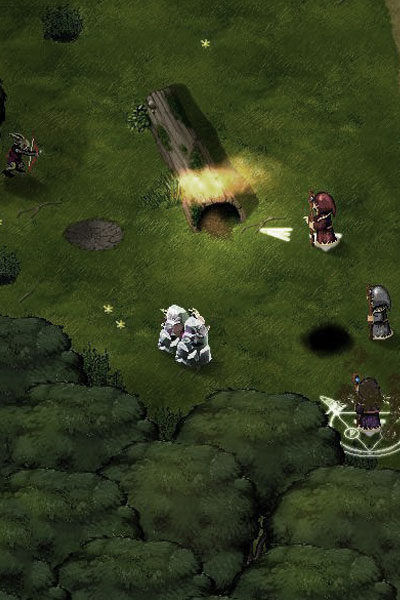
Jpeg-6Magicka

Jpeg-3Johan Pilestedt, CEO of Arrowhead

Problems began for Pilestedt almost immediately, when he suggested that the best place to locate the team was in the kitchen of the modest apartment where he lived with his girlfriend. She struggled, as might most people, with a game development team in the midst of her house, noisily working late-night shifts.

"There was a bit of trouble considering that I wasn't living alone at that time," says Pilestedt. "The mood in the apartment was weird. We were sitting in the kitchen with five or six computers set up to develop the game. It resulted in conflict."

"I got the feeling that she didn't really appreciate her kitchen being occupied," remembers Englund. "It did feel strange because [Pilestedt's] partner was there and she wasn't really a part of [the project]."

The team members had made the decision that nothing in their lives would get in the way of making Magicka. "We were all putting the company at the top of our priorities list," says Englund. "It's hard to keep anything else, anything big, going on in your life."

"Weekends weren't sacred at all, we came in at nine to start work and we didn't stop until 11 at least."

Pilestedt's relationship with his girlfriend fell apart. "Sometimes you have to choose which path you're going to take through life," he says. "Games development has always been the primary motivator. Nothing was going to get in the way of that." This was still early in the development schedule. After six months working in that student apartment kitchen they secured a small grant and found a humble office. Their lives were now entirely devoted to game development.

"Every time we went to parties together, we would all stand around, talking about the project," Pilestedt says. "Someone would say, 'Maybe we should go back and work some more.'"

"Weekends weren't sacred at all," says Englund. "We came in at nine to start work and we didn't stop until 11 at least, seven days a week, all the way up to the release."

The two years of Magicka's development brought a crippling amount of work on the team, so much that their seemingly boundless energy was replaced with utter exhaustion. Their confidence vanished, pushed out by self-doubt about their ability to complete the project. Outside of the game, there was precious little freedom or fun in their lives.

"Eventually of course, everyone was devastated with fatigue," says Pilestedt. "We had put ourselves in a situation where we all had to work 12- and 15-hour days, one after the other. We just kept doing that."

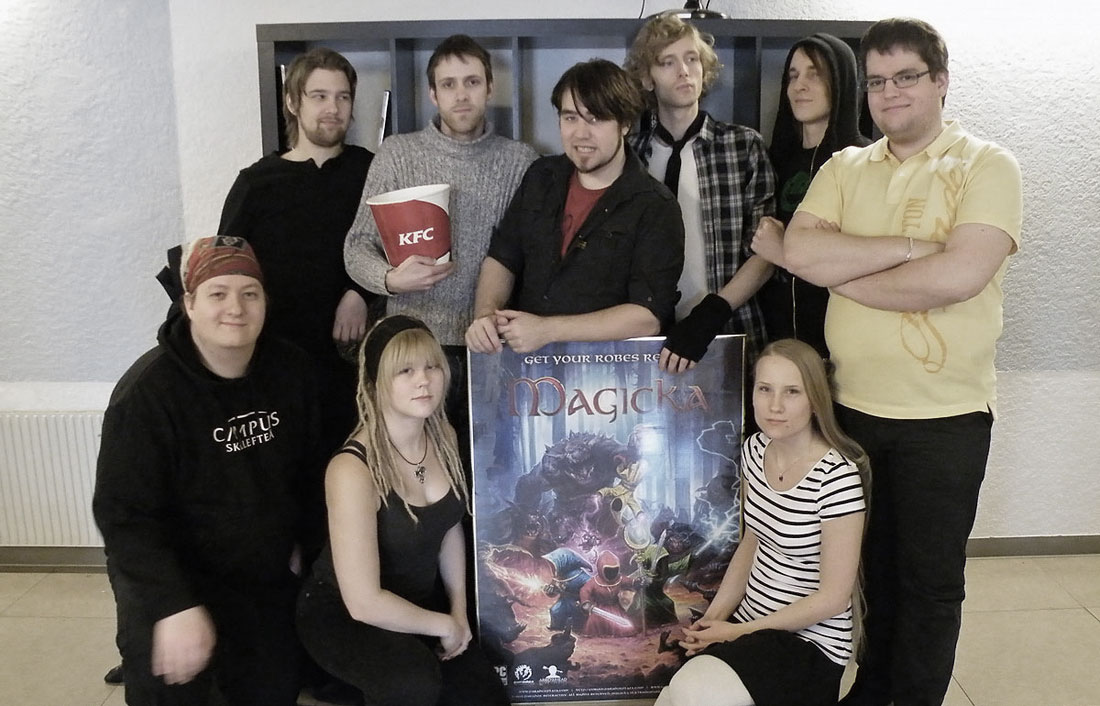
Jpeg-4Johan Pilestedt (center) with Emil Englund (to his immediate right) and the Magicka team
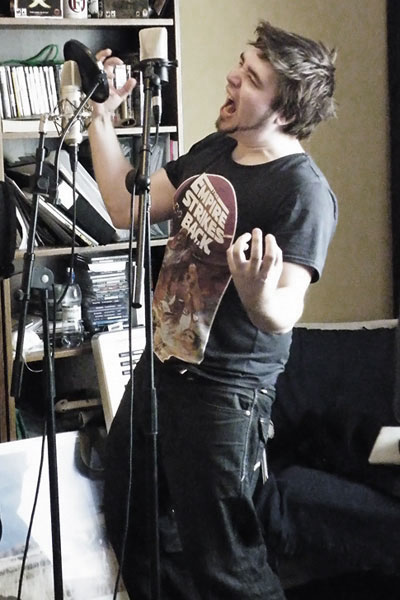
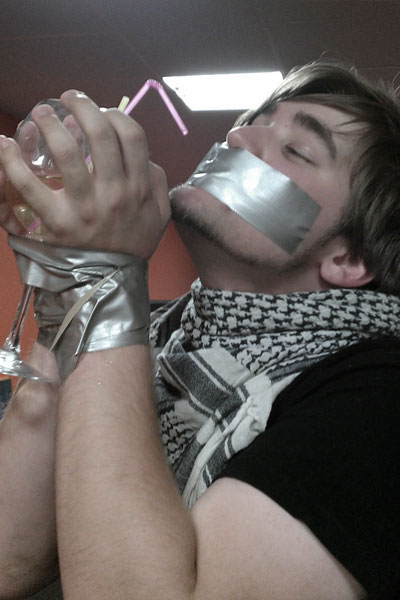
Jpeg-2Johan Pilestedt says shared cultural touchstones kept the team sane.

The project lacked something fundamental from the very beginning: a plan. Barreling forward in the early days, energized by their desire to create a game that would establish the team as a serious force in game development, Arrowhead's members kept adding features, and then sought to perfect those features, even when they weren't central to the experience.

"We overestimated our ability to create such a big product," says Pilestedt. "In the early days we always saw it as a small title. But looking at it now, in retrospect, the game has a ton of features and a ton of maps. There so much in that game. We could easily have removed 50 percent of it and people wouldn't have noticed."

The damage this freewheeling approach dealt to the project wasn't just counted in the man hours that piled up; it was psychological. Without a plan, Arrowhead's team members had no blueprint to which they could compare progress, only the collective memory of their original ideas. As Magicka approached its deadline, the reality was that the game had a plethora of content, none of which was entirely completed.

"Everything was broken, nothing was complete. We needed to fix things in every single feature to make it shippable."

"We poured everything into that project. We lacked discipline," says Englund. "Being noobs, we prioritized getting everything into the game, rather than spending time polishing."

"Everything was broken," says Pilestedt. "Nothing was complete. We needed to fix things in every single feature to make it shippable. We couldn't cut anything, because it wouldn't help. Everything was basically at 80 or 90 percent. We might as well have finished all of it rather than cutting many of the features."

This engendered a certain panic in the team, a sense that perhaps they might not be up to the task of creating a hit game after all. "That really, really hit us hard," he says. "We couldn't see our hands in front of our faces because we were so blinded by the development of the game." The boost the team had received from that award, from the seasoned jurors and from the university dean was a distant memory.

"Conflicts within the team started to break out," says Pilestedt. "It spilled over from development into the personal space." The bad atmosphere came to a head one Friday night. It focused on an attempt to lead a normal life, outside the demands of Magicka.

"It was seven or eight in the evening," recalls Englund. "My girlfriend came over to the office and I wanted to go out with her. I hadn't mentioned it to anyone. [Pilestedt] started questioning me, and that's how it started."

"He hadn't seen her in ages," says Pilestedt. "Basically, [Englund] was about to leave. But we had so much to do. We had a delivery, like two weeks from that day. We got into this big argument. I said, 'Are you really into this? Is this really what you want to do? You're wasting your time doing this other stuff.'"

"It was one of those monumental arguments when who ask yourself, 'Are you sure you want to do this?'"

They were shouting at each other in front of their teammates. Pilestedt was questioning his friend's commitment to what he calls "the cause." "Looking at it now, that was such an immature way of handling the situation," says Pilestedt. "That kind of thing, doubting the other people on the team, it was a big part of those last months of development. People were worried that they were working harder than everybody else, that they were being held back by the possibility that the other guys weren't working hard enough. That was the perceived view, even though everyone was working as hard as they could."

"It was one of those monumental arguments when who ask yourself, 'Are you sure you want to do this?'" says Englund. "We were emotionally and physically exhausted. Everyone was like, 'If you are going to fuck this up then I am going to leave.' It was very tense." They spent a few hours trying to patch up the argument, but the date was ruined. "It wasn't long after that," says Englund, referring to his girlfriend, "that the breakup came."

Helldivers

Like Magicka, Arrowhead's next game Helldivers is designed to be played cooperatively, to give players a chance to enjoy each other. "It's a creation of love to an old-school game type that we haven't seen a lot of lately," says Pilestedt. As discussed in Polygon's Gamescom report on the game, the fun is in failing, and in accidentally fouling up team efforts.

"There have been some twin-stick shooters out there, but they tend to not be as challenging as we prefer our games," Pilestedt says. "One thing that we always use when we discuss game design in-house [is] if a player sees a solution to a problem, that solution has to work. We get frustrated with games where you're like, 'Let's try to go around to do this flanking move,' and then the game puts up some kind of abstract barrier to prevent the player from playing the game in the way they want to."

Onward to Helldivers

Onward to Helldivers

When Magicka finally shipped in early 2011, the team gathered to meet and talk for a long time about . From this process, the team members made decisions together — vows, really — to approach their next project with a more structured plan.

The first vow was to ban crunch.

"I once read an article saying that the average career expectancy in the games industry is five years. That doesn't sound healthy," says Pilestedt. "After Magicka, we decided we're not going to force anybody to work overtime ever again.

"Conflict can be some of the most creative things you can have within a team. It brings the team together."

"We want to become a new breed of developers who look at games in a more professional way, a more mature way. We want to change the 'let's crunch till it's done' mentality." The team's next game, Helldivers, progresses according to a plan. Analysis of that plan, changes and additions of any kind, are considered with the utmost care. Pilestedt likens to process to sailing, in which the destination is pre-agreed, but corrections are required along the way.

The arguments continue, but now with strict divisions between life and work. "We like our conflicts now," he says. "Conflict can be some of the most creative things you can have within a team. It brings the team together. You've taken a step further in your relationship with that person. Arguments about the game are good for creating a well-functioning team, a team where everyone trusts every other person on the team."

Looking back at the terrible row on that Friday night, Englund believes it was a difficult but necessary part of the process. "If it hadn't been for that, I don't think we would have made it this far," he says. "That night we made up and parted as friends. We have always had a unified vision of where we want the company to go and we have always stuck together." Babykayak

18 Oct 16:44

Nvidia debuts G-Sync monitor module to improve image quality

by Samit Sarkar
firehose

gamers will buy anything beat

Stay Connected. Follow Polygon Now!

By Samit Sarkar on Oct 18, 2013 at 12:04p

Nvidia has developed new technology to improve visual performance in video games: G-Sync, a module for computer monitors that "brings big benefits for gamers," according to a blog post from the company.

G-Sync is designed to attack a key hurdle in display technology: the syncing between a graphics card's frame-rendering rate and a monitor's refresh rate, both of which are usually set to 60 Hz. That fixed refresh rate forces users to play with vertical synchronization (VSync) on, which causes latency and image stuttering, or with VSync off, which leads to screen tearing.

Instead of syncing a GPU to a monitor, G-Sync does it the other way around: The monitor only refreshes after the GPU has finished rendering a frame. According to Nvidia, keeping the monitor in sync with the GPU reduces screen tearing, stuttering and input lag.

G-Sync takes the form of a module that can be built into a monitor or installed onto an existing display, and the chip works with the hardware and software in many GeForce GTX cards — a GeForce GTX 650 Ti Boost or better. The first monitors with G-Sync will be available later this year: Nvidia is sending the modules to professional modders who will install them into Asus VG248QE monitors, and those G-Sync-equipped displays will cost a bit more than the standard ones. Monitors with G-Sync modules pre-installed by display manufacturers will start to be available next year.

Tap for more stories

[% var len = Math.min(data.comments.length, data.settings.autoUpdateAlertMaxShown) %] [% for (var i = 0; i [% if (comment.parent) { %] replied to [%= comment.parent.user.display_name %] [% } else { %] posted a new comment [% } %] [% } %]
[% if (data.comments.length > data.settings.autoUpdateAlertMaxShown) { %] [% } %] ]]>
18 Oct 16:43

To his friend...

by MRTIM

18 Oct 16:42

Nyan Nyan Nouveau, Red Wine For Cats From Japan

by Kimber Streams

Nyan Nyan Nouveau

Japanese pet supplier B&H Lifes has created a red wine specially made for cats called Nyan Nyan Nouveau, or Meow Nouveau. The non-alcoholic feline wine contains vitamins, a small amount of grape juice, and, of course, catnip. Nyan Nyan Nouveau is currently available to purchase online from B&H Lifes alongside other products like Wan Wan Sparkling Wine (Woof Woof Sparkling Wine) for dogs.

image via Atpress

via Atpress, RocketNews24

18 Oct 16:40

Books: Memory Wipe: Revisiting the sad, misogynistic fantasy of Xanth

by Jason Heller
firehose

TW: rape, slut-shaming, pedophilia

The Internet is choked with nostalgia for the youth-oriented entertainments of the not-too-distant past: Tumblr blogs regurgitating images of half-forgotten toys; YouTube compilations of long-lost TV-show intros; countless blogs playing “Remember when?” with movies and video games whose rose-colored recollections aren’t always properly earned. With Memory WipeThe A.V. Club takes a look at some of our formative favorites with clearer eyes and asks that all-important question: Were they really that great to begin with?

Here’s how this article was supposed to go down: As a kid, I lived in Florida. Back then I loved the books of Piers Anthony—especially his humorous, bestselling Xanth series, which is set in a parallel version of Florida where magic and mythical creatures exist. For this installment of Memory Wipe, I was going to reread A Spell For Chameleon, the 1977 novel that started the Xanth series (whose 37th—yes ...

Read more


18 Oct 16:35

New wave of online peer review and discussion tools frightens some scientists

by Chris Lee
Sites like Publons and PubPeer hope to quicken the pace of scientific conversation.

Earlier this year, I wrote a story about a new HIV/Aids detection kit that was under development. Since that time, the same group has published two more papers on the same topic, but questions are starting to be asked about the original research. The questions were so simple that I was pretty embarrassed I didn't spot the problems on my own.

But I wouldn't have gotten even that far were it not for the new directions that peer review and social media are taking science. I was alerted to the problems by twitter user @DaveFernig, pointing me to a discussion about the paper on PubPeer.

Before getting to that, let's recap what impressed me about the HIV detection paper. It achieved a couple of things that made it stand out from a veritable truckload of similar proof-of-principle experiments. The test was very sensitive—so sensitive that it could detect viral loads below that of the standard test and may even reach single molecule sensitivity. When someone uses single-molecule sensitivity, I tend to get all hot and bothered and all my critical thinking faculties vanish for a while.

Read 22 remaining paragraphs | Comments


18 Oct 16:23

If We Get Out Of This Debt Crisis, It'll Be Thanks To The Women Of The Senate

firehose

'Frustrated with the lack of progress, Ms. Collins, a Republican, two Saturdays ago quickly zipped out a three-point plan that she thought both parties could live with, marched to the Senate floor and dared her colleagues to come up with something better. A few days later, two other Republican female senators eagerly signed on — Lisa Murkowski of Alaska, who overcame the Tea Party to win re-election in 2010, and Kelly Ayotte of New Hampshire, who benefited from the Tea Party wave.

Together the three women started a bipartisan group whose negotiating framework formed the centerpiece of a tentative Senate deal nearing completion Monday to reopen the federal government and avert a disastrous default.

“Before I went to the Senate floor, no one was presenting any way out,” Ms. Collins said. “I think what our group did was pave the way, and I’m really happy about that.”

In a Senate still dominated by men, women on both sides of the partisan divide are proving to be the driving forces shaping a negotiated settlement.
18 Oct 15:43

I Broke Day One: Garry's Shitty Incident

by BirgirPall
firehose

uh how bout I press these buttons

This game is like a sponge for badness, it absorbed all the bad from great videogames and it is the hero we need, but not the one we want to play right now. ...
From: BirgirPall
Views: 796644
20235 ratings
Time: 10:56 More in Gaming
18 Oct 15:36

Bruins fans promised Red Sox game will be on TV – at Florida Panthers game

by gguillotte
firehose

Florida hates Florida

In a move that might go beyond catering to the opposing fans into outright servicing them, the Panthers are advertising their game against the Bruins with the assurance that “Red Sox vs. Tigers game to be played on TVs throughout the arena.”
18 Oct 15:34

Florida Man Sets Himself On Fire While Trying To Burn A Cross

firehose

never go

A Florida man attempting to burn a cross as part of an ill-conceived "prank" suffered severe injuries after accidentally setting himself on fire in the process.