Chemistry of Materials
DOI: 10.1021/acs.chemmater.6b01831

A stiff and healable polymer is obtained by using the dynamic-covalent boroxine bond to crosslink PDMS chain into 3D networks. The as-prepared polymer is very strong and stiff, and can bear a load of more than 450 times its weight. When damaged, it can be completely healed upon heating after wetting.
As a result of a unique synergy between ligand-free Fe/ppm Pd nanoparticles and PEG-containing designer surfactants, a facile and selective reduction of nitro-containing aromatics and heteroaromatics can be effected in water at room temperature in the presence of NaBH4. This new nanotechnology involves low catalyst loadings, is highly chemoselective, and tolerates a wide variety of functional groups. The process, which includes recycling of the entire aqueous medium, offers a general, environmentally responsible, and notably safe approach to highly valued reductions of nitro-containing compounds.

By design: As a result of a unique synergy between ligand-free Fe/ppm Pd nanoparticles and PEG-containing designer surfactants, a facile and selective reduction of nitro-containing (hetero)aromatics by NaBH4 can be effected in water at room temperature. The process offers a general, environmentally responsible, and notably safe approach to highly valued reductions of nitro-containing compounds.
Chemically highly stable MOFs incorporating multiple functionalities are of great interest for applications under harsh environments. Herein, we presented a facile one-pot synthetic strategy to incorporate multiple functionalities into stable Zr-MOFs from mixed ligands of different geometry and connectivity. Via our strategy, tetratopic tetrakis(4-carboxyphenyl)porphyrin (TCPP) ligands were successfully integrated into UiO-66 while maintaining the crystal structure, morphology, and ultrahigh chemical stability of UiO-66. The amount of incorporated TCPP is controllable. Through various combinations of BDC derivatives and TCPP, 49 MOFs with multiple functionalities were obtained. Among them, MOFs modified with FeTCPPCl were demonstrated to be catalytically active for the oxidation of ABTS. We anticipate our strategy to provide a facile route to introduce multiple functionalities into stable Zr-MOFs for a wide variety of potential applications.

Mix and match MOFs: Porphyrinic ligands are incorporated into UiO-66 through a one-pot, thermodynamically controlled synthesis from mixed ligands (ditopic 1,4-benzenedicarboxylate or its derivatives and tetratopic tetrakis(4-carboxyphenyl)porphyrin ligands). This strategy provides a facile route to introduce multiple functionalities into stable Zr-MOFs for an extensive variety of potential applications.


As an emerging class of porous crystalline materials, covalent organic frameworks (COFs) are excellent candidates for various applications. In particular, they can serve as ideal platforms for capturing CO2 to mitigate the dilemma caused by the greenhouse effect. Recent research achievements using COFs for CO2 capture are highlighted. A background overview is provided, consisting of a brief statement on the current CO2 issue, a summary of representative materials utilized for CO2 capture, and an introduction to COFs. Research progresses on: i) experimental CO2 capture using different COFs synthesized based on different covalent bond formations, and ii) computational simulation results of such porous materials on CO2 capture are summarized. Based on these experimental and theoretical studies, careful analyses and discussions in terms of the COF stability, low- and high-pressure CO2 uptake, CO2 selectivity, breakthrough performance, and CO2 capture conditions are provided. Finally, a perspective and conclusion section of COFs for CO2 capture is presented. Recent advancements in the field are highlighted and the strategies and principals involved are discussed.

Covalent organic frameworks (COFs) are excellent candidates for various important applications. Recent research progress on: i) experimental CO2 capture of different COFs according to the covalent bonds formed during the synthetic procedure, and ii) theoretical calculations of CO2 capture by COFs is highlighted. Analyses and discussions based on experimental and theoretical results are also provided.


3D carbon superstructures are fabricated through the hierarchical assembly of polyimide nanosheets and thermal treatment. Benefiting from the ultrahigh surface area and the hierarchically porous structure, along with the well-distributed highly electroactive sites, the flower-like carbon material exhibits outstanding catalytic activity toward the oxygen reduction reaction and also serves as a highly stable electrode material in supercapacitors.
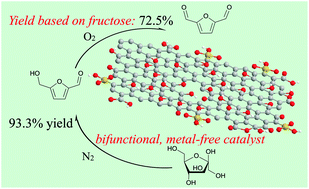
Water-containing organic solutions are widespread reaction media in organic synthesis and catalysis. This type of multicomponent liquid system has a number of unique properties because of the tendency for water to self-organize in mixtures with other liquids. The characterization of these water domains is a challenging task because of their soft and dynamic nature. In the present study, the morphology and dynamics of micrometer- and nanometer-scale water-containing compartments in ionic liquids were directly observed by electron microscopy. A variety of morphologies, including isolated droplets, dense structures, aggregates, and 2D meshworks, have been experimentally detected and studied. Using the developed method, the impact of water on the acid-catalyzed biomass conversion reaction was studied at the microscopic level. The process that produced nanostructured domains in solution led to better yields and higher selectivities compared with reactions involving the bulk system.

Watered down: The formation of micrometer- and nanometer-scale compartments in ionic liquids, mediated by addition of water, can be directly observed by using electron microscopy. The morphologies, which include isolated droplets, aggregates, and 2D meshworks, change according to the amount of added water. The ionic liquid/water systems were applied to the formation of the platform chemical 5-(hydroxymethyl)furfural.

Producing macrocyclic mesogens that are responsive to guest encapsulation presents a significant challenge. Cyclo[6]aramides, a type of macrocycle with a hydrogen-bond-constrained backbone, exhibit thermotropic lamellar, discotic nematic, hexagonal, and rectangular columnar mesophases over a considerably wide temperature range, including at room temperature. Additionally, cyclo[6]aramides show unusual mesophase transitions from lamellar to hexagonal columnar phase mediated by macrocyclic host–guest (H–G) interactions between the macrocycles and alkylammonium salts. The phase transition, triggered by an organic guest engaging in H–G interactions with a macrocyclic cavity, provides a novel strategy for manipulating the properties of liquid-crystalline materials. The crystal structure of a homologous cyclo[6]aramide reveals a disk-shaped, near-planar molecular backbone that facilitates intermolecular π–π stacking and leads to columnar assembly.

Stack the deck: Cyclo[6]aramides, having a hydrogen-bond-constrained backbone and a well-defined inner cavity, exhibit rich liquid-crystalline mesomorphic properties. Exploitation of host–guest interactions between the cavity (blue/green discs) and alkylammonium salts (red) leads to distinct mesophase transitions from a lamellar to a hexagonal columnar phase, as shown by polarized optical microscopy.

The electrochemical oxygen reduction reaction (ORR) is an important cathode reaction of various types of fuel cells. The development of electrocatalysts composed only of abundant elements is a key goal because currently only platinum is a suitable catalyst for ORR. Herein, we synthesized copper-modified covalent triazine frameworks (CTF) hybridized with carbon nanoparticles (Cu-CTF/CPs) as efficient electrocatalysts for the ORR in neutral solutions. The ORR onset potential of the synthesized Cu-CTF/CP was 810 mV versus the reversible hydrogen electrode (RHE; pH 7), the highest reported value at neutral pH for synthetic Cu-based electrocatalysts. Cu-CTF/CP also displayed higher stability than a Cu-based molecular complex at neutral pH during the ORR, a property that was likely as a result of the covalently cross-linked structure of CTF. This work may provide a new platform for the synthesis of durable non-noble-metal electrocatalysts for various target reactions.

Stable and efficient: The pores of covalent triazine frameworks hybridized with carbon nanoparticles were functionalized with Cu atoms by coordination to N atoms. The material functions as an efficient electrocatalyst for oxygen reduction reactions (ORR) in neutral solutions. The catalyst exhibited higher stability compared to other Cu-based organometallic catalysts as a result of the rigid network of covalent bonds in the framework.

海滨稚子酰胺

The multifunctional Baeyer–Villiger enzyme LgnC catalyzes the transformation of indolizidines into pyrrolizidines by carbamate formation, hydrolysis, decarboxylation-driven ring contraction, and hydroxylation. In their Communication (DOI: 10.1002/anie.201502902), H. Deng, Y. Yu et al. show that these are the crucial steps for the biosynthesis of the legonmycins, new bacterial pyrrolizidine alkaloids named after their association with Legon, Ghana.