Shared posts

04 Sep 14:51

Impostor Cell Phone Towers Could Be Controlling Your Mobile

by Annalee Newitz
Dance Magers

Kinda crazy

Impostor Cell Phone Towers Could Be Controlling Your Mobile

This map shows the locations of 17 mysterious cell towers in the United States that aren't part of any known cell phone provider network. Nobody knows where they came from, but they are busily intercepting the communications of any mobile in signal range. What happens next probably isn't good.

Read more...


04 Sep 13:57

CELEBRITY NUDES!!!! LEAKED!

by Brendan Kelly
Dance Magers

Love the sign off

“DON’T TAKE NUDE PICTURES IF YOU DON’T WANT THEM ON THE INTERNET!” some dork is furiously typing right now. Aaaaaaand now there’s some other smug dork typing the same thing. They’re all collecting ‘hacked n00dz,’ patting each other on the back, looking down at the prurient, self-pornographers from atop some (very boring) moral high ground. And no one really seems to argue their point. Sure, there are a few concessions given: Yes, it’s an invasion of privacy. Yes, it’s unfortunate. Yes, whoever did this is a Bad Person, but you know what? If you don’t want your naked pictures to end up on the internet, don’t take them. Right? Right. Wrong. That’s total bullshit.

Look, if we’re gonna run with this (deeply flawed) logic, here are some new maxims for you: If you don’t want to be mugged, don’t carry a wallet. If you don’t want your TV stolen and sold for a fraction of what you paid for it, then don’t have a nice TV in your house. If you don’t want to be mocked by talentless trolls for the rest of your life, then never attempt to express yourself artistically. And for fucks sake, if you don’t want shitty ex lovers to talk about your small dick/mommy issues/flappity vagina/tendency to get drunk and act like a total monster, well, then you should never ever become romantically involved with anyone.

The shitty, puritanical, troglodydian logic behind this victim shaming would be shocking if it wasn’t so run of the mill. How dare anyone take naked pictures of themselves! It’s…what? A sin? Maybe? No? Hmmm. I guess it’s NOT technically a sin. But it’s not very sophisticated or classy, that’s for sure. Maaaaaybe that’s true, but it’s exciting. Driving fast cars, watching football, playing minecraft, being at a sweaty rock concert, drinking beer, skydiving, eating nachos, reading comics, riding dune buggies and the general old act of just fucking your spouse are not exactly sophisticated pursuits either, but they’re fun, and only the most bizarre space alien would say that engaging in any of these activities are grounds for inviting theft of property and public humiliation. Seriously, what gives, nation of puritan grandmas? My ACTUAL grandma is less uptight than you.

So, yeah. I’m upset at the way that the current spate of “hacked celebrity nudes” has created a noxious victim blaming firestorm here on the internet, stemming mostly from everyone wanting to see Jennifer Lawrence and Kate Upton naked, feeling guilty, and then shifting that guilt onto those girls as to feel a little bit better about looking at their intimate photos. Pretty lame, even for you, Millhouse.

Listen, I get it. We’ve been burned by celebrity tits about a million times. Kim and Paris both claimed that those tapes of them fucking those losers were stolen, when that’s just patently not true. They were, in both cases, calculated maneuvers designed to catapult each of them into superstardom while making tidy profits. Hell, that teen mom chick went for the same thing, but used a highly desirable male porn star and then STILL had the gall to claim it was a “private tape.” The words kind of lose all meaning in the American-celebrity-tit-and-beaver-vacuum. However, the fact remains: it’s not sinful or bad to take pictures of yourself naked, partially naked, or fucking or jacking off. It’s not. And it’s not unreasonable to share those pictures with someone who you KNOW (and this is key [I’m looking at you, unsoclicited dickpic guys]) would like them. AND, and this is the big one, y’all, it’s not unreasonable to take such pictures, and even share such pictures with people you like, and expect some discretion, AND it’s not unreasonable to be totally bummed and feel violated or betrayed if said pictures are made public. That doesn’t make anyone stupid or naïve or a slut or a fool or any of it. It’s totally reasonable. Just because you have a nice bike doesn’t mean it’s your fault if someone steals it. Just because you’re wearing a slutty outfit doesn’t mean it’s your fault if someone fucks you against your will and just because you’ve got sexy pictures of yourself on your phone or computer does not (does NOT!) DOES NOT mean it’s your fault if some shithead hacks your phone and puts that shit everywhere. You want a world where nudity and sexuality are sins punishable by public shaming and more? Go to Afghanistan or Iran or anywhere where uptight, virginal religious psychopaths kill women for daring to have bodies and ideas about said bodies. Go cast your stones with the rest of the creeps, but fuck…leave the people who are just trying to have a little fun on this earth in peace. Sheesh.

And Kate Upton and Jennifer Lawrence, if you guys wanna talk more to an enlightened dude like me, I got your backs. Just hit me up. My aol name is fatschlongdaddy69. Love you ladies. Keep yer heads up.

03 Sep 17:59

​C-3PO and R2-D2 Want You to Get Vaccinated

by Mark Strauss

In 1977, measles was spreading across the U.S. in outbreaks of epidemic proportions. Less than 70% of children had been immunized due, in part, to a public backlash against swine flu vaccinations, which were rumored to be deadly. Fortunately, the CDC got help from two of the nation's top celebrities.

Read more...


03 Sep 13:59

I Got Cocaine Blown Up My Ass So You Don't Have To

by Justin Caffier

Photos courtesy of the author

If drugs are your thing, 2014 is a great time to be alive. The US seems to be full steam ahead on inevitable marijuana legalization, Vermont is now looking at heroin abuse as a health problem rather than a criminal offense, and the public stigma of using harder party drugs seems to fade day by day. But with this new frontier of drug Perestroika comes a new set of challenges, and for some users, the chief among those seems to be boredom with the old delivery methods.

In a recent lengthy thread on an infamous and private Facebook group for women in Southern California, users mentioned getting cocaine blown—literally blown, not inserted—up their butts. According to the young lady who started the discussion, she would “never do coke the old way again.” Others responded, days later, extolling the pleasures of this new approach. “It hits you faster.” “The numbness.” “A more intense high.” I had to dig deeper and see if this was just an isolated incident or if it was, in fact, a trend on the rise.

Sure enough, googling “coke up butt” took me right to this LiveLeak video (NSFW) of a young lady in Rothbury, Michigan, at the Electric Forest music festival, having a young man blow a straw-full of cocaine into her anus. Sadly, despite the completely chaste nature of the act filmed, many of the tags for the video contained pejoratives like “whore” and “skank.” More importantly, the upload date was July 16 of this year! Not long after that, hundreds of people talked about it on Reddit in a post titled "Is it ok to blow cocaine up a girls ass?" 

The trail was hot.

A simplified form of the practice has existed for ages, and it even has its own slang term, "boofing," but it never seemed like something I would try. I'd always dismissed it as the kind of schoolyard rumor perpetuated by kids who will believe anything, or occasionally as just one short chapter in someone's myriad anal adventures. Suddenly, though, It was being discussed as a fad.

The existing literature on the subject didn't include the blowing method. Some people said they got off from the numbness alone, or would be fucked after the numbness took effect. Others just wanted a new way to get high. But while there were somewhat detailed instructions, the preferred method seemed to be mixing a tiny bit of water with two snorts’ worth of powder, and using an oral medication syringe to get the mixture up there. I decided I needed a professional opinion.

I called the Kaiser Permanente Media Relations team for a physician's viewpoint, and a very nice woman named Kate spoke with me. I asked her about it and she fell silent. “I know it’s funny," I said, hoping the conversation could recover, "but I just want to understand the possible health effects on a more fundamental level.”

“I’d say it’s more sad actually,” Kate replied.

“Oh. Yeah. That’s the word I should’ve used. Sad.”

Overall, Kate was extremely helpful and promised to contact all the gastroenterologists to see if anyone would weigh in. A week later she informed me that Kaiser would be “passing on this opportunity.” I can hardly blame them. They're a large healthcare organization. Could I really have pictured them having a position on something called "boofing?"

Still, the internet had spoken. I had to try it.

Right before zero hour, I showered and scrubbed like I’d never done before in my life. My assistant (who shall remain anonymous) was wonderful enough to volunteer her time and lack of squeamishness for this experiment. The least I could do was give her an immaculately sterilized field of operations. I had looked up how anal porn stars prepped for a scene to make sure no dookie made an appearance, but an enema seemed a bit like overkill so I made do with a bunch of cupped handfuls of water in the shower.

I prepared the three methods described online. First, we’d attempt blowing the coke up my butt through a tube with lung power. Second, I’d mix a bit of water with the powder and inject the solution into my colon using a liquid syringe. Finally, I’d try just poking some dry powder right up there with my finger. My assistant, a virgin to cocaine herself, wouldn’t ever need to touch the stuff.

For the first method we used a plastic tampon applicator as the tunnel, both for ease of insertion, and because I feared no mere plastic straw could stand up to the strength of my clench. I started by chopping up approximately one third of a gram of blow into what I considered normal sized lines. It had been a while since I’d used this stuff in the more traditional sense, so I erred on the side of shorter lines. I spooned two lines into the applicator, careful not to tip it too far, lest the powder spill out the slits of the domed end.

We got the tip in me without any real difficulty. We let our laughter subside a bit and put on our game faces. She took a breath and blew into the Tampax tube. Had we the slightest bit of understanding of aerodynamics, we’d have been fully prepared for what happened next, which was the dead end of my rectum forcing the blown air to turn around and exit the side of the tube it came from.

“That didn’t work. And, my lips are very numb,” she said. “I think the coke went into my mouth.”

This may have been the most unique first time coke experience for anyone ever.

I let myself wait for a bit to see if I felt anything. Perhaps some of the coke had found its way in me after all. It was supposed to hit in about 20 seconds. Much more quickly than with inhalation. But I wasn’t feeling anything, so we moved on to round two.

I scooped two lines into the un-stoppered barrel of a baby medicine syringe. After adding a tiny bit of water and shaking up the whole solution, we put the plunger back in and slid the head of the syringe into my bum. This time it worked. Once the plunger was fully depressed, the thankfully empty syringe came back out and I instinctively shook my ass around like we were in a Looney Tunes cartoon. I guess I wanted the solution to fully coat all exposed surface areas of my rectum walls.

Success! I was chatty and a little sweaty a minute later. My assistant was enjoying her own high at that point. “My teeth are numb! How long will this last? This tastes so weird!” I was determined to give her a typical coke high experience, so we rode out the buzz with some lively discussion about the issues of the day, the representation of women in video games, and how we should totally, like, go camping some time, y’know?

Once I was on enough of a comedown that I’d be able to judge the efficacy of the third, and crudest, method, I pinched the final line between my thumb and finger, and pressed the powder into my balloon knot. Coke (of course) spilled onto the carpet, and I stood there like an idiot, afraid to pull my pants back up, lest more of the stuff decide it wasn’t going to stay up there. I suddenly realized that it probably wasn't the only time during this process that I looked like an idiot.

My butthole got numb, and I felt a little re-up from the drug. But I was mostly ready to be done with this. I was antsy and uncomfortable. I felt like the teaspoon of water from that mixed solution was going to leak out of me at any moment like a 1990s-era Olestra discharge, and my anesthetized asshole wouldn’t be able to tell. Coke can make you have to shit as it is. 

In the end, my high was no more significant than when I opt for the more orthodox approach, so the effort-to-payoff ratio is wildly lopsided. Who needs a Rube Goldberg-style delivery method when snorting will give you the same results? Maybe the girls from that original Facebook thread were just excited to be early adopters. Maybe they were having a laugh, and I ended up becoming the joke for trying it myself. Maybe I have a broken ass, and am doomed to never fully tap into the sensory pleasure center that others have there. Whatever the reason, coke up the ass is not worth the trouble.

If it ain't broke...

Follow Justin Caffier on Twitter

More on drugs:

This Is How Europe Takes Drugs in 2014

Meet the British Police Trying to Decriminalise Drugs

I Do Drugs Because Doing Drugs Is Fun


03 Sep 04:29

Were 'Devil Worshipper' Yazidis There for the Birth of Human Culture?

by Michael Smith
Dance Magers

Hadnt heard of this before. Interesting stuff.

Yazidi refugees receiving support from the International Rescue Committee (Photo via)

As the rolling news reports the latest round of atrocities in the ongoing Iraqi catastrophe, it’s easy to be desensitized to the desperate situation engulfing the Yazidis.

An entire people forced to abandon their ancestral homeland with only the shirts on their backs, they’re making the gruelling and perilous trek to refugee camps in Kurdistan, on foot through mountains and along desert dirt tracks. Many weren’t fortunate enough to escape mass executions at the hands of Islamic State militants, and thousands are still trapped up Mt. Sinjar in the baking heat with no food, water or shelter. Children and the elderly are dying in their droves.

As well as the attempted annihilation of an ethnic group, it’s also their religion IS want to destroy. One of the strangest survivals throughout the entirety of human culture, their faith has been viewed as so subversive and unsettling that it’s brought holy war and near extinction to the Yazidis throughout history.

In the eyes of IS, the Yazidis are Devil worshippers—something that’s actually kind of tricky to argue against; the group consider themselves to be the chosen people of Melek Taus, the “Peacock Angel," who they also know as Shaitan, or Satan. In Yazidi tradition, this special relationship began when Shaitan visited their ancestor Adam in the garden of Eden, bearing forbidden fruit.

The Yazidis are an ancient rural people from the plain of Mesopotamia, the cradle of civilization. Almost forgotten archaeological layers of belief still poke through the surface here, old echoes that stretch religious absolutes held sacred by Muslims, Christians and Jews alike into weird, unsettling shapes.

The parallels between the Peacock Angel and the Satan we’re more familiar with can be baffling—Melek Taus is God’s most important angel, his commander-in-chief in this world, which was also his original role in the Abrahamic traditions. He’s also a fallen angel who rebelled against God and was subsequently cast into Hell; but in the Yazidi cosmology, after 40,000 years his tears quenched Hell’s flames and God forgave and reinstated him.

Melek Taus, the "Peacock Angel" (Photo via)

This hints at the complex, ambiguous, almost human quality of Melek Taus. In the Mishefa Re, the holy book the Yazidis believe to be his revealed word, he tells us: “I give and take away; I enrich and impoverish; I cause both happiness and misery ... All treasures and hidden things are known to me; and as I desire, I take them from one and bestow them upon another.”

The Yazidis don’t see good and evil as polar opposites personified in particular gods, but as qualities that are integral parts of creation—they exist throughout the world, within the mind and spirit of human beings, and also within the Peacock Angel. The path we choose is up to us. “I allow everyone to follow the dictates of his own nature, but he that opposes me will regret it sorely.”

One of Melek Taus’ symbols is fire, and he can illuminate as well as burn. He’s responsible for granting mankind knowledge and free will, and in an intriguing twist on the familiar Garden of Eden story, he first initiates Adam with forbidden fruit: “[God] commanded Gabriel to escort Adam into Paradise, and to tell him that he could eat from all the trees, but not of wheat. Here Adam remained for a hundred years […] Melek Taus visited Adam and said, ‘Have you eaten of the grain?’ He answered, ‘No, God forbade me.’ Melek Taus replied and said, ‘Eat of the grain and all shall go better with thee.’”

A series of paintings from 1920 of Yazidis in traditional clothing (via / via / via)

The Yazidis claim to be the world’s oldest nation, tracing the origin of their culture back to this covenant between Shaitan and Adam. Though this obviously has the ring of massive over-simplification and elaboration common to all origin myths, there’s a growing body of archaeological evidence that seems to suggest there’s an element of symbolic truth in it—that the Garden of Eden story shared by all the Middle Eastern religions might in fact be a faded folk memory of how human civilization began in the first place, a memory connected to the Yazidis in a very special way; a memory that Judaism, and subsequently Christianity and Islam, inherited from them, distorting it in the process.

You can’t convert or intermarry into Yazidism. They’re a people set apart, a distinct ethnic group who’ve always lived in a corner of the Turkey-Iraq borderland that folk memory across the wider region recalls as the location of the Garden of Eden. All very well, you might say—the Garden of Eden’s just a myth. But have you heard of Gobekli Tepe? It’s a recently unearthed archaeological site just over the Turkish side of the border that’s in the process of causing complete upheaval to all our old assumptions about the dawn of human civilization.

Ruins at the Gobekli Tepe site (Photo via)

The discovery of Gobekli Tepe came when an archaeological team noticed a curious collection of what looked like gravestones on top of a strangely isolated hill. They began to examine these graves, which they soon discovered were just the tip of an astonishing iceberg: that the “hill” was in fact man-made, and, more importantly, that the “graves” were just the tops of huge, immaculately preserved limestone megaliths. These giant stones formed a large circular sacred site that had mysteriously been buried under tons of earth in distant antiquity, the rocks adorned with beautiful carvings of snakes, boars and strange bird-gods that the Yazidi swear they easily and instantly recognise as depictions of Melek Taus and their other angels.

To say these bird-gods have come down to us from the dawn of time is, in human terms, no exaggeration. The obvious comparison is with Stonehenge, but the real shock about Gobekli Tepe is its almost unimaginable age. Stonehenge is about 4,000 years old. Gobekli Tepe has been carbon dated and clocks in at an unbelievable 12,000 years old, extending the advent of monumental human architecture—and with it a human society large and complicated enough to build it—at least three times further back into the deep past, a time before writing, before metal and also a time before farming. “Stone age” hunter-gatherers built this place. Until very recently we imagined complex society—“civilization”—began with agriculture. Gobekli Tepe overturns this assumption about the birth of human culture in a stroke.

But the significance of Gobekli Tepe doesn’t stop there. Agriculture seems to have started around this area, too, around 10,000 years ago, when the megaliths were already 2,000 years old. Pigs were first domesticated in a place called Cayonu a few miles away. The wheat species first domesticated in ancient European and Asian agriculture all descended from a common ancestor: “einkorn” wheat, which just happens to be the very same indigenous species of these ancestral Yazidi heartlands. Which makes the small detail of Satan bringing Adam knowledge by introducing him to grain rather than apples in the Yazidi version of the Eden story suddenly seem very significant.

A Yazidi shrine on the left and the Nouri Mosque minaret to the right; Mosul, Iraq, 1932. (Photo via)

So, the Yazidis are descended from the original inhabitants of the garden of Eden and worship a bird-god called Satan, who brought mankind out of the Stone Age with the forbidden fruit of agriculture, right? Who knows.

This baffling conundrum certainly poses intriguing questions about how far back into the dawn of human culture—into the “Stone Age” and its transition into “civilization”—all our familiar stories about God and the Devil and Adam and Eden actually go. It also paints the Devil in a newly sympathetic light, and you wonder if the Old Testament’s take on Satan might have been a hatchet job on the older rival religion’s god.

It must be completely obvious to anyone who’s grown up with the “War On Terror” that the first thing you do in such situations is paint the other guys—and their Gods—as evil, blood-thirsty war mongers, because by demonizing them you can justify any inhumanity you might subsequently commit. It was the basic technique of Bin Laden and of Bush, and it seems perfectly tenable to imagine the writers of the New Testament involved in similar smoke and mirrors.

This would certainly be typical of the Yazidi’s historical experience; there have been 73 attempted genocides of these “devil worshippers” since the arrival of Islam in the region. The most remarkable part of the whole story is that the Yazidis have even survived at all.

Michael Smith is a writer, filmmaker and broadcaster. He is the author of three works of fiction, The Giro Playboy, Shorty Loves Wing Wong and Unreal City.

03 Sep 04:23

Rough Cut Star Wars' Cantina Scene Is Like Being On The Set Of New Hope

by Meredith Woerner
Dance Magers

Pretty cool

Rough Cut Star Wars' Cantina Scene Is Like Being On The Set Of New Hope

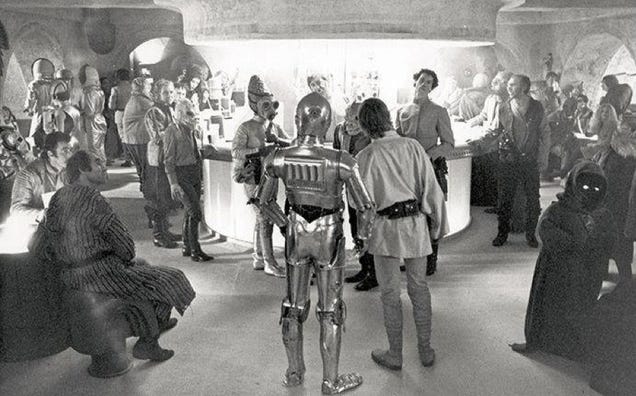
The Mos Eisley Cantina set is probably one of the most recognizable and beloved Star Wars settings. And now, thanks to an edited together rough cut video, you can experience what it probably felt like inside the Star Wars set while George Lucas was filming in 1976.

Read more...


03 Sep 04:06

The Not-So-Dark Knight: Batman Symbol Chest Sunburn

batman-sunburn.jpg This is a shot of some guy who looks suspiciously like my friend Paul (full disclosure: I have no friend named Paul) with a solid Batman symbol sunburn on his chest. I like how his nipples are included IN the bat part of the symbol, because I think they would have looked weird outside. Although it would have been even cooler if you made the bat-symbol so big they could have been eyeballs. *tapping head* I'm a thinker. Thanks to carey, who told me she's tempted to do the same thing with a Supergirl symbol. Heck yeah, take me to the beach with you.
03 Sep 04:02

Rare All Black Chickens Even Have Black Meat, Bones

Dance Magers

Crazy

all-black-chicken-1.jpg Because sometimes you want ALL dark meat, this are several shots of a rare Ayam Cemani Chicken of Indonesia. The birds are all black, every bit of them, except their blood. It kind of reminds me of Shadowmere from Skyrim. Man, I loved that horse. I might fire up the game tonight just so I can pet him. Ooooor ride him into battle against some giants. What? I need their toes to make health fortification potions!
Everything about it is black: plumage, beak, tongue, legs, toe nails, even its meat, bones, and organs! The only thing that is black is its blood - though it comes in a very dark shade. They get their black coloring from a generic trait known as 'fibromelanosis'. I don't know why you'd want to eat something that's as black as a black hole, but don't ever make the mistake of slaughtering it for a quick snack, because one chicken costs around $2,500!
Good lord, $2,500 for a single chicken? I could get you a real-life Pheonix for that much. Plus Pheonixes are even better because they cook themselves. Just make sure to eat the whole bird quickly, because that f***er's gonna be pissed if it's time to rise from the ashes and you've already eaten a wing and thigh. Keep going for several more shots including one of what you'd expect to find at your local grocery store's meat counter.all-black-chicken-2.jpg all-black-chicken-3.jpg all-black-chicken-4.jpg all-black-chicken-5.jpg Thanks to my buddy Argumus, who agrees $2,500 will get you a shit-ton of regular pink-slime chicken nuggets.
03 Sep 03:57

Bio-Hackers Are Using Human DNA to Make Vegan Cheese

by Wendy Syfret
Bio-Hackers Are Using Human DNA to Make Vegan Cheese
02 Sep 17:12

Liberals Won’t Let the Death Penalty Die

by Charles Davis
Dance Magers

Gotta love politics. His end point agould definitely be the goal.

The lethal injection room at San Quentin State Prison. Photo via Wikimedia

“I personally oppose this terrible, awful, unjust thing that I’m doing,” only really works as a defense of one’s terrible, awful, unjust behavior if the alternative to working at, say, the local cat-skinning factory is starvation. Capitalism requires us all to sacrifice a bit of our moral integrity to put food on the table so, while it’s nice to be pure, it’s also nice to eat. There’s a line, though, which I’d draw at: killing people. You really shouldn’t kill people—and in the case of California’s most powerful elected officials, all liberal Democrats, no one is forcing them to do anything of the sort.

But kill they shall.

Governor Jerry Brown and Attorney General Kamala Harris both profess to oppose the state-sanctioned killings, of course. For Brown, “repeal of the death penalty has been a lifelong cause,” according to the Los Angeles Times, and Harris “personally opposes the death penalty.” Both, however, have refused to let their very personal opposition to capital punishment get in the way of their very public defenses of it, so much so that they declined to endorse a 2012 ballot measure that would have fulfilled their lifelong missions and abolished it.

In July, though, a federal judge appointed by former President George W. Bush gave these liberal leaders in liberal California another chance. In a scathing ruling, Judge Cormac J. Carney vacated the death sentence of one Ernest D. Jones—convicted in 1995 of rape and murder—and ruled that California’s system of capital punishment is broken beyond repair.

"Allowing this system to continue to threaten Mr. Jones with the slight possibility of death, almost a generation after he was first sentenced, violates the Eighth Amendment's prohibition against cruel and unusual punishment,” Carney ruled.

Over 900 people have been sentenced to death in California since capital punishment was reinstated back in 1978—including 55 since the anti-death penalty attorney general took office in 2011—yet only 13 people have actually been executed, the last in 2006. Though about half of all murderers are white, most of those on California's death row are people of color, with the vast majority of them sentenced to die for killing a white person, the severity of a crime determined by the victim's melanin. And after arbitrarily being put on death row—less than one percent of homicide convictions lead to a death sentence—they wait around for years not knowing if they will be one of those arbitrarily selected to try out the state's latest lethal drug cocktail, with more than 40 percent of those sentenced to die having been on death row for at least two decades.

“[T]o be executed in such a system,” Carney wrote, “where so many are sentenced to death but only a random few are actually executed, would offend the most fundamental of constitutional protections—that the government shall not be permitted to arbitrarily inflict the ultimate punishment of death.”

Here it was: a chance for California’s liberal leaders to use the cover provided them by a conservative justice to do away with a punishment they decry as barbaric. In a state where nearly half the electorate backed replacing the punishment of death with life without parole, it would not be political suicide to finally act on that personal opposition. As attorney general, Harris is not obligated to appeal decisions all the way up to the Supreme Court. She could accept the judge’s ruling and move on. She could hold a press conference and say, “My job is to uphold the law, not defend violations of the Constitution.”

Alas, no: In an August 21 press release, Attorney General Harris announced she was “appealing the court's decision because it is not supported by the law and it undermines important protections that our courts provide to defendants.”

California Attorney General Kamala Harris speaks at a press conference. Photo via Wikimedia

When I called Harris’ office to ask how, specifically, throwing out the death penalty violates defendants’ rights, I did not get an answer. So I turned to Matt Cherry, executive director of Death Penalty Focus, an organization which opposes capital punishment. “I do not know what Kamala Harris meant,” he told me, as it’s the status quo that sees death row inmates languish for years in overcrowded prison cells—or torturous solitary confinement—waiting for execution that the state doesn’t even have the drugs to carry out (though Governor Brown says he’s working on a concoction that can kill prisoners without torturing them to death; such is the kinder, gentler face of liberalism).

“It is important to emphasize that the cost and length of the appeals process, which Judge Carney highlights, is not a flaw in the system,” Cherry said, “but is an inevitable outcome of the requirement for due process in the use of the only punishment that is fatal and irreversible.” The system can’t be fixed, in other words: it’s fatally broken and must be thrown out.

In California, it’s not Republicans preventing that from happening, but liberals who claim to oppose what it is they are doing. That’s classic Democratic Party strategy: telling the base, “We have the same moral convictions as you, we just can’t act on them.” And that’s enough for some people.

“Recently, I mentioned that California’s current attorney general, Kamala Harris, is anti-death penalty,” author Rebecca Solnit, who popularized the term “mansplaining,” wrote in a 2012 essay on those to her left explaining the failings of her liberal idols, a phenomena she termed “leftsplaining.” Immediately after she noted Harris’ “anti-death penalty” stance, Solnit wrote that a “snarky Berkeley professor” pointed out that Harris had actually “condoned the illegal purchase of lethal injection drugs.”

That claim was true: California, under Harris’ watch, purchased lethal injection drugs from a foreign source, violating federal law. But what mattered to Solnit were not the morally compromising deeds, but the spiritual uplift she received from believing someone who shared her values was now in elected office. Why take that away from her?

“Apparently, we are not allowed to celebrate the fact that the attorney general for 12 percent of all Americans is pretty cool in a few ways or figure out where that could take us,” Solnit wrote. “My respondent was attempting to crush my ebullience and wither the discussion, and what purpose exactly does that serve?”

Two years later, the liberal Harris has staked out a position on the death penalty that is to the right of a judge appointed by George W. Bush. Perhaps if ebullient liberals had paid more attention to actions than pretty cool words, liberal politicians might now feel some pressure to act on the personal convictions they espouse when asking for campaign contributions.

Then again, ending the death penalty is itself a rather liberal cause. It should of course be done, but it’s not as if life in an overcrowded prison, or in solitary confinement, without the possibility of parole is much if any more humane. There were also just under 40 executions last year, compared to the well over 400 people killed by police, most of them black, so even if we were to do away with capital punishment, we’d still have the death penalty—just administered by cops without the formality of a trial.

Still, there is something particularly evil about premeditated state killing; of keeping hundreds of people on death row for decades and arbitrarily killing a handful of them with a torturous mix of undisclosed chemicals. Just be aware that abolishing that form of state-sanctioned vengeance is far from the only thing that must be done to make the “criminal justice” system more just. Way too many people are imprisoned in America—more than two million, the most in human history—for way too long, the vast majority for nonviolent drug and property offenses.

We ultimately need to kill the policy of mass incarceration, which has devastated poor communities in this country, disproportionately those of color. Just don’t expect any liberals to lead the way.

Follow Charles Davis on Twitter.

02 Sep 17:06

Have Humans Already Conquered The Threat Of Extinction?

by George Dvorsky
Dance Magers

Some interesting thoughts. Comments are decent too.

Have Humans Already Conquered The Threat Of Extinction?

The Great Filter theory suggests that all advanced civilizations eventually destroy themselves before acquiring the capacity to colonize space — a notion that could explain why we've never been visited by aliens. But there may be another reason for the celestial silence. Yes, the Great Filter exists, but we've already passed it. Here's what this would mean.

Read more...


02 Sep 17:02

VICE Vs Video Games: The Worst Fighters in Video Game History

by Mike Diver

Competitors at the 2014 Evo Champion Series

Playing video games competitively can make you a millionaire. Of course, that won't come as much of a surprise if you've been paying attention to the increasingly lucrative world of eSports. The prize pot for the fourth international Dota 2 tournament, for example, was set at $10.5 million (£6.4 million) this past July, up from just under $3 million (£1.8 million) a year ago.

While some might believe that a multiplayer battle arena game like Dota 2 is still exclusively the preserve of barely washed basement dwellers, the millions of people following eSports worldwide suggest that perception is a little wide off the mark. People pay good money to see the very best Dota 2 players – and those of Riot Games’ League Of Legends, and a smorgasbord of one-on-one fighting games – in the flesh, at massive, arena-held tournaments.

In June, 10,000 punters made their way to London’s Wembley Arena to watch week five of the European League Of Legends Championship Series, a big enough turnout to attract coverage from the BBC, alongside the usual games-focused outlets. In 2013, around 71 million people watched competitive gaming, so you'll understand why it’s been suggested that these eSports heavyweights could ultimately feature at the Olympics

Guests at the international Dota 2 tournament in 2012

Such players were on parade at the annual EVO Champion Series, held from the 11th to the 13th of July at the Westgate Las Vegas Resort and Casino. EVO is a fighters occasion, inviting the very best from around the world to compete in matches across myriad beat ‘em ups, from Ultra Street Fighter IV (SFIV) to Ultimate Marvel Vs Capcom 3 via Tekken Tag Tournament 2 and Super Smash Bros. Melee (SSBM). What’s interesting there is that not all of the games are new releases; unlike the big gaming expos held globally, where the excitement is reserved for the freshest reveals, events like EVO highlight only the very best games of their kind.

These games comprise the bedrock of their genre – Super Smash Bros. Melee dates from 2001, and is so closely tied to its native controller, the GameCube’s oddly proportioned official model, that Nintendo are making the next entry in the series – out for 3DS and Wii U on the 3rd of October and late November, respectively – compatible with the GameCube pads. It’s a game that hasn’t been outclassed in 13 years. The same can be said of Ultra Street Fighter IV, merely an extension of 2008’s initial iteration in the IV strand, itself part of a series that dates back to 1987.

EVO’s top Ultra Street Fighter IV participant, Frenchman "MD|Louffy" (playing as the character Rose here), took away over £10,000 for his win. For triumphing in Smash Bros, "C9|Mango" scooped the best part of £3,600 – the pay-out lower because there were fewer entrants in the category. Still, not bad for a weekend’s work.

So why have these games continued to prosper? Says top-three-in-the-UK Smash Bros. tournament player Robby Gee, previously featured on VICE, “It’s due to the rich, deep engine and physics of the game. It’s unlikely developers knew they were making something so deep, though I think they’ve tried to claim they were aware. There are so many small details that make it brilliant as a competitive game, which you only start to discover when you raise your level. I’ve been playing it for 13 years, and I still want to go back to it every day.”

Kotaku UK editor Keza MacDonald is clear on why Smash Bros. not only continues to appeal in its GameCube version, but why the next iteration will be so important to the fortunes of its Wii U platform.

Smash Bros. is the ultimate Nintendo fan-gasm,” she says. “Every kid who has played something on their NES, SNES or Nintendo 64 – whether it was Mario, Zelda or Starfox, or something obscure like Fire Emblem – knows at least some of the characters. The whole universe-crossover thing will make big Nintendo fans excited enough to type a bunch of exclamation into comments boxes across the internet every time there’s a new character reveal. Smash Bros. is like the Mario Kart of beat ‘em ups – it’s easy to learn, hard to master and fun wherever you are on the skill spectrum.”

“As for Street Fighter IV, that’s a different story,” says Robby. “The game is less rich in terms of flexible options than SSBM, though the more rigid confines of physics and engine may mean that more players are able to develop robust strength at the game. SSBM has high barriers for player skills – it takes three to four years to really understand what you’re doing there, whereas new and skilled SFIV players can pick it up relatively quickly. That’s its positive side.”

Which explains why the Ultra Street Fighter IV winner took home the bigger prize for their effort: more players, more entrants, more money. The way Robby talks about these games makes them seem pretty simple – expertly engineered, no doubt, and above the pack, but ultimately bound by a set of rules to be understood before any bending of them can be undertaken.

Great games don’t get old, then, aesthetical lapses aside – and that extends beyond competitive play, as something like the Super Nintendo’s The Legend Of Zelda: A Link to the Past, or Team Ico’s wondrous Shadow Of The Colossus prove, both as transportative today as they were on release in 1991 and 2005, respectively. It’s why Tetris is perhaps the most popular videogame in the world some 30 years after its creation.

When it comes to fighters, like those featured at EVO, gaming history is littered with a litany of losers, titles that unsuccessfully went up against opponents like Mortal Kombat, Killer Instinct and the ubiquitous Street Fighter. Here’s a rogue’s gallery of the very worst.

Dangerous Streets (1994)

“And they say Shaq Fu was bad,” reads one YouTube comment. Oh, it was – and we’ll look at that game and its forthcoming "sequel" in more depth another time. But Dangerous Streets, for the Commodore Amiga and its awful spin-off CD32 console, was perhaps even worse. I mean, look at it. From the awful packaging to the grossly disproportioned character models and jerky animations, everything stinks.

Amiga Power – a monthly magazine for Amiga fans – awarded Flair Software’s attempt at emulating some of that Street Fighter magic a whopping 3 percent. If you had a cracked Amiga copy of this, picked up from a car boot sale, and played it once before copying over the game with anything else, you’re forgiven for giving it a minute or two. But if you bought it? Nah. There’s no coming back from that.

Capital Punishment (1996)

I was an Amiga owner, so believe me when I say to others out there: I feel that same pain – the system barely had a decent fighter to its name. Parts of Street Fighter II and Mortal Kombat were sluggish, and platform-exclusive releases like Team 17’s comparatively sprightly Body Blows (1993) and Full Contact (1991) were always hamstrung by having just a single trigger to play with. But not even the greatest pirate of Amiga software deserved to witness Capital Punishment, a game so utterly unplayable that its dire mechanics nearly obscured the brazen fact that makers clickBOOM were trying to almost exclusively trade on having knockers out in their knock-about.

Seriously, the character Demona, the sole playable female, as seen above – what the hell is that about? Amazingly, Capital Punishment didn’t review too badly on release, but anyone covering Amiga games by then was presumably doing whatever they could to keep themselves in beans on toast.

Rise of the Robots (1994)

Notoriously abysmal, multi-platform scrapper Rise of the Robots was all looks and no hooks – be they left, right or of the kind to keep you playing. While Super Smash Bros. Melee can still entertain and engross despite its outdated visuals, Rise of the Robots developers Mirage put all of their asset eggs in the basket marked first-impressions visuals and forgot to actually programme a halfway tolerable fighting game.

You can play as just one character, Cyborg, and he/it controlled like an errant hound in a park full of dogs on heat. That said, master the protagonist’s flying kick and victory was almost always assured. I have no idea what CVG's reviewer was thinking when they gave this rusted heap of scrap a 91 percent rating, but I'd hope the memory lives in their nightmares to this day.

Pit-Fighter (1990)

I was fascinated by Pit-Fighter because it seemed somehow exotic, developed by Atari for arcades that I was, at the time, too young to hang around in. It promised a new realm of realism, its marketing highlighting the game’s “DIGITALLY PROCESSED GRAPHICS” in all-caps, as if the words wouldn't make sense otherwise. Having three players participating at once was a neat quirk, too – something that the original Street Fighter couldn’t offer.

But then came the home ports, for the consoles of the time and computers alike (I had it on the Amiga), and they were diabolical. Characters were charmless and moved like cardboard cut-outs, controls were stiff, moves uninspiring and the whole thing felt like the biggest anti-climax to a kid who’d been drawn in by the promises of a fighter unlike the others.

Mind you, in a way, it was a game apart: quite removed from any semblance of quality. Listen to the sound effects on this Amiga footage – those hard-man kicks sound more like zits popping. Just put it out of its misery, already.

- - -

There are no hard and fast rules to making a great fighting game, though some elements – memorable characters and accessible special moves – help towards reaching out to the greatest possible audience and avoiding being quite as shit as those outlined above. Could it be, then, that we see Mario smashing several bales out of Princess Peach at a future Olympic Games, as a legion of Nintendo-loyal supporters scream for their favourite? It’s unlikely. I mean, if you’re putting videogames up for the Olympics, why not darts? 

@mikediver

More recent video games stuff: 

25 Mega Drive Games That Don’t Completely Suck in 2014

Video Games Are Good For You

The GTA Online 'Rapist' Is Just Another Annoying Gamer

02 Sep 03:00

How A Bean Becomes A Fart

by Lauren Davis

If you've ever wondered what it is about beans in particular that gives you gas, or just need a farting refresher, this strangely adorable animation guides you through a bean's journey from teeth to toot.

Read more...


02 Sep 02:40

Holy @#$%, Syrio Forel Is Joining Star Wars: Episode VII!!!

by Rob Bricken

BBC News is reporting that Mitlos Yerolemou, the actor best known as Arya's water-dancing swordmaster Syrio Forel on Game of Thrones, has been added to the cast of Star Wars: Episode VII in an undisclosed role. Honestly, I think he could be starring as Jar Jar's grandson and people would still be excited.

Read more...


31 Aug 02:25

Can a Smartphone App Fix America’s Gun-Control Problem?

by Justin Glawe
Dance Magers

Interesting idea.

Photo courtesy of Mark B. Barron

Unlike most entrepreneurs who make millions of dollars inventing pointless apps like Kim Kardashian: Hollywood, a Los Angeles-based entrepreneur named Mark B. Barron wants to use smartphones to solve one of America's biggest problems: gun violence. 

The 58-year-old inventor has created a new app called Lockdown, which he believes could decrease the country's number of gun-related crimes. The app works with a “clip” containing a GPS chip that a user can attach to his gun. The owner leaves his gun in designated areas and enters a code when he wants to remove his weapon. If someone removes the gun without entering the code, the smart chip sends a notification to the owner's smartphone. The gun owner can then cancel the alert, or forward it to police, family, neighbors, or anyone else he's chosen as an emergency contact on the app.

“We’re giving people the tools to know about it right away, so people can’t say, ‘I didn’t know the number of the police station,’” Barron said.

His vision isn’t based solely on altruism. Barron has invested $50,000 to $100,000 into Lockdown, and values the app at $150,000 to $200,000. He plans to put the app on the market when he determines it can be profitable.

In an ideal scenario, Barron said, congress would pass a law that would require gun makers to include Lockdown’s technology on weapons—legislation that could possibly piss off gun-rights groups like the National Rifle Association.

“Let's be honest, any one of these big gun companies could do what we're doing,” Anthony Phills, one of Barron's employees, said. “But they have different priorities.”

For now, Lockdown is still a prototype, and for the technology to succeed, Barron needs media exposure, along with help from Washington.

“It’d be nice if Piers [Morgan] would say, ‘You can have as many rifles as you want, but the more you have the more responsibility you have to take,’” Barron said.

According to the New York Times, only 34 percent of American households possessed guns in 2012. CNN reports that many of these Americans own more than one gun, which means they might need an app like Lockdown to keep track of their collections. In recent years, many gun owners have become more zealous about their Second Amendment rights and have started stockpiling weapons, but this isn't exactly a new phenomenon. As far back as 2004, an Injury Prevention Journal study found that 20 percent of gun-toting households owned 65 percent of the nation’s firearms. 

Gun owners' zeal is part of the reason President Obama’s gun-control legislation failed even after the horrendous shooting in Newtown. Getting lawmakers to back Lockdown’s GPS-tracking technology is an uphill battle for Barron to say the least.

“If I had a brother who worked at a gun manufacturer, this would be done,” Barron said. “They’re the gatekeepers, gun manufacturers—we need an insider.”

Barron displays an air of eccentricity reminiscent of a James Bond character when he makes these statements, but he has a lengthy background in safety-related projects. His company, Public Transportation Safety International Corporation, creates the S-1 GARD Danger Zone Deflector, the plastic arms that extend from the front of buses to prevent people from getting run over.

Phills has also used technology for good causes and believes getting lawmakers’ attention can be difficult even if the product is a no-brainer for gun-safety advocates.

“I spent over $300,000 to build a better Amber Alert system for the government, and they still didn’t use it,” he said. “I see this as being the same thing.”

Barron agreed: “Safety’s not sexy,” he said. “Thinking of things and inventing things is not the problem. It’s marketing it.”

He's been careful about his appearances in the media.  Marketing pushes will likely come after the next Newtown or Aurora, which, depending on your level of cynicism, is either an unfortunate inevitability or a phenomenon that could be prevented by new gun laws, like the legislation Barron wants passed.

“It adds fuel to awareness,” Barron said of the mass shootings that have sparked discussions about new gun legislation. Unfortunately, new gun laws won’t pass without the support of gun lovers.

“When somebody has a medical problem they go to the doctor, but the government, they don’t reach out to inventors,” Barron said. “All we are is another think tank with a product that’s focused on gun safety.”

Lockdown doesn't have a website yet. For more information about the app, contact the Maven Firm

Justin Glawe is a freelance journalist based in Peoria, Illinois. He writes about crime there, and recently launched a reporting project that will address issues of child welfare on the Spirit Lake Indian Reservation.

29 Aug 11:38

Things You Learn Designing Porn Banners for a Living

by Ash Berdebes
Dance Magers

In the end, you’re all gay. It’s all men to men, and girls have nothing to do with this. They’re just the face and they have no control. It’s all really homoerotic.


Image by Ben Thomson

Everyone has to make a living. Some do this by making garish gifs of young women gratefully covered in jizz, alongside phrases like “stop jerking off” and “horny bitches in your area.” One of those people is a young Jewish lady: an illustrator and graphic designer who didn’t even know what “amateur” meant when she first got into the porn banner game.

Adi Aviram was on vacation in Berlin and needed a job that didn’t require her to speak German. There weren’t many options. Then Adi’s friend, who worked in online trafficking, hooked her up with a job designing porn banners. At least she got to use her degree. VICE spoke to Adi about the initial thrill and then depressing reality of Photoshopping "amateur" sex all day long.

VICE: What did you do before you started designing porn banners?
Adi Aviram:
I studied visual communication. I’m a graphic designer. So, when I started doing banners, apparently I was making them too good. The girls were too pretty, and the text was, like, Helvetica! It wasn’t unlike American Apparel ads. Actually, American Apparel isn’t that far from porn.


Adi’s earlier, more glamorous attempt

Why do porn banners usually look so cheap and crappy?
In the beginning, I sent my banners and the trafficker told me, “it’s too pretty. The picture needs to look homemade”. He introduced me to this amazing keyword: “amateur”. It opened up a whole new world of pictures I could use! I had no idea. When I started, I didn’t know the genres.

So you didn’t even know the search terms they were asking for in the briefs?
Yeah, they’d send me an Excel table in all languages, with words like “ugly needs cock”. You know, really amazing, smart stuff, like “Asian hot pussy”. And I’d need to put the image with that phrase. One day it’s BDSM, tomorrow it’s MILFs. My boss told me all the time: ‘keep it as amateur as you can’. It all needs to be extremely ugly, so people believe it’s real and it’s an amateur website—and then they click more!

I had to do it in a lot of different languages—Russian, I don’t know why Russian! And he told me “just Google Translate it!” And I said “but it won’t be right”, and they said “no, it’s not supposed to be right, because then people click it more”. The amateur design wasn’t only for porn websites—it’s for dating and chat windows. If you see a selfie picture of someone, you would rely on it more than a studio picture. It seems like the girl exists.


Adi at work. Photo by Noa Flecker.

Could you just use anyone’s picture in a porn banner?
Yeah! I found a picture of myself on a website once. I was in the army, and someone said to Google “hot Israeli soldier”. So I did and I found it, and it was the ugliest picture. Me, tired, in flip-flops next to my shampoo bag, sitting with a gun. And it was this American “Jewish hot soldiers” website. It’s not a porn website, but it’s creepy. It’s disturbing. It’s on Google now, you know? If it’s there, it’s not under copyright. It’s a pretty grey area. I could use your Facebook pictures, like the ex-boyfriends who put up pictures of their exes.


The image Adi found of herself online.

Was it hard to get used to porn banners being your only source of income?
Absolutely! It opened me up to this whole world. I never was aware how much humiliating stuff guys are exposed to through porn. When you’re with a guy, intimately, sometimes it’s like why is he doing that? You’re just wondering about stuff they do? It’s all from porn. It’s just so fake—even the homemade stuff.

Can you remember making any banners you found quite confronting?
Sometimes I needed to make gifs, so I’d have to watch a movie. Mostly the BDSM was surprising for me. We think it sounds hot, getting tied up, you know? But it’s horrible! She’s all tied up in a really unsexy way. She’s all purple, because the blood can’t flow through her veins—purple and red. Such a big audience are exposed to it. It’s really depressing. It’s made me really depressed for a while, thinking—this is what people watch, daily?

Did you ever get to make fun banners?
I dunno. It was funny to me in the beginning, but it’s difficult to talk about the fun parts, because it’s pretty heavy after a while. I enjoyed making gifs. Gifs are funny. The hentai type—always a good comedic relief. I made gifs of a naked Snow White. The cartoons are okay to handle.

How do you know if your banners are being successful and getting hits?
My trafficker does that stuff. I just make it pretty and let the men handle the business stuff. I work closely with the trafficker. They tell me at the end. It’s all Excel tables, so you look at that and learn how to make the banners work better.

What makes a banner successful?
You know the font, impact? It’s the meme font. And they’re supposed to be written with spelling mistakes. It’s not that it looks homemade, as much as something is disturbed about the picture, so you look at it and you click. It’s all about catching the eye. It’s psychology. Low, low psychology. Also, really simple, stupid sentences, like “fuck the neighborhood sluts” or “hot MILFs”. MILF is nice! Strong independent women—I really like this genre! It’s much nicer.

We also did fake Facebook messenger stuff, like: Giselle19: ‘I’m bored, wanna come teach me new stuff? Making their chat names—that’s fun! Like “pussycat19”. But they always changed what I wrote in the chat window! They’d say, “it’s not in the creative, you should stick to that”.

So you had to do it by the book?
It’s funny. I’m a girl, so I thought I could do the text in the messenger box, and they said, “no, people will think it’s fake”. They replaced it with sentences that they wrote, always with a smiley face and really cute. So, every time a guy’s clicking on the girl to chat, “oh Pussycat19, she’s sounds really hot”, it’s always a guy that’s written it. In the end, you’re all gay. It’s all men to men, and girls have nothing to do with this. They’re just the face and they have no control. It’s all really homoerotic.

Do your parents know that this is your job?
I told them I did the banners. When they visited me in Germany, I had to work. They were like “are you doing it for porn?” and I was like “no, no, it’s for casinos.” I would never tell them. We’re a Jewish family, we talk about nothing!

Now you’re back in Tel Aviv. What are you doing there?
I’m working for the news channel. There’s a war here now, so I am writing subtitles for the news.

You’re subtitling the war?
Yes! 

It seems like all of your jobs are all really depressing.
Yeah, they are really depressing. I’m actually an illustrator, but there’s no money in that during wartime. People don’t pay for art: they pay for sex and war.

Follow Ash Berdebes on Twitter.

28 Aug 05:02

Another Day, Another Custom Star Wars Home Theater

star-wars-home-theater-1.jpg Screen looks small. This is the Star Wars themed home theater built for an undisclosed couple (smart) by Seattle based custom theater designer DillonWorks. It looks legit. The perfect place to watch my favorite movie of the franchise, Star Wars Into Darkness. "GW? Please go jump out a window." Believe me, if my office wasn't on the ground floor I would. The landscapers just get pissed at me for trampling flowers and mixing broken glass in with their mulch. UPDATE: Looks like these are just nicer pics from the same home theater posted back in 2007. Keep going for several more shots including the gangplank walkway leading into the theater.star-wars-home-theater-2.jpg star-wars-home-theater-3.jpg star-wars-home-theater-4.jpg Thanks to Matt E, who's happy with a 32" flatscreen and a couple Star Wars action figures. Oh wait, that's me, and I'm not actually happy with it.
28 Aug 05:02

Leading Anti-Marijuana Academics Are Paid by Painkiller Drug Companies

by Lee Fang

Dr. Herbert Kleber, an anti-marijuana doctor who has served as a paid consultant to Purdue Pharma, the maker of OxyContin. Image via YouTube

As Americans continue to embrace pot—as medicine and for recreational use—opponents are turning to a set of academic researchers to claim that policymakers should avoid relaxing restrictions around marijuana. It's too dangerous, risky, and untested, they say. Just as drug company-funded research has become incredibly controversial in recent years, forcing major medical schools and journals to institute strict disclosure requirements, could there be a conflict of interest issue in the pot debate?

VICE has found that many of the researchers who have advocated against legalizing pot have also been on the payroll of leading pharmaceutical firms with products that could be easily replaced by using marijuana. When these individuals have been quoted in the media, their drug-industry ties have not been revealed.

Take, for example, Dr. Herbert Kleber of Columbia University. Kleber has impeccable academic credentials, and has been quoted in the press and in academic publications warning against the use of marijuana, which he stresses may cause wide-ranging addiction and public health issues. But when he's writing anti-pot opinion pieces for CBS News, or being quoted by NPR and CNBC, what's left unsaid is that Kleber has served as a paid consultant to leading prescription drug companies, including Purdue Pharma (the maker of OxyContin), Reckitt Benckiser (the producer of a painkiller called Nurofen), and Alkermes (the producer of a powerful new opioid called Zohydro).

Kleber, who did not respond to a request for comment, maintains important influence over the pot debate. For instance, his writing has been cited by the New York State Association of Chiefs of Police in its opposition to marijuana legalization, and has been published by the American Psychiatric Association in the organization's statement warning against marijuana for medicinal uses.

Could Kleber's long-term financial relationship with drug firms be viewed as a conflict of interest? Studies have found that pot can be used for pain relief as a substitute for major prescription painkillers. The opioid painkiller industry is a multibillion business that has faced rising criticism from experts because painkillers now cause about 16,000 deaths a year, more than heroin and cocaine combined. Researchers view marijuana as a a safe alternative to opioid products like OxyContin, and there are no known overdose deaths from pot.

Other leading academic opponents of pot have ties to the painkiller industry. Dr. A. Eden Evins, an associate professor of psychiatry at Harvard Medical School, is a frequent critic of efforts to legalize marijuana. She is on the board of an anti-marijuana advocacy group, Project SAM, and has been quoted by leading media outlets criticizing the wave of new pot-related reforms. "When people can go to a ‘clinic’ or ‘cafe’ and buy pot, that creates the perception that it’s safe,” she told the Times last year.

Notably, when Evins participated in a commentary on marijuana legalization for the Journal of Clinical Psychiatry, the publication found that her financial relationships required a disclosure statement, which noted that as of November 2012, she was a "consultant for Pfizer and DLA Piper and has received grant/research support from Envivo, GlaxoSmithKline, and Pfizer." Pfizer has moved aggressively into the $7.3 billion painkiller market. In 2011, the company acquired King Pharmaceuticals (the makers of several opioid products) and is currently working to introduce Remoxy, an OxyContin competitor.

Dr. Mark L. Kraus, who runs a private practice and is a board member to the American Society of Addiction Medicine, submitted testimony in 2012 in opposition to a medical marijuana law in Connecticut. According to financial disclosures, Kraus served on the scientific advisory panel for painkiller companies such as Pfizer and Reckitt Benckiser in the year prior to his activism against the medical pot bill. Neither Kraus or Evins responded to a request for comment.

These academic revelations add fodder to the argument that drug firms maintain quiet ties to the marijuana prohibition lobby. In July, I reported for the Nation that many of the largest anti-pot advocacy groups, including the Community Anti-Drug Coalitions for America, which has organized opposition to reform through its network of activists and through handing out advocacy material (sample op-eds against medical pot along with Reefer Madness-style videos, for example), has relied on significant funding from painkiller companies, including Purdue Pharma and Alkermes. Pharmaceutical-funded anti-drug groups like the Partnership for Drug-Free Kids and CADCA use their budget to obsess over weed while paying lip-service to the much bigger drug problem in America of over-prescribed opioids.

As ProPublica reported, painkiller-funded researchers helped fuel America's deadly addiction to opioids such as OxyContin and Vicodin. These academics, with quiet funding from major pain pill firms, encouraged doctors to over-prescribe these drugs for a range of pain relief issues, leading to where we stand today as the world's biggest consumer of painkillers and the overdose capital of the planet. What does it say about medical academia today that many of that painkiller-funded researchers are now standing in the way of a safer alternative: smoking a joint.

28 Aug 03:33

Deadspin Why Your Team Sucks 2014: Green Bay Packers | Gizmodo The Ingenious Way the Ancient Egyptia

by Jane-Claire Quigley
Dance Magers

Why have Peppers rush the passer when you can surprise the offense by having him cover Megatron while sending the towel boy to rush the passer? NOW THAT'S ONE EXOTIC BLITZ.

28 Aug 03:27

Al Sharpton Is a Huge Fraud

by Michael Tracey

Photo by Michael Fleshman

The citizens of Ferguson, Missouri, deserve better than Al Sharpton. A world-class scumbag with criminally under-acknowledged ties to the Mafia, the FBI, Rudy Giuliani, Nixon administration shysters, corrupt business tycoons, and endless other seedy characters, Sharpton had the gall this week to castigate Ferguson residents for allegedly expressing too much anger at the police over the killing of 18-year-old Mike Brown. That Sharpton is being held up as some kind of moral exemplar, authorized to lecture people on proper behavior, is truly a sick joke. In a sense, though, you have to admire the guy’s brazenness: Few street preachers end up advising the president.

Sharpton may have conceded agreement with Senator Rand Paul last week that the militarization of local law enforcement represents an undesirable trend, but the good reverend lagged well behind the libertarian right in coming to the realization that equipment from Iraq and Afghanistan could be used for problematic purposes when transferred by the federal government to departments across the country, free of charge.

Sharpton’s tardiness in denouncing police militarization is perhaps partly explainable by the fact that, per his own reckoning, he literally operates as a proxy for the Feds—namely the Obama administration. CBS's 60 Minutes reported on this posture as such: “He's decided not to criticize the president about anything, even black unemployment that's twice the national rate.” Since acquiring his own MSNBC show, Sharpton—a former FBI informant, it was revealed in April—has regularly glommed onto highly charged controversies (such as the killing of Trayvon Martin) by presenting himself as a sort of de facto emissary between the White House and the “community” he purports to represent.

Sharpton postures as a fearless critic of state violence, but one can’t simultaneously be an honest broker about what’s going on in Ferguson—the federal government at Obama’s direction is complicit in extreme terror, escalation, and civil liberties infringements—while simultaneously affirming that the chief executive of the federal government ought to be off limits for scrutiny.

“Sharpton has a long and well-documented history of leveraging his civil rights profile for his own benefit,” journalist Wayne Barrett, who chronicled his travails for 37 years at the Village Voice, wrote on the sordid occasion of Sharpton’s 2011 ascension to the 6 PM MSNBC time slot, replacing Cenk Uygur of The Young Turks. Uygur had garnered excellent ratings in the preceding months, so the removal seemed somewhat puzzling—until Uygur revealed that network executives summoned him to a cartoonishly melodramatic closed-door meeting in which they issued a threat: Think twice before saying anything that might upset certain unnamed “people in Washington.” Uygur didn’t do that, and not long thereafter, he was replaced by Sharpton, a reliable peddler of pro-administration talking points.

Sharpton now enjoys a larger audience than ever before in his long, stupid career. In 2013, he made use of this privilege by moderating a probing segment titled "Should President Obama Be on Mount Rushmore?"

At times, Sharpton has certainly helped provide needed services to traumatized, grieving, and financially despondent victims of NYPD violence. But he has all too frequently used such endeavors to promote lies and slander, always to the convenient effect of heightening his own stature. The 1988 Tawana Brawley disaster is among Sharpton’s most high-profile scams, and is cited on a regular basis by the conservatives he purposely enrages. During that shameful saga, Sharpton served as lead spokesman for a batty team of NYC lawyers that claimed the Ku Klux Klan, Irish Republican Army, and other dark forces were involved in covering up the rape of a 15-year-old black girl. The entire story was ultimately exposed as a hoax, and the district attorney Sharpton falsely accused of being one of the attackers successfully sued for defamation.

Sharpton also thrust himself to the fore of Eric Garner’s police-caused death this summer. NYPD officers threatened, surrounded, and then seized Garner in an illegal choke hold, in broad daylight, for doing nothing more than standing on a Staten Island sidewalk. The coroner’s office declared it a homicide; locals were distressed. Given Sharpton’s longtime residency and activism in the city, that he would intervene after such an incident may seem reasonable enough.

Well. At the Garner funeral service on July 23, which I attended, Sharpton delivered a bombastic address. In it, he paid special attention to the individual who recorded Garner’s fatal police altercation, which showed incontrovertible proof of officers’ unprovoked aggression. Sharpton invited the young man up to the altar of Bethel Baptist Church in Downtown Brooklyn and heralded his courage—the only problem was that he kept misstating the man’s name as “Ramsey Ortiz” instead of “Ramsey Orta," indicating just how little attention Sharpton apparently pays to the pesky details of the causes he inserts himself into.

At an August 22 rally on Staten Island for Garner and Mike Brown, Sharpton cautioned the assembled crowd against formulating any systemic analysis of police misconduct in their neighborhoods, recommending instead to focus merely on the few “bad apples” who tarnish an otherwise valiant department. This logic is completely fallacious, and Sharpton thus distracts from the crucial task of assessing NYPD violence on an institutional, policy level.

Sharpton went on to warn any rally-goers who might be tempted to stir up trouble, “Don’t piss on my party,” then announced he’d be leaving his own event early to depart for Washington, DC. Janaye Ingram, executive director of National Action Network (NAN)—otherwise known as Sharpton’s personal corporate slush fund—later declined to provide details when I asked where exactly he had gone.

Al Sharpton speaks at the US Department of Agriculture. Photo via the USDA

According to the veteran journalist Barrett, despite the self-anointed “reverend” title, Sharpton has never actually administered a church. Still, he was invited recently to stand alongside Cardinal Timothy Dolan at a summit convened by Mayor Bill de Blasio, where the duo discussed “healing” strategies for NYC minority communities in the aftermath of Garner’s homicide. Dolan—another pandering, blusterous, hyper-partisan, power-worshipping clerical charlatan—has proved an awfully auspicious partner for Sharpton. Both men live opulent lifestyles. Sharpton infamously lavished his then girlfriend, who was also executive director of NAN, with luxury hotel stays valued at $4,000 per night—not to mention “a Mercedes, a Caddy, a $7,000 Rolex, mink coats, David Yurman jewels, and a Trump apartment.” (Dolan has a mansion on Madison Avenue in Manhattan.)

That someone with such an extensive record of deceit, lying, and fraud as Sharpton now occupies a position of such prominence says a lot about the fundamental ethical rot at the heart of elite US political culture. In all likelihood, the people who enable Sharpton privately find him a complete moron, but nevertheless understand his vacuous bombast is good for business. Such people therefore offer restrained praise for Sharpton in public, appear at his fake charitable functions, and pretend that he represents some kind of oh-so-very important “voice.” Shortly after the Uygur-Sharpton switcharoo, Phil Griffin, Sharpton’s boss at MSNBC, was bestowed with the NAN “Keepers of the Dream” award. (Two years later, NAN honored former NYPD commissioner Ray Kelly, granting him the opportunity to invoke Martin Luther King Jr. in defense of the department’s relentless stop-and-frisk policy.)

This duplicity goes back decades. Sharpton’s impetuous “campaign” for the 2004 Democratic presidential nomination, today largely forgotten, was regarded at the time as such a joke that almost no black people supported him. He finished a distant third in the heavily black South Carolina primary, which Obama himself won four years later by 29 points. (Sharpton also lost two thirds of the black vote in his home state.) Demonstrating his lack of backing among the demographic on whose behalf he claims to speak, the charade mostly served to get Sharpton on TV, which ended up paying big dividends.

After the phony presidential effort folded—he won laughably few delegates—Sharpton went on to enjoy a successful run as a regular Fox News talking head. The relationship made perfect sense. His overbearing, obnoxious persona allowed for topics with racial dimensions to be simplified into straightforward, easily digestible narratives. Issues of police violence already disrupt the typical partisan paradigm, because it’s not something like Obamacare, where the two parties have a vested self-interest in endlessly trumpeting their unchanging position one way or another. Countless Democrats heap worshipful praise on the police at every opportunity, and often provide them with more taxpayer-funded goodies than Republicans, but would be embarrassed to tout those accomplishments before black audiences. As senator, for instance, Vice President Joe Biden spearheaded the 1994 “crime bill” that played a major role in facilitating the transferal of military equipment from the Pentagon to podunk little police forces that never in a million years would have legitimate use for armored vehicles or rocket launchers. (“The Western Foothills of the State of Maine… currently face a previously unimaginable threat from terrorist activities,” one sheriff’s corporal recently proclaimed in defense of his application for federal funds.)

Despite the outsize importance that black voters assign to criminal justice issues, national Democrats have virtually ignored the policy preferences of their surest constituency in this arena. Sharpton’s primary function appears to be misdirecting black folks’ absolutely justifiable fury into votes for politicians who might systematically neglect their concerns but nonetheless pay requisite homage to “the Rev.”

Therein lies the danger of Sharpton injecting himself into situations like Ferguson: His unwieldy rants have the effect of inflaming tensions, and not the productive kind of tension that might eventually manifest in substantive change. Instead, he fosters an aura of cheap partisanship, which only reduces the likelihood that marginalized communities suffering under violent police regimes will secure any meaningful amelioration of their hellish predicaments.

As Ferguson shows, so many matters involving race today are in dire need of robust and honest public discussion. Sharpton inhibits this process. He is a self-aggrandizing fraud, and though it’s true that conservative media’s fixation on him is usually ridiculous and condescending, it’s equally true that his current prominence is thanks to all manner of major US political figures, including Mike Bloomberg, Newt Gingrich, Cory Booker, Condoleeza Rice, and especially Barack Obama, who adulated the bogus reverend twice in four days a few months ago.

Al Sharpton on an "education tour" with former House Speaker Newt Gingrich. Photo via American Solutions

From the Donald Sterling affair, to the 2004 Haiti coup d’état, to the 2000 Florida recount—Sharpton apparently feels that he has a constructive role to play in virtually every major world controversy. But if anything is impressive about Sharpton, it’s the sheer breadth of his hypocrisy. That so many powerful actors are eager to countenance his bullshit really sucks, most of all for the besieged people of Ferguson. Meanwhile, the sleazy “reverend” keeps laughing all the way to the bank.

Now that it’s clear the main aim of National Guard forces deployed to Ferguson by Missouri Governor Jay Nixon was not “ensuring the safety and welfare of the citizens,” as Nixon originally claimed, but instead to help reinforce and fortify the already militarized local police, will Sharpton call on the commander-in-chief to order swift redress? Seems unlikely.

Follow Michael Tracey on Twitter.

27 Aug 01:31

Jim Rubens and the Lonely Republican Crusade to Get Money Out of Politics

by Grace Wyler
Dance Magers

Maybe his message will catch on

Jim Rubens on the campaign trail. Photo courtesy of Jim Rubens 

On paper, Jim Rubens doesn’t sound like a Republican Senate candidate. For one thing, he believes that humans are causing climate change, which is tantamount to apostasy in the post–Tea Party GOP. Rather than lay out any sweeping conservative “vision,” his campaign platform details a long list of wonky policy proposals that are hard to pin down ideologically, like his plan to break up cable and internet monopolies. He’s asked for a truce on social issues. On top of that, he has promised to fight the influence of money in politics, a position that until recently would have been a disqualifier for any candidate claiming to be a conservative.

In any other year, all of this would have been enough to write off Rubens and his long-shot campaign for the 2014 Republican Senate nomination in New Hampshire. A 62-year-old entrepreneur and investor, Rubens hasn’t held public office since 1998. His two statewide campaigns, for governor in 1998 and for US Senate in 2000, ended unremarkably. In this year’s Senate race, he is up against former Massachusetts Senator Scott Brown, the presumptive front-runner who has national party support and a wide lead in the polls. 

But 2014 is shaping up to be the year that political finance reform becomes a major campaign issue, thanks to a new crop of advocacy groups and Super PACS dedicated to reducing the corrupting role of money in elections. Rubens has been riding that wave, railing against both Big Government and Big Business, and accusing his opponents of being “career politicians” beholden to Wall Street and other special interests. It’s an anti-corporate, anti-business message initially embodied by David Brat, the obscure economics professor who defeated former House Majority Leader Eric Cantor in June, and who shares with Rubens a devout faith in the free markets as a cure-all solution to the tyranny of the money-and-politics class (as well as his hard-line opposition to immigration reform).

While Brat remains firmly in the Tea Party camp, though, Rubens appears to be bridging the gap between right- and left-wing populism. Last month, Mayday PAC, the “anti-Super PAC Super PAC," co-founded by Harvard Law School professor Lawrence Lessig and bankrolled by tech moguls like Peter Thiel and Sean Parker, announced that Rubens would be one of the PAC’s first 2014 beneficiaries, pledging to spend upward of $1 million on his primary campaign against Brown. Represent.us, a like-minded advocacy organization, has also gotten on the Rubens bandwagon, and on Friday, the two groups rolled out their first ad in New Hampshire, part of a $800,000-plus media buy that will continue through the primary. (Represent.us is also selling Shepard Fairey posters mocking the Obama “Hope” image to support Rubens.)


The exposure—and the super PAC money is nevertheless helpful for Rubens, who is trailing in third place in the Republican Senate primary, according to recent polls. So far, Rubens has raised only $588,000, and loaned his campaign another $500,000. Brown, by comparison, has raised more than $2.6 million.

“Jim Rubens is very smart in a policy sense. He takes positions on things, he's got cache, and he's saying some things that would interest voters. The question is whether he can he get that message out,” said Neil Levesque, executive director of the New Hampshire Institute of Politics at St. Anselm College. “Is it an uphill battle? Yes, it is.” But, he added, “there is plenty of time between now and the September primary.”

With two weeks to go until Election Day, I called up Rubens on the campaign trail to find out whether he thinks he can pull off an upset—and what he intends to do if he actually wins.

Rubens presses the flesh. Photo courtesy of Jim Rubens. 

VICE: Obviously, you have gotten a lot of attention recently for your position on campaign finance reform. But do you think that’s an issue that will drive voters in New Hampshire this year?
Jim Rubens: This is a connecting-the-dots job. People in New Hampshire are deeply, deeply frustrated and angry—fed up to the eyeteeth—with career politics and career politicians in Washington. It’s universal, it’s across the political spectrum—[politicians] they go to Washington, they make promises, and they seem to become consumed with nothing but reelection and they forget about their constituents.

[New Hampshire Democratic Senator Jeanne] Shaheen took $1 million from Wall Street and the financial services industry. Brown took $7 million from the financial services industry. I’m connecting the dots on this issue—the reason voters are so frustrated, and the reason why politicians are so disconnected from their states. It takes millions of dollars to get elected and reelected—the political money system has corrupted Washington to the bone. And it’s preventing Washington from solving the problems that everyone knows we need to solve.

A lot of your positions aren’t very typical of a Republican Senate candidate…
No, they are not! They are not! Because I am not held captive by special interest funding sources. I can say what I believe to be the truth, and I can propose things that I believe are completely consistent with core Republican values: individual liberty, personal responsibility, constitutionally limited government, balanced budgets.

You’re also the only Republican Senate candidate to mention climate change…
Not just mention! I have freely stated the—I’m going to call it a fact—that humans are responsible for climate change.

Have you gotten pushback on that?
A lot of pushback. A lot of pushback. But the solutions that I am proposing are very appealing to economic conservatives. I’ve proposed eliminating all energy subsidies, and allowing the free market to advance the need for abundant, inexpensive clean energy throughout the entire free world as quickly as possible. I believe that the free market, unleashed from corporate cronyism—the jetting to Washington to get tax subsidies and carve-outs and mandates for your particular form of energy. These forms are often one or two generations behind the technology curve—this corporate cronyism energy policy is literally retarding the progress of getting inexpensive clean energy, abundant clean energy.

Let’s talk about Scott Brown.
Like I said, he took $7 million bucks from Wall Street and voted for Dodd-Frank. And it’s hurting the state of New Hampshire.

Do you think voters feel like he’s a carpetbagger? Or is that a nonissue?
It’s the number-one issue. It’s less the carpet bagging—a lot of people have moved here from out of state—it’s the opportunism. It looks like naked self-interest: [He] couldn’t get elected in Mass[achusetts], so [he’ll] come up here and try to keep his political career going up here.

Folks see US Senators go to Washington, and coming back in a few years as millionaires—people know why that’s happening. It’s the corrupt political system. A corrupt political money system where votes are being traded for cash—it’s almost all perfectly legal. It’s legalized bribery. People like Jeanne Shaheen and her family, or Scott Brown, they go to Washington, and they get to be millionaires. And they forget about serving their constituents. And the point I am making is that this is why the country’s immense challenges are not being addressed. The motivations are all wrong. And the motivations are inherent in the corrupt political money system. And it’s got to be fixed. That’s why I’m putting a solution on the table: voluntary public elections financing.

Do you think you actually have a chance of winning?
I do. There are huge, huge numbers of people still undecided. Brown is really not selling at the grassroots level here in the state… When voters go to the polls in two weeks, it’s going to surprise people. It’s going to be like Virginia.

Are there any lessons you’ve learned from David Brat’s campaign?
There were lots of lessons to be learned. It shows you can operate which much lower amounts of funding. I’m fortunate that I’m self-funded, and that I have $2 million of pledged super PAC money behind me in this last month. But even if I didn’t, it shows that the blizzards of TV ads that Big Money has been buying are really not very effective if voters are given an outlet, an opportunity to express the desire to end career politics and get the country’s problems solved. And part of the solutions is going to be smaller government. If you give voters in this primary an opportunity to express that, as I’ve given them, I think we’re going to see something like we did in Virginia. And it’s going to be unexpected. 

27 Aug 01:10

How Australia Perfected Solar Power and Then Went Back to Coal

by Julian Morgans


All images courtesy of the Clean Energy Council

There was a time in the 1980s when Australia led the world in solar technology. To begin with, Australia receives more solar radiation per square foot than anywhere on the planet, and that presents an obvious advantage. But the true catalyst was geography: two thirds of the country consists of uninhabited desert. This posed problems for engineers tasked with constructing a national telephone network in the early 1970s. The solution was to build remote relay stations powered with solar energy, which at the time was a fledgling, expensive technology. Yet by 1978 the national provider, Telecom, had developed reliable solar cells that could be installed affordably across the country and be infrequently maintained. International recognition came in 1983 when Perth was tapped with hosting the Solar World Congress.

Fast-forward to 2014 and Australian solar power is in a very different place. This week a proposed solar farm with 2,000 dishes—capable of powering 30,000 homes—was canceled amid uncertainty about the future of renewable energy. This comes at a time when every one of the country’s proposed solar farms are on hold and coal operators push legislation to strangle solar proliferation. So what happened?

“Power generators and NSPs (network service providers) are scared,” says Giles Parkinson, who is the editor of the green news site Renew Economy. “There will always be a grid, but it’s just a question of where that power comes from. Now we’re at the point where rooftop solar, subsidized by solar farms, is becoming a cheaper option. You see this with the internet affecting telcos, with digital cameras and film—it’s inevitable with new technology. But in Australia it's catastrophic because we used to be leaders, but we're now going backwards.”

Like most of the world, Australia swings between climate disavowal and action. In the 1980s Australian solar power was federally funded. Then, in the mid 90s, the incoming government scrapped the Energy Research and Development Corporation. Broadly speaking coal became the energy source of choice, until July 2012, when Australia introduced a fixed-price tax on carbon emissions. This carbon tax was part of a slate of climate initiatives called the Clean Energy Plan, which also legislated that 20 percent of electricity would come from renewables by 2020.

Now the weather-vane has swung back, with a center-right government coming to power in 2013, promising to repeal the “job destroying carbon tax.” They succeeded on July 17, and although they reluctantly retained the binder on renewables, they placed the entire program “under review.” According to Dr. Richard Corkish, who is the COO for the Australian Center for Advanced Photovoltaics, “under review” is clever wording as it “effectively achieves the same thing as a repeal.”

Here’s why: For a proposed solar farm to get financing, they need a signed power-purchase agreement from a distributor, stipulating exactly how much power they’ll buy. But given distributors are no longer required to buy renewable energy, and given their business models are threatened by solar, they’re not signing the agreements. The result is that solar farms don’t get built. According to Dr. Corkish this is what happened to the aforementioned solar farm. “We were hoping they could hold out until the review finished,” he said. “But uncertainty is enough and the investors ran. It’s a terrible shame.”

According to Australia’s Clean Energy Council, there are four large-scale solar farms currently under construction and another 13 in development, all with uncertain futures. As their Acting Chief Executive, Kane Thornton, explained via email, “Australia’s Renewable Energy Target is the critical policy for all renewable energy projects. While large scale solar projects also receive support from other Australian Government programs, without the Renewable Energy Target they wouldn’t get built.”

Not only is financial uncertainty putting solar technology on hold, generators and distributors are pushing legislation to repress it, which, according to Giles Parkinson, is “basically a conspiracy.” As he says, “none of the incumbents want to see more solar. Generators are fucked and they know it. NSPs will eventually profit from solar, but they’re focused on the short term, so they’re resisting.”

One example is in the northern state of Queensland, where power companies from July can charge their customers “an additional amount… for the purchase of electricity from renewable or environmentally friendly sources.” There are several conditions to this, but the upshot is that companies can now charge heavy solar consumers (mostly businesses) around $500 (£302) for every service, including meter readings. This piece of legislation, which is basically a deterrent to solar, was quietly approved at the behest of the state’s coal lobbyists, with very little scrutiny.

This suppression of solar is widespread, says Dr. Anna Bruce, who is an engineering lecturer at the University of New South Wales. “NSPs are doing all they can to stop it. They’re capping the amount of solar power that can be fed into the grid in certain areas, and they’ve introduced bans on exporting. The justification is that we need the network. If every home installs solar, the network won’t exist.”

But wouldn’t this behaviour attract the attention of some sort of consumer watchdog? Apparently not. Bruce claims that technological progress has outstripped the warning systems of advocacy groups, but Giles Parkinson says it goes further. “In Australia, we have this unique situation where regulators are run by state governments, and they see their role as protecting the incumbents, which are often the state power companies. It’s a hopeless conflict of interest. Just a classic example of aging white men who don’t understand the future.”

Despite the gloom about the short term, most exponents of solar seem positive about the future. The consensus is that while governments come and go, the market will always demand the cheapest option. Eventually, it’s hoped, solar will plunge power companies into something called the "death spiral." This is essentially when solar and battery technology allow consumers to use far less grid power, which will force costs onto an exponentially shrinking customer pool, which will encourage more to install solar. The grid will still exist, but customers will be using insufficient amounts of power to necessitate traditional generators, leaving solar farms to fill the gap.

If that sounds a little too much like hacktivist optimism, Parkinson insists Australians can at least claw back on the solar science front. “We’ve got the fundamentals,” he says. “Lots of sun, expensive electricity, and smart people. We’ll get there.”

Follow Julian on Twitter.

More on fuel:

26 Aug 15:00

Turns Out America Doesn't Download Apps

by Brian Anderson
Dance Magers

Makes sense to me. I only download things I use. Granted I have probably 2-3x as many apps on my phone that I rarely or never use, but they don't take much space so I just leave them.

Turns Out America Doesn't Download Apps
26 Aug 14:44

Top Secret Ebola serums, how do they work? [erv]

by ERV
Dance Magers

Interesting read

One wonderful thing that has come two US citizens being infected Ebola (and successfully treated for the disease) is *education* the general public is getting about this, frankly, ‘scary’ virus.

Im not talking about the bizarre nonsense/missed opportunity posted by Sanjay Gupta and his ‘producer’ Danielle Dellorto. Of course science bloggers have capitalized on this opportunity to educate people (its kinda what we *do*). But some journalists in main-stream-media, unlike Gupta and Dellorto, have taken a moment to speak to actual scientists working on Ebola/the technology to make the ‘secret serum’ the two US patients got.

West Africa: How Does the Ebola Serum Work? an Ebola Serum Researcher Explains

How the experimental Ebola serum works (Warning: video link!)

Those stories featured Dr. Charles Arntzen, a National Academy of Science member with *decades* of experience using plants to help treat viral disease, and, Dr. Erica Ollmann Saphire, a researcher at Scripps who figured out what the anti-Ebola antibodies used in this therapy ‘look like’, and how they work. Im so excited these kinds of scientists, down and dirty scientists, are getting to talk about what they love.

But I dont think either of those articles really explain well how this therapy could *WORK*.

We really have two options:

1– Two of the antibodies in this mix are ‘neutralizing antibodies‘. This means, these two antibodies ‘stick’ to Ebola in such a way, that the protein Ebola needs to use to infect cells, cant interact with the new host cell. Its like if you were about to play the violin, and someone put boxing gloves on your hands. Its not gonna happen.

2–One of the antibodies in the mix is non-neutralizing. “If it doesnt stop the virus, what good is it, eh?” you might ask. Well, antibodies are good for more than just neutralization. When a cell is infected with Ebola, it will produce Ebola proteins (duh). Proteins that are supposed to show up on the outside of the virus, will show up on the outside of a cell (of course, as the babby viruses bud off). Non-neutralizing antibodies can still help stop an Ebola infection by sticking to the outside of an infected cell. Covered in antibodies, an infected cell will either:
a) Die via getting blown up by the complement system: Complement dependent cytotoxity
b) Die via getting blown up by a Natural Killer cell (or alternative immune cell): Antibody-dependent cell-mediated cytotoxicity

That is how the serum *could* work. By killing infected cells, and preventing free virus from infecting new cells.

Thats how it *could* work.

That doesnt mean thats how it *did* work.

*If* it did work.

*If* the serum worked via #1, it seems like it would have taken at least 48 hours to see much of a result. The Ebola life-cycle is ~48 hours. So if  viruses were getting neutralized, you wouldnt notice much of anything until the cycle was interrupted by the neutralizing antibodies. You would have 48 hours of new viruses being released, before they could be neutralized.

But according to Sanjay (warning auto-play video!!), Kent Brantly was feeling better within one hour of receiving the drug.

The only thing I can think of that would work *that* fast in this serum is “2a: Complement dependent cytotoxicity”. It would be like hyperacute rejection of tissue/organ transplants– antibodies would bind to Ebola infected cells, the antibodies would set off the complement cascade, and all those infected cells would be dead like THAT *snaps-fingers*.

Xenotransplantation: current status and a perspective on the future


YAY!

… No yay. If you were in the midst of a full-blown Ebola infection, you would have LOTS of infected cells dying at the same time. You would FEEL LIKE CRAP. CRAAAAAAP. Remember those GMO tumor-killing viruses that Im always talking about? One of their side-effects is ‘feeling like crap’ because youve got a bunch of dead tumor floating around. I would expect a bunch of dead ebola cells floating around would have a similar effect.

… But Kent Brantly was feeling better within one hour of receiving the drug.

:-/

Look, I love technology, I love the idea of the Top Secret Serum, be we do not know if it helped treat the two US patients, and if it did, how.

There are still lots of bad things that could happen if it is rushed into patients without the proper trials. The antibodies could bind to some human protein and cause momentary autoimmunity. Depending on the target, this could vary in severity. The antibodies could bind to a TON of virus and mess up peoples kidneys. They could start complement mediated cell lysis and severe, if not deadly, immune activation in patients.

If you really fucking love science, you have to love the boring clinical trials, like putting the therapy into healthy people to make sure nothing bad happens (or something tolerably bad happens). You have to be able to temper the *chance* you might save lives during an outbreak, with the *chance* you might make things worse. Or, even though a treatment might look perfect on paper, you have to be able to admit that maybe, it might, perhaps… not do anything.


Fingers crossed scientists can get something worked out for the folks in Africa and the medical teams trying to save them. Fast.

26 Aug 13:53

Tim and Eric Tell Us About Their Greatest Fears

by Megan Koester

Tim Heidecker and Eric Wareheim are the kings of kooky programming. Their shows Tom Goes to the Mayor, Tim and Eric Awesome Show, Great Job!, and Check It Out! with Dr. Steve Brule are wildly successful, bizarrely beautiful odes to the absurd. Their latest, Tim and Eric's Bedtime Stories (premiering September 18 on Adult Swim), is a bit of a departure from the weird territory that's served them so well. What makes it different? In a word, its normalcy. Which is not to say that it's genuinely normal—far from it. This is Tim and Eric, after all. A parody of psychological horror dramas like The Twilight Zone and Tales From the Crypt, it contains more of a traditional narrative and darkly comic tinge than any of their previous works do. We recently caught up with them at their offices in beautiful Glendale, California, and chatted about Bedtime Stories, their storytelling influences, the underlying terror that lies beneath the surface of the everyday, and... boys!!!

VICE: So, I watched the first two episodes of Tim and Eric's Bedtime Storiesand noticed that the humor is subtler—less slapsticky—than the special that aired last year. Is that going to be consistent throughout the series, or does that just happen to be the first two episodes?
Tim: Yes. The show is much more like the first two episodes than it is the pilot. The pilot was like, “Let’s just get started doing something.” We had Zach [Galifianakis] available, and when we do something with Zach, it’s usually in the characters of these three stooges. That’s the way that went. But then when we actually started writing the series, it kind of drifted toward more cinematic, dark short stories and not so genre-based. So most of the episodes are like the first two.

I noticed in the second episode, you guys don’t appear at all. Is that going to be consistent too?
Tim: That’s the only one that we’re not in. There’s another one where we’re in a much smaller role, but that’s the only one where we’re not in it at all.
Eric: We really enjoyed that opportunity to just sit back and direct it. It was actually amazing.
Tim: You put on less makeup when you’re directing.

OK, so this is some armchair analysis from yours truly, but the common thread I noticed in the episodes is the underlying fear that exists below the surface of the modern suburban existence. Am I just up in my own ass about that, or was that intentional?
Tim: I think it’s there for sure. I think our ideas are products of our environment and our life, and we’re white boys: suburban, middle-class people. So I always think about that. We’re way close to the edge of everything falling apart. It feels like that every day. How has this not turned to total shit? How are people still working at TJ Maxx and not throwing garbage cans through windows? So the relationships that characters have in our shows are generally relationships that feel like they could turn into murder at any point.
Eric: Yeah, I think one thing we’ve connected—even back in college—was that we’ve always seen the undercurrent of what was happening. There’s society, and then there’s like, you can’t believe what is really happening. I recall this one image of this poor guy who was a sign twirler at this big real estate development. It was just a guy holding a sign, and across the street, at another development, was a motorized guy with the same job. That just blew my mind—that this man had to sit there and look at that motorized version of himself the whole day. Those are the kinds of themes that we look at, and we’re like, “That’s a real fucking nightmare existence.” That’s what we’re trying to do in this new show.
Tim: Once we started making the show, and we saw what we were actually doing, I sort of thought, Well, this show is not going to make you feel good. And we shouldn’t be feeling good! We’re shit people. We’re a shit culture. This is like punishment for being horrible. There’s so much feel-good stuff that comes out, especially in comedy now, where things are very cute and very clever and sort of like everybody’s in on the joke and winking. I feel like our show tends to try to be like a little more reminding of how awful things really are in the world.
Eric: My favorite films or art or music are when you feel something from it, and we want these episodes, even if you’re not laughing at the end of it, we want you to go away with like, “Whew, that was something.” That’s what we’re interested in now. A little different than the sketch show.

How do you think that people work at TJ Maxx without throwing garbage cans through windows?
Tim: That’s maybe not the best example, but yeah, I don’t know. I mean, I don’t want to sound like an elitist, but it seems like we all put up with a lot of crap. It’s amazing how much crap we put up with.
Eric: We didn’t start our lives making TV shows. I worked at Burger King for many years. I used to just make Whoppers for myself and put them in my pocket and go into the bathroom and eat them. I was such a hungry teenager, it was disgusting.
Tim: Growing boy.
Eric: I had to hide the trash. So I’ve been there. I’ve been on that level of life. I used to shoot Bat Mitzvahs for rich people. I think all of those life experiences add up.
Tim: And he's anti-Semitic, so it was very challenging. [Laughter

Oh, the blogosphere’s gonna love that anti-Semitism. I’ve been asked to ask you: Who are your storytelling influences?
Tim: Oh, I heard that was an idea for this story. Well, Dostoyevsky.
Eric: Who’s the guy that does the Giving Tree? Shel Silverstein? [Laughter] I mean, like, for me, it’s things like David Lynch. Recently, we were watching his old stuff, like Blue Velvet and Wild at Heart, which are almost like traditional stories—which we’re trying to tell here—but there’s this perverted nature of everything. It’s really interesting.
Tim: For me, the Coen Brothers, where there’s always characters who are on the verge of going through some kind of meltdown. Normal people who are complicated and having trouble, and being shit on by the world. Especially some of their later films—like, A Serious Man I just rewatched—goddamn it. Hell is lived through. You know, all the greats.
Eric: We also try not to be egomaniacs, but I mean, we try to live in this universe where we create stuff trying not to emulate anything. I feel like that’s the way we started. Even when we came to LA, we tried to really not get into the sitcom scene. We just wanted to stay in this universe.
Tim: The sitcom scene is a pretty cool scene.
Eric: It’s very hip.

You create completely original content, but while still operating under traditional dynamics. This is kind of like a Twilight Zone type of show.
Tim:
Well, yeah. When we were writing this, we thought… a lot of times, on Awesome Show and other stuff we do, there isn’t so much of a concern about the narrative. It’s not like, “How can this wrap up and be satisfying?” You know, a lot of stuff just kind of ends where a baby explodes out of our heads. It doesn’t matter. So for this show, we’re like, let’s tell real stories that have an ending and generally kind of conclude and wrap up in a way. That was an exercise for us and a new kind of thing we decided to care about, for the sake of making something feel different than what we’re used to seeing.

Are there any other tropes like that you would be interested in tackling?
Tim: You know, I think sci-fi is something we want to try to do more regularly. More science fiction.
Eric: Or something like The Shining. Real psychological horror, which I think we’re almost there in some of these episodes. Like, true horror. Not gore, but true really-fucking-frightening.

That segues flawlessly into my next question, which is: What genuinely terrifies each of you?
Tim: I’d say that VICE News special on ISIS.

Yeah, that’s terrifying shit.
Tim: That’s the scariest shit. All that shit really does frighten me. Today, I was driving back from an interview, and there was an Enterprise rental truck in the furthest lane. It was like, in the middle of the highway, just parked, with the hazards on. No driver. So obviously it had broken down, and the guy was on the other side, but my head immediately was like, “That’s a bomb!” Then I started thinking, well, if you’re terrorists, you could do that at the 10 freeway, the 5 freeway, and the 101. You’d need five guys, spread them out, time it right, and LA goes down. So that’s what I think about all the time. I make sure I have enough water in my home, and that kind of stuff. I’m this close to becoming one of those lunatics.
Eric: Do you have a survival kit?
Tim: I have a shitty one from Home Depot from a few years ago.
Eric: My biggest fear is having a daughter, and she turns into a fucking nightmare teenager slut.
Tim: Anal porn?
Eric: Yeah. I don’t know why I think about that a lot, though. I think about having a kid that hates me. That’s my biggest fear.
Tim: Shit. I actually have a daughter, and that’s not my biggest fear.
Eric: I know! I don’t know why I think about it. I see kids sometimes, and I’m just like, “They hate their parents.” They just want love.

What’s the least terrifying thing you can think of?
Eric: The least terrifying would be… My little cats, sleeping. Snuggling with my kitties.
Tim: I don’t think that’s a legitimate question. That’s a very strange Seventeen magazine question. Not up to VICE standards.

OK, so what do you think about boys?
[Laughter]

I was going to ask, “Do you remember the last time you were ever scared?” More on that Seventeen magazine tip, you know.
Eric: I would say that I did have this dream that included my first girlfriend, of 11 years, Tim, my parents, my friends, everyone turned on me. My girlfriend was fucking one of my friends and doing heroin, they killed Tim, and my sister and my family disowned me. I remember being so horrified for months because of this dream. It was really bad.

Like you couldn’t shake it?
Eric: Yeah! It was one of the heaviest things that’s happened, and it wasn’t real. It was like, classic horror ideas all rolled into one. Weird.

Follow Megan Koester on Twitter.

25 Aug 15:42

Yes, There Are Still People Who Believe the Earth Is Flat

by Félix Macherez

Photo via The Flat Earth Society's Flickr

In 1881, English writer Samuel Rowbotham published Zetetic Astronomy: Earth Not a Globea 430-page book in which he affirmed that Earth is flat. One-hundred and thirty years later, despite all the silly science that proves to us that the land we step on is actually spherical, his work is still spawning mini movements.

After Rowbotham passed away in 1884, Lady Elizabeth Blount, who admired his work, established a Universal Zetetic Society whose objective was “to carry on the work of the master.” With their beliefs largely based on a rather subjective reading of the Bible, after WWI the organization gradually lost influence and eventually disappeared.

Yet, the idea of a disc-shaped Earth has not completely vanished. The Flat Earth Society is a modern group dedicated to promoting Rowbotham's ideas and trying to convince skeptics like me. I wanted to make sure they were serious, so I got in touch with some of them via their online forum.


Image courtesy of the Flat Earth Society

VICE: Hi, guys. Can you clarify your Flat Earth concept?
People from the Flat Earth forum
: Welcome on board. Our group carries on Samuel Rowbotham's work. In his book Zetetic Astronomy: Earth Not a Globe, he demonstrates that our planet is flat. He died 130 years ago but his opinion survived. Like him, we base our reflection on the zetetic method—an alternative to science, which asserts that sensory observations prevail over scientific theory. Through logical deduction and empirical data, we maintain that the Earth is flat.

OK, but how do you explain the fact that we can't see the same stars depending on which hemisphere we are in?
We all know some stars are visible from the Southern Hemisphere and not from the Northern Hemisphere, but the reason behind that is electromagnetic and optical acceleration through an aetheric whirlpool. We believe in cosmic speed, but in an esoteric sense.

If the Earth were flat and you put two sundials in two different places, they would have the same shadow, wouldn't they?
Certainly not! Observe the floor in your kitchen. It is flat, isn't it? Imagine there is a ceiling light and you just put a stick in a vertical sense. If the stick is perpendicular to the floor, the length of shadows will depend on its position in the room.

It's just trigonometry, which also works on a flat Earth. This also proves that the sun is closer than what the scientists say.

Image courtesy of The Flat Society

What do you mean? How far away do you think the sun is?
It's about 2500 miles above us. [The distance between the earth and the sun, which astronomers call the semi-major axis is alleged to be 93 million miles.]

If I take the kitchen example again, it's pretty hard to compare the sun with a light bulb as the bulb is much smaller than the kitchen whereas the Sun weighs about 333000 times what the Earth does.
You're wrong. The sun and the moon have the same dimensions. Both stars have a diameter of 32 miles.

How can you be so sure?
When you observe the sun, it's always located between the Tropic of Cancer and the Tropic of Capricorn, which means a distance lower than 3000 miles. How can you explain that a star, whose diameter is 865000 miles according to scientists, could be seen between both tropics? It is just a logical deduction.

Image courtesy of The Flat Earth Society

If you look through a telescope, you will see that every planet and star in the universe is spherical. Why would the Earth be an exception?
Don't go too far into sophism. It's not because every planet seems spherical that the Earth is spherical as well. Our planet is very special. First, it is inhabited. The ancient Greeks used to think the Earth was round, because they believed every celestial body was a perfect sphere, including the Earth. They just strengthened their assertion with observation.

OK, but that doesn't prove anything. Is there any other generally accepted idea you believe is false?
Yes, of course. For instance, the sun is a spotlight, which shines and lights up a defined area. If you are outside the luminous flux, it's dark. When you watch a sunset, it's just the sun that stops shining for you.

We also think that the North Pole is located in the center of the Earth, and beyond the border of the planet there is the Antarctic. What you think is the southernmost continent is actually an ice wall which surrounds the Earth. This ice wall is 164 feet tall and holds back water. But we still have debates about what is beyond the wall.

I see. Thanks a lot guys.

24 Aug 22:45

This Mooring Tool Is Next-Level Design Sorcery

by Mika McKinnon on Space, shared by Robbie Gonzalez to io9
Dance Magers

Wow, this is so ingenious. Watch the video so you can see the slow mo on how it works.

This Mooring Tool Is Next-Level Design Sorcery

Every now and then, a bit of engineering comes by that is both deeply simple, and beautifully complex. This tool for hooking the mooring lines of boats onto a dock cleat is flat-out mesmerizing.

Read more...


24 Aug 03:09

Did I Get Away with Felony Drug-Dealing Charges Because I'm White?

by Peter Brown Hoffmeister

The author in his delinquent days, with a hairstyle straight from The Warriors.

When I was 17 years old, I was arrested at school along with my younger brother and our friend. The police officers divided the three of us up and interviewed us separately. We were read our rights, and then interrogated at school.

The police officer who interrogated me made it clear that I was going to prison. Not only was I in possession of felony levels of LSD at the time, but I’d also dealt various drugs to my classmates, their friends, and underclassmen as young as 14. I was 17, and the officer said, “You’ll be charged as an adult. You’ll face at least four different felonies—multiple counts on each—and those will guarantee a prison term. You’ll go to Oregon State Penitentiary.”

I was scared. I considered myself tough in comparison to kids in my high school and people at large, but I had a friend who went to prison and I knew it was a different world. Compared to the average inmate at the state prison, I wasn’t tough at all. I was little and soft and pink.

My brother and I spent a week under an agreed-upon house arrest at a friend of my father’s. We waited for our hearings and to be remanded to custody. But none of those things never happened.

Before I faced a pre-trial hearing, my father spoke to the district attorney. They worked out a deal in which I would participate in a nine-month-long Life Challenge parole and rehabilitation program as a diversion. In exchange for my felony charges, I would serve nine months in an East Texas facility. I’d heard enough stories about the penitentiary, so I took the deal.

But three weeks later, I escaped from the East Texas Life Challenge adult facility where I’d shared a cabin with multiple murderers, a rapist, and a school bomber, all of whom were on parole from the Texas State Pen.

I ran, knowing that the Sheriff’s Department would be called as soon as I left. But since my charges were in the state of Oregon, and not Texas, I hoped that I’d have enough time to get away before everything was figured out.

I hitchhiked all day and ended up sleeping under a bridge in Dallas. By the next night, I’d taken up residence in the city’s Greyhound station where I could eat free saltines and ketchup packets and sleep during the day in the bus terminal’s padded chairs. At night, I wandered the streets of Dallas, napping on warm sidewalk vents if I felt safe enough to close my eyes. After two weeks, a friend wired me money and I took a long bus ride home to Oregon.

That’s where the story gets strange. I’d been arrested, made a deal with the DA, and reneged on that deal. I hadn’t done my time. I hadn’t completed my nine months. So, back in Oregon, I awaited my charges from the DA. I knew the other possibility was that a patrol car could pick me up and drag me to the Lane County Jail.

I waited, laid low, and waited some more.

Finally, I got a letter from Lane County. I was to report to the juvenile detention center in Eugene on a specified date. I didn’t know what would happen once I got there, but I was happy to see that it was the juvenile detention center. That meant that my charges weren’t going to be a part of the adult system.

I wasn’t afraid of Juvi. I’d done reform school in Tennessee. I’d seen a lot of violence. I’d participated in a lot of violence—I’d been hurt and hurt other people. Kids didn’t scare me. So, on the requested date, I showed up.

And you know how many days I spent at that juvenile detention center? Just one.

I was promised prison at my arrest. I never even went to trial. My father wasn’t wealthy enough to pay anyone off—so that possibility is out of the question—but I do wonder what might’ve happened to me if I weren't a middle class kid who got pretty good grades and earned National Merit Commended Scholar status.

More than that, I wonder, still: What if I wasn’t white?

I know that’s not a question we’re supposed to ask in this country post-1968, but, well, I have to ask.

The author (right) with his brother and a very smiley girl

I was watching the series premiere of The Wire the other night (I’m that far behind on HBO television shows—12 years back), and I recognized my brother and me in the West Side Pit boys. My brother and I carried handguns, dealt drugs, sawed off shotguns, hit people with various objects, dodged police, ran scams, and backed each other up. People didn’t fuck with us. By my senior year in high school, anyone who knew us was afraid of what we might do if they made us angry, so they stayed clear. And to be honest, I never knew exactly what I’d do myself—what I was capable of.

One night I was really high and tapping an axe against a high school football player’s car window while he and his girlfriend huddled, terrified, inside the vehicle. And I didn’t even question why I was there. That seemed like a normal thing to do on a Friday night. Of course I was tapping an axe against his car window. He was a dick, so why wouldn’t I? He had it coming.

I made a lot of bad choices, and when I was finally caught and arrested, I wasn’t held accountable. I wasn’t tried and sentenced. And I have to wonder, if I was in the West Baltimore projects, would I have been treated the same way that I was treated in suburban Oregon? Or if I was a young black male instead of a young white male, would I have been tried in a court of law? Would I have been charged as the arresting officer promised?

One morning in Tennessee—one morning only—I sold speed, ran a car off the road, shoved a gun in a stranger’s face, and even littered out my car window. Finally, my car was pulled over by a sheriff’s deputy. But none of those previously-mentioned illegal activities were the reason for the deputy’s traffic stop.

The reason we were pulled over? Probably because one of my friends in the car was black. The sheriff’s deputy was wondering what he was doing, why he was in the car, what he was up to. Never mind that I had the gun and the drugs on me at the time, in the driver's seat. The deputy didn’t even search me. He barely looked at me.

Four years ago, before I published my memoir, my book editor called me from New York and said, “Are you willing to be fired from your job?”

“What?”

She said, “You’re a teacher, and so many things you did as a teenager were illegal and violent. And even the things that you didn’t pull off still included murderous intent, murderous thoughts. So I’m just telling you: You might be fired after this book goes to print.”

It's true: Along with being a former drug dealer and violent teen, I’m a teacher—a high school teacher.

My argument for holding the job that I do is that yes, I made so many mistakes in my past, but I’ve never hid from them. I went to college after, earned a degree, and then got a master’s. I acknowledge my mistakes and say in interviews that my bad choices probably help me relate to my students. I’ve never pretended to be perfect, and that’s part of what you get when you hire me. I’m an imperfect person, imperfect but empathetic.

After my memoir went to print, I wasn’t fired. In fact, my superintendent and my assistant superintendent didn’t read the book. They didn’t even read about the book. I’m not even sure that they knew my memoir existed. So there was no buzz, no push to get me fired. A writer for a local newspaper suggested that I be fired, but apparently no one in the school district read that article either. So I kept my job.

I’m thankful that I wasn’t fired when my memoir was published. I’m thankful that I’ve been given opportunities and trust at my job. But gratitude also comes with a painful partner—the realization that not everyone is afforded the opportunities that I am, that not everyone is forgiven the way that I’ve been forgiven. The grace I’ve experienced is a privileged grace.

So I ask the question: Would I be a teacher today if I weren't white? Given the nature of my past crimes, would I be allowed to stand in front of young, impressionable students? Would I be given autonomy and respect?

I hope so. I hope my opportunities would be the same because I’m nothing like my younger self. I’m not violent. I don’t deal or use drugs anymore. I’m generally honest and responsible, as I’m sure many former delinquents of all backgrounds are. I believe in the possibility of redemption because I understand it on a personal level.

I was profiled once. It was long after I'd stopped committing crimes. I was in my mid-20s. A teacher, a father, with no police record. But on this particular day, I committed the crime of driving by a police officer while wearing a flat-billed hat cocked to the left. Definitely off-center. It was the hat equivalent of a hoodie.

The police officer pulled me over but refused to speak to me. I waited for a half hour, then called out the window, "Sir, please talk to me about this traffic stop."

He didn't. He called back-up. I waited another 15 minutes and, finally, got out of the car.

I know I should have stayed in my vehicle, but instead, I walked back towards his police cruiser, held my hands high above my head and yelled at him: "Sir, it is your job to tell me why you're holding me!"

The police officer drew his gun. He used his service weapon to intimidate me back into my vehicle.

At the time, and later, interviewing with Internal Affairs, I considered myself unlucky. But now I see it differently. What if I wasn't white? What if, as a black man being illegally stopped by a police officer, I got fed up, left my vehicle, and walked toward a police cruiser while yelling at the officer? Would I have been shot? Would the shooting have later been justified? What if I'd had my hands in the air to show that I was unarmed in, say, Ferguson, Missouri?

Peter Brown Hoffmeister’s memoir about his druggy, violent high school days, is titled The End of Boys

Follow him on Twitter or on Facebook.

22 Aug 03:38

First Look At Peter Bishop's Untold Adventure, From Before Fringe

by Charlie Jane Anders

First Look At Peter Bishop's Untold Adventure, From Before Fringe

In the first episode of Fringe, we meet Peter Bishop, a shady operator who wants nothing to do with his institutionalized scientist father Walter. But what was Peter really up to before Olivia found him? A new Fringe novel reveals all, and we've got the exclusive first look.

Read more...


21 Aug 13:49

Makeup Artist Turns Her Lips Into Cartoon Characters

makeup-artist-character-lips-6.jpg These are 23 examples of makeup artist Laura Jenkinson turning her own lips into different cartoon characters (plus Cookie Monster). Some of them were really weird to look at. Like, I had to keep reminding myself I was staring at lips. Did I ever tell you about the time I had my makeup done? I let my girl cousins do it. I felt so pretty. At least until I saw myself in the mirror and realized what a shitty job they did. I looked like the f***ing Joker. I tried to get them both grounded but my aunt just laughed at me. So you know what I did? "Probably something sadly passive aggressive." Removed them as family members on Facebook and now purposefully don't send any of them birthday cards. "Wow, you're such a badass." WHEN I GET PISSED, PEOPLE SUFFER. Keep going for the rest.makeup-artist-character-lips-1.jpg makeup-artist-character-lips-3.jpg makeup-artist-character-lips-4.jpg makeup-artist-character-lips-5.jpg makeup-artist-character-lips-7.jpg makeup-artist-character-lips-8.jpg makeup-artist-character-lips-9.jpg makeup-artist-character-lips-10.jpg makeup-artist-character-lips-11.jpg makeup-artist-character-lips-12.jpg makeup-artist-character-lips-13.jpg makeup-artist-character-lips-14.jpg makeup-artist-character-lips-16.jpg makeup-artist-character-lips-17.jpg makeup-artist-character-lips-18.jpg makeup-artist-character-lips-19.jpg makeup-artist-character-lips-20.jpg makeup-artist-character-lips-21.jpg makeup-artist-character-lips-22.jpg makeup-artist-character-lips-24.jpg makeup-artist-character-lips-23.jpg Thanks to lizzy, who tried to tell me there isn't anybody who hasn't at least thought at some point in time of kissing a cartoon characters. Okay that's probably true.