Shared posts

21 Aug 13:48

500HP Electric Sportscar With Shelby Chassis Does 0 - 60MPH in 3.4 Seconds, Available Next Year

electric-sportscar-1.jpg This is the Renovo Coupe, a 500HP electric sports car with a Shelby American chassis (based on the 1964 - 65 Shelby Daytona Coupe) and 1,000 ft-pounds of torque that can rocket you from 0 - 60MPH in 3.4 seconds. For reference, it takes my car almost a minute and a half to get up to 55MPH, at which point it feels like it's going to shake itself apart and explode. Still, all the ladies love it. "What is it?" A flower delivery van. Keep going for several more shots and a video. If you're interested in buying one, buy me one too. electric-sportscar-2.jpg electric-sportscar-3.jpg electric-sportscar-4.jpg Thanks to Mark B, who told me he had a viper and I was like, "Whoa, the poisonous snake?!" and he was all, "No, the Dodge sports car," and that's when I got a lot less interested.
20 Aug 19:03

Genitales: An Investigation into the Dick Size of the American Male

by Monica Heisey

Welcome to Genitales! For the next few weeks we’re going to be checking in on the state of North American genitals in 2014. We’ll be talking foreskins, vaginal odor, sex-reassignment surgery, STIs, orgasms, childbirth, and more. How are everyone’s penises and vaginas? How are we feeling about them? I really want to know. Message me on Twitter to fill in the survey. For the inaugural column, we’re talking dick size.

The smallest penis in Brooklyn and the (alleged) largest penis in the world. Photos courtesy of Nick Gilronan and Jonah Falcon

There’s something fascinating about penises.

In truth, my fascination is less about penises themselves and more about the disjunct between what they are—dangling, fleshy, easily agitated protuberances—and what they are asked to represent: authority, virility, power. They are masculinity’s synecdoche, and rather an odd choice.

For a start, #notallpenises get to be representative of strong, manly qualities. We know the hierarchy: big = good, small = bad. For an organ that changes size upward of 11 times a day (and even more frequently at night), the size thing really gets to people. As a woman, I get that. I know what it is to consciously or unconsciously size up my body or parts of my body, noting the sizes of others', comparing, keeping track. It’s an enormous amount of unnecessary pressure, and it seems to me that if you tell a man he has a “small dick,” the message is more or less the same thing as saying, “You’re fat” to a woman: You are sexually undesirable and not good at being your gender.

While conversations about the everyday humiliations of embodiment in present-day North America are common among my female friends, the only men I’ve ever really talked to at length (heh) about their junk have been boyfriends or lovers. I was reminded of something dick-pic critic Madeleine Holden said in an interview with VICE in May: “I've come to the conclusion that men face similar (although less intense) pressures to look a certain way, but are afforded fewer outlets to discuss how it affects them. Traditional masculinity requires men to be stoic about their emotional issues and men risk being called pussies and fags if they are openly self-conscious. Basically, men are a simmering heap of raw nerves and unexplored emotions.”

I put out a call on Twitter: Did anyone want to talk about his dick? It turns out people really, really did. More than 55 men (all cis-gender) responded to my casual survey, including Jonah Falcon, who currently holds the title for largest recorded dick in the world, and Nick Gilronan, the winner of last year’s Smallest Penis in Brooklyn contest. Aside from Falcon and Gilronan, everyone else’s names have been changed. I let them pick their own pseudonyms.

The men came from a conveniently varied range of geographic, racial, religious, and socioeconomic backgrounds. Their average age was 32. The average dick size was 6.2 inches erect, at the high end of the North American average, which is between five and six inches. (I expect Jonah’s 13.5-inch penis skewed the stats somewhat.) The smallest reported penis was 3.6 inches erect. There was a 50:50 foreskin-to-circumcised ratio. The sheer range of items men compared their dick and balls to was incredible—eggs, berries, iPhones, Magic Markers, the classic bottle of Coke, and “about two lighters, end to end.”

With a few exceptions, almost all the guys knew the exact dimensions of their penises—length and circumference. A few claimed to “never have measured,” but even they acknowledged that was hard to believe.

This sample group was simultaneously very OK with having average-size penises, and not totally aware what the average is. Almost everyone considered their dicks to be average size, even when this was clearly not the case. “I know the average in Canada is between five and six inches,” said Steve, a 25-year-old from Toronto. “So I’m in the ballpark.” Steve’s penis is seven inches long and five inches around. Neil, 37, felt his was “likely below average,” despite it being over six inches (the top of the statistical average) while erect, and “occasionally having problems with lady friends not being able to accommodate it.” Overall, most men reported being happy with their penises, regardless of size.

Photos courtesy of Nick Gilronan and Jonah Falcon

The most concern seemed to be among the grower-not-a-shower demographic. Deggy, a 32-year-old bisexual man from Leeds, said he consciously avoids Speedos because of his 3.5-inch flaccid, 6.5-inch erect penis. “I often think, 'If only they could see it erect, then they wouldn’t think less of me,'” he said.

Ahmed, 29, from Toronto, said his erect penis is “slightly smaller than the length of an iPhone 5C.” He started shaving his pubes in his teens to make his 4.7-inch penis look longer and has kept up the practice despite not really noticing a difference. “I often feel ashamed of the size of my penis,” he said. “We're so inundated in our society that bigger is better, and people are always talking about if size really matters or not, so it's hard sometimes to not feel inferior.” He added, “I've often heard the average penis is five to six inches, so technically I'm almost average, but I still feel inferior, and often wish I had a bigger dick. I worry about my size constantly. It’s definitely something that sticks in the back of the mind and affects confidence.”

The lone supporter of this demo was Gilronan, winner of the aforementioned Brooklyn’s Smallest Penis contest, who said, “I do enjoy when I'm with a significant other and she looks at my penis in amazement when it triples in size from flaccid to erect. That always seems to wow them.” Flaccid, Nick’s penis is about one inch long. “I’m happy with my penis. Absolutely no complaints. We’ve had many fun times together and with others.”

Most men with small dicks reported finding their penis size unremarkable. “No one’s rushing home to text their girlfriends about it, but I’ve made peace with the size,” said Jim, 30. Men under four inches also reported occasionally being turned down for sex based on their dick size, but most were resilient enough to consider that bad manners on behalf of the proposed sex partner. John, a 67-year-old from Mississauga, Ontario, said, “Of the eight women I’ve been with, each of them eventually told me they’d been uncertain about the level of satisfaction I’d be able to deliver… Only one woman has ever decided it wouldn’t be OK for intercourse.”

There were a few ardent small-peen supporters, too. Kenny, 46, has a penis that is “just under four inches” and “about the size of a magic marker (med size).” He was very positive about all aspects of his genitalia, including balls (“left one hangs lower than the right, but feel great!”), foreskin (“I am great with it”), and overall aesthetics and functionality (“it may not be long but it does have a nice head and shoots big loads :) ”).

While less hung men were either neutral or negative about their small penises, men with large dicks seemed positively affected by the knowledge that they’re packing heat. “If I was as happy with everything else in my life as I am with my penis, it would be pretty magical!” said Stefano, a 26-year-old from Toronto with a girthy seven-inch penis. “I honestly love the size of my dick,” Luke, a Brooklyn-based 27-year-old with eight inches of cock in his pants. He explained, “I suffer from depression, and at low points its been a source of (extremely gendered comfort) for me. I think it’s bigger than the statistical average and that feels great.” As a child, Luke spent his spare time stretching his scrotal skin to completely engulf his penis. “Watching it slowly unfold would provide hours of entertainment.”

Todd, a 37-year-old from Toronto with an 8.5-inch dick, said he was “quite pleased” with his penis. “It never fails to impress. It’s visibly bigger than most other penises I’ve seen. I play a lot of sports so am in a lot of naked man showers.” He said there wasn’t anything particularly remarkable about well-endowed life, “other than how into big dicks girls are… They talk about it throughout the entire experience.” Todd also took the time to posit a theory: “I actually find that girls that are attracted to me are predominantly a C-cup and over. Is there a genetic thing that attracts well-endowed men to well-endowed ladies and vice verse?” Food for thought.

The men I spoke to mostly referred to their penises in the context of others—what sexual partners said about it, how it compared with others they’d seen. Average men responded with “no complaints from sexual partners,” while large dicks remarked on women’s positive comments. Overall, if a man’s penis was under five inches erect, he made repeated and emphatic reference to his ability to please orally. “It’s nothing to brag about,” said a man with a four-inch penis. “I wouldn't go showing it off.”

This experiment, like the abortion interviews I conducted a few months ago, reminded me once again how hard the patriarchy is truly screwing both genders. Many of the men said their everyday lives didn’t really afford them space to talk about their bodies and the pride and/or insecurity those bodies can elicit. They usually spoke about their penises with sexual partners or sometimes with guy friends, but the former conversations tended to involve (as one interviewee put it) “a biased party, trying to be kind or preserve feelings or get things going,” and locker-room-style conversation among lads was largely sexual grandstanding. More than a few of the interviews closed with an expression of relief. “This has been interesting… and to be honest, very unburdening,” one interviewee said.

Unburdening! We need to talk about how we need to talk. And hopefully we will, over the next few weeks.

That’s all for this week! Next week: Tell me about your vagina.

Follow Monica Heisey on Twitter.

20 Aug 18:50

Check Out Spider-Woman #1, Starring Spider-Woman's Ass

by Rob Bricken

Check Out Spider-Woman #1, Starring Spider-Woman's Ass

Oh, Marvel. Come on. You know better than this —this being Milo Manara's cover for the upcoming Spider-Woman #1. If you're wondering what the hell Jessica Drew, a.k.a. Spider-Woman is doing, I believe it's what's known in the animal kingdom as "presenting."

Read more...


19 Aug 16:26

Ukraine Says Dozens of Fleeing Civilians Were Just ‘Burned Alive’ by Pro-Russian Rebels

by Harriet Salem
Ukraine Says Dozens of Fleeing Civilians Were Just ‘Burned Alive’ by Pro-Russian Rebels
19 Aug 13:59

Why Are You Doing That?: Professional Poo Diver

by Julian Morgans


Images via East West Dive and Salvage

If you break life down into a series of activities, objectively, a lot of them don’t make sense. Like diving into a vat of raw sewage. Why would someone do that? To find out, we're asking people doing weird things why, to get an insight into their world.

This is Brendan Walsh’s world. He runs a Melbourne company called East West Dive and Salvage, which basically involves diving in all sorts of no-air environments. One such environment includes sewage, so I caught up with Brendan to find out what necessitates this foul job and why he does it.

VICE: Hi, Brendan. Why are you doing this?
Brendan Walsh: I’m doing it because in Australia, we don’t process our sewerage with chemicals. We get bacteria to break down the solids by aerating them with big stirring machines, 24 hours a day. It’s a very aggressive environment, and moving parts constantly break.

So what’s broken here?
One of the motors. The motors are all in the ponds, and there’s no other way to access them without getting in. And it’s completely black down there, so we have to do everything by feel. Sewage farms take thousands of photos of their site, before they fill up the ponds, so we look carefully at the photos before we get in. The diver then makes the repairs in the dark by talking to the guys above the surface. The dive suits are all connected via radio, so we can provide directions in real time.

That all sounds like a design flaw. Shouldn’t there be an easier way?
Ah, you’d think so, but then it gives me a job. Got to earn the ex-wife money somehow.

So what is it like when you’re down there?
It’s completely black, and you have to more walk than swim. There’s no smell, though. All your air is bottled, so it’s actually worse for the guys who have to decontaminate you when you get out.

Do you ever get claustrophobic?
No, I wouldn’t do it if I did. You need two years of training to become a diver, and that weeds out anyone with claustrophobia. Also, we can pipe music through the suits' radio system. We’ll play the guys whatever they want to hear. It keeps them happy.

What do you listen to?
I listen to AC/DC. "Back in Black" is my all-time favorite song, but you can’t do any air guitar when you’re working.

So what have you learned about poo?
It’s brown-gold—no one wants to touch it, so the dollars are better. And all sorts of stuff ends up in there. Lots of condoms, lots of old men’s underwear. I think they flush them in nursing homes after accidents. And people don’t chew their corn.

Have you ever been sick after doing this?
No, but I will say there’s something about chicken. We don’t let people dive after they’ve eaten chicken. Every time someone gets the squirts, and we examine our processes, it always turns out that they ate chicken before the dive. I don’t know why, but chicken and sewage don’t mix. We call it the dirty bird.

Nice. And how do you feel about eating generally, after a day of diving?
It’s fine. The clean-up process and decontamination is incredibly thorough. As I say, it’s the guys who clean you off who have the worst job. Getting in the sewage doesn’t actually expose you to sewage.

How do you explain that to the women in your life?
It’s not a pick-up line, I’ll tell you. I also generally don’t tell anyone what I do until I get to know them.

Is that because you have the worst job in the world?
No, it’s because they don’t understand. I love my job and always have. I’m a passionate diver from way back, and I’m a mechanic. I’ve never worked a day in my life because I combine my passions. We all do. You can’t do a job well unless you love it.

Follow Julian on Twitter.
 

19 Aug 03:06

World's Fastest Camera Shoots 4.4 Trillion Images Per Second

Dance Magers

Insane

Researchers in Japan have built a camera capable of recording 4.4 trillion frames per second, making it possible to visualize heat conduction and chemical reactions — things in nature once thought impossible to photograph. The team of 12 researchers from the University of Tokyo and Keio University call their technique Sequentially Timed All-optical Mapping Photography (STAMP). Researchers say their new camera is now the fastest in the world, and could be used in both medical and manufactu
19 Aug 02:59

The Bird Who Can Mimic Laser Guns and Camera Shutters

by Vincze Miklós
Dance Magers

This is fucking crazy. Seriously, listen to them all.

The Bird Who Can Mimic Laser Guns and Camera Shutters

Superb lyrebirds have the ability to mimic any sounds from their environment, including chainsaws, toy laser guns, camera shutters, jackhammers and also human voice. Sometimes, in summer, they sing for hours a day. Here are some of their most amazing songs.

Read more...


19 Aug 02:55

At Last, We May Understand What Causes Hangovers

by Annalee Newitz
Dance Magers

Well there ya go. I knew that large glass of wah and 4 ibu was the trick

At Last, We May Understand What Causes Hangovers

There are a lot of hangover myths. No, they are not caused by dehydration, so drinking lots of water with your booze won't help. And no, they are not caused by blood sugar levels. Scientists do have one hypothesis about what causes them, however — and luckily we have a cure for it.

Read more...


17 Aug 03:00

Is Disney Really Releasing The Unaltered Star Wars Trilogy on Blu Ray?

by Robbie Gonzalez

Is Disney Really Releasing The Unaltered Star Wars Trilogy on Blu Ray?

The Internet is abuzz with rumors that Disney intends to re-release the original, unaltered Star Wars trilogy in a remastered Blu-Ray box set – and in time for the release of Episode VII, no less. Could it really be true?

Read more...


15 Aug 02:54

LOLWUT?: Bro Gets So Drunk He Makes Out With The Guy Fawkes Mask On The Back Of A Girl's Head

making-out-with-mask.jpg This is a shot of a bro (I wish I had his tan) so drunk he's making out with the Guy Fawkes mask on the back of a girl's head. Presumably she told him to close his eyes and kiss her. Or maybe he just thought she was really, really white. With a mustache. Either way you have to admit those masks are sexy. Of course there's also the possibility the dude is in on the gag. Which, if that's the case, I'm curious to know what other kind of kinky shit they get into in the bedroom. My guess is them both wearing masks on every side of their heads so they can turn a twosome into an eightsome. Aww yeah, now lay on your side and let me bang the ninja turtle. Thanks to lilco, who has never been that drunk before.
14 Aug 03:25

D&D For The Rich: Beautifully Crafted Gaming Tables

gaming-table.jpg These are some examples of the beautifully crafted wooden gaming tables designed and built by Geek Chic. The tables range in price from $2,500 - $16,000 and "have two surfaces - a removable top and a recessed playing area. You can customize the number of player stations, drawers and rails and pick from walnut, maple or cherry wood." Plus you can get cup holders. Pretty sleek. I usually play board games at a folding table I set up in the kitchen. It might not be that fancy, but it's infinitely easier to flip and start swinging at people when they beat me. GAME NIGHT'S F***ING OVER JERKS, NOW GET OUT AND I'M KEEPING YOUR BEER. Keep going for a bunch more shots of the possibilities.gaming-table-1.jpg gaming-table-3.jpg gaming-table-4.jpg gaming-table-5.jpg gaming-table-6.jpg gaming-table-6-7.jpg gaming-table-7.jpg gaming-tables-21.jpg gaming-tables-22.jpg gaming-tables-23.jpg gaming-tables-24.jpg gaming-tables-25.jpg gaming-tables-31.jpg gaming-tables-32.jpg gaming-tables-33.jpg gaming-tables-34.jpg gaming-tables-35.jpg Thanks to Greg C, who plays board games around the fire burning in a 55-gallon drum. Heck yeah, hobo style -- let's go jump on a train!
13 Aug 14:15

CIA Analysis Of The War Of 1812 Finds Same Failures That Led To 9/11

by Mark Strauss
Dance Magers

Interesting stuff

CIA Analysis Of The War Of 1812 Finds Same Failures That Led To 9/11

This month is the 200th anniversary of the British capture of Washington, DC, and the torching of the White House. How did this disaster happen, despite ample warnings? A CIA analyst who pored through historical documents blames the same types of intelligence failures that preceded Pearl Harbor and September 11th.

Read more...


13 Aug 04:37

The Killing in Gaza May Be Fueling Extremism in Other Countries

by Ann Czernik

People at a pro-Palestine demonstration in Bradford, UK

Since the assault on Gaza began, Bradford, a city in northern England, has been decked out in Palestine’s red, white, green, and black flags. Generally speaking, the city—and in particular, its large Asian population—has been vocal in its support for the people of Gaza. When thousands gathered last month to hear speeches by local figures such as the left-leaning politician and broadcaster George Galloway, it was the biggest demonstration in Bradford since the 1990s. Galloway has even called for a motion to twin Bradford with Gaza, and its residents have been generous in their financial aid donations.

But for all the goodwill and humanitarian concern, there are worries that the situation in the Middle East is lending credibility to Islamic extremism in Bradford.

I have spoken to a number of prominent Muslim and non-Muslim figures in the city, and while it's impossible to prove in what numbers people are flocking to Islamic fundamentalism, they all seem to agree on one thing: For the young Muslim boys protesting in the city center—born and raised in areas of high unemployment and crime—what’s happening in Palestine is further evidence that the world doesn’t care about people like them. Meanwhile, many of the British government’s attempts to curb extremism—such as the controversial Prevent programme—are further alienating young Muslims who peacefully practice their faith.

Alyas Karmani is an Imam and leader of the Bradford Independent group on the city council. He's also a psychologist working with individuals who are deemed to be at risk of exploitation by extremists. Karmani has advised the Home Office (essentially the UK's State Department) in their dealings with radicalization, and warned me that, “Palestine is the primary recruitment sergeant,” for political Islam.

“Everyone’s using what is going on in Gaza at the moment. Gaza, Gaza, Gaza,” he said. “The jihadi groups do the same. It’s called the 'humiliation process.' They take you through all these images and these narratives that make them feel angry, powerless and humiliated and then they say, ‘Guess what? We have the solution.' It’s basically grooming.”

A man with an Islamist flag at a pro-Palestine demonstration in Bradford

Hizb ut-Tahrir (HT) is the world's single largest Islamist party, active in 45 countries. HT has a group in Bradford, and while its leadership disavows violence, it has been described as a feeder organisation for violent extremists. The idea of banning it in the UK has been floated more than once—most notably by Tony Blair's administration—and Taji Mustafa, a UK spokesperson for HT, has been described as a "preacher of hate" by members of the Australian government, which wanted to ban him from the country.

When I spoke to Mustafa, he rejected the "extremist" label, but he did tell me that democracy, nationalism and other “destructive” ideas are constantly debated by HT supporters, and that the goings on in Gaza have only widened the audience for those ideas. “Events like Palestine—people get to discuss the way forward," he said. "Is it the mujahedeen state, the Saudi state, the Syrian state, or is it going back to Islamic roots with just rule under an Islamic system?"

He gave me the rundown on HT’s non-violent brand of political Islam. “Hizb ut-Tahrir is trying to establish what has been done in Islamic history. The Prophet—peace be upon him—established the first Islamic state in Medina. So we asked, 'How did he do that? Did he cause chaos? Did he go and fight the people? Mayhem?' No, he didn’t. He discussed with the masses, he used all sorts of means to say, 'Here is a man with a new system, it’s called Islam.'"

Mustafa said Prevent exploits Islamophobia, demonizing Islamic ideas and claiming to the wider public that it’s a way of making us all safe.” Worst of all, says Mustafa, the only thing it really "prevents" is conversations among Muslims about the true meaning of jihad. It doesn't distinguish between fundamentalist Muslims who want to create a caliphate through a non-violent form of personal jihad—something Mustafa adheres to—and terrorists who want to blow people up. “People are afraid to speak out because under Prevent they can be reported—we need to speak about jihad so that we can explain where is the battlefield, where is not the battlefield. If you don’t allow that discussion to take place people make things up, they go onto the internet and get all sorts of stuff.”

George Galloway, Member of Parliament

The city’s Members of Parliament have found themselves in trouble over their support for Palestine. David Ward, of the leftist Liberal Democrat Party, has backed a boycott of Israeli goods and had to issue a partial apology for a tweet in which he said, "The big question is—if I lived in #Gaza would I fire a rocket?—probably yes." Meanwhile, George Galloway is under investigation by the police for declaring Bradford “an Israel-free zone.”

In Bradford's inner city, more than 25 percent of the population is under 16 and predominantly Muslim. Galloway is worried about the lasting impact the conflict will have on these people: “They see what they consider their Muslim brothers and sisters murdered day-in-and-day-out and no one—or at least only a few of us—speaking out in condemnation. Palestine is in their hearts, in their eyes as images of corpses and rubble flash across Facebook.

“If people aren’t listened to, they take direct action," he continued. "If it's peaceful and persuasive, fine. But the danger is that it just feeds extremism—that those already angry and marginalized, take it further. We are already seeing that.”

Hundreds of young British jihadists have already returned to the UK having fought in Syria. On Oxford Street in London, in Bradford and in Luton, extremist groups supporting the IS (formerly ISIS) caliphate are actively recruiting. In Tower Hamlets, Islamist groups vie with Stop the War for the attention of young people. After London's Palestine demonstration on Saturday, about 150 people from around the country stormed down Oxford Street, shouting, "God is great!" and "Allah is the final messenger!"

Obviously, radical Islam is a minority pursuit in both Bradford and Britain generally. But there are signs that this minority is growing.

Ralph Berry is a member of the Braford Metropolitan Council. He admits that groups like HT “are a problem," adding: "They are small, but gnawing away. They get the oxygen of publicity over Gaza and other issues.” Berry has reviewed literature and videos produced by the group for discussion and said, “I have come across people who have been infected by those views. They do particularly extreme debating videos.”

Mohammed Adam Abdul Rehman—or Adam, to his friends—used to go by the name MC Chippy. He had a minor internet hit in 2011 with the song, “In the Back of My Car," which got half a million hits on YouTube and includes the lyrics, “What goes on in the back of my car / Got your girl in the back of my car / And I took off her knickers and took off her bra.”

When he was 15, he was arrested and tagged for attacking a madrasa. “I beat the teachers up. I beat the students up. I smashed every window on the madrasa, and we got dragged in by the police,” he told me. “I used to think you only live once, so I did it all. Rob houses, sell drugs, I’ve done it all.”

Mohammed Adam Abdul Rehman—formerly known as "MC Chippy"

But now, aged 24, he’s more likely to be found reciting Quranic verses than spitting rhymes. “My mother is happy because the police don’t come to my house no more,” he said. Except, that is, when armed police knock on his door under the direction of Prevent, the government’s anti-extremism directive. “Have you ever seen a film called Four Lions?” he asked me. “My mates used to laugh and joke and call me 'Brother Barry' [a volatile white Muslim convert from the film]. I used to laugh. ‘I’ll show you Brother Barry—I’ll go and get an AK-47 and shoot you.’ Someone overheard, and it was misinterpreted. They didn’t realize it was banter and a joke.” In truth, he said, "I could never imagine harming someone, never." Nevertheless, the banter caused an armed response unit to come to his house and take him to the station for questioning. “They can put [surveillance] in my house, they can put it in my mosque, they can watch me all they want. I don’t do nothing wrong.”

I suggested that his treatment was like if I said "I'll kill you" to someone and got lifted under suspicion of murder. "Similar sort of thing, really," he said, although he blames himself for the police's attention, adding, "I hope they catch these people who are leading people astray and blowing things up."

Bradford Council initially refused to engage with Prevent, Berry told me, because, “All of its funding was with Islamic extremism when the main problem [with extremism in Bradford] was with neo-fascist activity in many areas of the city. It wasn’t balanced."

“The problem with Prevent," Berry continued, "is that we don’t have a properly formed consensus with communities. We are not yet in a position where they are trusting us to have a mature dialog across faiths and communities in cities like Bradford, Birmingham and London, about what it is that we want to achieve. It’s too cloak and dagger, isn’t it? If there are problems with people with intolerant views—Islamophobic, homophobic, extreme religious views—they exist in all societies and faiths and ideologies. The sensible approach would be to engage and work with local communities on drawing up their own approaches.”

A man holds an Islamist flag in Bradford

Berry was eager to emphasize that groups like HT are the exception. “In Bradford, most people consider [HT] to be fringe and extreme. Most Muslims consider them to be extreme. They are capable, like [British far-right parties] the BNP and the National Front. They are at the extreme end of the political spectrum. But I'm in no doubt that they are discordant and unrepresentative.”

As the death toll in Gaza continues to rise, even if a ceasefire prevails, the bombed-out schools and hospitals and dead children won’t be forgotten in Bradford. As long as politicians in the UK are unable or unwilling to make a stand against Israeli aggression, it seems that some will see our democratic process as bankrupt, and the fringes will find increasingly fertile ground to expand their influence.

Keep up with what's happening in Gaza with the VICE News series, Rockets and Revenge.

12 Aug 13:16

An Englishman Explains Cricket to an American

by Oscar Rickett
Dance Magers

This kinda makes me want to watch cricket

Australian batsman Bert Oldfield has his skull fractured on the Bodyline tour. Photo via Wikipedia

Cricket is baffling. If you grew up in a country that doesn’t play it, it basically looks like this. But this survivor of the Empire is also unique. A game that can last five days long, it doesn’t always sit comfortably within the commercial machinery of our world. With the England-India test series reaching its conclusion and the Cricket World Cup coming up next year, we had Harry Cheadle, our resident sports-y guy, speak to Oscar Rickett, an Englishman with some history of explaining things to Americans, to find out what the fuck all this goddamn leather on willow stuff is all about.

Question #1. The Basics and the Question of Time

Yankee Harry asks:
OK, so I understand the basics of cricket (I think): A pitcher (bowler) throws a ball at a batter (batsman) standing in front of a wicket, which is like a... couple posts? With something on top of them? If the bowler hits the wicket, his team gets to bat, but if the batsman hits the ball he sprints back and forth between the wickets (oh yeah, there's a second wicket in there somewhere, I think) and scores runs while fielders grab the ball and throw it back to the pitcher (or try to tag the batsman out?). Like in baseball, each team gets a set number of turns at bat, after which the game is over. My question is, why does this take days to accomplish?

Question #1.5 – WAIT, I did some more reading and apparently a "test match" is different from a regular match and now I'm totally adrift. What's the difference?

Britisher Oscar responds:
A test match is the ultimate test. Two teams, five days, hard balls, stiff bats. The fact that test matches now are only five days is a shameless capitulation to modernity. Teams used to play “timeless tests,” which went on until one team won. The last timeless test between England and South Africa went on for 12 days and only ended because England had to take the boat back. That was in 1939.

There are plenty of other types of cricket. The two most popular are T-20, which is a 20-over (six balls or "pitches" = one over) per side game that’s become a global phenomenon because of the Indian Premier League/people’s chronically shortened attention spans; and the 50-over game, which is what’s played at the World Cup. Neither of these forms of cricket is as challenging and potentially demoralizing as the test but they finish in less time than it takes to read Das Kapital. If you go and watch a test match, you often find yourself drinking, reading, chatting, or panicking because you’ve fallen asleep and have woken up and don’t know where you are.

It’s often assumed that the length of these games is the product of some carefree time in which a group of chaps had nothing better to do than spend a full working week playing a game in between drinking G&Ts and running India. There’s certainly an element of that, but it’s also worth remembering that the first test was played in the 1870s, at the height of the industrial revolution, when England’s green and pleasant hills had become dark satanic mills and there was no longer time to roam in pastoral idylls, so test match cricket was, from the beginning, nostalgic.

Each team has 11 players and ten of them need to get out in order for the other team to bat. Failing that, the team needs to declare (if it’s a test match) or run out of overs (if it’s a limited overs game). No one gets “tagged” out; this isn’t a New England county fair and we’re not talking about kids called Chet or Madison playing hopscotch. You can, however, get “run out.” Other ways to get out: bowled, caught, stumped, and LBW (leg before wicket), which is when the ball hits the batsman on the legs when his legs are in line with the wicket.

The wicket is made up of three stumps (vertical wooden posts) and the two bails (think solidly put together twigs) that rest on top of them. Yes, “stumps and bails” does sound a bit like “cock and balls”—both items are rich in symbolism, something cricket is fond of.

The Ashes urn. Photo via Flickr user Daniel Greef

Question #2. The Ashes

—Yankee Harry asks:
What's the deal with this thing I keep hearing about called the Ashes?

Britisher Oscar responds:
Bails are actually at the heart of the story of “The Ashes,” which is what a series of test matches between England and its former prison, Australia, are called. When the Aussies first beat England in England, a bunch of housewives in Melbourne burnt the “spirit of cricket” (an old bail), put its ashes in an urn and presented them to the horrified, bail-loving English captain on his arrival in Australia the following year. This urn has been the trophy the two teams have fought for ever since.

Question #3. Bowlers

—Yankee Harry asks:
What kind of pitches do bowlers have? (Is that the right term?) In baseball, which is my obvious reference point, pitchers throw either fast pitches that go straight, or slower pitches that curve or break in weird ways, and there are a bunch of different names for those pitches—is the same true of cricket? Also, what the heck is a "googly"?

—Britisher Oscar responds:
Basically, there are fast bowlers (85-95 mph), medium-pacers (75-85 mph), and spinners, who bowl slow and make the ball turn off the pitch. All of these bowlers can make the ball swing (curve) in the air but it’s the medium and fast-paced ones who focus on that.

In cricket, weather is very important because you can’t play in the rain and if there are clouds, the ball swings more. This means cricket people often take on a sort of "Wise American Indian in a Hollywood film" vibe, picking up a blade of grass and peering gravely into the middle distance before saying, “The nights grow colder, light cloud cover will move the ball.”

The fiercest delivery is the “bouncer,” which is when a fast bowler makes the ball bounce up at the head of the batsman. Back in the day, batsmen didn’t wear helmets, which seems stupid now, because a number of players have died after being hit by a ball.

There are two basic spin deliveries for a right-hander: the off-spinner, who turns the ball into a right-handed batsman; and the leg-spinner, which spins away. A googly is an off-spinner bowled with a leg-spin action. It was invented at the beginning of the 20th century by an Englishman named Bernard Bosanquet, who, as this cartoon suggests, wore his trousers nice and high.  

Other celebrated spin balls include the doosra, the carrom ball, and the furiously un-PC “chinaman,” which is a leg-break bowled by a left-hander. It’s named after its supposed inventor, Ellis Achong, who was a West Indian with Chinese heritage. After he got one England batsman out, the disgruntled Brit muttered, “fancy getting done by a Chinaman” on the way back to the pavilion. Ah, racism…     

—Yankee Harry responds:
People have died?! Jesus. What rules do the pitchers have to follow? I've seen videos of dudes throwing the ball seemingly straight at the batsman. How can that be legal?

—Britisher Oscar responds:
You’re allowed to bowl the ball straight at the batsman, but in limited overs games (T-20, 50 overs) there is a restriction on how many of these balls you can bowl every over. Cricket is a series of mini-battles between batsman and bowler, and batsman and fielder. The classic West Indian teams of the 1970s and 80s were great at this. One of their bowlers, Michael Holding, was called “Whispering Death” because his run-up was silent. Here he is terrorizing the helmet-less Brian Close, a bald Englishman in his 40s.

Cricket's fielding positions. Image by Robert Merkel

Question #4. Fielders

—Yankee Harry asks:
Are there set positions in the field like there are in baseball, where we have shortstops, first basemen, second basemen, etc., in the infield and outfielders in the outfield?

—Britisher Oscar responds:
You are more or less free to put your players where you want, though there are traditional positions and they have appropriately whacky English names, like "fine leg," "gully," and “silly mid-on.”

In one-day games you can’t have loads of fielders hanging out on the boundary making the game really boring. In any game, you can’t put more than two fielders behind square on the leg-side. This is a law brought in after the infamous “Bodyline” Ashes series of the 1930s, in which England’s bowlers bowled fast at the Australians’ bodies all day long and had lots of fielders perched around their legs for catches. The Australian cricket board cabled its English counterparts, the MCC, accusing them of being “unsportsmanlike.” Appalled at this totally legitimate attack on the nation’s honor, the British government naturally responded to a cricketing issue by threatening to withdraw outstanding financial loans to Australia. Struggling during the depths of the depression, this would have left Australia in economic ruin, so they withdrew the accusation.

Question #5. Great Cricketers

—Yankee Harry asks:
Who are some great cricketers and what makes them so good? Like, does it help to be really strong or fast or is it mostly hand-eye coordination? I ask because in baseball there are some dudes who don't seem to be in good shape at all (like Bartolo Colon) but are nonetheless really good, and I wonder if the same is true in cricket.

—Britisher Oscar responds:
Players are definitely fitter these days, as with every other sport, but there’s still room for the kind of joy you get watching fat guys in the NFL run. Above is a video of Dwayne Leverock, a 280-pound policeman who lives above a curry house, taking a great catch for Bermuda against India in the World Cup. At the other end of the scale, there was BS Chandrasekhar, an Indian leg spinner from the 1960s and 70s whose right arm had been withered by a childhood attack of polio but who was still really good.  

Generally, great batsmen have incredible hand-eye coordination married to the kind of mentality that makes spending enormous amounts of time in a field having a hard ball thrown at you bearable. Australian Don Bradman will forever be the finest batsman in the history of the game. In his last game he only needed four runs to have a career average of 100. He came out and the English players all took their hats off and gave him three cheers. He was bowled for a "duck" (that's what it's called when you get no runs) on his second ball and as he walked back, the crowd was completely silent. They say he missed the ball because he had tears in his eyes.

Partnerships are important in cricket. You bat with someone else and you bowl with someone else. You build something together in pairs and the history of cricket is full of famous partnerships. Francis Thompson, an opium addict who became homeless before being saved by a prostitute (are you listening, Hollywood?), wrote a haunting poem about this. In “At Lord’s,” a northerner transplanted to London watches a “ghostly batsman” playing the “bowling of a ghost” and remembers, through his tears, a Lancashire batting partnership he loved when he was younger. Cricket, like baseball, inspires a lot of wistful emotion. Perhaps it’s that batsmen, who only have one chance, play out a version of mortality every time they go into bat. You have one innings, just as you have one life.

There’s a chance I’m overdoing this, so here’s Shane Warne—an Australian who used to look like a surfer in a daytime soap opera but now looks like a guy who’s had lots of hair transplants and promotes a poker company—bowling the greatest ball of all time and here’s Khyber Province’s finest, Shahid Afridi, battering loads of sixes.

An MCC member asleep at Lord's. Photo via Wikipedia user PaddyBriggs

Question #6. The Empire and the Fans

—Yankee Harry asks:
I know that cricket is pretty popular in former British colonies like India, Pakistan, the West Indies, and Australia... how big is it in its homeland, though? I get the impression that the only Brits who really like the game are old dudes who always wear ties and the youth more or less just make fun of it. Am I totally off base?

—Britisher Oscar responds:
Football (soccer) is king in Britain, but there are still plenty of people who play cricket on the weekend (though fewer than used to, and it’s become more competitive). Sky has a big deal for international cricket games, and when there’s a big series on, people pay attention. Cricket is very big in Asian communities in England.

English cricket has always had a good sideline in solid, dour folk from up North. The most famous is Geoff Boycott, a batsman so defensive he was once deliberately run out by his own batting partner for being so boring. Boycott has now turned his no-nonsense approach to life into a personal brand. Here he is talking about getting out of bed (literally): “Get right out of the bed. No half measures. You must get your whole body out of the bed…” Here he is talking about how much he loves Katy Perry: “She’s different, she’s unusual, she’s clever… very feminine.”

Cricket’s role in the empire is fascinating. CLR James, a Marxist from Trinidad, wrote what is probably the best book on cricket, Beyond a Boundary, as well as one of the greatest lines in all sports writing: “What do they know of cricket who only cricket know?” CLR, who loved cricket, revealed the machinery of empire through the game and his writing was a major factor in the appointment of Frank Worrell as the first full-time black captain of the West Indies at the end of the 1950s. Up until then, cricket reinforced the logic of empire by having white men captain the West Indies.

Some "hilarious" moments from the Indian Premier League

Question #7. Shorter Games

—Yankee Harry asks:
I heard that some people have tried to make the games shorter, which seems like a really good idea. Is that something cricket people endorse?

 —Britisher Oscar responds:
Shorter forms of the game have been around since 1962 and, because normal people can’t spend five days playing a game, non-competitive matches almost always only last a day or less. The Cricket World Cup started in 1975. The games are 50-overs long, which means they take around seven hours, on average. 20-over games are the new thing, and when they were invented the only people who weren't in favor of them were over the age of 55. The Indian Premier League, or IPL, is the mecca for 20/20 cricket, with its Pepsi sponsorship, cheerleaders, and rampant betting syndicates. The games last about three hours and can be exciting but are hampered by the fact that the teams are all corporate inventions.

With so many things assaulting our attention spans it’s no surprise that people think test cricket might soon be dead. But they’ve been worrying about that for a long time now and it’s still going, so the future is hard to predict. The thing about test matches is that you can tune in and out of them. You can watch hour-long highlights packages and if you actually go to one, you can read, think, and drink while also taking in some of the action. It’s a game that doesn’t infantilize you by constantly overloading your senses.

Pakistani fast bowler Waqar Younis in action

Question #8. The Greatest Match

—Yankee Harry asks:
OK, last one—what's the best cricket match you've ever seen? Tell me why people like this game, because I've watched highlights that seem kinda exciting but I'm not sure I'd be into a full match.

—Britisher Oscar responds:
I think the best game I went to was probably a one-day match between two English counties when I was a kid. It was the final of a tournament sponsored by a cigarette company and it was won in the last over by the Pakistani bowler Waqar Younis. It was at Lord’s, the home of cricket, and I was with my dad.

If you, American friend, went to a test match, you’d have to think about it as being a bit like a slower, longer baseball game. (Sounds fun, right?) You can’t expect to be entertained all the time. That’s a difficult thing to cope with in the modern world. But that’s what makes cricket special.

Follow Oscar and Harry on Twitter.

12 Aug 02:24

Gay Men Draw Vaginas

by Shannon O'Malley and Keith Wilson

A few years ago, at a restaurant, dinner conversation turned to vaginas. Shannon schooled her longtime friend and collaborator Keith on his lack of vag knowledge. After Keith spouted some dumbass theory about what a vagina was and wasn't, Shannon pushed aside the bread basket and said, "If you know so much about vaginas, why don't you draw one." So he did. It sucked. Then his boyfriend drew one, and it was way prettier but way more inaccurate. Everyone at the table became fascinated with these drawings.

We were onto something.

A few months later, we set up a "Vagina Collection Booth" in the gayer locales of San Francisco. We wanted to collect as many interpretations of the term vagina as we could from anyone who identified as a gay man. With a big pink "Draw Vaginas Here" sign hoisted high on a PVC pipe, we attracted a range of reactions. Yes, there were the expected negative sneers, like "Eww girl, I'm scared of those nasty things," but there were more gay guys who loved what we were doing and were pretty enthusiastic about diving into our box of crayons and markers.

We think the resulting drawings form a continuum—from misogynist on one end to celebratory on the other—with a mix of bizarre, beautiful, and puzzling vaginas in between. We want more vaginas. We're trying to get Dan Savage to draw one. Maybe Neil Patrick Harris, Perez Hilton, John Waters, or George Takei would be interested.

Scroll down for the ones with artists' statements. Click through above for lots more.


James Molito

I drew my vagina with women of color in mind, specifically Janet Jackson. As a gay man, she was my idol growing up, and I was listening to her earlier in the day. So I guess you could say I had Janet's vagina on the brain. While I was in a bit of a rush when I drew this picture, I wanted the vagina to exude creativity, hence the musical notes, and I also added purple on the lips to give it some edge and to make it stand out from your garden-variety pink labia. Obviously the vagina itself is a bit enlarged, a veritable showboat even, but given the motif of the book, it's only fitting that the vagina steal the show.

Gregory S.

My vagina (titled “Keep Out, Please”) is what I consider a realistic and heartfelt depiction of the full-grown and evolved beast. I managed to capture the anger, depth, texture, color, and—most importantly—the hairiness of this truly spectacular creature. I believe with this drawing, I have elevated the female vagina to a higher level that allows gay men to connect with it, appreciate it, and, most importantly, comprehend that they should explore it with caution because it is indeed a frightening specimen that still so little is known about within the gay male community.


Larry Collins

My vaginal muse is Hillary Clinton. Clearly this is a vagina that gets shit done. She's in a power skirt suit­, purple with gold buttons. At her core is her love of the US, but the vagina itself isn't dominated by the flag­. In fact it's almost as if the vagina could swallow the flag—and by extension the US—at any minute. Make of that what you will. I'd say that despite the power suit and the patriotism, things are more complex than they might seem. The light emanating behind her was inspired by portraits of the Virgin of Guadalupe. I don't think Hillary is such a compassionate folk hero, but she's definitely iconic.


Cosgrove Norstadt

A friendly, smiling vagina is much more welcoming then the snarling hairy beast I imagine. But just because the devil disguises himself with a smile that doesn't means I'll go through that door.


Pixelstud

A rainy Thanksgiving night, a covered balcony, a suburban gay bar, a dance remix of "Don't Cry for Me Argentina" amidst conversation with strangers. The topic of piercings mixed with the much-needed release from cabin (family holiday) fever arose, like the skirt of an overzealous lipstick lesbian who needed to share where her piercing was—under her table­cloth­like dress. I heard the word "vagina." What I saw was a wattle. A pair of small fleshy caruncles hanging between her legs. Those red bits under a turkey's neck were like the skin of a vagina. 


Peter Max Lawrence

I read articles and looked at diagrams of the clitoris for historical context. Then I consulted a few of my queer/trans friends with concern for their feelings about the vagina, clitoral and penile similarities and differences. I made about 30 illustrations exploring the idea and settled on this version. I found it fascinating and worth processing through my actual desire. 


Jonathan Leach

Being a cat lover, I started drawing a cat between two hills and remembered what I was asked to do. I then turned to my phone for a quick peek. I saw everything! I observed that cats and vaginas could both be fluffy, and they are both pussies, so it works.

Austin London

Life to me is like a flower: sweet, fragile, and nurturing. My drawing represents the womb of the world to me, fertile, young, and ready to spread love through life. That is what a vagina is in my mind.

David Ramsay

My inspiration for my vagina was Shirley MacLaine in All That Jazz. I must have really been feeling that song that day in Dolores Park when I did my drawing. I pictured her welcoming visitors with her jazz-hand vaginal lips. Her hair being the pubes, pointy nose-tip the clitoris, and her red-lipstick-covered lips the vaginal opening. Who wouldn't want a jazz-singing vagina?

Gent Lee Ryder

My drawing is brightly colored because I wanted it to be different from the mostly taupe­-toned creations I saw. I finished it and thought to myself, Hmm, that looks a lot like the Virgin of Guadalupe. So I decided she needed company. As vaginas are usually worshiped, I figured good ol' Jesus could handle the attention.

11 Aug 14:04

Man Hits Target From 1,000 Yards With Revolver

Dance Magers

This is insane.

revolver-long-shot.jpg This is a video of famed shooter Jerry Miculek popping a balloon with a special edition (named after him) 9mm Smith &Wesson revolver from 1,000 yards (~ 914-meters, 3000-feet, ~3/5 of a mile). Jerry says he had to compensate for about 150 feet of bullet drop during its 4-second journey downrange. It's weird because I actually watched this video yesterday then last night I DREAMED I was in a long-distance shooting competition. "How'd you do?" Two shots in my foot and I accidentally killed a friend. Keep going for the video. Thanks to Swordmaster, who clearly isn't scared to bring a blade to a gunfight.
11 Aug 14:02

X-Rays Just Revealed That This 300-Year-Old Mexican Jesus Statue Has Real Human Teeth

by Andrea Noel
X-Rays Just Revealed That This 300-Year-Old Mexican Jesus Statue Has Real Human Teeth
09 Aug 01:48

This Jurassic Park Explorer Is A Race Car

by Travis Okulski on Truck Yeah, shared by Charlie Jane Anders to io9
Dance Magers

Awesome

This Jurassic Park Explorer Is A Race Car

The 24 Hours of LeMons is part motorsports, part theater. Nobody does the theater part better than Speedycop. You know, the guy who made the upside down Camaro . Well, here's a perfect Jurassic Park Explorer recreation from him. And it's going racing this weekend.

Read more...


09 Aug 01:42

How I Became Thousands of Nerds' Worst Enemy by Tweeting a Photo

by Michael Hale on Gawker, shared by Charlie Jane Anders to io9
Dance Magers

Funny read. And also the comments.

How I Became Thousands of Nerds' Worst Enemy by Tweeting a Photo

I'm sitting in an office in Manhattan a few blocks from Central Park. It's a fairly typical workday, filled with emails, trips to the coffee pot, and refreshing my sites. I'm on all the good ones: Twitter, Facebook, you name it.

Read more...


08 Aug 13:24

The Super Mario 64 Coin That Took 18 Years To Collect

by Patricia Hernandez on Kotaku, shared by Charlie Jane Anders to io9

The Super Mario 64 Coin That Took 18 Years To Collect

In 2002, someone on GameFaqs discovered something curious: there was a coin in Super Mario 64 on a course called Tiny-Huge Island. Not just any coin, though. This coin was different from all the other 191 coins on the level, because unlike the other coins, you couldn't actually collect it.

Read more...


06 Aug 13:26

Rep.

by Mark Strauss

Rep. Todd Rokita (R-Ind.) warns that some of the 30,000 children who have crossed illegally into the U.S. from Central America might have Ebola. The U.S. Office of Refugee Settlement says none of the children are infected, which is unsurprising since no one in the Western Hemisphere has ever contracted the disease.

Read more...


05 Aug 19:54

MIT Researchers Can Recreate A Conversation By Video Recording The Vibrations Of A Potato Chip Bag

Dance Magers

Fucking crazy

sound-from-video-vibrations.jpg Hey! Stop filming my chips. Researchers at MIT are able to successfully recreate conversations by analyzing the vibrations in a bag of potato chips and use an algorithm to reconstruct the sound waves that caused them. That...is some pretty serious spy shit. Are you getting this, James Bond? James?! Where'd he go? Dammit, please don't be boning the secretary. *Bond emerges from office supply closet, readjusting bow tie* "Sorry, I was just boning the secretary." Why you! God, you're just too suave to stay angry at.
When sound hits an object, it makes distinct vibrations. "There's this very subtle signal that's telling you what the sound passing through is," said Abe Davis, a graduate student in electrical engineering and computer science at MIT and first author on the paper. But the movement is tiny - sometimes as small as thousandths of a pixel on video. It's only when all of these signals are averaged, Davis said, that you can extract sound that makes sense. By observing the entire object, you can filter out the noise. The results are certainly impressive (and a little scary). In one example shown in a compilation video, a bag of chips is filmed from 15 feet away, through sound-proof glass. The reconstructed audio of someone reciting "Mary Had a Little Lamb" in the same room as the chips isn't crystal clear. But the words being said are possible to decipher.
Crazy, right? Unfortunately, I'm afraid this is actually some seriously bad news. You know why? "We're gonna have to start eating Pringles." EXACTLY. And I f***ing hate Pringles. Keep going for a video of the process in action. Thanks to Mycropht and Thaylor H, who can read lips. Oh really, then what did I just say? "You didn't say anything, you sneezed." Damn you're gooooood.
05 Aug 14:16

Norway's North Sea Divers Lost Their Minds over Oil

by Oscar Rickett
Dance Magers

Crazy


Still from Pioneer

Norway used to be a country of fishermen, lumberjacks, and guys who were really good at skiing across barren fields for days on end. The rest of Scandinavia looked down their noses at their simple, whale-eating cousins. Half the Swedish joke book is made up of stories and one-liners that boil down to “Norwegians are dumb. LOL.” In the land of black metal, it was said, everyone drank moonshine and fought in the street just to stave off the boredom. The Swedes are still making jokes about those hick Norwegians, and my friend Tom, who is from somewhere near the Arctic circle, says the whole "fights-and-moonshine" thing is still how they entertain themselves there, but these days the Swedish jokes are full of envy and the moonshine drinking is just for kicks.

That’s because Norway, once one of Europe’s poorest countries, was changed beyond recognition by the arrival of that most precious and deadly of modern commodities: oil. From 1969 onward, huge oil and gas deposits were discovered in the North Sea. The great ocean depths along the Norwegian coast kept the oil from being piped ashore. To lay a pipeline this far down, the Norwegian authorities financed a series of test dives, with the American diving industry helping develop safe methods to allow divers to work up to 1,300 feet beneath the waves. Vast sums of money lay in wait for anyone who could exploit these resources. Here, in the north, was a new Wild West.

At first, foreign companies dominated exploration of the Norwegian continental shelf. These companies were responsible for developing the country's first oil and gas fields, but in 1972 the Norwegian government created Statoil, and the principle of 50 percent state participation in each production license was established. On June 10, 1981, the Norwegian parliament approved development plans for a pipeline that would take oil and gas from the cold North Sea to the mainland. The construction was in the hands of the state. Choosing to pipe the petroleum resources to the mainland made Norway one of the world’s wealthiest countries.

Members of the Statpipe team. Photo courtesy of Angus Kleppe

Like many stories of great wealth, though, this too has a dark side—one that is explored in Erik Skjoldbjærg’s new film, Pioneer, a tense thriller that has already been picked up by George Clooney, who intends to remake it in God’s own language, American English. Skjoldbjærg already has some experience in Hollywood—his debut film, Insomnia, was remade by Christopher Nolan and starred Al Pacino and Robin Williams.

“I consider myself lucky Nolan did it,” Skjoldbjærg tells me. Pioneer, which has an original soundtrack by Air, is about the North Sea divers, also known as the “pioneer divers.” These were the men who went down to new depths as part of the oil-exploration process. An overwhelming majority of these divers were physically and psychologically damaged as a result of operating so far down. Today, it is deemed unsafe to dive below 590 feet, but in the 1970s the pioneer divers were working on pipelines up to 1,600 feet below the surface.

One of these men was Angus Kleppe, who tells me he has “neurological injuries” in his “central nervous system” as a result of the diving he did for Seaway Diving, a company that worked with oil companies and the Norwegian state. Kleppe and his team would be flown out to a ship and then sent far down into the sea in a diving bell, breathing specially developed gas to allow them to work at such pressures. Down on the ocean bed, the only light they had came from a vehicle that was sent with them.

The Statpipe pipeline, 350 meters below the surface of the North Sea. Photo courtesy of Angus Kleppe

At these depths, Kleppe never saw another living creature—save for once encountering an American diving team after the same oil. “I waved at them. When you are working in such dangerous conditions, you’re not going to swim over and start trying to pull their equipment off them. You may be rivals, but you’re divers and you respect each other.”

That respect was still present onshore in the bars, where divers from different countries tried to outdo each other with stories of their heroism. “It’s like soldiers from different regiments when they get together to have a drink—you’re all trying to tell the best story,” Kleppe says.

The enormous mental and physical strain placed on these men took its toil, though. Saturation divers need to spend weeks in decompression chambers, but with so much at stake, the divers were being used as guinea pigs for any new gas or medical advancements that might give their company an edge. “Everyone was experimenting, but the most likely consequences of this were not communicated to the divers," says Skjoldbjærg, who sees his film as marking a key moment in Norway’s history.

Some of the original pioneer divers. Photo courtesy of Angus Kleppe

"When I was growing up, it always felt like Norway was the little brother of Scandinavia. Finding oil changed everything. In 20 or 30 years the country has become a different place. It changed our mentality, and it changed who we are," he says. "Becoming rich has many sides. Wealth is a positive thing, but when I was growing up there was a strong communal sense in Norway. You depended on each other. I think that might have been lost."

The North Sea divers, working-class men from rural areas or Norway’s port towns, are symbolic of this. "The divers gained confidence from how well they dived,” Skjoldbjærg tells me, “but they quickly found that serious physical and mental health problems were the price they had to paid for it." Oil brought unimaginable wealth to Norway, but it also brought friction to a society that had once been close-knit. 

This is something Kleppe echoes when he talks about the professional pride he took in his bravery and the bravery of those around him. “The Norwegians had the record—we’d gotten down to 500 meters [1,600 feet]—and there was an enormous amount of professional pride that came from that. We wanted to be able to keep it up,” he says.

A diver works on the Statpipe pipeline. Photo courtesy of Angus Kleppe

This pride kept him going, but it didn’t obscure the anger he ended up feeling toward his government and the oil companies that profited richly from the dangerous and damaging work he did. “Governments are all the same. They want their money. I’m not unhappy with my diving company, but I am annoyed with the governments and oil companies involved,” he says.

In recent years, the Norwegian government has seen a number of cases brought against it by the North Sea divers. In March 2004, about 200 divers were offered sums up to $458,000 in compensation. Now, there is another case in the European Court of Human Rights, in Strasbourg. In 2012, Henning Haug, of the divers’ organization Offshore Dykker Unionen, said that Norway “must see it as very embarrassing that its wealth is based on human rights violations of such a serious character that they will now be highlighted in an international court.”

When oil made the country rich, "Norway learned how to gain control over an industry much bigger than itself," says Skjoldbjærg, but what they did to get there crystallized some of the more worrying elements of capitalism. The IMF currently ranks Norway as the fourth-richest country in the world judging by GDP per capita, something that would have been unimaginable to anyone growing up before the North Sea revealed its riches. That wealth was secured at the expense of ordinary working Norwegians. Some of these people are still fighting for compensation for what they were put through. Pioneer takes us back to the beginning of an ongoing story, when everything was still up for grabs and the resources-rich waters of the North Sea played a very similar role to that played by the oil-filled deserts of Iraq a couple of decades later.   

Follow Oscar on Twitter.

05 Aug 03:20

GMO viruses + bacteria + GMO tobacco likely saved Ebola patients [erv]

by ERV
Dance Magers

Cool stuff

Oh, Sanjay Gupta.

Secret serum likely saved Ebola patients (warning: link has auto-play video, ugh)

Three top secret, experimental vials stored at subzero temperatures were flown into Liberia last week in a last-ditch effort to save two American missionary workers who had contracted Ebola, according to a source familiar with details of the treatment.

There was nothing top-secret about the experimental treatment given to the US Ebola patients.

The ‘secret serum’ is just a monoclonal antibody therapy for Ebola. Administering exogenous antibodies as a therapy for viral infections is an old-as-dirt idea.

ZMapp itself is a combination of the ‘best’ antibodies from MB-003 and ZMAb. How do I know this? Because this is information released by the company this July. And MB-003 and ZMAb are not exactly ‘secret’, seeing as they were published in two of the most high profile journals in the world, PNAS and Science.

What I think is super cool is how this therapy is made.

1a. Genetically modify a virus to encode the heavy chain of an anti-Ebola antibody. These antibodies are also genetically modified, btw, to not be as ‘mouse-like’ (they were initially produced in mice) and sometimes to be more ‘human-like’. Putting antibodies from other animals into humans without genetic modification can mean trouble.

1b. Genetically modify a virus to encode the corresponding light chain of the anti-Ebola antibody.

WHY??

When both of these viruses infect a cell, one viral genome will make half the anti-Ebola antibody, the other viral genome will make the other half of the antibody. Together, the two viruses will make the anti-Ebola antibody!

2a. Put these GMO viral components into a bacteria, Agrobacterium tumefaciens.

2b. Infect a plant, like tobacco, with the Agrobacterium tumefaciens.

WHY??

You could just infect the plant with the viruses. So why introduce the bacteria into the equation? Because the viruses kinda suck at replicating in the plants. The bacteria helps get the viral genomes to as many parts of the plant as possible, which means lots and lots of cells in the plant are producing antibodies. This bumps up how much antibody you can purify from a single plant by a LOT.

3a. Infect GMO Nicotiana benthamiana with the bacteria.

3b. Wait.

3c. Purify your anti-Ebola antibodies.

WHY??

Plants are not people. In this case, Nicotiana benthamiana was genetically modified to inhibit the enzymes that make plant sugars plant-like, meaning the anti-Ebola antibodies will have more human-like sugars on the surface. This can be really important for some of the anti-viral properties of the antibodies.

After this genetic modification and infection with the bacteria+viruses, the plant leaves will produce a TON of anti-Ebola antibodies. Plants are a pretty cheap way to produce a lot of protein. Blow up the plant cells, purify your protein, and BAM!

A ton of anti-Ebola antibodies.

Do that with three different anti-Ebola antibodies, mix the antibodies together for an anti-Ebola cocktail, give them to people to see if it helps.

And indeed, if this therapy does prove to play an integral role in ‘saving’ these two US Ebola patients, we probably have a fairly cheap, readily up-scalable and modifiable way to treat the current Ebola epidemic.

GMO viruses + bacteria + GMO tobacco.

Not top secret.


EDIT: Since I drafted this post, CNN changed their headline/article to remove the ‘secret’/’top secret’ references. Stop sensationalizing things, CNN. The science is cool enough as is.

05 Aug 03:10

Antique Chair Upcycled With Adventure Time Theme

adveture-time-chair.jpg This is the antique chair that Redditor reallylovely bought for $20 from an antique store, then vastly improved with an Adventure Time theme. I bet that that shit feels good on your buttcheeks. Icy Hot too. Just kidding, Icy Hot kind of hurts. Especially if it seeps into your anus. I mean, at least that's what a friend told me. "I thought you didn't have any friends." I'm my own best friend. "So it was you." Don't act so surprised. I've probably experimented with putting Icy Hot on every body part. Plus one time I put muscle-relaxing gel on my balls. "And?" That was 2011 and I still can't feel them. Thanks to lilco, who agrees that, as far as good times go, adventure time is second only to afternoon nap time.
05 Aug 03:09

The Most Disastrous Typos In Western History

by Vincze Miklós

The Most Disastrous Typos In Western History

While typos are usually harmless little annoyances, sometimes they can completely change the meaning of a religious edict, embarrass a nation, or cause an engineering project to end in disaster. Here are some particular doozies from the history of typos.

Read more...


04 Aug 13:53

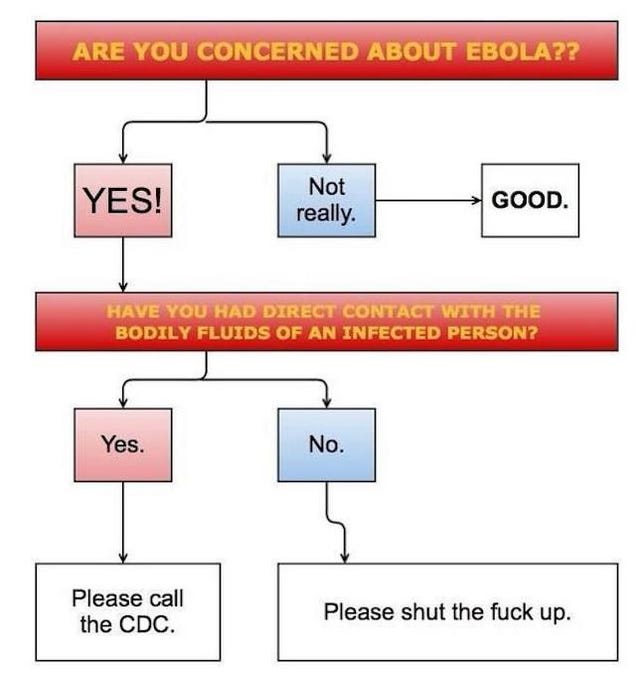
Should You Be Worried About Ebola? A Helpful Chart.

by Robert T. Gonzalez

Should You Be Worried About Ebola? A Helpful Chart.

Here for spreading far and wide is a flow chart for stemming the tide of undue Ebola panic on social media.

Read more...


01 Aug 23:06

Hero Dad Builds An Amazing Interactive Spaceship For His Son's Bedroom

by Robert T. Gonzalez
Dance Magers

This is awesome. I like the first commentor's idea too.

Hero Dad Builds An Amazing Interactive Spaceship For His Son's Bedroom

MAKE Magazine's Jeff Highsmith wanted to build his 4-year-old son an interactive model of an Apollo spacecraft. The result was the surprisingly complex play area seen here – but to really appreciate the thought and effort that went into this project, you really must watch the making-of video. Seriously, this'll blow you away.

Read more...


01 Aug 23:04

WTF Is That?!: The Truth Behind Thomas The Tank Engine

thomas-the-tank-engine-irl.jpg This is truth behind Thomas the Tank Engine as imagined by illustrator Yui Abe. Apparently Thomas is really a naked dude with his face poking out the front and his ass in the air. Are you thinking what I'm thinking? "I wish I hadn't seen that?" Choo choo! Thanks to lilco, who's always dreamed of traveling the rails sitting on the back of a caboose, watching the countryside roll by. Same, but in my dream I'm a crazed hobo.
01 Aug 14:27

This Cloud Looks So Much Like A Penis It's Not Even Funny

by George Dvorsky

This Cloud Looks So Much Like A Penis It's Not Even Funny

Actually, it's quite hilarious. The turgid image was captured in Foolow, Derbshire by a British photographer who goes by the name Villager Jim.

Read more...